EP4223618A2 - Système d'isolation d'un élément structural - Google Patents
Système d'isolation d'un élément structural Download PDFInfo
- Publication number
- EP4223618A2 EP4223618A2 EP23166716.3A EP23166716A EP4223618A2 EP 4223618 A2 EP4223618 A2 EP 4223618A2 EP 23166716 A EP23166716 A EP 23166716A EP 4223618 A2 EP4223618 A2 EP 4223618A2
- Authority
- EP
- European Patent Office
- Prior art keywords
- structural element
- carrier
- expandable adhesive
- adhesive
- component
- Prior art date
- Legal status (The legal status is an assumption and is not a legal conclusion. Google has not performed a legal analysis and makes no representation as to the accuracy of the status listed.)
- Pending
Links
Images


Classifications
-
- B—PERFORMING OPERATIONS; TRANSPORTING
- B62—LAND VEHICLES FOR TRAVELLING OTHERWISE THAN ON RAILS
- B62D—MOTOR VEHICLES; TRAILERS
- B62D25/00—Superstructure or monocoque structure sub-units; Parts or details thereof not otherwise provided for
- B62D25/20—Floors or bottom sub-units
-
- B—PERFORMING OPERATIONS; TRANSPORTING
- B62—LAND VEHICLES FOR TRAVELLING OTHERWISE THAN ON RAILS
- B62D—MOTOR VEHICLES; TRAILERS
- B62D29/00—Superstructures, understructures, or sub-units thereof, characterised by the material thereof
- B62D29/001—Superstructures, understructures, or sub-units thereof, characterised by the material thereof characterised by combining metal and synthetic material
- B62D29/002—Superstructures, understructures, or sub-units thereof, characterised by the material thereof characterised by combining metal and synthetic material a foamable synthetic material or metal being added in situ
-
- B—PERFORMING OPERATIONS; TRANSPORTING
- B29—WORKING OF PLASTICS; WORKING OF SUBSTANCES IN A PLASTIC STATE IN GENERAL
- B29C—SHAPING OR JOINING OF PLASTICS; SHAPING OF MATERIAL IN A PLASTIC STATE, NOT OTHERWISE PROVIDED FOR; AFTER-TREATMENT OF THE SHAPED PRODUCTS, e.g. REPAIRING
- B29C65/00—Joining or sealing of preformed parts, e.g. welding of plastics materials; Apparatus therefor
- B29C65/48—Joining or sealing of preformed parts, e.g. welding of plastics materials; Apparatus therefor using adhesives, i.e. using supplementary joining material; solvent bonding
- B29C65/52—Joining or sealing of preformed parts, e.g. welding of plastics materials; Apparatus therefor using adhesives, i.e. using supplementary joining material; solvent bonding characterised by the way of applying the adhesive
- B29C65/524—Joining or sealing of preformed parts, e.g. welding of plastics materials; Apparatus therefor using adhesives, i.e. using supplementary joining material; solvent bonding characterised by the way of applying the adhesive by applying the adhesive from an outlet device in contact with, or almost in contact with, the surface of the part to be joined
- B29C65/525—Joining or sealing of preformed parts, e.g. welding of plastics materials; Apparatus therefor using adhesives, i.e. using supplementary joining material; solvent bonding characterised by the way of applying the adhesive by applying the adhesive from an outlet device in contact with, or almost in contact with, the surface of the part to be joined by extrusion coating
-
- B—PERFORMING OPERATIONS; TRANSPORTING
- B60—VEHICLES IN GENERAL
- B60R—VEHICLES, VEHICLE FITTINGS, OR VEHICLE PARTS, NOT OTHERWISE PROVIDED FOR
- B60R13/00—Elements for body-finishing, identifying, or decorating; Arrangements or adaptations for advertising purposes
- B60R13/08—Insulating elements, e.g. for sound insulation
- B60R13/0815—Acoustic or thermal insulation of passenger compartments
- B60R13/083—Acoustic or thermal insulation of passenger compartments for fire walls or floors
-
- B—PERFORMING OPERATIONS; TRANSPORTING
- B62—LAND VEHICLES FOR TRAVELLING OTHERWISE THAN ON RAILS
- B62D—MOTOR VEHICLES; TRAILERS
- B62D27/00—Connections between superstructure or understructure sub-units
-
- B—PERFORMING OPERATIONS; TRANSPORTING
- B29—WORKING OF PLASTICS; WORKING OF SUBSTANCES IN A PLASTIC STATE IN GENERAL
- B29C—SHAPING OR JOINING OF PLASTICS; SHAPING OF MATERIAL IN A PLASTIC STATE, NOT OTHERWISE PROVIDED FOR; AFTER-TREATMENT OF THE SHAPED PRODUCTS, e.g. REPAIRING
- B29C44/00—Shaping by internal pressure generated in the material, e.g. swelling or foaming ; Producing porous or cellular expanded plastics articles
- B29C44/02—Shaping by internal pressure generated in the material, e.g. swelling or foaming ; Producing porous or cellular expanded plastics articles for articles of definite length, i.e. discrete articles
- B29C44/12—Incorporating or moulding on preformed parts, e.g. inserts or reinforcements
- B29C44/18—Filling preformed cavities
-
- B—PERFORMING OPERATIONS; TRANSPORTING
- B29—WORKING OF PLASTICS; WORKING OF SUBSTANCES IN A PLASTIC STATE IN GENERAL
- B29C—SHAPING OR JOINING OF PLASTICS; SHAPING OF MATERIAL IN A PLASTIC STATE, NOT OTHERWISE PROVIDED FOR; AFTER-TREATMENT OF THE SHAPED PRODUCTS, e.g. REPAIRING
- B29C44/00—Shaping by internal pressure generated in the material, e.g. swelling or foaming ; Producing porous or cellular expanded plastics articles
- B29C44/02—Shaping by internal pressure generated in the material, e.g. swelling or foaming ; Producing porous or cellular expanded plastics articles for articles of definite length, i.e. discrete articles
- B29C44/12—Incorporating or moulding on preformed parts, e.g. inserts or reinforcements
- B29C44/18—Filling preformed cavities
- B29C44/188—Sealing off parts of the cavities
-
- B—PERFORMING OPERATIONS; TRANSPORTING
- B29—WORKING OF PLASTICS; WORKING OF SUBSTANCES IN A PLASTIC STATE IN GENERAL
- B29L—INDEXING SCHEME ASSOCIATED WITH SUBCLASS B29C, RELATING TO PARTICULAR ARTICLES
- B29L2031/00—Other particular articles
- B29L2031/30—Vehicles, e.g. ships or aircraft, or body parts thereof
-
- B—PERFORMING OPERATIONS; TRANSPORTING
- B29—WORKING OF PLASTICS; WORKING OF SUBSTANCES IN A PLASTIC STATE IN GENERAL
- B29L—INDEXING SCHEME ASSOCIATED WITH SUBCLASS B29C, RELATING TO PARTICULAR ARTICLES
- B29L2031/00—Other particular articles
- B29L2031/30—Vehicles, e.g. ships or aircraft, or body parts thereof
- B29L2031/3002—Superstructures characterized by combining metal and plastics, i.e. hybrid parts
-
- B—PERFORMING OPERATIONS; TRANSPORTING
- B62—LAND VEHICLES FOR TRAVELLING OTHERWISE THAN ON RAILS
- B62D—MOTOR VEHICLES; TRAILERS
- B62D25/00—Superstructure or monocoque structure sub-units; Parts or details thereof not otherwise provided for
Definitions
- the invention relates to a system for insulating a structural element in a motor vehicle. It also relates to a method for insulating a structural element in a motor vehicle.
- components such as bodies and/or frames of means of transport and locomotion, in particular of vehicles on water or on land or of aircraft, have structures with cavities in order to enable lightweight constructions.
- these voids cause various problems.
- it must be sealed to prevent the ingress of moisture and dirt, which can lead to corrosion of the components.
- It is often also desirable to significantly strengthen the cavities and thus the structural element, while maintaining the low weight.
- It is also often necessary to stabilize the cavities, and hence the components, to reduce noise that would otherwise be transmitted along or through the cavity.
- Many of these cavities are irregular in shape or narrow in size, making them difficult to properly seal, reinforce and cushion.
- sealing elements are therefore used to seal cavities and/or acoustically seal them off, or reinforcing elements (English: reinforcer) are used to reinforce cavities.
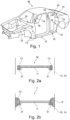
- the body 10 has various structures with cavities, such as pillars 14 and supports or struts 12 .
- Such structural elements 12, 14 with cavities are usually sealed or reinforced with sealing and/or reinforcing elements 16.
- Figures 2a and 2b schematically show a known concept for the sealing and/or reinforcing closure of openings or cavities in a motor vehicle.
- the Figure 2a a device 16 before an expansion of an adhesive 13.
- Figure 2b shows the same device 16 as part of the system 1, but after expansion of the adhesive 13, ie with the expanded adhesive 13'.
- the device 16 is located in a cavity of a body structure, as for example in 1 is shown. A portion of such a structural element 12, 14 of a body is in the Figures 2a and 2b shown schematically.
- the device 16 comprises a carrier 11 which has an edge area 21 .
- the adhesive 13 is essentially arranged on this edge area 21 of the carrier 11 .
- the adhesive 13 Before the expansion of the adhesive 13 there is a gap between the device 16 and the structural element 12,14. This gap allows the structural element 12, 14 to be coated in order to protect the structural element 12, 14 from corrosion. After this coating, the adhesive 13 is usually expanded by the action of heat, the expanded adhesive 13' closing the gap between the device 16 and the structural element 12, 14 as a result. In addition, due to the expansion of the adhesive 13, the device 16' is fixed in the structural element 12, 14 at the same time. A device 16' fastened in the structural element 12, 14 in this way strengthens the structural element 12, 14 on the one hand and closes the cavity in the structural element 12, 14 on the other hand.
- sealing and/or reinforcing elements are relatively complex, complicated and expensive to produce.
- the known sealing and/or reinforcing elements have the disadvantage that they only have a limited shelf life. This is particularly so because the adhesive on the elements cannot be stored for any length of time and cannot be stored under extreme conditions.
- the system should in particular bring economic advantages and also simplify or improve the associated logistics, and in particular the storability.
- a system for insulating a structural element in a motor vehicle comprising: a structural element with a first component and a second component, the components being joined at a first joint and at a second joint, and the structural element having a cavity forms; a device having a carrier, the carrier being arranged on the structural element by a fastening element; and an expandable adhesive disposed on the structural member or on the support by pumping or by extrusion; wherein the carrier and the expandable adhesive are constructed and arranged in such a way that the carrier limits the expandable adhesive in at least one direction when it expands.
- this solution has the advantage that the device can be manufactured in a significantly simpler and more cost-effective manner in comparison to the prior art.
- a one-piece device and/or a device constructed from only one material and/or manufactured in one step can be used.
- a one-component injection molding process can be used instead of a two-component injection molding process. This lowers both the effective costs of manufacture and the expense involved in planning and designing the device.
- a key idea of the present invention is that the expandable adhesive is not placed on the carrier before the device is fixed in the structural element, but that the device is fixed in the structural element without adhesive and the expandable adhesive is introduced into the system separately. This has the advantage that the device is much easier to transport and store without the adhesive. This significantly reduces the associated logistics costs.
- the expandable adhesive can be freshly applied to the system in a production line for the motor vehicle, for example in the form of bulk goods.
- the separate application of the expandable adhesive means that hard-to-reach places in the cavity of the structural element can be reinforced, sealed, dampened or insulated better than is possible with the systems mentioned at the outset.
- the expandable adhesive can completely fill out joints even before it is activated.
- the solution proposed here has the advantage that different structural elements can be insulated with a (standardized) device by using a different quantity and/or arrangement of the expandable adhesive in each case.
- a first structural member with a larger cavity can be insulated with the standard jig and a larger amount of expandable adhesive
- a second structural member with a smaller cavity can be insulated with the same standard jig and a smaller amount of expandable adhesive.
- insulation or "insulated” includes elements or functions or structures or process steps for sealing off and/or closing and/or reinforcing and/or damping and/or insulating a structural element. These different properties of such insulation can occur individually or in combination with one another.
- the structural element comprises at least a first component and a second component, which are joined together at a first joint and at a second joint and thus form a cavity.
- the first and the second component of the structural element can each consist of one element or else of a plurality of elements.
- the structural element can therefore also have more than two joints.
- the system includes multiple devices having a carrier and a fastener.
- the system includes two devices, three devices, four devices, five devices, more than two devices, more than three devices, more than four devices, or more than five devices.
- Both the shape and the materials of these multiple devices can be the same or different.
- the carrier is disposed on the first component of the structural member and the expandable adhesive is disposed on the second component of the structural member.
- the carrier is arranged on the first component of the structural element and the expandable adhesive is also arranged on the first component of the structural element.
- the carrier is arranged on the first component of the structural element, and the expandable adhesive is arranged on the first component and on the second component of the structural element.
- the carrier is arranged on the first component of the structural element and the expandable adhesive is arranged on the carrier.
- the carrier is substantially L-shaped, or an I-shaped, or an H-shaped, or a C-shaped, or a T-shaped, or a W-shaped, or a V-shaped, or a U-shaped, or a N-shaped, or a Z-shaped, or an O-shaped, or a rectangular, or an oval, or a round, or a trapezoidal, or a triangular, or a polygonal cross-section.
- the carrier has a base and a wing.
- the fastener is located on the base and the wing limits expansion of the expandable adhesive in at least one direction.
- the wing forms an angle between 60° and 160° or between 70° and 150° or between 80° and 140° with the base.
- the device or just the carrier is made by an injection molding process.
- the device or only the carrier is produced by a one-component injection molding process.
- the device or just the carrier is made by an extrusion process.
- the carrier and the fastening element are formed in one piece.
- the carrier and the fastening element are formed from the same material.
- the carrier comprises a plastic, in particular polyamide.
- the carrier comprises a fiber-reinforced plastic, in particular a glass-fiber-reinforced or carbon-fiber-reinforced plastic.
- the carrier can consist of different materials.
- Preferred materials are plastics, in particular polyurethanes, polyamides, polyesters and polyolefins, preferably high-temperature-resistant polymers such as poly(phenylene ether), polysulfones or polyether sulfones, which in particular are also foamed; metals, in particular aluminum and steel; or grown organic materials, in particular wood or other (pressed) fiber materials or vitreous or ceramic materials; specifically also foamed materials of this type; or any combination of these materials.
- Polyamide in particular polyamide 6, polyamide 6.6, polyamide 11, polyamide 12 or a mixture thereof is particularly preferably used. Combinations with fibers such as glass fibers or carbon fibers are also possible.
- the carrier can have any construction and any structure.
- it can be solid, hollow, or foamed, or have a lattice-like structure.
- the surface of the support can typically be smooth, rough or textured.
- the device has a substantially circular, or oval, or oblong, or irregularly shaped plan.
- the expandable adhesive has an expansion rate of at least 200%, or at least 300%, or at least 400%, or at least 500%, or at least 800%.
- An example of such an expandable pumpable adhesive is an adhesive available under the tradename Sikaseal® .
- An example of an expandable adhesive that is extrudable is available under the name SikaBaffle® 455.
- the expandable adhesive is arranged in the form of a bead or beads on the second component of the structural element.
- the expandable adhesive is placed onto the second component of the structural member by a robot.
- the at least one bead has a diameter of 2 to 20 mm, or 4 to 18 mm, or 6 to 16 mm.
- the at least one bead has a length of at least 10 mm, or at least 20 mm, or at least 30 mm, or at least 50 mm, or at least 100 mm.
- the expandable adhesive is in contact with the structural element at the first joint and at the second joint.
- the expandable adhesive in the area of the first and the second joint touches both the first component of the structural element and the second component of the structural element.
- the expandable adhesive extends along the second part of the structural element by at least 10 mm or at least 15 mm or at least 20 mm or at least 30 mm or at least 40 mm, starting from the joints.
- the expandable adhesive forms a continuous element between the first joint and the second joint.
- the expandable adhesive forms a single continuous element.
- multiple non-contiguous expandable adhesives form multiple non-contiguous elements.
- the expandable adhesive is a pumpable or extrudable material.
- the expandable adhesive is pumpable at a temperature of less than 80°C, preferably less than 70°C, preferably less than 60°C, more preferably less than 50°C.
- the expandable adhesive is extrudable at a temperature of less than 100°C, preferably less than 90°C, preferably less than 80°C, more preferably less than 70°C.
- the expandable adhesive is pumpable or extrudable at a temperature which is at least 20 K, or at least 30 K, or at least 40 K, or at least 50 K, or at least 60 K below an activation temperature of the second expandable adhesive.
- the fastening element is designed as a clip.
- the fastening element is designed as a welded tab or as a magnetic element or as an adhesive or as a hook.
- the structural element has an opening, with the carrier being arranged such that the opening is free of expanded adhesive after expansion of the expandable adhesive.
- Such an arrangement of the carrier has the advantage that openings in the structural element, such as those used for cable ducts or the like, can be kept free of expanded adhesive, so that such openings are not impaired in their function.
- a distance between the carrier and the structural element is between 2 and 6 mm or between 3 and 5 mm.
- the object set at the outset is also achieved by a method for insulating a structural element in a motor vehicle, the method comprising the steps of: providing a device with a carrier; placing the device on the structural member; placing an expandable adhesive by pumping or by extrusion on the structural member or on the support; joining a first component and a second component of the structural member to form the structural member, the device and the expandable adhesive being disposed in a cavity between the components of the structural member; and expanding the expandable adhesive, wherein the backing limits expansion of the expandable adhesive in at least one direction.
- the expandable adhesive is placed at a temperature of less than 80°C, or less than 70°C, or less than 60°C, or less than 50°C by pumping.
- the expandable adhesive is disposed at a temperature of less than 100°C, or less than 90°C, or less than 80°C, or less than 70°C by extrusion.
- the expandable adhesive is expanded at a temperature greater than 100°C, or greater than 110°C, or greater than 120°C, or greater than 140°C.
- the method is carried out using a system as described above.
- the expandable adhesive is placed onto the structural member or backing by a robot.
- the expandable adhesive is pumped or extruded onto the second component of the structural member.
- the placement of the adhesive on the structural member or the carrier is performed before or after placing the device on the first component of the structural member.
- heat is used when activating the expandable adhesive; in particular, the activation of the adhesive is carried out in a painting oven or in a corrosion protection oven.
- a device 16 in a structural element 12, 14 is shown schematically and by way of example in a cross-sectional illustration.
- the device 16 has a support 11 with an L-shaped cross section.
- a first leg forms a base 17 of the carrier and a second leg forms a wing 18.
- the base 17 and the wing 18 form an angle ⁇ , which in this exemplary embodiment is approximately 90°.
- a fastening element 5 is arranged on the base 17 .
- the device 16 is arranged on the structural element 12 , 14 by this fastening element 5 .
- the fastening element 5 is designed as a clip.
- a distance 4 between the carrier 11 and the structural element 12, 14 is approximately 4 mm in this exemplary embodiment. Such a distance 4 makes it possible, on the one hand, to coat the structural element 12, 14 with a coating liquid before the expandable adhesive expands, and on the other hand allows the carrier 11 on the other hand, to effectively limit an expansion of the expandable adhesive against at least one direction.
- FIGS. 4a and 4b two different devices 16 are shown schematically and by way of example in a spatial representation.
- the device 16 in the Figure 4a is essentially circular in plan.
- the carrier 11 in this exemplary embodiment again has an essentially L-shaped cross section.
- the carrier 11 has a base 17 and a wing 18 which form an angle 9 .
- three fastening elements 5 are arranged on the base 17 for arranging the device 16 on a structural element.
- the device 16 in Figure 4b has a rectangular cross section.
- the device 16 is elongate or has an elongate outline.
- the support 11 of the device 16 has a base 17 and a wing 18 which form an angle ⁇ .
- the base 17 and the wing 18 are supplemented by further walls of the support 11.
- two fastening elements 5 for arranging the device 16 in a structural element are arranged on the base 17 of the carrier 11 .
- a system 1 is shown, wherein the expandable adhesive 13 is arranged on the structural element 12,14.
- the expandable adhesive 13 is arranged on a first component 12.1, 14.1 of the structural element and the device 16 is arranged on a second component 12.2, 14.2 of the structural element.
- the two components 12.1, 14.1, 12.2, 14.2 of the structural element are joined together at a first joint 6 and at a second joint 7.
- the structural element 12, 14 forms a cavity 3 in which both the expandable adhesive 13 and the device 16 are arranged.
- the device 16 comprises a support 11 and a fastener 5.
- the support 11 has a base 17 and a wing 18 which form an angle ⁇ .
- the wing 18 is arranged in front of an opening 8 in the structural element 12, 14.
- the carrier 11 and in particular its wings 18 limit the expansion of the expandable adhesive 13 in the direction of this opening 8, so that the expanded adhesive 13' cannot reach the region of the opening 8. This is in Figure 5b 1, in which the system 1' is shown after expansion of the expandable adhesive 13.
- FIGs 6a and 6b another exemplary system 1 for insulating a structural element 12, 14 is shown.
- the expandable adhesive 13 is not arranged on the structural element 12, 14 but on the carrier 11.
- the expandable adhesive 13 is in the form of a bead and is arranged on the carrier 11 by pumping or extrusion.
- the carrier 11 limits an expansion of the expandable adhesive 13 in at least one direction, so that a predetermined area of the structural element 12, 14 or its cavity 3 remains free of expanded adhesive 13' after an expansion of the expandable adhesive 13. This is in the Figure 6b shown.
Landscapes
- Engineering & Computer Science (AREA)
- Mechanical Engineering (AREA)
- Chemical & Material Sciences (AREA)
- Combustion & Propulsion (AREA)
- Transportation (AREA)
- Architecture (AREA)
- Structural Engineering (AREA)
- Acoustics & Sound (AREA)
- Physics & Mathematics (AREA)
- Standing Axle, Rod, Or Tube Structures Coupled By Welding, Adhesion, Or Deposition (AREA)
- Body Structure For Vehicles (AREA)
- Connection Of Plates (AREA)
- Element Separation (AREA)
- Thin Film Transistor (AREA)
- Bipolar Transistors (AREA)
- Insulation, Fastening Of Motor, Generator Windings (AREA)
- Railway Tracks (AREA)
Applications Claiming Priority (3)
| Application Number | Priority Date | Filing Date | Title |
|---|---|---|---|
| EP18192073 | 2018-08-31 | ||
| EP19758417.0A EP3844051B1 (fr) | 2018-08-31 | 2019-08-27 | Système d'isolation d'un élément structural |
| PCT/EP2019/072884 WO2020043739A1 (fr) | 2018-08-31 | 2019-08-27 | Système pour isoler un élément structural |
Related Parent Applications (2)
| Application Number | Title | Priority Date | Filing Date |
|---|---|---|---|
| EP19758417.0A Division EP3844051B1 (fr) | 2018-08-31 | 2019-08-27 | Système d'isolation d'un élément structural |
| EP19758417.0A Division-Into EP3844051B1 (fr) | 2018-08-31 | 2019-08-27 | Système d'isolation d'un élément structural |
Publications (2)
| Publication Number | Publication Date |
|---|---|
| EP4223618A2 true EP4223618A2 (fr) | 2023-08-09 |
| EP4223618A3 EP4223618A3 (fr) | 2023-08-23 |
Family
ID=63490234
Family Applications (2)
| Application Number | Title | Priority Date | Filing Date |
|---|---|---|---|
| EP19758417.0A Active EP3844051B1 (fr) | 2018-08-31 | 2019-08-27 | Système d'isolation d'un élément structural |
| EP23166716.3A Pending EP4223618A3 (fr) | 2018-08-31 | 2019-08-27 | Système d'isolation d'un élément structural |
Family Applications Before (1)
| Application Number | Title | Priority Date | Filing Date |
|---|---|---|---|
| EP19758417.0A Active EP3844051B1 (fr) | 2018-08-31 | 2019-08-27 | Système d'isolation d'un élément structural |
Country Status (6)
| Country | Link |
|---|---|
| US (1) | US12246776B2 (fr) |
| EP (2) | EP3844051B1 (fr) |
| KR (1) | KR102618225B1 (fr) |
| CN (1) | CN112638752B (fr) |
| ES (1) | ES2949792T3 (fr) |
| WO (1) | WO2020043739A1 (fr) |
Families Citing this family (1)
| Publication number | Priority date | Publication date | Assignee | Title |
|---|---|---|---|---|
| ES2992533T3 (es) * | 2020-08-28 | 2024-12-13 | Henkel Ag & Co Kgaa | Pieza de mamparo |
Citations (1)
| Publication number | Priority date | Publication date | Assignee | Title |
|---|---|---|---|---|
| EP3281970A1 (fr) | 2016-08-08 | 2018-02-14 | Sika Technology Ag | Compositions de remplissage thermiquement expansibles et pompables |
Family Cites Families (35)
| Publication number | Priority date | Publication date | Assignee | Title |
|---|---|---|---|---|
| US5266133A (en) | 1993-02-17 | 1993-11-30 | Sika Corporation | Dry expansible sealant and baffle composition and product |
| US5358397A (en) | 1993-05-10 | 1994-10-25 | L&L Products, Inc. | Apparatus for extruding flowable materials |
| US6103341A (en) | 1997-12-08 | 2000-08-15 | L&L Products | Self-sealing partition |
| US6247287B1 (en) * | 1998-08-05 | 2001-06-19 | Neo-Ex Lab, Inc. | Structure and method for closing and reinforcing hollow structural members |
| US6387470B1 (en) | 1998-11-05 | 2002-05-14 | Sika Corporation | Sound deadening and structural reinforcement compositions and methods of using the same |
| KR100403476B1 (ko) * | 2001-05-29 | 2003-10-30 | 지엠대우오토앤테크놀로지주식회사 | 자동차 필러의 소음방지 구조 |
| FR2826621B1 (fr) * | 2001-07-02 | 2003-09-26 | Hutchinson | Dispositif d'isolation acoustique destine a etre monte dans une piece tubulaire, en particulier d'une piece de carrosserie automobile |
| JP4391826B2 (ja) | 2002-01-22 | 2009-12-24 | ダウ グローバル テクノロジーズ インコーポレイティド | 強化構造体及びその製造方法 |
| US7043815B2 (en) | 2002-01-25 | 2006-05-16 | L & L Products, Inc. | Method for applying flowable materials |
| JP3784756B2 (ja) * | 2002-04-11 | 2006-06-14 | 共和産業株式会社 | 中空構造物の中空室遮断具 |
| EP1497092A1 (fr) * | 2002-04-15 | 2005-01-19 | Dow Global Technologies Inc. | Elements structurels ameliores de vehicule et procede de fabrication de ces elements |
| US20040255546A1 (en) | 2003-06-18 | 2004-12-23 | Daniel Sophiea | Method of forming a structural member |
| US7479245B2 (en) | 2003-06-26 | 2009-01-20 | Zephyros, Inc. | Process for applying a material to a member |
| US7597382B2 (en) | 2005-06-07 | 2009-10-06 | Zephyros, Inc. | Noise reduction member and system |
| DE102007038659A1 (de) * | 2007-08-15 | 2009-02-19 | Henkel Ag & Co. Kgaa | Expandierbares, extrudiertes Formteil und Verfahren zu seiner Herstellung |
| EP1932648A1 (fr) | 2006-12-15 | 2008-06-18 | Sika Technology AG | Matériau de consolidation de construction, insert et sa cavité consolidée |
| EP1946995A1 (fr) | 2006-12-22 | 2008-07-23 | Sika Technology AG | Système de renforcement destiné au renforcement d'un espace creux d'un composant |
| EP2109563A1 (fr) * | 2006-12-28 | 2009-10-21 | Henkel Kommanditgesellschaft auf Aktien | Écran acoustique |
| DE102007015394A1 (de) * | 2007-03-28 | 2008-10-02 | Henkel Ag & Co. Kgaa | Schalldämmendes Schottteil zum Abdichten eines Hohlraumes |
| CN101802062B (zh) * | 2007-09-19 | 2012-07-04 | 汉高两合股份公司 | 高度衰减的可膨胀的材料和装置 |
| CN102177013B (zh) * | 2008-07-29 | 2014-07-23 | 陶氏环球技术有限责任公司 | 用于汽车空腔中的加强和能量耗散的增韧可膨胀环氧树脂 |
| GB2463858A (en) * | 2008-08-20 | 2010-03-31 | Zephyros Inc | Foamed insulation |
| EP2159136A1 (fr) | 2008-09-01 | 2010-03-03 | Sika Technology AG | Liaison avec cordons ou plots adhésifs |
| JP2009083497A (ja) * | 2008-11-07 | 2009-04-23 | Nitto Denko Corp | 発泡充填部材 |
| CN102224038B (zh) * | 2008-11-26 | 2013-10-23 | 陶氏环球技术有限责任公司 | 声障板构件和用于在空腔中应用声障板的方法 |
| EP2251250A1 (fr) | 2009-05-05 | 2010-11-17 | Sika Technology AG | Collage avec bourrelets ou bosses adhésifs |
| GB201006478D0 (en) | 2010-04-19 | 2010-06-02 | Zephyros Inc | Improvements in or relatigng to automobile components |
| DE102011000450A1 (de) * | 2011-02-02 | 2012-08-02 | Dr. Ing. H.C. F. Porsche Aktiengesellschaft | Trägerstruktur für ein Fahrzeug sowie Verfahren zur Herstellung einer Trägerstruktur für ein Fahrzeug |
| US20120235442A1 (en) * | 2011-03-16 | 2012-09-20 | GM Global Technology Operations LLC | Reinforced structural assembly with acoustic foam member and method of reinforcing vehicle components |
| US8770340B2 (en) * | 2011-11-16 | 2014-07-08 | Huntair, Inc. | Sound-absorptive panel for an air handling system |
| CN104885148A (zh) * | 2012-12-21 | 2015-09-02 | Sika技术股份公司 | 隔离元件、已膨胀的隔离元件、该隔离元件的用途和用于隔离的方法 |
| EP2945837B1 (fr) | 2013-01-18 | 2017-03-08 | Sika Technology AG | Elément de renfort pour une section fermée et procédé de fabrication |
| JP6364027B2 (ja) | 2013-02-15 | 2018-07-25 | シーカ・テクノロジー・アーゲー | 補強構造部品を作製するプロセス及び機構 |
| DE102015002262A1 (de) | 2014-02-27 | 2015-08-27 | Imperia Gesellschaft für angewandte Fahrzeugentwicklung mbH | Verfahren zur Herstellung eines Leichtbauteils |
| WO2017158143A1 (fr) * | 2016-03-18 | 2017-09-21 | Sika Technology Ag | Élément d'isolation |
-
2019
- 2019-08-27 WO PCT/EP2019/072884 patent/WO2020043739A1/fr not_active Ceased
- 2019-08-27 CN CN201980056444.8A patent/CN112638752B/zh active Active
- 2019-08-27 EP EP19758417.0A patent/EP3844051B1/fr active Active
- 2019-08-27 KR KR1020217004568A patent/KR102618225B1/ko active Active
- 2019-08-27 ES ES19758417T patent/ES2949792T3/es active Active
- 2019-08-27 EP EP23166716.3A patent/EP4223618A3/fr active Pending
- 2019-08-27 US US17/269,426 patent/US12246776B2/en active Active
Patent Citations (1)
| Publication number | Priority date | Publication date | Assignee | Title |
|---|---|---|---|---|
| EP3281970A1 (fr) | 2016-08-08 | 2018-02-14 | Sika Technology Ag | Compositions de remplissage thermiquement expansibles et pompables |
Also Published As
| Publication number | Publication date |
|---|---|
| CN112638752B (zh) | 2023-05-05 |
| CN112638752A (zh) | 2021-04-09 |
| EP3844051B1 (fr) | 2023-06-07 |
| US20210179191A1 (en) | 2021-06-17 |
| WO2020043739A1 (fr) | 2020-03-05 |
| KR102618225B1 (ko) | 2023-12-27 |
| EP4223618A3 (fr) | 2023-08-23 |
| KR20210053283A (ko) | 2021-05-11 |
| EP3844051A1 (fr) | 2021-07-07 |
| ES2949792T3 (es) | 2023-10-03 |
| US12246776B2 (en) | 2025-03-11 |
Similar Documents
| Publication | Publication Date | Title |
|---|---|---|
| EP3486147B2 (fr) | Système d'un élément structurel renforcé | |
| EP3612436B2 (fr) | Élément de renfort | |
| WO2019224121A1 (fr) | Élément d'isolation | |
| EP3421331B1 (fr) | Système d'un élément structurel renforcé d'un véhicule automobile | |
| EP3263425B1 (fr) | Élément d'isolation | |
| EP3543089B1 (fr) | Dispositif de renforcement, d'étanchéité ou d'amortissement d'un élément structural | |
| EP3844051B1 (fr) | Système d'isolation d'un élément structural | |
| EP3844052B1 (fr) | Système d'isolation d'un élément structural | |
| EP3466800B1 (fr) | Dispositif de renfort permettant de renforcer un élément structural dans un véhicule automobile | |
| EP3429909B1 (fr) | Élément d'isolation | |
| EP3710339B1 (fr) | Dispositif de renforcement, d'étanchéité ou d'amortissement d'un élément structurel | |
| EP3844053B1 (fr) | Dispositif de renforcement, d'étanchéité ou d'amortissement d'un élément structural | |
| EP3611081B1 (fr) | Dispositif de renforcement, d'étanchéité ou d'amortissement d'un élément structurel | |
| EP4519149A1 (fr) | Élément isolant | |
| EP4306389A1 (fr) | Élément isolant | |
| DE102017201790A1 (de) | Abdichtanordnung zum Ausschäumen eines wenigstens einen Hohlraum sowie Öffnungen aufweisenden Karosserieteils eines Kraftwagens | |
| EP3642100A1 (fr) | Assemblage d'éléments dans des véhicules automobiles | |
| EP3560798A1 (fr) | Élément d'isolation | |
| EP4306390A1 (fr) | Dispositif de renforcement d'un élément structural | |
| DE102013215933A1 (de) | Strukturbauteil eines Fahrzeugs |
Legal Events
| Date | Code | Title | Description |
|---|---|---|---|
| PUAI | Public reference made under article 153(3) epc to a published international application that has entered the european phase |
Free format text: ORIGINAL CODE: 0009012 |
|
| STAA | Information on the status of an ep patent application or granted ep patent |
Free format text: STATUS: THE APPLICATION HAS BEEN PUBLISHED |
|
| PUAL | Search report despatched |
Free format text: ORIGINAL CODE: 0009013 |
|
| AC | Divisional application: reference to earlier application |
Ref document number: 3844051 Country of ref document: EP Kind code of ref document: P |
|
| AK | Designated contracting states |
Kind code of ref document: A2 Designated state(s): AL AT BE BG CH CY CZ DE DK EE ES FI FR GB GR HR HU IE IS IT LI LT LU LV MC MK MT NL NO PL PT RO RS SE SI SK SM TR |
|
| AK | Designated contracting states |
Kind code of ref document: A3 Designated state(s): AL AT BE BG CH CY CZ DE DK EE ES FI FR GB GR HR HU IE IS IT LI LT LU LV MC MK MT NL NO PL PT RO RS SE SI SK SM TR |
|
| RIC1 | Information provided on ipc code assigned before grant |
Ipc: B29L 31/30 20060101ALI20230714BHEP Ipc: B62D 29/00 20060101ALI20230714BHEP Ipc: B29C 44/18 20060101ALI20230714BHEP Ipc: B62D 25/00 20060101AFI20230714BHEP |
|
| STAA | Information on the status of an ep patent application or granted ep patent |
Free format text: STATUS: REQUEST FOR EXAMINATION WAS MADE |
|
| 17P | Request for examination filed |
Effective date: 20240223 |
|
| RBV | Designated contracting states (corrected) |
Designated state(s): AL AT BE BG CH CY CZ DE DK EE ES FI FR GB GR HR HU IE IS IT LI LT LU LV MC MK MT NL NO PL PT RO RS SE SI SK SM TR |
|
| STAA | Information on the status of an ep patent application or granted ep patent |
Free format text: STATUS: EXAMINATION IS IN PROGRESS |
|
| 17Q | First examination report despatched |
Effective date: 20250826 |