EP4223767A1 - Inhibiteur d'agrégation de bêta-amyloïde, composition pharmaceutique pour maladie d'agrégation de bêta-amyloïde et utilisation associée - Google Patents
Inhibiteur d'agrégation de bêta-amyloïde, composition pharmaceutique pour maladie d'agrégation de bêta-amyloïde et utilisation associée Download PDFInfo
- Publication number
- EP4223767A1 EP4223767A1 EP21875887.8A EP21875887A EP4223767A1 EP 4223767 A1 EP4223767 A1 EP 4223767A1 EP 21875887 A EP21875887 A EP 21875887A EP 4223767 A1 EP4223767 A1 EP 4223767A1
- Authority
- EP
- European Patent Office
- Prior art keywords
- amyloid
- peptide
- aggregation
- sequence
- present
- Prior art date
- Legal status (The legal status is an assumption and is not a legal conclusion. Google has not performed a legal analysis and makes no representation as to the accuracy of the status listed.)
- Pending
Links
Images




Classifications
-
- C—CHEMISTRY; METALLURGY
- C07—ORGANIC CHEMISTRY
- C07K—PEPTIDES
- C07K7/00—Peptides having 5 to 20 amino acids in a fully defined sequence; Derivatives thereof
- C07K7/04—Linear peptides containing only normal peptide links
- C07K7/06—Linear peptides containing only normal peptide links having 5 to 11 amino acids
-
- A—HUMAN NECESSITIES
- A61—MEDICAL OR VETERINARY SCIENCE; HYGIENE
- A61K—PREPARATIONS FOR MEDICAL, DENTAL OR TOILETRY PURPOSES
- A61K38/00—Medicinal preparations containing peptides
- A61K38/04—Peptides having up to 20 amino acids in a fully defined sequence; Derivatives thereof
-
- A—HUMAN NECESSITIES
- A61—MEDICAL OR VETERINARY SCIENCE; HYGIENE
- A61K—PREPARATIONS FOR MEDICAL, DENTAL OR TOILETRY PURPOSES
- A61K49/00—Preparations for testing in vivo
- A61K49/0004—Screening or testing of compounds for diagnosis of disorders, assessment of conditions, e.g. renal clearance, gastric emptying, testing for diabetes, allergy, rheuma, pancreas functions
- A61K49/0008—Screening agents using (non-human) animal models or transgenic animal models or chimeric hosts, e.g. Alzheimer disease animal model, transgenic model for heart failure
-
- A—HUMAN NECESSITIES
- A61—MEDICAL OR VETERINARY SCIENCE; HYGIENE
- A61P—SPECIFIC THERAPEUTIC ACTIVITY OF CHEMICAL COMPOUNDS OR MEDICINAL PREPARATIONS
- A61P25/00—Drugs for disorders of the nervous system
- A61P25/28—Drugs for disorders of the nervous system for treating neurodegenerative disorders of the central nervous system, e.g. nootropic agents, cognition enhancers, drugs for treating Alzheimer's disease or other forms of dementia
-
- A—HUMAN NECESSITIES
- A61—MEDICAL OR VETERINARY SCIENCE; HYGIENE
- A61K—PREPARATIONS FOR MEDICAL, DENTAL OR TOILETRY PURPOSES
- A61K38/00—Medicinal preparations containing peptides
Definitions
- the present invention relates to an amyloid- ⁇ aggregation inhibitor, a pharmaceutical composition for an amyloid- ⁇ aggregation disease, and a use application of the same.
- Alzheimer's disease which predominantly occurs in old age, has become a serious issue due to the increasing proportion of the elderly in the population as a result of rising life expectancy.
- Alzheimer's is a progressive central neurodegenerative disease that results in cognitive dysfunction and memory loss. This disease is thought to be caused by fibrillar aggregates (amyloid fibrils) generated by aggregation of amyloid- ⁇ through intermolecular association in the brain.
- fibrillar aggregates amyloid fibrils
- no clinically effective drugs have been implemented into practice, and further investigation of candidate drugs is required. This issue is not limited to Alzheimer's, but applies to all diseases caused by amyloid fibers.
- the present invention is directed to an amyloid- ⁇ aggregation inhibitor characterized by containing at least one of a peptide having an amino acid sequence of Sequence ID No. 1 and a peptide having an amino acid sequence of Sequence ID No. 2.
- the present invention is directed to a method for treating an amyloid- ⁇ aggregation disease, characterized by including administering the amyloid- ⁇ aggregation inhibitor of the present invention to a test subject.
- amyloid- ⁇ aggregation inhibitor of the present invention can inhibit the aggregation of amyloid- ⁇ through intermolecular association, thus enabling treatment, e.g., prevention, inhibition of progression, and amelioration, of amyloid aggregation diseases such as Alzheimer's.
- Peptide 1 and Peptide 2 may be, for example, chemically modified peptide isosters.
- the chemical modification may be performed, for example, on all of the amino acid residues or some of the amino acid residues.
- There is no particular limitation on the type of chemical modification and examples thereof include substitution of hydrogen atoms with halogen atoms, substitution with non-naturally occurring amino acids corresponding to naturally occurring amino acids, introduction of methyl groups, modification of amino acid side chains, cyclization of peptides, modification of carboxyl groups and/or amino groups, and amidation of terminal carboxyl groups.
- Peptide 1 and Peptide 2 can inhibit the aggregation of amyloid- ⁇ (hereinafter also referred to as A ⁇ ) or fragment peptides thereof. That is to say, it is possible to inhibit the aggregation itself of amyloid- ⁇ (A ⁇ ) or fragment peptides thereof through intermolecular association, and thus this effect can be said to be, for example, inhibition of the formation of aggregates.
- a ⁇ amyloid- ⁇
- Peptide 1 and Peptide 2 examples thereof include a human and a non-human animal, with the source preferably being a human.
- the cells and tissue may be sourced from a human or a non-human animal, for example, and the organism may be, for example, a human or a non-human animal.
- the non-human animal include mammalian animals such as mice, rats, rabbits, horses, sheep, cattle, and camels.
- aggregation inhibition is, for example, inhibition (reducing) of amyloid- ⁇ aggregation, or inhibition (reducing) through dissociation of amyloid- ⁇ aggregates that have already been formed.
- Peptide 1 (GSGNR) of the present invention may be, for example, capable of dissociating amyloid- ⁇ aggregates and inhibiting aggregation itself.
- Peptide 2 (GSGFK) of the present invention may be, for example, capable of inhibiting amyloid- ⁇ aggregation itself and dissociating amyloid- ⁇ aggregates.
- the dissociation of amyloid- ⁇ aggregates means breaking the aggregates up into simple components, i.e., amyloid- ⁇ , for example, and excludes the meaning of degradation through cleavage in amyloid- ⁇ molecules, for example, in the amyloid- ⁇ aggregates (cleavage of amyloid- ⁇ by hydrolysis).
- the aggregation inhibitor of the present invention can be, for example, said to be an aggregation dissociating agent.
- the inhibition of amyloid- ⁇ aggregation itself is particularly preferable for prevention, inhibition of progression, amelioration, and the like, for example, and the dissociation of amyloid- ⁇ aggregates is particularly preferable, for example, for inhibition of progression, amelioration, and the like.
- the aggregation inhibitor of the present invention may contain, for example, an additional peptide in addition to Peptide 1 and/or Peptide 2.
- the additional peptide may be, for example, in a form that is bonded to Peptide 1 or Peptide 2.
- the additional peptide may have, for example, a DDS ability to the site in which amyloid- ⁇ or amyloid- ⁇ aggregates are present.
- the additional peptide may be, for example, a signal peptide that is bonded to Peptide 1 or Peptide 2 at the time of administration to an organism and is cleaved from Peptide 1 or Peptide 2 by an enzyme or the like in the organism after administration to the organism.
- the aggregation inhibitor of the present invention can be used, for example, also as a later-described pharmaceutical composition for an amyloid- ⁇ aggregation disease of the present invention. Furthermore, the aggregation inhibitor of the present invention can be used, for example, in a later-described method for inhibiting amyloid- ⁇ aggregation of the present invention and method for treating an amyloid- ⁇ aggregation disease. As for the aggregation inhibitor of the present invention, reference can be made to the following descriptions regarding the pharmaceutical composition for an amyloid- ⁇ aggregation disease, the method for inhibiting aggregation of amyloid- ⁇ , and the method for treating an amyloid- ⁇ aggregation disease of the present invention.
- the pharmaceutical composition for an amyloid- ⁇ aggregation disease of the present invention (hereinafter also referred to as a pharmaceutical composition) is characterized by containing at least one of Peptide 1 having an amino acid sequence of Sequence ID No. 1 and Peptide 2 having an amino acid sequence of Sequence ID No. 2.
- the pharmaceutical composition of the present invention is characterized by containing at least one of Peptide 1 and Peptide 2 that can inhibit the aggregation of amyloid- ⁇ or fragment peptides thereof, and there is no particular limitation on the other aspects of the configuration.
- Peptide 1 and Peptide 2 reference can be made to the foregoing descriptions regarding the aggregation inhibitor of the present invention.
- the pharmaceutical composition of the present invention contains at least one of Peptide 1 and Peptide 2 as an active component.
- the active component contained in the pharmaceutical composition of the present invention may be Peptide 1 alone, Peptide 2 alone, or both Peptide 1 and Peptide 2, and may further include other active components on the amyloid- ⁇ aggregation diseases.
- the other active components may be an active component that inhibits the formation of aggregates or an active component that degrades aggregates that have been formed as with Peptide 1 and Peptide 2, for example, the latter being preferred.
- the degradation of aggregates may be, for example, degradation through cleavage of the aggregates using hydrolytic activity or the like, or degradation through dissociation of the aggregates into constituent molecules thereof (amyloid- ⁇ or fragment peptides thereof.
- the active component that degrades the aggregates through cleavage examples include a catalytic peptide that exhibits hydrolytic activity as disclosed in WO 2017/119511A , which is herein incorporated by reference.
- the pharmaceutical composition of the present invention particularly preferably contains an active component that inhibits the formation of aggregates itself (Peptide 1 and/or Peptide 2) and an active component that degrades the aggregates, for example, because the former inhibits the formation of aggregates itself, and, even if aggregates are formed, the latter can degrade aggregates that have been formed, and thus it is possible to provide double defense.
- the pharmaceutical composition of the present invention may be, for example, a composition containing only the active component or a composition containing the active component and other additive components.
- the additive components may be, for example, set as appropriate according to the administration method, the administration site, the dosage form, and the like of the pharmaceutical composition of the present invention.
- parenteral administration may be, for example, intravenous administration.
- parenteral administration examples include administration by injection at an affected site, intravenous injection, subcutaneous injection, intradermal injection, and intravenous drip injection, nasal administration, and dermal administration.
- parenteral administration there is no particular limitation on the administration site, and the pharmaceutical composition may be, for example, directly administered to a treatment site or indirectly administered to a treatment site.
- the administration site for example, is a site from which the active component of the pharmaceutical composition of the present invention can be delivered to the treatment site.
- amyloid- ⁇ aggregation diseases are caused by, for example, aggregation of amyloid- ⁇ in the brain, as in the case of memory impairment and Alzheimer's mentioned above.
- the treatment site is the brain, for example, and the administration method is preferably direct administration to the brain, for example, by injection, nasal administration, or the like.
- the dosage form of the pharmaceutical composition of the present invention may be set as appropriate according to the administration method.
- the dosage form of the pharmaceutical composition of the present invention at the time of administration is, for example, liquid, cream, gel, powder, or the like.
- the dosage form of the pharmaceutical composition of the present invention before administration specifically the dosage form during the distribution process may be, for example, the same as or different from the dosage form at the time of administration.
- the dosage form may be, for example, a form that allows a pharmacist, a nurse, a physician, or the like at the time of administration to prepare the pharmaceutical composition into a dosage form for use at the time of administration.
- the dosage form before administration may be, for example, a powder, a solid such as granules, a concentrated liquid, or the like.
- the additive components to the pharmaceutical composition of the present invention may be set as appropriate according to the administration method, the dosage form, and the like, and examples thereof include a solvent, a diluent, an excipient, and a carrier.
- the solvent may be, for example, an aqueous solvent such as water, saline solution, isotonic solution, or buffer solution, an oil solvent such as soybean oil, or an emulsion solvent, which is a mixed solution of an aqueous solvent and an oil solvent.
- the pharmaceutical composition of the present invention may contain, for example, alcohols, polyalcohols, surfactants, and the like, as the additive components.
- the pharmaceutical composition of the present invention may contain, for example, a DDS agent for effectively delivering the active component to the treatment site.
- the pharmaceutical composition of the present invention may be, for example, in a form containing a carrier in which the active component is encapsulated.
- the carrier may be, for example, nanoparticles such as polymers.
- the form in which the active component is encapsulated in this manner can maintain the stability of the active component, and also allow the carrier to function, for example, as a DDS.
- the pharmaceutical composition of the present invention is preferably used for administration, for example, by intravenous injection or the like.
- Examples of the administration target (test subject) of the pharmaceutical composition of the present invention include a human and a non-human animal.
- administration conditions of the pharmaceutical composition of the present invention may be determined as appropriate according to the species, the age, the weight, the sex, the presence or absence of amyloid- ⁇ aggregation diseases, the degree of progression, and the like. If the administration target is an adult male weighing 70 kg, the administration conditions of the pharmaceutical composition of the present invention are, for example, such that the total amount of Peptide (Peptide 1 and/or Peptide 2) per administration is 0.0005 to 100 mg, the administration frequency is once per day, and the interval is every 1 to 10 days.
- the meaning of treatment includes, for example, the meaning of prevention, inhibition of progression, and amelioration (alleviation).
- the pharmaceutical composition of the present invention may be used, for example, for any one or more of these purposes.
- the method for inhibiting amyloid- ⁇ aggregation of the present invention is characterized by including adding the amyloid- ⁇ aggregation inhibitor of the present invention to a test subject.
- the inhibiting method of the present invention is characterized by using the aggregation inhibitor of the present invention, and there is no limitation on the other steps, conditions, or the like.
- the method for inhibiting aggregation of the present invention further includes, for example, performing incubation, after adding the aggregation inhibitor of the present invention to the test subject.
- the incubation temperature is, for example, from room temperature to 37°C
- the incubation time is from 4 to 72 hours
- the pH is from 6.5 to 8.
- the incubation temperature is, for example, from room temperature to 37°C
- the incubation time is from 1 to 7 days
- the pH is from 6.5 to 8.
- the method for treating an amyloid- ⁇ aggregation disease of the present invention is characterized by administering the amyloid- ⁇ aggregation inhibitor of the present invention to a test subject.
- the treating method of the present invention is characterized by using the pharmaceutical composition of the present invention, and there is no limitation on the other steps, conditions, or the like.
- the peptide of the present invention is a peptide having an amino acid sequence of Sequence ID No. 1 or 2, for use in inhibiting aggregation of amyloid- ⁇ . Furthermore, the peptide of the present invention is a peptide having an amino acid sequence of Sequence ID No. 1 or 2, for use in treating amyloid- ⁇ aggregation diseases caused by aggregation of amyloid- ⁇ .
- a ⁇ 25-35 which has high aggregability, was selected as the fragment peptide.
- the A ⁇ 25-35 is a peptide constituted by 11 amino acid residues consisting of the 25 -th to 35 -th amino acid residues in the full length sequence of human-derived A ⁇ (Sequence ID No. 4: GSNKGAIIGLM, hereinafter also referred to as Ab25-35).
- the fluorescent dye thioflavin T (ThT) binds to Ab aggregates and emits strong fluorescence upon binding, and thus the increase or inhibition of aggregation can be determined by measuring the fluorescence intensity.
- ThT The fluorescent dye thioflavin T
- the measurement wavelengths were set such that the excitation wavelength (ex) was 444 nm and the emission wavelength (em) was 480 nm.
- a reaction solution to which water was added instead of Peptide 1 and Peptide 2 was also measured in the same way. Table 1 Amount Final conc.
- FIG. 1 shows the results.
- FIG. 1 is a graph showing the fluorescence intensities of reaction solutions to which Peptide 1 (GSGNR) or Peptide 2 (GSGFK) was added.
- the X axis indicates the incubation time (h), and the vertical axis indicates the fluorescence intensity (unit: Fluorescence Intensity).
- Ab means A ⁇ (the same applies below).
- the fluorescence intensity of the reaction solution containing only A ⁇ 25-35 serving as a negative control increased rapidly from 0 to 4 hours.
- the fluorescence intensity of the reaction solution containing A ⁇ 25-35 gradually decreased slightly after 4 hours, with this being because the aggregates of A ⁇ 25-35 gradually precipitated and the aggregation was not reflected in the fluorescence intensity.
- the fluorescence intensity of the reaction solution to which Peptide 2 (GSGFK) was added (plotted as ⁇ ) had slightly increased 4 hours after incubation, but it was well below the negative control. It was found that Peptide 2 can inhibit aggregation, specifically, aggregation, for example, itself of A ⁇ 25-35. Furthermore, the fluorescence intensity of the reaction solution to which Peptide 2 (GSGFK) was added did not increase after 8 and 24 hours.
- the fluorescence intensity of the reaction solution to which Peptide 1 (GSGNR) was added had increased 4 hours after incubation, but decreased significantly compared with the negative control after 8 and 24 hours. It was found that Peptide 1 can inhibit aggregation; specifically, even when A ⁇ 25-35 aggregates, Peptide 1 can dissociate the aggregation.
- FIG. 2(A) shows the results.
- FIG. 2(A) is a graph showing the fluorescence intensities of reaction solutions to which Peptide 2 (GSGFK) was added.
- the X axis indicates the incubation time (h), and the vertical axis indicates the fluorescence intensity (unit: Fluorescence Intensity).
- the addition of Peptide 2 significantly reduced the fluorescence intensity compared with the negative control to which only A ⁇ 25-35 was added, which confirmed that Peptide 2 inhibits aggregation of A ⁇ 25-35.
- FIG. 2(B) shows the results.
- FIG. 2(B) is a graph showing the fluorescence intensities of reaction solutions to which Peptide 1 (GSGNR) was added.
- the X axis indicates the incubation time (h), and the vertical axis indicates the fluorescence intensity (unit: Fluorescence Intensity).
- the addition of Peptide 1 significantly reduced the fluorescence intensity compared with the negative control to which only A ⁇ 25-35 was added, which confirmed that Peptide 1 inhibits aggregation of A ⁇ 25-35.
- Peptide 1 significantly inhibited the aggregation sufficiently when added at a final concentration of 1 pmol/L or more, and inhibited the aggregation in a particularly excellent manner when added at a final concentration of around 10 pmol/L.
- Peptide 2 (GSGFK) in vivo was checked. Note that physiological saline was used as a solvent for adjusting peptide or A ⁇ 25-35 for administration.
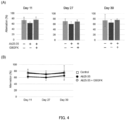
- Each group was then given a Y-maze (short-term memory assessment) test on days 11, 27, and 39 after administration, and an object recognition test over 3 days starting from day 49.
- the Y-maze test was conducted in a general manner under the following conditions. That is to say, mice were placed such that their noses faced the wall at an end of one particular arm among the three arms. The mice were allowed to move freely for 10 minutes, and their behavior was captured on a monitor of an analyzer (product name: Time YM1, manufactured by O'hara & Co., Ltd.) to calculate the alternation behavior rate (alternation behavior (%)).
- an analyzer product name: Time YM1, manufactured by O'hara & Co., Ltd.
- the object recognition test (ORT) from day 49 was conducted as follows. First, for the purpose of checking sociability, mice were placed in a square cage (with a width of 45 cm, a length of 45 cm, and a height of 15 cm) and allowed to become accustomed to the space over the course of one day. For each group, the speed of movement of the mice in the cage was measured, as well as the percentage (%) of time they stayed in the center region of the cage (the inner region being at least 7.5 cm away from a side wall of the cage).
- the fluorescence intensity was measured for the solutions administered to each group. Specifically, a mixed solution obtained by mixing 0.5 ⁇ g/ ⁇ L A ⁇ 25-35 and 0.25 ⁇ g/ ⁇ L Peptide 2 in equal amounts, which was the same as that administered to the administration group, and a 0.5 ⁇ g/ ⁇ L A ⁇ 25-35 solution, which was the same as that administered to the negative control group, were each added in an amount of 100 pL per well, and 10 pL of 1 mmol/L ThT was further added to the well immediately before measurement. These reaction solutions were each reacted at 37°C, and the fluorescence intensity was measured as in Example 1 above.
- FIG. 3 shows the measurement results of fluorescence intensities of the A ⁇ 25-35 solution and the mixed solution on day 11.
- a ⁇ 25-35(+)/GSGFK(-) indicates the measurement results of the A ⁇ 25-35 solution
- a ⁇ 25-35(+)/GSGFK(+) indicates the measurement results of the mixed solution.
- the vertical axis indicates the fluorescence intensity (unit: Fluorescence Intensity).
- the A ⁇ 25-35 solution showed an increase in fluorescence intensity indicating aggregation of A ⁇ 25-35, whereas the mixed solution containing Peptide 2 did not show an increase in fluorescence intensity. That is to say, it is clear from these results that A ⁇ 25-35 aggregates in vitro and that the aggregation is inhibited by the presence of Peptide 2.
- FIG. 5 shows the results of the movement speed and the percentage of time spent in a center region on day 1, which represent the sociability of the mice.
- FIG. 5(A) is a graph showing the movement speed of each group, where the vertical axis indicates the average speed (cm/s)
- FIG. 5(B) is a graph showing the percentage of time spent in a center region, where the vertical axis indicates the percentage (%) of time spent.
- FIG. 5(A) there was no difference in movement speed between the groups.
- the negative control group to which A ⁇ 25-35 was administered had a slightly higher percentage of time spent than the administration group and the positive control group, which confirmed that they were less fearful than the other groups.
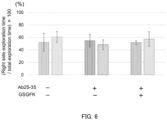
- FIG. 6 shows the results of the object recognition test on day 52, which was conducted over 3 days from day 49.
- the vertical axis indicates the percentage (%) of the exploration time for the object on the right side with respect to the total exploration time.
- the positive control group and the administration group to which A ⁇ 25-35 and Peptide 2 were added showed a significant increase in the percentage of exploration time for the object on the right side in the test phase (oblique lines) compared with the sample phase (vertical lines).
- the administration group to which only A ⁇ 25-35 was added did not show a significant increase, and, on the contrary, showed a decrease in the percentage of exploration time for the object on the right side in the test phase (oblique lines) compared with the sample phase (vertical lines).
- a reaction solution with the following composition was prepared and incubated at 37°C for 24 hours to form aggregates of A ⁇ 25-35. After incubation, the fluorescence intensities of the reaction solution with the following composition to which A ⁇ 25-35 was added and a reaction solution to which water was added instead of A ⁇ 25-35 were measured as in Example 1. As a result, the fluorescence intensity of the reaction solution to which A ⁇ 25-35 was added significantly increased compared with that of the reaction solution to which A ⁇ 25-35 was not added, and thus it was found that aggregates of A ⁇ 25-35 were formed.
- FIG. 7 shows the results.
- FIG. 7(A) is a graph showing the fluorescence intensities of reaction solutions to which Peptide 1 (GSGNR) or Peptide 2 (GSGFK) was added, where the vertical axis indicates the fluorescence intensity (unit: Fluorescence Intensity).
- FIG. 7(B) is a graph showing the percentages of decrease in fluorescence intensity after 4 hr, where the vertical axis indicates the percentage (%) of decrease in fluorescence intensity. As shown in FIG. 7 , it was confirmed that the addition of Peptide 1 or Peptide 2 resulted in a significant decrease in fluorescence intensity 4 hours after the start of incubation.
Landscapes
- Health & Medical Sciences (AREA)
- Chemical & Material Sciences (AREA)
- Life Sciences & Earth Sciences (AREA)
- General Health & Medical Sciences (AREA)
- Engineering & Computer Science (AREA)
- Organic Chemistry (AREA)
- Biomedical Technology (AREA)
- Bioinformatics & Cheminformatics (AREA)
- Medicinal Chemistry (AREA)
- Neurology (AREA)
- Animal Behavior & Ethology (AREA)
- Neurosurgery (AREA)
- Public Health (AREA)
- Veterinary Medicine (AREA)
- Pharmacology & Pharmacy (AREA)
- Proteomics, Peptides & Aminoacids (AREA)
- Molecular Biology (AREA)
- Nuclear Medicine, Radiotherapy & Molecular Imaging (AREA)
- Biophysics (AREA)
- Biochemistry (AREA)
- Epidemiology (AREA)
- Hospice & Palliative Care (AREA)
- Genetics & Genomics (AREA)
- Gastroenterology & Hepatology (AREA)
- Psychiatry (AREA)
- Chemical Kinetics & Catalysis (AREA)
- General Chemical & Material Sciences (AREA)
- Rheumatology (AREA)
- Zoology (AREA)
- Diabetes (AREA)
- Endocrinology (AREA)
- Pathology (AREA)
- Toxicology (AREA)
- Urology & Nephrology (AREA)
- Immunology (AREA)
- Medicines That Contain Protein Lipid Enzymes And Other Medicines (AREA)
- Peptides Or Proteins (AREA)
Applications Claiming Priority (2)
| Application Number | Priority Date | Filing Date | Title |
|---|---|---|---|
| JP2020167404A JP7629182B2 (ja) | 2020-10-02 | 2020-10-02 | アミロイドβの凝集抑制剤、アミロイドβ凝集疾患用医薬組成物、およびその用途 |
| PCT/JP2021/036466 WO2022071591A1 (fr) | 2020-10-02 | 2021-10-01 | INHIBITEUR D'AGRÉGATION DE β-AMYLOÏDE, COMPOSITION PHARMACEUTIQUE POUR MALADIES À AGRÉGATION DE β-AMYLOÏDE, ET APPLICATION D'UTILISATION ASSOCIÉE |
Publications (2)
| Publication Number | Publication Date |
|---|---|
| EP4223767A1 true EP4223767A1 (fr) | 2023-08-09 |
| EP4223767A4 EP4223767A4 (fr) | 2024-12-11 |
Family
ID=80951713
Family Applications (1)
| Application Number | Title | Priority Date | Filing Date |
|---|---|---|---|
| EP21875887.8A Pending EP4223767A4 (fr) | 2020-10-02 | 2021-10-01 | Inhibiteur d'agrégation de bêta-amyloïde, composition pharmaceutique pour maladie d'agrégation de bêta-amyloïde et utilisation associée |
Country Status (4)
| Country | Link |
|---|---|
| US (1) | US20230374070A1 (fr) |
| EP (1) | EP4223767A4 (fr) |
| JP (1) | JP7629182B2 (fr) |
| WO (1) | WO2022071591A1 (fr) |
Families Citing this family (1)
| Publication number | Priority date | Publication date | Assignee | Title |
|---|---|---|---|---|
| EP4737474A1 (fr) * | 2024-11-04 | 2026-05-06 | China Medical University Hospital | Peptide synthétique, composition pharmaceutique comprenant un peptide synthétique et utilisation d'un peptide synthétique pour le traitement de l'amylose |
Family Cites Families (5)
| Publication number | Priority date | Publication date | Assignee | Title |
|---|---|---|---|---|
| EP1658264A2 (fr) | 2003-06-23 | 2006-05-24 | Neurochem (International) Limited | Procedes et compositions de traitement de maladies associees aux amyloides |
| JP7046349B2 (ja) | 2016-01-06 | 2022-04-04 | 学校法人沖縄科学技術大学院大学学園 | 加水分解活性を示す新規ペプチドおよびその用途 |
| EP3630153B1 (fr) | 2017-05-22 | 2026-03-11 | ResQ Biotech P.C. | Modulateurs macrocycliques de mauvais repliement et d'agrégation de protéines associés à une maladie |
| JP6804053B2 (ja) | 2019-03-28 | 2020-12-23 | Toto株式会社 | 静電チャック |
| KR20200033718A (ko) | 2019-05-23 | 2020-03-30 | 주식회사 이노퓨틱스 | 아밀로이드베타 집적억제 조성물 및 집적억제 방법 |
-
2020
- 2020-10-02 JP JP2020167404A patent/JP7629182B2/ja active Active
-
2021
- 2021-10-01 EP EP21875887.8A patent/EP4223767A4/fr active Pending
- 2021-10-01 US US18/247,584 patent/US20230374070A1/en active Pending
- 2021-10-01 WO PCT/JP2021/036466 patent/WO2022071591A1/fr not_active Ceased
Also Published As
| Publication number | Publication date |
|---|---|
| JP2022059674A (ja) | 2022-04-14 |
| EP4223767A4 (fr) | 2024-12-11 |
| US20230374070A1 (en) | 2023-11-23 |
| JP7629182B2 (ja) | 2025-02-13 |
| WO2022071591A1 (fr) | 2022-04-07 |
Similar Documents
| Publication | Publication Date | Title |
|---|---|---|
| JP2025019234A (ja) | メラノコルチン4受容体経路関連障害を治療する方法 | |
| US11723949B2 (en) | Modulators of complement activity | |
| US20210401776A1 (en) | Method of treating refractory epilepsy syndromes using fenfluramine enantiomers | |
| US20250082688A1 (en) | Compositions and methods for williams syndrome (ws) therapy | |
| JP2018500299A (ja) | 神経線維腫症2型に関連する腫瘍の治療のためのユビキチン−プロテアソーム系阻害剤の使用 | |
| US20230374070A1 (en) | AMYLOID-beta AGGREGATION INHIBITOR, PHARMACEUTICAL COMPOSITION FORAMYLOID-beta AGGREGATION DISEASE, AND USE APPLICATION OF SAME | |
| EP3856187A1 (fr) | Infigratinib pour le traitement de maladies du squelette associées à fgfr3 pendant la grossesse | |
| TW202228760A (zh) | 治療黑素皮質素-4受體路徑相關病症之方法 | |
| TW202423471A (zh) | 使用mc4r促效劑治療肥胖之方法 | |
| EP4338748A1 (fr) | Inhibiteur d'agrégation de beta-amyloïde, composition pharmaceutique pour maladies à agrégation de beta-amyloïde et application d'utilisation associée | |
| EP4338747A1 (fr) | Inhibiteur d'agrégation d'alpha-synucléine, composition pharmaceutique pour une maladie liée à l'alpha-synucléine et utilisation associée | |
| EP3641763A2 (fr) | Modulateurs de régulateur de conductance transmembranaire de fibrose kystique pour le traitement d'une polykystose rénale autosomique dominante | |
| US11160843B2 (en) | Oxytocin and opioid antagonists for treatment of social dysfunction disorder | |
| US9717722B2 (en) | Methods and agents for treating tyrosinase-positive albinism | |
| US20180117113A1 (en) | Amidated Dopamine Neuron Stimulating Peptide Restoration of Mitochondrial Activity | |
| JP2022112968A (ja) | アミロイドβの凝集抑制剤、アミロイドβ凝集疾患用医薬組成物、およびその用途 | |
| RU2785889C1 (ru) | Способ лечения нарушений, ассоциированных с путем рецептора меланокортина 4 | |
| de Sousa | Effects of opioids on descending pain facilitation: Studies after cessation of chronic opioid treatment | |
| US20120321613A1 (en) | Molecular targets for healing or treating wounds | |
| WO2022177967A1 (fr) | Traitement de remyélinisation par ciblage d'adgrg1 et de ses effecteurs dans des oligodendrocytes | |
| JP6551671B2 (ja) | アルツハイマー治療薬 | |
| CN108778264A (zh) | 用于治疗疼痛、炎症、炎性疾病、免疫或自身免疫疾病和肿瘤生长的单独的或与类固醇组合的(r)-卡比多巴 | |
| Zhaoa et al. | Parkin-mediated mitophagy is a potential treatment for oxaliplatin-induced |
Legal Events
| Date | Code | Title | Description |
|---|---|---|---|
| STAA | Information on the status of an ep patent application or granted ep patent |
Free format text: STATUS: THE INTERNATIONAL PUBLICATION HAS BEEN MADE |
|
| PUAI | Public reference made under article 153(3) epc to a published international application that has entered the european phase |
Free format text: ORIGINAL CODE: 0009012 |
|
| STAA | Information on the status of an ep patent application or granted ep patent |
Free format text: STATUS: REQUEST FOR EXAMINATION WAS MADE |
|
| 17P | Request for examination filed |
Effective date: 20230502 |
|
| AK | Designated contracting states |
Kind code of ref document: A1 Designated state(s): AL AT BE BG CH CY CZ DE DK EE ES FI FR GB GR HR HU IE IS IT LI LT LU LV MC MK MT NL NO PL PT RO RS SE SI SK SM TR |
|
| P01 | Opt-out of the competence of the unified patent court (upc) registered |
Effective date: 20231101 |
|
| DAV | Request for validation of the european patent (deleted) | ||
| DAX | Request for extension of the european patent (deleted) | ||
| REG | Reference to a national code |
Ref country code: DE Ref legal event code: R079 Free format text: PREVIOUS MAIN CLASS: C07K0007060000 Ipc: A61K0038080000 |
|
| A4 | Supplementary search report drawn up and despatched |
Effective date: 20241113 |
|
| RIC1 | Information provided on ipc code assigned before grant |
Ipc: A61K 38/04 20060101ALI20241107BHEP Ipc: A61P 43/00 20060101ALI20241107BHEP Ipc: A61P 25/28 20060101ALI20241107BHEP Ipc: C07K 7/06 20060101ALI20241107BHEP Ipc: A61K 38/08 20190101AFI20241107BHEP |
|
| STAA | Information on the status of an ep patent application or granted ep patent |
Free format text: STATUS: EXAMINATION IS IN PROGRESS |
|
| 17Q | First examination report despatched |
Effective date: 20251020 |