EP4223980A2 - Rotoranordnung mit strukturellen plattformen für gasturbinenmotoren - Google Patents
Rotoranordnung mit strukturellen plattformen für gasturbinenmotoren Download PDFInfo
- Publication number
- EP4223980A2 EP4223980A2 EP23165612.5A EP23165612A EP4223980A2 EP 4223980 A2 EP4223980 A2 EP 4223980A2 EP 23165612 A EP23165612 A EP 23165612A EP 4223980 A2 EP4223980 A2 EP 4223980A2
- Authority
- EP
- European Patent Office
- Prior art keywords
- airfoils
- retention
- platform
- rotor assembly
- section
- Prior art date
- Legal status (The legal status is an assumption and is not a legal conclusion. Google has not performed a legal analysis and makes no representation as to the accuracy of the status listed.)
- Granted
Links
Images







Classifications
-
- F—MECHANICAL ENGINEERING; LIGHTING; HEATING; WEAPONS; BLASTING
- F01—MACHINES OR ENGINES IN GENERAL; ENGINE PLANTS IN GENERAL; STEAM ENGINES
- F01D—NON-POSITIVE DISPLACEMENT MACHINES OR ENGINES, e.g. STEAM TURBINES
- F01D5/00—Blades; Blade-carrying members; Heating, heat-insulating, cooling or antivibration means on the blades or the members
- F01D5/12—Blades
- F01D5/14—Form or construction
- F01D5/147—Construction, i.e. structural features, e.g. of weight-saving hollow blades
-
- F—MECHANICAL ENGINEERING; LIGHTING; HEATING; WEAPONS; BLASTING
- F01—MACHINES OR ENGINES IN GENERAL; ENGINE PLANTS IN GENERAL; STEAM ENGINES
- F01D—NON-POSITIVE DISPLACEMENT MACHINES OR ENGINES, e.g. STEAM TURBINES
- F01D5/00—Blades; Blade-carrying members; Heating, heat-insulating, cooling or antivibration means on the blades or the members
- F01D5/30—Fixing blades to rotors; Blade roots ; Blade spacers
- F01D5/3053—Fixing blades to rotors; Blade roots ; Blade spacers by means of pins
-
- F—MECHANICAL ENGINEERING; LIGHTING; HEATING; WEAPONS; BLASTING
- F01—MACHINES OR ENGINES IN GENERAL; ENGINE PLANTS IN GENERAL; STEAM ENGINES
- F01D—NON-POSITIVE DISPLACEMENT MACHINES OR ENGINES, e.g. STEAM TURBINES
- F01D11/00—Preventing or minimising internal leakage of working-fluid, e.g. between stages
- F01D11/005—Sealing means between non relatively rotating elements
- F01D11/006—Sealing the gap between rotor blades or blades and rotor
- F01D11/008—Sealing the gap between rotor blades or blades and rotor by spacer elements between the blades, e.g. independent interblade platforms
-
- F—MECHANICAL ENGINEERING; LIGHTING; HEATING; WEAPONS; BLASTING
- F01—MACHINES OR ENGINES IN GENERAL; ENGINE PLANTS IN GENERAL; STEAM ENGINES
- F01D—NON-POSITIVE DISPLACEMENT MACHINES OR ENGINES, e.g. STEAM TURBINES
- F01D5/00—Blades; Blade-carrying members; Heating, heat-insulating, cooling or antivibration means on the blades or the members
- F01D5/12—Blades
- F01D5/22—Blade-to-blade connections, e.g. for damping vibrations
-
- F—MECHANICAL ENGINEERING; LIGHTING; HEATING; WEAPONS; BLASTING
- F01—MACHINES OR ENGINES IN GENERAL; ENGINE PLANTS IN GENERAL; STEAM ENGINES
- F01D—NON-POSITIVE DISPLACEMENT MACHINES OR ENGINES, e.g. STEAM TURBINES
- F01D5/00—Blades; Blade-carrying members; Heating, heat-insulating, cooling or antivibration means on the blades or the members
- F01D5/12—Blades
- F01D5/28—Selecting particular materials; Particular measures relating thereto; Measures against erosion or corrosion
- F01D5/282—Selecting composite materials, e.g. blades with reinforcing filaments
-
- F—MECHANICAL ENGINEERING; LIGHTING; HEATING; WEAPONS; BLASTING
- F01—MACHINES OR ENGINES IN GENERAL; ENGINE PLANTS IN GENERAL; STEAM ENGINES
- F01D—NON-POSITIVE DISPLACEMENT MACHINES OR ENGINES, e.g. STEAM TURBINES
- F01D5/00—Blades; Blade-carrying members; Heating, heat-insulating, cooling or antivibration means on the blades or the members
- F01D5/30—Fixing blades to rotors; Blade roots ; Blade spacers
- F01D5/3023—Fixing blades to rotors; Blade roots ; Blade spacers of radial insertion type, e.g. in individual recesses
- F01D5/3046—Fixing blades to rotors; Blade roots ; Blade spacers of radial insertion type, e.g. in individual recesses the rotor having ribs around the circumference
-
- F—MECHANICAL ENGINEERING; LIGHTING; HEATING; WEAPONS; BLASTING
- F05—INDEXING SCHEMES RELATING TO ENGINES OR PUMPS IN VARIOUS SUBCLASSES OF CLASSES F01-F04
- F05D—INDEXING SCHEME FOR ASPECTS RELATING TO NON-POSITIVE-DISPLACEMENT MACHINES OR ENGINES, GAS-TURBINES OR JET-PROPULSION PLANTS
- F05D2220/00—Application
- F05D2220/30—Application in turbines
- F05D2220/36—Application in turbines specially adapted for the fan of turbofan engines
-
- F—MECHANICAL ENGINEERING; LIGHTING; HEATING; WEAPONS; BLASTING
- F05—INDEXING SCHEMES RELATING TO ENGINES OR PUMPS IN VARIOUS SUBCLASSES OF CLASSES F01-F04
- F05D—INDEXING SCHEME FOR ASPECTS RELATING TO NON-POSITIVE-DISPLACEMENT MACHINES OR ENGINES, GAS-TURBINES OR JET-PROPULSION PLANTS
- F05D2240/00—Components
- F05D2240/20—Rotors
- F05D2240/30—Characteristics of rotor blades, i.e. of any element transforming dynamic fluid energy to or from rotational energy and being attached to a rotor
- F05D2240/301—Cross-sectional characteristics
-
- F—MECHANICAL ENGINEERING; LIGHTING; HEATING; WEAPONS; BLASTING
- F05—INDEXING SCHEMES RELATING TO ENGINES OR PUMPS IN VARIOUS SUBCLASSES OF CLASSES F01-F04
- F05D—INDEXING SCHEME FOR ASPECTS RELATING TO NON-POSITIVE-DISPLACEMENT MACHINES OR ENGINES, GAS-TURBINES OR JET-PROPULSION PLANTS
- F05D2240/00—Components
- F05D2240/80—Platforms for stationary or moving blades
-
- F—MECHANICAL ENGINEERING; LIGHTING; HEATING; WEAPONS; BLASTING
- F05—INDEXING SCHEMES RELATING TO ENGINES OR PUMPS IN VARIOUS SUBCLASSES OF CLASSES F01-F04
- F05D—INDEXING SCHEME FOR ASPECTS RELATING TO NON-POSITIVE-DISPLACEMENT MACHINES OR ENGINES, GAS-TURBINES OR JET-PROPULSION PLANTS
- F05D2260/00—Function
- F05D2260/30—Retaining components in desired mutual position
-
- F—MECHANICAL ENGINEERING; LIGHTING; HEATING; WEAPONS; BLASTING
- F05—INDEXING SCHEMES RELATING TO ENGINES OR PUMPS IN VARIOUS SUBCLASSES OF CLASSES F01-F04
- F05D—INDEXING SCHEME FOR ASPECTS RELATING TO NON-POSITIVE-DISPLACEMENT MACHINES OR ENGINES, GAS-TURBINES OR JET-PROPULSION PLANTS
- F05D2300/00—Materials; Properties thereof
- F05D2300/60—Properties or characteristics given to material by treatment or manufacturing
- F05D2300/603—Composites; e.g. fibre-reinforced
-
- F—MECHANICAL ENGINEERING; LIGHTING; HEATING; WEAPONS; BLASTING
- F05—INDEXING SCHEMES RELATING TO ENGINES OR PUMPS IN VARIOUS SUBCLASSES OF CLASSES F01-F04
- F05D—INDEXING SCHEME FOR ASPECTS RELATING TO NON-POSITIVE-DISPLACEMENT MACHINES OR ENGINES, GAS-TURBINES OR JET-PROPULSION PLANTS
- F05D2300/00—Materials; Properties thereof
- F05D2300/60—Properties or characteristics given to material by treatment or manufacturing
- F05D2300/603—Composites; e.g. fibre-reinforced
- F05D2300/6034—Orientation of fibres, weaving, ply angle
-
- Y—GENERAL TAGGING OF NEW TECHNOLOGICAL DEVELOPMENTS; GENERAL TAGGING OF CROSS-SECTIONAL TECHNOLOGIES SPANNING OVER SEVERAL SECTIONS OF THE IPC; TECHNICAL SUBJECTS COVERED BY FORMER USPC CROSS-REFERENCE ART COLLECTIONS [XRACs] AND DIGESTS
- Y02—TECHNOLOGIES OR APPLICATIONS FOR MITIGATION OR ADAPTATION AGAINST CLIMATE CHANGE
- Y02T—CLIMATE CHANGE MITIGATION TECHNOLOGIES RELATED TO TRANSPORTATION
- Y02T50/00—Aeronautics or air transport
- Y02T50/60—Efficient propulsion technologies, e.g. for aircraft
Definitions
- This disclosure relates to a gas turbine engine, and more particularly to a rotor assembly including a hub that carries an array of airfoils.
- Gas turbine engines can include a fan for propulsion air and to cool components.
- the fan also delivers air into a core engine where it is compressed.
- the compressed air is then delivered into a combustion section, where it is mixed with fuel and ignited.
- the combustion gas expands downstream over and drives turbine blades.
- Static vanes are positioned adjacent to the turbine blades to control the flow of the products of combustion.
- the fan typically includes an array of fan blades having dovetails that are mounted in slots of a fan hub.
- a platform for a gas turbine engine includes a platform body that extends in a circumferential direction between first and second sidewalls to define a gas path surface, and opposed rows of flexible retention tabs that extend from the platform body and are dimensioned to wedge the platform between adjacent airfoils.
- the platform body defines a plurality of slots that space apart the retention tabs.
- each of the retention tabs includes a first portion that extends in the circumferential direction and a second portion that extends in a radial direction from the first portion to mate with a contour of a respective one of the adjacent airfoils.
- each of the retention tabs is integrally formed with the platform body, and the platform body is made of a metallic material.
- the platform body includes at least one flange attachable to a rotatable hub.
- a rotor assembly for a gas turbine engine includes a rotatable hub that has a main body that extends along a longitudinal axis, and that has an array of annular flanges that extend about an outer periphery of the main body to define an array of annular channels along the longitudinal axis.
- An array of airfoils are circumferentially distributed about the outer periphery. Each one of the airfoils has an airfoil section that extends from a root section received in the annular channels.
- the airfoil section extends between a leading edge and a trailing edge in a chordwise direction and extends between a tip portion and the root section in a radial direction, and the airfoil section defines a pressure side and a suction side separated in a thickness direction.
- An array of platforms are releasably secured to the hub. Each of the platforms includes a platform body and opposed rows of resilient support members that abut against adjacent airfoils of the array of airfoils to oppose movement of the respective airfoil section in the circumferential direction.
- a further embodiment of any of the foregoing embodiments includes a plurality of retention pins each extending through the root section of a respective one of the airfoils and through each of the annular flanges to mechanically attach the root section to the hub.
- the airfoil section is pivotable about a respective one of the retention pins in an installed position.
- the platform body is mechanically attached to the hub.
- the airfoil section includes a metallic sheath that receives a composite core, and the core includes first and second ligaments received in respective internal channels defined by the sheath such that the first and second ligaments are spaced apart along the root section with respect to the longitudinal axis.
- each of the support members is a retention tab that abuts against the sheath of a respective one of the adjacent airfoils.
- the retention tab opposes circumferential movement of the respective one of the adjacent airfoils in response to a load on the respective one of the adjacent airfoils being below a predefined limit, but deflects in response to the load exceeding the predefined limit.
- a further embodiment of any of the foregoing embodiments includes a plurality of retention pins each extending through the root section of a respective one of the airfoils and through each of the annular flanges to mechanically attach the root section to the hub, and wherein the airfoil section is pivotable about a respective one of the retention pins in an installed position.
- the retention tab abuts against the sheath of the respective one of the adjacent airfoils at a position radially outward of the retention pins.
- the first and second ligaments define a set of bores aligned to receive a common one of the retention pins.
- the opposed rows of support members extend outwardly from the platform body and are dimensioned to wedge the platform between the adjacent airfoils.
- each of the support members is a retention tab that abuts against the sheath of a respective one of the adjacent airfoils.
- the retention tab includes a retention body that has an L-shaped geometry that reacts a load on a respective one of the adjacent airfoils in operation, and the retention body is integrally formed with the platform body.
- a gas turbine engine includes a fan section that has a fan shaft rotatable about an engine longitudinal axis.
- the fan section has a rotor assembly.
- the rotor assembly includes a rotatable hub that has a main body mechanically attached to the fan shaft, and has an array of annular flanges that extend about an outer periphery of the main body to define an array of annular channels along the engine longitudinal axis.
- An array of airfoils are circumferentially distributed about the outer periphery. Each one of the airfoils includes an airfoil section that extends from a root section received in the annular channels.
- An array of platforms are releasably secured to the hub. Each of the platforms includes a platform body and opposed rows of flexible support members that extend from the platform body and are dimensioned to wedge the platform between adjacent airfoils and oppose circumferential movement of the adjacent airfoils relative to the engine longitudinal axis.
- the airfoil section includes a metallic sheath and a composite core.
- the core includes first and second ligaments at least partially received in respective internal channels defined in the sheath.
- a further embodiment of any of the foregoing embodiments includes a plurality of retention pins, each of the retention pins extending through the root section of a respective one of the airfoils, across the annular channels, and through the annular flanges to mechanically attach the root section to the hub.
- the airfoil section is pivotable about a respective one of the retention pins in an installed position.
- Each of the support members is an L-shaped retention tab integrally formed with the platform body.
- the platform body is made of a metallic material, and the retention tab opposes circumferential movement of the respective one of the adjacent airfoils in response to a load on the respective one of the adjacent airfoils being below a predefined limit, but deflects in response to the load exceeding the predefined limit.
- FIG. 1 schematically illustrates a gas turbine engine 20.
- the gas turbine engine 20 is disclosed herein as a two-spool turbofan that generally incorporates a fan section 22, a compressor section 24, a combustor section 26 and a turbine section 28.
- the fan section 22 drives air along a bypass flow path B in a bypass duct defined within a nacelle 15, and also drives air along a core flow path C for compression and communication into the combustor section 26 then expansion through the turbine section 28.
- FIG. 1 schematically illustrates a gas turbine engine 20.
- the gas turbine engine 20 is disclosed herein as a two-spool turbofan that generally incorporates a fan section 22, a compressor section 24, a combustor section 26 and a turbine section 28.
- the fan section 22 drives air along a bypass flow path B in a bypass duct defined within a nacelle 15, and also drives air along a core flow path C for compression and communication into the combustor section 26 then expansion through the turbine section 28.
- FIG. 1 schematic
- the exemplary engine 20 generally includes a low speed spool 30 and a high speed spool 32 mounted for rotation about an engine central longitudinal axis A relative to an engine static structure 36 via several bearing systems 38. It should be understood that various bearing systems 38 at various locations may alternatively or additionally be provided, and the location of bearing systems 38 may be varied as appropriate to the application.
- the low speed spool 30 generally includes an inner shaft 40 that interconnects, a first (or low) pressure compressor 44 and a first (or low) pressure turbine 46.
- the inner shaft 40 is connected to the fan 42 through a speed change mechanism, which in exemplary gas turbine engine 20 is illustrated as a geared architecture 48 to drive a fan 42 at a lower speed than the low speed spool 30.
- the high speed spool 32 includes an outer shaft 50 that interconnects a second (or high) pressure compressor 52 and a second (or high) pressure turbine 54.
- a combustor 56 is arranged in exemplary gas turbine 20 between the high pressure compressor 52 and the high pressure turbine 54.
- a mid-turbine frame 57 of the engine static structure 36 may be arranged generally between the high pressure turbine 54 and the low pressure turbine 46.
- the mid-turbine frame 57 further supports bearing systems 38 in the turbine section 28.
- the inner shaft 40 and the outer shaft 50 are concentric and rotate via bearing systems 38 about the engine central longitudinal axis A which is colline
- the core airflow is compressed by the low pressure compressor 44 then the high pressure compressor 52, mixed and burned with fuel in the combustor 56, then expanded over the high pressure turbine 54 and low pressure turbine 46.
- the mid-turbine frame 57 includes airfoils 59 which are in the core airflow path C.
- the turbines 46, 54 rotationally drive the respective low speed spool 30 and high speed spool 32 in response to the expansion.
- gear system 48 may be located aft of the low pressure compressor, or aft of the combustor section 26 or even aft of turbine section 28, and fan 42 may be positioned forward or aft of the location of gear system 48.
- the engine 20 in one example is a high-bypass geared aircraft engine.
- the engine 20 bypass ratio is greater than about six, with an example embodiment being greater than about ten
- the geared architecture 48 is an epicyclic gear train, such as a planetary gear system or other gear system, with a gear reduction ratio of greater than about 2.3 and the low pressure turbine 46 has a pressure ratio that is greater than about five.
- the engine 20 bypass ratio is greater than about ten
- the fan diameter is significantly larger than that of the low pressure compressor 44
- the low pressure turbine 46 has a pressure ratio that is greater than about five.
- Low pressure turbine 46 pressure ratio is pressure measured prior to inlet of low pressure turbine 46 as related to the pressure at the outlet of the low pressure turbine 46 prior to an exhaust nozzle.
- the geared architecture 48 may be an epicycle gear train, such as a planetary gear system or other gear system, with a gear reduction ratio of greater than about 2.3:1 and less than about 5:1. It should be understood, however, that the above parameters are only exemplary of one embodiment of a geared architecture engine and that the present invention is applicable to other gas turbine engines including direct drive turbofans.
- the fan section 22 of the engine 20 is designed for a particular flight condition -- typically cruise at about 0.8 Mach and about 35,000 feet (10,668 meters).
- the flight condition of 0.8 Mach and 35,000 ft (10,668 meters), with the engine at its best fuel consumption - also known as "bucket cruise Thrust Specific Fuel Consumption ('TSFC')" - is the industry standard parameter of lbm of fuel being burned divided by lbf of thrust the engine produces at that minimum point.
- "Low fan pressure ratio” is the pressure ratio across the fan blade alone, without a Fan Exit Guide Vane (“FEGV”) system.
- the low fan pressure ratio as disclosed herein according to one non-limiting embodiment is less than about 1.45.
- the "Low corrected fan tip speed” as disclosed herein according to one non-limiting embodiment is less than about 1150 ft / second (350.5 meters/second).
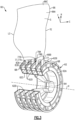
- Figure 2 illustrates a rotor assembly 60 for a gas turbine engine according to an example.
- the rotor assembly 60 can be incorporated into the fan section 22 or the compressor section 24 of the engine 20 of Figure 1 , for example.
- the rotor assembly 60 is incorporated into a multi-stage fan section of a direct drive or geared engine architecture.
- the rotor assembly 60 includes a rotatable hub 62 mechanically attached or otherwise mounted to a fan shaft 64.
- the fan shaft 64 is rotatable about longitudinal axis X.
- the fan shaft 64 can be rotatably coupled to the low pressure turbine 46 ( Figure 1 ), for example.
- the rotatable hub 62 includes a main body 62A that extends along the longitudinal axis X.
- the longitudinal axis X can be parallel to or collinearly with the engine longitudinal axis A of Figure 1 , for example.
- the hub 62 includes an array of annular flanges 62B that extend about an outer periphery 62C of the main body 62A.
- the annular flanges 62B define an array of annular channels 62D along the longitudinal axis X.
- An array of airfoils 66 are circumferentially distributed about the outer periphery 62C of the rotatable hub 62. Referring to Figure 3 , with continued reference to Figure 2 , one of the airfoils 66 mounted to the hub 62 is shown for illustrative purposes.
- the airfoil 66 includes an airfoil section 66A extending from a root section 66B.
- the airfoil section 66A extends between a leading edge LE and a trailing edge TE in a chordwise direction C, and extends in a radial direction R between the root section 66B and a tip portion 66C to provide an aerodynamic surface.
- the tip portion 66C defines a terminal end or radially outermost extent of the airfoil 66 to establish a clearance gap with fan case 15 ( Figure 1 ).
- the airfoil section 66A defines a pressure side P ( Figure 2 ) and a suction side S separated in a thickness direction T.
- the root section 66B is dimensioned to be received in each of the annular channels 62D.
- the rotor assembly 60 includes an array of platforms 70 that are separate and distinct from the airfoils 66.
- the platforms 70 are situated between and abut against adjacent pairs of airfoils 66 to define an inner boundary of a gas path along the rotor assembly 60, as illustrated in Figure 2 .
- the platforms 70 can be mechanically attached and releasably secured to the hub 62 with one or more fasteners, for example.
- Figure 4 illustrates one of the platforms 70 abutting against the airfoil section 66A of adj acent airfoils 66.
- Figure 5A illustrates an exploded, cutaway view of portions of the rotor assembly 60.
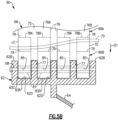
- Figure 5B illustrates a side view of one of the airfoils 66 secured to the hub 62.
- the rotor assembly 60 includes a plurality of retention pins 68 for securing the airfoils 66 to the hub 62 (see Figure 2 ).
- Each of the platforms 70 can abut the adjacent airfoils 66 at a position radially outward of the retention pins 68, as illustrated by Figure 2 .
- Each of the retention pins 68 is dimensioned to extend through the root section 66B of a respective one of the airfoils 66 and to extend through each of the flanges 62B to mechanically attach the root section 66B of the respective airfoil 66 to the hub 62, as illustrated by Figures 3 and 5B .
- the retention pins 68 react to centrifugal loads in response to rotation of the airfoils 66.
- the hub 62 can include at least three annular flanges 62B, such as five flanges 62B as shown, that are axially spaced apart relative to the longitudinal axis X to support a length of each of the retention pins 68.
- flanges 62B can be utilized with the teachings herein. Utilizing three or more flanges 62B can provide relatively greater surface contact area and support along a length each retention pin 68, which can reduce bending and improve durability of the retention pin 68.
- the airfoil 66 can be a hybrid airfoil including metallic and composite portions.
- the airfoil 66 includes a metallic sheath 72 that at least partially receives and protects a composite core 74.
- substantially all of the aerodynamic surfaces of the airfoil 66 are defined by the sheath 72.
- the sheath 72 can be dimensioned to terminate radially inward prior to the root section 66B such that the sheath 72 is spaced apart from the respective retention pin(s) 68, as illustrated by Figure 5B .
- the sheath 72 includes a first skin 72A and a second skin 72B. The first and second skins 72A, 72B are joined together to define an external surface contour of the airfoil 66 including the pressure and suction sides P, S of the airfoil section 66A.
- the core 74 includes one or more ligaments 76 that define portions of the airfoil and root sections 66A, 66B.
- the ligament 76 can define radially outermost extent or tip of the tip portion 66C, as illustrated by Figure 6 . In other examples, the ligaments 76 terminate prior to the tip of the airfoil section 66A.
- the core 74 includes two separate and distinct ligaments 76A, 76B spaced apart from each other as illustrated in Figures 5B and 6 .
- the core 74 can include fewer or more than two ligaments 76, such as three to ten ligaments 76.
- the ligaments 76A, 76B extend outwardly from the root section 66B towards the tip portion 66C of the airfoil section 66A, as illustrated by Figures 3 , 6 and 8 .
- the sheath 72 defines one or more internal channels 72C, 72D to receive the core 74.
- the sheath 72 includes at least one rib 73 defined by the first skin 72A that extends in the radial direction R to bound the adjacent channels 72C, 72D.
- the ligaments 76A, 76B are received in respective internal channels 72C, 72D such that the skins 72A, 72B at least partially surround the core 74 and sandwich the ligaments 76A, 76B therebetween, as illustrated by Figure 6 .
- the ligaments 76A, 76B receive the common retention pin 68 such that the common retention pin 68 is slideably received through at least three, or each, of annular flanges 62B.
- the common retention pin 68 is dimensioned to extend through each and every one of the interface portions 78 of the respective airfoil 66 to mechanically attach or otherwise secure the airfoil 66 to the hub 62.
- each of one of the ligaments 76 includes at least one interface portion 78 in the root section 66B.
- Figure 9 illustrates ligament 76 with the first and second skin 72A, 72B removed.
- Figure 10 illustrates the core 74 and skins 72A, 72B in an assembled position, with the interface portion 78 defining portions of the root section 66B.
- the interface portion 78 includes a wrapping mandrel 79 and a bushing 81 mechanically attached to the mandrel 79 with an adhesive, for example.
- the bushing 81 is dimensioned to slideably receive one of the retention pins 68 ( Figure 5B ).
- the mandrel 79 tapers from the bushing 81 to define a teardrop profile, as illustrated by Figure 11 .
- each of the ligaments 76 defines at least one slot 77 in the root section 66B to define first and second root portions 83A, 83B received in the annular channels 62D on opposed sides of the respective flange 62B such that the root portions 83A, 83B are interdigitated with the flanges 62B.
- the slots 77 can decrease bending of the retention pins 68 by decreasing a distance between adjacent flanges 62B and increase contact area and support along a length of the retention pin 68, which can reduce contact stresses and wear.
- Each ligament 76 can include a plurality of interface portions 78 (indicated as 78A, 78B) received in root portions 83A, 83B, respectively.
- the interface portions 78A, 78B of each ligament 76A, 76B receive a common retention pin 68 to mechanically attach or otherwise secure the ligaments 76A, 76B to the hub 62.
- the root section 66B defines at least one bore 85 dimensioned to receive a retention pin 68. In the illustrated example of Figure 5B , each bore 85 is defined by a respective bushing 81.
- the first and second skins 72A, 72B comprise a metallic material such as titanium, stainless steel, nickel, a relatively ductile material such as aluminum, or another metal or metal alloy
- the core 74 comprises carbon or carbon fibers, such as a ceramic matrix composite (CMC).
- CMC ceramic matrix composite
- the sheath 72 defines a first weight
- the composite core 74 defines a second weight
- a ratio of the first weight to the second weight is at least 1:1 such that at least 50% of the weight of the airfoil 66 is made of a metallic material.
- the metal or metal alloy can provide relatively greater strength and durability under operating conditions of the engine and can provide relatively greater impact resistance to reduce damage from foreign object debris (FOD).
- the composite material can be relatively strong and lightweight, but may not be as ductile as metallic materials, for example.
- the hybrid construction of airfoils 66 can reduce an overall weight of the rotor assembly 60.
- each of the ligaments 76 includes at least one composite layer 80.
- Each composite layer 80 can be fabricated to loop around the interface portion 78 and retention pin 68 (when in an installed position) such that opposed end portions 80A, 80B of the respective layer 80 are joined together along the airfoil portion 66A.
- the composite layers 80 can be dimensioned to define a substantially solid core 74, such that substantially all of a volume of the internal cavities 72C, 72D of the sheath 72 are occupied by a composite material comprising carbon.
- the composite layers 80 include a first composite layer 80C and a second composite layer 80D between the first layer 80C and an outer periphery of the interface portion 78.
- the composite layers 80C and 80D can be fabricated to each loop around the interface portion 78 and the retention pin 68.
- the layers 80 can include various fiber constructions to define the core 74.
- the first layer 80C can define a first fiber construction
- the second layer 80D can define a second fiber construction that differs from the first fiber construction.
- the first fiber construction can include one or more uni-tape plies or a fabric
- the second fiber construction can include at least one ply of a three-dimensional weave of fibers as illustrated by layer 80-1 of Figure 14A , for example.
- uni-tape plies include a plurality of fibers oriented in the same direction ("uni-directional), and fabric includes woven or interlaced fibers, each known in the art.
- each of the first and second fiber constructions includes a plurality of carbon fibers.
- other materials can be utilized for each of the fiber constructions, including fiberglass, Kevlar ® , a ceramic such as Nextel TM , a polyethylene such as Spectra ® , and/or a combination of fibers.
- Figure 14B illustrates a layer 80-2 defined by a plurality of braided yarns.
- Figure 14C illustrates a layer 80-3 defined by a two-dimensional woven fabric.
- Figure 14D illustrates a layer 80-4 defined by a non-crimp fabric.
- Figure 14E illustrates a layer 80-5 defined by a tri-axial braided fabric.
- Other example fiber constructions include biaxial braids and plain or satin weaves.
- the rotor assembly 60 can be constructed and assembled as follows.
- the ligaments 76A, 76B of core 74 are situated in the respective internal channels 72C, 72D defined by the sheath 72 such that the ligaments 76A, 76B are spaced apart along the root section 66B by one of the annular flanges 62B and abut against opposed sides of rib 73, as illustrated by Figures 5B , 6 and 13 .
- the ligaments 76A, 76B are directly bonded or otherwise mechanically attached to the surfaces of the internal channels 72C, 72D.
- Example bonding materials can include polymeric adhesives such as epoxies, resins such as polyurethane and other adhesives curable at room temperature or elevated temperatures.
- the polymeric adhesives can be relatively flexible such that ligaments 76 are moveable relative to surfaces of the internal channels 72C, 72D to provide damping during engine operation.
- the core 74 includes a plurality of stand-offs or detents 82 that are distributed along surfaces of the ligaments 76.
- the detents 82 are dimensioned and arranged to space apart the ligaments 76 from adjacent surfaces of the internal channels 72C, 72D.
- Example geometries of the detents 82 can include conical, hemispherical, pyramidal and complex geometries.
- the detents 82 can be uniformly or nonuniformly distributed.
- the detents 82 can be formed from a fiberglass fabric or scrim having raised protrusions made of rubber or resin that can be fully cured or co-cured with the ligaments 76, for example.
- the second skin 72B is placed against the first skin 72A to define an external surface contour of the airfoil 66, as illustrated by Figures 6 and 13 .
- the skins 72A, 72B can be welded, brazed, riveted or otherwise mechanically attached to each other, and form a "closed loop" around the ligaments 76.
- the detents 82 can define relatively large bondline gaps between the ligaments 76 and the surfaces of the internal channels 72C, 72D, and a relatively flexible, weaker adhesive can be utilized to attach the sheath 72 to the ligaments 76.
- the relatively large bondline gaps established by the detents 82 can improve flow of resin or adhesive such as polyurethane and reducing formation of dry areas.
- the detents 82 are dimensioned to establish bondline gap of at least a 0.020 inches (0.508 mm), or more narrowly between 0.020 and 0.120 inches (0.508 and 3.048 mm).
- the relatively large bondline gap can accommodate manufacturing tolerances between the sheath 72 and core 74, can ensure proper positioning during final cure and can ensure proper bond thickness.
- the relatively large bondline gap allows the metal and composite materials to thermally expand, which can reduce a likelihood of generating discontinuity stresses.
- the gaps and detents 82 can also protect the composite from thermal degradation during welding or brazing of the skins 72A, 72B to each other.
- a resin or adhesive such as polyurethane can be injected into gaps or spaces established by the detents 82 between the ligaments 76 and the surfaces of the internal channels 72C, 72D.
- a relatively weak and/or soft adhesive such as polyurethane is injected into the spaces.
- Utilization of relatively soft adhesives such as polyurethane can isolate and segregate the disparate thermal expansion between metallic sheath 72 and composite core 74, provide structural damping, isolate the delicate inner fibers of the composite core 74 from relatively extreme welding temperatures during attachment of the second skin 72B to the first skin 72A, and enables the ductile sheath 72 to yield during a bird strike or other FOD event, which can reduce a likelihood of degradation of the relatively brittle inner fibers of the composite core 74.
- the composite layers 80 can be simultaneously cured and bonded to each other with the injected resin, which may be referred to as "co-bonding” or “cocuring". In other examples, the composite layers 80 can be pre-formed or preimpregnated with resin prior to placement in the internal channels 72C, 72D.
- the composite core 74 is cured in an oven, autoclave or by other conventional methods, with the ligaments 76 bonded to the sheath 72, as illustrated by Figures 10 and 13 .
- the airfoils 66 are moved in a direction D1 ( Figures 5A-5B ) toward the outer periphery 62C of the hub 62.
- a respective retention pin 68 is slideably received through each bushing 81 of the interface portions 78 and each of the flanges 62B to mechanically attach the ligaments 76 to the flanges 62B.
- the platforms 70 are then moved into abutment against respective pairs of airfoils 66 at a position radially outward of the flanges 62B to limit circumferential movement of the airfoil sections 66A, as illustrated by Figure 2 .
- the rotor assembly 60 also enables relatively thinner airfoils which can improve aerodynamic efficiency.
- FIGS. 15-16 illustrate an airfoil 166 according to another example.
- like reference numerals designate like elements where appropriate and reference numerals with the addition of one-hundred or multiples thereof designate modified elements that are understood to incorporate the same features and benefits of the corresponding original elements.
- a first skin 172A of sheath 172 defines internal channels 172C, 172D.
- the internal channels 172C, 172D are adjacent to each other and are bounded by a pair of opposing ribs 173.
- the ribs 173 can extend in a radial direction R, for example, and are spaced apart along an internal gap 172F that interconnects the internal cavities 172C, 172D.
- Composite core 174 includes a ligament bridge 184 that interconnects an adjacent pair of ligaments 176 at a location radially outward of a common pin 168 (shown in dashed lines in Figure 15 for illustrative purposes).
- the ligament bridge 184 can be made of any of the materials disclosed herein, such as a composite material.
- the ligament bridge 184 is dimensioned to be received within the gap 172F.
- the ligament bridge 184 interconnects the adjacent pair of ligaments 176 in a position along the airfoil section 166A when in the installed position.
- the core 174 may move in a direction D2 ( Figure 16 ) relative to the sheath 172, which can correspond to the radial direction R, for example.
- the ligament bridge 184 is dimensioned to abut against the opposing ribs 173 of the sheath 172 in response to movement in direction D2 to react blade pull and bound radial movement of the core 174 relative to the sheath 172.
- the ligament bridge 184 serves as a failsafe by trapping the ligaments 176 to reduce a likelihood of liberation of the ligaments 176 which may otherwise occur due to failure of the bond between the sheath 172 and ligaments 176.
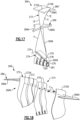
- FIGS 17 and 18 illustrate an airfoil 266 according to yet another example.
- Airfoil 266 includes at least one shroud 286 that extends outwardly from pressure and suction sides P, S of airfoil section 266A at a position radially outward of platforms 270 (shown in dashed lines in Figure 17 for illustrative purposes).
- the shroud 286 defines an external surface contour and can be utilized to tune mode(s) of the airfoil 266 by changing boundary constraints.
- the shroud 286 can be made of a composite or metallic material, including any of the materials disclosed herein, or can be made of an injection molded plastic having a plastic core and a thin metallic coating, for example.
- the airfoil 266 can include a second shroud 286' (shown in dashed lines) to provide a dual shroud architecture, with shroud 286 arranged to divide airfoil between bypass and core flow paths B, C ( Figure 1 ) and shroud 286' for reducing a flutter condition of the airfoil 266, for example.
- a second shroud 286' shown in dashed lines to provide a dual shroud architecture, with shroud 286 arranged to divide airfoil between bypass and core flow paths B, C ( Figure 1 ) and shroud 286' for reducing a flutter condition of the airfoil 266, for example.
- the shroud 286 includes first and second shroud portions 286A, 286B secured to the opposing pressure and suction sides P, S.
- the shroud portions 286A, 286B can be joined together with one or more inserts fasteners F that extend through the airfoil section 266A.
- the fasteners F can be baked into the ligaments 276, for example, and can be frangible to release in response to a load on either of the shroud portions 286A, 286B exceeding a predefined threshold.
- the airfoil 266 includes only one of the shroud portions 286A, 286B such that the shroud 286 is on only one side of the airfoil section 266A or is otherwise unsymmetrical.
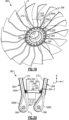
- FIG 19 illustrates a rotor assembly 360 according to another example.
- the rotor assembly 360 includes an array of platforms 370 that are releasably secured to hub 362.
- the platforms 370 are separate and distinct from the airfoils 366.
- Each platform 370 includes one or more features that support the adjacent airfoils 366 to oppose circumferential or other relative movement during engine operation.
- each platform 370 includes a platform body 388 that extends in a circumferential or thickness direction T between first and second sidewalls 390 to define an aerodynamic contour or gas path surface 391.
- the platform body 388 includes at least one bracket or flange 392 that is mechanically attachable or otherwise secured to the platform body 388.
- each of the flanges 392 is integrally formed with the platform body 388.
- the flanges 392 are mechanically attachable to respective flanges 362B ( Figure 21 ) to mechanically attach or otherwise secure the platform 370 to the hub 362.
- Each airfoil section 366A may be pivotable about a respective retention pin 368 in an installed position, which may cause the airfoil 366 to pivot or lean in the circumferential direction T, for example.
- the platform 370 includes a plurality of resilient support members 394 that each extend from the platform body 388 and are dimensioned to abut against a sheath 372 of an adjacent airfoil 366 to oppose movement of the airfoil section 366A in the circumferential direction T, for example.
- Each of the support members 394 can be dimensioned to abut against the sheath 372 at a position that is radially outward of the retention pins 368.
- the support members 394 are arranged in opposed rows of support members 394-1, 394-2.
- the rows of support members 394-1, 394-2 are dimensioned to provide a spring bias or force against the airfoils 366, wedge the platform 370 between adjacent airfoils 366, and oppose circumferential movement of the adjacent airfoils 366 relative to the longitudinal axis X.
- each of the support members 394 can be a retention tab including a retention body having first and second portions 394A, 394B.
- the first portion 394A can extend in the circumferential direction T outwardly from the platform body 388, and the second portion 388B can be flared or otherwise extend in a radial direction R from the first portion 394A and outwardly with respect to the platform body 388 to mate with a contour of the airfoil section 366A of the adjacent airfoil 366.
- the platform body 388 can define a plurality of slots or cutouts 396 along the sidewalls 390 to define and space apart the support members 394.
- the platform 370 can be made of a metallic material such as aluminum or sheet metal, or can be made of a composite material.
- the support members 394 can be integrally formed with the platform body 388 such that the support members 394 are resilient and ductile or otherwise flexible. In other examples, the support members 394 are mechanically attached to the platform body 388 utilizing various techniques such as by bonding, welding, or riveting.
- the platform 370 supports adjacent airfoils 366 against gas loads during engine operation.
- the support members 394 are constructed to be relatively strong and ductile to support the adjacent airfoils 366 during normal operation and to transfer loads in a manner that reduces a likelihood of permanent deformation, liberation or other degradation of the platforms 370 and airfoils 366.
- the retention pins 368 can reduce a bending stiffness of the airfoils 366 due the ability of the airfoils 366 to pivot about the retention pins 368.
- the support members 394 can be constructed to have different stiffnesses utilizing the techniques disclosed herein, including being relatively stiff and elastic for a flutter mode, but yielding during relatively more severe bending or leaning of the airfoil 366.
- each airfoil 366 may be subject to an internal and/or external load or force F, such as flutter, vibratory or centrifugal loads, or impacts caused by bird strikes or other FOD events.
- the force F may cause or urge the airfoil to lean or pivot about a respective one of the retention pins 368 ( Figures 20-22 ).
- the platforms 370 including support members 394 serve to support and hold the adjacent airfoils 366 in a predefined aerodynamic position to increase aerodynamic performance and support the airfoils 366 during impact events.
- Each one of the support members 394 can be dimensioned to oppose circumferential movement of the adjacent airfoil 366 in response to the force or load F on the airfoil 366 being below a predefined limit, but can be dimensioned to deflect or yield in response to the load or force F exceeding the predefined limit as illustrated by support member 394' and airfoil 366' (shown in dashed lines for illustrative purposes). Yielding of the support members 394 reduces a likelihood that the platform 370 will liberate or otherwise degrade due to high energy impacts such as bird strikes.
- each support member 394 can be dimensioned to have an L-shaped geometry that reacts the load or force F on a respective one of the airfoils 366 in operation.
- the support members 394 serve to cushion the airfoils 366 from the force F, which can improve durability and propulsive efficiency of the airfoils 366.
- the rotor assembly 360 can be installed as follows. Flanges 392 are mounted or otherwise secured to the platform body 388, as illustrated by Figure 24 . Thereafter, the platform 370 can be moved in direction D1 to wedge the platform 370 between adjacent platforms 366, as illustrated by Figure 21 . Thereafter, one or more fasteners 398, such as elongated bolts or pins, can be moved in direction D2 to secure the flanges 392 to respective annular flanges 362B of the hub 362. The fasteners 398 are illustrated in an installed position in Figures 21 and 22 .
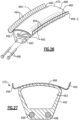
- FIGs 26 and 27 illustrate a platform 470 for a rotor assembly according to another example.
- the platform 470 includes an elongated flange 492 mechanically attached or otherwise secured to platform body 488.
- a plurality of support members 494 extend outwardly from the platform body 488 to abut against and support adjacent airfoils.
- the flange 492 extends along a length of platform body 488.
- the flange 492 can have a hollow interior 493 that extends between opposed ends of the flange 492.
- the flange 492 defines one or more slots 495 ( Figure 26 ) to receive a respective flange of the hub (see, e.g., flanges 362B of Figure 25 ).
- a cross-section of the flange 492 can have a generally trapezoidal geometry, as illustrated by Figure 27 , or another geometry such as a triangular or rectangular profile.
- the flange 492 defines apertures for receiving fasteners 498 to mechanically attach the platform 470 to a hub, such as hub 362 of Figure 25 .
Landscapes
- Engineering & Computer Science (AREA)
- Mechanical Engineering (AREA)
- General Engineering & Computer Science (AREA)
- Chemical & Material Sciences (AREA)
- Materials Engineering (AREA)
- Composite Materials (AREA)
- Architecture (AREA)
- Structures Of Non-Positive Displacement Pumps (AREA)
- Turbine Rotor Nozzle Sealing (AREA)
Applications Claiming Priority (2)
| Application Number | Priority Date | Filing Date | Title |
|---|---|---|---|
| US16/163,654 US11359500B2 (en) | 2018-10-18 | 2018-10-18 | Rotor assembly with structural platforms for gas turbine engines |
| EP19203663.0A EP3643879B1 (de) | 2018-10-18 | 2019-10-16 | Rotoranordnung mit strukturplattformen für gasturbinenmotoren |
Related Parent Applications (1)
| Application Number | Title | Priority Date | Filing Date |
|---|---|---|---|
| EP19203663.0A Division EP3643879B1 (de) | 2018-10-18 | 2019-10-16 | Rotoranordnung mit strukturplattformen für gasturbinenmotoren |
Publications (3)
| Publication Number | Publication Date |
|---|---|
| EP4223980A2 true EP4223980A2 (de) | 2023-08-09 |
| EP4223980A3 EP4223980A3 (de) | 2024-01-17 |
| EP4223980B1 EP4223980B1 (de) | 2025-03-19 |
Family
ID=68281225
Family Applications (2)
| Application Number | Title | Priority Date | Filing Date |
|---|---|---|---|
| EP19203663.0A Active EP3643879B1 (de) | 2018-10-18 | 2019-10-16 | Rotoranordnung mit strukturplattformen für gasturbinenmotoren |
| EP23165612.5A Active EP4223980B1 (de) | 2018-10-18 | 2019-10-16 | Rotoranordnung mit strukturellen plattformen für gasturbinenmotoren |
Family Applications Before (1)
| Application Number | Title | Priority Date | Filing Date |
|---|---|---|---|
| EP19203663.0A Active EP3643879B1 (de) | 2018-10-18 | 2019-10-16 | Rotoranordnung mit strukturplattformen für gasturbinenmotoren |
Country Status (2)
| Country | Link |
|---|---|
| US (1) | US11359500B2 (de) |
| EP (2) | EP3643879B1 (de) |
Families Citing this family (4)
| Publication number | Priority date | Publication date | Assignee | Title |
|---|---|---|---|---|
| US11073030B1 (en) * | 2020-05-21 | 2021-07-27 | Raytheon Technologies Corporation | Airfoil attachment for gas turbine engines |
| US11655719B2 (en) * | 2021-04-16 | 2023-05-23 | General Electric Company | Airfoil assembly |
| US12576601B2 (en) | 2024-01-30 | 2026-03-17 | General Electric Company | Composite structure for a turbine engine |
| US20250346003A1 (en) * | 2024-05-08 | 2025-11-13 | General Electric Company | Method of manufacturing a composite component for a gas turbine engine |
Family Cites Families (43)
| Publication number | Priority date | Publication date | Assignee | Title |
|---|---|---|---|---|
| US3694104A (en) * | 1970-10-07 | 1972-09-26 | Garrett Corp | Turbomachinery blade |
| GB2168111B (en) | 1984-12-08 | 1988-05-18 | Rolls Royce | Rotor aerofoil blade containment |
| US5129787A (en) | 1991-02-13 | 1992-07-14 | United Technologies Corporation | Lightweight propulsor blade with internal spars and rigid base members |
| GB9209895D0 (en) * | 1992-05-07 | 1992-06-24 | Rolls Royce Plc | Rotors for gas turbine engines |
| US5281096A (en) * | 1992-09-10 | 1994-01-25 | General Electric Company | Fan assembly having lightweight platforms |
| GB9602129D0 (en) * | 1996-02-02 | 1996-04-03 | Rolls Royce Plc | Rotors for gas turbine engines |
| JPH1054204A (ja) | 1996-05-20 | 1998-02-24 | General Electric Co <Ge> | ガスタービン用の多構成部翼 |
| US5839882A (en) | 1997-04-25 | 1998-11-24 | General Electric Company | Gas turbine blade having areas of different densities |
| US6039542A (en) | 1997-12-24 | 2000-03-21 | General Electric Company | Panel damped hybrid blade |
| US6231941B1 (en) | 1998-07-14 | 2001-05-15 | The Boeing Company | Radius fillers for a resin transfer molding process |
| US6217283B1 (en) * | 1999-04-20 | 2001-04-17 | General Electric Company | Composite fan platform |
| GB9915637D0 (en) * | 1999-07-06 | 1999-09-01 | Rolls Royce Plc | A rotor seal |
| US6213719B1 (en) | 1999-07-28 | 2001-04-10 | United Technologies Corporation | Bar wedge preload apparatus for a propeller blade |
| US6422820B1 (en) * | 2000-06-30 | 2002-07-23 | General Electric Company | Corner tang fan blade |
| US6447250B1 (en) * | 2000-11-27 | 2002-09-10 | General Electric Company | Non-integral fan platform |
| US7435058B2 (en) | 2005-01-18 | 2008-10-14 | Siemens Power Generation, Inc. | Ceramic matrix composite vane with chordwise stiffener |
| FR2914008B1 (fr) * | 2007-03-21 | 2009-10-09 | Snecma Sa | Ensemble rotatif d'une soufflante de turbomachine |
| US7828526B2 (en) | 2007-04-11 | 2010-11-09 | General Electric Company | Metallic blade having a composite inlay |
| US8182228B2 (en) | 2007-08-16 | 2012-05-22 | General Electric Company | Turbine blade having midspan shroud with recessed wear pad and methods for manufacture |
| US8241003B2 (en) | 2008-01-23 | 2012-08-14 | United Technologies Corp. | Systems and methods involving localized stiffening of blades |
| CN102066768A (zh) | 2008-05-13 | 2011-05-18 | 旋转合成技术有限责任公司 | 风扇叶片保持和可变桨距系统 |
| US8616849B2 (en) | 2009-02-18 | 2013-12-31 | Pratt & Whitney Canada Corp. | Fan blade platform |
| US8585368B2 (en) | 2009-04-16 | 2013-11-19 | United Technologies Corporation | Hybrid structure airfoil |
| US20110211965A1 (en) | 2010-02-26 | 2011-09-01 | United Technologies Corporation | Hollow fan blade |
| US8066479B2 (en) | 2010-04-05 | 2011-11-29 | Pratt & Whitney Rocketdyne, Inc. | Non-integral platform and damper for an airfoil |
| US9556742B2 (en) | 2010-11-29 | 2017-01-31 | United Technologies Corporation | Composite airfoil and turbine engine |
| GB201106276D0 (en) * | 2011-04-14 | 2011-05-25 | Rolls Royce Plc | Annulus filler system |
| GB201106278D0 (en) * | 2011-04-14 | 2011-05-25 | Rolls Royce Plc | Annulus filler system |
| US8834125B2 (en) | 2011-05-26 | 2014-09-16 | United Technologies Corporation | Hybrid rotor disk assembly with a ceramic matrix composite airfoil for a gas turbine engine |
| US8777576B2 (en) * | 2011-08-22 | 2014-07-15 | General Electric Company | Metallic fan blade platform |
| US8939727B2 (en) | 2011-09-08 | 2015-01-27 | Siemens Energy, Inc. | Turbine blade and non-integral platform with pin attachment |
| US20130064676A1 (en) | 2011-09-13 | 2013-03-14 | United Technologies Corporation | Composite filled metal airfoil |
| FR2984847B1 (fr) | 2011-12-23 | 2013-12-27 | Ratier Figeac Soc | Pale a ancrage redondant dans un moyeu, helice, turbopropulseur et aeronef |
| US9221120B2 (en) | 2012-01-04 | 2015-12-29 | United Technologies Corporation | Aluminum fan blade construction with welded cover |
| US9297268B2 (en) * | 2012-09-06 | 2016-03-29 | United Technologies Corporation | Fan blade platform flap seal |
| WO2015073096A2 (en) * | 2013-09-13 | 2015-05-21 | United Technologies Corporation | Fan platform |
| WO2015102715A2 (en) | 2013-10-30 | 2015-07-09 | United Technologies Corporation | Fan blade composite ribs |
| US11118463B2 (en) * | 2014-04-11 | 2021-09-14 | Raytheon Technologies Corporation | Electrically grounding fan platforms |
| EP3026216B1 (de) | 2014-11-20 | 2017-07-12 | Rolls-Royce North American Technologies, Inc. | Verbundschaufel für gasturbinentriebwerke |
| CN108699914A (zh) | 2016-02-19 | 2018-10-23 | 西门子股份公司 | 具有冷却通道的混合部件及对应方法 |
| US10612385B2 (en) | 2016-03-07 | 2020-04-07 | Rolls-Royce Corporation | Turbine blade with heat shield |
| US10563666B2 (en) * | 2016-11-02 | 2020-02-18 | United Technologies Corporation | Fan blade with cover and method for cover retention |
| US10927677B2 (en) | 2018-03-15 | 2021-02-23 | General Electric Company | Composite airfoil assembly with separate airfoil, inner band, and outer band |
-
2018
- 2018-10-18 US US16/163,654 patent/US11359500B2/en active Active
-
2019
- 2019-10-16 EP EP19203663.0A patent/EP3643879B1/de active Active
- 2019-10-16 EP EP23165612.5A patent/EP4223980B1/de active Active
Also Published As
| Publication number | Publication date |
|---|---|
| EP3643879A3 (de) | 2020-07-08 |
| EP4223980B1 (de) | 2025-03-19 |
| EP4223980A3 (de) | 2024-01-17 |
| EP3643879B1 (de) | 2023-04-05 |
| US20200123917A1 (en) | 2020-04-23 |
| US11359500B2 (en) | 2022-06-14 |
| EP3643879A2 (de) | 2020-04-29 |
Similar Documents
| Publication | Publication Date | Title |
|---|---|---|
| EP3643880B1 (de) | Rotoranordnung mit aktiver dämpfung für gasturbinentriebwerke | |
| US12286905B2 (en) | Rotor assembly for gas turbine engines | |
| EP3643878B1 (de) | Verstiftete schaufel für gasturbinenmotoren | |
| EP3447306B1 (de) | Containmentgehäuse für den fan eines zweistromturbostrahltriebwerks | |
| EP2932052B1 (de) | Bläsergehäuse mit thermisch konformer auskleidung | |
| EP3643879B1 (de) | Rotoranordnung mit strukturplattformen für gasturbinenmotoren | |
| EP3816399B1 (de) | Schaufel mit einkapselnder verkleidung | |
| EP3816398B1 (de) | Schaufel mit verkleidungen die eine verbindung mit durchgehender steifigkeit aufweisen | |
| US11391167B2 (en) | Hybrid airfoil for gas turbine engines | |
| EP3913190B1 (de) | Schaufelbefestigung für gasturbinenmotoren |
Legal Events
| Date | Code | Title | Description |
|---|---|---|---|
| PUAI | Public reference made under article 153(3) epc to a published international application that has entered the european phase |
Free format text: ORIGINAL CODE: 0009012 |
|
| STAA | Information on the status of an ep patent application or granted ep patent |
Free format text: STATUS: THE APPLICATION HAS BEEN PUBLISHED |
|
| AC | Divisional application: reference to earlier application |
Ref document number: 3643879 Country of ref document: EP Kind code of ref document: P |
|
| AK | Designated contracting states |
Kind code of ref document: A2 Designated state(s): AL AT BE BG CH CY CZ DE DK EE ES FI FR GB GR HR HU IE IS IT LI LT LU LV MC MK MT NL NO PL PT RO RS SE SI SK SM TR |
|
| RAP3 | Party data changed (applicant data changed or rights of an application transferred) |
Owner name: RTX CORPORATION |
|
| PUAL | Search report despatched |
Free format text: ORIGINAL CODE: 0009013 |
|
| AK | Designated contracting states |
Kind code of ref document: A3 Designated state(s): AL AT BE BG CH CY CZ DE DK EE ES FI FR GB GR HR HU IE IS IT LI LT LU LV MC MK MT NL NO PL PT RO RS SE SI SK SM TR |
|
| RIC1 | Information provided on ipc code assigned before grant |
Ipc: F01D 11/00 20060101ALI20231211BHEP Ipc: F01D 5/22 20060101ALI20231211BHEP Ipc: F01D 5/28 20060101ALI20231211BHEP Ipc: F01D 5/14 20060101AFI20231211BHEP |
|
| STAA | Information on the status of an ep patent application or granted ep patent |
Free format text: STATUS: REQUEST FOR EXAMINATION WAS MADE |
|
| 17P | Request for examination filed |
Effective date: 20240717 |
|
| RBV | Designated contracting states (corrected) |
Designated state(s): AL AT BE BG CH CY CZ DE DK EE ES FI FR GB GR HR HU IE IS IT LI LT LU LV MC MK MT NL NO PL PT RO RS SE SI SK SM TR |
|
| GRAP | Despatch of communication of intention to grant a patent |
Free format text: ORIGINAL CODE: EPIDOSNIGR1 |
|
| STAA | Information on the status of an ep patent application or granted ep patent |
Free format text: STATUS: GRANT OF PATENT IS INTENDED |
|
| INTG | Intention to grant announced |
Effective date: 20241008 |
|
| GRAS | Grant fee paid |
Free format text: ORIGINAL CODE: EPIDOSNIGR3 |
|
| GRAA | (expected) grant |
Free format text: ORIGINAL CODE: 0009210 |
|
| STAA | Information on the status of an ep patent application or granted ep patent |
Free format text: STATUS: THE PATENT HAS BEEN GRANTED |
|
| AC | Divisional application: reference to earlier application |
Ref document number: 3643879 Country of ref document: EP Kind code of ref document: P |
|
| AK | Designated contracting states |
Kind code of ref document: B1 Designated state(s): AL AT BE BG CH CY CZ DE DK EE ES FI FR GB GR HR HU IE IS IT LI LT LU LV MC MK MT NL NO PL PT RO RS SE SI SK SM TR |
|
| REG | Reference to a national code |
Ref country code: GB Ref legal event code: FG4D |
|
| REG | Reference to a national code |
Ref country code: CH Ref legal event code: EP |
|
| REG | Reference to a national code |
Ref country code: DE Ref legal event code: R096 Ref document number: 602019067665 Country of ref document: DE |
|
| REG | Reference to a national code |
Ref country code: IE Ref legal event code: FG4D |
|
| PG25 | Lapsed in a contracting state [announced via postgrant information from national office to epo] |
Ref country code: RS Free format text: LAPSE BECAUSE OF FAILURE TO SUBMIT A TRANSLATION OF THE DESCRIPTION OR TO PAY THE FEE WITHIN THE PRESCRIBED TIME-LIMIT Effective date: 20250619 |
|
| PG25 | Lapsed in a contracting state [announced via postgrant information from national office to epo] |
Ref country code: FI Free format text: LAPSE BECAUSE OF FAILURE TO SUBMIT A TRANSLATION OF THE DESCRIPTION OR TO PAY THE FEE WITHIN THE PRESCRIBED TIME-LIMIT Effective date: 20250319 |
|
| REG | Reference to a national code |
Ref country code: LT Ref legal event code: MG9D |
|
| PG25 | Lapsed in a contracting state [announced via postgrant information from national office to epo] |
Ref country code: NO Free format text: LAPSE BECAUSE OF FAILURE TO SUBMIT A TRANSLATION OF THE DESCRIPTION OR TO PAY THE FEE WITHIN THE PRESCRIBED TIME-LIMIT Effective date: 20250619 |
|
| PG25 | Lapsed in a contracting state [announced via postgrant information from national office to epo] |
Ref country code: HR Free format text: LAPSE BECAUSE OF FAILURE TO SUBMIT A TRANSLATION OF THE DESCRIPTION OR TO PAY THE FEE WITHIN THE PRESCRIBED TIME-LIMIT Effective date: 20250319 |
|
| PG25 | Lapsed in a contracting state [announced via postgrant information from national office to epo] |
Ref country code: LV Free format text: LAPSE BECAUSE OF FAILURE TO SUBMIT A TRANSLATION OF THE DESCRIPTION OR TO PAY THE FEE WITHIN THE PRESCRIBED TIME-LIMIT Effective date: 20250319 |
|
| PG25 | Lapsed in a contracting state [announced via postgrant information from national office to epo] |
Ref country code: GR Free format text: LAPSE BECAUSE OF FAILURE TO SUBMIT A TRANSLATION OF THE DESCRIPTION OR TO PAY THE FEE WITHIN THE PRESCRIBED TIME-LIMIT Effective date: 20250620 Ref country code: BG Free format text: LAPSE BECAUSE OF FAILURE TO SUBMIT A TRANSLATION OF THE DESCRIPTION OR TO PAY THE FEE WITHIN THE PRESCRIBED TIME-LIMIT Effective date: 20250319 |
|
| REG | Reference to a national code |
Ref country code: NL Ref legal event code: MP Effective date: 20250319 |
|
| REG | Reference to a national code |
Ref country code: AT Ref legal event code: MK05 Ref document number: 1777093 Country of ref document: AT Kind code of ref document: T Effective date: 20250319 |
|
| PG25 | Lapsed in a contracting state [announced via postgrant information from national office to epo] |
Ref country code: NL Free format text: LAPSE BECAUSE OF FAILURE TO SUBMIT A TRANSLATION OF THE DESCRIPTION OR TO PAY THE FEE WITHIN THE PRESCRIBED TIME-LIMIT Effective date: 20250319 |
|
| PG25 | Lapsed in a contracting state [announced via postgrant information from national office to epo] |
Ref country code: SE Free format text: LAPSE BECAUSE OF FAILURE TO SUBMIT A TRANSLATION OF THE DESCRIPTION OR TO PAY THE FEE WITHIN THE PRESCRIBED TIME-LIMIT Effective date: 20250319 |
|
| PG25 | Lapsed in a contracting state [announced via postgrant information from national office to epo] |
Ref country code: SM Free format text: LAPSE BECAUSE OF FAILURE TO SUBMIT A TRANSLATION OF THE DESCRIPTION OR TO PAY THE FEE WITHIN THE PRESCRIBED TIME-LIMIT Effective date: 20250319 |
|
| PG25 | Lapsed in a contracting state [announced via postgrant information from national office to epo] |
Ref country code: ES Free format text: LAPSE BECAUSE OF FAILURE TO SUBMIT A TRANSLATION OF THE DESCRIPTION OR TO PAY THE FEE WITHIN THE PRESCRIBED TIME-LIMIT Effective date: 20250319 Ref country code: PT Free format text: LAPSE BECAUSE OF FAILURE TO SUBMIT A TRANSLATION OF THE DESCRIPTION OR TO PAY THE FEE WITHIN THE PRESCRIBED TIME-LIMIT Effective date: 20250721 |
|
| PG25 | Lapsed in a contracting state [announced via postgrant information from national office to epo] |
Ref country code: IT Free format text: LAPSE BECAUSE OF FAILURE TO SUBMIT A TRANSLATION OF THE DESCRIPTION OR TO PAY THE FEE WITHIN THE PRESCRIBED TIME-LIMIT Effective date: 20250319 Ref country code: PL Free format text: LAPSE BECAUSE OF FAILURE TO SUBMIT A TRANSLATION OF THE DESCRIPTION OR TO PAY THE FEE WITHIN THE PRESCRIBED TIME-LIMIT Effective date: 20250319 |
|
| PGFP | Annual fee paid to national office [announced via postgrant information from national office to epo] |
Ref country code: GB Payment date: 20250923 Year of fee payment: 7 |
|
| PG25 | Lapsed in a contracting state [announced via postgrant information from national office to epo] |
Ref country code: AT Free format text: LAPSE BECAUSE OF FAILURE TO SUBMIT A TRANSLATION OF THE DESCRIPTION OR TO PAY THE FEE WITHIN THE PRESCRIBED TIME-LIMIT Effective date: 20250319 |
|
| PGFP | Annual fee paid to national office [announced via postgrant information from national office to epo] |
Ref country code: FR Payment date: 20250923 Year of fee payment: 7 |
|
| PG25 | Lapsed in a contracting state [announced via postgrant information from national office to epo] |
Ref country code: EE Free format text: LAPSE BECAUSE OF FAILURE TO SUBMIT A TRANSLATION OF THE DESCRIPTION OR TO PAY THE FEE WITHIN THE PRESCRIBED TIME-LIMIT Effective date: 20250319 Ref country code: CZ Free format text: LAPSE BECAUSE OF FAILURE TO SUBMIT A TRANSLATION OF THE DESCRIPTION OR TO PAY THE FEE WITHIN THE PRESCRIBED TIME-LIMIT Effective date: 20250319 |
|
| PG25 | Lapsed in a contracting state [announced via postgrant information from national office to epo] |
Ref country code: RO Free format text: LAPSE BECAUSE OF FAILURE TO SUBMIT A TRANSLATION OF THE DESCRIPTION OR TO PAY THE FEE WITHIN THE PRESCRIBED TIME-LIMIT Effective date: 20250319 |
|
| PG25 | Lapsed in a contracting state [announced via postgrant information from national office to epo] |
Ref country code: SK Free format text: LAPSE BECAUSE OF FAILURE TO SUBMIT A TRANSLATION OF THE DESCRIPTION OR TO PAY THE FEE WITHIN THE PRESCRIBED TIME-LIMIT Effective date: 20250319 |
|
| PG25 | Lapsed in a contracting state [announced via postgrant information from national office to epo] |
Ref country code: IS Free format text: LAPSE BECAUSE OF FAILURE TO SUBMIT A TRANSLATION OF THE DESCRIPTION OR TO PAY THE FEE WITHIN THE PRESCRIBED TIME-LIMIT Effective date: 20250719 |
|
| REG | Reference to a national code |
Ref country code: DE Ref legal event code: R097 Ref document number: 602019067665 Country of ref document: DE |
|
| PGFP | Annual fee paid to national office [announced via postgrant information from national office to epo] |
Ref country code: DE Payment date: 20250923 Year of fee payment: 7 |
|
| PG25 | Lapsed in a contracting state [announced via postgrant information from national office to epo] |
Ref country code: DK Free format text: LAPSE BECAUSE OF FAILURE TO SUBMIT A TRANSLATION OF THE DESCRIPTION OR TO PAY THE FEE WITHIN THE PRESCRIBED TIME-LIMIT Effective date: 20250319 |
|
| PLBE | No opposition filed within time limit |
Free format text: ORIGINAL CODE: 0009261 |
|
| STAA | Information on the status of an ep patent application or granted ep patent |
Free format text: STATUS: NO OPPOSITION FILED WITHIN TIME LIMIT |
|
| REG | Reference to a national code |
Ref country code: CH Ref legal event code: L10 Free format text: ST27 STATUS EVENT CODE: U-0-0-L10-L00 (AS PROVIDED BY THE NATIONAL OFFICE) Effective date: 20260128 |
|
| 26N | No opposition filed |
Effective date: 20251222 |