EP4224558A1 - Accumulateur à électrolyte non aqueux - Google Patents
Accumulateur à électrolyte non aqueux Download PDFInfo
- Publication number
- EP4224558A1 EP4224558A1 EP21875477.8A EP21875477A EP4224558A1 EP 4224558 A1 EP4224558 A1 EP 4224558A1 EP 21875477 A EP21875477 A EP 21875477A EP 4224558 A1 EP4224558 A1 EP 4224558A1
- Authority
- EP
- European Patent Office
- Prior art keywords
- aqueous electrolyte
- negative electrode
- positive electrode
- battery
- composite oxide
- Prior art date
- Legal status (The legal status is an assumption and is not a legal conclusion. Google has not performed a legal analysis and makes no representation as to the accuracy of the status listed.)
- Pending
Links
Images
Classifications
-
- H—ELECTRICITY
- H01—ELECTRIC ELEMENTS
- H01M—PROCESSES OR MEANS, e.g. BATTERIES, FOR THE DIRECT CONVERSION OF CHEMICAL ENERGY INTO ELECTRICAL ENERGY
- H01M4/00—Electrodes
- H01M4/02—Electrodes composed of, or comprising, active material
- H01M4/36—Selection of substances as active materials, active masses, active liquids
- H01M4/48—Selection of substances as active materials, active masses, active liquids of inorganic oxides or hydroxides
- H01M4/52—Selection of substances as active materials, active masses, active liquids of inorganic oxides or hydroxides of nickel, cobalt or iron
- H01M4/525—Selection of substances as active materials, active masses, active liquids of inorganic oxides or hydroxides of nickel, cobalt or iron of mixed oxides or hydroxides containing iron, cobalt or nickel for inserting or intercalating light metals, e.g. LiNiO2, LiCoO2 or LiCoOxFy
-
- H—ELECTRICITY
- H01—ELECTRIC ELEMENTS
- H01M—PROCESSES OR MEANS, e.g. BATTERIES, FOR THE DIRECT CONVERSION OF CHEMICAL ENERGY INTO ELECTRICAL ENERGY
- H01M10/00—Secondary cells; Manufacture thereof
- H01M10/05—Accumulators with non-aqueous electrolyte
- H01M10/052—Li-accumulators
-
- H—ELECTRICITY
- H01—ELECTRIC ELEMENTS
- H01M—PROCESSES OR MEANS, e.g. BATTERIES, FOR THE DIRECT CONVERSION OF CHEMICAL ENERGY INTO ELECTRICAL ENERGY
- H01M10/00—Secondary cells; Manufacture thereof
- H01M10/05—Accumulators with non-aqueous electrolyte
- H01M10/056—Accumulators with non-aqueous electrolyte characterised by the materials used as electrolytes, e.g. mixed inorganic/organic electrolytes
- H01M10/0564—Accumulators with non-aqueous electrolyte characterised by the materials used as electrolytes, e.g. mixed inorganic/organic electrolytes the electrolyte being constituted of organic materials only
- H01M10/0566—Liquid materials
- H01M10/0568—Liquid materials characterised by the solutes
-
- H—ELECTRICITY
- H01—ELECTRIC ELEMENTS
- H01M—PROCESSES OR MEANS, e.g. BATTERIES, FOR THE DIRECT CONVERSION OF CHEMICAL ENERGY INTO ELECTRICAL ENERGY
- H01M10/00—Secondary cells; Manufacture thereof
- H01M10/42—Methods or arrangements for servicing or maintenance of secondary cells or secondary half-cells
- H01M10/4235—Safety or regulating additives or arrangements in electrodes, separators or electrolyte
-
- H—ELECTRICITY
- H01—ELECTRIC ELEMENTS
- H01M—PROCESSES OR MEANS, e.g. BATTERIES, FOR THE DIRECT CONVERSION OF CHEMICAL ENERGY INTO ELECTRICAL ENERGY
- H01M4/00—Electrodes
- H01M4/02—Electrodes composed of, or comprising, active material
- H01M4/13—Electrodes for accumulators with non-aqueous electrolyte, e.g. for lithium-accumulators; Processes of manufacture thereof
- H01M4/131—Electrodes based on mixed oxides or hydroxides, or on mixtures of oxides or hydroxides, e.g. LiCoOx
-
- H—ELECTRICITY
- H01—ELECTRIC ELEMENTS
- H01M—PROCESSES OR MEANS, e.g. BATTERIES, FOR THE DIRECT CONVERSION OF CHEMICAL ENERGY INTO ELECTRICAL ENERGY
- H01M4/00—Electrodes
- H01M4/02—Electrodes composed of, or comprising, active material
- H01M4/13—Electrodes for accumulators with non-aqueous electrolyte, e.g. for lithium-accumulators; Processes of manufacture thereof
- H01M4/134—Electrodes based on metals, Si or alloys
-
- H—ELECTRICITY
- H01—ELECTRIC ELEMENTS
- H01M—PROCESSES OR MEANS, e.g. BATTERIES, FOR THE DIRECT CONVERSION OF CHEMICAL ENERGY INTO ELECTRICAL ENERGY
- H01M4/00—Electrodes
- H01M4/02—Electrodes composed of, or comprising, active material
- H01M4/36—Selection of substances as active materials, active masses, active liquids
- H01M4/38—Selection of substances as active materials, active masses, active liquids of elements or alloys
- H01M4/381—Alkaline or alkaline earth metals elements
- H01M4/382—Lithium
-
- H—ELECTRICITY
- H01—ELECTRIC ELEMENTS
- H01M—PROCESSES OR MEANS, e.g. BATTERIES, FOR THE DIRECT CONVERSION OF CHEMICAL ENERGY INTO ELECTRICAL ENERGY
- H01M4/00—Electrodes
- H01M4/02—Electrodes composed of, or comprising, active material
- H01M2004/026—Electrodes composed of, or comprising, active material characterised by the polarity
- H01M2004/028—Positive electrodes
-
- H—ELECTRICITY
- H01—ELECTRIC ELEMENTS
- H01M—PROCESSES OR MEANS, e.g. BATTERIES, FOR THE DIRECT CONVERSION OF CHEMICAL ENERGY INTO ELECTRICAL ENERGY
- H01M2300/00—Electrolytes
- H01M2300/0017—Non-aqueous electrolytes
- H01M2300/0025—Organic electrolyte
- H01M2300/0028—Organic electrolyte characterised by the solvent
- H01M2300/0034—Fluorinated solvents
-
- H—ELECTRICITY
- H01—ELECTRIC ELEMENTS
- H01M—PROCESSES OR MEANS, e.g. BATTERIES, FOR THE DIRECT CONVERSION OF CHEMICAL ENERGY INTO ELECTRICAL ENERGY
- H01M2300/00—Electrolytes
- H01M2300/0017—Non-aqueous electrolytes
- H01M2300/0025—Organic electrolyte
- H01M2300/0045—Room temperature molten salts comprising at least one organic ion
-
- H—ELECTRICITY
- H01—ELECTRIC ELEMENTS
- H01M—PROCESSES OR MEANS, e.g. BATTERIES, FOR THE DIRECT CONVERSION OF CHEMICAL ENERGY INTO ELECTRICAL ENERGY
- H01M4/00—Electrodes
- H01M4/02—Electrodes composed of, or comprising, active material
- H01M4/62—Selection of inactive substances as ingredients for active masses, e.g. binders, fillers
- H01M4/628—Inhibitors, e.g. gassing inhibitors, corrosion inhibitors
-
- Y—GENERAL TAGGING OF NEW TECHNOLOGICAL DEVELOPMENTS; GENERAL TAGGING OF CROSS-SECTIONAL TECHNOLOGIES SPANNING OVER SEVERAL SECTIONS OF THE IPC; TECHNICAL SUBJECTS COVERED BY FORMER USPC CROSS-REFERENCE ART COLLECTIONS [XRACs] AND DIGESTS
- Y02—TECHNOLOGIES OR APPLICATIONS FOR MITIGATION OR ADAPTATION AGAINST CLIMATE CHANGE
- Y02E—REDUCTION OF GREENHOUSE GAS [GHG] EMISSIONS, RELATED TO ENERGY GENERATION, TRANSMISSION OR DISTRIBUTION
- Y02E60/00—Enabling technologies; Technologies with a potential or indirect contribution to GHG emissions mitigation
- Y02E60/10—Energy storage using batteries
Definitions
- the present disclosure relates to a non-aqueous electrolyte secondary battery.
- Non-aqueous electrolyte secondary batteries represented by lithium-ion secondary batteries have high energy density and high output, and have been seen as promising power sources for mobile devices such as smartphones, driving power sources for vehicles such as electric cars, and power storage apparatus for storing natural energy such as solar energy.
- a composite oxide containing lithium and a transition metal is used for the positive electrode active material of a non-aqueous electrolyte secondary battery.
- Patent Literature 1 a non-aqueous electrolyte secondary battery of a type in which lithium metal deposits on a negative electrode current collector during charge and the lithium metal dissolves during discharge.
- Patent Literature 1 Japanese Laid-Open Patent Publication No. H9-259929
- a non-aqueous electrolyte secondary battery including: a positive electrode; a negative electrode; and a non-aqueous electrolyte, wherein lithium metal deposits on the negative electrode during charge, and the lithium metal dissolves from the negative electrode into the non-aqueous electrolyte during discharge,
- the positive electrode includes a positive electrode active material
- the positive electrode active material includes a composite oxide containing lithium and a transition metal
- the non-aqueous electrolyte contains an oxalate salt
- the composite oxide contains Ni and at least one selected from the group consisting of Fe, V, Ti, and Nb, and has a structure based on a crystal structure belonging to a space group R-3m.
- the safety of the non-aqueous electrolyte secondary battery can be enhanced.
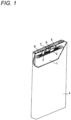
- FIG. 1 A partially cut-away schematic oblique view of a non-aqueous electrolyte secondary battery according to one embodiment of the present disclosure.
- a non-aqueous electrolyte secondary battery includes a positive electrode, a negative electrode, and a non-aqueous electrolyte, in which lithium metal deposits on the negative electrode during charge, and the lithium metal dissolves from the negative electrode into the non-aqueous electrolyte during discharge.
- the positive electrode includes a positive electrode active material, and the positive electrode active material includes a composite oxide containing lithium and a transition metal.
- the non-aqueous electrolyte contains an oxalate salt.
- the composite oxide contains, as the transition metal, Ni and at least one selected from the group consisting of Fe, V, Ti, and Nb, and has a structure based on a layered rock-salt type crystal structure belonging to a space group R-3m. This configuration can reduce the rate of gas generation when the battery generates heat.
- the composite oxide which is the positive electrode active material
- the composite oxide is thermally decomposed, to generate oxygen.
- a composite oxide containing Ni can realize a high capacity by increasing the Ni content, but is readily thermally decomposed. Due to the thermal decomposition, the crystal structure changes from the structure based on a layered rock-salt type crystal structure belonging to the space group R-3m to a structure based on a non-layered rock-salt type structure belonging to a space group Fm-3m, through which oxygen is released.
- the oxygen release speed can be slowed down.
- the rate of oxygen generation at the positive electrode is reduced, the rate of reaction between the oxygen generated from the positive electrode and the lithium metal deposited at the surface of the negative electrode is also reduced.
- the heat generation of the battery associated with the above reaction is suppressed, and further oxygen generation from the positive electrode can also be suppressed.
- the rise in battery internal pressure due to the oxygen generation from the positive electrode is suppressed.
- oxidative decomposition of the non-aqueous electrolyte due to the oxygen generated from the positive electrode is suppressed, and the rise in battery internal pressure due to the gas generation associated with the above oxidative decomposition is also suppressed.
- the non-aqueous electrolyte contains an oxalate salt.
- the oxalate salt is a salt containing a cation (e.g., lithium ion) and an anion of an oxalate complex.
- a cation e.g., lithium ion
- an anion of an oxalate complex e.g., lithium ion
- lithium metal tends to deposit uniformly in the form of fine particles, and local deposition of lithium metal in a dendritic form is suppressed.
- the surface area of the lithium metal is reduced, and the reaction between the oxygen generated from the positive electrode and the lithium metal is further suppressed, and the heat generation of the battery associated with the above reaction is further suppressed.
- the rise in battery internal pressure due to the oxygen generation from the positive electrode is further suppressed.
- the non-aqueous electrolyte containing an oxalate salt in combination with the composite oxide containing at least one selected from the group consisting of Fe, V, Ti, and Nb, the reaction between the oxygen generated from the positive electrode and the lithium metal is synergistically suppressed, and the heat generation of the battery can be remarkably suppressed. Furthermore, the rise in battery internal pressure due to the oxygen generation from the positive electrode is remarkably suppressed, and the damage to the battery case due to the rise in battery internal pressure is suppressed, leading to an improved battery safety.
- the oxalate salt is preferably lithium difluorooxalate borate (LiFOB).
- concentration of the oxalate salt (the concentration of the anion of the oxalate complex) in the non-aqueous electrolyte may be, for example, 0.05 mol/L or more and 1 mol/L or less.
- concentration of the oxalate salt in the non-aqueous electrolyte is preferably 0.2 mol/L or more and 0.6 mol/L or less, from the point of suppressing the reaction between the oxygen and the lithium metal.
- the composite oxide may further contain Al.
- Al By containing Al, the crystal structure of the composite oxide is stabilized, and the thermal stability is enhanced.
- the composite oxide may be represented by a general formula LiNi 1-x-y M 1 x M 2 y O 2 , where 0.03 ⁇ x ⁇ 0.15 and 0.02 ⁇ y ⁇ 0.6.
- M 1 contains at least one selected from the group consisting of Fe, Ti, V, and Nb.
- M 2 contains at least one selected from the group consisting of Al, Mn, and Co.
- the atomic ratio of Ni to the total of Ni, M 1 , and M 2 is preferably 0.55 or more and less than 1, more preferably 0.7 or more and less than 1, further more preferably 0.8 or more and less than 1. That is, in the above general formula, x+y ⁇ 0.45 is preferable, x+y ⁇ 0.3 is more preferable, and x+y ⁇ 0.2 is further more preferable.
- the Ni ratio is 0.7 or more (i.e., x+y is 0.3 or less)
- a large amount of oxygen is generated when the battery is exposed to high temperatures. Therefore, with the configuration of the present disclosure, an effect of suppressing the rise in battery internal pressure due to the oxygen generation from the positive electrode can remarkably obtained.
- the element M 1 50 atm% or more thereof may be iron (Fe), and 90 atm% or more or 95% or more thereof may be iron (Fe).
- the element M 1 may be substantially iron (Fe) only.
- the composite oxide may be represented by LiNi 1-x-y Fe x M 2 yO 2 , where 0.03 ⁇ x ⁇ 0.15 and 0.02 ⁇ y ⁇ 0.6.
- the element M 2 is added to the composite oxide.
- the element M 2 preferably contains at least aluminum (Al).
- M 2 may contain Al, and manganese (Mn) and/or cobalt (Co).
- M 2 contains Co, during charge and discharge, the phase transition of the composite oxide containing Li and Ni is suppressed, and the stability of the crystal structure is improved, and the cycle characteristics are likely to be improved.
- M 2 contains Mn and/or Al, the thermal stability is enhanced.
- the atomic ratio x of M 1 to the total of Ni, M 1 , and M 2 is preferably 0.06 ⁇ x ⁇ 0.15, more preferably 0.06 ⁇ x ⁇ 0.12, further more preferably 0.09 ⁇ x ⁇ 0.12.
- the atomic ratio y of M 2 to the total of Ni, M 1 , and M 2 is preferably 0.02 ⁇ y ⁇ 0.27, more preferably satisfies 0.02 ⁇ y ⁇ 0.1, in view of achieving a high capacity by increasing the Ni ratio while obtaining an effect of improving the stability of the composite oxide produced by the element M 2 .
- the atomic ratio of Co to the total of Ni, M 1 , and M 2 may be above 0 and 0.2 or less. In this case, high capacity and high output are likely to be maintained, and, the stability of the crystal structure during charge and discharge is likely to be improved.
- the element M 2 contains Al
- the atomic ratio of Al to the total of Ni, M 1 , and M 2 may be above 0 and 0.05 or less. In this case, high capacity and high output are likely to be maintained, and the thermal stability tends to be enhanced.
- the composite oxide may contain an element other than lithium, in addition to the above Ni, and the elements M 1 and M 2 .
- the composite oxide may contain at least one element selected from the group consisting of copper (Cu), chromium (Cr), zirconium (Zr), vanadium (V), tantalum (Ta), molybdenum (Mo), magnesium (Mg), calcium (Ca), strontium (Sr), zinc (Zn), silicon (Si), and boron (B).
- the non-aqueous electrolyte secondary battery of the present embodiment for example, 70% or more of the rated capacity is developed by the deposition and dissolution of lithium metal.
- the electron migration at the negative electrode during charge and during discharge is mainly due to the deposition and dissolution of lithium metal at the negative electrode.
- 70 to 100% (e.g., 80 to 100% or 90 to 100%) of the electron migration (in other words, current flow) at the negative electrode during charge and during discharge is due to the deposition and dissolution of lithium metal.
- the negative electrode in the non-aqueous electrolyte secondary battery according to the present embodiment differs from a negative electrode in which the electron migration at the negative electrode during charge and during discharge is mainly due to the absorption and release of lithium ions into or from the negative electrode active material (e.g., graphite).
- the negative electrode active material e.g., graphite
- the open circuit potential (OCV: Open Circuit Voltage) of the negative electrode at full charge is, for example, 70 mV or less, relative to lithium metal.
- OCV Open Circuit Voltage
- at full charge means a state in which the battery is charged to, for example, a charged state (SOC: State of Charge) of 0.98C or more, where C is the rated capacity of the battery.
- SOC State of Charge
- the OCV of the negative electrode at full charge is measured by disassembling a fully charged battery in an argon atmosphere, to take out the negative electrode therefrom, and assembling a cell with lithium metal used as a counter electrode.
- the non-aqueous electrolyte of the cell may be of the same composition as that of the non-aqueous electrolyte in the disassembled battery, or, for example, a non-aqueous electrolyte as used in Example 1 described hereinafter may be used as a model non-aqueous electrolyte.
- the positive electrode includes, for example, a positive electrode current collector, and a positive electrode mixture layer supported on a surface of the positive electrode current collector.
- the positive electrode mixture layer can be formed by applying a positive electrode slurry prepared by dispersing a positive electrode mixture in a dispersion medium, onto a surface of a positive electrode current collector, followed by drying. The applied film after drying may be rolled as needed.
- the positive electrode material mixture layer may be formed on one side of the positive electrode current collector, or may be formed on both sides thereof.
- the positive electrode mixture contains, as essential components, a positive electrode active material and an additive, and may contain, as optional components, a binder, a conductive agent, and the like.
- NMP N-methyl-2-pyrrolidone
- the binder may be a resin material, examples of which include fluorocarbon resin, polyolefin resin, polyamide resin, polyimide resin, acrylic resin, vinyl resin, and polyvinylpyrrolidone, polyethersulfone, and a rubbery material.
- fluorocarbon resin examples include polytetrafluoroethylene (PTFE) and polyvinylidene fluoride (PVDF).
- PVDF polyvinylidene fluoride
- the rubbery material include styrene-butadiene copolymer rubber (SBR).
- SBR styrene-butadiene copolymer rubber
- Examples of the conductive agent include: carbon blacks, such as acetylene black; conductive fibers, such as carbon fibers and metal fibers; and fluorinated carbon.
- the conductive agent may be used singly, or in combination of two or more kinds.
- the positive electrode current collector for example, a metal foil can be used.
- the metal constituting the positive electrode current collector include aluminum (Al), titanium (Ti), alloys containing these metal elements, and stainless steel.
- the thickness of the positive electrode current collector is not particularly limited, and is, for example, 3 to 50 ⁇ m.
- the negative electrode may include a negative electrode current collector.
- lithium metal deposits on the surface of the negative electrode current collector during charge, and the lithium metal deposited on the surface of the negative electrode current collector dissolves in the non-aqueous electrolyte during discharge.
- the negative electrode current collector for example, a metal foil can be used.
- the metal constituting the negative electrode current collector is preferably a metal that does not react with lithium metal, examples of which include copper (Cu), nickel (Ni), iron (Fe), and alloys containing these metal elements.
- the thickness of the negative electrode current collector is not particularly limited, and is, for example, 5 ⁇ m or more and 300 ⁇ m or less.
- the negative electrode may include a negative electrode current collector, and a negative electrode mixture layer supported on a surface of the negative electrode current collector.
- the thickness of the negative electrode mixture layer is set sufficiently thin so that lithium metal can deposit at the negative electrode during charge.
- a design capacity Cn accounted for by the negative electrode active material in the negative electrode mixture layer relative to a design capacity Cp of the positive electrode satisfies Cn/Cp ⁇ 1, and may satisfy Cn/Cp ⁇ 0.8.
- lithium metal deposits on the surface of the negative electrode mixture layer during charge, and the lithium metal deposited on the surface of the negative electrode mixture layer dissolves in the non-aqueous electrolyte during discharge.
- the negative electrode mixture layer can be formed, for example, by applying a negative electrode slurry prepared by dispersing a negative electrode mixture into a dispersion medium, onto a surface of the negative electrode current collector, followed by drying. The applied film after drying may be rolled as needed.
- the negative electrode mixture layer may be formed on one side of the negative electrode current collector, or may be formed on both sides thereof.
- As the dispersion medium for example, water or NMP is used.
- the negative electrode mixture contains a negative electrode active material, as an essential component, and may contain, as optional components, a binder, a conductive agent, a thickener, and the like.
- a binder As the binder and the conductive agent, those exemplified for the positive electrode can be used.
- the thickener include carboxymethyl cellulose (CMC) and modified products thereof (e.g., Na salts).
- the negative electrode active material may contain a carbon material that absorbs and releases lithium ions.
- the carbon material that absorbs and releases lithium ions include graphite (natural graphite, artificial graphite), graphitizable carbon (soft carbon), non-graphitizable carbon (hard carbon).
- graphite is preferable because of its excellent stability during charge and discharge and its low irreversible capacity.
- the negative electrode active material may contain an alloy-based material.
- the alloy-based material is a material containing at least one metal capable of forming an alloy with lithium, examples of which include silicon, tin, a silicon alloy, a tin alloy, and a silicon compound.
- the alloy-based material may be a composite material having a lithium ion conductive phase and silicon particles dispersed in the phase.
- a silicate phase, a silicon oxide phase containing 95 mass% or more of silicon dioxide, a carbon phase, and the like may be used as the lithium ion conductive phase.
- an alloy-based material and a carbon material may be used in combination.
- the mass ratio of the carbon material to the total of the alloy-based material and the carbon material is, for example, preferably 80 mass% or more, more preferably 90 mass% or more.
- the non-aqueous electrolyte contains lithium ions and anions, and has lithium ion conductivity.
- the non-aqueous electrolyte contains at least an oxalate salt.
- the non-aqueous electrolyte may be in a liquid form.
- the non-aqueous electrolyte in a liquid form contains, for example, lithium ions, anions, and a non-aqueous solvent.
- the non-aqueous electrolyte in a liquid form is prepared by dissolving a lithium salt in a non-aqueous solvent. When the lithium salt dissolves in the non-aqueous solvent, lithium ions and anions are produced.
- the non-aqueous electrolyte may be in a gel form.
- the non-aqueous electrolyte in a gel form contains, for example, lithium ions, anions, and a matrix polymer, and may further contain a non-aqueous solvent.
- a matrix polymer for example, a polymer material that forms a gel by absorbing the non-aqueous solvent is used. Examples of the polymer material include a fluorocarbon resin, an acrylic resin, and a polyether resin.
- the anions that can be used include, in addition to an oxalate complex anion, any known anions that are used for non-aqueous electrolytes in lithium secondary batteries. Specific examples thereof include BF 4 - , ClO 4 - , PF 6 - , CF 3 SO 3 - , CF 3 CO 2 - , and anions of imides.
- the oxalate complex anion may contain boron and/or phosphorus.
- Examples of the oxalate complex anion include B(C 2 O 4 ) 2 - , difluorooxalate borate anion: BF 2 (C 2 O 4 ) - , PF 4 (C 2 O 4 ) - , and PF 2 (C 2 O 4 ) 2 - .
- the anion may be used singly, or in combination of two or more kinds.
- the non-aqueous electrolyte preferably includes at least an oxalate complex anion.
- the oxalate complex anion interacts with lithium, to make lithium metal more likely to be deposited uniformly in a fine particulate state. Therefore, local deposition of lithium metal tends to be suppressed.
- the oxalate complex anion may be used in combination with one or more other anions.
- the other anions may be, for example, PF 6 - and/or anions of imides.
- the concentration of the anions in the non-aqueous electrolyte may be 0.5 mol/L or more and 3.5 mol/L or less.
- the concentration of the oxalate complex anion in the non-aqueous electrolyte may be 0.05 mol/L or more and 1 mol/L or less.
- non-aqueous solvent examples include esters, ethers, nitriles, amides, and halogen substituted derivatives of these.
- the non-aqueous solvent may be used singly, or in combination of two or more kinds.
- examples of the halogen substituted derivatives include fluorides.
- ester examples include cyclic carbonic acid esters, chain carbonic acid esters, cyclic carboxylic acid esters, and chain carboxylic acid esters.
- the cyclic carbonic acid esters are exemplified by ethylene carbonate (EC) and propylene carbonate (PC).
- the chain carbonic acid esters are exemplified by dimethyl carbonate (DMC), ethyl methyl carbonate (EMC), and diethyl carbonate (DEC).
- DMC dimethyl carbonate
- EMC ethyl methyl carbonate
- DEC diethyl carbonate
- the cyclic carboxylic acid esters are exemplified by ⁇ -butyrolactone (GBL) and ⁇ -valerolactone (GVL).
- the chain carboxylic acid esters are exemplified by ethyl acetate, propyl acetate, and methyl propionate (PM).
- Examples of the ethers include cyclic ethers and chain ethers.
- Examples of the cyclic ethers include 1,3-dioxolane, 4-methyl-1,3-dioxolane, tetrahydrofuran, and 2-methyltetrahydrofuran.
- Examples of the chain ethers include 1,2-dimethoxyethane, diethyl ether, ethyl vinyl ether, and 1,2-diethoxyethane.
- the non-aqueous electrolyte may contain at least one component selected from the group consisting of vinylene carbonate (VC), fluoroethylene carbonate (FEC), and vinyl ethylene carbonate (VEC).
- VC vinylene carbonate
- FEC fluoroethylene carbonate
- VEC vinyl ethylene carbonate
- the separator is excellent in ion permeability and has moderate mechanical strength and electrically insulating properties.
- the separator may be, for example, a microporous thin film, a woven fabric, or a nonwoven fabric.
- the separator is preferably made of polyolefin, such as polypropylene and polyethylene.
- the non-aqueous electrolyte secondary battery for example, has a structure in which an electrode group formed by winding the positive electrode and the negative electrode with the separator interposed therebetween is housed in an outer body, together with the non-aqueous electrolyte.
- the wound electrode group may be replaced with a different form of electrode group, for example, a stacked electrode group formed by stacking the positive electrode and the negative electrode with the separator interposed therebetween.
- the non-aqueous electrolyte secondary battery may be in any form, such as cylindrical type, prismatic type, coin type, button type, or laminate type.
- FIG. 1 is a partially cut-away schematic oblique view of a non-aqueous electrolyte secondary battery according to one embodiment of the present disclosure.
- the battery includes a bottomed prismatic battery case 4, and an electrode group 1 and a non-aqueous electrolyte housed in the battery case 4.
- the electrode group 1 has a long negative electrode, a long positive electrode, and a separator interposed between the positive electrode and the negative electrode and preventing them from directly contacting with each other.
- the electrode group 1 is formed by winding the negative electrode, the positive electrode, and the separator around a flat plate-like winding core, and then removing the winding core.
- a negative electrode lead 3 is attached at its one end, by means of welding or the like.
- the other end of the negative electrode lead 3 is electrically connected, via an insulating plate made of resin, to a negative electrode terminal 6 disposed at a sealing plate 5.
- the negative electrode terminal 6 is electrically insulated from the sealing plate 5 by a gasket 7 made of resin.
- a positive electrode lead 2 is attached at its one end, by means of welding or the like.
- the other end of the positive electrode lead 2 is connected, via the insulating plate, to the back side of the sealing plate 5. That is, the positive electrode lead 2 is electrically connected to the battery case 4 serving as a positive electrode terminal.
- the insulating plate provides electrical insulation between the electrode group 1 and the sealing plate 5 and between the negative electrode lead 3 and the battery case 4.
- the periphery of the sealing plate 5 is engaged with the opening end of the battery case 4, and the engaged portion is laser-welded. In this way, the opening of battery case 4 is sealed with the sealing plate 5.
- An injection port for non-aqueous electrolyte provided in the sealing plate 5 is closed with a sealing plug 8.
- a hydroxide containing Ni, Co, Al, Mn, and/or Fe in the ratios as shown in Table 1 was synthesized by a coprecipitation method, and the synthesized hydroxide was mixed with lithium hydroxide monohydrate (LiOH ⁇ H 2 O) so that the molar ratio of the total amount of the metal elements other than Li to Li was 1:1.02.
- the mixture was baked, under an oxygen flow with an oxygen concentration of 95% (flow rate: 5 L/min per 1 kg of the mixture), at a temperature elevation rate of 2.0 °C/min from room temperature to 650 °C, and then, baked at a temperature elevation rate of 1 °C/min from 650 °C to 780 °C, to give a composite oxide.
- the composite oxide after baking was washed with water, and subjected to solid-liquid separation, to obtain a positive electrode active material which is powder of a composite oxide having a water content of 3 to 8 mass%.
- the obtained positive electrode active material was mixed with acetylene black (AB) and polyvinylidene fluoride (PVDF), to prepare a positive electrode mixture.
- NMP N-methyl-2-pyrrolidone
- the mass ratio between the composite oxide, AB, and PVDF was set to 100:2:2.
- the positive electrode slurry was applied onto a surface of an aluminum foil (thickness: 15 ⁇ m) serving as a positive electrode current collector, and the applied film was dried, and then rolled. In this manner, a positive electrode material mixture layer was formed on both sides of the aluminum foil, to give a laminate.
- the laminate was cut into a predetermined size, to obtain a positive electrode.
- a positive electrode current collector-exposed portion that does not have the positive electrode mixture layer was formed.
- a positive electrode lead made of aluminum was attached at its one end, by means of welding.
- An electrolytic copper foil (thickness: 10 ⁇ m) serving as a negative electrode current collector was cut into a predetermined size, to obtain a negative electrode.
- a negative electrode lead made of nickel was attached at its end, by means of welding.
- a non-aqueous electrolyte was prepared by dissolving LiPF 6 and LiBF 2 (C 2 O 4 ) in a non-aqueous solvent.
- the non-aqueous solvent used here was a mixed solvent containing fluoroethylene carbonate (FEC), ethyl methyl carbonate (EMC), and dimethyl carbonate (DMC) in a volume ratio of 20:5:75.
- the concentration of LiPF 6 in the non-aqueous electrolyte was set to 1.0 mol/L.
- the concentration of LiBF 2 (C 2 O 4 ) in the non-aqueous electrolyte was set to 0.5 mol/L.
- the positive electrode and the negative electrode were wound with a separator made of polyethylene interposed therebetween, to prepare a wound electrode group.
- the electrode group was housed in a battery case also serving as a negative electrode terminal.
- an upper insulating plate and a lower insulating plate both made of resin were placed on the top and the bottom of the electrode group, respectively.
- the battery case used here was a bottomed cylindrical iron case (outer diameter: 21 mm, height: 70 mm).
- the non-aqueous electrolyte was injected into the battery case, and then, the opening of the battery case was closed using a metal sealing body also serving as a positive electrode terminal.
- non-aqueous electrolyte secondary batteries A1 to A4 and B1 differing in the composition of the composite oxide were produced.
- the batteries A1 to A4 correspond to Examples 1 to 4
- the battery B1 corresponds to Comparative Example 1.
- non-aqueous electrolyte secondary batteries B2 and B3 were produced.
- the batteries B2 and B3 correspond to Comparative Examples 2 and 3.
- the negative electrode mixture used here was a mixture of artificial graphite (average particle diameter: 25 ⁇ m), styrene-butadiene rubber (SBR), and sodium carboxymethylcellulose (CMC-Na).
- SBR styrene-butadiene rubber
- CMC-Na sodium carboxymethylcellulose
- the mass ratio between the artificial graphite, SBR, and CMC-Na was set to 100:1:1.
- the negative electrode slurry was applied onto a surface of a copper foil, and the applied film was dried, and then rolled, to give a laminate having a negative electrode mixture layer formed on both sides of the copper foil.
- the laminate was cut into a predetermined size, to produce a negative electrode.
- a non-aqueous electrolyte was prepared by dissolving LiPF 6 at a concentration of 1.2 mol/L in a mixed solvent of ethylene carbonate (EC) and diethyl carbonate (DEC) (1:1 by volume ratio).
- the negative electrode and the non-aqueous electrolyte obtained above were used.
- a battery C1 was produced.
- the thickness of the negative electrode mixture layer was adjusted so as not to allow Li metal to deposit on the surface of the negative electrode during charge. That is, the design capacity Cn of the negative electrode accounted for by the negative electrode active material in the negative electrode mixture layer was set higher than the design capacity Cp of the positive electrode.
- the batteries A1 to A4, B1 to B3, and C1 were evaluated as follows.
- the batteries in a fully charged state were each housed in a sealed container, and an internal short circuit was caused in the battery by nail penetration, so that the battery generates heat. At this time, the changes over time in the amount of gas generated from the battery were measured.
- the gas generation rate was expressed, as an index, with the gas generation rate of the battery B1 of Comparative Example 1 taken as 100.
- Table 1 shows the composition of the composite oxide used in each battery and whether the electrolyte was with or without the addition of LiFOB, together with the evaluation results of the gas generation rate.
- Table 1 Battery Composition of composite oxide Electrolyte Gas generation rate Ni Co Al Mn Fe LiFOB A1 80% 2% 3% 5% 10% With 4.5 A2 85% - 3% - 12% With 30.6 A3 88% - 3% - 9% With 30.6 A4 91% - 3% - 6% With 65.6 B1 91% 4.5% 4.5% - - With 100 B2 91% 4.5% 4.5% - - Without 149 B3 80% 2% 3% 5% 10% Without 137 C1 91% 4.5% 4.5% - - Without 11.8
- Comparison between the battery B1 and the battery B2 including the composite oxides having the same composition shows that in the battery B 1, in which LiFOB was added to the electrolyte, the gas generation rate was reduced to approximately 2/3 of that of the battery B2.
- comparison between the battery A1 and the battery B3 including the composite oxides having the same composite shows that, in the battery A1 containing Fe in the composite oxide, in which LiFOB was added to the electrolyte, the gas generation rate was reduced to as small as approximately 1/30 of that of battery B3, and a remarkable improvement in gas generation rate was observed.
- the non-aqueous electrolyte secondary battery according to the present disclosure is suitably used as, for example, a power source for mobile devices such as smartphones, a driving power source for vehicles such as electric cars, and a power storage apparatus for storing natural energy such as solar energy.
Landscapes
- Chemical & Material Sciences (AREA)
- Chemical Kinetics & Catalysis (AREA)
- Electrochemistry (AREA)
- General Chemical & Material Sciences (AREA)
- Engineering & Computer Science (AREA)
- Inorganic Chemistry (AREA)
- Materials Engineering (AREA)
- Manufacturing & Machinery (AREA)
- Physics & Mathematics (AREA)
- Condensed Matter Physics & Semiconductors (AREA)
- General Physics & Mathematics (AREA)
- Secondary Cells (AREA)
- Battery Electrode And Active Subsutance (AREA)
Applications Claiming Priority (2)
| Application Number | Priority Date | Filing Date | Title |
|---|---|---|---|
| JP2020164937 | 2020-09-30 | ||
| PCT/JP2021/035243 WO2022071175A1 (fr) | 2020-09-30 | 2021-09-27 | Accumulateur à électrolyte non aqueux |
Publications (2)
| Publication Number | Publication Date |
|---|---|
| EP4224558A1 true EP4224558A1 (fr) | 2023-08-09 |
| EP4224558A4 EP4224558A4 (fr) | 2024-10-09 |
Family
ID=80949134
Family Applications (1)
| Application Number | Title | Priority Date | Filing Date |
|---|---|---|---|
| EP21875477.8A Pending EP4224558A4 (fr) | 2020-09-30 | 2021-09-27 | Accumulateur à électrolyte non aqueux |
Country Status (5)
| Country | Link |
|---|---|
| US (1) | US20230369582A1 (fr) |
| EP (1) | EP4224558A4 (fr) |
| JP (1) | JP7796335B2 (fr) |
| CN (1) | CN116261789A (fr) |
| WO (1) | WO2022071175A1 (fr) |
Family Cites Families (10)
| Publication number | Priority date | Publication date | Assignee | Title |
|---|---|---|---|---|
| JPH09259929A (ja) | 1996-03-21 | 1997-10-03 | Japan Storage Battery Co Ltd | リチウム二次電池 |
| JP2005219978A (ja) * | 2004-02-06 | 2005-08-18 | Japan Storage Battery Co Ltd | リチウムニッケル複合酸化物の製造方法およびそれを用いた非水電解質二次電池 |
| US10044066B2 (en) * | 2012-06-01 | 2018-08-07 | Solvary SA | Fluorinated electrolyte compositions |
| KR101583125B1 (ko) * | 2014-01-06 | 2016-01-08 | 한국교통대학교산학협력단 | 철 이온 도핑된 리튬이차전지용 nca계열 양극활물질, 그 양극활물질의 제조방법 및 그 양극활물질을 포함한 리튬이차전지 |
| WO2018025621A1 (fr) * | 2016-08-03 | 2018-02-08 | 日本電気株式会社 | Solution d'électrolyte non aqueuse et batterie secondaire au lithium-ion |
| JP6917586B2 (ja) * | 2017-03-28 | 2021-08-11 | パナソニックIpマネジメント株式会社 | 非水電解質二次電池 |
| CN107240684A (zh) * | 2017-06-08 | 2017-10-10 | 华中科技大学 | 一种表面改性的锂电池高镍正极材料的制备方法及产品 |
| EP3726636B1 (fr) * | 2017-12-12 | 2024-06-26 | Central Glass Company, Limited | Solution électrolytique pour batteries à électrolyte non aqueux, et batterie à électrolyte non aqueux l'utilisant |
| US11362333B2 (en) * | 2019-01-23 | 2022-06-14 | Ut-Battelle, Llc | Cobalt-free layered oxide cathodes |
| CN110931875B (zh) * | 2019-12-24 | 2023-02-07 | 哈尔滨工业大学 | 一种耦合有机锂盐和氟代碳酸乙烯酯的丁二腈基电解液、制备方法及其应用 |
-
2021
- 2021-09-27 EP EP21875477.8A patent/EP4224558A4/fr active Pending
- 2021-09-27 JP JP2022553927A patent/JP7796335B2/ja active Active
- 2021-09-27 US US18/029,209 patent/US20230369582A1/en active Pending
- 2021-09-27 WO PCT/JP2021/035243 patent/WO2022071175A1/fr not_active Ceased
- 2021-09-27 CN CN202180066723.XA patent/CN116261789A/zh active Pending
Also Published As
| Publication number | Publication date |
|---|---|
| WO2022071175A1 (fr) | 2022-04-07 |
| JP7796335B2 (ja) | 2026-01-09 |
| CN116261789A (zh) | 2023-06-13 |
| JPWO2022071175A1 (fr) | 2022-04-07 |
| EP4224558A4 (fr) | 2024-10-09 |
| US20230369582A1 (en) | 2023-11-16 |
Similar Documents
| Publication | Publication Date | Title |
|---|---|---|
| US9331361B2 (en) | Nonaqueous electrolyte secondary battery and production method thereof | |
| JP5582587B2 (ja) | リチウムイオン二次電池 | |
| US20160351905A1 (en) | Nonaqueous-electrolyte secondary battery and method for manufacturing nonaqueous-electrolyte secondary battery | |
| US10818911B2 (en) | Positive-electrode active material and battery | |
| US20130122373A1 (en) | Lithium ion secondary battery | |
| US20170365860A1 (en) | Nonaqueous electrolyte battery | |
| JP2008108689A (ja) | 非水電解質二次電池 | |
| JP2010062113A (ja) | リチウムイオン二次電池 | |
| JP2011090876A (ja) | リチウム二次電池および該電池の製造方法 | |
| US20130337344A1 (en) | Lithium ion secondary battery | |
| CN112689916A (zh) | 蓄电元件 | |
| US8980482B2 (en) | Nonaqueous electrolyte lithium ion secondary battery | |
| EP3993106A1 (fr) | Matériau actif d'électrode positive pour une batterie rechargeable à électrolyte non aqueux, batterie rechargeable à électrolyte non aqueux et procédé de fabrication d'un matériau actif d'électrode positive pour une batterie rechargeable à électrolyte non aqueux | |
| CN117941101B (zh) | 正极活性材料及其制备方法、极片、二次电池及用电装置 | |
| JP5017010B2 (ja) | リチウム二次電池 | |
| EP4224558A1 (fr) | Accumulateur à électrolyte non aqueux | |
| US12406988B2 (en) | Non-aqueous electrolyte secondary battery | |
| US12401062B2 (en) | Nonaqueous electrolyte secondary battery | |
| EP4254541A1 (fr) | Électrode positive pour batterie secondaire à électrolyte non aqueux et batterie secondaire à électrolyte non aqueux | |
| EP4191724A1 (fr) | Batterie secondaire au lithium | |
| JP2025154203A (ja) | リチウムイオン二次電池およびリチウムイオン二次電池モジュール | |
| EP4704209A1 (fr) | Liquide électrolytique non aqueux et batterie secondaire à électrolyte non aqueux | |
| JP2025154209A (ja) | リチウムイオン二次電池およびリチウムイオン二次電池モジュール | |
| JP2025154206A (ja) | リチウムイオン二次電池およびリチウムイオン二次電池モジュール | |
| CN119133436A (zh) | 一种富镍多元正极材料及其制备方法和应用 |
Legal Events
| Date | Code | Title | Description |
|---|---|---|---|
| STAA | Information on the status of an ep patent application or granted ep patent |
Free format text: STATUS: THE INTERNATIONAL PUBLICATION HAS BEEN MADE |
|
| PUAI | Public reference made under article 153(3) epc to a published international application that has entered the european phase |
Free format text: ORIGINAL CODE: 0009012 |
|
| STAA | Information on the status of an ep patent application or granted ep patent |
Free format text: STATUS: REQUEST FOR EXAMINATION WAS MADE |
|
| 17P | Request for examination filed |
Effective date: 20230329 |
|
| AK | Designated contracting states |
Kind code of ref document: A1 Designated state(s): AL AT BE BG CH CY CZ DE DK EE ES FI FR GB GR HR HU IE IS IT LI LT LU LV MC MK MT NL NO PL PT RO RS SE SI SK SM TR |
|
| DAV | Request for validation of the european patent (deleted) | ||
| DAX | Request for extension of the european patent (deleted) | ||
| A4 | Supplementary search report drawn up and despatched |
Effective date: 20240905 |
|
| RIC1 | Information provided on ipc code assigned before grant |
Ipc: H01M 4/02 20060101ALN20240830BHEP Ipc: H01M 4/62 20060101ALN20240830BHEP Ipc: H01M 10/42 20060101ALI20240830BHEP Ipc: H01M 4/38 20060101ALI20240830BHEP Ipc: H01M 4/134 20100101ALI20240830BHEP Ipc: H01M 10/0568 20100101ALI20240830BHEP Ipc: H01M 10/052 20100101ALI20240830BHEP Ipc: H01M 4/525 20100101ALI20240830BHEP Ipc: H01M 4/505 20100101ALI20240830BHEP Ipc: H01M 4/131 20100101AFI20240830BHEP |