EP4224664A1 - Dispositif de boîtier - Google Patents
Dispositif de boîtier Download PDFInfo
- Publication number
- EP4224664A1 EP4224664A1 EP22155595.6A EP22155595A EP4224664A1 EP 4224664 A1 EP4224664 A1 EP 4224664A1 EP 22155595 A EP22155595 A EP 22155595A EP 4224664 A1 EP4224664 A1 EP 4224664A1
- Authority
- EP
- European Patent Office
- Prior art keywords
- circuit board
- charging port
- case device
- main housing
- charging
- Prior art date
- Legal status (The legal status is an assumption and is not a legal conclusion. Google has not performed a legal analysis and makes no representation as to the accuracy of the status listed.)
- Pending
Links
Images

Classifications
-
- H—ELECTRICITY
- H02—GENERATION; CONVERSION OR DISTRIBUTION OF ELECTRIC POWER
- H02J—ELECTRIC POWER NETWORKS; CIRCUIT ARRANGEMENTS OR SYSTEMS FOR SUPPLYING OR DISTRIBUTING ELECTRIC POWER; SYSTEMS FOR STORING ELECTRIC ENERGY
- H02J7/00—Circuit arrangements for charging or discharging batteries or for supplying loads from batteries
- H02J7/70—Circuit arrangements for charging or discharging batteries or for supplying loads from batteries characterised by the mechanical construction
-
- H—ELECTRICITY
- H02—GENERATION; CONVERSION OR DISTRIBUTION OF ELECTRIC POWER
- H02J—ELECTRIC POWER NETWORKS; CIRCUIT ARRANGEMENTS OR SYSTEMS FOR SUPPLYING OR DISTRIBUTING ELECTRIC POWER; SYSTEMS FOR STORING ELECTRIC ENERGY
- H02J7/00—Circuit arrangements for charging or discharging batteries or for supplying loads from batteries
- H02J7/70—Circuit arrangements for charging or discharging batteries or for supplying loads from batteries characterised by the mechanical construction
- H02J7/731—Circuit arrangements for charging or discharging batteries or for supplying loads from batteries characterised by the mechanical construction specially adapted for holding portable devices containing batteries
-
- A—HUMAN NECESSITIES
- A45—HAND OR TRAVELLING ARTICLES
- A45C—PURSES; LUGGAGE; HAND CARRIED BAGS
- A45C11/00—Receptacles for purposes not provided for in groups A45C1/00-A45C9/00
-
- A—HUMAN NECESSITIES
- A62—LIFE-SAVING; FIRE-FIGHTING
- A62C—FIRE-FIGHTING
- A62C3/00—Fire prevention, containment or extinguishing specially adapted for particular objects or places
- A62C3/16—Fire prevention, containment or extinguishing specially adapted for particular objects or places in electrical installations, e.g. cableways
-
- H—ELECTRICITY
- H02—GENERATION; CONVERSION OR DISTRIBUTION OF ELECTRIC POWER
- H02J—ELECTRIC POWER NETWORKS; CIRCUIT ARRANGEMENTS OR SYSTEMS FOR SUPPLYING OR DISTRIBUTING ELECTRIC POWER; SYSTEMS FOR STORING ELECTRIC ENERGY
- H02J7/00—Circuit arrangements for charging or discharging batteries or for supplying loads from batteries
- H02J7/60—Circuit arrangements for charging or discharging batteries or for supplying loads from batteries including safety or protection arrangements
-
- H—ELECTRICITY
- H02—GENERATION; CONVERSION OR DISTRIBUTION OF ELECTRIC POWER
- H02J—ELECTRIC POWER NETWORKS; CIRCUIT ARRANGEMENTS OR SYSTEMS FOR SUPPLYING OR DISTRIBUTING ELECTRIC POWER; SYSTEMS FOR STORING ELECTRIC ENERGY
- H02J7/00—Circuit arrangements for charging or discharging batteries or for supplying loads from batteries
- H02J7/60—Circuit arrangements for charging or discharging batteries or for supplying loads from batteries including safety or protection arrangements
- H02J7/65—Circuit arrangements for charging or discharging batteries or for supplying loads from batteries including safety or protection arrangements against overtemperature
-
- H—ELECTRICITY
- H02—GENERATION; CONVERSION OR DISTRIBUTION OF ELECTRIC POWER
- H02J—ELECTRIC POWER NETWORKS; CIRCUIT ARRANGEMENTS OR SYSTEMS FOR SUPPLYING OR DISTRIBUTING ELECTRIC POWER; SYSTEMS FOR STORING ELECTRIC ENERGY
- H02J7/00—Circuit arrangements for charging or discharging batteries or for supplying loads from batteries
- H02J7/70—Circuit arrangements for charging or discharging batteries or for supplying loads from batteries characterised by the mechanical construction
- H02J7/751—Circuit arrangements for charging or discharging batteries or for supplying loads from batteries characterised by the mechanical construction concerning the insertion or the connection of the batteries
-
- H—ELECTRICITY
- H04—ELECTRIC COMMUNICATION TECHNIQUE
- H04R—LOUDSPEAKERS, MICROPHONES, GRAMOPHONE PICK-UPS OR LIKE ACOUSTIC ELECTROMECHANICAL TRANSDUCERS; ELECTRIC HEARING AIDS; PUBLIC ADDRESS SYSTEMS
- H04R1/00—Details of transducers, loudspeakers or microphones
- H04R1/10—Earpieces; Attachments therefor ; Earphones; Monophonic headphones
- H04R1/1025—Accumulators specially adapted for earpieces; Arrangements specially adapted for charging thereof
-
- A—HUMAN NECESSITIES
- A45—HAND OR TRAVELLING ARTICLES
- A45C—PURSES; LUGGAGE; HAND CARRIED BAGS
- A45C11/00—Receptacles for purposes not provided for in groups A45C1/00-A45C9/00
- A45C11/003—Receptacles for purposes not provided for in groups A45C1/00-A45C9/00 for storing portable computing devices, e.g. laptops, tablets or calculators
-
- H—ELECTRICITY
- H04—ELECTRIC COMMUNICATION TECHNIQUE
- H04R—LOUDSPEAKERS, MICROPHONES, GRAMOPHONE PICK-UPS OR LIKE ACOUSTIC ELECTROMECHANICAL TRANSDUCERS; ELECTRIC HEARING AIDS; PUBLIC ADDRESS SYSTEMS
- H04R2225/00—Details of deaf aids covered by H04R25/00, not provided for in any of its subgroups
- H04R2225/31—Aspects of the use of accumulators in hearing aids, e.g. rechargeable batteries or fuel cells
Definitions
- the present invention relates to a case device.
- Battery operated products are becoming a vital part of our lives, as more people bring their electronic devices with them when on the move. Since battery operated products are continuing to gain traction, the need for better and faster battery charging is of the essence.
- the temperatures generated may transfer to other components of the case device, e.g., the battery associated with the charging port.
- the transferred heat from the charging port may result in the battery itself starting to undergo a thermal runaway event.
- the temperature of the battery may rise rapidly leading to the battery catching fire, and in some cases the battery may even explode. As the battery catches fire, it may act as a fire starter. Elevated temperatures in the battery may also lead to reduced performance of the battery i.e., deterioration of charging and discharging characteristics, and reduced battery life.
- the charging port itself may be heated to elevated temperatures, the applicant has during tests on USB-C charging ports measured temperatures as high as 550°C in the charging port. Consequently, the charging port itself may pose a fire hazard.
- the heat generated at the charging port may negatively affect other components in the vicinity of the charging port.
- a case device comprising a main housing comprising a charging opening extending longitudinally with a first length in a longitudinal direction, a rechargeable battery arranged within the main housing, a charging port electrically connected to the rechargeable battery to allow for recharging of the rechargeable battery, and wherein the charging port is accessible by a user of the case device via the charging opening, a first circuit board arranged within the first main housing, wherein the charging port is attached to the first circuit board, and wherein the charging port is electrically connected to the first circuit board, characterized in that, the case device comprises a clamping device attached to the first circuit board and being configured for clamping the charging port onto the first circuit board.
- the charging port By clamping the charging port to the first circuit board it prevents the charging port from being separated from the first circuit board during a thermal runaway event.
- the risk of the charging port separating from the first circuit board is especially pronounced during a thermal runaway event at the charging port.
- the attachment between the charging port and first circuit board may deteriorate because of the elevated temperatures, e.g., detachment may occur because of the charging port unsoldering from the first circuit board.
- a thermal runaway event is to be understood as a process which generates heat which in return further accelerates the process, hence reaching higher and higher temperatures.
- the release of heat from the process may slow down or fully stop thermal runaway events.
- a thermal runaway event may take place at the charging port caused by dirt or liquids short circuiting the charging port.
- a thermal runaway event may take place at the rechargeable battery caused by elevated temperatures, e.g., because of heat generated at the charging port.
- a casing device may be any device configured to hold and/or to protect something.
- the casing device itself may form part of a larger housing.
- the casing device may be a modular component.
- the casing device may be a charging cradle for one or more wireless devices, e.g., a charging cradle for earbuds or a hearing aid.
- the casing device may be an earcup forming part of a headset.
- the main housing may assume any desired shape.
- the main housing preferably comprises a hollow interior configured for receiving one or more items.
- the main housing may be separated into sub housings by means of a partition.
- the main housing comprises a first sub housing and a second sub housing.
- the first sub housing may define a first hollow interior for receiving one or more items e.g., a pair of earbuds.
- the second sub housing may define a second hollow interior for housing one or more components.
- the second sub housing is configured for housing one or more electrical components, such as the rechargeable battery, the charging port, and/or the first circuit board.
- the main housing may be an earcup of a headset or a charging cradle comprising one or more electrical and/or mechanical components, e.g., speakers, microphones, input transducers, LEDs (Light emitting diodes), a processor, a transceiver for wireless communication etc.
- electrical and/or mechanical components e.g., speakers, microphones, input transducers, LEDs (Light emitting diodes), a processor, a transceiver for wireless communication etc.
- the charging opening may assume a rectangular shape, a circular shape, or any other shape.
- the charging opening is preferably formed with a complementary shape to the charging port.
- the charging opening is preferably formed in an outer surface of the main housing.
- the charging opening may be formed as an integral part of the main housing.
- the charging opening may be formed together with the main housing by a molding process.
- the rechargeable battery may be an electrical battery.
- the rechargeable battery may be capable of being discharged and charged with an electrical load several times.
- the first circuit board may be any type of printed circuit board.
- the first circuit board is formed with a rigid dielectric substrate.
- the charging port may be attached to the first circuit board via soldering, glue, or mechanical fixation.
- the charging port may comprise one or more protrusions for being inserted into one or more complementary shaped holes formed in the first circuit board.
- the one or more protrusions of the charging port may be soldered or glued to the first circuit board, thereby attaching the charging port to the first circuit board.
- the one or more protrusions of the charging port electrically connects the charging port with the first circuit board.
- the charging port may be a USB-C port, USB-A port, USB-B mini port, USB-B micro port, USB-C port or a lightning port or any other type charging port allowing for a power transfer.
- the charging port may be any charging connector capable of facilitating an electrical connection between the rechargeable battery and a power source external to the case device.
- the clamping device may be formed from a heat resistant material such as a heat resistant steel alloy or other heat resistant metal alloys, alternatively the clamping device may be formed from a ceramic.
- the clamping device may be configured to deliver an adjustable clamping force to the charging port.
- the clamping force may be adjustable by a lever, a screw, or a cam.
- the clamping device may be configured to deliver a fixed clamping force to the charging port. In some embodiments it may be advantageous to have the clamping force fixed to minimize the number of movable components to keep the clamping device simple and easy to manufacture and mount.
- the clamping device may be formed from a single element or a plurality of interconnected elements.
- the clamping device is formed from a resilient material, wherein the clamping device is configured to deform to thereby deliver the clamping force.
- the clamping device may be connected to the first circuit board by a mechanical connection, by glue, or by soldering.
- the clamping device is attached to the first circuit board by a snap-fit attachment.
- a snap-fit attachment may be considered as an attachment obtained by pushing interlocking components of the clamping device and the first circuit board together.
- the snap-fit attachment is achieved by having the clamping device snapping onto the edges of the first circuit board.
- the first circuit board comprises an attachment through-going hole
- the clamping device comprises a snap connector configured for being inserted through the through-going hole to provide the snap-fit attachment
- the through-going hole is formed with complementary shape to the snap connector to ensure a snug fit between the through-going hole and the snap connector.
- the attachment through-going hole is formed as a substantially circular through-going hole, however the attachment through-going hole may alternatively be formed as a slit or as a rectangular hole.
- the snap connector is preferably formed as a resilient element.
- the snap connector may be configured to undergo a compressive deformation while being inserted into the attachment through-going hole, and upon passing through the attachment through-going hole the snap connector expands, thus achieving the snap-fit attachment.
- the snap connector is formed with a V-shape.
- the V-shape may provide the snap-fit attachment by having the legs of the V-shape move towards each other while inserting the snap connector into the attachment through-going hole, and upon passing through the attachment through-going hole the legs of the V-shape move away from each other to achieve the snap-fit attachment.
- the movement of the legs of the V-shape towards each other is caused by the span of the legs being larger than at least one dimension of the attachment through-going hole, hence leading to the legs abutting the edges of the attachment through-going hole while being inserted into the attachment through-going hole, after the legs have passed the attachment through-going hole the legs are not limited by the edges of the attachment through-going hole, and are thus allowed to move away from each other.
- V-shape has been described for the snap connector, other shapes such as U-shapes, L-shapes, hook shapes, etc. are equally applicable.
- the charging port comprises a first port side facing the first circuit board, and wherein the charging port comprises a second port side opposite the first port side, and wherein the clamping device extends over the second port side and exerts a clamping force onto the second port side towards the first port side.
- the first port side and/or the second port side may be formed as substantially planar sides.
- the first port side and/or the second port side may be formed as curving sides, e.g., each forming a half-circle.
- the first port side and/or the second port side are formed as substantially planar sides to allow for a large contact area with the clamping device to be achieved.
- the clamping device may extend over opposing ends of the second port side. Having the clamping device extending over opposing ends of the second port side may help in delivering a uniform clamping pressure to the charging port.
- the clamping device may extend in a meandering pattern over the second port side, e.g., extending in a S-pattern, an M-pattern or similar as opposed to extending simply in a straight line over the second port side. Having the clamping device extending in a meandering path over opposing ends of the second port side may help in delivering a uniform clamping pressure to the charging port.
- the clamping device is formed to conform with the second port side to allow for a large contact area between the clamping device and the second port side, thus assuring a uniform clamping pressure to be delivered to the charging port.
- a uniform clamping may prevent local clamping pressures from deforming the charging port, and to ease mounting of the clamping device onto the charging port.
- the clamping device may deliver a clamping force onto several port side of the charging port, to further enlarge the contact area between the clamping device and the charging port.
- the first circuit board comprises an attachment interface for connecting the first circuit board to the main housing, and wherein the first circuit board comprises a barrier hole arranged in-between the charging port and the attachment interface.
- heat generated at the charging port may be obstructed or at least hindered from reaching the attachment interface, and thereby deteriorating the connection between the first circuit board and the main housing. Especially heat conducted through the first circuit board is hindered from reaching the attachment interface.
- the attachment interface may be a through-going hole for receiving a screw, in such cases the main housing may comprise an associated screw tower for receiving the screw.
- the attachment interface may be a glue pad, a snap-lock or any other mechanical engagement between the plastic housing and circuit board.
- Different connection types may undergo severe deterioration in situations with elevated heat e.g., the thread of the screw tower may partially melt or otherwise structurally weaken, or the glue associated with a glue pad may turn less viscous, thus going from a solid state to a more liquid state. Hence, hindering heat from reaching the attachment interface may ensure a good connection between the main housing and the first circuit board.
- the first circuit board may comprise one or more attachment interfaces for connecting the first circuit board to the main housing.
- the barrier hole may be formed as slot extending in-between the attachment interface and the charging port.
- the barrier hole is configured for limiting heat conduction through the first circuit board between the charging port and the attachment interface.
- the barrier hole may extend the path heat generated at the charging port must travel through the first circuit board to reach the attachment interface or create a torturous path heat must travel through.
- the barrier hole may extend fully through the first circuit board to form a through-going hole.
- the barrier hole may extend partly through the first circuit board, thus forming a groove or an indentation in the first circuit board.
- the case device comprises a second circuit board arranged within the main housing separate from the first circuit board, wherein the rechargeable battery is attached to the second circuit board.
- Arranging the rechargeable battery on the second circuit board may ease handling of the rechargeable battery during manufacturing and ease the creation of electrical interfaces between the rechargeable battery and other electrical components of the case device.
- the rechargeable battery is not arranged on a second board, and instead arranged separately from the first circuit board inside the main housing.
- the rechargeable battery is arranged on the first circuit board.
- the case device comprises a third circuit board, wherein the first circuit board is electrically connected to the second circuit board by the third circuit board, and wherein the third circuit board is a flexible circuit board.
- first circuit board and the second circuit board are electrically connected by one or more wires.
- the main housing is formed from a polymer material with a glass transition temperature below 130°C, preferably below 128°C, even more preferred below 125°C.
- the main housing may melt and/or deform to allow for heat to be transported away from the main housing to an external environment.
- the charging opening may expand to allow for a higher heat convection to an environment external to the main housing, thus lessening the risk of a thermal runaway event taking place at the charging port.
- the applicant has found that some lithium-ion batteries undergo a thermal runaway at a temperature of around 132 °C, consequently, by having the glass transitioning below 130°C it may assure the battery itself will not be able to reach a thermal runaway temperature before the main housing melts and/or deforms to allow for a higher heat transport away from the main housing, thereby halting or stopping the thermal runaway event happening at charging port, and thus halting or stopping the thermal runaway event from taking place at the rechargeable battery.
- the main housing is formed from a polymer material with an ignition temperature above 550°C, preferably above 560°C, even more preferred above 570°C.
- the first circuit board extends longitudinally with a second length in the longitudinal direction, wherein the second length is larger than the first length, preferably the second length is more than one and a half times larger than the first length, even more preferred more than two times larger.
- the first circuit board is hindered from falling out of the main housing and thus posing a fire hazard.
- the charging opening may be prone to deformation from elevated temperature as the charging opening is in proximity to the charging port.
- the case device comprises a thermally insulating material insulating the charging port from the rechargeable battery.
- the thermally insulating material may insulate the charging port from the rechargeable battery by partly or fully enclosing the charging port.
- the thermally insulating material may insulate the charging port from the rechargeable battery by being arranged in-between the rechargeable battery and the charging port.
- the thermally insulating material may be made with any material configured for withstanding elevated temperatures, e.g., above 550 °C, preferably above 560°C, even more preferred above 570°C.
- the thermally insulating material being configured to hinder heat transport through the thermally insulating material.
- the thermally insulating may comprise ceramic fibers such as silicate fibers.
- the thermally insulating material preferably has a heat conductivity at 20°C below 1.5Wm -1 K -1 , even more preferred below 1Wm -1 K -1, and even more preferred below 0.5Wm -1 K -1 .
- the thermally insulating material forms a thermal chamber with the first circuit board and the main housing, and wherein the charging port is arranged within the thermal chamber.
- heat may be encapsulated and hindered from reaching other sensitive components of the case device.
- an oven-like effect may be created with a localized heating at the charging port, such high localized heating may facilitate melting or other structural degradation at the charging opening, thus enlarging the charging opening and facilitating increased heat convection away from the charging port.
- heat generated at the charging port reaches the rechargeable battery heat may be lead away from the case device.
- the thermal chamber may substantially enclose the charging port from the rest of the electrical components of the main housing.
- the thermal chamber is formed by the thermally insulating material and the first circuit board substantially abutting and/or extending in near proximity to the main housing, e.g., extending within 3mm, 2mm, 1mm, 0.5mm of the main housing, thus forming a substantially enclosed space for the charging port.
- the thermally insulating material, the first circuit board, and the main housing may form walls of the thermal chamber. Heat may escape the thermal chamber through the charging opening.
- the thermally insulating material has a thickness of 1mm - 5mm, preferably 2mm - 4mm.
- the thickness of the thermally insulating material may be understood as the amount of thermally insulating material blocking the direct path between the charging port and the rechargeable battery. For example, if the thermally insulating material has a thickness of 3mm, heat developed at the charging port would have the direct path between the insulating material and the rechargeable battery obstructed by 3mm of the thermally insulating material.
- the direct path should be interpreted as the smallest distance between two objects.
- movement of the thermally insulating material is delimited by the first circuit board and the main housing.
- the charging port is a USB-C port.
- the main housing is configured for storing one or more hearing devices, and wherein the rechargeable battery is configured charging the one or more hearing devices stored by the case device.
- the case device may be formed as an ear cup of a headset, wherein the rechargeable battery is configured to power the headset.
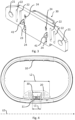
- Fig. 1 depicting a schematic perspective view of a case device 1 according to an embodiment of the disclosure.
- the case device 1 is embodied as a charging cradle 1 configured for storing and charging one or more hearing devices such as one or more earbuds or one or more hearing aids.
- the case device 1 comprises a main housing 10.
- the main housing 10 comprises a charging opening 11.
- the charging opening 11 is formed in an outer surface of the main housing 10, thus allowing access to a charging port 30 arranged within the charging opening 11 to be accessible by a user of the case device 1.
- the charging opening 11 allows for a plug to be inserted from an exterior of the case device and into the charging port 11.
- the main housing 10 is formed from a polymer material.
- the polymer material may be a PC/ABS (Polycarbonate/acrylonitrile butadiene styrene) polymer.
- the polymer material has a glass transition temperature below 130°C, preferably below 128°C, even more preferred below 125°C.
- the polymer material has an ignition temperature above 550°C, preferably above 560°C, even more preferred above 570°C.
- the main housing comprises a bottom part 13 and a top part 14. The bottom part 13 and the top part 14 are hingedly connected, thus allowing for the case device 1 to be opened and allowing a user of the case device 1 to place one or more hearing devices within the main housing 10.
- FIGs 2 and 3 depicting different schematic perspective views of a first circuit board 20 with a charging port 30 and a clamping device 40 according to an embodiment of the disclosure.
- the charging port 30 is attached to the first circuit board 20.
- a first port side 31 of the charging port 30 faces towards the first circuit board 20.
- the charging port 30 comprises several protrusions 33, which extend into complementary holes 24 of the first circuit board 20.
- the protrusions 33 are soldered onto the first circuit board 20, thus attaching and electrically connecting the charging port 30 to the first circuit board 20.
- the clamping device 40 is also attached to the first circuit board 20.
- the clamping device 40 is configured for clamping the charging port 30 onto the first circuit board 20. In the shown embodiment, the clamping device 40 clamps the charging port 30 onto the first circuit board 20.
- the clamping device 40 is attached to the first circuit board 20 by a snap-fit attachment.
- the clamping device 40 comprises a snap connector 41 configured for being inserted through an attachment through-going hole 23 to provide the snap-fit attachment.
- the attachment through-going hole 23 is formed in the first circuit board 20.
- the clamping device 40 comprises two snap-connectors 41 and the first circuit board 20 comprises two corresponding attachment through-going holes 23 for receiving the two snap-connectors 41 of the clamping device in a snap-fit attachment.
- Each of the snap-connectors 41 are formed by bending corresponding stems of the clamping device 40 into hook shapes.
- the bents forming the snap-connectors 41 allow the snap-connectors 41 to deform, hence when inserting the snap-connectors 41 into the attachment through-going holes 23, the snap-connectors 41 compress, hence allowing the snap-connectors to pass through the complementary holes 23.
- the charging port 30 comprises a second port side 32 opposite the first port side 31.
- the clamping device 40 extends over the second port side 32.
- the clamping device 40 exerts a clamping force onto the second port side 32 towards the first port side 31.
- the first circuit board 20 comprises an attachment interface 21.
- the first circuit board 20 comprises two attachment interfaces 21 provided as through-going holes in the first circuit board 20.
- the two attachment interfaces 21 are arranged on opposing sides of the charging port 30.
- the attachment interfaces 21 are each configured for receiving a screw for connecting the first circuit board 20 to the main housing 10.
- the main housing 10 may comprise one or more threaded bores for receiving screws, to thereby connect the first circuit board 20 with the main housing 10.
- the first circuit board 20 comprises a barrier hole 22.
- the first circuit board 20 comprises four barrier holes 22.
- the barrier holes 22 are arranged in-between the charging port 30 and the attachment interface 21.
- the barrier holes 22 are arranged in pairs of twos on opposing sides of the charging port 30.
- the barrier holes 22 are formed as through-going slots in the first circuit board 20.
- the main housing 10 comprises a charging opening 11 extending longitudinally with a first length L1 in a longitudinal direction LD.
- the first circuit board 20 extends longitudinally with a second length L2 in the longitudinal direction LD.
- the second length L2 is larger than the first length L1. In the shown embodiment the second length L2 is more than two times larger than first length. The second length L2 is more than three times larger than the first length L1.
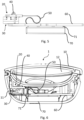
- fig. 5 shows a schematic side view of a circuit board assembly according to an embodiment of the disclosure
- fig. 6 shows a schematic cross-sectional view of the circuit board assembly of fig. 5 mounted in a main housing 10 of a case device 1 according to an embodiment of the disclosure
- the circuit board assembly comprises a first circuit board 20, a charging port 30, a clamping device 40, a second circuit board 60, a third circuit board 50, and a rechargeable battery.
- the circuit board assembly is configured for being arranged in the main housing 10 of a case device 1.
- the rechargeable battery 70 is connected to the second circuit board 60.
- the rechargeable battery 70 is connected to the second circuit board 60 by one or more battery connectors 71.
- the battery connectors 71 may be solders, glue, or mechanical connectors.
- the battery connectors 71 may electrically connect the rechargeable battery 70 with the second circuit board 60.
- the battery connectors 71 are adhesive foam pads, and electrical connection between the rechargeable battery 70 and the second circuit board 60 is achieved by wires.
- the rechargeable battery 70 is electrically connected to the second circuit board 60.
- the second circuit board 60 is arranged separately from the first circuit board 20.
- the first circuit board 20 is electrically connected to the second circuit board 60 by the third circuit board 50.
- the third circuit board 50 is in the shown embodiment a flexible circuit board.
- the charging port 30 is electrically connected to the rechargeable battery 70 via the first circuit board 20, the third circuit board 50, and the second circuit board 60.
- the charging port 30 is electrically connected to the rechargeable battery 70 to allow for recharging of the rechargeable battery 70.
- the charging port 30 is a USB-C port connected to the first circuit board 20.
- the charging port 30 in the shown embodiment is a USB-C port, other charging ports such as USB-A, USB-B mini, USB-B micro, USB-C, or a lightning may be equally applicable.
- the circuit board assembly is arranged within the main housing 10 to allow for the charging port 30 to be accessible for a user of the case device 1 via the charging opening 11 formed in the main housing 10.
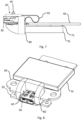
- fig. 7 shows a schematic side view of a circuit board assembly according to another embodiment of the disclosure
- fig. 8 shows a schematic perspective view of the circuit board assembly of fig. 7
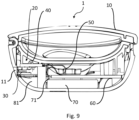
- fig. 9 shows a schematic cross-sectional view of the circuit board assembly of figs 7 and 8 mounted in a main housing 10 of a case device 1 according to an embodiment of the disclosure.
- the circuit board assembly shown in figs 7 and 8 is like the circuit board assembly shown in fig. 5 , however, differs in that the circuit board assembly comprises a thermally insulating material 80 arranged in-between the rechargeable battery 70 and the charging port 30.
- the thermally insulating material 80 is configured for limiting heat transport between the charging port 30 and the rechargeable battery 70.
- the thickness of the thermally insulating material 80 is 1mm - 5mm.
- the thermally insulating material 80 comprises ceramic fibers.
- the thermally insulating material 80 partially encloses the charging port 30.
- the thermally insulating material 80 forms a thermal chamber 81 with the first circuit board 20 and the main housing 10.
- the charging port 30 is arranged within the thermal chamber 81.
- the thermal chamber 81 is formed by the thermally insulating material 80 abutting the main housing 10 and the first circuit board 20 and by the first circuit board 20 extending towards the main housing 10.
Landscapes
- Engineering & Computer Science (AREA)
- Power Engineering (AREA)
- Physics & Mathematics (AREA)
- Acoustics & Sound (AREA)
- Signal Processing (AREA)
- Health & Medical Sciences (AREA)
- Public Health (AREA)
- Business, Economics & Management (AREA)
- Emergency Management (AREA)
- Charge And Discharge Circuits For Batteries Or The Like (AREA)
Priority Applications (3)
| Application Number | Priority Date | Filing Date | Title |
|---|---|---|---|
| EP22155595.6A EP4224664A1 (fr) | 2022-02-08 | 2022-02-08 | Dispositif de boîtier |
| US18/095,372 US20230253806A1 (en) | 2022-02-08 | 2023-01-10 | Case device |
| CN202310079872.0A CN116581835A (zh) | 2022-02-08 | 2023-02-08 | 外壳装置 |
Applications Claiming Priority (1)
| Application Number | Priority Date | Filing Date | Title |
|---|---|---|---|
| EP22155595.6A EP4224664A1 (fr) | 2022-02-08 | 2022-02-08 | Dispositif de boîtier |
Publications (1)
| Publication Number | Publication Date |
|---|---|
| EP4224664A1 true EP4224664A1 (fr) | 2023-08-09 |
Family
ID=80445599
Family Applications (1)
| Application Number | Title | Priority Date | Filing Date |
|---|---|---|---|
| EP22155595.6A Pending EP4224664A1 (fr) | 2022-02-08 | 2022-02-08 | Dispositif de boîtier |
Country Status (3)
| Country | Link |
|---|---|
| US (1) | US20230253806A1 (fr) |
| EP (1) | EP4224664A1 (fr) |
| CN (1) | CN116581835A (fr) |
Families Citing this family (8)
| Publication number | Priority date | Publication date | Assignee | Title |
|---|---|---|---|---|
| JP1700022S (fr) * | 2021-04-23 | 2021-11-22 | ||
| USD1016010S1 (en) * | 2022-03-18 | 2024-02-27 | Huizhou Jinghao Medical Technology Co., Ltd. | Hearing aids and charging case set |
| USD1022899S1 (en) * | 2022-11-17 | 2024-04-16 | Sonova Ag | Charging unit |
| USD1113670S1 (en) * | 2022-12-08 | 2026-02-17 | Kunwei Medical Electronics Co., Ltd | Charging box for hearing aids |
| TWI881576B (zh) * | 2023-12-04 | 2025-04-21 | 僑威科技股份有限公司 | 多功能充電及資料轉接器 |
| USD1040100S1 (en) * | 2024-01-09 | 2024-08-27 | Shenzhen Yawell Intelligent Technology Co., Ltd. | Combination charging case and smart ring |
| USD1058501S1 (en) * | 2024-08-13 | 2025-01-21 | Erqi Zhang | Bluetooth headset charging case |
| USD1124347S1 (en) * | 2024-10-14 | 2026-04-28 | Dylan Arthur Garber | Hearing aid and charger set |
Citations (6)
| Publication number | Priority date | Publication date | Assignee | Title |
|---|---|---|---|---|
| WO1998034298A1 (fr) * | 1997-01-31 | 1998-08-06 | The Whitaker Corporation | Connecteur de carte a circuit imprime |
| JP2000277193A (ja) * | 1998-10-19 | 2000-10-06 | Molex Inc | 低プロフィル基板実装用電気コネクタ |
| US20180109867A1 (en) * | 2015-08-29 | 2018-04-19 | Bragi GmbH | Power Control for Battery Powered Personal Area Network Device System and Method |
| CN110380479A (zh) * | 2019-07-19 | 2019-10-25 | 常德沁音科技有限公司 | 一种精确显示电量的耳机充电盒 |
| US20200084532A1 (en) * | 2018-09-07 | 2020-03-12 | Cheng Uei Precision Industry Co., Ltd. | Earbud charging storage case |
| CN212323269U (zh) * | 2020-06-29 | 2021-01-08 | 宁波志伦电子有限公司 | 一种立式沉板式高速usb |
Family Cites Families (16)
| Publication number | Priority date | Publication date | Assignee | Title |
|---|---|---|---|---|
| TW347156U (en) * | 1997-08-13 | 1998-12-01 | Molex Taiwan Ltd | Mixing-type universal connector |
| JP4114195B2 (ja) * | 2000-08-31 | 2008-07-09 | 富士フイルム株式会社 | コネクタジャックの取付構造、電子カメラ及びコネクタジャックの取付方法 |
| DE10102459B4 (de) * | 2001-01-15 | 2014-12-24 | Finisar Corp. | Gehäuse für ein steckbar mit dem Gehäuse verbindbares elektrisches Bauteil und Verfahren zur Montage eines derartigen Gehäuses an einer Leiterplatte |
| KR100984223B1 (ko) * | 2005-11-25 | 2010-09-28 | 미쓰비시덴키 가부시키가이샤 | 커넥터 유지 기구, 커넥터 리테이닝 구조 및 보강형 장치 측 커넥터 |
| DE202007005013U1 (de) * | 2007-04-03 | 2008-08-07 | Weidmüller Interface GmbH & Co. KG | Leiterplattenverbinder |
| JP2011103258A (ja) * | 2009-11-11 | 2011-05-26 | Sanyo Electric Co Ltd | バッテリパック |
| TWM376975U (en) * | 2009-11-23 | 2010-03-21 | Hon Hai Prec Ind Co Ltd | Electrical connector and electrical connector assembly |
| TWM429218U (en) * | 2011-12-21 | 2012-05-11 | Tai Twun Entpr Co Ltd | Electrical connector |
| CN202856089U (zh) * | 2012-09-11 | 2013-04-03 | 富士康(昆山)电脑接插件有限公司 | 插座连接器 |
| US9620844B2 (en) * | 2013-03-13 | 2017-04-11 | Samsung Electronics Co., Ltd | Connector joint support module, electronic device including the same, and methods of assembling and disassembling electronic device |
| US9148717B2 (en) * | 2014-02-21 | 2015-09-29 | Alpha Audiotronics, Inc. | Earbud charging case |
| US9967648B2 (en) * | 2015-09-30 | 2018-05-08 | Apple Inc. | Case with magnetic over-center mechanism |
| US10424955B2 (en) * | 2016-10-28 | 2019-09-24 | Starkey Laboratories, Inc. | Charging system with compressible contacts |
| US11582566B2 (en) * | 2019-12-02 | 2023-02-14 | Gn Hearing A/S | Hearing instrument charger device and system, and a method of manufacturing a holder therefor |
| US11997444B2 (en) * | 2020-03-23 | 2024-05-28 | Molonlave Group Llc | Device for charging electronic devices and in-ear headphones |
| CN119155881A (zh) * | 2023-06-15 | 2024-12-17 | 台达电子工业股份有限公司 | 电子组件的散热结构 |
-
2022
- 2022-02-08 EP EP22155595.6A patent/EP4224664A1/fr active Pending
-
2023
- 2023-01-10 US US18/095,372 patent/US20230253806A1/en active Pending
- 2023-02-08 CN CN202310079872.0A patent/CN116581835A/zh active Pending
Patent Citations (6)
| Publication number | Priority date | Publication date | Assignee | Title |
|---|---|---|---|---|
| WO1998034298A1 (fr) * | 1997-01-31 | 1998-08-06 | The Whitaker Corporation | Connecteur de carte a circuit imprime |
| JP2000277193A (ja) * | 1998-10-19 | 2000-10-06 | Molex Inc | 低プロフィル基板実装用電気コネクタ |
| US20180109867A1 (en) * | 2015-08-29 | 2018-04-19 | Bragi GmbH | Power Control for Battery Powered Personal Area Network Device System and Method |
| US20200084532A1 (en) * | 2018-09-07 | 2020-03-12 | Cheng Uei Precision Industry Co., Ltd. | Earbud charging storage case |
| CN110380479A (zh) * | 2019-07-19 | 2019-10-25 | 常德沁音科技有限公司 | 一种精确显示电量的耳机充电盒 |
| CN212323269U (zh) * | 2020-06-29 | 2021-01-08 | 宁波志伦电子有限公司 | 一种立式沉板式高速usb |
Also Published As
| Publication number | Publication date |
|---|---|
| US20230253806A1 (en) | 2023-08-10 |
| CN116581835A (zh) | 2023-08-11 |
Similar Documents
| Publication | Publication Date | Title |
|---|---|---|
| US20230253806A1 (en) | Case device | |
| CA3172703A1 (fr) | Bloc-batterie | |
| US10818982B2 (en) | Quick charge battery | |
| CN102742043B (zh) | 新颖结构的电池胞组件和采用该电池胞组件的电池组 | |
| CN101997093B (zh) | 电池包 | |
| EP2068419A2 (fr) | Module de circuit de protection pour batterie secondaire | |
| US10342134B2 (en) | Printed circuit board and a method of bonding electrode lead of battery to printed circuit board | |
| KR102265300B1 (ko) | 단열 구조를 가지는 충전기 | |
| TW201740626A (zh) | 連接器系統 | |
| TW200814411A (en) | Battery pack case | |
| CN104380497A (zh) | 包括多个能量储存元件和改进的热耗散装置的能量储存模块及组装方法 | |
| JP7714701B2 (ja) | 電池アセンブリ、電池パック及び車両 | |
| CN103682230B (zh) | 引线接头及其制造方法以及具有该引线接头的电池包 | |
| JP7580846B2 (ja) | 電池モジュールおよびこれを含む電池パック | |
| KR20150002138A (ko) | 이차 전지 | |
| EP3823085B1 (fr) | Bloc-batterie empilé | |
| JP2011103258A (ja) | バッテリパック | |
| JP3206949U (ja) | プラグ付き電子機器 | |
| CN113067069B (zh) | 电池包以及用电设备 | |
| TW201933653A (zh) | 電池模組及電池組 | |
| CN104078641B (zh) | 电池组 | |
| JP3796213B2 (ja) | バッテリパック | |
| KR101101019B1 (ko) | 배터리 팩 | |
| KR20180074457A (ko) | 배터리 모듈 | |
| CN217740463U (zh) | 温度保险丝、温度保险丝组件、电池及电子设备 |
Legal Events
| Date | Code | Title | Description |
|---|---|---|---|
| PUAI | Public reference made under article 153(3) epc to a published international application that has entered the european phase |
Free format text: ORIGINAL CODE: 0009012 |
|
| STAA | Information on the status of an ep patent application or granted ep patent |
Free format text: STATUS: THE APPLICATION HAS BEEN PUBLISHED |
|
| AK | Designated contracting states |
Kind code of ref document: A1 Designated state(s): AL AT BE BG CH CY CZ DE DK EE ES FI FR GB GR HR HU IE IS IT LI LT LU LV MC MK MT NL NO PL PT RO RS SE SI SK SM TR |
|
| STAA | Information on the status of an ep patent application or granted ep patent |
Free format text: STATUS: REQUEST FOR EXAMINATION WAS MADE |
|
| 17P | Request for examination filed |
Effective date: 20240208 |
|
| RBV | Designated contracting states (corrected) |
Designated state(s): AL AT BE BG CH CY CZ DE DK EE ES FI FR GB GR HR HU IE IS IT LI LT LU LV MC MK MT NL NO PL PT RO RS SE SI SK SM TR |
|
| STAA | Information on the status of an ep patent application or granted ep patent |
Free format text: STATUS: EXAMINATION IS IN PROGRESS |