EP4225155B1 - Ensemble de résection endoscopique - Google Patents
Ensemble de résection endoscopique Download PDFInfo
- Publication number
- EP4225155B1 EP4225155B1 EP21802871.0A EP21802871A EP4225155B1 EP 4225155 B1 EP4225155 B1 EP 4225155B1 EP 21802871 A EP21802871 A EP 21802871A EP 4225155 B1 EP4225155 B1 EP 4225155B1
- Authority
- EP
- European Patent Office
- Prior art keywords
- pusher
- adaptor
- clip
- endoscopic
- tissue
- Prior art date
- Legal status (The legal status is an assumption and is not a legal conclusion. Google has not performed a legal analysis and makes no representation as to the accuracy of the status listed.)
- Active
Links
Images



Classifications
-
- A—HUMAN NECESSITIES
- A61—MEDICAL OR VETERINARY SCIENCE; HYGIENE
- A61B—DIAGNOSIS; SURGERY; IDENTIFICATION
- A61B17/00—Surgical instruments, devices or methods
- A61B17/32—Surgical cutting instruments
- A61B17/320016—Endoscopic cutting instruments, e.g. arthroscopes, resectoscopes
-
- A—HUMAN NECESSITIES
- A61—MEDICAL OR VETERINARY SCIENCE; HYGIENE
- A61B—DIAGNOSIS; SURGERY; IDENTIFICATION
- A61B17/00—Surgical instruments, devices or methods
- A61B17/32—Surgical cutting instruments
- A61B17/3205—Excision instruments
- A61B17/32056—Surgical snare instruments
-
- A—HUMAN NECESSITIES
- A61—MEDICAL OR VETERINARY SCIENCE; HYGIENE
- A61B—DIAGNOSIS; SURGERY; IDENTIFICATION
- A61B1/00—Instruments for performing medical examinations of the interior of cavities or tubes of the body by visual or photographical inspection, e.g. endoscopes; Illuminating arrangements therefor
- A61B1/00064—Constructional details of the endoscope body
- A61B1/00071—Insertion part of the endoscope body
- A61B1/0008—Insertion part of the endoscope body characterised by distal tip features
- A61B1/00087—Tools
-
- A—HUMAN NECESSITIES
- A61—MEDICAL OR VETERINARY SCIENCE; HYGIENE
- A61B—DIAGNOSIS; SURGERY; IDENTIFICATION
- A61B1/00—Instruments for performing medical examinations of the interior of cavities or tubes of the body by visual or photographical inspection, e.g. endoscopes; Illuminating arrangements therefor
- A61B1/00131—Accessories for endoscopes
- A61B1/0014—Fastening element for attaching accessories to the outside of an endoscope, e.g. clips, clamps or bands
-
- A—HUMAN NECESSITIES
- A61—MEDICAL OR VETERINARY SCIENCE; HYGIENE
- A61B—DIAGNOSIS; SURGERY; IDENTIFICATION
- A61B17/00—Surgical instruments, devices or methods
- A61B17/0057—Implements for plugging an opening in the wall of a hollow or tubular organ, e.g. for sealing a vessel puncture or closing a cardiac septal defect
-
- A—HUMAN NECESSITIES
- A61—MEDICAL OR VETERINARY SCIENCE; HYGIENE
- A61B—DIAGNOSIS; SURGERY; IDENTIFICATION
- A61B17/00—Surgical instruments, devices or methods
- A61B17/12—Surgical instruments, devices or methods for ligaturing or otherwise compressing tubular parts of the body, e.g. blood vessels or umbilical cord
- A61B17/122—Clamps or clips, e.g. for the umbilical cord
- A61B17/1227—Spring clips
-
- A—HUMAN NECESSITIES
- A61—MEDICAL OR VETERINARY SCIENCE; HYGIENE
- A61B—DIAGNOSIS; SURGERY; IDENTIFICATION
- A61B17/00—Surgical instruments, devices or methods
- A61B17/12—Surgical instruments, devices or methods for ligaturing or otherwise compressing tubular parts of the body, e.g. blood vessels or umbilical cord
- A61B17/128—Surgical instruments, devices or methods for ligaturing or otherwise compressing tubular parts of the body, e.g. blood vessels or umbilical cord for applying or removing clamps or clips
- A61B17/1285—Surgical instruments, devices or methods for ligaturing or otherwise compressing tubular parts of the body, e.g. blood vessels or umbilical cord for applying or removing clamps or clips for minimally invasive surgery
-
- A—HUMAN NECESSITIES
- A61—MEDICAL OR VETERINARY SCIENCE; HYGIENE
- A61B—DIAGNOSIS; SURGERY; IDENTIFICATION
- A61B17/00—Surgical instruments, devices or methods
- A61B17/00234—Surgical instruments, devices or methods for minimally invasive surgery
- A61B2017/00238—Type of minimally invasive operation
- A61B2017/00269—Type of minimally invasive operation endoscopic mucosal resection EMR
-
- A—HUMAN NECESSITIES
- A61—MEDICAL OR VETERINARY SCIENCE; HYGIENE
- A61B—DIAGNOSIS; SURGERY; IDENTIFICATION
- A61B17/00—Surgical instruments, devices or methods
- A61B17/00234—Surgical instruments, devices or methods for minimally invasive surgery
- A61B2017/00292—Surgical instruments, devices or methods for minimally invasive surgery mounted on or guided by flexible, e.g. catheter-like, means
- A61B2017/00296—Surgical instruments, devices or methods for minimally invasive surgery mounted on or guided by flexible, e.g. catheter-like, means mounted on an endoscope
-
- A—HUMAN NECESSITIES
- A61—MEDICAL OR VETERINARY SCIENCE; HYGIENE
- A61B—DIAGNOSIS; SURGERY; IDENTIFICATION
- A61B17/00—Surgical instruments, devices or methods
- A61B2017/00477—Coupling
-
- A—HUMAN NECESSITIES
- A61—MEDICAL OR VETERINARY SCIENCE; HYGIENE
- A61B—DIAGNOSIS; SURGERY; IDENTIFICATION
- A61B17/00—Surgical instruments, devices or methods
- A61B17/0057—Implements for plugging an opening in the wall of a hollow or tubular organ, e.g. for sealing a vessel puncture or closing a cardiac septal defect
- A61B2017/00575—Implements for plugging an opening in the wall of a hollow or tubular organ, e.g. for sealing a vessel puncture or closing a cardiac septal defect for closure at remote site, e.g. closing atrial septum defects
- A61B2017/00584—Clips
-
- A—HUMAN NECESSITIES
- A61—MEDICAL OR VETERINARY SCIENCE; HYGIENE
- A61B—DIAGNOSIS; SURGERY; IDENTIFICATION
- A61B17/00—Surgical instruments, devices or methods
- A61B2017/00831—Material properties
- A61B2017/0084—Material properties low friction
- A61B2017/00845—Material properties low friction of moving parts with respect to each other
-
- A—HUMAN NECESSITIES
- A61—MEDICAL OR VETERINARY SCIENCE; HYGIENE
- A61B—DIAGNOSIS; SURGERY; IDENTIFICATION
- A61B17/00—Surgical instruments, devices or methods
- A61B2017/00831—Material properties
- A61B2017/00902—Material properties transparent or translucent
- A61B2017/00907—Material properties transparent or translucent for light
-
- A—HUMAN NECESSITIES
- A61—MEDICAL OR VETERINARY SCIENCE; HYGIENE
- A61B—DIAGNOSIS; SURGERY; IDENTIFICATION
- A61B17/00—Surgical instruments, devices or methods
- A61B17/30—Surgical pincettes, i.e. surgical tweezers without pivotal connections
- A61B2017/306—Surgical pincettes, i.e. surgical tweezers without pivotal connections holding by means of suction
-
- A—HUMAN NECESSITIES
- A61—MEDICAL OR VETERINARY SCIENCE; HYGIENE
- A61B—DIAGNOSIS; SURGERY; IDENTIFICATION
- A61B90/00—Instruments, implements or accessories specially adapted for surgery or diagnosis and not covered by any of the groups A61B1/00 - A61B50/00, e.g. for luxation treatment or for protecting wound edges
- A61B90/03—Automatic limiting or abutting means, e.g. for safety
- A61B2090/037—Automatic limiting or abutting means, e.g. for safety with a frangible part, e.g. by reduced diameter
Definitions
- the present application is directed to devices used in surgical procedures, such as endoscopic procedures, and more particularly to endoscopic resection assemblies that can be connected to an endoscopic device.
- an endoscope includes a long flexible insertion tube having one or more channels through which miniaturized, flexible instruments can be inserted and advanced.
- the endoscope typically includes various optical features allowing for visualization of internal views of particular body parts, organs, or passages without requiring invasive surgery.
- the insertion tube may transmit images or image-producing signals from the illuminated operative site to a viewing means, providing the operator with full vision of the actions being performed at the working end of the endoscope.
- the operator first identifies a tissue such as a lesion in the digestive tract.
- the tissue is pulled into a cap provided on the endoscopic device via suction or other means.
- a clip is deployed over the tissue.
- a cutting device such as a snare cuts over the top of the clip, removing the tissue and leaving the clip closed over the otherwise open defect.
- the clip should be deployed before the cutting in order to pre-close the defect resulting from the cutting. Also, the clip should remain at the resection site until the body can heal itself.
- US5968056 relates generally to the field of tissue ligation, and more particularly to an improved device and method for electrosurgically severing lesions.
- US2014100423 relates to a method, a system and subsystems thereof for endoscopic full thickness resection surgical procedures, typically, but not necessarily, of the gastrointestinal (GI) tract.
- US2013172918 relates generally to systems and methods for resecting tissue, and more particularly, to systems for endoscopic mucosal resection.
- US2015230782 relates to a system for attaching devices to the distal end of endoscopic instruments.
- US2012010633 relates generally to devices and methods for securing inverted tissue, and more particularly, though not exclusively, to securing inverted diverticulum serosa to serosa.
- the present invention provides endoscopic resection assemblies for use in endoscopic procedures.
- the invention is defined by independent claim 1. Further embodiments are defined by the dependent claims. No surgical methods are claimed.
- the present invention provides an endoscopic resection assembly (100), comprising: (a) an adaptor (170), configured to couple to an endoscopic device; (b) a pusher (180), disposed on the adaptor (170); (c) at least one driver, configured to move the pusher (180) in a distal direction with respect to the adaptor (170); and (d) a cutting device (150), removably coupled to the pusher (180), wherein the cutting device (150) is configured to be removed from the pusher (180) when at least a portion of the pusher is distal to the adaptor (170), wherein the adaptor (170) is configured to be loaded with a clip (160), wherein the clip (160) is configured to operate between an open state and a closed state.
- the clip (160) is configured to be loaded on the adaptor (170) in the open state at a position distal to the pusher (180), wherein the clip (160) is configured to be pushed by the pusher (180) to slide off the distal edge (1701) of the adaptor (170) so that the clip (160) is configured to be released from the adaptor (170) and to engage onto a tissue before the cutting device (150) is removed from the pusher (180).
- the present invention can be used for cutting into or through the muscularis of the GI tract in order to remove dysplasia that has invaded past the mucosal layer of tissue.
- a clip can be deployed over the tissue prior to resection in order to pre-close the resulting defect created from the resection.
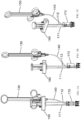
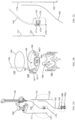
- an endoscopic resection assembly 100 includes an adaptor 170, a pusher 180, a cutting device 150, and a clip 160.
- the adaptor 170 is configured to attach to an endoscopic device.
- the pusher 180 is disposed on the adaptor 170 and configured to slide in the axial direction with respect to the adaptor 170.
- the cutting device 150 is an endoscopic tool for cutting a tissue, which operates between an open state and a closed state. As illustrated in FIGS. 3A and 3B , the cutting device 150 is removably coupled to the pusher 180.
- the clip 160 is an endoscopic tool configured to operate between an open state and a closed state, and is configured to engage onto a tissue. As illustrated in FIGS. 5A-5C , the clip 160 is loaded on the adaptor 170 in the open state at a position distal to the pusher 180.
- the endoscopic resection assembly 100 further includes at least one driver, controlled by an operator, configured to slide the pusher 180 in the distal direction with respect to the adaptor 170. As the pusher 180 slides in the distal direction with respect to the adaptor 170, the clip 160 is pushed by the pusher 180 to slide off the distal edge 1701 of the adaptor 170, and engages onto a tissue by reforming toward the closed state.
- the cutting device 150 can then be activated by the operator to detach from the pusher 180, and resect tissue above the pusher by operating toward the closed state.
- the endoscopic resection assembly 100 may include at least one driver and at least one sheath, a catheter 140, a clip deployment handle 190, and a handle 130.
- the at least one driver may comprise a first driver 121 and a second driver 122.
- the at least one sheath may comprise a first sheath 111 and a second sheath 112.
- the drivers may be directly adjacent to one another or spaced apart somewhat along the circumference of the pusher 180. For example, the drivers may be spaced about 10 degrees to 180 degrees, or about 15 degrees to 90 degrees, or about 30 degrees, apart from one another.
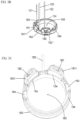
- FIG. 3B illustrates the assembly of the distal components of the endoscopic resection assembly 100, including the pusher 180, the cutting device 150, and the at least one driver.
- the cutting device 150 is an endoscopic tool for cutting a tissue, and operates between an open state and a closed state.
- the cutting device 150 has a snare drive cable 152 and a snare loop 154.
- the pusher 180 includes at least one retainer. As illustrated in FIG. 3B , the at least one retainer comprises the first retainer 183 and the second retainer 184, and retains the snare loop 154, such that the cutting device 150 is removably coupled to the pusher 180.
- the pusher 180 is driven by the at least one driver.
- the at least one driver comprises the first driver 121 and the second driver 122. The first driver 121 and the second driver 122 can be actuated to move the pusher 180 in the distal direction.
- the pusher 180 is disposed on the adaptor 170 and configured to slide in the axial direction with respect to the adaptor 170.
- the adaptor 170 may comprise a material to reduce friction and support movement of the pusher 180 and the clip 160. Suitable materials for the adaptor 170 include plastics such as polycarbonate, K-resin, acrylic, xylar, ASA, polypropylene, silicone, and TPES, or other similar materials.
- the adaptor 170 may comprise such plastics, or other materials, entirely or in part.
- the clip 160 is an endoscopic tool configured to operate between an open state and a closed state, and is configured to engage onto a tissue.
- the clip 160 is loaded on the adaptor in the open state at a position distal to the pusher 180.
- the pusher 180 and the clip 160 may not be secured together.
- the pusher 180 and the clip 160 may be secured together.
- one or more indents can be formed on the pusher 180
- one or more protrusions can be formed on the clip 160, where the one or more protrusions are configured to be secured into the one or more indents.
- the pusher 180 and the clip 160 can be secured together by other means such as welding, gluing, and overmolding.
- the snare drive cable 152 of the cutting device 150 extends within the catheter 140.
- the catheter 140 may be coupled with the adaptor 170.
- the at least one driver may respectively extend within the at least one sheath. As illustrated in FIG. 2C , the first driver 121 and the second driver 122 respectively extend within the first sheath 111 and the second sheath 112. The at least one sheath can be attached to the adaptor 170.
- the at least one driver can be actuated to move the pusher 180 in the distal direction.
- the pusher 180 slides in the distal direction with respect to the adaptor 170.
- the clip 160 is pushed by the pusher to slide off the distal edge 1701 of the adaptor 170, and engage onto a tissue by reverting to the closed state.
- the cutting device 150 can be activated to detach from the pusher 180, and cut a tissue by operating toward the closed state.
- the adaptor 170 has an inside surface and an outside surface.
- the adaptor 170 may include a lumen 173 and at least one overmolding.
- the at least one overmolding may comprise an overmolding 171 and an overmolding 172.
- the adaptor 170 may be substantially tubular with a distal open end and a proximal open end.
- the adaptor 170 may be hollow and define a tissue chamber channel.
- the adaptor 170 may be configured to attach with different types of endoscopic devices (e.g., Olympus ® , Fujinon ® , or Pentax ® endoscopes).
- endoscopic devices e.g., Olympus ® , Fujinon ® , or Pentax ® endoscopes.
- the inner and outer surface of the adaptor 170 may be contoured, and the inner and outer diameter of the adaptor 170 may be varied, in order to provide a good fit with the endoscopic device.
- the endoscopic device may be press-fitted to the proximal end of the adaptor 170.
- the adaptor 170 may comprise a flexible band, such as a rubber band, configured to be wrapped around the distal end of the endoscopic device.
- a person skilled in the art should understand that the shape of the adaptor 170 or the shape the tissue chamber channel can be any suitable shapes as long as it does not interfere with the operations of the endoscopic device.
- the tissue chamber channel may be configured to receive the tissue to be resected during resection operation.
- the adaptor 170 may be entirely or partially formed with materials sufficiently transparent to allow visualization of outside environment through various optical features from the inside of the adaptor 170. During resection operation, the sufficiently transparent materials may allow the operator to confirm whether the clip 160 is deployed, and observe the position of the cutting device 150 prior to tissue resection.
- the adaptor 170 is configured to allow the clip 160 and the pusher 180 to be disposed on the adaptor 170. As illustrated in FIGS. 5A-5C , the adaptor 170 is configured to allow the clip 160 and the pusher 180 to be disposed on the outside surface of the adaptor 170. The adaptor 170 is configured to allow the clip 160 and the pusher 180 to slide in the axial direction with respect to the adaptor 170. As illustrated in FIGS. 5A-5C , the outside surface of the adaptor 170 may be a smooth surface such that the clip 160 and the pusher 180 can slide in the axial direction with respect to the adaptor 170.
- the adaptor 170 may have any shape and may include any structural components, as long as the clip 160 and the pusher 180 can be disposed on the adaptor 170 and slide in the axial direction with respect to the adaptor 170.
- the adaptor 170 is configured to allow the clip 160 and/or the pusher 180 to be disposed on the inside surface of the adaptor 170.
- the adaptor 170 may include a support surface formed inside the adaptor 170, such that the clip 160 and/or the pusher 180 can be disposed on the support surface.
- the adaptor 170 can include one or more guide rails, such that the clip 160 and/or the pusher 180 are allowed to slide in the axial direction along the one or more guide rails.
- the adaptor 170 can include one or more longitudinal slits, such that the clip 160 and/or the pusher 180 are allowed to slide in the axial direction along the one or more longitudinal slits.
- the adaptor 170 may be configured to couple with the catheter 140. As illustrated in FIG. 2C , the adaptor 170 is coupled with the catheter 140 by inserting the catheter 140 into the lumen 173 of the adaptor 170.
- the lumen 173 may be formed on the outside surface of the adaptor 170, such that the catheter 140 is coupled with the outside surface of the adaptor 170.
- the lumen 173 may provide slip fit between the catheter 140 and the adaptor 170, such that the catheter 140 is allowed to freely slide in the axial direction with respect to the adaptor 170.
- the catheter 140 may be coupled to any portion of the adaptor 170, such as the inside surface of the adaptor 170, as long as the catheter 140 does not interfere with the operations of the endoscopic device and other components of the endoscopic resection assembly 100.
- the catheter 140 may penetrate the adaptor 170, such that the catheter 140 extends through a hole formed on the adaptor 170.
- the adaptor 170 can be fixed with the catheter 140, or be detached from the catheter 140, as long as the catheter 140 does not interfere with the operations of the endoscopic device and other components of the endoscopic resection assembly 100.
- the adaptor 170 may be configured to attach with the at least one sheath.
- the at least one sheath may comprise the first sheath 111 and the second sheath 112, and the first sheath 111 and the second sheath 112 may be attached to the adaptor 170 respectively by the overmolding 171 and the overmolding 172.
- the overmolding 171 and the overmolding 172 may be formed on the outside surface of the adaptor 170, such that the at least one sheath is attached to the outside surface of the adaptor 170.
- the at least one sheath can be attached with the adaptor 170 by other means, for example, friction, heat staking, gluing, or welding.
- the at least one sheath can be attached to any portion of the adaptor 170, such as the inside surface of the adaptor 170, as long as the at least one sheath does not interfere with the operations of the endoscopic device and other components of the endoscopic resection assembly 100.
- the at least one sheath may penetrate the adaptor 170, such that the at least one sheath extends through a hole formed on the adaptor 170.
- the at least one sheath may not be attached with the adaptor 170.
- the at least one sheath may be attached with any component of the endoscopic device or the endoscopic resection assembly 100, as long as the at least one sheath does not interfere with the operations of the endoscopic device and other components of the endoscopic resection assembly 100.
- the pusher 180 includes at least one knob which comprises the first knob 181 and the second knob 182, and at least one retainer which comprises the first retainer 183 and the second retainer 184.
- the pusher 180 may be configured to be disposed on the adaptor 170 and can slide in the axial direction with respect to the adaptor 170. As illustrated in FIG. 2B , the pusher 180 is substantially ring-shaped, defining a central opening 185. As illustrated in FIG. 5A , the adaptor can be inserted into the central opening 185, such that the pusher 180 is disposed on the outside surface of the adaptor 170 and can slide in the axial direction with respect to the adaptor 170.
- the central opening 185 may have different shapes to fit with the different shapes of the outside surface of the adaptor 170.
- the pusher 180 may be configured to be disposed on the inside surface or the outside surface of the adaptor 170, or on a support surface formed inside the adaptor 170.
- the pusher 180 may include structural components, such as protrusions and indents, to fit with guide rails, longitudinal slits, or other structural components of the adaptor 170, such that the pusher 180 can slide in the axial direction with respect to the adaptor 170.
- the pusher 180 may have a closed ring structure configured to be disposed on the entire periphery of the adaptor 170, as illustrated in FIG. 5A .
- a person skilled in the art should understand that the pusher 180 may be disposed on a portion of the periphery of the adaptor 170, as long as there is no interference with the operations of the endoscopic device and other components of the endoscopic resection assembly 100.
- the pusher 180 may have a half-ring structure configured to be disposed on a half of the periphery of the adaptor 170.
- the pusher 180 may be attached with at least one driver.
- the pusher 180 may include at least one knob for attaching with the at least one driver.
- the at least one driver comprises a first driver 121 and a second driver 122
- the at least one knob comprises the first knob 181 and the second knob 182.
- the distal ends of the first driver 121 and the second driver 122 are bent into a circle and fitted around the first knob 181 and the second knob 182.
- the at least one driver is secured to the at least one knob of the pusher 180.
- the at least one knob is a round knob over which the bent distal end of the at least one driver can be snapped into place.
- the at least one driver may fit with, or be secured to, other structural components of the pusher 180, for example, one or more holes formed on the pusher 180. Glue may be applied to reinforce the attachment of the at least one driver to the pusher 180.
- the at least one driver may be attached to the pusher 180 by different means, for example, gluing, welding, or overmolding.
- the at least one driver is configured to move the pusher 180 in the distal direction.
- the first driver 121 and the second driver 122 respectively extend within the first sheath 111 and the second sheath 112.
- the first driver 121 and the second driver 122 can be actuated to advance in the distal direction with respect to the first sheath 111 and the second sheath 112, pushing the pusher 180 in the distal direction.
- the at least one driver may comprise various structural components configured to move the pusher 180 in the distal direction.
- the at least one driver can comprise a pull thread with a distal end tied on the pusher 180, where the pull thread is configured to pull the pusher 180 in the distal direction when a proximal end of the pull thread is retracted.
- the at least one driver may not be coupled or attached to the pusher 180, as long as the pusher 180 can be driven by the at least one driver in the distal direction.
- a spring may be coupled to the clip deployment handle 190 or the at least one sheath.
- the spring can be configured to be compressed or extended, such that the spring exerts a force on the at least one driver in the axial direction.
- the clip deployment handle 190 can include a stopper for preventing the axial movement of the at least one driver with respect to the at least one sheath.
- the clip deployment handle 190 can be configured to activate the stopper by, for example, deforming the stopper, such that the stopper no longer prevents the axial movement of the at least one driver.
- the compressed or extended spring moves the at least one driver in the axial direction with respect to the at least one sheath, and the at least one driver moves the pusher 180 in the distal direction.
- the pusher 180 may be spring loaded on the adaptor 170.
- a spring can be coupled with the adaptor 170 and configured to be compressed or extended by the pusher 180 when the pusher 180 is disposed on the adaptor 170. As such, the spring exerts a force on the pusher 180 in the distal direction.
- a stopper can be coupled to the adaptor 170, the endoscopic device, or other structural components of the endoscopic resection assembly 100, and can be configured to prevent the distal movement of the pusher 180 with respect to the adaptor 170.
- An actuator such as a pull thread extending within a sheath, can be operatively coupled with the stopper.
- the actuator may be configured to activate the stopper by, for example, deforming the stopper or detaching the stopper from other structural components, such that the stopper no longer prevents the distal movement of the pusher 180.
- the compressed spring pushes the pusher 180, and the pusher 180 slides in the distal direction with respect to the adaptor 170.
- the adaptor 170 may be slidably coupled with the endoscopic device, such that the adaptor 170 can slide in the axial direction with respect to the endoscopic device.
- An actuator such as a pull thread extending within a sheath, can be operatively coupled with the adaptor.
- the actuator may be configured to move the adaptor 170 in the proximal direction with respect to the endoscopic device and the pusher 180, such that the pusher 180 moves in the distal direction in relative to the adaptor 170.
- the pusher 180 may be removably coupled with the cutting device 150.
- the cutting device 150 is an endoscopic tool for cutting a tissue, which operates between an open state and a closed state. As illustrated in FIG. 2B , the cutting device 150 includes a snare drive cable 152 and a snare loop 154. FIG. 2B illustrates the cutting device 150 in the open state. The snare drive cable 152 can be actuated to contract the snare loop 154, such that the cutting device 150 operates toward the closed state.
- the pusher 180 includes at least one retainer.
- the at least one retainer may comprise a first retainer 183 and a second retainer 184.
- Each of the at least one retainer may define a passage and a slit.
- the first retainer 183 defines a passage 1831 and a slit 1832
- the second retainer 184 defines a passage 1841 and a slit 1842.
- the passage defined by the at least one retainer may be configured to accommodate the snare loop 154 of the cutting device 150.
- the slit defined by the at least one retainer may be configured to communicate the passage with the central opening 185 defined by the pusher 180.
- FIG. 3B illustrates the assembly of the cutting device 150 with the pusher 180.
- the snare loop 154 is in the open state and accommodated in the passage 1831 defined by the first retainer 183 and the passage 1841 defined by the second retainer 184.
- the snare loop 154 lies in a plane substantially parallel to the plane defined by the pusher 180, and moves in tandem with the pusher 180 when the pusher 180 moves in the axial direction.
- the pusher 180 can be formed from one or more components that could be snapped, glued, or welded together to form the at least one retainer that removably retains the cutting device 150 to the pusher 180.
- the pusher 180 may include at least one housing formed around the at least one knob. As illustrated in FIG. 3C , a housing 1811 can be formed around the knob 181 and a housing 1821 can be formed around the knob 182. As illustrated in FIG. 3C , the snare loop 154 is bent at the positions where the at least one housing is located, such that the snare loop 154 is positioned along the inward facing surface of the at least one housing. As such, the at least one housing does not block the operation of the snare loop 154 between the open state and the closed state.
- the snare loop 154 can be bent or deformed to extend around various structural components formed on the pusher 180, such that the structural components do not block the operation of the snare loop 154 between the open state and the closed state.
- passages for accommodating the snare loop 154 can be formed on the surface of the various structural components of the pusher 180, such that the structural components do not block the operation of the snare loop 154 between the open state and the closed state.
- the at least one retainer is formed on the proximal surface of the pusher 180.
- the snare loop 154 is accommodated in the passage formed through the at least one retainer, the snare loop 154 is positioned at a set distance from the distal surface of the pusher 180.
- the set distance can be, for example, 2 to 4 mm or 1 to 5 mm.
- the set distance can be varied depending on user need and anatomical constraints.
- the at least one retainer may comprise various structural components configured to removably couple with the cutting device 150. IThe at least one retainer may comprise a groove configured to hold the snare loop 154.
- the at least one retainer may comprise holes or indents configured to fit with bent or protruding portions of the snare loop 154.
- the at least one retainer may be formed on any portion of the pusher 180, for example, the proximal surface, the distal surface, the inward facing surface, or the outward facing surface.
- the pusher 180 can be removably coupled with the snare loop 154 by various means.
- the snare loop 154 can be detachably glued to the pusher 180.
- the snare loop 154 can be magnetically attached to the pusher 180.
- the snare loop 154 can be removably coupled to the pusher 180 by a breakable seal.
- the breakable seal may comprise a rigid seal attached to the pusher 180 and configured to detach from the pusher 180.
- the breakable seal may also comprise a soft seal attached to the pusher 180, where the snare loop 154 is configured to break the seal by cutting through the soft seal.
- the snare loop 154 when the snare loop 154 is removably coupled with the pusher 180, the snare loop 154 can be positioned at a set distance from the distal surface of the pusher 180, where the set distance can be, for example, 2 to 4 mm or 1 to 5 mm.
- the cutting device 150 is an endoscopic tool for resecting tissue, and operates between an open state and a closed state. As illustrated in FIG. 2B , the cutting device 150 includes the snare drive cable 152 and the snare loop 154.
- the snare drive cable 152 and the snare loop 154 may be formed with conductive metal wire, which allows the use of diathermic energy by directing electric current in the snare drive cable 152 and the snare loop 154.
- the snare drive cable 152 and the snare loop 154 can be formed with materials including stainless steel, nitinol, nickel-titanium shape memory alloy, and polymers such as PTFE, polyolefin, and fluorinated ethylene propylene.
- the snare drive cable 152 can be attached to the snare loop 154 by welding at an angle substantially perpendicular to the plane defined by the snare loop 154. As illustrated in FIG. 3D , the snare drive cable 152 extends within the catheter 140. The proximal end of the snare drive cable 152 is operatively coupled with the handle 130.
- FIGS. 2B and 3D illustrate the cutting device 150 in the open state.
- the handle 130 may be configured to retract the snare drive cable 152 with respect to the catheter 140. As result, the snare drive cable 152 pulls a portion or the entirety of the snare loop 154 into the catheter 140, such that the snare loop 154 is contracted toward the closed state having a smaller loop area than the loop area of the open state.
- the cutting device 150 may be one integral piece of wire.
- the cutting device 150 may extend within the catheter 140 from the proximal end to the distal end, protrudes out of the distal end of the catheter 140 to form a snare loop, and extends within the catheter 140 back from the distal end to the proximal end.
- both ends of the cutting device 150 are positioned at the proximal end of the catheter 140, where the catheter 140 is operatively coupled with the handle 130.
- the handle 130 may be configured to actuate the cutting device 150 by retracting one end or both ends of the cutting device 150 with respect to the catheter 140, such that the snare loop 154 is contracted.
- the cutting device 150 may be one integral piece of wire.
- the cutting device 150 may extend within the catheter 140, with the proximal end positioned at the proximal end of the catheter 140 and the distal end attached to the distal end of the catheter 140.
- the handle 130 may be configured to actuate the cutting device 150 by retracting the proximal end of the cutting device 150 with respect to the catheter 140, such that the snare loop 154 is contracted.
- the cutting device 150 may be removably coupled with the pusher 180As illustrated in FIG. 3B , the snare loop 154 of the cutting device 150 may be retained in the passage 1831 and the passage 1841 defined by the at least one retainer of the pusher 180.
- the snare drive cable 152 is retracted by the handle 130, the snare loop 154 is contracted to escape from the passage 1831 and the passage 1841 through the slit 1832 and the slit 1842 defined by the pusher 180, and move radially inward into the central opening 185 defined by the pusher 180.
- the cutting device 150 may comprise any known endoscopic tools for cutting a tissue, as long as the cutting device 150 can be removably coupled with the pusher 180.
- the cutting device 150 may comprise one or more jaws for cutting a tissue.
- the cutting device 150 may be removably coupled to any portion of the pusher 180, for example, the proximal surface, the distal surface, the inward facing surface, or the outward facing surface of the pusher 180.
- the cutting device 150 can be positioned at a set distance from the distal surface of the pusher 180, where the set distance can be, for example, 2 to 4 mm or 1 to 5 mm.
- the cutting device 150 may be removably coupled to the pusher 180 in the open state.
- the cutting device 150 may comprise various endoscopic tools allowing the operation between an open state and a closed state.
- the cutting device 150 may be removably coupled to the pusher 180 in the closed state or an intermediate state between the open state and the closed state.
- the clip 160 may be an endoscopic clip which can be deployed to engage onto a tissue.
- the clip may be based on the Padlock Clip ® Defect Closure System currently marketed by STERIS Corporation.
- the clip 160 may comprise a plurality of tines for engaging the tissue. Each tine of the clip 160 may be blunt or pointed for various purposes, for example, stopping bleeding by compressing the tissue, allowing for optimal healing abilities while still allowing blood flow to the tissue, and holding the tissue together until the site heals itself.
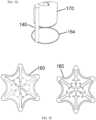
- FIG. 2B illustrates the clip 160 in the open state
- FIG. 3E illustrates the clip 160 in the closed state.
- the clip 160 is made from resilient materials which can store strain energy, for example, elastic metal alloy such as nitinol.
- the clip 160 can be formed with materials including stainless steel, nitinol, nickel-titanium shape memory alloy, and polymers such as PTFE, polyolefin, and fluorinated ethylene propylene.
- the clip 160 rests in the closed state when no external force is applied, and can be deformed into the open state by application of external force. When in the open state, the clip 160 defines a central opening 165. When the external force is no longer applied, the clip 160 releases the stored energy and reforms back to the closed state.
- FIG. 4 illustrates the assembly of the pusher 180 and the clip 160 onto the adaptor 170.
- the pusher 180 is disposed on the adaptor 170 by inserting the adaptor 170 into the central opening 185 defined by the pusher 180.
- the pusher 180 rides along the outside surface of the adaptor 170, where the pusher 180 can slide in the axial direction with respect to the adaptor 170.
- the at least one driver is attached to the pusher 180 by securing onto the at least one knob of the pusher 180.
- the clip 160 is deformed into the open state by external force, and the clip 160 in the open state defines a central opening 165.
- the clip 160 is then loaded onto the adaptor 170 at a position distal to the pusher 180.
- FIG. 5A illustrates the pusher 180 and the clip 160 assembled onto the adaptor 170. As illustrated in FIG. 5A , the clip 160 contacts the pusher 180 such that the clip 160 can be pushed in the distal direction when the pusher 180 moves in the distal direction.
- the clip 160 can be loaded onto the inside surface or the outside surface of the adaptor 170, or onto a support surface formed inside the adaptor 170, as long as the clip 160 can be maintained in the open position and can slide off the distal edge 1701 of the adaptor 170.
- the clip 160 and the pusher 180 can be disposed on different surfaces of the adaptor 170, where the adaptor 170 provides one or more longitudinal slits allowing the pusher 180 to contact the clip 160 and push the clip 160 in the distal direction.
- the pusher 180 may not contact and push the clip 160 in the distal direction. Instead, a clip driver such as a drive wire or a pull thread can be configured to move the clip 160 in the distal direction, such that the clip 160 can slide off the distal edge 1701 of the adaptor 170.
- a clip driver such as a drive wire or a pull thread can be configured to move the clip 160 in the distal direction, such that the clip 160 can slide off the distal edge 1701 of the adaptor 170.
- Each of the at least one sheath defines a passage for each of the at least one driver.
- the first driver 121 and the second driver 122 respectively extends within the first sheath 111 and the second sheath 112.
- the at least one sheath can be reinforced sheaths, such as a spring sheath, formed with various materials including, but not limited to stainless steel, HDPE, PTFE, and nitinol.
- the at least one sheath may be coated inside or outside to improve the deployment of the device.
- a heat shrink may be applied over the top of the at least one sheath to increase strength along lengths where the sheath transitions from flexible to stiffer segments of the assembly.
- the proximal end of the at least one sheath can be coupled with the clip deployment handle 190.
- the distal end of the at least one sheath is attached to the adaptor 170 by, for example, heat staking, gluing, welding, or overmolding.
- the first sheath 111 and the second sheath 112 are attached to the adaptor 170 respectively by the overmolding 171 and the overmolding 172.
- the overmolding 171 and the overmolding 172 may be integrally formed with the lumen 173 by one step of overmolding.
- Each of the at least one sheath can be separately attached to the adaptor 170, either before or after the lumen 173 is formed.
- the at least one sheath can be attached to any portion of the adaptor 170, such as the inside surface of the adaptor 170, as long as the at least one sheath does not interfere with the operations of the endoscopic device and other components of the endoscopic resection assembly 100.
- the at least one sheath may penetrate the adaptor 170, such that the at least one sheath extends through a hole formed on the adaptor 170.
- the at least one sheath may not be attached with the adaptor 170.
- the at least one sheath may be attached with any component of the endoscopic device or the endoscopic resection assembly 100, as long as the at least one sheath does not interfere with the operations of the endoscopic device and other components of the endoscopic resection assembly 100.
- the at least one driver comprises endoscopic tools for pushing the pusher 180 in the distal direction.
- the at least one driver comprises the first driver 121 and the second driver 122 which are drive wires respectively extending within the first sheath 111 and the second sheath 112.
- the proximal end of the at least one driver may operatively couple with the clip deployment handle 190.
- the clip deployment handle 190 is configured to actuate the at least one driver, such that the at least one driver advances with respect to the at least one sheath.
- the catheter 140 is a catheter configured for allowing the operation of the cutting device 150 between the open state and the closed state.
- the catheter 140 may define a passage for the snare drive cable 152 of the cutting device 150.
- the catheter 140 can be a sheath formed with various materials including, but not limited to stainless steel, HDPE, PTFE, and nitinol.
- the catheter 140 and the at least one sheath, for example the first sheath 111 and the second sheath 112, may be contained within the same catheter subassembly, such as in a multilumen catheter sheath.
- the proximal end of the catheter 140 may be coupled with the handle 130. As illustrated in FIG.
- the catheter 140 is coupled with the adaptor 170 by slip fitting into the lumen 173 of the adaptor 170.
- the catheter 140 may be coupled to any portion of the adaptor 170, such as the inside surface of the adaptor 170, as long as the catheter 140 does not interfere with the operations of the endoscopic device and other components of the endoscopic resection assembly 100.
- the catheter 140 may penetrate the adaptor 170, such that the catheter 140 extends through a hole formed on the adaptor 170.
- the catheter 140 can be fixed with the adaptor 170, or be detached from the adaptor 170, as long as the catheter 140 does not interfere with the operations of the endoscopic device and other components of the endoscopic resection assembly 100.
- a marking device such as a probe, can be provided in the endoscopic device to outline the perimeter of the target tissue to be resected.
- the endoscopic resection assembly is mounted on an endoscopic device through the adaptor 170 configured to attach with the endoscopic device (e.g., Olympus ® , Fujinon ® , or Pentax ® endoscopes) by, for example, press fitting.
- the endoscopic device e.g., Olympus ® , Fujinon ® , or Pentax ® endoscopes
- the operator guides the endoscope into the GI tract and to the lesion that needs to be resected.
- the perimeter of the target tissue to be resected can be marked with a marking device, such as a probe, provided in the endoscopic device.
- the target tissue to be resected is recruited into the tissue chamber channel defined by the adaptor 170.
- the target tissue is a lesion
- some extra tissue surrounding the lesion in addition to the lesion can be recruited into the adaptor 170, which ensures that the entire lesion can be resected and removed.
- An endoscopic grasper may be provided in the adaptor 170. The endoscopic grasper may advance out of the adaptor 170, grasp a tissue, and pull the tissue into the adaptor 170. Tissue can be recruited into the adaptor 170 via suction or by other means and endoscopic tools.
- the marked edges can help the operator in determining whether the target tissue is entirely pulled into the cap.
- the clip 160 is deployed over the tissue.
- the clip deployment handle 190 may be actuated to advance the at least one driver with respect to the at least one sheath.
- a force may be exerted on the pusher 180 in the distal direction.
- the pusher 180 moves in the distal direction with respect to the adaptor 170.
- the clip 160 may be loaded on the adaptor 170 at a position distal to the pusher 180 and maintained in the open state.
- the distal surface of the pusher 180 may contact the clip 160 to exert a force sufficient to overcome the friction between the clip 160 and the adaptor 170.
- the clip 160 slides against the outside surface of the adaptor 170 in the distal direction.
- the support provided by the outside surface of the adaptor 170 becomes insufficient to maintain the clip 160 in the open state. Due to the energy stored in the clip 160, the clip 160 reforms toward the closed state where the tines of the clip 160 engage onto the tissue recruited into the adaptor 170. In cases where the target tissue is a lesion, the clip 160 may engage onto some extra or marginal tissue surrounding the lesion which ensures that the entire lesion can be resected and removed.
- the clip deployment handle 190 may be further actuated to advance the at least one driver, which further moves the pusher 180 in the distal direction.
- the clip deployment handle 190 is actuated until the pusher 180 sits directly on top of the clip 160.
- FIGS. 6A-6D illustrates the clip 160 and the pusher 180 in the deployed position where the tissue is not shown.
- the pusher 180 when the pusher 180 is in the deployed position, at least a portion of the pusher 180 is distal to the adapter 170.
- at least a portion of the pusher 180 in the deployed position extends beyond the edge 1701 of the adaptor 170.
- the pusher 180 in the deployed position may extend beyond the edge 1701 of the adaptor 170 by 0 to 3 cm.
- the tissue is resected by operating the cutting device 150.
- the cutting device 150 is operated from the open state toward the closed state while cutting the tissue.
- the cutting device 150 is operated from the closed state toward the open state, and then operated from the open state toward the closed state while cutting the tissue.
- the handle 130 is actuated to retract the snare drive cable 152 with respect to the catheter 140, which pulls the snare loop 154 into the catheter 140.
- the snare loop 154 is contracted such that the cutting device 150 operates from the open state toward the closed state.
- the cutting device 150 is removably coupled to the pusher 180 where the snare loop 154 is accommodated in the passage defined by the at least one retainer of the pusher 180.
- the snare loop 154 When contracted, the snare loop 154 escapes from the passage through the slit defined by the at least one retainer, and moves radially inward into the central opening 185 defined by the pusher 180. As such, the cutting device 150 is removed from the pusher 180, and the tissue recruited in the adaptor 170 is resected by the snare loop 154 moving radially inward. Diathermic energy may be applied through the snare loop to assist the resection. The amount of tissue that can be resected is affected by the axial distance between the distal end of the pusher 180 and the position on the pusher 180 where the cutting device 150 is coupled. As illustrated in FIGS. 2D and 3A-3C, the cutting device 150 is coupled to the top surface of the pusher 180.
- the axial distance between the distal end of the pusher 180 and the position on the pusher 180 where the cutting device 150 is coupled is equivalent to the stack height of the pusher 180, that is, the distance between the top surface and the bottom surface of the pusher 180.
- the pusher 180 has a large stack height, there is a large axial distance between the distal end of the pusher 180 and the position on the pusher 180 where the cutting device 150 is coupled. Therefore, the resection will be shallow, with less tissue being resected by the cutting device 150 and more tissue remaining within the central opening 185 defined by the pusher 180 after resection.
- the pusher 180 has a small stack height
- the axial distance between the distal end of the pusher 180 and the position on the pusher 180 where the cutting device 150 is coupled can be varied and adjusted, for example by adjusting the stack height of the pusher 180, in order to ensure there is an appropriate amount of tissue to be resected as well as an appropriate amount of tissue remaining within the central opening 185 defined by the pusher 180 after resection.
- the clip deployment handle 190 can be actuated to retract the at least one driver which moves the pusher 180 in the proximal direction and back onto the adaptor 170.
- a spring may be coupled to the clip deployment handle 190 or the at least one sheath.
- the spring can be configured to be compressed or extended when the pusher 180 is in the deployed position, such that the spring exerts a force on the at least one driver in the proximal direction.
- the clip deployment handle 190 can include a stopper for preventing retraction of the at least one driver with respect to the at least one sheath.
- the clip deployment handle 190 can be configured to activate the stopper by, for example, deforming the stopper, such that the stopper no longer prevents the proximal movement of the at least one driver.
- the compressed or extended spring moves the at least one driver in the proximal direction with respect to the at least one sheath, and the at least one driver moves the pusher 180 in the proximal direction and back onto the adaptor 170.
Landscapes
- Health & Medical Sciences (AREA)
- Life Sciences & Earth Sciences (AREA)
- Surgery (AREA)
- General Health & Medical Sciences (AREA)
- Veterinary Medicine (AREA)
- Biomedical Technology (AREA)
- Heart & Thoracic Surgery (AREA)
- Medical Informatics (AREA)
- Molecular Biology (AREA)
- Animal Behavior & Ethology (AREA)
- Nuclear Medicine, Radiotherapy & Molecular Imaging (AREA)
- Public Health (AREA)
- Engineering & Computer Science (AREA)
- Physics & Mathematics (AREA)
- Biophysics (AREA)
- Optics & Photonics (AREA)
- Pathology (AREA)
- Radiology & Medical Imaging (AREA)
- Reproductive Health (AREA)
- Vascular Medicine (AREA)
- Orthopedic Medicine & Surgery (AREA)
- Cardiology (AREA)
- Surgical Instruments (AREA)
Claims (12)
- Ensemble de résection endoscopique (100), comprenant :(a) un adaptateur (170), configuré pour se coupler à un dispositif endoscopique ;(b) un poussoir (180), disposé sur l'adaptateur (170) ;(c) au moins un élément d'entraînement, configuré pour déplacer le poussoir (180) dans une direction distale par rapport à l'adaptateur (170) ; et(d) un dispositif de coupe (150), couplé de manière amovible au poussoir (180),dans lequel le dispositif de coupe (150) est configuré pour être retiré du poussoir (180) lorsqu'au moins une partie du poussoir est distale par rapport à l'adaptateur (170),dans lequel l'adaptateur (170) est configuré pour être chargé avec une agrafe (160), dans lequel l'agrafe (160) est configurée pour fonctionner entre un état ouvert et un état fermé, dans lequel l'agrafe (160) est configurée pour être chargée sur l'adaptateur (170) dans l'état ouvert à une position distale par rapport au poussoir (180), dans lequel l'agrafe (160) est configurée pour être poussée par le poussoir (180) pour glisser hors du bord distal (1701) de l'adaptateur (170) de sorte que l'agrafe (160) est configurée pour être libérée de l'adaptateur (170) et pour venir en prise sur un tissu avant que le dispositif de coupe (150) ne soit retiré du poussoir (180).
- Ensemble de résection endoscopique selon la revendication 1, dans lequel le dispositif de coupe (150) comprend un câble d'entraînement d'anse (152) et une boucle d'anse (154), et dans lequel la boucle d'anse (154) est configurée pour se contracter lorsque le câble d'entraînement d'anse (152) est activé.
- Ensemble de résection endoscopique selon la revendication 2, dans lequel le poussoir (180) comprend au moins un dispositif de retenue, et dans lequel la boucle d'anse (154) est logée dans un passage défini par au moins un dispositif de retenue.
- Ensemble de résection endoscopique selon la revendication 3, dans lequel l'au moins un élément de retenue définit une fente, et dans lequel la boucle d'anse (154) est configurée pour s'échapper du passage à travers la fente lorsque la boucle d'anse (154) est contractée.
- Ensemble de résection endoscopique selon la revendication 1, dans lequel le dispositif de coupe (150) est positionné à une distance définie d'une surface distale du poussoir.
- Ensemble de résection endoscopique selon la revendication 5, dans lequel la distance définie est de 1 à 5 mm.
- Ensemble de résection endoscopique selon la revendication 1, dans lequel le poussoir (180) est disposé sur la surface extérieure de l'adaptateur (170), et l'agrafe (160) est configurée pour être chargée sur la surface extérieure de l'adaptateur (170).
- Ensemble de résection endoscopique selon la revendication 1, dans lequel le poussoir (180) est configuré pour pousser l'agrafe (160) dans une direction distale, de sorte que l'agrafe (160) est configurée pour être libérée de l'adaptateur (170) et pour venir en prise sur un tissu.
- Ensemble de résection endoscopique selon la revendication 1, dans lequel le poussoir (180) et l'agrafe (160) sont fixés ensemble.
- Ensemble de résection endoscopique selon la revendication 1, dans lequel un dispositif de préhension endoscopique est configuré pour recruter le tissu dans l'adaptateur (170) avant que l'agrafe (160) vienne en prise sur le tissu.
- Ensemble de résection endoscopique selon la revendication 1, dans lequel l'au moins un élément d'entraînement est configuré pour déplacer le poussoir (180) vers une position directement au-dessus de l'agrafe (160) après que l'agrafe (160) vienne en prise sur le tissu.
- Ensemble de résection endoscopique selon la revendication 1, dans lequel l'au moins un élément d'entraînement est configuré pour déplacer le poussoir (180) de sorte que le poussoir (180) se prolonge au-delà d'un bord de l'adaptateur (170) de 0 à 3 cm après que l'agrafe (160) vienne en prise sur le tissu.
Applications Claiming Priority (2)
| Application Number | Priority Date | Filing Date | Title |
|---|---|---|---|
| US202063089360P | 2020-10-08 | 2020-10-08 | |
| PCT/US2021/054266 WO2022076882A1 (fr) | 2020-10-08 | 2021-10-08 | Ensemble de résection endoscopique |
Publications (2)
| Publication Number | Publication Date |
|---|---|
| EP4225155A1 EP4225155A1 (fr) | 2023-08-16 |
| EP4225155B1 true EP4225155B1 (fr) | 2025-01-29 |
Family
ID=78529017
Family Applications (1)
| Application Number | Title | Priority Date | Filing Date |
|---|---|---|---|
| EP21802871.0A Active EP4225155B1 (fr) | 2020-10-08 | 2021-10-08 | Ensemble de résection endoscopique |
Country Status (4)
| Country | Link |
|---|---|
| US (1) | US11771455B2 (fr) |
| EP (1) | EP4225155B1 (fr) |
| JP (1) | JP7646822B2 (fr) |
| WO (1) | WO2022076882A1 (fr) |
Families Citing this family (5)
| Publication number | Priority date | Publication date | Assignee | Title |
|---|---|---|---|---|
| EP4465899A1 (fr) * | 2022-06-10 | 2024-11-27 | Boston Scientific Medical Device Limited | Agrafe repositionnable sur le champ d'application dotée d'un mécanisme adaptatif |
| EP4295784A1 (fr) * | 2022-06-22 | 2023-12-27 | B. Braun Surgical, S.A. | Ensemble chirurgical, procédé de fabrication d'un ensemble chirurgical et dispositif de fabrication d'un ensemble chirurgical |
| US12471928B2 (en) * | 2022-07-06 | 2025-11-18 | Boston Scientific Medical Device Limited | Repositionable over-the-scope clip with cancer seeding prevention in full tissue resection |
| WO2024084351A1 (fr) * | 2022-10-17 | 2024-04-25 | Boston Scientific Medical Device Limited | Systèmes médicaux, dispositifs et procédés associés |
| EP4712881A1 (fr) * | 2023-05-19 | 2026-03-25 | United States Endoscopy Group, Inc. | Dispositif endoscopique de résection transmurale (eftr) |
Family Cites Families (5)
| Publication number | Priority date | Publication date | Assignee | Title |
|---|---|---|---|---|
| US5968056A (en) * | 1997-11-13 | 1999-10-19 | Boston Scientific Corporation | Device and method for severing lesions |
| US8062308B2 (en) | 2007-10-23 | 2011-11-22 | Minos Medical | Devices and methods for securing tissue |
| EP3456238B1 (fr) | 2008-11-18 | 2020-05-13 | United States Endoscopy Group, Inc. | Procede de fixation de dispositifs a des endoscopes a l'aide d'un adaptateur |
| US9155554B2 (en) * | 2011-10-27 | 2015-10-13 | Boston Scientific Scimed, Inc. | Tissue resection bander and related methods of use |
| US20140100423A1 (en) | 2012-07-18 | 2014-04-10 | Leonid Monassevitch | Endoscopic full thickness resection using surgical compression clips |
-
2021
- 2021-10-08 EP EP21802871.0A patent/EP4225155B1/fr active Active
- 2021-10-08 US US17/497,677 patent/US11771455B2/en active Active
- 2021-10-08 JP JP2023521559A patent/JP7646822B2/ja active Active
- 2021-10-08 WO PCT/US2021/054266 patent/WO2022076882A1/fr not_active Ceased
Also Published As
| Publication number | Publication date |
|---|---|
| JP2023544843A (ja) | 2023-10-25 |
| EP4225155A1 (fr) | 2023-08-16 |
| US20220110652A1 (en) | 2022-04-14 |
| US11771455B2 (en) | 2023-10-03 |
| WO2022076882A1 (fr) | 2022-04-14 |
| JP7646822B2 (ja) | 2025-03-17 |
Similar Documents
| Publication | Publication Date | Title |
|---|---|---|
| EP4225155B1 (fr) | Ensemble de résection endoscopique | |
| EP2330986B1 (fr) | Dispositif de suture endoscopique | |
| JP4266743B2 (ja) | 内視鏡用フード及び内視鏡用粘膜切除具 | |
| JP4643328B2 (ja) | 医療用結紮縫合装置 | |
| US5947983A (en) | Tissue cutting and stitching device and method | |
| US20070066869A1 (en) | Endoscopic assembly including cap and sheath | |
| CN114554974B (zh) | 细丝切割装置 | |
| US9872600B2 (en) | Tissue resection bander and related methods of use | |
| US20080015613A1 (en) | System and method for endoscopic treatment of tissue | |
| KR20060117278A (ko) | 내시경과 함께 사용하기 위한 의료 기기 | |
| US20240122595A1 (en) | Systems, devices, and related methods for fastening tissue | |
| CN113766885A (zh) | 用于紧固组织的系统、装置及相关方法 | |
| JP2020523177A (ja) | 組織クリップ適用取付セット/後付セット | |
| JP2018535738A (ja) | 内視鏡治療用の偏向チャネルを有する内視鏡キャップ | |
| JP2020508825A (ja) | 手術道具のためのジョー組立体及び生検試料収集部材 | |
| JP2022530239A (ja) | 内視鏡処置のための牽引システム及びその使用方法 | |
| JPH10286224A (ja) | 結紮処置用内視鏡 | |
| US20240366214A1 (en) | Devices, systems, and methods for articulation and/or retroflexion of a medical device | |
| EP4287961B1 (fr) | Attache sur un scope dotée d'un mécanisme souple | |
| JP4542562B2 (ja) | 医療用結紮具 | |
| US20240366215A1 (en) | Devices, systems, and methods for performing a procedure with respect to tissue | |
| CA3157972A1 (fr) | Forceps pour biopsie dote d'un element de percage de tissu | |
| CN114585312A (zh) | 用于紧固组织的系统、设备和相关方法 | |
| JP2007069013A (ja) | 医療用結紮具 | |
| WO2010028039A2 (fr) | Dispositif et procédé de positionnement d'un fil guide autour du myocarde |
Legal Events
| Date | Code | Title | Description |
|---|---|---|---|
| STAA | Information on the status of an ep patent application or granted ep patent |
Free format text: STATUS: UNKNOWN |
|
| STAA | Information on the status of an ep patent application or granted ep patent |
Free format text: STATUS: THE INTERNATIONAL PUBLICATION HAS BEEN MADE |
|
| PUAI | Public reference made under article 153(3) epc to a published international application that has entered the european phase |
Free format text: ORIGINAL CODE: 0009012 |
|
| STAA | Information on the status of an ep patent application or granted ep patent |
Free format text: STATUS: REQUEST FOR EXAMINATION WAS MADE |
|
| 17P | Request for examination filed |
Effective date: 20230331 |
|
| AK | Designated contracting states |
Kind code of ref document: A1 Designated state(s): AL AT BE BG CH CY CZ DE DK EE ES FI FR GB GR HR HU IE IS IT LI LT LU LV MC MK MT NL NO PL PT RO RS SE SI SK SM TR |
|
| DAV | Request for validation of the european patent (deleted) | ||
| DAX | Request for extension of the european patent (deleted) | ||
| P01 | Opt-out of the competence of the unified patent court (upc) registered |
Effective date: 20240116 |
|
| STAA | Information on the status of an ep patent application or granted ep patent |
Free format text: STATUS: EXAMINATION IS IN PROGRESS |
|
| 17Q | First examination report despatched |
Effective date: 20240405 |
|
| GRAP | Despatch of communication of intention to grant a patent |
Free format text: ORIGINAL CODE: EPIDOSNIGR1 |
|
| STAA | Information on the status of an ep patent application or granted ep patent |
Free format text: STATUS: GRANT OF PATENT IS INTENDED |
|
| RIC1 | Information provided on ipc code assigned before grant |
Ipc: A61B 17/30 20060101ALN20240919BHEP Ipc: A61B 17/128 20060101ALI20240919BHEP Ipc: A61B 1/00 20060101ALI20240919BHEP Ipc: A61B 17/3205 20060101ALI20240919BHEP Ipc: A61B 17/122 20060101ALI20240919BHEP Ipc: A61B 17/00 20060101AFI20240919BHEP |
|
| INTG | Intention to grant announced |
Effective date: 20241011 |
|
| GRAS | Grant fee paid |
Free format text: ORIGINAL CODE: EPIDOSNIGR3 |
|
| GRAA | (expected) grant |
Free format text: ORIGINAL CODE: 0009210 |
|
| STAA | Information on the status of an ep patent application or granted ep patent |
Free format text: STATUS: THE PATENT HAS BEEN GRANTED |
|
| AK | Designated contracting states |
Kind code of ref document: B1 Designated state(s): AL AT BE BG CH CY CZ DE DK EE ES FI FR GB GR HR HU IE IS IT LI LT LU LV MC MK MT NL NO PL PT RO RS SE SI SK SM TR |
|
| REG | Reference to a national code |
Ref country code: GB Ref legal event code: FG4D |
|
| REG | Reference to a national code |
Ref country code: CH Ref legal event code: EP |
|
| REG | Reference to a national code |
Ref country code: DE Ref legal event code: R096 Ref document number: 602021025533 Country of ref document: DE |
|
| REG | Reference to a national code |
Ref country code: IE Ref legal event code: FG4D |
|
| REG | Reference to a national code |
Ref country code: NL Ref legal event code: MP Effective date: 20250129 |
|
| PG25 | Lapsed in a contracting state [announced via postgrant information from national office to epo] |
Ref country code: NL Free format text: LAPSE BECAUSE OF FAILURE TO SUBMIT A TRANSLATION OF THE DESCRIPTION OR TO PAY THE FEE WITHIN THE PRESCRIBED TIME-LIMIT Effective date: 20250129 |
|
| PG25 | Lapsed in a contracting state [announced via postgrant information from national office to epo] |
Ref country code: RS Free format text: LAPSE BECAUSE OF FAILURE TO SUBMIT A TRANSLATION OF THE DESCRIPTION OR TO PAY THE FEE WITHIN THE PRESCRIBED TIME-LIMIT Effective date: 20250429 |
|
| PG25 | Lapsed in a contracting state [announced via postgrant information from national office to epo] |
Ref country code: FI Free format text: LAPSE BECAUSE OF FAILURE TO SUBMIT A TRANSLATION OF THE DESCRIPTION OR TO PAY THE FEE WITHIN THE PRESCRIBED TIME-LIMIT Effective date: 20250129 |
|
| PG25 | Lapsed in a contracting state [announced via postgrant information from national office to epo] |
Ref country code: PL Free format text: LAPSE BECAUSE OF FAILURE TO SUBMIT A TRANSLATION OF THE DESCRIPTION OR TO PAY THE FEE WITHIN THE PRESCRIBED TIME-LIMIT Effective date: 20250129 |
|
| PG25 | Lapsed in a contracting state [announced via postgrant information from national office to epo] |
Ref country code: ES Free format text: LAPSE BECAUSE OF FAILURE TO SUBMIT A TRANSLATION OF THE DESCRIPTION OR TO PAY THE FEE WITHIN THE PRESCRIBED TIME-LIMIT Effective date: 20250129 |
|
| REG | Reference to a national code |
Ref country code: LT Ref legal event code: MG9D |
|
| PG25 | Lapsed in a contracting state [announced via postgrant information from national office to epo] |
Ref country code: NO Free format text: LAPSE BECAUSE OF FAILURE TO SUBMIT A TRANSLATION OF THE DESCRIPTION OR TO PAY THE FEE WITHIN THE PRESCRIBED TIME-LIMIT Effective date: 20250429 Ref country code: IS Free format text: LAPSE BECAUSE OF FAILURE TO SUBMIT A TRANSLATION OF THE DESCRIPTION OR TO PAY THE FEE WITHIN THE PRESCRIBED TIME-LIMIT Effective date: 20250529 |
|
| REG | Reference to a national code |
Ref country code: AT Ref legal event code: MK05 Ref document number: 1762663 Country of ref document: AT Kind code of ref document: T Effective date: 20250129 |
|
| PG25 | Lapsed in a contracting state [announced via postgrant information from national office to epo] |
Ref country code: HR Free format text: LAPSE BECAUSE OF FAILURE TO SUBMIT A TRANSLATION OF THE DESCRIPTION OR TO PAY THE FEE WITHIN THE PRESCRIBED TIME-LIMIT Effective date: 20250129 |
|
| PG25 | Lapsed in a contracting state [announced via postgrant information from national office to epo] |
Ref country code: LV Free format text: LAPSE BECAUSE OF FAILURE TO SUBMIT A TRANSLATION OF THE DESCRIPTION OR TO PAY THE FEE WITHIN THE PRESCRIBED TIME-LIMIT Effective date: 20250129 Ref country code: PT Free format text: LAPSE BECAUSE OF FAILURE TO SUBMIT A TRANSLATION OF THE DESCRIPTION OR TO PAY THE FEE WITHIN THE PRESCRIBED TIME-LIMIT Effective date: 20250529 |
|
| PG25 | Lapsed in a contracting state [announced via postgrant information from national office to epo] |
Ref country code: GR Free format text: LAPSE BECAUSE OF FAILURE TO SUBMIT A TRANSLATION OF THE DESCRIPTION OR TO PAY THE FEE WITHIN THE PRESCRIBED TIME-LIMIT Effective date: 20250430 Ref country code: BG Free format text: LAPSE BECAUSE OF FAILURE TO SUBMIT A TRANSLATION OF THE DESCRIPTION OR TO PAY THE FEE WITHIN THE PRESCRIBED TIME-LIMIT Effective date: 20250129 |
|
| PG25 | Lapsed in a contracting state [announced via postgrant information from national office to epo] |
Ref country code: AT Free format text: LAPSE BECAUSE OF FAILURE TO SUBMIT A TRANSLATION OF THE DESCRIPTION OR TO PAY THE FEE WITHIN THE PRESCRIBED TIME-LIMIT Effective date: 20250129 |
|
| PG25 | Lapsed in a contracting state [announced via postgrant information from national office to epo] |
Ref country code: SE Free format text: LAPSE BECAUSE OF FAILURE TO SUBMIT A TRANSLATION OF THE DESCRIPTION OR TO PAY THE FEE WITHIN THE PRESCRIBED TIME-LIMIT Effective date: 20250129 |
|
| PG25 | Lapsed in a contracting state [announced via postgrant information from national office to epo] |
Ref country code: SM Free format text: LAPSE BECAUSE OF FAILURE TO SUBMIT A TRANSLATION OF THE DESCRIPTION OR TO PAY THE FEE WITHIN THE PRESCRIBED TIME-LIMIT Effective date: 20250129 |
|
| PG25 | Lapsed in a contracting state [announced via postgrant information from national office to epo] |
Ref country code: DK Free format text: LAPSE BECAUSE OF FAILURE TO SUBMIT A TRANSLATION OF THE DESCRIPTION OR TO PAY THE FEE WITHIN THE PRESCRIBED TIME-LIMIT Effective date: 20250129 |
|
| PG25 | Lapsed in a contracting state [announced via postgrant information from national office to epo] |
Ref country code: EE Free format text: LAPSE BECAUSE OF FAILURE TO SUBMIT A TRANSLATION OF THE DESCRIPTION OR TO PAY THE FEE WITHIN THE PRESCRIBED TIME-LIMIT Effective date: 20250129 Ref country code: CZ Free format text: LAPSE BECAUSE OF FAILURE TO SUBMIT A TRANSLATION OF THE DESCRIPTION OR TO PAY THE FEE WITHIN THE PRESCRIBED TIME-LIMIT Effective date: 20250129 |
|
| PG25 | Lapsed in a contracting state [announced via postgrant information from national office to epo] |
Ref country code: RO Free format text: LAPSE BECAUSE OF FAILURE TO SUBMIT A TRANSLATION OF THE DESCRIPTION OR TO PAY THE FEE WITHIN THE PRESCRIBED TIME-LIMIT Effective date: 20250129 |
|
| PG25 | Lapsed in a contracting state [announced via postgrant information from national office to epo] |
Ref country code: SK Free format text: LAPSE BECAUSE OF FAILURE TO SUBMIT A TRANSLATION OF THE DESCRIPTION OR TO PAY THE FEE WITHIN THE PRESCRIBED TIME-LIMIT Effective date: 20250129 |
|
| REG | Reference to a national code |
Ref country code: DE Ref legal event code: R097 Ref document number: 602021025533 Country of ref document: DE |
|
| PLBE | No opposition filed within time limit |
Free format text: ORIGINAL CODE: 0009261 |
|
| STAA | Information on the status of an ep patent application or granted ep patent |
Free format text: STATUS: NO OPPOSITION FILED WITHIN TIME LIMIT |
|
| 26N | No opposition filed |
Effective date: 20251030 |
|
| PGFP | Annual fee paid to national office [announced via postgrant information from national office to epo] |
Ref country code: DE Payment date: 20251029 Year of fee payment: 5 |
|
| PGFP | Annual fee paid to national office [announced via postgrant information from national office to epo] |
Ref country code: GB Payment date: 20251027 Year of fee payment: 5 |
|
| PGFP | Annual fee paid to national office [announced via postgrant information from national office to epo] |
Ref country code: IT Payment date: 20251021 Year of fee payment: 5 |
|
| PGFP | Annual fee paid to national office [announced via postgrant information from national office to epo] |
Ref country code: FR Payment date: 20251027 Year of fee payment: 5 |