EP4225877B1 - Composition d'additif sans cendres - Google Patents
Composition d'additif sans cendres Download PDFInfo
- Publication number
- EP4225877B1 EP4225877B1 EP21787056.7A EP21787056A EP4225877B1 EP 4225877 B1 EP4225877 B1 EP 4225877B1 EP 21787056 A EP21787056 A EP 21787056A EP 4225877 B1 EP4225877 B1 EP 4225877B1
- Authority
- EP
- European Patent Office
- Prior art keywords
- branched
- independently
- linear
- lubricating oil
- chain monovalent
- Prior art date
- Legal status (The legal status is an assumption and is not a legal conclusion. Google has not performed a legal analysis and makes no representation as to the accuracy of the status listed.)
- Active
Links
Images

Classifications
-
- C—CHEMISTRY; METALLURGY
- C10—PETROLEUM, GAS OR COKE INDUSTRIES; TECHNICAL GASES CONTAINING CARBON MONOXIDE; FUELS; LUBRICANTS; PEAT
- C10M—LUBRICATING COMPOSITIONS; USE OF CHEMICAL SUBSTANCES EITHER ALONE OR AS LUBRICATING INGREDIENTS IN A LUBRICATING COMPOSITION
- C10M133/00—Lubricating compositions characterised by the additive being an organic non-macromolecular compound containing nitrogen
- C10M133/02—Lubricating compositions characterised by the additive being an organic non-macromolecular compound containing nitrogen having a carbon chain of less than 30 atoms
- C10M133/16—Amides; Imides
-
- C—CHEMISTRY; METALLURGY
- C10—PETROLEUM, GAS OR COKE INDUSTRIES; TECHNICAL GASES CONTAINING CARBON MONOXIDE; FUELS; LUBRICANTS; PEAT
- C10M—LUBRICATING COMPOSITIONS; USE OF CHEMICAL SUBSTANCES EITHER ALONE OR AS LUBRICATING INGREDIENTS IN A LUBRICATING COMPOSITION
- C10M133/00—Lubricating compositions characterised by the additive being an organic non-macromolecular compound containing nitrogen
- C10M133/02—Lubricating compositions characterised by the additive being an organic non-macromolecular compound containing nitrogen having a carbon chain of less than 30 atoms
- C10M133/38—Heterocyclic nitrogen compounds
-
- C—CHEMISTRY; METALLURGY
- C10—PETROLEUM, GAS OR COKE INDUSTRIES; TECHNICAL GASES CONTAINING CARBON MONOXIDE; FUELS; LUBRICANTS; PEAT
- C10M—LUBRICATING COMPOSITIONS; USE OF CHEMICAL SUBSTANCES EITHER ALONE OR AS LUBRICATING INGREDIENTS IN A LUBRICATING COMPOSITION
- C10M133/00—Lubricating compositions characterised by the additive being an organic non-macromolecular compound containing nitrogen
- C10M133/02—Lubricating compositions characterised by the additive being an organic non-macromolecular compound containing nitrogen having a carbon chain of less than 30 atoms
- C10M133/38—Heterocyclic nitrogen compounds
- C10M133/40—Six-membered ring containing nitrogen and carbon only
-
- C—CHEMISTRY; METALLURGY
- C10—PETROLEUM, GAS OR COKE INDUSTRIES; TECHNICAL GASES CONTAINING CARBON MONOXIDE; FUELS; LUBRICANTS; PEAT
- C10M—LUBRICATING COMPOSITIONS; USE OF CHEMICAL SUBSTANCES EITHER ALONE OR AS LUBRICATING INGREDIENTS IN A LUBRICATING COMPOSITION
- C10M2207/00—Organic non-macromolecular hydrocarbon compounds containing hydrogen, carbon and oxygen as ingredients in lubricant compositions
- C10M2207/02—Hydroxy compounds
- C10M2207/023—Hydroxy compounds having hydroxy groups bound to carbon atoms of six-membered aromatic rings
- C10M2207/028—Overbased salts thereof
-
- C—CHEMISTRY; METALLURGY
- C10—PETROLEUM, GAS OR COKE INDUSTRIES; TECHNICAL GASES CONTAINING CARBON MONOXIDE; FUELS; LUBRICANTS; PEAT
- C10M—LUBRICATING COMPOSITIONS; USE OF CHEMICAL SUBSTANCES EITHER ALONE OR AS LUBRICATING INGREDIENTS IN A LUBRICATING COMPOSITION
- C10M2207/00—Organic non-macromolecular hydrocarbon compounds containing hydrogen, carbon and oxygen as ingredients in lubricant compositions
- C10M2207/26—Overbased carboxylic acid salts
-
- C—CHEMISTRY; METALLURGY
- C10—PETROLEUM, GAS OR COKE INDUSTRIES; TECHNICAL GASES CONTAINING CARBON MONOXIDE; FUELS; LUBRICANTS; PEAT
- C10M—LUBRICATING COMPOSITIONS; USE OF CHEMICAL SUBSTANCES EITHER ALONE OR AS LUBRICATING INGREDIENTS IN A LUBRICATING COMPOSITION
- C10M2215/00—Organic non-macromolecular compounds containing nitrogen as ingredients in lubricant Compositions
- C10M2215/086—Imides [having hydrocarbon substituents containing less than thirty carbon atoms]
-
- C—CHEMISTRY; METALLURGY
- C10—PETROLEUM, GAS OR COKE INDUSTRIES; TECHNICAL GASES CONTAINING CARBON MONOXIDE; FUELS; LUBRICANTS; PEAT
- C10M—LUBRICATING COMPOSITIONS; USE OF CHEMICAL SUBSTANCES EITHER ALONE OR AS LUBRICATING INGREDIENTS IN A LUBRICATING COMPOSITION
- C10M2215/00—Organic non-macromolecular compounds containing nitrogen as ingredients in lubricant Compositions
- C10M2215/22—Heterocyclic nitrogen compounds
-
- C—CHEMISTRY; METALLURGY
- C10—PETROLEUM, GAS OR COKE INDUSTRIES; TECHNICAL GASES CONTAINING CARBON MONOXIDE; FUELS; LUBRICANTS; PEAT
- C10M—LUBRICATING COMPOSITIONS; USE OF CHEMICAL SUBSTANCES EITHER ALONE OR AS LUBRICATING INGREDIENTS IN A LUBRICATING COMPOSITION
- C10M2215/00—Organic non-macromolecular compounds containing nitrogen as ingredients in lubricant Compositions
- C10M2215/22—Heterocyclic nitrogen compounds
- C10M2215/221—Six-membered rings containing nitrogen and carbon only
-
- C—CHEMISTRY; METALLURGY
- C10—PETROLEUM, GAS OR COKE INDUSTRIES; TECHNICAL GASES CONTAINING CARBON MONOXIDE; FUELS; LUBRICANTS; PEAT
- C10M—LUBRICATING COMPOSITIONS; USE OF CHEMICAL SUBSTANCES EITHER ALONE OR AS LUBRICATING INGREDIENTS IN A LUBRICATING COMPOSITION
- C10M2219/00—Organic non-macromolecular compounds containing sulfur, selenium or tellurium as ingredients in lubricant compositions
- C10M2219/04—Organic non-macromolecular compounds containing sulfur, selenium or tellurium as ingredients in lubricant compositions containing sulfur-to-oxygen bonds, i.e. sulfones, sulfoxides
- C10M2219/046—Overbased sulfonic acid salts
-
- C—CHEMISTRY; METALLURGY
- C10—PETROLEUM, GAS OR COKE INDUSTRIES; TECHNICAL GASES CONTAINING CARBON MONOXIDE; FUELS; LUBRICANTS; PEAT
- C10M—LUBRICATING COMPOSITIONS; USE OF CHEMICAL SUBSTANCES EITHER ALONE OR AS LUBRICATING INGREDIENTS IN A LUBRICATING COMPOSITION
- C10M2223/00—Organic non-macromolecular compounds containing phosphorus as ingredients in lubricant compositions
- C10M2223/02—Organic non-macromolecular compounds containing phosphorus as ingredients in lubricant compositions having no phosphorus-to-carbon bonds
- C10M2223/04—Phosphate esters
- C10M2223/045—Metal containing thio derivatives
-
- C—CHEMISTRY; METALLURGY
- C10—PETROLEUM, GAS OR COKE INDUSTRIES; TECHNICAL GASES CONTAINING CARBON MONOXIDE; FUELS; LUBRICANTS; PEAT
- C10N—INDEXING SCHEME ASSOCIATED WITH SUBCLASS C10M RELATING TO LUBRICATING COMPOSITIONS
- C10N2010/00—Metal present as such or in compounds
- C10N2010/04—Groups 2 or 12
-
- C—CHEMISTRY; METALLURGY
- C10—PETROLEUM, GAS OR COKE INDUSTRIES; TECHNICAL GASES CONTAINING CARBON MONOXIDE; FUELS; LUBRICANTS; PEAT
- C10N—INDEXING SCHEME ASSOCIATED WITH SUBCLASS C10M RELATING TO LUBRICATING COMPOSITIONS
- C10N2030/00—Specified physical or chemical properties which is improved by the additive characterising the lubricating composition, e.g. multifunctional additives
- C10N2030/06—Oiliness; Film-strength; Anti-wear; Resistance to extreme pressure
-
- C—CHEMISTRY; METALLURGY
- C10—PETROLEUM, GAS OR COKE INDUSTRIES; TECHNICAL GASES CONTAINING CARBON MONOXIDE; FUELS; LUBRICANTS; PEAT
- C10N—INDEXING SCHEME ASSOCIATED WITH SUBCLASS C10M RELATING TO LUBRICATING COMPOSITIONS
- C10N2030/00—Specified physical or chemical properties which is improved by the additive characterising the lubricating composition, e.g. multifunctional additives
- C10N2030/10—Inhibition of oxidation, e.g. anti-oxidants
-
- C—CHEMISTRY; METALLURGY
- C10—PETROLEUM, GAS OR COKE INDUSTRIES; TECHNICAL GASES CONTAINING CARBON MONOXIDE; FUELS; LUBRICANTS; PEAT
- C10N—INDEXING SCHEME ASSOCIATED WITH SUBCLASS C10M RELATING TO LUBRICATING COMPOSITIONS
- C10N2030/00—Specified physical or chemical properties which is improved by the additive characterising the lubricating composition, e.g. multifunctional additives
- C10N2030/36—Seal compatibility, e.g. with rubber
-
- C—CHEMISTRY; METALLURGY
- C10—PETROLEUM, GAS OR COKE INDUSTRIES; TECHNICAL GASES CONTAINING CARBON MONOXIDE; FUELS; LUBRICANTS; PEAT
- C10N—INDEXING SCHEME ASSOCIATED WITH SUBCLASS C10M RELATING TO LUBRICATING COMPOSITIONS
- C10N2030/00—Specified physical or chemical properties which is improved by the additive characterising the lubricating composition, e.g. multifunctional additives
- C10N2030/40—Low content or no content compositions
- C10N2030/45—Ash-less or low ash content
-
- C—CHEMISTRY; METALLURGY
- C10—PETROLEUM, GAS OR COKE INDUSTRIES; TECHNICAL GASES CONTAINING CARBON MONOXIDE; FUELS; LUBRICANTS; PEAT
- C10N—INDEXING SCHEME ASSOCIATED WITH SUBCLASS C10M RELATING TO LUBRICATING COMPOSITIONS
- C10N2030/00—Specified physical or chemical properties which is improved by the additive characterising the lubricating composition, e.g. multifunctional additives
- C10N2030/52—Base number [TBN]
-
- C—CHEMISTRY; METALLURGY
- C10—PETROLEUM, GAS OR COKE INDUSTRIES; TECHNICAL GASES CONTAINING CARBON MONOXIDE; FUELS; LUBRICANTS; PEAT
- C10N—INDEXING SCHEME ASSOCIATED WITH SUBCLASS C10M RELATING TO LUBRICATING COMPOSITIONS
- C10N2040/00—Specified use or application for which the lubricating composition is intended
- C10N2040/04—Oil-bath; Gear-boxes; Automatic transmissions; Traction drives
-
- C—CHEMISTRY; METALLURGY
- C10—PETROLEUM, GAS OR COKE INDUSTRIES; TECHNICAL GASES CONTAINING CARBON MONOXIDE; FUELS; LUBRICANTS; PEAT
- C10N—INDEXING SCHEME ASSOCIATED WITH SUBCLASS C10M RELATING TO LUBRICATING COMPOSITIONS
- C10N2040/00—Specified use or application for which the lubricating composition is intended
- C10N2040/04—Oil-bath; Gear-boxes; Automatic transmissions; Traction drives
- C10N2040/042—Oil-bath; Gear-boxes; Automatic transmissions; Traction drives for automatic transmissions
-
- C—CHEMISTRY; METALLURGY
- C10—PETROLEUM, GAS OR COKE INDUSTRIES; TECHNICAL GASES CONTAINING CARBON MONOXIDE; FUELS; LUBRICANTS; PEAT
- C10N—INDEXING SCHEME ASSOCIATED WITH SUBCLASS C10M RELATING TO LUBRICATING COMPOSITIONS
- C10N2040/00—Specified use or application for which the lubricating composition is intended
- C10N2040/04—Oil-bath; Gear-boxes; Automatic transmissions; Traction drives
- C10N2040/045—Oil-bath; Gear-boxes; Automatic transmissions; Traction drives for continuous variable transmission [CVT]
-
- C—CHEMISTRY; METALLURGY
- C10—PETROLEUM, GAS OR COKE INDUSTRIES; TECHNICAL GASES CONTAINING CARBON MONOXIDE; FUELS; LUBRICANTS; PEAT
- C10N—INDEXING SCHEME ASSOCIATED WITH SUBCLASS C10M RELATING TO LUBRICATING COMPOSITIONS
- C10N2040/00—Specified use or application for which the lubricating composition is intended
- C10N2040/08—Hydraulic fluids, e.g. brake-fluids
-
- C—CHEMISTRY; METALLURGY
- C10—PETROLEUM, GAS OR COKE INDUSTRIES; TECHNICAL GASES CONTAINING CARBON MONOXIDE; FUELS; LUBRICANTS; PEAT
- C10N—INDEXING SCHEME ASSOCIATED WITH SUBCLASS C10M RELATING TO LUBRICATING COMPOSITIONS
- C10N2040/00—Specified use or application for which the lubricating composition is intended
- C10N2040/14—Electric or magnetic purposes
- C10N2040/16—Dielectric; Insulating oil or insulators
-
- C—CHEMISTRY; METALLURGY
- C10—PETROLEUM, GAS OR COKE INDUSTRIES; TECHNICAL GASES CONTAINING CARBON MONOXIDE; FUELS; LUBRICANTS; PEAT
- C10N—INDEXING SCHEME ASSOCIATED WITH SUBCLASS C10M RELATING TO LUBRICATING COMPOSITIONS
- C10N2040/00—Specified use or application for which the lubricating composition is intended
- C10N2040/25—Internal-combustion engines
-
- C—CHEMISTRY; METALLURGY
- C10—PETROLEUM, GAS OR COKE INDUSTRIES; TECHNICAL GASES CONTAINING CARBON MONOXIDE; FUELS; LUBRICANTS; PEAT
- C10N—INDEXING SCHEME ASSOCIATED WITH SUBCLASS C10M RELATING TO LUBRICATING COMPOSITIONS
- C10N2070/00—Specific manufacturing methods for lubricant compositions
Definitions
- This disclosure relates to lubricating oil additives and lubricating oil compositions containing the same. More specifically, this disclosure describes ashless additives that can increase total base number and/or modify friction and/or improve wear performance in lubricating oils.
- Lubricating oils are often formulated to a specific total base number (TBN) or TBN range. This ensures that the lubricating oils contain sufficient basic additives and/or detergents to neutralize acidic byproducts that can damage engine parts.
- Conventional base-containing additives such as overbased phenate and sulfonate detergents carry with them an abundance of metal as measured by sulfated ash. This presents challenges as industry and regulatory standards keep pushing towards ash restriction.
- Basic amine additives are an alternative to ash containing overbased metal detergents. At least one drawback is that amine additives can degrade fluoroelastomers which are commonly found in seals (e.g., Viton seals).
- Basic amine additives such as succinimide dispersants, contain polyamine head-groups, which are believed to cause dehydrofluorination in fluoroelastomeric seals.
- Certain additives may be multi-functional (e.g., friction modifier, anti-wear) and provide more than one performance benefit.
- US 2006160709 A1 describes a lubricant additive which comprises a succinimide compound or a boronization product thereof which is used for preparation of a lubricant composition which can maintain the property of anti-shudder for a long time without decreasing the transmission torque capacity or friction coefficient between metals.
- an ashless additive composition comprising: tertiary amine-containing compound having the following structure: wherein R 1 and R 2 are independently a linear or branched-chain monovalent hydrocarbyl group having two to about twenty carbon atoms, each m is independently from 0 to 4, each p is independently from 0 to 4, for each cyclic moiety m + p is from 2 to 4, and n is independently from 1 to 6.
- a lubricating oil composition comprising: a major amount of a base oil; and an ashless tertiary amine-containing compound having the following structure: wherein R 1 and R 2 are independently a linear or branched-chain monovalent hydrocarbyl group having two to about twenty carbon atoms, each m is independently from 0 to 4, each p is independently from 0 to 4, for each cyclic moiety m + p is from 2 to 4, and n is independently from 1 to 6.
- an ashless additive composition comprising diamide product of a reaction comprising: a hydrocarbyl-substituted succinic anhydride represented by the following structure: wherein R 1 is a linear or branched-chain monovalent hydrocarbyl group having two to about twenty carbon atoms; and a cyclic polyamine represented by the following structure:
- a method for operating an internal combustion engine comprising lubricating said engine with a lubricating oil composition comprising: a major amount of base oil of lubricating viscosity; and an ashless tertiary amine containing composition having the following structure: wherein R 1 and R 2 are independently a linear or branched-chain monovalent hydrocarbyl group having two to about twenty carbon atoms, each m is independently from 0 to 4, each p is independently from 0 to 4, for each cyclic moiety m + p is from 2 to 4, and each n is independently from 1 to 6.
- total base number refers to the amount of base equivalent to milligrams of KOH in 1 gram of sample as measured by the ASTM D-2896 test.
- hydrocarbyl refers to a chemical group or moiety derived from hydrocarbons including saturated and unsaturated hydrocarbons.
- hydrocarbyl groups include alkenyl, alkyl, polyalkenyl, polyalkyl, phenyl, and the like.
- 'oil-soluble' or 'oil-dispersible' do not necessarily indicate that the compounds or additives are soluble, dissolvable, miscible or capable of being suspended in the oil in all proportions. These do mean, however, that they are, for instance, soluble or stably dispersible in oil to an extent sufficient to exert their intended effect in the environment in which the oil is employed. Moreover, the additional incorporation of other additives may also permit incorporation of higher levels of a particular additive, if desired.
- the present invention relates to an ashless additive composition that can be utilized as a TBN source and/or friction modifier and/or anti-wear agent in lubricating oil.
- the additive composition can be used at cost-effective treat rates while maintaining fluoroelastomer seal compatibility.
- the present invention may also be used as a friction modifier which reduces friction and wear in machine components.
- the ashless additive composition of the present invention includes product(s) of a reaction involving a hydrocarbyl-substituted succinic anhydride and a cyclic polyamine.
- the result is a diamide structure featuring at least two basic tertiary amines.
- the ashless additive composition of the present invention may be synthesized by any known compatible method such as those described in, for example, U.S. Patent No. 7,091,306 .
- the reaction may proceed under various conditions.
- the hydrocarbyl-substituted succinic anhydride is reacted with the cyclic polyamine at a temperature of about 130°C to 220°C (e.g., 140°C to 200°C, 145°C to 175°C, etc.). More preferably, the temperature may range from about 160°C to 215°C.
- the imidation step may be carried out at lower temperatures (e.g., 150°C to 170°C) while higher temperatures (e.g., 200°C to 220°C) may be necessary to complete the amidation step.
- the reaction can be carried out under an inert atmosphere, such as nitrogen or argon.
- a suitable molar charge of hydrocarbyl-substituted succinic anhydride to cyclic polyamine is from about 1.4:1 to about 1.7:1, more preferably from about 1.5:1 to about 1.6:1.
- CMR charge mole ratio
- the charge mole ratio is important as too much hydrocarbyl-substituted succinic anhydride can result in mono amide/acid structure instead of the diamide structure while too little can result in mono succinimide products containing secondary amines.
- the reaction may proceed in multiple steps, wherein the total CMR of hydrocarbyl-substituted succinic anhydride to cyclic polyamine or cyclic polyamine product is from about 1.4:1 to about 1.7:1, more preferably from about 1.5:1 to about 1.6:1.
- the first step may involve the reaction between the hydrocarbyl-substituted succinic anhydride and cyclic polyamine in a 1:1 charge mole ratio to generate the imide structure.
- the imide structure is reacted with hydrocarbyl-substituted succinic anhydride at about 0.5 charge mole ratio (succinic anhydride to imide product) to form the diamide structure.
- the total CMR of the two steps is 1.5:1.
- the hydrocarbyl-substituted succinic anhydride in the first step and hydrocarbyl-substituted succinic anhydride in the second step may be the same or may differ in the hydrocarbyl groups.
- the hydrocarbyl-substituted succinic anhydride is given by Structure I: wherein R 1 is a linear or branched-chain monovalent hydrocarbyl group having two to about twenty carbon atoms, such as from ten to twenty carbon atoms, twelve to twenty carbon atoms, and fourteen to twenty carbon atoms. In some embodiments, the average number of carbons is about 14 or higher. R 1 may be cyclic or acylic. In some embodiments, R 1 is saturated. In other embodiments, R 1 is unsaturated.
- hydrocarbyl group may depend on a number of factors. Solubility in oil is an important consideration. In general, longer hydrocarbyl groups have greater solubility in oil.
- Hydrocarbyl-substituted succinic anhydrides are commercially readily available.
- alkenyl succinic anhydrides are widely used in paper sizing.
- hydrocarbyl-substituted succinic anhydrides of the present invention may be synthesized by well-established methods.
- One conventional synthesis involves reacting maleic anhydride with an olefin at elevated temperatures ( ⁇ 200°C).
- the cyclic polyamine is represented by Structure II: wherein R 2 is a linear or branched-chain monovalent hydrocarbyl group having two to about twenty carbon atoms, m is from 0 to 4, p is from 0 to 4, wherein m + p is from 2 to 4, and n is from 1 to 6.
- R 2 may be cyclic or acylic. In some embodiments, R 2 is saturated. In other embodiments, R 2 is unsaturated.
- the cyclic polyamine serves as the source of basic tertiary amines.
- polyamines suitable for use in the present invention are commercially available and others may be prepared by methods which are well known in the art. For example, methods for preparing amines and their reactions are detailed in Sidgewick's "The Organic Chemistry of Nitrogen", Clarendon Press, Oxford, 1966 ; Noller's “Chemistry of Organic Compounds”, Saunders, Philadelphia, 2nd Ed., 1957 ; and Kirk-Othmer's "Encyclopedia of Chemical Technology", 2nd Ed., especially Volume 2, pp. 99 116 .
- Suitable examples of cyclic polyamines include, for example, aminoethyl piperazine, aminopropyl piperazine, aminobutyl piperazine, aminoethyl diazepane, aminoethyl diazocane, suitable derivatives thereof, and the like.
- One class of ashless additive composition may be represented by Structure III: wherein R 1 and R 2 are independently a linear or branched-chain monovalent hydrocarbyl group having two to about twenty carbon atoms, each m is independently from 0 to 4, each p is independently from 0 to 4, for each cyclic moiety m + p from 2 to 4 and each n is independently from 1 to 6.
- the ashless additive composition of the present invention is usually present in the lubricating oil composition in concentrations ranging from about 0.001 to about 20 wt. % (including, but not limited to, 0.01 to 5 wt. %, 0.2 to 4 wt. %, 0.5 to 3 wt. %, 1 to 2 wt. %, and so forth), based on the total weight of the lubricating oil composition.
- Oils used as the base oil will be selected or blended depending on the desired end use and the additives in the finished oil to give the desired grade of engine oil, e.g. a lubricating oil composition having an Society of Automotive Engineers (SAE) Viscosity Grade of 0W, 0W-8, 0W-16, 0W-20, 0W-30, 0W-40, 0W-50, 0W-60, 5W, 5W-20, 5W-30, 5W-40, 5W-50, 5W-60, 10W, 10W-20, 10W-30, 10W-40, 10W-50, 15W, 15W-20, 15W-30, or 15W-40.
- SAE Society of Automotive Engineers
- the oil of lubricating viscosity (sometimes referred to as “base stock” or “base oil”) is the primary liquid constituent of a lubricant, into which additives and possibly other oils are blended, for example to produce a final lubricant (or lubricant composition).
- a base oil which is useful for making concentrates as well as for making lubricating oil compositions therefrom, may be selected from natural (vegetable, animal or mineral) and synthetic lubricating oils and mixtures thereof.
- Base Oil Interchangeability Guidelines for Passenger Car Motor Oils and Diesel Engine Oils are the same as those found in American Petroleum Institute (API) Publication 1509 Annex E ("API Base Oil Interchangeability Guidelines for Passenger Car Motor Oils and Diesel Engine Oils," December 2016).
- Group I base stocks contain less than 90% saturates and/or greater than 0.03% sulfur and have a viscosity index greater than or equal to 80 and less than 120 using the test methods specified in Table E-1.
- Group II base stocks contain greater than or equal to 90% saturates and less than or equal to 0.03% sulfur and have a viscosity index greater than or equal to 80 and less than 120 using the test methods specified in Table E-1.
- Group III base stocks contain greater than or equal to 90% saturates and less than or equal to 0.03% sulfur and have a viscosity index greater than or equal to 120 using the test methods specified in Table E-1.
- Group IV base stocks are polyalphaolefins (PAO).
- Group V base stocks include all other base stocks not included in Group I, II, III, or IV.
- Natural oils include animal oils, vegetable oils (e.g., castor oil and lard oil), and mineral oils. Animal and vegetable oils possessing favorable thermal oxidative stability can be used. Of the natural oils, mineral oils are preferred. Mineral oils vary widely as to their crude source, for example, as to whether they are paraffinic, naphthenic, or mixed paraffinic-naphthenic. Oils derived from coal or shale are also useful. Natural oils vary also as to the method used for their production and purification, for example, their distillation range and whether they are straight run or cracked, hydrorefined, or solvent extracted.
- Synthetic oils include hydrocarbon oil.
- Hydrocarbon oils include oils such as polymerized and interpolymerized olefins (e.g., polybutylenes, polypropylenes, propylene isobutylene copolymers, ethylene-olefin copolymers, and ethylenealphaolefin copolymers).
- Polyalphaolefin (PAO) oil base stocks are commonly used synthetic hydrocarbon oil.
- PAOs derived from C 8 to C 14 olefins e.g., C 8 , C 10 , C 12 , C 14 olefins or mixtures thereof, may be utilized.
- base oils include non-conventional or unconventional base stocks that have been processed, preferably catalytically, or synthesized to provide high performance characteristics.
- Non-conventional or unconventional base stocks/base oils include one or more of a mixture of base stock(s) derived from one or more Gas-to-Liquids (GTL) materials, as well as isomerate/isodewaxate base stock(s) derived from natural wax or waxy feeds, mineral and or non-mineral oil waxy feed stocks such as slack waxes, natural waxes, and waxy stocks such as gas oils, waxy fuels hydrocracker bottoms, waxy raffinate, hydrocrackate, thermal crackates, or other mineral, mineral oil, or even nonpetroleum oil derived waxy materials such as waxy materials received from coal liquefaction or shale oil, and mixtures of such base stocks.
- Other base oils include Coal to liquid (CTL) products and alkyl-naphthalene.
- Base oils for use in the lubricating oil compositions of present disclosure are any of the variety of oils corresponding to API Group I, Group II, Group III, Group IV, and Group V oils, and mixtures thereof, preferably API Group II, Group III, Group IV, and Group V oils, and mixtures thereof, more preferably the Group III to Group V base oils due to their exceptional volatility, stability, viscometric and cleanliness features.
- the base oil will have a kinematic viscosity at 100°C (ASTM D445) in a range of 1.5 to 35 mm 2 /s (e.g., 1.5 to 25 mm 2 /s, 2.0 to 20 mm 2 /s, or 2.0 to 15 mm 2 /s).
- the present lubricating oil compositions may also contain conventional lubricant additives for imparting auxiliary functions to give a finished lubricating oil composition in which these additives are dispersed or dissolved.
- the lubricating oil compositions can be blended with antioxidants, ashless dispersants, anti-wear agents, detergents such as metal detergents, rust inhibitors, dehazing agents, demulsifying agents, friction modifiers, metal deactivating agents, pour point depressants, viscosity modifiers, antifoaming agents, co-solvents, package compatibilizers, corrosion-inhibitors, dyes, extreme pressure agents and the like and mixtures thereof.
- a variety of the additives are known and commercially available. These additives, or their analogous compounds, can be employed for the preparation of the lubricating oil compositions of the invention by the usual blending procedures.
- each of the foregoing additives when used, is used at a functionally effective amount to impart the desired properties to the lubricant.
- a functionally effective amount of this ashless dispersant would be an amount sufficient to impart the desired dispersancy characteristics to the lubricant.
- the concentration of each of these additives, when used may range, unless otherwise specified, from about 0.001 to about 20 wt. %, such as about 0.01 to about 10 wt. %.
- the reactor was heated to 150°C under a nitrogen sweep.
- the temperature of the mixture was increased to 160°C and maintained for 2 hours.
- the reaction was pulled under vacuum up to 20 mm Hg for 30 minutes.
- the reactor was heated to 195°C under a nitrogen sweep and maintained for 1 hour. The mixture was then cooled down to ambient temperature.
- the reaction mixture was reheated the following day to 200°C while applying vacuum up to 35 mm Hg. The reaction mixture was held at temperature for an additional 2.5 hours.
- Example 11 is a composite of Example 11, Example 15, and Example 16.
- a baseline lubricating oil formulation was formed containing ashless dispersants, alkaline earth metal carboxylate, sulfonate, and phenate detergents, zinc dithiophosphate, non-dispersant viscosity index improver, antioxidants, foam inhibitor, and pour point depressant.
- the lubricating oil compositions of Examples 1-4 were tested for compatibility with fluorocarbon elastomer seals in a Volkswagen (VW) bench test (PV 3344) by suspending a fluorocarbon test piece in an oil-based solution. The solution was then heated to 150 °C for 168 hours. The variation in the percent volume change, points hardness change (PH), the percent tensile strength change (TS) and the percent elongation change (EL) of each sample was measured.
- This sample is an automotive engine oil with a conventional amine-containing additive.
- HTCBT High Temperature Corrosion Bench Test
- the ASTM D6594 HTCBT was used to evaluate engine lubricants to determine their tendency to corrode various metals, specifically alloys of lead and copper commonly used in cam followers and bearings.
- Four metal specimens of copper, lead, tin and phosphor bronze were immersed in engine oil. The oil, at an elevated temperature (170°C), was blown with air (5 l/h) for a period of time (168 h).
- the copper specimen and the stressed oil were examined for corrosion and corrosion products, respectively.
- the concentrations of copper, lead, and tin in the new oil and stressed oil and the respective changes in metal concentrations are reported.
- To "pass", the concentration of lead should not exceed 120 ppm and the copper 20 ppm.
- Lubricating oil samples were also tested for their wear performance using High Frequency Reciprocating Rig (HFRR) test.
- HFRR High Frequency Reciprocating Rig
- Comparative Example C includes a baseline lubricating oil.
- Example 6 includes the baseline lubricating oil of Comparative Example C and an ashless additive of the present invention (reaction product of C 18 succinic anhydride and aminoethyl piperazine).
- Example 7 includes the lubricating oil of Comparative Example C and a conventional amine-containing additive.
- This sample includes a baseline automatic transmission fluid and the reaction product of C 20 succinic anhydride and diethylenetriamine (DETA) at 2:1 charge mole ratio.
- the treat rate is 1.0 wt%.
- This sample includes the baseline automatic transmission fluid used in Comparative Example D and the reaction product of C 18 succinic anhydride and aminoethyl piperazine at 1.6:1 charge mole ratio.
- the treat rate is 1.0 wt%.
- This sample includes the baseline automatic transmission fluid used in Comparative Example D and the reaction product of C 20 succinic anhydride and aminoethyl piperazine at 1.6:1 charge mole ratio.
- the treat rate is 1.19 wt%.
- ranges from any lower limit may be combined with any upper limit to recite a range not explicitly recited, as well as, ranges from any lower limit may be combined with any other lower limit to recite a range not explicitly recited, in the same way, ranges from any upper limit may be combined with any other upper limit to recite a range not explicitly recited.
- ranges from any upper limit may be combined with any other upper limit to recite a range not explicitly recited.
- within a range includes every point or individual value between its end points even though not explicitly recited. Thus, every point or individual value may serve as its own lower or upper limit combined with any other point or individual value or any other lower or upper limit, to recite a range not explicitly recited.
- compositions, an element or a group of elements are preceded with the transitional phrase “comprising,” it is understood that we also contemplate the same composition or group of elements with transitional phrases “consisting essentially of,” “consisting of,” “selected from the group of consisting of,” or “is” preceding the recitation of the composition, element, or elements and vice versa.
Landscapes
- Chemical & Material Sciences (AREA)
- Chemical Kinetics & Catalysis (AREA)
- General Chemical & Material Sciences (AREA)
- Oil, Petroleum & Natural Gas (AREA)
- Organic Chemistry (AREA)
- Lubricants (AREA)
Claims (15)
- Composition d'additif sans cendres comprenant :un composé contenant une amine tertiaire ayant la structure suivante :
 dans laquelle R1 et R2 sont indépendamment un groupe hydrocarbyle monovalent à chaîne linéaire ou ramifiée possédant deux à environ vingt atomes de carbone, chaque m est indépendamment de 0 à 4, chaque p est indépendamment de 0 à 4, pour chaque groupement cyclique, m + p est de 2 et 4 et chaque n est indépendamment de 1 à 6.
 - Composition d'additif sans cendres selon la revendication 1, dans laquelle le groupe hydrocarbyle monovalent à chaîne linéaire ou ramifiée est un groupe alcényle ramifié en C12 à C20.
- Composition d'additif sans cendres selon la revendication 1, dans laquelle le groupe hydrocarbyle monovalent à chaîne linéaire ou ramifiée est un groupe alcényle ramifié en C18 à C20.
- Composition d'huile lubrifiante comprenant :une quantité majoritaire d'une huile de base ; etun composé contenant une amine tertiaire sans cendres ayant la structure suivante :
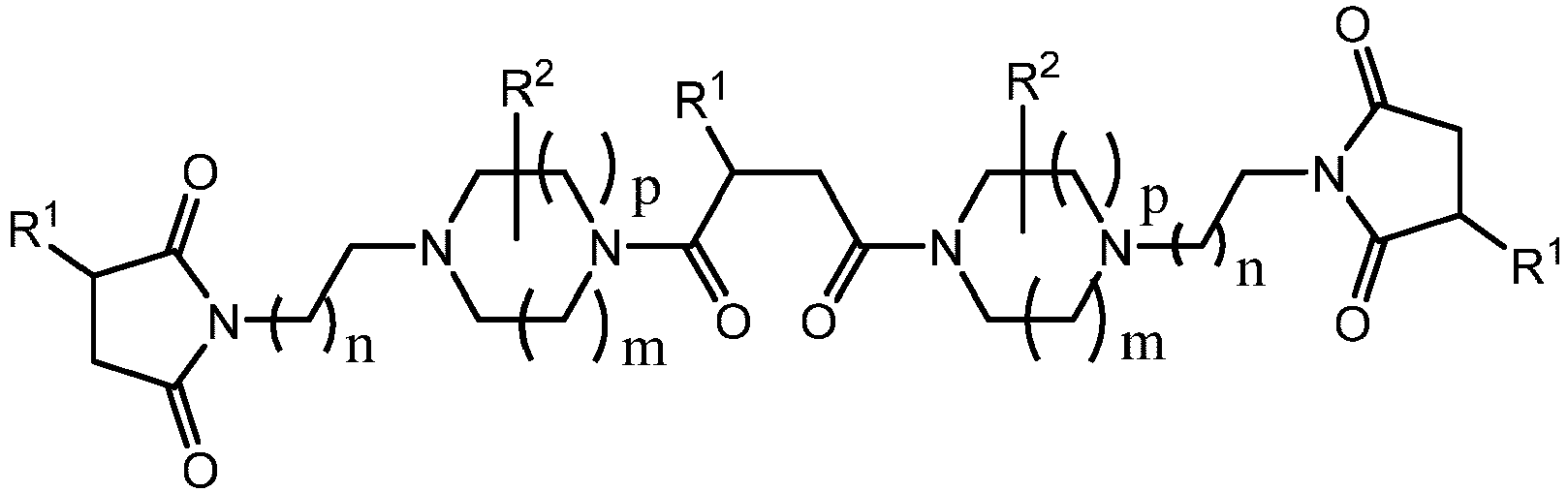 dans laquelle R1 et R2 sont indépendamment un groupe hydrocarbyle monovalent à chaîne linéaire ou ramifiée possédant deux à environ vingt atomes de carbone, chaque m est de 0 à 4, chaque p est de 0 à 4, pour chaque groupement cyclique, m + p est de 2 et 4 et chaque n est indépendamment de 1 à 6.
 - Composition d'huile lubrifiante selon la revendication 4, dans laquelle le groupe hydrocarbyle monovalent à chaîne linéaire ou ramifiée est un groupe alcényle ramifié en C12 à C20.
- Composition d'huile lubrifiante selon la revendication 4, dans laquelle le groupe hydrocarbyle monovalent à chaîne linéaire ou ramifiée est un groupe alcényle ramifié en C18 à C20.
- Composition d'huile lubrifiante selon la revendication 4, dans laquelle le composé contenant une amine tertiaire est présent en une quantité d'environ 0,1 à 2 % en poids par rapport à la composition d'huile lubrifiante.
- Composition d'huile lubrifiante selon la revendication 4, dans laquelle la composition d'huile lubrifiante est un liquide hydraulique, un lubrifiant de glissière, un liquide de transmission automatique, un liquide de transmission à variation continue, un véhicule électrique à batterie, un liquide de transmission de véhicule électrique hybride ou une huile pour engrenage.
- Composition d'huile lubrifiante selon la revendication 4, comprenant en outre :
un modificateur de friction, un additif anti-usure sans cendres, un antioxydant, un désactivateur de métal, un additif de gonflement d'étanchéité, un inhibiteur de mousse ou un modificateur de viscosité. - Composition d'additif sans cendres comprenant un produit de type diamide d'une réaction comprenant :un anhydride succinique substitué par hydrocarbyle représenté par la structure suivante :
 dans laquelle R1 est un groupe hydrocarbyle monovalent à chaîne linéaire ou ramifiée possédant deux à environ vingt atomes de carbone ; etune polyamine cyclique représentée par la structure suivante :
 dans laquelle R2 est un groupe hydrocarbyle monovalent à chaîne linéaire ou ramifiée possédant deux à environ vingt atomes de carbone, m est de 0 à 4, p est de 0 à 4, m + p est de 2 à 4 et n est de 1 à 6 ; etdans laquelle le rapport molaire de charge d'anhydride succinique substitué par hydrocarbyle sur polyamine cyclique est d'environ 1,5:1 à environ 1,6:1.
 - Composition d'additif sans cendres selon la revendication 10, dans laquelle la polyamine cyclique est une aminoéthylpipérazine, une aminopropylpipérazine, une aminobutylpipérazine, un aminoéthyldiazépane ou un aminoéthyldiazocane.
- Procédé pour la modification de la friction dans un moteur, le procédé comprenant la lubrification dudit moteur avec une composition d'huile de lubrification comprenant :une quantité majoritaire d'une huile de base de viscosité lubrifiante ; etune composition d'additif sans cendres présentant la structure suivante :
 dans laquelle R1 et R2 sont indépendamment un groupe hydrocarbyle monovalent à chaîne linéaire ou ramifiée possédant deux à environ vingt atomes de carbone, chaque m est indépendamment de 0 à 4, chaque p est indépendamment de 0 à 4, pour chaque groupement cyclique, m + p est de 2 et 4 et chaque n est indépendamment de 1 à 6.
 - Procédé selon la revendication 12, dans lequel le groupe hydrocarbyle monovalent à chaîne linéaire ou ramifiée est un groupe alcényle ramifié en C12 à C20.
- Procédé selon la revendication 12, dans lequel le groupe hydrocarbyle monovalent à chaîne linéaire ou ramifiée est un groupe alcényle ramifié en C18 à C20.
- Procédé d'augmentation de l'indice de base total dans une huile lubrifiante, le procédé comprenant le mélange d'une huile de base et d'une composition d'additif sans cendres ayant la structure suivante :

Applications Claiming Priority (2)
| Application Number | Priority Date | Filing Date | Title |
|---|---|---|---|
| US202063087584P | 2020-10-05 | 2020-10-05 | |
| PCT/IB2021/058896 WO2022074512A1 (fr) | 2020-10-05 | 2021-09-29 | Composition d'additif sans cendres |
Publications (2)
| Publication Number | Publication Date |
|---|---|
| EP4225877A1 EP4225877A1 (fr) | 2023-08-16 |
| EP4225877B1 true EP4225877B1 (fr) | 2024-07-17 |
Family
ID=78080399
Family Applications (1)
| Application Number | Title | Priority Date | Filing Date |
|---|---|---|---|
| EP21787056.7A Active EP4225877B1 (fr) | 2020-10-05 | 2021-09-29 | Composition d'additif sans cendres |
Country Status (5)
| Country | Link |
|---|---|
| EP (1) | EP4225877B1 (fr) |
| JP (1) | JP2023543939A (fr) |
| CN (1) | CN116323877B (fr) |
| CA (1) | CA3197324A1 (fr) |
| WO (1) | WO2022074512A1 (fr) |
Families Citing this family (3)
| Publication number | Priority date | Publication date | Assignee | Title |
|---|---|---|---|---|
| US20240093115A1 (en) | 2020-10-05 | 2024-03-21 | Chevron Oronite Company Llc | Ashless additive composition |
| CN119013381A (zh) * | 2022-03-31 | 2024-11-22 | 雪佛龙奥伦耐有限责任公司 | 无灰添加剂组合物 |
| US20260109911A1 (en) * | 2023-04-17 | 2026-04-23 | Chevron Oronite Company Llc | Friction modifier for wet clutch |
Family Cites Families (11)
| Publication number | Priority date | Publication date | Assignee | Title |
|---|---|---|---|---|
| US3200076A (en) * | 1963-03-28 | 1965-08-10 | California Research Corp | Polypiperazinyl succinimides in lubricating oils |
| EP0451380B2 (fr) * | 1990-04-10 | 1997-07-30 | Ethyl Petroleum Additives Limited | Compositions de succinimide |
| US20020119895A1 (en) * | 1995-05-26 | 2002-08-29 | Susan P. Cook | Lubricants with molybdenum containing compositions and methods of using the same |
| EP1078977B1 (fr) * | 1999-07-30 | 2010-01-27 | Afton Chemical Limited | Compositions lubrifiantes |
| WO2003102117A1 (fr) * | 2002-05-30 | 2003-12-11 | Idemitsu Kosan Co., Ltd. | Composition d'additif d'huile lubrifiante pour moteur a combustion interne |
| US7091306B2 (en) | 2003-05-09 | 2006-08-15 | Chevron Oronite Company Llc | Process for preparing polyalkenylsuccinimides |
| US8598100B2 (en) * | 2003-06-23 | 2013-12-03 | Idemitsu Kosan Co., Ltd. | Lubricating oil additive and lubricating oil composition |
| US20050070446A1 (en) * | 2003-09-25 | 2005-03-31 | Ethyl Petroleum Additives, Inc. | Boron free automotive gear oil |
| JP4677359B2 (ja) * | 2005-03-23 | 2011-04-27 | アフトン・ケミカル・コーポレーション | 潤滑組成物 |
| US8455568B2 (en) * | 2008-04-25 | 2013-06-04 | Chevron Oronite Company Llc | Lubricating oil additive composition and method of making the same |
| EP3518569B1 (fr) | 2015-04-08 | 2020-04-08 | Huawei Technologies Co., Ltd. | Procédé d'amélioration de clé de système gprs, dispositif sgsn, ue, hlr/hss et système gprs |
-
2021
- 2021-09-29 EP EP21787056.7A patent/EP4225877B1/fr active Active
- 2021-09-29 CN CN202180071362.8A patent/CN116323877B/zh active Active
- 2021-09-29 WO PCT/IB2021/058896 patent/WO2022074512A1/fr not_active Ceased
- 2021-09-29 CA CA3197324A patent/CA3197324A1/fr active Pending
- 2021-09-29 JP JP2023520556A patent/JP2023543939A/ja active Pending
Also Published As
| Publication number | Publication date |
|---|---|
| WO2022074512A1 (fr) | 2022-04-14 |
| CN116323877A (zh) | 2023-06-23 |
| CN116323877B (zh) | 2025-07-04 |
| CA3197324A1 (fr) | 2022-04-14 |
| EP4225877A1 (fr) | 2023-08-16 |
| JP2023543939A (ja) | 2023-10-18 |
Similar Documents
| Publication | Publication Date | Title |
|---|---|---|
| US12331260B2 (en) | Ashless additive composition | |
| EP4225877B1 (fr) | Composition d'additif sans cendres | |
| JP7777611B2 (ja) | 潤滑油組成物 | |
| EP4225878B1 (fr) | Système de modification de frottement | |
| EP2297284B1 (fr) | Additif d'huile lubrifiante et composition d'huile lubrifiante contenant cet additif | |
| EP4185673B1 (fr) | Dispersants succinimides post-traités avec des éthers glycidyliques hétéroaromatiques qui offrent de bonnes performances de traitement des suies | |
| EP4211210B1 (fr) | Composition lubrifiante contenant un acide phosphonique alkylé | |
| US20230085359A1 (en) | Lubricating oil compositions with improved oxidative performance comprising alkylated diphenylamine antioxidant and sulfonate detergents | |
| US20250188381A1 (en) | Lubricating oil compositions with improved oxidative performance comprising alkylated diphenylamine antioxidant and carboxylate detergents | |
| EP4499788A1 (fr) | Composition d'additif sans cendres | |
| WO2025059629A1 (fr) | Amélioration en termes de corrosion, de rouille et de rétention d'émulsion dans des moteurs à hydrogène | |
| WO2026080073A1 (fr) | Composés et compositions inhibiteurs de corrosion | |
| EP4565671A1 (fr) | Composition d'huile lubrifiante pour lutter contre la corrosion |
Legal Events
| Date | Code | Title | Description |
|---|---|---|---|
| STAA | Information on the status of an ep patent application or granted ep patent |
Free format text: STATUS: UNKNOWN |
|
| STAA | Information on the status of an ep patent application or granted ep patent |
Free format text: STATUS: THE INTERNATIONAL PUBLICATION HAS BEEN MADE |
|
| PUAI | Public reference made under article 153(3) epc to a published international application that has entered the european phase |
Free format text: ORIGINAL CODE: 0009012 |
|
| STAA | Information on the status of an ep patent application or granted ep patent |
Free format text: STATUS: REQUEST FOR EXAMINATION WAS MADE |
|
| 17P | Request for examination filed |
Effective date: 20230328 |
|
| AK | Designated contracting states |
Kind code of ref document: A1 Designated state(s): AL AT BE BG CH CY CZ DE DK EE ES FI FR GB GR HR HU IE IS IT LI LT LU LV MC MK MT NL NO PL PT RO RS SE SI SK SM TR |
|
| DAV | Request for validation of the european patent (deleted) | ||
| DAX | Request for extension of the european patent (deleted) | ||
| GRAP | Despatch of communication of intention to grant a patent |
Free format text: ORIGINAL CODE: EPIDOSNIGR1 |
|
| STAA | Information on the status of an ep patent application or granted ep patent |
Free format text: STATUS: GRANT OF PATENT IS INTENDED |
|
| INTG | Intention to grant announced |
Effective date: 20240205 |
|
| RIN1 | Information on inventor provided before grant (corrected) |
Inventor name: HOSSEINI, SEYEDEH MAHBOOBEH Inventor name: FUCHI, MASAMI Inventor name: RUHE, JR., WILLIAM RAYMOND |
|
| GRAS | Grant fee paid |
Free format text: ORIGINAL CODE: EPIDOSNIGR3 |
|
| GRAA | (expected) grant |
Free format text: ORIGINAL CODE: 0009210 |
|
| STAA | Information on the status of an ep patent application or granted ep patent |
Free format text: STATUS: THE PATENT HAS BEEN GRANTED |
|
| AK | Designated contracting states |
Kind code of ref document: B1 Designated state(s): AL AT BE BG CH CY CZ DE DK EE ES FI FR GB GR HR HU IE IS IT LI LT LU LV MC MK MT NL NO PL PT RO RS SE SI SK SM TR |
|
| REG | Reference to a national code |
Ref country code: CH Ref legal event code: EP |
|
| REG | Reference to a national code |
Ref country code: DE Ref legal event code: R096 Ref document number: 602021015927 Country of ref document: DE |
|
| REG | Reference to a national code |
Ref country code: IE Ref legal event code: FG4D |
|
| RAP4 | Party data changed (patent owner data changed or rights of a patent transferred) |
Owner name: CHEVRON JAPAN LTD. Owner name: CHEVRON ORONITE COMPANY LLC |
|
| REG | Reference to a national code |
Ref country code: LT Ref legal event code: MG9D |
|
| REG | Reference to a national code |
Ref country code: NL Ref legal event code: MP Effective date: 20240717 |
|
| PG25 | Lapsed in a contracting state [announced via postgrant information from national office to epo] |
Ref country code: PT Free format text: LAPSE BECAUSE OF FAILURE TO SUBMIT A TRANSLATION OF THE DESCRIPTION OR TO PAY THE FEE WITHIN THE PRESCRIBED TIME-LIMIT Effective date: 20241118 |
|
| REG | Reference to a national code |
Ref country code: AT Ref legal event code: MK05 Ref document number: 1704154 Country of ref document: AT Kind code of ref document: T Effective date: 20240717 |
|
| PG25 | Lapsed in a contracting state [announced via postgrant information from national office to epo] |
Ref country code: NL Free format text: LAPSE BECAUSE OF FAILURE TO SUBMIT A TRANSLATION OF THE DESCRIPTION OR TO PAY THE FEE WITHIN THE PRESCRIBED TIME-LIMIT Effective date: 20240717 |
|
| PG25 | Lapsed in a contracting state [announced via postgrant information from national office to epo] |
Ref country code: PT Free format text: LAPSE BECAUSE OF FAILURE TO SUBMIT A TRANSLATION OF THE DESCRIPTION OR TO PAY THE FEE WITHIN THE PRESCRIBED TIME-LIMIT Effective date: 20241118 Ref country code: NL Free format text: LAPSE BECAUSE OF FAILURE TO SUBMIT A TRANSLATION OF THE DESCRIPTION OR TO PAY THE FEE WITHIN THE PRESCRIBED TIME-LIMIT Effective date: 20240717 |
|
| PG25 | Lapsed in a contracting state [announced via postgrant information from national office to epo] |
Ref country code: NO Free format text: LAPSE BECAUSE OF FAILURE TO SUBMIT A TRANSLATION OF THE DESCRIPTION OR TO PAY THE FEE WITHIN THE PRESCRIBED TIME-LIMIT Effective date: 20241017 |
|
| P01 | Opt-out of the competence of the unified patent court (upc) registered |
Free format text: CASE NUMBER: APP_64736/2024 Effective date: 20241206 |
|
| PG25 | Lapsed in a contracting state [announced via postgrant information from national office to epo] |
Ref country code: FI Free format text: LAPSE BECAUSE OF FAILURE TO SUBMIT A TRANSLATION OF THE DESCRIPTION OR TO PAY THE FEE WITHIN THE PRESCRIBED TIME-LIMIT Effective date: 20240717 Ref country code: PL Free format text: LAPSE BECAUSE OF FAILURE TO SUBMIT A TRANSLATION OF THE DESCRIPTION OR TO PAY THE FEE WITHIN THE PRESCRIBED TIME-LIMIT Effective date: 20240717 Ref country code: GR Free format text: LAPSE BECAUSE OF FAILURE TO SUBMIT A TRANSLATION OF THE DESCRIPTION OR TO PAY THE FEE WITHIN THE PRESCRIBED TIME-LIMIT Effective date: 20241018 |
|
| PG25 | Lapsed in a contracting state [announced via postgrant information from national office to epo] |
Ref country code: BG Free format text: LAPSE BECAUSE OF FAILURE TO SUBMIT A TRANSLATION OF THE DESCRIPTION OR TO PAY THE FEE WITHIN THE PRESCRIBED TIME-LIMIT Effective date: 20240717 |
|
| PG25 | Lapsed in a contracting state [announced via postgrant information from national office to epo] |
Ref country code: LV Free format text: LAPSE BECAUSE OF FAILURE TO SUBMIT A TRANSLATION OF THE DESCRIPTION OR TO PAY THE FEE WITHIN THE PRESCRIBED TIME-LIMIT Effective date: 20240717 |
|
| PG25 | Lapsed in a contracting state [announced via postgrant information from national office to epo] |
Ref country code: AT Free format text: LAPSE BECAUSE OF FAILURE TO SUBMIT A TRANSLATION OF THE DESCRIPTION OR TO PAY THE FEE WITHIN THE PRESCRIBED TIME-LIMIT Effective date: 20240717 Ref country code: IS Free format text: LAPSE BECAUSE OF FAILURE TO SUBMIT A TRANSLATION OF THE DESCRIPTION OR TO PAY THE FEE WITHIN THE PRESCRIBED TIME-LIMIT Effective date: 20241117 |
|
| PG25 | Lapsed in a contracting state [announced via postgrant information from national office to epo] |
Ref country code: HR Free format text: LAPSE BECAUSE OF FAILURE TO SUBMIT A TRANSLATION OF THE DESCRIPTION OR TO PAY THE FEE WITHIN THE PRESCRIBED TIME-LIMIT Effective date: 20240717 |
|
| PG25 | Lapsed in a contracting state [announced via postgrant information from national office to epo] |
Ref country code: ES Free format text: LAPSE BECAUSE OF FAILURE TO SUBMIT A TRANSLATION OF THE DESCRIPTION OR TO PAY THE FEE WITHIN THE PRESCRIBED TIME-LIMIT Effective date: 20240717 Ref country code: RS Free format text: LAPSE BECAUSE OF FAILURE TO SUBMIT A TRANSLATION OF THE DESCRIPTION OR TO PAY THE FEE WITHIN THE PRESCRIBED TIME-LIMIT Effective date: 20241017 |
|
| PG25 | Lapsed in a contracting state [announced via postgrant information from national office to epo] |
Ref country code: RS Free format text: LAPSE BECAUSE OF FAILURE TO SUBMIT A TRANSLATION OF THE DESCRIPTION OR TO PAY THE FEE WITHIN THE PRESCRIBED TIME-LIMIT Effective date: 20241017 Ref country code: PL Free format text: LAPSE BECAUSE OF FAILURE TO SUBMIT A TRANSLATION OF THE DESCRIPTION OR TO PAY THE FEE WITHIN THE PRESCRIBED TIME-LIMIT Effective date: 20240717 Ref country code: NO Free format text: LAPSE BECAUSE OF FAILURE TO SUBMIT A TRANSLATION OF THE DESCRIPTION OR TO PAY THE FEE WITHIN THE PRESCRIBED TIME-LIMIT Effective date: 20241017 Ref country code: LV Free format text: LAPSE BECAUSE OF FAILURE TO SUBMIT A TRANSLATION OF THE DESCRIPTION OR TO PAY THE FEE WITHIN THE PRESCRIBED TIME-LIMIT Effective date: 20240717 Ref country code: IS Free format text: LAPSE BECAUSE OF FAILURE TO SUBMIT A TRANSLATION OF THE DESCRIPTION OR TO PAY THE FEE WITHIN THE PRESCRIBED TIME-LIMIT Effective date: 20241117 Ref country code: HR Free format text: LAPSE BECAUSE OF FAILURE TO SUBMIT A TRANSLATION OF THE DESCRIPTION OR TO PAY THE FEE WITHIN THE PRESCRIBED TIME-LIMIT Effective date: 20240717 Ref country code: GR Free format text: LAPSE BECAUSE OF FAILURE TO SUBMIT A TRANSLATION OF THE DESCRIPTION OR TO PAY THE FEE WITHIN THE PRESCRIBED TIME-LIMIT Effective date: 20241018 Ref country code: FI Free format text: LAPSE BECAUSE OF FAILURE TO SUBMIT A TRANSLATION OF THE DESCRIPTION OR TO PAY THE FEE WITHIN THE PRESCRIBED TIME-LIMIT Effective date: 20240717 Ref country code: ES Free format text: LAPSE BECAUSE OF FAILURE TO SUBMIT A TRANSLATION OF THE DESCRIPTION OR TO PAY THE FEE WITHIN THE PRESCRIBED TIME-LIMIT Effective date: 20240717 Ref country code: BG Free format text: LAPSE BECAUSE OF FAILURE TO SUBMIT A TRANSLATION OF THE DESCRIPTION OR TO PAY THE FEE WITHIN THE PRESCRIBED TIME-LIMIT Effective date: 20240717 Ref country code: AT Free format text: LAPSE BECAUSE OF FAILURE TO SUBMIT A TRANSLATION OF THE DESCRIPTION OR TO PAY THE FEE WITHIN THE PRESCRIBED TIME-LIMIT Effective date: 20240717 |
|
| PG25 | Lapsed in a contracting state [announced via postgrant information from national office to epo] |
Ref country code: SM Free format text: LAPSE BECAUSE OF FAILURE TO SUBMIT A TRANSLATION OF THE DESCRIPTION OR TO PAY THE FEE WITHIN THE PRESCRIBED TIME-LIMIT Effective date: 20240717 Ref country code: DK Free format text: LAPSE BECAUSE OF FAILURE TO SUBMIT A TRANSLATION OF THE DESCRIPTION OR TO PAY THE FEE WITHIN THE PRESCRIBED TIME-LIMIT Effective date: 20240717 Ref country code: RO Free format text: LAPSE BECAUSE OF FAILURE TO SUBMIT A TRANSLATION OF THE DESCRIPTION OR TO PAY THE FEE WITHIN THE PRESCRIBED TIME-LIMIT Effective date: 20240717 |
|
| REG | Reference to a national code |
Ref country code: DE Ref legal event code: R097 Ref document number: 602021015927 Country of ref document: DE |
|
| PG25 | Lapsed in a contracting state [announced via postgrant information from national office to epo] |
Ref country code: MC Free format text: LAPSE BECAUSE OF FAILURE TO SUBMIT A TRANSLATION OF THE DESCRIPTION OR TO PAY THE FEE WITHIN THE PRESCRIBED TIME-LIMIT Effective date: 20240717 Ref country code: EE Free format text: LAPSE BECAUSE OF FAILURE TO SUBMIT A TRANSLATION OF THE DESCRIPTION OR TO PAY THE FEE WITHIN THE PRESCRIBED TIME-LIMIT Effective date: 20240717 |
|
| PG25 | Lapsed in a contracting state [announced via postgrant information from national office to epo] |
Ref country code: CZ Free format text: LAPSE BECAUSE OF FAILURE TO SUBMIT A TRANSLATION OF THE DESCRIPTION OR TO PAY THE FEE WITHIN THE PRESCRIBED TIME-LIMIT Effective date: 20240717 |
|
| PG25 | Lapsed in a contracting state [announced via postgrant information from national office to epo] |
Ref country code: SK Free format text: LAPSE BECAUSE OF FAILURE TO SUBMIT A TRANSLATION OF THE DESCRIPTION OR TO PAY THE FEE WITHIN THE PRESCRIBED TIME-LIMIT Effective date: 20240717 |
|
| REG | Reference to a national code |
Ref country code: CH Ref legal event code: PL |
|
| PG25 | Lapsed in a contracting state [announced via postgrant information from national office to epo] |
Ref country code: LU Free format text: LAPSE BECAUSE OF NON-PAYMENT OF DUE FEES Effective date: 20240929 |
|
| PLBE | No opposition filed within time limit |
Free format text: ORIGINAL CODE: 0009261 |
|
| STAA | Information on the status of an ep patent application or granted ep patent |
Free format text: STATUS: NO OPPOSITION FILED WITHIN TIME LIMIT |
|
| 26N | No opposition filed |
Effective date: 20250422 |
|
| REG | Reference to a national code |
Ref country code: BE Ref legal event code: MM Effective date: 20240930 |
|
| PG25 | Lapsed in a contracting state [announced via postgrant information from national office to epo] |
Ref country code: BE Free format text: LAPSE BECAUSE OF NON-PAYMENT OF DUE FEES Effective date: 20240930 |
|
| PG25 | Lapsed in a contracting state [announced via postgrant information from national office to epo] |
Ref country code: CH Free format text: LAPSE BECAUSE OF NON-PAYMENT OF DUE FEES Effective date: 20240930 |
|
| PG25 | Lapsed in a contracting state [announced via postgrant information from national office to epo] |
Ref country code: IE Free format text: LAPSE BECAUSE OF NON-PAYMENT OF DUE FEES Effective date: 20240929 |
|
| PG25 | Lapsed in a contracting state [announced via postgrant information from national office to epo] |
Ref country code: SE Free format text: LAPSE BECAUSE OF FAILURE TO SUBMIT A TRANSLATION OF THE DESCRIPTION OR TO PAY THE FEE WITHIN THE PRESCRIBED TIME-LIMIT Effective date: 20240717 |
|
| PGFP | Annual fee paid to national office [announced via postgrant information from national office to epo] |
Ref country code: DE Payment date: 20250805 Year of fee payment: 5 |
|
| PGFP | Annual fee paid to national office [announced via postgrant information from national office to epo] |
Ref country code: GB Payment date: 20250807 Year of fee payment: 5 |
|
| PGFP | Annual fee paid to national office [announced via postgrant information from national office to epo] |
Ref country code: FR Payment date: 20250808 Year of fee payment: 5 |
|
| PG25 | Lapsed in a contracting state [announced via postgrant information from national office to epo] |
Ref country code: CY Free format text: LAPSE BECAUSE OF FAILURE TO SUBMIT A TRANSLATION OF THE DESCRIPTION OR TO PAY THE FEE WITHIN THE PRESCRIBED TIME-LIMIT; INVALID AB INITIO Effective date: 20210929 Ref country code: IT Free format text: LAPSE BECAUSE OF FAILURE TO SUBMIT A TRANSLATION OF THE DESCRIPTION OR TO PAY THE FEE WITHIN THE PRESCRIBED TIME-LIMIT Effective date: 20240717 |
|
| PG25 | Lapsed in a contracting state [announced via postgrant information from national office to epo] |
Ref country code: HU Free format text: LAPSE BECAUSE OF FAILURE TO SUBMIT A TRANSLATION OF THE DESCRIPTION OR TO PAY THE FEE WITHIN THE PRESCRIBED TIME-LIMIT; INVALID AB INITIO Effective date: 20210929 |