EP4227385A1 - Verfahren zur herstellung von erneuerbarem luftfahrtkerosin - Google Patents
Verfahren zur herstellung von erneuerbarem luftfahrtkerosin Download PDFInfo
- Publication number
- EP4227385A1 EP4227385A1 EP21876777.0A EP21876777A EP4227385A1 EP 4227385 A1 EP4227385 A1 EP 4227385A1 EP 21876777 A EP21876777 A EP 21876777A EP 4227385 A1 EP4227385 A1 EP 4227385A1
- Authority
- EP
- European Patent Office
- Prior art keywords
- ethanol
- catalyst
- coupling
- reaction
- hydrodeoxygenation
- Prior art date
- Legal status (The legal status is an assumption and is not a legal conclusion. Google has not performed a legal analysis and makes no representation as to the accuracy of the status listed.)
- Pending
Links
Images
Classifications
-
- C—CHEMISTRY; METALLURGY
- C10—PETROLEUM, GAS OR COKE INDUSTRIES; TECHNICAL GASES CONTAINING CARBON MONOXIDE; FUELS; LUBRICANTS; PEAT
- C10G—CRACKING HYDROCARBON OILS; PRODUCTION OF LIQUID HYDROCARBON MIXTURES, e.g. BY DESTRUCTIVE HYDROGENATION, OLIGOMERISATION, POLYMERISATION; RECOVERY OF HYDROCARBON OILS FROM OIL-SHALE, OIL-SAND, OR GASES; REFINING MIXTURES MAINLY CONSISTING OF HYDROCARBONS; REFORMING OF NAPHTHA; MINERAL WAXES
- C10G3/00—Production of liquid hydrocarbon mixtures from oxygen-containing organic materials, e.g. fatty oils, fatty acids
- C10G3/50—Production of liquid hydrocarbon mixtures from oxygen-containing organic materials, e.g. fatty oils, fatty acids in the presence of hydrogen, hydrogen donors or hydrogen generating compounds
-
- B—PERFORMING OPERATIONS; TRANSPORTING
- B01—PHYSICAL OR CHEMICAL PROCESSES OR APPARATUS IN GENERAL
- B01J—CHEMICAL OR PHYSICAL PROCESSES, e.g. CATALYSIS OR COLLOID CHEMISTRY; THEIR RELEVANT APPARATUS
- B01J21/00—Catalysts comprising the elements, oxides, or hydroxides of magnesium, boron, aluminium, carbon, silicon, titanium, zirconium, or hafnium
- B01J21/02—Boron or aluminium; Oxides or hydroxides thereof
- B01J21/04—Alumina
-
- B—PERFORMING OPERATIONS; TRANSPORTING
- B01—PHYSICAL OR CHEMICAL PROCESSES OR APPARATUS IN GENERAL
- B01J—CHEMICAL OR PHYSICAL PROCESSES, e.g. CATALYSIS OR COLLOID CHEMISTRY; THEIR RELEVANT APPARATUS
- B01J23/00—Catalysts comprising metals or metal oxides or hydroxides, not provided for in group B01J21/00
- B01J23/70—Catalysts comprising metals or metal oxides or hydroxides, not provided for in group B01J21/00 of the iron group metals or copper
- B01J23/76—Catalysts comprising metals or metal oxides or hydroxides, not provided for in group B01J21/00 of the iron group metals or copper combined with metals, oxides or hydroxides provided for in groups B01J23/02 - B01J23/36
- B01J23/78—Catalysts comprising metals or metal oxides or hydroxides, not provided for in group B01J21/00 of the iron group metals or copper combined with metals, oxides or hydroxides provided for in groups B01J23/02 - B01J23/36 with alkali- or alkaline earth metals
-
- B—PERFORMING OPERATIONS; TRANSPORTING
- B01—PHYSICAL OR CHEMICAL PROCESSES OR APPARATUS IN GENERAL
- B01J—CHEMICAL OR PHYSICAL PROCESSES, e.g. CATALYSIS OR COLLOID CHEMISTRY; THEIR RELEVANT APPARATUS
- B01J23/00—Catalysts comprising metals or metal oxides or hydroxides, not provided for in group B01J21/00
- B01J23/70—Catalysts comprising metals or metal oxides or hydroxides, not provided for in group B01J21/00 of the iron group metals or copper
- B01J23/76—Catalysts comprising metals or metal oxides or hydroxides, not provided for in group B01J21/00 of the iron group metals or copper combined with metals, oxides or hydroxides provided for in groups B01J23/02 - B01J23/36
- B01J23/84—Catalysts comprising metals or metal oxides or hydroxides, not provided for in group B01J21/00 of the iron group metals or copper combined with metals, oxides or hydroxides provided for in groups B01J23/02 - B01J23/36 with arsenic, antimony, bismuth, vanadium, niobium, tantalum, polonium, chromium, molybdenum, tungsten, manganese, technetium or rhenium
- B01J23/85—Chromium, molybdenum or tungsten
- B01J23/88—Molybdenum
- B01J23/883—Molybdenum and nickel
-
- B—PERFORMING OPERATIONS; TRANSPORTING
- B01—PHYSICAL OR CHEMICAL PROCESSES OR APPARATUS IN GENERAL
- B01J—CHEMICAL OR PHYSICAL PROCESSES, e.g. CATALYSIS OR COLLOID CHEMISTRY; THEIR RELEVANT APPARATUS
- B01J37/00—Processes, in general, for preparing catalysts; Processes, in general, for activation of catalysts
- B01J37/16—Reducing
- B01J37/18—Reducing with gases containing free hydrogen
-
- B—PERFORMING OPERATIONS; TRANSPORTING
- B01—PHYSICAL OR CHEMICAL PROCESSES OR APPARATUS IN GENERAL
- B01J—CHEMICAL OR PHYSICAL PROCESSES, e.g. CATALYSIS OR COLLOID CHEMISTRY; THEIR RELEVANT APPARATUS
- B01J37/00—Processes, in general, for preparing catalysts; Processes, in general, for activation of catalysts
- B01J37/20—Sulfiding
-
- C—CHEMISTRY; METALLURGY
- C07—ORGANIC CHEMISTRY
- C07C—ACYCLIC OR CARBOCYCLIC COMPOUNDS
- C07C29/00—Preparation of compounds having hydroxy or O-metal groups bound to a carbon atom not belonging to a six-membered aromatic ring
- C07C29/15—Preparation of compounds having hydroxy or O-metal groups bound to a carbon atom not belonging to a six-membered aromatic ring by reduction of oxides of carbon exclusively
- C07C29/151—Preparation of compounds having hydroxy or O-metal groups bound to a carbon atom not belonging to a six-membered aromatic ring by reduction of oxides of carbon exclusively with hydrogen or hydrogen-containing gases
- C07C29/1516—Multisteps
-
- C—CHEMISTRY; METALLURGY
- C10—PETROLEUM, GAS OR COKE INDUSTRIES; TECHNICAL GASES CONTAINING CARBON MONOXIDE; FUELS; LUBRICANTS; PEAT
- C10G—CRACKING HYDROCARBON OILS; PRODUCTION OF LIQUID HYDROCARBON MIXTURES, e.g. BY DESTRUCTIVE HYDROGENATION, OLIGOMERISATION, POLYMERISATION; RECOVERY OF HYDROCARBON OILS FROM OIL-SHALE, OIL-SAND, OR GASES; REFINING MIXTURES MAINLY CONSISTING OF HYDROCARBONS; REFORMING OF NAPHTHA; MINERAL WAXES
- C10G3/00—Production of liquid hydrocarbon mixtures from oxygen-containing organic materials, e.g. fatty oils, fatty acids
- C10G3/42—Catalytic treatment
- C10G3/44—Catalytic treatment characterised by the catalyst used
- C10G3/45—Catalytic treatment characterised by the catalyst used containing iron group metals or compounds thereof
- C10G3/46—Catalytic treatment characterised by the catalyst used containing iron group metals or compounds thereof in combination with chromium, molybdenum, tungsten metals or compounds thereof
-
- C—CHEMISTRY; METALLURGY
- C10—PETROLEUM, GAS OR COKE INDUSTRIES; TECHNICAL GASES CONTAINING CARBON MONOXIDE; FUELS; LUBRICANTS; PEAT
- C10G—CRACKING HYDROCARBON OILS; PRODUCTION OF LIQUID HYDROCARBON MIXTURES, e.g. BY DESTRUCTIVE HYDROGENATION, OLIGOMERISATION, POLYMERISATION; RECOVERY OF HYDROCARBON OILS FROM OIL-SHALE, OIL-SAND, OR GASES; REFINING MIXTURES MAINLY CONSISTING OF HYDROCARBONS; REFORMING OF NAPHTHA; MINERAL WAXES
- C10G3/00—Production of liquid hydrocarbon mixtures from oxygen-containing organic materials, e.g. fatty oils, fatty acids
- C10G3/42—Catalytic treatment
- C10G3/44—Catalytic treatment characterised by the catalyst used
- C10G3/47—Catalytic treatment characterised by the catalyst used containing platinum group metals or compounds thereof
-
- C—CHEMISTRY; METALLURGY
- C10—PETROLEUM, GAS OR COKE INDUSTRIES; TECHNICAL GASES CONTAINING CARBON MONOXIDE; FUELS; LUBRICANTS; PEAT
- C10G—CRACKING HYDROCARBON OILS; PRODUCTION OF LIQUID HYDROCARBON MIXTURES, e.g. BY DESTRUCTIVE HYDROGENATION, OLIGOMERISATION, POLYMERISATION; RECOVERY OF HYDROCARBON OILS FROM OIL-SHALE, OIL-SAND, OR GASES; REFINING MIXTURES MAINLY CONSISTING OF HYDROCARBONS; REFORMING OF NAPHTHA; MINERAL WAXES
- C10G3/00—Production of liquid hydrocarbon mixtures from oxygen-containing organic materials, e.g. fatty oils, fatty acids
- C10G3/42—Catalytic treatment
- C10G3/44—Catalytic treatment characterised by the catalyst used
- C10G3/48—Catalytic treatment characterised by the catalyst used further characterised by the catalyst support
- C10G3/49—Catalytic treatment characterised by the catalyst used further characterised by the catalyst support containing crystalline aluminosilicates, e.g. molecular sieves
-
- C—CHEMISTRY; METALLURGY
- C10—PETROLEUM, GAS OR COKE INDUSTRIES; TECHNICAL GASES CONTAINING CARBON MONOXIDE; FUELS; LUBRICANTS; PEAT
- C10L—FUELS NOT OTHERWISE PROVIDED FOR; NATURAL GAS; SYNTHETIC NATURAL GAS OBTAINED BY PROCESSES NOT COVERED BY SUBCLASSES C10G OR C10K; LIQUIFIED PETROLEUM GAS; USE OF ADDITIVES TO FUELS OR FIRES; FIRE-LIGHTERS
- C10L1/00—Liquid carbonaceous fuels
- C10L1/04—Liquid carbonaceous fuels essentially based on blends of hydrocarbons
- C10L1/06—Liquid carbonaceous fuels essentially based on blends of hydrocarbons for spark ignition
-
- C—CHEMISTRY; METALLURGY
- C10—PETROLEUM, GAS OR COKE INDUSTRIES; TECHNICAL GASES CONTAINING CARBON MONOXIDE; FUELS; LUBRICANTS; PEAT
- C10G—CRACKING HYDROCARBON OILS; PRODUCTION OF LIQUID HYDROCARBON MIXTURES, e.g. BY DESTRUCTIVE HYDROGENATION, OLIGOMERISATION, POLYMERISATION; RECOVERY OF HYDROCARBON OILS FROM OIL-SHALE, OIL-SAND, OR GASES; REFINING MIXTURES MAINLY CONSISTING OF HYDROCARBONS; REFORMING OF NAPHTHA; MINERAL WAXES
- C10G2300/00—Aspects relating to hydrocarbon processing covered by groups C10G1/00 - C10G99/00
- C10G2300/10—Feedstock materials
- C10G2300/1011—Biomass
- C10G2300/1014—Biomass of vegetal origin
-
- C—CHEMISTRY; METALLURGY
- C10—PETROLEUM, GAS OR COKE INDUSTRIES; TECHNICAL GASES CONTAINING CARBON MONOXIDE; FUELS; LUBRICANTS; PEAT
- C10G—CRACKING HYDROCARBON OILS; PRODUCTION OF LIQUID HYDROCARBON MIXTURES, e.g. BY DESTRUCTIVE HYDROGENATION, OLIGOMERISATION, POLYMERISATION; RECOVERY OF HYDROCARBON OILS FROM OIL-SHALE, OIL-SAND, OR GASES; REFINING MIXTURES MAINLY CONSISTING OF HYDROCARBONS; REFORMING OF NAPHTHA; MINERAL WAXES
- C10G2400/00—Products obtained by processes covered by groups C10G9/00 - C10G69/14
- C10G2400/08—Jet fuel
-
- C—CHEMISTRY; METALLURGY
- C10—PETROLEUM, GAS OR COKE INDUSTRIES; TECHNICAL GASES CONTAINING CARBON MONOXIDE; FUELS; LUBRICANTS; PEAT
- C10L—FUELS NOT OTHERWISE PROVIDED FOR; NATURAL GAS; SYNTHETIC NATURAL GAS OBTAINED BY PROCESSES NOT COVERED BY SUBCLASSES C10G OR C10K; LIQUIFIED PETROLEUM GAS; USE OF ADDITIVES TO FUELS OR FIRES; FIRE-LIGHTERS
- C10L2200/00—Components of fuel compositions
- C10L2200/04—Organic compounds
- C10L2200/0407—Specifically defined hydrocarbon fractions as obtained from, e.g. a distillation column
- C10L2200/043—Kerosene, jet fuel
-
- C—CHEMISTRY; METALLURGY
- C10—PETROLEUM, GAS OR COKE INDUSTRIES; TECHNICAL GASES CONTAINING CARBON MONOXIDE; FUELS; LUBRICANTS; PEAT
- C10L—FUELS NOT OTHERWISE PROVIDED FOR; NATURAL GAS; SYNTHETIC NATURAL GAS OBTAINED BY PROCESSES NOT COVERED BY SUBCLASSES C10G OR C10K; LIQUIFIED PETROLEUM GAS; USE OF ADDITIVES TO FUELS OR FIRES; FIRE-LIGHTERS
- C10L2200/00—Components of fuel compositions
- C10L2200/04—Organic compounds
- C10L2200/0461—Fractions defined by their origin
- C10L2200/0469—Renewables or materials of biological origin
-
- C—CHEMISTRY; METALLURGY
- C10—PETROLEUM, GAS OR COKE INDUSTRIES; TECHNICAL GASES CONTAINING CARBON MONOXIDE; FUELS; LUBRICANTS; PEAT
- C10L—FUELS NOT OTHERWISE PROVIDED FOR; NATURAL GAS; SYNTHETIC NATURAL GAS OBTAINED BY PROCESSES NOT COVERED BY SUBCLASSES C10G OR C10K; LIQUIFIED PETROLEUM GAS; USE OF ADDITIVES TO FUELS OR FIRES; FIRE-LIGHTERS
- C10L2270/00—Specifically adapted fuels
- C10L2270/04—Specifically adapted fuels for turbines, planes, power generation
-
- Y—GENERAL TAGGING OF NEW TECHNOLOGICAL DEVELOPMENTS; GENERAL TAGGING OF CROSS-SECTIONAL TECHNOLOGIES SPANNING OVER SEVERAL SECTIONS OF THE IPC; TECHNICAL SUBJECTS COVERED BY FORMER USPC CROSS-REFERENCE ART COLLECTIONS [XRACs] AND DIGESTS
- Y02—TECHNOLOGIES OR APPLICATIONS FOR MITIGATION OR ADAPTATION AGAINST CLIMATE CHANGE
- Y02P—CLIMATE CHANGE MITIGATION TECHNOLOGIES IN THE PRODUCTION OR PROCESSING OF GOODS
- Y02P20/00—Technologies relating to chemical industry
- Y02P20/50—Improvements relating to the production of bulk chemicals
- Y02P20/52—Improvements relating to the production of bulk chemicals using catalysts, e.g. selective catalysts
-
- Y—GENERAL TAGGING OF NEW TECHNOLOGICAL DEVELOPMENTS; GENERAL TAGGING OF CROSS-SECTIONAL TECHNOLOGIES SPANNING OVER SEVERAL SECTIONS OF THE IPC; TECHNICAL SUBJECTS COVERED BY FORMER USPC CROSS-REFERENCE ART COLLECTIONS [XRACs] AND DIGESTS
- Y02—TECHNOLOGIES OR APPLICATIONS FOR MITIGATION OR ADAPTATION AGAINST CLIMATE CHANGE
- Y02P—CLIMATE CHANGE MITIGATION TECHNOLOGIES IN THE PRODUCTION OR PROCESSING OF GOODS
- Y02P30/00—Technologies relating to oil refining and petrochemical industry
- Y02P30/20—Technologies relating to oil refining and petrochemical industry using bio-feedstock
Definitions
- the present invention relates to a production process of renewable aviation kerosene (bioQAV) from ethanol from fermentation of sugars applied in the area of biofuels and renewable energy sources, aiming at converting ethanol into at least 50% of C8+.
- bioQAV renewable aviation kerosene
- biofuels especially renewable aviation kerosene (bioQAV) to replace fossil fuels.
- bioQAV renewable aviation kerosene
- the main route of obtaining bioQAV considered in the art is the hydroprocessing of vegetable oil (Hydroprocessing of Vegetable Oils, HVO), generating paraffins that are subsequently hydroisomerized for use as aviation kerosene (QAV).
- HVO Vegetable Oils
- QAV aviation kerosene
- the chain size of paraffins in triglycerides limits the amount of HVO which can be used as bioQAV.
- oil productivity plant per unit of planted hectare, for crops such as soy is low, usually less than 500 L/ha.
- crops such as sugar cane typically allow 65 to 95 ton/ha per year, resulting in ethanol of up to 8.550 L/ha, with potential to increase. That is, it can be produced almost 20 times more ethanol than soybean oil in the same area, which increases with the possibility of cellulosic ethanol and energy cane.
- Ethanol from a renewable source is usually produced by fermentation of sucrose by yeasts, such as Saccharomices Cereviseae.
- sucrose such as Saccharomices Cereviseae.
- other sugars such as glucose obtained from starch and xylose obtained from hemicellulose can be fermented.
- Sucrose can be obtained of sugar cane. From sugarcane bagasse, cellulose can still be converted to glucose and hemicellulose to xylose and other sugars, also fermentable. Assuming the fermentation of the glucose molecule, with 6 carbons, 4 carbons will result in 2 ethanol molecules and 2 carbons in 2 molecules of CO 2 . In this way, each molecule of ethanol obtained also generates an unused CO 2 molecule.
- the routes usually involve the reactions of dehydration of ethanol to ethene, followed by oligomerization of olefins.
- Ethene can then be oligomerized to components with size of a molecule compatible with diesel and QAV.
- the Guerbet reaction initially involves the reaction: 2 Ethanol ⁇ 1-butanol + H 2 O and can occur successively.
- the patent US 4134926 teaches the dehydration of ethanol in acid catalysts such as alumina, silica-aluminas, activated clays and zeolites, at least 370 °C, and in a fluidized bed to facilitate its regeneration. Lower temperatures favor the formation of diethyl ether, not the dehydration to ethene.
- acid catalysts such as alumina, silica-aluminas, activated clays and zeolites, at least 370 °C, and in a fluidized bed to facilitate its regeneration.
- Lower temperatures favor the formation of diethyl ether, not the dehydration to ethene.
- oligomerization of ethylene in one step, with selectivity, is difficult by classical heterogeneous acid catalysis, being preferable the oligomerization of butylenes or greater, including recycling of products below of the distillate range, as taught by documents US 7271304 , US 9644159 and US 9663415 . Even the conversion of ethanol and/or ethylene to C3 to C6 olefins for further oligomerization.
- the patent US 8378160 teaches how to obtain isobutanol by fermentation, dehydration to olefins, oligomerization in acid catalyst and subsequent hydrogenation. It also teaches the transformation of isobutenes into aromatics, and the alkylation of olefins with the aromatics obtained.
- the initial oligomerization step may present low selectivity and problems such as catalyst deactivation, an attempt was made to alternatives for the production of longer chain components from ethanol, like the Guerbet reaction.
- the Guerbet reaction is a coupling reaction of alcohols.
- ethanol In the case of ethanol, it involves dehydrogenation to acetaldehyde, aldol self-condensation of acetaldehyde and hydrogenation of the intermediate to butanol.
- the reaction can occur sequentially, generating C4-C6 alcohols, C6-C8 alcohols or even C12-C16 alcohols, and the process can be combined with another acid oligomerization after dehydration of olefins of different chain sizes.
- Acetobutyl fermentation produces a mixture of butanol, acetone and ethanol.
- US 9790444 patent teaches the production of higher molecular weight branched paraffin hydrocarbons from the reaction of condensation of alcohols and aldol in Guerbet type catalysts, with basic function in support, such as hydrotalcite, and hydrogenating/ dehydrogenating function such as Pd and Cu.
- the document teaches coupling of acetone with one or more primary alcohols, resulting in higher molecular weight branched ketones.
- the patent requires that the water content in the reaction load is less than 5% due to its inhibition effect.
- the ethanol route has a higher fermentation yield of sugars, even if to each 6 carbons in a unit of sugar (glucose), 2 carbons are lost as CO 2 .
- Another possible route is the generation of methanol from gasification biomass, and conversion of this methanol to bioQAV using MTD processes (Methanol to Diesel), but several processing, separation and treatment are necessary. Further, in the case of sugarcane, significant amount of bagasse is burned to provide energy for the distillation of the diluted ethanol from fermentation, decreasing its availability, and the remainder is burned to produce electricity.
- MTD processes Methanol to Diesel
- the present invention was developed, through which the production of bioQAV through conversion of ethanol and additionally methanol and/or CO 2 or synthesis gas into alkylaromatics by basic catalysis route plus hydrogenating/dehydrogenating function.
- the present invention relates to a production process of renewable aviation kerosene (bioQAV), characterized in that the reaction of ethanol and optionally methanol and/or CO 2 and/or synthesis gas and mixtures thereof, in the presence of hydrogen, into a catalyst combining basic and hydrogenating/dehydrogenating function, preferably heterogeneous, resulting in alkyl aromatics.
- bioQAV renewable aviation kerosene
- the catalyst and conditions of the invention allow the alcohol combination Guerbet reaction, with generation of acetone and coupling of the same and other intermediates to alkyl-aromatics in the QAV distillation range.
- the alkyl aromatics preferentially undergo hydrodeoxygenation to conversion of oxygenates and remaining olefinic unsaturation and optionally hydrogenation of alkyl aromatics to alkyl naphthenics.
- hydrogen generated in the first step of the alcohol coupling reaction is used to hydrogenation of at least part of the alkyl aromatic to alkyl naphthenic.
- methanol or precursors of the same can also be combined with ethanol in the coupling reaction.
- An advantageous case is the use of CO 2 itself generated in the fermentation of sugars to bioethanol.
- the production process of renewable aviation kerosene (bioQAV) from ethanol from the fermentation of sugars is characterized by the coupling reaction of ethanol, being catalyzed by a combination of hydrogenating/dehydrogenating function and basic function, as catalysts for the Guerbet reaction.
- the catalyst of present invention in addition to the Guerbet alcohol coupling reaction, also promotes cyclization to aromatics. Without limiting the present invention to understanding the reaction mechanism, it is believed to occur parallel to the Guerbet reaction the synthesis reaction of acetone or intermediate and condensation thereof and the same between the alcohols by aldol condensation.
- the Guerbet reaction involves the reaction of a primary and/or secondary alcohol (or alcohol mixture), occurring in the following steps:
- methanol precursors can be used to formation of methanol in situ , or mixtures of methanol and precursors.
- Acetone is very reactive, and by basic catalysis it reacts to oxide mesityl, mesitylene and isophorone, and in its turn to phenolics and aromatics.
- the catalyst and conditions of the present invention allow both routes happen together, and that aldehydes from both the ethanol and derivatives and acetone and derivatives react with each other, for aldol condensation. Furthermore, the catalyst can carry out the reaction of coupling of intermediate phenolic compounds with alcohols, including methanol.
- the catalyst of the present invention catalyzes the CO 2 hydrogenation reactions and the water-gas-shift reaction and its reverse during the reaction, resulting in CO 2 formed in the reaction or fed to the reactor can be converted into methanol and formaldehyde, continuing the reactions of aldol condensation.
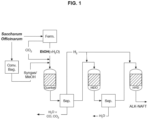
- the CO 2 generated in fermentation for ethanol production is fed to the coupling reactor.
- the bagasse of sugar cane or biomass is sent to gasification to generate methanol or sent directly to the ethanol coupling reaction.
- the invention used ethanol from a renewable energy source and preferably methanol from a renewable source, to obtain renewable aviation kerosene, totally or partly, ethanol and methanol (or methanol precursors such as CO 2 ) from other, non-renewable sources, can be used, and the renewable content of the aviation kerosene so-called renewable is proportional to the renewable content of reagents.
- the coupling reaction is carried out in two steps, to avoid unwanted formation of C3 oxygenates which are more time consuming to react. So, methanol and formaldehyde are more rapidly reacted with higher molecular weight alcohols and phenols, increasing the content of products in the middle distillate range.
- the mixture of alkyl aromatics and oxygenated products from condensation reactions can be hydrodeoxygenated in a second step of oxygen removal reaction, particularly hydrodeoxygenation (HDO).
- HDO hydrodeoxygenation
- the product of the ethanol coupling reaction passes through HDO, both to provide stability to the use of the stream as bioQAV and to facilitate the hydrogenation of alkyl aromatic to alkyl naphthenics in a final hydrogenation step.
- intermediate oxygen compounds can be sent back to the first step of the ethanol coupling reaction.
- Oxygen removal may occur for at least two mechanisms.
- it can be catalyzed by a combination of hydrogenating and acidic function, in which the carbonyls of the aldehydes are hydrogenated to alcohols, dehydrated alcohols to olefins and resulting olefins hydrogenated or not to isoparaffins, depending on the catalyst and hydrodeoxygenation conditions.
- the alkyl aromatics products of the alcohol coupling steps and HDO can be further fully or partially hydrogenated to alkyl naphthenes.
- the reaction is advantageous to gain density, use H 2 generated in the reaction itself, and finally enable greater use of the stream as bioQAV, which has a maximum limit of aromatics in the specification.
- the step of HDO and hydrogenation of aromatics can also take place in the same reactor or same catalyst.
- the HDO step is separated from the hydrogenation step of aromatics, since some typical HDO catalysts (e.g., Mo or W sulfides, promoted or not by Co and Ni) has little activity for hydrogenation of aromatics.
- some typical HDO catalysts e.g., Mo or W sulfides, promoted or not by Co and Ni
- Both the first reaction step of coupling alcohols and the subsequent HDO step can take place in the same reactor or in different reactors. Preferably, in different reactors, with recovery of unreacted oxygenates in the aldol coupling reaction step and their recycle to the coupling reactor.
- MeOH can be additionally used as a filler, or the same can be generated in situ from CO and hydrogen, CO 2 and hydrogen or a mixture thereof.
- CO 2 results from the parallel/intermediate acetone synthesis reaction itself.
- the mixtures of CO, CO 2 and H 2 gases can still be combined with MeOH in the feed of the reactor.
- formaldehyde can also be fed to the reactor, since it is the intermediate of the reaction produced by methanol dehydrogenation.
- the use of MeOH and/or combination of the same with synthesis gas are preferred, since formaldehyde can polymerize, obstructing access to catalyst sites.
- the calculation of the chemical equilibrium indicates that the amount of formaldehyde formed is small, and the absence of formaldehyde in the analysis of the product indicates that it reacts quickly.
- the hydrogenolysis reaction of methanol to CO and H 2 is endothermic, while the synthesis reaction of MeOH from CO and H 2 , exothermic. It can be advantageous the combination of methanol with synthesis gas (CO and H 2 ) in the load, in order to reduce the need for heat supply in the reaction conditions, making the temperature profile in the reactor close to the isothermal, favoring the coupling reaction.
- the coupling reaction with ethanol can be either powered by mixtures of CO and H 2 or CO 2 and H 2 or mixture thereof or be fed by MeOH or mixture of gases.
- the presence of H 2 has an effect in the methanol synthesis reaction when the feed contains CO (synthesis gas).
- CO synthesis gas
- higher levels of H 2 are required for hydrogenation.
- a coupling reaction occurs with compounds containing 1 carbon, either MeOH or mixtures of H 2 and CO or CO 2 or even formaldehyde, provided that sufficient conditions exist for the formation of methanol and for formaldehyde in its turn.
- the MeOH synthesis reaction can be performed in different reactors prior to mixing with ethanol or be formed in situ in parallel to the coupling reaction.
- Catalysts for the coupling reaction step have a basic function and hydrogenating/dehydrogenating function. Typical temperatures are greater than 150 °C, preferably greater than 250 °C, more preferably greater than 350 °C. Temperatures greater than 450 °C are unnecessary, and lead to increased formation of secondary reactions, although temperatures up to 550 °C can be used.
- Typical pressures are at least 1 bar, usually greater than 5 bar, preferably greater than 10 bar, more preferably greater than 20 bar and less than 60 bar, more preferably less than 100 bar. Pressures greater than 60 bar leads to smaller gains, not being the preferred conditions, although pressures of up to 200 bar can be used. Condition between 20 and 40 bar is preferred and sufficient for the reactions. In case of feeding higher amounts of CO 2 in the reaction, higher pressures may be required, but limited to the values previously described.
- the gaseous effluent from the coupling reaction is partially sent back to the coupling reaction itself for the synthesis of formaldehyde and its coupling reaction.
- batch volumes processed per unit reactor volume per unit time are typically 0.1 to 10 h -1 , preferably the LHSV (load volume per hour per reactor volume) are from 0.2 to 5 h -1 , more preferably from 0.5 to 2 h -1 .
- the ethanol-water solution from the fermentation itself can be used, preferably provided with a previous evaporation of the mixture for purification.
- the use of ethanol-water solution avoids the high energy demand from distillation to recover ethanol from fermentation.
- the water of the load plus the one coming from the alcohol coupling reaction and HDO are easily separable from coupling products or HDO, by polarity difference, when an organic and an aqueous phase is formed.
- Hydrogen is not necessary for the reaction, since it is generated and consumed in the coupling reaction itself and in the acetone synthesis.
- the presence of hydrogen may be desired for increase in campaign time and favor alcohols, more easily hydrodeoxygenated than aldehydes or ketones.
- the operation mechanism of hydrogen is that the presence of hydrogen keeps the catalyst partially reduced, or with the desired degree of reduction of metals hydrogenating/dehydrogenating function, favors the evaporation and hydrogenation of reactive intermediates, such as enone, which could lead to the formation of coke on the catalyst.
- the typical H 2 ratio is between 0 and 500 NL of H 2 /L of ethanol, preferably between 0 and 100 NL of H 2 /L, more preferably from 20 to 50 NL of H 2 /L of ethanol, where NL refers to normal liter, liter of gas in normal conditions of temperature and pressure.
- H 2 is not necessary, but can be used to heat the reactor bed and as catalyst activation or regeneration.
- the Guerbet reaction produces H 2 O as a by-product, in which it can react with methanol and CO, in the water-gas-shift reaction, resulting in more H 2 .
- Metals with hydrogenating/dehydrogenating capacity are known to catalyze these reactions.
- several reactions can occur from MeOH, the main ones mentioned being MeOH to DME, MeOH to formaldehyde, which can in its turn react to methyl formates which break down CO 2 and methane or CO and H 2 .
- Copper is known to be a catalyst for the hydrogenation of CO and CO 2 to methanol, mainly if promoted by ZnO.
- Other active metals for reactions are Fe, Ni, Pd, Pt, Rh, Ru, among others.
- synthesis gas CO and H 2
- CO and H 2 synthesis gas
- CO and H 2 synthesis gas
- CO and H 2 synthesis gas
- CO 2 synthesis gas
- the gaseous phase is fed back to the reactor, using a recycle gas compressor.
- Part of the gas can be purged and H 2 fed to keep the ratio between H 2 and CO at 2:1 mol/mol.
- Homogeneous alcohol coupling catalysts known are: salts, hydroxides and alkoxides, associated or not with hydrogenating/dehydrogenating function catalysis, homogeneous or not.
- heterogeneous catalysts are used, most preferably a metal with hydrogenating/ dehydrogenating function supported on a basic support, or support containing basic component.
- oxides hydroxides, phosphates, carbonates, carbides of elements of group IA and IIA, alkali and/or alkaline earth metals such as K, Na, Ca, Cs, Sr, Ba and Rb can be used. Only one basic component or mixture of components such as mixed oxides can be used.
- supports such as alumina, silicas, zeolites, doped with basic components such as K, Ca or Mg, usually as oxides (K 2 O, CaO) can be used.
- the supports themselves can be basic, such as alkaline earths metal oxides such as MgO, CaO, SrO, BaO and rare earth oxides such as CeO, La 2 O 3 , Sm 2 O 3 .
- Other oxides provided to the present invention such as support, in addition to Al 2 O 3 , are ZrO 2 , Y 2 O 3 , ZnO, TiO 2 , MoOs and ThO 2 . They can be also double component oxides such as ZnO-Al 2 O 3 , MgO-TiO 2 .
- alkali metal ions supported on alumina, silica and the aforementioned oxides mainly alkaline earth metal oxides. Ions are employed mainly as oxides, but can be non-oxides, such as KF and KCl supported on alumina, and lanthanide imides and nitrides.
- Basic zeolites can also be used as basic components in the present invention, which may have alkaline ions by ion exchange, such as Na-X, Cs-X, or have alkali added, such as Cs 2 O/Cs-X. Zeolites exchanged with basic metals, already mentioned, transition metals, rare earths, higher valence oxides.
- Basic clays mineral clays, such as limestone, dolomite, magnesite, chrysolite, sepiolite, olivine and hydrotalcite are also known.
- Hydrotalcites are lamellar double hydroxides, where a divalent cation (such as Mg, Mn, Fe, Co, Ni, Cu, Zn, Ga) is combined with a trivalent metal (Al, Cr, Mn, Fe, Co, Ni, La), plus a compensating anion between the lamellae. Hydrotalcite can also be doped with additional metal. Hydrotalcites can be calcined or not, resulting in mixed oxides and spinels, depending on the condition.
- a divalent cation such as Mg, Mn, Fe, Co, Ni, Cu, Zn, Ga
- Hydrotalcite can also be doped with additional metal.
- Hydrotalcites can be calcined or not, resulting in mixed oxides and spinels, depending on the condition.
- Hydroxyapatites are also known in the art as basic catalysts.
- Perovskites, beta-aluminas, hydroxides and metallic carbonates in general can be also used.
- Other supports are nitrides, nitrates, metallic or supported sulfides, sulfates, carbides, phosphates and fluorides; activated and impregnated carbons; anion exchange resins; organic bases supported on microporous or mesoporous metallic oxides; in general solid or supported alkalis and alkaline earth metals or basic organometallics.
- the invention is not limited to the nature of the component which confers the basic function employed in the coupling catalyst, different basic compounds may fulfill the same basic function in reaction.
- a support widely used in industry is alumina, mainly gamma-alumina.
- Gamma-alumina has intrinsic acidity unwanted, but good surface area and pore distribution, and can be doped with alkaline and/or alkaline earth metals such as K, Na, Ca, Cs or Rb.
- the hydrogenating/dehydrogenating function in the coupling catalyst can be transition metals, specifically from group VB, VIB, VIIIB, IB, as V, Cr, Mo, W, Fe, Ru, Rh, Re, Co, Ni, Cu, Ag, Sn, Pb, Zn, Mn, Pt and Pd, alone or in combination.
- the metals are Cu and/or Ni.
- Metals may or may not be promoted by other metals such as Zn.
- Metals can be present as oxides, hydroxides, salts or reduced. Metals may further be present as a homogeneous catalytic system, this supported or not.
- a mixture of distinct catalysts a basic solid and a hydrogenating catalyst, but preferably the functions, basic and hydrogenating, are combined in the same catalyst.
- the basic function may be present as homogeneous or heterogeneous catalyst, and likewise the hydrogenating/ dehydrogenating function may be present in homogeneous or heterogeneous form, being possible homogeneous basic phase with supported hydrogenating catalyst or heterogeneous basic phase and homogeneous hydrogenating function.
- the preferred catalyst however, combines the two functions in the same heterogeneous catalyst.
- the catalyst is Cu deposited on potassium-doped gamma-alumina.
- a catalyst prepared containing copper species Cu(I) has more activity for the coupling reactions than fully reduced copper.
- Cu(I) can be prepared with precursors such as CuCl 2 , which reduces to CuCl when reacted with KOH on the surface of the catalyst.
- a preferred method of preparing the catalyst is deposit CuCl 2 on alumina, calcine and then deposit KOH and then final calcination.
- Another promoter of Cu(I) and Cu(II) is the presence of ZnO on the support.
- ZnO can be combined with K or another basic component.
- One known support is the mixture of ZnO and Al 2 O 3 .
- the use of Cu catalysts in ZnO and Al 2 O 3 mixtures is known in industry, especially for the hydrogenation of CO (and CO 2 ) to methanol.
- the contents of Cu in the catalyst may be at least 1% by weight, preferably greater than 2% by weight and less than 10% by weight and preferably in the range of 5% by weight.
- the KOH content in the alumina is at least 5% by weight and less than 30% by weight, preferably greater than 10% by weight and preferably equal to 20% by weight. Amounts greater than 30% by weight lead to pore occlusion and exacerbated reduction of the catalyst area.
- Cu In addition to the preferential use of Cu, another metal can be used together with Cu, as a promoter of dehydrogenation and promoter of methanol activation reactions such as, but not limited to Pd, Pt, Fe.
- Unreacted alcohols and aldehydes can be separated from the products from the ethanol reaction and fed back to the coupling reaction, as well as ethers. The entire effluent can still be partially hydrodeoxygenated before of separation.
- alkyl aromatics and other main phenolic compounds other by-products can be formed in the reaction, such as ethyl ether (diethyl ether, DEE), methyl ether (dimethyl ether, DME), ethoxyethane, esters and others oxygenated.
- DEE diethyl ether
- DME methyl ether
- ethoxyethane esters and others oxygenated.
- Hydrolysis is easily carried out by reacting the ether with water on an acid catalyst, such as an acidic ion exchange resin or acid catalysts known in the state of the art.
- an acid catalyst such as an acidic ion exchange resin or acid catalysts known in the state of the art.
- For hydrolysis it is necessary to supply water to the hydrolysis reactor, at least in the stoichiometric ratio.
- the direct recycling of the ethers or the mixture of remaining ethers plus alcohols to the main reactor to hydrolysis can be carried out.
- the effluent of the coupling step separates into two phases.
- methanol in the product, part of which remains in the aqueous phase, facilitating its separation and reuse in the coupling reaction.
- liquid-liquid extraction scheme preferably with water countercurrent to organic phase, can be used to separate methanol and non-ethanol converted.
- the ethanol and methanol are separated to be reused in the coupling reaction.
- aldehydes and ketones unreacted are preferentially returned to the reaction.
- olefins and light dienes also present in the products can be reacted by alkylation with benzene, toluene and styrene to produce higher molecular weight compounds, in the range of C8+.
- CO and CO 2 have been removed.
- Means for removal of CO 2 and CO are known in the state of the art.
- the gas containing H 2 , CO and CO 2 effluent from the coupling reaction is sent back to the coupling reaction, H 2 being completely or partially removed in order to maintain a molar relationship desired of MeOH and MeOH precursors.
- the methane and light formed in the reaction can be sent to a synthesis gas/MeOH production unit.
- the conversion of ethanol is greater than 75%, more usually greater than 95% under the reaction conditions of the invention, which remainder of ethanol can be separated by means known in the state of the art, as distillation, and sent back to the coupling reactor.
- catalysts as hydrotreating catalysts are commonly employed, Mo or W sulfides, promoted by Ni or Co, supported on solids such as alumina, silicas, silica-aluminas, zeolites, hydrotalcites, mixed oxides, spinels, MgO, TiO 2 , ZnO, CeO 2 , phosphates, sulfonic resins, ZrO 2 , sulfated Zr, carbon, active carbon, among others.
- Ni-promoted Mo sulfides supported on gamma-alumina hydrotreating catalysts are more common. Typical contents are 10 to 20 wt%, typically 15 wt% Mo plus 5% Ni (such as MoOs and NiO) supported on Al 2 O 3 .
- W sulfides, or mixtures thereof with Mo can be used, and alternatively Co in place or in addition to Ni as a promoter.
- These catalysts are widely commercially available, being used in the HDT of petroleum fractions. It is necessary to perform sulfidation prior to using the catalyst, or use presulfided catalyst, also commercially available. When using sulphide catalysts, it may be necessary to dop the load with sulfur compounds continuously or intermittently to maintain the sulphide catalyst.
- metals can be used fully or partially reduced as Pt, Pd, Ru, Ni, Cu, Mo, W, Co, Ir, Rh, Au, Ce, Fe, Mn, Ga, Pb, Bi. Metals are usually supported on the same supports described above.
- other catalysts such as oxides, phosphates, carbides and nitrides, such as MoOs, NiP, MoC 2 and CoN x are known.
- MoOs with vacancy due to the presence of H 2 , has the ability to remove carbonyl oxygen and alcohols resulting in alpha-olefin.
- Mo carbides and nitrides can make direct HDO from alcohols and carbonyls.
- the working mechanism of catalysts is by oxygen vacancy created by H 2 , in a mechanism Mars-van Krevelen reverse C-O bond activation.
- RuO 2 , IrO 2 , PdO and Rh 2 O 3 Other catalysts with lower activity are SnO 2 , ZnO, VO 2 , TiO 2 and CeO 2 , in addition to CuO, Ag 2 O and Au 2 O 3 .
- Some supports are oxophilic, have an affinity for oxygen, which may favor HDO, such as carbon, alumina, TiO 2 and ZrO 2 . Acidity is also required for oxygenate activation, including alcohol dehydration.
- acidity has an effect on the alcohol dehydration, which may favor HDO by dehydration mechanism more hydrogenation, as in alumina-supported catalysts. Further, acidity of some supports can favor the dispersion of the metallic function of HDO.
- Typical pressure conditions range from 5 to 100 bar, preferably 10 to 50 bar, more preferably 20 to 40 bar are sufficient to conversion of the remaining oxygenates (alcohols, phenols, aldehydes, esters) to hydrocarbons being unnecessary higher pressures.
- Temperatures typical ranges from 200 °C to 400 °C, preferably from 200 °C to 350 °C, more preferably from 250 °C to 325 °C. Lower temperatures lower the hydrodeoxygenation, and higher temperatures can lead to deactivation.
- Typical aromatic hydrogenation catalysts can be of Ni or noble metals like Pt, Pd, Ru, Rh, Re.
- Supports such as alumina, silica-alumina, zeolites, active carbon, Ti, basic oxides, clays.
- Typical pressure conditions range from 5 to 100 bar, preferably 10 to 50 bar, more preferably 20 to 40 bar are sufficient to conversion of the remaining oxygenates (alcohols, phenols, aldehydes, esters) to hydrocarbons being unnecessary higher pressures.
- Temperatures typical ranges from 150 °C to 300 °C, preferably from 150 °C to 250 °C, more preferably from 200 °C to 250 °C. Lower temperatures lower the hydrogenation, and higher temperatures can lead to hydrogenolysis.
- the HDO and hydrogenation steps of aromatics may be combined in the same reactor.
- the reactor may have catalysts in separated beds, being the preferred section for the first contact with the load the HDO catalyst. It is also possible to mix HDO and hydrogenation.
- Another particular arrangement of the present invention is to carry out the HDO and hydrogenation reactions of aromatics in the same catalyst. Therefore, sites may be combined that have a hydrodeoxygenating function and/or acid function, with hydrogenating function, in preferred configuration of the present invention the support may have the acid dehydration function plus a metal with a hydrogenating function. Any of the sites and components mentioned above can be used for deoxygenation and hydrogenation combined reactions, being known to those skilled in the art. Several options are viable, and variations on possible catalysts for HDO and hydrogenation or combined HDO and hydrogenation steps are provided to processing the coupling reaction effluent. The final product being obtained as a mixture of alkyl aromatics and alkyl naphthenics or just alkyl naphthenics.
- the nature of the coupling catalyst presenting, however, basic and hydrogenating/dehydrogenating sites, is not limitation of the present invention, several heterogeneous or homogeneous catalysts or combinations, are able to catalyze the present invention of ethanol coupling reaction, optionally with CO 2 and methanol, resulting in alkyl aromatic and optionally alkyl naphthenic components, after hydrogenation.
- the catalysts were tested at 350 °C in bench scale, continuous reactor, 10 mL of catalyst bed, after activation for 4 hours in atmosphere of H 2 at 400 °C.
- the load was ethanol, pressure of 30 bar, LHSV of 1 h -1 and H 2 /load ratio of 6 mol H 2 /mol ethanol.
- a mass of 100 grams of extruded alumina 1/16 was impregnated with CuCl 2 .2H 2 O solution in corresponding volume of ethanol to the pore volume of the alumina, in order to obtain 5 grams of Cu.
- the alumina containing Cu was dried for 24 hours and calcined at 420 °C for 4 hours, obtaining the intermediate Cu/Al.
- Catalysts containing potassium, specifically containing 20 g K/100 g original Al 2 O 3 showed higher conversion and selectivity for the Guerbet reaction. Contents greater than 20 g K/100 g Al 2 O 3 decreased the mechanical strength of the catalyst. 5% Cu content proved to be sufficient for the dehydrogenation reaction step.
- Alumina supported catalyst was used, which in 100 grams base were added 5 grams of Cu (from CuCl 2 ) and 20 grams of K (from KOH), prepared as described in EXAMPLE 2.
- the catalyst was activated at a temperature of 400 °C, pressure of 30 bar of H 2 for 4 hours.
- the load had different contents of ethanol, 10% ethanol solution in water to 100% ethanol.
- Temperature test ranged from 360 °C to 460 °C, pressure 30 bar, H2/load ratio from 60 to 420 NL/L of load and LHSV from 0.5 to 6 h -1 .
- Table 2 presents the chromatography results of tests 8, 9, 22 and 23, of conditions described in Table 1. It is observed that adding water from test 8 to 9 decreased the formation of DEE and increased the content of all products. A further increase in water content (test 9 to 22), processing a load with only 10% ethanol resulted in a lower light content, although the benzene content increased, it also decreased C7 and C8 and increased C9 to C17. The effect of the additional H 2 in test 23 was to decrease the total light and increase the content of intermediates C7 to C9, keep high yields of C10 to C15 and decrease C17+.
- load tests were carried out containing ethanol and methanol, and ethanol and methanol plus water.
- Table 3 presents the results of tests 8, 9, 22, without methanol, and of tests 25 and 27, with methanol in the load.
- Tests were performed using a test product mixture prior to ethanol coupling.
- the resulting product mixture is presented in Table 4, column load mix 1.
- the example shows that the same CO 2 and H 2 can be used in the coupling reaction.
- the analysis of the gaseous effluents from the reactions showed typical levels of 80% H 2 , 8 to 14% CO 2 , less than 5% CO, typically 1 to 2%, and small methane contents, around 2%, ethane and ethylene, lower than 1%, propane, propylene and other light, totaling 100%.
- the presence of water reduced the CO content from 2% to less than 0.3%.
- Mass flow totalizers of gaseous and liquid effluents from the reactor point out that typically to each 100 mass units of ethanol fed to the reactor results in 5 masses of H 2 , 10 masses of CO 2 and about 1 mass of CO.
Landscapes
- Chemical & Material Sciences (AREA)
- Organic Chemistry (AREA)
- Oil, Petroleum & Natural Gas (AREA)
- Engineering & Computer Science (AREA)
- Chemical Kinetics & Catalysis (AREA)
- General Chemical & Material Sciences (AREA)
- Materials Engineering (AREA)
- Crystallography & Structural Chemistry (AREA)
- Organic Low-Molecular-Weight Compounds And Preparation Thereof (AREA)
- Catalysts (AREA)
- Preparation Of Compounds By Using Micro-Organisms (AREA)
Applications Claiming Priority (2)
| Application Number | Priority Date | Filing Date | Title |
|---|---|---|---|
| BR102020020883-7A BR102020020883A2 (pt) | 2020-10-09 | 2020-10-09 | Processo para produção de querosene de aviação renovável |
| PCT/BR2021/050406 WO2022073087A1 (pt) | 2020-10-09 | 2021-09-23 | Processo para produção de querosene de aviação renovável |
Publications (2)
| Publication Number | Publication Date |
|---|---|
| EP4227385A1 true EP4227385A1 (de) | 2023-08-16 |
| EP4227385A4 EP4227385A4 (de) | 2024-11-06 |
Family
ID=81127089
Family Applications (1)
| Application Number | Title | Priority Date | Filing Date |
|---|---|---|---|
| EP21876777.0A Pending EP4227385A4 (de) | 2020-10-09 | 2021-09-23 | Verfahren zur herstellung von erneuerbarem luftfahrtkerosin |
Country Status (6)
| Country | Link |
|---|---|
| US (1) | US20230399571A1 (de) |
| EP (1) | EP4227385A4 (de) |
| CN (1) | CN116964179A (de) |
| BR (1) | BR102020020883A2 (de) |
| CA (1) | CA3195145A1 (de) |
| WO (1) | WO2022073087A1 (de) |
Families Citing this family (4)
| Publication number | Priority date | Publication date | Assignee | Title |
|---|---|---|---|---|
| FR3138444B1 (fr) * | 2022-07-27 | 2026-01-09 | Totalenergies Onetech | Composition renouvelable de carburéacteur à teneur élevée en composés naphténiques et procédé de préparation associé |
| FR3138443B1 (fr) * | 2022-07-27 | 2025-08-15 | Totalenergies Onetech | Composition renouvelable de carburéacteur à teneur élevée en composés naphténiques |
| DK181610B1 (en) * | 2022-12-12 | 2024-06-26 | Topsoe As | Conversion of carbon oxides to sustainable aviation fuel (SAF) |
| CN118995260B (zh) * | 2024-10-24 | 2025-03-11 | 洛阳恒玖生物能源有限公司 | 一种生物航煤的生产方法 |
Family Cites Families (27)
| Publication number | Priority date | Publication date | Assignee | Title |
|---|---|---|---|---|
| US1663350A (en) | 1924-12-10 | 1928-03-20 | Holzverkohlungsindustrie A G | Method of producing acetone |
| US2943125A (en) | 1954-08-07 | 1960-06-28 | Ziegler | Production of dimers and low molecular polymerization products from ethylene |
| US4134926A (en) | 1977-04-18 | 1979-01-16 | The Lummus Company | Production of ethylene from ethanol |
| WO1985005102A1 (en) | 1984-04-27 | 1985-11-21 | Atlantic Richfield Company | Two stage process for catalytic conversion of olefins to higher hydrocarbons |
| US4847223A (en) | 1988-04-08 | 1989-07-11 | Concordia University | Superacidic catalysts for low temperature conversion of aqueous ethanol to ethylene |
| AU8141301A (en) | 2000-07-10 | 2002-01-21 | Sasol Tech Pty Ltd | Process and apparatus for the production of diesel fuels by oligomerisation of olefinic feed streams |
| US8907150B2 (en) | 2006-07-27 | 2014-12-09 | Swift Fuels, Llc | Biogenic fuel and method of making same |
| US7846222B2 (en) | 2006-10-10 | 2010-12-07 | Amyris Biotechnologies, Inc. | Fuel compositions comprising farnesane and farnesane derivatives and method of making and using same |
| KR20100095004A (ko) | 2007-12-03 | 2010-08-27 | 게보 인코포레이티드 | 재생 조성물 |
| US8802905B2 (en) | 2009-06-19 | 2014-08-12 | The Texas A&M University System | Integrated biofuel processing system |
| FR2959749B1 (fr) | 2010-05-06 | 2012-06-01 | Inst Francais Du Petrole | Procede flexible de transformation de l'ethanol en distillats moyens. |
| FR2959751B1 (fr) | 2010-05-06 | 2012-06-08 | Inst Francais Du Petrole | Procede de production de base pour carburants a partir d'une charge ethylenique mettant en oeuvre au moins une etape d'oligomerisation en presence d'un systeme catalytique homogene. |
| US8373012B2 (en) | 2010-05-07 | 2013-02-12 | Gevo, Inc. | Renewable jet fuel blendstock from isobutanol |
| WO2012035772A1 (en) * | 2010-09-15 | 2012-03-22 | Kabushiki Kaisha Sangi | Method for producing alcohol by guerbet reaction |
| US20130144098A1 (en) * | 2011-12-06 | 2013-06-06 | Phillips 66 Company | Direct conversion of biomass oxygenates to hydrocarbons |
| US9840676B1 (en) | 2012-07-26 | 2017-12-12 | The Goverment of United States of America as Represented by to Secretary of the Navy | Diesel and turbine fuels from ethanol |
| US9644159B2 (en) | 2012-11-12 | 2017-05-09 | Uop Llc | Composition of oligomerate |
| US9663415B2 (en) | 2012-11-12 | 2017-05-30 | Uop Llc | Process for making diesel by oligomerization of gasoline |
| WO2014176552A2 (en) | 2013-04-26 | 2014-10-30 | The Regents Of The University Of California | Methods to produce fuels |
| EP2891698B1 (de) | 2014-01-03 | 2019-12-04 | Arkema France | Anwendung einer Alkoholkomponente zur Verbesserung der elektrischen Leitfähigkeit einer Flugkraftstoffzusammensetzung |
| ES2691278T3 (es) * | 2014-02-28 | 2018-11-26 | Arkema France | Síntesis de alcoholes de Guerbet |
| SG11201703075VA (en) | 2014-10-14 | 2017-05-30 | Gevo Inc | Methods for conversion of ethanol to functionalized lower hydrocarbons and downstream hydrocarbons |
| US20160108323A1 (en) * | 2014-10-16 | 2016-04-21 | Phillips 66 Company | Upgrading alcohols, diols and glycols to larger products |
| US9771533B2 (en) | 2014-10-30 | 2017-09-26 | Battelle Memorial Institute | Systems and processes for conversion of ethylene feedstocks to hydrocarbon fuels |
| BR112017023507B1 (pt) | 2015-05-05 | 2021-02-17 | Shell Internationale Research Maatschappij B.V. | usos de um componente de mescla de combustível de querosene aromático |
| CN105132003B (zh) * | 2015-08-27 | 2017-04-12 | 中国科学院青岛生物能源与过程研究所 | 一种生物基航空燃料的制备方法 |
| CN106047425B (zh) * | 2016-05-31 | 2018-06-08 | 北京化工大学 | 一种航空燃料添加剂及其制备方法与应用 |
-
2020
- 2020-10-09 BR BR102020020883-7A patent/BR102020020883A2/pt not_active Application Discontinuation
-
2021
- 2021-09-23 US US18/248,376 patent/US20230399571A1/en active Pending
- 2021-09-23 EP EP21876777.0A patent/EP4227385A4/de active Pending
- 2021-09-23 WO PCT/BR2021/050406 patent/WO2022073087A1/pt not_active Ceased
- 2021-09-23 CA CA3195145A patent/CA3195145A1/en active Pending
- 2021-09-23 CN CN202180082306.4A patent/CN116964179A/zh active Pending
Also Published As
| Publication number | Publication date |
|---|---|
| US20230399571A1 (en) | 2023-12-14 |
| EP4227385A4 (de) | 2024-11-06 |
| CN116964179A (zh) | 2023-10-27 |
| WO2022073087A1 (pt) | 2022-04-14 |
| CA3195145A1 (en) | 2022-04-14 |
| BR102020020883A2 (pt) | 2022-04-26 |
Similar Documents
| Publication | Publication Date | Title |
|---|---|---|
| US20230399571A1 (en) | Renewable aviation kerosene production process | |
| US12162826B2 (en) | Process for producing a renewable isoparaffin compound, renewable isoparaffin compound and use of the renewable isopraffin compound | |
| US10300459B2 (en) | Metal oxide catalyst systems for conversion of ethanol to butadiene | |
| EP0127959B1 (de) | Verfahren zur Herstellung von Olefinen aus Methanol und/oder Dimethyläther | |
| WO2014176552A2 (en) | Methods to produce fuels | |
| AU586416B2 (en) | Process for producing alcohols from carbon monoxide and hydrogen using an alkali-molybdenum sulfide catalyst | |
| WO2015198351A2 (en) | Ni containing anionic clay catalyst useful for selective hydrogenation of furfural to furfuryl alcohol and its preparation thereof | |
| US12338403B2 (en) | Method for producing motor fuel from ethanol | |
| EP0149256B1 (de) | Katalytisches Herstellungsverfahren von Alkoholen aus Kohlenstoffmonoxyd, Wasserstoff und Olefinen | |
| US12297158B2 (en) | Process for producing compounds, including triptane by an alcohol coupling reaction | |
| WO2008148807A1 (de) | Verbessertes verfahren zur umsetzung von kohlenwasserstoffen an einem katalysator in gegenwart von wasserdampf | |
| Apesteguia et al. | Catalysts for producing methanol and isobutanol mixtures from synthesis gas | |
| El Doukkali et al. | Advances in catalyst design and reaction strategies for carbon‐neutral conversion of bioglycerol to propylene, 1, 2‐propanediol, and hydrogen | |
| US11787758B2 (en) | Processes for producing ethers and olefins from primary alcohols | |
| EP3301142B1 (de) | Verbesserung von 5-nonanon | |
| EP4141090B1 (de) | Verfahren zur herstellung von motortreibstoff aus ethanol | |
| SE2151091A1 (en) | Method for producing motor fuel from ethanol | |
| Kulawska et al. | Copper/zinc catalysts in hydrogenation of carbon oxides | |
| JP2007181755A (ja) | 液化石油ガス製造用触媒、および、この触媒を用いた液化石油ガスの製造方法 | |
| US12486208B2 (en) | Isobutanol production process | |
| FI20246015A1 (en) | Process for manufacturing a jet fuel component | |
| Dubois et al. | Catalytic Dehydration of Isopropanol to Propylene. Catalysts 2022, 12, 1097 | |
| Erickson et al. | The Cnnverslon of Llgnln Model Compounds Into Phenolic Products Using MoS | |
| HK1172607B (en) | Process for preparing ethylbenzene |
Legal Events
| Date | Code | Title | Description |
|---|---|---|---|
| STAA | Information on the status of an ep patent application or granted ep patent |
Free format text: STATUS: THE INTERNATIONAL PUBLICATION HAS BEEN MADE |
|
| PUAI | Public reference made under article 153(3) epc to a published international application that has entered the european phase |
Free format text: ORIGINAL CODE: 0009012 |
|
| STAA | Information on the status of an ep patent application or granted ep patent |
Free format text: STATUS: REQUEST FOR EXAMINATION WAS MADE |
|
| 17P | Request for examination filed |
Effective date: 20230505 |
|
| AK | Designated contracting states |
Kind code of ref document: A1 Designated state(s): AL AT BE BG CH CY CZ DE DK EE ES FI FR GB GR HR HU IE IS IT LI LT LU LV MC MK MT NL NO PL PT RO RS SE SI SK SM TR |
|
| P01 | Opt-out of the competence of the unified patent court (upc) registered |
Effective date: 20230821 |
|
| DAV | Request for validation of the european patent (deleted) | ||
| DAX | Request for extension of the european patent (deleted) | ||
| A4 | Supplementary search report drawn up and despatched |
Effective date: 20241007 |
|
| RIC1 | Information provided on ipc code assigned before grant |
Ipc: C07C 29/34 20060101ALI20240930BHEP Ipc: C07C 1/20 20060101ALI20240930BHEP Ipc: C10G 3/00 20060101ALI20240930BHEP Ipc: C10L 1/02 20060101AFI20240930BHEP |
|
| STAA | Information on the status of an ep patent application or granted ep patent |
Free format text: STATUS: EXAMINATION IS IN PROGRESS |
|
| 17Q | First examination report despatched |
Effective date: 20251030 |