EP4228193A1 - Direktzugriffsverfahren und -vorrichtung, endgerät und netzwerkseitige vorrichtung - Google Patents
Direktzugriffsverfahren und -vorrichtung, endgerät und netzwerkseitige vorrichtung Download PDFInfo
- Publication number
- EP4228193A1 EP4228193A1 EP21900049.4A EP21900049A EP4228193A1 EP 4228193 A1 EP4228193 A1 EP 4228193A1 EP 21900049 A EP21900049 A EP 21900049A EP 4228193 A1 EP4228193 A1 EP 4228193A1
- Authority
- EP
- European Patent Office
- Prior art keywords
- target message
- message
- terminal
- related information
- information
- Prior art date
- Legal status (The legal status is an assumption and is not a legal conclusion. Google has not performed a legal analysis and makes no representation as to the accuracy of the status listed.)
- Pending
Links
Images

Classifications
-
- H—ELECTRICITY
- H04—ELECTRIC COMMUNICATION TECHNIQUE
- H04L—TRANSMISSION OF DIGITAL INFORMATION, e.g. TELEGRAPHIC COMMUNICATION
- H04L5/00—Arrangements affording multiple use of the transmission path
- H04L5/003—Arrangements for allocating sub-channels of the transmission path
- H04L5/0044—Allocation of payload; Allocation of data channels, e.g. PDSCH or PUSCH
-
- H—ELECTRICITY
- H04—ELECTRIC COMMUNICATION TECHNIQUE
- H04L—TRANSMISSION OF DIGITAL INFORMATION, e.g. TELEGRAPHIC COMMUNICATION
- H04L5/00—Arrangements affording multiple use of the transmission path
- H04L5/003—Arrangements for allocating sub-channels of the transmission path
- H04L5/0053—Allocation of signalling, i.e. of overhead other than pilot signals
-
- H—ELECTRICITY
- H04—ELECTRIC COMMUNICATION TECHNIQUE
- H04W—WIRELESS COMMUNICATION NETWORKS
- H04W74/00—Wireless channel access
- H04W74/08—Non-scheduled access, e.g. ALOHA
- H04W74/0833—Random access procedures, e.g. with 4-step access
-
- H—ELECTRICITY
- H04—ELECTRIC COMMUNICATION TECHNIQUE
- H04L—TRANSMISSION OF DIGITAL INFORMATION, e.g. TELEGRAPHIC COMMUNICATION
- H04L5/00—Arrangements affording multiple use of the transmission path
- H04L5/003—Arrangements for allocating sub-channels of the transmission path
- H04L5/0032—Distributed allocation, i.e. involving a plurality of allocating devices, each making partial allocation
- H04L5/0035—Resource allocation in a cooperative multipoint environment
-
- H—ELECTRICITY
- H04—ELECTRIC COMMUNICATION TECHNIQUE
- H04W—WIRELESS COMMUNICATION NETWORKS
- H04W4/00—Services specially adapted for wireless communication networks; Facilities therefor
- H04W4/02—Services making use of location information
-
- H—ELECTRICITY
- H04—ELECTRIC COMMUNICATION TECHNIQUE
- H04W—WIRELESS COMMUNICATION NETWORKS
- H04W74/00—Wireless channel access
- H04W74/002—Transmission of channel access control information
- H04W74/004—Transmission of channel access control information in the uplink, i.e. towards network
-
- H—ELECTRICITY
- H04—ELECTRIC COMMUNICATION TECHNIQUE
- H04L—TRANSMISSION OF DIGITAL INFORMATION, e.g. TELEGRAPHIC COMMUNICATION
- H04L5/00—Arrangements affording multiple use of the transmission path
- H04L5/003—Arrangements for allocating sub-channels of the transmission path
- H04L5/0048—Allocation of pilot signals, i.e. of signals known to the receiver
- H04L5/0051—Allocation of pilot signals, i.e. of signals known to the receiver of dedicated pilots, i.e. pilots destined for a single user or terminal
-
- H—ELECTRICITY
- H04—ELECTRIC COMMUNICATION TECHNIQUE
- H04W—WIRELESS COMMUNICATION NETWORKS
- H04W64/00—Locating users or terminals or network equipment for network management purposes, e.g. mobility management
Definitions
- This application belongs to the field of communication technologies, and in particular, to a random access method and apparatus, a terminal, and a network side device.
- each cell has a specific coverage area.
- a downlink or uplink signal is associated with information (such as a cell ID) about or a configuration parameter of the cell.
- information such as a cell ID
- an inter-cell handover or a cell reselection needs to be performed.
- a terminal at an edge of a cell is usually interfered by a neighboring cell (inter-cell interference).
- a concept of cell free (cell free) abandons an idea of cell.
- a system is composed of many access points (Access point, AP) or transmission reception points (Transmission Reception Point, TRP), and the terminal communicates with one or more neighboring APs or TRPs at the same time.
- AP access point
- TRP Transmission Reception Point
- a serving AP or TRP of the terminal changes.
- the inter-cell handover or the cell reselection does not happen.
- a terminal is not subject to strong interference from a neighboring AP or TRP (because N APs or TRPs adjacent to the terminal usually serve as serving APs or TRPs of the terminal, and N is greater than or equal to 1).
- the terminal in a random access process, the terminal needs to determine a RACH occasion based on a measured synchronization signal block index whose reference signal received power of a serving cell is greater than a target value, and send a MSG 1 (MSG 1).
- a network side device determines a corresponding synchronization signal block index based on related information about the received MSG 1, to send a MSG 2 (MSG (2)) based on the determined synchronization signal block index.
- Embodiments of this application provide a random access method and apparatus, a terminal, and a network side device, to solve a problem that the existing cell-based random access method is not applicable to random access of a terminal in a cell-free system.
- an embodiment of this application provides a random access method.
- the method includes: A terminal sends a first target message for random access.
- a transmission parameter of the first target message is associated with position related information of the terminal, or the first target message carries position related information of the terminal.
- the transmission parameter of the first target message includes at least one of:
- an embodiment of this application provides a random access apparatus.
- the apparatus is applied to a terminal and includes: a first sending module, configured to send a first target message for random access.
- a transmission parameter of the first target message is associated with position related information of the terminal, or the first target message carries position related information of the terminal.
- the transmission parameter of the first target message includes at least one of:
- an embodiment of this application provides a random access method.
- the method includes: A network side device receives a first target message for random access.
- the network side device obtains a transmission parameter of the first target message for random access or position related information of a terminal carried in the first target message for random access.
- the transmission parameter of the first target message is associated with the position related information of the terminal.
- the transmission parameter of the first target message includes at least one of:
- an embodiment of this application provides a random access apparatus.
- the apparatus is applied to a network side device and includes:
- the transmission parameter of the first target message includes at least one of:
- an embodiment of this application provides a terminal.
- the terminal includes a processor, a memory, and a program or an instruction stored in the memory and executable on the processor.
- the program or the instruction when executed by the processor, implements steps of the method according to the first aspect.
- an embodiment of this application provides a network side device.
- the network side device includes a processor, a memory, and a program or an instruction stored in the memory and executable by the processor.
- the program or instruction when executed by the processor, implements steps of the method according to the third aspect.
- an embodiment of this application provides a readable storage medium.
- the readable storage medium stores a program or an instruction.
- the program or instruction when executed by a processor, implements steps of the method according to the first aspect, or steps of the method according to the third aspect.
- an embodiment of this application provides a chip.
- the chip includes a processor and a communication interface, the communication interface is coupled to the processor, and the processor is configured to run a program or an instruction of a network side device to implement the method according to the first aspect, or the method according to the third aspect.
- an embodiment of this application provides a program product.
- the program product is stored in a non-volatile storage medium, and the program product is executed by at least one processor to implement steps of the method according to the first aspect, or steps of the method according to the third aspect.
- an embodiment of this application provides a communication device.
- the communication device is configured to perform steps of the method according to the first aspect, or steps of the method according to the third aspect.
- a terminal explicitly or implicitly indicates position related information of the terminal through a first target message for random access, so that a network side device may adjust, based on the position related information of the terminal, related information of a node and/or a beam for sending a second target message, to reduce potential inter-node interference and improve received signal quality of the second target message.
- first and second in the specification and the claims of this application are intended to distinguish between similar objects, but are not used for describing a specific sequence or a chronological order. It is to be understood that the data used in such a way is interchangeable in proper circumstances, so that embodiments of this application can be implemented in other sequences than the sequence illustrated or described herein.
- objects distinguished by “first”, “second”, and the like are usually of one type, and a quantity of the objects is not limited.
- a first object may be one or more than one.
- “and/or” in the specification and claims represents at least one of connected objects. The character “/" generally indicates an "or" relationship between the associated objects.
- technologies described in embodiments of this application are not limited to a long term evolution (Long Term Evolution, LTE)/LTE-advanced (LTE-Advanced, LTE-A) system, but may further be used in other wireless communication systems, such as code division multiple access (Code Division Multiple Access, CDMA), time division multiple access (Time Division Multiple Access, TDMA), frequency division multiple access (Frequency Division Multiple Access, FDMA), orthogonal frequency division multiple access (Orthogonal Frequency Division Multiple Access, OFDMA), single-carrier frequency-division multiple access (Single-carrier Frequency-Division Multiple Access, SC-FDMA), and other systems.
- code division multiple access Code Division Multiple Access
- TDMA time division multiple access
- FDMA frequency division multiple access
- OFDMA Orthogonal frequency division multiple access
- SC-FDMA single-carrier Frequency-Division Multiple Access
- system and “network” in embodiments of this application are often used interchangeably, and the described technologies may be used for not only the foregoing systems and radio technologies, but also other systems and radio technologies.
- the following description describes a new radio (New Radio, NR) system for a purpose of example, and an NR term is used in many parts of the following description.
- NR New Radio
- these technologies are also applicable to an application other than an NR system application, such as a 6 th generation (6 th Generation, 6G) communication system.
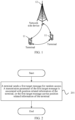
- FIG. 1 is a block diagram of a wireless communication system to which an embodiment of this application is applicable.
- the wireless communication system includes a terminal 11 and a network side device 12.
- the terminal 11 may also be referred to as a terminal device or user equipment (User Equipment, UE).
- UE User Equipment
- the terminal 11 may be a terminal-side device such as a mobile phone, a tablet personal computer (Tablet Personal Computer), a laptop computer (Laptop Computer) or a notebook computer, a personal digital assistant (Personal Digital Assistant, PDA), a palmtop computer, a netbook, an ultra-mobile personal computer (ultra-mobile personal computer, UMPC), a mobile Internet device (Mobile Internet Device, MID), a wearable device (Wearable Device) or vehicle user equipment (VUE), pedestrian user equipment (PUE), and the like.
- the wearable device includes: a bracelet, a headphone, glasses, and the like. It needs to be noted that, embodiments of this application do not limit a specific type of the terminal 11.
- the network side device 12 may be a base station or a core network.
- the base station may be referred to as a node B, an evolved node B, an access point, a base transceiver station (Base Transceiver Station, BTS), a radio base station, a radio transceiver, a basic service set (Basic Service Set, BSS), an extended service set (Extended Service Set, ESS), a node B, an evolved node B (eNB), a home node B, a home evolved node B, a wireless local area network (Wireless Local Area Network, WLAN) access point, a WiFi node, a Transmission Reception Point point (Transmission Reception Point Point, TRP), or some another suitable term in the described art.
- the base station is not limited to a specific technical term. It needs to be noted that, in embodiments of this application, only a base station in the NR system is used as an example, but a specific type of the base station is not limited.
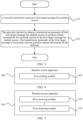
- At least one embodiment of this application provides a random access method.
- the method includes:
- Step 201 A terminal sends a first target message for random access.
- a transmission parameter of the first target message is associated with position related information of the terminal, or the first target message carries position related information of the terminal.
- the transmission parameter of the first target message includes at least one of:
- the first target message may be a message 1 (also referred to as a MSG 1 or MSG (1)) or a message 3 (that is, a MSG 3).
- a transmission parameter of the MSG 1 includes: at least one of sequence information of the MSG 1, time domain resource information of the MSG 1, and frequency domain resource information of the MSG 1. That the transmission parameter of the MSG 1 is associated with the position related information of the terminal means that the terminal implicitly indicates the position related information of the terminal through the transmission parameter of the MSG 1.
- the sequence information of MSG 1 includes: a preamble (preamble) index or a preamble ID.
- the preamble index or the preamble ID is associated with a preamble sequence format (such as at least one of a sequence length, subcarrier spacing, and a root sequence).
- a correspondence between the preamble index or the preamble ID and the sequence information is predefined or configured by a base station, or some related parameters of the correspondence between the preamble index or the preamble ID and the sequence information are configured by the base station, and a related rule or a calculation formula of the correspondence is predefined.
- the transmission parameter of the MSG 3 includes: sequence information of a DMRS of the MSG 3.
- the sequence information of the DMRS includes: at least one of a sequence identifier, a scrambling sequence, an initialization sequence, a cyclic shift of a sequence, and an orthogonal cover code. That the transmission parameter of the MSG 3 is associated with the position related information of the terminal means that the terminal implicitly indicates the position related information of the terminal through the transmission parameter of the MSG 3.
- the method further includes:
- the beam related information mentioned in the embodiment of this application includes: at least one of a direction of a beam, quasi co-location (Quasi Co-Location, QCL) information, and transmission configuration index (Transmission Configuration Index, TCI) state information. This is not repeated in the following.
- the network side device determines, based on the position information of the terminal implicitly or explicitly indicated by the first target message, related information of a node or a beam for sending the second target message, to reduce potential inter-node interference and improve received signal quality of the second target message.
- the first target message includes: a MSG 1 (MSG (1)) in a four-step random access
- the second target message includes: at least one of a MSG 2 (MSG (2)) and a MSG 4 (MSG (4)) in the four-step random access.
- the first target message includes: a MSG 3 (MSG (3)) in a four-step random access; and the second target message includes: a MSG 4 (MSG (4)) in the four-step random access.
- the method includes: measuring N1 first signals, and determining the position related information of the terminal, where N1 is an integer greater than or equal to 1.
- the first signal mentioned in the embodiment of this application includes at least one of: a synchronization signal and PBCH block (Synchronization Signal and PBCH block, SSB); a channel state information reference signal (Channel State Information Reference Signal, CSI-RS); a tracking reference signal (Tracking Reference Signal, TRS); a positioning reference signal (Positioning Reference Signal, PRS); and another downlink reference signal.
- a synchronization signal and PBCH block Synchrom Reference Signal and PBCH block
- CSI-RS Channel State Information Reference Signal
- TRS Track Reference Signal
- PRS positioning reference signal
- the N1 first signals are signals from a same cell or signals from different cells (for example, a serving cell and a neighboring cell).
- the N1 first signals are sent through a same node or different nodes (for example, N1 SSBs are associated with different nodes).
- sync rasters (sync raster) of the N1 first signals are different.
- frequency domain resources for example, a carrier or a resource block (Resource Block, RB)
- time domain resources of the N1 first signals are different.
- sequence formats of the N1 first signals are different.
- reference signal received power Reference Signal Received Power, RSRP
- Signal to interference plus noise ratio Signal to Interference plus Noise Ratio, SINR
- reference signal received quality Reference Signal Received Quality, RSRQ
- RSRP Reference Signal Received Power
- SINR Signal to Interference plus Noise Ratio
- RSRQ Reference Signal Received Quality
- Global Navigation Satellite System Global Navigation Satellite System, GNSS
- radio frequency identification Radio Frequency Identification, RFID
- UWB ultra Wide Band
- Bluetooth Wireless Fidelity
- Wi-Fi wireless local area network
- the position related information of the terminal includes:
- the position information of the terminal includes at least one of:
- the measurement item related to the terminal position and measured by the terminal includes at least one of:
- the method further includes: determining, based on the position related information of the terminal, the transmission parameter of the first target message associated with the position related information.
- the transmission parameter of the MSG 1 is determined based on the position related information of the terminal.
- the scrambling sequence of the DMRS of the MSG 3 is determined based on the position related information of the terminal.
- step 201 includes: sending the first target message based on the determined transmission parameter.
- the terminal determines, based on the position related information and a first mapping relationship, the transmission parameter of the MSG 1.
- the first mapping relationship defines a correspondence between the position related information and the transmission parameter of the MSG 1, for example, a mapping relationship between different position regions and sequence formats, time domain resources, and frequency domain resources of different MSGs 1.
- the first mapping relationship is defined by a protocol or configured by a base station, or some parameters of the first mapping relationship are configured by a base station and a related rule or a calculation formula of the first mapping relationship is defined by a protocol.
- Table 1 is a table of association between the transmission parameter of the MSG 1 and the position related information of the terminal.
- Table 1 Position information of terminal MSG 1 related information Position 1 ⁇ preamble index, preamble time domain resource, preamble frequency domain resource ⁇ combination 1 Position 2 ⁇ preamble index, preamble time domain resource, preamble frequency domain resource ⁇ combination 2 Position 3 ⁇ preamble index, preamble time domain resource, preamble frequency domain resource ⁇ combination 3 Position 4 ⁇ preamble index, preamble time domain resource, preamble frequency domain resource ⁇ combination 4
- Each combination of ⁇ preamble index, preamble time domain resource, preamble frequency domain resource ⁇ may include a plurality of value combinations of preamble indexes, preamble time domain resources, and preamble frequency domain resources, and the terminal may select a value combination of ⁇ preamble index, preamble time domain resource, preamble frequency domain resource ⁇ to send.
- the method further includes: determining, based on at least one of measured reference signal received power RSRP of N2 first signals and N2 path losses, at least one of transmit power and a sending carrier of the first target message, where N2 is an integer greater than or equal to 1, and the N2 path losses are associated with the RSRP of the N2 first signals. Because the first signal is sent by a plurality of nodes, path losses of the plurality of nodes to the terminal are considered in transmit power of the MSG 1.
- a target reference path loss is obtained by taking a logarithm of the sum with a base of 10, and the transmit power is calculated based on the target reference path loss.
- step 201 includes: sending the first target message based on at least one of the determined transmit power and the determined sending carrier of the first target message.
- a plurality of uplink carriers are configured in the terminal as optional carriers for sending the MSG 1
- the terminal sends the MSG 1 through a target carrier (for example, a carrier whose frequency is lower). Otherwise, the MSG 1 is sent through another carrier (for example, a carrier whose frequency is higher).
- transmit power of the MSG 1 when the transmit power of the MSG 1 is considered, if the MSG 1 is retransmitted, transmit power of the retransmitted MSG 1 is raised based on a number of retransmissions. If an SSB index is changed when the MSG 1 is retransmitted, no power raise is performed.
- a method for determining a beam for sending the MSG 1 by the terminal is as follows: If it is FR2, the MSG 1 needs to be sent to two nodes through two beams of one panel (panel) or two beams of two panels.
- the message 2 includes at least one of:
- the terminal receives the message 4 by using relevant information of the message 4 carried in the message 2.
- the message 2 is also used for indicating a time-frequency domain resource and a transmission format of the message 3.
- the receiving a second target message for random access sent by at least one first node includes:
- the method before the receiving a second target message for random access sent by at least one first node, the method further includes: receiving a first signal sent by the at least one first node. The first signal is used for assisting the terminal to receive the second target message.
- the receiving a second target message for random access sent by at least one first node includes: receiving, based on beam related information of the first signal sent by the at least one first node, the second target message for random access sent by the at least one first node.
- a DMRS of the second target message is quasi co-located with the first signal.
- the terminal detects the first signal sent by the at least one first node before receiving the MSG 2 or the MSG 4, the terminal assumes that a DMRS of the MSG 2 or the MSG 4 is quasi co-located with the first signal.
- the terminal does not detect the first signal sent by the at least one first node before receiving the MSG 2
- the terminal assumes that a DMRS of the MSG 2 is quasi co-located with a first signal whose signal strength is detected to be highest before.
- the terminal does not detect the first signal sent by the at least one first node before receiving the MSG 4
- the terminal assumes that a DMRS of the MSG 4 is quasi co-located with the DMRS of the MSG 2.
- the second target message further includes: the position related information of the terminal.
- the method further includes:
- the MSG 2 also carries a preamble index. In addition to judgment on the position related information, whether the preamble index in the MSG 2 is the same as the preamble index in the MSG 1 need to be judged to determine whether the terminal successfully receives the MSG 2. For example, if the preamble index in the MSG 2 is the same as the preamble index in the MSG 1, and the position related information of the terminal carried in the MSG 2 is the same as the position related information of the terminal carried in the MSG 1, the terminal determines that the MSG 2 is successfully received, and in this case, the terminal stops listening to the MSG 2.
- the method further includes:
- the terminal If the terminal successfully receives a MSG 2, and a preamble index and position related information carried in the MSG 2 are the same as a preamble index and position related information sent by the terminal, the terminal sends the MSG 3.
- the MSG 3 implicitly (for example, through a scrambling sequence of the DMRS) or explicitly (for example, through a bit of the MSG (3)) indicates node information and/or beam related information corresponding to the MSG 2 successfully received by the terminal.
- the terminal may expect to receive N4 MSGs 2, and select, based on signal strength or another criterion, one of the MSGs 2 to reply (that is, send the MSG 3); and decide, based on the selected MSG 2, to receive the beam related information of the MSG 4 (that is, the selected MSG 2 is quasi co-located with the MSG 4).
- the method further includes:
- the reference signal is a sounding reference signal (Sounding Reference Signal, SRS).
- SRS Sounding Reference Signal
- An association rule between the reference signal and the terminal identifier is predefined.
- the network side device may calculate a position of the terminal based on SRSs received by a plurality of nodes.
- the network side device further determines sending related information of a MSG 4 corresponding to the position of the terminal, and sends the MSG 4 by using the determined sending related information.
- a time-frequency domain resource of the SRS is notified to the terminal by the base station through the MSG 2. If the SRS is sent on at least one symbol of a slot in which the message 3 is located, the time-frequency domain resource of the SRS is the same as the time-frequency domain resource of the message 3.
- the method before step 201, the method further includes: receiving first signaling, where the first signaling includes at least one of the following information:
- the terminal before sending the MSG 1, the terminal receives at least one of a plurality of pieces of cell or node information (for example, ID information) indicated by the base station through the first signaling (for example, system information block SIB signaling), position information (which may be encrypted) of the cell or node, and information about first signals respectively associated by the cell or node (for example, sequence information of the signals, time-frequency resources of the signals, and the like).
- the SIB signaling is a SIB sent by a cell or a node, or a SIB sent through an SFN (Single Frequency Network).
- the method before step 201, further includes: receiving second signaling, where the second signaling is used for indicating resource information of a shared random access channel corresponding to at least two cells or at least two nodes.
- the resource information includes: at least one of time domain resource information, frequency domain resource information, and sequence resource information.
- the terminal before sending the MSG 1, the terminal receives a random access channel (Random Access Channel, RACH) resource indicated by the base station through the second signaling (for example, a SIB).
- RACH Random Access Channel
- the second signaling includes information about shared RACH resources corresponding to a plurality of peripheral nodes.
- the SIB is a SIB sent by a cell or a node, or a SIB sent through an SFN (Single Frequency Network).
- the base station may broadcast, through the SIB, information about a plurality of frequency points of the RACH resource, and the terminal may select one frequency point from the plurality of frequency points for performing RACH transmission, for example, select, based on a size of a measured SSB RSRP, one frequency point for performing RACH transmission.
- the terminal explicitly or implicitly indicates the position related information of the terminal through the first target message for random access, so that the network side device may adjust, based on the position related information of the terminal, related information of a node and/or a beam for sending the second target message, to reduce potential inter-node interference and improve received signal quality of the second target message.
- At least one embodiment of this application further provides a random access method.
- the method includes:
- the transmission parameter of the first target message includes at least one of:
- the network side device may be an AP, or a TRP, or a central control unit.
- the central control unit may be arranged on an AP or a TRP, or at another position on a network side. This is not specifically limited herein.
- the first target message may be a message 1 (also referred to as a MSG (1)) or a message 3 (that is, a MSG 3).
- a transmission parameter of the MSG 1 includes: at least one of sequence information of the MSG 1, time domain resource information of the MSG 1, and frequency domain resource information of the MSG 1. That the transmission parameter of the MSG 1 is associated with the position related information of the terminal means that the terminal implicitly indicates the position related information of the terminal through the transmission parameter of the MSG 1.
- the sequence information of MSG 1 includes: a preamble (preamble) index or a preamble ID.
- the preamble index or the preamble ID is associated with a preamble sequence format (such as at least one of a sequence length, subcarrier spacing, and a root sequence).
- a correspondence between the preamble index or the preamble ID and the sequence information is predefined or configured by a base station, or some related parameters of the correspondence between the preamble index or the preamble ID and the sequence information are configured by the base station, and a related rule or a calculation formula of the correspondence is predefined.
- the transmission parameter of the MSG 3 includes: sequence information of a DMRS of the MSG 3.
- the sequence information of the DMRS includes: at least one of a sequence identifier, a scrambling sequence, an initialization sequence, a cyclic shift of a sequence, and an orthogonal cover code. That the transmission parameter of the MSG 3 is associated with the position related information of the terminal means that the terminal implicitly indicates the position related information of the terminal through the transmission parameter of the MSG 3.
- the method further includes:
- the beam related information mentioned in the embodiment of this application includes: at least one of a direction of a beam, quasi co-location (Quasi Co-Location, QCL) information, and transmission configuration index (Transmission Configuration Index, TCI) state information. This is not repeated in the following.
- the network side device determines, based on the position information of the terminal implicitly or explicitly indicated by the first target message, related information of a node or a beam for sending the second target message, to reduce potential inter-node interference and improve received signal quality of the second target message.
- the first target message includes: a MSG 1 (MSG (1) in a four-step random access
- the second target message includes: at least one of a MSG 2 (MSG (2)) and a MSG 4 (MSG (4)) in the four-step random access.
- the first target message includes: a MSG 3 (MSG (3)) in a four-step random access; and the second target message includes: a MSG 4 (MSG (4)) in the four-step random access.
- the determining, based on the transmission parameter of the first target message, sending related information of a second target message for random access includes:
- Table 2 Transmission parameter of MSG 1 Beam related information of MSG 2 ⁇ preamble index, preamble time domain resource, preamble frequency domain resource ⁇ combination 1 Beam 1 of cell 1 (for example, with SSB1 QCL) ⁇ preamble index, preamble time domain resource, preamble frequency domain resource ⁇ combination 2 Beam 2 of cell 1 (with SSB2 QCL) ⁇ preamble index, preamble time domain resource, preamble frequency domain resource ⁇ combination 3 Beam 3 of cell 1 (with SSB3 QCL) ⁇ preamble index, preamble time domain resource, preamble frequency domain resource ⁇ combination 4 Beam 4 of cell 1 (with SSB4 QCL)
- a table of association between the transmission parameter of the MSG 1 and sending related information of the MSG 2 is shown in Table 3.
- Table 3 Transmission parameter of MSG 1 AP/TRP information of sending MSG 2 ⁇ preamble index, preamble time domain resource, preamble frequency domain resource ⁇ combination 1 AP/TRP 1 ⁇ preamble index, preamble time domain resource, preamble frequency domain resource ⁇ combination 2 AP/TRP 1, AP/TRP 2 ⁇ preamble index, preamble time domain resource, preamble frequency domain resource ⁇ combination 3 AP/TRP 2 ⁇ preamble index, preamble time domain resource, preamble frequency domain resource ⁇ combination 4 AP/TRP 3
- a table of association between the transmission parameter of the MSG 1 and sending related information of the MSG 2 is shown in Table 4.
- Table 4 Transmission parameter of MSG 1 AP/beam related information of MSG 2 ⁇ preamble index, preamble time domain resource, preamble frequency domain resource ⁇ combination 1 Beam A of AP1 ⁇ preamble index, preamble time domain resource, preamble frequency domain resource ⁇ combination 2 Beam B of AP1 and AP2 (beam B is sent jointly through AP1 and AP2) ⁇ preamble index, preamble time domain resource, preamble frequency domain resource ⁇ combination 3 Beam C of AP2 ⁇ preamble index, preamble time domain resource, preamble frequency domain resource ⁇ combination 4 Beam D of AP3 and beam E of AP4 (beam D and beam E are respectively sent through AP3 and AP4)
- the position related information of the terminal includes:
- the position information of the terminal includes at least one of:
- the measurement item related to the terminal position and measured by the terminal includes at least one of:
- the determining, based on the position related information of the terminal, sending related information of a second target message for random access includes:
- Table 5 Position information of terminal Related information of beam for sending second target message Position 1 Beam 1 of cell 1 (for example, with SSB1 QCL) Position 2 Beam 2 of cell 1 (with SSB2 QCL) Position 3 Beam 3 of cell 1 (with SSB3 QCL) Position 4 Beam 4 of cell 1 (with SSB4 QCL)
- a table of association between the terminal position and the sending related information of the second target message is shown in Table 6.
- a table of association between the terminal position and the sending related information of the second target message is shown in Table 7.
- Table 7 Position information of terminal Information about AP/beam for sending second target message Position 1 Beam A of AP1 Position 2 Beam B of AP1 and AP2 (beam B is sent jointly through AP1 and AP2)
- Position 4 Beam D of AP3 and beam E of AP4 Beam D and beam E are respectively sent through AP3 and AP4
- the message 2 includes at least one of:
- the terminal receives the message 4 by using relevant information of the message 4 carried in the message 2.
- the message 2 is also used for indicating a time-frequency domain resource and a transmission format of the message 3.
- the method before the sending, based on the sending related information of the second target message, the second target message through at least one first node, the method further includes: sending a first signal through at least one first node, where the first signal is used for assisting the terminal to receive the second target message.
- Beam related information of the first signal is the same as the beam related information of the second target message.
- a DMRS of the second target message is quasi co-located with the first signal.
- the second target message further includes: the position related information of the terminal.
- the first target message is the message 3 and the second target message is the message 4,
- the terminal before sending the message 3, the terminal sends a reference signal associated with a terminal identifier. Alternatively, after sending the message 3, the terminal sends a reference signal associated with a terminal identifier. Alternatively, the terminal sends a reference signal associated with the terminal identifier on at least one symbol of a slot in which the message 3 is located.
- the reference signal is a sounding reference signal (Sounding Reference Signal, SRS).
- SRS Sounding Reference Signal
- An association rule between the reference signal and the terminal identifier is predefined.
- the network side device may calculate a position of the terminal based on SRSs received by a plurality of nodes. The network side device further determines sending related information of a MSG 4 corresponding to the position of the terminal, and sends the MSG 4 by using the determined sending related information.
- a time-frequency domain resource of the SRS is notified to the terminal by the base station through the MSG 2. If the SRS is sent on at least one symbol of a slot in which the message 3 is located, the time-frequency domain resource of the SRS is the same as the time-frequency domain resource of the message 3.
- step 301 the method further includes: sending first signaling to the terminal, where the first signaling includes at least one of the following information:
- the terminal before sending the MSG 1, the terminal receives at least one of a plurality of pieces of cell or node information (for example, ID information) indicated by the base station through the first signaling (for example, system information block SIB signaling), position information (which may be encrypted) of the cell or node, and information about first signals respectively associated by the cell or node (for example, sequence information of the signals, time-frequency resources of the signals, and the like).
- the SIB signaling is a SIB sent by a cell or a node, or a SIB sent through an SFN (Single Frequency Network).
- the method before step 301, further includes: sending second signaling to the terminal, where the second signaling is used for indicating resource information of a shared random access channel corresponding to at least two cells or at least two nodes.
- the resource information includes: at least one of time domain resource information, frequency domain resource information, and sequence resource information.
- the terminal before sending the MSG 1, the terminal receives a random access channel (Random Access Channel, RACH) resource indicated by the base station through the second signaling (for example, a SIB).
- RACH Random Access Channel
- the second signaling includes information about shared RACH resources corresponding to a plurality of peripheral nodes.
- the SIB is a SIB sent by a cell or a node, or a SIB sent through an SFN (Single Frequency Network).
- the base station may broadcast, through the SIB, information about a plurality of frequency points of the RACH resource, and the terminal may select one frequency point from the plurality of frequency points for performing RACH transmission, for example, select, based on a size of a measured SSB RSRP, one frequency point for performing RACH transmission.
- the terminal explicitly or implicitly indicates the position related information of the terminal through the first target message for random access, so that the network side may adjust, based on the position related information of the terminal, related information of a node and/or a beam for sending the second target message, to reduce potential inter-node interference and improve received signal quality of the second target message.
- Example 1 If a terminal explicitly or implicitly indicates, through a MSG 1, position related information of the terminal, a network side device determines, based on the position related information, sending related information of a MSG 2 and a MSG 4.
- Example 2 If a terminal explicitly or implicitly indicates position related information of the terminal through a MSG 3, or a terminal sends an SRS associated with a terminal identifier (a base station may determine position information of the terminal through the SRS), a network side device determines sending related information of sending a MSG 4 based on the position information of the terminal.
- the plurality of reference signals or synchronization signals are signals from a same cell or signals from different cells (for example, a serving cell and a neighboring cell).
- the plurality of reference signals or synchronization signals are sent through a same node or different nodes (for example, a plurality of SSBs are associated with different nodes).
- sync rasters (sync raster) of the plurality of reference signals or synchronization signals are different.
- frequency domain resources for example, a carrier carrier or a resource block, Resource Block, RB
- time domain resources of the plurality of reference signals or synchronization signals are different.
- sequence formats of the plurality of reference signals or synchronization signals are different.
- reference signal received power Reference Signal Received Power, RSRP
- Signal Received Power Signal Received Power
- SINR Signal to Interference plus Noise Ratio
- RSRQ Reference Signal Received Quality
- the transmission parameter of the MSG 1 is associated with information about the plurality of reference signals or synchronization signals (for example, an SSB). For details, refer to Table 8 below.
- Table 8 SSB information Transmission parameter of MSG 1 SSB 1, SSB 2 ⁇ preamble index, preamble time domain resource, preamble frequency domain resource ⁇ combination 1 SSB 2, SSB 3 ⁇ preamble index, preamble time domain resource, preamble frequency domain resource ⁇ combination 2 SSB 1, SSB 3 ⁇ preamble index, preamble time domain resource, preamble frequency domain resource ⁇ combination 3 SSB 2, SSB 3, SSB 1 ⁇ preamble index, preamble time domain resource, preamble frequency domain resource ⁇ combination 4 SSB 1 ⁇ preamble index, preamble time domain resource, preamble frequency domain resource ⁇ combination 5 SSB 2 ⁇ preamble index, preamble time domain resource, preamble frequency domain resource ⁇ combination 6 SSB 3 ⁇ preamble index, preamble time domain
- the preamble index is associated with a preamble sequence format (such as at least one of a sequence length, SCS, a root sequence, and the like).
- Each combination of ⁇ preamble index, preamble time domain resource, preamble frequency domain resource ⁇ may include a plurality of value combinations of preamble indexes, preamble time domain resources, and preamble frequency domain resources, and the terminal may select a value combination of ⁇ preamble index, preamble time domain resource, preamble frequency domain resource ⁇ to send.
- the terminal sends the MSG 1 based on the determined transmission parameter of the MSG 1.
- a base station receives the MSG 1 sent by the terminal.
- a method for sending node information and/or beam related information of the MSG 2 by the base station includes at least one of the following:
- the base station sends the MSG 2 to the terminal through N5 TCIs corresponding to N5 SSB indexes, and the N5 TCIs correspond to different transport blocks TB or a same TB.
- the N5 SSB indexes are determined by the base station through detected MSG 1 information and a preset mapping relationship.
- the base station sends the MSG 2 to the terminal through X (N5 > X > (1)TCIs of the N5 TCIs corresponding to the N5 SSB indexes.
- the N5 SSB indexes are determined by the base station through detected MSG 1 information and a preset mapping relationship.
- the base station sends the MSG 2 to the terminal through a TCI corresponding to an SSB having an index different from the N5 SSB indexes, and in this case, the terminal needs to detect a new SSB and receive a corresponding MSG 2.
- Different SSBs or TCIs may correspond to one or more APs.
- the terminal receives the MSG 2 sent by the base station.
- a receiving behavior of the terminal includes at least one of the following: The terminal receives the MSG 2 sent by the N5 TCIs corresponding to the N5 SSB indexes (three possible results: receiving unsuccessfully; receiving the MSG 2 sent by X (N5 > X > 1) TCIs; and receiving the MSG 2 sent by the N5 TCIs).
- the terminal receives a MSG 2 corresponding to one of the N5 TCIs corresponding to the N5 SSB indexes (two possible results: receiving unsuccessfully; and receiving successfully).
- the terminal receives a MSG 2 sent by a TCI corresponding to an SSB having an index different from the N5 SSB indexes (two possible results: receiving unsuccessfully; and receiving successfully).
- the MSG 2 includes new QCL/TCI information.
- the QCL/TCI is different from a QCL/TCI of a previous SSB.
- the new QCL information is included in the MSG 2, and the terminal receives a MSG 4 by using the new QCL/TCI information.
- the terminal receives the MSG 2, it is assumed that N5 pieces of TCI information corresponding to the N5 SSB indexes or one piece of TCI information corresponding to one SSB is used.
- a network may indicate a corresponding frequency domain position at which the terminal receives the MSG 4 in the MSG 2, to reduce interference.
- the terminal may stop listening to the MSG 2. If the terminal does not receive the MSG 2, or if the terminal receives the MSG 2 but the MSG 2 does not carry the preamble index of the terminal, the terminal retransmits the MSG 1.
- the terminal If the terminal successfully receives a MSG 2, and a preamble index carried in the MSG 2 is the same as the preamble index sent by the terminal, the terminal sends a MSG 3.
- Solution 1 The MSG 3 implicitly or explicitly indicates the position related information of the terminal.
- the terminal further sends an SRS before or after sending the MSG 3, or on at least one symbol of a slot in which the MSG 3 is located.
- the SRS is associated with a terminal ID and an association rule is predefined.
- the base station determines sending related information of the MSG 4 based on a transmission parameter of the MSG 3 or position related information carried by the MSG 3.
- the base station determines a terminal position based on the SRS, and determines sending related information of a MSG 4 corresponding to the terminal position.
- the base station sends the MSG 4 based on the sending related information determined in (8) or (9).
- the base station before sending the MSG 4, the base station sends an SSB or a TRS (for assisting the terminal to receive the MSG (4)) to the terminal based on sending related information associated with the terminal position.
- an SSB or a TRS for assisting the terminal to receive the MSG (4)
- the terminal receives the MSG 4 sent by the base station. If the terminal detects the SSB or the TRS sent by the base station before the terminal receives the MSG 4, the terminal assumes that the DMRS of the MSG 4 is quasi co-located with the detected SSB or TRS. Alternatively, the terminal assumes that the DMRS of the MSG 4 is quasi co-located with the DMRS of the MSG 2.
- the random access method provided in embodiments of this application may be performed by a random access apparatus or a control module included in the random access apparatus and configured to perform and load the random access method.
- the random access apparatus provided in embodiments of this application is described by using an example in which the random access method is performed by the random access apparatus.
- a random access apparatus 400 is further provided, and applied to a terminal.
- the apparatus includes:
- the apparatus further includes:
- the first target message includes: a message 1 in a four-step random access
- the second target message includes: at least one of a message 2 and a message 4 in the four-step random access; or, the first target message includes: a message 3 in a four-step random access; and the second target message includes: a message 4 in the four-step random access.
- the apparatus includes: a position determining module, configured to measure N1 first signals, and determine the position related information of the terminal, where N1 is an integer greater than or equal to 1.
- the position related information of the terminal includes:
- the apparatus further includes:
- the apparatus further includes:
- the message 2 includes at least one of:
- the second receiving module includes: a second receiving submodule, configured to receive, based on target beam related information, the second target message for random access sent by the at least one first node, where
- the apparatus further includes: a third receiving module, configured to receive a first signal sent by the at least one first node.
- the second receiving module includes: a third receiving submodule, configured to receive, based on beam related information of the first signal sent by the at least one first node, the second target message for random access sent by the at least one first node.
- the second target message further includes: the position related information of the terminal.
- the apparatus further includes:
- the apparatus further includes:
- the apparatus further includes:
- the apparatus further includes: a fourth receiving module, configured to receive first signaling, where the first signaling includes at least one of the following information:
- the apparatus further includes: a fifth receiving module, configured to receive second signaling, where the second signaling is used for indicating resource information of a shared random access channel corresponding to at least two cells or at least two nodes.
- the terminal explicitly or implicitly indicates the position related information of the terminal through the first target message for random access, so that the network side may adjust, based on the position related information of the terminal, related information of a node and/or a beam for sending the second target message, to reduce potential inter-node interference and improve received signal quality of the second target message.
- the random access apparatus provided in embodiments of this application is an apparatus capable of performing the random access method, all embodiments of the random access method are applicable to the apparatus and can achieve the same or similar beneficial effects.
- a random access apparatus 500 is further provided, and applied to a network side device.
- the apparatus includes:
- the apparatus further includes:
- the first target message includes: a message 1 in a four-step random access
- the second target message includes: at least one of a message 2 and a message 4 in the four-step random access; or, the first target message includes: a message 3 in a four-step random access; and the second target message includes: a message 4 in the four-step random access.
- the information determining module includes:
- the position related information of the terminal includes:
- the information determining module includes:
- the message 2 includes at least one of:
- the apparatus further includes: a fifth sending module, configured to send a first signal through at least one first node, where beam related information of the first signal is the same as the beam related information of the second target message.
- the second target message further includes: the position related information of the terminal.
- the apparatus further includes:
- the apparatus further includes: a seventh sending module, configured to send first signaling to the terminal, where the first signaling includes at least one of the following information:
- the apparatus further includes: an eighth sending module, configured to send second signaling to the terminal, where the second signaling is used for indicating resource information of a shared random access channel corresponding to at least two cells or at least two nodes.
- the terminal explicitly or implicitly indicates the position related information of the terminal through the first target message for random access, so that the network side may adjust, based on the position related information of the terminal, related information of a node and/or a beam for sending the second target message, to reduce potential inter-node interference and improve received signal quality of the second target message.
- the random access apparatus provided in embodiments of this application is an apparatus capable of performing the random access method, all embodiments of the random access method are applicable to the apparatus and can achieve the same or similar beneficial effects.
- the random access apparatus in embodiments of this application may be an apparatus, or a component, an integrated circuit, or a chip in a terminal.
- the apparatus may be a mobile electronic device or a non-mobile electronic device.
- the mobile electronic device may be a mobile phone, a tablet computer, a laptop computer, a palmtop computer, an in-vehicle electronic device, a wearable device, an ultra-mobile personal computer (ultra-mobile personal computer, UMPC), a netbook, or a personal digital assistant (personal digital assistant, PDA).
- UMPC ultra-mobile personal computer
- PDA personal digital assistant
- the non-mobile electronic device may be a server, a network attached storage (Network Attached Storage, NAS), a personal computer (personal computer, PC), a television (television, TV), an automated teller machine, or a self-service machine. This is not specifically limited in embodiments of this application.
- the random access apparatus in embodiments of this application may be an apparatus with an operating system.
- the operating system may be an Android (Android) operating system, or may be an ios operating system or other possible operating systems, which is not specifically limited in embodiments of this application.
- the random access apparatus provided in embodiments of this application may implement the processes implemented in the method embodiments of FIG. 1 to FIG. 3 . To avoid repetition, details are not described herein again.
- embodiments of this application further provide a communication device 600, including a processor 601, a memory 602, and a program or an instruction stored in the memory 602 and executable on the processor 601.
- a communication device 600 including a processor 601, a memory 602, and a program or an instruction stored in the memory 602 and executable on the processor 601.
- the communication device 600 is a terminal
- the program or instruction is executed by the processor 601 to implement processes of the foregoing embodiments of the random access method, and the same technical effects can be achieved.
- the communication device 600 is a network side device
- the program or instruction is executed by the processor 601 to implement processes of the foregoing embodiments of the random access method, and the same technical effect can be achieved. To avoid repetition, details are not described herein again.
- FIG. 7 is a schematic structural diagram of hardware of a terminal implementing an embodiment of this application.
- the terminal 700 includes, but is not limited to: components such as a radio frequency unit 701, a network module 702, an audio output unit 703, an input unit 704, a sensor 705, a display unit 706, a user input unit 707, an interface unit 708, a memory 709, and a processor 710.
- components such as a radio frequency unit 701, a network module 702, an audio output unit 703, an input unit 704, a sensor 705, a display unit 706, a user input unit 707, an interface unit 708, a memory 709, and a processor 710.
- the terminal 700 may further include a power supply (such as a battery) for supplying power to the components.
- the power supply may be logically connected to the processor 710 by using a power supply management system, thereby implementing functions such as charging, discharging, and power consumption management, by using the power supply management system.
- a terminal structure shown in FIG. X does not constitute a limitation to the terminal, and the terminal may include more or fewer components than those shown in the figure, or some components may be combined, or a different component deployment may be used. Details are not described herein again.
- the input unit 704 may include a graphics processing unit (Graphics Processing Unit, GPU) 7041 and a microphone 7042, and the graphics processing unit 7041 processes image data of a still picture or a video obtained by an image capture apparatus (such as a camera) in a video capture mode or an image capture mode.
- the display unit 706 may include a display panel 7061.
- the display panel 7061 may be configured by using a liquid crystal display, an organic light-emitting diode, or the like.
- the user input unit 707 includes a touch panel 7071 and another input device 7072.
- the touch panel 7071 is also referred to as a touch screen.
- the touch panel 7071 may include two parts: a touch detection apparatus and a touch controller.
- the another input device 7072 may include, but is not limited to, a physical keyboard, a functional key (for example, a volume control key or a switch key), a track ball, a mouse, and a joystick, and the details are not described herein again.
- a functional key for example, a volume control key or a switch key
- a track ball for example, a mouse, and a joystick
- the radio frequency unit 701 is configured to receive downlink data from a network side device and transmit the downlink data to the processor 710 for processing; and send uplink data to the network side device.
- the radio frequency unit 701 includes, but is not limited to, an antenna, at least one amplifier, a transceiver, a coupler, a low noise amplifier, a duplexer, and the like.
- the memory 709 may be configured to store a software program or instruction and various data.
- the memory 709 may mainly include a program or instruction storage area and a data storage area.
- the program or instruction storage area may store an operating system, an application program or instruction required by at least one function (for example, a sound playback function and an image display function), and the like.
- the memory 709 may include a high-speed random access memory and may also include a non-volatile memory.
- the non-volatile memory may be a read-only memory (Read-Only Memory, ROM), a programmable read-only memory (Programmable ROM, PROM), an erasable programmable read-only memory (Erasable PROM, EPROM), an electrically erasable programmable read-only memory (Electrically EPROM, EEPROM), or a flash memory.
- the memory 709 may include, for example, at least one magnetic disk memory device, a flash memory device, or other non-volatile solid-state memory devices.
- the processor 710 may include one or more processing units.
- the processor 710 may integrate an application processor and a modem processor, where the application processor mainly processes an operating system, a user interface, an application program or instruction, and the like, and the modem processor mainly processes wireless communication, such as a baseband processor. It may be understood that the modem processor may alternatively not be integrated into the processor 710.
- the radio frequency unit 701 is configured to send a first target message for random access, where a transmission parameter of the first target message is associated with position related information of the terminal, or the first target message carries position related information of the terminal, where the transmission parameter of the first target message includes at least one of:
- the radio frequency unit 701 is further configured to receive a second target message for random access sent by at least one first node, where sending related information of the second target message is associated with the transmission parameter of the first target message, or sending related information of the second target message is associated with the position related information of the terminal, where the sending related information of the second target message includes at least one of: identification information of the at least one first node; and beam related information of the second target message.
- the terminal explicitly or implicitly indicates the position related information of the terminal through the first target message for random access, so that the network side may adjust, based on the position related information of the terminal, related information of a node and/or a beam for sending the second target message, to reduce potential inter-node interference and improve received signal quality of the second target message.
- the terminal provided in embodiments of this application is a terminal capable of performing the random access method, all embodiments of the random access method are applicable to the terminal and can achieve the same or similar beneficial effects.
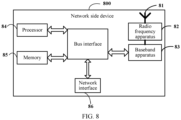
- the network device 800 includes: an antenna 81, a radio frequency apparatus 82, and a baseband apparatus 83.
- the antenna 81 is connected to the radio frequency apparatus 82.
- the radio frequency apparatus 82 receives information through the antenna 81, and sends the received information to the baseband apparatus 83 for processing.
- the baseband apparatus 83 processes to-be-sent information, and sends the information to the radio frequency apparatus 82.
- the radio frequency apparatus 82 processes the received information and sends the information through the antenna 81.
- the frequency band processing apparatus may be located in the baseband apparatus 83.
- the method performed by the network side device in the foregoing embodiments may be implemented in the baseband apparatus 83, and the baseband apparatus 83 includes a processor 84 and a memory 85.
- the baseband apparatus 83 may include, for example, at least one baseband plate.
- a plurality of chips are disposed on the baseband plate. As shown in FIG. 8 , one of the plurality of chips is, for example, the processor 84, and is connected to the memory 85, to invoke a program in the memory 85 to perform operations of the network device in the foregoing method embodiments.
- the baseband apparatus 83 may further include a network interface 86, configured to exchange information with the radio frequency apparatus 82.
- the interface is, for example, a common public radio interface (common public radio interface, CPRI).
- the network side device provided in the embodiments of the present invention further includes: an instruction or program stored in the memory 85 and executable on the processor 84.
- the processor 84 invokes the instruction or program in the memory 85 to perform the method performed by each module shown in FIG. 3 and achieve the same technical effect. To avoid repetition, details are not described herein again.
- An embodiment of this application further provides a readable storage medium, and the readable storage medium stores a program or an instruction.
- the program or instruction is executed by a processor to implement the processes of the embodiments of the random access method, and the same technical effects can be achieved. To avoid repetition, details are not described herein again.
- the processor is a processor in the electronic device in the foregoing embodiments.
- the readable storage medium includes a computer-readable storage medium, for example, a computer read-only memory (Read-Only Memory, ROM), a random access memory (Random Access Memory, RAM), a magnetic disk, or an optical disc.
- An embodiment of this application further provides a chip.
- the chip includes a processor and a communication interface.
- the communication interface is coupled to the processor, and the processor is configured to run a program or an instruction to implement processes of the embodiments of the random access method, and the same technical effect can be achieved. To avoid repetition, details are not described herein again.
- An embodiment of this application provides a computer program product.
- the program product is stored in a non-volatile storage medium.
- the program product is executed by at least one processor to implement processes of the foregoing embodiments of the random access method, and the same technical effect can be achieved. To avoid repetition, details are not described herein again.
- An embodiment of this application provides a communication device.
- the communication device is configured to perform processes of the embodiments of the random access method, and the same technical effect can be achieved. To avoid repetition, details are not described herein again.
- the chip mentioned in embodiments of this application may also be referred to as a system-level chip, a system chip, a chip system, a system on chip, or the like.
- the method according to the foregoing embodiments may be implemented through software and a necessary general hardware platform, and certainly, may also be implemented through hardware, but in many cases, the former manner is a better implementation.
- the technical solutions of this application essentially, or the part contributing to the prior art may be implemented in a form of a software product.
- the computer software product is stored in a storage medium (for example, a ROM/RAM, a magnetic disk, or an optical disc), and includes several instructions for instructing a terminal (which may be a mobile phone, a computer, a server, an air conditioner, a network device, or the like) to perform the methods according to embodiments of this application.
Landscapes
- Engineering & Computer Science (AREA)
- Signal Processing (AREA)
- Computer Networks & Wireless Communication (AREA)
- Mobile Radio Communication Systems (AREA)
Applications Claiming Priority (2)
| Application Number | Priority Date | Filing Date | Title |
|---|---|---|---|
| CN202011415213.2A CN114598430B (zh) | 2020-12-04 | 2020-12-04 | 随机接入方法、装置、终端及网络侧设备 |
| PCT/CN2021/134968 WO2022117023A1 (zh) | 2020-12-04 | 2021-12-02 | 随机接入方法、装置、终端及网络侧设备 |
Publications (2)
| Publication Number | Publication Date |
|---|---|
| EP4228193A1 true EP4228193A1 (de) | 2023-08-16 |
| EP4228193A4 EP4228193A4 (de) | 2024-04-24 |
Family
ID=81802996
Family Applications (1)
| Application Number | Title | Priority Date | Filing Date |
|---|---|---|---|
| EP21900049.4A Pending EP4228193A4 (de) | 2020-12-04 | 2021-12-02 | Direktzugriffsverfahren und -vorrichtung, endgerät und netzwerkseitige vorrichtung |
Country Status (4)
| Country | Link |
|---|---|
| US (1) | US20230319893A1 (de) |
| EP (1) | EP4228193A4 (de) |
| CN (1) | CN114598430B (de) |
| WO (1) | WO2022117023A1 (de) |
Families Citing this family (3)
| Publication number | Priority date | Publication date | Assignee | Title |
|---|---|---|---|---|
| CN117979457A (zh) * | 2022-10-21 | 2024-05-03 | 展讯通信(上海)有限公司 | 消息传输方法及通信装置 |
| CN116827408A (zh) * | 2023-05-25 | 2023-09-29 | 泰斗微电子科技有限公司 | 一种通信卫星波束捕获方法、接收机、终端及存储介质 |
| WO2025208515A1 (en) * | 2024-04-03 | 2025-10-09 | Nokia Shanghai Bell Co., Ltd. | Orthogonal cover code configuration for message 3 |
Family Cites Families (24)
| Publication number | Priority date | Publication date | Assignee | Title |
|---|---|---|---|---|
| CN102630090A (zh) * | 2012-03-22 | 2012-08-08 | 中兴通讯股份有限公司 | 小区随机接入信道配置参数优化方法及系统 |
| EP3043615B1 (de) * | 2013-09-16 | 2018-06-20 | Huawei Technologies Co., Ltd. | Verfahren, benutzervorrichtung und basisstation zur vorbestimmung einer ressource bei direktzugriff |
| US10257842B2 (en) * | 2015-08-18 | 2019-04-09 | Samsung Electronics Co., Ltd | Method and apparatus for providing zone based coooperation to user equipment (UE) in a wireless communication network |
| CN109392180B (zh) * | 2017-08-11 | 2021-06-29 | 中国移动通信有限公司研究院 | 一种随机接入方法、网络侧设备和移动通信终端 |
| WO2019028924A1 (zh) * | 2017-08-11 | 2019-02-14 | 华为技术有限公司 | 一种通信方法及相关设备 |
| US20190342874A1 (en) * | 2018-05-04 | 2019-11-07 | Intel Corporation | Interlace-Based Uplink Physical Channel Design for New Radio-Unlicensed (NR-U) |
| CN113647193B (zh) * | 2019-02-15 | 2023-12-15 | Lg 电子株式会社 | 无线通信系统中终端执行随机接入信道过程的方法及其设备 |
| WO2020167083A1 (ko) * | 2019-02-15 | 2020-08-20 | 엘지전자 주식회사 | 무선 통신 시스템에서 단말이 임의 접속 과정을 수행하는 방법 및 이를 위한 장치 |
| US11503647B2 (en) * | 2019-04-29 | 2022-11-15 | Qualcomm Incorporated | Beam management for direct and indirect links |
| AU2019446091A1 (en) * | 2019-05-10 | 2021-05-06 | Guangdong Oppo Mobile Telecommunications Corp., Ltd. | Method for random access and device |
| US11553534B2 (en) * | 2019-09-27 | 2023-01-10 | Qualcomm Incorporated | Handling collisions due to multiple radio resource control (RRC) connection requests |
| US11785632B2 (en) * | 2019-10-02 | 2023-10-10 | Ofinno, Llc | On demand system information for sidelink communications |
| WO2021067959A2 (en) * | 2019-10-03 | 2021-04-08 | Ofinno, Llc | Sidelink configuration of wireless devices |
| KR102487216B1 (ko) * | 2019-10-04 | 2023-01-12 | 엘지전자 주식회사 | 무선 통신 시스템에서 단말이 임의 접속 과정을 수행하는 방법 및 이를 위한 장치 |
| US12439372B2 (en) * | 2019-12-16 | 2025-10-07 | Qualcomm Incorporated | Network assisted positioning without service request procedure |
| PL4026391T3 (pl) * | 2020-02-13 | 2024-10-28 | Canon Kabushiki Kaisha | Transmisja małych danych (SDT) |
| US11533773B2 (en) * | 2020-03-31 | 2022-12-20 | Ofinno, Llc | Early data transmission |
| CN114071672B (zh) * | 2020-08-07 | 2024-05-03 | 大唐移动通信设备有限公司 | 定位方法、装置、终端及基站 |
| KR102646127B1 (ko) * | 2020-09-24 | 2024-03-11 | 오피노 엘엘씨 | 소형 데이터 송신 절차의 릴리스 메시지 |
| EP4229927A1 (de) * | 2020-10-14 | 2023-08-23 | InterDigital Patent Holdings, Inc. | Verfahren und vorrichtung zur leistungseffizienten positionierung in drahtlosen kommunikationssystemen |
| US11743948B2 (en) * | 2020-10-16 | 2023-08-29 | Qualcomm Incorporated | SRS transmitted with Msg4 ACK |
| EP4229996A1 (de) * | 2020-10-19 | 2023-08-23 | Ofinno, LLC | Uplink-daten eines kleinen datenübertragungsverfahrens |
| EP4128978B1 (de) * | 2020-10-21 | 2026-01-28 | Peninsula Technologies, LLC | Downlink-daten eines kleinen datenübertragungsverfahrens |
| CN114599111B (zh) * | 2020-12-04 | 2025-02-18 | 维沃移动通信有限公司 | 随机接入方法、装置、终端及网络侧设备 |
-
2020
- 2020-12-04 CN CN202011415213.2A patent/CN114598430B/zh active Active
-
2021
- 2021-12-02 EP EP21900049.4A patent/EP4228193A4/de active Pending
- 2021-12-02 WO PCT/CN2021/134968 patent/WO2022117023A1/zh not_active Ceased
-
2023
- 2023-06-02 US US18/205,498 patent/US20230319893A1/en active Pending
Also Published As
| Publication number | Publication date |
|---|---|
| CN114598430B (zh) | 2026-02-24 |
| EP4228193A4 (de) | 2024-04-24 |
| WO2022117023A1 (zh) | 2022-06-09 |
| US20230319893A1 (en) | 2023-10-05 |
| CN114598430A (zh) | 2022-06-07 |
Similar Documents
| Publication | Publication Date | Title |
|---|---|---|
| US20250175868A1 (en) | Ue procedures for reducing rsrp/rsrq measurement in rrc idle mode and inactive state | |
| US12574954B2 (en) | Random access method and apparatus, terminal, and network side device | |
| US11871332B2 (en) | Methods for tracking area management for moving RAN | |
| US20240179684A1 (en) | Random access resource selection method and apparatus, random access resource configuration method and apparatus, terminal, and network side device | |
| US12519587B2 (en) | Method for measuring reference signal, terminal, and network side device | |
| US20230319893A1 (en) | Random access method and apparatus, terminal, and network side device | |
| US20230389083A1 (en) | Random access method, terminal device, and network device | |
| US12543083B2 (en) | Network switching method and device | |
| US12439302B2 (en) | Cell handover method and terminal | |
| US20230269768A1 (en) | Random access method, terminal device, and network device | |
| JP2018019345A (ja) | 端末装置、基地局、方法及び記録媒体 | |
| JP6992743B2 (ja) | 通信制御装置、端末装置、方法及びプログラム | |
| US20240236707A9 (en) | Spatial relation indication method and device | |
| US20230354408A1 (en) | Random access method and apparatus, and device | |
| WO2023061602A1 (en) | Beam management | |
| CN116250187B (en) | Mobility-based beam configuration for positioning reference signals | |
| US20260040034A1 (en) | Sidelink positioning reference signal processing method and apparatus, terminal, and storage medium | |
| EP4557811A1 (de) | Messverfahren und -vorrichtung sowie vorrichtung | |
| WO2026026664A1 (zh) | 移动性测量方法、装置及相关设备 | |
| CN120456215A (zh) | 确定定时提前信息的方法、装置及设备 |
Legal Events
| Date | Code | Title | Description |
|---|---|---|---|
| STAA | Information on the status of an ep patent application or granted ep patent |
Free format text: STATUS: THE INTERNATIONAL PUBLICATION HAS BEEN MADE |
|
| PUAI | Public reference made under article 153(3) epc to a published international application that has entered the european phase |
Free format text: ORIGINAL CODE: 0009012 |
|
| STAA | Information on the status of an ep patent application or granted ep patent |
Free format text: STATUS: REQUEST FOR EXAMINATION WAS MADE |
|
| 17P | Request for examination filed |
Effective date: 20230510 |
|
| AK | Designated contracting states |
Kind code of ref document: A1 Designated state(s): AL AT BE BG CH CY CZ DE DK EE ES FI FR GB GR HR HU IE IS IT LI LT LU LV MC MK MT NL NO PL PT RO RS SE SI SK SM TR |
|
| DAV | Request for validation of the european patent (deleted) | ||
| DAX | Request for extension of the european patent (deleted) | ||
| A4 | Supplementary search report drawn up and despatched |
Effective date: 20240326 |
|
| RIC1 | Information provided on ipc code assigned before grant |
Ipc: H04W 74/08 20090101ALI20240320BHEP Ipc: H04W 4/02 20180101ALI20240320BHEP Ipc: H04L 5/00 20060101AFI20240320BHEP |