EP4230794A1 - Verfahren zur behandlung von pech enthaltendem wasser bei der papierherstellung - Google Patents
Verfahren zur behandlung von pech enthaltendem wasser bei der papierherstellung Download PDFInfo
- Publication number
- EP4230794A1 EP4230794A1 EP21879939.3A EP21879939A EP4230794A1 EP 4230794 A1 EP4230794 A1 EP 4230794A1 EP 21879939 A EP21879939 A EP 21879939A EP 4230794 A1 EP4230794 A1 EP 4230794A1
- Authority
- EP
- European Patent Office
- Prior art keywords
- pitch
- treated
- water
- containing water
- present
- Prior art date
- Legal status (The legal status is an assumption and is not a legal conclusion. Google has not performed a legal analysis and makes no representation as to the accuracy of the status listed.)
- Granted
Links
Images

Classifications
-
- C—CHEMISTRY; METALLURGY
- C02—TREATMENT OF WATER, WASTE WATER, SEWAGE, OR SLUDGE
- C02F—TREATMENT OF WATER, WASTE WATER, SEWAGE, OR SLUDGE
- C02F1/00—Treatment of water, waste water, or sewage
- C02F1/24—Treatment of water, waste water, or sewage by flotation
-
- B—PERFORMING OPERATIONS; TRANSPORTING
- B03—SEPARATION OF SOLID MATERIALS USING LIQUIDS OR USING PNEUMATIC TABLES OR JIGS; MAGNETIC OR ELECTROSTATIC SEPARATION OF SOLID MATERIALS FROM SOLID MATERIALS OR FLUIDS; SEPARATION BY HIGH-VOLTAGE ELECTRIC FIELDS
- B03D—FLOTATION; DIFFERENTIAL SEDIMENTATION
- B03D1/00—Flotation
- B03D1/001—Flotation agents
- B03D1/004—Organic compounds
- B03D1/0043—Organic compounds modified so as to contain a polyether group
-
- B—PERFORMING OPERATIONS; TRANSPORTING
- B03—SEPARATION OF SOLID MATERIALS USING LIQUIDS OR USING PNEUMATIC TABLES OR JIGS; MAGNETIC OR ELECTROSTATIC SEPARATION OF SOLID MATERIALS FROM SOLID MATERIALS OR FLUIDS; SEPARATION BY HIGH-VOLTAGE ELECTRIC FIELDS
- B03D—FLOTATION; DIFFERENTIAL SEDIMENTATION
- B03D1/00—Flotation
- B03D1/02—Froth-flotation processes
-
- B—PERFORMING OPERATIONS; TRANSPORTING
- B03—SEPARATION OF SOLID MATERIALS USING LIQUIDS OR USING PNEUMATIC TABLES OR JIGS; MAGNETIC OR ELECTROSTATIC SEPARATION OF SOLID MATERIALS FROM SOLID MATERIALS OR FLUIDS; SEPARATION BY HIGH-VOLTAGE ELECTRIC FIELDS
- B03D—FLOTATION; DIFFERENTIAL SEDIMENTATION
- B03D1/00—Flotation
- B03D1/02—Froth-flotation processes
- B03D1/028—Control and monitoring of flotation processes; computer models therefor
-
- B—PERFORMING OPERATIONS; TRANSPORTING
- B03—SEPARATION OF SOLID MATERIALS USING LIQUIDS OR USING PNEUMATIC TABLES OR JIGS; MAGNETIC OR ELECTROSTATIC SEPARATION OF SOLID MATERIALS FROM SOLID MATERIALS OR FLUIDS; SEPARATION BY HIGH-VOLTAGE ELECTRIC FIELDS
- B03D—FLOTATION; DIFFERENTIAL SEDIMENTATION
- B03D1/00—Flotation
- B03D1/08—Subsequent treatment of concentrated product
- B03D1/082—Subsequent treatment of concentrated product of the froth product, e.g. washing
-
- D—TEXTILES; PAPER
- D21—PAPER-MAKING; PRODUCTION OF CELLULOSE
- D21F—PAPER-MAKING MACHINES; METHODS OF PRODUCING PAPER THEREON
- D21F1/00—Wet end of machines for making continuous webs of paper
- D21F1/66—Pulp catching, de-watering, or recovering; Re-use of pulp-water
-
- D—TEXTILES; PAPER
- D21—PAPER-MAKING; PRODUCTION OF CELLULOSE
- D21H—PULP COMPOSITIONS; PREPARATION THEREOF NOT COVERED BY SUBCLASSES D21C OR D21D; IMPREGNATING OR COATING OF PAPER; TREATMENT OF FINISHED PAPER NOT COVERED BY CLASS B31 OR SUBCLASS D21G; PAPER NOT OTHERWISE PROVIDED FOR
- D21H21/00—Non-fibrous material added to the pulp, characterised by its function, form or properties; Paper-impregnating or coating material, characterised by its function, form or properties
- D21H21/02—Agents for preventing deposition on the paper mill equipment, e.g. pitch or slime control
-
- B—PERFORMING OPERATIONS; TRANSPORTING
- B03—SEPARATION OF SOLID MATERIALS USING LIQUIDS OR USING PNEUMATIC TABLES OR JIGS; MAGNETIC OR ELECTROSTATIC SEPARATION OF SOLID MATERIALS FROM SOLID MATERIALS OR FLUIDS; SEPARATION BY HIGH-VOLTAGE ELECTRIC FIELDS
- B03D—FLOTATION; DIFFERENTIAL SEDIMENTATION
- B03D2201/00—Specified effects produced by the flotation agents
- B03D2201/02—Collectors
-
- B—PERFORMING OPERATIONS; TRANSPORTING
- B03—SEPARATION OF SOLID MATERIALS USING LIQUIDS OR USING PNEUMATIC TABLES OR JIGS; MAGNETIC OR ELECTROSTATIC SEPARATION OF SOLID MATERIALS FROM SOLID MATERIALS OR FLUIDS; SEPARATION BY HIGH-VOLTAGE ELECTRIC FIELDS
- B03D—FLOTATION; DIFFERENTIAL SEDIMENTATION
- B03D2203/00—Specified materials treated by the flotation agents; Specified applications
- B03D2203/008—Water purification, e.g. for process water recycling
-
- C—CHEMISTRY; METALLURGY
- C02—TREATMENT OF WATER, WASTE WATER, SEWAGE, OR SLUDGE
- C02F—TREATMENT OF WATER, WASTE WATER, SEWAGE, OR SLUDGE
- C02F2103/00—Nature of the water, waste water, sewage or sludge to be treated
- C02F2103/26—Nature of the water, waste water, sewage or sludge to be treated from the processing of plants or parts thereof
- C02F2103/28—Nature of the water, waste water, sewage or sludge to be treated from the processing of plants or parts thereof from the paper or cellulose industry
Definitions
- the present invention relates to a method for treating pitch-containing water to be treated in a paper manufacturing process, and a pitch removal method in a paper manufacturing process, as well as an apparatus for treating pitch-containing water to be treated, and the like.
- Paper manufacturing is conducted through a papermaking step of subjecting a raw material slurry where a pulp raw material is dispersed in water, to papermaking.
- a large amount of water including a fine fiber such as pulp and a loading material is discharged from a papermaking machine.
- pulp-containing water discharged is returned by a water recovery step or the like to and used in the papermaking step with circulation.
- the pulp-containing water discharged is here repeatedly circulated and used, and thus this water used includes much pitch generated in a paper manufacturing process.
- waste paper includes many components causing pitch, and thus much pitch is easily included in pulp-containing water in a preparation step where waste paper is used as a raw material, and a subsequent papermaking step.
- pitch means a hydrophobic sticking material mainly including a pulp-derived resin component, a synthetic sticky material in regenerated waste paper, and organic matter derived from a chemical agent added for use in a paper manufacturing process.
- pitch While pitch is present with being dispersed as colloid in water, it is precipitated in water by breakage of a colloid state due to a large change in shear force, the change in pH, the change in water temperature, addition of a chemical agent, and/or the like, to thereby form a coagulated product of fine pitch or with a loading material such as calcium carbonate, a fine fiber, and/or the like.
- pitch is high in hydrophobicity and thus easily adheres to a papermaking tool such as a wire or felt. This may cause contamination of a pitch-derived coagulated product into a manufactured product, water squeezing failure, paper breakage, and the like.
- pitch trouble causes the occurrence of the problems of, for example, reductions in quality of a manufactured product and in yield, and a reduction in productivity due to stopping of maintaining and then cleaning of a papermaking tool and the like.
- pitch trouble Such a trouble due to pitch, leading to reductions in quality of a manufactured product and in a production efficiency, is called pitch trouble.
- a pitch suppressor for example, various chemical agents capable of suppressing pitch in a paper manufacturing process are studied.
- a pitch suppressor for example, a synthetic polymer, an inorganic coagulant, or the like is used.
- Such a pitch suppressor is expected to exert the effects of reducing the stickiness of pitch and dispersing pitch itself so as not to cause formation of a coagulated product, and thus hardly causes the occurrence of any pitch trouble.
- PTL1 proposes a method for controlling sedimentation of organic contaminants from fibers in a paper manufacturing system, the method including treating an aqueous fiber-containing suspension with at least one lipase and at least one peroxide source-free oxidant, in which the organic contaminants include one or more pitch components.
- NPL1 Takeshi KANAZAWA, Optimum Design of Screening Apparatus for Sticky Removal, JAPAN TAPPI JOURNAL, 1997, vol. 51, No. 1, p. 40-47
- NPL1 describes, for example, slipping of pitch having a size of 400 ⁇ m or 500 ⁇ m, through a screening apparatus.
- the present inventors have decided to study a technique capable of efficiently discharging pitch contained in pulp-containing water, outside the system.
- a main object of the present invention is to provide a technique capable of efficiently discharging pitch outside the system from pitch-containing water in a paper manufacturing process.
- the present inventors have focused on properties of pitch-containing water in a preparation step, a papermaking step and a water recovery step, and have made intensive studies about a technique for efficiently discharging pitch outside the system from the pitch-containing water in consideration of the properties.
- the present inventors have found a technique capable of efficiently discharging pitch outside the system from pitch-containing water by applying aeration to pitch-containing water and thus generating gas bubbles, and have completed the present invention.
- the present invention is as follows.
- the present invention can provide a method for treating pitch-containing water to be treated in a paper manufacturing process, wherein
- the present invention can provide a pitch removal method for removing pitch from pitch-containing water to be treated in a paper manufacturing process, wherein
- the present invention can provide an apparatus for treating pitch-containing water to be treated, comprising
- a particle size of the pitch may be 20 ⁇ m or more.
- the water to be treated may be water to be treated, after being subjected to screening treatment.
- the froth formed by adhesion of pitch to gas bubbles may be removed.
- a selective concentration factor of the pitch in the froth may be 3 or more.
- a non-ionic surfactant having a HLB value of 12 or less may be further added to the water to be treated.
- the apparatus for treating pitch-containing water to be treated may be one that carries out the method for treating pitch-containing water to be treated in a paper manufacturing process, or the pitch removal method in a paper manufacturing process.
- a technique capable of efficiently discharging pitch outside the system from pitch-containing water in a paper manufacturing process can be provided.
- the present invention can provide a method for treating pitch-containing water to be treated in a paper manufacturing process, comprising generating gas bubbles by applying aeration to the water to be treated to thereby remove pitch.
- the pitch to be removed is further suitably froth formed by adhesion to gas bubbles.
- the pitch-containing water to be treated in a paper manufacturing process is suitably pitch-containing water to be treated in one, or two or more selected from the group consisting of a preparation step, a papermaking step, and a water recovery step. Furthermore, it is suitably pitch-containing water to be treated in a preparation step, with waste paper except for waste newspaper, as a raw material.
- the water to be treated suitably has a suspended solid concentration of 0.3% or more and/or the particle size of the pitch is suitably 20 ⁇ m or more.
- the water to be treated is suitably water to be treated, after being subjected to screening treatment, and is more suitably water to be treated, after being subjected to screening treatment and before being subjected to the next step.
- a non-ionic surfactant is suitably added, a non-ionic surfactant having a HLB value of 12 or less is more suitably added, and polyalkylene glycol having a HLB value of 12 or less is further suitably added to the water to be treated.
- Gas bubbles generated by aeration in a tank for treating pitch-containing treated water are hydrophobic as compared with water.
- pitch is also a hydrophobic foreign object.
- Such gas bubbles are blown into a paper manufacturing slurry having specific properties, by aeration, thereby moving pitch contained in water, from the water to a bubble surface, due to hydrophobic interaction.
- pitch adhering to a gas bubble surface travels to an aqueous surface of the slurry due to flotation of gas bubbles, and is present as a scum where such pitch is concentrated, near an aqueous surface.
- a fine bubble scum formed by adhesion of such pitch to gas bubbles is in the state of being concentrated and densified near an aqueous surface, such a dense bubble scum can be disposed outside the system by the flow of an aqueous surface, or recovered by a froth removal apparatus such as a scraper and discharged outside the system.
- the paper manufacturing slurry having specific properties is combined with aeration, thereby enabling pitch included in the paper manufacturing slurry to be selectively discharged outside the system.
- treated water in which pitch is efficiently removed from pitch-containing water to be treated, has a favorably reduced pitch content, and thus can be transferred to and recycled in a preparation step and/or a papermaking step.
- the pitch content inside the system can be reduced and any pitch-derived trouble inside the system (in particular, papermaking step) can be suppressed.
- pitch can be efficiently discharged outside the system from pitch-containing water to be treated in one, or two or more selected from the group consisting of a preparation step, a papermaking step, and a water recovery step in a paper manufacturing process.
- Steps in an embodiment according to the present invention can be applied to production, an apparatus or a system.
- the paper manufacturing process may be made by paper manufacturing (manufacturing of paper), a paper manufacturing apparatus, or a paper manufacturing system.
- the paper manufacturing process using the method of the present embodiment is not particularly limited, and the method of the present embodiment can be applied to a known paper manufacturing process or a paper manufacturing process that can be produced in future.
- the paper manufacturing process in the present embodiment suitably includes a preparation step, a papermaking step, and a water recovery step.
- Fig. 1 illustrates one example, but the steps in the present embodiment are not limited thereto.
- the preparation step may be a common preparation step, and may be, for example, configured so as to adjust and compound a raw material (pulp or the like) for use in papermaking and thus make a raw material for paper manufacturing.
- the papermaking step may be a common papermaking step, and may be configured so as to form a raw material for paper manufacturing, into a sheet by a papermaking machine.
- the water recovery step may be a common water recovery step, may be, for example, configured so as to recover, circulate or discharge water generated in the preparation step and/or the papermaking step, and is preferably a step of recovering water generated in the papermaking step.
- pitch-containing water it is suitable in the method of the present embodiment to treat pitch-containing water to be treated in one, or two or more selected from the group consisting of the preparation step, the papermaking step, and the water recovery step in the paper manufacturing process.
- the preparation step is not particularly limited and may be a usual preparation step, and examples thereof include a step of preparing chemical pulp, mechanical pulp or waste paper pulp.
- the preparation step in the method of the present embodiment is preferably a preparation step with waste paper as a raw material.
- the waste paper includes a component from which pitch originates, and the method of the present embodiment can efficiently discharge pitch outside the system, from pitch-containing water in such a preparation step with the waste paper as a raw material.
- the waste paper for use as a raw material in the preparation step is not particularly limited, examples thereof include waste newspaper, cardboard waste paper (cardboard box waste paper, liner waste paper, and the like), white waste paper and high-grade waste paper (white paper of 100% of virgin pulp, white paper with waste paper as a raw material, plain paper, high-grade paper, and the like), and low-grade waste paper (magazine waste paper, mixed waste paper, waste paper of certificate of land title, regenerated paper, and the like), and one, or two or more selected therefrom can be used.
- waste paper pulp obtained in such a waste paper preparation step examples include waste newspaper pulp, cardboard waste paper pulp, white waste paper pulp, high-grade waste paper pulp, and low-grade waste paper pulp.
- waste paper pulp may be used as a pulp raw material for paper manufacturing, or such waste paper pulp and furthermore chemical pulp and/or mechanical pulp may be included.
- the waste paper for use in such a waste paper preparation step is preferably waste paper except for waste newspaper.
- substantially no waste newspaper is preferably included in the total waste paper, and, for example, 5%, 3%, 1% or 0.5% or less of waste newspaper in the total waste paper is included.
- the pitch-containing water to be treated, in the papermaking step and the water recovery step may include waste paper pulp, and this waste paper pulp may include waste newspaper pulp.
- pitch-containing water it is preferable to use pitch-containing water to be treated in a preparation step of making a raw material for paper manufacturing, with waste paper except for waste newspaper, as a raw material, and it is preferable to exclude, from the preparation step, a step of preparing waste newspaper with waste newspaper as a raw material.
- preparation step examples include a dissolution step by a pulper apparatus or the like, a disaggregation step by a kneader apparatus or the like, a dust removal step by a cleaner apparatus, a screening apparatus, and/or the like, cleaning and/or concentration step(s) by a thickener apparatus or the like, a beating step by a refiner apparatus or the like, and a combination thereof.
- a cleaner step in the dust removal step is a step configured so as to separate a large foreign object contaminated into a raw material, such as beaching and a stapler needle, by a separation apparatus such as a cleaner apparatus.
- a screening step in the dust removal step is a step configured so as to remove a foreign object not capable of passing through a slit width provided in the screening apparatus.
- a screening form include a slit screening form and a hole screening form, but are not limited thereto.
- a slit screen having a predetermined (for example, 400 ⁇ m or 500 ⁇ m) slit width for example, a foreign object having a size equal to or more than a predetermined (for example, 400 ⁇ m or 500 ⁇ m) size, which is contained in pitch-containing water to be treated when the pitch-containing water to be treated passes through a slit screen having a predetermined slit width, cannot pass through the slit width and is removed.
- the cleaner step of removing a large foreign object and the screening step of removing a small foreign object are preferably performed in the listed order, in the dust removal step.
- the disaggregation step, the dust removal step, the concentration step, and the beating step are preferably performed in the listed order, and a dissolution step of dissolving a raw material and the dust removal step may be added before these steps, and the dissolution step and the dust removal step, as well as the disaggregation step, the dust removal step, the concentration step, and the beating step may be performed in the listed order.
- pitch-containing water in a step after the screening step in the dust removal step in the preparation step.
- a step "after” means the preparation step, the papermaking step, and the water recovery step after the screening step.
- pitch-containing water in one, or two or more selected from the group consisting of the cleaning and/or the concentration step, the beating step, the papermaking step, and the water recovery step is treated.
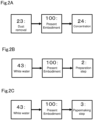
- the method of the present embodiment can efficiently discharge even pitch, which has a size so as to slip through a dust removal apparatus such as a screen, outside the system, and thus pitch-containing water to be treated is more preferably treated after dust removal treatment (suitably after screening treatment). This is more preferable from the viewpoint that treated water reduced in pitch is provided and a pitch trouble is suppressed in the next step and subsequent steps (see, for example, Fig. 2A ).
- examples include a disassociation step, a first dust removal (rough sorting) step, a deinking step, a second dust removal (fine sorting) step, a cleaning step, a bleaching step by a bleaching tower or the like, and a storage step by a chest or the like, and these may be sequentially performed.
- a main object of the method of the present embodiment is to efficiently discharge pitch outside the system, which has not been able to deal by a conventional paper manufacturing process, and the method can also deal with the above-mentioned pitch slipping through a screen.
- the method of the present embodiment is preferred to use not pitch-containing water in a deinking step, but pitch-containing water to be treated, in any step other than a deinking step.
- the method of the present embodiment can also deal with the above-mentioned pitch slipping through a screen, and thus, in the case of a paper manufacturing process including a deinking step, it is preferable to treat pitch-containing water to be treated, in the papermaking step or the water recovery step.
- pitch slipping through in a screening step can be more favorably treated to thereby provide treated water reduced in pitch.
- the preparation system or the preparation apparatus for performing the preparation step may be configured so as to make a raw material for paper manufacturing, and a common preparation system or preparation apparatus may also be used.
- the papermaking step is not particularly limited, and may be a usual papermaking step.
- the papermaking step includes a paper layer formation step of pouring a raw material for paper manufacturing (paper stock finely sorted) prepared, onto a mesh for filtration to thereby form a paper layer, in a wire part; a wet paper dehydration step of passing wet paper obtained, together with a blanket (felt), between two rolls for compression dehydration, in a press part; and a primary circulation water step of recovering water (in particular, pulp-containing water) from each water generated in these steps, in a storage unit and a flow path (silo, pit, pipe, and the like) to thereby circulate the water in a seed box, a chest, and the like, and such water in the papermaking step includes pitch in addition to pulp.
- the papermaking step may include a wet paper drying step of drying the wet paper in a drier part after the wet paper dehydration step.
- pitch-containing water it is preferable in the method of the present embodiment to treat pitch-containing water to be treated in one, or two or more selected from the group consisting of the paper layer formation step, the wet paper dehydration step, and the primary circulation water step in the papermaking step.
- pitch is included in the water generated and/or the water recovered in the papermaking step, and thus such pitch-containing water can be treated as pitch-containing water to be treated.
- examples include shower water in the wire part, cleaning water for a wire, felt, and the like, water or a filtrate recovered from a seal pit, a white water silo, a recovery water tank, and the like, and pitch-containing water to be treated from one, or two or more selected from such examples may be treated.
- the papermaking system or the papermaking apparatus for performing the papermaking step may be configured so as to be capable of papermaking, and a common papermaking system or papermaking apparatus may also be used.
- Examples of the papermaking system or the papermaking apparatus here provided include a wire part, a press part and a drier part, but are not limited thereto, and furthermore one, or two or more selected from the group consisting of a dust removal apparatus such as a screen, a chest (for example, a mixing chest and a machine chest), a refiner, a seed box and an inlet, a white water silo, a seal pit, a recovery water tank, a water flow path for white water recovery, and the like may be further provided.
- a dust removal apparatus such as a screen, a chest (for example, a mixing chest and a machine chest), a refiner, a seed box and an inlet, a white water silo, a seal pit, a recovery water tank, a water flow path for white water recovery, and the like may be further provided.
- the water recovery step is not particularly limited, and is usually configured so as to recover and circulate water in order to recycle water (for example, shower water, cleaning water, excess water, white water, and a filtrate) generated in each step (more suitably the preparation step and/or the papermaking step) in the paper manufacturing process, in the preparation step and/or the papermaking step.
- a dust removal apparatus such as a screen, a pressure flotation apparatus, a polydisc filter, a water storage unit, a chest, a pipe and a flow path, a pump, and the like is/are provided for the water recovery step, and is/are preferably connected in a network manner so as to be able to recover, circulate, or treat water for any purpose.
- pitch is included in water recovered, circulated and recycled in the water recovery step, and thus the pitch-containing water in the water recovery step is preferably treated as pitch-containing water to be treated.
- the water recovery step in the present embodiment preferably includes a primary circulation water step and a secondary circulation water step.
- circulation of water in the papermaking step is referred to as “primary circulation”
- secondary circulation circulation of water generated in the papermaking step, and transferred out of the step and circulated
- the primary circulation water step is preferably to recover water generated in the papermaking step, and to circulate and recycle the water recovered, in the papermaking step.
- the secondary circulation water step is preferably configured so as to recover water generated in the papermaking step, and to transfer and recycle the water recovered, to and in the preparation step, or discharge the water recovered, outside the system.
- the water recovery system or the water recovery apparatus for performing the water recovery step is configured so as to be able to recover water generated in each step, transfer water to an objective facility, and circulate water, and, for example, may be configured so as to include a water storage unit, a chest, a pipe and a flow path, a pump, a dust removal apparatus such as a screen, and/or the like, and be connected in a network manner for any purpose.
- the pitch-containing water to be treated is suitably pitch-containing water in the paper manufacturing process, as described in "1-1.” above, and the pitch-containing water may include pulp and the pulp may be any of virgin pulp, waste paper pulp or a mixture thereof.
- the pitch-containing water to be treated in the paper manufacturing process is pitch-containing water to be treated in one, or two or more selected from the group consisting of the preparation step, the papermaking step, and the water recovery step.
- the pH of the water to be treated is not particularly limited, and is preferably a pH of 5 to 13, more preferably a pH of 5 to 10.
- the pulp concentration in the pitch-containing water to be treated is not particularly limited, a more suitable lower limit value thereof is preferably 1000 mg/L or more, more preferably 2000 mg/L or more, further preferably 3000 mg/L or more and a more suitable upper limit value thereof is preferably, 35000 mg/L or less, more preferably 30000 mg/L or less, further preferably 25000 mg/L or less, and the suitable numerical value range is more preferably 1000 to 35000 mg/L, further preferably 3000 to 30000 mg/L.
- pitch can be more efficiently discharged outside the system from the pitch-containing water in the preparation step, the papermaking step and the water recovery step, and thus the amount of pitch inside the system can be reduced and a pitch trouble can be suppressed.
- the pulp concentration (mg/L) can be calculated from the suspended solid weight (mg/L) - the ash content weight (mg/L) - the pitch weight (mg/L).
- the suspended solid concentration of the pitch-containing water to be treated is not particularly limited, a more suitable lower limit value thereof is preferably 0.3% or more, more preferably 0.4% or more and a more suitable upper limit value thereof is preferably 10% or less, more preferably 5% or less, further preferably 4% or less, still more preferably 3% or less.
- the suitable numerical value range is more preferably 0.3 to 10%, further preferably 0.4 to 5%.
- the suspended solid concentration can be determined according to "(1) Suspended solid concentration" in ⁇ Measurement methods used in present embodiment> described below.
- pitch can be more efficiently discharged outside the system from the pitch-containing water in at least one of the preparation step, the papermaking step, or the water recovery step, and thus the amount of pitch inside the system can be reduced and furthermore a pitch trouble inside the system can be suppressed.
- the present inventors have found that, in the method of the present embodiment, as shown in Examples described below, if the suspended solid concentration of the pitch-containing water to be treated is raised from 0.1% to 0.2%, the selective concentration factor of pitch in froth is lightly reduced, and if the concentration exceeds 0.2% and then reaches 0.5%, the selective concentration factor is rapidly raised and a high concentration factor is exhibited.
- the method of the present embodiment can more efficiently discharge pitch outside the system from even pitch-containing water to be treated, high in suspended solid concentration, in the paper manufacturing process. Additionally, the method of the present embodiment, in which mechanical aeration is used, thus can more easily discharge pitch outside the system from pitch-containing water to be treated, than use of a chemical agent required to be adjusted in concentration. Furthermore, the method of the present embodiment more efficiently discharge pitch outside the system, even in the case of pitch having a size so as to slip through a screen, or even in the case of a predetermined or higher suspended solid concentration of the pitch-containing water to be treated.
- the method of the present embodiment can efficiently discharge pitch outside the system, from the pitch-containing water to be treated, even in the case of difficult pitch removal.
- the pitch content inside the system can be reduced and furthermore a pitch trouble inside the system (in particular, papermaking step) can be suppressed.
- the size (particle size) of the pitch included in the pitch-containing water to be treated is not particularly limited, a suitable lower limit value thereof is preferably 10 ⁇ m or more, more preferably 15 ⁇ m or more, further preferably 20 ⁇ m or more and a suitable upper limit value thereof is preferably 1000 ⁇ m or less, more preferably 800 ⁇ m or less, further preferably 600 ⁇ m or less, still more preferably 500 ⁇ m or less, more preferably 425 ⁇ m or less, and a more suitable numerical value range is more preferably 20 ⁇ m or more and 500 ⁇ m or less, further preferably 20 ⁇ m or more and 425 ⁇ m or less.
- the size of the pitch can be determined by sieving as described in "(2) Particle size of pitch" in ⁇ Measurement methods used in present embodiment> below.
- a chemical agent such as a common pitch suppressor can effectively treat pitch having a size of several tens of micrometers or less, but is not suitable for treatment of pitch of several tens of micrometers or more, particularly, equal to or more than 100 ⁇ m. Furthermore, pitch is generally removed with a screen, and it is confirmed that pitch is high in softness and thus is changed in shape and formed into pitch having a size equal to or more a slit width, for example, pitch having a size of 400 ⁇ m or 500 ⁇ m and such pitch slips through a screen (NPL1). In the case of such large pitch being included in water to be treated, it has been technically difficult to sufficiently discharge such pitch outside the system even by use of a conventional chemical treatment or mechanical treatment.
- the method of the present embodiment can be used to thereby favorably treat even water to be treated, containing large pitch having a size of 10 ⁇ m or more, and favorably remove pitch from the water to be treated.
- even large pitch can be efficiently discharged outside the system, and thus the amount of pitch inside the system can be reduced and a pitch trouble can be suppressed.
- treated water reduced in large pitch can be recycled in the preparation step and/or the papermaking step.
- the amount of an ash content included in the pitch-containing water to be treated is not particularly limited, a suitable lower limit value thereof is preferably 100 mg/L or more, more preferably 300 mg/L or more, further preferably 400 mg/L or more and a suitable upper limit value thereof is preferably 10000 mg/L or less, more preferably 7000 mg/L or less, further preferably 5000 mg/L or less.
- the suitable numerical value range is more preferably 300 to 7000 mg/L, further preferably 400 to 5000 mg/L.
- the method of the present embodiment can remove pitch by aeration of the pitch-containing water to be treated and thus generation of gas bubbles.
- Aeration can be used to thereby provide froth obtained by selective adhesion of pitch to gas bubbles, and float the froth near an aqueous surface.
- pitch can be floated and separated, and then discharged outside the system.
- gas bubble generation by aeration and thus contact of pitch present in water with gas bubbles allows the pitch to adhere to the gas bubbles and float near an aqueous surface, and be concentrated near an aqueous surface, to thereby form froth. Since the froth is higher in pitch concentration, treatment near such an aqueous surface can be made to thereby allow the pitch highly contained in the froth to be efficiently easily recovered.
- the froth recovered can be simply discharged outside the system.
- not only pitch can be efficiently discharged outside the system from the pitch-containing water to be treated in the paper manufacturing process, but also the pitch content inside the system can be reduced.
- a pitch trouble inside the system can also be suppressed.
- the resulting treated water has a reduced pitch content and also has fewer pitch-derived trouble, and thus can be more favorably recycled in the preparation step and/or the papermaking step.
- the pitch removal step in the present embodiment preferably includes a gas bubble generation step of generating gas bubbles by aeration and/or stirring, and preferably further includes a froth removal step of discharging froth including pitch, formed by the gas bubbles, outside the system, after the gas bubble generation step.
- the pitch removal step in the present embodiment more preferably includes such gas bubble generation step and froth removal step.
- the aeration method is not particularly limited, and a known aeration method may also be used.
- gas bubbles can also be supplied to the pitch-containing water to be treated.
- the aeration method here adopted can be, for example, a method of using a diffuser, a stirring apparatus, or the like. While aeration can also be made by strong stirring so that air is taken by a stirring apparatus configured so as to be capable of aeration, diffusion is preferable because the size, the direction, the amount, and the like of gas bubbles are easily adjusted.
- a method is preferably adopted where a diffuser (for example, a floatater) including a gas bubble generation unit capable of generating gas bubbles by diffusion members such as a diffuser tube and a diffuser plate is used, from the viewpoint that aeration can be stably and continuously performed.
- the method where the diffuser is used can efficiently perform aeration by providing the gas bubble generation unit (or apparatus) on the bottom of a tank and blowing fine gas bubbles downward and/or upward from the bottom to thereby increase the contact efficiency between the pitch-containing water to be treated and the gas bubbles.
- the gas bubble generation unit is not particularly limited, and a method is preferably adopted where a gas bubble generation unit configured so as to be able to generate fine gas bubbles is used.
- the direction in which gas bubbles are sent by the gas bubble generation unit may be any of the bottom direction, the side surface direction, or the upper direction of a tank, and thus gas bubbles can be sprayed in the bottom direction, the side surface direction, or the upper direction to thereby generate convection.
- the particle size of bubbles generated in the method of the present embodiment is not particularly limited and is preferably fine, a suitable lower limit value thereof is preferably 0.5 mm or more, more preferably 1 mm or more and a suitable upper limit value thereof is preferably 10 mm or less, more preferably 5 mm or less, further preferably 3 mm or less, and the suitable numerical value range is more preferably 1 to 3 mm.
- the amount of a gas for the aeration in the method of the present embodiment is not particularly limited, a more suitable lower limit value thereof per liter of sample water is preferably 0.5 L/min or more, more preferably 0.7 L/min or more, further preferably 1 L/min or more, still further preferably 1.2 L/min or more, and the upper limit value is not particularly limited and can be appropriately set depending on the performance of an aeration apparatus used.
- the gas is preferably air.
- the aeration time in the method of the present embodiment is not particularly limited, and can be appropriately set depending on the performance of an aeration apparatus used, the size of a tank used, or the like.
- the water temperature in the pitch-containing water to be treated, in aeration in the method of the present embodiment is not particularly limited, a suitable lower limit value thereof is preferably 20°C or more, more preferably 30°C or more, more preferably 35°C or more and a suitable upper limit value thereof is preferably 50°C or less, more preferably 45°C or less.
- the suitable numerical value range is more preferably 20 to 50°C.
- the water temperature of the pitch-containing water to be treated adopted in treatment in "1-3-2.
- Method for removing froth including pitch described below, can correspond to the temperature condition in the "water temperature of the pitch-containing water to be treated, in the aeration", and is more preferably 20 to 50°C.
- the pitch-containing water to be treated is preferably not only aerated, but also stirred so as to generate convection, in the method of the present embodiment.
- convection is more preferably vertical convection or horizontal convection. This not only makes it possible to uniformly contact the pitch-containing water to be treated, in a tank, with gas bubbles, but also makes it easy to form froth in contact of pitch and gas bubbles, and thus pitch can be efficiently discharged outside the system from the pitch-containing water to be treated.
- the stirring method is not particularly limited, and a method is preferably adopted where a stirring apparatus configured so as to generate convection in the pitch-containing water to be treated, by stirring, is used.
- a stirring apparatus configured so as to generate convection in the pitch-containing water to be treated, by stirring, is used.
- the stirring apparatus include an underwater stirring apparatus including one or more stirring blades or injection tools, but are not limited thereto.
- the froth removal method is not particularly limited, and a method can be adopted where a usual froth removal apparatus is used.
- the froth removal method here adopted is preferably a method where a mechanism or an apparatus configured so as to allow froth near an aqueous surface to tap into a flow near an aqueous surface and thus be discharged, a mechanism or an apparatus configured so as to scrape froth near an aqueous surface, or the like is used. Since froth highly concentrated, in the aeration method, is present near an aqueous surface in a tank, pitch can be more efficiently easily discharged outside the system from the pitch-containing water to be treated, even if a simple apparatus or mechanism is adopted.
- the conditions in "1-3-1.” described above for example, water temperature
- the method for discharging froth by a flow near an aqueous surface is more specifically, for example, preferably a method where a mechanism or an apparatus that collects and drops froth near an aqueous surface, into a drainage port provided at a slightly high or low position as compared with such an aqueous surface, and thus removes the froth is used.
- the method for scraping froth near an aqueous surface is more specifically, for example, preferably a method where an apparatus such as a travelling or rotating apparatus with a scraping plate (Krofta), Scoop Robo (automatic recovery apparatus of floating matter), or a skimmer such as a mini-skimmer (ultra-compact recovery apparatus of floating matter) is used.
- an apparatus such as a travelling or rotating apparatus with a scraping plate (Krofta), Scoop Robo (automatic recovery apparatus of floating matter), or a skimmer such as a mini-skimmer (ultra-compact recovery apparatus of floating matter) is used.
- an apparatus such as a travelling or rotating apparatus with a scraping plate (Krofta), Scoop Robo (automatic recovery apparatus of floating matter), or a skimmer such as a mini-skimmer (ultra-compact recovery apparatus of floating matter) is used.
- Krofta travelling or rotating apparatus with a scraping plate
- Such a mechanism or apparatus may be configured so as to, for example, include an apparatus (scraping apparatus, recovery apparatus, transfer pump, or the like), a tank, a flow path, and the like to enable pitch to be discharged outside the system.
- a froth removal apparatus may be adopted which is configured so as to remove froth formed by adhesion of pitch to gas bubbles.
- the mechanism or apparatus may be configured so as to be connected with other unit(s) (for example, an apparatus (such as a pump), a tank, and/or a flow path) to finally discharge pitch outside the system.
- gas bubbles are generated by applying aeration to the pitch-containing water to be treated to thereby remove pitch, and thus the selective concentration factor of pitch in froth can be enhanced.
- treatment of the pitch-containing water to be treated is performed so as to enhance the selective concentration factor of pitch in froth, and thus pitch can be efficiently discharged outside the system from the pitch-containing water to be treated.
- Treated water where pitch is efficiently removed from the pitch-containing water to be treated has a significantly reduced pitch content, and can be transferred to and recycled in the preparation step and/or the papermaking step.
- the treated water can be used to thereby reduce a pitch trouble occurring in the paper manufacturing process.
- a more suitable lower limit value of the selective concentration factor of pitch in froth in the method of the present embodiment is preferably 2 or more, more preferably 3 or more, further preferably 4 or more, still more preferably 5 or more, more preferably 5.5 or more, more preferably 6 or more.
- the upper limit value of the selective concentration factor of pitch in froth is not particularly limited because the method of the present embodiment can allow for treatment for two stages or three stages even in a continuous manner, and the upper limit value can be, for example, 500 or less, 250 or less or 100 or less, and can also be, for example, 10 or less, 20 or less, or 50 or less. If the suspended solid concentration of the pitch-containing water to be treated is 0.5% or more, the selective concentration factor of pitch in froth is rapidly increased, and thus the method of the present embodiment is more preferably used in a step where the suspended solid concentration is higher.
- a chemical agent is preferably further contained in the pitch-containing water to be treated, for the purpose of an enhancement in adsorption selectivity of pitch to bubbles in the above aeration or for the purpose of a more enhancement in pitch removal ratio.
- Such a chemical agent can be used in an application for an enhancement in adsorption selectivity of pitch to bubbles or an application for an enhancement in pitch removal ratio, or in a composition or formulation for the application, or can be a composition or formulation including such a chemical agent, for an enhancement in adsorption selectivity of pitch to bubbles or for an enhancement in pitch removal ratio.
- Such a chemical agent may also be used to produce a composition or formulation for an enhancement in adsorption selectivity of pitch to bubbles or for an enhancement in pitch removal ratio.
- Such a chemical agent may be added for use in a method for enhancing the adsorption selectivity of pitch to bubbles or a method for enhancing the pitch removal ratio.
- a chemical agent obtained by a known production method may be used, or a commercially available product may be used.
- the HLB value of the chemical agent is not particularly limited, a suitable upper limit value thereof is preferably 14 or less, more preferably 13 or less, further preferably 12 or less, and a combination use with a chemical agent low in HLB value and high in hydrophobicity can enhance the pitch concentration effect in further recovery.
- a suitable lower limit value of the HLB value of the chemical agent is preferably 6 or more, more preferably 8 or more, further preferably 10 or more, thereby not only facilitating contact with pitch in water to be treated, but also allowing pitch to easily adhere to gas bubbles and be separated from water to be treated, and floated, in the aeration.
- the HLB value is widely known with respect to the HLB calculation method by Oda et al., ( Ryohei Oda et al., "Surfactant Synthesis and Their Applications", Maki Shoten (1964 )), and is calculated by the following (mathematical formula 1).
- the "inorganic value” and “organic value” in the following (mathematical formula 1) are values predetermined with respect to each group in a compound, and the HLB is calculated by summing such values with respect to the entire compound.
- HLB ⁇ inorganic value/ ⁇ organic value ⁇ 10
- the chemical agent is preferably a surfactant, more specifically, preferably a surfactant having a hydrophobic group.
- the hydrophobic group is preferably an alkyl group and/or an alkylene group, and such a group may be any of a linear, branched, or cyclic group, and is preferably linear or branched. More specific examples include alkyl groups having 1 to 4 carbon atoms, such as a methyl group, a propyl group, and a butyl group; and alkylene groups having 1 to 4 carbon atoms, such as a methylene group, an ethylene group, a propylene group, and a butylene group, and one, or two or more selected therefrom can be adopted.
- a surfactant may be a homopolymer or a copolymer with other monomer.
- a non-ionic surfactant is preferred and polyalkylene glycol is further preferred, and the polyalkylene glycol can be represented by the following (chemical formula 1). HO- (R-O) n -H ... (chemical formula 1)
- R is preferably a linear or branched alkylene group having 1 to 4 carbon atoms, and n is an integer and n ⁇ 450 (suitably n ⁇ 20) is preferred.
- alkylene group in the (chemical formula 1) is preferably the same as the definition of the "alkylene group” described above, and in particular, an alkylene group having 1 to 3 carbon atoms is more preferred and an ethylene group is further preferred, and "n" described above is preferably about 5 to 20, more preferably 5 to 10.
- the number-average molecular weight of the chemical agent (polymer) used in the present embodiment is not particularly limited, a suitable lower limit value thereof is preferably 100 or more, more preferably 200 or more, further preferably 300 or more and a suitable upper limit value thereof is preferably 3000 or less, more preferably 2000 or less, further preferably 1000 or less.
- the number-average molecular weight of the "polymer” or watersoluble high-molecular-weight polymer used in the present embodiment can be measured by GPC (gel permeation chromatography) analysis with standard polystyrene as a standard material.
- the amount of the chemical agent used in the present embodiment is not particularly limited, and a suitable lower limit value thereof is preferably 0.1 mg/L or more, more preferably 0.5 mg/L or more, further preferably 1 mg/L or more relative to the pitch-containing water to be treated, and a suitable upper limit value thereof is preferably determined with appropriate addition in observation of the state of froth occurrence and is not particularly limited, and is preferably 50 mg/L or less, more preferably 20 mg/L or less, further preferably 10 mg/L or less, still more preferably 5 mg/L or less.
- the chemical agent is preferably added in a step of treating the pitch-containing water to be treated or a step of removing pitch.
- a location where the chemical agent is used is more preferably a place or an apparatus, where treatment of the pitch-containing water to be treated or pitch removal is performed, or an upstream location thereof.
- the upstream location suitably include a pipe or a flow path connected to a location or an apparatus where the treatment or removal is performed.
- the chemical agent is preferably added at a location where the aeration is made, or an upstream location thereof. More specifically, the chemical agent is preferably added in a tank configured so as to generate gas bubbles by the aeration, or a step or a flow path located before the tank.
- the step or flow path located before the tank is preferably a pipe or flow path that is connected to the tank and that is located immediately before flowing into the tank.
- a paper manufacturing process 1 includes a preparation step 2, a papermaking step 3, and a water recovery step 4 of recovering water generated in each of such steps.
- the preparation step 2 includes a dissolution step 21, a disassociation step 22, a dust removal step (cleaner step, screening step) 23, a concentration step 24, and a beating step 25, and a raw material 10 such as waste paper can be formed into a raw material for paper manufacturing, through the dissolution step 21 toward the beating step 25 in the preparation step 2.
- the papermaking step 3 includes a dust removal step 31, a paper layer formation step 32, a wet paper dehydration step 33, and a wet paper drying step 34, and the papermaking step can finally make paper 5.
- the papermaking step 3 (respective steps 31 to 34) is linked to a water recovery step of recovering primary circulation water 41 and/or secondary circulation water 42, in which water (for example, pitch and pulp-containing water) generated in papermaking, such as cleaning water, is recovered.
- water generated in the papermaking step 3 is recovered. Water that can be recycled is circulated in the preparation step 2 and/or the papermaking step 3, and unnecessary water is discharged as drainage water 6, outside the system.
- a method 100 for treating pitch-containing water to be treated, in the present embodiment can be used for the paper manufacturing process, and can be suitably used in one step, or two or more selected from the group consisting of the preparation step 2, the papermaking step 3, and the water recovery step 4. Furthermore, the treatment method 100 of the present embodiment can treat pitch-containing water to be treated in one, or two or more selected from the group consisting of the preparation step 2, the papermaking step 3, and the water recovery step 4.
- the method 100 for treating pitch-containing water to be treated in the present embodiment, can be used between the dust removal (suitably screening) step 23 and the concentration step 24 in the preparation step 2.
- the treatment method 100 of the present embodiment can treat pitch-containing water to be treated, generated after the dust removal (suitably, screening) step 23 and before the concentration step 24 in the preparation step 2.
- treated water having a reduced pitch content can be transferred to the concentration step 24 and water including pitch can be discharged as the drainage water 6, outside the system.
- the method 100 for treating pitch-containing water to be treated can be used between white water 43 including excess white water in the papermaking step 3 and the preparation step 2 and/or the papermaking step 3.
- treated water having a reduced pitch content can be transferred to the preparation step 2 and/or the papermaking step 3, in which there may be a plurality of locations to which the treated water is to be transferred.
- the water including pitch, after treatment, can go through the secondary circulation water step 42 and be discharged as the drainage water 6, outside the system.
- the method 100 for treating pitch-containing water to be treated may be repeatedly performed until a predetermined value (for example, predetermined "selective concentration factor of pitch in froth") is achieved.
- a predetermined value for example, predetermined "selective concentration factor of pitch in froth"
- the present embodiment can provide a pitch removal method for removing pitch from pitch-containing water to be treated in a paper manufacturing process, comprising supplying gas bubbles to the water to be treated to thereby remove pitch. More suitably, gas bubbles are supplied by generation of gas bubbles due to aeration (see, for example, Fig. 1 and Fig. 2 ).
- the pitch-containing water to be treated in a paper manufacturing process is suitably pitch-containing water to be treated in one, or two or more selected from the group consisting of a preparation step, a papermaking step, and a water recovery step. Furthermore, such water is suitably pitch-containing water to be treated, in the preparation step where waste paper except for waste newspaper is used as a raw material.
- the water to be treated suitably has a suspended solid concentration of 0.3% or more.
- the particle size of the pitch in the water to be treated is suitably 20 ⁇ m or more.
- the water to be treated is suitably water to be treated, after being subjected to screening treatment.
- the water to be treated suitably further includes a surfactant having a HLB value of 13 or less.
- the removal is suitably removal of froth formed by adhesion of pitch to gas bubbles.
- the removal is suitably removal so that the selective concentration factor of the pitch in the froth is 3 or more.
- the pitch removal method of the present embodiment can be used between the dust removal (suitably, screening) step and the concentration step in the preparation step, or can be used between white water including excess white water in the papermaking step, and the preparation step and/or the papermaking step.
- the pitch removal method of the present embodiment can treat pitch-containing water to be treated, generated after the dust removal (suitably screening) step and before the concentration step in the preparation step, or can treat pitch-containing water to be treated in a white water silo or of excess white water in the papermaking step and/or pitch-containing water to be treated of water recovered therefrom.
- pitch can be selectively discharged outside the system from pitch-containing water to be treated. Furthermore, treated water where pitch is efficiently removed from pitch-containing water to be treated has a favorably reduced pitch content, and can be transferred to and recycled in the preparation step and/or the papermaking step. Thus, the amount of pitch inside the system can be reduced and a pitch-derived trouble in the papermaking step can be suppressed.
- the method of the present embodiment can also be realized by an apparatus for carrying out or managing the method (for example, the methods described in “1.” and “2.” above) such as the method for treating pitch-containing water to be treated or the pitch removal method as described above, or a control unit (the control unit including CPU and the like) provided in the apparatus, and such an apparatus or control unit can be provided.
- the apparatus for carrying out or managing the method include a computer, a notebook computer, a desktop personal computer, a tablet PC, PLC, a server, and a cloud service.
- the apparatus for carrying out or managing the method or the like may also appropriately include an input unit such as a touch panel and a key board, transmitting and receiving units and a network between units, a communication unit such as a network access unit, and a display unit such as a touch panel and a display.
- an input unit such as a touch panel and a key board
- transmitting and receiving units and a network between units a communication unit such as a network access unit
- a display unit such as a touch panel and a display.
- the method of the present embodiment can also be saved as a program in a hardware resource including a memory medium (nonvolatile memory (USB memory or the like), SSD (Solid State Drive), HDD (Hard Disk Drive), CD, DVD, Blu-ray, or the like) and realized by the control unit.
- a memory medium nonvolatile memory (USB memory or the like), SSD (Solid State Drive), HDD (Hard Disk Drive), CD, DVD, Blu-ray, or the like
- the method of the present embodiment can also be provided as a program.
- a memory medium where the method of the present embodiment is stored can be provided. Thus, the method of the present embodiment can be carried out.
- a system that includes the control unit, the memory medium, the program, or the like and that is configured so as to control treatment or pitch removal of pitch-containing water to be treated, such as a treatment system or a pitch removal system of pitch-containing water to be treated, can be provided.
- the method of the present embodiment can be carried out.
- a program that realizes treatment of pitch-containing water to be treated in which a computer or the like includes a function of generating gas bubbles by application of aeration and/or stirring to pitch-containing water to be treated, in a predetermined step, and a function of discharging froth formed by contact of pitch in pitch-containing water to be treated, with gas bubbles, outside the system, can be provided, but is not limited thereto.
- the method of the present embodiment can be carried out.
- an apparatus which includes a control unit configured so as to generate gas bubbles by application of aeration and/or stirring to pitch-containing water to be treated, in a predetermined step, and furthermore, the control unit is more preferably configured so as to discharge froth formed by contact of pitch in pitch-containing water to be treated, with gas bubbles, outside the system.
- the method of the present embodiment can be more favorably carried out.
- the present invention can provide an apparatus for treating pitch-containing water to be treated, including a tank for treating pitch-containing water to be treated, wherein the tank is configured so as to perform aeration to thereby remove froth formed by adhesion of pitch to gas bubbles (see, for example, Fig. 1 and Fig. 2 ).
- the tank is more preferably configured so as to perform aeration and/or stirring in the same tank.
- an apparatus configured so as to add a chemical agent is suitably included.
- control unit configured so as to practice the method of the present embodiment (for example, the method described in “1.” and "2.") is suitably further included.
- a suitable aspect of the present embodiment relates to an apparatus for treating pitch-containing water to be treated, including
- the apparatus for treating pitch-containing water to be treated can be used as a pitch removal apparatus (see, for example, Fig. 2 ).
- the apparatus for example, treatment apparatus and removal apparatus
- the apparatus may be a treatment system or a pitch removal system of pitch-containing water to be treated (see, for example, Fig. 1 and Fig. 2 ).
- Each equipment constituting the apparatus of the present embodiment can be any unit, and, for example, aeration equipment may be an aeration unit.
- the tank may be configured so as to allow for inflow of pitch-containing water to be treated, from other unit, furthermore may be configured so as to be able to transfer treated water from the tank to other objective unit, and may be connected to other unit (for example, equipment, a tank, and a flow path) so as to be able to discharge pitch recovered, outside the system.
- the shape and the size of the tank are not particularly limited.
- the installation location or usage location of the apparatus of the present embodiment, in the paper manufacturing process is not particularly limited, and the apparatus of the present embodiment can be installed or used in any step and here the apparatus of the present embodiment may be installed singularly or plurally (see, for example, Fig. 2 ).
- the apparatus is more suitably installed or used singularly or plurally in one, or two or more selected from the group consisting of a preparation step, a papermaking step, and a water recovery step.
- the installation location or usage location is preferred to be after screening treatment. For example, as illustrated in Fig.
- an apparatus 100 of the present embodiment may be installed or used between a dust removal (suitably, screening) step 23 and a concentration step 24 in a preparation step 2.
- the apparatus 100 of the present embodiment may also be installed or used between white water 43 including excess white water in the papermaking step 3, and the preparation step 2 and/or the papermaking step 3.
- the apparatus of the present embodiment may be here installed or used singularly or plurally.
- pitch can be efficiently selectively removed from pitch-containing water to be treated, and pitch can be finally discharged outside the system. Furthermore, treated water where pitch is efficiently removed from pitch-containing water to be treated can be produced, and the treated water has a favorably reduced pitch content and thus can be transferred to and recycled in the preparation step and/or the papermaking step. Thus, the amount of pitch inside the system can be reduced and a pitch-derived trouble in the papermaking step can be suppressed.
- the apparatus of the present embodiment can carry out the method for treating pitch-containing water to be treated, according to "1.” described above, or the pitch removal method according to "2.” described above.
- the apparatus of the present embodiment may be an apparatus configured so as to be able to carry out the method for treating pitch-containing water to be treated, according to "1.” described above, or the pitch removal method according to "2.” described above.
- the present invention can also adopt the following configurations.
- Example 1 to 5 and Comparative Examples 1 to 2 water to be treated, including pitch and cardboard waste paper pulp
- Floatation was performed on such each sample, and fine bubble scum (froth) formed by adhesion of pitch floated near an aqueous surface was scraped by a scraper (scraping plate).
- Measurement methods used in the present embodiment are as follows.
- Each test slurry of Examples 1 to 5 and Comparative Examples 1 to 2 was prepared by disaggregating a cardboard not used after purchase, by tap water so that the suspended solid (SS) concentration reached a predetermined concentration.
- SS suspended solid
- Canadian Standard freeness was prepared so as to be in an amount of 300 mL. These were used as test slurries (pH at a SS concentration of 1%: 6.5 (water temperature 40°C)).
- Such each test slurry (Examples 1 to 5 and Comparative Examples 1 to 2) was prepared by adjustment to 40°C so that the suspended solid concentration shown in Table 2 was achieved, and was adopted as each sample.
- pitch removal chemicals A and B were respectively added to the test slurries adjusted to 40°C of Examples 4 and 5, before treatment in a floatater, so as to be each in an amount of 1.4 mg/L relative to sample water.
- a small desktop floatater apparatus (MT-5L manufactured by Ishikawajima Industrial Machinery Co., Ltd.) was used with air in an amount of 6 L/min to generate gas bubbles (gas bubbles having a particle size of 1 to 2 mm) in each of the samples, and floatation was performed on such each sample for 3 minutes with horizontal convection being generated under a medium-stirring condition (rotational rate: substantially 3800 rpm).
- Such a small desktop floatater is configured so as to perform stirring where plain gas bubbles are contacted with a turbine rotated at a high rate and thus crushed to gas bubbles of 1 to 2 mm to result in not only aeration in a 360-degree direction, but also generation of horizontal convection.
- the froth was recovered by scraping with travelling of a scraper attached to the small desktop floatater apparatus, near an aqueous surface with respect to 30 seconds.
- the pitch removal chemicals used are collectively shown in Table 1.
- the number-average molecular weight and the HLB value in Table 1 can be calculated by the method described in the above ⁇ 1-3-3. Chemical agent added>.
- Table 1 Pitch removal chemical list Chemical name Composition Number-average molecular weight HLB value Chemical A Esterified polyethylene glycol 400 11.8 Chemical B Esterified polyethylene glycol 600 13.7
- the pitch concentration in the froth was determined by adding Nile red so as to achieve a concentration of 1.25 mg/L to the filtrate in filtration with a sieve having an opening of 425 ⁇ m or 20 ⁇ m, and measuring the absorbance with an AquaFluor Handheld Fluorometer (manufactured by Turner Designs Inc.).
- the pitch removal effect was determined from the SS concentration and the pitch ratio, removed in the froth.
- the selective concentration factor of pitch in froth was determined by the above "(7) Pitch concentration and selective concentration factor of pitch in froth".
- Example 4 where chemical A was used in combination exhibited a high concentration factor of pitch as compared with Example 5 and thus the concentration effect could be further enhanced by combination use of a chemical low in HLB value (suitably HLB value: 12 or less), namely, high in hydrophobicity with a floatater.
- a chemical low in HLB value suitable HLB value: 12 or less
Landscapes
- Engineering & Computer Science (AREA)
- Chemical & Material Sciences (AREA)
- Life Sciences & Earth Sciences (AREA)
- Hydrology & Water Resources (AREA)
- Environmental & Geological Engineering (AREA)
- Water Supply & Treatment (AREA)
- Organic Chemistry (AREA)
- General Engineering & Computer Science (AREA)
- Dispersion Chemistry (AREA)
- Paper (AREA)
- Physical Water Treatments (AREA)
Applications Claiming Priority (2)
| Application Number | Priority Date | Filing Date | Title |
|---|---|---|---|
| JP2020173360A JP7115525B2 (ja) | 2020-10-14 | 2020-10-14 | 製紙工程におけるピッチ含有被処理水の処理方法 |
| PCT/JP2021/036899 WO2022080199A1 (ja) | 2020-10-14 | 2021-10-06 | 製紙工程におけるピッチ含有被処理水の処理方法 |
Publications (4)
| Publication Number | Publication Date |
|---|---|
| EP4230794A1 true EP4230794A1 (de) | 2023-08-23 |
| EP4230794A4 EP4230794A4 (de) | 2024-05-01 |
| EP4230794B1 EP4230794B1 (de) | 2026-02-25 |
| EP4230794C0 EP4230794C0 (de) | 2026-02-25 |
Family
ID=81208033
Family Applications (1)
| Application Number | Title | Priority Date | Filing Date |
|---|---|---|---|
| EP21879939.3A Active EP4230794B1 (de) | 2020-10-14 | 2021-10-06 | Verfahren zur behandlung von pech enthaltendem wasser bei der papierherstellung |
Country Status (5)
| Country | Link |
|---|---|
| EP (1) | EP4230794B1 (de) |
| JP (1) | JP7115525B2 (de) |
| KR (1) | KR102820436B1 (de) |
| CN (1) | CN116323496B (de) |
| WO (1) | WO2022080199A1 (de) |
Families Citing this family (1)
| Publication number | Priority date | Publication date | Assignee | Title |
|---|---|---|---|---|
| WO2025037610A1 (ja) * | 2023-08-15 | 2025-02-20 | 株式会社メンテック | 監視システム |
Family Cites Families (18)
| Publication number | Priority date | Publication date | Assignee | Title |
|---|---|---|---|---|
| JPS63152493A (ja) * | 1986-12-11 | 1988-06-24 | 新王子製紙株式会社 | パルプ紙製造工程水中のピツチの除去法 |
| JP2562534B2 (ja) * | 1991-12-02 | 1996-12-11 | 本州製紙株式会社 | 古紙再生処理法 |
| US5225046A (en) * | 1992-02-26 | 1993-07-06 | Shell Oil Company | Wastepaper deinking process |
| JPH06257082A (ja) * | 1993-02-26 | 1994-09-13 | Honshu Paper Co Ltd | 古紙再生処理方法 |
| US6171445B1 (en) * | 1999-07-30 | 2001-01-09 | Hercules Incorporated | Process for controlling deposit of sticky material |
| CN100460592C (zh) | 2004-10-26 | 2009-02-11 | 中国印钞造币总公司 | 造纸白水的处理方法 |
| US7967947B2 (en) * | 2005-02-09 | 2011-06-28 | Nippon Paper Industries Co., Ltd. | Methods for beating pulp, methods for treating process waters, and methods for producing pulp and paper |
| JP2008255498A (ja) * | 2007-03-30 | 2008-10-23 | Nippon Paper Industries Co Ltd | 再生パルプの製造方法 |
| CN102051836A (zh) * | 2009-10-29 | 2011-05-11 | 海茂株式会社 | 纸浆制造排水的处理方法 |
| CN202072970U (zh) | 2011-05-31 | 2011-12-14 | 东莞海龙纸业有限公司 | 一种用于去除纸机白水中的胶粘物的装置 |
| JP6037432B2 (ja) | 2012-06-18 | 2016-12-07 | ハイモ株式会社 | 製紙用添加剤およびそれを用いた製紙方法 |
| PT2864541T (pt) | 2012-06-22 | 2017-07-24 | Buckman Laboratories Int Inc | Métodos de utilização de combinações de uma lipase e de um oxidante para controlo de pez em processos de fabrico de papel e seus produtos |
| JP6325813B2 (ja) * | 2012-12-27 | 2018-05-16 | 栗田工業株式会社 | ピッチ抑制剤、ピッチ抑制方法、及び脱墨パルプの製造方法 |
| JP6179982B2 (ja) | 2013-07-18 | 2017-08-16 | ハイモ株式会社 | アニオン性水溶性重合体によるピッチ低減方法 |
| CN105217753B (zh) | 2015-09-25 | 2017-12-05 | 东莞玖龙纸业有限公司 | 一种白水处理絮凝剂及其使用方法 |
| JP2019039113A (ja) | 2017-08-28 | 2019-03-14 | 日華化学株式会社 | ピッチコントロール剤及びピッチコントロール方法 |
| JP6569758B1 (ja) | 2018-03-14 | 2019-09-04 | 栗田工業株式会社 | ピッチ障害防止方法 |
| JP7163758B2 (ja) | 2018-12-21 | 2022-11-01 | 栗田工業株式会社 | ピッチ含有水の処理方法及び処理装置 |
-
2020
- 2020-10-14 JP JP2020173360A patent/JP7115525B2/ja active Active
-
2021
- 2021-10-06 CN CN202180070211.0A patent/CN116323496B/zh active Active
- 2021-10-06 KR KR1020237010767A patent/KR102820436B1/ko active Active
- 2021-10-06 EP EP21879939.3A patent/EP4230794B1/de active Active
- 2021-10-06 WO PCT/JP2021/036899 patent/WO2022080199A1/ja not_active Ceased
Also Published As
| Publication number | Publication date |
|---|---|
| CN116323496A (zh) | 2023-06-23 |
| EP4230794B1 (de) | 2026-02-25 |
| JP7115525B2 (ja) | 2022-08-09 |
| WO2022080199A1 (ja) | 2022-04-21 |
| EP4230794A4 (de) | 2024-05-01 |
| CN116323496B (zh) | 2024-12-24 |
| KR102820436B1 (ko) | 2025-06-12 |
| JP2022064627A (ja) | 2022-04-26 |
| KR20230085139A (ko) | 2023-06-13 |
| EP4230794C0 (de) | 2026-02-25 |
Similar Documents
| Publication | Publication Date | Title |
|---|---|---|
| EP1652999B1 (de) | Verfahren zur herstellung von recyclingpapierstoff, verfahren zur modifizierung der papierstofffaseroberfläche und des störstoffs sowie papierstoffbehandlungsvorrichtung | |
| CN101705634B (zh) | 工序用水的处理方法、纸浆和纸的制造方法 | |
| JP2000096473A (ja) | 故紙原料より粘着性物質を除去しその粘着作用を抑制する方法 | |
| Kemper | State-of-the-art and new technologies in flotation deinking | |
| JP3453146B2 (ja) | 再利用パルプの脱インキ法 | |
| EP1126076B1 (de) | Verfahren und Vorrichtung zur Halbstoffreinigung | |
| EP4230794A1 (de) | Verfahren zur behandlung von pech enthaltendem wasser bei der papierherstellung | |
| JP2005299073A (ja) | セルロースパルプの処理方法及び装置 | |
| JP2006316400A (ja) | 汚染物質を水性の繊維物質懸濁液から除去する方法 | |
| JP4854733B2 (ja) | 紙を生産するために使用されるリサイクルされた繊維からの有機析出物の除去 | |
| JP5861910B2 (ja) | 古紙脱墨パルプの製造方法 | |
| JP2562534B2 (ja) | 古紙再生処理法 | |
| CN100587156C (zh) | 纸浆的打浆方法 | |
| JP2006052486A (ja) | 古紙原料パルプの製造方法 | |
| JP6004325B2 (ja) | 古紙脱墨パルプの製造方法 | |
| JP6583005B2 (ja) | 脱墨古紙パルプの製造方法及び製造システム | |
| CN106948199A (zh) | 一种采用浮选法处理废纸浆料胶粘物的系统 | |
| Strickland | Applications and methods for increased liberation and separation in the deinking of recycled paper fiber | |
| Lee et al. | Evaluation of the dynamic attachment phenomena of micro stickies to air bubbles | |
| Crossley et al. | A pilot plant study of the recyclability of pressure sensitive adhesives (PSA) | |
| KR20010021612A (ko) | 폐지의 탈묵 공정에서 양이온성 고분자전해질 및계면활성제의 용도 | |
| JPH0649792A (ja) | 古紙処理方法 | |
| Sauvé | The effect of flotation deinking process parameters on air bubble size and deinking efficiency | |
| WO1996036763A1 (en) | Pulping apparatus and related method for recycling paper | |
| JP2006291379A (ja) | パルプの洗浄方法 |
Legal Events
| Date | Code | Title | Description |
|---|---|---|---|
| STAA | Information on the status of an ep patent application or granted ep patent |
Free format text: STATUS: THE INTERNATIONAL PUBLICATION HAS BEEN MADE |
|
| PUAI | Public reference made under article 153(3) epc to a published international application that has entered the european phase |
Free format text: ORIGINAL CODE: 0009012 |
|
| STAA | Information on the status of an ep patent application or granted ep patent |
Free format text: STATUS: REQUEST FOR EXAMINATION WAS MADE |
|
| 17P | Request for examination filed |
Effective date: 20230427 |
|
| AK | Designated contracting states |
Kind code of ref document: A1 Designated state(s): AL AT BE BG CH CY CZ DE DK EE ES FI FR GB GR HR HU IE IS IT LI LT LU LV MC MK MT NL NO PL PT RO RS SE SI SK SM TR |
|
| DAV | Request for validation of the european patent (deleted) | ||
| DAX | Request for extension of the european patent (deleted) | ||
| A4 | Supplementary search report drawn up and despatched |
Effective date: 20240403 |
|
| RIC1 | Information provided on ipc code assigned before grant |
Ipc: C02F 103/28 20060101ALN20240326BHEP Ipc: B03D 1/02 20060101ALI20240326BHEP Ipc: B03D 1/004 20060101ALI20240326BHEP Ipc: D21F 1/66 20060101ALI20240326BHEP Ipc: C02F 1/24 20060101ALI20240326BHEP Ipc: D21H 21/02 20060101AFI20240326BHEP |
|
| STAA | Information on the status of an ep patent application or granted ep patent |
Free format text: STATUS: EXAMINATION IS IN PROGRESS |
|
| 17Q | First examination report despatched |
Effective date: 20250103 |
|
| RIC1 | Information provided on ipc code assigned before grant |
Ipc: D21H 21/02 20060101AFI20250718BHEP Ipc: C02F 1/24 20230101ALI20250718BHEP Ipc: D21F 1/66 20060101ALI20250718BHEP Ipc: B03D 1/004 20060101ALI20250718BHEP Ipc: B03D 1/02 20060101ALI20250718BHEP Ipc: B03D 1/08 20060101ALI20250718BHEP Ipc: C02F 103/28 20060101ALN20250718BHEP |
|
| GRAP | Despatch of communication of intention to grant a patent |
Free format text: ORIGINAL CODE: EPIDOSNIGR1 |
|
| STAA | Information on the status of an ep patent application or granted ep patent |
Free format text: STATUS: GRANT OF PATENT IS INTENDED |
|
| RIC1 | Information provided on ipc code assigned before grant |
Ipc: D21H 21/02 20060101AFI20250828BHEP Ipc: C02F 1/24 20230101ALI20250828BHEP Ipc: D21F 1/66 20060101ALI20250828BHEP Ipc: B03D 1/004 20060101ALI20250828BHEP Ipc: B03D 1/02 20060101ALI20250828BHEP Ipc: B03D 1/08 20060101ALI20250828BHEP Ipc: C02F 103/28 20060101ALN20250828BHEP |
|
| INTG | Intention to grant announced |
Effective date: 20250925 |
|
| GRAS | Grant fee paid |
Free format text: ORIGINAL CODE: EPIDOSNIGR3 |
|
| GRAA | (expected) grant |
Free format text: ORIGINAL CODE: 0009210 |
|
| STAA | Information on the status of an ep patent application or granted ep patent |
Free format text: STATUS: THE PATENT HAS BEEN GRANTED |
|
| AK | Designated contracting states |
Kind code of ref document: B1 Designated state(s): AL AT BE BG CH CY CZ DE DK EE ES FI FR GB GR HR HU IE IS IT LI LT LU LV MC MK MT NL NO PL PT RO RS SE SI SK SM TR |
|
| REG | Reference to a national code |
Ref country code: CH Ref legal event code: F10 Free format text: ST27 STATUS EVENT CODE: U-0-0-F10-F00 (AS PROVIDED BY THE NATIONAL OFFICE) Effective date: 20260225 Ref country code: GB Ref legal event code: FG4D |
|
| REG | Reference to a national code |
Ref country code: IE Ref legal event code: FG4D |
|
| U01 | Request for unitary effect filed |
Effective date: 20260225 |
|
| U07 | Unitary effect registered |
Designated state(s): AT BE BG DE DK EE FI FR IT LT LU LV MT NL PT RO SE SI Effective date: 20260302 |