EP4231082A1 - Améliorations apportées ou se rapportant à des systèmes d'affichage de guide d'ondes - Google Patents
Améliorations apportées ou se rapportant à des systèmes d'affichage de guide d'ondes Download PDFInfo
- Publication number
- EP4231082A1 EP4231082A1 EP22275018.4A EP22275018A EP4231082A1 EP 4231082 A1 EP4231082 A1 EP 4231082A1 EP 22275018 A EP22275018 A EP 22275018A EP 4231082 A1 EP4231082 A1 EP 4231082A1
- Authority
- EP
- European Patent Office
- Prior art keywords
- image
- waveguide
- collimated image
- collimated
- coupling
- Prior art date
- Legal status (The legal status is an assumption and is not a legal conclusion. Google has not performed a legal analysis and makes no representation as to the accuracy of the status listed.)
- Ceased
Links
- 230000008878 coupling Effects 0.000 claims abstract description 86
- 238000010168 coupling process Methods 0.000 claims abstract description 86
- 238000005859 coupling reaction Methods 0.000 claims abstract description 86
- 238000012544 monitoring process Methods 0.000 claims abstract description 75
- 238000000034 method Methods 0.000 claims abstract description 16
- 238000003384 imaging method Methods 0.000 claims abstract description 7
- 230000003287 optical effect Effects 0.000 claims description 64
- 238000012937 correction Methods 0.000 claims description 14
- 210000003128 head Anatomy 0.000 claims description 6
- 210000001747 pupil Anatomy 0.000 claims description 6
- 239000011248 coating agent Substances 0.000 claims description 4
- 238000000576 coating method Methods 0.000 claims description 4
- 239000000758 substrate Substances 0.000 description 10
- 238000010586 diagram Methods 0.000 description 9
- 238000004458 analytical method Methods 0.000 description 7
- 230000008569 process Effects 0.000 description 6
- 238000013461 design Methods 0.000 description 5
- 230000000712 assembly Effects 0.000 description 4
- 238000000429 assembly Methods 0.000 description 4
- 230000002730 additional effect Effects 0.000 description 2
- 239000003086 colorant Substances 0.000 description 2
- 238000010276 construction Methods 0.000 description 2
- 238000001514 detection method Methods 0.000 description 2
- 230000000694 effects Effects 0.000 description 2
- 238000007689 inspection Methods 0.000 description 2
- 238000012545 processing Methods 0.000 description 2
- 238000001228 spectrum Methods 0.000 description 2
- 230000009471 action Effects 0.000 description 1
- 230000008901 benefit Effects 0.000 description 1
- 230000005540 biological transmission Effects 0.000 description 1
- 239000000463 material Substances 0.000 description 1
- 238000009877 rendering Methods 0.000 description 1
- 239000007787 solid Substances 0.000 description 1
- 230000008685 targeting Effects 0.000 description 1
Images



Classifications
-
- G—PHYSICS
- G02—OPTICS
- G02B—OPTICAL ELEMENTS, SYSTEMS OR APPARATUS
- G02B27/00—Optical systems or apparatus not provided for by any of the groups G02B1/00 - G02B26/00, G02B30/00
- G02B27/01—Head-up displays
- G02B27/017—Head mounted
- G02B27/0172—Head mounted characterised by optical features
-
- G—PHYSICS
- G02—OPTICS
- G02B—OPTICAL ELEMENTS, SYSTEMS OR APPARATUS
- G02B27/00—Optical systems or apparatus not provided for by any of the groups G02B1/00 - G02B26/00, G02B30/00
- G02B27/10—Beam splitting or combining systems
- G02B27/108—Beam splitting or combining systems for sampling a portion of a beam or combining a small beam in a larger one, e.g. wherein the area ratio or power ratio of the divided beams significantly differs from unity, without spectral selectivity
-
- G—PHYSICS
- G02—OPTICS
- G02B—OPTICAL ELEMENTS, SYSTEMS OR APPARATUS
- G02B27/00—Optical systems or apparatus not provided for by any of the groups G02B1/00 - G02B26/00, G02B30/00
- G02B27/01—Head-up displays
- G02B27/0101—Head-up displays characterised by optical features
- G02B2027/011—Head-up displays characterised by optical features comprising device for correcting geometrical aberrations, distortion
-
- G—PHYSICS
- G02—OPTICS
- G02B—OPTICAL ELEMENTS, SYSTEMS OR APPARATUS
- G02B27/00—Optical systems or apparatus not provided for by any of the groups G02B1/00 - G02B26/00, G02B30/00
- G02B27/01—Head-up displays
- G02B27/0101—Head-up displays characterised by optical features
- G02B2027/0138—Head-up displays characterised by optical features comprising image capture systems, e.g. camera
-
- G—PHYSICS
- G02—OPTICS
- G02B—OPTICAL ELEMENTS, SYSTEMS OR APPARATUS
- G02B27/00—Optical systems or apparatus not provided for by any of the groups G02B1/00 - G02B26/00, G02B30/00
- G02B27/01—Head-up displays
- G02B27/017—Head mounted
- G02B27/0172—Head mounted characterised by optical features
- G02B2027/0174—Head mounted characterised by optical features holographic
Definitions
- the present invention relates to improvements in or relating to waveguide display systems, including but not limited to a display integrity scheme.
- a display system may be required to operate with a high level of integrity. This is relevant in many situations, including for example for a flight critical display system, for use with avionics or for a targeting system used by the military. Display systems used to present safety critical information to a user are required to operate with a very high level of integrity. The display system must be able to detect when hazardously misleading information is presented to the user and act to mitigate the issue.
- the display's integrity is monitored solely in the electronic side of the display path with no optical inspection of the display. This is possible where the display path electronics are fully understood from the generation of the image content through to the construction of the image on the display device. This typically requires a full understanding of the design and function of each component in the display path. This is not always possible, especially with the use of complex COTS (commercial off the shelf) components, such as display chipsets. With the use of COTS components within the system full access to the underlying processes and designs of the COTS items may not be possible which may lead to a more basic integrity monitoring system implemented within the display system giving inaccurate information. In these scenarios optical monitoring of the display would provide a method of closing the display path integrity loop.
- COTS commercial off the shelf
- Optical integrity monitoring systems previously implemented with various display systems can rely on a separate display path within the display projection optic. These optical integrity monitoring systems add mass and volume to the projection system. When used in display systems such as a head up display (HUDs) this is not a major issue as size and weight are not key design parameters. However, in other systems where mass and volume are a key design parameter, for example in a head worn display (HWD), this type of optical integrity monitoring system is inadequate.
- HUDs head up display
- HWD head worn display
- the invention provides a scheme which overcomes at least some of the disadvantages of present systems and for implementing a lightweight, low volume optical monitoring package. The invention allows for more detailed pixel level monitoring to take place.
- one object of the present invention is to provide a waveguide display system that is able to determine the integrity of an image.
- a system for delivering an image to a user via a waveguide display system and for determining integrity of an image comprising: a combination waveguide, in coupling and out coupling assembly comprising: a waveguide region; an in coupling region configured to receive a collimated image from an imaging system and an out coupling region configured to direct the collimated image toward an eye of a user, wherein the waveguide is configured to direct at least a first portion of the collimated image from the in coupling region towards the out coupling region to be directed to the user; and wherein prior to the collimated image being directed towards the eye, a second portion of the collimated image is configured to be directed towards an integrity monitoring module which is configured to determine at least one discrepancy between the collimated image and the image to thereby correct the first portion of the collimated image.
- the in coupling and out coupling regions each comprise a surface of the waveguide assembly providing a predetermined optical effect.
- each surface of the waveguide assembly comprises a reflective coating.
- each surface of the waveguide assembly is a predetermined shape.
- the in coupling region includes a reflective surface having a saw-tooth profile which splits the light into a +1R diffracted beam and a -1R diffracted beam.
- the in coupling region includes a reflective surface having a saw-tooth profile which splits the light into different order beams.
- the out coupling region includes a reflective surface having a saw-tooth profile.
- the collimated image comes from a collimation optic configured to output an exit pupil comprising the collimated image.
- the in coupling region directs the first portion of the collimated image towards the out coupling region and the second portion of the collimated image towards the integrity monitoring module.
- the integrity monitoring module comprises an optical arrangement configured to direct the second portion of the collimated image to a sensor.
- the integrity monitoring module is further configured to analyse the second portion of the collimated image to determine the at least one discrepancy between the collimated image and the image and to send to the system information related to at least one of the nature of the at least one discrepancy between the collimated image and the image and one or more corrections to mitigate or overcome the at least one discrepancy between the collimated image and the image.
- system of is for use in a binocular arrangement comprising one combination waveguide, in coupling and out coupling assembly for each eye.
- a correction system is configured to implement a correction to the image such that a discrepancy between the collimated image and the image is reduced.
- the discrepancy is reduced based on comparison with a threshold discrepancy.
- the integrity monitoring module comprises an optical arrangement configured to direct the second portion of the collimated image to a sensor.
- the integrity monitoring module comprises a lens element and a sensor to provide the second portion of the collimated image to a monitoring loop in which discrepancies between the collimated image and image are determined.
- the integrity monitoring module is further configured to analyse the second portion of the collimated image to determine the at least one discrepancy between the collimated image and the image and to send to the system information related to at least one of the nature of the at least one discrepancy between the collimated image and the image and one or more corrections to mitigate or overcome the at least one discrepancy between the collimated image and the image.
- a Heads Up Display including the system of another aspect of the invention.
- a head worn display system of another aspect of the invention According to another aspect of the present invention there is provided a head worn display system of another aspect of the invention.
- an integrity monitoring module for use in the system of any preceding claim, the integrity monitoring module comprising: optics configured to receive the second potion of the collimated image; direct the second potion of the collimated image towards one or more sensors configured to determine at least one discrepancy between the collimated image and the image on the second potion of the collimated image; generate an output indicative of at least one of the at least one discrepancy between the collimated image and the image and a correction to the at least one discrepancy between the collimated image and the image.
- a combination waveguide, in coupling and out coupling assembly for a system for delivering an image to a user via a waveguide display system and for determining integrity of an image
- the combination waveguide, in coupling and out coupling assembly comprising: a waveguide region; an in coupling region configured to receive a collimated image from a display system and an out coupling region configured to direct the collimated image to an eye of a user.
- the in coupling and out coupling regions each comprise a surface of the waveguide assembly providing a predetermined optical effect.
- each surface comprises at least one of: a reflective coating, is of a predetermined shape.
- the in coupling region includes a reflective surface having a saw-tooth profile which splits the light into different order diffractive beams.
- a method for delivering an image to a user via a waveguide display system and for determining integrity of an image comprising: receiving via a combination waveguide, in coupling and out coupling assembly a collimated image from an imaging system; splitting the collimated image into first and second portions; directing via an out coupling region the first portion of the collimated image to an eye of a user, directing the second portion of the collimated image to an integrity monitoring module which determines at least one discrepancy between the collimated image and the image in the collimated image to
- the present invention relates to an integrity monitoring scheme (also referred to as an optical integrity monitoring system) used with waveguide-based displays which provides a scheme for checking the optical output of the display system and bypassing any issues with the use of existing components within the display path which cannot be interrogated or modified.
- an integrity monitoring scheme also referred to as an optical integrity monitoring system
- waveguide-based displays which provides a scheme for checking the optical output of the display system and bypassing any issues with the use of existing components within the display path which cannot be interrogated or modified.
- a number of examples are presented, which make use of diffractive optical elements for an in coupling element and an out coupling element.
- the invention could also encompass other optical methods for the coupling of light into and out of the waveguide assembly, such as reflective structures.
- the image bearing light is then collected by an optical sensing element which provides a way to analyse the display content as part of the optical integrity monitoring system.
- Integrity monitoring systems have been implemented in Avionic display systems or imaging which are used as primary flight instruments for some time.
- the displays integrity is monitored solely in the electronic side of the display path with no optical inspection of the display.
- the display path electronics are fully understood from the generation of the image content through to the construction of the image on the display device.
- This typically requires a full understanding of the design and function of each component in the display path.
- This is not always possible, especially with the use of complex COTS components, such as display chipsets.
- these methods do not account for any physical changes within the optical system which might affect the display image, for example optical lenses moving causing the display image to become defocussed.
- optical monitoring of the display provides a method of closing the display path integrity loop.
- the optical integrity monitoring system then feeds back data which can be used to either correct discrepancies between the commanded or original image from a scene and the image displayed to the user, or inform the user of a failure within the device and removing the risk of potentially misleading information being displayed to the user.
- the original image may comprise a collimated image which is received from a source, such as a display, camera or any other imaging system.
- the collimated image comes from a collimation optic configured to output an exit pupil comprising the collimated image. This will be described in greater detail below.
- a solid light ray represents the part of light directed towards a user and the dotted line (secondary path) represents the part of light directed to an optical integrity monitoring module.
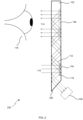
- an optical system 100 (also referred to as a waveguide assembly) is shown.
- the optical system includes a pupil expansion device including a waveguide substrate 102, an in coupling region 104 and, in this example, two out coupling regions 106 and 107.
- the waveguide substrate may also include one or more additional optical elements on or within the substrate for performing additional optical functions.
- the waveguide substrate (also referred to as the waveguide region) 102 allows light to be directed between and beyond the in and out coupling regions.
- the waveguide substrate is shown in cross-section and has substantially parallel sides although this is not essential.
- the waveguide assembly is described in Figure 7 below.
- the system includes an integrity monitoring module 108, which is ideally an optical integrity monitoring module.
- the in coupling region directs the majority of the light 110 along a primary path 112 (shown as a solid line) towards the out coupling region 106 which then expands the pupil and directs light 114 out of the waveguide assembly towards the user's eye 116.
- the primary path 112 is created by the +1R diffracted order (reflected order).
- the in coupling region 104 directs a smaller proportion of the incident light along a secondary path 118 within the waveguide assembly (shown by the dashed line) towards the secondary out coupling region 107. This secondary path is created by the -1R diffracted order (reflected order).
- the secondary out coupling region 107 directs the light out of the waveguide assembly which is then collected by the optical integrity monitoring module 108.
- the split of light between the positive and negative diffractive orders can be controlled by the shape of the diffractive structure and any coating applied to the structure. This will be described in more detail below.
- This aspect of the invention makes use of the +1 and -1 orders; however, any diffractive orders could be utilised to split the light paths.
- the out coupling regions may be the conjugate of the in coupling region to conserve the angles of the light paths injected into and ejected from the waveguide assembly.
- the secondary out coupling region could also be configured to be used in transmission rather than reflection. Other optical systems having the ability to split and transmit the light as required may also be used.
- the optical integrity monitoring module is configured to analyse portion 118 to determine at least one optical discrepancy between an original collimated and received image and to send to the system information related to at least one of the nature of the optical discrepancies between the original and received image and one or more corrections to mitigate or overcome the optical discrepancies between the original and received image.
- the manner in which the integrity module analyses and determines discrepancies is discussed further below with reference to figure 10 and 11.
- FIG. 2 shows a similar arrangement to the Figure 1 scheme.
- the light traveling along the secondary path 118 is coupled out of the waveguide assembly by a prismatic feature 202.
- the light coupled from the waveguide assembly is then collected by the optical integrity monitoring module 108.
- the in coupling region 104 is diffractive and the incident light bundle 110 is polychromatic or broad in terms of wavelength there may be some limitations.
- the chromatic spread of light induced by the diffractive region may not be compensated for by the prismatic element, therefore light collected by the optical integrity monitoring module will include some optical discrepancies between the original and received image in comparison to the light injected into the waveguide assembly. This can be overcome by using narrow spectrum light sources and compensating for any lateral colour effects in the optical integrity monitoring module. It is also an option to filter the light collected by the optical integrity monitoring module to a narrower spectrum than the light used within the display path.
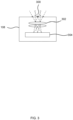
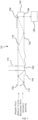
- Figure 3 shows an example of an optical arrangement of the optical integrity monitoring module 108.
- the monitor could be a simple camera system, where the light 300 captured is focused by one or more lens elements 302 onto a sensor 304 to provide an image of the displayed content. It is possible to provide a greater complexity of monitoring from pixel level integrity monitoring to a simpler monitoring of specific displayed elements where the resolution of the camera is matched to or greater than that of the display system.
- the sensing element could also be of a more basic nature and could range from a simple single photodiode capable of measuring light levels to multiple light detection sites providing resolution across the displayed image. The sensing element could be colour capable. It will be appreciated that many options are possible.
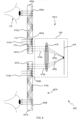
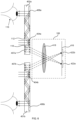
- Figure 4 , Figure 5 , and Figure 6 show how an arrangement for a binocular display system may work whilst utilising a single optical integrity monitoring module 108.
- the same reference applies to corresponding features.
- the arrangement 400 in Figure 4 comprises a wave guide assembly 401a and 401b for each eye.
- Each waveguide assembly is similar to the assembly shown in either Figure 1 or 2 .
- each waveguide assembly includes a respective waveguide and pupil expanders, respective in coupler regions 404a and 404b and respective out coupler regions 406a and 406b and 407a, 407b.
- the arrangement also includes the optical integrity monitoring module 108.
- Each in coupler region receives light 410a and 410b and splits each into two portions of light 412a, 412b and 414a, 414b.
- the light 414a and 414b which passes through the waveguide assembly and is collected by the optical integrity monitoring module 108 from both waveguide assemblies 401a and 401b is directed to a desired position on a sensor 416 via lens or lenses 418.
- the image to the left eye is driven by its display device, and then blanked, during this blanking period the image to the right eye is driven by its display device, and then blanked and so on.
- the optical integrity monitoring module is configured to capture sequentially frames 420b, 420a respectively at the same time as the image is displayed to the left eye, and subsequently timed to capture the separate image driven to the right eye.
- the secondary out coupling region imposes a deviation to the out coupled light.
- this could be achieved by changing the pitch and/or spacing of the diffractive structure. This may have similar chromatic limitations as described previously in relation to Figure 2 .
- the angular deviation could be achieved by altering the reflective facet angle.
- the display system may use time multiplexing to split the images or to switch between the left and right displays. For example, each image is displayed at one eye and then the other. In the time the image is being displayed at one eye the other may be blanked
- the sensor is configured to capture a frame at the same time as the image is displayed to the left eye, and subsequently timed to capture the separate image driven to the right eye. In order to determine the optical discrepancies between the original collimated image and actual image displayed to each eye and caused in the system would thus require a complex analysis.
- Figure 7 shows waveguide assembly 101 including a waveguide substrate 102, an in coupling region 104 and an out coupling region 106.
- the waveguide substrate includes internal surfaces that are substantially parallel to one another, shown as regions 702, 704 and 706. These surfaces enable internal reflection of light through the waveguide assembly.
- regions 702, 704 and 706 These surfaces enable internal reflection of light through the waveguide assembly.
- light enters the waveguide substrate via the in coupling region and is split and directed proportionately in the primary path and the secondary path.
- Each of the in coupling and out coupling regions are configured to provide an optical effect to light incident thereon. The effect can be predetermined by the shape, size and nature of the required optical effect.
- the in coupling region includes an internal reflective surface 700 which splits the light into the +1R and -1R beams 112 and 118.
- the proportion of light transmitted in each order can be controlled or dictated by the form, shape and/or size of optical surface 700.
- the reflective surface is a saw-tooth wave form. It will be appreciated different forms could be used. It will also be appreciated that the in coupling region could be laser based or any other appropriate type of optic.
- Waveguide substrates 702, 704 and 706 will comprise the main proportion of the waveguide assembly and the in coupling and out coupling regions will be sized as required.
- the waveguide assembly of the present invention can be coupled to the optical integrity monitoring module, which may or may not be part of the system.
- the waveguide assembly is a combined waveguide substrate, in coupler and out coupler, the assembly is formed as a single compact component which is relatively lighter in weight than the individual separate elements.
- the light extracted for integrity monitoring is analysed to determine if there are any optical discrepancies between the original and received image introduced by the display system.
- Information relating to any such optical discrepancies between the original and received image is fed back to a correction system (not shown) to apply a correction to the light arriving at the eye of the user.
- the integrity monitoring module is able to detect and generate corrections for all optical discrepancies between the original and actual image.
- the integrity monitoring system looks for discrepancies between the collimated image and the displayed image, any discrepancy can then be compared to a pre-set threshold value for that discrepancy type. If the discrepancy exceeds the threshold value, then the user is made aware of a fault within the system via a correction or feedback system forming part of the overall system.
- the fault is a frozen display i.e. the display is not being updated with the latest image.
- the user may be made aware of the issue by the display channel being switched off. This would prevent the user being exposed to misleading information.
- a portion or section of the image is incorrect, due to "stuck pixels" in the display generator. In this case it may be possible to reposition information which would be displayed over those pixels to another position on the display, therefore still providing the correct information to the user albeit in a different location.
- the integrity monitoring system may be capable of monitoring the following discrepancies in the display path:
- a correction may be able to be applied to the driven image to mitigate the detected failure, such as a luminance adjustment, an image shift/rotation.
- the user could be made aware of the reduced colour palette being made available. The information may still be displayed to the user, but perhaps in monochrome, removing the advantage of colour coded symbols etc. but still allowing the user to see an accurate representation of the image.
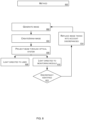
- FIG. 8 shows and example of a generic monitoring process 800.
- An image is generated, 802, by the system or any appropriate image generating means.
- the image is created or drawn 804, so that is can be displayed.
- the created image is projected 806, though the relevant optical system, in this case system 100.
- a portion of light is directed towards a user 808 and a portion towards the monitor including the integrity monitoring module 810.
- the portion directed towards the monitor passes through a monitoring loop 812 in which discrepancies between the original collimated image and actual image are determined or identified.
- the image is then redrawn, recreated, corrected, blanked or otherwise altered 814 and then returned to step 802 in which the image is generated.
- Figure 9 shows the process for one specific discrepancy by way of example.
- the example 900 is an image shift fault detection.
- a position of a symbol in the image is detected 902.
- the symbol position in the commanded or original image is input (symbology input) 904.
- the detected image and the original image are compared 906.
- a determination is made as to whether there is a discrepancy between the images 908. If no, the process continues to monitor the display 910 and no additional action is taken. If yes, the process seeks a relevant threshold value 912 which is then compared with the discrepancy, 914. If the discrepancy does not exceed the threshold the process continues to monitor the display 916 and no additional action is taken. If the discrepancy does exceed the threshold the process sends a fault code to the system 918.
- the system Control Processing Unit causes corrective action (920) to be taken, such as for example blanking the display or otherwise alerting the user.
- the invention is intended to be used in waveguide HWDs, however its use is not limited to HWDs and could be implemented on the waveguide HUD system. Whilst the invention provides the ability to monitor the integrity of the images displayed to the user, it could also be implemented in a simpler form to monitor display brightness and colour. In these examples the sensor in the optical integrity monitoring module would be appropriate to the intended type of monitoring.
Landscapes
- Physics & Mathematics (AREA)
- General Physics & Mathematics (AREA)
- Optics & Photonics (AREA)
- Spectroscopy & Molecular Physics (AREA)
- Optical Couplings Of Light Guides (AREA)
Priority Applications (4)
| Application Number | Priority Date | Filing Date | Title |
|---|---|---|---|
| EP22275018.4A EP4231082A1 (fr) | 2022-02-22 | 2022-02-22 | Améliorations apportées ou se rapportant à des systèmes d'affichage de guide d'ondes |
| US18/839,212 US20250180903A1 (en) | 2022-02-22 | 2023-02-15 | Waveguide display systems |
| EP23706670.9A EP4483228A1 (fr) | 2022-02-22 | 2023-02-15 | Améliorations dans ou relatives à des systèmes d'affichage à guide d'ondes |
| PCT/GB2023/050346 WO2023161607A1 (fr) | 2022-02-22 | 2023-02-15 | Améliorations dans ou relatives à des systèmes d'affichage à guide d'ondes |
Applications Claiming Priority (1)
| Application Number | Priority Date | Filing Date | Title |
|---|---|---|---|
| EP22275018.4A EP4231082A1 (fr) | 2022-02-22 | 2022-02-22 | Améliorations apportées ou se rapportant à des systèmes d'affichage de guide d'ondes |
Publications (1)
| Publication Number | Publication Date |
|---|---|
| EP4231082A1 true EP4231082A1 (fr) | 2023-08-23 |
Family
ID=80447544
Family Applications (1)
| Application Number | Title | Priority Date | Filing Date |
|---|---|---|---|
| EP22275018.4A Ceased EP4231082A1 (fr) | 2022-02-22 | 2022-02-22 | Améliorations apportées ou se rapportant à des systèmes d'affichage de guide d'ondes |
Country Status (1)
| Country | Link |
|---|---|
| EP (1) | EP4231082A1 (fr) |
Citations (8)
| Publication number | Priority date | Publication date | Assignee | Title |
|---|---|---|---|---|
| EP1215522A2 (fr) * | 2000-12-15 | 2002-06-19 | Samsung Electronics Co., Ltd. | Dispositif de visualisation portable comprenant un guide d'onde |
| DE102016115938A1 (de) * | 2016-08-26 | 2018-03-01 | Carl Zeiss Jena Gmbh | Wellenleiter sowie Vorrichtungen zur Dateneinspiegelung |
| CN110660036A (zh) * | 2019-11-01 | 2020-01-07 | 长春理工大学 | 一种近眼显示系统的图像畸变矫正方法 |
| US20200018968A1 (en) * | 2018-07-13 | 2020-01-16 | Magic Leap, Inc. | Systems and methods for display binocular deformation compensation |
| WO2020136306A1 (fr) * | 2018-12-27 | 2020-07-02 | Nokia Technologies Oy | Appareil, procédé et système destinés à être utilisés dans un affichage |
| WO2020191170A1 (fr) * | 2019-03-20 | 2020-09-24 | Magic Leap, Inc. | Système de fourniture d'éclairage de l'œil |
| US20210072437A1 (en) * | 2019-09-11 | 2021-03-11 | Magic Leap, Inc. | Display device with diffraction grating having reduced polarization sensitivity |
| US11202043B1 (en) * | 2020-08-25 | 2021-12-14 | Facebook Technologies, Llc | Self-testing display device |
-
2022
- 2022-02-22 EP EP22275018.4A patent/EP4231082A1/fr not_active Ceased
Patent Citations (8)
| Publication number | Priority date | Publication date | Assignee | Title |
|---|---|---|---|---|
| EP1215522A2 (fr) * | 2000-12-15 | 2002-06-19 | Samsung Electronics Co., Ltd. | Dispositif de visualisation portable comprenant un guide d'onde |
| DE102016115938A1 (de) * | 2016-08-26 | 2018-03-01 | Carl Zeiss Jena Gmbh | Wellenleiter sowie Vorrichtungen zur Dateneinspiegelung |
| US20200018968A1 (en) * | 2018-07-13 | 2020-01-16 | Magic Leap, Inc. | Systems and methods for display binocular deformation compensation |
| WO2020136306A1 (fr) * | 2018-12-27 | 2020-07-02 | Nokia Technologies Oy | Appareil, procédé et système destinés à être utilisés dans un affichage |
| WO2020191170A1 (fr) * | 2019-03-20 | 2020-09-24 | Magic Leap, Inc. | Système de fourniture d'éclairage de l'œil |
| US20210072437A1 (en) * | 2019-09-11 | 2021-03-11 | Magic Leap, Inc. | Display device with diffraction grating having reduced polarization sensitivity |
| CN110660036A (zh) * | 2019-11-01 | 2020-01-07 | 长春理工大学 | 一种近眼显示系统的图像畸变矫正方法 |
| US11202043B1 (en) * | 2020-08-25 | 2021-12-14 | Facebook Technologies, Llc | Self-testing display device |
Similar Documents
| Publication | Publication Date | Title |
|---|---|---|
| US11226261B2 (en) | Optical device testing method and apparatus | |
| US7023621B2 (en) | Device and method for the laser projection of high-resolution images onto the retina of the eye, superimposed with the image content of the field of vision | |
| US10685431B1 (en) | Optical measurement system | |
| US6201517B1 (en) | Stereoscopic image display apparatus | |
| EP4042675B1 (fr) | Dispositifs d'affichage éclairés par laser présentant une uniformité | |
| EP3254606B1 (fr) | Endoscope et dispositif d'imagerie à profondeur de champ | |
| US11163169B2 (en) | Endoscope and imaging arrangement providing improved depth of field and resolution | |
| EP3911982B1 (fr) | Procédé et appareil d'essai de dispositif optique | |
| US20170187943A1 (en) | Endoscope system | |
| CN110596895B (zh) | 一种近眼显示装置及投影反馈方法 | |
| US12066629B2 (en) | Image display apparatus and head-mounted display | |
| US10921644B1 (en) | Liquid crystal display backlight utilizing reflective stack | |
| DE102020127594A1 (de) | Optische anordnung einer datenbrille | |
| EP3984213B1 (fr) | Système de surveillance pour systèmes d'affichage laser améliorés | |
| US11215818B1 (en) | Waveguide display with structured light for eye and face tracking | |
| EP4231082A1 (fr) | Améliorations apportées ou se rapportant à des systèmes d'affichage de guide d'ondes | |
| US20250180903A1 (en) | Waveguide display systems | |
| GB2615825A (en) | Improvements in or relating to waveguide display systems | |
| US12422779B2 (en) | Optical assembly and method for reducing zero-order light in a holographic display | |
| US20250180902A1 (en) | Waveguide display systems | |
| EP4233208B1 (fr) | Système et procédé de communication optique | |
| EP4231081A1 (fr) | Améliorations apportées ou se rapportant à des systèmes d'affichage de guide d'ondes | |
| US20250044589A1 (en) | Head-up display system | |
| US12436386B2 (en) | Head wearable display device with image monitoring comprising at least one image monitor sensor optically coupled to a waveguide | |
| GB2615824A (en) | Improvements in or relating to waveguide display systems |
Legal Events
| Date | Code | Title | Description |
|---|---|---|---|
| PUAI | Public reference made under article 153(3) epc to a published international application that has entered the european phase |
Free format text: ORIGINAL CODE: 0009012 |
|
| STAA | Information on the status of an ep patent application or granted ep patent |
Free format text: STATUS: THE APPLICATION HAS BEEN PUBLISHED |
|
| AK | Designated contracting states |
Kind code of ref document: A1 Designated state(s): AL AT BE BG CH CY CZ DE DK EE ES FI FR GB GR HR HU IE IS IT LI LT LU LV MC MK MT NL NO PL PT RO RS SE SI SK SM TR |
|
| STAA | Information on the status of an ep patent application or granted ep patent |
Free format text: STATUS: THE APPLICATION HAS BEEN REFUSED |
|
| 18R | Application refused |
Effective date: 20230911 |