EP4231285B1 - Accès à de multiples assistants personnels virtuels (vpa) à partir d'un seul dispositif - Google Patents
Accès à de multiples assistants personnels virtuels (vpa) à partir d'un seul dispositif Download PDFInfo
- Publication number
- EP4231285B1 EP4231285B1 EP23185178.3A EP23185178A EP4231285B1 EP 4231285 B1 EP4231285 B1 EP 4231285B1 EP 23185178 A EP23185178 A EP 23185178A EP 4231285 B1 EP4231285 B1 EP 4231285B1
- Authority
- EP
- European Patent Office
- Prior art keywords
- vpa
- speech data
- input speech
- words
- user
- Prior art date
- Legal status (The legal status is an assumption and is not a legal conclusion. Google has not performed a legal analysis and makes no representation as to the accuracy of the status listed.)
- Active
Links
Images

Classifications
-
- G—PHYSICS
- G10—MUSICAL INSTRUMENTS; ACOUSTICS
- G10L—SPEECH ANALYSIS TECHNIQUES OR SPEECH SYNTHESIS; SPEECH RECOGNITION; SPEECH OR VOICE PROCESSING TECHNIQUES; SPEECH OR AUDIO CODING OR DECODING
- G10L15/00—Speech recognition
- G10L15/28—Constructional details of speech recognition systems
- G10L15/30—Distributed recognition, e.g. in client-server systems, for mobile phones or network applications
-
- G—PHYSICS
- G06—COMPUTING OR CALCULATING; COUNTING
- G06F—ELECTRIC DIGITAL DATA PROCESSING
- G06F3/00—Input arrangements for transferring data to be processed into a form capable of being handled by the computer; Output arrangements for transferring data from processing unit to output unit, e.g. interface arrangements
- G06F3/01—Input arrangements or combined input and output arrangements for interaction between user and computer
- G06F3/048—Interaction techniques based on graphical user interfaces [GUI]
- G06F3/0481—Interaction techniques based on graphical user interfaces [GUI] based on specific properties of the displayed interaction object or a metaphor-based environment, e.g. interaction with desktop elements like windows or icons, or assisted by a cursor's changing behaviour or appearance
- G06F3/0482—Interaction with lists of selectable items, e.g. menus
-
- G—PHYSICS
- G10—MUSICAL INSTRUMENTS; ACOUSTICS
- G10L—SPEECH ANALYSIS TECHNIQUES OR SPEECH SYNTHESIS; SPEECH RECOGNITION; SPEECH OR VOICE PROCESSING TECHNIQUES; SPEECH OR AUDIO CODING OR DECODING
- G10L15/00—Speech recognition
- G10L15/22—Procedures used during a speech recognition process, e.g. man-machine dialogue
-
- G—PHYSICS
- G10—MUSICAL INSTRUMENTS; ACOUSTICS
- G10L—SPEECH ANALYSIS TECHNIQUES OR SPEECH SYNTHESIS; SPEECH RECOGNITION; SPEECH OR VOICE PROCESSING TECHNIQUES; SPEECH OR AUDIO CODING OR DECODING
- G10L15/00—Speech recognition
- G10L15/28—Constructional details of speech recognition systems
-
- G—PHYSICS
- G10—MUSICAL INSTRUMENTS; ACOUSTICS
- G10L—SPEECH ANALYSIS TECHNIQUES OR SPEECH SYNTHESIS; SPEECH RECOGNITION; SPEECH OR VOICE PROCESSING TECHNIQUES; SPEECH OR AUDIO CODING OR DECODING
- G10L17/00—Speaker identification or verification techniques
- G10L17/22—Interactive procedures; Man-machine interfaces
-
- G—PHYSICS
- G10—MUSICAL INSTRUMENTS; ACOUSTICS
- G10L—SPEECH ANALYSIS TECHNIQUES OR SPEECH SYNTHESIS; SPEECH RECOGNITION; SPEECH OR VOICE PROCESSING TECHNIQUES; SPEECH OR AUDIO CODING OR DECODING
- G10L15/00—Speech recognition
- G10L15/08—Speech classification or search
-
- G—PHYSICS
- G10—MUSICAL INSTRUMENTS; ACOUSTICS
- G10L—SPEECH ANALYSIS TECHNIQUES OR SPEECH SYNTHESIS; SPEECH RECOGNITION; SPEECH OR VOICE PROCESSING TECHNIQUES; SPEECH OR AUDIO CODING OR DECODING
- G10L15/00—Speech recognition
- G10L15/22—Procedures used during a speech recognition process, e.g. man-machine dialogue
- G10L2015/223—Execution procedure of a spoken command
Definitions
- VPAs virtual personal assistants
- IPAs intelligent personal assistants
- VPAs include), Alexa ® (provided by Amazon Inc. of Seattle, WA), Google Assistant ® (provided by Google Inc. of Mountain View, CA), S Voice ® (provided by Samsung Electronics of Suwon, South Korea), Voice Mate ® (provided by LG Electronics of Seoul, South Korea) and Cortana ® (provided by Microsoft Inc. of Redmond, WA).
- this document features a method for accessing multiple virtual personal assistants, VPAs, the method comprising:
- the document also features a system for accessing multiple virtual personal assistants, VPAs, the system comprising:
- VPAs Virtual personal assistants
- IPAs intelligent personal assistants
- a VPA can be implemented as an agent application that executes on a particular device (e.g., a computing device or mobile device), and communicates with one or more remote computing devices (e.g., servers) associated with a corresponding VPA service provider to carry out tasks and provide responses and services based on a user input.
- remote computing devices e.g., servers
- the agent application can provide at least a portion of the user input (e.g., speech input) to one or more computing devices (e.g., servers) associated with a remote, cloud-based VPA service provider, which then processes the portion of the user input to generate a response.
- the response is transmitted back to the particular device, which then executes one or more tasks (e.g., generate a display and/or play an audio file) based on the response.
- the VPA service provider may use information from various other sources (e.g., location information of the particular device, information on weather, news, stock prices etc. as available, for example, from various databases, user information and schedules as available, for example, from a user account, etc.) in generating the response.
- VPA service providers typically provide VPA services to corresponding specific devices or applications. For example, various mobile devices have dedicated VPA applications executing on the devices.
- a VPA service provider may provide an application programming interface (API) that may be used to integrate a corresponding VPA into a device. Either way, only one VPA may be available from a particular device.
- API application programming interface
- a user may be interested in leveraging a choice of VPAs. For example, a user may want to ask for driving directions using a first VPA (e.g., Siri ® provided by Apple Inc. of Cupertino, CA), but prefer a second VPA (e.g., Alexa ® provided by Amazon Inc.
- a first VPA e.g., Siri ® provided by Apple Inc. of Cupertino, CA
- Alexa ® e.g., Alexa ® provided by Amazon Inc.
- VPAs or VPA service providers
- the technology described in this document allows for a selecting one of multiple available VPAs (or VPA service providers) from a single device.
- the selection may be made, for example, based on the presence of one or more keywords in the user-input, via pre-configured user settings, or automatically, e.g., based on the content of the user-input.
- the selection may be made from personal acoustic devices such as headphones or earphones connected to a source device (e.g., a mobile device, media player, or streaming device), which in turn may allow users to access their favorite VPA services through the personal acoustic devices without having to invest in devices associated with the corresponding VPA services.
- a source device e.g., a mobile device, media player, or streaming device
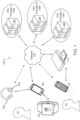
- a device that may communicate with multiple cloud-based VPA service providers 125 can also include a remote controller 110 configured to control a media playing device 112.
- the media playing device 112 can include, for example, a media streaming device, an optical disk player, a home theater receiver, or a speaker device that may be connected to a TV. The technology is described herein primarily using an example of a headphone 102 connected to a mobile device 105.
- the headphones 102 and/or mobile device 105 can be configured to communicate with one or more computing devices (e.g., servers 130) associated with each of multiple VPA service providers 125a, 125b, and 125c (125, in general).
- one or more computing devices e.g., servers 130
- VPA service providers 125a, 125b, and 125c 125, in general.
- input speech data based, for example, on the speech of a user 101
- the portion of the input speech may be packaged into one or more electronic files in accordance with a specification of the particular destination VPA service provider 125.
- Information representing the response is then transmitted back over the network 120 to the mobile device 105 and/or the personal acoustic device 102.
- the information is then processed at the recipient device to generate an output (e.g., an audio clip, or a video display) for the user 101.
- input speech data can be captured by a microphone at a first acoustic device (e.g., smart watch 103) and the output can be routed to a second acoustic device (e.g., headphone 102).
- the input speech data can be captured via a microphone 104 of the headphone 102.
- the microphone 104 could be supported by a housing of the headphone (and could be, for example, a feedback or feed-forward microphone associated with active noise reducing circuitry in the headphone).
- the input speech data may also be captured by a microphone of another device such as the mobile device 105 or a smart watch 103.
- the headphone 102 can include a VPA access button that may be activated to trigger the microphone 104 to capture speech input data intended for a VPA service provider 125.
- the microphone 104 can be configured to be always listening for one or more keywords indicative of a preferred VPA service provider.
- VPA service provider A 125a For example, if the keywords associated with VPA service provider A 125a are "Hello There,” and are detected by the microphone 104, words or phrases following the detected keywords are captured as input speech data intended for the VPA service provider A 125a. Similarly, if the keywords associated with VPA service provider B 125b are "Tell Me,” and are detected by the microphone 104, words or phrases following the detected keywords are captured as input speech data intended for the VPA service provider A 125b. In some implementations, these keywords are dictated by the VPA service providers.
- the user can customize keywords and/or phrases to be associated with a particular VPA service provider. For example, if a user is interested in using VPA service provider A for directions, the user could configure personal acoustic device 102 to recognize a customized keyword and/or phase (e.g., "Give me directions” or “Directions”) that would indicate that the input speech data is intended for the VPA service provider A. Similarly, if a user is interested in using VPA service provider B for shopping online, the user could configure personal acoustic device 102 to recognize a customized keyword and/or phrase (e.g., "I'd like to shop" or "Shopping”) that would indicate that the input speech data is intended for the VPA service provider B.
- a customized keyword and/or phase e.g., "Give me directions" or "Directions”
- the user could configure these customized keywords and/or phrases via a voice and/or visual user interface (for example the interface shown in FIGs. 3A-3C as described below).
- the input speech data can then be provided to the connected mobile device 105 for processing and subsequent packaging for transmission to a destination VPA service provider 125. This may be done, for example, using an application program executing on the mobile device 105 and/or the personal acoustic device.
- the headphone 102 may establish a connection (e.g., a wireless connection) with the mobile device 105 and start streaming the data captured by the microphone to the application program executing on the mobile device 105.
- the application may already be executing on the mobile device when the microphone 104 is triggered. In some cases, where the application is not already executing, triggering of the microphone 104 can cause the application to be launched. In some implementations, launching of the application upon triggering of the microphone 104 may require a user-input (e.g., via the mobile device 105) indicative of a permission to launch the application.
- the application program can be configured to record the incoming data from the microphone 104 substantially continuously until, for example, a gap in speech (which may signify an end of the spoken input) is detected.
- the application can then be configured to package at least a portion of the recorded audio into one or more electronic files in accordance with specifications of the destination VPA service provider as selected or indicated by the user.
- the specified file format for VPA service provider A 125a may be .wav
- the specified file formats for VPA service providers 125b and 125c are .mpg and .txt, respectively.
- the application can be configured to package portions of the input speech into .wav or .mpg files depending on whether the destination VPA service provider is 125a or 125b, respectively.
- the application can also be configured to perform speech recognition and include portions of the recognized speech within a .txt file, as per specifications for VPA service provider C 125c.
- the headphone 102 may directly communicate at least a portion of the speech input to a destination VPA service provider 125.
- the headphone 102 may directly transmit a portion of the speech input to a destination VPA service provider 125 over the network 120.
- the remote controller 110 may directly communicate with a VPA service provider 125 (e.g., bypassing the corresponding media playing device 112) over the network 120.
- one or more processing devices e.g., microprocessors, microcontrollers, or digital signal processors
- the headphone 102 can be configured to execute an application program that processes the input speech data in accordance with specifications of the destination VPA service provider 125.
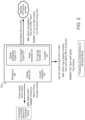
- FIG. 2 shows an example block-diagram of a device 200 configured to interact with multiple VPA service providers.
- the device 200 can include a headphone 102, a smart watch 103, a mobile device 105, or a remote controller 110.
- the device 200 includes one or more microphones 205 for capturing input speech and one or more acoustic transducers (e.g., speakers) for generating an acoustic output based on, for example, a response to the input speech data.
- the device 200 includes a display device 207 configured to present, for example, one or more user interfaces associated with accessing one of the multiple VPA service providers.
- the display device 207 can be configured to present a user-interface that includes a user-selectable menu of multiple VPA service providers.
- the display device 207 can also be configured to present a user-interface for receiving credentials (e.g., username-password pair) for using a particular VPA service provider.
- credentials e.g., username-password pair
- the device 200 may not include the display device 207.
- the input speech data captured by the microphone 205 can be processed by the device 200 in various ways.
- at least a portion of the input speech data may be processed locally at the device 200 to address one or more requests or queries included within the input speech data.
- the portion of the input speech data may be processed and/or addressed locally at the device 200 or at a connected device.
- the device 200 can be a mobile device to which an acoustic device (e.g., a headset) is connected.
- input speech data received through a microphone of the headset may be parsed at the mobile device (e.g., using an application executing on the mobile device), and at least a portion of the input speech data may be addressed/processed locally at the mobile device, for example, to control and/or provide information about the acoustic device.
- product based information and control include a query about the battery level of the acoustic device, and an instruction for altering a volume level or other playback control parameter of the acoustic device.
- a portion of the input speech data may request information and/or control pertaining to an application ecosystem.
- Examples of such information and control include a query on which applications are currently executing on a connected mobile device (or on the device 200 itself, for example, if the device 200 is capable of executing applications), a query on remaining battery power of the mobile device, or a request to perform a particular task on the mobile device (e.g., launch a particular application or provide particular information).
- the portion of the input speech data may also be processed and/or addressed locally, for example, either at the device 200 itself, or at a mobile device connected to the device 200 (e.g., in cases where the device 200 is an acoustic device such as a headset).
- such local processing of at least portions of input speech data may reduce an amount of data that is sent to a remote computing system (e.g., one or more computing devices associated with a cloud-based VPA service provider) and/or time required to address the corresponding portions of the request.
- a remote computing system e.g., one or more computing devices associated with a cloud-based VPA service provider
- time required to address the corresponding portions of the request For example, information about remaining battery life of the device 200 is available locally, and may be provided to a user without having to send the information to a VPA service provider and generate an output based on a response received from the VPA service provider.
- such local processing may reduce latency in providing information to a user, thereby potentially improving the overall user experience.
- the portion may be excluded from information sent to a VPA service provider. In some implementations, even if a portion of the input speech data is addressable locally, the portion is not excluded from the information sent to a VPA service provider. In such cases, if the response generated by the VPA service provider is received before the locally generated response, the former can be used for providing a corresponding output to the user. Such redundancy may be useful, for example, in leveraging superior processing power available from the VPA service provider (or in compensating for lack of adequate processing power available locally), and ensuring that a response is provided to the user as quickly as possible.
- the portion of the input speech data is used in generating one or more electronic files that are sent to a selected VPA service provider for processing.
- information and/or control can include information that may be available in remote databases (e.g., weather information, "How tall is the Eiffel Tower?" or "What time does the next 30B bus arrive at South Station?"), or instructions that may require communications with computing devices of a third-party service provider (e.g., "Turn on my lights outside," or "Set the bedroom thermostat to 75 degrees at 6:30 PM.”).
- the device 200 processes the input speech data to generate one or more electronic files based on at least a portion of the input speech data in accordance with specifications of the selected VPA service provider.
- the device 200 includes a controller 212 that processes the input speech data, for example, to determine whether at least a portion of the input speech data may be processed locally and accordingly generate the one or more electronic files to be transmitted to the selected VPA service provider.
- the controller 212 can include one or more processing devices (e.g., one or more microprocessors, microcontrollers, or digital signal processors) that may be used for implementing various modules of the controller 212.
- the controller can execute an application on the device 200 for implementing one or more modules.
- the controller 212 includes a speech recognition engine 215 that processes the input speech data to determine content of the input speech data.
- the output of the speech recognition engine can be used to determine, for example, which of the multiple VPA service providers have been selected by the user to process the requests within the input speech data.
- the output of the speech recognition engine 215 can be analyzed to monitor for one or more keywords indicative of the user's choice of a VPA service provider. If such keywords are detected, at least portions of the input speech data are prepared for routing to the selected VPA service provider. On the other hand, if no keywords are detected, relevant portions of the input speech data may be routed to a default VPA service provider (which may also be pre-selected by the user).
- the controller 212 can also include a packet generator 225 that generates data packets based on the portions of the input speech data to be transmitted to the selected VPA service provider. For example, if the controller determines that a portion of the input speech data may be addressed locally at the device 200, the packet generator 225 can be configured to omit the relevant portions from the data packets prepared for the selected VPA service provider. In some implementations, such portions may still be included in the data packets even if the portions are locally addressable at the device 200.
- the controller 212 further includes a VPA specific handler 230 that formats the information to be sent to the selected VPA in accordance with the specifications of the selected VPA. For example, if a particular VPA service provider requires an input in the form of a .wav file, the VPA specific handler 230 can be configured to generate such a wave file based on, for example, a portion of the input speech data determined to be sent to the particular VPA service provider. In another example, if a selected VPA service provider requires an input in the form of .txt files, the VPA specific handler 230 may coordinate with the speech recognition engine in creating such a file for the selected VPA service provider.
- the controller 212 can receive, responsive to local processing of a portion of the input speech data and/or transmitting a portion of the input speech data to a remote VPA service provider, one or more electronic files that represent a response to requests, queries etc. included within the input speech data.
- the received electronic files can be used for causing an acoustic transducer to generate an acoustic output. In some implementations, this may be facilitated by a text-to-speech (TTS) engine 220 configured to generate intelligible audio based on one or more electronic files that include the response (either locally generated, or received from a remote VPA service provider).
- TTS text-to-speech
- the received electronic files can be used for causing an output on a display associated with the device 200 or at a mobile device connected to the device 200.
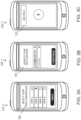
- FIGs. 3A-3C are example screenshots associated with configuring an acoustic device to interact with multiple VPA service providers.
- the screenshots shown in these figures may be presented, for example, on a display device 207 described above with reference to FIG. 2 .
- FIG. 3A shows a user-interface 305 that includes a user-selectable menu of multiple VPA service providers.
- the user-interface 305 can be used, for example, to set a default VPA service provider (e.g., the one to use when the user does not specify a VPA service provider in a spoken input) or to specify the VPA service provider to be used for all requests and queries.
- the user-interface 305 may also be used for configuring the various VPA service providers included in the user-selectable menu.
- a second user-interface 310 (as shown in FIG. 3B ) is presented on the display device for receiving credentials for using the particular VPA service provider. For example, if the user-selection indicates the selection of VPA 2 as a VPA service provider, the second user-interface 310 may display one or more text-boxes for receiving credentials (e.g., email/username and password pair) associated with an account set up for using the VPA 2.
- credentials e.g., email/username and password pair
- the credentials may be provided to the corresponding VPA service provider for authentication, and a communication channel with one or more computing devices associated with the corresponding VPA service provider is established upon authentication of the credentials.
- a third user-interface 315 (as shown in FIG. 3C ) for receiving speech input is presented upon the credentials being authenticated. While the examples in FIGS. 3A-3C depict a visual user interface for configuring one or more VPA service providers, in other implementations, a user could configure and establish connections to VPA service providers via a voice user interface and/or manually operable controls on a personal device (for example, on device 200 described above with reference to FIG. 2 ).
- FIG. 4 shows a flowchart for an example process 400 for interacting with a user-selected VPA service provider.
- the process 400 may be executed on a device such as the device 200 described above.
- the process 400 may be executed, at least in part, on a mobile device, a headphone, a remote controller or a smart watch.
- execution of the process 400 may be facilitated, at least in part, by an application executing on a mobile device.
- Operations of the process 400 include presenting, on a first device, a first user-interface that includes a user-selectable menu of multiple virtual personal assistant (VPA) service providers (410).
- the user-interface can be presented, for example, on a display device of the first device.
- the first device can be, for example, a mobile device, a headphone, a smart watch, or a remote controller.
- the first interface can be substantially similar to the user-interface 305 illustrated in FIG. 3A .
- Operations of the process 400 also include receiving a user-selection identifying a particular VPA service provider (420). The user selection can be received via a user-interface such as the user-interface 305, or as a spoken input.
- Operations of the process 400 also include receiving, at the first device, a first signal representing input speech data (430).
- the first signal representing input speech data can be captured using a microphone of an acoustic device (e.g., a headphone, a headset, an earphone, a portable speaker, or a hearing aid), or a smart watch.
- the input speech data may also be captured using the microphone of a remote controller that controls, for example, an acoustic device, a media streaming device, a home theater system, or a television.
- the input speech data may also be captured using the microphone of a mobile device such as a smartphone, tablet computer, or e-reader, or another computing device such as a laptop or desktop computer.
- Operations of the process 400 further include processing, using one or more processors of the first device, the first signal to generate a first electronic file that includes at least a portion of the input speech data, the first electronic file being generated in accordance with a specification of the particular VPA service provider (440).
- processing the first signal can include determining that a request included in the input speech data is locally addressable at the first device, and processing the request by the one or more processors of the first device.
- the locally addressable request may be excluded from the input speech data that is included in the first electronic file.
- the first electronic file can be generated in accordance with the specification of the particular VPA service, for example, as described above with reference to FIGs. 1 and 2 .
- Operations of the process 400 also include transmitting the first electronic file to one or more remote computing devices associated with the particular VPA service provider (450) and receiving a second electronic file including a response to the input speech data included in the first electronic file (460).
- the one or more remote computing devices can be ones that provide cloud-based services for the particular VPA service provider.
- the operations further include causing an acoustic transducer to generate an acoustic output based on the second electronic file (470).
- the acoustic transducers e.g., speakers
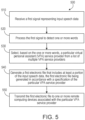
- FIG. 5 shows a flowchart for an example process 500 for selecting one of multiple VPA service providers based on detecting the presence of one or more words in a speech input.
- the process 500 may be executed on a device such as the device 200 described above.
- the process 500 may be executed, at least in part, on a mobile device, a headphone, a remote controller or a smart watch.
- execution of the process 500 may be facilitated, at least in part, by an application executing on a mobile device.
- Operations of the process 500 include receiving a first signal representing input speech data (510).
- the first signal representing input speech data can be captured using a microphone of an acoustic device (e.g., a headphone, a headset, an earphone, a portable speaker, or a hearing aid), or a smart watch.
- the input speech data may also be captured using the microphone of a remote controller that controls, for example, an acoustic device, a media streaming device, a home theater system, or a television.
- the input speech data may also be captured using the microphone of a mobile device such as a smartphone, tablet computer, or e-reader, or another computing device such as a laptop or desktop computer.
- Operations of the process 500 also include processing the first signal to detect one or more words in the input speech data (520).
- the one or more words can be keywords associated with various VPA service providers.
- the keywords can be words that are pre-determined by a particular VPA service provider to trigger that VPA service provider or the keywords can be words that the user has customized to be associated with a particular VPA service provider. In some implementations, this may be performed, for example, using the speech recognition engine 215 of the controller 212 described above with reference to FIG. 2 .
- Operations of the process 500 further include selecting, based on the one or more words detected in the input speech data, a particular virtual personal assistant (VPA) service provider from a list of multiple voice-activated virtual personal assistant (VPA) service providers (530).
- the controller 212 of a device 200 can be configured to detect that the one or more words include a set of one or more keywords associated with the particular VPA service provider, and in response, select the particular VPA service provider for addressing/routing at least a portion of the input speech data.
- a default VPA service provider may be selected to address at least a portion of the input speech data.
- Operations of the process 500 further include generating a first electronic file that includes at least a portion of the input speech data, the first electronic file being generated in accordance with a specification of the particular VPA service provider (540). In some implementations, this can include determining that a request included in the input speech data is locally addressable on the device executing the process 500, and processing the request by the one or more processors of the device. In some implementations, the locally addressable request may be excluded from the input speech data that is included in the first electronic file.
- the first electronic file can be generated in accordance with the specification of the particular VPA service, for example, as described above with reference to FIGs. 1 and 2 .
- Operations of the process 500 also include transmitting the first electronic file to one or more remote computing devices associated with the particular VPA service provider (550).
- the one or more remote computing devices can be ones that provide cloud-based services for the particular VPA service provider.
- the first electronic file may be transmitted via a communication channel established with the one or more remote computing devices. In case such a channel has not already been established, credentials for using the particular VPA service provider can be retrieved (e.g., from a storage location, or from a user via a user-interface as shown in FIG. 3B ), and provided to the particular VPA service provider.
- the communication channel can then be established in response to the credentials being authenticated by the VPA service provider.
- one or more electronic files may be received from the remote computing devices, such files including a response to the input speech data included in the first electronic file.
- An acoustic output can then be generated based, at least in part, on the second electronic file, via an acoustic transducer.
- the functionality described herein, or portions thereof, and its various modifications can be implemented, at least in part, via a computer program product, e.g., a computer program tangibly embodied in an information carrier, such as one or more non-transitory machine-readable media or storage device, for execution by, or to control the operation of, one or more data processing apparatus, e.g., a programmable processor, a computer, multiple computers, and/or programmable logic components.
- a computer program product e.g., a computer program tangibly embodied in an information carrier, such as one or more non-transitory machine-readable media or storage device, for execution by, or to control the operation of, one or more data processing apparatus, e.g., a programmable processor, a computer, multiple computers, and/or programmable logic components.
- a computer program can be written in any form of programming language, including compiled or interpreted languages, and it can be deployed in any form, including as a stand-alone program or as a module, component, subroutine, or other unit suitable for use in a computing environment.
- a computer program can be deployed to be executed on one computer or on multiple computers at one site or distributed across multiple sites and interconnected by a network.
- Actions associated with implementing all or part of the functions can be performed by one or more programmable processors executing one or more computer programs to perform the functions of the calibration process. All or part of the functions can be implemented as, special purpose logic circuitry, e.g., an FPGA and/or an ASIC (application-specific integrated circuit). In some implementations, at least a portion of the functions may also be executed on a floating point or fixed point digital signal processor (DSP) such as the Super Harvard Architecture Single-Chip Computer (SHARC) developed by Analog Devices Inc.
- DSP floating point or fixed point digital signal processor
- SHARC Super Harvard Architecture Single-Chip Computer
- processors suitable for the execution of a computer program include, by way of example, both general and special purpose microprocessors, and any one or more processors of any kind of digital computer.
- a processor will receive instructions and data from a read-only memory or a random access memory or both.
- Components of a computer include a processor for executing instructions and one or more memory devices for storing instructions and data.
- the technology described herein may be used for an automated selection of VPA service provider based on content of the input speech data. For example, a machine learning process may be used to determine that a user typically uses a first VPA service provider in asking for driving directions, and a second VPA service provider for online shopping.
- the request may automatically be routed to the second VPA even if the user has not explicitly specified the keywords for the second VPA.
- the user may specify, for example via a user-interface, different VPA service providers for different types of requests, and such preferences may be used for automatic routing of the input speech data to different VPA service providers.
- the machine learning process may be updated and refined based on user input in response to a particular VPA service provider being selected. For example, if the user indicates via a user interface that a different VPA service provider should have been selected for the particular request being processed, the machine learning process may take this information into account in processing future requests.
Landscapes
- Engineering & Computer Science (AREA)
- Human Computer Interaction (AREA)
- Physics & Mathematics (AREA)
- Acoustics & Sound (AREA)
- Audiology, Speech & Language Pathology (AREA)
- Health & Medical Sciences (AREA)
- Multimedia (AREA)
- Computational Linguistics (AREA)
- General Engineering & Computer Science (AREA)
- Theoretical Computer Science (AREA)
- General Physics & Mathematics (AREA)
- Telephonic Communication Services (AREA)
- User Interface Of Digital Computer (AREA)
- Selective Calling Equipment (AREA)
- Telephone Function (AREA)
Claims (11)
- Procédé pour accéder à de multiples assistants personnels virtuels, VPA, le procédé comprenant :la réception de premières données vocales d'entrée ;le traitement, en utilisant au moins un processeur, des premières données vocales d'entrée pour détecter un premier ensemble d'un ou plusieurs mots ;sur la base de la détection du premier ensemble d'un ou plusieurs mots, le routage d'un premier fichier électronique qui comporte au moins une partie des premières données vocales d'entrée vers un premier VPA présélectionné dans une liste de multiples VPA ;la réception de deuxièmes données vocales d'entrée ;le traitement, en utilisant l'au moins un processeur, des deuxièmes données vocales d'entrée pour détecter un deuxième ensemble d'un ou plusieurs mots ; etsur la base de la détection du deuxième ensemble d'un ou plusieurs mots, le routage d'un deuxième fichier électronique qui comporte au moins une partie des deuxièmes données vocales d'entrée vers un deuxième VPA présélectionné dans la liste de multiples VPA,caractérisé paravant la réception des premières données vocales d'entrée, la présentation de la liste de multiples VPA à un utilisateur pour la sélection du premier VPA et du deuxième VPA.
- Procédé selon la revendication 1, comprenant en outre :la réception d'un troisième fichier électronique comportant une réponse à l'au moins une partie des premières données vocales d'entrée comprises dans le premier fichier électronique ; etle fait d'amener un transducteur acoustique (210) à générer une sortie acoustique sur la base du troisième fichier électronique.
- Procédé selon la revendication 1, dans lequel le premier ensemble d'un ou plusieurs mots est associé au premier VPA.
- Procédé selon la revendication 1, dans lequel le premier ensemble d'un ou plusieurs mots n'est associé à aucun des fournisseurs de service de VPA dans la liste de multiples VPA, et dans lequel le premier fichier électronique est routé vers le premier VPA par défaut.
- Procédé selon la revendication 1, dans lequel le premier fichier électronique est routé vers le premier VPA sur la base du contenu d'au moins une partie des premières données vocales d'entrée.
- Procédé selon la revendication 1, dans lequel le premier ensemble d'un ou plusieurs mots peut être personnalisé par l'utilisateur.
- Procédé selon la revendication 1, comprenant en outre, avant la réception des premières données vocales d'entrée et des deuxièmes données vocales d'entrée, le fait d'attendre toujours le premier ensemble d'un ou plusieurs mots et le deuxième ensemble d'un ou plusieurs mots.
- Système (200) pour accéder à de multiples assistants personnels virtuels, VPA, le système comprenant :au moins un microphone (104 ; 205) ; etau moins un processeur configuré pourrecevoir des premières données vocales d'entrée capturées par l'au moins un microphone (104 ; 205),traiter les premières données vocales d'entrée pour détecter un premier ensemble d'un ou plusieurs mots,sur la base de la détection du premier ensemble d'un ou plusieurs mots, router un premier fichier électronique qui comporte au moins une partie des premières données vocales d'entrée vers un premier VPA présélectionné dans une liste de multiples VPA,recevoir des deuxièmes données vocales d'entrée capturées par l'au moins un microphone (104 ; 205),traiter les deuxièmes données vocales d'entrée pour détecter un deuxième ensemble d'un ou plusieurs mots, etsur la base de la détection du deuxième ensemble d'un ou plusieurs mots, router un deuxième fichier électronique qui comporte au moins une partie des deuxièmes données vocales d'entrée vers un deuxième VPA présélectionné dans la liste de multiples VPA,caractérisé parl'au moins un processeur est en outre configuré pour, avant la réception des premières données vocales d'entrée, présenter la liste de multiples VPA à un utilisateur pour la sélection du premier VPA et du deuxième VPA.
- Système selon la revendication 8, dans lequel l'au moins un processeur est en outre configuré pourrecevoir un troisième fichier électronique comportant une réponse à l'au moins une partie des premières données vocales d'entrée comprises dans le premier fichier électronique ; etamener un transducteur acoustique (210) à générer une sortie acoustique sur la base du troisième fichier électronique.
- Système selon la revendication 8, dans lequel le premier ensemble d'un ou plusieurs mots est associé au premier VPA.
- Système selon la revendication 8, dans lequel le premier ensemble d'un ou plusieurs mots n'est associé à aucun des fournisseurs de service de VPA dans la liste de multiples VPA, et dans lequel le premier fichier électronique est routé vers le premier VPA par défaut.
Applications Claiming Priority (3)
| Application Number | Priority Date | Filing Date | Title |
|---|---|---|---|
| US15/253,034 US10685656B2 (en) | 2016-08-31 | 2016-08-31 | Accessing multiple virtual personal assistants (VPA) from a single device |
| EP17765339.1A EP3507797B1 (fr) | 2016-08-31 | 2017-08-31 | Accès à de multiples assistants personnels virtuels (vpa) à partir d'un seul dispositif |
| PCT/US2017/049518 WO2018045119A1 (fr) | 2016-08-31 | 2017-08-31 | Accès à de multiples assistants personnels virtuels (vpa) à partir d'un seul dispositif |
Related Parent Applications (2)
| Application Number | Title | Priority Date | Filing Date |
|---|---|---|---|
| EP17765339.1A Division-Into EP3507797B1 (fr) | 2016-08-31 | 2017-08-31 | Accès à de multiples assistants personnels virtuels (vpa) à partir d'un seul dispositif |
| EP17765339.1A Division EP3507797B1 (fr) | 2016-08-31 | 2017-08-31 | Accès à de multiples assistants personnels virtuels (vpa) à partir d'un seul dispositif |
Publications (3)
| Publication Number | Publication Date |
|---|---|
| EP4231285A2 EP4231285A2 (fr) | 2023-08-23 |
| EP4231285A3 EP4231285A3 (fr) | 2023-11-08 |
| EP4231285B1 true EP4231285B1 (fr) | 2025-01-01 |
Family
ID=59856636
Family Applications (2)
| Application Number | Title | Priority Date | Filing Date |
|---|---|---|---|
| EP23185178.3A Active EP4231285B1 (fr) | 2016-08-31 | 2017-08-31 | Accès à de multiples assistants personnels virtuels (vpa) à partir d'un seul dispositif |
| EP17765339.1A Active EP3507797B1 (fr) | 2016-08-31 | 2017-08-31 | Accès à de multiples assistants personnels virtuels (vpa) à partir d'un seul dispositif |
Family Applications After (1)
| Application Number | Title | Priority Date | Filing Date |
|---|---|---|---|
| EP17765339.1A Active EP3507797B1 (fr) | 2016-08-31 | 2017-08-31 | Accès à de multiples assistants personnels virtuels (vpa) à partir d'un seul dispositif |
Country Status (5)
| Country | Link |
|---|---|
| US (4) | US10685656B2 (fr) |
| EP (2) | EP4231285B1 (fr) |
| JP (1) | JP6886022B2 (fr) |
| CN (3) | CN116758919A (fr) |
| WO (1) | WO2018045119A1 (fr) |
Families Citing this family (101)
| Publication number | Priority date | Publication date | Assignee | Title |
|---|---|---|---|---|
| US11313173B2 (en) * | 2019-05-14 | 2022-04-26 | Olibra Llc | Smart electric shades system, and its method of operation |
| US10095470B2 (en) | 2016-02-22 | 2018-10-09 | Sonos, Inc. | Audio response playback |
| US9947316B2 (en) | 2016-02-22 | 2018-04-17 | Sonos, Inc. | Voice control of a media playback system |
| US9820039B2 (en) | 2016-02-22 | 2017-11-14 | Sonos, Inc. | Default playback devices |
| US10264030B2 (en) | 2016-02-22 | 2019-04-16 | Sonos, Inc. | Networked microphone device control |
| US9965247B2 (en) | 2016-02-22 | 2018-05-08 | Sonos, Inc. | Voice controlled media playback system based on user profile |
| US10509626B2 (en) | 2016-02-22 | 2019-12-17 | Sonos, Inc | Handling of loss of pairing between networked devices |
| US9978390B2 (en) | 2016-06-09 | 2018-05-22 | Sonos, Inc. | Dynamic player selection for audio signal processing |
| US10152969B2 (en) | 2016-07-15 | 2018-12-11 | Sonos, Inc. | Voice detection by multiple devices |
| US10134399B2 (en) | 2016-07-15 | 2018-11-20 | Sonos, Inc. | Contextualization of voice inputs |
| US10115400B2 (en) | 2016-08-05 | 2018-10-30 | Sonos, Inc. | Multiple voice services |
| US10685656B2 (en) * | 2016-08-31 | 2020-06-16 | Bose Corporation | Accessing multiple virtual personal assistants (VPA) from a single device |
| US9942678B1 (en) | 2016-09-27 | 2018-04-10 | Sonos, Inc. | Audio playback settings for voice interaction |
| US9743204B1 (en) | 2016-09-30 | 2017-08-22 | Sonos, Inc. | Multi-orientation playback device microphones |
| US10181323B2 (en) | 2016-10-19 | 2019-01-15 | Sonos, Inc. | Arbitration-based voice recognition |
| WO2018174443A1 (fr) * | 2017-03-23 | 2018-09-27 | Samsung Electronics Co., Ltd. | Appareil électronique, procédé de commande associé et support d'enregistrement lisible par ordinateur non transitoire |
| US11183181B2 (en) | 2017-03-27 | 2021-11-23 | Sonos, Inc. | Systems and methods of multiple voice services |
| US10529327B1 (en) * | 2017-03-29 | 2020-01-07 | Parallels International Gmbh | System and method for enabling voice recognition for operating system |
| US10748531B2 (en) * | 2017-04-13 | 2020-08-18 | Harman International Industries, Incorporated | Management layer for multiple intelligent personal assistant services |
| US10503467B2 (en) * | 2017-07-13 | 2019-12-10 | International Business Machines Corporation | User interface sound emanation activity classification |
| CN109601017B (zh) | 2017-08-02 | 2024-05-03 | 松下知识产权经营株式会社 | 信息处理装置、声音识别系统及信息处理方法 |
| US10475449B2 (en) | 2017-08-07 | 2019-11-12 | Sonos, Inc. | Wake-word detection suppression |
| US10048930B1 (en) | 2017-09-08 | 2018-08-14 | Sonos, Inc. | Dynamic computation of system response volume |
| KR102489914B1 (ko) * | 2017-09-15 | 2023-01-20 | 삼성전자주식회사 | 전자 장치 및 이의 제어 방법 |
| WO2019054827A1 (fr) | 2017-09-15 | 2019-03-21 | 삼성전자주식회사 | Dispositif électronique et son procédé de commande |
| US10446165B2 (en) | 2017-09-27 | 2019-10-15 | Sonos, Inc. | Robust short-time fourier transform acoustic echo cancellation during audio playback |
| US10482868B2 (en) | 2017-09-28 | 2019-11-19 | Sonos, Inc. | Multi-channel acoustic echo cancellation |
| US10051366B1 (en) | 2017-09-28 | 2018-08-14 | Sonos, Inc. | Three-dimensional beam forming with a microphone array |
| US10621981B2 (en) | 2017-09-28 | 2020-04-14 | Sonos, Inc. | Tone interference cancellation |
| US10466962B2 (en) | 2017-09-29 | 2019-11-05 | Sonos, Inc. | Media playback system with voice assistance |
| JP2019086903A (ja) * | 2017-11-02 | 2019-06-06 | 東芝映像ソリューション株式会社 | 音声対話端末、および音声対話端末制御方法 |
| US10880650B2 (en) | 2017-12-10 | 2020-12-29 | Sonos, Inc. | Network microphone devices with automatic do not disturb actuation capabilities |
| US10818290B2 (en) | 2017-12-11 | 2020-10-27 | Sonos, Inc. | Home graph |
| US20190196779A1 (en) * | 2017-12-21 | 2019-06-27 | Harman International Industries, Incorporated | Intelligent personal assistant interface system |
| US11343614B2 (en) | 2018-01-31 | 2022-05-24 | Sonos, Inc. | Device designation of playback and network microphone device arrangements |
| US11030412B2 (en) * | 2018-04-10 | 2021-06-08 | Verizon Patent And Licensing Inc. | System and method for chatbot conversation construction and management |
| US11175880B2 (en) | 2018-05-10 | 2021-11-16 | Sonos, Inc. | Systems and methods for voice-assisted media content selection |
| US10847178B2 (en) | 2018-05-18 | 2020-11-24 | Sonos, Inc. | Linear filtering for noise-suppressed speech detection |
| US10959029B2 (en) | 2018-05-25 | 2021-03-23 | Sonos, Inc. | Determining and adapting to changes in microphone performance of playback devices |
| US10235999B1 (en) | 2018-06-05 | 2019-03-19 | Voicify, LLC | Voice application platform |
| US10803865B2 (en) * | 2018-06-05 | 2020-10-13 | Voicify, LLC | Voice application platform |
| US10636425B2 (en) | 2018-06-05 | 2020-04-28 | Voicify, LLC | Voice application platform |
| US10681460B2 (en) | 2018-06-28 | 2020-06-09 | Sonos, Inc. | Systems and methods for associating playback devices with voice assistant services |
| JP2020004192A (ja) * | 2018-06-29 | 2020-01-09 | 株式会社フュートレック | 通信装置および通信装置を備える音声認識端末装置 |
| WO2020040753A1 (fr) * | 2018-08-21 | 2020-02-27 | Google Llc | Invocation d'assistant automatisée d'un second module interactif à l'aide de données supplémentaires fournies par un premier module interactif |
| US10461710B1 (en) | 2018-08-28 | 2019-10-29 | Sonos, Inc. | Media playback system with maximum volume setting |
| US11076035B2 (en) | 2018-08-28 | 2021-07-27 | Sonos, Inc. | Do not disturb feature for audio notifications |
| US10587430B1 (en) | 2018-09-14 | 2020-03-10 | Sonos, Inc. | Networked devices, systems, and methods for associating playback devices based on sound codes |
| US10878811B2 (en) | 2018-09-14 | 2020-12-29 | Sonos, Inc. | Networked devices, systems, and methods for intelligently deactivating wake-word engines |
| US11024331B2 (en) | 2018-09-21 | 2021-06-01 | Sonos, Inc. | Voice detection optimization using sound metadata |
| US10811015B2 (en) | 2018-09-25 | 2020-10-20 | Sonos, Inc. | Voice detection optimization based on selected voice assistant service |
| US11100923B2 (en) | 2018-09-28 | 2021-08-24 | Sonos, Inc. | Systems and methods for selective wake word detection using neural network models |
| US10692518B2 (en) | 2018-09-29 | 2020-06-23 | Sonos, Inc. | Linear filtering for noise-suppressed speech detection via multiple network microphone devices |
| KR20200044175A (ko) | 2018-10-05 | 2020-04-29 | 삼성전자주식회사 | 전자 장치 및 그의 비서 서비스 제공 방법 |
| US11899519B2 (en) | 2018-10-23 | 2024-02-13 | Sonos, Inc. | Multiple stage network microphone device with reduced power consumption and processing load |
| US10908883B2 (en) * | 2018-11-13 | 2021-02-02 | Adobe Inc. | Voice interaction development tool |
| EP3654249A1 (fr) | 2018-11-15 | 2020-05-20 | Snips | Convolutions dilatées et déclenchement efficace de mot-clé |
| US10847156B2 (en) | 2018-11-28 | 2020-11-24 | Adobe Inc. | Assembled voice interaction |
| US11183183B2 (en) | 2018-12-07 | 2021-11-23 | Sonos, Inc. | Systems and methods of operating media playback systems having multiple voice assistant services |
| US11132989B2 (en) | 2018-12-13 | 2021-09-28 | Sonos, Inc. | Networked microphone devices, systems, and methods of localized arbitration |
| US10602268B1 (en) | 2018-12-20 | 2020-03-24 | Sonos, Inc. | Optimization of network microphone devices using noise classification |
| US11037559B2 (en) | 2018-12-27 | 2021-06-15 | At&T Intellectual Property I, L.P. | Voice gateway for federated voice services |
| CN109949801A (zh) * | 2019-01-10 | 2019-06-28 | 百度在线网络技术(北京)有限公司 | 一种基于耳机的智能家居设备语音控制方法及系统 |
| US11017771B2 (en) | 2019-01-18 | 2021-05-25 | Adobe Inc. | Voice command matching during testing of voice-assisted application prototypes for languages with non-phonetic alphabets |
| US10964322B2 (en) | 2019-01-23 | 2021-03-30 | Adobe Inc. | Voice interaction tool for voice-assisted application prototypes |
| US10867604B2 (en) | 2019-02-08 | 2020-12-15 | Sonos, Inc. | Devices, systems, and methods for distributed voice processing |
| US11315556B2 (en) | 2019-02-08 | 2022-04-26 | Sonos, Inc. | Devices, systems, and methods for distributed voice processing by transmitting sound data associated with a wake word to an appropriate device for identification |
| US10978069B1 (en) * | 2019-03-18 | 2021-04-13 | Amazon Technologies, Inc. | Word selection for natural language interface |
| TWI718513B (zh) * | 2019-03-29 | 2021-02-11 | 群光電子股份有限公司 | 電子裝置與語音辨識切換方法 |
| US11120794B2 (en) | 2019-05-03 | 2021-09-14 | Sonos, Inc. | Voice assistant persistence across multiple network microphone devices |
| KR20200141687A (ko) * | 2019-06-11 | 2020-12-21 | 주식회사 오투오 | 음성 인식 액세서리를 이용한 서비스 제공 시스템 및 방법 |
| US11200894B2 (en) | 2019-06-12 | 2021-12-14 | Sonos, Inc. | Network microphone device with command keyword eventing |
| US10586540B1 (en) | 2019-06-12 | 2020-03-10 | Sonos, Inc. | Network microphone device with command keyword conditioning |
| US11361756B2 (en) | 2019-06-12 | 2022-06-14 | Sonos, Inc. | Conditional wake word eventing based on environment |
| CN110544475B (zh) * | 2019-07-08 | 2022-03-11 | 三星电子(中国)研发中心 | 一种多语音助手的实现方法 |
| KR102735642B1 (ko) | 2019-07-19 | 2024-11-29 | 구글 엘엘씨 | 복잡한 애플리케이션 gui의 자동화 어시스턴트를 제어하기 위한 축약된 음성 발언 |
| US11138969B2 (en) | 2019-07-31 | 2021-10-05 | Sonos, Inc. | Locally distributed keyword detection |
| US11138975B2 (en) | 2019-07-31 | 2021-10-05 | Sonos, Inc. | Locally distributed keyword detection |
| US10871943B1 (en) | 2019-07-31 | 2020-12-22 | Sonos, Inc. | Noise classification for event detection |
| US11189286B2 (en) | 2019-10-22 | 2021-11-30 | Sonos, Inc. | VAS toggle based on device orientation |
| EP4013085B1 (fr) | 2019-12-09 | 2025-10-01 | Google LLC | Dispositif relais pour des commandes vocales à traiter par un assistant vocal, assistant vocal et réseau sans fil |
| US11200900B2 (en) | 2019-12-20 | 2021-12-14 | Sonos, Inc. | Offline voice control |
| US11562740B2 (en) | 2020-01-07 | 2023-01-24 | Sonos, Inc. | Voice verification for media playback |
| US11026177B1 (en) * | 2020-01-23 | 2021-06-01 | Amazon Technologies, Inc. | Reducing battery consumption for portable devices with microphones |
| US11556307B2 (en) | 2020-01-31 | 2023-01-17 | Sonos, Inc. | Local voice data processing |
| US11308958B2 (en) | 2020-02-07 | 2022-04-19 | Sonos, Inc. | Localized wakeword verification |
| CN111488090A (zh) * | 2020-04-13 | 2020-08-04 | 北京市商汤科技开发有限公司 | 交互方法、装置、交互系统、电子设备及存储介质 |
| US11727919B2 (en) | 2020-05-20 | 2023-08-15 | Sonos, Inc. | Memory allocation for keyword spotting engines |
| US11308962B2 (en) | 2020-05-20 | 2022-04-19 | Sonos, Inc. | Input detection windowing |
| US11482224B2 (en) | 2020-05-20 | 2022-10-25 | Sonos, Inc. | Command keywords with input detection windowing |
| US12387716B2 (en) | 2020-06-08 | 2025-08-12 | Sonos, Inc. | Wakewordless voice quickstarts |
| US11698771B2 (en) | 2020-08-25 | 2023-07-11 | Sonos, Inc. | Vocal guidance engines for playback devices |
| US12283269B2 (en) | 2020-10-16 | 2025-04-22 | Sonos, Inc. | Intent inference in audiovisual communication sessions |
| US11984123B2 (en) | 2020-11-12 | 2024-05-14 | Sonos, Inc. | Network device interaction by range |
| US11551700B2 (en) | 2021-01-25 | 2023-01-10 | Sonos, Inc. | Systems and methods for power-efficient keyword detection |
| EP4409571B1 (fr) | 2021-09-30 | 2025-03-26 | Sonos Inc. | Gestion de conflit pour processus de détection de mot d'activation |
| CN118303040A (zh) | 2021-09-30 | 2024-07-05 | 搜诺思公司 | 启用和禁用麦克风和语音助手 |
| US12327549B2 (en) | 2022-02-09 | 2025-06-10 | Sonos, Inc. | Gatekeeping for voice intent processing |
| US12597425B1 (en) * | 2022-09-30 | 2026-04-07 | Amazon Technologies, Inc. | Data routing in a multi-assistant context |
| US12444422B2 (en) | 2022-12-28 | 2025-10-14 | Spotify Ab | Method and system for selecting a voice assistant |
| US12488787B2 (en) | 2022-12-28 | 2025-12-02 | Spotify Ab | System for processing voice requests including wake word verification |
Family Cites Families (42)
| Publication number | Priority date | Publication date | Assignee | Title |
|---|---|---|---|---|
| US7016847B1 (en) * | 2000-12-08 | 2006-03-21 | Ben Franklin Patent Holdings L.L.C. | Open architecture for a voice user interface |
| EP1661124A4 (fr) * | 2003-09-05 | 2008-08-13 | Stephen D Grody | Procedes et appareil de prestation de services utilisant la reconnaissance vocale |
| US20070291299A1 (en) * | 2006-06-14 | 2007-12-20 | Kabushiki Kaisha Toshiba | System and method for generating location based content |
| US8032383B1 (en) * | 2007-05-04 | 2011-10-04 | Foneweb, Inc. | Speech controlled services and devices using internet |
| BRPI0810285A2 (pt) | 2007-05-18 | 2014-12-30 | Shorthand Mobile Inc | "sistema e processo para comunicações aperfeiçoadas via sistemas de comunicação de pequena taxa de dados" |
| US9386154B2 (en) * | 2007-12-21 | 2016-07-05 | Nuance Communications, Inc. | System, method and software program for enabling communications between customer service agents and users of communication devices |
| US20090248397A1 (en) * | 2008-03-25 | 2009-10-01 | Microsoft Corporation | Service Initiation Techniques |
| US9146651B1 (en) * | 2009-07-14 | 2015-09-29 | Sprint Communications Company L.P. | Displaying multiple applications on limited capability devices |
| US20110184740A1 (en) * | 2010-01-26 | 2011-07-28 | Google Inc. | Integration of Embedded and Network Speech Recognizers |
| US9159322B2 (en) * | 2011-10-18 | 2015-10-13 | GM Global Technology Operations LLC | Services identification and initiation for a speech-based interface to a mobile device |
| US9326088B2 (en) * | 2011-10-21 | 2016-04-26 | GM Global Technology Operations LLC | Mobile voice platform architecture with remote service interfaces |
| US9361878B2 (en) * | 2012-03-30 | 2016-06-07 | Michael Boukadakis | Computer-readable medium, system and method of providing domain-specific information |
| US9171092B2 (en) | 2012-12-07 | 2015-10-27 | Empire Technology Development Llc | Personal assistant context building |
| US9172747B2 (en) | 2013-02-25 | 2015-10-27 | Artificial Solutions Iberia SL | System and methods for virtual assistant networks |
| TWI533686B (zh) | 2013-03-11 | 2016-05-11 | 緯創資通股份有限公司 | 虛擬頻道之管理方法、具有虛擬頻道之網路多媒體重現系統和電腦可讀取記錄媒體 |
| US9875494B2 (en) | 2013-04-16 | 2018-01-23 | Sri International | Using intents to analyze and personalize a user's dialog experience with a virtual personal assistant |
| US9081411B2 (en) * | 2013-05-10 | 2015-07-14 | Sri International | Rapid development of virtual personal assistant applications |
| CN109584868B (zh) * | 2013-05-20 | 2022-12-13 | 英特尔公司 | 用于虚拟个人助理系统的自然人-计算机交互 |
| US20140357248A1 (en) | 2013-06-03 | 2014-12-04 | Ford Global Technologies, Llc | Apparatus and System for Interacting with a Vehicle and a Device in a Vehicle |
| WO2014197335A1 (fr) * | 2013-06-08 | 2014-12-11 | Apple Inc. | Interprétation et action sur des commandes qui impliquent un partage d'informations avec des dispositifs distants |
| US20150019201A1 (en) | 2013-07-09 | 2015-01-15 | Stanley F. Schoenbach | Real-time interpreting systems and methods |
| US9666187B1 (en) | 2013-07-25 | 2017-05-30 | Google Inc. | Model for enabling service providers to address voice-activated commands |
| WO2015030796A1 (fr) * | 2013-08-30 | 2015-03-05 | Intel Corporation | Interactions de langage naturel extensibles, sensibles au contexte pour des assistants personnels virtuels |
| US10534623B2 (en) * | 2013-12-16 | 2020-01-14 | Nuance Communications, Inc. | Systems and methods for providing a virtual assistant |
| US9547468B2 (en) | 2014-03-31 | 2017-01-17 | Microsoft Technology Licensing, Llc | Client-side personal voice web navigation |
| US9966065B2 (en) | 2014-05-30 | 2018-05-08 | Apple Inc. | Multi-command single utterance input method |
| US10152987B2 (en) | 2014-06-23 | 2018-12-11 | Google Llc | Remote invocation of mobile device actions |
| US9338493B2 (en) * | 2014-06-30 | 2016-05-10 | Apple Inc. | Intelligent automated assistant for TV user interactions |
| JP6671379B2 (ja) * | 2014-10-01 | 2020-03-25 | エクスブレイン・インコーポレーテッド | 音声および接続プラットフォーム |
| US20160162469A1 (en) * | 2014-10-23 | 2016-06-09 | Audience, Inc. | Dynamic Local ASR Vocabulary |
| US10192549B2 (en) | 2014-11-28 | 2019-01-29 | Microsoft Technology Licensing, Llc | Extending digital personal assistant action providers |
| CN107209549B (zh) | 2014-12-11 | 2020-04-17 | 微软技术许可有限责任公司 | 能够实现可动作的消息传送的虚拟助理系统 |
| US10572810B2 (en) | 2015-01-07 | 2020-02-25 | Microsoft Technology Licensing, Llc | Managing user interaction for input understanding determinations |
| US9934406B2 (en) | 2015-01-08 | 2018-04-03 | Microsoft Technology Licensing, Llc | Protecting private information in input understanding system |
| GB2535766B (en) * | 2015-02-27 | 2019-06-12 | Imagination Tech Ltd | Low power detection of an activation phrase |
| US20160373909A1 (en) | 2015-06-17 | 2016-12-22 | Hive Life, LLC | Wireless audio, security communication and home automation |
| US9978366B2 (en) | 2015-10-09 | 2018-05-22 | Xappmedia, Inc. | Event-based speech interactive media player |
| US10453450B2 (en) | 2015-10-20 | 2019-10-22 | Bragi GmbH | Wearable earpiece voice command control system and method |
| US9990209B2 (en) | 2015-11-12 | 2018-06-05 | Microsoft Technology Licensing, Llc | Digital assistance device for facilitating multi-stage setup |
| US9965247B2 (en) | 2016-02-22 | 2018-05-08 | Sonos, Inc. | Voice controlled media playback system based on user profile |
| US10115400B2 (en) | 2016-08-05 | 2018-10-30 | Sonos, Inc. | Multiple voice services |
| US10685656B2 (en) * | 2016-08-31 | 2020-06-16 | Bose Corporation | Accessing multiple virtual personal assistants (VPA) from a single device |
-
2016
- 2016-08-31 US US15/253,034 patent/US10685656B2/en active Active
- 2016-10-13 US US15/292,857 patent/US10186270B2/en active Active
-
2017
- 2017-08-31 WO PCT/US2017/049518 patent/WO2018045119A1/fr not_active Ceased
- 2017-08-31 CN CN202310923331.1A patent/CN116758919A/zh active Pending
- 2017-08-31 EP EP23185178.3A patent/EP4231285B1/fr active Active
- 2017-08-31 CN CN202310923686.0A patent/CN116758920A/zh active Pending
- 2017-08-31 CN CN201780063587.2A patent/CN109844856B/zh active Active
- 2017-08-31 JP JP2019531603A patent/JP6886022B2/ja active Active
- 2017-08-31 EP EP17765339.1A patent/EP3507797B1/fr active Active
-
2020
- 2020-06-15 US US16/901,743 patent/US11250859B2/en active Active
-
2022
- 2022-01-31 US US17/589,820 patent/US12223964B2/en active Active
Also Published As
| Publication number | Publication date |
|---|---|
| EP3507797B1 (fr) | 2023-12-27 |
| US20180061420A1 (en) | 2018-03-01 |
| EP4231285A3 (fr) | 2023-11-08 |
| CN109844856A (zh) | 2019-06-04 |
| CN116758919A (zh) | 2023-09-15 |
| US10685656B2 (en) | 2020-06-16 |
| US12223964B2 (en) | 2025-02-11 |
| EP4231285A2 (fr) | 2023-08-23 |
| US10186270B2 (en) | 2019-01-22 |
| WO2018045119A1 (fr) | 2018-03-08 |
| CN109844856B (zh) | 2023-07-28 |
| US20180061418A1 (en) | 2018-03-01 |
| US20220157319A1 (en) | 2022-05-19 |
| CN116758920A (zh) | 2023-09-15 |
| JP6886022B2 (ja) | 2021-06-16 |
| US20200312330A1 (en) | 2020-10-01 |
| JP2019534522A (ja) | 2019-11-28 |
| EP3507797A1 (fr) | 2019-07-10 |
| US11250859B2 (en) | 2022-02-15 |
Similar Documents
| Publication | Publication Date | Title |
|---|---|---|
| US12223964B2 (en) | Accessing multiple virtual personal assistants (VPA) from a single device | |
| US10115396B2 (en) | Content streaming system | |
| KR102091003B1 (ko) | 음성인식 기술을 이용한 상황 인식 서비스 제공 방법 및 장치 | |
| US10055190B2 (en) | Attribute-based audio channel arbitration | |
| EP3663905B1 (fr) | Dispositif de traitement d'informations, système de reconnaissance vocale et procédé de traitement d'informations | |
| US20250254485A1 (en) | Spatial Audio for Device Assistants | |
| US12041438B2 (en) | Location based audio signal message processing | |
| WO2019173577A9 (fr) | Moteur de contenu audio pour réalité augmentée audio | |
| EP3320673A1 (fr) | Réveil pour diffuser une alarme ou une alarme plus une invite de contenu | |
| KR20170043319A (ko) | 전자 장치 및 전자 장치의 오디오 출력 방법 | |
| KR102161554B1 (ko) | 이어셋을 이용한 통역기능 제공 방법 및 장치 | |
| CN106134166B (zh) | 语音接口的语言的自动选择 | |
| KR102204488B1 (ko) | 통신 장치 | |
| KR20200112791A (ko) | 이어셋을 이용한 통역기능 제공 방법 및 장치 | |
| WO2020072585A1 (fr) | Redirection audio bluetooth de dispositif intelligent |
Legal Events
| Date | Code | Title | Description |
|---|---|---|---|
| PUAI | Public reference made under article 153(3) epc to a published international application that has entered the european phase |
Free format text: ORIGINAL CODE: 0009012 |
|
| STAA | Information on the status of an ep patent application or granted ep patent |
Free format text: STATUS: REQUEST FOR EXAMINATION WAS MADE |
|
| 17P | Request for examination filed |
Effective date: 20230713 |
|
| AC | Divisional application: reference to earlier application |
Ref document number: 3507797 Country of ref document: EP Kind code of ref document: P |
|
| AK | Designated contracting states |
Kind code of ref document: A2 Designated state(s): AL AT BE BG CH CY CZ DE DK EE ES FI FR GB GR HR HU IE IS IT LI LT LU LV MC MK MT NL NO PL PT RO RS SE SI SK SM TR |
|
| REG | Reference to a national code |
Ref country code: DE Ref legal event code: R079 Free format text: PREVIOUS MAIN CLASS: G10L0015300000 Ipc: G10L0015220000 Ref country code: DE Ref legal event code: R079 Ref document number: 602017087200 Country of ref document: DE Free format text: PREVIOUS MAIN CLASS: G10L0015300000 Ipc: G10L0015220000 |
|
| PUAL | Search report despatched |
Free format text: ORIGINAL CODE: 0009013 |
|
| AK | Designated contracting states |
Kind code of ref document: A3 Designated state(s): AL AT BE BG CH CY CZ DE DK EE ES FI FR GB GR HR HU IE IS IT LI LT LU LV MC MK MT NL NO PL PT RO RS SE SI SK SM TR |
|
| RIC1 | Information provided on ipc code assigned before grant |
Ipc: G10L 15/30 20130101ALI20231004BHEP Ipc: G10L 15/28 20130101ALI20231004BHEP Ipc: G10L 15/22 20060101AFI20231004BHEP |
|
| GRAP | Despatch of communication of intention to grant a patent |
Free format text: ORIGINAL CODE: EPIDOSNIGR1 |
|
| STAA | Information on the status of an ep patent application or granted ep patent |
Free format text: STATUS: GRANT OF PATENT IS INTENDED |
|
| INTG | Intention to grant announced |
Effective date: 20240904 |
|
| GRAS | Grant fee paid |
Free format text: ORIGINAL CODE: EPIDOSNIGR3 |
|
| GRAA | (expected) grant |
Free format text: ORIGINAL CODE: 0009210 |
|
| STAA | Information on the status of an ep patent application or granted ep patent |
Free format text: STATUS: THE PATENT HAS BEEN GRANTED |
|
| AC | Divisional application: reference to earlier application |
Ref document number: 3507797 Country of ref document: EP Kind code of ref document: P |
|
| AK | Designated contracting states |
Kind code of ref document: B1 Designated state(s): AL AT BE BG CH CY CZ DE DK EE ES FI FR GB GR HR HU IE IS IT LI LT LU LV MC MK MT NL NO PL PT RO RS SE SI SK SM TR |
|
| REG | Reference to a national code |
Ref country code: GB Ref legal event code: FG4D |
|
| REG | Reference to a national code |
Ref country code: DE Ref legal event code: R096 Ref document number: 602017087200 Country of ref document: DE |
|
| REG | Reference to a national code |
Ref country code: CH Ref legal event code: EP |
|
| REG | Reference to a national code |
Ref country code: IE Ref legal event code: FG4D |
|
| REG | Reference to a national code |
Ref country code: LT Ref legal event code: MG9D |
|
| REG | Reference to a national code |
Ref country code: NL Ref legal event code: MP Effective date: 20250101 |
|
| REG | Reference to a national code |
Ref country code: AT Ref legal event code: MK05 Ref document number: 1757134 Country of ref document: AT Kind code of ref document: T Effective date: 20250101 |
|
| PG25 | Lapsed in a contracting state [announced via postgrant information from national office to epo] |
Ref country code: NL Free format text: LAPSE BECAUSE OF FAILURE TO SUBMIT A TRANSLATION OF THE DESCRIPTION OR TO PAY THE FEE WITHIN THE PRESCRIBED TIME-LIMIT Effective date: 20250101 |
|
| PG25 | Lapsed in a contracting state [announced via postgrant information from national office to epo] |
Ref country code: FI Free format text: LAPSE BECAUSE OF FAILURE TO SUBMIT A TRANSLATION OF THE DESCRIPTION OR TO PAY THE FEE WITHIN THE PRESCRIBED TIME-LIMIT Effective date: 20250101 |
|
| PG25 | Lapsed in a contracting state [announced via postgrant information from national office to epo] |
Ref country code: PL Free format text: LAPSE BECAUSE OF FAILURE TO SUBMIT A TRANSLATION OF THE DESCRIPTION OR TO PAY THE FEE WITHIN THE PRESCRIBED TIME-LIMIT Effective date: 20250101 |
|
| PG25 | Lapsed in a contracting state [announced via postgrant information from national office to epo] |
Ref country code: ES Free format text: LAPSE BECAUSE OF FAILURE TO SUBMIT A TRANSLATION OF THE DESCRIPTION OR TO PAY THE FEE WITHIN THE PRESCRIBED TIME-LIMIT Effective date: 20250101 |
|
| PG25 | Lapsed in a contracting state [announced via postgrant information from national office to epo] |
Ref country code: IS Free format text: LAPSE BECAUSE OF FAILURE TO SUBMIT A TRANSLATION OF THE DESCRIPTION OR TO PAY THE FEE WITHIN THE PRESCRIBED TIME-LIMIT Effective date: 20250501 Ref country code: NO Free format text: LAPSE BECAUSE OF FAILURE TO SUBMIT A TRANSLATION OF THE DESCRIPTION OR TO PAY THE FEE WITHIN THE PRESCRIBED TIME-LIMIT Effective date: 20250401 |
|
| PG25 | Lapsed in a contracting state [announced via postgrant information from national office to epo] |
Ref country code: HR Free format text: LAPSE BECAUSE OF FAILURE TO SUBMIT A TRANSLATION OF THE DESCRIPTION OR TO PAY THE FEE WITHIN THE PRESCRIBED TIME-LIMIT Effective date: 20250101 |
|
| PG25 | Lapsed in a contracting state [announced via postgrant information from national office to epo] |
Ref country code: PT Free format text: LAPSE BECAUSE OF FAILURE TO SUBMIT A TRANSLATION OF THE DESCRIPTION OR TO PAY THE FEE WITHIN THE PRESCRIBED TIME-LIMIT Effective date: 20250502 Ref country code: LV Free format text: LAPSE BECAUSE OF FAILURE TO SUBMIT A TRANSLATION OF THE DESCRIPTION OR TO PAY THE FEE WITHIN THE PRESCRIBED TIME-LIMIT Effective date: 20250101 |
|
| PG25 | Lapsed in a contracting state [announced via postgrant information from national office to epo] |
Ref country code: BG Free format text: LAPSE BECAUSE OF FAILURE TO SUBMIT A TRANSLATION OF THE DESCRIPTION OR TO PAY THE FEE WITHIN THE PRESCRIBED TIME-LIMIT Effective date: 20250101 Ref country code: GR Free format text: LAPSE BECAUSE OF FAILURE TO SUBMIT A TRANSLATION OF THE DESCRIPTION OR TO PAY THE FEE WITHIN THE PRESCRIBED TIME-LIMIT Effective date: 20250402 |
|
| PG25 | Lapsed in a contracting state [announced via postgrant information from national office to epo] |
Ref country code: AT Free format text: LAPSE BECAUSE OF FAILURE TO SUBMIT A TRANSLATION OF THE DESCRIPTION OR TO PAY THE FEE WITHIN THE PRESCRIBED TIME-LIMIT Effective date: 20250101 |
|
| PG25 | Lapsed in a contracting state [announced via postgrant information from national office to epo] |
Ref country code: CZ Free format text: LAPSE BECAUSE OF FAILURE TO SUBMIT A TRANSLATION OF THE DESCRIPTION OR TO PAY THE FEE WITHIN THE PRESCRIBED TIME-LIMIT Effective date: 20250101 |
|
| PG25 | Lapsed in a contracting state [announced via postgrant information from national office to epo] |
Ref country code: SE Free format text: LAPSE BECAUSE OF FAILURE TO SUBMIT A TRANSLATION OF THE DESCRIPTION OR TO PAY THE FEE WITHIN THE PRESCRIBED TIME-LIMIT Effective date: 20250101 |
|
| REG | Reference to a national code |
Ref country code: DE Ref legal event code: R097 Ref document number: 602017087200 Country of ref document: DE |
|
| PG25 | Lapsed in a contracting state [announced via postgrant information from national office to epo] |
Ref country code: SM Free format text: LAPSE BECAUSE OF FAILURE TO SUBMIT A TRANSLATION OF THE DESCRIPTION OR TO PAY THE FEE WITHIN THE PRESCRIBED TIME-LIMIT Effective date: 20250101 |
|
| PG25 | Lapsed in a contracting state [announced via postgrant information from national office to epo] |
Ref country code: DK Free format text: LAPSE BECAUSE OF FAILURE TO SUBMIT A TRANSLATION OF THE DESCRIPTION OR TO PAY THE FEE WITHIN THE PRESCRIBED TIME-LIMIT Effective date: 20250101 |
|
| PGFP | Annual fee paid to national office [announced via postgrant information from national office to epo] |
Ref country code: DE Payment date: 20250724 Year of fee payment: 9 |
|
| PG25 | Lapsed in a contracting state [announced via postgrant information from national office to epo] |
Ref country code: IT Free format text: LAPSE BECAUSE OF FAILURE TO SUBMIT A TRANSLATION OF THE DESCRIPTION OR TO PAY THE FEE WITHIN THE PRESCRIBED TIME-LIMIT Effective date: 20250101 |
|
| PGFP | Annual fee paid to national office [announced via postgrant information from national office to epo] |
Ref country code: GB Payment date: 20250725 Year of fee payment: 9 |
|
| PGFP | Annual fee paid to national office [announced via postgrant information from national office to epo] |
Ref country code: FR Payment date: 20250725 Year of fee payment: 9 |
|
| PG25 | Lapsed in a contracting state [announced via postgrant information from national office to epo] |
Ref country code: EE Free format text: LAPSE BECAUSE OF FAILURE TO SUBMIT A TRANSLATION OF THE DESCRIPTION OR TO PAY THE FEE WITHIN THE PRESCRIBED TIME-LIMIT Effective date: 20250101 |
|
| PG25 | Lapsed in a contracting state [announced via postgrant information from national office to epo] |
Ref country code: RO Free format text: LAPSE BECAUSE OF FAILURE TO SUBMIT A TRANSLATION OF THE DESCRIPTION OR TO PAY THE FEE WITHIN THE PRESCRIBED TIME-LIMIT Effective date: 20250101 |
|
| PG25 | Lapsed in a contracting state [announced via postgrant information from national office to epo] |
Ref country code: SK Free format text: LAPSE BECAUSE OF FAILURE TO SUBMIT A TRANSLATION OF THE DESCRIPTION OR TO PAY THE FEE WITHIN THE PRESCRIBED TIME-LIMIT Effective date: 20250101 |
|
| PLBE | No opposition filed within time limit |
Free format text: ORIGINAL CODE: 0009261 |
|
| STAA | Information on the status of an ep patent application or granted ep patent |
Free format text: STATUS: NO OPPOSITION FILED WITHIN TIME LIMIT |
|
| REG | Reference to a national code |
Ref country code: CH Ref legal event code: L10 Free format text: ST27 STATUS EVENT CODE: U-0-0-L10-L00 (AS PROVIDED BY THE NATIONAL OFFICE) Effective date: 20251112 |
|
| 26N | No opposition filed |
Effective date: 20251002 |
|
| REG | Reference to a national code |
Ref country code: CH Ref legal event code: H13 Free format text: ST27 STATUS EVENT CODE: U-0-0-H10-H13 (AS PROVIDED BY THE NATIONAL OFFICE) Effective date: 20260324 |
|
| PG25 | Lapsed in a contracting state [announced via postgrant information from national office to epo] |
Ref country code: MC Free format text: LAPSE BECAUSE OF FAILURE TO SUBMIT A TRANSLATION OF THE DESCRIPTION OR TO PAY THE FEE WITHIN THE PRESCRIBED TIME-LIMIT Effective date: 20250101 |
|
| PG25 | Lapsed in a contracting state [announced via postgrant information from national office to epo] |
Ref country code: LU Free format text: LAPSE BECAUSE OF NON-PAYMENT OF DUE FEES Effective date: 20250831 |
|
| PG25 | Lapsed in a contracting state [announced via postgrant information from national office to epo] |
Ref country code: CH Free format text: LAPSE BECAUSE OF NON-PAYMENT OF DUE FEES Effective date: 20250831 |