EP4232109B1 - Encres pour jet d'encre à séchage rapide à décapsulage prolongé - Google Patents
Encres pour jet d'encre à séchage rapide à décapsulage prolongé Download PDFInfo
- Publication number
- EP4232109B1 EP4232109B1 EP20958868.0A EP20958868A EP4232109B1 EP 4232109 B1 EP4232109 B1 EP 4232109B1 EP 20958868 A EP20958868 A EP 20958868A EP 4232109 B1 EP4232109 B1 EP 4232109B1
- Authority
- EP
- European Patent Office
- Prior art keywords
- inkjet ink
- inkjet
- inkjet inks
- ink
- carbonate
- Prior art date
- Legal status (The legal status is an assumption and is not a legal conclusion. Google has not performed a legal analysis and makes no representation as to the accuracy of the status listed.)
- Active
Links
Images

Classifications
-
- C—CHEMISTRY; METALLURGY
- C09—DYES; PAINTS; POLISHES; NATURAL RESINS; ADHESIVES; COMPOSITIONS NOT OTHERWISE PROVIDED FOR; APPLICATIONS OF MATERIALS NOT OTHERWISE PROVIDED FOR
- C09D—COATING COMPOSITIONS, e.g. PAINTS, VARNISHES OR LACQUERS; FILLING PASTES; CHEMICAL PAINT OR INK REMOVERS; INKS; CORRECTING FLUIDS; WOODSTAINS; PASTES OR SOLIDS FOR COLOURING OR PRINTING; USE OF MATERIALS THEREFOR
- C09D11/00—Inks
- C09D11/02—Printing inks
- C09D11/10—Printing inks based on artificial resins
- C09D11/102—Printing inks based on artificial resins containing macromolecular compounds obtained by reactions other than those only involving unsaturated carbon-to-carbon bonds
-
- B—PERFORMING OPERATIONS; TRANSPORTING
- B41—PRINTING; LINING MACHINES; TYPEWRITERS; STAMPS
- B41J—TYPEWRITERS; SELECTIVE PRINTING MECHANISMS, i.e. MECHANISMS PRINTING OTHERWISE THAN FROM A FORME; CORRECTION OF TYPOGRAPHICAL ERRORS
- B41J11/00—Devices or arrangements of selective printing mechanisms, e.g. ink-jet printers or thermal printers, for supporting or handling copy material in sheet or web form
- B41J11/0015—Devices or arrangements of selective printing mechanisms, e.g. ink-jet printers or thermal printers, for supporting or handling copy material in sheet or web form for treating before, during or after printing or for uniform coating or laminating the copy material before or after printing
- B41J11/002—Curing or drying the ink on the copy materials, e.g. by heating or irradiating
-
- B—PERFORMING OPERATIONS; TRANSPORTING
- B41—PRINTING; LINING MACHINES; TYPEWRITERS; STAMPS
- B41M—PRINTING, DUPLICATING, MARKING, OR COPYING PROCESSES; COLOUR PRINTING
- B41M5/00—Duplicating or marking methods; Sheet materials for use therein
- B41M5/50—Recording sheets characterised by the coating used to improve ink, dye or pigment receptivity, e.g. for ink-jet or thermal dye transfer recording
-
- C—CHEMISTRY; METALLURGY
- C09—DYES; PAINTS; POLISHES; NATURAL RESINS; ADHESIVES; COMPOSITIONS NOT OTHERWISE PROVIDED FOR; APPLICATIONS OF MATERIALS NOT OTHERWISE PROVIDED FOR
- C09D—COATING COMPOSITIONS, e.g. PAINTS, VARNISHES OR LACQUERS; FILLING PASTES; CHEMICAL PAINT OR INK REMOVERS; INKS; CORRECTING FLUIDS; WOODSTAINS; PASTES OR SOLIDS FOR COLOURING OR PRINTING; USE OF MATERIALS THEREFOR
- C09D11/00—Inks
- C09D11/02—Printing inks
- C09D11/10—Printing inks based on artificial resins
- C09D11/106—Printing inks based on artificial resins containing macromolecular compounds obtained by reactions only involving carbon-to-carbon unsaturated bonds
- C09D11/107—Printing inks based on artificial resins containing macromolecular compounds obtained by reactions only involving carbon-to-carbon unsaturated bonds from unsaturated acids or derivatives thereof
-
- C—CHEMISTRY; METALLURGY
- C09—DYES; PAINTS; POLISHES; NATURAL RESINS; ADHESIVES; COMPOSITIONS NOT OTHERWISE PROVIDED FOR; APPLICATIONS OF MATERIALS NOT OTHERWISE PROVIDED FOR
- C09D—COATING COMPOSITIONS, e.g. PAINTS, VARNISHES OR LACQUERS; FILLING PASTES; CHEMICAL PAINT OR INK REMOVERS; INKS; CORRECTING FLUIDS; WOODSTAINS; PASTES OR SOLIDS FOR COLOURING OR PRINTING; USE OF MATERIALS THEREFOR
- C09D11/00—Inks
- C09D11/02—Printing inks
- C09D11/10—Printing inks based on artificial resins
- C09D11/106—Printing inks based on artificial resins containing macromolecular compounds obtained by reactions only involving carbon-to-carbon unsaturated bonds
- C09D11/108—Hydrocarbon resins
-
- C—CHEMISTRY; METALLURGY
- C09—DYES; PAINTS; POLISHES; NATURAL RESINS; ADHESIVES; COMPOSITIONS NOT OTHERWISE PROVIDED FOR; APPLICATIONS OF MATERIALS NOT OTHERWISE PROVIDED FOR
- C09D—COATING COMPOSITIONS, e.g. PAINTS, VARNISHES OR LACQUERS; FILLING PASTES; CHEMICAL PAINT OR INK REMOVERS; INKS; CORRECTING FLUIDS; WOODSTAINS; PASTES OR SOLIDS FOR COLOURING OR PRINTING; USE OF MATERIALS THEREFOR
- C09D11/00—Inks
- C09D11/30—Inkjet printing inks
- C09D11/32—Inkjet printing inks characterised by colouring agents
- C09D11/328—Inkjet printing inks characterised by colouring agents characterised by dyes
-
- C—CHEMISTRY; METALLURGY
- C09—DYES; PAINTS; POLISHES; NATURAL RESINS; ADHESIVES; COMPOSITIONS NOT OTHERWISE PROVIDED FOR; APPLICATIONS OF MATERIALS NOT OTHERWISE PROVIDED FOR
- C09D—COATING COMPOSITIONS, e.g. PAINTS, VARNISHES OR LACQUERS; FILLING PASTES; CHEMICAL PAINT OR INK REMOVERS; INKS; CORRECTING FLUIDS; WOODSTAINS; PASTES OR SOLIDS FOR COLOURING OR PRINTING; USE OF MATERIALS THEREFOR
- C09D11/00—Inks
- C09D11/30—Inkjet printing inks
- C09D11/36—Inkjet printing inks based on non-aqueous solvents
-
- C—CHEMISTRY; METALLURGY
- C09—DYES; PAINTS; POLISHES; NATURAL RESINS; ADHESIVES; COMPOSITIONS NOT OTHERWISE PROVIDED FOR; APPLICATIONS OF MATERIALS NOT OTHERWISE PROVIDED FOR
- C09D—COATING COMPOSITIONS, e.g. PAINTS, VARNISHES OR LACQUERS; FILLING PASTES; CHEMICAL PAINT OR INK REMOVERS; INKS; CORRECTING FLUIDS; WOODSTAINS; PASTES OR SOLIDS FOR COLOURING OR PRINTING; USE OF MATERIALS THEREFOR
- C09D11/00—Inks
- C09D11/30—Inkjet printing inks
- C09D11/38—Inkjet printing inks characterised by non-macromolecular additives other than solvents, pigments or dyes
Definitions
- the present invention relates to inkjet inks, specifically inkjet inks that include (A) a terpene phenol resin having a hydroxyl value of 10 to 80 mgKOH/g and (B) a carbonate ester whose boiling point is less than 150 °C.
- Thermal inkjet (TIJ) printing is a desirable technology for printing, coding, and marking as it offers high print resolutions at lower costs than competing technologies in the field, such as continuous inkjet methods.
- the print cartridges contain a series of tiny chambers, each containing a heater, which produce ink droplets from thermal vaporization of an ink solvent.
- a resistor is heated rapidly to produce a vapor bubble (hence the phrase "bubble jet"), which subsequently ejects a droplet from the orifice.
- bubble jet vapor bubble
- thermal inkjet printing can be troubled by poor reliability over time.
- some inkjet inks suffer from short decap times, in which solvent losses due to prolonged exposure to air within an uncapped printhead leads to clogging/plugging of printhead nozzles, and thus unreliable ink jetting and image quality erosion over time.
- the use of special solvent systems with high boiling components devised to prevent such premature solvent losses in an uncapped printhead setting require extended drying times once the inks are applied and thus inefficient overall printing processes. Therefore, it is often difficult to counterbalance the need for long decap times (the need for a slow rate of solvent loss) and short drying times (the need for a fast rate of solvent loss).
- US2017/0037269 discloses an inkjet ink that includes a specialty blend of terpene phenol resin and/or a rosin ester compounded with a polyamide resin, and an alcohol solvent having 1 to 3 carbon atoms.
- US2018/0251650 discloses a thermal inkjet ink composition formulated with volatile organic solvents (i.e., C 1 -C 4 alcohols, C 3 -C 6 ketones, C 3 -C 6 esters, and C 4 -C 8 ethers), binder resins, and humectants having a boiling point of greater than 160 °C.
- volatile organic solvents i.e., C 1 -C 4 alcohols, C 3 -C 6 ketones, C 3 -C 6 esters, and C 4 -C 8 ethers
- binder resins i.e., C 1 -C 6 ketones, C 3 -C 6 esters, and C 4 -C 8 ethers
- humectants having a boiling point of greater than 160 °C.
- GB2507727A discloses an inkjet ink that includes less than 50 wt. % of an organic solvent such as ethanol, at least 35 wt. % of a humectant having a boiling point of greater than 150 °C, a terpene phenol resin, and additional binder resins such as acrylic binder.
- an organic solvent such as ethanol
- a humectant having a boiling point of greater than 150 °C a terpene phenol resin
- additional binder resins such as acrylic binder.
- substantially free describes an amount of a particular component in the inkjet ink being less than 1 wt. %, preferably less than 0.5 wt. %, more preferably less than 0.1 wt. %, even more preferably less than 0.05 wt. %, yet even more preferably 0 wt. %, relative to a total weight of the inkjet ink.
- the terms “optional” or “optionally” means that the subsequently described event(s) can or cannot occur or the subsequently described component(s) may or may not be present (e.g., 0 wt. %).
- alkyl refers to a straight, branched, or cyclic, aliphatic fragment having at least 1, preferably at least 2, preferably at least 3, preferably at least 4 carbon atoms and up to 22, preferably up to 20, preferably up to 18, preferably up to 12, preferably up to 8 carbon atoms.
- alkyl groups include, but are not limited to, methyl, ethyl, propyl, isopropyl, butyl, isobutyl, t-butyl, pentyl, isopentyl, neopentyl, hexyl, isohexyl, 3-methylpentyl, 2,2-dimethylbutyl, 2,3-dimethylbutyl, lauryl, myristyl, cetyl, stearyl, and the like, including guerbet-type alkyl groups (e.g., 2-methylpentyl, 2-ethylhexyl, 2-proylheptyl, 2-butyloctyl, 2-pentylnonyl, 2-hexyldecyl, 2-heptylundecyl, 2-octyldodecyl, 2-nonyltridecyl, 2-decyltetradecyl, and 2-undecyl
- Cycloalkyl is a type of cyclized alkyl group.
- exemplary cycloalkyl groups include, but are not limited to, cyclopropyl, cyclobutyl, cyclopentyl, cyclohexyl, norbornyl, and adamantyl.
- alkenyl refers to a linear, branched, or cyclic, aliphatic fragment having at least 2, preferably at least 3, preferably at least 4 carbon atoms and up to 22, preferably up to 20, preferably up to 18, preferably up to 12, preferably up to 8 carbon atoms, and which contains at least one site of unsaturation.
- alkenyl groups include, but are not limited to, vinyl, allyl, 1-propenyl, 2-propenyl, 1-butenyl, 2-butenyl, 3-butenyl, 1-pentenyl, 2-pentenyl, 3-pentenyl, 4-pentenyl, 1-hexenyl, 2-hexenyl, 3-hexenyl, 4-hexenyl, 5-hexenyl, oleyl, linoleyl, and the like, including cycloalkenyl groups such as cyclopentenyl, cyclohexenyl, cycloheptenyl, and the like.
- fatty describes a compound with a long-chain (linear) hydrophobic portion made up of hydrogen and anywhere from 8 to 22 carbon atoms, which may be fully saturated or partially unsaturated.
- aryl refers to an aromatic group containing only carbon in the aromatic ring(s), such as phenyl, biphenyl, naphthyl, anthracenyl, and the like.
- arylalkyl refers to a straight, branched, or cyclic alkyl moiety (as defined above) that is substituted by an aryl group (as defined above) which may itself be optionally substituted by an alkyl group, examples of which include, but are not limited to, benzyl, phenethyl, 3-phenylpropyl, 2-phenylpropyl, 1-phenylpropyl, 4-phenylbutyl, 3-phenylbutyl, 2-phenylbutyl, 2-methylbenzyl, 3-methylbenzyl, 4-methylbenzyl, 2,4-dimethylbenzyl, 2-(4-ethylphenyl)ethyl, 3-(3-propylphenyl)propyl, and the like.
- (meth)acrylate is used herein to refer to both acrylate and methacrylate groups. In other words, this term should be read as through “meth” is optional. Further, the term “(meth)acrylate” is used generally to refer to both acrylic acid-based compounds and acrylic ester-based compounds.
- decap behavior refers to the ability of the inkjet ink to readily eject from the printhead, upon prolonged exposure to air.
- the inkjet ink “decap time” is measured as the amount of time that an inkjet printhead may be left uncapped before the printer nozzles no longer fire properly, potentially because of clogging or plugging when printing resumes.
- nozzle(s) may become clogged (i.e., impeded, slowed) or plugged (i.e., obstructed, substantially or completely closed) by a viscous plug that forms in the nozzle(s) as a result of solvent loss, crusting of the ink, and/or kogation of various ink components in and/or around any of the nozzles.
- the criteria for measuring failure to fire by a nozzle is a misdirection of ink through the nozzle's orifice to a lesser or greater degree, or a complete blockage, which can be measured by visually inspecting a printed image.
- boiling point refers to the boiling point of a liquid measured at sea-level atmospheric pressure (i.e., 760 mmHg or 1 atmosphere), also called the normal boiling point, unless specified otherwise.
- the present disclosure is directed to inkjet inks that possess suitable physical and chemical stability at both ambient temperatures and printhead operating temperatures, are jetted reliably, exhibit good adhesion to porous and non-porous substrates, and have prolonged decap times while still drying quickly after being applied onto a substrate (e.g., dry times of 15 seconds or less).
- the combination of ingredients disclosed herein has been surprisingly found to perform under extended decap conditions without sacrificing ink dry time.
- Terpene phenol resins (A) are the copolymeric reaction products from alkylation of one or more phenolic compounds with one or more terpenes, and have been used in inks and adhesives to provide a tackifier effect. As known by those of ordinary skill in the art, such resins may be readily obtained through copolymerization of a phenolic compound and a terpene monomer under the catalytic action of strong acids, metal salts having a condensing effect, bleaching earths, Friedel-Craft catalysts (e.g., boron trifluoride), and the like.
- the terpene phenol resins (A) of the present disclosure may include small amounts of other constitutional units other than the constitutional units derived from phenolic compounds and constitutional units derived from terpene, the amount of other (e.g., non-phenol and non-terpene based) constitutional units is preferably less than 5 mol %, preferably less than 4 mol %, preferably less than 3 mol %, preferably less than 2 mol %, more preferably less than 1 mol %, even more preferably less than 0.5 mol %, yet even more preferably 0 mol %, based on the total constitutional units (100 mol%) of the terpene phenol resin (A).
- the amount of other constitutional units is preferably less than 5 mol %, preferably less than 4 mol %, preferably less than 3 mol %, preferably less than 2 mol %, more preferably less than 1 mol %, even more preferably less than 0.5 mol %, yet even more preferably 0 mol
- the terpene phenol resins (A) utilized herein may be based on any terpene having at least one olefinic double bond that is capable of being alkylated by a phenolic compound.
- Terpenes have a basic skeleton (C 5 H 8 ) p where p is a positive integer that delineates the number of isoprene units that are successively bound head to tail.
- the terpene phenol resin (A) is based on monoterpene monomer units.
- the monoterpene may be a linear monoterpene (e.g., myrcene, ocimene, etc.), a monocyclic monoterpenes (e.g., limonene, ⁇ -terpinene, ⁇ -phellandrene, ⁇ -phellandrene, terpinolene, etc.), or a bicyclic monoterpene (e.g., 3-carene, ⁇ -pinene, ⁇ -pinene, ⁇ -fenchene, camphene, etc.), including the various stereoisomers thereof, as well as mixtures thereof.
- a linear monoterpene e.g., myrcene, ocimene, etc.
- a monocyclic monoterpenes e.g., limonene, ⁇ -terpinene, ⁇ -phell
- the monoterpene is a monocyclic monoterpene, with particular preference to limonene.
- the monoterpene is a bicyclic monoterpene, with particular preference to 3-carene, ⁇ -pinene, ⁇ -pinene, and camphene, more preferably ⁇ -pinene and/or ⁇ -pinene.
- a phenolic compound has at least one hydroxyl group directly bonded to a phenyl ring. All mono- or polyvalent phenolic compounds are useful in the preparation of the terpene phenol resin described herein provided that the phenolic compound has at least two replaceable hydrogen atoms in ortho- and/or para-positions with respect to at least one hydroxyl group. That is, the phenolic compound should be capable of being polyalkylated (e.g., bis-alkylated) with the terpene(s), and thus should have at least two available ortho-/para-positions with respect to at least one hydroxyl group for alkylation.
- polyalkylated e.g., bis-alkylated
- the phenolic compound is phenol, which is considered the parent unsubstituted phenolic compound (i.e., contains one hydroxyl group bonded directly to the phenyl ring with no other substitution).
- the phenolic compound may be substituted at up to three positions in addition to the phenolic hydroxyl group, wherein one, two or three of the aromatic hydrogens of phenol are replaced with an equal number of substituents, each independently selected from a hydroxyl group; a C 1 -C 22 alkyl group, preferably a C 2 -C 18 alkyl group, more preferably a C 3 -C 12 alkyl group, even more preferably a C 4 -C 9 alkyl group, for example, methyl, ethyl, n-propyl, isopropyl, n-butyl, isobutyl, tert-butyl; a C 1 -C 22 alkoxy group, preferably a C 2 -C 12 alk
- substituted phenolic compounds include, but are not limited to, o-cresol, m-cresol, p-cresol, 2,5-xylenol, 2,3-xylenol, 3,4-xylenol, 3,5-xylenol, 2,3,5-trimethylphenol, isopropylphenol (e.g., 4-isopropylphenol), tert-butylphenol (e.g., 4-tert-butylphenol), amylphenol (e.g., 4-tert-amylphenol), heptylphenol (e.g., 4-heptylphenol), octylphenol (e.g., o-octylphenol, p-octylphenol, etc.), nonylphenol (e.g., 4-(2,4-dimethylheptan-3-yl)phenol), decylphenol, dodecylphenol, bisphenols such as diphenylolpropane (
- the terpene phenol resin (A) employed in the inkjet ink is a copolymer formed from phenol and one or more of ⁇ -pinene, ⁇ -pinene, and limonene.
- the terpene phenol resin (A) may be present in the inkjet inks in an amount of at least 0.1 wt. %, preferably at least 0.5 wt. %, preferably at least 1 wt. %, more preferably at least 1.5 wt. %, even more preferably at least 2 wt. %, yet even more preferably at least 2.5 wt. %, and up to 10 wt. %, preferably up to 9 wt. %, preferably up to 8 wt. %, preferably up to 7 wt. %, preferably up to 6 wt. %, more preferably up to 5 wt. %, even more preferably up to 4 wt. %, yet even more preferably up to 3 wt. %, based on a total weight of the inkjet ink.
- the molecular weight of the terpene phenol resin (A) may vary depending on the monomers utilized, the reaction conditions, among many other factors, but typically terpene phenol resins (A) are used that have a weight average molecular weight (Mw) of at least 400 g/mol, preferably at least 500 g/mol, more preferably at least 600 g/mol, even more preferably at least 700 g/mol, and up to 3,000 g/mol, preferably up to 2,500 g/mol, more preferably up to 2,000 g/mol, even more preferably up to 1,500 g/mol, yet even more preferably up to 1,000 g/mol.
- Mw weight average molecular weight
- the terpene phenol resin (A) utilized herein may be categorized based upon its softening point (SP), for example according to a ring-and-ball softening point method.
- SP softening point
- the ring-and-ball softening point is defined as the temperature at which a disk of the sample held within a horizontal ring is forced downward a distance of 1 in.
- the terpene phenol resin (A) has a softening point of at least 60 °C, preferably at least 80 °C, preferably at least 90 °C, preferably at least 100 °C preferably at least 105 °C, more preferably at least 110 °C, even more preferably at least 115 °C, yet even more preferably at least 120 °C, and up to 160 °C, preferably up to 155 °C, preferably up to 150 °C, preferably up to 145 °C, preferably up to 140 °C, more preferably up to 135 °C, even more preferably up to 130 °C, yet even more preferably up to 125 °C.
- the hydroxyl value is defined as the number of milligrams of potassium hydroxide required to neutralize the acetic acid taken up on acetylation of one gram of a chemical substance that contains free hydroxyl groups. Therefore, the hydroxyl value, or the measure of the relative hydroxyl content of the terpene phenol resin (A), is directly correlated to the content of the phenolic compound(s) within the terpene phenol resin (A), with higher hydroxyl values indicating higher phenolic compound incorporation into the copolymer (and lower terpene incorporation). Hydroxyl values can be determined according to Japanese Industrial Standards JIS K 0070: 1992 "Test methods for acid value, saponification value, ester value, iodine value, hydroxyl value, and unsaponifiable matter of chemical products.”
- a terpene phenol resin (A) having a hydroxyl value of at least 10 mgKOH/g, preferably at least 15 mgKOH/g, preferably at least 20 mgKOH/g, preferably at least 22 mgKOH/g, preferably at least 24 mgKOH/g, preferably at least 25 mgKOH/g, preferably at least 28 mgKOH/g, preferably at least 30 mgKOH/g, preferably at least 32 mgKOH/g, preferably at least 34 mgKOH/g, more preferably at least 36 mgKOH/g, even more preferably at least 38 mgKOH/g, yet even more preferably at least 40 mgKOH/g, and up to 80 mgKOH/g, preferably up to 75 mgKOH/g, preferably up to 70 mgKOH/g, preferably up to 65 mgKOH/g, preferably up to 60 mgKOH/g, more preferably up to 55 mgKOH/g, even more preferably up to 50 mgKOH/g
- Particularly preferred terpene phenol resins (A) are YS POLYSTER U130 DERTOPHENE T105, DERTOPHENE T115, and DERTOPHENE T160.
- terpene phenol resin (A) those having an OHV of 10 to 80 mgKOH/g provide the inkjet inks with desirable decap behavior (see e.g., Tables 1-3, Examples 1-4, 9-13, and 16-18).
- the terpene phenol resin (A) improves the decap behavior of the inkjet inks by forming a thin 'skin' or film covering within the printhead nozzles, thereby creating a temporary seal that prevents or reduces solvent losses during periods of inactivity, but where the 'skin' can be easily broken once the printing operation resumes.
- the above hydroxyl value range, and thus polarity of the terpene phenol resin (A), is believed to be high enough for vehicle solubility, but not so high as to inhibit 'skin' formation from taking place due to too strong an interaction with the solvent system.
- the inkjet inks may optionally contain other tackifiers/binder/adhesive substances in amounts described above for the terpene phenol resin (A).
- additional tackifiers/binder/adhesive substances may include, but are not limited to,
- the inkjet inks are substantially free of other tackifiers/binder/adhesive (i.e., those other than the terpene phenol resin (A)).
- the inkjet inks are substantially free of polyamide resins, such as those described above and disclosed in US2017/0037269 .
- the terpene phenol resin (A) having an OHV of 10 to 80 mgKOH/g is the only tackifier/binder/adhesive resin present in the inkjet inks.
- the selection of an appropriate solvent system may impact the reliability of the printing process, the properties/appearance of the printed ink product, and the overall printing process efficiency.
- the choice of solvent system may 1) aid bubble formation during the jetting process resulting in reliable ink jetting, 2) affect the stability/volatility of the inkjet inks by changing the interaction dynamics between the solvent(s) and the various inkjet ink components and thus the decap behavior, kogation, and/or drop trajectory, 3) impact the adhesion, rub and scratch resistance, and optical density properties of the printed image through the interactive forces between the solvent system and the other inkjet ink components even though the solvent(s) may no longer be present, or may be present in lesser amounts, after drying, and/or 4) influence the drying time after application or the equipment needed to dry the applied ink.
- the solvent system of the disclosed inkjet inks includes one or more (B) carbonate esters (i.e., carbonic acid diesters).
- suitable drying times can be achieved when the carbonate ester (B) has a boiling point (at 760 mmHg) of less than 150 °C, preferably less than 145 °C, preferably less than 140 °C, preferably less than 135 °C, preferably less than 130 °C, preferably less than 125 °C, preferably less than 120 °C, preferably less than 115 °C, preferably less than 110 °C, more preferably less than 105 °C, even more preferably less than 100 °C, yet even more preferably less than 95 °C, with particular preference given to carbonate esters (B) having a boiling point of 90 °C to 126 °C, more preferably 90 °C to 107 °C.
- Any carbonate ester (B) satisfying the above boiling point range condition can be used in the inkjet inks herein, including acyclic carbonate esters containing alkyl groups, alkenyl groups, substituted variants (e.g., halogen substituted variants ) thereof, and mixtures thereof, either symmetrical or unsymmetrical, such as those containing a total of 3 to 6 carbon atoms, or 4 to 5 carbon atoms.
- the carbonate ester (B) may be of general formula (I) wherein R and R' are independently an alkyl group, an alkenyl group, or a substituted variant thereof (e.g., halogen substituted alkyl or alkenyl group), and where R and R' can be the same or different, so long as the carbonate ester meets the boiling point limitation above.
- carbonate esters (B) which provide satisfactory drying times include, but are not limited to, dimethyl carbonate, ethyl methyl carbonate, diethyl carbonate, methyl propyl carbonate, methyl isopropyl carbonate, bis(2,2,2-trifluoroethyl) carbonate, allyl methyl carbonate, and allyl ethyl carbonate, with particular preference given to dimethyl carbonate, ethyl methyl carbonate, and diethyl carbonate, more preferably dimethyl carbonate.
- the carbonate ester (B) may be present in the inkjet inks in an amount of at least 5 wt. %, preferably at least 6 wt. %, preferably at least 8 wt. %, preferably at least 10 wt. %, preferably at least 12 wt. %, more preferably at least 14 wt. %, even more preferably at least 16 wt. %, yet even more preferably at least 18 wt. %, and up to 50 wt. %, preferably up to 45 wt. %, preferably up to 40 wt. %, preferably up to 35 wt. %, more preferably up to 30 wt.
- a weight ratio of the carbonate ester (B) to the terpene phenol resin (A) ((B):(A)) is at least 2:1, preferably at least 4:1, preferably at least 5:1, preferably at least 6:1, more preferably at least 7:1, even more preferably at least 8:1, yet even more preferably at least 9:1, and up to 25:1, preferably up to 24:1, preferably up to 22:1, preferably up to 20:1, preferably up to 18:1, preferably up to 16:1, more preferably up to 14:1, even more preferably up to 12:1 , yet even more preferably up to 10:1.
- inkjet inks can be produced with extremely fast drying times of 15 seconds or less, preferably 10 seconds or less, preferably 5 seconds or less (see e.g., Tables 1-3, Examples 1-4, 9-14, and 16-18).
- carbonate esters (B) provide the inkjet inks with a low boiling solvent that does not interact strongly with the phenolic groups of the terpene phenol resin (A), owing to the fact that carbonate esters lack hydroxyl functionality, which facilitates rapid solvent losses after the inkjet ink is applied.
- the inkjet inks of the present disclosure are substantially free of, preferably completely free of (0 wt.%), carbonate esters having a boiling point of 150 °C or higher, preferably 160 °C or higher, preferably 170 °C or higher, more preferably 180 °C or higher, even more preferably 190 °C or higher, yet even more preferably 200 °C or higher.
- high boiling carbonate esters include, but are not limited to, dipropyl carbonate, dibutyl carbonate, alkylene carbonates (e.g., ethylene carbonate, propylene carbonate, 4-(hydroxymethyl)-1,3-dioxolan-2-one, 4-chloro-1,3-dioxolan-2-one, 4-fluoro-1,3-dioxolan-2-one, etc.), dibenzyl carbonate, benzyl phenyl carbonate, 1-chloroethyl ethyl carbonate, 1-chloroethyl cyclohexyl carbonate, vinylene carbonate, bis(4-methoxyphenyl) carbonate, bis(2-chloroethyl) carbonate, and dimethylallyl carbonate.
- alkylene carbonates e.g., ethylene carbonate, propylene carbonate, 4-(hydroxymethyl)-1,3-dioxolan-2-one, 4-chloro-1,3-d
- the inkjet inks may also be formulated with (C) ethanol, which when present, is preferably used as the base solvent.
- ethanol (C) is present in the inkjet inks in an amount of at least 40 wt. %, preferably at least 45 wt. %, preferably at least 50 wt. %, more preferably at least 55 wt. %, even more preferably at least 60 wt. %, yet even more preferably at least 65 wt. %, and up to 85 wt. %, preferably up to 80 wt. %, more preferably up to 75 wt. %, even more preferably up to 72 wt. %, yet even more preferably up to 70 wt. %, based on a total weight of the inkjet inks.
- ethanol (C) may aid solvation of the inkjet ink components and provide the inkjet inks with acceptable volatility for the purposes of dry times.
- a blend of carbonate ester (B) and ethanol (C) may incorporate advantageous characteristics from both carbonate ester (B) and ethanol (C) to augment the fast dry time properties of the inkjet inks.
- a combined weight of carbonate ester (B) and ethanol (C) ((B)+(C)) in the inkjet ink may range from at least 60 wt. %, preferably at least 65 wt. %, preferably at least 70 wt. %, preferably at least 75 wt. %, more preferably at least 80 wt.
- % even more preferably at least 85 wt. %, yet even more preferably at least 88 wt. %, and up to 95 wt. %, preferably up to 93 wt. %, more preferably up to 91 wt. %, even more preferably up to 90 wt. %, yet even more preferably up to 89 wt. %, based on a total weight of the inkjet ink.
- the amount of carbonate ester (B) is equal to or greater than the amount of ethanol (C) by weight.
- a weight ratio of the carbonate ester (B) to ethanol (C) ((B)/(C)) may range from 1:1 and up to 2:1, preferably up to 1.5:1, preferably up to 1.3:1, preferably up to 1.2:1, preferably up to 1.1:1.
- ethanol (C) constitutes a majority of the solvent system used in the inkjet inks herein, i.e., the amount of carbonate ester (B) is preferably less than the amount of ethanol (C) by weight.
- a preferred weight ratio of the carbonate ester (B) to ethanol (C) may range from at least 0.05:1, preferably at least 0.08:1, preferably at least 0.1:1, preferably at least 0.125:1, more preferably at least 0.15:1, even more preferably at least 0.2:1, yet even more preferably at least 0.25:1, and up to 0.80:1, preferably up to 0.70:1, preferably up to 0.65:1, preferably up to 0.60:1, more preferably up to 0.50:1, even more preferably up to 0.40:1, yet even more preferably up to 0.30:1.
- the inkjet inks may optionally contain one or more additional organic solvents or humectants (such as those described in US2017/0037269 , US2018/0251650 , and GB2507727A
- the additional organic solvents (or humectants) may be included in amounts of up to 35 wt. %, preferably up to 30 wt. %, preferably up to 25 wt. %, preferably up to 20 wt. %, preferably up to 15 wt. %, preferably up to 10 wt. %, preferably up to 5 wt.
- additional organic solvents or humectants include, but are not limited to:
- ethanol (C) is the only lower alcohol present in the inkjet inks, that is, the inkjet inks are substantially free of all lower alcohols having 1 to 8 carbon atoms other than ethanol (C).
- the inkjet inks are preferably substantially free of 1-propanol, 2-propanol, and 1-butanol.
- the inkjet inks are substantially free of ketone solvents, in particular, the inkjet inks are preferably substantially free of methyl ethyl ketone and acetone.
- the inkjet inks are substantially free of additional organic solvents and humectants, that is, organic solvents and humectants other than carbonate ester (B) and ethanol (C). In preferred embodiments, the inkjet inks are substantially free of glycol ethers.
- the inkjet inks of the present disclosure are substantially non-aqueous, meaning that no water is added to the inkjet inks other than what may be incidental amounts of moisture derived from ambient conditions.
- the inkjet inks may have less than 1 wt. %, preferably less than 0.5 wt. %, preferably less than 0.1 wt. %, preferably less than 0.05 wt. %, preferably less than 0.01 wt. % of water, more preferably 0 wt. %, based on the total weight of inkjet inks.
- the inkjet inks may optionally include a neutralization reagent, preferably in the form of an alkanolamine, which are alkane-based compounds that contain both hydroxyl (-OH) and amino (primary, secondary, or tertiary) groups.
- a neutralization reagent preferably in the form of an alkanolamine, which are alkane-based compounds that contain both hydroxyl (-OH) and amino (primary, secondary, or tertiary) groups.
- the alkanolamine (D) has a total of at least 2 carbon atoms, preferably at least 3 carbon atoms, preferably at least 4 carbon atoms, and up to 8 carbon atoms, preferably up to 7 carbon atoms, more preferably up to 6 carbon atoms, more preferably up to 5 carbon atoms.
- the alkanolamine (D) used in the inkjet inks herein has the following general formula (II): wherein X, Y and Z are independently selected from the group consisting of
- one of X, Y, and Z is an alkanol group. In some embodiments, two of X, Y, and Z are an alkanol group. In some embodiments, X, Y, and Z are all alkanol groups.
- the alkyl chain thereof may contain branching.
- the alkyl chain of the alkanol group may be linear (contains no alkyl branching).
- the alkanol group(s) is based on a linear alkyl chain.
- the hydroxyl bearing carbon of the alkanol group may be a primary, secondary, or tertiary carbon, preferably the hydroxyl bearing carbon is a primary or secondary carbon.
- the alkanolamine (D) may contain a primary amino group (i.e., two of X, Y, and Z are hydrogen), a secondary amino group (i.e., one of X, Y, and Z are hydrogen), or a tertiary amino group (i.e., X, Y, and Z are all non-hydrogen).
- a primary amino group i.e., two of X, Y, and Z are hydrogen
- a secondary amino group i.e., one of X, Y, and Z are hydrogen
- a tertiary amino group i.e., X, Y, and Z are all non-hydrogen.
- the two non-hydrogen substituents may be the same or different alkanol groups, preferably the same alkanol group, for example as is the case in diethanolamine.
- the three non-hydrogen substituents may be the same or different alkanol groups, preferably the same alkanol group, for example as is the case in triethanolamine.
- alkanolamine (D) examples include, but are not limited to, ethanolamine, N-methylethanolamine, N,N-dimethylethanolamine, N-ethylethanolamine, N-propylethanolamine, N-isopropylethanolamine, N,N-diisopropylethanolamine, N-butylethanolamine, diethanolamine, N-methyldiethanolamine, N-ethyldiethanolamine, triethanolamine, propanolamine (3-Amino-1-propanol), N-methylpropanolamine, N,N-dimethylpropanolamine, dipropanolamine, tripropanolamine, isopropanolamine, N,N-dimethylisopropanolamine, diisopropanolamine, triisopropanolamine, 2-amino-2-methyl-1-propanol, 2-amino-2-ethyl-1,3-propanediol, 4-amino-1-butan
- the alkanolamine (D) is at least one selected from the group consisting of ethanolamine, diethanolamine, triethanolamine, propanolamine (3-amino-1-propanol), and isopropanolamine, with isopropanolamine being more preferred.
- the alkanolamine (D) is present in the inkjet inks in amounts of at least 0.1 wt. %, preferably at least 0.2 wt. %, preferably at least 0.3 wt. %, preferably at least 0.4 wt. %, preferably at least 0.5 wt. %, preferably at least 0.6 wt. %, preferably at least 0.7 wt. %, more preferably at least 0.8 wt. %, even more preferably at least 0.9 wt. %, yet even more preferably at least 1 wt. %, and up to 10 wt. %, preferably up to 8 wt. %, preferably up to 6 wt.
- % preferably up to 5 wt. %, preferably up to 4 wt. %, more preferably up to 3 wt. %, even more preferably up to 2 wt. %, yet even more preferably up to 1.5 wt. %, relative to the total weight of the inkjet inks.
- the weight ratio of the terpene phenol resin (A) to the alkanolamine (D) is at least 0.5:1, preferably at least 0.7:1, more preferably at least 1:1, even more preferably at least 1.5:1, yet even more preferably at least 2:1, and up to 15:1, preferably up to 10:1, preferably up to 8:1, more preferably up to 6:1, even more preferably up to 4:1, yet even more preferably up to 3:1.
- the inkjet ink may optionally include (E) a silicone acrylate copolymer as a surfactant.
- a surfactant may provide the inkjet inks advantageous nozzle discharge properties, as well as leveling and substrate wetting properties, thus contributing to improved overall print quality.
- a copolymer made of distinct materials, such as (meth)acrylate and silicone portions a single ingredient can supply multiple beneficial characteristics to the inkjet inks.
- the (meth)acrylate portion may provide advantageous leveling and substrate wetting, while the silicone portion may provide desirable anti-crater properties.
- the silicone acrylate copolymer (E) may be obtained according to methods known to those of ordinary skill in the art, for example, by polymerization (e.g., free-radical polymerization) or grafting of a polyorganosiloxane macromer comprising at least one polymerizable group (e.g., on one of the ends of the polyorganosiloxane chain, on both ends of the polyorganosiloxane chain, or on the silicone backbone) and a (meth)acrylate monomer, as described for example, in US 5,219,560 .
- polymerization e.g., free-radical polymerization
- grafting of a polyorganosiloxane macromer comprising at least one polymerizable group e.g., on one of the ends of the polyorganosiloxane chain, on both ends of the polyorganosiloxane chain, or on the silicone backbone
- a (meth)acrylate monomer as described for example
- the silicone acrylate copolymer (E) is a polysiloxane (polyorganosiloxane) modified poly(meth)acrylate, that is, a copolymer composed of a poly(meth)acrylate backbone and one or more polyorganosiloxane side chains grafted to the poly(meth)acrylate backbone (i.e., a graft copolymer).
- a major proportion of the silicone acrylate copolymer (E) is poly(meth)acrylate.
- the silicone acrylate copolymer (E) has a polyorganosiloxane content of at least 1 wt. %, preferably at least 2 wt.
- the polyorganosiloxane macromer may be based on any organosilicon polymer or oligomer of linear structure, of variable molecular weight, which can be formed from polymerization and/or polycondensation of suitably functionalized silanes, and which has a polysiloxane backbone structure (silicon atoms are linked together via oxygen atoms, -Si-O-Si-), with alkyl, aryl, and/or arylalkyl groups directly bonded to the (tetravalent) silicon atoms.
- the polyorganosiloxane backbone may be a polydimethylsiloxane backbone (where each silicon atom in the backbone is directly bonded to two methyl groups), a poly(dimethylsiloxane-co-methylphenylsiloxane) backbone, a poly(dimethylsiloxane-co-diphenylsiloxane) backbone, or a poly(dimethylsiloxane-co-methylalkylsiloxane) backbone.
- the polyorganosiloxane macromer may be modified to include at least one polymerizable group (e.g., (meth)acrylate-containing group), preferably the polyorganosiloxane macromer may be end group modified to include a polymerizable group on at least one of the ends of the polysiloxane chain.
- the polyorganosiloxane macromer has a polymerizable group on both ends of the polysiloxane chain.
- the polyorganosiloxane macromer has a polymerizable group on one end of the polysiloxane chain and a non-polymerizable end group (e.g., trimethyl silane, triphenyl silane, phenyldimethylsilane, etc.) on the other end of the chain.
- a polymerizable group on one end of the polysiloxane chain
- a non-polymerizable end group e.g., trimethyl silane, triphenyl silane, phenyldimethylsilane, etc.
- the silicone acrylate copolymer (E) may be made by polymerizing the polyorganosiloxane macromer in the presence of a wide variety of (meth)acrylate monomers, including both (meth)acrylic acid (acrylic acid and methacrylic acid) and ester variants, which may be aryl or alkyl (meth)acrylate esters.
- the poly(meth)acrylate backbone may be formed from one type of monomer, or alternatively from two or more types of (meth)acrylate monomers.
- the (meth)acrylate monomers are (meth)acrylate alkyl esters, which may be chosen from linear, branched or cyclic alkyl esters, for example C 1 to C 22 alkyl esters, preferably C 2 to C 20 alkyl esters, preferably C 3 to C 18 alkyl esters of acrylates and methacrylates.
- the alkyl group is chosen from methyl, ethyl, butyl, stearyl, isostearyl, and 2-ethylhexyl, as well as mixtures thereof.
- Suitable (meth)acrylate monomers include, but are not limited to, methyl acrylate, ethyl acrylate, isopropyl acrylate, n-butyl acrylate, tert-butyl acrylate, cyclohexyl acrylate, 2-ethylhexyl acrylate, tridecyl acrylate, stearyl acrylate, isostearyl acrylate, behenyl acrylate, methyl methacrylate, ethyl methacrylate, isopropyl methacrylate, n-butyl methacrylate, tert-butyl methacrylate, cyclohexyl methacrylate, 2-ethylhexyl methacrylate, tridecyl methacrylate, stearyl methacrylate, isostearyl methacrylate, behenyl methacrylate, and combinations thereof.
- the silicone acrylate copolymer (E) has a weight average molecular weight of from 3,000 g/mol, preferably from 4,000 g/mol, more preferably from 5,000 g/mol, even more preferably from 8,000 g/mol, yet even more preferably from 10,000 g/mol, and up to 500,000 g/mol, preferably up to 400,000 g/mol, more preferably up to 300,000 g/mol, even more preferably up to 200,000 g/mol, yet even more preferably up to 100,000 g/mol.
- the silicone acrylate copolymer (E) may be used as is or, alternatively, may be dispersed or dissolved in an organic solvent such as lower alcohols containing from 2 to 8 carbon atoms (e.g., ethanol, 1-proponol, 2-propanol, 1-butanol, etc.), ester solvents (e.g., methoxyethyl acetate, ethoxyethyl acetate, methoxypropyl acetate, ethoxypropyl acetate, butyl acetate, etc.) or oils (e.g., cyclopentasiloxane).
- an organic solvent such as lower alcohols containing from 2 to 8 carbon atoms (e.g., ethanol, 1-proponol, 2-propanol, 1-butanol, etc.), ester solvents (e.g., methoxyethyl acetate, ethoxyethyl acetate, methoxypropyl acetate
- the solvent when employed as a dispersion or solution, is an ester solvent, most preferably methoxypropyl acetate.
- the solids (silicone acrylate copolymer (E)) content of the dispersion or solution is at least 30 wt. %, preferably at least 40 wt. %, preferably at least 50 wt. %, and up to 60 wt. %, preferably up to 55 wt. %, preferably up to 52 wt. %, relative to a total weight of the dispersion/solution.
- silicone acrylate copolymers (E) that are commercially available and which may be used in the inkjet inks described herein include, but are not limited to, KP-541, KP-543, KP-545, KP-550, KP-575 (acrylic polymers grafted with polydimethylsiloxane side chains, available from Shin-Etsu Chemical Co., Ltd.), BYK-3550 (available from BYK Japan K.K.), including mixtures thereof.
- the silicone acrylate copolymer (E) is BYK-3550.
- the silicone acrylate copolymer (E) may be employed in amounts of at least 0.01 wt. %, preferably at least 0.05 wt. %, more preferably at least 0.1 wt. %, even more preferably at least 0.5 wt. %, yet even more preferably at least 1 wt. %, and up to 5 wt. %, preferably up to 4 wt. %, more preferably up to 3 wt. %, even more preferably up to 2.5 wt. %, yet even more preferably up to 2 wt. %, preferably up to 1.5 wt. %, based on a total weight of the inkjet ink.
- one or more colorants (F) may be optionally included in the inkjet inks to provide colored inks that may be used for a variety of printing purposes and the inkjet inks are not limited to any particular color.
- Any colorant (F) can be employed in the inkjet inks to provide the desired color, including dyes, pigments, mixtures thereof, and the like, provided that the colorant (F) can be dissolved or dispersed within the inkjet inks.
- Suitable colors include, for example, cyan, magenta, yellow, and key (black) (“CMYK”), white, orange, green, light cyan, light magenta, violet, and the like, including both spot colors and process colors.
- the colorant(s) (F) may be employed in amounts of at least 0.1 wt. %, preferably at least 0.5 wt. %, preferably at least 1 wt. %, preferably at least 2 wt. %, more preferably at least 3 wt. %, even more preferably at least 5 wt. %, yet even more preferably at least 6 wt. %, and up to 20 wt. %, preferably up to 15 wt. %, more preferably up to 10 wt. %, even more preferably up to 8 wt. %, yet even more preferably up to 7 wt. (% relative to the total weight of the inkjet inks.
- the inkjet inks can be formulated with various dyes, with particular preference given to metal complex dyes and organic dyes, specific and non-limiting examples of which include those dyes in the VALIFAST color series such as VALIFAST BLACK 3870, VALIFAST RED 1355, and VALIFAST YELLOW 3150 (which are azo-metal complex dyes), as well as those organic dyes in the OIL color series such as OIL BLUE 613, each available from Orient Chemical Industries Co., Ltd.
- the inkjet inks can be formulated with various inorganic pigments and/or organic pigments.
- such pigments may be capable of improving the light resistance, the weather resistance, etc., of the printed images.
- the inkjet inks may also be formulated with various additives (G) to improve various ink characteristics and performance.
- the inkjet inks may optionally contain one or more of an anti-kogation agent, additional surfactants (i.e., surfactants other than the silicon acrylate copolymer (E)), a stabilizer, and a security taggant, in art appropriate levels.
- the inkjet inks may optionally contain one or more additional surfactants, in addition to or in lieu of the silicon acrylate copolymer (E).
- additional surfactants may be employed in amounts of at least 0.01 wt. %, preferably at least 0.05 wt. %, more preferably at least 0.1 wt. %, even more preferably at least 0.5 wt. %, yet even more preferably at least 1 wt. %, and up to 5 wt. %, preferably up to 4 wt. %, more preferably up to 3 wt. %, even more preferably up to 2.5 wt. %, yet even more preferably up to 2 wt. %, preferably up to 1.5 wt. %, based on a total weight of the inkjet ink.
- Such additional surfactants may include, but are not limited to
- the inkjet inks are substantially free of surfactants other than the silicon acrylate copolymer (E).
- Embodiments of the inkjet inks described herein may be prepared by any suitable technique known to those of ordinary skill in the art, for example by combining components (A) a terpene phenol resin and (B) a carbonate ester with any other desired organic solvents (e.g., (C) ethanol) and any desired optional ingredients (e.g., (D) an alkanolamine, (E) a silicone acrylate copolymer, (F) a colorant, and/or (G) an additive), in any order and stirring, agitating, and/or homogenizing at a temperature between 20 and 100°C until a homogeneous solution is formed.
- any other desired organic solvents e.g., (C) ethanol
- any desired optional ingredients e.g., (D) an alkanolamine, (E) a silicone acrylate copolymer, (F) a colorant, and/or (G) an additive
- the inkjet ink may be made by first combining the terpene phenol resin (A) with the carbonate ester (B) and any optional additional organic solvents or humectants in a vessel and stirring for example for at least 10 minutes, preferably at least 15 minutes, preferably at least 20 minutes, preferably at least 25 minutes, preferably at least 30 minutes, preferably at least 35 minutes, preferably at least 40 minutes, preferably at least 45 minutes.
- ethanol (C), the alkanolamine (D), and the silicone acrylate copolymer (E), along with any desired additive (G) may be added to the mixture with continued mixing for at least 5 minutes, preferably at least 10 minutes, preferably at least 15 minutes, preferably at least 20 minutes, preferably at least 25 minutes, preferably at least 30 minutes or otherwise until complete dissolution.
- the colorant (F) may then be added slowly with continued mixing for at least 10 minutes, preferably at least 15 minutes, preferably at least 20 minutes, preferably at least 25 minutes, preferably at least 30 minutes.
- the resulting inkjet ink may then be optionally filtered (e.g., through a 1.0 ⁇ m filter) and placed into a printing cartridge, such as HP45SI made by Hewlett Packard.
- the inkjet inks disclosed herein possess a superior combination of extended decap times and quick dry times after being applied.
- Dry times may be measured by applying the inkjet inks in the form of a solid block image (e.g., 1 cm * 10 cm) onto a substrate, waiting for the inkjet inks to dry under ambient conditions (in air at room temperature, about 23°C, without applied heat), for a certain period of time, for example at 5, 10, 15, or 20 seconds, and then performing an abrasion test by finger to test if color transfers from the printed image to the finger at the tested time interval ( see e.g., Fig. 1 ). If color transfer occurs, then the tested dry time is not satisfactory to achieve complete drying and the inkjet ink is rated "NG" (No Good) at that time interval.
- a solid block image e.g., 1 cm * 10 cm
- the inkjet inks of the present disclosure have acceptable (quick) dry times, and dry within 15 seconds or less, preferably 10 seconds or less, preferably 5 seconds or less, more preferably 3 seconds or less after being applied.
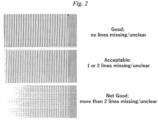
- the inkjet inks disclosed herein also possess extended decap times as measured by printing a narrow line image (e.g., barcode) (1 mm * 1 cm, narrow lines, Monochrome bitmap), exposing the inkjet ink to air (decapping the ink cartridge) for a particular time (e.g., 5, 10, 30, or 60 minutes), reprinting the same narrow line image, and comparing the reprinted image after decapping to the original image to determine if loss of lines/loss of line clarity occurs in the narrow line image (see e.g., Fig. 2 ). If no loss of lines/loss of line clarity occurs at the tested time interval, then the inkjet inks are given a "G" (Good) decap rating for that time interval.
- a narrow line image e.g., barcode
- a particular time e.g., 5, 10, 30, or 60 minutes
- the inkjet inks are given an "A" (Acceptable) decap rating for that time interval. If more than 2 lines are lost/lost clarity at the tested time interval, then the inkjet ink is given an "NG" (Not Good) decap rating for that time interval.
- Inkjet inks which maintain a "G” or “A” decap rating, preferably a "G” decap rating when decapped for 5 minutes or longer, preferably 10 minutes or longer, more preferably 30 minutes or longer, even more preferably 60 minutes or longer are considered desirable in terms of decap performance.
- the inkjet inks can be printed on various substrates including three dimensional parts as well as flat sheets or webs that are supplied in roll form, for the manufacture of a wide variety of printed articles. Additionally, the substrates may possess various surface types, for example, a flat surface, a structured surface, such as grained surfaces, and a three-dimensional surface, such as curved and/or complex surfaces, which are notoriously difficult substrates owing to the long distance that the ink must travel to reach all parts of the curved and/or complex surface.
- Such printed articles may be suitable in the graphic arts, textiles, packaging (e.g., food packaging, pharmaceutical packaging, etc.), lottery, direct mail, business forms and publishing industries, examples of which include a tag or label, a lottery ticket, a publication, packaging (e.g., food packaging, pharmaceutical packaging, blister packaging, other various flexible packaging, etc.), a folding carton, a rigid container (e.g., a plastic cup or tub, glass containers, metal cans, bottles such as PET bottles, jars, and tubes), envelopes, corrugate, a point-of-sale display, and the like.
- packaging e.g., food packaging, pharmaceutical packaging, blister packaging, other various flexible packaging, etc.
- a folding carton e.g., a rigid container (e.g., a plastic cup or tub, glass containers, metal cans, bottles such as PET bottles, jars, and tubes), envelopes, corrugate, a point-of-sale display, and the like.
- the inkjet inks may be printed on porous (or penetrable) substrates, examples of which include, but are not limited to, non-coated paper (plain paper), wood, membranes, corrugate (corrugated cardboard/fiberboard), and fabrics (including, for example, but not limited to, woven fabric, non-woven fabric, and foil-laminated fabric).
- porous (or penetrable) substrates examples of which include, but are not limited to, non-coated paper (plain paper), wood, membranes, corrugate (corrugated cardboard/fiberboard), and fabrics (including, for example, but not limited to, woven fabric, non-woven fabric, and foil-laminated fabric).
- the inkjet inks may also be printed on non-porous (or non-penetrable/non-penetration) substrates, for example, various plastics, glass, metals (e.g., steel, aluminum, etc.), and or non-penetration papers (e.g., coated papers such as varnish coated papers), including, but not limited to, molded plastic or metal parts as well a flat sheets or rolls of plastic or metallic films.
- non-porous substrates for example, various plastics, glass, metals (e.g., steel, aluminum, etc.), and or non-penetration papers (e.g., coated papers such as varnish coated papers), including, but not limited to, molded plastic or metal parts as well a flat sheets or rolls of plastic or metallic films.
- polyesters such as polyethylene terephthalate (PET), biaxially oriented polystyrene (OPS), polyolefins such as polyethylene (PE), polypropylene (PP), oriented polypropylene (OPP), and biaxially oriented polypropylene (BOPP), polylactic acid (PLA), nylon and oriented nylon, polyvinyl chloride (PVC), cellulose triacetate (TAC), polycarbonate, acrylonitrile butadiene styrene (ABS), polyacetal, polyvinyl alcohol (PVA), coated papers such as varnish coated papers, and metals such as steel and aluminum, and the like.
- the substrate is a PET film, one example of which is U292W made by Teijin.
- a desired printed image is formed when a precise pattern of dots is ejected from a drop-generating device, known as a printhead, onto a print medium.
- the printhead has an array of precisely formed nozzles located on a nozzle plate and attached to an inkjet printhead substrate.
- the inkjet printhead substrate incorporates an array of firing chambers that receive inkjet ink through fluid communication with one or more ink reservoirs.
- Each firing chamber has a resistor element, known as a firing resistor, located opposite the nozzle so that the inkjet ink collects between the firing resistor and the nozzle.
- Each resistor element is typically a pad of a resistive material and measures for example about 35 ⁇ m ⁇ 35 ⁇ m.
- the printhead is held and protected by an outer packaging referred to as a print cartridge or an inkjet pen.
- a droplet of inkjet ink is expelled through the nozzle toward the print medium.
- the firing of ink droplets is typically under the control of a microprocessor, the signals of which are conveyed by electrical traces to the resistor elements, forming alphanumeric and other image patterns on the print medium. Since the nozzles are small, typically 10 ⁇ m to 40 ⁇ m in diameter, inks that minimize clogging are desired.
- thermal inkjet is an open atmosphere print head design (the nozzle orifices are open to atmosphere and there is no valve seal at the orifice to allow ink pressurization)
- TIJ printing has historically suffered from poor performance during intermittent printing, where decap time (print idle time) causes premature drying of ink in and around the nozzles.
- the present disclosure provides a method of forming a printed image by applying the inkjet ink, in one or more of its embodiments, onto a surface of a substrate by a thermal inkjet printhead and allowing the inkjet ink to diy.
- Use of the inkjet inks described herein overcomes the competing problems of short decap time (rate of solvent loss is too fast) and slow drying times (rate of solvent loss is too slow) commonly associated with thermal inkjet processes, while still producing high quality prints.
- any drop on demand printhead known to those of ordinary skill in the art of inkjet printing can be used as printing units in the present method, including continuous printheads, thermal printheads, electrostatic printheads, and acoustic printheads, preferably a thermal printhead (having a thermal transducer) is used.
- Typical parameters such as, for example, printing resolution, printing speed, printhead pulse warming temperature, driving voltage and 2pulse length, can be adjusted according to the specifications of the printhead.
- Printheads which are generally suitable for usage in the methods herein have a droplet size in the range of 2 to 80 pL and a droplet frequency in the range of 10 to 100 kHz, and high quality prints may be obtained for example by setting the driving voltage to 8.0 to 9.5 Volts, the print speed up to 300 feet/minute, the pulse warming temperature to 25 to 45°C, and the pulse length to 0.7-2.5 microseconds, although values above or below these described may also be used and still obtain satisfactory prints.
- One non-limiting printhead example suitable for use in the disclosed methods is HP45SI made by Hewlett Packard.
- the inkjet ink is dried.
- drying is achieved by allowing the applied inkjet ink to dry under ambient conditions (in air, at about 23 °C) for 15 seconds or less, preferably 10 seconds or less, preferably 5 seconds or less, more preferably 4 seconds or less, even more preferably 3 seconds or less, yet even more preferably 2 seconds or less.
- external heat may be applied to dry the applied inkjet inks
- external heat is not applied to facilitate drying or to increase drying speeds (unassisted drying).
- a heater is preferably not employed for drying the inkjet ink after application.
- the methods of the present disclosure do not require energy curing (e.g., UV or electron beam curing).
- substrate surface treatments such as corona treatment, atmospheric plasma treatment, and flame treatment may optionally be employed in the methods herein prior to application of the inkjet inks to improve printed article characteristics, for example ink adhesion.
- the parameters of such substrate surface treatments may be varied greatly depending on the substrate material to be printed, the specific inkjet ink utilized, the printing method applied, and the desired properties and applications of the printed article.
- Glycol ether PM is propylene glycol monomethyl ether.
- DERTOPHENE T160 OIL BLUE 613 is an organic dye, available from Orient Chemical Industries Co., Ltd. Table 1.
- the terpene phenol resin was first combined with the indicated carbonate ester, the 1-propanol, and/or the glycol ether, and mixed by magnetic stirrer for at least 30 minutes.
- the ethanol, neutralization reagent (isopropanolamine) and silicon acrylate copolymer were then added to the mixture, and mixed for at least 15 minutes or until complete dissolution.
- the colorant was next added slowly with mixing, and the resulting mixture was mixed for at least 30 minutes.
- the prepared inkjet inks were then placed into a HP45SI cartridge made by Hewlett Packard.
- the solid block image was printed according to the conditions above, and an abrasion test was done by the finger after allowing the inkjet ink to dry for a specific time interval (5, 10, 15, and 20 sec).
- a colored finger indicates not enough time had lapsed for complete drying and the inkjet ink was given a "NG" (No Good) rating at that time interval.
- a non-colored finger indicates the time was adequate for complete drying and the inkjet ink was given a "G" (Good) rating at that time interval.
- Inkjet inks requiring a drying time of over 15 seconds to achieve a "G” rating were deemed unacceptable (slow drying) and inkjet inks which dried in 15 seconds or less were deemed acceptable (quick drying).
- the narrow line image was printed to confirm that there were no missing or unclear lines included in the printed image (signifying plugged or missing nozzles). After confirming, the printhead was left decapped for a specific time (5, 10, 30, or 60 minutes), then reprinted using the same narrow line image. The reprinted image (after the specific time lapse) was checked to determine whether loss of lines/loss of line clarity occurred. If no loss of lines/loss of line clarity occurred at the tested time interval, then the inkjet ink was given a "G" (Good) decap rating for that time interval.
- G Good
- Suitable/desirable inkjet inks are those which maintain a "G” or an "A” decap classification when decapped (i.e., exposed to air) for each of the tested time intervals.
- inkjet inks containing a terpene phenol resin having a OHV of 10 to 80 mgKOH/g were found to possess advantageous decap behavior, with "G" or "A" decap ratings for each of the tested time intervals (Examples 1-4 and 7-18).
- inkjet inks which were formulated with terpene phenol resins having hydroxyl values outside of this range suffered from unacceptable decap times at all decap times tested (Examples 5 and 6).
- inkjet inks formulated with a carbonate ester whose boiling point is less than 150 °C were found to be fast drying, with drying times of 15 seconds or less (Examples 1-6, 9-14, and 16-18).
- examples 1-6, 9-14, and 16-18 In terms of the quantity of carbonate ester whose boiling point is less than 150 °C, even low amounts were found to be sufficient for fast drying inkjet inks (Example 11, with a 10 wt. % loading of carbonate ester).
- Higher loadings of carbonate ester, such as 35 wt. % in Example 13, and 45 wt. % in Example 14, also provided acceptable drying properties, although a 45 wt. % loading of the carbonate ester was found to require >10-15 seconds for adequate drying (Example 14).
Landscapes
- Chemical & Material Sciences (AREA)
- Life Sciences & Earth Sciences (AREA)
- Engineering & Computer Science (AREA)
- Materials Engineering (AREA)
- Wood Science & Technology (AREA)
- Organic Chemistry (AREA)
- Chemical Kinetics & Catalysis (AREA)
- Inks, Pencil-Leads, Or Crayons (AREA)
- Ink Jet Recording Methods And Recording Media Thereof (AREA)
- Ink Jet (AREA)
Claims (15)
- Encre pour jet d'encre, comprenant :(A) une résine de terpène phénol présentant une valeur hydroxyle entre 10 et 80 mgKOH/g ; et(B) un ester de carbonate dont le point d'ébullition est inférieur à 150 °C.
- Encre pour jet d'encre selon la revendication 1, dans laquelle la résine de terpène phénol (A) est un copolymère formé à partir d'une réaction entre un monoterpène et un composé phénolique comprenant au moins un groupe hydroxyle et au moins deux atomes d'hydrogène remplaçables en positions ortho et/ou para par rapport à l'au moins un groupe hydroxyle.
- Encre pour jet d'encre selon la revendication 2, dans laquelle le monoterpène est au moins un monoterpène bicyclique sélectionné parmi le groupe constitué par le 3-carène, l'α-pinène, le β-pinène, et le camphène.
- Encre pour jet d'encre selon la revendication 2, dans laquelle le composé phénolique est un phénol.
- Encre pour jet d'encre selon l'une quelconque des revendications 1 à 4, dans laquelle la résine de terpène phénol (A) est présente dans une proportion de 0,1 à 10 % en poids, par rapport au poids total de l'encre pour jet d'encre.
- Encre pour jet d'encre selon l'une quelconque des revendications 1 à 5, dans laquelle l'ester de carbonate (B) est présent dans une proportion de 5 à 50 %. en poids, par rapport à un poids total de l'encre pour jet d'encre.
- Encre pour jet d'encre selon l'une quelconque des revendications 1 à 6, dans laquelle un rapport en poids entre l'ester de carbonate (B) et la résine de terpène phénol (A) ((B):(A)) est entre 2:1 et 25:1.
- Encre pour jet d'encre selon l'une quelconque des revendications 1 à 7, comprenant en outre (C) de l'éthanol.
- Encre pour jet d'encre selon la revendication 8, dans laquelle l'éthanol (C) est présent dans une proportion de 40 à 85 % en poids, par rapport à un poids total de l'encre pour jet d'encre.
- Encre pour jet d'encre selon la revendication 8 ou 9, dans laquelle un rapport en poids entre l'ester de carbonate (B) et l'éthanol (C) ((B)/(C)) est entre 0,05:1 et 0,80:1.
- Encre pour jet d'encre selon l'une quelconque des revendications 1 à 10, comprenant en outre (D) une alcanolamine, dans laquelle l'alcanolamine (D) est présente dans une proportion de 0,1 à 10 % en poids, par rapport à un poids total de l'encre pour jet d'encre.
- Encre pour jet d'encre selon la revendication 11, dans laquelle l'alcanolamine (D) est au moins un composé sélectionné parmi le groupe constitué par l'éthanolamine, la propanolamine, l'isopropanolamine, la diéthanolamine, et la triéthanolamine.
- Encre pour jet d'encre selon l'une quelconque des revendications 1 à 12, comprenant en outre (E) un copolymère d'acrylate de silicone, dans laquelle le copolymère d'acrylate de silicone (E) est facultativement présent dans une proportion allant jusqu'à 5 % en poids, par rapport à un poids total de l'encre pour jet d'encre.
- Encre pour jet d'encre selon l'une quelconque des revendications 1 à 13, comprenant en outre (F) un colorant.
- Procédé de formation d'une image imprimée sur un substrat, comprenant :une application de l'encre pour jet d'encre selon l'une quelconque des revendications 1 à 14 sur le substrat avec une tête d'impression à jet d'encre thermique ; etun séchage de l'encre pour jet d'encre.
Applications Claiming Priority (1)
| Application Number | Priority Date | Filing Date | Title |
|---|---|---|---|
| PCT/US2020/056615 WO2022086517A1 (fr) | 2020-10-21 | 2020-10-21 | Encres pour jet d'encre à séchage rapide à décapsulage prolongé |
Publications (3)
| Publication Number | Publication Date |
|---|---|
| EP4232109A1 EP4232109A1 (fr) | 2023-08-30 |
| EP4232109A4 EP4232109A4 (fr) | 2024-07-24 |
| EP4232109B1 true EP4232109B1 (fr) | 2025-04-23 |
Family
ID=81291150
Family Applications (1)
| Application Number | Title | Priority Date | Filing Date |
|---|---|---|---|
| EP20958868.0A Active EP4232109B1 (fr) | 2020-10-21 | 2020-10-21 | Encres pour jet d'encre à séchage rapide à décapsulage prolongé |
Country Status (6)
| Country | Link |
|---|---|
| US (1) | US20230312952A1 (fr) |
| EP (1) | EP4232109B1 (fr) |
| JP (1) | JP7579446B2 (fr) |
| CN (1) | CN116367870A (fr) |
| TW (1) | TWI910243B (fr) |
| WO (1) | WO2022086517A1 (fr) |
Families Citing this family (1)
| Publication number | Priority date | Publication date | Assignee | Title |
|---|---|---|---|---|
| US12269957B1 (en) * | 2020-11-02 | 2025-04-08 | Wikoff Color Corporation | Ink formulation for thermal inkjet printing |
Family Cites Families (10)
| Publication number | Priority date | Publication date | Assignee | Title |
|---|---|---|---|---|
| CN104583344A (zh) * | 2012-11-02 | 2015-04-29 | 多米诺印刷科学有限公司 | 喷墨油墨组合物 |
| FR2997956B1 (fr) * | 2012-11-15 | 2015-04-10 | Markem Imaje | Composition d'encre pour l'impression par jet continu devie notamment sur des substrats en polymeres organiques. |
| JP6268473B2 (ja) * | 2014-03-03 | 2018-01-31 | セイコーエプソン株式会社 | 非水系インクジェットインク組成物およびこれを用いたインクジェット記録方法 |
| JP5878224B2 (ja) * | 2014-04-28 | 2016-03-08 | ゼネラル株式会社 | インクジェットインク |
| JP6641653B2 (ja) * | 2015-09-25 | 2020-02-05 | ゼネラル株式会社 | インクジェットインク |
| FR3046418B1 (fr) * | 2016-01-06 | 2020-04-24 | Dover Europe Sarl | Composition de liquide, notamment encre, pour l'impression par jet continu devie binaire, a gouttes non chargees, utilisation de ladite composition, procede de marquage, et substrat marque. |
| GB2575229C (en) * | 2018-03-28 | 2024-02-21 | Domino Printing Sciences Plc | Ink composition comprising siloxane surfactant and metal conductivity salt |
| JP7336519B2 (ja) * | 2018-11-30 | 2023-08-31 | 花王株式会社 | インクジェットインク |
| US20220049118A1 (en) * | 2018-11-30 | 2022-02-17 | Kao Corporation | Inkjet inks |
| JP2022162984A (ja) * | 2021-03-31 | 2022-10-25 | 株式会社Dnpファインケミカル | 非水性インク組成物、記録方法、及び記録物の製造方法 |
-
2020
- 2020-10-21 JP JP2023524331A patent/JP7579446B2/ja active Active
- 2020-10-21 CN CN202080106552.4A patent/CN116367870A/zh active Pending
- 2020-10-21 US US18/245,756 patent/US20230312952A1/en active Pending
- 2020-10-21 EP EP20958868.0A patent/EP4232109B1/fr active Active
- 2020-10-21 WO PCT/US2020/056615 patent/WO2022086517A1/fr not_active Ceased
-
2021
- 2021-10-08 TW TW110137519A patent/TWI910243B/zh active
Also Published As
| Publication number | Publication date |
|---|---|
| TW202223003A (zh) | 2022-06-16 |
| JP7579446B2 (ja) | 2024-11-07 |
| TWI910243B (zh) | 2026-01-01 |
| EP4232109A4 (fr) | 2024-07-24 |
| EP4232109A1 (fr) | 2023-08-30 |
| JP2023546594A (ja) | 2023-11-06 |
| WO2022086517A1 (fr) | 2022-04-28 |
| CN116367870A (zh) | 2023-06-30 |
| US20230312952A1 (en) | 2023-10-05 |
Similar Documents
| Publication | Publication Date | Title |
|---|---|---|
| EP3887460B1 (fr) | Encres pour l'impression à jet d'encre | |
| EP3887459B1 (fr) | Encres pour l'impression à jet d'encre | |
| US12595385B2 (en) | Inkjet inks | |
| EP4232109B1 (fr) | Encres pour jet d'encre à séchage rapide à décapsulage prolongé | |
| JP7579445B2 (ja) | 非多孔質基材上の印刷に適したインクジェットインク | |
| EP4326827B1 (fr) | Encres pour jet d'encre à base de solvant | |
| US20250277124A1 (en) | Dioxolane and terpene resin based inkjet ink | |
| EP4626986A1 (fr) | Encres pour jet d'encre contenant de la silicone modifiée par une amine | |
| WO2024182072A1 (fr) | Encres pour jet d'encre à base de solvant | |
| WO2022211797A1 (fr) | Encres pour jet d'encre à longue distance de projection |
Legal Events
| Date | Code | Title | Description |
|---|---|---|---|
| STAA | Information on the status of an ep patent application or granted ep patent |
Free format text: STATUS: THE INTERNATIONAL PUBLICATION HAS BEEN MADE |
|
| PUAI | Public reference made under article 153(3) epc to a published international application that has entered the european phase |
Free format text: ORIGINAL CODE: 0009012 |
|
| STAA | Information on the status of an ep patent application or granted ep patent |
Free format text: STATUS: REQUEST FOR EXAMINATION WAS MADE |
|
| 17P | Request for examination filed |
Effective date: 20230324 |
|
| AK | Designated contracting states |
Kind code of ref document: A1 Designated state(s): AL AT BE BG CH CY CZ DE DK EE ES FI FR GB GR HR HU IE IS IT LI LT LU LV MC MK MT NL NO PL PT RO RS SE SI SK SM TR |
|
| DAV | Request for validation of the european patent (deleted) | ||
| DAX | Request for extension of the european patent (deleted) | ||
| REG | Reference to a national code |
Ref country code: DE Ref legal event code: R079 Free format text: PREVIOUS MAIN CLASS: A61L0029080000 Ipc: C09D0011108000 Ref document number: 602020050225 Country of ref document: DE |
|
| A4 | Supplementary search report drawn up and despatched |
Effective date: 20240624 |
|
| RIC1 | Information provided on ipc code assigned before grant |
Ipc: A61L 29/14 20060101ALI20240618BHEP Ipc: A61L 29/08 20060101ALI20240618BHEP Ipc: C09D 11/38 20140101ALI20240618BHEP Ipc: C09D 11/328 20140101ALI20240618BHEP Ipc: C09D 11/36 20140101ALI20240618BHEP Ipc: C09D 11/102 20140101ALI20240618BHEP Ipc: C09D 11/108 20140101AFI20240618BHEP |
|
| GRAP | Despatch of communication of intention to grant a patent |
Free format text: ORIGINAL CODE: EPIDOSNIGR1 |
|
| STAA | Information on the status of an ep patent application or granted ep patent |
Free format text: STATUS: GRANT OF PATENT IS INTENDED |
|
| INTG | Intention to grant announced |
Effective date: 20241203 |
|
| GRAS | Grant fee paid |
Free format text: ORIGINAL CODE: EPIDOSNIGR3 |
|
| GRAA | (expected) grant |
Free format text: ORIGINAL CODE: 0009210 |
|
| STAA | Information on the status of an ep patent application or granted ep patent |
Free format text: STATUS: THE PATENT HAS BEEN GRANTED |
|
| AK | Designated contracting states |
Kind code of ref document: B1 Designated state(s): AL AT BE BG CH CY CZ DE DK EE ES FI FR GB GR HR HU IE IS IT LI LT LU LV MC MK MT NL NO PL PT RO RS SE SI SK SM TR |
|
| REG | Reference to a national code |
Ref country code: GB Ref legal event code: FG4D |
|
| REG | Reference to a national code |
Ref country code: CH Ref legal event code: EP |
|
| REG | Reference to a national code |
Ref country code: DE Ref legal event code: R096 Ref document number: 602020050225 Country of ref document: DE |
|
| REG | Reference to a national code |
Ref country code: IE Ref legal event code: FG4D |
|
| REG | Reference to a national code |
Ref country code: NL Ref legal event code: MP Effective date: 20250423 |
|
| PG25 | Lapsed in a contracting state [announced via postgrant information from national office to epo] |
Ref country code: NL Free format text: LAPSE BECAUSE OF FAILURE TO SUBMIT A TRANSLATION OF THE DESCRIPTION OR TO PAY THE FEE WITHIN THE PRESCRIBED TIME-LIMIT Effective date: 20250423 |
|
| REG | Reference to a national code |
Ref country code: AT Ref legal event code: MK05 Ref document number: 1787763 Country of ref document: AT Kind code of ref document: T Effective date: 20250423 |
|
| PG25 | Lapsed in a contracting state [announced via postgrant information from national office to epo] |
Ref country code: FI Free format text: LAPSE BECAUSE OF FAILURE TO SUBMIT A TRANSLATION OF THE DESCRIPTION OR TO PAY THE FEE WITHIN THE PRESCRIBED TIME-LIMIT Effective date: 20250423 Ref country code: ES Free format text: LAPSE BECAUSE OF FAILURE TO SUBMIT A TRANSLATION OF THE DESCRIPTION OR TO PAY THE FEE WITHIN THE PRESCRIBED TIME-LIMIT Effective date: 20250423 Ref country code: PT Free format text: LAPSE BECAUSE OF FAILURE TO SUBMIT A TRANSLATION OF THE DESCRIPTION OR TO PAY THE FEE WITHIN THE PRESCRIBED TIME-LIMIT Effective date: 20250825 |
|
| REG | Reference to a national code |
Ref country code: LT Ref legal event code: MG9D |
|
| PG25 | Lapsed in a contracting state [announced via postgrant information from national office to epo] |
Ref country code: NO Free format text: LAPSE BECAUSE OF FAILURE TO SUBMIT A TRANSLATION OF THE DESCRIPTION OR TO PAY THE FEE WITHIN THE PRESCRIBED TIME-LIMIT Effective date: 20250723 Ref country code: GR Free format text: LAPSE BECAUSE OF FAILURE TO SUBMIT A TRANSLATION OF THE DESCRIPTION OR TO PAY THE FEE WITHIN THE PRESCRIBED TIME-LIMIT Effective date: 20250724 |
|
| PG25 | Lapsed in a contracting state [announced via postgrant information from national office to epo] |
Ref country code: PL Free format text: LAPSE BECAUSE OF FAILURE TO SUBMIT A TRANSLATION OF THE DESCRIPTION OR TO PAY THE FEE WITHIN THE PRESCRIBED TIME-LIMIT Effective date: 20250423 |
|
| PG25 | Lapsed in a contracting state [announced via postgrant information from national office to epo] |
Ref country code: BG Free format text: LAPSE BECAUSE OF FAILURE TO SUBMIT A TRANSLATION OF THE DESCRIPTION OR TO PAY THE FEE WITHIN THE PRESCRIBED TIME-LIMIT Effective date: 20250423 |
|
| PGFP | Annual fee paid to national office [announced via postgrant information from national office to epo] |
Ref country code: GB Payment date: 20250828 Year of fee payment: 6 |
|
| PG25 | Lapsed in a contracting state [announced via postgrant information from national office to epo] |
Ref country code: HR Free format text: LAPSE BECAUSE OF FAILURE TO SUBMIT A TRANSLATION OF THE DESCRIPTION OR TO PAY THE FEE WITHIN THE PRESCRIBED TIME-LIMIT Effective date: 20250423 |
|
| PG25 | Lapsed in a contracting state [announced via postgrant information from national office to epo] |
Ref country code: AT Free format text: LAPSE BECAUSE OF FAILURE TO SUBMIT A TRANSLATION OF THE DESCRIPTION OR TO PAY THE FEE WITHIN THE PRESCRIBED TIME-LIMIT Effective date: 20250423 |
|
| PG25 | Lapsed in a contracting state [announced via postgrant information from national office to epo] |
Ref country code: RS Free format text: LAPSE BECAUSE OF FAILURE TO SUBMIT A TRANSLATION OF THE DESCRIPTION OR TO PAY THE FEE WITHIN THE PRESCRIBED TIME-LIMIT Effective date: 20250723 |
|
| PG25 | Lapsed in a contracting state [announced via postgrant information from national office to epo] |
Ref country code: IS Free format text: LAPSE BECAUSE OF FAILURE TO SUBMIT A TRANSLATION OF THE DESCRIPTION OR TO PAY THE FEE WITHIN THE PRESCRIBED TIME-LIMIT Effective date: 20250823 |
|
| PG25 | Lapsed in a contracting state [announced via postgrant information from national office to epo] |
Ref country code: LV Free format text: LAPSE BECAUSE OF FAILURE TO SUBMIT A TRANSLATION OF THE DESCRIPTION OR TO PAY THE FEE WITHIN THE PRESCRIBED TIME-LIMIT Effective date: 20250423 |
|
| PGFP | Annual fee paid to national office [announced via postgrant information from national office to epo] |
Ref country code: DE Payment date: 20250902 Year of fee payment: 6 |
|
| PG25 | Lapsed in a contracting state [announced via postgrant information from national office to epo] |
Ref country code: SM Free format text: LAPSE BECAUSE OF FAILURE TO SUBMIT A TRANSLATION OF THE DESCRIPTION OR TO PAY THE FEE WITHIN THE PRESCRIBED TIME-LIMIT Effective date: 20250423 Ref country code: DK Free format text: LAPSE BECAUSE OF FAILURE TO SUBMIT A TRANSLATION OF THE DESCRIPTION OR TO PAY THE FEE WITHIN THE PRESCRIBED TIME-LIMIT Effective date: 20250423 |
|
| PG25 | Lapsed in a contracting state [announced via postgrant information from national office to epo] |
Ref country code: CZ Free format text: LAPSE BECAUSE OF FAILURE TO SUBMIT A TRANSLATION OF THE DESCRIPTION OR TO PAY THE FEE WITHIN THE PRESCRIBED TIME-LIMIT Effective date: 20250423 |
|
| PG25 | Lapsed in a contracting state [announced via postgrant information from national office to epo] |
Ref country code: EE Free format text: LAPSE BECAUSE OF FAILURE TO SUBMIT A TRANSLATION OF THE DESCRIPTION OR TO PAY THE FEE WITHIN THE PRESCRIBED TIME-LIMIT Effective date: 20250423 |
|
| REG | Reference to a national code |
Ref country code: DE Ref legal event code: R097 Ref document number: 602020050225 Country of ref document: DE |
|
| PG25 | Lapsed in a contracting state [announced via postgrant information from national office to epo] |
Ref country code: SK Free format text: LAPSE BECAUSE OF FAILURE TO SUBMIT A TRANSLATION OF THE DESCRIPTION OR TO PAY THE FEE WITHIN THE PRESCRIBED TIME-LIMIT Effective date: 20250423 |
|
| PG25 | Lapsed in a contracting state [announced via postgrant information from national office to epo] |
Ref country code: IT Free format text: LAPSE BECAUSE OF FAILURE TO SUBMIT A TRANSLATION OF THE DESCRIPTION OR TO PAY THE FEE WITHIN THE PRESCRIBED TIME-LIMIT Effective date: 20250423 |
|
| PLBE | No opposition filed within time limit |
Free format text: ORIGINAL CODE: 0009261 |
|
| STAA | Information on the status of an ep patent application or granted ep patent |
Free format text: STATUS: NO OPPOSITION FILED WITHIN TIME LIMIT |
|
| REG | Reference to a national code |
Ref country code: CH Ref legal event code: L10 Free format text: ST27 STATUS EVENT CODE: U-0-0-L10-L00 (AS PROVIDED BY THE NATIONAL OFFICE) Effective date: 20260304 |
|
| PG25 | Lapsed in a contracting state [announced via postgrant information from national office to epo] |
Ref country code: RO Free format text: LAPSE BECAUSE OF FAILURE TO SUBMIT A TRANSLATION OF THE DESCRIPTION OR TO PAY THE FEE WITHIN THE PRESCRIBED TIME-LIMIT Effective date: 20250423 |
|
| 26N | No opposition filed |
Effective date: 20260126 |