EP4234531A1 - Séparation de l'acide acrylique à l'aide des contacteurs à membrane - Google Patents
Séparation de l'acide acrylique à l'aide des contacteurs à membrane Download PDFInfo
- Publication number
- EP4234531A1 EP4234531A1 EP22158781.9A EP22158781A EP4234531A1 EP 4234531 A1 EP4234531 A1 EP 4234531A1 EP 22158781 A EP22158781 A EP 22158781A EP 4234531 A1 EP4234531 A1 EP 4234531A1
- Authority
- EP
- European Patent Office
- Prior art keywords
- acrylic acid
- membrane
- aqueous
- organic solvent
- aqueous stream
- Prior art date
- Legal status (The legal status is an assumption and is not a legal conclusion. Google has not performed a legal analysis and makes no representation as to the accuracy of the status listed.)
- Withdrawn
Links
- SMZOUWXMTYCWNB-UHFFFAOYSA-N 2-(2-methoxy-5-methylphenyl)ethanamine Chemical compound COC1=CC=C(C)C=C1CCN SMZOUWXMTYCWNB-UHFFFAOYSA-N 0.000 title claims abstract description 112
- NIXOWILDQLNWCW-UHFFFAOYSA-N 2-Propenoic acid Natural products OC(=O)C=C NIXOWILDQLNWCW-UHFFFAOYSA-N 0.000 title claims abstract description 107
- 239000012528 membrane Substances 0.000 title claims abstract description 93
- 238000000926 separation method Methods 0.000 title description 7
- 238000000034 method Methods 0.000 claims abstract description 41
- 238000000605 extraction Methods 0.000 claims abstract description 37
- 239000003960 organic solvent Substances 0.000 claims abstract description 34
- YXFVVABEGXRONW-UHFFFAOYSA-N Toluene Chemical compound CC1=CC=CC=C1 YXFVVABEGXRONW-UHFFFAOYSA-N 0.000 claims description 89
- HGINCPLSRVDWNT-UHFFFAOYSA-N Acrolein Chemical compound C=CC=O HGINCPLSRVDWNT-UHFFFAOYSA-N 0.000 claims description 24
- 239000003112 inhibitor Substances 0.000 claims description 16
- 238000004519 manufacturing process Methods 0.000 claims description 12
- 239000012510 hollow fiber Substances 0.000 claims description 11
- QQONPFPTGQHPMA-UHFFFAOYSA-N Propene Chemical compound CC=C QQONPFPTGQHPMA-UHFFFAOYSA-N 0.000 claims description 10
- 229920001343 polytetrafluoroethylene Polymers 0.000 claims description 10
- 239000004810 polytetrafluoroethylene Substances 0.000 claims description 10
- 238000006243 chemical reaction Methods 0.000 claims description 9
- 238000004821 distillation Methods 0.000 claims description 7
- IMNFDUFMRHMDMM-UHFFFAOYSA-N N-Heptane Chemical compound CCCCCCC IMNFDUFMRHMDMM-UHFFFAOYSA-N 0.000 claims description 6
- QVGXLLKOCUKJST-UHFFFAOYSA-N atomic oxygen Chemical compound [O] QVGXLLKOCUKJST-UHFFFAOYSA-N 0.000 claims description 6
- 239000001301 oxygen Substances 0.000 claims description 6
- 229910052760 oxygen Inorganic materials 0.000 claims description 6
- 239000000126 substance Substances 0.000 claims description 6
- 238000010521 absorption reaction Methods 0.000 claims description 4
- XNLICIUVMPYHGG-UHFFFAOYSA-N pentan-2-one Chemical compound CCCC(C)=O XNLICIUVMPYHGG-UHFFFAOYSA-N 0.000 claims description 4
- YKYONYBAUNKHLG-UHFFFAOYSA-N propyl acetate Chemical compound CCCOC(C)=O YKYONYBAUNKHLG-UHFFFAOYSA-N 0.000 claims description 4
- 230000002209 hydrophobic effect Effects 0.000 claims description 3
- JMMWKPVZQRWMSS-UHFFFAOYSA-N isopropanol acetate Natural products CC(C)OC(C)=O JMMWKPVZQRWMSS-UHFFFAOYSA-N 0.000 claims description 3
- 229940011051 isopropyl acetate Drugs 0.000 claims description 3
- GWYFCOCPABKNJV-UHFFFAOYSA-N isovaleric acid Chemical compound CC(C)CC(O)=O GWYFCOCPABKNJV-UHFFFAOYSA-N 0.000 claims description 3
- -1 polytetrafluoroethylene Polymers 0.000 claims description 3
- NTIZESTWPVYFNL-UHFFFAOYSA-N Methyl isobutyl ketone Chemical compound CC(C)CC(C)=O NTIZESTWPVYFNL-UHFFFAOYSA-N 0.000 claims description 2
- UIHCLUNTQKBZGK-UHFFFAOYSA-N Methyl isobutyl ketone Natural products CCC(C)C(C)=O UIHCLUNTQKBZGK-UHFFFAOYSA-N 0.000 claims description 2
- 239000003125 aqueous solvent Substances 0.000 claims description 2
- GJRQTCIYDGXPES-UHFFFAOYSA-N iso-butyl acetate Natural products CC(C)COC(C)=O GJRQTCIYDGXPES-UHFFFAOYSA-N 0.000 claims description 2
- FGKJLKRYENPLQH-UHFFFAOYSA-M isocaproate Chemical compound CC(C)CCC([O-])=O FGKJLKRYENPLQH-UHFFFAOYSA-M 0.000 claims description 2
- OQAGVSWESNCJJT-UHFFFAOYSA-N isovaleric acid methyl ester Natural products COC(=O)CC(C)C OQAGVSWESNCJJT-UHFFFAOYSA-N 0.000 claims description 2
- XLYOFNOQVPJJNP-UHFFFAOYSA-N water Substances O XLYOFNOQVPJJNP-UHFFFAOYSA-N 0.000 description 24
- 239000008346 aqueous phase Substances 0.000 description 19
- 239000012071 phase Substances 0.000 description 15
- 238000012360 testing method Methods 0.000 description 11
- 239000002609 medium Substances 0.000 description 10
- 239000012074 organic phase Substances 0.000 description 10
- 239000000463 material Substances 0.000 description 8
- UZFMOKQJFYMBGY-UHFFFAOYSA-N 4-hydroxy-TEMPO Chemical group CC1(C)CC(O)CC(C)(C)N1[O] UZFMOKQJFYMBGY-UHFFFAOYSA-N 0.000 description 7
- 238000002474 experimental method Methods 0.000 description 7
- 238000011068 loading method Methods 0.000 description 7
- 238000006116 polymerization reaction Methods 0.000 description 7
- 239000000243 solution Substances 0.000 description 7
- 238000009736 wetting Methods 0.000 description 7
- 239000011148 porous material Substances 0.000 description 6
- 238000011161 development Methods 0.000 description 5
- 238000010438 heat treatment Methods 0.000 description 5
- 239000007788 liquid Substances 0.000 description 5
- 238000005191 phase separation Methods 0.000 description 5
- 238000010586 diagram Methods 0.000 description 4
- 239000000203 mixture Substances 0.000 description 4
- 238000004062 sedimentation Methods 0.000 description 4
- 239000002904 solvent Substances 0.000 description 4
- QTBSBXVTEAMEQO-UHFFFAOYSA-N Acetic acid Chemical compound CC(O)=O QTBSBXVTEAMEQO-UHFFFAOYSA-N 0.000 description 3
- 150000001252 acrylic acid derivatives Chemical class 0.000 description 3
- 239000012736 aqueous medium Substances 0.000 description 3
- 239000006227 byproduct Substances 0.000 description 3
- 238000010612 desalination reaction Methods 0.000 description 3
- 239000006185 dispersion Substances 0.000 description 3
- 238000002156 mixing Methods 0.000 description 3
- 238000001728 nano-filtration Methods 0.000 description 3
- 239000012495 reaction gas Substances 0.000 description 3
- 239000006096 absorbing agent Substances 0.000 description 2
- 239000003054 catalyst Substances 0.000 description 2
- 239000003795 chemical substances by application Substances 0.000 description 2
- 238000010924 continuous production Methods 0.000 description 2
- 238000009776 industrial production Methods 0.000 description 2
- BDAGIHXWWSANSR-UHFFFAOYSA-N methanoic acid Natural products OC=O BDAGIHXWWSANSR-UHFFFAOYSA-N 0.000 description 2
- 239000000178 monomer Substances 0.000 description 2
- NWVVVBRKAWDGAB-UHFFFAOYSA-N p-methoxyphenol Chemical compound COC1=CC=C(O)C=C1 NWVVVBRKAWDGAB-UHFFFAOYSA-N 0.000 description 2
- 229920000058 polyacrylate Polymers 0.000 description 2
- 238000000746 purification Methods 0.000 description 2
- 238000012546 transfer Methods 0.000 description 2
- OSWFIVFLDKOXQC-UHFFFAOYSA-N 4-(3-methoxyphenyl)aniline Chemical compound COC1=CC=CC(C=2C=CC(N)=CC=2)=C1 OSWFIVFLDKOXQC-UHFFFAOYSA-N 0.000 description 1
- 241001295925 Gegenes Species 0.000 description 1
- LJSAJMXWXGSVNA-UHFFFAOYSA-N a805044 Chemical compound OC1=CC=C(O)C=C1.OC1=CC=C(O)C=C1 LJSAJMXWXGSVNA-UHFFFAOYSA-N 0.000 description 1
- 239000011149 active material Substances 0.000 description 1
- 238000013459 approach Methods 0.000 description 1
- 239000007864 aqueous solution Substances 0.000 description 1
- 230000015572 biosynthetic process Effects 0.000 description 1
- CQEYYJKEWSMYFG-UHFFFAOYSA-N butyl acrylate Chemical compound CCCCOC(=O)C=C CQEYYJKEWSMYFG-UHFFFAOYSA-N 0.000 description 1
- 238000004364 calculation method Methods 0.000 description 1
- 150000001735 carboxylic acids Chemical class 0.000 description 1
- 238000002425 crystallisation Methods 0.000 description 1
- 230000008025 crystallization Effects 0.000 description 1
- 238000009792 diffusion process Methods 0.000 description 1
- 230000000694 effects Effects 0.000 description 1
- 230000005611 electricity Effects 0.000 description 1
- 238000005516 engineering process Methods 0.000 description 1
- 238000001704 evaporation Methods 0.000 description 1
- 230000008020 evaporation Effects 0.000 description 1
- 230000002349 favourable effect Effects 0.000 description 1
- 238000011049 filling Methods 0.000 description 1
- 235000019253 formic acid Nutrition 0.000 description 1
- 239000007789 gas Substances 0.000 description 1
- 239000012535 impurity Substances 0.000 description 1
- 230000005764 inhibitory process Effects 0.000 description 1
- 230000003647 oxidation Effects 0.000 description 1
- 238000007254 oxidation reaction Methods 0.000 description 1
- 230000001590 oxidative effect Effects 0.000 description 1
- 239000012466 permeate Substances 0.000 description 1
- 229920000642 polymer Polymers 0.000 description 1
- 239000000047 product Substances 0.000 description 1
- 239000013049 sediment Substances 0.000 description 1
- 239000007787 solid Substances 0.000 description 1
- 230000008961 swelling Effects 0.000 description 1
- 238000003786 synthesis reaction Methods 0.000 description 1
- 238000010998 test method Methods 0.000 description 1
- 238000010626 work up procedure Methods 0.000 description 1
Images


Classifications
-
- C—CHEMISTRY; METALLURGY
- C07—ORGANIC CHEMISTRY
- C07C—ACYCLIC OR CARBOCYCLIC COMPOUNDS
- C07C51/00—Preparation of carboxylic acids or their salts, halides or anhydrides
- C07C51/16—Preparation of carboxylic acids or their salts, halides or anhydrides by oxidation
- C07C51/21—Preparation of carboxylic acids or their salts, halides or anhydrides by oxidation with molecular oxygen
- C07C51/25—Preparation of carboxylic acids or their salts, halides or anhydrides by oxidation with molecular oxygen of unsaturated compounds containing no six-membered aromatic ring
- C07C51/252—Preparation of carboxylic acids or their salts, halides or anhydrides by oxidation with molecular oxygen of unsaturated compounds containing no six-membered aromatic ring of propene, butenes, acrolein or methacrolein
-
- C—CHEMISTRY; METALLURGY
- C07—ORGANIC CHEMISTRY
- C07C—ACYCLIC OR CARBOCYCLIC COMPOUNDS
- C07C45/00—Preparation of compounds having >C = O groups bound only to carbon or hydrogen atoms; Preparation of chelates of such compounds
- C07C45/27—Preparation of compounds having >C = O groups bound only to carbon or hydrogen atoms; Preparation of chelates of such compounds by oxidation
- C07C45/32—Preparation of compounds having >C = O groups bound only to carbon or hydrogen atoms; Preparation of chelates of such compounds by oxidation with molecular oxygen
- C07C45/33—Preparation of compounds having >C = O groups bound only to carbon or hydrogen atoms; Preparation of chelates of such compounds by oxidation with molecular oxygen of CHx-moieties
- C07C45/34—Preparation of compounds having >C = O groups bound only to carbon or hydrogen atoms; Preparation of chelates of such compounds by oxidation with molecular oxygen of CHx-moieties in unsaturated compounds
- C07C45/35—Preparation of compounds having >C = O groups bound only to carbon or hydrogen atoms; Preparation of chelates of such compounds by oxidation with molecular oxygen of CHx-moieties in unsaturated compounds in propene or isobutene
-
- C—CHEMISTRY; METALLURGY
- C07—ORGANIC CHEMISTRY
- C07C—ACYCLIC OR CARBOCYCLIC COMPOUNDS
- C07C51/00—Preparation of carboxylic acids or their salts, halides or anhydrides
- C07C51/42—Separation; Purification; Stabilisation; Use of additives
- C07C51/43—Separation; Purification; Stabilisation; Use of additives by change of the physical state, e.g. crystallisation
- C07C51/44—Separation; Purification; Stabilisation; Use of additives by change of the physical state, e.g. crystallisation by distillation
-
- C—CHEMISTRY; METALLURGY
- C07—ORGANIC CHEMISTRY
- C07C—ACYCLIC OR CARBOCYCLIC COMPOUNDS
- C07C51/00—Preparation of carboxylic acids or their salts, halides or anhydrides
- C07C51/42—Separation; Purification; Stabilisation; Use of additives
- C07C51/47—Separation; Purification; Stabilisation; Use of additives by solid-liquid treatment; by chemisorption
Definitions
- Acrylic acid is a basic chemical that is produced industrially on a large scale. It is used, among other things, as a monomer for the production of acrylates.
- An industrially significant synthesis route consists in oxidizing propene in a first step to acrolein and then in a second step to acrylic acid.
- the oxidation steps can be carried out in separate reactors over different catalysts or integrated in one reactor over one catalyst.
- the reaction takes place in the gas phase.
- the reaction gas obtained also contains many other by-products. Since the by-products greatly impair the usability of acrylic acid as a monomer for the production of high-quality acrylates, it is a key technical development goal in acrylic acid production to separate the acrylic acid from the reaction gas in as pure a form as possible.
- the reaction gas is usually brought into contact with a liquid absorber (usually water or an organic solvent), so that the acrylic acid is present in a solution together with some by-products.
- a liquid absorber usually water or an organic solvent
- the solution is then distilled in several stages to obtain concentrated crude acrylic acid (AA). This is then further purified with crystallization processes so that at the end there is high-purity acrylic acid (glacial acrylic acid - GAA).
- One way to reduce the use of heating energy is to use extraction processes.
- extraction processes an aqueous absorber containing the acrylic acid is contacted with an organic extraction medium.
- the acrylic acid is thereby enriched in the organic solvent.
- the organic phase then has to be separated from the aqueous phase and finally the organic phase has to be distilled in order to obtain the acrylic acid.
- An advantage of the extraction process described compared to pure distillation is that less heating energy is required. This is due to the fact that the solvent usually has a lower evaporation enthalpy than water. The separation of the acrylic acid from the solvent by distillation is therefore energetically more favorable than the separation of acrylic acid from water.
- a method for extracting acrylic acid with organic solvents is in EP1466885A2 described.
- a mixture of isopropyl acetate and toluene is used as the extraction medium, and a KARR column is mentioned as the contactor.
- KARR columns the organic and aqueous phases are dispersed by rotating actuators to achieve a large contact area at the phase boundaries.
- the inherent disadvantage of the KARR columns is the mechanical energy required to turn the actuators.
- the moving parts of the KARR column are particularly susceptible to polymers: This is why KARR columns in acrylic acid have comparatively frequent shutdown times.
- a KARR column still requires phase separation after extraction.
- Membrane separation is another option for separating acrylic acid from aqueous streams. That's how she describes it US5635071A the separation of carboxylic acids from aqueous streams using a nanofiltration membrane. The process is pressure driven, preferably at 300 psig transmembrane pressure and is carried out at a temperature of 40 to 50°C. Concretely, a mixture of acetic acid and formic acid is separated through the membrane. Diaphragm material is not specified; reference is made only to the availability of a desalination membrane from Desalination Systems Inc. of California, available under the trademark DS-5-DK8040. It doesn't say what kind of membrane material it is. The selection of the membrane material is of crucial interest to a person skilled in the field of membrane technology.
- the invention is based on the object of specifying a process for the extraction of acrylic acid from aqueous streams which requires little energy and which allows longer operating times.
- This object is achieved in that the aqueous stream containing the acrylic acid is brought into contact with a membrane whose side facing away from the aqueous stream is exposed to an organic solvent.
- Such a method is a first object of the invention.
- a membrane contactor is a device that is divided into two compartments by a porous membrane: the so-called shell and the so-called lumen.
- the shell is on this side of the membrane, while the lumen is on the other side of the membrane.
- the membrane has different wettability for organic and aqueous media. If the two compartments are each charged with the aqueous or the organic medium, the pores of the membrane are filled with the phase for which the membrane material has a higher wettability. Due to the surface tension between the two media at the interface, there is no mixing: the surface tension of the two media with respect to one another prevents them from breaking through.
- the contact area between the two phases required for the extraction is defined by the pores of the membrane.
- the advantage of the membrane contactor is therefore that an extraction can be carried out without having to carry out a subsequent phase separation.
- Suitable membrane contactors are, inter alia, from WO 2008088293 A1 or also from the EP 3444021 B1 known and also commercially available.
- a membrane containing or consisting of porous polytetrafluoroethylene (PTFE) is preferably used.
- the PTFE may or may not be hydrophilic. Normally, PTFE is hydrophobic. Roughly speaking, it is not important whether a hydrophilic or non-hydrophilic PTFE membrane is used.
- the important thing when selecting the membrane material is that of two phases that are to be brought into contact on the membrane, only one wets the surface of the membrane. If then also the two media among themselves a surface tension possess - which is the case with an organic medium on the one hand and an aqueous medium on the other hand - this prevents the breakthrough through the membrane. Breakthrough here means that the organic phase flows through the pores into the aqueous phase. This is prevented by the higher pressure in the water and the surface tension.
- the porosity of the membrane material is important.
- the separating active material has a porosity of 25% to 75%.
- the porosity is about 50%.
- the pores should have a pore diameter between 0.2 ⁇ m and 0.4 ⁇ m.
- the membrane preferably consists entirely of appropriately porous PTFE.
- the membrane is in the form of a hollow fiber module.
- Hollow-fiber modules comprise a bundle of a large number of hollow-fiber membranes connected in parallel.
- a hollow-fiber membrane has the shape of a pipeline, on the lumen side (inside) of which one medium flows, while on the outside (shell) the other medium flows.
- the shell side of all hollow fibers form a common space, whereas each hollow fiber has an individual lumen.
- the aqueous flow is preferably on the lumen side, while the organic solvent flows on the shell side. The reverse is also possible.
- the organic solvent and the aqueous stream preferably flow in opposite directions through the hollow fiber module (countercurrent operation). As a result, the concentration gradient is better maintained.
- An advantage of the extraction process is that it can be performed at ambient temperature. This saves heating energy compared to a distillation.
- the extraction is preferably carried out at a temperature of 20° C. to 30° C., because then no heating energy is generally required.
- the tendency of acrylic acid to polymerize is less pronounced at such low temperatures, which increases operational reliability, extends the switch-off intervals and reduces the need for inhibitors.
- the process can also be carried out at a temperature of 20°C to 50°C.
- a substance is used as the organic solvent which, on the one hand, absorbs acrylic acid well and, on the other hand, does not attack the membrane.
- Particularly suitable organic solvents are toluene, n-heptane, isobutyl acetate, n-propyl acetate, isopropyl acetate, 2-pentanone, and methyl isobutyl ketone. Mixtures of these substances can also be used as solvents.
- Toluene is preferably used as the organic solvent. Toluene meets the requirements very well and is readily available as a bulk chemical. A mixture with other substances is then not required.
- the fresh organic solvent preferably consists of 95% to 100% by weight toluene. The rest can be impurities.
- the membrane used in the present method is immobile. This means no mechanical power is required to move the membrane relative to the environment. In this respect, there is an advantage over a KARR column that includes moving parts. In addition, a non-moving membrane is less susceptible to blockages caused by unwanted polymerization. The mechanical power required for the aqueous medium to flow through the membrane is negligible because the aqueous flow has to be pumped in a continuous process anyway.
- the organic solvent is circulated in the circuit, the circuit comprising the loading of the membrane with the organic solvent and a distillative removal of the organic solvent from the acrylic acid.
- the closed circulation of the toluene can be integrated particularly well into a continuous process for the production of acrylic acid or acrolein.
- the toluene is not lost from the system, which makes the process particularly sustainable. This process is particularly suitable for removing toluene from acrylic acid.
- the hollow fibers have a larger diameter on the outside than on the inside. So if the boundary surface is on the outside (wetting medium is moved on the lumen side), the boundary surface is somewhat higher than vice versa.
- Another aspect is the flow dynamic consideration.
- the flow in the lumen is more linear than on the shell. For this reason, it makes sense to direct the stream to be extracted through the lumen to prevent back-mixing due to turbulence in the stream with less depleted product before exiting the contactor.
- the organic solvent is preferably run on the shell side, while the aqueous stream is run on the lumen side.
- a hydrophobic membrane it is necessary to drive the aqueous stream through the membrane module at a higher pressure than the organic solvent. In concrete terms, it is preferred to run the process with a pressure gradient which prevails between the aqueous side and the organic side of the membrane, the pressure on the aqueous side being between 1000 Pa and 10000 Pa higher than the pressure on the organic side.
- a preferred development of the method according to the invention therefore provides for a pressure gradient between the two sides of the present non-hydrophilic membrane, the pressure on the (organic) side facing away from the aqueous flow being between 1000 Pa and 10000 Pa lower than the pressure on the the (aqueous) side facing the aqueous stream.
- An alternative development of the method according to the invention therefore provides a pressure gradient between the two sides of a hydrophilized membrane, the pressure on the (organic) side facing away from the aqueous flow being between 1000 Pa and 10,000 Pa higher than the pressure on the aqueous Stream facing (aqueous) side.
- the aqueous stream contains a first inhibitor and that the organic solvent contains a second inhibitor, with the first inhibitor and the second inhibitor being the same or different.
- Hydroquinone (1,4-dihydroxybenzene) and/or hydroquinone monomethyl ether (MEHQ) can be considered as the first inhibitor in the aqueous stream, and 4-hydroxy-2,2,6,6-tetramethylpiperidinyloxyl (4- HT) are used.
- the extraction process described here can also be combined with classic extraction processes including phase separation, for example when acrylic acid has to be separated in quantities for which the performance of the membrane contactors is not sufficient. Then, in a first step, classical extraction would take place with phase separation and then in a second step according to the invention with a membrane contactor and without phase separation. The second extraction step according to the invention would then represent a fine purification. Ultimately, choosing the right setup is a question of economy.
- the extraction process described here also works in the opposite direction, namely to extract acrylic acid from an organic stream into an aqueous stream.
- the reverse route works even without reversing the wettability of the membrane. It doesn't seem to matter which side of the membrane has which wettability; it is crucial that the wettability of the membrane for water is greater on one side than for the organic solvent.
- a second subject of the invention is therefore a method for extracting acrylic acid from organic streams, characterized in that an organic stream containing acrylic acid is brought into contact with a membrane whose side facing away from the organic stream is exposed to an aqueous solvent.
- the extraction process according to the invention is preferably used in the industrial production of acrylic acid.
- Another subject of the invention is therefore a process for the production of acrylic acid, comprising a first reaction step in which propene is reacted with oxygen to form acrolein, a second reaction step in which acrolein is reacted with oxygen to form acrylic acid, an absorption step in which acrylic acid is an aqueous stream is absorbed and an extraction step in which the acrylic acid is extracted from the aqueous stream into an organic solvent in a manner described herein.
- the membrane contactor can be used instead of a KARR column.
- a combination of an extraction column without energy input and a membrane contactor in series can be used.
- the membrane contactor can be used in the effluent streams of acrylic acid production to recover residual acrylic acid using an organic solvent.
- a further object of the invention is therefore a process for the production of acrolein, comprising a reaction step in which propene is reacted with oxygen to form acrolein and acrylic acid and an absorption step in which acrylic acid is absorbed into an aqueous stream and an extraction step in which the acrylic acid is extracted from the aqueous stream into an organic solvent in a manner described herein.
- the membrane contactor can be used in the effluent streams of acrolein production to recover residual acrylic acid using a solvent.
- the process according to the invention can be used in an analogous manner in the production of acrylates, in particular butyl acrylate, because aqueous streams containing acrylic acid are also produced in such processes.
- the acrylic acid can be recovered using the extraction process of the present invention.
- acrylic acid is to be extracted from an aqueous stream.
- FIG. 1 A simplified process flow diagram of the test setup is in figure 1 shown.
- the central element is the tested membrane contactor 0.
- the membrane contactor 0 has no moving parts.
- a first container 1 contains water with the respective proportion of acrylic acid.
- a second container 2 contains toluene as the organic solvent.
- An aqueous stream containing acrylic acid is conveyed from the first container 1 into the lumen of the membrane contactor 0 with a first pump 3 .
- the organic solvent toluene
- the second container 2 into the shell of the membrane contactor 0, so that an organic stream is created.
- the temperature of the aqueous stream in the lumen of the membrane contactor 0 is adjusted with the aid of a first thermostat 5 with a connected heat exchanger.
- the temperature of the organic solvent in the shell of the membrane contactor 0 is set using a second thermostat 6 with a connected heat exchanger.
- a third thermostat 7 sets the temperature of the membrane contactor 7 and the two containers 1,2.
- the measuring and control lines of the temperature control are in figure 1 shown dotted.
- the experimental setup has a flow control, which controls the pressures and volume flows of the aqueous stream and the organic electricity regulates. This is done via the respective pumps 3, 4 and numerous valves that are figure 1 marked but not numbered.
- the associated controllers and sensors are also drawn in, but not individually numbered.
- the measuring and control lines of the flow control are in figure 1 shown dashed.
- the acrylic acid is extracted from the aqueous stream into the organic solvent.
- the acrylic acid migrates from the lumen side to the shell side of the membrane.
- Acrylic acid is depleted in water and enriched in toluene.
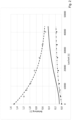
- the diagram shown shows the experimentally determined loadings of the two phases.
- the mass loading is plotted over the course of the test in the diagram.
- the square dots ( ⁇ ) refer to the aqueous phase
- the round dots (•) refer to the organic phase.
- the loading for the aqueous phase is shown as a dashed line after being arithmetically interpolated.
- the loading for the organic phase is shown as a dot-dash line after being arithmetically interpolated.
- the calculated equilibrium line for the aqueous phase is shown as a solid line.
- Tables 1a to 1d The most important test data are shown in Tables 1a to 1d.
- Table 1a shows the batches used in the test
- Table 1b shows the flow rates in the test procedure
- Table 1c sets out the general procedural instructions.
- the test results are compiled in Table 1d.
- phase Remark Keep 1L stopper solution (water with 500ppm 4-HT) ready trial time PIR301 PIR302 PIR303 differential pressure was standing was standing FIR 202 FIR 204 lumens on lumens off shell one lumens shell dense lumens dense shell uh:mm mbar mbar mbar cm cm g/mL g/mL 1,070 1.01 1,024 0.046 5 15 1,043 0.861 1 1,070 1.01 1.018 0.052 5.3 14.6 1,042 0.862 2 1.055 1.01 1.016 0.039 6.2 14 1,041 0.863 3 1,064 1.01 1.016 0.048 7.2 13.6 1,039 0.864 4 1,061 1.01 1.018 0.043 7.9 13.5 1,039 0.868 5 1,060 1.01 1.018 0.042 8.4 13 1,039 0.870 6 1,064 1.01 1.019 0.045 9 12.8 1,039 0.872 7 1,064 1.01 1.019 0.045 9.3
- the extraction was carried out in shaking experiments without a membrane. These were carried out with different concentrations of acrylic acid in water and toluene as the extraction agent in a ratio of 2:1 (water:toluene). With the same energy input, the two-phase solutions of acrylic acid, water and toluene (stabilized with 4-HT) were dispersed and the settling behavior was then observed.
- the height at which the phase boundary was located is plotted against the time after dispersion.
- the height is related to the total filling height and is therefore dimensionless.
- the time is given in seconds.
- the round points ( ⁇ ) refer to the measuring points with 1% acrylic acid (AA)
- the square points ( ⁇ ) refer to the measuring points with 10% acrylic acid (AA)
- the crossed points (x) refer on the measuring points with 40% acrylic acid (AA).
- the respective points form a sedimentation line (not shown).
Landscapes
- Chemical & Material Sciences (AREA)
- Organic Chemistry (AREA)
- Engineering & Computer Science (AREA)
- Oil, Petroleum & Natural Gas (AREA)
- Crystallography & Structural Chemistry (AREA)
- Organic Low-Molecular-Weight Compounds And Preparation Thereof (AREA)
Priority Applications (4)
| Application Number | Priority Date | Filing Date | Title |
|---|---|---|---|
| EP22158781.9A EP4234531A1 (fr) | 2022-02-25 | 2022-02-25 | Séparation de l'acide acrylique à l'aide des contacteurs à membrane |
| PCT/EP2023/053747 WO2023161095A1 (fr) | 2022-02-25 | 2023-02-15 | Séparation d'acide acrylique à l'aide de contacteurs à membrane |
| EP23704207.2A EP4482818B1 (fr) | 2022-02-25 | 2023-02-15 | Séparation de l'acide acrylique à l'aide des contacteurs à membrane |
| US18/841,337 US20250162970A1 (en) | 2022-02-25 | 2023-02-15 | Separation of acrylic acid with the aid of membrane contactors |
Applications Claiming Priority (1)
| Application Number | Priority Date | Filing Date | Title |
|---|---|---|---|
| EP22158781.9A EP4234531A1 (fr) | 2022-02-25 | 2022-02-25 | Séparation de l'acide acrylique à l'aide des contacteurs à membrane |
Publications (1)
| Publication Number | Publication Date |
|---|---|
| EP4234531A1 true EP4234531A1 (fr) | 2023-08-30 |
Family
ID=80461922
Family Applications (2)
| Application Number | Title | Priority Date | Filing Date |
|---|---|---|---|
| EP22158781.9A Withdrawn EP4234531A1 (fr) | 2022-02-25 | 2022-02-25 | Séparation de l'acide acrylique à l'aide des contacteurs à membrane |
| EP23704207.2A Active EP4482818B1 (fr) | 2022-02-25 | 2023-02-15 | Séparation de l'acide acrylique à l'aide des contacteurs à membrane |
Family Applications After (1)
| Application Number | Title | Priority Date | Filing Date |
|---|---|---|---|
| EP23704207.2A Active EP4482818B1 (fr) | 2022-02-25 | 2023-02-15 | Séparation de l'acide acrylique à l'aide des contacteurs à membrane |
Country Status (3)
| Country | Link |
|---|---|
| US (1) | US20250162970A1 (fr) |
| EP (2) | EP4234531A1 (fr) |
| WO (1) | WO2023161095A1 (fr) |
Citations (6)
| Publication number | Priority date | Publication date | Assignee | Title |
|---|---|---|---|---|
| DE2364679A1 (de) * | 1973-01-02 | 1974-07-04 | Allied Chem | Membranloesungsmittelextraktionsverfahren |
| US5635071A (en) | 1995-01-20 | 1997-06-03 | Zenon Airport Enviromental, Inc. | Recovery of carboxylic acids from chemical plant effluents |
| EP1070700A2 (fr) * | 1999-07-23 | 2001-01-24 | Rohm And Haas Company | Procédé de capacité améliorée pour la préparation et purification de l'acide acrylique à partir du propylène |
| EP1466885A2 (fr) | 1999-07-23 | 2004-10-13 | Rohm And Haas Company | Procédé de capacité améliorée pour la préparation et purification de l'acide acrylique à partir du propylène |
| WO2008088293A1 (fr) | 2007-01-18 | 2008-07-24 | Hyflux Membrane Manufacturing (S) Pte Ltd | Contacteur à membrane |
| EP3444021B1 (fr) | 2017-08-16 | 2020-04-15 | MemO3 GmbH | Dispositif de traitement d'un fluide et procédé de fabrication d'un tel dispositif |
-
2022
- 2022-02-25 EP EP22158781.9A patent/EP4234531A1/fr not_active Withdrawn
-
2023
- 2023-02-15 EP EP23704207.2A patent/EP4482818B1/fr active Active
- 2023-02-15 US US18/841,337 patent/US20250162970A1/en active Pending
- 2023-02-15 WO PCT/EP2023/053747 patent/WO2023161095A1/fr not_active Ceased
Patent Citations (6)
| Publication number | Priority date | Publication date | Assignee | Title |
|---|---|---|---|---|
| DE2364679A1 (de) * | 1973-01-02 | 1974-07-04 | Allied Chem | Membranloesungsmittelextraktionsverfahren |
| US5635071A (en) | 1995-01-20 | 1997-06-03 | Zenon Airport Enviromental, Inc. | Recovery of carboxylic acids from chemical plant effluents |
| EP1070700A2 (fr) * | 1999-07-23 | 2001-01-24 | Rohm And Haas Company | Procédé de capacité améliorée pour la préparation et purification de l'acide acrylique à partir du propylène |
| EP1466885A2 (fr) | 1999-07-23 | 2004-10-13 | Rohm And Haas Company | Procédé de capacité améliorée pour la préparation et purification de l'acide acrylique à partir du propylène |
| WO2008088293A1 (fr) | 2007-01-18 | 2008-07-24 | Hyflux Membrane Manufacturing (S) Pte Ltd | Contacteur à membrane |
| EP3444021B1 (fr) | 2017-08-16 | 2020-04-15 | MemO3 GmbH | Dispositif de traitement d'un fluide et procédé de fabrication d'un tel dispositif |
Non-Patent Citations (1)
| Title |
|---|
| OHARA, TSATO, T.SHIMIZU, N.PRESCHER, G.SCHWIND, H.WEIBERG, O.MARTEN, K.GREIM, H.SHAFFER, T.D.NANDI, P.: "Ullmann's Encyclopedia of Industrial Chemistry", 2021, article "Acrylic Acid and Derivatives" |
Also Published As
| Publication number | Publication date |
|---|---|
| WO2023161095A1 (fr) | 2023-08-31 |
| US20250162970A1 (en) | 2025-05-22 |
| EP4482818A1 (fr) | 2025-01-01 |
| EP4482818B1 (fr) | 2026-04-01 |
Similar Documents
| Publication | Publication Date | Title |
|---|---|---|
| EP1492755B1 (fr) | Cristal d'acide (meth)acrylique et procede pour produire et purifier de l'acide (meth)acrylique aqueux | |
| DE69629214T2 (de) | Veresterung von aus fermentation erhaltenen säuren mittel pervaporation | |
| EP2280922B1 (fr) | Procédé de fabrication et de lavage de phases aqueuses | |
| DE69001968T2 (de) | Verfahren zur erzeugung von wasserstoffperoxyd. | |
| EP1349826A1 (fr) | Procede continu pour la production et la purification d'acide (meth)acrylique | |
| EP2817284B1 (fr) | Procédé et dispositif destinés à l'hydroformylation d'isobutène et à la séparation du mélange de produits | |
| CH687004A5 (de) | Membranreaktor fuer die Umsetzung von gasfoermigen Ausgangsstoffen. | |
| DE60015538T2 (de) | Rückgewinnungssystem von aethylen | |
| DE102008042009A1 (de) | Verfahren zum Betreiben einer kontinuierlichen Abtrennung eines Zielproduktes X in Form von feinteiligem Kristallisat des Zielproduktes X | |
| DE19542287A1 (de) | Verfahren zur Herstellung von di- und höheroxidierten Carbonsäuren von Kohlenhydraten, Kohlenhydratderivaten oder primären Alkoholen | |
| DE60001862T2 (de) | Verfahren zur abtrennung und rückgewinnung von phenolischen verbindungen aus wässrigen flüssigkeiten | |
| EP0532905A2 (fr) | Procédé de séparation d'un mélange liquide | |
| EP1524277B1 (fr) | Procédé de préparation d'élastomères purifiées à partir d'une solution | |
| DE1467142C3 (de) | Verfahren zur Abtrennung von Chlorwasserstoffgas aus einem bei der katalytischen Oxydation von Chlorwasserstoffgas mit einem sauerstoffhaltigen Gas erhaltenen Gasgemisch | |
| EP4234531A1 (fr) | Séparation de l'acide acrylique à l'aide des contacteurs à membrane | |
| DE69723294T2 (de) | Materialien behandlung | |
| EP2294060B1 (fr) | Procédé pour séparer l acide fumarique d autres composants secondaires lors de la production d anhydride d acide maléique | |
| WO1994012456A1 (fr) | Procede de separation par pervaporation d'un melange de methanol et de tetrahydrofurane | |
| DE602005004939T2 (de) | Epoxidierung von propylen, bei der eine membran zur abtrennung des phospin- und/oder phosphinoxidpromotors vom produkt verwendet wird | |
| DE69506503T2 (de) | Methode zur Reinigung von Wasserstoffperoxid | |
| AT401935B (de) | Verfahren zur selektiven an- oder abreicherung flüchtiger bestandteile eines fluidgemisches | |
| DE2015781A1 (de) | Verfahren zur Entfernung der Syntheserückstände aus einer Harnstofflösung | |
| DE102010031507A1 (de) | Verfahren zur Reinigung kristalliner Phasen aus Produktgemischen mittels Schichtkristallisation | |
| DE1467141C3 (de) | Verfahren zur Abtrennung von Chlorwasserstoff aus dem bei der katalytischer Oxydation von Chlorwasserstoffgas mit einem sauerstoffhaltigen Gas erhaltenen Gasgemisch | |
| AT226207B (de) | Verfahren zur Isolierung von hochkonzentriertem Isopren |
Legal Events
| Date | Code | Title | Description |
|---|---|---|---|
| PUAI | Public reference made under article 153(3) epc to a published international application that has entered the european phase |
Free format text: ORIGINAL CODE: 0009012 |
|
| STAA | Information on the status of an ep patent application or granted ep patent |
Free format text: STATUS: THE APPLICATION HAS BEEN PUBLISHED |
|
| AK | Designated contracting states |
Kind code of ref document: A1 Designated state(s): AL AT BE BG CH CY CZ DE DK EE ES FI FR GB GR HR HU IE IS IT LI LT LU LV MC MK MT NL NO PL PT RO RS SE SI SK SM TR |
|
| STAA | Information on the status of an ep patent application or granted ep patent |
Free format text: STATUS: THE APPLICATION IS DEEMED TO BE WITHDRAWN |
|
| 18D | Application deemed to be withdrawn |
Effective date: 20240301 |