EP4234704A2 - Cellule recombinante et procédé de production d'isoprène - Google Patents
Cellule recombinante et procédé de production d'isoprène Download PDFInfo
- Publication number
- EP4234704A2 EP4234704A2 EP23169866.3A EP23169866A EP4234704A2 EP 4234704 A2 EP4234704 A2 EP 4234704A2 EP 23169866 A EP23169866 A EP 23169866A EP 4234704 A2 EP4234704 A2 EP 4234704A2
- Authority
- EP
- European Patent Office
- Prior art keywords
- recombinant cell
- nucleic acid
- isoprene
- recombinant
- acid encoding
- Prior art date
- Legal status (The legal status is an assumption and is not a legal conclusion. Google has not performed a legal analysis and makes no representation as to the accuracy of the status listed.)
- Pending
Links
Images
Classifications
-
- C—CHEMISTRY; METALLURGY
- C12—BIOCHEMISTRY; BEER; SPIRITS; WINE; VINEGAR; MICROBIOLOGY; ENZYMOLOGY; MUTATION OR GENETIC ENGINEERING
- C12P—FERMENTATION OR ENZYME-USING PROCESSES TO SYNTHESISE A DESIRED CHEMICAL COMPOUND OR COMPOSITION OR TO SEPARATE OPTICAL ISOMERS FROM A RACEMIC MIXTURE
- C12P5/00—Preparation of hydrocarbons or halogenated hydrocarbons
- C12P5/007—Preparation of hydrocarbons or halogenated hydrocarbons containing one or more isoprene units, i.e. terpenes
-
- C—CHEMISTRY; METALLURGY
- C12—BIOCHEMISTRY; BEER; SPIRITS; WINE; VINEGAR; MICROBIOLOGY; ENZYMOLOGY; MUTATION OR GENETIC ENGINEERING
- C12N—MICROORGANISMS OR ENZYMES; COMPOSITIONS THEREOF; PROPAGATING, PRESERVING, OR MAINTAINING MICROORGANISMS; MUTATION OR GENETIC ENGINEERING; CULTURE MEDIA
- C12N9/00—Enzymes; Proenzymes; Compositions thereof; Processes for preparing, activating, inhibiting, separating or purifying enzymes
- C12N9/0004—Oxidoreductases (1.)
- C12N9/0008—Oxidoreductases (1.) acting on the aldehyde or oxo group of donors (1.2)
-
- C—CHEMISTRY; METALLURGY
- C12—BIOCHEMISTRY; BEER; SPIRITS; WINE; VINEGAR; MICROBIOLOGY; ENZYMOLOGY; MUTATION OR GENETIC ENGINEERING
- C12N—MICROORGANISMS OR ENZYMES; COMPOSITIONS THEREOF; PROPAGATING, PRESERVING, OR MAINTAINING MICROORGANISMS; MUTATION OR GENETIC ENGINEERING; CULTURE MEDIA
- C12N9/00—Enzymes; Proenzymes; Compositions thereof; Processes for preparing, activating, inhibiting, separating or purifying enzymes
- C12N9/88—Lyases (4.)
-
- C—CHEMISTRY; METALLURGY
- C12—BIOCHEMISTRY; BEER; SPIRITS; WINE; VINEGAR; MICROBIOLOGY; ENZYMOLOGY; MUTATION OR GENETIC ENGINEERING
- C12Y—ENZYMES
- C12Y302/00—Hydrolases acting on glycosyl compounds, i.e. glycosylases (3.2)
- C12Y302/01—Glycosidases, i.e. enzymes hydrolysing O- and S-glycosyl compounds (3.2.1)
-
- C—CHEMISTRY; METALLURGY
- C12—BIOCHEMISTRY; BEER; SPIRITS; WINE; VINEGAR; MICROBIOLOGY; ENZYMOLOGY; MUTATION OR GENETIC ENGINEERING
- C12Y—ENZYMES
- C12Y102/00—Oxidoreductases acting on the aldehyde or oxo group of donors (1.2)
- C12Y102/07—Oxidoreductases acting on the aldehyde or oxo group of donors (1.2) with an iron-sulfur protein as acceptor (1.2.7)
- C12Y102/07004—Carbon-monoxide dehydrogenase (ferredoxin) (1.2.7.4)
-
- C—CHEMISTRY; METALLURGY
- C12—BIOCHEMISTRY; BEER; SPIRITS; WINE; VINEGAR; MICROBIOLOGY; ENZYMOLOGY; MUTATION OR GENETIC ENGINEERING
- C12Y—ENZYMES
- C12Y102/00—Oxidoreductases acting on the aldehyde or oxo group of donors (1.2)
- C12Y102/99—Oxidoreductases acting on the aldehyde or oxo group of donors (1.2) with other acceptors (1.2.99)
- C12Y102/99002—Carbon-monoxide dehydrogenase (acceptor) (1.2.99.2)
-
- C—CHEMISTRY; METALLURGY
- C12—BIOCHEMISTRY; BEER; SPIRITS; WINE; VINEGAR; MICROBIOLOGY; ENZYMOLOGY; MUTATION OR GENETIC ENGINEERING
- C12Y—ENZYMES
- C12Y402/00—Carbon-oxygen lyases (4.2)
- C12Y402/03—Carbon-oxygen lyases (4.2) acting on phosphates (4.2.3)
- C12Y402/03027—Isoprene synthase (4.2.3.27)
-
- Y—GENERAL TAGGING OF NEW TECHNOLOGICAL DEVELOPMENTS; GENERAL TAGGING OF CROSS-SECTIONAL TECHNOLOGIES SPANNING OVER SEVERAL SECTIONS OF THE IPC; TECHNICAL SUBJECTS COVERED BY FORMER USPC CROSS-REFERENCE ART COLLECTIONS [XRACs] AND DIGESTS
- Y02—TECHNOLOGIES OR APPLICATIONS FOR MITIGATION OR ADAPTATION AGAINST CLIMATE CHANGE
- Y02E—REDUCTION OF GREENHOUSE GAS [GHG] EMISSIONS, RELATED TO ENERGY GENERATION, TRANSMISSION OR DISTRIBUTION
- Y02E50/00—Technologies for the production of fuel of non-fossil origin
- Y02E50/30—Fuel from waste, e.g. synthetic alcohol or diesel
Definitions
- the present invention relates to a recombinant cell capable of producing isoprene from a specific C1 compound such as carbon monoxide, and a method for producing isoprene using the recombinant cell.
- Isoprene is a monomer raw material for synthetic polyisoprene, and is an important material, in particular, in the tire industry.
- the technique for conversion from a production process of basic chemicals relying on petroleum to a production process from renewable resources such as plant resources has been developed and practical realization thereof is steadily progressing.
- isoprene for example, a production technique from saccharides as a raw material by recombinant Escherichia coli is known (Patent Documents 1 and 2).
- Syngas is a mixed gas mainly containing carbon monoxide, carbon dioxide, and hydrogen, which is efficiently obtained from waste, natural gas and coal by action of a metal catalyst under high temperature and high pressure.
- a process for mass production of liquid chemicals such as methanol, formic acid and formaldehyde at low costs has been developed.
- Patent Document 3 discloses a production technique of isopropanol by a recombinant of Escherichia coli. In this technique, a plurality of CO metabolic enzyme genes are introduced into Escherichia coli to impart a syngas utilizing ability, and isopropanol is produced from syngas. However, this technique does not relate to production of isoprene.
- an object of the present invention is to provide a series of techniques capable of producing isoprene from syngas or the like.
- One aspect of the present invention for solving the aforementioned problem is a recombinant cell prepared by introducing a nucleic acid encoding isoprene synthase into a host cell having an isopentenyl diphosphate synthesis ability by a non-mevalonate pathway, wherein the nucleic acid is expressed in the host cell, and the recombinant cell is capable of producing isoprene from at least one C1 compound selected from the group consisting of carbon monoxide, carbon dioxide, formic acid, and methanol.
- the present invention relates to a recombinant cell capable of producing isoprene.
- the recombinant cell of the present invention is prepared by introducing a nucleic acid encoding isoprene synthase into a host cell having an "isopentenyl diphosphate synthesis ability by a non-mevalonate pathway", and the nucleic acid is expressed in the host cell.
- the recombinant cell is capable of producing isoprene from at least one C1 compound selected from the group consisting of carbon monoxide, carbon dioxide, formic acid, and methanol.
- the recombinant cell of the present invention it is possible to synthesize isopentenyl diphosphate (IPP) from the C1 compound, and further to convert the synthesized IPP to isoprene. As a result, it is possible to produce isoprene from the C1 compound.
- IPP isopentenyl diphosphate
- isoprene from syngas containing carbon monoxide and/or carbon dioxide.
- Isoprenoid biosynthesis pathways are generally classified into a mevalonate pathway (also referred to as MVA pathway) and a non-mevalonate pathway (also referred to as MEP pathway).
- the non-mevalonate pathway is a pathway of eventually generating isopentenyl diphosphate (IPP) or dimethylallyl diphosphate (DMAPP) from glyceraldehyde 3-phosphate and pyruvic acid.
- the host cell for use in the present invention has an isopentenyl diphosphate synthesis ability by a non-mevalonate pathway.
- Another aspect of the present invention is a recombinant cell prepared by introducing a nucleic acid encoding isoprene synthase into a host cell having a function of synthesizing acetyl CoA from methyltetrahydrofolate, carbon monoxide, and CoA, wherein the nucleic acid is expressed in the host cell, and the recombinant cell is capable of producing isoprene from at least one C1 compound selected from the group consisting of carbon monoxide, carbon dioxide, formic acid, and methanol.
- the recombinant cell of the present invention is prepared by introducing a nucleic acid encoding isoprene synthase into a host cell having a "function of synthesizing acetyl CoA from methyltetrahydrofolate, carbon monoxide, and CoA", and the nucleic acid is expressed in the host cell.
- the recombinant cell is capable of producing isoprene from at least one C1 compound selected from the group consisting of carbon monoxide, carbon dioxide, formic acid, and methanol. Also by the recombinant cell of the present invention, it is possible to synthesize IPP from the C1 compound, and further to convert the synthesized IPP to isoprene.
- isoprene from the C1 compound.
- isoprene for example, from syngas containing carbon monoxide and/or carbon dioxide.
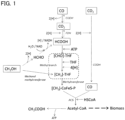
- Examples of the cell having a "function of synthesizing acetyl CoA from methyltetrahydrofolate, carbon monoxide, and CoA" include anaerobic microorganisms having an acetyl CoA pathway (Wood-Ljungdahl pathway) and a methanol pathway shown in Fig. 1 .
- the recombinant cell has carbon monoxide dehydrogenase.
- Carbon monoxide dehydrogenase (EC 1.2.99.2/1.2.7.4) (CO dehydrogenase, CODH) has an activity of generating carbon dioxide and proton from carbon monoxide and water, and an activity of generating carbon monoxide and water from carbon dioxide and proton, which is a reverse reaction.
- the carbon monoxide dehydrogenase is one of enzymes that act in the acetyl CoA pathway ( Fig. 1 ).
- the host cell is a Clostridium bacterium or a Moorella bacterium.
- a nucleic acid encoding a group of enzymes acting in a mevalonate pathway is further introduced so that an isopentenyl diphosphate synthesis ability by a mevalonate pathway is further imparted.
- IPP that is to be a substrate for isoprene synthase is synthesized both in a mevalonate pathway and in a non-mevalonate pathway, so that IPP is supplied efficiently.
- the recombinant cell of the present invention has a higher isoprene producing ability.
- the mevalonate pathway is that of yeast.
- the mevalonate pathway is that of prokaryote.
- the mevalonate pathway is that of actinomycete.
- a nucleic acid encoding at least one enzyme acting in a non-mevalonate pathway is further introduced, and the nucleic acid is expressed in the host cell.
- the recombinant cell of the present invention has a higher isoprene producing ability.
- the non-mevalonate pathway is that of other organisms than the host cell.
- the isoprene synthase is derived from plant.
- the nucleic acid encoding isoprene synthase encodes the following (a), (b) or (c):
- the nucleic acid introduced into the host cell is codon-modified.
- the nucleic acid introduced into the host cell is incorporated in a genome of the host cell.
- the nucleic acid introduced into the host cell is incorporated in a plasmid.
- Another aspect of the present invention is a method for producing isoprene by culturing the recombinant cell using at least one C1 compound selected from the group consisting of carbon monoxide, carbon dioxide, formic acid, and methanol as a carbon source, to allow the recombinant cell to produce isoprene.
- the present invention relates to a method for producing isoprene.
- the recombinant cell by culturing the recombinant cell using at least one C1 compound selected from the group consisting of carbon monoxide, carbon dioxide, formic acid, and methanol as a carbon source, the recombinant cell is allowed to produce isoprene.
- the present invention it is possible to produce isoprene from syngas containing carbon monoxide and/or carbon dioxide, formic acid, or methanol.
- Another aspect of the present invention is a method for producing isoprene by bringing at least one C1 compound selected from the group consisting of carbon monoxide, carbon dioxide, formic acid, and methanol into contact with the recombinant cell, to allow the recombinant cell to produce isoprene from the C1 compound.
- the recombinant cell by bringing at least one C1 compound selected from the group consisting of carbon monoxide, carbon dioxide, formic acid, and methanol into contact with the recombinant cell, the recombinant cell is allowed to produce isoprene from the C1 compound. Also according to the present invention, it is possible to produce isoprene from syngas containing carbon monoxide and/or carbon dioxide, formic acid, or methanol.
- the recombinant cell is provided with a gas mainly containing carbon monoxide and hydrogen, or a gas mainly containing carbon dioxide and hydrogen.
- the wording "provide the recombinant cell with a gas” means giving to the recombinant cell a gas as a carbon source or the like, or bringing the gas into contact with the recombinant cell.
- the recombinant cell is prepared from a Clostridium bacterium or a Moorella bacterium as a host cell, and isoprene released outside the recombinant cell is recovered.
- Bicarbonate may be used in place of carbon dioxide.
- isoprene from carbon monoxide, carbon dioxide, formic acid, or methanol.
- isoprene from syngas containing carbon monoxide and/or carbon dioxide.
- isoprene from carbon monoxide, carbon dioxide, formic acid, or methanol.
- a recombinant cell according to one aspect of the present invention is prepared by introducing a nucleic acid encoding isoprene synthase into a host cell having an isopentenyl diphosphate (IPP) synthesis ability by a non-mevalonate pathway, and the nucleic acid is expressed in the host cell, and the recombinant cell is capable of producing isoprene from at least one C1 compound selected from the group consisting of carbon monoxide, carbon dioxide, formic acid, and methanol.
- IPP isopentenyl diphosphate
- the host cell in the recombinant cell of the present aspect has an "IPP synthesis ability by a non-mevalonate pathway".
- synthesis pathways of IPP are generally classified into a mevalonate pathway (MVA pathway) and a non-mevalonate pathway (MEP pathway).
- the mevalonate pathway is inherent in eukaryotes, and starts with acetyl CoA as a starting substance.
- Enzymes acting in the mevalonate pathway include, in the order from the upstream, acetyl CoA acetyl transferase, HMG-CoA synthase, HMG-CoA reductase, mevalonate kinase, 5-phosphomevalonate kinase, diphosphomevalonate decarboxylase, and isopentenyl diphosphate isomerase.
- the non-mevalonate pathway is inherent in prokaryotes and chloroplasts and plastids, and starts with glyceraldehyde 3-phosphate and pyruvic acid as starting substances.
- Enzymes acting in the non-mevalonate pathway include, in the order from the upstream, DOXP synthase, DOXP reductoisomerase, 4-diphosphocytidyl-2-C-methyl-D-erythritol synthase, 4-diphosphocytidyl-2-C-methyl-D-erythritol kinase, 2-C-methyl-D-erythritol-2,4-cyclodiphosphate synthase, HMB-PP synthase and HMB-PP reductase.
- a recombinant cell according to another aspect of the present invention is prepared by introducing a nucleic acid encoding isoprene synthase into a host cell having a function of synthesizing acetyl CoA from methyltetrahydrofolate, carbon monoxide, and CoA, and the nucleic acid is expressed in the host cell, and the recombinant cell is capable of producing isoprene from at least one C1 compound selected from the group consisting of carbon monoxide, carbon dioxide, formic acid, and methanol.
- the recombinant cell of the present invention further has carbon monoxide dehydrogenase (CODH).
- CODH carbon monoxide dehydrogenase
- a cell that grows by a function of generating carbon dioxide and proton from carbon monoxide and water mainly by carbon monoxide metabolism, namely, by the action of carbon monoxide dehydrogenase is preferred.
- Examples of such a cell include anaerobic microorganisms having an acetyl CoA pathway (Wood-Ljungdahl pathway) and a methanol pathway (Methanol pathway) shown in Fig. 1 .
- Clostridium bacteria or Moorella bacteria such as Clostridium ljungdahlii, Clostridium autoethanogenumn, Clostridium carboxidivorans, Clostridium ragsdalei ( Kopke M. et al., Appl. Environ. Microbiol. 2011, 77(15), 5467-5475 ), and Moorella thermoacetica (same as Clostridium thermoaceticum) ( Pierce EG. Et al., Environ. Microbiol. 2008, 10, 2550-2573 ).
- Clostridium bacteria are preferred as the host cell in the present invention because their host-vector systems and culture methods have been established.
- Clostridium bacteria or Moorella bacteria recited above are known as representative examples of syngas utilizing microorganisms.
- oxygen insensitive CODH exists in other bacterial species represented by Oligotropha carboxidovorans ( Schubel, U. et al., J. Bacteriol., 1995, 2197-2203 ), and Bradyrhizobium japonicum ( Lorite MJ. Et al., Appl. Environ. Microbiol., 2000, 66(5), 1871-1876 ) ( King GM et al., Appl. Environ. Microbiol. 2003, 69 (12), 7257-7265 ). Also in Ralsotonia bacteria which are aerobic hydrogen oxidizing bacteria, oxygen insensitive CODH exists (NCBI Gene ID: 4249199, 8019399).
- the host cell for use in the present invention can be appropriately selected therefrom.
- a selective medium containing CO, CO/H 2 (gas mainly containing CO and H 2 ), or CO/CO 2 /H 2 (gas mainly containing CO, CO 2 and H 2 ) as the sole carbon source and energy source
- a bacterium having CODH that is usable as the host cell can be isolated in anaerobic, microaerobic or aerobic conditions.
- the isoprene synthase is not particularly limited as far as it can exert its enzyme activity in the recombinant cell.
- the nucleic acid (gene) encoding isoprene synthase is not particularly limited insofar as it is normally transcribed and translated in the recombinant cell.
- the nucleic acid encoding isoprene synthase may be codon-modified for ease of transcription in the host cell. For example, when the host cell is a Clostridium bacterium, the codon of the nucleic acid to be introduced may be modified based on the information of codon usage of Clostridium bacteria.
- Isoprene synthase is found in many plants. Specific examples of isoprene synthase include one derived from poplar (Populus nigra) (GenBank Accession No.: AM410988.1). Besides the above, one derived from Bacillus subtilis ( Sivy TL. et al., Biochem. Biophys. Res. Commu. 2002, 294(1), 71-5 ) can be recited.
- SEQ ID NO: 1 shows a nucleotide sequence of a nucleic acid (DNA) encoding the isoprene synthase derived from poplar and a corresponding amino acid sequence.
- SEQ ID NO: 2 shows only the amino acid sequence.
- DNA having the nucleotide sequence represented by SEQ ID NO: 1 is one example of the nucleic acid encoding isoprene synthase.
- nucleic acid encoding isoprene synthase includes at least a nucleic acid encoding the following (a), (b) or (c):
- the homology of an amino acid sequence in (c) is more preferably 80% or more, further preferably 90% or more, and particularly preferably 95% or more.
- nucleic acid may be further introduced in addition to the nucleic acid encoding isoprene synthase.
- a nucleic acid encoding a group of enzymes acting in a mevalonate pathway is further introduced, so that an IPP synthesis ability by a mevalonate pathway is further imparted.
- IPP is synthesized both in a mevalonate pathway and in a non-mevalonate pathway, the IPP synthesis ability is enhanced, and as a result, isoprene is produced more efficiently.
- acetyl CoA acetyl transferase As described above, as the group of enzymes acting in a mevalonate pathway, acetyl CoA acetyl transferase, HMG-CoA synthase, HMG-CoA reductase, mevalonate kinase, 5-phosphomevalonate kinase, diphosphomevalonate decarboxylase, and isopentenyl diphosphate isomerase can be recited.
- a nucleic acid to be introduced may be selected among these so that a group of enzymes consisting, for example, of HMG-CoA synthase, HMG-CoA reductase, mevalonate kinase, 5-phosphomevalonate kinase, diphosphomevalonate decarboxylase, and isopentenyl diphosphate isomerase is expressed in the host cell.
- a group of enzymes consisting, for example, of HMG-CoA synthase, HMG-CoA reductase, mevalonate kinase, 5-phosphomevalonate kinase, diphosphomevalonate decarboxylase, and isopentenyl diphosphate isomerase is expressed in the host cell.
- a group of enzymes consisting, for example, of HMG-CoA synthase, HMG-CoA reductase, mevalonate kinase, 5-phosphomevalonate kinase, diphosphomevalon
- the mevalonate pathway is inherent in all eukaryotes, but is also found in prokaryotes.
- Streptomyces sp. Strain CL190 Takagi M. et al., J. Bacteriol. 2000, 182 (15), 4153-7
- Streptomyces griseolosporeus MF730-N6 Hamano Y. et al., Biosci. Biotechnol. Biochem. 2001, 65(7), 1627-35 ) are recited with respect to actinomycetes.
- Lactobacillus helvecticus Smeds A et al., DNA seq. 2001, 12(3), 187-190
- Corynebacterium amycolatum Mycobacterium marinum
- Bacillus coagulans Enterococcus faecalis
- Streptococuss agalactiae Myxococcus xanthus and so on are recited ( Lombard J. et al., Mol. Biol. Evol. 2010, 28(1), 87-99 ).
- the origin of the group of enzymes acting in a mevalonate pathway is not particularly limited, however, a group of enzymes acting in a mevalonate pathway of yeast is preferred. Also, a group of enzymes acting in a mevalonate pathway of actinomycete is preferably employed.
- a nucleic acid encoding at least one enzyme acting in a non-mevalonate pathway is further introduced, and the nucleic acid is expressed in the host cell. Also in this embodiment, the IPP synthesis ability is enhanced, and as a result, isoprene is produced more efficiently.
- One nucleic acid or two or more nucleic acids may be introduced.
- the enzymes acting in a non-mevalonate pathway include DOXP synthase, DOXP reductoisomerase, 4-diphosphocytidyl-2-C-methyl-D-erythritol synthase, 4-diphosphocytidyl-2-C-methyl-D-erythritol kinase, 2-C-methyl-D-erythritol-2,4-cyclodiphosphate synthase, HMB-PP synthase, and HMB-PP reductase.
- one enzyme or two or more enzymes may be selected from the above group of enzymes, and then a nucleic acid encoding the selected enzymes may be introduced into the host cell.
- the enzymes acting in a non-mevalonate pathway are preferably derived from other organisms than the host cell. With such a constitution, it is possible to avoid reaction suppression by a reaction product.
- nucleic acid one that is codon-modified for ease of transcription in the host cell may be employed.
- the enzymes acting in a mevalonate pathway or in a non-mevalonate pathway may be naturally occurring enzymes or enzymes modified therefrom.
- amino acid substitution variants of each enzyme, and polypeptides that are partial fragments of each enzyme and have equivalent enzyme activity are also applicable.
- the technique for introducing a nucleic acid into the host cell is not particularly limited, and can be appropriately selected depending on the kind of the host cell and the like.
- a vector that can be introduced into the host cell and can allow expression of the nucleic acid incorporated therein may be used.
- the host cell when the host cell is a prokaryote such as a bacterium, a vector that can self duplicate or can be incorporated in chromosome in the host cell, and contains a promoter at the position allowing transcription of the inserted nucleic acid (DNA) may be used.
- a vector that can self duplicate or can be incorporated in chromosome in the host cell and contains a promoter at the position allowing transcription of the inserted nucleic acid (DNA) may be used.
- it is preferred to construct in the host cell a series of structures including a promoter, a ribosome binding sequence, the above nucleic acid (DNA) and a transcription termination sequence by using the vector.
- a shuttle vector pIMP1 between Clostridium bacterium and Escherichia coli may be used.
- the shuttle vector is a fusion vector of pUC9 (ATCC 37252) and pIM13 isolated from Bacillus subtilis ( Projan SJ et al., J. Bacteriol. 1987, 169 (11), 5131-5139 ) and is retained stably in the Clostridium bacterium.
- promoter for heterologous gene expression in Clostridium bacteria examples include thl (thiolase) promoter ( Perret S et al., J. Bacteriol. 2004, 186(1), 253-257 ), Dha (glycerol dehydratase) promoter ( Raynaud C. et al., PNAS 2003, 100(9), 5010-5015 ), ptb (phosphotransbutyrylase) promoter ( Desai RP et al., Appl. Environ. Microbiol. 1999, 65(3), 936-945 ), and adc (acetoacetate decarboxylase) promoter ( Lee J et al., Appl. Environ. Microbiol. 2012, 78 (5), 1416-1423 ).
- sequences of promoter regions used in operons of various metabolic systems found in the host cell or the like may be used without limited to the above examples.
- nucleic acids For introducing plural kinds of nucleic acids into the host cell by using a vector, the nucleic acids may be incorporated in one vector, or incorporated in individual vectors. When plural kinds of nucleic acids are incorporated in one vector, these nucleic acids may be expressed under a common promoter for these nucleic acids, or expressed under individual promoters.
- a mode of introducing "a nucleic acid encoding a group of enzymes acting in a mevalonate pathway" and "a nucleic acid encoding at least one enzyme acting in a non-mevalonate pathway” in addition to "a nucleic acid encoding isoprene synthase" can be recited.
- an exogenous nucleic acid may be incorporated in a genome of the host cell or incorporated in a plasmid.
- the recombinant cell is cultured using at least one C1 compound selected from the group consisting of carbon monoxide, carbon dioxide, formic acid, and methanol as a carbon source, to allow the recombinant cell to produce isoprene.
- the C1 compound used as a carbon source may be used singly or in combination of two or more.
- the C1 compound is preferably used as a main carbon source, and more preferably as the sole carbon source.
- the method for culturing the recombinant cell of the present invention is not particularly limited, and may be appropriately conducted depending on the kind of the host cell and the like.
- the recombinant cell is a Clostridium bacterium (strictly anaerobic)
- it is cultured, for example, in a nutrient condition including inorganic salts required for growth, and syngas.
- it is cultured under a pressurized condition at about 0.2 to 0.3MPa (absolute pressure).
- small amounts of organic substances such as vitamin, yeast extract, corn steep liquor, and Bacto Tryptone may be added.
- the recombinant cell When the recombinant cell is aerobic or obligately anaerobic, for example, it may be cultured in a liquid medium under aeration and stirring.
- At least one C1 compound selected from the group consisting of carbon monoxide, carbon dioxide, formic acid, and methanol is brought into contact with the recombinant cell, to allow the recombinant cell to produce isoprene from the C1 compound. That is, regardless of whether or not cell division (cell proliferation) associates, it is possible to bring the C1 compound into contact with the recombinant cell, to produce isoprene.
- the C1 compound may be continuously supplied to an immobilized recombinant cell to continuously produce isoprene.
- the C1 compound may be used singly or in combination of two or more. It is preferred to bring hydrogen (H 2 ) into contact concurrently as an energy source.
- the recombinant cell is provided with a gas mainly containing carbon monoxide and hydrogen, or a gas mainly containing carbon dioxide and hydrogen.
- isoprene is produced from carbon monoxide or carbon dioxide in such a gas by culturing the recombinant cell by using the gas as a carbon source, or by bringing the gas into contact with the recombinant cell.
- hydrogen is used as an energy source.
- Isoprene may be produced from formic acid and/or methanol by providing the recombinant cell with formic acid and/or methanol.
- isoprene can also be produced from formic acid and/or methanol by culturing the recombinant cell using, as a carbon source, formic acid or methanol solely or in addition to carbon monoxide and/or carbon dioxide, or by bringing formic acid and/or methanol into contact with the recombinant cell.
- the produced isoprene is accumulated in the cell or released outside the cell.
- the recombinant cell prepared from a host cell of a Clostridium bacterium or a Moorella bacterium and recovering isoprene released outside the cell, followed by isolation and purification, purified isoprene can be obtained.
- Bicarbonate can be sometimes used in place of carbon dioxide.
- Clostridium bacteria and related species are known to have carbonic anhydrase (CA) (EC 4.2.1.1: H 2 O + CO 2 ⁇ HCO 3 - + H + ) ( Braus-Stromeyer SA et al., J. Bacteriol. 1997, 179(22), 7197-7200 ).
- Bicarbonate such as NaHCO 3 which is a source of HCO 3 - can be used as a CO 2 source.
- acetyl CoA synthesis by the acetyl CoA pathway a synthesis process of acetyl CoA from CoA, methyltetrahydrofolate ([CH 3 ]-THF), and CO by the actions of methyltransferase, Corrinoid iron-sulfur protein (CoFeS-P), acetyl CoA synthase (ACS), and CODH is essential ( Ragsdale SW et al., B.B.R.C. 2008, 1784(12), 1873-1898 ).
- the host cell strain Even if the host cell strain inherently lacks the forward activity of formate dehydrogenase, it may be provided with the forward activity by gene modification such as introduction of mutation, introduction of foreign gene, or genome shuffling.
- the recombinant cell of the present invention is cultured exclusively for cell proliferation, rather than for production of isoprene, it is not necessary to use carbon monoxide and/or carbon dioxide as a carbon source.
- the recombinant cell may be cultured using other carbon sources such as saccharides or glycerin.
- RNA derived from leaf of poplar Populus nigra
- a nucleic acid encoding isoprene synthase (IspS) from poplar IspS gene from poplar, SEQ ID NO: 1, GenBank Accession No.: AM410988.1
- the obtained amplified DNA fragment was cloned into pT7-Blue T vector (TAKARA BIO INC.) to construct pT7IS.
- the IspS gene was introduced into BamHI site of pIM1B to construct a vector pIMBIS to express poplar IspS.
- a promoter and a terminator region derived from pSOS95 lie upstream and downstream of the IspS gene, respectively.
- E. coli ER2275 (NEB), into which pAN1 encoding methyl transferase gene from Bacillus subtilis phage ⁇ 3TI ( Mermelstein LD et al., Appl. Environ. Microbiol., 1993, 59(4), 1077-1081 ) was introduced, with pIMBIS prepared in the above (1), in vivo methylation was conducted. Methylated pIMBIS was recovered from transformed E. coli ER2275. According to the method described in " BIO/TECHNOLOGY 1992, VOL. 10, 190-195 ", Clostridium ljungdahlii (DSM13528/ATCC55383) was transformed with the methylated pIMBIS by electroporation to obtain a recombinant.
- the recombinant of C. ljungdahlii obtained in the above (2) was cultured at 37°C in an aerobic condition.
- ATCC medium 1754 PETC medium containing 5 ⁇ g/mL of Clarithromycin and 20 ⁇ g/mL of Thiamphenicol (but not containing fructose and yeast extract) was used as a culture medium.
- a 100 mL-volume hermetically-sealable glass vessel was charged with 10 mL of culture medium, and filled with an oxygen-free gas at a gas pressure of 2.5 atmospheric pressure (absolute pressure), and hermetically sealed with an aluminum cap, and then shaking culture was conducted.
- a recombinant into which pIMB1 was introduced in place of pIMBIS was cultured in the same manner.
- the gas phase component after end of the culture was analyzed by GC/MS.
- isoprene was produced from syngas by culturing the recombinant of Clostridium ljungdahlii into which isoprene synthase gene from poplar was introduced.
- a nucleic acid encoding mevalonate pathway enzymes of S. griseolosporeus (SEQ ID NO: 9) was amplified by PCR using primers represented by SEQ ID NO: 10 and SEQ ID NO: 11.
- This nucleic acid includes a gene cluster encoding mevalonate kinase, mevalonate diphosphate decarboxylase, phosphomevalonate kinase, IPP isomerase, HMG-CoA (3-hydroxy-3-methylglutaryl coenzyme A) reductase (HMGR), and HMG-CoA synthase.
- the obtained amplified DNA fragment was cloned into pT7-Blue T vector to construct pT7SMV.
- pT7IS prepared in Example 1 a DNA fragment containing IspS gene from poplar was amplified by using primers represented by SEQ ID NO: 3 and SEQ ID NO: 12. This DNA fragment was cloned into pT7-Blue T vector to construct pT7IS2.
- pT7SMV was cut with KpnI to obtain an insert DNA fragment.
- This DNA fragment was introduced in KpnI site of pIMCIS to construct pIMCISMV.
- pIMCISMV has genes encoding isoprene synthase derived from poplar, and the group of mevalonate pathway enzymes derived from Streptomyces. Expression of these genes in pIMCISMV is regulated by a promoter and a terminator derived from pSOS95 ( Mingardon F et al., Appl. Envirion. Microbiol. 2005, 71(3), 1215-1222 ).
- Clostridium ljungdahlii (DSM13528/ATCC55383) was transformed with pIMCISMV subjected to a methylation treatment, in the same manner as in Example 1, to obtain a recombinant.
- the recombinant transformed with pIMCISMV was cultured by using any one of three kinds of mixed gases in the same manner as in Example 1.
- a recombinant into which pIM1C was introduced in place of pIMCISMV, and a recombinant having pIMBIS prepared in Example 1 were cultured in the same manner.
- the gas phase component after end of the culture was analyzed by GC/MS.
- the part spanning nucleotide numbers 165 to 713 corresponds to codon-modified IDI gene from Escherichia coli
- the part spanning nucleotide numbers 780 to 2567 corresponds to codon-modified IspS gene from poplar.
- nucleotide sequence of IDI gene from Escherichia coli before codon modification is shown in SEQ ID NO: 16.
- nucleotide sequence of IspS gene from poplar before codon modification is as shown in SEQ ID NO: 1.
- Clostridium ljungdahlii (DSM13528) was transformed with pIMAIS1 and pIMAIS2 subjected to a methylation treatment, in the same manner as in Example 1, to obtain recombinants IS1 and IS2, respectively.
- the recombinants IS1 and IS2 were cultured by using three kinds of mixed gases in the same manner as in Example 1.
- the gas phase component after end of the culture was analyzed by GC/MS.
- IspS isoprene synthase
- IDI isopentenyl diphosphate isomerase
- IspS IspS from Populus alba (GenBank accession no. Q50L36) and IDI from yeast were codon optimized using the codon usage pattern of C. acetobutylicum (SEQ ID NO: 17).
- the codon optimized IspS (SEQ ID NO: 17) and IDI gene were cloned into an Escherichia coli/Clostridium shuttle vector pSCi01 (SEQ ID NO: 18).
- the IspS gene and IDI gene were inserted between the inducible tetracycline promoter and fdx transcription terminator ( Nariya H. et al., Appl. Environ.
- an expression vector pSCi::idi-isps (SEQ ID NO: 19) in which expression of IspS and IDI was induced by anhydrotetracycline was constructed.
- Plasmid was amplified in Escherichia coli strain NEB Express (NEB). By being amplified in this host (DCM - , DAM + ), the plasmid exhibits the right methylation pattern, and can transform C. ljungdahlii efficiently.
- C. ljungdahlii (DSMZ No. 13528) was cultured under strict anaerobic conditions in YTF medium (16 g tryptone, 10 g yeast extract, 4 g NaCl, 2 mM cysteine and 5 g fructose / L, pH 5.9-6).
- YTF medium 16 g tryptone, 10 g yeast extract, 4 g NaCl, 2 mM cysteine and 5 g fructose / L, pH 5.9-6.
- the cells were grown in YTF medium supplemented with 40 mM D,L-threonine to OD600 of 0.2-0.3 and then washed with a SMP buffer (270 mM sucrose, 1 mM MgCl 2 , 7 mM sodium phosphate, pH 6) and resuspended in 0.5 mL of SMP buffer containing 10% DMSO.
- SMP buffer 270 mM sucrose, 1 mM MgCl 2 , 7 mM sodium phosphate, pH 6
- 3 ⁇ g of pSCi: :idi-ispS plasmid DNA was employed.
- a BioRad Micropulser TM electroporator system (Bio-Rad Laboratories) was used with the following setting: cuvette size 0.1 mm, voltage 0.625 kV, resistance 600 ⁇ , and capacity 25 ⁇ F. After 12 hours of regeneration in 1 mL of YTF medium, the cells were transferred to 25 mL of YTF medium containing 4 ⁇ g/mL clarithromycin and 4 ⁇ g/mL thiamphenicol. In a next step, 5-10 mL of the cell suspension was mixed with 20 mL of molten YTF-agar (1.5 % agar) and cultured for 3-5 days until colonies appeared. Individual clones were picked from agar plates and liquid cultured in YTF medium (supplemented with 4 ⁇ g/mL clarithromycin and 4 ⁇ g/mL thiamphenicol).
- the cultures were transferred to ATCC 1754 medium (supplemented with 4 ⁇ g/mL clarithromycin and 4 ⁇ g/mL thiamphenicol) containing syngas (60% CO, 10% CO 2 , 30% H 2 ) as the sole carbon source and energy source, and cultured in 50 mL of culture liquid in hermetically-sealed 200 mL glass bottle under a syngas pressure of 2 atmospheric pressure (absolute pressure).
- ATCC 1754 medium supplied with 4 ⁇ g/mL clarithromycin and 4 ⁇ g/mL thiamphenicol
- syngas 60% CO, 10% CO 2 , 30% H 2
- CAR/PDMS fiber For sampling out of a 200 mL bottle culture, 75 ⁇ m CAR/PDMS fiber (Sulpelco-Sigma Aldrich) was employed. Sampling was performed for 30 minutes at 22°C. After fiber injection into KAS6 (Gerstel), thermal desorption at 200°C was performed for 30 seconds. A ZB-624 column available from Phenomenex (30 m length; inner diameter 0.25 mm I.D.; 1.4 ⁇ m film thickness) was used to separate the gas components. The GC/MS/MS analysis parameters were set as follows.
- the fiber was treated at 300°C for 30 minutes by the next use.
- the mass spectrometer was operated in MRM (multiple reaction monitoring) mode. Two transitions were selected for isoprene: 68.1 m/z to 67.0 m/z and 67.1 m/z to 41.0 m/z, and argon was used as CID (collision induced dissociation) gas.
- isoprene Sigma Aldrich cat no. I19551 (99% purity) was used as an isoprene standard.
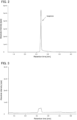
- the isoprene standard showed a retention time of 2.7 minutes and a characteristic mass transition pattern of 68.1 m/z to 67.0 m/z and 67.1 m/z to 41.0 m/z.
- a head space sample was taken and analyzed by GC/MS/MS.
- Fig. 3 shows a result of GC/MS/MS analysis in C. ljungdahlii carrying pSCi01 plasmid.
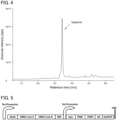
- Fig. 4 shows a result of GC/MS/MS analysis in C. ljungdahlii carrying pSCi::idi-ispS plasmid.
- Fig. 5 and SEQ ID NO: 20 show the design of the isoprene synthesis gene cluster of plasmid pSCi::MVA-IspS-idi. Accession numbers, abbreviations and source organisms of the codon optimized genes are listed in the following table.
- the MVA-IspS-idi gene cluster was inserted between the inducible tetracycline promoter and the fdx transcription terminator resulting in an anhydrotetracycline inducible expression system. Correct transgene expression from the constructed expression vector was assessed by targeted proteomics. Plasmid was amplified in Escherichia coli strain NEB Express (NEB).
- C. ljungdahlii (DSMZ No. 13528) was cultured under strict anaerobic conditions in YTF medium (16 g tryptone, 10 g yeast extract, 4 g NaCl, 2 mM cysteine and 5 g fructose / L, pH 5.9-6).
- YTF medium 16 g tryptone, 10 g yeast extract, 4 g NaCl, 2 mM cysteine and 5 g fructose / L, pH 5.9-6.
- the cells were grown in YTF medium supplemented with 40 mM D,L-threonine to OD600 of 0.2-0.3 and washed with a SMP buffer (270 mM sucrose, 1 mM MgCl 2 , 7 mM sodium phosphate, pH 6) and resuspended in 0.5 mL of SMP buffer containing 10% DMSO.
- SMP buffer 270 mM sucrose, 1 mM MgCl 2 , 7 mM sodium phosphate, pH 6
- SMP buffer 270 mM sucrose, 1 mM MgCl 2 , 7 mM sodium phosphate, pH 6
- a BioRad Micropulser TM electroporator system (Bio-Rad Laboratories) was used with the following setting: cuvette size 0.1 mm, voltage 0.625 kV, resistance 600 ⁇ , and capacity 25 ⁇ F. After 12 hours of regeneration in 1 mL of YTF medium the cells were transferred to 25 mL of YTF medium containing 4 ⁇ g/mL clarithromycin and 4 ⁇ g/mL thiamphenicol. In a next step 5-10 mL of the cell suspension was mixed with 20 mL of molten YTF-agar (1.5% agar) and cultured for 3-5 days until colonies appeared. Individual clones were picked from agar plates and liquid cultured in YTF medium (supplemented with 4 ⁇ g/mL clarithromycin and 4 ⁇ g/mL thiamphenicol).
- the cultures were transferred to ATCC 1754 medium (supplemented with 4 ⁇ g/mL clarithromycin and 4 ⁇ g/mL thiamphenicol) containing syngas (60% CO, 10% CO 2 , 30% H 2 ) as the sole carbon source and energy source, and cultured in 50 mL of culture liquid in hermetically-sealed 200 mL glass bottle under a syngas pressure of 2 atmospheric pressure (absolute pressure).
- a head space sample was taken in the same manner as in Example 4, and analyzed by GC/MS/MS in the same condition as in Example 4.
- ATCC medium Composition of 1754 PETC medium is shown below.
- NH 4 Cl 1.0 g KCl 0.1 g MgSO 4 •7H 2 O 0.2 g NaCl 0.8 g KH 2 PO 4 0.1 g CaCl 2 •2H 2 O 20.0 mg
- Yeast extract 1.0 g Trace Elements (see below) 10.0 mL Wolfe's Vitamin Solution (see below) 10.0 mL NaHCO 3 2.0 g Reducing Agent (see below) 10.0 mL Distilled water 980.0 mL Final pH 5.9
- Nitrilotriacetic acid 2.0 g MnSO 4 H 2 O 1.0 g Fe(SO 4 ) 2 (NH 4 ) 2 •6H 2 O 0.8 g CoCl 2 •6H 2 O 0.2 g ZnSO 4 •7H 2 O 0.2 mg CuCl 2 •2H 2 O 20.0 mg NiCl 2 •6H 2 O 20.0 mg Na 2 MoO 4 •2H 2 O 20.0 mg Na 2 SeO 4 20.0 mg Na 2 WO 4 20.0 mg Distilled water 1.0 L
- the present invention thus relates to the following aspects:
Landscapes
- Chemical & Material Sciences (AREA)
- Organic Chemistry (AREA)
- Life Sciences & Earth Sciences (AREA)
- Health & Medical Sciences (AREA)
- Engineering & Computer Science (AREA)
- Zoology (AREA)
- Wood Science & Technology (AREA)
- Genetics & Genomics (AREA)
- Bioinformatics & Cheminformatics (AREA)
- General Engineering & Computer Science (AREA)
- General Health & Medical Sciences (AREA)
- Biochemistry (AREA)
- Biotechnology (AREA)
- Microbiology (AREA)
- Biomedical Technology (AREA)
- Molecular Biology (AREA)
- Medicinal Chemistry (AREA)
- Chemical Kinetics & Catalysis (AREA)
- General Chemical & Material Sciences (AREA)
- Micro-Organisms Or Cultivation Processes Thereof (AREA)
- Preparation Of Compounds By Using Micro-Organisms (AREA)
- Physics & Mathematics (AREA)
- Biophysics (AREA)
- Plant Pathology (AREA)
Applications Claiming Priority (4)
| Application Number | Priority Date | Filing Date | Title |
|---|---|---|---|
| JP2012233571 | 2012-10-23 | ||
| JP2013132423 | 2013-06-25 | ||
| PCT/JP2013/078558 WO2014065271A1 (fr) | 2012-10-23 | 2013-10-22 | Cellule recombinante et procédé de production d'isoprène |
| EP13848830.9A EP2913392B1 (fr) | 2012-10-23 | 2013-10-22 | Cellule recombinante et procédé de production d'isoprène |
Related Parent Applications (2)
| Application Number | Title | Priority Date | Filing Date |
|---|---|---|---|
| EP13848830.9A Division EP2913392B1 (fr) | 2012-10-23 | 2013-10-22 | Cellule recombinante et procédé de production d'isoprène |
| EP13848830.9A Division-Into EP2913392B1 (fr) | 2012-10-23 | 2013-10-22 | Cellule recombinante et procédé de production d'isoprène |
Publications (2)
| Publication Number | Publication Date |
|---|---|
| EP4234704A2 true EP4234704A2 (fr) | 2023-08-30 |
| EP4234704A3 EP4234704A3 (fr) | 2024-01-03 |
Family
ID=50544650
Family Applications (2)
| Application Number | Title | Priority Date | Filing Date |
|---|---|---|---|
| EP23169866.3A Pending EP4234704A3 (fr) | 2012-10-23 | 2013-10-22 | Cellule recombinante et procédé de production d'isoprène |
| EP13848830.9A Active EP2913392B1 (fr) | 2012-10-23 | 2013-10-22 | Cellule recombinante et procédé de production d'isoprène |
Family Applications After (1)
| Application Number | Title | Priority Date | Filing Date |
|---|---|---|---|
| EP13848830.9A Active EP2913392B1 (fr) | 2012-10-23 | 2013-10-22 | Cellule recombinante et procédé de production d'isoprène |
Country Status (7)
| Country | Link |
|---|---|
| US (1) | US9783828B2 (fr) |
| EP (2) | EP4234704A3 (fr) |
| JP (1) | JP6375227B2 (fr) |
| KR (1) | KR102056250B1 (fr) |
| CN (2) | CN104919038A (fr) |
| CA (1) | CA2886137C (fr) |
| WO (1) | WO2014065271A1 (fr) |
Families Citing this family (14)
| Publication number | Priority date | Publication date | Assignee | Title |
|---|---|---|---|---|
| KR20150100666A (ko) * | 2012-12-27 | 2015-09-02 | 세키스이가가쿠 고교가부시키가이샤 | 재조합 세포, 및 이소프렌의 생산 방법 |
| JP2016059313A (ja) * | 2014-09-17 | 2016-04-25 | 積水化学工業株式会社 | 組換え細胞、並びに、イソプレン又は環式イソプレノイドの生産方法 |
| JP6470532B2 (ja) * | 2014-09-17 | 2019-02-13 | 積水化学工業株式会社 | 組換え細胞、並びに、有機化合物の生産方法 |
| CN106554933A (zh) * | 2015-09-30 | 2017-04-05 | 中国科学院上海生命科学研究院 | 异戊二烯基因工程生产菌及其应用 |
| US20180334657A1 (en) * | 2015-11-30 | 2018-11-22 | Sekisui Chemical Co., Ltd. | Recombinant cell, method for producing recombinant cell, and method for producing organic compound |
| US20190218577A1 (en) | 2016-09-30 | 2019-07-18 | Invista North America S.A.R.L. | Methods, synthetic hosts and reagents for the biosynthesis of isoprene and derivatives |
| US20190309328A1 (en) * | 2016-10-28 | 2019-10-10 | Sekisui Chemical Co., Ltd. | Recombinant cells and method for producing isoprene or terpene |
| CN110268058B (zh) * | 2017-02-27 | 2023-11-21 | 积水化学工业株式会社 | 重组细胞、重组细胞的制备方法以及异戊二烯或萜烯的生产方法 |
| JP2018153152A (ja) * | 2017-03-21 | 2018-10-04 | 積水化学工業株式会社 | 有機化合物生産システム、並びに、有機化合物の生産方法 |
| US11634733B2 (en) | 2017-06-30 | 2023-04-25 | Inv Nylon Chemicals Americas, Llc | Methods, materials, synthetic hosts and reagents for the biosynthesis of hydrocarbons and derivatives thereof |
| US11162115B2 (en) | 2017-06-30 | 2021-11-02 | Inv Nylon Chemicals Americas, Llc | Methods, synthetic hosts and reagents for the biosynthesis of hydrocarbons |
| US11505809B2 (en) | 2017-09-28 | 2022-11-22 | Inv Nylon Chemicals Americas Llc | Organisms and biosynthetic processes for hydrocarbon synthesis |
| CN109097378B (zh) * | 2018-08-13 | 2021-08-03 | 中国科学院青岛生物能源与过程研究所 | 一种异戊二烯合酶和其编码基因、表达载体、工程菌以及生产异戊二烯的方法及应用 |
| CN114480242B (zh) * | 2022-03-04 | 2023-04-25 | 中国科学院合肥物质科学研究院 | 一种用于MK-n生产的大肠杆菌工程菌及其构建方法 |
Citations (3)
| Publication number | Priority date | Publication date | Assignee | Title |
|---|---|---|---|---|
| JP2011505841A (ja) | 2007-12-13 | 2011-03-03 | ダニスコ・ユーエス・インク | イソプレンを産出する組成物及び方法 |
| JP2011509691A (ja) | 2008-01-22 | 2011-03-31 | ジェノマティカ, インコーポレイテッド | 合成ガスまたは他のガス状炭素源およびメタノールを利用するための方法および生物体 |
| JP2011518564A (ja) | 2008-04-23 | 2011-06-30 | ダニスコ・ユーエス・インク | 改良された微生物によるイソプレン産出用のイソプレンシンターゼ変異体 |
Family Cites Families (10)
| Publication number | Priority date | Publication date | Assignee | Title |
|---|---|---|---|---|
| EA019266B1 (ru) | 2008-03-12 | 2014-02-28 | Ланзатек Нью Зиленд Лимитед | Микробиологический способ производства спирта |
| BRPI0913850B1 (pt) | 2008-06-20 | 2020-01-21 | Ineos Bio Sa | método de produção de álcool |
| US8592190B2 (en) | 2009-06-11 | 2013-11-26 | Ineos Bio Limited | Methods for sequestering carbon dioxide into alcohols via gasification fermentation |
| CN103025688A (zh) * | 2010-06-17 | 2013-04-03 | 丹尼斯科美国公司 | 包含异戊二烯衍生物的燃料组合物 |
| WO2012019169A1 (fr) * | 2010-08-06 | 2012-02-09 | Danisco Us Inc. | Production d'isoprène dans des conditions de ph neutre |
| CA2816306A1 (fr) | 2010-10-27 | 2012-05-03 | Danisco Us Inc. | Variantes d'isoprene synthase pour l'augmentation de la production d'isoprene |
| JP2012147682A (ja) * | 2011-01-17 | 2012-08-09 | Daicel Corp | 気体資源から有機物を製造する方法、及び装置 |
| JP6101275B2 (ja) * | 2011-10-27 | 2017-03-22 | ダニスコ・ユーエス・インク | イソプレン産生時の溶解度が向上されたイソプレン合成酵素変異体 |
| WO2013181647A2 (fr) * | 2012-06-01 | 2013-12-05 | Danisco Us Inc. | Compositions et procédés de production d'isoprène et/ou de bioproduits industriels à l'aide de microorganismes anaérobies |
| US20130323820A1 (en) * | 2012-06-01 | 2013-12-05 | Lanzatech New Zealand Limited | Recombinant microorganisms and uses therefor |
-
2013
- 2013-10-22 WO PCT/JP2013/078558 patent/WO2014065271A1/fr not_active Ceased
- 2013-10-22 CA CA2886137A patent/CA2886137C/fr active Active
- 2013-10-22 EP EP23169866.3A patent/EP4234704A3/fr active Pending
- 2013-10-22 CN CN201380062508.8A patent/CN104919038A/zh active Pending
- 2013-10-22 JP JP2014543301A patent/JP6375227B2/ja active Active
- 2013-10-22 KR KR1020157010718A patent/KR102056250B1/ko active Active
- 2013-10-22 EP EP13848830.9A patent/EP2913392B1/fr active Active
- 2013-10-22 US US14/437,034 patent/US9783828B2/en not_active Expired - Fee Related
- 2013-10-22 CN CN202010073970.XA patent/CN111621453A/zh active Pending
Patent Citations (3)
| Publication number | Priority date | Publication date | Assignee | Title |
|---|---|---|---|---|
| JP2011505841A (ja) | 2007-12-13 | 2011-03-03 | ダニスコ・ユーエス・インク | イソプレンを産出する組成物及び方法 |
| JP2011509691A (ja) | 2008-01-22 | 2011-03-31 | ジェノマティカ, インコーポレイテッド | 合成ガスまたは他のガス状炭素源およびメタノールを利用するための方法および生物体 |
| JP2011518564A (ja) | 2008-04-23 | 2011-06-30 | ダニスコ・ユーエス・インク | 改良された微生物によるイソプレン産出用のイソプレンシンターゼ変異体 |
Non-Patent Citations (35)
| Title |
|---|
| "GenBank", Database accession no. AM410988.1 |
| "NCBI Gene ID", Database accession no. 4249199 |
| BIO/TECHNOLOGY, vol. 10, 1992, pages 190 - 195 |
| BRAUS-STROMEYER SA ET AL., J. BACTERIOL., vol. 179, no. 22, 1997, pages 7197 - 7200 |
| DESAI RP ET AL., L. ENVIRON. MICROBIOL., vol. 65, no. 3, 1999, pages 936 - 945 |
| DONG H. ET AL., PLOS ONE, vol. 5, no. 2, 2010, pages e9038 |
| DURRE P. ET AL., PNAS, vol. 107, no. 29, 2010, pages 13087 - 13092 |
| GENTHNER BRS. ET AL., APPL. ENVIRON. MICROBIOL., vol. 53, no. 3, 1987, pages 471 - 476 |
| HAMANO Y. ET AL., BIOSCI. BIOTECHNOL. BIOCHEM., vol. 65, no. 7, 2001, pages 1627 - 35 |
| KEAMY JJ ET AL., J. BACTERIOL., vol. 109, no. 1, 1972, pages 152 - 161 |
| KERBY R ET AL., J. BATERIOL., vol. 169, no. 12, 1987, pages 5605 - 5609 |
| KING GM ET AL., APPL. ENVIRON. MICROBIOL., vol. 69, no. 12, 2003, pages 7257 - 7265 |
| LEE J ET AL., APPL. ENVIRON. MICROBIOL., vol. 78, no. 5, 2012, pages 1416 - 1423 |
| LIU CL ET AL., J. BACTERIOL., vol. 159, no. 1, 1984, pages 375 - 380 |
| LOMBARD J ET AL., MOL. BIOL. EVOL., vol. 28, no. 1, 2010, pages 87 - 99 |
| LORITE MJ ET AL., APPL. ENVIRON. MICROBIOL., vol. 66, no. 5, 2000, pages 1871 - 1876 |
| LYND, LH. ET AL., J. BACTERIOL., vol. 153, no. 3, 1983, pages 1415 - 1423 |
| MERMELSTEIN LD ET AL., APPL. ENVIRON. MICROBIOL., vol. 59, no. 4, 1993, pages 1077 - 1081 |
| MERMELSTEIN LD ET AL., APPLY. ENVIRON. MICROBIOL., vol. 59, no. 4, 1993, pages 1077 - 1081 |
| MERMELSTEIN LD ET AL., BIO/TECHNOLOGY, vol. 10, 1992, pages 190 - 195 |
| MINGARDON F ET AL., APPI. ENVIRON. MICROBIOL., vol. 71, no. 3, 2005, pages 1215 - 1222 |
| MINGARDON F ET AL., APPL. ENVIRION. MICROBIOL., vol. 71, no. 3, 2005, pages 1215 - 1222 |
| NARIYA H ET AL., APPL. ENVIRON. MICROBIOL., vol. 77, no. 77, 2011, pages 1375 - 5475 |
| PERRET S ET AL., J. BACTERIOL., vol. 186, no. 1, 2004, pages 253 - 257 |
| PIERCE E ET AL., ENVIRON. MICROBIOL, vol. 10, no. 10, 2008, pages 2550 - 2573 |
| PIERCE EG ET AL., ENVIRON. MICROBIOL., vol. 10, 2008, pages 2550 - 2573 |
| PROJAN SJ ET AL., J. BACTERIOL., vol. 169, no. 12, 1987, pages 5605 - 5609 |
| RAGSDALE SW ET AL., B.B.R.C., vol. 1784, no. 12, 2008, pages 1873 - 1898 |
| RAYNAUD C. ET AL., PNAS, vol. 100, no. 9, 2003, pages 5010 - 5015 |
| ROH H. ET AL., J. BACTERIOL., vol. 193, no. 1, 2011, pages 307 - 308 |
| SCHUBEL, U. ET AL., J. BACTERIOL., 1995, pages 2197 - 2203 |
| SIVY TL ET AL., BIOCHEM. BIOPHYS. RES. COMMU., vol. 294, no. 1, 2002, pages 71 - 5 |
| SLEPOVA TV. ET AL., INTER. J. SYS. EVOL. MICROBIOL., vol. 56, 2006, pages 797 - 800 |
| SMEDS A ET AL., DNA SEQ, vol. 12, no. 3, 2001, pages 187 - 190 |
| TAKAGI M. ET AL., J. BACTERIOL., vol. 182, no. 15, 2000, pages 4153 - 7 |
Also Published As
| Publication number | Publication date |
|---|---|
| CA2886137C (fr) | 2021-10-19 |
| US20150284742A1 (en) | 2015-10-08 |
| CN111621453A (zh) | 2020-09-04 |
| CN104919038A (zh) | 2015-09-16 |
| EP2913392A1 (fr) | 2015-09-02 |
| KR20150072410A (ko) | 2015-06-29 |
| WO2014065271A1 (fr) | 2014-05-01 |
| EP4234704A3 (fr) | 2024-01-03 |
| JPWO2014065271A1 (ja) | 2016-09-08 |
| JP6375227B2 (ja) | 2018-08-15 |
| EP2913392B1 (fr) | 2023-06-07 |
| CA2886137A1 (fr) | 2014-05-01 |
| EP2913392A4 (fr) | 2016-06-22 |
| KR102056250B1 (ko) | 2019-12-16 |
| US9783828B2 (en) | 2017-10-10 |
Similar Documents
| Publication | Publication Date | Title |
|---|---|---|
| US9783828B2 (en) | Recombinant cell, and method for producing isoprene | |
| CN103502435B (zh) | 重组微生物及其用途 | |
| US20230159902A1 (en) | Alcohol dehydrogenase variants | |
| JP7304859B2 (ja) | エチレングリコールの生物生産のための微生物および方法 | |
| EP2859089B1 (fr) | Microorganismes recombinants et leurs utilisations | |
| ES2674984T3 (es) | Microorganismos recombinantes y sus usos | |
| US20110014669A1 (en) | Production of 1,4 Butanediol in a Microorganism | |
| BR112014018844B1 (pt) | Micro-organismo, e, método para a produção de um ou mais produtos | |
| EP2909325A1 (fr) | Micro-organismes et procédés d'amélioration de la disponibilité d'équivalents réducteurs en présence de méthanol, et de production de succinate correspondant | |
| BR112021011629A2 (pt) | Via de coprodução de derivados de 3-hp e acetil-coa a partir de malonato semialdeído | |
| EP3385378A1 (fr) | Cellule recombinante, procédé de production de la cellule recombinante, et procédé de production d'un composé organique | |
| EP3345995B1 (fr) | Cellules recombinantes, procédé de production de cellules recombinantes et procédé de production de 1,4-butanediol | |
| KR20230003072A (ko) | 조작된 효소 및 이의 이용 및 제조 방법 | |
| JP2016059313A (ja) | 組換え細胞、並びに、イソプレン又は環式イソプレノイドの生産方法 | |
| JP6325862B2 (ja) | 組換え細胞、並びに、環式モノテルペンの生産方法 | |
| JP6470532B2 (ja) | 組換え細胞、並びに、有機化合物の生産方法 | |
| JP6309304B2 (ja) | 組換え細胞、並びに、1,4−ブタンジオールの生産方法 | |
| US20190233854A1 (en) | Obligately anaerobic acetic acid-producing microorganism, and recombinant microorganism | |
| JP2022150299A (ja) | イソプレノイド類産生能を有する遺伝子改変微生物およびこれを用いたイソプレノイド類製造方法 | |
| JP2017055702A (ja) | 組換え細胞、組換え細胞の製造方法、並びに、ショウブノールの生産方法 |
Legal Events
| Date | Code | Title | Description |
|---|---|---|---|
| PUAI | Public reference made under article 153(3) epc to a published international application that has entered the european phase |
Free format text: ORIGINAL CODE: 0009012 |
|
| STAA | Information on the status of an ep patent application or granted ep patent |
Free format text: STATUS: THE APPLICATION HAS BEEN PUBLISHED |
|
| AC | Divisional application: reference to earlier application |
Ref document number: 2913392 Country of ref document: EP Kind code of ref document: P |
|
| AK | Designated contracting states |
Kind code of ref document: A2 Designated state(s): AL AT BE BG CH CY CZ DE DK EE ES FI FR GB GR HR HU IE IS IT LI LT LU LV MC MK MT NL NO PL PT RO RS SE SI SK SM TR |
|
| REG | Reference to a national code |
Ref country code: DE Ref legal event code: R079 Free format text: PREVIOUS MAIN CLASS: C12P0005000000 Ipc: C12N0009020000 |
|
| PUAL | Search report despatched |
Free format text: ORIGINAL CODE: 0009013 |
|
| AK | Designated contracting states |
Kind code of ref document: A3 Designated state(s): AL AT BE BG CH CY CZ DE DK EE ES FI FR GB GR HR HU IE IS IT LI LT LU LV MC MK MT NL NO PL PT RO RS SE SI SK SM TR |
|
| RIC1 | Information provided on ipc code assigned before grant |
Ipc: C12P 5/00 20060101ALI20231124BHEP Ipc: C12N 15/09 20060101ALI20231124BHEP Ipc: C12N 1/21 20060101ALI20231124BHEP Ipc: C12N 9/88 20060101ALI20231124BHEP Ipc: C12N 9/02 20060101AFI20231124BHEP |
|
| STAA | Information on the status of an ep patent application or granted ep patent |
Free format text: STATUS: REQUEST FOR EXAMINATION WAS MADE |
|
| 17P | Request for examination filed |
Effective date: 20240701 |
|
| RBV | Designated contracting states (corrected) |
Designated state(s): AL AT BE BG CH CY CZ DE DK EE ES FI FR GB GR HR HU IE IS IT LI LT LU LV MC MK MT NL NO PL PT RO RS SE SI SK SM TR |