EP4234785A2 - Tricot incorporant une structure épaisse inclinée - Google Patents
Tricot incorporant une structure épaisse inclinée Download PDFInfo
- Publication number
- EP4234785A2 EP4234785A2 EP23175658.6A EP23175658A EP4234785A2 EP 4234785 A2 EP4234785 A2 EP 4234785A2 EP 23175658 A EP23175658 A EP 23175658A EP 4234785 A2 EP4234785 A2 EP 4234785A2
- Authority
- EP
- European Patent Office
- Prior art keywords
- knitted component
- raised structure
- yarn
- margin
- course
- Prior art date
- Legal status (The legal status is an assumption and is not a legal conclusion. Google has not performed a legal analysis and makes no representation as to the accuracy of the status listed.)
- Granted
Links
Images




Classifications
-
- D—TEXTILES; PAPER
- D04—BRAIDING; LACE-MAKING; KNITTING; TRIMMINGS; NON-WOVEN FABRICS
- D04B—KNITTING
- D04B1/00—Weft knitting processes for the production of fabrics or articles not dependent on the use of particular machines; Fabrics or articles defined by such processes
- D04B1/22—Weft knitting processes for the production of fabrics or articles not dependent on the use of particular machines; Fabrics or articles defined by such processes specially adapted for knitting goods of particular configuration
-
- A—HUMAN NECESSITIES
- A43—FOOTWEAR
- A43B—CHARACTERISTIC FEATURES OF FOOTWEAR; PARTS OF FOOTWEAR
- A43B1/00—Footwear characterised by the material
- A43B1/02—Footwear characterised by the material made of fibres or fabrics made therefrom
- A43B1/028—Synthetic or artificial fibres
-
- A—HUMAN NECESSITIES
- A43—FOOTWEAR
- A43B—CHARACTERISTIC FEATURES OF FOOTWEAR; PARTS OF FOOTWEAR
- A43B1/00—Footwear characterised by the material
- A43B1/02—Footwear characterised by the material made of fibres or fabrics made therefrom
- A43B1/04—Footwear characterised by the material made of fibres or fabrics made therefrom braided, knotted, knitted or crocheted
-
- A—HUMAN NECESSITIES
- A43—FOOTWEAR
- A43B—CHARACTERISTIC FEATURES OF FOOTWEAR; PARTS OF FOOTWEAR
- A43B23/00—Uppers; Boot legs; Stiffeners; Other single parts of footwear
- A43B23/02—Uppers; Boot legs
- A43B23/0205—Uppers; Boot legs characterised by the material
-
- D—TEXTILES; PAPER
- D10—INDEXING SCHEME ASSOCIATED WITH SUBLASSES OF SECTION D, RELATING TO TEXTILES
- D10B—INDEXING SCHEME ASSOCIATED WITH SUBLASSES OF SECTION D, RELATING TO TEXTILES
- D10B2401/00—Physical properties
- D10B2401/06—Load-responsive characteristics
- D10B2401/063—Load-responsive characteristics high strength
-
- D—TEXTILES; PAPER
- D10—INDEXING SCHEME ASSOCIATED WITH SUBLASSES OF SECTION D, RELATING TO TEXTILES
- D10B—INDEXING SCHEME ASSOCIATED WITH SUBLASSES OF SECTION D, RELATING TO TEXTILES
- D10B2403/00—Details of fabric structure established in the fabric forming process
- D10B2403/01—Surface features
- D10B2403/011—Dissimilar front and back faces
- D10B2403/0113—One surface including hollow piping or integrated straps, e.g. for inserts or mountings
-
- D—TEXTILES; PAPER
- D10—INDEXING SCHEME ASSOCIATED WITH SUBLASSES OF SECTION D, RELATING TO TEXTILES
- D10B—INDEXING SCHEME ASSOCIATED WITH SUBLASSES OF SECTION D, RELATING TO TEXTILES
- D10B2501/00—Wearing apparel
- D10B2501/04—Outerwear; Protective garments
- D10B2501/043—Footwear
Definitions
- a variety of articles are formed from textiles.
- articles of apparel e.g., shirts, pants, socks, footwear, jackets and other outerwear, briefs and other undergarments, hats and other headwear
- containers e.g., backpacks, bags
- upholstery for furniture e.g., chairs, couches, car seats
- textiles are often formed by weaving or interlooping (e.g., knitting) a yarn or a plurality of yarns, usually through a mechanical process involving looms or knitting machines.
- tubular knit structures In some articles, it may be desirable to include a raised structure via a tubular knit structure.
- tubular knit structures extend along a course-wise direction of a knitted component.
- the present disclosure describes knitting techniques and structures for including an angled raised structure.
- an article is an article of apparel (e.g., shirts, pants, socks, footwear, jackets and other outerwear, briefs and other undergarments, hats and other headwear, or the like).
- the article may be an upper configured for use in an article of footwear.
- the upper may be used in connection with any type of footwear.
- Illustrative, non-limiting examples of articles of footwear include a basketball shoe, a biking shoe, a cross-training shoe, a global football (soccer) shoe, an American football shoe, a bowling shoe, a golf shoe, a hiking shoe, a ski or snowboarding boot, a tennis shoe, a running shoe, and a walking shoe.
- the upper may also be incorporated into a non-athletic shoe, such as a dress shoe, a loafer, and a sandal.
- the present disclosure relates to a knitted component.
- the knitted component may include a base portion formed with a plurality of courses extending generally in a course-wise direction of the knitted component and a tubular knit structure forming a raised structure located on a first side of the base portion, where the raised structure includes a plurality of uninterrupted consecutive loops of a first course.
- the first course of the raised structure may be angled at least 5 degrees relative to the course-wise direction of the knitted component.
- the raised structure further includes a second course and a third course, where the first course is interlooped with the second course, and where the second course is interlooped with the third course.
- a first loop may couple a first end of the raised structure to the base portion of the knitted component, where a second loop couples a second end of the raised structure to the base portion, and where the first loop and the second loop are offset in a wale-wise direction, the wale-wise direction being perpendicular to the course-wise direction.
- At least one of the first loop and the second loop may be formed with at least one yarn having a tenacity greater than about 5 g/D.
- a margin extending along a longitudinal edge of the raised structure may be included, where the margin is formed with a yarn having a tenacity greater than about 5 g/D.
- the margin may have a color that is different than a color of the raised structure.
- the raised structure may be elevated at least 3 mm with respect to the base portion of the knitted component.
- the raised structure may have a length of at least 5 mm.
- the base portion includes a plurality of courses extending generally in the course-wise direction such that the plurality of courses of the base portion are angled relative to the raised structure.
- the method may include knitting a tubular knit structure to form a raised structure on a base portion of a knitted component, securing the tubular knit structure a first loop and a second loop, interlooping the first loop to a base portion of the knitted component at a first location, holding the second loop on a needle bed of a knitting machine while knitting at least two courses of the base portion with the knitting machine, and interlooping the second loop to the base portion of the knitted component at a second location.
- the first location and the second location may be offset in a wale-wise direction such that the raised structure is angled.
- FIG. 1 is an illustration showing a front view (e.g., a first side) of a knitted component 102 that may be used in any of the examples above (e.g., an upper for an article of footwear or an article of apparel).
- FIG. 2 is a magnified view of a portion of the knitted component 102 of FIG. 1 .
- a base portion 104 of the knitted component 102 may be formed with a plurality of courses extending generally in a course-wise direction 200 of the knitted component.
- the course-wise direction 200 is defined by the direction that a feeder moves on a knitting machine when forming courses of the knitted component on a needle bed (e.g., as described in U.S. Patent No.
- the course-wise direction 200 of the knitted component 102 is apparent to those skilled in the art upon viewing the structure of the knitted component 102, since the course-wise direction 200 is the direction that the majority of the courses of the knitted component 102 generally follow (at any given location). In some examples the course-wise direction 200 may change along the knitted component 102 (e.g., when the knitted component 102 has a curved feature) when the knitted component 102 is in a resting state, but the course-wise direction 200 is constant during manufacturing (e.g., corresponding to the needle bed of the knitting machine). Similarly, a wale-wise direction 202, which is defined as the direction perpendicular to the course-wise direction 200, generally follows the direction of the majority of the wales of the knitted component 102.
- the knitted component 102 may include one or more raised structures 110 that extend from the first side 106 of the base portion 104.
- a second side of the base portion 104 which is located on the opposite side of the textile (and thus not visible in FIGS. 1-2 ), may additionally or alternatively include raised structures.
- the raised structures may be formed generally of tubular knit structures known to form "ottomans" or "welts" on a fabric by knitting a series of consecutive courses (each having a plurality of uninterrupted consecutive loops) on a single needle bed of a knitting machine and then locking those courses to a second needle bed, thus forming a multi-layer knit structure where one layer has more courses than the other layer to provide the self-elevating tubular knit structure (as described in more detail below).
- the raised structures 110 may be raised at least about 2 mm relative to the base portion 104, such as about 4 mm in certain exemplary embodiments.
- the raised structures 110 may each include approximately the same elevation, or at least some of the raised structures 110 may have different elevations than others. While any suitable length is contemplated, the raised structures 110 of the depicted embodiment may have length of at least about 5mm, such as about 10 mm. Desirable lengths of the raised structures 110 may be determined by the types of manufacturing techniques used (e.g., the knitting sequence(s) as described in more detail below), and/or by the desired physical and/or aesthetic characteristics of the knitted component 102.
- the raised structure 110 may be generally formed with a knitting technique that forms a tubular knit structure, such as a technique where a number of courses are formed on a single needle bed of the knitting machine alone without knitting on the second needle bed (see, e.g., the raised structure 110 indicated in the knit diagram of FIG. 9 ).
- the raised structure 110 may therefore comprise more courses and/or more loops on a first side 106 of the knitted component 102 relative to the number of courses and/or loops on the second side 108, the therefore the raised structure 110 has a tendency to elevate from the first side 106 relative to the surrounding base portion 104.
- the first side 106 and the second side 108 may include separable layers at the raised structure 110 due to the tubular structure, and thus the raised structure 110 may have an opening or pocket 111 therein located between the first side 106 and the second side 108, which optionally may be filled with another component (e.g., a non-knit component supplied after knitting).
- another component e.g., a non-knit component supplied after knitting.
- a tubular knit structure is an elongated feature that extends lengthwise in the course-wise direction 200.
- the presently-described raised structures 110 may be angled with respect to the course-wise direction 200. That is, the longitudinal axis 206 of the raised structure 110, may be angled with respect to the course-wise direction 200 (at a depicted angle Q, for example).
- FIG. 4 depicts a set of base courses 112 forming the base portion 104 and a set of angled raised structure courses 114 forming the raised structure 110 (e.g., four raised structure courses 114 that are interlooped).
- the raised structure courses 114 which each include a plurality of uninterrupted consecutive loops (e.g., formed on a single needle bed in accordance with the tubular knit structure described above), may be angled at least 5 degrees relative to the course-wise direction 200 (which is approximately, or exactly, the lengthwise direction of the base courses 112), at least 10 degrees relative to the course-wise direction 200, at least 20 degrees relative to the course-wise direction, or more.
- Specific techniques for forming an angled raised structure 110 are described herein (e.g., with reference to FIG. 5 ).
- Advantages of the angled raised structures 110 include, but are not limited to, desirable aesthetics, particular friction characteristics (e.g., the textile may provide surface friction in particular, select directions based on the angled orientation and size of the raised structures 110), etc.
- FIG. 5 is an illustration showing a technique for manufacturing the knitted component 102 with the angled raised structures 110
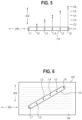
- FIG. 6 shows the raised structure 110 after completion of the process of FIG. 5
- the raised structure 110 is depicted as a tubular knit structure as it may appear immediately after formation on a knitting machine (e.g., after its courses are coupled to both needle beds to close the "tube").
- the longitudinal axis of the tubular knit structure may be parallel to the course-wise direction 200.
- the raised structure 110 may be secured to the base portion (not shown) with a plurality of loops, which are represented in FIGS.
- loops L1, L2, L3, L4, L5, and L6 although any suitable number of loops may be used to secure the raised structure to the base portion 104.
- the loops L1-L6 may all be part of the same course, but this is not required, and in some embodiments, a high tenacity yarn may be used to form the loops L1-L6 to provide sufficient strength (as described in more detail below).
- the loops L1-L6 not be directly behind the tubular knit structure, but instead may be offset with respect to loops of the tubular knit structure such that they indirectly force the tubular knit structure into an angled orientation even when partially offset from the tubular knit structure through yarn tension (e.g., as is accomplished by the knitted structure of the knit diagram depicted by FIG. 9 ).
- the raised structure 110 may be angled relative to the course-wise direction 200 by selectively releasing the loops L1-L6 at different points (e.g., at different courses such that they are offset in the wale-wise direction 202) during the knitting process.
- loop L1 may be released at a first course C1, which may be a course that occurs immediately after finalizing the tubular knit structure forming the raised structure 110.
- the second loop L2 may be held on a needle of the knitting machine until course C2 is formed, which may occur after the course C1 is formed.
- the loop C2 becomes offset in the wale-wise direction 202 in the finished knit product (e.g., offset vertically in FIGS. 5-6 ).
- loops L3-L6 may be selectively released at different respective courses C3-C6 such that the raised structure 110 is angled along its entire length, resulting in the angled raised structure 110 depicted in FIG. 6 .
- the specific angle of the raised structure 110 may be determined by the number of courses formed between when the loops L1 -L6 are released. For example, if one course is formed between when each of the loops L1-L6 is released, the angle of the raised structure 110 relative to the course-wise direction 200 will be smaller than if two course are formed between each looprelease step. Further, it is contemplated that different numbers of courses may be knit/formed between the respective loops L1-L6, and thus the angle of the raised structure 110 may vary along its length. Releasing the loops L1-L6 at variable intervals may additionally cause the raised structure to curve in some instances, which is depicted in FIG. 7 .
- high-strength and/or visually-appealing margins may be included on at least one side of the raised structure 110, and such margins may form the loops L1-L6.
- FIG. 8 is an illustration showing a first margin 116 extending along a first edge 120 of the raised structure 110 and a second margin 118 extending along a second edge 122 of the raised structure 110, where the edges 120, 122 extend longitudinally along the raised structure 110.
- the margins 116, 118 may be flush (e.g., not substantially elevated) with the base portion 104 of the knitted component 102, and it is contemplated that they may be slightly depressed with respect to the base portion 104 (e.g., such that cavities are formed at the bottom of the raised structure 110).
- Such a depression feature may enhance the definition of the raised structures 110, for example. Further, it is contemplated that at least one of the margins 116, 118 may have a color that is different than a color of the raised structure 110, and/or different than a color of the base portion 104, which may provide desirable aesthetic effects. When two margins 116, 118 are included, the two margins 116, 118 may have the same color, or not.
- the margins 116, 118 may be formed with yarns that are different than the yarns forming the raised structure 110.
- the yarns forming the raised structure 110 may be formed primarily or entirely of polyester (e.g., a strand or multiple strands of textured polyester). This may be advantageous for the desirable softness, durability, and texture characteristics provided by polyester (e.g., when the knitted component 102 is used in an article of apparel or an upper for an article of footwear).
- At least one of the yarns incorporated into the margins 116, 118 may be what is referred to as a "high-tenacity" yarn, which may be particularly advantageous when it is desired for the margins to exhibit enhanced strength.
- the loop-holding process described above e.g., holding the loops L1-L6 of FIGS. 5-6 on the needle bed for a series of courses
- tenacity is understood to refer to the amount of force (expressed in units of weight, for example: pounds, grams, centinewtons or other units) needed to rupture a yarn (i.e., the breaking force or breaking point of the yarn), divided by the linear mass density of the yarn expressed, for example, in (unstrained) denier, decitex, or some other measure of weight per unit length.
- the amount of force needed to break a yarn is determined by subjecting a sample of the yarn to a known amount of force by stretching the sample until it breaks, for example, by inserting each end of a sample of the yarn into the grips on the measuring arms of an extensometer, subjecting the sample to a stretching force, and measuring the force required to break the sample using a strain gauge load cell.
- Suitable testing systems can be obtained from Instron (Norwood, MA, USA).
- Yarn tenacity and yarn breaking force are distinct from burst strength or bursting strength of a textile, which is a measure of the maximum force that can be applied to the surface of a textile before the surface bursts.
- the minimum tenacity required is approximately 1.5 grams per denier (g/D).
- Most synthetic polymer continuous filament yarns formed from commodity polymeric materials generally have tenacities in the range of about 1.5 g/D to about 4 g/D.
- polyester filament yarns that may be used in the manufacture of knit uppers for article of footwear have tenacities in the range of about 2.5 g/D to about 4 g/D.
- Filament yarns formed from commodity synthetic polymeric materials which are considered to have high tenacities (e.g., a "high tenacity yarn") generally have tenacities in the range of about 5 g/D to about 10 g/D.
- filament yarns formed of aramid typically have tenacities of about 20 g/D
- filament yarns formed of ultra-high molecular weight polyethylene (UFIMWPE) having tenacities greater than 30 g/D are available from Dyneema (Stanley, NC, USA) and Spectra (Honeywell-Spectra, Colonial Heights, VA, USA).
- FIG. 9 is a diagram illustrating an example of a knitting sequence for forming the angled raised structure 110 described above, along with a first margin 116 and a second margin 118.
- courses 1 -6 may correspond with a first margin 116.
- a first yarn 122 of the first margin 116 may be a high-tenacity yarn as described above, having a tenacity of at least 5 g/D (such as at least 10 g/D).
- the first yarn 122 may be formed with three loops knitted on a front needle bed (at half-gauge) followed by two loops knitted on a back needle bed (spaced by three needles).
- Two passes of a second yarn 124 which may be a polyester yarn that eventually forms the raised structures (as described above), may be integrated into the first margin 116 on the back needle bed, which may provide a backing on the second side of the knitted component 102.
- each of the raised structures 110 includes six uninterrupted consecutive loops, which are optionally at full gauge on the needle bed (as shown).
- Courses 11-14 of FIG. 9 form the second margin 118.
- the structure of the second margin 118 is similar to the structure of the first margin 116, and the third yarn 126 used to form the second margin 118 may be a high-tenacity yarn. Further, the third yarn 126 may have a different color than at least one of the first yarn and/or the second yarn. In other embodiments, the third yarn 126 may be identical (and even the same strand) as the first yarn 122.
- loops 130 referenced in FIG. 9 which are on the back bed, are held on the back bed while the tubular portion of the raised structure 110 is formed.
- These loops 130 serve as connection points to the back bed of the knitting machine, and holding these loops on the back bed for a number of courses (e.g., as indicated by the lines 132) to force the raised structures 110 to angle (in a manner similar to as described with reference to FIG. 5 , though the loops are offset in the course-wise direction from loops of a corresponding raised structure 110).
- Courses 15-30 are associated with base portion 104 of the knitted component 102. These courses formed a so-called “tubular interlock" structure recognized by those skilled in the art. However, any other suitable base structure may be used in other embodiments.
- the yarns forming the base portion 104 may include any suitable material, such as a high-tenacity material, a polyester, a fusible material, etc. In some embodiments, for example, the base portion 104 may be formed primarily with polyester yarns, which may be desirable in articles of apparel and/or uppers for an article of footwear.
- the knit sequence of FIG. 9 may be repeated, as necessary, to form a knitted component with a suitable size. Further, it is noted that the sequence(s) may be varied to incorporate different features by changing certain knit structures, by varying yarn types, by increasing or decreasing the number of courses at each step, or by any other suitable adjustment to the knitting process or materials used. Further, other sequences may be used before, after, or between the sequences of FIG. 9 .
- a knitted component comprising:
- Clause 3 The knitted component of clause 1, wherein a first loop couples a first end of the raised structure to the base portion of the knitted component, wherein a second loop couples a second end of the raised structure to the base portion, and wherein the first loop and the second loop are offset in a wale-wise direction, the wale-wise direction being perpendicular to the course-wise direction.
- Clause 4 The knitted component of clause 3, wherein at least one of the first loop and the second loop is formed with at least one yarn having a tenacity greater than about 5 g/D.
- Clause 5 The knitted component of clause 1, further comprising a margin extending along a longitudinal edge of the raised structure, wherein the margin is formed with a yarn having a tenacity greater than about 5 g/D.
- Clause 6 The knitted component of clause 1, further comprising a margin extending along a longitudinal edge of the raised structure, wherein the margin has a color that is different than a color of the raised structure.
- Clause 7 The knitted component of clause 1, wherein the raised structure is elevated at least 3 mm with respect to the base portion of the knitted component.
- Clause 8 The knitted component of clause 1, wherein the raised structure has a length of at least 5 mm.
- a knitted component comprising:
- Clause 11 The knitted component of clause 10, further comprising a second margin extending along a second longitudinal edge of the raised structure, the second longitudinal edge being opposite the first longitudinal edge, wherein the second margin includes a yarn having a tenacity of at least 5 g/D.
- Clause 12 The knitted component of clause 10, wherein the first margin has a color that is different than a color of the tubular knit structure.
- Clause 13 The knitted component of clause 10, wherein the raised structure is angled relative to a course-wise direction of the knitted component.
- Clause 16 The knitted component of clause 10, wherein the raised structure is elevated at least 3 mm with respect to the base portion of the knitted component.
- Clause 19 The method of clause 18, wherein the first location and the second location are offset in a wale-wise direction.
- Clause 20 The method of clause 18, wherein the raised structure is angled at least 5 degrees with respect to a course-wise direction.
Landscapes
- Engineering & Computer Science (AREA)
- Textile Engineering (AREA)
- Chemical & Material Sciences (AREA)
- Materials Engineering (AREA)
- Knitting Of Fabric (AREA)
Applications Claiming Priority (3)
| Application Number | Priority Date | Filing Date | Title |
|---|---|---|---|
| US201862702192P | 2018-07-23 | 2018-07-23 | |
| EP19749950.2A EP3827120B1 (fr) | 2018-07-23 | 2019-07-23 | Tricot incorporant une structure épaisse inclinée |
| PCT/US2019/042960 WO2020023468A1 (fr) | 2018-07-23 | 2019-07-23 | Composant tricoté doté d'une structure surélevée inclinée |
Related Parent Applications (1)
| Application Number | Title | Priority Date | Filing Date |
|---|---|---|---|
| EP19749950.2A Division EP3827120B1 (fr) | 2018-07-23 | 2019-07-23 | Tricot incorporant une structure épaisse inclinée |
Publications (3)
| Publication Number | Publication Date |
|---|---|
| EP4234785A2 true EP4234785A2 (fr) | 2023-08-30 |
| EP4234785A3 EP4234785A3 (fr) | 2023-09-27 |
| EP4234785B1 EP4234785B1 (fr) | 2026-04-22 |
Family
ID=67544401
Family Applications (2)
| Application Number | Title | Priority Date | Filing Date |
|---|---|---|---|
| EP23175658.6A Active EP4234785B1 (fr) | 2018-07-23 | 2019-07-23 | Tricot incorporant une structure épaisse inclinée |
| EP19749950.2A Active EP3827120B1 (fr) | 2018-07-23 | 2019-07-23 | Tricot incorporant une structure épaisse inclinée |
Family Applications After (1)
| Application Number | Title | Priority Date | Filing Date |
|---|---|---|---|
| EP19749950.2A Active EP3827120B1 (fr) | 2018-07-23 | 2019-07-23 | Tricot incorporant une structure épaisse inclinée |
Country Status (4)
| Country | Link |
|---|---|
| US (3) | US11466387B2 (fr) |
| EP (2) | EP4234785B1 (fr) |
| CN (2) | CN115568660B (fr) |
| WO (1) | WO2020023468A1 (fr) |
Families Citing this family (10)
| Publication number | Priority date | Publication date | Assignee | Title |
|---|---|---|---|---|
| EP3644779B1 (fr) | 2017-06-27 | 2020-08-12 | Puma Se | Chaussure, en particulier chaussure de sport |
| EP3826503B1 (fr) | 2018-07-23 | 2025-02-26 | Nike Innovate C.V. | Article tricoté avec une structure en relief et procédés de production |
| CN115568660B (zh) * | 2018-07-23 | 2026-01-02 | 耐克创新有限合伙公司 | 具有成角度的凸起结构的针织部件 |
| CN115998034A (zh) | 2018-10-19 | 2023-04-25 | 耐克创新有限合伙公司 | 具有凸起结构的针织部件和制造方法 |
| USD932762S1 (en) | 2019-07-23 | 2021-10-12 | Puma SE | Shoe |
| USD935760S1 (en) | 2019-07-23 | 2021-11-16 | Puma SE | Shoe |
| CN114929054B (zh) * | 2020-01-08 | 2024-08-06 | 耐克创新有限合伙公司 | 具有两种纱线类型的用于鞋类制品的鞋面 |
| CN113668129B (zh) * | 2021-07-19 | 2022-12-09 | 信泰(福建)科技有限公司 | 一种含有立体装饰组织的针织面料及鞋面 |
| CN113668126B (zh) * | 2021-07-26 | 2022-12-13 | 信泰(福建)科技有限公司 | 一种摇床弯曲鼓包效果的针织面料及编织方法、鞋面 |
| IT202300012498A1 (it) * | 2023-06-16 | 2024-12-16 | Tex Tech S R L | Tessuto 3d fonoassorbente/fonocorrettore |
Citations (1)
| Publication number | Priority date | Publication date | Assignee | Title |
|---|---|---|---|---|
| US8522577B2 (en) | 2011-03-15 | 2013-09-03 | Nike, Inc. | Combination feeder for a knitting machine |
Family Cites Families (14)
| Publication number | Priority date | Publication date | Assignee | Title |
|---|---|---|---|---|
| JPS60181351A (ja) * | 1984-02-28 | 1985-09-17 | 名草繊維株式会社 | 編地と編機 |
| DE102008027856A1 (de) * | 2008-06-11 | 2009-12-24 | W. L. Gore & Associates Gmbh | Schuh mit Belüftung im unteren Schaftbereich und dafür verwendbares luftdurchlässiges Abstandsgebilde |
| US8490299B2 (en) * | 2008-12-18 | 2013-07-23 | Nike, Inc. | Article of footwear having an upper incorporating a knitted component |
| US9510636B2 (en) * | 2012-02-20 | 2016-12-06 | Nike, Inc. | Article of footwear incorporating a knitted component with an integral knit tongue |
| EP2964819A4 (fr) * | 2013-03-07 | 2017-04-05 | GRT Developments Pty Limited | Système de tissu |
| WO2015166824A1 (fr) * | 2014-05-02 | 2015-11-05 | 株式会社島精機製作所 | Tige de chaussure et procédé pour tricoter une tige de chaussure |
| US9661892B2 (en) * | 2014-07-29 | 2017-05-30 | Nike, Inc. | Article of footwear incorporating an upper with a shifted knit structure |
| US9078488B1 (en) * | 2014-09-30 | 2015-07-14 | Nike, Inc. | Article of footwear incorporating a lenticular knit structure |
| CN107208333B (zh) * | 2015-01-30 | 2020-08-18 | 耐克创新有限合伙公司 | 形成针织部件的方法以及组装包含针织部件的鞋类物品的方法 |
| CN109714998B (zh) * | 2016-08-12 | 2021-11-02 | 耐克创新有限合伙公司 | 具有带有第一纱和第二纱的第一区段的物品 |
| CN117286624B (zh) * | 2016-08-26 | 2026-01-27 | 耐克创新有限合伙公司 | 包括缓冲结构的针织部件、鞋面和制造鞋类物品的方法 |
| CN107268165A (zh) * | 2017-05-22 | 2017-10-20 | 浙江华诗秀新材料科技有限公司 | 腿部护具及其管状半边弧形渐变压力控制针织方法 |
| CN121176695A (zh) * | 2018-04-16 | 2025-12-23 | 耐克创新有限合伙公司 | 包括针织缓冲区域的鞋的鞋面和结合该鞋面的鞋类物品 |
| CN115568660B (zh) * | 2018-07-23 | 2026-01-02 | 耐克创新有限合伙公司 | 具有成角度的凸起结构的针织部件 |
-
2019
- 2019-07-23 CN CN202211135980.7A patent/CN115568660B/zh active Active
- 2019-07-23 EP EP23175658.6A patent/EP4234785B1/fr active Active
- 2019-07-23 WO PCT/US2019/042960 patent/WO2020023468A1/fr not_active Ceased
- 2019-07-23 US US16/519,313 patent/US11466387B2/en active Active
- 2019-07-23 CN CN201980048915.0A patent/CN112469854B/zh active Active
- 2019-07-23 EP EP19749950.2A patent/EP3827120B1/fr active Active
-
2022
- 2022-09-23 US US17/951,574 patent/US12195890B2/en active Active
-
2025
- 2025-01-13 US US19/019,019 patent/US20250146194A1/en active Pending
Patent Citations (1)
| Publication number | Priority date | Publication date | Assignee | Title |
|---|---|---|---|---|
| US8522577B2 (en) | 2011-03-15 | 2013-09-03 | Nike, Inc. | Combination feeder for a knitting machine |
Also Published As
| Publication number | Publication date |
|---|---|
| CN115568660A (zh) | 2023-01-06 |
| US20250146194A1 (en) | 2025-05-08 |
| EP3827120A1 (fr) | 2021-06-02 |
| CN112469854B (zh) | 2022-10-04 |
| US11466387B2 (en) | 2022-10-11 |
| EP3827120B1 (fr) | 2023-05-31 |
| CN115568660B (zh) | 2026-01-02 |
| US20200022447A1 (en) | 2020-01-23 |
| US20230013080A1 (en) | 2023-01-19 |
| EP4234785A3 (fr) | 2023-09-27 |
| WO2020023468A4 (fr) | 2020-05-07 |
| CN112469854A (zh) | 2021-03-09 |
| US12195890B2 (en) | 2025-01-14 |
| WO2020023468A1 (fr) | 2020-01-30 |
| EP4234785B1 (fr) | 2026-04-22 |
Similar Documents
| Publication | Publication Date | Title |
|---|---|---|
| US12195890B2 (en) | Knitted component with an angled raised structure | |
| EP3496561B1 (fr) | Article ayant une première zone ayant un premier et un deuxième fils | |
| US11725312B2 (en) | Knitted component with vertical inlay and method of making the same | |
| US11447899B2 (en) | Upper including a knitted component and a tab element | |
| CN110998000B (zh) | 具有用高韧度纱线形成的表面区域的针织部件 | |
| HK40046052B (en) | Knitted component with an angled raised structure | |
| HK40086034A (zh) | 具有成角度的凸起结构的针织部件 | |
| HK40046052A (en) | Knitted component with an angled raised structure | |
| HK40056610A (en) | Knitted component with vertical inlay, a method of making same and a knitting machine suitable therefore | |
| AU2022311503A1 (en) | Method for knitting dense zones and knit obtained | |
| WO2025250043A1 (fr) | Chaussette renforcée résistant à l'usure et procédé de fabrication | |
| HK40011164B (zh) | 包括针织部件和拉片元件的鞋面 |
Legal Events
| Date | Code | Title | Description |
|---|---|---|---|
| PUAI | Public reference made under article 153(3) epc to a published international application that has entered the european phase |
Free format text: ORIGINAL CODE: 0009012 |
|
| STAA | Information on the status of an ep patent application or granted ep patent |
Free format text: STATUS: THE APPLICATION HAS BEEN PUBLISHED |
|
| PUAL | Search report despatched |
Free format text: ORIGINAL CODE: 0009013 |
|
| AC | Divisional application: reference to earlier application |
Ref document number: 3827120 Country of ref document: EP Kind code of ref document: P |
|
| AK | Designated contracting states |
Kind code of ref document: A2 Designated state(s): AL AT BE BG CH CY CZ DE DK EE ES FI FR GB GR HR HU IE IS IT LI LT LU LV MC MK MT NL NO PL PT RO RS SE SI SK SM TR |
|
| AK | Designated contracting states |
Kind code of ref document: A3 Designated state(s): AL AT BE BG CH CY CZ DE DK EE ES FI FR GB GR HR HU IE IS IT LI LT LU LV MC MK MT NL NO PL PT RO RS SE SI SK SM TR |
|
| RIC1 | Information provided on ipc code assigned before grant |
Ipc: D04B 1/22 20060101AFI20230824BHEP |
|
| STAA | Information on the status of an ep patent application or granted ep patent |
Free format text: STATUS: REQUEST FOR EXAMINATION WAS MADE |
|
| 17P | Request for examination filed |
Effective date: 20240326 |
|
| RBV | Designated contracting states (corrected) |
Designated state(s): AL AT BE BG CH CY CZ DE DK EE ES FI FR GB GR HR HU IE IS IT LI LT LU LV MC MK MT NL NO PL PT RO RS SE SI SK SM TR |
|
| P01 | Opt-out of the competence of the unified patent court (upc) registered |
Effective date: 20240522 |
|
| STAA | Information on the status of an ep patent application or granted ep patent |
Free format text: STATUS: EXAMINATION IS IN PROGRESS |
|
| 17Q | First examination report despatched |
Effective date: 20241015 |
|
| GRAP | Despatch of communication of intention to grant a patent |
Free format text: ORIGINAL CODE: EPIDOSNIGR1 |
|
| STAA | Information on the status of an ep patent application or granted ep patent |
Free format text: STATUS: GRANT OF PATENT IS INTENDED |
|
| INTG | Intention to grant announced |
Effective date: 20250616 |
|
| GRAJ | Information related to disapproval of communication of intention to grant by the applicant or resumption of examination proceedings by the epo deleted |
Free format text: ORIGINAL CODE: EPIDOSDIGR1 |
|
| STAA | Information on the status of an ep patent application or granted ep patent |
Free format text: STATUS: EXAMINATION IS IN PROGRESS |
|
| GRAP | Despatch of communication of intention to grant a patent |
Free format text: ORIGINAL CODE: EPIDOSNIGR1 |
|
| STAA | Information on the status of an ep patent application or granted ep patent |
Free format text: STATUS: GRANT OF PATENT IS INTENDED |
|
| INTC | Intention to grant announced (deleted) | ||
| INTG | Intention to grant announced |
Effective date: 20251113 |
|
| GRAS | Grant fee paid |
Free format text: ORIGINAL CODE: EPIDOSNIGR3 |
|
| GRAA | (expected) grant |
Free format text: ORIGINAL CODE: 0009210 |
|
| STAA | Information on the status of an ep patent application or granted ep patent |
Free format text: STATUS: THE PATENT HAS BEEN GRANTED |
|
| AC | Divisional application: reference to earlier application |
Ref document number: 3827120 Country of ref document: EP Kind code of ref document: P |
|
| AK | Designated contracting states |
Kind code of ref document: B1 Designated state(s): AL AT BE BG CH CY CZ DE DK EE ES FI FR GB GR HR HU IE IS IT LI LT LU LV MC MK MT NL NO PL PT RO RS SE SI SK SM TR |
|
| REG | Reference to a national code |
Ref country code: CH Ref legal event code: F10 Free format text: ST27 STATUS EVENT CODE: U-0-0-F10-F00 (AS PROVIDED BY THE NATIONAL OFFICE) Effective date: 20260422 Ref country code: GB Ref legal event code: FG4D |