EP4235083A1 - Systemintegration - Google Patents
Systemintegration Download PDFInfo
- Publication number
- EP4235083A1 EP4235083A1 EP22275021.8A EP22275021A EP4235083A1 EP 4235083 A1 EP4235083 A1 EP 4235083A1 EP 22275021 A EP22275021 A EP 22275021A EP 4235083 A1 EP4235083 A1 EP 4235083A1
- Authority
- EP
- European Patent Office
- Prior art keywords
- aircraft
- weapon
- target
- coefficients
- generic algorithm
- Prior art date
- Legal status (The legal status is an assumption and is not a legal conclusion. Google has not performed a legal analysis and makes no representation as to the accuracy of the status listed.)
- Pending
Links
- 230000010354 integration Effects 0.000 title description 10
- 238000004422 calculation algorithm Methods 0.000 claims abstract description 158
- 238000000034 method Methods 0.000 claims abstract description 70
- 238000010304 firing Methods 0.000 claims abstract description 36
- 238000012549 training Methods 0.000 claims description 15
- 238000010801 machine learning Methods 0.000 claims description 10
- 238000004590 computer program Methods 0.000 claims description 4
- 238000002372 labelling Methods 0.000 claims description 3
- 230000001052 transient effect Effects 0.000 claims description 2
- 230000008569 process Effects 0.000 description 22
- 230000002068 genetic effect Effects 0.000 description 21
- 230000006870 function Effects 0.000 description 14
- 238000013528 artificial neural network Methods 0.000 description 13
- 238000013459 approach Methods 0.000 description 10
- 230000000717 retained effect Effects 0.000 description 9
- 238000012545 processing Methods 0.000 description 8
- 238000012360 testing method Methods 0.000 description 6
- 238000004364 calculation method Methods 0.000 description 5
- 230000006872 improvement Effects 0.000 description 5
- 230000006399 behavior Effects 0.000 description 4
- 238000012986 modification Methods 0.000 description 4
- 230000004048 modification Effects 0.000 description 4
- 238000013500 data storage Methods 0.000 description 3
- 230000000694 effects Effects 0.000 description 3
- 238000011156 evaluation Methods 0.000 description 3
- 230000008901 benefit Effects 0.000 description 2
- 238000013461 design Methods 0.000 description 2
- 230000007613 environmental effect Effects 0.000 description 2
- 230000033001 locomotion Effects 0.000 description 2
- 238000012795 verification Methods 0.000 description 2
- 230000006978 adaptation Effects 0.000 description 1
- 238000009395 breeding Methods 0.000 description 1
- 230000001488 breeding effect Effects 0.000 description 1
- 230000009956 central mechanism Effects 0.000 description 1
- 238000010276 construction Methods 0.000 description 1
- 238000009795 derivation Methods 0.000 description 1
- 238000010586 diagram Methods 0.000 description 1
- 230000007246 mechanism Effects 0.000 description 1
- 238000013508 migration Methods 0.000 description 1
- 230000005012 migration Effects 0.000 description 1
- 230000035772 mutation Effects 0.000 description 1
- 231100000989 no adverse effect Toxicity 0.000 description 1
- 230000000704 physical effect Effects 0.000 description 1
- 238000012797 qualification Methods 0.000 description 1
- 230000009467 reduction Effects 0.000 description 1
Images



Classifications
-
- F—MECHANICAL ENGINEERING; LIGHTING; HEATING; WEAPONS; BLASTING
- F41—WEAPONS
- F41G—WEAPON SIGHTS; AIMING
- F41G3/00—Aiming or laying means
- F41G3/22—Aiming or laying means for vehicle-borne armament, e.g. on aircraft
-
- F—MECHANICAL ENGINEERING; LIGHTING; HEATING; WEAPONS; BLASTING
- F41—WEAPONS
- F41G—WEAPON SIGHTS; AIMING
- F41G7/00—Direction control systems for self-propelled missiles
- F41G7/007—Preparatory measures taken before the launching of the guided missiles
-
- F—MECHANICAL ENGINEERING; LIGHTING; HEATING; WEAPONS; BLASTING
- F41—WEAPONS
- F41G—WEAPON SIGHTS; AIMING
- F41G9/00—Systems for controlling missiles or projectiles, not provided for elsewhere
- F41G9/002—Systems for controlling missiles or projectiles, not provided for elsewhere for guiding a craft to a correct firing position
Definitions
- This invention relates to the integration of systems and, more particularly, to the integration of weapons on complex, highly integrated aircraft.
- a weapon integration is to enable the display of information to the aircraft pilot as to whether or not a weapon is capable of successfully engaging a particular target.
- weapons are usually grouped into two categories, weapons designed to engage targets on the ground (air to ground weapons) and weapons designed to engage targets in the air (air to air weapons).
- a Launch Acceptability Region (LAR) is calculated, being the region where the probability of successfully engaging or hitting a selected target is above some threshold value.
- the LAR is calculated in order to provide cockpit displays in the launch aircraft indicating the feasibility of successfully engaging the target, and is a function of the weapon performance characteristics, the relative positions and motions of the aircraft and the target, and often ambient conditions such as wind speed and direction.
- a Launch Success Zone is calculated, indicative of the probability of successfully engaging a selected air target being above some threshold value.
- the LSZ is used to provide a cockpit display indicating whether the weapon is capable of successfully engaging the target.
- calculation of an LSZ is more complicated than the calculation of an LAR because the relative speeds and directions of travel of the launch aircraft and the target are much greater, the effects of ambient conditions are greater, and also the physical properties of the weapons in flight are more significant on the calculation.
- the conventional approach has been to create a simple, abstract model of the weapon, which is modified according to the launch conditions (taking into account the aircraft and target conditions (e.g. range, direction and speed of travel, etc.) and the ambient conditions).
- the model is used on board the aircraft to generate the LAR or LSZ for display to the pilot.
- a disadvantage of the conventional approach is that each model, for each different weapon type, is different. Storing the data relating to several different implicit models consumes significant storage capacity, and each model has to be comprehensively integrated to ensure that there is no adverse effect on any of the aircraft systems.
- a computer-implemented method of generating, in an aircraft in flight, a feasibility display indicative of a feasibility of a weapon carried on the aircraft successfully engaging a target and/or a feasibility of a weapon carried on the target successfully engaging the aircraft comprising:
- a Capability Filter finds the limits of the capable envelope of a weapon system in any chosen region of the engagement envelope and examines the feasibility of weapon engagement for current launch conditions - i.e. for finding out if the current firing is inside or outside the "hit zone" for the weapon.
- This offers the prospect of classifying large, highly dimensional spaces using relatively concise models, thus saving in both processing and storage for the host system.
- the capability filter assesses whether or not the weapon has capability.
- the relevant LSZ/LAR parameters are then estimated.
- the method comprises inferring if the aircraft and the target are within the performance envelope of the weapon, according to the conditions of the aircraft and the target, using a trained machine learning model, for example a trained neural network.
- a trained machine learning model for example a trained neural network.
- the method comprises training the machine learning model using training data of performance envelopes of respective weapons, according to conditions of respective aircraft and respective targets.
- the machine learning model may be trained using training data of performance envelopes of respective weapons, according to conditions of respective aircraft and respective targets.
- the method comprises labelling the training data based on if the respective aircraft and the respective target are within the performance envelope of the respective weapon, according to the conditions of the respective aircraft and the respective target.
- the method comprises creating respective coefficients characteristic of the performance envelopes using the generic algorithm, by steps including identifying respective best candidate polynomials from a plurality of candidate polynomials, the variables of the polynomials being some or all of a group of respective weapon or aircraft firing condition parameters.
- the respective coefficients are created for the training data, for example in the same way as for the performance envelope of the weapon.
- inferring if the aircraft and the target are within the performance envelope of the weapon, according to the conditions of the aircraft and the target, using the trained machine learning model comprises thresholding a result of the inferring.
- selecting, by the reconstructor on the aircraft containing the same generic algorithm, the coefficients for the generic algorithm, if the aircraft and the target are within the performance envelope of the weapon, according to the conditions of the aircraft and the target comprises selecting, by the reconstructor on the aircraft containing the same generic algorithm, the coefficients for the generic algorithm, if the aircraft and the target are currently within the performance envelope of the weapon.
- the coefficients for the generic algorithm are selected if the aircraft and the target are currently within the performance envelope of the weapon, thereby optimising the coefficients for the generic algorithm and hence improving determination of the feasibility of the weapon carried on the aircraft successfully engaging a target and/or the feasibility of a weapon carried on the target successfully engaging the aircraft according to the conditions of the aircraft and the target.
- selecting, by the reconstructor on the aircraft containing the same generic algorithm, the coefficients for the generic algorithm, if the aircraft and the target are within the performance envelope of the weapon, according to the conditions of the aircraft and the target comprises selecting, by the reconstructor on the aircraft containing the same generic algorithm, the coefficients for the generic algorithm, only if the aircraft and the target are within the performance envelope of the weapon.
- the coefficients for the generic algorithm are selected only if the aircraft and the target are within the performance envelope of the weapon, thereby optimising the coefficients for the generic algorithm and hence improving determination of the feasibility of the weapon carried on the aircraft successfully engaging a target and/or the feasibility of a weapon carried on the target successfully engaging the aircraft according to the conditions of the aircraft and the target.
- selecting, by the reconstructor on the aircraft containing the same generic algorithm, the coefficients for the generic algorithm, if the aircraft and the target are within the performance envelope of the weapon, according to the conditions of the aircraft and the target comprises selecting, by the reconstructor on the aircraft containing the same generic algorithm, the coefficients for the generic algorithm, while the aircraft and the target are within the performance envelope of the weapon.
- the coefficients for the generic algorithm are selected while the aircraft and the target are within the performance envelope of the weapon, thereby optimising the coefficients for the generic algorithm and hence improving determination of the feasibility of the weapon carried on the aircraft successfully engaging a target and/or the feasibility of a weapon carried on the target successfully engaging the aircraft according to the conditions of the aircraft and the target.
- selecting, by the reconstructor on the aircraft containing the same generic algorithm, the coefficients for the generic algorithm, if the aircraft and the target are within the performance envelope of the weapon, according to the conditions of the aircraft and the target comprises repeatedly selecting, by the reconstructor on the aircraft containing the same generic algorithm, the coefficients for the generic algorithm, if the aircraft and the target are within the performance envelope of the weapon.
- the coefficients for the generic algorithm are repeatedly, for example periodically (e.g. ms timescale) or intermittently, selected if the aircraft and the target are within the performance envelope of the weapon, thereby repeatedly optimising the coefficients for the generic algorithm and hence improving determination of the feasibility of the weapon carried on the aircraft successfully engaging a target and/or the feasibility of a weapon carried on the target successfully engaging the aircraft according to the conditions of the aircraft and the target.
- selecting, by the reconstructor on the aircraft containing the same generic algorithm, the coefficients for the generic algorithm, if the aircraft and the target are within the performance envelope of the weapon, according to the conditions of the aircraft and the target comprises deselecting, by the reconstructor on the aircraft containing the same generic algorithm, the coefficients for the generic algorithm, if the aircraft and the target are no longer within the performance envelope of the weapon.
- the feasibility display is not generated by the reconstructor if the aircraft and the target are no longer within the performance envelope of the weapon.
- the types of the candidate polynomials of the set thereof include univariate polynomials, multivariate polynomials and modifications thereof. Other polynomial types are known.
- the orders of the candidate polynomials of the set thereof are in a range from 1 to 100, preferably in a range from 2 to 25, more preferably in a range from 3 to 10, most preferably in a range from 5 to 9, for example 5, 6, 7, 8, 9.
- the order of the generic polynomial is 3 or greater. In one example, the order of the generic polynomial is in a range from 10 to 25, for example 20. Surprisingly, the inventors have found that using a generic algorithm with an order of around 20 adequately describes most air-to-air engagements accurately in an appropriate runtime for on-aircraft implementation. Nevertheless, the generic algorithm may have an order greater than 2.
- step b) for each candidate polynomial, computing coefficients for that candidate polynomial which best fit that candidate polynomial to the characteristic of the performance envelope of the weapon using the criterion of least square error comprises: 1) generating an initial population of candidate polynomials; 2) for each candidate polynomial, computing a set of coefficients which fit that polynomial to the performance envelope according to one or more criteria; and 3) for each candidate polynomial and respective set of coefficients, computing a score function indicative of the quality of the fit of that candidate polynomial and that set of coefficients to the performance envelope; and 4) recursively applying a genetic algorithm to the set of candidate polynomials until one or more criteria are met, including retaining at least the best scoring polynomial and discarding the other polynomial(s).
- the outputs of the retained polynomial(s) are a layer of a Self-Organising Polynomial Neural Network and are used to provide inputs for creating higher order candidate polynomials. In one example, these steps are iterated on the higher order candidate polynomials. In one example, a final result is obtained from the path ending with the best candidate score.
- a genetic algorithm proceeds in an iterative manner by generating new populations of strings from old ones. Every string is the encoded version of a tentative solution.
- An evaluation function associates a fitness measure to every string indicating its suitability to the problem.
- the algorithm applies stochastic operators such as selection, crossover and mutation on an initially random population in order to compute a whole generation of new strings.
- the inventors have identified that these algorithms may be adapted for use on multiple processor workstations or distributed systems with transparent process migration. Every fitness evaluation and adaptation operation may be performed within a separate process i.e. concurrently. In the case of a trivial fitness function, it is likely that not much improvement in the evolution's speed will be observed because of the level of overhead.
- an internal representation of the space to be searched is selected and an external function that assigns a fitness value to candidate solutions is defined.
- the method can be used for different weapon types, and a respective set of coefficients may be easily determined for each weapon type e.g. for each of a plurality of different firing conditions (i.e. aircraft and target conditions).
- the aircraft and target conditions may include but are not limited to one or more of their relative positions, distances, directions of movement, speeds and ambient atmospheric conditions.
- the weapon or aircraft firing condition parameters may include, but are not limited to, parameters such as aircraft velocities, aircraft height, aircraft attitude, slant range to target, target velocities, target height, line of sight azimuth, target pitch and aspect angles, and wind speed.
- the weapon or aircraft firing condition parameters may include, but are not limited to relative velocities and directions of travel of the launch aircraft and the target and those of the weapon relative to the target.
- the above described generic polynomial/algorithm may be used (e.g. simultaneously) by multiple different types of aircraft.
- different types of aircraft may use the same generic algorithm to calculate LARs/LSZs.
- the same generic algorithm may be used to calculate LARs/LSZs for different weapon types.
- aircraft software comprising the generic polynomial and means for allowing loading of coefficients for each weapon loaded on aircraft is produced only once.
- the software algorithm and coefficients, for any given weapon are the same for any aircraft type.
- This tends to be different to conventional methodologies in which, although common tools may be used for polynomial and coefficient generation, both the software (including an algorithm/polynomial) and coefficients are generated for every weapon type and every time the weapon performance is changed. This need to rewrite the software and the certification of it tends to be particularly costly.
- the above described method and system advantageously tend to provide that the aircraft software does not have to be rewritten and hence no new certification is required.
- each aircraft within a fleet comprising a plurality of different aircraft is loaded with the same, common generic polynomial.
- the specific coefficients corresponding to that weapon may also be loaded onto that aircraft. This tends to be in contrast to conventional systems in which, although the tools for generating LAR/LSZs may be common across multiple different aircraft, when a weapon is loaded onto an aircraft, both a polynomial/algorithm and corresponding coefficients for generating LAR/LSZs are generated for that aircraft and weapon load-out.
- the coefficients can be implemented as loadable data so as to allow accurate and precise weapon behaviour to be implemented within the weapon system. Also, using one or only a few generic algorithms would allow different weapon systems to be cleared or certificated/qualified for use with the aircraft with reduced effort and more quickly than with the extensive testing which is required with conventional approaches. That is, a minimal number of generic weapon aiming algorithms may be used in order to take account of all weapon types.
- the above aspects provide a generic polynomial/algorithm that may be used (e.g. simultaneously) by multiple different types of aircraft.
- Different types of aircraft may use the same generic algorithm to calculate LARs/LSZs.
- the same generic algorithm may be used to calculate LARs/LSZs for different weapon types.
- aircraft software comprising the generic polynomial and means for allowing loading of coefficients for each weapon loaded on aircraft is produced only once.
- the software algorithm and coefficients, for any given weapon are the same for any aircraft type.
- This tends to be different to conventional methodologies in which, although common tools may be used for polynomial and coefficient generation, both the software (including an algorithm/polynomial) and coefficients are generated for every weapon type and every time the weapon performance is changed. This need to rewrite the software and the certification of it tends to be particularly costly.
- the above described method and system advantageously tend to provide that the aircraft software does not have to be rewritten and hence no new certification is required.
- the target comprises and/or is an aircraft.
- the feasibility display is indicative of a Launch Success Zone of the aircraft and/or the target.
- the target comprises and/or is a ground-based target.
- the feasibility display is indicative of a Launch Acceptability Region of the aircraft and/or a Missile Engagement Zone of the target.
- step b) for each candidate polynomial, computing coefficients for that candidate polynomial which best fit that candidate polynomial to the characteristic of the performance envelope of the weapon using the criterion of least square error comprises:
- the outputs of the retained polynomial(s) are a layer of a Self-Organising Polynomial Neural Network and are used to provide inputs for creating higher order candidate polynomials. In one example, these are iterated until a final result having the best candidate score is obtained.
- the performance envelope of the weapon is the weapon's performance, for example the minimum envelope defining the weapon's performance, when the weapon is implemented on the aircraft. In one example, the performance envelope of the weapon is the weapon's respective performance when the weapon is implemented on aircraft of different aircraft types. In one example, the method comprises acquiring respective performance envelopes for one or more different aircraft types, for example for a plurality of different aircraft types.
- the method comprises determining the performance envelope using a plurality of aircraft performance envelopes, including determining a performance envelope defining the performance of all of the different aircraft types (i.e. a "maximum aircraft performance envelope"), and, using the performance envelope that is representative of the performance of all of the different aircraft types and the weapon performance envelope, determining a performance envelope defining the weapon's performance when that weapon is implemented on each of the different aircraft types.
- the performance envelope is the minimum sized envelope that defines the weapon's performance when that weapon is implemented on each of the different aircraft types.
- a database is generated by: defining the range of conditions for which the weapon may be required to be fired, the range of aircraft conditions for which it is feasible for the aircraft to fire the weapon and the range of weapon conditions for which it is feasible to fire the weapon; generating data indicative of the weapon performance for each weapon firing possibility from within the defined ranges; and creating a database defining the weapon's overall performance envelope.
- the coefficients may then be determined from this database and the generic polynomial.
- the database can be generated on a ground-based system, so that the aircraft system needs the capacity only to store the generic polynomial and process the coefficients with the aircraft and target conditions in order to generate the feasibility display.
- the amount of data storage/processing capacity required on the aircraft tends to be reduced.
- the coefficients can be implemented as loadable data so as to allow accurate and precise weapon behaviour to be implemented within the weapon system. Also, using one or only a few generic algorithms would allow different weapon systems to be cleared or certificated/qualified for use with the aircraft with reduced effort and more quickly than with the extensive testing which is required with conventional approaches.
- the step of uploading, to the aircraft, the generated coefficients may be performed when the weapon is loaded as an aircraft store.
- the coefficients associated with that weapon may be uploaded to the aircraft at the same time as the weapon.
- the coefficients are stored on a hardware device with the weapon, and the device is connected to the aircraft to upload the coefficient data as the weapon is loaded.
- the types of the candidate polynomials of the set thereof include univariate polynomials, multivariate polynomials and modifications thereof. Other polynomial types are known.
- the orders of the candidate polynomials of the set thereof are in a range from 1 to 100, preferably in a range from 2 to 25, more preferably in a range from 3 to 10, most preferably in a range from 5 to 9, for example 5, 6, 7, 8, 9.
- the order of the generic polynomial is 3 or greater. In one example, the order of the generic polynomial is in a range from 10 to 25, for example 20. Surprisingly, the inventors have found that using a generic algorithm with an order of around 20 adequately describes most air-to-air engagements accurately in an appropriate runtime for on-aircraft implementation. Nevertheless, the generic algorithm may have an order greater than 2.
- step b) for each candidate polynomial, computing coefficients for that candidate polynomial which best fit that candidate polynomial to the characteristic of the performance envelope of the weapon using the criterion of least square error comprises: 1) generating an initial population of candidate polynomials; 2) for each candidate polynomial, computing a set of coefficients which fit that polynomial to the performance envelope according to one or more criteria; and 3) for each candidate polynomial and respective set of coefficients, computing a score function indicative of the quality of the fit of that candidate polynomial and that set of coefficients to the performance envelope; and 4) recursively applying a genetic algorithm to the set of candidate polynomials until one or more criteria are met, including retaining at least the best scoring polynomial and discarding the other polynomial(s).
- the outputs of the retained polynomial(s) are a layer of a Self-Organising Polynomial Neural Network and are used to provide inputs for creating higher order candidate polynomials. In one example, these steps are iterated on the higher order candidate polynomials. In one example, a final result is obtained from the path ending with the best candidate score.
- the target comprises and/or is an aircraft.
- the feasibility display is indicative of a Launch Success Zone of the aircraft and/or the target.
- the target comprises and/or is a ground-based target.
- the feasibility display is indicative of a Launch Acceptability Region of the aircraft and/or a Missile Engagement Zone of the target.
- step b) for each candidate polynomial, computing coefficients for that candidate polynomial which best fit that candidate polynomial to the characteristic of the performance envelope of the weapon using the criterion of least square error comprises:
- the outputs of the retained polynomial(s) are a layer of a Self-Organising Polynomial Neural Network and are used to provide inputs for creating higher order candidate polynomials. In one example, these are iterated until a final result having the best candidate score is obtained.
- the performance envelope of the weapon is the weapon's performance, for example the minimum envelope defining the weapon's performance, when the weapon is implemented on the aircraft. In one example, the performance envelope of the weapon is the weapon's respective performance when the weapon is implemented on aircraft of different aircraft types. In one example, the method comprises acquiring respective performance envelopes for one or more different aircraft types, for example for a plurality of different aircraft types.
- the method comprises determining the performance envelope using a plurality of aircraft performance envelopes, including determining a performance envelope defining the performance of all of the different aircraft types (i.e. a "maximum aircraft performance envelope"), and, using the performance envelope that is representative of the performance of all of the different aircraft types and the weapon performance envelope, determining a performance envelope defining the weapon's performance when that weapon is implemented on each of the different aircraft types.
- the performance envelope is the minimum sized envelope that defines the weapon's performance when that weapon is implemented on each of the different aircraft types.
- a database is generated by: defining the range of conditions for which the weapon may be required to be fired, the range of aircraft conditions for which it is feasible for the aircraft to fire the weapon and the range of weapon conditions for which it is feasible to fire the weapon; generating data indicative of the weapon performance for each weapon firing possibility from within the defined ranges; and creating a database defining the weapon's overall performance envelope.
- the coefficients may then be determined from this database and the generic polynomial.
- the database can be generated on a ground-based system, so that the aircraft system needs the capacity only to store the generic polynomial and process the coefficients with the aircraft and target conditions in order to generate the feasibility display.
- the amount of data storage/processing capacity required on the aircraft tends to be reduced.
- the coefficients can be implemented as loadable data so as to allow accurate and precise weapon behaviour to be implemented within the weapon system. Also, using one or only a few generic algorithms would allow different weapon systems to be cleared or certificated/qualified for use with the aircraft with reduced effort and more quickly than with the extensive testing which is required with conventional approaches.
- the step of uploading, to the aircraft, the generated coefficients may be performed when the weapon is loaded as an aircraft store.
- the coefficients associated with that weapon may be uploaded to the aircraft at the same time as the weapon.
- the coefficients are stored on a hardware device with the weapon, and the device is connected to the aircraft to upload the coefficient data as the weapon is loaded.
- the types of the candidate polynomials of the set thereof include univariate polynomials, multivariate polynomials and modifications thereof. Other polynomial types are known.
- the orders of the candidate polynomials of the set thereof are in a range from 1 to 100, preferably in a range from 2 to 25, more preferably in a range from 3 to 10, most preferably in a range from 5 to 9, for example 5, 6, 7, 8, 9.
- the order of the generic polynomial is 3 or greater. In one example, the order of the generic polynomial is in a range from 10 to 25, for example 20. Surprisingly, the inventors have found that using a generic algorithm with an order of around 20 adequately describes most air-to-air engagements accurately in an appropriate runtime for on-aircraft implementation. Nevertheless, the generic algorithm may have an order greater than 2.
- step b) for each candidate polynomial, computing coefficients for that candidate polynomial which best fit that candidate polynomial to the characteristic of the performance envelope of the weapon using the criterion of least square error comprises: 1) generating an initial population of candidate polynomials; 2) for each candidate polynomial, computing a set of coefficients which fit that polynomial to the performance envelope according to one or more criteria; and 3) for each candidate polynomial and respective set of coefficients, computing a score function indicative of the quality of the fit of that candidate polynomial and that set of coefficients to the performance envelope; and 4) recursively applying a genetic algorithm to the set of candidate polynomials until one or more criteria are met, including retaining at least the best scoring polynomial and discarding the other polynomial(s).
- the outputs of the retained polynomial(s) are a layer of a Self-Organising Polynomial Neural Network and are used to provide inputs for creating higher order candidate polynomials. In one example, these steps are iterated on the higher order candidate polynomials. In one example, a final result is obtained from the path ending with the best candidate score.
- the target comprises and/or is an aircraft.
- the feasibility display is indicative of a Launch Success Zone of the aircraft and/or the target.
- the target comprises and/or is a ground-based target.
- the feasibility display is indicative of a Launch Acceptability Region of the aircraft and/or a Missile Engagement Zone of the target.
- step b) for each candidate polynomial, computing coefficients for that candidate polynomial which best fit that candidate polynomial to the characteristic of the performance envelope of the weapon using the criterion of least square error comprises:
- the outputs of the retained polynomial(s) are a layer of a Self-Organising Polynomial Neural Network and are used to provide inputs for creating higher order candidate polynomials. In one example, these are iterated until a final result having the best candidate score is obtained.
- the performance envelope of the weapon is the weapon's performance, for example the minimum envelope defining the weapon's performance, when the weapon is implemented on the aircraft. In one example, the performance envelope of the weapon is the weapon's respective performance when the weapon is implemented on aircraft of different aircraft types. In one example, the method comprises acquiring respective performance envelopes for one or more different aircraft types, for example for a plurality of different aircraft types.
- the method comprises determining the performance envelope using a plurality of aircraft performance envelopes, including determining a performance envelope defining the performance of all of the different aircraft types (i.e. a "maximum aircraft performance envelope"), and, using the performance envelope that is representative of the performance of all of the different aircraft types and the weapon performance envelope, determining a performance envelope defining the weapon's performance when that weapon is implemented on each of the different aircraft types.
- the performance envelope is the minimum sized envelope that defines the weapon's performance when that weapon is implemented on each of the different aircraft types.
- a database is generated by: defining the range of conditions for which the weapon may be required to be fired, the range of aircraft conditions for which it is feasible for the aircraft to fire the weapon and the range of weapon conditions for which it is feasible to fire the weapon; generating data indicative of the weapon performance for each weapon firing possibility from within the defined ranges; and creating a database defining the weapon's overall performance envelope.
- the coefficients may then be determined from this database and the generic polynomial.
- the database can be generated on a ground-based system, so that the aircraft system needs the capacity only to store the generic polynomial and process the coefficients with the aircraft and target conditions in order to generate the feasibility display.
- the amount of data storage/processing capacity required on the aircraft tends to be reduced.
- the coefficients can be implemented as loadable data so as to allow accurate and precise weapon behaviour to be implemented within the weapon system. Also, using one or only a few generic algorithms would allow different weapon systems to be cleared or certificated/qualified for use with the aircraft with reduced effort and more quickly than with the extensive testing which is required with conventional approaches.
- the step of uploading, to the aircraft, the generated coefficients may be performed when the weapon is loaded as an aircraft store.
- the coefficients associated with that weapon may be uploaded to the aircraft at the same time as the weapon.
- the coefficients are stored on a hardware device with the weapon, and the device is connected to the aircraft to upload the coefficient data as the weapon is loaded.
- a system for generating in an aircraft in flight, a feasibility display indicative of a feasibility of a weapon carried on the aircraft successfully engaging a target and/or a feasibility of a weapon carried on the target successfully engaging the aircraft the computer, the system comprising a first computer, comprising a memory and a processor, remote from the aircraft and a second computer, comprising a memory and a processor, onboard the aircraft;
- the system comprises a display for displaying the feasibility display.
- an aircraft comprising the second computer according to the second aspect.
- a computer comprising a processor and a memory, configured to implement a method according to the first aspect.
- a computer program comprising instructions which, when executed by a computer, comprising a processor and a memory, cause the computer to perform a method according to the first aspect.
- a non-transient computer-readable storage medium comprising instructions which, when executed by a computer, comprising a processor and a memory, cause the computer to perform a method according to the first aspect.
- Figure 1A schematically depicts the LAR in the plane of flight of a launch aircraft 1 flying along a flight path 3 in respect of a target 5 for an air-to-surface weapon (not shown) loaded on the aircraft.
- the LAR is calculated to provide cockpit displays in the launch aircraft 1 concerning the feasibility and firing opportunities for the situation.
- Figure 1B schematically depicts the display generated for the LAR of Figure 1A , which is in the form of a down range and cross range display (shaded area), where the weapon flight path 7 coincides with the aircraft flight path 3; to successfully engage the target 5 as shown in the display, the target must fall inside the shaded LAR.
- the displayed LAR is bounded by the minimum and maximum ranges, R min and R max .
- a Missile Engagement Zone (MEZ) for the target 5 may be determined and displayed to the pilot of the aircraft 1.
- This MEZ may indicate a region in which the likelihood of a ground-to-air weapon (e.g. a missile) carried by the target 5 successfully intercepting the aircraft 1 is above a threshold value.
- a ground-to-air weapon e.g. a missile
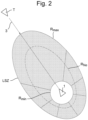
- the LSZ shown in Figure 2 is the region where the probability of an air-to-air weapon hitting an airborne target T is above a threshold level. Calculation of the LSZ is more complicated than for the LAR, because a greater number of factors are involved, such as the relative velocities and directions of travel of the launch aircraft and the target, and those of the weapon relative to the target.
- the shape of the LSZ is more complex than that of the LAR; as with the LAR, there are maximum and minimum ranges, R min and R max , between which the target T can be successfully engaged, but there is a zone bounded by R min within which the target T cannot be engaged successfully because it is outside the capability of the weapon to manoeuvre and hit the target when the launch aircraft is so close to the target, given the speeds and directions of travel of the launch aircraft and the target T.
- the LSZ further includes a so-called "no escape range" R NE .
- the zone bounded by R NE and R min is a zone in which the likelihood of the Target T successfully evading the weapon is below a threshold likelihood. This range may be determined using performance parameters of the weapon, the launch aircraft 1 and the target T.
- there are two LSZs one for the launch aircraft to engage the target 7 and the other for the target to engage the launch aircraft.
- DDWI Data Driven Weapon Integration
- the mission data coefficients uploaded onto the platform are derived from a sophisticated multi-dimensional weapon model. Performing parallel computations on multicore computers, GPUs, and computer clusters let the inventors solve such computationally and data-intensive problems, unlock more performance and reduction in processing time.
- FIG. 3 schematically depicts a system according to an exemplary embodiment.
- the DDWI has three elements:
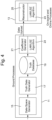
- Figure 4 schematically depicts the system of Figure 3 , in more detail, and is divided between those processes 11 which are carried out on the ground and the processes 13 which are carried out on the launch aircraft 1.
- the system is for generating in an aircraft in flight, a feasibility display indicative of a feasibility of a weapon carried on the aircraft successfully engaging a target and/or a feasibility of a weapon carried on the target successfully engaging the aircraft, the computer, the system comprising a first computer, comprising a memory and a processor, remote from the aircraft and a second computer, comprising a memory and a processor, onboard the aircraft 1.
- the first computer 11 is configured to: provide a database describing a performance envelope of the weapon; create coefficients characteristic of that performance envelope using a generic algorithm, wherein the generic algorithm has the form of a polynomial, by steps including identifying a best candidate polynomial from a plurality of candidate polynomials, the variables of the polynomials being some or all of a group of weapon or aircraft firing condition parameters; and upload, to the second computer, the coefficients of the identified best candidate polynomial.
- the second computer 13 is configured to: select, by a reconstructor containing the same generic algorithm, the coefficients for the generic algorithm according to conditions of the aircraft and the target; and using the selected coefficients, generate, by the reconstructor, the feasibility display.
- the second computer 13 is configured to select, by the reconstructor containing the same generic algorithm, the coefficients for the generic algorithm according to conditions of the aircraft and the target, if the aircraft and the target are within the performance envelope of the weapon, according to the conditions of the aircraft and the target.
- CF Capability Filter
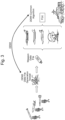
- Figure 6 shows how the capability filter fits in the assessment of the whole envelope.
- the diagram represents the process carried out for a candidate engagement. Firstly, the capability filter assesses whether or not the weapon has capability. Secondly, if the weapon has capability, the relevant LSZ/LAR parameters are then estimated.
- Figure 7 outlines the three main steps involved in the CF implementation. First, all capability ranges in the training data are converted to one and the no capability cases are kept as zero, then the fitting and estimation method described above is used to numerically learn the binary outputs, and finally a threshold is applied to the predicted values, (somewhere between 1 and 0), to determine the true binary output.
- the core of the DDWI is the off-line coefficient generator 21.
- the coefficient generator 21 identifies coefficients for the generic algorithm to make it 'fit' the performance envelope shape.
- the form of the generic algorithm is usually decided in advance e.g. any polynomial equation of degree (i.e. order) up to n.
- the coefficient generator 21 receives the true performance envelope and calculates coefficients for the generic algorithm.
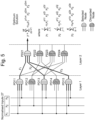
- the estimation and fitting process uses a Genetic Algorithm for self-organising Neural Network approach. It calculates the sets of coefficients that would allow the geometric shapes of LAR/LSZ regions to be modelled (and subsequently reconstructed) by standard polynomial "algorithms", see Figure 5 . It uses an evolutionary technique called Genetic Algorithm as the central mechanism for Self-Organising Polynomial Neural Network (GA-SOPNN), and automating the derivation of a number of polynomial model's coefficients within each layer. The process involves the following steps:
- an internal representation of the space to be searched is selected and an external function that assigns a fitness value to candidate solutions is defined.
- the method comprises inferring if the aircraft and the target are within the performance envelope of the weapon, according to the conditions of the aircraft and the target, using a trained machine learning model, for example a trained neural network.
- a trained machine learning model for example a trained neural network.
- the method comprises training the machine learning model using training data of performance envelopes of respective weapons, according to conditions of respective aircraft and respective targets.
- the method comprises labelling the training data based on if the respective aircraft and the respective target are within the performance envelope of the respective weapon, according to the conditions of the respective aircraft and the respective target.
- the method comprises creating respective coefficients characteristic of the performance envelopes using the generic algorithm, by steps including identifying respective best candidate polynomials from a plurality of candidate polynomials, the variables of the polynomials being some or all of a group of respective weapon or aircraft firing condition parameters.
- inferring if the aircraft and the target are within the performance envelope of the weapon, according to the conditions of the aircraft and the target, using the trained machine learning model, comprises thresholding a result of the inferring.
- the processes 11, 13 begin with the generation of the data space, which is the range of conditions over which the weapon performance envelope is to be defined; this is effected by a data space generator 15, and depends on the ranges of conditions: for which it is required to fire the weapon (which is defined by the weapon user/operator); for which it is feasible to fire according to the launch aircraft capability, and for which it is feasible to fire according to the weapon capability/performance.
- the data space generator 15 comprises data which describes performance parameters for each of a plurality of different aircraft types.
- Different types of aircraft may have different capabilities from one another, thus, for example, aircraft having the same or similar capabilities may be regarded as being the same "aircraft type".
- Different types of aircraft may be different models or makes of aircraft and/or may have different manufacturers.
- Different types of aircraft may have different operational parameters (maximum speed, maximum altitude, g limit, etc.).
- Different types of aircraft may be configured for different purposes or function (e.g. bombers, fighters, re-fuelling etc.). These aircraft performance envelopes may be supplied by the aircraft manufacturers or through testing.
- the plurality of different aircraft types includes the type of the launch aircraft 1 and, preferably, the target aircraft T.
- the performance parameters for each of the aircraft types may include, but are not limited to, a maximum achievable altitude, a maximum achievable g-force, and a maximum achievable climb angle.
- the values of the performance parameters for different types of aircraft may be different from one another. For example, a first type of aircraft may have a maximum altitude of 45,000ft whereas a second type of aircraft may have a maximum altitude of 55,000ft, and so on.
- the data space generator 15 further comprises data which describes performance parameters for each of a plurality of different weapon types, e.g. different weapons that may be loaded onto to the launch aircraft or may be expected to be carried by a hostile target. These weapon performance envelopes may be supplied by the weapon manufacturers or through testing.
- the plurality of different weapon types includes the type of the weapon that is carried by the launch aircraft 1 and, preferably, the target.
- the performance parameters for each of the weapon types may include, but are not limited to, a maximum altitude at which the weapon may be released, a maximum g-force at which the weapon may be released, and release mechanism of the weapon.
- the values of the performance parameters for different types of weapon may be different from one another. For example, a first type of weapon may be able to be released up to an altitude of 35,000ft, whereas a second type of weapon may be able to be released up to an altitude of 45,000ft, and so on.
- the data space generator 15 may define the release, weather and commanded impact conditions for training and verification sets which are run by a truth data generator 17.
- the truth data generator 17 determines the weapon performance for each firing case in the data space; this depends on the weapon performance model which is usually provided by the weapon manufacturer.
- the product of the truth data generator 17 is the truth database 19, which is a set of data specifying, for each weapon type, the further weapon performance envelope for each of a plurality of exemplary weapon firings.
- the truth data generator 17 may produce the training and verification sets which are used by a coefficient generator 21.
- the truth database is used as a model which can be employed onboard the launch aircraft in order to generate the feasibility of engagement displays (LAR or LSZ, as appropriate).
- the coefficient generator 21 receives the further weapon performance envelopes stored by the truth database 19 and calculates, for each weapon type and for each example weapon firing, coefficients according to a generic LAR/LSZ algorithm 23 that "fit" the generic algorithm to the further weapon performance envelope shape.
- the coefficient generator 21 starts by creating an initial set of candidate polynomials whose variables are some or all of the weapon or aircraft firing condition parameters.
- Each of the candidate polynomials is a unique solution to the fitting problem. Some or all of the candidate polynomials may have different order, or dimension, from some or all of the other candidate polynomials.
- a set of coefficients is then computed that best "fit" that candidate polynomial to the weapon performance envelope. This may be done using a criterion of least square error or any other fitting method.
- a score indicative of the quality of this fit is then computed.
- the number of inputs 27 and the form of each polynomial descriptor, PD Layer Node, are determined by an optimisation method known as the Genetic Algorithm.
- the Genetic Algorithm is applied to the candidate polynomials and scores.
- the best scoring polynomials are retained and the other (i.e. worst scoring) polynomials are rejected.
- New candidate polynomials that have similar features to the retained candidate polynomials are then created to replace the rejected ones (e.g. by 'breeding' and 'mutating' the retained candidate polynomials).
- a set of coefficients and score values are then calculated for this new generation of candidates, and so on.
- the Genetic Algorithm is repeated until improvement in the scores of the best candidates ceases or some other criteria are satisfied.
- the result is the first layer, Layer 1, of a Self-Organising Polynomial Neural Network (SOPNN).
- SOPNN Self-Organising Polynomial Neural Network
- the whole process is then repeated with the outputs of the first layer providing the inputs to create a second layer, Layer 2, of the SOPNN.
- the new layer has the effect of creating higher-order candidate polynomials and coefficients for consideration.
- the selection of polynomials in the new layer is again governed and optimised by the Genetic Algorithm.
- Layers are added to the SOPNN in this way until improvement in the scores of the best candidates ceases or some other criteria are satisfied.
- a completed network comprising two layers is represented in Figure 5 .
- the final network is obtained recursively from the path ending at the output node with the best score in the final generation of candidates (the "Optimum Solution"). Any node with no connection to this path is discarded as shown in Figure 5 , where nodes which contribute to the optimal solution are lightly shaded and discarded nodes are black.
- the inventors have adapted the genetic algorithm to parallelise over the many polynomial orders and input parameters that the genetic algorithm has to run.
- the best single candidate polynomial and coefficient set is identified and stored. This process is repeated until all the required characteristics of the LAR/LSZ have corresponding polynomial models. In other words, the process is repeated until, for each firing condition, and for each weapon type, a polynomial model fitted to the further weapon performance envelope for that weapon type and firing condition is generated.
- the order of the generic polynomial is in a range from 10 to 25, for example 20.
- the output of the coefficient generator 21 is the set of coefficients which is loaded onto the launch aircraft by a data uploader.
- the onboard processes 13 comprise a reconstructor 25, which brings together the generic LAR/LSZ algorithm 23 (which is held in the aircraft systems) and the uploaded coefficients, so as to reconstruct the LAR, LSZ, or MEZ for a particular engagement by selecting the appropriate algorithm and coefficients for the current launch conditions (i.e. the weapon or aircraft firing conditions).
- the LAR, LSZ, or MEZ is displayed by conventional means onboard the aircraft.
- the reconstructor 25 onboard the launch aircraft 1 may select, from the uploaded coefficients, those coefficients that correspond to the weapon being carried by the launch aircraft 1 and that correspond to the relevant firing condition (altitude, angle of attack, environmental conditions, g-force being experienced etc.). The selected coefficients may then be used to reconstruct the LSZ of the launch aircraft 1 for display to the pilot of the launch aircraft 1.
- the reconstructed LSZ of the launch aircraft 1 may also be used by other systems onboard the launch aircraft 1 to recommend actions to the pilot of the launch aircraft 1 (e.g. a recommendation that the weapon is fired etc.).
- the aircraft type of the hostile target T may be determined by the pilot of the launch aircraft 1 (or by other means) and input to the reconstructor 25.
- the reconstructor 25 onboard the launch aircraft 1 may then select, from the uploaded coefficients, those coefficients that correspond to the weapon most likely being carried by the hostile target T and that correspond to the relevant firing conditions.
- the selected coefficients may then be used to reconstruct the LSZ of the hostile target T for display to the pilot of the launch aircraft 1.
- the reconstructed LSZ of the hostile target T may also be used by other systems onboard the launch aircraft 1 to recommend actions to the pilot of the launch aircraft 1 (e.g. a recommendation that certain evasive manoeuvres are performed etc.).
- the reconstructor 25 on-board the launch aircraft 1 may select, from the uploaded coefficients, those coefficients that correspond to the weapon being carried by the launch aircraft 1 and that correspond to the relevant firing condition (altitude, angle of attack, environmental conditions, g-force being experienced etc.). The selected coefficients may then be used to reconstruct the LAR of the launch aircraft 1 for display to the pilot of the launch aircraft 1 .
- the reconstructed LAR of the launch aircraft 1 may also be used by other systems onboard the launch aircraft 1 to recommend actions to the pilot of the launch aircraft 1 (e.g. a recommendation that the weapon is fired etc.).
- the type of the ground target 5 may be determined by the pilot of the launch aircraft 1 (or by other means) and input to the reconstructor 25.
- the reconstructor 25 onboard the launch aircraft 1 may then select, from the uploaded coefficients, those coefficients that correspond to the weapon most likely being carried by the ground target 5 and that correspond to the relevant firing conditions.
- the selected coefficients may then be used to reconstruct the MEZ of the ground target 5 for display to the pilot of the launch aircraft 1.
- the reconstructed MEZ of the ground target 5 may also be used by other systems onboard the launch aircraft 1 to recommend actions to the pilot of the launch aircraft 1 (e.g. a recommendation that certain evasive manoeuvres are performed etc.).
- Apparatus including the any of the above mentioned processors, for implementing the above described arrangement, may be provided by configuring or adapting any suitable apparatus, for example one or more computers or other processing apparatus or processors, and/or providing additional modules.
- the apparatus may comprise a computer, a network of computers, or one or more processors, for implementing instructions and using data, including instructions and data in the form of a computer program or plurality of computer programs stored in or on a machine readable storage medium such as computer memory, a computer disk, ROM, PROM etc., or any combination of these or other storage media.
Landscapes
- Engineering & Computer Science (AREA)
- General Engineering & Computer Science (AREA)
- Aviation & Aerospace Engineering (AREA)
- Chemical & Material Sciences (AREA)
- Combustion & Propulsion (AREA)
- Radar Systems Or Details Thereof (AREA)
Priority Applications (16)
| Application Number | Priority Date | Filing Date | Title |
|---|---|---|---|
| EP22275021.8A EP4235083A1 (de) | 2022-02-24 | 2022-02-24 | Systemintegration |
| PCT/GB2023/050403 WO2023161628A1 (en) | 2022-02-24 | 2023-02-22 | System integration |
| JP2024550288A JP7841108B2 (ja) | 2022-02-24 | 2023-02-22 | システム統合 |
| EP23707786.2A EP4483124A1 (de) | 2022-02-24 | 2023-02-22 | Systemintegration |
| EP23707456.2A EP4483123A1 (de) | 2022-02-24 | 2023-02-22 | Systemintegration |
| PCT/GB2023/050404 WO2023161629A1 (en) | 2022-02-24 | 2023-02-22 | System integration |
| EP23707787.0A EP4483125A1 (de) | 2022-02-24 | 2023-02-22 | Systemintegration |
| US18/841,142 US20250189270A1 (en) | 2022-02-24 | 2023-02-22 | System integration |
| US18/841,130 US20250190816A1 (en) | 2022-02-24 | 2023-02-22 | System integration |
| GB2302532.3A GB2617455B (en) | 2022-02-24 | 2023-02-22 | System integration |
| JP2024550290A JP7841109B2 (ja) | 2022-02-24 | 2023-02-22 | システム統合 |
| US18/841,156 US20250187749A1 (en) | 2022-02-24 | 2023-02-22 | System integration |
| JP2024550287A JP7841107B2 (ja) | 2022-02-24 | 2023-02-22 | システム統合 |
| GB2302533.1A GB2617684B (en) | 2022-02-24 | 2023-02-22 | System integration |
| GB2302535.6A GB2617685B (en) | 2022-02-24 | 2023-02-22 | System integration |
| PCT/GB2023/050402 WO2023161627A1 (en) | 2022-02-24 | 2023-02-22 | System integration |
Applications Claiming Priority (1)
| Application Number | Priority Date | Filing Date | Title |
|---|---|---|---|
| EP22275021.8A EP4235083A1 (de) | 2022-02-24 | 2022-02-24 | Systemintegration |
Publications (1)
| Publication Number | Publication Date |
|---|---|
| EP4235083A1 true EP4235083A1 (de) | 2023-08-30 |
Family
ID=80595442
Family Applications (1)
| Application Number | Title | Priority Date | Filing Date |
|---|---|---|---|
| EP22275021.8A Pending EP4235083A1 (de) | 2022-02-24 | 2022-02-24 | Systemintegration |
Country Status (1)
| Country | Link |
|---|---|
| EP (1) | EP4235083A1 (de) |
Citations (2)
| Publication number | Priority date | Publication date | Assignee | Title |
|---|---|---|---|---|
| EP2876402A1 (de) * | 2013-11-25 | 2015-05-27 | BAE Systems PLC | Systemintegration |
| EP3449203B1 (de) * | 2016-04-25 | 2020-05-13 | BAE Systems PLC | Systemintegration |
-
2022
- 2022-02-24 EP EP22275021.8A patent/EP4235083A1/de active Pending
Patent Citations (2)
| Publication number | Priority date | Publication date | Assignee | Title |
|---|---|---|---|---|
| EP2876402A1 (de) * | 2013-11-25 | 2015-05-27 | BAE Systems PLC | Systemintegration |
| EP3449203B1 (de) * | 2016-04-25 | 2020-05-13 | BAE Systems PLC | Systemintegration |
Similar Documents
| Publication | Publication Date | Title |
|---|---|---|
| EP2464943B1 (de) | Systemintegration | |
| EP3449203B1 (de) | Systemintegration | |
| EP3074713B1 (de) | Systemintegration | |
| EP2876401A1 (de) | Systemintegration | |
| EP2876402A1 (de) | Systemintegration | |
| GB2522110A (en) | System integration | |
| EP4235083A1 (de) | Systemintegration | |
| US20250190816A1 (en) | System integration | |
| EP4235082A1 (de) | Wafensystemintegration | |
| EP4235084A1 (de) | Waffen systemintegration | |
| JP2025508854A5 (de) | ||
| JP2025508853A5 (de) | ||
| JP2025508855A5 (de) | ||
| EP3239645A1 (de) | Datenverarbeitung | |
| EP3449202B1 (de) | Datenverarbeitung | |
| CA3020782C (en) | Data processing | |
| GB2551626A (en) | Data processing | |
| EP3239646A1 (de) | Systemintegration |
Legal Events
| Date | Code | Title | Description |
|---|---|---|---|
| PUAI | Public reference made under article 153(3) epc to a published international application that has entered the european phase |
Free format text: ORIGINAL CODE: 0009012 |
|
| STAA | Information on the status of an ep patent application or granted ep patent |
Free format text: STATUS: THE APPLICATION HAS BEEN PUBLISHED |
|
| AK | Designated contracting states |
Kind code of ref document: A1 Designated state(s): AL AT BE BG CH CY CZ DE DK EE ES FI FR GB GR HR HU IE IS IT LI LT LU LV MC MK MT NL NO PL PT RO RS SE SI SK SM TR |