EP4235488A1 - Bildklassifizierungsverfahren und -vorrichtung, vorrichtung, speichermedium und programmprodukt - Google Patents
Bildklassifizierungsverfahren und -vorrichtung, vorrichtung, speichermedium und programmprodukt Download PDFInfo
- Publication number
- EP4235488A1 EP4235488A1 EP22831494.4A EP22831494A EP4235488A1 EP 4235488 A1 EP4235488 A1 EP 4235488A1 EP 22831494 A EP22831494 A EP 22831494A EP 4235488 A1 EP4235488 A1 EP 4235488A1
- Authority
- EP
- European Patent Office
- Prior art keywords
- image
- feature
- feature set
- initial
- initial image
- Prior art date
- Legal status (The legal status is an assumption and is not a legal conclusion. Google has not performed a legal analysis and makes no representation as to the accuracy of the status listed.)
- Pending
Links
Images




Classifications
-
- G—PHYSICS
- G06—COMPUTING OR CALCULATING; COUNTING
- G06V—IMAGE OR VIDEO RECOGNITION OR UNDERSTANDING
- G06V10/00—Arrangements for image or video recognition or understanding
- G06V10/70—Arrangements for image or video recognition or understanding using pattern recognition or machine learning
- G06V10/764—Arrangements for image or video recognition or understanding using pattern recognition or machine learning using classification, e.g. of video objects
-
- G—PHYSICS
- G06—COMPUTING OR CALCULATING; COUNTING
- G06F—ELECTRIC DIGITAL DATA PROCESSING
- G06F18/00—Pattern recognition
- G06F18/20—Analysing
- G06F18/24—Classification techniques
- G06F18/241—Classification techniques relating to the classification model, e.g. parametric or non-parametric approaches
-
- G—PHYSICS
- G06—COMPUTING OR CALCULATING; COUNTING
- G06F—ELECTRIC DIGITAL DATA PROCESSING
- G06F18/00—Pattern recognition
- G06F18/20—Analysing
- G06F18/21—Design or setup of recognition systems or techniques; Extraction of features in feature space; Blind source separation
- G06F18/214—Generating training patterns; Bootstrap methods, e.g. bagging or boosting
-
- G—PHYSICS
- G06—COMPUTING OR CALCULATING; COUNTING
- G06F—ELECTRIC DIGITAL DATA PROCESSING
- G06F18/00—Pattern recognition
- G06F18/20—Analysing
- G06F18/25—Fusion techniques
- G06F18/253—Fusion techniques of extracted features
-
- G—PHYSICS
- G06—COMPUTING OR CALCULATING; COUNTING
- G06N—COMPUTING ARRANGEMENTS BASED ON SPECIFIC COMPUTATIONAL MODELS
- G06N3/00—Computing arrangements based on biological models
- G06N3/02—Neural networks
- G06N3/08—Learning methods
-
- G—PHYSICS
- G06—COMPUTING OR CALCULATING; COUNTING
- G06V—IMAGE OR VIDEO RECOGNITION OR UNDERSTANDING
- G06V10/00—Arrangements for image or video recognition or understanding
- G06V10/70—Arrangements for image or video recognition or understanding using pattern recognition or machine learning
- G06V10/77—Processing image or video features in feature spaces; using data integration or data reduction, e.g. principal component analysis [PCA] or independent component analysis [ICA] or self-organising maps [SOM]; Blind source separation
- G06V10/774—Generating sets of training patterns; Bootstrap methods, e.g. bagging or boosting
-
- Y—GENERAL TAGGING OF NEW TECHNOLOGICAL DEVELOPMENTS; GENERAL TAGGING OF CROSS-SECTIONAL TECHNOLOGIES SPANNING OVER SEVERAL SECTIONS OF THE IPC; TECHNICAL SUBJECTS COVERED BY FORMER USPC CROSS-REFERENCE ART COLLECTIONS [XRACs] AND DIGESTS
- Y02—TECHNOLOGIES OR APPLICATIONS FOR MITIGATION OR ADAPTATION AGAINST CLIMATE CHANGE
- Y02T—CLIMATE CHANGE MITIGATION TECHNOLOGIES RELATED TO TRANSPORTATION
- Y02T10/00—Road transport of goods or passengers
- Y02T10/10—Internal combustion engine [ICE] based vehicles
- Y02T10/40—Engine management systems
Definitions
- Embodiments of this application relate to the field of artificial intelligence, and in particular, to an image classification method and apparatus, a device, a storage medium, and a program product.
- Image classification refers to a process of distinguishing between different categories of images according to semantic information of the images.
- ViT vision transformer
- the ViT model has a poor training effect, which affects the accuracy of image classification.
- Embodiments of this application provide an image classification method and apparatus, a device, a storage medium, and a program product, which can reduce the need for labeled sample images during a training process of an image classification model, and help to improve the accuracy of a prediction result of the image classification model.
- the technical solutions include the following contents.
- some embodiments provides an image classification method, performed by a computer device, the method including:
- an image classification apparatus including the following modules:
- some embodiments provides a computer device, including a processor and a memory, the memory storing at least one instruction, at least one program, a code set, or an instruction set, the at least one instruction, the at least one program, the code set, or the instruction set being loaded and executed by the processor to implement the image classification method according to the foregoing aspect.
- some embodiments provides a computer-readable storage medium, storing at least one instruction, at least one program, a code set, or an instruction set, the at least one instruction, the at least one program, the code set, or the instruction set being loaded and executed by a processor to implement the image classification method according to the foregoing aspect.
- some embodiments provides a computer program product or a computer program, the computer program product or the computer program including computer instructions, the computer instructions being stored in a computer-readable storage medium, a processor of a computer device reading the computer instructions from the computer-readable storage medium, the processor executing the computer instructions to cause the computer device to perform the image classification method according to the foregoing aspect.
- a computer program product or a computer program including computer instructions, the computer instructions being stored in a computer-readable storage medium, a processor of a computer device reading the computer instructions from the computer-readable storage medium, the processor executing the computer instructions to cause the computer device to perform the image classification method according to various exemplary implementations in the foregoing aspect.
- an order of the initial image features is disturbed in different manners and is rearranged and recombined to obtain the first image feature set and the second image feature set, and then self-supervision pre-training may be performed on the image classification model based on the image feature sets under different rearrangement and combination manners.
- the pre-training is performed without the use of labeled sample images, which reduces the amount of need for the labeled sample images, and reduces the amount of manual labeling tasks.
- the pre-trained image classification model is fine-tuned through the labeled sample images, to ensure the classification performance of the finally obtained image classification model, which helps to improve the accuracy of image classification.
- AI Artificial intelligence
- AI is a theory, method, technology, and application system that uses a digital computer or a machine controlled by the digital computer to simulate, extend, and expand human intelligence, perceive an environment, acquire knowledge, and use knowledge to obtain an optimal result.
- AI is a comprehensive technology in computer science and attempts to understand the essence of intelligence and produce a new intelligent machine that can react in a manner similar to human intelligence.
- AI is to study design principles and implementation methods of various intelligent machines, to enable the machines to have functions of perception, reasoning, and decision-making.
- An AI technology is a comprehensive discipline, and relates to a wide range of fields including both hardware-level technologies and software-level technologies.
- Basic AI technologies generally include technologies such as a sensor, a dedicated AI chip, cloud computing, distributed storage, a big data processing technology, an operating/interaction system, and electromechanical integration.
- AI software technologies mainly include several major directions such as a computer vision technology, a speech processing technology, a natural language processing technology, and machine learning/deep learning.
- a computer vision (CV) technology is a science that studies how to use a machine to "see”, and furthermore, refers to using a camera and a computer to replace human eyes to perform machine vision such as recognition, tracking, and measurement on a target, and further perform graphic processing, so that the computer processes the target into an image more suitable for human eyes to observe, or an image transmitted to an instrument for detection.
- CV studies related theories and technologies, and attempts to establish an AI system that can obtain information from images or multidimensional data.
- the CV technologies generally include technologies such as image processing, image recognition, image segmentation, image semantic understanding, image retrieval, video processing, video semantic understanding, video content/behavior recognition, three-dimensional object reconstruction, a 3D technology, virtual reality, augmented reality, synchronous positioning, and map construction, and further include biometric feature recognition technologies such as common face recognition and fingerprint recognition.
- An image classification method involved in the embodiments of this application that is, an application of the CV technology in the field of image recognition, can reduce the need for labeled sample images during a training process of an image classification model, and help to improve the accuracy of a prediction result of the trained image classification model.
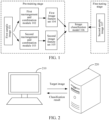
- FIG. 1 shows a schematic diagram of a principle of training an image classification model according to some embodiments.
- a model pre-training system includes a first rearrangement and combination module 102 and a second rearrangement and combination module 103.
- a first sample image 101 that does not carry a sample label is inputted into the first rearrangement and combination module 102 and the second rearrangement and combination module 103, respectively, to obtain a first image feature set 104 and a second image feature set 105.
- an image classification model 106 is pre-trained based on the first image feature set 104 and the second image feature set 105.
- a second sample image 107 carrying the sample label is inputted into the pre-trained image classification model 106, and parameters are fine-tuned, so as to obtain a final image classification model for image classification.
- FIG. 2 shows a schematic diagram of an implementation environment according to some embodiments.
- the implementation environment includes a computer device 210 and a server 220.
- the computer device 210 and the server 220 perform data communication with each other through a communication network.
- the communication network may be a wired network or a wireless network, and the communication network may be at least one of a local area network, a metropolitan area network, and a wide area network.
- the computer device 210 is an electronic device having image classification needs, and the electronic device may be a smartphone, a tablet computer, a personal computer, or the like, which is not limited herein.
- an application having an image classification function is run in the computer device 210.
- the application may be a social application, an image retrieval application, or an image storage application.
- the computer device 210 may input the target image set or the target image into the application, thereby uploading the target image set or the target image to the server 220 for identification of the image category and feedback of classification results.
- the server 220 may be an independent physical server, a server cluster or a distributed system formed by a plurality of physical servers, or a cloud server that provides a basic cloud computing service such as a cloud service, a cloud database, cloud computing, a cloud function, cloud storage, a network service, cloud communication, a middleware service, a domain name service, a security service, a content delivery network (CDN), big data, and an artificial intelligence platform.
- a basic cloud computing service such as a cloud service, a cloud database, cloud computing, a cloud function, cloud storage, a network service, cloud communication, a middleware service, a domain name service, a security service, a content delivery network (CDN), big data, and an artificial intelligence platform.
- a basic cloud computing service such as a cloud service, a cloud database, cloud computing, a cloud function, cloud storage, a network service, cloud communication, a middleware service, a domain name service, a security service, a content delivery network (CDN), big data, and an artificial
- the server 220 is configured to provide an image classification service for the application installed in the computer device 210.
- an image classification model is disposed in the server 220.
- the image classification model is an image classification model that has been pre-trained through an unlabeled first sample image and fine-tuned through a labeled second sample image, and is configured to classify images sent by the computer device 210.
- the image classification model may also be deployed on the side of the computer device 210, and the computer device 210 implements image classification locally without the use of the server 220.
- the image classification model is trained on the side of the computer device 210.
- the image classification model is trained on the side of the server 220, and the trained image classification model is deployed in the computer device 210. This is not limited herein.
- the following embodiments are described by using an example in which the image classification method is performed by the computer device.
- the server deployed with a neural network model may be a node in a distributed system, where the distributed system may be a blockchain system, and the blockchain system may be a distributed system formed by connecting a plurality of nodes through network communication.
- the nodes may form a peer to peer (P2P) network.
- P2P peer to peer
- Computing devices in any form, for example, electronic devices such as a server and a terminal, may join the P2P network to become a node in the blockchain system.
- the node includes a hardware layer, an intermediate layer, an operating system layer, and an application layer.
- training samples of the image classification model may be saved on the blockchain.
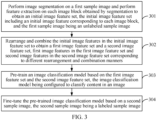
- FIG. 3 shows a flowchart of an image classification method according to some embodiments.
- description is made by using an example in which the method is performed by the computer device.
- the method includes the following steps.
- Step 301 Perform image segmentation on a first sample image to obtain a plurality of image blocks, the first sample image being an unlabeled sample image, and perform feature extraction on each of the image blocks to obtain an initial image feature set including a plurality of initial image features each corresponding to one of the image blocks.
- the image classification model may be applied to any scenario that identifies a category to which image content belongs, and thus, the first sample image may be an image of any category, such as a medical image, an animal image, or a landscape image.
- the first sample image is an image set of unlabeled sample images.
- the computer device after obtaining the first sample image, the computer device first performs image segmentation on the image.
- the first sample image may be segmented into image blocks of the same size, and different image blocks carry different image information.
- the computer device After the segmentation is completed, the computer device performs feature extraction on each image block obtained by segmentation. In some embodiments, the computer device performs linear mapping on each image block to obtain the initial image feature corresponding to each image block, and the initial image features are combined into the initial image feature set.
- Step 302 Rearrange and combine the initial image features in the initial image feature set to obtain a first image feature set and a second image feature set, first image features in the first image feature set and second image features in the second image feature set corresponding to different rearrangement and combination manners.
- the computer device rearranges and combines the initial image features in the initial image feature set in different manners to obtain the first image feature set and the second image feature set.
- each first image feature included in the first image feature set and each second image feature included in the second image feature set indicate different image information. That is, the computer device obtains different combination manners of image features in the first sample image through different rearrangement and combination manners.
- a quantity of the obtained first image features is the same as a quantity of the initial image features in the initial image feature set, and correspondingly, a quantity of the second image features is the same as the quantity of the initial image features.
- Step 303 Pre-train an image classification model based on the first image feature set and the second image feature set, the image classification model being configured to classify content in an image.
- the pre-training refers to a process in which the image classification model is trained by using a large dataset so that the image classification model learns common features in the dataset.
- a purpose of the pre-training is to provide high-quality model parameters for subsequent training of the image classification model on a particular dataset.
- the computer device may implement self-supervision training of the image classification model according to the obtained classification result based on the principle that the prediction results of the model are consistent, and thus it is not necessary to use the labeled sample images, that is, sample images with labels.
- the image classification model is configured to classify the content in the image.
- the image classification model may identify a category of a single image or distinguish categories of images in an image set to complete the classification of the image set.
- Step 304 Fine-tune the pre-trained image classification model based on a second sample image, the second sample image being a labeled sample image.
- Fine-tuning is a process of making small-scale precise adjustments to the model parameters through a small quantity of datasets, and a supervision-type learning manner is adopted in a fine-tuning stage. Therefore, the pre-trained image classification model is fine-tuned by using the labeled second sample image.
- the fine-tuning stage may only require a small quantity of labeled samples to make the model have high performance on a target task.
- a data quantity of the data set used for fine-tuning may be less than a data quantity of the data set used for pre-training. Therefore, a quantity of the second sample image is less than a quantity of the first sample image, which may reduce the need for the labeled sample images.
- an order of the initial image features is disturbed in different manners and is rearranged and recombined to obtain the first image feature set and the second image feature set, and then self-supervision pre-training may be performed on the image classification model based on the image feature sets under different rearrangement and combination manners.
- the pre-training is performed without the use of labeled sample images, which reduces the amount of need for the labeled sample images, and reduces the amount of manual labeling tasks.
- the pre-trained image classification model is fine-tuned through the labeled sample images, to ensure the classification performance of the finally obtained image classification model, which helps to improve the accuracy of image classification.
- an online learning branch and a target learning branch are respectively used to classify image feature sets obtained by different rearrangements and combinations, and then a pre-training process of the image classification model is implemented based on classification results of the two branches.
- a pre-training process of the image classification model is implemented based on classification results of the two branches.
- FIG. 4 shows a flowchart of an image classification method according to another exemplary embodiment of this application.
- description is made by using an example in which the method is performed by the computer device.
- the method includes the following steps.
- Step 401 Perform image segmentation on a first sample image to obtain a plurality of image blocks, the first sample image being an unlabeled sample image, and perform feature extraction on each of the image blocks to obtain an initial image feature set including a plurality of initial image features each corresponding to one of the image blocks.
- the image classification model may be a ViT model
- the ViT model is an image classification model obtained by combining CV and natural language processing (NLP) fields.
- the computer device When using the ViT model to classify the first sample image, the computer device first segments the first sample image into image blocks having a fixed size, and then transforms each image block into the initial image feature through linear transformation, that is, each image block is encoded into a token, and the token is provided with order information.
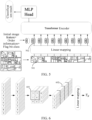
- the first sample image is segmented into image blocks 501, and then each image block is linearly transformed to obtain tokens 502 corresponding to each image block, thereby obtaining the initial image feature set.
- Step 402 Adjust a feature order of the initial image features in the initial image feature set to obtain a first initial image feature set and a second initial image feature set, an order of the initial image features in the first initial image feature set being different from that in the second initial image feature set.
- the order of the initial image features is first adjusted, that is, position information of each initial image feature is disturbed.
- the computer device randomly disturbs an arrangement order of the initial image features to obtain the first initial image feature set and the second initial image feature set.
- the computer device may change the arrangement order of the initial image features in two fixed order adjustment manners to obtain the first initial image feature set and the second initial image feature set. This is not limited herein.
- the order of each initial image feature may be adjusted, which is adjusted to be different from an initial order.
- partial initial image features are selected, and only a feature order of the partial initial image features is adjusted.
- first image feature set and the second image feature set are obtained by performing different rearrangements and combinations on the initial image features, when randomly disturbing the initial image features, different disturbing manners are adopted to obtain the first initial image feature set and the second initial image feature set, so that the order of the initial image features is different, that is, the first image feature set and the second image feature set may be different. Subsequent feature recombination may be performed in the same or different manners.
- an initial image feature set T ⁇ ⁇ t 1 , ..., t 9 ⁇ includes 9 initial image features, that is, 9 tokens, with corresponding order information.
- T p2 ⁇ t 2 , t 7 , t 3 , t 1 , t 4 , t 9 , t 8 , t 5 , t 6 ⁇ .
- Step 403 Rearrange the first initial image feature set to obtain a first feature matrix, and rearrange the second initial image feature set to obtain a second feature matrix.
- a feature matrix for the disturbed initial image feature set may be constructed first, including constructing the first feature matrix of the first initial image feature set and the second feature matrix of the second initial image feature set. That constructing the first feature matrix and the second feature matrix may include the following steps.
- Step 403a Determine a matrix size based on an image segmentation manner of the first sample image.
- the size of the constructed matrix may be determined according to the image segmentation manner of the first sample image, to avoid that the size of the constructed matrix does not match a quantity of image blocks obtained by segmentation. If 9 image blocks are obtained by segmenting the first sample image, a 3 ⁇ 3 matrix may be constructed; if 16 image blocks are obtained by segmenting the first sample image, a 4 ⁇ 4 matrix or a 2 ⁇ 8 matrix may be constructed.
- the matrix size may be determined as 3 ⁇ 3, which matches the quantity of image blocks obtained by segmentation.
- Step 403b Rearrange the initial image features in the first initial image feature set based on the matrix size to obtain the first feature matrix.
- the first feature matrix is constructed according to the matrix size, that is, the initial image features in the first initial image feature set are rearranged.
- the initial image features may be selected in sequence according to the order of the initial image features in the first initial image feature, and then arranged in rows or arranged in columns, to construct the first feature matrix.
- the matrix size is 3 ⁇ 3
- the first feature matrix is: t 3 t 5 t 8 t 1 t 6 t 2 t 9 t 4 t 7
- Step 403c Rearrange the initial image features in the second initial image feature set based on the matrix size to obtain the second feature matrix.
- the computer device also constructs the second feature matrix according to the matrix size, that is, rearranges the initial image features in the second initial image feature set.
- the manner for constructing the second feature matrix may be the same as or different from that for the first feature matrix, which is not limited herein.
- the first feature matrix is constructed by row arrangement
- the second feature matrix is constructed by column arrangement
- the first feature matrix is constructed by column arrangement
- the second feature matrix is constructed by row arrangement
- both the first feature matrix and the second feature matrix are constructed by row arrangement.
- the second initial image feature set T p2 ⁇ t 2 , t 7 , t 3 , t 1 , t 4 , t 9 , t 8 , t 5 , t 6 ⁇ is rearranged to construct a 3 ⁇ 3 matrix by column, to obtain the second feature matrix as follows: t 2 t 1 t 8 t 7 t 4 t 5 t 3 t 9 t 6
- This step and the above step 403b that is, the step of constructing the first feature matrix, may be performed synchronously or asynchronously.
- This embodiment describes only the manners for constructing the first feature matrix and the second feature matrix, but does not limit execution timing.
- Step 404 Perform feature combination on the initial image features in the first feature matrix, and generate the first image feature set based on a feature combination result.
- the computer device After the rearrangement ends, the computer device performs feature combination on the initial image features in the first feature matrix, and generates the first image feature set according to the combination result.
- Image information in the image block corresponding to each first image feature in the first image feature set changes, that is, is different from image information in the image block corresponding to each initial image feature.
- a process of performing feature combination and generating the first image feature set based on the combination result may include the following steps.
- Step 404a Select n adjacent initial image features in the first feature matrix through a sliding window.
- the computer device uses a sliding window sampling manner to select n initial image features for feature combination every time, where a size of the sliding window needs to be smaller than the matrix size.
- a 2 ⁇ 2 sliding window may be used for the 3 ⁇ 3 matrix
- a 2 ⁇ 2 sliding window or a 3 ⁇ 3 sliding window may be used for the 4 ⁇ 4 matrix.
- a 3 ⁇ 3 first feature matrix may be sampled by using a 2 ⁇ 2 sliding window.
- 4 initial image features may be selected through a sliding window 601.
- Step 404b Perform feature combination on the n initial image features to obtain a first combined image feature.
- feature combination is performed on the n initial image features in the sliding window to obtain the first combined image feature after combination.
- a feature combination manner may include feature splicing, feature fusion, and the like, that is, performing feature splicing on the n initial image features to obtain the first combined image feature, or performing feature fusion, that is, feature addition on the n initial image features to obtain the first combined image feature.
- the computer device performs feature splicing on 4 initial image features t 3 , t 5 , t 1 , and t 6 to obtain a first combined image feature 602.
- Step 404c Perform linear mapping on m groups of the first combined image features to obtain the first image feature set, the m groups of the first combined image features being obtained by moving the sliding window.
- the computer device traverses the first feature matrix by sliding the sliding window to obtain the m groups of the first combined image features, where m is a positive integer.
- a sliding step size and a sliding direction of the sliding window may be set randomly or fixedly.
- the sliding step size may be set to 1, and the sliding window may slide according to a row direction.
- the computer device After obtaining the m groups of the first combined image features, the computer device performs linear mapping on the m groups of the first combined image features to obtain the first image feature set.
- the m groups of the first combined image features may be outputted to a multilayer perceptron (MLP) for linear mapping to obtain the first image feature set.
- MLP multilayer perceptron
- the sliding step size is set to 1, and the sliding window first slides in the row direction. After the combination of one row of image features is completed, the sliding window is moved in a column direction to combine the next row of image features, so as to obtain a combination of 4 groups of initial image features, each group including 4 initial image features.
- T L ⁇ t 1 ', t 2 ', t 3 ', t 4 ' ⁇ is linearly mapped to obtain a
- Step 405 Perform feature combination on the initial image features in the second feature matrix, and generate the second image feature set based on a feature combination result.
- the computer device performs feature combination on the initial image features in the second feature matrix, and generates the second image feature set according to the combination result.
- Image information in the image block corresponding to each second image feature in the second image feature set changes, that is, is different from image information in the image block corresponding to each initial image feature, and different from the image information of the image block corresponding to the first image feature.
- that performing feature combination and generating the second image feature set based on the combination result may include the following steps.
- Step 405a Select n adjacent initial image features in the second feature matrix through a sliding window.
- the computer device when constructing the second feature matrix, the computer device also uses a sliding window sampling manner to select n initial image features for feature combination, where a size of the sliding window needs to be smaller than the matrix size.
- a size of the sliding window for sampling the second feature matrix may be the same as or different from a size of the sliding window for sampling the first feature matrix.
- a 2 ⁇ 2 sliding window may be used for sampling a 4 ⁇ 4 first feature matrix to obtain 4 groups of first combined image features that do not intersect with each other
- a 3 ⁇ 3 sliding window may be used for sampling a 4 ⁇ 4 second feature matrix to obtain 4 groups of second combined image features that intersect with each other.
- Step 405b Perform feature combination on the n initial image features to obtain a second combined image feature.
- feature combination is performed on the n initial image features in the sliding window to obtain the second combined image feature after combination.
- a feature combination manner may include feature splicing, feature fusion, and the like, that is, performing feature splicing on the n initial image features to obtain the second combined image feature, or performing feature fusion, that is, feature addition on the n initial image features to obtain the second combined image feature.
- Step 405c Perform linear mapping on m groups of the second combined image features to obtain the second image feature set, the m groups of the second combined image features being obtained by moving the sliding window.
- the computer device traverses the second feature matrix by sliding the sliding window to obtain the m groups of the second combined image features.
- a sliding step size and a sliding direction of the sliding window may be set randomly.
- the sliding step size may be set to 1, and the sliding window may slide according to the column direction.
- the computer device After obtaining the m groups of the second combined image features, the computer device performs linear mapping on the m groups of the second combined image features to obtain the second image feature set.
- the m groups of the second combined image features may be outputted to a MLP for linear mapping to obtain the second image feature set.
- a quantity of the second image features in the second image feature set obtained by mapping is the same as the quantity of the initial image features.
- Step 406 Input the first image feature set into an online learning branch of the image classification model to obtain a first classification result.
- the computer device may pre-train the image classification model by using the first image feature set and the second image feature set.
- the image classification model includes an online learning branch and a target learning branch, where the online learning branch and the target learning branch have the same structures of the image classification model, which are structures corresponding to the ViT model, but the corresponding model parameters are updated in different manners.
- the computer device inputs the first image feature set into the online learning branch of the image classification model, and the online learning branch is used for identifying an image category of the first sample image according to the image features indicated by the first image feature set, to obtain the first classification result.
- the ViT model inputs the first image feature set into a Transformer encoder, performs image feature extraction on the first image feature set, and inputs extraction results into a classifier MLP Head for image classification, to obtain the first classification result.
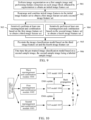
- a first sample image 701 is inputted into a first rearrangement and combination module 702 to obtain the first image feature set, and the first image feature set is inputted into the ViT model to obtain a first classification result Z, this branch being the online learning branch.
- Step 407 Input the second image feature set into a target learning branch of the image classification model to obtain a second classification result.
- the second image feature set is inputted into the target learning branch, and the target learning branch is used for identifying an image category of the second sample image according to the image features indicated by the second image feature set, that is, to obtain the second classification result. Similar to the manner for obtaining the first classification result, the second image feature set is inputted into the encoder, image feature extraction is performed on the second image feature set, and extraction results are also inputted into the classifier MLP Head for image classification, to obtain the second classification result.
- the first sample image 701 is inputted into a second rearrangement and combination module 703 to obtain the second image feature set, and the second image feature set is inputted into the ViT model to obtain a second classification result Z', this branch being the target learning branch.
- the rearrangement and combination module 703 and the rearrangement and combination module 702 respectively correspond to different rearrangement and combination manners.
- Step 408 Train the online learning branch based on the first classification result and the second classification result.
- the computer device first trains the online learning branch based on the first classification result and the second classification result, and then updates model parameters of the target learning branch based on the updated online learning branch.
- a training process of the online learning branch may include the following steps.
- Step 408a Determine a similarity loss between the first classification result and the second classification result.
- the computer device determines the similarity loss between the first classification result and the second classification result, and then trains the ViT model based on the similarity loss, so that the ViT model can obtain the same classification result according to the image features under different combination arrangement manners, thereby improving the accuracy of the ViT model for image classification.
- the update of the model parameters of the ViT model may also be implemented without the use of labeled sample images, thereby implementing self-supervision learning of the ViT model.
- the similarity loss refers to the degree of consistency between the first classification result and the second classification result
- the similarity loss between the first classification result and the second classification result may be determined by using a L1 loss function, a L2 loss function, or the like.
- L represents the similarity loss
- Z represents the first classification result
- Z' represents the second classification result
- Step 408b Update the model parameters of the online learning branch by back propagation based on the similarity loss.
- a manner for updating the model parameters in the online learning branch is different from a manner for updating the model parameters in the target learning branch.
- the online learning branch is updated by using a back propagation manner, while the model parameters in the target learning branch are updated according to the model parameters in the online learning branch.
- the model parameters of the image classification model in the online learning branch and the target learning branch are optimized through iterative training, that is, the model parameters of the ViT model are optimized.
- the model parameters of the online learning branch may be updated based on the similarity loss by back propagation until the model parameters meet training conditions, that is, until the similarity loss meets convergence conditions.
- Step 409 Update model parameters of the target learning branch based on model parameters of the trained online learning branch.
- the computer device will update the model parameters of the target learning branch accordingly.
- the model parameters of the target learning branch will be updated again. In this case, both the online learning branch and the target learning branch stop updating the model parameters.
- the model parameters of the target learning branch may be updated with exponential moving average (EMA).
- EMA exponential moving average
- ⁇ is the model parameter of the image classification model in the target learning branch
- ⁇ is the model parameter of the image classification model in the online learning branch
- ⁇ is a weight parameter for balancing the two model parameters.
- Step 410 Fine-tune the model parameters of the target learning branch in the image classification model based on the second sample image.
- the model parameters of the image classification model are fine-tuned by using a small quantity of labeled second sample images.
- the model parameters of the target learning branch may be fine-tuned, and a fine-tuning process may include the following steps.
- Step 410a Input the second sample image into the target learning branch of the image classification model to obtain a sample classification result.
- Each labeled second sample image is inputted into the ViT model of the target learning branch to obtain the sample classification result corresponding to each second sample image.
- Step 410b Fine-tune the model parameters of the target learning branch by back propagation based on the sample classification result and a sample classification label corresponding to the second sample image.
- the model parameters may be fine-tuned by back propagation according to the sample classification result and the pre-labeled sample classification label, to obtain a final image classification model. For example, a loss may be determined based on the sample classification result and the labeled sample classification label, and the model parameters may be fine-tuned inversely based on the loss to obtain optimized model parameters.
- the accuracy of outputting the classification result may be improved when the image classification model performs classification prediction on different combination manners of the same sample image feature.
- different feature orders are obtained by adjustment, which makes the rearrangement and combination manners of the image features in the first image feature set and the second image feature set different.
- the computer device may further obtain the first image feature set and the second image feature set by setting different feature rearrangement manners or feature combination manners.
- FIG. 8 shows a flowchart of an image classification method according to another embodiment of this application.
- description is made by using an example in which the method is performed by the computer device.
- the method includes the following steps.
- Step 801 Perform image segmentation on a first sample image to obtain a plurality of image blocks, the first sample image being an unlabeled sample image, and perform feature extraction on each of the image blocks to obtain an initial image feature set including a plurality of initial image features each corresponding to one of the image blocks.
- step 801 For a specific implementation of step 801, reference may be made to the above step 401, and details are not described again herein.
- Step 802 Adjust a feature order of the initial image features in the initial image feature set to obtain a first initial image feature set and a second initial image feature set.
- the order of the initial image features is first adjusted, that is, position information of each initial image feature is disturbed.
- the computer device may adjust the feature order of the initial image features in the initial image feature set in the same manner to obtain the first initial image feature set and the second initial image feature set, or may adjust the feature order of the initial image features in the initial image feature set in different disturbing manners to obtain the first initial image feature set and the second initial image feature set. This is not limited herein.
- Step 803 Rearrange the first initial image feature set to obtain a first feature matrix, and rearrange the second initial image feature set to obtain a second feature matrix.
- the computer device may rearrange the first initial image feature set and the second initial image feature set in the same rearrangement manner, or may rearrange the first initial image feature set and the second initial image feature set in different rearrangement manners.
- the computer device rearranges the first initial image feature set and the second initial image feature set in the same rearrangement manner, it needs to ensure that feature combination manners corresponding to the first image feature set and the second image feature set are different in a subsequent feature combination process.
- Step 804 Perform feature combination on the initial image features in the first feature matrix, and generate the first image feature set based on a feature combination result.
- Step 805 Perform feature combination on the initial image features in the second feature matrix, and generate the second image feature set based on a feature combination result.
- a rearrangement manner of the initial image features in the first feature matrix is different from that in the second feature matrix, and/or, a feature combination manner of the initial image features in the first image feature set is different from that in the second image feature set.
- the computer device After the rearrangement ends, the computer device performs feature combination on the initial image features in the first feature matrix, and generates the first image feature set according to the combination result, and performs feature combination on the initial image features in the second feature matrix, and generates the second image feature set according to the combination result.
- the feature combination manners of the initial image features in the first image feature set and the second image feature set need to be different, thereby ensuring that the image features corresponding to the first image feature set and the second image feature set are different.
- Step 806 Pre-train an image classification model based on the first image feature set and the second image feature set, the image classification model being configured to classify content in an image.
- Step 807 Fine-tune the pre-trained image classification model based on a second sample image, the second sample image being a labeled sample image.
- the complexity of the image features in the image feature set obtained after the rearrangement and combination may be improved through multiple rearrangements and combinations, and then the image classification model may be pre-trained through the complex image feature set.
- description is made by using an exemplary embodiment.
- FIG. 9 shows a flowchart of an image classification method according to another exemplary embodiment of this application.
- description is made by using an example in which the method is applied to a computer device.
- the method includes the following steps:
- Step 903 Iteratively perform at least one rearrangement and combination based on the first image feature set to obtain a third image feature set.
- the first image features in the first image feature set continue to be rearranged and combined to obtain a new image feature set, and image features in the new image feature set continue to be rearranged and combined, that is, iteratively performing at least one rearrangement and combination, to obtain the third image feature set.
- a quantity of times of iterations may be set according to the needs for the classification performance of the image classification model, and the quantity of times of iterations is positively correlated with the classification performance of the image classification model.
- a manner for iteratively performing rearrangement and combination may refer to the above manner for rearranging and combining the initial image features in the initial image feature set, that is, including a process of disrupting, rearranging, combining, and ultimately linearly mapping the first image features.
- the same rearrangement and combination manner or different rearrangement and combination manners may be adopted, which is not limited in the embodiment.
- Step 904 Iteratively perform at least one rearrangement and combination based on the second image feature set to obtain a fourth image feature set.
- the second image feature set may also be iteratively rearranged and combined at least once, to obtain the fourth image feature set.
- the rearrangement and combination manner includes a process of disrupting, rearranging, combining, and ultimately linearly mapping the second image features. Also, the same rearrangement and combination manner or different rearrangement and combination manners may be adopted.
- a quantity of times of iterations for iteratively rearranging and combining the second image feature set may be the same as or different from a quantity of times of iterations for iteratively rearranging and combining the first image feature set.
- Step 905 Pre-train the image classification model based on the third image feature set and the fourth image feature set.
- the step of pre-training the image classification model based on the third image feature set and the fourth image feature set may refer to the step of pre-training the image classification model based on the first image feature set and the second image feature set in the above embodiment, and details are not described again herein.
- Step 906 Fine-tune the pre-trained image classification model based on a second sample image, the second sample image being a labeled sample image.
- the rearrangement and combination continue to be iteratively performed based on the first image feature set and the second image feature set to improve the complexity of the third image features in the finally obtained third image feature set and the fourth image features in the finally obtained fourth image feature set, and then the image classification model is pre-trained based on the third image feature set and the fourth image feature set, to improve the robustness of the image classification model.
- the robustness of the image classification model is improved by iteratively rearranging and combining the first image feature set and the second image feature set.
- a learning branch of the image classification model may continue to be added, thereby pre-training the image classification model based on classification results of multi-branches.
- the model parameters of the online learning branch may be updated by back propagation based on a similarity loss between two classification results.
- a first sample image 1001 is inputted into a first rearrangement and combination module 1002, a second rearrangement and combination module 1003, and a third rearrangement and combination module 1004, respectively, to obtain image feature sets under different rearrangement and combination manners.
- the image feature sets are respectively inputted into the ViT model for image classification, to obtain a first classification result Z, a second classification result Z', and a third classification result Z".
- a first similarity loss L1 may be determined based on the first classification result Z and the second classification result Z'
- a second similarity loss L2 may be determined based on the first classification result Z and the third classification result Z
- a third similarity loss L3 may be determined based on the second classification result Z' and the third classification result Z".
- a total loss is determined based on the first similarity loss L1, the second similarity loss L2, and the third similarity loss L3.
- Model parameters of a ViT model 1005 are updated by back propagation, while model parameters of a ViT model 1006 and a ViT model 1007 are updated based on the model parameters of the ViT model 1005.
- the robustness of the image classification model can be improved by respectively performing image classification on the image feature sets obtained under multiple rearrangement and combination manners and training the image classification model based on multiple classification results.
- FIG. 11 is a structural block diagram of an image classification apparatus according to some embodiments. As shown in FIG. 11 , the apparatus includes the following modules:
- the first rearrangement and combination module 1102 is further configured to:
- the rearrangement and combination module 1102 is further configured to:
- the rearrangement and combination module 1102 is further configured to:
- the rearrangement and combination module 1102 is further configured to: perform feature splicing on the n initial image features to obtain the first combined image feature, or perform feature fusion on the n initial image features to obtain the first combined image feature.
- the rearrangement and combination module 1102 is further configured to: perform feature splicing on the n initial image features to obtain the second combined image feature, or perform feature fusion on the n initial image features to obtain the second combined image feature.
- the rearrangement and combination module 1102 is further configured to:
- the rearrangement and combination module 1102 is further configured to:
- the pre-training module 1103 is further configured to pre-train the image classification model based on the third image feature set and the fourth image feature set.
- the rearrangement and combination module 1102 is further configured to:
- the pre-training module 1103 is further configured to:
- the pre-training module 1103 is further configured to:
- the pre-training module 1103 is further configured to: perform EMA update on the model parameters of the target learning branch based on the model parameters of the trained online learning branch.
- the fine-tuning module 1104 is further configured to: fine-tune the model parameters of the target learning branch in the image classification model based on the second sample image.
- the fine-tuning module 1104 is further configured to:
- the image classification model is a ViT model.
- the image segmentation and feature extraction are performed on the sample image to obtain the initial image feature set
- the initial image features in the initial image feature set are rearranged and combined in different manners to obtain the first image feature set and the second image feature set
- the pre-training may be performed on the image classification model based on the image feature sets under different rearrangement and combination manners.
- the pre-training is performed without the use of labeled sample images, which reduces the amount of need for the labeled sample images.
- the pre-trained image classification model is fine-tuned through the labeled sample images, to ensure the classification performance of the finally obtained image classification model, which helps to improve the accuracy of image classification.
- FIG. 12 is a schematic structural diagram of a computer device according to some embodiments.
- a computer device 1200 includes a central processing unit (CPU) 1201, a system memory 1204 including a random access memory 1202 and a read-only memory 1203, and a system bus 1205 connecting the system memory 1204 to the central processing unit 1201.
- the computer device 1200 further includes a basic input/output system (I/O system) 1206 configured to transmit information between components in the computer, and a mass storage device 1207 configured to store an operating system 1213, an application program 1214, and other program module 1215.
- I/O system basic input/output system
- the basic I/O system 1206 includes a display 1208 configured to display information and an input device 1209 such as a mouse or a keyboard that is configured to input information by a user.
- the display 1208 and the input device 1209 are both connected to the central processing unit 1201 through an input/output controller 121120 connected to the system bus 1205.
- the basic I/O system 1206 may further include the input/output controller 1210, to receive and process inputs from a plurality of other devices, such as the keyboard, the mouse, or an electronic stylus.
- the input/output controller 1210 further provides an output to a display screen, a printer, or other types of output devices.
- the mass storage device 1207 is connected to the central processing unit 1201 by using a mass storage controller (not shown) connected to the system bus 1205.
- the mass storage device 1207 and an associated computer-readable medium provide non-volatile storage for the computer device 1200. That is, the mass storage device 1207 may include a computer-readable medium (not shown), such as a hard disk or a drive.
- the computer-readable medium may include a computer storage medium and a communication medium.
- the computer storage medium includes volatile and non-volatile media, and removable and non-removable media implemented by using any method or technology used for storing information such as computer-readable instructions, data structures, program modules, or other data.
- the computer storage medium includes a random access memory (RAM), a read only memory (ROM), a flash memory or other solid state storage technologies, a compact disc read-only memory (CD-ROM), a digital versatile disc (DVD) or other optical storage, a magnetic cassette, a magnetic tape, magnetic disk storage or other magnetic storage devices.
- RAM random access memory
- ROM read only memory
- CD-ROM compact disc read-only memory
- DVD digital versatile disc
- the computer storage medium is not limited to the foregoing several types.
- the system memory 1204 and the mass storage device 1207 may be collectively referred to as a memory.
- the memory stores one or more programs, and the one or more programs are configured to be executed by one or more central processing units 1201.
- the one or more programs include instructions used for implementing the foregoing method, and the central processing unit 1201 executes the one or more programs to implement the method according to the foregoing method embodiments.
- the computer device 1200 may further be connected, through a network such as the Internet, to a remote computer on the network for running. That is, the computer device 1200 may be connected to a network 1212 by using a network interface unit 1211 connected to the system bus 1205, or may be connected to another type of network or a remote computer system (not shown) by using the network interface unit 1211.
- a network such as the Internet
- the memory further includes one or more programs.
- the one or more programs are stored in the memory, and include steps performed by the computer device for implementing the method according to the embodiments of this application.
- Some embodiments further provides a computer-readable storage medium, storing at least one instruction, at least one program, a code set, or an instruction set, the at least one instruction, the at least one program, the code set, or the instruction set being loaded and executed by a processor to implement the image classification method according to any of the embodiments.
- Some embodiments provides a computer program product or a computer program, the computer program product or the computer program including computer instructions, the computer instructions being stored in a computer-readable storage medium, a processor of a computer device reading the computer instructions from the computer-readable storage medium, the processor executing the computer instructions to cause the computer device to perform the image classification method according to the foregoing aspect.
- the information including but not limited to user device information, user personal information, and the like
- data including but not limited to data used for analysis, stored data, displayed data, and the like
- signals involved in this application are all authorized by the user or fully authorized by the parties, and the collection, use and processing of relevant data need to comply with relevant laws, regulations and standards of relevant countries and regions.
- information such as the first sample image and the second sample image involved in this application are all obtained under full authorization.
Landscapes
- Engineering & Computer Science (AREA)
- Theoretical Computer Science (AREA)
- Physics & Mathematics (AREA)
- General Physics & Mathematics (AREA)
- Artificial Intelligence (AREA)
- Evolutionary Computation (AREA)
- Computer Vision & Pattern Recognition (AREA)
- Data Mining & Analysis (AREA)
- Software Systems (AREA)
- General Health & Medical Sciences (AREA)
- Computing Systems (AREA)
- Health & Medical Sciences (AREA)
- Multimedia (AREA)
- Medical Informatics (AREA)
- Databases & Information Systems (AREA)
- General Engineering & Computer Science (AREA)
- Life Sciences & Earth Sciences (AREA)
- Evolutionary Biology (AREA)
- Bioinformatics & Computational Biology (AREA)
- Bioinformatics & Cheminformatics (AREA)
- Biomedical Technology (AREA)
- Biophysics (AREA)
- Computational Linguistics (AREA)
- Molecular Biology (AREA)
- Mathematical Physics (AREA)
- Image Analysis (AREA)
Applications Claiming Priority (2)
| Application Number | Priority Date | Filing Date | Title |
|---|---|---|---|
| CN202110723873.5A CN113177616B (zh) | 2021-06-29 | 2021-06-29 | 图像分类方法、装置、设备及存储介质 |
| PCT/CN2022/093376 WO2023273668A1 (zh) | 2021-06-29 | 2022-05-17 | 图像分类方法、装置、设备、存储介质及程序产品 |
Publications (2)
| Publication Number | Publication Date |
|---|---|
| EP4235488A1 true EP4235488A1 (de) | 2023-08-30 |
| EP4235488A4 EP4235488A4 (de) | 2024-05-29 |
Family
ID=76927873
Family Applications (1)
| Application Number | Title | Priority Date | Filing Date |
|---|---|---|---|
| EP22831494.4A Pending EP4235488A4 (de) | 2021-06-29 | 2022-05-17 | Bildklassifizierungsverfahren und -vorrichtung, vorrichtung, speichermedium und programmprodukt |
Country Status (4)
| Country | Link |
|---|---|
| US (1) | US12322157B2 (de) |
| EP (1) | EP4235488A4 (de) |
| CN (1) | CN113177616B (de) |
| WO (1) | WO2023273668A1 (de) |
Families Citing this family (16)
| Publication number | Priority date | Publication date | Assignee | Title |
|---|---|---|---|---|
| CN113177616B (zh) | 2021-06-29 | 2021-09-17 | 腾讯科技(深圳)有限公司 | 图像分类方法、装置、设备及存储介质 |
| CN113627597B (zh) * | 2021-08-12 | 2023-10-13 | 上海大学 | 一种基于通用扰动的对抗样本生成方法及系统 |
| CN113610021A (zh) * | 2021-08-12 | 2021-11-05 | 上海明略人工智能(集团)有限公司 | 视频分类方法及装置、电子设备及计算机可读存储介质 |
| CN114549459B (zh) * | 2022-02-21 | 2025-05-23 | 上海皓桦科技股份有限公司 | 图像分割方法、装置及存储介质 |
| CN116843937A (zh) * | 2022-03-21 | 2023-10-03 | 北京字跳网络技术有限公司 | 图像识别模型生成方法、图像识别方法、装置及设备 |
| CN114943708A (zh) * | 2022-05-26 | 2022-08-26 | 北京沃东天骏信息技术有限公司 | 图像缺陷检测方法、装置、设备、存储介质和程序产品 |
| CN115205962A (zh) * | 2022-06-07 | 2022-10-18 | 阿里巴巴(中国)有限公司 | 行为识别方法、存储介质和电子设备 |
| CN115114984A (zh) * | 2022-06-29 | 2022-09-27 | 上海交通大学 | 一种基于半监督学习辅助搭建影像组学模型的方法和系统 |
| CN115934984A (zh) * | 2022-11-18 | 2023-04-07 | 吴章军 | 一种基于区块链的数据分类系统 |
| CN115731203A (zh) * | 2022-11-25 | 2023-03-03 | 南方科技大学 | 白内障图像识别方法、装置、计算机设备和可读存储介质 |
| KR102941633B1 (ko) | 2022-12-26 | 2026-03-19 | 한양대학교 산학협력단 | 이미지 분류를 위한 비전 트랜스포머의 하이퍼 파라미터 최적화 방법 및 시스템 |
| CN116403061A (zh) * | 2023-03-31 | 2023-07-07 | 清华大学 | 图像处理方法、装置、电子设备及存储介质 |
| CN116912621B (zh) * | 2023-07-14 | 2024-02-20 | 浙江大华技术股份有限公司 | 图像样本构建方法、目标识别模型的训练方法及相关装置 |
| CN117036788B (zh) * | 2023-07-21 | 2024-04-02 | 阿里巴巴达摩院(杭州)科技有限公司 | 图像分类方法、训练图像分类模型的方法及装置 |
| CN116821398B (zh) * | 2023-08-14 | 2023-11-10 | 新唐信通(浙江)科技有限公司 | 一种道路缺陷识别模型训练用数据集获取方法 |
| CN117975512B (zh) * | 2024-03-29 | 2024-06-11 | 深圳市魔力信息技术有限公司 | 一种基于Transformer的指纹图像匹配方法 |
Family Cites Families (15)
| Publication number | Priority date | Publication date | Assignee | Title |
|---|---|---|---|---|
| US7245315B2 (en) * | 2002-05-20 | 2007-07-17 | Simmonds Precision Products, Inc. | Distinguishing between fire and non-fire conditions using cameras |
| US7747082B2 (en) * | 2005-10-03 | 2010-06-29 | Xerox Corporation | JPEG detectors and JPEG image history estimators |
| CA2617119A1 (en) * | 2008-01-08 | 2009-07-08 | Pci Geomatics Enterprises Inc. | Service oriented architecture for earth observation image processing |
| US9639780B2 (en) * | 2008-12-22 | 2017-05-02 | Excalibur Ip, Llc | System and method for improved classification |
| WO2010088672A1 (en) * | 2009-02-02 | 2010-08-05 | Rutgers, The State University Of New Jersey | Image-based risk score-a prognostic predictor of survival and outcome from digital histopathology |
| US8548828B1 (en) * | 2012-05-09 | 2013-10-01 | DermTap | Method, process and system for disease management using machine learning process and electronic media |
| US9947090B2 (en) * | 2014-09-06 | 2018-04-17 | RaPID Medical Technologies, LLC | Medical image dectection system and method |
| CN109948671B (zh) * | 2019-03-04 | 2021-11-30 | 腾讯医疗健康(深圳)有限公司 | 图像分类方法、装置、存储介质以及内窥镜成像设备 |
| CN110766038B (zh) * | 2019-09-02 | 2022-08-16 | 深圳中科保泰空天技术有限公司 | 无监督式的地貌分类模型训练和地貌图构建方法 |
| CN110909803B (zh) * | 2019-11-26 | 2023-04-18 | 腾讯科技(深圳)有限公司 | 图像识别模型训练方法、装置和计算机可读存储介质 |
| CN111126481A (zh) * | 2019-12-20 | 2020-05-08 | 湖南千视通信息科技有限公司 | 一种神经网络模型的训练方法及装置 |
| CN111242217A (zh) * | 2020-01-13 | 2020-06-05 | 支付宝实验室(新加坡)有限公司 | 图像识别模型的训练方法、装置、电子设备及存储介质 |
| CN111898696B (zh) * | 2020-08-10 | 2023-10-27 | 腾讯云计算(长沙)有限责任公司 | 伪标签及标签预测模型的生成方法、装置、介质及设备 |
| CN112836762A (zh) * | 2021-02-26 | 2021-05-25 | 平安科技(深圳)有限公司 | 模型蒸馏方法、装置、设备及存储介质 |
| CN113177616B (zh) * | 2021-06-29 | 2021-09-17 | 腾讯科技(深圳)有限公司 | 图像分类方法、装置、设备及存储介质 |
-
2021
- 2021-06-29 CN CN202110723873.5A patent/CN113177616B/zh active Active
-
2022
- 2022-05-17 EP EP22831494.4A patent/EP4235488A4/de active Pending
- 2022-05-17 WO PCT/CN2022/093376 patent/WO2023273668A1/zh not_active Ceased
- 2022-11-30 US US18/072,337 patent/US12322157B2/en active Active
Also Published As
| Publication number | Publication date |
|---|---|
| EP4235488A4 (de) | 2024-05-29 |
| CN113177616B (zh) | 2021-09-17 |
| WO2023273668A1 (zh) | 2023-01-05 |
| CN113177616A (zh) | 2021-07-27 |
| US12322157B2 (en) | 2025-06-03 |
| US20230092619A1 (en) | 2023-03-23 |
Similar Documents
| Publication | Publication Date | Title |
|---|---|---|
| EP4235488A1 (de) | Bildklassifizierungsverfahren und -vorrichtung, vorrichtung, speichermedium und programmprodukt | |
| US12530864B2 (en) | Content processing method and apparatus, computer device, and storage medium | |
| US12051275B2 (en) | Video processing method and apparatus for action recognition | |
| US12361036B2 (en) | Visual dialog method and apparatus, method and apparatus for training visual dialog model, electronic device, and computer-readable storage medium | |
| US20220122378A1 (en) | Data-driven, photorealistic social face-trait encoding, prediction, and manipulation using deep neural networks | |
| CN117033609B (zh) | 文本视觉问答方法、装置、计算机设备和存储介质 | |
| CN115223082A (zh) | 一种基于时空多尺度Transformer的航拍视频分类方法 | |
| US20250200955A1 (en) | Model training method and apparatus, device, storage medium, and product | |
| CN112862005B (zh) | 视频的分类方法、装置、电子设备和存储介质 | |
| EP4198898A1 (de) | Bildverarbeitungsverfahren und -vorrichtung, elektronische vorrichtung und speichermedium | |
| CN113821668A (zh) | 数据分类识别方法、装置、设备及可读存储介质 | |
| Habib et al. | Exploring progress in Text-to-Image synthesis: an In-Depth survey on the evolution of generative adversarial networks | |
| CN113766310A (zh) | 一种视频生成方法、装置、设备及计算机可读存储介质 | |
| CN115049950B (zh) | 视频的处理方法和装置 | |
| CN117351382A (zh) | 视频对象定位方法及其装置、存储介质、程序产品 | |
| CN114330514A (zh) | 一种基于深度特征与梯度信息的数据重建方法及系统 | |
| CN113379594A (zh) | 脸型变换模型训练、脸型变换方法及相关装置 | |
| Luleci | Investigating emerging technologies in civil structural health monitoring: Generative artificial intelligence and virtual reality | |
| CN118779478A (zh) | 一种视频文本检索方法、装置、电子设备和存储介质 | |
| Zhang | Deep learning distributed architecture design implementation for computer vision | |
| HK40048761A (en) | Image classification method and apparatus, device, and storage medium | |
| HK40048761B (en) | Image classification method and apparatus, device, and storage medium | |
| US20260064772A1 (en) | Smart frame selection via activity-based ranking and optimization | |
| DE102025109159A1 (de) | Szenengraphen zum verständnis von videoszenen und informationsabruf | |
| DE102025128845A1 (de) | Ausrichten von daten dreidimensionaler formen zum trainieren von systemen und anwendungen mit generativer text-zu-3d-ki unter verwendung von poseninformationen |
Legal Events
| Date | Code | Title | Description |
|---|---|---|---|
| STAA | Information on the status of an ep patent application or granted ep patent |
Free format text: STATUS: THE INTERNATIONAL PUBLICATION HAS BEEN MADE |
|
| PUAI | Public reference made under article 153(3) epc to a published international application that has entered the european phase |
Free format text: ORIGINAL CODE: 0009012 |
|
| STAA | Information on the status of an ep patent application or granted ep patent |
Free format text: STATUS: REQUEST FOR EXAMINATION WAS MADE |
|
| 17P | Request for examination filed |
Effective date: 20230526 |
|
| AK | Designated contracting states |
Kind code of ref document: A1 Designated state(s): AL AT BE BG CH CY CZ DE DK EE ES FI FR GB GR HR HU IE IS IT LI LT LU LV MC MK MT NL NO PL PT RO RS SE SI SK SM TR |
|
| REG | Reference to a national code |
Ref country code: DE Ref legal event code: R079 Free format text: PREVIOUS MAIN CLASS: H99Z9999999999 Ipc: G06V0010764000 |
|
| A4 | Supplementary search report drawn up and despatched |
Effective date: 20240430 |
|
| RIC1 | Information provided on ipc code assigned before grant |
Ipc: G06V 10/774 20220101ALI20240424BHEP Ipc: G06V 10/764 20220101AFI20240424BHEP |
|
| DAV | Request for validation of the european patent (deleted) | ||
| DAX | Request for extension of the european patent (deleted) | ||
| GRAP | Despatch of communication of intention to grant a patent |
Free format text: ORIGINAL CODE: EPIDOSNIGR1 |
|
| STAA | Information on the status of an ep patent application or granted ep patent |
Free format text: STATUS: GRANT OF PATENT IS INTENDED |