EP4236079A1 - Procédé mis en oeuvre par ordinateur pour l'étalonnage d'un circuit de nettoyage de signaux basé sur une boucle à verrouillage de phase et système d'étalonnage - Google Patents
Procédé mis en oeuvre par ordinateur pour l'étalonnage d'un circuit de nettoyage de signaux basé sur une boucle à verrouillage de phase et système d'étalonnage Download PDFInfo
- Publication number
- EP4236079A1 EP4236079A1 EP22158856.9A EP22158856A EP4236079A1 EP 4236079 A1 EP4236079 A1 EP 4236079A1 EP 22158856 A EP22158856 A EP 22158856A EP 4236079 A1 EP4236079 A1 EP 4236079A1
- Authority
- EP
- European Patent Office
- Prior art keywords
- base
- ipv
- train
- frequency
- new
- Prior art date
- Legal status (The legal status is an assumption and is not a legal conclusion. Google has not performed a legal analysis and makes no representation as to the accuracy of the status listed.)
- Withdrawn
Links
Images


Classifications
-
- H—ELECTRICITY
- H03—ELECTRONIC CIRCUITRY
- H03L—AUTOMATIC CONTROL, STARTING, SYNCHRONISATION OR STABILISATION OF GENERATORS OF ELECTRONIC OSCILLATIONS OR PULSES
- H03L7/00—Automatic control of frequency or phase; Synchronisation
- H03L7/06—Automatic control of frequency or phase; Synchronisation using a reference signal applied to a frequency- or phase-locked loop
- H03L7/08—Details of the phase-locked loop
- H03L7/10—Details of the phase-locked loop for assuring initial synchronisation or for broadening the capture range
- H03L7/104—Details of the phase-locked loop for assuring initial synchronisation or for broadening the capture range using an additional signal from outside the loop for setting or controlling a parameter in the loop
-
- G—PHYSICS
- G06—COMPUTING OR CALCULATING; COUNTING
- G06N—COMPUTING ARRANGEMENTS BASED ON SPECIFIC COMPUTATIONAL MODELS
- G06N20/00—Machine learning
Definitions
- the invention refers to a computer-implemented method for calibrating a "phase-locked loop ⁇ PLL>" based signal clean-up circuit according to the preamble claim 1 and a calibration system according to the preamble claim 13.
- PLL-circuits phase-locked loop
- PLL-circuits The primary function of the PLL-principle behind the technology is to generate a clean, unitary signal which is synchronous with a noisy input signal where the amplitude and frequency can change with time. This is required in almost all technical systems that are interfaced with an AC power grid and are intended to interact with it in an active and controlled manner. This includes grid-connected inverters, rectifier loads, motor drives, and battery chargers.
- the PLL-technology has also been extended to perform secondary tasks such as estimation of signal attributes including the magnitude, frequency, harmonics, sequence components, etc.
- Another important task of the PLL-technology in power electronics and power system-based technology is to estimate the grid impedance to control the stability of the system.
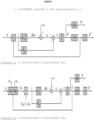
- the Picture 1 shows a conventional single-phase PLL with the following PLL-parameter:
- the Picture 2 shows a conventional triple-phase PLL with the following PLL-parameter:
- a current source inverter and a method for uninterrupted switching of the current source inverter which comprises means for operating the inverter in fundamental frequency unregulated operation, means for operating the inverter in clocked voltage regulated operation, means for recording parameters from which conclusions can be drawn at an instantaneous operating point and/or at an instantaneous network condition, means for determining an appropriate operating condition from the recorded parameters and means for uninterrupted switching of the operation of the inverter to the operating condition as determined from the recorded parameters.
- the described approach is designed according to claim 13 for a calibration system, which can be preferably used as a computer-implemented-tool embodied for instance as a Computer-Program-Product being designed as an "APP".
- the calibration system which is based on ( i ) a non-transitory, processor-readable storage medium having processor-readable program-instructions of a program module stored in the non-transitory processor-readable storage medium and ( ii ) a processor connected with the storage medium executing the processor-readable program-instructions of the program module, is designed such that ( 1 ) the program module includes either a training data generator, a machine-learning module and a preprocessing entity or a training data generator, a machine-learning module, a preprocessing entity and a postprocessing entity, and ( 2 ) the processor executes the processor-readable program-instructions of the program module and thereby accesses to the included components to execute the described approach.
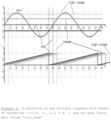
- the multiple counters are initialized for a defined threshold on y-coordinate axis, a defined input phase on x-coordinate axis and a type of y-coordinate level crossing, e.g., positive and/or negative, wherein for each counter a logic is applied such that:
- the invention is developed advantageously by reconfiguring the lock-in-frequency from the lock-in-frequency "f0" to a new lock-in-frequency "f0_new" according to which
- sampling-frequency "fs" reconfiguration from the training-used sampling-frequency "fs_train”, to a new sampling frequency "fs_new" comprises
- the noisy input signal inputted into the signal clean-up circuit and ( ii ) the signal clean-up circuit belong to a technical system that is interfaced with an AC power grid and is intended to interact with it in an active and controlled manner.
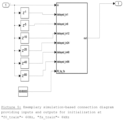
- FIG. 4 An exemplary simulation-based connection diagram with respect to a possible preprocessing entity and a machine-learning module concerning the scenario presented above by ( 1 ) to ( 3 ) is shown in Picture 4 .
- a sample with a single delay is fed into the module to realize the counter logic according to the claim 2 (cf. explanations above i.c.w. the Picture 3).
- FIG. 5 An exemplary simulation-based connection diagram with respect to a possible preprocessing entity and a machine-learning module concerning the scenario presented above by ( a ) to ( b ) is shown in Picture 5 . Also, according to this depicted scenario and in addition, a sample with a single delay is fed into the module to realize the counter logic according to the claim 2 ( cf. explanations above i.c.w. the Picture 2 ) .
- the FIGURE shows the principal design or structure of a calibration system CBSY for calibrating a "phase-locked loop ⁇ PLL>"-based signal clean-up circuit SCUC, which belong to a technical system TSY that is interfaced preferably with an AC power grid ACPG and is intended to interact with it in an active and controlled manner.
- This includes for example grid-connected inverters, rectifier loads, motor drives, and battery chargers.
- the AC power grid ACPG provides a noisy input signal IPS n inputted into the signal clean-up circuit SCUC.
- the noisy input signal IPS n includes an amplitude and a frequency dynamically changed and being synchronous with a clean, unitary signal of the signal clean-up circuit SCUC.
- the calibration system CBSY carries out a calibration process to calibrate the "phase-locked loop ⁇ PLL>"-based signal clean-up circuit SCUC, wherein the calibration process includes a training process TDG, MLM, trn, a preprocessing process PRPE, prpc, and an estimating process MLM, ipt, pvd.
- the calibration system CBSY is preferably designed as a computer-implemented-tool CIT, which for example is embodied as a Computer-Program-Product being designed as an "APP" APP, and includes a non-transitory, processor-readable storage medium STM, e.g., a Random Acces Memory ⁇ RAM>, having processor-readable program-instructions of a program module PGM stored in the non-transitory processor-readable storage medium STM and a processor PRC connected with the storage medium STM executing the processor-readable program-instructions of the program module PGM.
- APP Computer-Program-Product
- the program module PGM includes essentially a training data generator TDG, a machine-learning module MLM and a preprocessing entity PRPE.
- the program module PGM includes a postprocessing entity POPE, which accordingly is depicted in dashed lines.
- the processor PRC executes the processor-readable program-instructions of the program module PGM and thereby accessing to the training data generator TDG, the machine-learning module MLM and the preprocessing entity PRPE and if necessary, the postprocessing entity POPE.
- the calibration process includes a training process TDG, MLM, trn, a preprocessing process PRPE, prpc, and an estimating process MLM, ipt, pvd supplemented optionally by a postprocessing process POPE, popc.
- the starting point for a calibration process is the presence of data.
- the "phase-locked loop ⁇ PLL>"-based signal clean-up circuit SCUC receive rcv input values IPV of the noisy input signal IPS n .
- These input values are preferably in the case of the AC power grid ACPG input values related to at least one phase IPV ph , e.g., a "1-phase” related input value IPV 1-ph ( cf. Picture 1 i.c.w. the corresponding explanations ) or "3-phase”related input values IPV 3-ph ( cf. Picture 2 i.c.w. the corresponding explanations ) .
- the machine-learning module MLM is trained trn by samples of training data generated by the training data generator TDG.
- Training is generally understood to mean an optimization of a mapping from input data to output data of the machine-learning module MLM. This mapping is optimized according to predetermined criteria during a training phase.
- a prediction error in the case of prediction models, a classification error in the case of classification models, or a performance of a technical system controlled by the output data in the case of models of reinforcement learning can be used as criteria.
- the training can be used in particular to set or optimize network structures of neurons in a neural network, weights of connections between the neurons and/or other parameters of the mapping in such a way that the specified criteria are met as well as possible.
- the training can thus be regarded as an optimization problem.
- a large number of efficient optimization methods are available for such optimization problems of machine learning. In particular, gradient descent methods, back-propagation methods, particle swarm optimization and/or genetic optimization methods can be used.
- the machine-learning module MLM is preferably an artificial neural network, a Bayesian neural network, a recurrent neural network, a convolutional neural network, multilayer perceptron, autoencoder, support-vector-machine, a data-driven trainable regression model, a k-nearest neighbor regressor, a physical model, a deep neural network regressor and/or a decision tree regressor.
- the machine-learning module MLM is trained trn by the samples of the training data generated in the training data generator TDG, when the processor PRC
- the training process TDG, MLM, trn can be advantageously carried out offline from the actual calibration process.
- prpc when the processor PRC accesses to the preprocessing entity PRPE of the program module PGM, the received input values IPV, IPV ph , IPV 1-ph , IPV 3-ph regarding sampling-frequencies "fs" and lock-in-frequencies "f0" are preprocessed prpc by the preprocessing entity PRPE by combining multiple adjustable delays and multiple threshold counters with variable increment to enable a reconfiguration of each the sampling-frequency "fs" and each the lock-in-frequency "f0" without retraining the machine learning module weights MLMW.
- sampling-frequencies "fs are each equal or unequal to the training-used sampling-frequency "fs_train” and the lock-in-frequencies "f0" are each equal or unequal to the training-used lock-in frequency "f0_train”.
- the processor PRC accesses to the preprocessing entity PRPE and the machine-learning module MLM of the program module PGM
- the preprocessed input values are inputted ipt into the trained machine-learning module MLM and the trained machine-learning module MLM provides pvd estimated, weighted output values OPV related accordingly to the received input values IPV, IPV ph , IPV 1-ph , IPV 3-ph .
- the reprocessing process PRPE, prpc, when the processor PRC accesses to the preprocessing entity PRPE of the program module PGM is further designed in such a way that
- the signal clean-up circuit SCUC belong to the technical system TSY that is interfaced with the AC power grid ACPG and for the calibration process "1-phase" related input values IPV 1-ph or "3-phase”related input values IPV 3-ph , of the noisy input signal IPS n are received rcv, the reprocessing process PRPE, prpc, when the processor PRC accesses to the preprocessing entity PRPE of the program module PGM, is further designed in such a way that
Landscapes
- Engineering & Computer Science (AREA)
- Theoretical Computer Science (AREA)
- Software Systems (AREA)
- Data Mining & Analysis (AREA)
- Evolutionary Computation (AREA)
- Medical Informatics (AREA)
- Computer Vision & Pattern Recognition (AREA)
- Physics & Mathematics (AREA)
- Computing Systems (AREA)
- General Engineering & Computer Science (AREA)
- General Physics & Mathematics (AREA)
- Mathematical Physics (AREA)
- Artificial Intelligence (AREA)
- Stabilization Of Oscillater, Synchronisation, Frequency Synthesizers (AREA)
Priority Applications (2)
| Application Number | Priority Date | Filing Date | Title |
|---|---|---|---|
| EP22158856.9A EP4236079A1 (fr) | 2022-02-25 | 2022-02-25 | Procédé mis en oeuvre par ordinateur pour l'étalonnage d'un circuit de nettoyage de signaux basé sur une boucle à verrouillage de phase et système d'étalonnage |
| PCT/EP2023/053177 WO2023161032A1 (fr) | 2022-02-25 | 2023-02-09 | Procédé mis en œuvre par ordinateur pour calibrer un circuit de nettoyage de signaux basé sur une boucle à verrouillage de phase (pll) et système de calibrage |
Applications Claiming Priority (1)
| Application Number | Priority Date | Filing Date | Title |
|---|---|---|---|
| EP22158856.9A EP4236079A1 (fr) | 2022-02-25 | 2022-02-25 | Procédé mis en oeuvre par ordinateur pour l'étalonnage d'un circuit de nettoyage de signaux basé sur une boucle à verrouillage de phase et système d'étalonnage |
Publications (1)
| Publication Number | Publication Date |
|---|---|
| EP4236079A1 true EP4236079A1 (fr) | 2023-08-30 |
Family
ID=80461333
Family Applications (1)
| Application Number | Title | Priority Date | Filing Date |
|---|---|---|---|
| EP22158856.9A Withdrawn EP4236079A1 (fr) | 2022-02-25 | 2022-02-25 | Procédé mis en oeuvre par ordinateur pour l'étalonnage d'un circuit de nettoyage de signaux basé sur une boucle à verrouillage de phase et système d'étalonnage |
Country Status (2)
| Country | Link |
|---|---|
| EP (1) | EP4236079A1 (fr) |
| WO (1) | WO2023161032A1 (fr) |
Families Citing this family (1)
| Publication number | Priority date | Publication date | Assignee | Title |
|---|---|---|---|---|
| CN119199458B (zh) * | 2024-11-26 | 2025-03-04 | 江西煜明智慧光电股份有限公司 | 一种无荧光粉多基色led测试方法及系统 |
Citations (3)
| Publication number | Priority date | Publication date | Assignee | Title |
|---|---|---|---|---|
| US5705956A (en) * | 1996-07-12 | 1998-01-06 | National Semiconductor Corporation | Neural network based PLL |
| WO2007147649A2 (fr) | 2006-06-19 | 2007-12-27 | Siemens Aktiengesellschaft | Convertisseur de courant, côté réseau, à commutation exempte d'interruption entre un fonctionnement régulé en tension synchronisé et un fonctionnement non régulé à fréquence de base, et procédé de commutation exempte d'interruption d'un tel convertisseur |
| DE102012209227A1 (de) | 2012-05-31 | 2013-12-05 | Siemens Industry, Inc. | Verfahren und Vorrichtung zum Messen der Grundfrequenz eines Leitungssignals |
-
2022
- 2022-02-25 EP EP22158856.9A patent/EP4236079A1/fr not_active Withdrawn
-
2023
- 2023-02-09 WO PCT/EP2023/053177 patent/WO2023161032A1/fr not_active Ceased
Patent Citations (3)
| Publication number | Priority date | Publication date | Assignee | Title |
|---|---|---|---|---|
| US5705956A (en) * | 1996-07-12 | 1998-01-06 | National Semiconductor Corporation | Neural network based PLL |
| WO2007147649A2 (fr) | 2006-06-19 | 2007-12-27 | Siemens Aktiengesellschaft | Convertisseur de courant, côté réseau, à commutation exempte d'interruption entre un fonctionnement régulé en tension synchronisé et un fonctionnement non régulé à fréquence de base, et procédé de commutation exempte d'interruption d'un tel convertisseur |
| DE102012209227A1 (de) | 2012-05-31 | 2013-12-05 | Siemens Industry, Inc. | Verfahren und Vorrichtung zum Messen der Grundfrequenz eines Leitungssignals |
Non-Patent Citations (3)
| Title |
|---|
| ALI BECHOUCHE ET AL: "An adaptive neural PLL for grid synchronization", IECON 2012 - 38TH ANNUAL CONFERENCE ON IEEE INDUSTRIAL ELECTRONICS SOCIETY, IEEE, 25 October 2012 (2012-10-25), pages 4451 - 4456, XP032281756, ISBN: 978-1-4673-2419-9, DOI: 10.1109/IECON.2012.6389469 * |
| MCHIRI MOHAMED ET AL: "Neural networks based control of chaotic Phase-Locked Loop", SYSTEMS, SIGNALS AND DEVICES, 2008. IEEE SSD 2008. 5TH INTERNATIONAL MULTI-CONFERENCE ON, IEEE, PISCATAWAY, NJ, USA, 20 July 2008 (2008-07-20), pages 1 - 5, XP031326834, ISBN: 978-1-4244-2205-0 * |
| WENJIN DAI ET AL: "A PLL control based on algorithm of BP neural network", COMPUTATIONAL INTELLIGENCE FOR MEASUREMENT SYSTEMS AND APPLICATIONS, 2009. CIMSA '09. IEEE INTERNATIONAL CONFERENCE ON, IEEE, PISCATAWAY, NJ, USA, 11 May 2009 (2009-05-11), pages 97 - 101, XP031471679, ISBN: 978-1-4244-3819-8 * |
Also Published As
| Publication number | Publication date |
|---|---|
| WO2023161032A1 (fr) | 2023-08-31 |
Similar Documents
| Publication | Publication Date | Title |
|---|---|---|
| D'Arco et al. | Small-signal modelling and parametric sensitivity of a virtual synchronous machine | |
| CN107294527B (zh) | 同步旋转坐标系锁相环及其测试方法、装置 | |
| US11012016B2 (en) | Energy packet control of generator prime mover | |
| US8497602B2 (en) | Time delay compensation in power system control | |
| EP2871743B1 (fr) | Centrale éolienne, parc éolien et procédés d'exploitation | |
| WO2018122391A1 (fr) | Surveillance de grille avancée en temps réel précise | |
| EP4250512B1 (fr) | Procédé et appareil d'attribution de puissance | |
| EP4236079A1 (fr) | Procédé mis en oeuvre par ordinateur pour l'étalonnage d'un circuit de nettoyage de signaux basé sur une boucle à verrouillage de phase et système d'étalonnage | |
| Ali et al. | Performance enhancement of MAF based PLL with phase error compensation in the pre-filtering stage | |
| CN116885781A (zh) | 一种并网变流器随网-构网运行模式切换方法及系统 | |
| CN120280950A (zh) | 一种dsp数控高频双向pcs变流器的vsg控制方法及装置 | |
| CN113013926B (zh) | 一种分布式并网发电系统序阻抗聚合方法及系统 | |
| EP1495524A1 (fr) | Procede de compensation du desequilibre de tension | |
| Gurumurthy et al. | Load bus frequency estimation in converter-driven grids-a dynamic phasor approach | |
| Wang et al. | The cause of insufficient damping in phase-locked-loop and its influence | |
| CN120820784A (zh) | 一种适用于新能源及储能的构网型变流器性能检测装置 | |
| EP4106179A1 (fr) | Opération de formation de réseau avec un générateur à induction à rotor bobine | |
| Alves et al. | Real-time wavelet-based adaptive algorithm for low inertia AC microgrids power measurements | |
| CN109103875A (zh) | 一种基于神经网络的自适应谐波振荡抑制方法与系统 | |
| Chacko et al. | Rotor resistance estimation of vector controlled induction motor drive using GA/PSO tuned fuzzy controller | |
| CN119171470A (zh) | 面向弱电网的储能电站的频率电压支撑控制方法和系统 | |
| Giudicepietro et al. | Resynchronization of islanded virtual synchronous machines by cascaded phase and frequency controllers acting on the internal power reference | |
| Amoura et al. | Neural Networks-Based Adaptive Predictive Current Control of a Grid-Connected Three-Phase PWM Converter | |
| CN115236399B (zh) | 光伏系统低电压穿越时相位信号确定方法和装置 | |
| Sahoo et al. | Power-sharing based on open-loop synchronization of inverters in an islanded ac microgrid |
Legal Events
| Date | Code | Title | Description |
|---|---|---|---|
| PUAI | Public reference made under article 153(3) epc to a published international application that has entered the european phase |
Free format text: ORIGINAL CODE: 0009012 |
|
| STAA | Information on the status of an ep patent application or granted ep patent |
Free format text: STATUS: THE APPLICATION HAS BEEN PUBLISHED |
|
| AK | Designated contracting states |
Kind code of ref document: A1 Designated state(s): AL AT BE BG CH CY CZ DE DK EE ES FI FR GB GR HR HU IE IS IT LI LT LU LV MC MK MT NL NO PL PT RO RS SE SI SK SM TR |
|
| STAA | Information on the status of an ep patent application or granted ep patent |
Free format text: STATUS: THE APPLICATION IS DEEMED TO BE WITHDRAWN |
|
| 18D | Application deemed to be withdrawn |
Effective date: 20240301 |