EP4236191A1 - Procédé de commande, dispositif de traitement d'informations et programme de commande - Google Patents
Procédé de commande, dispositif de traitement d'informations et programme de commande Download PDFInfo
- Publication number
- EP4236191A1 EP4236191A1 EP20958706.2A EP20958706A EP4236191A1 EP 4236191 A1 EP4236191 A1 EP 4236191A1 EP 20958706 A EP20958706 A EP 20958706A EP 4236191 A1 EP4236191 A1 EP 4236191A1
- Authority
- EP
- European Patent Office
- Prior art keywords
- public key
- authenticator
- update
- authentication
- repository
- Prior art date
- Legal status (The legal status is an assumption and is not a legal conclusion. Google has not performed a legal analysis and makes no representation as to the accuracy of the status listed.)
- Withdrawn
Links
Images





Classifications
-
- H—ELECTRICITY
- H04—ELECTRIC COMMUNICATION TECHNIQUE
- H04L—TRANSMISSION OF DIGITAL INFORMATION, e.g. TELEGRAPHIC COMMUNICATION
- H04L9/00—Cryptographic mechanisms or cryptographic arrangements for secret or secure communications; Network security protocols
- H04L9/08—Key distribution or management, e.g. generation, sharing or updating, of cryptographic keys or passwords
- H04L9/0891—Revocation or update of secret information, e.g. encryption key update or rekeying
-
- H—ELECTRICITY
- H04—ELECTRIC COMMUNICATION TECHNIQUE
- H04L—TRANSMISSION OF DIGITAL INFORMATION, e.g. TELEGRAPHIC COMMUNICATION
- H04L9/00—Cryptographic mechanisms or cryptographic arrangements for secret or secure communications; Network security protocols
- H04L9/50—Cryptographic mechanisms or cryptographic arrangements for secret or secure communications; Network security protocols using hash chains, e.g. blockchains or hash trees
-
- H—ELECTRICITY
- H04—ELECTRIC COMMUNICATION TECHNIQUE
- H04L—TRANSMISSION OF DIGITAL INFORMATION, e.g. TELEGRAPHIC COMMUNICATION
- H04L9/00—Cryptographic mechanisms or cryptographic arrangements for secret or secure communications; Network security protocols
- H04L9/08—Key distribution or management, e.g. generation, sharing or updating, of cryptographic keys or passwords
- H04L9/088—Usage controlling of secret information, e.g. techniques for restricting cryptographic keys to pre-authorized uses, different access levels, validity of crypto-period, different key- or password length, or different strong and weak cryptographic algorithms
-
- H—ELECTRICITY
- H04—ELECTRIC COMMUNICATION TECHNIQUE
- H04L—TRANSMISSION OF DIGITAL INFORMATION, e.g. TELEGRAPHIC COMMUNICATION
- H04L9/00—Cryptographic mechanisms or cryptographic arrangements for secret or secure communications; Network security protocols
- H04L9/08—Key distribution or management, e.g. generation, sharing or updating, of cryptographic keys or passwords
- H04L9/0894—Escrow, recovery or storing of secret information, e.g. secret key escrow or cryptographic key storage
- H04L9/0897—Escrow, recovery or storing of secret information, e.g. secret key escrow or cryptographic key storage involving additional devices, e.g. trusted platform module [TPM], smartcard or USB
-
- H—ELECTRICITY
- H04—ELECTRIC COMMUNICATION TECHNIQUE
- H04L—TRANSMISSION OF DIGITAL INFORMATION, e.g. TELEGRAPHIC COMMUNICATION
- H04L9/00—Cryptographic mechanisms or cryptographic arrangements for secret or secure communications; Network security protocols
- H04L9/14—Cryptographic mechanisms or cryptographic arrangements for secret or secure communications; Network security protocols using a plurality of keys or algorithms
-
- H—ELECTRICITY
- H04—ELECTRIC COMMUNICATION TECHNIQUE
- H04L—TRANSMISSION OF DIGITAL INFORMATION, e.g. TELEGRAPHIC COMMUNICATION
- H04L9/00—Cryptographic mechanisms or cryptographic arrangements for secret or secure communications; Network security protocols
- H04L9/14—Cryptographic mechanisms or cryptographic arrangements for secret or secure communications; Network security protocols using a plurality of keys or algorithms
- H04L9/16—Cryptographic mechanisms or cryptographic arrangements for secret or secure communications; Network security protocols using a plurality of keys or algorithms the keys or algorithms being changed during operation
-
- H—ELECTRICITY
- H04—ELECTRIC COMMUNICATION TECHNIQUE
- H04L—TRANSMISSION OF DIGITAL INFORMATION, e.g. TELEGRAPHIC COMMUNICATION
- H04L9/00—Cryptographic mechanisms or cryptographic arrangements for secret or secure communications; Network security protocols
- H04L9/32—Cryptographic mechanisms or cryptographic arrangements for secret or secure communications; Network security protocols including means for verifying the identity or authority of a user of the system or for message authentication, e.g. authorization, entity authentication, data integrity or data verification, non-repudiation, key authentication or verification of credentials
- H04L9/3263—Cryptographic mechanisms or cryptographic arrangements for secret or secure communications; Network security protocols including means for verifying the identity or authority of a user of the system or for message authentication, e.g. authorization, entity authentication, data integrity or data verification, non-repudiation, key authentication or verification of credentials involving certificates, e.g. public key certificate [PKC] or attribute certificate [AC]; Public key infrastructure [PKI] arrangements
- H04L9/3268—Cryptographic mechanisms or cryptographic arrangements for secret or secure communications; Network security protocols including means for verifying the identity or authority of a user of the system or for message authentication, e.g. authorization, entity authentication, data integrity or data verification, non-repudiation, key authentication or verification of credentials involving certificates, e.g. public key certificate [PKC] or attribute certificate [AC]; Public key infrastructure [PKI] arrangements using certificate validation, registration, distribution or revocation, e.g. certificate revocation list [CRL]
-
- H—ELECTRICITY
- H04—ELECTRIC COMMUNICATION TECHNIQUE
- H04L—TRANSMISSION OF DIGITAL INFORMATION, e.g. TELEGRAPHIC COMMUNICATION
- H04L9/00—Cryptographic mechanisms or cryptographic arrangements for secret or secure communications; Network security protocols
- H04L9/32—Cryptographic mechanisms or cryptographic arrangements for secret or secure communications; Network security protocols including means for verifying the identity or authority of a user of the system or for message authentication, e.g. authorization, entity authentication, data integrity or data verification, non-repudiation, key authentication or verification of credentials
- H04L9/3271—Cryptographic mechanisms or cryptographic arrangements for secret or secure communications; Network security protocols including means for verifying the identity or authority of a user of the system or for message authentication, e.g. authorization, entity authentication, data integrity or data verification, non-repudiation, key authentication or verification of credentials using challenge-response
Definitions
- the present disclosure relates to a control method, an information processing device, and a control program.
- IDs Distributed identifiers managed by distributed network systems such as blockchains enable lower-cost and more flexible operation compared to centralized IDs managed by certification authorities (CAs) due absence of CAs.
- CAs certification authorities
- the distributed IDs do not have a control tower like a CA.
- the problematic public key remains in a repository for a long time, creating a risk of spoofing occurring in secure communication using the key.
- an object is to provide a control method, an information processing device, and a control program capable of suppressing key update by a third party.
- a computer executes processing of: detecting a risk to a first public key managed by a public key repository; performing update restriction of the first public key in response to the detection of the risk; authenticating an authenticator associated with the first public key; and releasing, in a case where the authentication of the authenticator succeeds, the update restriction.
- FIG. 1 is a diagram illustrating an overall configuration example of a system according to a first embodiment.
- the present system is a system in which an information processing device 10, an authenticator 100, and user terminals 200-1 to 200-n (n is an optional integer, hereinafter collectively referred to as "user terminals 200") are coupled to each other in a communicable manner via a network N.
- a network N various communication networks such as the Internet may be adopted regardless of whether the communication network is wired or wireless.
- the information processing device 10 is a device used by a servicer that has Lock/Unlock authority for a public key repository and is, for example, a provider of financial services or the like.
- the information processing device 10 may be a notebook personal computer (PC), a stationary terminal, or a mobile terminal such as a smartphone or a tablet PC.
- PC personal computer
- the information processing device 10 detects a risk to a public key in the public key repository recorded and managed by a distributed ledger of a blockchain, or the like, the information processing device 10 restricts update of the target public key (Lock).
- the authenticator 100 logs in to a service, the information processing device 10 authenticates the authenticator 100, and in a case where the authentication succeeds, releases the update restriction of the public key (Unlock).
- the authenticator 100 is a device used by a creator of a public key in the public key repository, who is a legitimate owner of a private key.
- the authenticator 100 may be a notebook PC, a smartphone, or the like, or may be a USB token that is used by being coupled to a notebook PC or the like.
- the authenticator 100 receives a request to update a problematic public key from the information processing device 10.
- the authenticator 100 includes a hardware security module (HSM) and a key generation library, securely generates a public key, and uploads the generated public key to the public key repository.
- HSM hardware security module
- the user terminal 200 is a terminal used by a user who uses services such as financial services, for example, provided by a servicer.
- the user terminal 200 may be a notebook PC, a smartphone, or the like.
- Each of the user terminals 200 stores a ledger of a blockchain, and the public key repository may be recorded by the ledger.
- the information processing device 10 and the authenticator 100 may also store the ledger of the blockchain and record the public key repository. Furthermore, processing on the public key repository recorded in the blockchain may be executed by using a smart contract. In this way, by managing the public key repository by the blockchain including the smart contract, security of the public key repository may be enhanced.
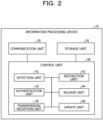
- FIG. 2 is a functional block diagram illustrating the functional configuration of the information processing device 10 according to the first embodiment.
- the information processing device 10 includes a communication unit 20, a storage unit 30, and a control unit 40.
- the communication unit 20 is a processing unit that controls communication with another device, and is, for example, a communication interface such as a network interface card.
- the storage unit 30 is an example of a storage device that stores various types of data and a program to be executed by the control unit 40, and is, for example, a memory, a hard disk, or the like.
- the storage unit 30 stores, for example, history data such as the number of times of authentication used for authentication of the authenticator 100.
- the storage unit 30 may store a ledger of a blockchain. Note that the storage unit 30 may also store various types of data other than the specific examples described above.
- the control unit 40 is a processing unit that is in charge of overall control of the information processing device 10, and is, for example, a processor or the like.
- the control unit 40 includes a detection unit 41, a restriction unit 42, an authentication unit 43, a release unit 44, a transmission/reception unit 45, and an update unit 46.
- each of the processing units is an example of an electronic circuit included in the processor or an example of a process executed by the processor.
- the detection unit 41 detects a risk to a public key managed by the public key repository.
- the detection of the risk may be performed based on information regarding vulnerability of the public key repository.
- information regarding the vulnerability of the repository for example, which key generation library (algorithm) of which authenticator of which vendor has vulnerability, or the like is disclosed.
- the restriction unit 42 performs, in response to the fact that the detection unit 41 has detected a risk to a public key, update restriction of the target public key. This, for example, locks the public key repository and restricts writing to the public key repository. With this configuration, update of the public key by spoofing in which a private key is calculated from the public key may be suppressed.
- the authentication unit 43 authenticates the authenticator 100 associated with a public key.
- the authentication is performed to determine whether or not the authenticator 100 is a legitimate owner of a private key to the public key, and is performed by, for example, asking the authenticator 100 a question regarding the number of times of authentication performed by the authenticator 100 so far, and the like and determining whether or not the answer is correct.
- the release unit 44 releases update restriction of a public key associated with the authenticator 100 in a case where authentication of the authenticator 100 by the authentication unit 43 succeeds. This, for example, unlocks the locked public key repository and enables writing to the public key repository. With this configuration, the public key may be updated by a legitimate authority while suppressing update of the public key by spoofing.
- the transmission/reception unit 45 transmits a question for authentication of the authenticator 100 to the authenticator 100. Furthermore, the transmission/reception unit 45 receives an answer to the question from the authenticator 100.
- the question for authentication of the authenticator 100 is created with respect to, for example, at least one of the number of times of past authentication of the authenticator 100, the number of times of registration of a public key in the public key repository by the authenticator 100, and the total number of the public keys associated with the authenticator 100, and is transmitted to the authenticator 100.
- the question for authentication of the authenticator 100 may be created and transmitted with respect to holding a private key corresponding to the public key. Note that the question for authentication of the authenticator 100 may be created and transmitted for each service using the public key.
- the transmission/reception unit 45 transmits a request to update the public key to the authenticator 100 in a case where authentication of the authenticator 100 by the authentication unit 43 succeeds. Furthermore, the transmission/reception unit 45 receives a new public key for updating the old public key from the authenticator 100.
- the processing of receiving the new public key from the authenticator 100 includes processing of receiving, from the authenticator 100, the new public key using a public key cryptosystem different from a public key cryptosystem used for the old public key.
- the public key cryptosystem is, for example, RSA encryption or elliptic curve cryptography.
- the update unit 46 updates an old public key in the public key repository with a new public key received from the authenticator 100 by the transmission/reception unit 45.
- FIG. 3 is a diagram illustrating an example of the update control of the public key repository using the conventional technology.
- a public key is generated for each service that uses the public key, and in a case where a risk to the public key is detected, a servicer that is a provider of the corresponding service becomes responsible for repairing the problematic public key.
- the authenticator 100 uses a private key 60 corresponding to a public key 70 currently available in a public key repository 50 to log in to a service A provided by the information processing device 10.
- the information processing device 10 transmits a request to update the public key to the authenticator 100.
- the authenticator 100 does not know that the public key 70 is a problematic key until the authenticator 100 logs in to the service A and is notified by the information processing device 10. Therefore, the problematic public key 70 remains in an available state in the public key repository 50 for a long time.
- the authenticator 100 when receiving the request to update, the authenticator 100 generates a new public key 71 corresponding to a new private key 61, and writes the generated new public key 71 to the public key repository 50. With this configuration, the problematic public key 70 is updated to the new public key 71. Then, the new public key 71 becomes available in the service A. Furthermore, thereafter, the authenticator 100 logs in to the service A by using the new private key 61.
- FIG. 4 is a diagram illustrating an example of update control of the public key repository according to the first embodiment.
- the information processing device 10 locks the public key repository 50, and performs update restriction of the problematic public key.
- the problematic public key is a public key 70, similarly to the update control using the conventional technology illustrated in FIG. 3 .
- the authenticator 100 uses a private key 60 corresponding to the public key 70 currently available in the public key repository 50 to log in to the service A provided by the information processing device 10. This is similar to the update control using the conventional technology illustrated in FIG. 3 .
- the information processing device 10 authenticates the authenticator 100, and determines whether or not the authenticator 100 is a legitimate owner of the private key 60.
- the authentication is performed by, for example, asking the authenticator 100 a question regarding the number of times of authentication performed by the authenticator 100 so far, and the like and determining whether or not the answer is correct.
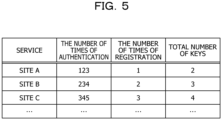
- FIG. 5 is a diagram illustrating an example of history data stored in the authenticator 100 according to the first embodiment.
- the authenticator 100 holds, for example, for each service, the number of times of past authentication of the authenticator 100, the number of times of registration of the public key in the public key repository 50 by the authenticator 100, and the total number of the public keys associated with the authenticator 100. Then, the authenticator 100 updates the history data each time authentication or registration of a public key is performed.
- FIG. 6 is a diagram illustrating an example of history data stored in the information processing device 10 according to the first embodiment.
- the information processing device 10 holds, for example, for each authenticator 100, the number of times of past authentication of the authenticator 100 and the number of times of registration of the public key in the public key repository 50 by the authenticator 100. Furthermore, since the same user may use a plurality of authenticators 100, an identifier of the user may also be held.
- the information processing device 10 uses the history data as illustrated in FIG. 6 to transmit a question to the authenticator 100 in the form of, for example, the number of times of authentication ⁇ 5 + the number of times of registration ⁇ 100, or the like. Note that the format of the question is not fixed, and may be changed each time.
- the authenticator 100 uses the held history data as illustrated in FIG. 5 to calculate an answer to the question and transmit the answer to the information processing device 10. Then, the information processing device 10 determines whether or not the answer is correct, and in a case where the answer is correct, determines that the authentication of the authenticator 100 succeeds. In this way, since the history data is data that may only be known by the information processing device 10 that performs authentication and the legitimate authenticator 100, the information processing device 10 may perform stronger authentication.
- the authentication of the authenticator 100 may use other authentication methods alternatively or in combination instead of the form of the question and answer described above.
- the information processing device 10 may authenticate the authenticator 100 by confirming one or a plurality of private keys held by the authenticator 100.
- the information processing device 10 may authenticate the authenticator 100 by, for example, transmitting a confirmation code that is a random number to the authenticator 100 or another device used by a user of the authenticator 100, and having the confirmation code input via the authenticator 100.
- the information processing device 10 transmits a request to update the public key to the authenticator 100.
- the authenticator 100 does not know that the public key 70 is a problematic key until the authenticator 100 logs in to the service A and is notified by the information processing device 10.
- the public key repository 50 is in a Lock state as described above and update of the problematic public key 70 is restricted, malicious update of the public key 70 by spoofing is suppressed.
- the authenticator 100 when receiving the request to update, the authenticator 100 generates a new public key 71 corresponding to a new private key 61.
- the information processing device 10 unlocks the public key repository 50 and releases the update restriction of the public key 70.
- the authenticator 100 writes the new public key 71 to the public key repository 50.
- the problematic public key 70 is updated to the new public key 71.
- timing at which the public key 70 may be updated is a short time from when the authentication of the authenticator 100 succeeds to when the public key 70 is updated to the new public key 71, update of the public key 70 due to spoofing may be suppressed compared to the update control using the conventional technology illustrated in FIG. 3 .
- FIG. 7 is a diagram illustrating an example of key management data according to the first embodiment.
- Lock ID is an identifier of a servicer.
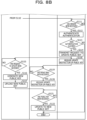
- FIG. 8 is a flowchart illustrating the flow of the update control processing of the public key repository according to the first embodiment.
- the information processing device 10 detects a risk to a public key (Step S101). This, for example, acquires and searches for information regarding vulnerability of the public key repository 50 that has been disclosed, and detects that the public key involved in an own service is a problematic public key.
- Step S102 update restriction of the public key for which the risk is detected in Step S101 is performed (Step S102). This, for example, transmits a Lock token designating the problematic public key to the public key repository 50.
- Step S103 the public key repository 50 waits for reception of the Lock token.
- Step S103: Yes the public key repository 50 restricts update of the problematic public key (Step S104).
- the authenticator 100 uses a private key associated with the service to log in to the service provided by the information processing device 10 (Step S105).
- Step S106 the information processing device 10 waits for reception of the login request.
- the information processing device 10 generates a question for authentication of the authenticator 100, and transmits the question to the authenticator 100 (Step S107).
- the question for authentication is generated by using history data held by the information processing device 10, such as that illustrated in FIG. 6 , for example.
- Step S108 In a case where the authenticator 100 has not received the question for authentication from the information processing device 10 (Step S108: No), the authenticator 100 waits for reception of the question for authentication. On the other hand, in a case where the question for authentication has been received (Step S108: Yes), the authenticator 100 outputs the received question for authentication (Step S109).
- the authenticator 100 inputs an answer to the question (Step S110).
- the answer to the question is generated based on the received question for authentication, by using history data held by the authenticator 100, such as that illustrated in FIG. 7 , for example.
- the input answer is transmitted to the information processing device 10 by the authenticator 100.
- Step S111: No the information processing device 10 waits for reception of the answer to the question.
- the information processing device 10 determines whether or not the answer is correct based on the received answer, and authenticates the authenticator 100 (Step S112).
- Step S113 In a case where the authentication of the authenticator 100 fails (Step S113: No), an error message indicating the authentication failure is transmitted to the authenticator 100, or the like, and the update control processing of the public key repository 50 illustrated in FIG. 8 ends.
- Step S113 the information processing device 10 transmits, to the authenticator 100, a request to update the problematic public key for which the risk is detected in Step S101 (Step S114).
- Step S115: No the authenticator 100 waits for reception of the request to update the public key.
- the authenticator 100 generates a new public key (Step S116).
- the new public key may be generated by using a public key cryptosystem different from a public key cryptosystem used for the old public key.
- the authenticator 100 uploads the generated new public key to the public key repository 50 (Step S117).
- Step S113 the authentication of the authenticator 100 succeeds (Step S113: Yes)
- the information processing device 10 releases the update restriction of the problematic public key for which the risk is detected in Step S101 (Step S118). This, for example, transmits an Unlock token designating the problematic public key to the public key repository 50.
- Step S119: No the public key repository 50 waits for reception of the Unlock token.
- Step S119: Yes the public key repository 50 releases the update restriction of the problematic public key (Step S120).
- Step S121: No the public key repository 50 waits for reception of the new public key.
- the public key repository 50 updates the problematic public key to the received new public key (Step S122). After the execution of Step S122, the update control processing of the public key repository 50 illustrated in FIG. 8 ends.
- the information processing device 10 executes processing of detecting a risk to a public key managed by the public key repository 50, performing update restriction of the public key in response to the detection of the risk, authenticating the authenticator 100 associated with the public key, and releasing, in a case where the authentication of the authenticator 100 succeeds, the update restriction of the public key.
- the information processing device 10 further executes processing of transmitting, in a case where the authentication of the authenticator 100 succeeds, a request to update the public key to the authenticator 100, receiving a new public key for updating the public key from the authenticator 100, and updating the public key to the new public key.
- timing at which the public key may be updated is a short time from when the authentication of the authenticator 100 succeeds to when the public key is updated to the new public key, update of the public key by a third party may be suppressed.
- the information processing device 10 further executes processing of transmitting a question for authentication of the authenticator 100 to the authenticator 100, and receiving an answer to the question from the authenticator 100. Furthermore, the processing of authenticating the authenticator 100, which is executed by the information processing device 10, includes processing of determining whether or not the answer is correct, and determining, in a case where it is determined that the answer is correct, that the authentication of the authenticator 100 succeeds.
- the processing of transmitting the question to the authenticator 100 includes processing of transmitting, to the authenticator 100, the question regarding at least one of the number of times of past authentication of the authenticator 100, the number of times of registration of the public key, the total number of the public keys associated with the authenticator 100, and holding a private key corresponding to the public key.
- processing of transmitting the question to the authenticator 100 includes processing of transmitting the question for each service using the public key to the authenticator 100.
- processing of detecting the risk includes processing of acquiring information regarding vulnerability of the repository.
- update restriction of the target public key may be performed, and update of the public key by a third party may be suppressed.
- the processing of receiving the public key from the authenticator 100 includes processing of receiving, from the authenticator 100, the public key using a public key cryptosystem different from a public key cryptosystem used for the public key.
- the update restriction and the release of the public key in the public key repository 50 is executed in a case where at least the public key and an identifier of authority that has authority to execute the update restriction are stored and the information processing device 10 is determined to be the legitimate authority by using key management data recorded in a ledger of a blockchain.
- a servicer may participate only in update of a public key used in a service the servicer provides. In other words, it is possible to perform control so that the target servicer may not participate in update of a public key other than a public key used in the service the servicer itself provides.
- the information processing device 10 detects a risk to a public key managed by a public key repository, authenticates the authenticator 100 associated with the public key, transmits, in a case where the authentication of the authenticator 100 succeeds, a request to update the public key to the authenticator 100, receives a new public key for updating the public key from the authenticator 100, and updates the public key to the new public key.
- Pieces of information including a processing procedure, a control procedure, a specific name, various types of data, and parameters described above or illustrated in the drawings may be optionally changed unless otherwise noted. Furthermore, the specific examples, distributions, numerical values, and the like described in the embodiment are merely examples, and may be optionally changed.
- each component of each device illustrated in the drawings is functionally conceptual, and does not necessarily have to be physically configured as illustrated in the drawings.
- specific modes of distribution and integration of the respective devices are not limited to those illustrated in the drawings. That is, all or a part of the devices may be configured by being functionally or physically distributed or integrated in optional units, according to various types of loads, use situations, or the like.
- the detection unit 41 and the release unit 44 of the information processing device 10 may be integrated.
- each device may be implemented by a CPU and a program analyzed and executed by the CPU, or may be implemented as hardware by wired logic.
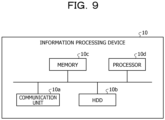
- FIG. 9 is a diagram illustrating a hardware configuration example of the information processing device 10.
- the information processing device 10 includes a communication unit 10a, a hard disk drive (HDD) 10b, a memory 10c, and a processor 10d. Furthermore, the respective units illustrated in FIG. 9 are coupled to each other by a bus or the like.
- the communication unit 10a is a network interface card or the like, and communicates with another server.
- the HDD 10b stores programs and data that operate the respective functions illustrated in FIG. 2 .
- the processor 10d reads, from the HDD 10b or the like, a program that executes processing similar to that of each processing unit illustrated in FIG. 2 , and loads the read program into the memory 10c, thereby operating a process that executes each function described with reference to FIG. 2 .
- this process executes a function similar to that of each processing unit included in the information processing device 10.
- the processor 10d reads, from the HDD 10b or the like, a program having functions similar to those of the detection unit 41, the restriction unit 42, and the like. Then, the processor 10d executes a process that executes processing similar to that of the detection unit 41, the restriction unit 42, and the like.
- the information processing device 10 operates as an information processing device that executes each processing by reading and executing the program. Furthermore, the information processing device 10 may also implement functions similar to those of the embodiment described above by reading the program described above from a recording medium with a medium reading device and executing the read program described above. Note that the program referred to in other embodiments is not limited to being executed by the information processing device 10. For example, the present invention may be similarly applied also to a case where another computer or server executes the program, or a case where these computer and server cooperatively execute the program.
- this program may be distributed via a network such as the Internet. Furthermore, this program may be recorded in a computerreadable recording medium such as a hard disk, a flexible disk (FD), a CD-ROM, a magneto-optical disk (MO), or a digital versatile disc (DVD), and may be executed by being read from the recording medium by a computer.
- a computerreadable recording medium such as a hard disk, a flexible disk (FD), a CD-ROM, a magneto-optical disk (MO), or a digital versatile disc (DVD)
- Information processing device 10a Communication unit 10b HDD 10c Memory 10d Processor 20 Communication unit 30 Storage unit 40 Control unit 41 Detection unit 42 Restriction unit 43 Authentication unit 44 Release unit 45 Transmission/reception unit 46 Update unit 50 Public key repository 60 Private key 61 Private key 70 Public key 71 Public key 100 Authenticator 200 User terminal
Landscapes
- Engineering & Computer Science (AREA)
- Computer Security & Cryptography (AREA)
- Computer Networks & Wireless Communication (AREA)
- Signal Processing (AREA)
- Storage Device Security (AREA)
Applications Claiming Priority (1)
| Application Number | Priority Date | Filing Date | Title |
|---|---|---|---|
| PCT/JP2020/039719 WO2022085154A1 (fr) | 2020-10-22 | 2020-10-22 | Procédé de commande, dispositif de traitement d'informations et programme de commande |
Publications (1)
| Publication Number | Publication Date |
|---|---|
| EP4236191A1 true EP4236191A1 (fr) | 2023-08-30 |
Family
ID=81289751
Family Applications (1)
| Application Number | Title | Priority Date | Filing Date |
|---|---|---|---|
| EP20958706.2A Withdrawn EP4236191A1 (fr) | 2020-10-22 | 2020-10-22 | Procédé de commande, dispositif de traitement d'informations et programme de commande |
Country Status (4)
| Country | Link |
|---|---|
| US (1) | US20230216674A1 (fr) |
| EP (1) | EP4236191A1 (fr) |
| JP (1) | JPWO2022085154A1 (fr) |
| WO (1) | WO2022085154A1 (fr) |
Families Citing this family (1)
| Publication number | Priority date | Publication date | Assignee | Title |
|---|---|---|---|---|
| DE102024000427A1 (de) | 2024-02-09 | 2025-08-14 | C&Cs Catalysts And Chemical Specialties Gmbh | Katalysator mit niedriger Aktivierungstemperatur zur Einstellung des temperaturabhängigen Gleichgewichtes von ortho-para Wasserstoffgemischen |
Family Cites Families (5)
| Publication number | Priority date | Publication date | Assignee | Title |
|---|---|---|---|---|
| US8595816B2 (en) * | 2007-10-19 | 2013-11-26 | Nippon Telegraph And Telephone Corporation | User authentication system and method for the same |
| TWI608722B (zh) | 2016-06-23 | 2017-12-11 | Public key certificate method | |
| JP2018074205A (ja) | 2016-10-24 | 2018-05-10 | 富士通株式会社 | プログラム、情報処理装置、情報処理システム、及び情報処理方法 |
| JP6340107B1 (ja) | 2017-04-10 | 2018-06-06 | アイビーシー株式会社 | 電子証明システム |
| JP2019057764A (ja) * | 2017-09-19 | 2019-04-11 | キヤノン株式会社 | 情報処理装置、情報処理方法、およびコンピュータプログラム |
-
2020
- 2020-10-22 EP EP20958706.2A patent/EP4236191A1/fr not_active Withdrawn
- 2020-10-22 WO PCT/JP2020/039719 patent/WO2022085154A1/fr not_active Ceased
- 2020-10-22 JP JP2022556329A patent/JPWO2022085154A1/ja not_active Withdrawn
-
2023
- 2023-03-01 US US18/176,739 patent/US20230216674A1/en not_active Abandoned
Also Published As
| Publication number | Publication date |
|---|---|
| WO2022085154A1 (fr) | 2022-04-28 |
| US20230216674A1 (en) | 2023-07-06 |
| JPWO2022085154A1 (fr) | 2022-04-28 |
Similar Documents
| Publication | Publication Date | Title |
|---|---|---|
| KR102674418B1 (ko) | 서로 다른 네트워크들 간의 자산 전송을 위한 안전하고 신뢰할 수 있는 브릿지 | |
| CN112970236B (zh) | 协作风险感知认证 | |
| CN110915183B (zh) | 经由硬/软令牌验证的区块链认证 | |
| US10589719B1 (en) | Method for managing digital key of mobile device for vehicle-sharing and key server using the same | |
| CN112311735B (zh) | 可信认证方法,网络设备、系统及存储介质 | |
| JP4685876B2 (ja) | 複数の信用証明認証プロトコルを提供するシステム及び方法 | |
| US8196186B2 (en) | Security architecture for peer-to-peer storage system | |
| US20090113543A1 (en) | Authentication certificate management for access to a wireless communication device | |
| EP4032228B1 (fr) | Procédés et dispositifs de vérification de certificat numérique automatisée | |
| US10511488B2 (en) | Device, system and method for performing integrity verification based on distributed delegator | |
| CN112291375B (zh) | 物联网设备安全访问控制方法、物联网设备及物联网系统 | |
| CN111247521B (zh) | 将多用户设备远程锁定为用户集合 | |
| CN104412273A (zh) | 用于进行激活的方法和系统 | |
| US8234497B2 (en) | Method and apparatus for providing secure linking to a user identity in a digital rights management system | |
| US20250220002A1 (en) | Mobile device management including features of passwordless authentication | |
| CN118233193A (zh) | 物联网设备的身份认证方法、密钥存储方法及装置 | |
| CN113569210B (zh) | 分布式身份认证方法、设备访问方法及装置 | |
| US9323911B1 (en) | Verifying requests to remove applications from a device | |
| CN111565179A (zh) | 身份校验方法、装置、电子设备及存储介质 | |
| CN114070571A (zh) | 一种建立连接的方法、装置、终端及存储介质 | |
| US20230216674A1 (en) | Control method, information processing device, and non-transitory computer-readable recording medium storing control program | |
| WO2019129351A1 (fr) | Systèmes et procédés permettant de fournir une authentification et/ou une autorisation | |
| KR20180052479A (ko) | 서명 체인을 이용한 유무선 공유기의 펌웨어 업데이트 시스템, 유무선 공유기 및 유무선 공유기의 펌웨어 업데이트 방법 | |
| JP2004013560A (ja) | 認証システム、通信端末及びサーバ | |
| JPWO2019244289A1 (ja) | 電子錠システム、電子錠管理方法、および電子錠管理プログラム |
Legal Events
| Date | Code | Title | Description |
|---|---|---|---|
| STAA | Information on the status of an ep patent application or granted ep patent |
Free format text: STATUS: THE INTERNATIONAL PUBLICATION HAS BEEN MADE |
|
| PUAI | Public reference made under article 153(3) epc to a published international application that has entered the european phase |
Free format text: ORIGINAL CODE: 0009012 |
|
| STAA | Information on the status of an ep patent application or granted ep patent |
Free format text: STATUS: REQUEST FOR EXAMINATION WAS MADE |
|
| 17P | Request for examination filed |
Effective date: 20230301 |
|
| AK | Designated contracting states |
Kind code of ref document: A1 Designated state(s): AL AT BE BG CH CY CZ DE DK EE ES FI FR GB GR HR HU IE IS IT LI LT LU LV MC MK MT NL NO PL PT RO RS SE SI SK SM TR |
|
| STAA | Information on the status of an ep patent application or granted ep patent |
Free format text: STATUS: THE APPLICATION HAS BEEN WITHDRAWN |
|
| 18W | Application withdrawn |
Effective date: 20231023 |