EP4236428A1 - Kommunikationsdatenverarbeitungsverfahren und -vorrichtung sowie kommunikationsvorrichtung - Google Patents
Kommunikationsdatenverarbeitungsverfahren und -vorrichtung sowie kommunikationsvorrichtung Download PDFInfo
- Publication number
- EP4236428A1 EP4236428A1 EP21894058.3A EP21894058A EP4236428A1 EP 4236428 A1 EP4236428 A1 EP 4236428A1 EP 21894058 A EP21894058 A EP 21894058A EP 4236428 A1 EP4236428 A1 EP 4236428A1
- Authority
- EP
- European Patent Office
- Prior art keywords
- communications data
- subband
- processing
- specified
- communications
- Prior art date
- Legal status (The legal status is an assumption and is not a legal conclusion. Google has not performed a legal analysis and makes no representation as to the accuracy of the status listed.)
- Pending
Links
Images


Classifications
-
- H—ELECTRICITY
- H04—ELECTRIC COMMUNICATION TECHNIQUE
- H04W—WIRELESS COMMUNICATION NETWORKS
- H04W24/00—Supervisory, monitoring or testing arrangements
- H04W24/02—Arrangements for optimising operational condition
-
- H—ELECTRICITY
- H04—ELECTRIC COMMUNICATION TECHNIQUE
- H04L—TRANSMISSION OF DIGITAL INFORMATION, e.g. TELEGRAPHIC COMMUNICATION
- H04L1/00—Arrangements for detecting or preventing errors in the information received
- H04L1/12—Arrangements for detecting or preventing errors in the information received by using return channel
- H04L1/16—Arrangements for detecting or preventing errors in the information received by using return channel in which the return channel carries supervisory signals, e.g. repetition request signals
- H04L1/1607—Details of the supervisory signal
- H04L1/1642—Formats specially adapted for sequence numbers
-
- H—ELECTRICITY
- H04—ELECTRIC COMMUNICATION TECHNIQUE
- H04L—TRANSMISSION OF DIGITAL INFORMATION, e.g. TELEGRAPHIC COMMUNICATION
- H04L5/00—Arrangements affording multiple use of the transmission path
- H04L5/003—Arrangements for allocating sub-channels of the transmission path
- H04L5/0048—Allocation of pilot signals, i.e. of signals known to the receiver
-
- H—ELECTRICITY
- H04—ELECTRIC COMMUNICATION TECHNIQUE
- H04L—TRANSMISSION OF DIGITAL INFORMATION, e.g. TELEGRAPHIC COMMUNICATION
- H04L1/00—Arrangements for detecting or preventing errors in the information received
- H04L1/12—Arrangements for detecting or preventing errors in the information received by using return channel
- H04L1/16—Arrangements for detecting or preventing errors in the information received by using return channel in which the return channel carries supervisory signals, e.g. repetition request signals
- H04L1/1607—Details of the supervisory signal
- H04L1/1628—List acknowledgements, i.e. the acknowledgement message consisting of a list of identifiers, e.g. of sequence numbers
-
- H—ELECTRICITY
- H04—ELECTRIC COMMUNICATION TECHNIQUE
- H04L—TRANSMISSION OF DIGITAL INFORMATION, e.g. TELEGRAPHIC COMMUNICATION
- H04L5/00—Arrangements affording multiple use of the transmission path
- H04L5/003—Arrangements for allocating sub-channels of the transmission path
- H04L5/0044—Allocation of payload; Allocation of data channels, e.g. PDSCH or PUSCH
- H04L5/0046—Determination of the number of bits transmitted on different sub-channels
-
- H—ELECTRICITY
- H04—ELECTRIC COMMUNICATION TECHNIQUE
- H04W—WIRELESS COMMUNICATION NETWORKS
- H04W72/00—Local resource management
- H04W72/04—Wireless resource allocation
- H04W72/044—Wireless resource allocation based on the type of the allocated resource
- H04W72/0453—Resources in frequency domain, e.g. a carrier in FDMA
-
- H—ELECTRICITY
- H04—ELECTRIC COMMUNICATION TECHNIQUE
- H04W—WIRELESS COMMUNICATION NETWORKS
- H04W72/00—Local resource management
- H04W72/04—Wireless resource allocation
- H04W72/044—Wireless resource allocation based on the type of the allocated resource
- H04W72/0473—Wireless resource allocation based on the type of the allocated resource the resource being transmission power
-
- G—PHYSICS
- G06—COMPUTING OR CALCULATING; COUNTING
- G06N—COMPUTING ARRANGEMENTS BASED ON SPECIFIC COMPUTATIONAL MODELS
- G06N3/00—Computing arrangements based on biological models
- G06N3/02—Neural networks
-
- H—ELECTRICITY
- H04—ELECTRIC COMMUNICATION TECHNIQUE
- H04L—TRANSMISSION OF DIGITAL INFORMATION, e.g. TELEGRAPHIC COMMUNICATION
- H04L1/00—Arrangements for detecting or preventing errors in the information received
- H04L2001/0092—Error control systems characterised by the topology of the transmission link
Definitions
- This application relates to the field of communications technologies, and in particular, relates to a communications data processing method and apparatus, and a communications device.
- AIN Artificial Intelligence Network
- problems such as a random phase shift and an amplitude bias, of communications data to be processed, due to impacts of various nonideal factors in an actual environment may appear, greatly affecting data processing performance of the AI network, and affecting performance of a wireless communications system.
- Embodiments of this application provide a communications data processing method and apparatus, and a communications device that can at least resolve the problem that data processing performance of an AI network becomes poor due to impacts of various nonideal factors in an actual environment on communications data that is to be processed.
- a first aspect provides a communications data processing method, performed by a first communications device.
- the method includes: A first communications device pre-processes first communications data in a pre-specified processing manner; and inputs the pre-processed first communications data to a target artificial intelligence AI network to obtain second communications data, where the pre-specified processing manner includes at least one of an amplitude processing manner, a phase processing manner, and a transform domain processing manner.
- a second aspect provides a communications data processing apparatus.
- the apparatus includes: a first processing module, configured to pre-process first communications data in a pre-specified processing manner, where the pre-specified processing manner includes at least one of an amplitude processing manner, a phase processing manner, and a transform domain processing manner; and a second processing module, configured to input the pre-processed first communications data to a target artificial intelligence AI network to obtain second communications data.
- a third aspect provides a terminal.
- the terminal includes a processor, a memory, and a program or an instruction stored in the memory and executable on the processor, where when the program or the instruction is executed by the processor, the steps of the method according to the first aspect are implemented.
- a fourth aspect provides a readable storage medium.
- the readable storage medium stores a program or an instruction, and when the program or the instruction is executed by a processor, the steps of the method according to the first aspect are implemented.
- a fifth aspect provides a chip.
- the chip includes a processor and a communications interface, the communications interface is coupled to the processor, and the processor is configured to run a program or an instruction of a network side device to implement the method according to the first aspect.
- a sixth aspect provides a computer program product.
- the computer program product includes a processor, a memory, and a program or an instruction stored in the memory and executable on the processor, where when the program or the instruction is executed by the processor, the steps of the method according to the first aspect are implemented.
- the communications device pre-processes the first communications data in the pre-specified processing manner first; and then inputs the pre-processed first communications data to the target artificial intelligence AI network to obtain the second communications data, where the pre-specified processing manner includes at least one of an amplitude processing manner, a phase processing manner, and a transform domain processing manner.
- first, second, and the like in the description and the claims of this application are used to distinguish between similar objects instead of describing a specific order or sequence. It should be understood that, the terms used in such a way is interchangeable in proper circumstances, so that the embodiments of this application can be implemented in an order other than the order illustrated or described herein.
- Objects classified by “first” and “second” are usually of a same type, and the number of objects is not limited. For example, there may be one or more first objects.
- "and/or" represents at least one of connected objects, and a character “/" generally represents an "or” relationship between associated objects.
- LTE Long Time Evolution
- LTE-A Long Time Evolution-Advanced
- LTE-A Long Time Evolution-Advanced
- code division multiple access Code Division Multiple Access, CDMA
- time division multiple access Time Division Multiple Access, TDMA
- frequency division multiple access Frequency Division Multiple Access, FDMA
- orthogonal frequency division multiple access Orthogonal Frequency Division Multiple Access, OFDMA
- single-carrier frequency-division multiple access Single-carrier Frequency-Division Multiple Access, SC-FDMA
- SC-FDMA single-carrier Frequency-Division Multiple Access
- system and “network” in the embodiments of this application may be used interchangeably.
- the technologies described can be applied to both the systems and the radio technologies mentioned above as well as to other systems and radio technologies.
- a New Radio (New Radio, NR) system is described below as an example, and the term NR is used in most of the descriptions, although these technologies can also be used in an application other than an application of the NR system, for example, a sixth (6th Generation, 6G) communications system.
- 6G 6th Generation
- FIG. 1 is a schematic diagram of a wireless communications system to which an embodiment of this application can be applied.
- the wireless communications system includes a terminal 11 and a network side device 12.
- the terminal 11 may also be referred to as a terminal device or user equipment (User Equipment, UE).
- UE User Equipment
- the terminal 11 may be a terminal side device, for example, a mobile phone, a tablet personal computer (Tablet Personal Computer), a laptop computer (Laptop Computer) or a notebook computer, a personal digital assistant (Personal Digital Assistant, PDA), a palmtop computer, a netbook, an ultra-mobile personal computer (ultra-mobile personal computer, UMPC), a mobile internet device (Mobile Internet Device, MID), a wearable device (Wearable Device), vehicle user equipment (VUE), or pedestrian user equipment (PUE).
- the wearable device includes a bracelet, a headset, glasses, and the like. It should be noted that a specific type of the terminal 11 is not limited in this embodiment of this application.
- the network side device 12 may be a base station or a core network.
- the base station may be referred to as a NodeB, an evolved NodeB, an access point, a base transceiver station (Base Transceiver Station, BTS), a radio base station, a radio transceiver, a basic service set (Basic Service Set, BSS), an extended service set (Extended Service Set, ESS), a NodeB, an evolved NodeB (eNB), a home NodeB, a home evolved NodeB, a WLAN access point, a Wi-Fi node, a transmission and reception point (Transmitting Receiving Point, TRP), or another appropriate term in the art.
- the base station is not limited to a specified technical term. It should be noted that, in the embodiments of this application, only a base station in an NR system is used as an example, but a specific type of the base station is not limited.
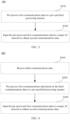
- FIG. 2 is a schematic flowchart of a communications data processing method 200 according to an example embodiment of this application.
- the method 200 may be applied to, but not limited to, a first communications device, for example, a terminal or a network side device, and may specifically be performed by software and/or hardware installed on the communications device.
- the method 200 at least includes the following steps.
- the first communications data is pre-processed, so that a problem, such as a random phase shift and an amplitude bias of communications data, due to impacts of nonideal factors in an actual communications environment on the data can be resolved, thereby ensuring accuracy of the communications data.
- a corresponding pre-specified processing manner may be adopted based on an actual condition of the impacts of the nonideal factors in the actual communications environment on the data. For example, when a phase of the first communications data is impacted, the pre-specified processing manner may be a phase processing manner. For another example, when an amplitude of the first communications data is impacted, the pre-specified processing manner may be an amplitude processing manner.
- the pre-specified processing manner may include at least one of a phase processing manner, an amplitude processing manner, and a transform domain processing manner.
- a specific implementation of the phase processing manner, the amplitude processing manner, and the transform domain processing manner may be specified based on a requirement. This is not limited herein.
- the pre-specified processing manner may be determined by at least one of a configuration at a network side, a report of a terminal side, and default in a protocol.
- M1 is default in the protocol
- a device B reports that M2 is supported
- M3 is configured by a device A
- the device B reports that M4 is to be selected.
- the device A and the device B is interchangeable.
- the device A may be a network side device (or terminal)
- the device B may be a terminal (or network side device).
- the foregoing first communications data may at least include at least one of the following (1) to (10).
- the first communications data may include, but is not limited to, the foregoing (1) to (10), for example, may include only one or more of the foregoing (1) to (10), or may include another signal, or other information or signaling beyond the foregoing (1) to (10). This is not limited herein.
- S220 inputting the pre-processed first communications data to a target AI network to obtain second communications data.
- the target AI network (namely, the artificial intelligence network or artificial neural network) has been widely used in various fields, for example, in commonly seen neural networks.
- the target AI network is an algorithmic mathematical model, built by using neurons, imitating behavior features of neural networks of animals for parallel distributed information processing.
- the network achieves the purpose of information processing and gains self-learning and self-adaption capabilities by adjusting a connection relationship between a great quantity of neuron nodes inside with high complexity of the system.
- a structure and a type of the target AI network are not limited, and may be determined based on an actual processing requirement during communications data processing.
- the target AI network may alternatively be a decision tree, a support vector machine, a Bayes classifier, or the like.
- the second communications data may be the same as or may be different from the first communications data.
- the second communications data may include at least one of a reference signal, a signal carried on a channel, channel state information, beam information, channel estimation information, interference information, positioning information, track information, specified estimation information and management information, and control signaling.
- the first communications device pre-processes the first communications data in the pre-specified processing manner first; and then inputs the pre-processed first communications data to the target AI network to obtain the second communications data, where the pre-specified processing manner includes at least one of the amplitude processing manner, the phase processing manner, and the transform domain processing manner.
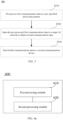
- FIG. 3 is a schematic flowchart of a communications data processing method 300 according to an example embodiment of this application.
- the method 300 may be applied to, but not limited to, a first communications device, for example, a terminal or a network side device, and may specifically be performed by software and/or hardware installed on the communications device.
- the method 300 at least includes the following steps.
- the first communications device may pre-process the first communications data with any one of the following (1) to (7). It should be noted that an amplitude in Example 1 may refer to an original amplitude.
- a frequency-domain subband refers to division of the first communications data in a frequency domain resource manner based on a radio bearer (Radio Bearer, RB), a physical resource block (Physical Resource Block, PRB), a subband, a precoding resource block group (Precoding Resource block Group, PRG), a bandwidth part (Bandwidth Part, BWP), or the like.
- a time-domain subband refers to division of the first communications data in a time domain resource manner based on a subcarrier, a symbol, a slot, a half-slot, or the like.
- a code-domain subband refers to division of the first communications data in a code domain resource manner based on an orthogonal code, a quasi-orthogonal code, a semi-orthogonal code, or the like.
- a spatial-domain subband refers to division of the first communications data in a spatial domain resource manner based on an antenna, an antenna element, an antenna panel, a transmission and reception unit, a beam, a layer, a rank, an antenna angle, or the like.
- the foregoing subband may be at least one of a time-domain subband, a frequency-domain subband, a code-domain subband, a spatial-domain subband, a delay-domain subband, a Doppler-domain subband, an angle-domain subband, an S-domain subband, and a Z-domain subband.
- the first subband may also include at least one of a time-domain subband, a frequency-domain subband, a code-domain subband, a spatial-domain subband, a delay-domain subband, a Doppler-domain subband, an angle-domain subband, an S-domain subband, and a Z-domain subband.
- the S-domain is domain obtained through the S transform, and the S transform is a classic transform in mathematics, and means that any signal may be decomposed into a plurality of different imaginary exponential components based on an imaginary exponential exp(j ⁇ t) as a basic signal in frequency domain analysis. This may also be another way of describing frequency domain.
- the Z-domain is domain obtained through the Z transform, and the Z transform is another classic transform in mathematics.
- the first subband is a special subband as a reference for pre-processing the first communications data, that is, all subbands in the first communications data is pre-processed with reference to the first subband
- the first subband may be any one of the following (1) to (9).
- the specified element set in (8) and (9) may be determined based on the first communications data. For example, elements are sorted based on an amplitude/power in a subband in a descending order, and an element set including top N2 elements is the specified element set. Correspondingly, a subband that is in the specified element set and that is with a largest average amplitude or total power is the first subband. For an averaging method, refer to the descriptions in (3). Details are not provided herein again.
- first subband may be set by a configuration at a network side, default in a protocol, or autonomous setting of a terminal. This is not limited in this embodiment.
- the pre-specified processing manner is the phase processing manner
- the first communications data is pre-processed with any one of the following (1) to (4).
- the first element is any one of the following (a) to (c).
- the fifth pre-specified value and the sixth pre-specified value may be set as required. This is not limited herein.
- each element in one subband times one single complex number uniformly to cause a uniform phase shift of each element in the subband, to ensure that a phase of a first element in the subband is a specific preset value.
- IDs of first elements in various subbands may be the same or different.
- IDs of elements with a largest amplitude/power in the subbands are different, the IDs of the first elements in the subbands may be different.
- a phase of another element in the subband may be normalized based on a first element in the subband.
- the another element is an element, in the subband, other than the first element.
- a phase of the first element is 0.
- the phase of the another element in the subband may be normalized to 0 degree based on "0", that is, a phase of each pre-processed element is 0 degree.
- the first communications device may perform the following (1) or (2) to pre-process the first communications data.
- the pre-specified transform domain processing manner may include the Fourier transform, the fast Fourier transform (FFT), the discrete Fourier transform, the fractional Fourier transform, the short-time Fourier transform, the Laplace transform (Laplace method), the Z-transform, the wavelet transform, the discrete wavelet transform, and the continuous wavelet transform, and corresponding inverse transforms, that is, the inverse Fourier transform, the inverse fast Fourier transform (FFT), the inverse discrete Fourier transform, the inverse fractional Fourier transform, the inverse short-time Fourier transform, the inverse Laplace transform (Laplace method), the inverse Z-transform, the inverse wavelet transform, the inverse discrete wavelet transform, the inverse continuous wavelet transform, etc.
- FFT fast Fourier transform
- Laplace method Laplace transform
- the pre-specified transform domain processing manner may further include time-domain transform, frequency-domain transform, S-domain transform (in S-domain, any signal may be decomposed into a plurality of different imaginary exponential components based on an imaginary exponential exp(j ⁇ t) as a basic signal in frequency domain analysis), Z-domain transform (domain obtained through the Z-transform), and the like, and inverse transforms of the transforms, that is, inverse time-domain transform, inverse frequency-domain transform, inverse S-domain transform, inverse Z-domain transform, and the like.
- the first communications data may alternatively be pre-processed with a combination of any two or three transforms and/or inverse transforms in the foregoing domain transforms.
- the first communications data when transform domain processing is performed, the first communications data, a total input, is an object to be processed, that is, the total input is used as a whole in transform domain processing (for example, FFT processing) to obtain a result corresponding to one FFT on the first communications data; and in (2), a subband included in the first communications data is an object to be processed, that is, if transform domain processing (for example, FFT processing) is performed on each subband included in the first communications data, results corresponding to a plurality of FFTs on various subbands.
- transform domain processing for example, FFT processing
- the plurality of processing manners for pre-processing the first communications data provided in Example 1 to Example 3 may be combined in any manner or sorted in any sequence. For example, (1) transform domain+amplitude+phase, that is, first transform domain processing, then amplitude processing, and finally phase processing may be performed on the first communications data; (2) amplitude+phase; (3) amplitude+transform domain; or (4) phase+transform domain. It should be noted that the foregoing combinations and sequences are not enlisted in detail herein.
- the first communications data is pre-processed based on at least one of an amplitude, a phase, or transform domain, so that communications data processing performance can be further improved, and subsequent wireless communications performance is ensured.
- FIG. 4 is a schematic flowchart of a communications data processing method 400 according to an example embodiment of this application.
- the method 400 may be applied to, but not limited to, a first communications device, for example, a terminal or a network side device, and may specifically be performed by software and/or hardware installed on the communications device.
- the method 400 at least includes the following steps.
- S410 receiving third communications data.
- the third communications data is data used for pre-processing the first communications data, and may be obtained by a same module of the first communications device that obtains the first communications data, or may be obtained by a different module. This is not limited herein.
- the third communications data may be an ID, amplitude information, phase information, etc., of a first subband.
- the amplitude information may be original amplitude information, and/or information about a target amplitude to be normalized. This is not limited in this embodiment.
- S420 pre-processing first communications data based on the third communications data in a pre-specified processing manner.
- the third communications data is received, and information used for pre-processing the first communications data is obtained, so that there is high flexibility in a communications data processing process.
- FIG. 5 is a schematic flowchart of a communications data processing method 500 according to an example embodiment of this application.
- the method 500 may be applied to, but not limited to, a first communications device, for example, a terminal or a network side device, and may specifically be performed by software and/or hardware installed on the communications device.
- the method 500 at least includes the following steps.
- S530 sending fourth communications data to a second communications device.
- the second communications device may be a terminal, or may be a network side device.
- the first communications device is a terminal, and the second communications device is a network side device; the first communications device is a network side device, and the second communications device is a terminal; the first communications device and the second communications device are both network side devices; or the first communications device and the second communications device are both terminals. This is not limited in this embodiment.
- the fourth communications data may include at least one of the pre-specified processing manner, the second communications data, and fifth communications data
- the fifth communications data is intermediate information obtained during pre-processing of the first communications data.
- the intermediate information is intermediate information obtained in a process in which the first communications data is pre-processed, for example, an original amplitude in amplitude normalization, an original power, an amplitude difference (an absolute difference and a relative difference), a power difference (an absolute difference and a relative difference), an original phase in phase normalization, and a phase difference (an absolute difference and a relative difference). This is not limited in this embodiment.
- the communications data processing method according to the embodiments of this application may be performed by a communications data processing apparatus, or a control module that is in the communications data processing apparatus and that is configured to perform the communications data processing method.
- a communications data processing apparatus performs the communications data processing method is used as an example to describe the communications data processing apparatus provided in the embodiments of this application.
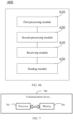
- FIG. 6a is a block diagram of a communications data processing apparatus 600 according to an example embodiment of this application.
- the communications data processing apparatus 600 includes: a first processing module 610, configured to pre-process first communications data in a pre-specified processing manner, where the pre-specified processing manner includes at least one of an amplitude processing manner, a phase processing manner, and a transform domain processing manner; and a second processing module 620, configured to input the pre-processed first communications data to a target artificial intelligence AI network to obtain second communications data.
- the first processing module is configured to: in a case in which the pre-specified processing manner is the amplitude processing manner, pre-process the first communications data with any one of the following processes: processing a total power of the first communications data into a first pre-specified value; processing an amplitude of each element in the first communications data into a second pre-specified value; processing a total input power of each subband in the first communications data into a third pre-specified value; processing a total input power of each subband in the first communications data into a same value; processing a total input power of each subband in the first communications data into a value the same as a power of a first subband; processing an amplitude of each element in each subband in the first communications data into a fourth pre-specified value; and processing an amplitude of each element in another subband based on an amplitude of each element in the first subband, where the another subband is a subband, in the first communications data, other than the first subband.
- the first processing module is configured to: in a case in which the pre-specified processing manner is the phase processing manner, pre-process the first communications data with any one of the following processes: normalizing a phase of each element in the first communications data based on a first element in the first communications data; processing a phase of each element in the first communications data into a same value; normalizing a phase of another subband based on a first element in the first subband in the first communications data, where the another subband is a subband, in the first communications data, other than the first subband; and for each subband included in the first communications data, normalizing a phase of an element in each of the subbands.
- the first element is any one of the following: an element at a first pre-specified position in the first communications data; an element with an amplitude of a fifth pre-specified value in the first communications data; and an element with a power of a sixth pre-specified value in the first communications data.
- the first subband is any one of the following: a subband at a second pre-specified position in the first communications data; a subband with a highest total power in the first communications data; a subband, in the first communications data, in which an average amplitude of all elements is highest; a subband, in the first communications data, including a single element with a largest amplitude; a subband, in the first communications data, including a single element with a largest power; a subband including a largest quantity of elements with an amplitude exceeding a first pre-specified threshold; a subband including a largest quantity of elements with a power exceeding a second pre-specified threshold; a subband that is in a specified element set and that is with a largest amplitude; and a subband that is in a specified element set and that is with a largest power, where the specified element set is determined based on the first communications data.
- the first subband includes at least one of a time-domain subband, a frequency-domain subband, a code-domain subband, a spatial-domain subband, a delay-domain subband, a Doppler-domain subband, an angle-domain subband, an S-domain subband, and a Z-domain subband.
- the first processing module is configured to: is configured to: in a case in which the pre-specified processing manner is the transform domain processing manner, perform any one of the following: processing the first communications data in the pre-specified transform domain processing manner; and processing at least one subband included in the first communications data in the pre-specified transform domain processing manner.
- the first communications data includes at least one of a reference signal, a signal carried on a channel, channel state information, beam information, channel estimation information, interference information, positioning information, track information, specified estimation information and management information, and control signaling; and/or the second communications data includes at least one of a reference signal, a signal carried on a channel, channel state information, beam information, channel estimation information, interference information, positioning information, track information, specified estimation information and management information, and control signaling.
- the apparatus 600 further includes a receiving module 630, configured to receive third communications data, where the third communications data is data used for pre-processing the first communications data; and the first processing module 610 is further configured to pre-process the first communications data based on the third communications data in the pre-specified processing manner.
- the apparatus 600 further includes a sending module 640, configured to send fourth communications data to a second communications device, where the fourth communications data includes at least one of the pre-specified processing manner, the second communications data, and fifth communications data, and the fifth communications data is intermediate information obtained during pre-processing of the first communications data.
- a sending module 640 configured to send fourth communications data to a second communications device, where the fourth communications data includes at least one of the pre-specified processing manner, the second communications data, and fifth communications data, and the fifth communications data is intermediate information obtained during pre-processing of the first communications data.
- the pre-specified processing manner is determined by at least one of the following: being configured at a network side; being reported at a terminal side; and being set to default in a protocol.
- the communications data processing apparatus 600 in this embodiment of this application may be an apparatus, or may be a component, an integrated circuit, or a chip in a terminal.
- the apparatus may be a mobile terminal, or a non-mobile terminal.
- the mobile terminal may include but is not limited to the foregoing listed types of terminals 11.
- the non-mobile terminal may be a server, a network attached storage (Network Attached Storage, NAS), a personal computer (personal computer, PC), a television (television, TV), a teller machine, or a self-service machine. This is not specifically limited in this embodiment of this application.
- the communications data processing apparatus 600 in this embodiment of this application may be an apparatus with an operating system.
- the operating system may be an Android (Android) operating system, may be an iOS operating system, or may be another possible operating system. This is not specifically limited in this embodiment of this application.
- the communications data processing apparatus 600 provided in this embodiment of this application can implement the processes implemented in the method embodiments in FIG. 2 to FIG. 5 , with the same technical effect achieved. To avoid repetition, details are not described herein again.
- an embodiment of this application further provides a communications device 700, including a processor 701, a memory 702, a program or an instruction that is stored in the memory 702 and that can run on the processor 701.
- a communications device 700 including a processor 701, a memory 702, a program or an instruction that is stored in the memory 702 and that can run on the processor 701.
- the communications device 700 is a terminal
- the program or the instruction is executed by the processor 701 to implement each process in communications data processing method embodiments, with the same technical effect achieved.
- the communications device 700 is a network side device
- the program or the instruction is executed by the processor 701
- the processes in the communications data processing method embodiment are implemented, with the same technical effect achieved. To avoid repetition, details are not provided herein again.
- the communications device 700 may be a terminal.
- FIG. 8 is a schematic diagram of a hardware structure of a terminal according to an embodiment of this application.
- the terminal 800 includes but is not limited to components such as a radio frequency unit 801, a network module 802, an audio output unit 803, an input unit 804, a sensor 805, a display unit 806, a user input unit 807, an interface unit 808, a memory 809, and a processor 810.
- the terminal 800 may further include a power supply (such as a battery) that supplies power to each component.
- the power supply may be logically connected to the processor 810 by using a power supply management system, to implement functions such as charging and discharging management, and power consumption management by using the power supply management system.
- the terminal structure shown in FIG. 8 constitutes no limitation on the terminal, and the terminal may include more or fewer components than those shown in the figure, or combine some components, or have different component arrangements. Details are not described herein.
- the input unit 804 may include a graphics processing unit (Graphics Processing Unit, GPU) 8041 and a microphone 8042, and the graphics processing unit 8041 processes image data of a still picture or a video obtained by an image capture apparatus (for example, a camera) in a video capture mode or an image capture mode.
- the display unit 806 may include a display panel 8061, and the display panel 8061 may be configured in a form of a liquid crystal display, an organic light-emitting diode, or the like.
- the user input unit 807 includes a touch panel 8071 and another input device 8072.
- the touch panel 8071 is also referred to as a touchscreen.
- the touch panel 8071 may include two parts: a touch detection apparatus and a touch controller.
- the another input device 8072 may include but is not limited to a physical keyboard, a functional button (such as a volume control button or a power on/off button), a trackball, a mouse, and a joystick. Details are not described herein.
- the radio frequency unit 801 receives downlink data from a network side device and then sends the downlink data to the processor 810 for processing; and sends uplink data to the network side device.
- the radio frequency unit 801 includes but is not limited to an antenna, at least one amplifier, a transceiver, a coupler, a low noise amplifier, a duplexer, and the like.
- the memory 809 may be configured to store a software program or an instruction and various data.
- the memory 809 may mainly include a program or instruction storage area and a data storage area.
- the program or instruction storage area may store an operating system, and an application program or an instruction required by at least one function (for example, a sound playing function or an image playing function).
- the memory 809 may include a high speed random access memory, and may further include a non-volatile memory.
- the non-volatile memory may be a read-only memory (Read-Only Memory, ROM), a programmable read-only memory (Programmable ROM, PROM), an erasable programmable read-only memory (Erasable PROM, EPROM), an electrically erasable programmable read-only memory (Electrically EPROM, EEPROM), or a flash memory, for example, at least one disk storage device, a flash memory device, or another non-volatile solid-state storage device.
- ROM Read-Only Memory
- PROM programmable read-only memory
- Erasable PROM Erasable PROM
- EPROM electrically erasable programmable read-only memory
- EEPROM electrically erasable programmable read-only memory
- flash memory for example, at least one disk storage device, a flash memory device, or another non-volatile solid-state storage device.
- the processor 810 may include one or more processing units.
- an application processor and a modem processor may be integrated into the processor 810.
- the application processor mainly processes an operating system, a user interface, an application, an instruction, or the like.
- the modem processor mainly processes wireless communications, for example, a baseband processor. It can be understood that, alternatively, the modem processor may not be integrated into the processor 810.
- the processor 810 is configured to: pre-process first communications data in a pre-specified processing manner; and input the pre-processed first communications data to a target artificial intelligence AI network to obtain second communications data, where the pre-specified processing manner includes at least one of an amplitude processing manner, a phase processing manner, and a transform domain processing manner.
- the first communications data is pre-processed in the pre-specified processing manner first; and then the pre-processed first communications data is input to the target AI network to obtain the second communications data, where the pre-specified processing manner includes at least one of the amplitude processing manner, the phase processing manner, and the transform domain processing manner.
- the communications device 700 may alternatively be a network side device.
- FIG. 9 is a block diagram of a network side device according to an example embodiment of this application.
- the network device 900 includes an antenna 901, a radio frequency apparatus 902, and a baseband apparatus 903.
- the antenna 901 is connected to the radio frequency apparatus 902.
- the radio frequency apparatus 902 receives information through the antenna 901, and sends the received information to the baseband apparatus 903 for processing.
- the baseband apparatus 903 processes information to be sent and transmits the information to the radio frequency apparatus 902, and the radio frequency apparatus 902 processes the received information and then transmits the information through the antenna 901.
- the foregoing band processing apparatus may be located in the baseband apparatus 903, and the method performed by the network side device in the foregoing embodiment may be implemented in the baseband apparatus 903.
- the baseband apparatus 903 includes a processor 904 and a memory 905.
- the baseband apparatus 903 may include, for example, at least one baseband board, where a plurality of chips are disposed on the baseband board. As shown in FIG. 9 , one chip is, for example, the processor 904, which is connected to the memory 905, so as to invoke a program in the memory 905 to perform operations of the network device shown in the foregoing method embodiment.
- the baseband apparatus 903 may further include a network interface 906, configured to exchange information with the radio frequency apparatus 902, where the interface is, for example, a common public radio interface (common public radio interface, CPRI for short).
- a network interface 906 configured to exchange information with the radio frequency apparatus 902, where the interface is, for example, a common public radio interface (common public radio interface, CPRI for short).
- the network side device in this embodiment of the present invention further includes an instruction or a program that is stored in the memory 905 and that can be run on the processor 904.
- the processor 904 invokes the instruction or the program in the memory 905 to perform the method performed by the modules shown in FIG. 6a and FIG. 6b , with the same technical effect achieved. To avoid repetition, details are not described herein again.
- An embodiment of this application further provides a readable storage medium, where the readable storage medium stores a program or an instruction, and when the program or the instruction is executed by a processor, the processes of the foregoing communications data processing method embodiments are implemented, with the same technical effect achieved. To avoid repetition, details are not described herein again.
- the processor is a processor in the terminal in the foregoing embodiment.
- the readable storage medium includes a computer-readable storage medium such as a read-only memory (Read-Only Memory, ROM), a random access memory (Random Access Memory, RAM), a magnetic disk, an optical disc, or the like.
- An embodiment of this application further provides a chip.
- the chip includes a processor and a communications interface, the communications interface is coupled to the processor, and the processor is configured to run a program or an instruction of a network side device to implement the processes of the foregoing communications data processing method embodiments, with the same technical effect achieved. To avoid repetition, details are not described herein again.
- the chip mentioned in this embodiment of this application may also be referred to as a system-level chip, a system chip, a chip system, or an on-chip system chip.
- An embodiment of this application further provides a computer program product.
- the computer program product includes a processor, a memory, and a program or an instruction stored in the memory and executable on the processor, where when the program or the instruction is executed by the processor, the processes of the foregoing communications data processing method embodiments are implemented, with the same technical effect achieved. To avoid repetition, details are not described herein again.
- the terms "include”, “comprise”, or any other variant thereof are intended to cover a non-exclusive inclusion, so that a process, a method, an article, or an apparatus that includes a list of elements not only includes those elements but also includes other elements which are not expressly listed, or further includes elements inherent to such a process, method, article, or apparatus.
- An element limited by “includes a " does not, without more constraints, preclude the presence of additional identical elements in the process, method, article, or apparatus that includes the element.
- a scope of the method and the apparatus in the implementations of this application is not limited to: performing a function in a sequence shown or discussed, and may further include: performing a function in a basically simultaneous manner or in a reverse sequence based on an involved function.
- the described method may be performed in a different order, and various steps may be added, omitted, or combined.
- features described with reference to some examples may be combined in other examples.
- the method in the foregoing embodiments may be implemented by software in addition to a necessary universal hardware platform or by hardware only. In most cases, the former is a preferred implementation. Based on such an understanding, the technical solutions of this application essentially or the part contributing to the prior art may be implemented in a form of a software product.
- the computer software product is stored in a storage medium (such as a ROM/RAM, a magnetic disk, or an optical disc) and includes several instructions for instructing a terminal (which may be a mobile phone, a computer, a server, an air conditioner, or a network device) to execute the methods described in the embodiments of this application.
Landscapes
- Engineering & Computer Science (AREA)
- Signal Processing (AREA)
- Computer Networks & Wireless Communication (AREA)
- Physics & Mathematics (AREA)
- Theoretical Computer Science (AREA)
- Data Mining & Analysis (AREA)
- General Health & Medical Sciences (AREA)
- Biomedical Technology (AREA)
- Biophysics (AREA)
- Computational Linguistics (AREA)
- Life Sciences & Earth Sciences (AREA)
- Evolutionary Computation (AREA)
- Artificial Intelligence (AREA)
- Molecular Biology (AREA)
- Computing Systems (AREA)
- General Engineering & Computer Science (AREA)
- General Physics & Mathematics (AREA)
- Mathematical Physics (AREA)
- Software Systems (AREA)
- Health & Medical Sciences (AREA)
- Mobile Radio Communication Systems (AREA)
Applications Claiming Priority (2)
| Application Number | Priority Date | Filing Date | Title |
|---|---|---|---|
| CN202011321231.4A CN114531694B (zh) | 2020-11-23 | 2020-11-23 | 通信数据处理方法、装置及通信设备 |
| PCT/CN2021/132050 WO2022105911A1 (zh) | 2020-11-23 | 2021-11-22 | 通信数据处理方法、装置及通信设备 |
Publications (2)
| Publication Number | Publication Date |
|---|---|
| EP4236428A1 true EP4236428A1 (de) | 2023-08-30 |
| EP4236428A4 EP4236428A4 (de) | 2024-05-08 |
Family
ID=81619336
Family Applications (1)
| Application Number | Title | Priority Date | Filing Date |
|---|---|---|---|
| EP21894058.3A Pending EP4236428A4 (de) | 2020-11-23 | 2021-11-22 | Kommunikationsdatenverarbeitungsverfahren und -vorrichtung sowie kommunikationsvorrichtung |
Country Status (4)
| Country | Link |
|---|---|
| US (1) | US20230299910A1 (de) |
| EP (1) | EP4236428A4 (de) |
| CN (1) | CN114531694B (de) |
| WO (1) | WO2022105911A1 (de) |
Families Citing this family (2)
| Publication number | Priority date | Publication date | Assignee | Title |
|---|---|---|---|---|
| WO2024000438A1 (en) * | 2022-06-30 | 2024-01-04 | Shenzhen Tcl New Technology Co., Ltd. | Communication device and method for determining post-processing based on artificial intelligence/machine learning |
| CN121533066A (zh) * | 2023-10-27 | 2026-02-13 | 华为技术有限公司 | 一种通信方法及相关设备 |
Family Cites Families (27)
| Publication number | Priority date | Publication date | Assignee | Title |
|---|---|---|---|---|
| JPH05297114A (ja) * | 1992-04-22 | 1993-11-12 | Mitsubishi Heavy Ind Ltd | ソナー信号処理装置 |
| JPH0643238A (ja) * | 1992-07-27 | 1994-02-18 | Mitsubishi Heavy Ind Ltd | ソーナー信号処理装置 |
| US7362822B2 (en) * | 2004-09-08 | 2008-04-22 | Intel Corporation | Recursive reduction of channel state feedback |
| CN101359984A (zh) * | 2007-08-03 | 2009-02-04 | 华为技术有限公司 | 实现信号发射的方法、装置及系统 |
| US8896759B2 (en) * | 2010-10-26 | 2014-11-25 | Sony Corporation | Method to increase the accuracy of phase correlation motion estimation in low-bit-precision circumstances |
| US20200064444A1 (en) * | 2015-07-17 | 2020-02-27 | Origin Wireless, Inc. | Method, apparatus, and system for human identification based on human radio biometric information |
| CN105122869B (zh) * | 2013-04-08 | 2019-06-14 | Lg电子株式会社 | 在无线通信系统中针对部分波束成形报告信道状态信息的方法和设备 |
| US9654158B2 (en) * | 2015-10-20 | 2017-05-16 | The Aerospace Corporation | Circuits and methods for reducing an interference signal that spectrally overlaps a desired signal |
| WO2018080124A2 (ko) * | 2016-10-24 | 2018-05-03 | 엘지전자 주식회사 | 딥 러닝 신경망 기반의 보안 시스템 및 그 제어 방법 |
| CN108282207B (zh) * | 2017-01-06 | 2021-06-15 | 华为技术有限公司 | 一种预编码矩阵指示方法、装置和系统 |
| US11418379B2 (en) * | 2017-06-09 | 2022-08-16 | Lg Electronics Inc. | Method for transmitting/receiving reference signal in wireless communication system, and device therefor |
| CN107968689B (zh) * | 2017-12-06 | 2020-07-31 | 北京邮电大学 | 基于无线通信信号的感知识别方法及装置 |
| US20190192024A1 (en) * | 2017-12-27 | 2019-06-27 | X Development Llc | Electroencephalogram system with reconfigurable network of redundant electrodes |
| CN109995692A (zh) * | 2017-12-30 | 2019-07-09 | 华为技术有限公司 | 发送数据的方法及装置 |
| CN108647556A (zh) * | 2018-03-02 | 2018-10-12 | 重庆邮电大学 | 基于分频和深度神经网络的声源定位方法 |
| CN110365380B (zh) * | 2018-04-10 | 2021-12-14 | 成都华为技术有限公司 | 数据传输的方法、通信装置及系统 |
| CN110392427B (zh) * | 2018-04-16 | 2021-08-31 | 维沃移动通信有限公司 | 通信流程处理方法及终端 |
| CN108600137B (zh) * | 2018-04-28 | 2020-11-24 | 重庆邮电大学 | 一种基于反向传播神经网络的新型多载波识别方法 |
| US11741355B2 (en) * | 2018-07-27 | 2023-08-29 | International Business Machines Corporation | Training of student neural network with teacher neural networks |
| CN109394229A (zh) * | 2018-11-22 | 2019-03-01 | 九牧厨卫股份有限公司 | 一种跌倒检测方法、装置及系统 |
| KR102051011B1 (ko) * | 2018-11-27 | 2019-12-02 | 오아 주식회사 | 학습 기반 음성 인식 단말을 제어하는 서버 및 제어 방법 |
| CN111836309B (zh) * | 2019-08-23 | 2023-10-24 | 维沃移动通信有限公司 | 信道状态信息csi报告的传输方法、终端及网络侧设备 |
| KR20190106946A (ko) * | 2019-08-30 | 2019-09-18 | 엘지전자 주식회사 | 지능형 디바이스 및 그 제어 방법 |
| CN115003215A (zh) * | 2020-01-20 | 2022-09-02 | 比纳人工智能有限公司 | 根据光学数据进行脉搏传播时间测量的系统和方法 |
| US11341743B2 (en) * | 2020-06-12 | 2022-05-24 | Wärtsilä Finland Oy | Apparatus and computer implemented method in marine vessel data system for generating anomaly heatmap information using neural network |
| CN111933172B (zh) * | 2020-08-10 | 2024-09-06 | 广州九四智能科技有限公司 | 人声分离提取方法、装置、计算机设备及存储介质 |
| CN114531355B (zh) * | 2020-11-23 | 2023-07-18 | 维沃移动通信有限公司 | 通信方法、装置及通信设备 |
-
2020
- 2020-11-23 CN CN202011321231.4A patent/CN114531694B/zh active Active
-
2021
- 2021-11-22 WO PCT/CN2021/132050 patent/WO2022105911A1/zh not_active Ceased
- 2021-11-22 EP EP21894058.3A patent/EP4236428A4/de active Pending
-
2023
- 2023-05-22 US US18/200,541 patent/US20230299910A1/en active Pending
Also Published As
| Publication number | Publication date |
|---|---|
| WO2022105911A1 (zh) | 2022-05-27 |
| EP4236428A4 (de) | 2024-05-08 |
| CN114531694A (zh) | 2022-05-24 |
| US20230299910A1 (en) | 2023-09-21 |
| CN114531694B (zh) | 2024-11-19 |
Similar Documents
| Publication | Publication Date | Title |
|---|---|---|
| US20230254711A1 (en) | Configuration method for ai network parameter and device | |
| CN115913486B (zh) | 信息上报方法、装置、终端及可读存储介质 | |
| US12604304B2 (en) | Beam control method and apparatus for intelligent surface device and electronic device | |
| EP4404613A1 (de) | Parameterauswahlverfahren, parameterkonfigurationsverfahren, endgerät und netzwerkseitige vorrichtung | |
| US20230291517A1 (en) | Communication method, communications apparatus, and communications device | |
| US20230244911A1 (en) | Neural network information transmission method and apparatus, communication device, and storage medium | |
| US20230291658A1 (en) | Method for Processing Partial Input Missing of AI Network, and Device | |
| US20230299910A1 (en) | Communications data processing method and apparatus, and communications device | |
| US20240088970A1 (en) | Method and apparatus for feeding back channel information of delay-doppler domain, and electronic device | |
| CN117997457A (zh) | 参考信号确定方法、终端及网络侧设备 | |
| US20230261815A1 (en) | Communication Information Sending Method, Communication Information Receiving Method, and Communication Device | |
| US20250037030A1 (en) | Method for determining a model input and communication device | |
| WO2025241972A1 (zh) | 通信处理的方法、装置及终端 | |
| CN120834875A (zh) | 干扰信息获取方法、装置、终端、网络侧设备及存储介质 | |
| WO2026032220A1 (zh) | 波束预测性能监测方法及终端 | |
| CN119210668A (zh) | 信道状态信息的反馈方法、终端及网络侧设备 | |
| CN120224400A (zh) | 频域设置指示方法、终端及网络侧设备 | |
| CN120200639A (zh) | 预编码矩阵的获取方法、终端及网络侧设备 | |
| CN117676667A (zh) | 测量参数的反馈方法、装置、终端和存储介质 |
Legal Events
| Date | Code | Title | Description |
|---|---|---|---|
| STAA | Information on the status of an ep patent application or granted ep patent |
Free format text: STATUS: THE INTERNATIONAL PUBLICATION HAS BEEN MADE |
|
| PUAI | Public reference made under article 153(3) epc to a published international application that has entered the european phase |
Free format text: ORIGINAL CODE: 0009012 |
|
| STAA | Information on the status of an ep patent application or granted ep patent |
Free format text: STATUS: REQUEST FOR EXAMINATION WAS MADE |
|
| 17P | Request for examination filed |
Effective date: 20230526 |
|
| AK | Designated contracting states |
Kind code of ref document: A1 Designated state(s): AL AT BE BG CH CY CZ DE DK EE ES FI FR GB GR HR HU IE IS IT LI LT LU LV MC MK MT NL NO PL PT RO RS SE SI SK SM TR |
|
| DAV | Request for validation of the european patent (deleted) | ||
| DAX | Request for extension of the european patent (deleted) | ||
| REG | Reference to a national code |
Ref country code: DE Ref legal event code: R079 Free format text: PREVIOUS MAIN CLASS: H04W0024020000 Ipc: H04L0001000000 |
|
| A4 | Supplementary search report drawn up and despatched |
Effective date: 20240409 |
|
| RIC1 | Information provided on ipc code assigned before grant |
Ipc: G06N 3/02 20060101ALN20240403BHEP Ipc: H04L 65/60 20220101ALN20240403BHEP Ipc: H04W 28/04 20090101ALI20240403BHEP Ipc: H04L 1/00 20060101AFI20240403BHEP |