EP4238766A1 - Procédé d'assemblage d'éléments de tôlerie en paquets de tôles et dispositif associé - Google Patents
Procédé d'assemblage d'éléments de tôlerie en paquets de tôles et dispositif associé Download PDFInfo
- Publication number
- EP4238766A1 EP4238766A1 EP22160359.0A EP22160359A EP4238766A1 EP 4238766 A1 EP4238766 A1 EP 4238766A1 EP 22160359 A EP22160359 A EP 22160359A EP 4238766 A1 EP4238766 A1 EP 4238766A1
- Authority
- EP
- European Patent Office
- Prior art keywords
- sheet metal
- carrier
- metal parts
- separating element
- coating
- Prior art date
- Legal status (The legal status is an assumption and is not a legal conclusion. Google has not performed a legal analysis and makes no representation as to the accuracy of the status listed.)
- Withdrawn
Links
Images

Classifications
-
- B—PERFORMING OPERATIONS; TRANSPORTING
- B32—LAYERED PRODUCTS
- B32B—LAYERED PRODUCTS, i.e. PRODUCTS BUILT-UP OF STRATA OF FLAT OR NON-FLAT, e.g. CELLULAR OR HONEYCOMB, FORM
- B32B37/00—Methods or apparatus for laminating, e.g. by curing or by ultrasonic bonding
- B32B37/12—Methods or apparatus for laminating, e.g. by curing or by ultrasonic bonding characterised by using adhesives
- B32B37/1207—Heat-activated adhesive
-
- B—PERFORMING OPERATIONS; TRANSPORTING
- B32—LAYERED PRODUCTS
- B32B—LAYERED PRODUCTS, i.e. PRODUCTS BUILT-UP OF STRATA OF FLAT OR NON-FLAT, e.g. CELLULAR OR HONEYCOMB, FORM
- B32B37/00—Methods or apparatus for laminating, e.g. by curing or by ultrasonic bonding
- B32B37/14—Methods or apparatus for laminating, e.g. by curing or by ultrasonic bonding characterised by the properties of the layers
- B32B37/26—Methods or apparatus for laminating, e.g. by curing or by ultrasonic bonding characterised by the properties of the layers with at least one layer which influences the bonding during the lamination process, e.g. release layers or pressure equalising layers
-
- B—PERFORMING OPERATIONS; TRANSPORTING
- B21—MECHANICAL METAL-WORKING WITHOUT ESSENTIALLY REMOVING MATERIAL; PUNCHING METAL
- B21D—WORKING OR PROCESSING OF SHEET METAL OR METAL TUBES, RODS OR PROFILES WITHOUT ESSENTIALLY REMOVING MATERIAL; PUNCHING METAL
- B21D28/00—Shaping by press-cutting; Perforating
- B21D28/02—Punching blanks or articles with or without obtaining scrap; Notching
- B21D28/22—Notching the peripheries of circular blanks, e.g. laminations for dynamo-electric machines
-
- B—PERFORMING OPERATIONS; TRANSPORTING
- B21—MECHANICAL METAL-WORKING WITHOUT ESSENTIALLY REMOVING MATERIAL; PUNCHING METAL
- B21D—WORKING OR PROCESSING OF SHEET METAL OR METAL TUBES, RODS OR PROFILES WITHOUT ESSENTIALLY REMOVING MATERIAL; PUNCHING METAL
- B21D43/00—Feeding, positioning or storing devices combined with, or arranged in, or specially adapted for use in connection with, apparatus for working or processing sheet metal, metal tubes or metal profiles; Associations therewith of cutting devices
- B21D43/20—Storage arrangements; Piling or unpiling
- B21D43/22—Devices for piling sheets
-
- B—PERFORMING OPERATIONS; TRANSPORTING
- B32—LAYERED PRODUCTS
- B32B—LAYERED PRODUCTS, i.e. PRODUCTS BUILT-UP OF STRATA OF FLAT OR NON-FLAT, e.g. CELLULAR OR HONEYCOMB, FORM
- B32B15/00—Layered products comprising a layer of metal
- B32B15/01—Layered products comprising a layer of metal all layers being exclusively metallic
- B32B15/011—Layered products comprising a layer of metal all layers being exclusively metallic all layers being formed of iron alloys or steels
-
- B—PERFORMING OPERATIONS; TRANSPORTING
- B32—LAYERED PRODUCTS
- B32B—LAYERED PRODUCTS, i.e. PRODUCTS BUILT-UP OF STRATA OF FLAT OR NON-FLAT, e.g. CELLULAR OR HONEYCOMB, FORM
- B32B38/00—Ancillary operations in connection with laminating processes
- B32B38/04—Punching, slitting or perforating
-
- B—PERFORMING OPERATIONS; TRANSPORTING
- B32—LAYERED PRODUCTS
- B32B—LAYERED PRODUCTS, i.e. PRODUCTS BUILT-UP OF STRATA OF FLAT OR NON-FLAT, e.g. CELLULAR OR HONEYCOMB, FORM
- B32B7/00—Layered products characterised by the relation between layers; Layered products characterised by the relative orientation of features between layers, or by the relative values of a measurable parameter between layers, i.e. products comprising layers having different physical, chemical or physicochemical properties; Layered products characterised by the interconnection of layers
- B32B7/04—Interconnection of layers
- B32B7/12—Interconnection of layers using interposed adhesives or interposed materials with bonding properties
-
- H—ELECTRICITY
- H01—ELECTRIC ELEMENTS
- H01F—MAGNETS; INDUCTANCES; TRANSFORMERS; SELECTION OF MATERIALS FOR THEIR MAGNETIC PROPERTIES
- H01F41/00—Apparatus or processes specially adapted for manufacturing or assembling magnets, inductances or transformers; Apparatus or processes specially adapted for manufacturing materials characterised by their magnetic properties
- H01F41/02—Apparatus or processes specially adapted for manufacturing or assembling magnets, inductances or transformers; Apparatus or processes specially adapted for manufacturing materials characterised by their magnetic properties for manufacturing cores, coils, or magnets
- H01F41/0206—Manufacturing of magnetic cores by mechanical means
- H01F41/0233—Manufacturing of magnetic circuits made from sheets
-
- H—ELECTRICITY
- H02—GENERATION; CONVERSION OR DISTRIBUTION OF ELECTRIC POWER
- H02K—DYNAMO-ELECTRIC MACHINES
- H02K15/00—Processes or apparatus specially adapted for manufacturing, assembling, maintaining or repairing of dynamo-electric machines
- H02K15/02—Processes or apparatus specially adapted for manufacturing, assembling, maintaining or repairing of dynamo-electric machines of stator or rotor bodies
-
- B—PERFORMING OPERATIONS; TRANSPORTING
- B32—LAYERED PRODUCTS
- B32B—LAYERED PRODUCTS, i.e. PRODUCTS BUILT-UP OF STRATA OF FLAT OR NON-FLAT, e.g. CELLULAR OR HONEYCOMB, FORM
- B32B37/00—Methods or apparatus for laminating, e.g. by curing or by ultrasonic bonding
- B32B37/12—Methods or apparatus for laminating, e.g. by curing or by ultrasonic bonding characterised by using adhesives
- B32B37/1207—Heat-activated adhesive
- B32B2037/1215—Hot-melt adhesive
-
- B—PERFORMING OPERATIONS; TRANSPORTING
- B32—LAYERED PRODUCTS
- B32B—LAYERED PRODUCTS, i.e. PRODUCTS BUILT-UP OF STRATA OF FLAT OR NON-FLAT, e.g. CELLULAR OR HONEYCOMB, FORM
- B32B37/00—Methods or apparatus for laminating, e.g. by curing or by ultrasonic bonding
- B32B37/14—Methods or apparatus for laminating, e.g. by curing or by ultrasonic bonding characterised by the properties of the layers
- B32B37/26—Methods or apparatus for laminating, e.g. by curing or by ultrasonic bonding characterised by the properties of the layers with at least one layer which influences the bonding during the lamination process, e.g. release layers or pressure equalising layers
- B32B2037/262—Partition plates or sheets for separating several laminates pressed simultaneously
-
- B—PERFORMING OPERATIONS; TRANSPORTING
- B32—LAYERED PRODUCTS
- B32B—LAYERED PRODUCTS, i.e. PRODUCTS BUILT-UP OF STRATA OF FLAT OR NON-FLAT, e.g. CELLULAR OR HONEYCOMB, FORM
- B32B38/00—Ancillary operations in connection with laminating processes
- B32B38/04—Punching, slitting or perforating
- B32B2038/042—Punching
-
- B—PERFORMING OPERATIONS; TRANSPORTING
- B32—LAYERED PRODUCTS
- B32B—LAYERED PRODUCTS, i.e. PRODUCTS BUILT-UP OF STRATA OF FLAT OR NON-FLAT, e.g. CELLULAR OR HONEYCOMB, FORM
- B32B2307/00—Properties of the layers or laminate
- B32B2307/70—Other properties
- B32B2307/718—Weight, e.g. weight per square meter
-
- B—PERFORMING OPERATIONS; TRANSPORTING
- B32—LAYERED PRODUCTS
- B32B—LAYERED PRODUCTS, i.e. PRODUCTS BUILT-UP OF STRATA OF FLAT OR NON-FLAT, e.g. CELLULAR OR HONEYCOMB, FORM
- B32B2307/00—Properties of the layers or laminate
- B32B2307/70—Other properties
- B32B2307/732—Dimensional properties
- B32B2307/737—Dimensions, e.g. volume or area
- B32B2307/7375—Linear, e.g. length, distance or width
- B32B2307/7376—Thickness
-
- B—PERFORMING OPERATIONS; TRANSPORTING
- B32—LAYERED PRODUCTS
- B32B—LAYERED PRODUCTS, i.e. PRODUCTS BUILT-UP OF STRATA OF FLAT OR NON-FLAT, e.g. CELLULAR OR HONEYCOMB, FORM
- B32B2457/00—Electrical equipment
-
- B—PERFORMING OPERATIONS; TRANSPORTING
- B32—LAYERED PRODUCTS
- B32B—LAYERED PRODUCTS, i.e. PRODUCTS BUILT-UP OF STRATA OF FLAT OR NON-FLAT, e.g. CELLULAR OR HONEYCOMB, FORM
- B32B2457/00—Electrical equipment
- B32B2457/04—Insulators
Definitions
- the invention relates to a method for connecting sheet metal parts to form laminated cores and a device for carrying out the method.
- the invention has therefore set itself the task of improving the reproducibility of a method for producing laminated cores of the type described at the outset.
- the invention solves the problem set by the features of claim 1.
- the adhesive coating consists of a UV-crosslinked pressure-sensitive hot-melt adhesive (HMPSA) based on acrylate, it can be ensured that the function of the separating element in the stack can be maintained despite a comparatively high surface pressure and a comparatively high temperature. Because of the UV-crosslinked pressure sensitive hot-melt adhesive, there is no need to worry about the adhesive of the separating element being squeezed out - which can reliably guarantee the required quality of the laminated cores produced.
- HMPSA UV-crosslinked pressure-sensitive hot-melt adhesive
- the risk of the adhesive of the adhesive coating on the backing squeezing out can be further reduced by having a basis weight in the range from 9 to 13 g/m 2 . Nevertheless, this weight per unit area can ensure a sufficient adhesive effect on the sheet metal part or laminated core.
- This adhesive coating preferably has a basis weight of 11 g/m 2 .
- the adhesive coating on the carrier has a layer thickness in the range from 10 to 17 ⁇ m.
- the adhesive coating on the backing preferably has a layer thickness in the range from 13 to 16 ⁇ m.
- the mechanical stability of the separating element in the process can be further improved if a woven fabric, a fleece or a film forms the carrier.
- the carrier is preferably a polyester film (PET film).
- the film backing preferably has a backing thickness of 50 ⁇ m.
- the separation of the sheet metal parts into laminated cores in the process can be further facilitated if the separating element has a non-stick coating on the flat side of the carrier opposite the flat side of the carrier with the adhesive coating.
- This non-stick coating is preferably based on silicone in order to enable residue-free removal from the respective sheet metal part or sheet metal stack.
- the non-stick coating can be a crosslinked, in particular solvent-free, silicone coating.
- the silicone coating can be thermally crosslinked.
- the invention has also set itself the task of improving the stability of a device for carrying out the method according to the invention.
- the invention solves the problem set by the features of claim 7.
- the adhesive coating consists of a UV-crosslinked pressure-sensitive hot-melt adhesive based on acrylate, the risk of the stacking device of the device sticking due to a squeezed-out adhesive of the separating element can be reduced or avoided altogether. The stability of the device can thus be further increased.
- the invention has also set itself the task of ensuring that easier separation of laminated cores is maintained even at high surface pressures and temperatures on a separating element.
- the invention solves the problem set by the features of claim 8.
- This separation can be carried out more reliably by using a separating element which has a flat carrier with an adhesive coating consisting of a UV-crosslinked pressure-sensitive hot-melt adhesive based on acrylate on a carrier flat side, and the separating element is stacked with sheet metal parts and these sheet metal parts are stacked with one another to form laminated cores connected by material-to-material joining - in spite of comparatively high thermal and physical loads on the separating element.
- the adhesive coating on the backing has a basis weight in the range from 9 to 13 g/m 2 , in particular 11 g/m 2 .
- the adhesive coating can have a layer thickness in the range from 10 to 17 ⁇ m, in particular 13 to 16 ⁇ m.
- the mechanical and/or thermal stability of the separating element can also be further increased if a woven fabric, a fleece or a film, in particular a polyester film, forms the carrier.
- the carrier has a carrier thickness in the range from 40 to 60 ⁇ m, in particular 50 ⁇ m, for this use, this also makes it easier to handle the separating element.
- the separating element has a non-stick coating, in particular based on silicone, on the flat side of the carrier opposite the flat side of the carrier with the adhesive coating.
- a crosslinked, in particular solvent-free, silicone coating is used as the non-stick coating.
- the silicone coating can be thermally crosslinked.
- the laminated core has a separating element on or at one of its end faces.
- This separating element can also form an electrical insulation layer
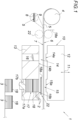
- a device 1 for carrying out the method according to the invention is shown schematically.
- This device 1 is used for stacking individual sheet metal parts 2 to form stacks of sheets 3.
- an electrical strip 5 is unwound from a coil 4, which on one of its flat sides 6 or 7 or -as in 1 shown- on both of its flat sides 6, 7 has a full-area, thermally activatable and thus curable hot-melt adhesive lacquer layer 8, 9.
- the hot-melt adhesive lacquer can have an epoxy resin base.
- the hot-melt adhesive lacquer is preferably a bisphenol-based epoxy resin system with a hardener, for example with a dicyandiamide base.
- the hot-melt adhesive lacquer mentioned can be a bisphenol-A-epichlorohydrin resin system with dicyanamide as the hardener. This two-stage curing epoxy resin system is on the electrical strip 5 in the B state. This means that the partially cross-linked hot-melt adhesive lacquer is still reactive.
- this partially crosslinked hot-melt adhesive lacquer layer 8, 9 has a thickness of a few micrometers.
- the punching tool 10 performs a cutting with several strokes 11 by its upper tool 12 with its lower tool 13 interacts.
- the punching tool 10 has a plurality of punching stages 14, 15.
- the electrical strip 5 is pre-processed for punching, after which a second stamp 15a of the second and last stamping stage 15 on the upper tool 11 stamps sheet metal parts 2 out of the electrical strip 5 and separates them.
- the punches 14a, 15a interact with the respective dies 14b, 15b of the punching stages 14, 15 on the lower tool 13.
- Such a follow-up cutting is in the 1 This can be recognized, among other things, by the fact that a part 16 is separated from the electrical steel strip 5 during the pre-processing stamping in order to prepare the electrical steel strip 5 for the sheet metal part 2 to be stamped free.
- the sheet metal parts 2 punched free with the help of the punching stage 15 are pushed into a stacking device 17 by the pressure of the upper tool 11 or the stamp 15a and stacked there.
- the stacking device 17 comprises a shaft 17a and a counter-holder 17b in the lower tool 13. This counter-holder 17b in the lower tool 13 brakes the sheet metal parts 2, whereby these sheet metal parts 2 are subjected to a physical and/or enter into a chemical connection or are joined therewith - namely with thermal activation of the hot-melt adhesive layers 8, 9 between the sheet metal parts 2.
- the stacking device 17 is actively heated.
- the laminated cores 3 can be subjected to further hardening steps, not shown, in order to further harden the bonded connection between the sheet metal parts 2 . Furthermore, there is the possibility of rotating the stacking device 17 in order, for example, to form segmented laminated cores 3 from layers with a plurality of sheet metal parts 2 arranged next to one another and stacked one on top of the other—which is also not shown.
- At least one separating element 18 is stacked with the sheet metal parts 2 .
- the separating element 18 is formed, the adhesion with the Adhesive layer 8, 9 to reduce at least one subsequent sheet metal part 2. This creates a reduced bond strength between the sheet metal parts 2 of the adjacent laminated cores 3, which facilitates the separation of the connected sheet metal parts 2 into laminated cores 3 when they leave the stacking device 17 - as in FIG 1 to recognize.
- the separating element 18 shown in an enlarged view has a flat carrier 19 or a flat substrate.
- An adhesive coating 20 is provided directly on the carrier 19, namely on a first carrier flat side 19a of its two carrier sides 19a, 19b.
- the adhesive coating 20 consists of a UV-crosslinked (UV-C) hot-melt pressure-sensitive adhesive (HMPSA) based on acrylate.
- UV-C UV-crosslinked
- HMPSA hot-melt pressure-sensitive adhesive
- a separating element 18 is distinguished for this purpose, which has a polyester film with a carrier thickness of 49.5 ⁇ m (rounded 50 ⁇ m) as the carrier 19 in order to withstand high temperatures and pressures in the stacking device 17 .
- the adhesive coating 20 has a weight per unit area of 11 g/m 2 and a first layer thickness of 14.6 ⁇ m—and can thus ensure adequate adhesion to a laminated core 3 . Accidental loosening of the Separating element 18 in the process can thus be avoided, which can further increase reproducibility.
- the separating element 18 reduces the adhesion with an adjoining sheet metal part 2 of another laminated core 3 in that a non-stick coating 21 with a silicone base is provided on the flat side 19b of the carrier opposite the flat side 19a with the adhesive coating 20 .
- this non-stick coating is a thermally crosslinked silicone coating, which has preferably been applied without solvent to the flat side 19b of the carrier.
- the silicone coating has a second layer thickness in the range of 2.4 to 2.9 ⁇ m.
- the separating element 18 thus remains attached to a laminated core 3 , whereas the separating element 18 can be separated more easily from the other laminated core 3 , which facilitates the separation of the stacked sheet metal parts 2 into laminated cores 3 .
- the device 1 also has a device 22 with which the separating element 18 is provided between two sheet metal parts 2 .
- the second punching stage 15 punches out the sheet metal part 2 together with the separating element 18—and thus brings it into a shape corresponding to the die 15.2.
- the separating element 18 can be stacked with the sheet metal parts 2 .
- the tape or sheet is fed to the punching stage 15 as required so as to provide a separator 18 of the stacker 17.
- the separating element 18 is applied to the electrical steel strip before the punching tool 10 or progressive punching tool, which is 1 has been shown in dashed lines.
Landscapes
- Engineering & Computer Science (AREA)
- Power Engineering (AREA)
- Manufacturing & Machinery (AREA)
- Mechanical Engineering (AREA)
- Laminated Bodies (AREA)
- Adhesives Or Adhesive Processes (AREA)
- Lining Or Joining Of Plastics Or The Like (AREA)
- Adhesive Tapes (AREA)
Priority Applications (8)
| Application Number | Priority Date | Filing Date | Title |
|---|---|---|---|
| EP22160359.0A EP4238766A1 (fr) | 2022-03-04 | 2022-03-04 | Procédé d'assemblage d'éléments de tôlerie en paquets de tôles et dispositif associé |
| JP2024548548A JP2025509087A (ja) | 2022-03-04 | 2023-03-03 | 板金部を接続してラミネーションスタックを形成するための方法、及び本方法を実施するためのデバイス |
| US18/843,777 US20250170814A1 (en) | 2022-03-04 | 2023-03-03 | Method for connecting sheet metal parts to form lamination stacks, and device for carrying out the method |
| CN202380022261.0A CN118742445A (zh) | 2022-03-04 | 2023-03-03 | 用于将金属板件连接成金属叠片组件的方法和执行该方法的设备 |
| EP23710256.1A EP4486568A1 (fr) | 2022-03-04 | 2023-03-03 | Procédé de liaison de tôles pour former des empilages de tôles, et dispositif pour une mise en oevre du procédé |
| KR1020247030526A KR20240162049A (ko) | 2022-03-04 | 2023-03-03 | 적층 스택들을 형성하기 위해 적층 부품들을 연결하기 위한 방법 및 방법을 실행하기 위한 디바이스 |
| PCT/EP2023/055502 WO2023166208A1 (fr) | 2022-03-04 | 2023-03-03 | Procédé de liaison de tôles pour former des empilages de tôles, et dispositif pour une mise en œuvre du procédé |
| MX2024010523A MX2024010523A (es) | 2022-03-04 | 2024-08-27 | Metodo para conectar piezas de chapa metalica para formar pilas de laminacion y dispositivo para llevar a cabo el metodo |
Applications Claiming Priority (1)
| Application Number | Priority Date | Filing Date | Title |
|---|---|---|---|
| EP22160359.0A EP4238766A1 (fr) | 2022-03-04 | 2022-03-04 | Procédé d'assemblage d'éléments de tôlerie en paquets de tôles et dispositif associé |
Publications (1)
| Publication Number | Publication Date |
|---|---|
| EP4238766A1 true EP4238766A1 (fr) | 2023-09-06 |
Family
ID=80819869
Family Applications (2)
| Application Number | Title | Priority Date | Filing Date |
|---|---|---|---|
| EP22160359.0A Withdrawn EP4238766A1 (fr) | 2022-03-04 | 2022-03-04 | Procédé d'assemblage d'éléments de tôlerie en paquets de tôles et dispositif associé |
| EP23710256.1A Pending EP4486568A1 (fr) | 2022-03-04 | 2023-03-03 | Procédé de liaison de tôles pour former des empilages de tôles, et dispositif pour une mise en oevre du procédé |
Family Applications After (1)
| Application Number | Title | Priority Date | Filing Date |
|---|---|---|---|
| EP23710256.1A Pending EP4486568A1 (fr) | 2022-03-04 | 2023-03-03 | Procédé de liaison de tôles pour former des empilages de tôles, et dispositif pour une mise en oevre du procédé |
Country Status (7)
| Country | Link |
|---|---|
| US (1) | US20250170814A1 (fr) |
| EP (2) | EP4238766A1 (fr) |
| JP (1) | JP2025509087A (fr) |
| KR (1) | KR20240162049A (fr) |
| CN (1) | CN118742445A (fr) |
| MX (1) | MX2024010523A (fr) |
| WO (1) | WO2023166208A1 (fr) |
Cited By (1)
| Publication number | Priority date | Publication date | Assignee | Title |
|---|---|---|---|---|
| EP4672285A1 (fr) * | 2024-06-26 | 2025-12-31 | Siemens Energy Global GmbH & Co. KG | Agencement de paquet de tôles |
Citations (4)
| Publication number | Priority date | Publication date | Assignee | Title |
|---|---|---|---|---|
| EP0953025A1 (fr) | 1997-11-14 | 1999-11-03 | Elf Atochem S.A. | Adhesif thermofusible a base d'un copolymere de l'ethylene et d'un (meth)acrylate d'alkyle |
| EP3089335A1 (fr) * | 2015-04-30 | 2016-11-02 | STAMPTEC-Holding GmbH | Dispositif et procédé de liaison de parties de tôles à un paquet de tôles |
| EP3316457A1 (fr) * | 2016-10-27 | 2018-05-02 | voestalpine Automotive Components Deutschland GmbH | Dispositif et procédé de liaison de parties de tôles à un paquet de tôles |
| US20200407601A1 (en) | 2019-06-27 | 2020-12-31 | Bostik Sa | Hot-melt pressure-sensitive adhesive composition based on polyurethane/(meth)acrylic |
Family Cites Families (4)
| Publication number | Priority date | Publication date | Assignee | Title |
|---|---|---|---|---|
| FR2946280B1 (fr) | 2009-06-03 | 2018-01-05 | Corso Magenta | Article en feuille pour application sur une paroi a decorer, procede de fabrication et procede d'application associes |
| FR3098520B1 (fr) | 2019-07-10 | 2022-07-22 | Bostik Sa | HMPSA réticulable sous irradiation UV |
| FR3110872B1 (fr) | 2020-05-26 | 2022-06-03 | Bostik Sa | film multicouche pour emballage refermable avec couche de polyPROPYLENE obtenu PAR CO-extrusion a plat |
| FR3110873B1 (fr) | 2020-05-26 | 2022-06-03 | Bostik Sa | film multicouche pour emballage refermable avec couche de polyethylene obtenu PAR CO-extrusion a plat |
-
2022
- 2022-03-04 EP EP22160359.0A patent/EP4238766A1/fr not_active Withdrawn
-
2023
- 2023-03-03 WO PCT/EP2023/055502 patent/WO2023166208A1/fr not_active Ceased
- 2023-03-03 CN CN202380022261.0A patent/CN118742445A/zh active Pending
- 2023-03-03 US US18/843,777 patent/US20250170814A1/en active Pending
- 2023-03-03 KR KR1020247030526A patent/KR20240162049A/ko active Pending
- 2023-03-03 EP EP23710256.1A patent/EP4486568A1/fr active Pending
- 2023-03-03 JP JP2024548548A patent/JP2025509087A/ja active Pending
-
2024
- 2024-08-27 MX MX2024010523A patent/MX2024010523A/es unknown
Patent Citations (4)
| Publication number | Priority date | Publication date | Assignee | Title |
|---|---|---|---|---|
| EP0953025A1 (fr) | 1997-11-14 | 1999-11-03 | Elf Atochem S.A. | Adhesif thermofusible a base d'un copolymere de l'ethylene et d'un (meth)acrylate d'alkyle |
| EP3089335A1 (fr) * | 2015-04-30 | 2016-11-02 | STAMPTEC-Holding GmbH | Dispositif et procédé de liaison de parties de tôles à un paquet de tôles |
| EP3316457A1 (fr) * | 2016-10-27 | 2018-05-02 | voestalpine Automotive Components Deutschland GmbH | Dispositif et procédé de liaison de parties de tôles à un paquet de tôles |
| US20200407601A1 (en) | 2019-06-27 | 2020-12-31 | Bostik Sa | Hot-melt pressure-sensitive adhesive composition based on polyurethane/(meth)acrylic |
Cited By (1)
| Publication number | Priority date | Publication date | Assignee | Title |
|---|---|---|---|---|
| EP4672285A1 (fr) * | 2024-06-26 | 2025-12-31 | Siemens Energy Global GmbH & Co. KG | Agencement de paquet de tôles |
Also Published As
| Publication number | Publication date |
|---|---|
| EP4486568A1 (fr) | 2025-01-08 |
| KR20240162049A (ko) | 2024-11-14 |
| CN118742445A (zh) | 2024-10-01 |
| MX2024010523A (es) | 2024-12-06 |
| JP2025509087A (ja) | 2025-04-11 |
| US20250170814A1 (en) | 2025-05-29 |
| WO2023166208A1 (fr) | 2023-09-07 |
Similar Documents
| Publication | Publication Date | Title |
|---|---|---|
| WO2020225444A1 (fr) | Procédé d'empilage par poinçonnage de pièces de tôle en des paquets de tôles | |
| WO2018078132A1 (fr) | Dispositif et procédé de liaison de pièces de tôle pour obtenir un noyau feuilleté | |
| EP4329167A1 (fr) | Procédé de paquetage de pièces de tôle d'une bande ou tôle électrique pour obtenir au moins un paquet de tôles | |
| EP4238766A1 (fr) | Procédé d'assemblage d'éléments de tôlerie en paquets de tôles et dispositif associé | |
| EP3167481B1 (fr) | Procédé de production d'un adaptateur de substrat, et d'interconnexion d'un élément semi-conducteur | |
| WO2018162752A1 (fr) | Dispositif et procédé de liaison de pièces de tôle pour obtenir un noyau feuilleté | |
| EP4244056B1 (fr) | Procédé de raccordement des éléments de tôle à des paquets de tôle | |
| EP4420226A1 (fr) | Procédé de production d'au moins un canal de liquide dans un noyau feuilleté et noyau feuilleté avec ledit canal de liquide | |
| EP3741033A1 (fr) | Procédé d'assemblage de pièces de tôle pour former un noyau feuilleté | |
| EP3514925A1 (fr) | Procédé d'assemblage d'éléments de tôle à des paquets de tôle | |
| WO2024089268A1 (fr) | Procédé de liaison de pièces en tôle pour former au moins un empilement de tôles | |
| DE3210647C2 (de) | Verfahren zum Kaltpressen aufeinanderliegender Metallblechscheiben | |
| EP4132789B1 (fr) | Dispositif et procédé d'assemblage de pièces en tôle en paquets de tôle | |
| WO2012027856A2 (fr) | Procédé de fabrication d'un corps métallique | |
| WO2025083291A1 (fr) | Noyau feuilleté et procédé pour assembler des pièces de tôle pour former un noyau feuilleté | |
| WO2004036969A1 (fr) | Procede et dispositif permettant de joindre au moins deux composants | |
| DE102024120952A1 (de) | Vorrichtung zur Herstellung eines Blechelements und Blechelement | |
| EP4573582A1 (fr) | Procédé d'emballage de pièces en tôle à partir d'une bande ou d'une tôle d'acier électrique pour former un noyau feuilleté | |
| EP4712320A1 (fr) | Procédé de groupage par estampage avec une étape de collage et de durcissement | |
| DE102018205767A1 (de) | Verfahren zum Verbinden wenigstens zweier Bauteile | |
| WO2019091616A1 (fr) | Procédé et dispositif pour estamper des pièces |
Legal Events
| Date | Code | Title | Description |
|---|---|---|---|
| PUAI | Public reference made under article 153(3) epc to a published international application that has entered the european phase |
Free format text: ORIGINAL CODE: 0009012 |
|
| STAA | Information on the status of an ep patent application or granted ep patent |
Free format text: STATUS: THE APPLICATION HAS BEEN PUBLISHED |
|
| AK | Designated contracting states |
Kind code of ref document: A1 Designated state(s): AL AT BE BG CH CY CZ DE DK EE ES FI FR GB GR HR HU IE IS IT LI LT LU LV MC MK MT NL NO PL PT RO RS SE SI SK SM TR |
|
| TPAC | Observations filed by third parties |
Free format text: ORIGINAL CODE: EPIDOSNTIPA |
|
| STAA | Information on the status of an ep patent application or granted ep patent |
Free format text: STATUS: REQUEST FOR EXAMINATION WAS MADE |
|
| 17P | Request for examination filed |
Effective date: 20240306 |
|
| RBV | Designated contracting states (corrected) |
Designated state(s): AL AT BE BG CH CY CZ DE DK EE ES FI FR GB GR HR HU IE IS IT LI LT LU LV MC MK MT NL NO PL PT RO RS SE SI SK SM TR |
|
| STAA | Information on the status of an ep patent application or granted ep patent |
Free format text: STATUS: THE APPLICATION IS DEEMED TO BE WITHDRAWN |
|
| 18D | Application deemed to be withdrawn |
Effective date: 20240307 |