EP4239092A1 - Aluminiumlegierung für kraftfahrzeugräder und kraftfahrzeugrad - Google Patents
Aluminiumlegierung für kraftfahrzeugräder und kraftfahrzeugrad Download PDFInfo
- Publication number
- EP4239092A1 EP4239092A1 EP21886062.5A EP21886062A EP4239092A1 EP 4239092 A1 EP4239092 A1 EP 4239092A1 EP 21886062 A EP21886062 A EP 21886062A EP 4239092 A1 EP4239092 A1 EP 4239092A1
- Authority
- EP
- European Patent Office
- Prior art keywords
- mass
- less
- aluminum alloy
- range
- particles
- Prior art date
- Legal status (The legal status is an assumption and is not a legal conclusion. Google has not performed a legal analysis and makes no representation as to the accuracy of the status listed.)
- Pending
Links
- 229910000838 Al alloy Inorganic materials 0.000 title claims abstract description 100
- 239000011856 silicon-based particle Substances 0.000 claims abstract description 50
- 229910000765 intermetallic Inorganic materials 0.000 claims abstract description 39
- 239000013078 crystal Substances 0.000 claims abstract description 25
- 239000012535 impurity Substances 0.000 claims abstract description 9
- 230000005496 eutectics Effects 0.000 claims description 26
- 239000002245 particle Substances 0.000 claims description 12
- 239000000047 product Substances 0.000 description 62
- 238000005266 casting Methods 0.000 description 44
- 230000007797 corrosion Effects 0.000 description 33
- 238000005260 corrosion Methods 0.000 description 33
- 238000005242 forging Methods 0.000 description 25
- 238000000034 method Methods 0.000 description 23
- 238000010438 heat treatment Methods 0.000 description 17
- 230000000052 comparative effect Effects 0.000 description 16
- 230000000694 effects Effects 0.000 description 14
- 238000011156 evaluation Methods 0.000 description 13
- 230000032683 aging Effects 0.000 description 11
- 229910052751 metal Inorganic materials 0.000 description 11
- 238000010791 quenching Methods 0.000 description 11
- 230000000171 quenching effect Effects 0.000 description 11
- 239000000243 solution Substances 0.000 description 11
- 229910052802 copper Inorganic materials 0.000 description 9
- 238000004519 manufacturing process Methods 0.000 description 9
- 239000002184 metal Substances 0.000 description 9
- 229910052804 chromium Inorganic materials 0.000 description 7
- 238000005520 cutting process Methods 0.000 description 7
- 229910052749 magnesium Inorganic materials 0.000 description 7
- 238000005259 measurement Methods 0.000 description 7
- 229910052710 silicon Inorganic materials 0.000 description 7
- 230000035882 stress Effects 0.000 description 7
- 229910052742 iron Inorganic materials 0.000 description 6
- 229910052748 manganese Inorganic materials 0.000 description 6
- 239000000203 mixture Substances 0.000 description 6
- 239000002244 precipitate Substances 0.000 description 6
- 239000006104 solid solution Substances 0.000 description 6
- 238000009864 tensile test Methods 0.000 description 6
- 239000012085 test solution Substances 0.000 description 6
- 239000000654 additive Substances 0.000 description 5
- 230000000996 additive effect Effects 0.000 description 5
- 230000006866 deterioration Effects 0.000 description 5
- XLYOFNOQVPJJNP-UHFFFAOYSA-N water Substances O XLYOFNOQVPJJNP-UHFFFAOYSA-N 0.000 description 5
- FAPWRFPIFSIZLT-UHFFFAOYSA-M Sodium chloride Chemical compound [Na+].[Cl-] FAPWRFPIFSIZLT-UHFFFAOYSA-M 0.000 description 4
- WGLPBDUCMAPZCE-UHFFFAOYSA-N Trioxochromium Chemical compound O=[Cr](=O)=O WGLPBDUCMAPZCE-UHFFFAOYSA-N 0.000 description 4
- 239000000956 alloy Substances 0.000 description 4
- 239000000463 material Substances 0.000 description 4
- KMUONIBRACKNSN-UHFFFAOYSA-N potassium dichromate Chemical compound [K+].[K+].[O-][Cr](=O)(=O)O[Cr]([O-])(=O)=O KMUONIBRACKNSN-UHFFFAOYSA-N 0.000 description 4
- 238000005480 shot peening Methods 0.000 description 4
- 239000006061 abrasive grain Substances 0.000 description 3
- 229910045601 alloy Inorganic materials 0.000 description 3
- 150000001875 compounds Chemical class 0.000 description 3
- 238000009749 continuous casting Methods 0.000 description 3
- 239000007788 liquid Substances 0.000 description 3
- 239000007769 metal material Substances 0.000 description 3
- 229910018125 Al-Si Inorganic materials 0.000 description 2
- 229910018191 Al—Fe—Si Inorganic materials 0.000 description 2
- 229910018473 Al—Mn—Si Inorganic materials 0.000 description 2
- 229910018520 Al—Si Inorganic materials 0.000 description 2
- 229910017827 Cu—Fe Inorganic materials 0.000 description 2
- 229910017060 Fe Cr Inorganic materials 0.000 description 2
- 229910002544 Fe-Cr Inorganic materials 0.000 description 2
- VEXZGXHMUGYJMC-UHFFFAOYSA-N Hydrochloric acid Chemical compound Cl VEXZGXHMUGYJMC-UHFFFAOYSA-N 0.000 description 2
- MHAJPDPJQMAIIY-UHFFFAOYSA-N Hydrogen peroxide Chemical compound OO MHAJPDPJQMAIIY-UHFFFAOYSA-N 0.000 description 2
- 239000007864 aqueous solution Substances 0.000 description 2
- 238000004512 die casting Methods 0.000 description 2
- 239000011159 matrix material Substances 0.000 description 2
- 150000002739 metals Chemical class 0.000 description 2
- 239000002994 raw material Substances 0.000 description 2
- 238000009774 resonance method Methods 0.000 description 2
- 238000001878 scanning electron micrograph Methods 0.000 description 2
- 239000011780 sodium chloride Substances 0.000 description 2
- 238000007711 solidification Methods 0.000 description 2
- 230000008023 solidification Effects 0.000 description 2
- 238000012360 testing method Methods 0.000 description 2
- 229910018134 Al-Mg Inorganic materials 0.000 description 1
- 229910018467 Al—Mg Inorganic materials 0.000 description 1
- 229910019819 Cr—Si Inorganic materials 0.000 description 1
- 238000005473 Guinier-Preston zone Methods 0.000 description 1
- 229910019064 Mg-Si Inorganic materials 0.000 description 1
- 229910019406 Mg—Si Inorganic materials 0.000 description 1
- 230000016571 aggressive behavior Effects 0.000 description 1
- 238000003483 aging Methods 0.000 description 1
- PNEYBMLMFCGWSK-UHFFFAOYSA-N aluminium oxide Inorganic materials [O-2].[O-2].[O-2].[Al+3].[Al+3] PNEYBMLMFCGWSK-UHFFFAOYSA-N 0.000 description 1
- 238000004458 analytical method Methods 0.000 description 1
- 238000010273 cold forging Methods 0.000 description 1
- 238000011109 contamination Methods 0.000 description 1
- 238000005336 cracking Methods 0.000 description 1
- 238000002425 crystallisation Methods 0.000 description 1
- 230000008025 crystallization Effects 0.000 description 1
- 230000002542 deteriorative effect Effects 0.000 description 1
- 238000001035 drying Methods 0.000 description 1
- 238000000921 elemental analysis Methods 0.000 description 1
- -1 for example Substances 0.000 description 1
- 239000000446 fuel Substances 0.000 description 1
- 238000007654 immersion Methods 0.000 description 1
- 238000003754 machining Methods 0.000 description 1
- 230000013011 mating Effects 0.000 description 1
- 238000002156 mixing Methods 0.000 description 1
- 238000012986 modification Methods 0.000 description 1
- 230000004048 modification Effects 0.000 description 1
- 229910052759 nickel Inorganic materials 0.000 description 1
- 230000003287 optical effect Effects 0.000 description 1
- 238000011160 research Methods 0.000 description 1
- 238000005096 rolling process Methods 0.000 description 1
- 238000005204 segregation Methods 0.000 description 1
- 239000010935 stainless steel Substances 0.000 description 1
- 229910001220 stainless steel Inorganic materials 0.000 description 1
- 229910052719 titanium Inorganic materials 0.000 description 1
- 229910052725 zinc Inorganic materials 0.000 description 1
- 229910052726 zirconium Inorganic materials 0.000 description 1
Images

Classifications
-
- C—CHEMISTRY; METALLURGY
- C22—METALLURGY; FERROUS OR NON-FERROUS ALLOYS; TREATMENT OF ALLOYS OR NON-FERROUS METALS
- C22C—ALLOYS
- C22C21/00—Alloys based on aluminium
- C22C21/02—Alloys based on aluminium with silicon as the next major constituent
-
- C—CHEMISTRY; METALLURGY
- C22—METALLURGY; FERROUS OR NON-FERROUS ALLOYS; TREATMENT OF ALLOYS OR NON-FERROUS METALS
- C22F—CHANGING THE PHYSICAL STRUCTURE OF NON-FERROUS METALS AND NON-FERROUS ALLOYS
- C22F1/00—Changing the physical structure of non-ferrous metals or alloys by heat treatment or by hot or cold working
- C22F1/04—Changing the physical structure of non-ferrous metals or alloys by heat treatment or by hot or cold working of aluminium or alloys based thereon
- C22F1/043—Changing the physical structure of non-ferrous metals or alloys by heat treatment or by hot or cold working of aluminium or alloys based thereon of alloys with silicon as the next major constituent
Definitions
- the present invention relates to an aluminum alloy for automobile wheels, and an automobile wheel.
- the material of the wheel have a high specific strength, which is the ratio of strength to weight.
- Aluminum alloys are used as materials for automobile wheels that have a large non-strength ratio.
- Al-Mg-based aluminum alloys and Al-Si-based aluminum alloys are used as aluminum alloys.
- a die casting method and a forging method are used as methods for manufacturing automobile wheels using aluminum alloys.
- various metallic elements have been added to aluminum alloys, and manufacturing methods such as a die casting method and a forging method have been selected (Patent Documents 1 and 2).
- automobile wheels be resistant to breaking when impact is applied, that is, have high tensile strength and elongation.
- the automobile wheels In order to exert the clipping force of the tire, it is preferable that the automobile wheels not be easily deformed, that is, have a large modulus of longitudinal elasticity (Young's modulus).
- the automobile wheels be resistant to corrosion by water such as rainwater, that is, be excellent in corrosion resistance.
- tensile properties such as tensile strength and elongation, modulus of longitudinal elasticity, and corrosion resistance in a well-balanced manner. For example, when certain metallic elements are added to improve tensile properties such as tensile strength and elongation of the wheel, properties such as modulus of longitudinal elasticity and corrosion resistance will deteriorate.
- the present invention has been made in view of the above-mentioned technical background, and an object of the present invention is to provide an aluminum alloy for automobile wheels and an automobile wheel having improved tensile properties, modulus of longitudinal elasticity, and corrosion resistance.
- the present inventors have conducted intensive research, found that tensile properties, modulus of longitudinal elasticity, and corrosion resistance are improved by adding Cu, Mg, Mn, Fe, and Cr in specific amounts to an Al-Si-based aluminum alloy, and by suppressing the contamination of coarse Cu-containing crystallized products, coarse Cr-containing intermetallic compounds formed of two or more types of metals, and coarse primary crystal Si particles, and completed the present invention.
- a first aspect of the present invention provides an aluminum alloy described in [1] below.
- an aluminum alloy for automobile wheels and an automobile wheel having improved tensile properties, modulus of longitudinal elasticity, and corrosion resistance.
- the aluminum alloy for automobile wheels of the present embodiment contains Si in a range of 8.5% by mass or more and 10.5% by mass or less, Cu in a range of 0.8% by mass or more and 1.1% by mass or less, Mg in a range of 0.4% by mass or more and 0.6% by mass or less, Mn in a range of 0.30% by mass or more and 0.60% by mass or less, Fe in a range of 0.10% by mass or more and 0.30% by mass or less, Cr in a range of 0.01% by mass or more and 0.03% by mass or less, and balance Al with inevitable impurities.
- the aluminum alloy for wheels of the present embodiment does not contain, per 1182 ⁇ m 2 , two or more crystallized products containing 1% by mass or more of Cu and having a circle equivalent diameter exceeding 5 ⁇ m, and the aluminum alloy does not contain, per 1182 ⁇ m 2 , two or more Cr-containing intermetallic compounds having a length of 8 ⁇ m or more, and does not contain, per 4726 ⁇ m 2 , two or more primary crystal Si particles having a circle equivalent diameter exceeding 10 ⁇ m.
- an average particle size of eutectic Si particles may be in a range of 0.5 ⁇ m or more and 4 ⁇ m or less, and an area ratio of the eutectic Si particles may be 8% or more.
- the aluminum alloy for wheels of the present embodiment may have a tensile strength within a range of 330 MPa or more and 380 MPa or less, and an elongation within a range of 8% or more and 12% or less.
- the aluminum alloy for wheels of the present embodiment may have a modulus of longitudinal elasticity of 77 GPa or more.
- the corrosion resistance of the aluminum alloy for wheels of the present embodiment may be less than 1 mm as a corrosion progress depth when immersed in a test solution at a liquid temperature of 90°C for 10 hours under a stress of 70% of 0.2% proof stress.
- Si (component) has the effect of improving the tensile strength and modulus of longitudinal elasticity of the aluminum alloy.
- Si is excessively added to the aluminum alloy, there is a concern of decrease in the elongation of the aluminum alloy due to the crystallization of coarse primary crystal Si particles.
- the Si content is in a range of 8.0% by mass or more and 11.5% by mass or less.
- the Si content is preferably in a range of 8.3% by mass or more and 11.3% by mass or less, more preferably in a range of 8.5% by mass or more and 11.0% by mass or less, and even more preferably in a range of 9.0% by mass or more and 10.0% by mass or less.
- any Si content can be selected as long as the content is within the above range.
- the content may be 8.00% by mass to 11.50% by mass, 8.10% by mass to 11.30% by mass, 8.30% by mass to 11.00% by mass, 8.50% by mass to 10.50% by mass, 8.70% by mass to 10.30% by mass, 8.90% by mass to 10.00% by mass, 9.20% by mass to 9.80% by mass, or 9.40% by mass to 9.60% by mass.
- Cu has the effect of improving the tensile strength of the aluminum alloy.
- Cu forms a G. P. zone in aluminum alloys.
- This Guinier-Preston zone (G. P. zone) is an intermediate phase, which contributes to the improvement of the tensile strength of the aluminum alloy.
- a G. P. zone is an aggregate of solute atoms that appears in a matrix phase during aging of an age hardening alloy.
- the Cu content is in a range of 0.7% by mass or more and 1.2% by mass or less.
- the Cu content is preferably in a range of 0.8% by mass or more and 1.1% by mass or less, and more preferably in a range of 0.9% by mass or more and 1.0% by mass or less.
- Any Cu content can be selected as long as the content is within the above range.
- the content may be 0.80% by mass to 1.10% by mass, 0.85% by mass to 1.05% by mass, 0.90% by mass to 1.00% by mass, or 0.93% by mass to 0.98% by mass.
- Mg (component) has the effect of improving the tensile strength of the aluminum alloy similarly to Cu.
- Mg forms compounds containing Si and/or Cu in aluminum alloys. This compound precipitates as a Q phase, thereby contributing to the improvement of the tensile strength of the aluminum alloy.
- the Mg content is set to be in a range of 0.2% by mass or more and 0.6% by mass or less.
- the Mg content is preferably in a range of 0.4% by mass or more and 0.6% by mass or less, and more preferably in a range of 0.45% by mass or more and 0.55% by mass or less.
- Any Mg content can be selected as long as the content is within the above range.
- the content may be 0.40% by mass to 0.60% by mass, 0.43% by mass to 0.58% by mass, or 0.47% by mass to 0.53% by mass.
- Mn (component) has the effect of improving the tensile strength of the aluminum alloy.
- Mn forms fine granular crystallized products containing Al-Mn-Si intermetallic compounds and the like in aluminum alloys, thereby contributing to the improvement of the tensile strength of aluminum alloy.
- the Mn content is in the range of 0.30% by mass or more and 0.60% by mass or less.
- the Mn content is preferably in a range of 0.35% by mass or more and 0.55% by mass or less. Any Mn content can be selected as long as the content is within the above range.
- the content may be 0.38% by mass to 0.53% by mass, 0.40% by mass to 0.50% by mass, or 0.43% by mass to 0.47% by mass.
- Fe (component) has the effect of improving the tensile strength of the aluminum alloy. Fe crystallizes in the aluminum alloy as fine crystallized products including Al-Fe-Si intermetallic compounds, Al-Cu-Fe intermetallic compounds, Al-Mn-Fe intermetallic compounds, and the like, thereby contributing to the improvement of the mechanical properties of the aluminum alloys.
- the Fe content is in the range of 0.10% by mass or more and 0.30% by mass or less.
- the Fe content is preferably in a range of 0.15% by mass or more and 0.25% by mass or less. Any Fe content can be selected as long as the content is within the above range.
- the content may be 0.13% by mass to 0.27% by mass, or 0.17% by mass to 0.20% by mass.
- Cr (component) has the effect of improving the mechanical properties of the aluminum alloy. Cr crystallizes in the aluminum alloy as fine Cr-containing intermetallic compounds including Al-Fe-Cr intermetallic compounds and the like, thereby contributing to the improvement of the mechanical properties of the aluminum alloy.
- the Cr content is in the range of 0.01% by mass or more and 0.03% by mass or less.
- the Cr content is preferably in a range of 0.015% by mass or more and 0.02% by mass or less. Any Cr content can be selected as long as the content is within the above range.
- the content may be 0.013% by mass to 0.028% by mass, 0.018% by mass to 0.026% by mass, or 0.020% by mass to 0.024% by mass.
- the inevitable impurities are impurities that are inevitably mixed into the aluminum alloy from the raw material of the aluminum alloy or from the manufacturing process.
- the mixed amount of each of the elements Zn, Ni, Zr, and Ti preferably does not exceed 0.5% by mass in terms of the total content of each of these elements.
- the total content of each of the above elements exceeds 0.5% by mass, there is a concern of each element crystallizing before the an Al matrix phase and forming coarse crystallized products, thereby reducing the ductility of the aluminum alloy and deteriorating tensile strength and elongation. Any amount of inevitable impurities can be selected as long as the content is within the above range.
- the amount may be less than 0.50% by mass, 0.40% by mass or less, 0.30% by mass or less, 0.20% by mass or less, 0.10% by mass or less, 0.05% by mass or less, 0.01% by mass or less, or 0.001% by mass or less.
- the circle equivalent diameter of the Cu-based crystallized products containing 1 % by mass or more of Cu exceeds 5 ⁇ m, there is a concern of deterioration of the tensile strength and elongation of the aluminum alloy. Therefore, in the present embodiment, two or more coarse Cu-based crystallized products having a circle equivalent diameter exceeding 5 ⁇ m are not contained per 1182 ⁇ m 2 .
- the number of coarse Cu-based crystallized products per 1182 ⁇ m 2 is preferably one or less, and more preferably, no coarse Cu-based crystallized products are contained.
- the maximum circle equivalent diameter of the Cu-based crystallized products contained in the aluminum alloy is preferably 3 ⁇ m or less, and more preferably 1 ⁇ m or less.
- the crystallized products include, but are not limited to, Al-Cu-Mg-Si.
- a Cr-containing intermetallic compound having a length of 8 ⁇ m or more there is a concern of deterioration of the tensile strength and elongation of the aluminum alloy. Therefore, in the present embodiment, two or more coarse Cr-containing intermetallic compounds having a length of 8 ⁇ m or more are not contained per 1182 ⁇ m 2 .
- the number of coarse Cr-containing intermetallic compounds per 1182 ⁇ m 2 is preferably one or less, and more preferably, no coarse Cr-containing intermetallic compounds are contained.
- the maximum length of the Cr-containing intermetallic compound contained in the aluminum alloy is preferably 6 ⁇ m or less, and more preferably 4 ⁇ m or less.
- the length and the number of the Cr-containing intermetallic compounds can be measured by detecting the Cr-containing intermetallic compounds by using FE-SEM/EDS for a range of 1182 ⁇ m 2 of the cross section of the aluminum alloy, and by measuring the length and the number of the detected Cr-containing intermetallic compounds using SEM images.
- the intermetallic compounds include, but are not limited to, Al-Cr-Si.
- the difference between the Cr-containing intermetallic compound and the Cu-based crystallized product is the shape of the intermetallic compound, or the like.
- coarse primary crystal Si particles having a circle equivalent diameter exceeding 10 ⁇ m there is a concern of deterioration of the elongation of the aluminum alloy. Therefore, in the present embodiment, it is set that two or more coarse primary crystal Si particles having a circle equivalent diameter exceeding 10 ⁇ m are not contained per 4726 ⁇ m 2 .
- the number of coarse primary crystal Si particles is preferably one or less, and more preferably, no coarse primary crystal Si particles are contained.
- the maximum circle equivalent diameter of the primary crystal Si particles contained in the aluminum alloy is preferably 8 ⁇ m or less, and more preferably 4 ⁇ m or less.
- the average particle size of the eutectic Si particles is less than 0.5 ⁇ m, there is a concern of insufficient wear resistance.
- the average particle size of the eutectic Si particles exceeds 4 ⁇ m, the wear resistance is excessive, and there is a concern of increase in the aggression against the mating member (for example, tire and shaft). Therefore, in the present embodiment, the average particle size of the eutectic Si particles is in the range of 0.5 ⁇ m or more and 4 ⁇ m or less. Further, the average particle size is the average value of the circle equivalent diameters of the observed eutectic Si particles.
- the area ratio of the eutectic Si particles is set to 8% or more.
- the area ratio of the eutectic Si particles may be 15% or less.
- the area ratio of the eutectic Si particles may be 8.0 to 15.0%, 9.0 to 14.0%, 10.0 to 13.0%, or 11.0 to 12.0%.
- the average particle size and the area ratio of the eutectic Si particles can be measured by observation using FE-SEM/EDS for a range of 4726 ⁇ m 2 of the cross section of the aluminum alloy in the same manner as in the case of obtaining the circle equivalent diameter of the primary crystal Si particles.
- the area ratio of the eutectic Si particles is the ratio of the total area of the observed eutectic Si particles to the area of the observed cross section.
- the aluminum alloy for wheels of the present embodiment may have a tensile strength in the range of 330 MPa or more and 380 MPa or less at 25°C. Further, the elongation at 25°C may be in the range of 8% or more and 12% or less.
- Tensile strength and elongation are values measured in accordance with the provisions of JIS Z2241:2011 (metal material tensile test method) using a JIS No. 4 tensile test piece.
- the tensile strength may be 340 MPa or more and 370 MPa or less, or 350 MPa or more and 360 MPa or less.
- the elongation may be 8.5% or more and 11.5% or less, or 9.0% or more and 11.0% or less.
- the aluminum alloy for wheels of the present embodiment may have a modulus of longitudinal elasticity (Young's modulus) of 77 GPa or more at 25°C.
- the modulus of longitudinal elasticity may be 85 GPa or less.
- the modulus of longitudinal elasticity is a value obtained by a method of measuring the resonance frequency (eigenfrequency) by applying mechanical or electrical forced vibration to the test piece for modulus of longitudinal elasticity measurement, and calculating the modulus of longitudinal elasticity from this resonance frequency (resonance method).
- the modulus of longitudinal elasticity may be, for example, 77.0 GPa or more and 85.0 GPa or less, 78.0 GPa or more and 84.0 GPa or less, 79.0 GPa or more and 83.0 GPa or less, or 80.0 GPa or more and 82.0 GPa or less.
- the corrosion progress depth of the aluminum alloy for wheels of the present embodiment may be less than 1 mm when immersed in a test solution at a liquid temperature of 90°C for 10 hours under a stress of 70% of 0.2% proof stress.
- the test solution is an aqueous solution having a potassium dichromate concentration of 3% by mass, a chromic anhydride concentration of 3.6% by mass, and a sodium chloride concentration of 0.3% by mass.
- the automobile wheel of the present embodiment is made of the above-described aluminum alloy for wheels of the present embodiment. That is, in the wheel of the present embodiment, the content of each additive element such as Si, Cu, Mg, Mn, Fe, and Cr is equivalent to that of the aluminum alloy for wheels of the above-described present embodiment. In addition, in the wheel of the present embodiment, the content of precipitates such as crystallized products containing 1% by mass or more of Cu, Cr-containing intermetallic compounds, primary crystal Si particles, and eutectic Si particles is equivalent to that of the aluminum alloy for wheels of the above-described embodiment.
- the automobile wheel of the present embodiment may be a forged product.
- FIG. 1 is a flowchart showing a method for manufacturing an automobile wheel according to one embodiment of the present invention.
- the method for manufacturing a wheel of the present embodiment includes a molten metal forming step S01 for obtaining a molten aluminum alloy, a casting step S02 for obtaining a casting by casting the molten metal, and a forging step S05 for obtaining a forged product by forging the casting.
- a homogenizing heat treatment step S03 and a cutting step S04 may be performed between the casting step S02 and the forging step S05.
- a solution treatment step S06, a quenching step S07, an aging treatment step S08, and a shot peening step S09 may be performed.
- a molten aluminum alloy is obtained by mixing the raw materials of Al source, Si source, Cu source, Mg source, Mn source, Fe source, and Cr source to have a composition that forms the above alloy, and heating and dissolving the obtained mixture at optionally selected temperature.
- Each of Al source, Si source, Cu source, Mg source, Mn source, Fe source, and Cr source may be a single metal material, or may be an alloy material containing two or more metals. Any temperature can be chosen as a temperature used to form the molten metal.
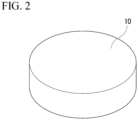
- FIG. 2 is a perspective view showing an example of the aluminum alloy (casting) obtained in the casting step S02.
- the casting method is not particularly limited.
- known methods that have been conventionally used as aluminum alloy casting methods such as a continuous casting and rolling method, a hot top casting method, a float casting method, and a semi-continuous casting method (DC casting method) can be used. Due to this casting step, Mn forms fine granular crystallized products containing Al-Mn-Si intermetallic compounds.
- Fe forms fine crystallized products such as Al-Fe-Si intermetallic compounds, Al-Cu-Fe intermetallic compounds, and Al-Mn-Fe intermetallic compounds.
- Cr forms crystallized products as fine Cr-containing intermetallic compounds such as Al-Fe-Cr intermetallic compounds.
- the cylindrical casting 10 obtained in the casting step S02 is subjected to homogenizing heat treatment.
- This homogenizing heat treatment eliminates the segregation of the additive elements that occurs during casting, homogenizes the composition, precipitates the supersaturated solid solution generated by solidification during casting, and further, changes a metastable phase formed by solidification during casting to an equilibrium phase.
- Any temperature can be selected as the heating temperature in the homogenizing heat treatment, but is, for example, within a range of 420°C or higher and 500°C or lower. If necessary, the temperature may be 430°C or higher and 480°C or lower, or 440°C or higher and 460°C or lower.
- the cylindrical casting 10 subjected to the homogenizing heat treatment in the homogenizing heat treatment step S03 is cut into a predetermined size to obtain a casting which is used for forging. That is, in the cutting step S04, a casting which is used for forging is obtained by cutting the casting 10 along a plane.
- the forging step S05 forging is performed on the casting which is used for forging obtained in the cutting step S04 to obtain a forged product (second casting; automobile wheel) of a desired shape.
- the forging method may be hot forging or cold forging.
- the heating temperature in hot forging is, for example, within a range of 350°C or higher and 450°C or lower. If necessary, the temperature may be 370°C or higher and 430°C or lower, or 390°C or higher and 420°C or lower.
- the forged product obtained in the forging step S05 is subjected to solution treatment.
- elements such as Si, Cu, and Mg in the forged product are redissolved in the aluminum alloy to form a solid solution state.
- Any temperature can be selected as the heating temperature in the solution treatment, but is, for example, within a range of 450°C or higher and 540°C or lower. If necessary, the temperature may be 470°C or higher and 530°C or lower, or 490°C or higher and 510°C or lower.
- the quenching step S07 the forged product that has been put into a solid solution state in the solution treatment step S06 is quenched.
- This quenching treatment rapidly cools the forged product to form a supersaturated solid solution in which the solid solution state is maintained.
- forging step S05 when the forging is performed by hot forging, forging and quenching, in which quenching is performed as it is after forging, may be performed by utilizing the heating during hot forging without performing the solution treatment step S06.
- quenching treatment include water quenching.
- the forged product made into a supersaturated solid solution in the quenching treatment step S07 is subjected to aging treatment.
- the forged product is tempered at a low temperature. Due to this aging treatment, clusters are generated in the aluminum alloy that forms the forged product, and Cu is precipitated from these clusters as nuclei to form a G. P. zone. Moreover, Mg forms a compound with Si or Cu and precipitates as a Q phase.
- Any temperature can be selected as the heating temperature in the aging treatment, but is, for example, within a range of 150°C or higher and 220°C or lower. If necessary, the temperature may be 170°C or higher and 200°C or lower, or 180°C or higher and 190°C or lower.
- Any time can be selected as the heating time, but examples thereof include 0.5 hours to 20 hours and 1 hour to 16 hours.
- the forged product subjected to the aging treatment in the aging treatment step S08 is cut by machining and then shot peened to apply plastic working in the vicinity of the surface to improve the fatigue strength.
- the size of the abrasive grains used in shot peening, in which the abrasive grains collide with the alloy surface at high speed, is preferably 1 mm or less.
- a material for the abrasive grains for example, stainless steel (for example, SUS304), alumina, or the like can be used.
- the peening pressure is preferably 1 MPa or less.
- An automobile wheel (forged product) can be manufactured by the manufacturing method described above.
- the aluminum alloy for automobile wheels of the present embodiment having the above configuration contains each additive element of Si, Cu, Mg, Mn, Fe, and Cr within the above range, and balance Al with inevitable impurities, the aluminum alloy does not contain, per 1182 ⁇ m 2 , two or more crystallized products containing 1% by mass or more of Cu and having a circle equivalent diameter exceeding 5 ⁇ m, the aluminum alloy does not contain, per 1182 ⁇ m 2 , two or more Cr-containing intermetallic compounds having a length of 8 ⁇ m or more, and the aluminum alloy does not contain, per 4726 ⁇ m 2 , two or more primary crystal Si particles having a circle equivalent diameter exceeding 10 ⁇ m. Therefore, properties such as tensile properties, modulus of longitudinal elasticity, and corrosion resistance are improved.
- an average particle size of eutectic Si particles is in the range of 0.5 ⁇ m or more and 4 ⁇ m or less, and an area ratio of the eutectic Si particles is 8% or more, the tensile properties and the modulus of longitudinal elasticity are more reliably improved.
- an automobile wheel of the present embodiment is formed of the aluminum alloy for wheels described above, properties such as tensile properties, modulus of longitudinal elasticity, and corrosion resistance are improved.
- a molten aluminum alloy containing 10.0% by mass Si, 0.9% by mass Cu, 0.3% by mass Mg, 0.5% by mass Mn, 0.02% by mass Cr, 0.20% by mass Fe, and the balance Al was formed.
- the obtained molten metal was subjected to continuous casting to obtain a cylindrical casting (first casting) having a diameter of 76 mm and a height of 1000 mm.
- the obtained casting was subjected to homogenizing heat treatment, and then the casting was air-cooled. The casting was then cut to a height of 75 mm to obtain a casting which is used for forging.
- the obtained casting was subjected to hot forging to obtain a wheel-shaped forged product (second casting).
- the obtained forged product was subjected to solution treatment and then to water quenching.
- the casting after the water quenching treatment was subjected to the aging treatment to obtain a forged product for wheels.
- Example 1 A forged product for wheels was obtained in the same manner as in Example 1, except that the contents of Si, Cu, Mg, Mn, Cr, and Fe in the aluminum alloy were changed to the proportions shown in Table 1.
- Table 1 Composition of aluminum alloy (% by mass) Si Cu Mg Mn Cr Fe Al
- Example 1 10.0 0.9 0.3 0.5 0.02 0.20 balance
- Example 2 11.5 1.2 0.6 0.6 0.03 0.28 balance
- Example 3 8.2 0.7 0.2 0.3 0.01 0.12 balance
- Comparative Example 6 9.9 1.0 1.0 0.5 0.02 0.20 balance
- Comparative Example 7 10.0 0.9 0.3 0.01 0.02 0.20 balance
- the contents of the elements Si, Cu, Mg, Mn, Cr, and Fe in the forged product for wheels were measured as follows.
- the forged product for wheels are dissolved using hydrochloric acid and hydrogen peroxide.
- the content of each element in the resulting solution is measured using an ICP emission spectrometer, and the measured value is converted to the content of each element in the forged product.
- the structure of the forged product for wheels was observed as follows.
- a forged product for wheels was cut into a size of 2 ⁇ 5 ⁇ 10 mm to prepare an observation sample.
- a surface parallel to a forging direction of the observation sample was machined as an observation surface.
- the observation surface of the observation sample was observed using FE-SEM/EDS at a magnification of 3000 times.
- the circle equivalent diameter of the Cu-based crystallized products was calculated, and "the number of Cu-based crystallized products having a circle equivalent diameter exceeding 5 ⁇ m" and "the maximum circle equivalent diameter” were obtained.
- the length of the Cr-containing intermetallic compound was calculated, and "the number of Cr-containing intermetallic compounds having a length of 8 ⁇ m or more" and "maximum length" were obtained.
- the circle equivalent diameters of the primary crystal Si particles were calculated, and "the number of primary crystal Si particles having a circle equivalent diameter exceeding 10 ⁇ m" and "the maximum circle equivalent diameter” were obtained.
- For the eutectic Si particles 150 particle sizes were measured, the “average particle size” was calculated, and the "area ratio", which is the occupancy rate of the eutectic Si particles in the observation field, was obtained.
- Corrosion resistance of the forged products for wheels was evaluated by stress corrosion cracking (SCC) testing.
- a forged product for wheels is cut into a size of 4 ⁇ 2 ⁇ 45 mm to prepare a corrosion resistance evaluation sample.
- the corrosion resistance evaluation sample is bent at three points using a strain gauge such that a stress equivalent to 70% of the 0.2% proof stress measured in advance is applied.
- a corrosion resistance evaluation sample that has been bent at three points is immersed in a test solution (an aqueous solution with potassium dichromate concentration of 3% by mass, chromic anhydride concentration of 3.6% by mass, and sodium chloride concentration of 0.3% by mass) at a liquid temperature of 90°C for 10 hours. After immersion, the corrosion resistance evaluation sample is taken out from the test solution, washed with water, and then dried. The corrosion resistance evaluation sample after drying is observed using an optical microscope to determine the presence or absence of cracks, and if no cracks are present, the corrosion progress depth is measured.
- Table 2 shows the measurement results.
- the corrosion resistance was evaluated as “ ⁇ (acceptable)” when the maximum corrosion progress depth was less than 1 mm, and “ ⁇ (not acceptable)” when the maximum corrosion progress depth was 1 mm or more.
- the tensile strength and elongation of the forged products for wheels were measured as follows.
- a forged product for wheels was cut into a size of 10 ⁇ 10 ⁇ 70 mm to prepare a JIS No. 14A tensile test piece.
- a tensile test was performed on the obtained JIS No. 14A tensile test piece in accordance with the provisions of JIS Z2241:2011 (metal material tensile test method), and the tensile strength (MPa) and breaking elongation (%) at 25°C were measured.
- Table 2 shows the measurement results.
- Table 2 in the evaluation of tensile properties, the case where a tensile strength was 330 MPa or more and a breaking elongation was 8% or more was indicated as " ⁇ (acceptable)", and the case where a tensile strength was less than 330 MPa or an elongation was less than 8% was indicated as " ⁇ (not acceptable).”
- the modulus of longitudinal elasticity of the forged products for wheels was measured as follows.
- a forget product for wheels is cut into a predetermined size to prepare a longitudinal elasticity evaluation sample.
- a modulus of longitudinal elasticity (GPa) at 25°C is measured using a resonance method on the longitudinal elasticity evaluation sample.
- Table 2 shows the measurement results.
- the modulus of longitudinal elasticity was evaluated as " ⁇ (acceptable)” when the modulus of longitudinal elasticity was 77 GPa or more, and “ ⁇ (not acceptable)” when the modulus of longitudinal elasticity was lower than 77 GPa.
- an aluminum alloy for automobile wheels and an automobile wheel having improved tensile properties, modulus of longitudinal elasticity, and corrosion resistance.
- the automobile wheel according to the present invention has high tensile strength and elongation, and thus, it is less likely to break when impact is applied.
- the automobile wheel according to the present invention has a large modulus of longitudinal elasticity and is not easily deformed, and thus, the clipping force of the tire can be exerted.
- the automobile wheel according to the present invention is excellent in rain corrosion resistance, and thus, it can be used for a long period of time.
Landscapes
- Chemical & Material Sciences (AREA)
- Engineering & Computer Science (AREA)
- Materials Engineering (AREA)
- Mechanical Engineering (AREA)
- Metallurgy (AREA)
- Organic Chemistry (AREA)
- Physics & Mathematics (AREA)
- Thermal Sciences (AREA)
- Crystallography & Structural Chemistry (AREA)
- Forging (AREA)
Applications Claiming Priority (2)
| Application Number | Priority Date | Filing Date | Title |
|---|---|---|---|
| JP2020182091A JP7669663B2 (ja) | 2020-10-30 | 2020-10-30 | 自動車のホイール用アルミニウム合金及び自動車のホイール |
| PCT/JP2021/038965 WO2022091944A1 (ja) | 2020-10-30 | 2021-10-21 | 自動車のホイール用アルミニウム合金及び自動車のホイール |
Publications (2)
| Publication Number | Publication Date |
|---|---|
| EP4239092A1 true EP4239092A1 (de) | 2023-09-06 |
| EP4239092A4 EP4239092A4 (de) | 2024-09-11 |
Family
ID=81382403
Family Applications (1)
| Application Number | Title | Priority Date | Filing Date |
|---|---|---|---|
| EP21886062.5A Pending EP4239092A4 (de) | 2020-10-30 | 2021-10-21 | Aluminiumlegierung für kraftfahrzeugräder und kraftfahrzeugrad |
Country Status (5)
| Country | Link |
|---|---|
| US (1) | US20230416878A1 (de) |
| EP (1) | EP4239092A4 (de) |
| JP (1) | JP7669663B2 (de) |
| CN (1) | CN116324009A (de) |
| WO (1) | WO2022091944A1 (de) |
Families Citing this family (1)
| Publication number | Priority date | Publication date | Assignee | Title |
|---|---|---|---|---|
| CN115637343A (zh) * | 2022-11-08 | 2023-01-24 | 马鞍山市三川机械制造有限公司 | 一种降低铸造铝合金汽车轮毂废品率的生产方法 |
Family Cites Families (13)
| Publication number | Priority date | Publication date | Assignee | Title |
|---|---|---|---|---|
| JP3982849B2 (ja) * | 1995-11-02 | 2007-09-26 | 住友軽金属工業株式会社 | 鍛造用アルミニウム合金 |
| JPH10298689A (ja) * | 1997-04-23 | 1998-11-10 | Hitachi Metals Ltd | 高靱性アルミニウム合金ダイカスト |
| JP2006336044A (ja) | 2005-05-31 | 2006-12-14 | Hitachi Metals Ltd | アルミニウム合金鋳物及びその製造方法 |
| JP4982159B2 (ja) | 2006-11-16 | 2012-07-25 | 三協マテリアル株式会社 | アルミニウム合金ビレット |
| KR101362645B1 (ko) * | 2009-07-03 | 2014-02-12 | 쇼와 덴코 가부시키가이샤 | 엔진 피스톤용 소형재의 제조 방법 |
| CN102268577A (zh) | 2011-07-09 | 2011-12-07 | 浙江巨科铝业有限公司 | 一种汽车轮毂用铸造铝合金材料 |
| CN106255770A (zh) | 2015-04-15 | 2016-12-21 | 株式会社大纪铝工业所 | 压铸用铝合金以及使用该铝合金的铝合金压铸件 |
| JP2017039986A (ja) | 2015-08-21 | 2017-02-23 | 日立金属株式会社 | アルミニウム合金製車両用ホイール |
| CN108251715A (zh) * | 2018-02-08 | 2018-07-06 | 山东弗泽瑞金属科技有限公司 | 适用于真空低速压铸方法的铝合金材料 |
| JP7096690B2 (ja) | 2018-03-29 | 2022-07-06 | 株式会社豊田中央研究所 | ダイカスト鋳造用アルミニウム合金およびアルミニウム合金鋳物 |
| JP2020100863A (ja) * | 2018-12-21 | 2020-07-02 | 昭和電工株式会社 | コンプレッサー摺動部品用アルミニウム合金、コンプレッサー摺動部品鍛造品およびその製造方法 |
| JP6942151B2 (ja) * | 2019-02-06 | 2021-09-29 | Bbsジャパン株式会社 | アルミニウム合金鍛造ホイール及びその製造方法 |
| JP7347955B2 (ja) | 2019-04-24 | 2023-09-20 | 太陽誘電株式会社 | 弾性波デバイスおよびその製造方法、フィルタおよびマルチプレクサ |
-
2020
- 2020-10-30 JP JP2020182091A patent/JP7669663B2/ja active Active
-
2021
- 2021-10-21 CN CN202180071468.8A patent/CN116324009A/zh active Pending
- 2021-10-21 WO PCT/JP2021/038965 patent/WO2022091944A1/ja not_active Ceased
- 2021-10-21 EP EP21886062.5A patent/EP4239092A4/de active Pending
- 2021-10-21 US US18/033,880 patent/US20230416878A1/en active Pending
Also Published As
| Publication number | Publication date |
|---|---|
| JP2022072574A (ja) | 2022-05-17 |
| EP4239092A4 (de) | 2024-09-11 |
| JP7669663B2 (ja) | 2025-04-30 |
| CN116324009A (zh) | 2023-06-23 |
| US20230416878A1 (en) | 2023-12-28 |
| WO2022091944A1 (ja) | 2022-05-05 |
Similar Documents
| Publication | Publication Date | Title |
|---|---|---|
| EP2811042B1 (de) | Geschmiedetes aluminiumlegierungsmaterial und herstellungsverfahren dafür | |
| JP6792618B2 (ja) | 高強度6xxxアルミニウム合金及びその作製方法 | |
| EP3728666B1 (de) | 6xxx aluminiumlegierung extrudiertes schmiedevormaterial und verfahren zu seiner herstellung | |
| JP3684313B2 (ja) | 自動車のサスペンション部品用高強度高靱性アルミニウム合金鍛造材 | |
| EP3124633B1 (de) | Federungsteil und verfahren zur herstellung davon | |
| EP1778887B1 (de) | Al-si-mg-zn-cu-legierung für gussteile für luft- und raumfahrt und kraftfahrzeuge | |
| US20120261034A1 (en) | Method of creating a cast automotive product having an improved critical fracture strain | |
| EP2878692A1 (de) | Produkte aus einer hochfesten Legierung auf Aluminiumbasis und Verfahren zur Herstellung davon | |
| EP4141136A1 (de) | Magnesiumlegierung, magnesiumlegierungsplatte, magnesiumlegierungsstange, herstellungsverfahren dafür und magnesiumlegierungselement | |
| KR20150132604A (ko) | 고온 특성이 우수한 알루미늄 합금 | |
| CN121065544A (zh) | 由铝合金挤压材形成的汽车的车门防撞梁及其制造方法 | |
| CN111989415A (zh) | 用于具有优异的碰撞性能和高屈服强度的挤压件的6xxx铝合金及其制备方法 | |
| Wu et al. | Evolution of microstructure and mechanical properties of A356 aluminium alloy processed by hot spinning process | |
| GB2065516A (en) | A cast bar of an aluminum alloy for wrought products, having improved mechanical properties and workability | |
| EP4239092A1 (de) | Aluminiumlegierung für kraftfahrzeugräder und kraftfahrzeugrad | |
| EP2113576A1 (de) | Verfahren zur herstellung eines baumaterials aus magnesiumhaltiger legierung auf aluminiumbasis | |
| EP1522600B1 (de) | Geschmiedeter Aluminium Legierung, die ausgezeichnete Dauerfestigkeit Aufweist | |
| JP5607960B2 (ja) | 疲労強度特性に優れた耐熱マグネシウム合金およびエンジン用耐熱部品 | |
| EP4239090A1 (de) | Aluminiumlegierung für gleitbauteile und gleitbauteil | |
| JP7517081B2 (ja) | 摺動部品用アルミニウム合金及び摺動部品 | |
| Onyia | The effects of copper and manganese additives on the mechanical and structural properties of aluminium alloy (Al-5wt.% Mg) | |
| EP4600392A1 (de) | Material für aluminiumlegierungsschraube und aluminiumlegierungsschraube und herstellungsverfahren dafür | |
| JP7643025B2 (ja) | アルミニウム合金鍛造品およびその製造方法 | |
| WO2026014293A1 (ja) | アルミニウム合金の押出材 | |
| Lin et al. | Effects of Rotary Swaging on Microstructure and Mechanical Properties of 2024 Aluminum Tubes |
Legal Events
| Date | Code | Title | Description |
|---|---|---|---|
| STAA | Information on the status of an ep patent application or granted ep patent |
Free format text: STATUS: THE INTERNATIONAL PUBLICATION HAS BEEN MADE |
|
| PUAI | Public reference made under article 153(3) epc to a published international application that has entered the european phase |
Free format text: ORIGINAL CODE: 0009012 |
|
| STAA | Information on the status of an ep patent application or granted ep patent |
Free format text: STATUS: REQUEST FOR EXAMINATION WAS MADE |
|
| 17P | Request for examination filed |
Effective date: 20230510 |
|
| AK | Designated contracting states |
Kind code of ref document: A1 Designated state(s): AL AT BE BG CH CY CZ DE DK EE ES FI FR GB GR HR HU IE IS IT LI LT LU LV MC MK MT NL NO PL PT RO RS SE SI SK SM TR |
|
| DAV | Request for validation of the european patent (deleted) | ||
| DAX | Request for extension of the european patent (deleted) | ||
| RAP3 | Party data changed (applicant data changed or rights of an application transferred) |
Owner name: RESONAC CORPORATION |
|
| A4 | Supplementary search report drawn up and despatched |
Effective date: 20240812 |
|
| RIC1 | Information provided on ipc code assigned before grant |
Ipc: C22F 1/043 20060101ALI20240806BHEP Ipc: C22C 21/02 20060101AFI20240806BHEP |