EP4240924B1 - Systèmes de drain de toit intelligent - Google Patents
Systèmes de drain de toit intelligent Download PDFInfo
- Publication number
- EP4240924B1 EP4240924B1 EP21890142.9A EP21890142A EP4240924B1 EP 4240924 B1 EP4240924 B1 EP 4240924B1 EP 21890142 A EP21890142 A EP 21890142A EP 4240924 B1 EP4240924 B1 EP 4240924B1
- Authority
- EP
- European Patent Office
- Prior art keywords
- water seepage
- water
- drain
- roof
- detection module
- Prior art date
- Legal status (The legal status is an assumption and is not a legal conclusion. Google has not performed a legal analysis and makes no representation as to the accuracy of the status listed.)
- Active
Links
Images





Classifications
-
- E—FIXED CONSTRUCTIONS
- E04—BUILDING
- E04D—ROOF COVERINGS; SKY-LIGHTS; GUTTERS; ROOF-WORKING TOOLS
- E04D13/00—Special arrangements or devices in connection with roof coverings; Protection against birds; Roof drainage ; Sky-lights
- E04D13/006—Provisions for detecting water leakage
-
- E—FIXED CONSTRUCTIONS
- E04—BUILDING
- E04D—ROOF COVERINGS; SKY-LIGHTS; GUTTERS; ROOF-WORKING TOOLS
- E04D13/00—Special arrangements or devices in connection with roof coverings; Protection against birds; Roof drainage ; Sky-lights
- E04D13/04—Roof drainage; Drainage fittings in flat roofs, balconies or the like
- E04D13/0404—Drainage on the roof surface
- E04D13/0409—Drainage outlets, e.g. gullies
-
- G—PHYSICS
- G08—SIGNALLING
- G08B—SIGNALLING SYSTEMS, e.g. PERSONAL CALLING SYSTEMS; ORDER TELEGRAPHS; ALARM SYSTEMS
- G08B21/00—Alarms responsive to a single specified undesired or abnormal condition and not otherwise provided for
- G08B21/18—Status alarms
- G08B21/20—Status alarms responsive to moisture
-
- G—PHYSICS
- G08—SIGNALLING
- G08B—SIGNALLING SYSTEMS, e.g. PERSONAL CALLING SYSTEMS; ORDER TELEGRAPHS; ALARM SYSTEMS
- G08B25/00—Alarm systems in which the location of the alarm condition is signalled to a central station, e.g. fire or police telegraphic systems
- G08B25/01—Alarm systems in which the location of the alarm condition is signalled to a central station, e.g. fire or police telegraphic systems characterised by the transmission medium
- G08B25/10—Alarm systems in which the location of the alarm condition is signalled to a central station, e.g. fire or police telegraphic systems characterised by the transmission medium using wireless transmission systems
-
- H—ELECTRICITY
- H04—ELECTRIC COMMUNICATION TECHNIQUE
- H04W—WIRELESS COMMUNICATION NETWORKS
- H04W4/00—Services specially adapted for wireless communication networks; Facilities therefor
- H04W4/30—Services specially adapted for particular environments, situations or purposes
- H04W4/38—Services specially adapted for particular environments, situations or purposes for collecting sensor information
-
- H—ELECTRICITY
- H04—ELECTRIC COMMUNICATION TECHNIQUE
- H04W—WIRELESS COMMUNICATION NETWORKS
- H04W4/00—Services specially adapted for wireless communication networks; Facilities therefor
- H04W4/80—Services using short range communication, e.g. near-field communication [NFC], radio-frequency identification [RFID] or low energy communication
-
- E—FIXED CONSTRUCTIONS
- E04—BUILDING
- E04D—ROOF COVERINGS; SKY-LIGHTS; GUTTERS; ROOF-WORKING TOOLS
- E04D13/00—Special arrangements or devices in connection with roof coverings; Protection against birds; Roof drainage ; Sky-lights
- E04D13/04—Roof drainage; Drainage fittings in flat roofs, balconies or the like
- E04D13/0404—Drainage on the roof surface
- E04D13/0409—Drainage outlets, e.g. gullies
- E04D2013/0413—Strainers for drainage outlets
Definitions
- the present disclosure is generally directed to roof drainage systems, more particularly to systems for detecting abnormal conditions proximate a roof drain.
- Roof construction includes a roof substructure that is typically not a waterproof that is subsequently covered by another material, such as a roofing membrane, that provides the waterproof integrity to the roof.
- Roof drains may be positioned at locations across the roof to drain water from the roof to an offsite location such as a storm sewer or retention pond. Since the roof drain must connect to a stormwater management system, penetrations through the roofing membrane are needed at each roof drain. In addition, seams/overlaps in the roofing membrane, cables, sky windows, ventilation shafts, and damage to the roofing membrane can also result in penetrations through the roofing membrane.
- EP 3176341 discloses a flat roof installation part that can be inserted into an opening of a flat roof, comprising a first section, which forms an upper section of the installation part in an installation position of the installation part and with an external seal for connection to the flat roof, a second section, which in an installation position of the installation part which forms a lower section of the installation part and a middle section comprising a moisture detection device positioned on the middle section and / or on the lower section on the built-in part.
- a roofing membrane includes any elastic or inelastic material used to provide waterproof integrity to a roof. Typically, such roofing membranes are disposed proximate a roof structure.
- the top or upper surface of the roofing membrane should be considered to include all of the roofing membrane exposed or potentially exposed to atmospheric precipitation and/or water contact from other sources such as hoses and the like.
- the bottom or lower surface of the roofing membrane should be considered to include all of the roofing membrane transversely opposite the top or upper surface of the roofing membrane and disposed proximate an underlying roof structure or substructure.
- a "short-range wireless communication protocol” includes any current or future developed, commercial or proprietary communications protocol capable of facilitating communication between devices such as an intelligent roof drain system and a gateway device.
- a "long-range wireless communication protocol” includes any current or future developed, commercial or proprietary communications protocol capable of facilitating communication between devices such as a gateway device and a building management system.
- long-range wireless communication protocols are protocols intended for use worldwide, for example via the Internet, and typically will have a range greater than three miles from source to destination.
- FIG. 1 is a schematic overview that depicts an illustrative intelligent roof drain system 100 consistent with at least one example of the present disclosure.
- the present disclosure is directed at a roof drain system according to claim 1.
- the intelligent roof drain system 100 includes one or more roof drains 102, one or more detectors 104, and one or more gateways 106.
- one roof drain 102, one detector 104, and one gateway 106 is shown, but the intelligent roof drain system 100 may include two or more roof drains 102, two or more detectors 104, and/or two or more gateways 106.
- Each of the roof drains 102 may be disposed to form a regular or irregular pattern of roof drains 102 on the roof 108 of a building 110 and is fluidly coupled to one or more drainage conduits (not shown for clarity) to allow water to drain from the roof 108.
- At least one detector 104A may be associated with a particular drain 102A.
- Each of the detectors 104 may include water seepage detection circuitry to generally monitor for seepage or leakage beneath a roofing membrane 112 disposed on, about, or across at least a portion of the roof 108.
- the water seepage detection circuity included in the detector 104 may be disposed beneath the roofing membrane 112 and may be positioned to wirelessly couple with the detector 104 to both receive power from the detector 104 and communicate a leakage or seepage event to the detector 104.
- the one or more detectors 104 additionally include water level detection circuitry to monitor standing or flowing water level on top of the roofing membrane 112.
- the detector 104 may additionally include transmitter circuitry to transmit at least one output signal 114 to one or more of the gateways 106 that includes information indicative of at least one of: a water seepage condition or event beneath the roofing membrane 112 and/or an abnormal standing or flowing water condition or event on the roofing membrane 112.
- At least some of the gateways 106 may include transceiver circuitry to receive a respective output signals 104 generated by each of some or all of the detectors 104.
- at least some of the gateways 106 may be configured to communicate with a building management system 116 (via one or more wired communications (e.g., Modbus RTU) and/or wireless communications).
- the building management system 116 may be part of and/or associated with, for example, a building security system, an insurance company, a building management company, a cloud service or the like.
- the gateway 106 and/or the building management system 116 is configured to generate a notification 118 upon detection of an abnormal condition (e.g ., but not limited to, detection of a water leak beneath the roofing membrane 110, abnormally high drain water levels, low battery power, exceeding maximum or minimum temperatures, icing events, thawing events, etc. ) .
- the notification 118 may include but is not limited to, an electromagnetic signal, an optical signal, an auditory alarm, a visual alarm, a text message, an email, a phone call, an alert transmitted via one or more networks such as the Internet, or the like.
- the roof drain system 100 may be particularly useful on flat roofs, however, it should be appreciated that the roof drain system 100 may be used in any application using an underlayment or similar sealing membrane (e.g., but not limited to, a roofing membrane) with or without a drain, but the present invention is indeed directed to a roof drain system comprising a roof drain and intended for use with a roofing membrane.
- an underlayment or similar sealing membrane e.g., but not limited to, a roofing membrane
- FIG. 2 depicts a perspective view of an illustrative roof drain system 200 consistent with at least one example of the present disclosure.
- FIG. 3 depicts a cross-sectional elevation of an illustrative roof drain system 200 installation on a roof 108 that includes a roofing membrane 112 consistent with at least one example of the present disclosure.
- the roof drain 102 allows water collecting on and/or flowing across the roof 108 of the building 110 to drain off of the roof 108 to a retention pond, storm sewer system, or similar stormwater collection and/or retention system.
- the roof drain 102 includes a drain plate 202, one or more drain openings 204, and one or more drain caps 206.
- the drain plate 202 may be configured to be secured to the roof 108 of the building 110, for example, to a roof substructure 308 (such as a wood, metal, concrete, insulation, or composite substructure) disposed beneath the roofing membrane 112.
- the drain plate 202 may include an upper surface 212 and a generally oppositely disposed lower surface 214.
- the upper surface 212 of the drain plate 202 refers to the surface of the drain plate 202 disposed proximate the roofing membrane 112 and the lower surface 214 of the drain plate 202 refers to the surface of the drain plate 202 disposed proximate the roof substructure 308.
- the drain plate 202 may include a generally planar member; however, it should be appreciated that one or more portions of the drain plate 202 may have a concaved and/or convex shape. For example, at least a portion of the drain plate 202 may have a concave upper surface 212 to facilitate the flow of water towards the drain opening 204.
- one or more water seepage detection modules 240 may be disposed proximate the upper surface 212 of the drain plate 202.
- the water seepage detection module 240 may be flush with the drain plate 202.
- the water seepage detection module 240 may include a generally planar structure having an upper or first surface and a transversely opposed lower, or second surface.
- a secondary coil, such as an antenna system 343, is disposed in, on, or about the first surface of the water seepage detection module 240.
- Water seepage detection circuitry 344 and one or more water seepage sensors 342 may be disposed in, on, or about the second surface of the water seepage detection module 240.
- one or more waterproof layers or coatings may be applied to the second surface of the water seepage detection module 240.
- the one or more seepage detection sensors 342 extend from the surface of the water seepage detection module 240 and may additionally extend partially or completely through an aperture 315 that penetrates the drain plate 202 such that the one or more seepage detection sensors 342 are disposed at or near the roof substructure 308.
- the one or more seepage detection sensors 342 detect the presence of moisture and/or water (including, but not limited to, humidity) between the roof substructure 308 and the roofing membrane 112 ( i.e ., the presence of water or moisture beneath the roofing membrane 112 that may potentially cause damage to the underlying roof substructure 308).
- the water sensor apertures 315 extend completely through the aperture 315 formed in the drain plate 202 ( e.g., from the upper surface 212 of the drain plate 202 to the lower surface 214 of the drain plate 202).
- the drain plate 202 includes a plurality of fastener openings 216A-216n (collectively, "fastener openings 216"). Each of the fastener openings 216 accommodates the passage of one or more fasteners 316A-316n (screws, bolts, nails, rivets, etc. ) and/or adhesives (mastic, etc. ) to secure the drain plate 202 to the roofing substructure 308.
- the drain plate 202 may extend outwardly from the drain opening 204 to provide a sufficiently large upper surface area for the roofing membrane 112 to seal against. The exact dimensions (e.g., length and width) of the drain plate 202 may therefore depend on the intended application.
- the drain opening 204 penetrates the drain plate 202, extending through the upper surface 212 and the lower surface 214 of the drain plate 202.
- a discharge outlet 220 may fluidly couple the drain opening 204 to a drain conduit 218.
- the drain opening 204 may directly fluidly couple (i.e ., couple without the use of an intervening structure or device) to the drain conduit 218.
- a drain cap 206 extends at least partially around one or more of the drain openings 204.
- the drain cap 206 may be configured to generally prevent larger objects such as leaves, rocks, animals, debris, etc. from clogging/blocking the roof drain 102.
- the drain cap 206 may include one or more of smaller drain cap openings 222 that allow water to pass, but generally prevent larger objects, debris, or other detritus from passing.
- the drain cap openings 222 may be physically smaller than the drain opening 204, and may be evenly or unevenly distributed around all or a portion of the external surface or perimeter of the drain cap 206.
- the drain cap 206 may have a frustoconical shape extending upwardly away from the roof 108 such that the drain cap openings 222 are at least partially vertical; however, it should be appreciated that the drain cap 206 may be substantially flush with or recessed from the upper surface of the roof 108.
- the detection system 104 incorporates multiple components, including a monitoring module 230 and a water seepage detection module 240.
- the monitoring module 230 includes control circuitry 332, communications interface circuitry 324, and power supply circuitry 336.
- the monitoring module 230 may include a housing 232 or similar water-resistant and/or waterproof housing, such as a National Electric Manufacturer's Association NEMA 3, NEMA 3R, NEMA 3S, NEMA 4, NEMA 4X, or NEMA 6 rated enclosure.
- at least the control circuitry 332, communications interface circuitry 324, and power supply circuitry 336 may be disposed partially or completely within the housing.
- the monitoring module 230 additionally includes water level monitoring circuitry 338 to continuously, intermittently, periodically, or aperiodically detect or determine the water level standing on or flowing across the roofing membrane 112.
- the water level monitoring circuitry 338 may include one or more sensors, electrodes, and/or pins 236 that extend through and are exposed on an exterior surface of a housing disposed about all or a portion of the monitoring module 230.
- the water level monitoring circuitry 338 may detect a high-water event when the water level standing on or flowing across the roofing membrane 112 exceeds a defined value.
- the water seepage detection module 240 includes the one or more water seepage sensors 342 and water seepage detection circuitry 344.
- the one or more water seepage sensors 342 detect the presence of moisture and/or water between the roofing membrane 112 and the roof substructure 308.
- the control circuitry 332 and the water seepage detection circuitry 344 each include antenna circuitry to enable at least the wireless transfer of power from the monitoring module 230 to the water seepage detection module 240 and the communication of data from the water seepage detection module 240 to the monitoring module 230.
- the communications interface circuitry 324 generates one or more output signals 114 that may be communicated on a continuous, periodic, intermittent or event-driven basis to one or more gateways 106 and/or one or more building management systems 116.
- the one or more output signals 114 may include one or more of: information indicative of a presence of water or moisture between the roofing membrane 112 and the roof substructure 308; information indicative of the ambient temperature proximate the roof drain 102; and/or information representative of a water level proximate the roof drain 102.
- the detection system 104 beneficially provides an early indication of two potential issues with the roofing membrane 112 and/or roof drain 102 - first, a failure that permits water to enter between the roofing membrane 112 and the roof substructure 308; and second, a failure of the roof drain 102 to provide proper drainage thereby allowing a water build-up on the roof 108.
- the water seepage detection module 240 includes a secondary coil, such as an antenna system 343, that wirelessly communicatively couples to a primary coil, such as an antenna system 333, disposed in the monitoring module 230, eliminating the need for a penetration through the roofing membrane 112 to facilitate communication between the monitoring module 230 and the water seepage detection module 240 and the transfer of power from the monitoring module 230 to the water seepage detection module 240.
- a secondary coil such as an antenna system 343
- a primary coil such as an antenna system 333
- the control circuitry 332 receives the output signals generated by the water seepage detection circuitry 342, the water level monitoring circuitry 338, and/or the one or more temperature sensors 339. In at least some embodiments, the control circuitry 332 causes a communication of one or more output signals 114 that may include: a unique identifier associated with the roof drain 102; information indicative of a presence of water and/or moisture between the roofing membrane 112 and the roof substructure 308; information indicative of elevated humidity in the roofing structure 308; information representative of a water level proximate the roof drain 102; and/or information representative of the ambient temperature proximate the roof drain 102.
- the one or more output signals 114 may include information and/or data indicative of a power level (e.g ., output voltage) and/or remaining energy in the power supply circuitry 336 (e.g ., % remaining capacity of an energy storage device such as a battery, supercapacitor, or ultracapacitor).
- the control circuitry 332 may generate the one or more output signals 114 on a continuous basis. In other embodiments, the control circuitry 332 may generate or cause the generation of the one or more output signals 114 on an intermittent or aperiodic basis.
- control circuitry 332 may generate or cause the generation of the one or more output signals 114 on a periodic basis, such as every 15 seconds, 30 seconds, 1 minute, 5 minutes, 10 minutes, 15 minutes, 30 minutes, 60 minutes, 6 hours, 24 hours, etc. In further embodiments, the control circuitry 332 may generate or cause the generation of the one or more output signals 114 based on events and/or value changes (such as, but not limited to, sending updates if temperature changes more than a predetermined amount).
- the control circuitry may generate one or more output signals 114 that include additional information such as: the current level of an energy storage device included in the power supply circuitry 336, system maintenance reminders, energy storage device replacement reminders, information indicative of a water seepage detection circuitry 342 failure, alarms, alerts, notifications, etc.
- the control circuitry 332 may include one or more processor-based devices.
- Example processor-based devices include but are not limited to: one or more application specific integrated circuits (ASICs); one or more field programmable gate arrays (FPGAs); one or more digital signal processors (DSPs); one or more reduced instruction set computers (RISCs); one or more microprocessors, one or more controllers/microcontrollers, or similar.
- the control circuitry 332 may include one or more data storage circuitry that include but are not limited to: electrically erasable programmable read only memory (EEPROM) circuitry, NAND flash memory circuitry, read only memory (ROM) circuitry, and similar.
- EEPROM electrically erasable programmable read only memory
- ROM read only memory
- the data storage circuitry may store or otherwise retain an operating system, programming, applications, and/or instruction sets executable by the control circuitry 332.
- the control circuitry 332 may cause the storage of one or more measured parameters (water seepage, water level, temperature, power level, etc. ) in a non-transitory storage circuitry.
- the control circuitry 332 may send data associated with a defined time period as a burst data transmission via the one or more output signals 114.
- the control circuitry 332 operably couples to an antenna system 333.
- the antenna system 333 may include any number and/or combination of systems, devices, components, or assemblies capable of transferring energy from the power supply circuitry 336 to the water seepage detection module 240 via the antenna system 343 disposed in the water seepage detection module 240. Further, the antenna system 333 may include any number and/or combination of systems, devices, components, or assemblies capable of unidirectionally or bidirectionally communicating one or more signals containing information indicative of at least one of: water seepage, water level, and/or temperature between the monitoring module 230 and the water seepage detection module 240. The antenna system 333 may be used to transfer power from the monitoring module 230 to the water seepage detection module 240.
- control circuitry 332 may transfer power, via inductive coupling and/or resonant inductive coupling, from the power supply circuitry 336 to the water seepage detection module 240 via the antenna system 333.
- the antenna system 333 may also support unidirectional or bidirectional communication between the monitoring module 230 and the water seepage detection module 240.
- the antenna system 333 includes a single antenna used to transfer power and support communications between the monitoring module 230 and the water seepage detection module 240.
- the antenna system 333 includes a plurality of antennas, at least a first of which may be used to transfer power from the monitoring module 230 to the water seepage detection module 240 and at least a second of which may be used to communicate between the monitoring module 230 and the water seepage detection module 240.
- the monitoring module 230 includes communications interface circuitry 324.
- the communications interface circuitry 324 may include one or more wired communications interfaces (universal serial bus (USB), IEEE 802.3 (Ethernet), etc. ), one or more wireless communications interfaces (IEEE 802.11 (WiFi), Bluetooth ® , ZigBee, Cellular GSM, Cellular CDMA, etc. ), or any combination thereof.
- the communications interface circuitry 324 communicates information from the monitoring module 230 to one or more external locations, for example to one or more gateway devices 106.
- the one or more gateway devices 106 may then communicate with one or more local or remote building management systems 116, for example via a local area network (LAN), wide area network (WAN), metropolitan area network (MAN), or a worldwide area network (WWAN - the Internet).
- the control circuitry 332 may cause the communication via the communications interface circuitry 324 of a notification containing information indicative of an event occurrence such as detected water seepage beneath the roofing membrane 112; a high-water level condition proximate a roof drain 102; and/or potential freezing or thawing conditions that may impact the ability of the roof drain 102 to remove water from the roof 108.
- the monitoring module 230 further includes power supply circuitry 336.
- the power supply circuitry 336 provides power to system components such as the control circuitry 332 and the water seepage detection module 240 via an inductive coupling between antenna system 333 and antenna system 343.
- the power supply circuitry 336 may include one or more energy storage devices.
- energy storage devices include: one or more supercapacitors, one or more ultracapacitors, one or more primary ( i.e ., non-rechargeable) batteries, one or more secondary ( i.e ., rechargeable) batteries, or combinations thereof.
- the power supply circuitry 336 may include conditioning circuitry, filtering circuitry, and/or conversion circuitry to convert the received power to a lower voltage and/or waveform suitable for use by the control circuitry 230 and/or the water seepage detection module 240.
- the power supply circuitry 336 may include circuitry to receive power from an electrical distribution grid and convert the received power to a lower voltage and/or waveform suitable for use by the control circuitry 230 and/or the water seepage detection module 240.
- the power supply circuitry 336 may include one or more energy collection devices, such as one or more solar cells, that collect energy and store the collected energy in an energy storage device, such as a secondary storage cell.
- the power supply circuitry 336 may communicate power system status (e.g ., voltage level or remaining capacity of an energy storage device) to the control circuitry 332.
- the control circuitry 332 may generate a notification that is communicated to the building management system 116 via the one or more gateways 106.
- the monitoring module 230 additionally includes water level monitoring circuitry 338.
- the water level monitoring circuitry 338 may include any number and/or combination of devices, systems, components, or assemblies capable of detecting the presence of a liquid, such as water, having a defined depth. Non-limiting examples of such detection devices include float switches, contact switches, conductivity switches, and similar.
- the water level monitoring circuitry 338 may include any number and/or combination of devices, systems, components, or assemblies capable of providing a continuous, intermittent, periodic, or aperiodic output indicative of a water level proximate the water level monitoring circuitry 338.
- Non-limiting examples of such monitoring devices include: ultrasonic level measurement devices, radar level measurement devices, capacitance probe level measurement devices, and similar.
- the water level monitoring circuitry 338 monitors the standing (i . e. , static) water level and/or the flowing water level at a location proximate the roof drain 102. Such monitoring may provide an early indication of a potential issue with the roof drain. For example, such monitoring may beneficially alert to potential plugging of the roof drain with debris prior to the roof drain becoming completely plugged with debris or detritus.
- the water level monitoring circuitry 338 may communicate information and/or data representative of the water level proximate the roof drain 102 to the control circuitry 332 on a continuous, intermittent, periodic, or event driven basis.
- the water level monitoring circuitry 338 may include one or more point level detectors (e.g ., reed switches, floats, electrical contacts) having at least one predetermined depth setpoint such that the control circuitry 332 is notified when the water proximate the roof drain 102 reaches the at least one predetermined depth.
- one or more rain or similar water detectors may be used to activate the water level monitoring circuitry 338, thereby placing the water level monitoring circuitry 338 in a STANDBY or similar low-energy consumption state when no atmospheric moisture is present and/or no moisture is present proximate the monitoring module 230.
- the control circuitry 332 may include one or more temporal dead band features such that a detected high water event must exist for a defined interval prior to communicating the notification to the building management system 116 via the one or more gateways 106.
- control circuitry 332 may include a temporal deadband of about: 30 seconds, 1 minute, 3 minutes, 5 minutes, 10 minutes, 15 minutes, 30 minutes, 45 minutes, 60 minutes, 120 minutes, 180 minutes or 240 minutes prior to communicating the notification to the building management system 116 via the one or more gateways 106.
- the drain water level signal may be representative of the level of drain water on the roof 108. It should be appreciated that the water level may not correlate to the exact amount of water present on the roof 108, but rather may represent the level of water relative to the position of the water level monitoring circuitry 338.
- the monitoring module 230 may include one or more ambient temperature sensors 339 to measure the ambient temperature proximate the roof drain 102. Such information may beneficially provide notice of freezing or icing conditions that alter or impact the performance of the roof drain 102.
- the one or more temperature sensors 339 may include any number and/or combination of devices, systems, components, or assemblies capable of generating one or more output signals indicative of an ambient or atmospheric temperature proximate the roof drain 102.
- Example temperature sensors include but are not limited to one or more thermocouples, one or more resistive thermal devices (RTDs); and similar.
- the one or more temperature sensors 339 may communicate an output signal indicative of the ambient temperature to the control circuitry 332.
- the monitoring module 230 may include one or more internal moisture sensors inside the enclosure of the monitoring module 230.
- the water seepage detection module 240 includes one or more water seepage sensors 342, the antenna system 343, and water seepage detection circuitry 344.
- the one or more water seepage sensors 342 may include any number and/or combination of systems, devices, components, or assemblies capable of detecting the presence of an electrically conductive fluid, such as water, between the roofing membrane 112 and the roof substructure 308 and/or elevated moisture level in substructure 308.
- the one or more water seepage sensors 342 may include a plurality of physically separated contacts that detect the presence of the electrically conductive fluid by measuring the resistance or conductivity between the physically separated contacts.
- the one or more water seepage sensors 342 receive power from the power supply circuitry 336 via the antenna system 333 in the monitoring module 230 and the antenna system 343 in the water seepage detection module 240.
- the one or more water seepage sensors 342 may project or extend from the lower surface of the water seepage detection module 240.
- the one or more water seepage sensors 342 may extend partially or completely through a water sensor aperture 315 through the drain plate 202.
- the drain plate 202 may include one or more antenna alignment features 234 useful for aligning the monitoring module 230 and the water seepage detection module 240 such that the antenna system 333 in the monitoring module 230 is in proper alignment with the antenna system 343 in the water seepage detection module 240.
- the one or more alignment features may include but are not limited to one or more raised surface features, one or more recessed surface features, one or more apertures, one or more threaded apertures to accept the insertion of a threaded fastener, or combinations thereof.
- the monitoring module 230 may include one or more human perceptible indicators (audible, visual, tactile, etc. ) to indicate when the monitoring module antenna system 333 is aligned with the water seepage detection module antenna system 343.
- the water seepage detection circuitry 344 operably couples to an antenna system 343.
- the antenna system 343 may include any number and/or combination of systems, devices, components, or assemblies capable of receiving energy from the power supply circuitry 336 in the monitoring module 230. Further, the antenna system 343 may include any number and/or combination of systems, devices, components, or assemblies capable of unidirectionally or bidirectionally communicating one or more signals containing information indicative of at least one of: water seepage, water level, and/or temperature between the water seepage detection module 240 and the monitoring module 230.
- the control circuitry 332 may cause the transfer of power, via inductive coupling, from the power supply circuitry 336 to the water seepage detection module 240 via the antenna system 343.
- the antenna system 343 may also support unidirectional or bidirectional communication between the water seepage detection module 240 and the monitoring module 230.
- the antenna system 343 includes a single antenna used to receive power and support communications between the water seepage detection module 240 and the monitoring module 230.
- the antenna system 343 includes a plurality of antennas, at least a first of which may be used to receive power from the monitoring module 230 and at least a second of which may be used to communicate between the water seepage detection module 240 and the monitoring module 230.
- the use of wireless power transfer and wireless communications between the monitoring module 230 and the water seepage detection module eliminates the need for a penetration through the roofing membrane 108 thereby reducing or even eliminating a potential leakage point through the roofing membrane 108.
- the water seepage detection circuitry 344 includes any number and/or combination of devices, systems, components, and/or assemblies capable of receiving one or more signals from the one or more water seepage sensors 342 and communicating an output signal containing information indicative of a water seepage status to the control circuitry 332 via the antenna system 343 (such as, but not limited to, inductive signal transfer).
- the water seepage detection circuitry 344 may cause the communication of the water seepage status output signal on a continuous basis.
- the water seepage detection circuitry 344 may cause the communication of the water seepage status output signal to the control circuitry 332 on an intermittent or aperiodic basis.
- the water seepage detection circuitry 344 may cause the communication of the water seepage status output signal to the control circuitry 332 on a periodic basis, such as every 15 seconds, 30 seconds, 1 minute, 5 minutes, 10 minutes, 15 minutes, 30 minutes, 60 minutes, 6 hours, 24 hours, etc. In further embodiments, the water seepage detection circuitry 344 may cause the communication of the water seepage status output signal to the control circuitry 332 based on predetermined events (e.g., temperature changes meeting/exceeding a threshold, rain events, snow events, wind events, or the like).
- predetermined events e.g., temperature changes meeting/exceeding a threshold, rain events, snow events, wind events, or the like.
- the water seepage detection circuitry 344 may include type of circuity known to those skilled in the art.
- the water seepage detection circuitry 344 may one or more processor-based devices and/or resistive measurements.
- Example processor-based devices include but are not limited to: one or more application specific integrated circuits (ASICs); one or more field programmable gate arrays (FPGAs); one or more digital signal processors (DSPs); one or more reduced instruction set computers (RISCs); one or more microprocessors, one or more controllers/microcontrollers, or similar.
- ASICs application specific integrated circuits
- FPGAs field programmable gate arrays
- DSPs digital signal processors
- RISCs reduced instruction set computers
- microprocessors one or more controllers/microcontrollers, or similar.
- the water seepage detection circuitry 344 may include one or more data storage circuitry that include but are not limited to: electrically erasable programmable read only memory (EEPROM) circuitry, NAND flash memory circuitry, read only memory (ROM) circuitry, and similar.
- the data storage circuitry may store or otherwise retain an operating system, programming, applications, and/or instruction sets executable by the water seepage detection circuitry 344.
- the water seepage detection circuitry 344 may cause the storage of one or more measured parameters (e.g ., water seepage information, time/date information, etc. ) in a non-transitory storage circuitry.
- the water seepage detection circuitry 344 may send data associated with a defined time interval as a burst data transmission to the control circuitry 332 via the antenna system 343.
- one or more positioning members 260 may locate the drain cap 206 relative to the monitoring module 230.
- the positioning members 260 may include magnetic locators in which the position of the drain cap 206 relative to the monitoring module 230 is based on one or more magnets, visual markers, or the like.
- the positioning members 260 may physically couple the drain cap 206 to the monitoring module 230.
- the one or more positioning members 260 beneficially position the monitoring module 230 in a location such that the one or more antennas 333 in the monitoring module 230 align with the one or more antennas 343 in the water seepage detection module 240.
- Aligning the one or more antennas 333 in the monitoring module 230 align with the one or more antennas 343 in the water seepage detection module 240 beneficially improves signal strength and power transfer efficiency while minimizing the introduction of noise into signals communicated between the monitoring module 230 and the water seepage detection module 240.
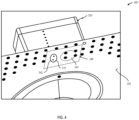
- FIG. 4 is a perspective view depicting the underside or bottom of the roof drain system 200 depicted in FIG. 2 showing an exemplary positioning of the water seepage detection module 240 with respect to the monitoring module 230 such that the monitoring module antenna system 333 is aligned with the water seepage detection module antenna system 343, in accordance with at least one embodiment described herein.
- the water seepage detection module 240 is disposed proximate the upper surface 212 of the drain plate 202.
- the roofing membrane 112 covers the water seepage detection module 240 and the monitoring module 230 is disposed above the roofing membrane 112 proximate the water seepage detection module 240 with the monitoring module antenna system 333 aligned with the water seepage detection module antenna system 343. As depicted in FIG.
- the water seepage sensors 342 pass at least partially through the water sensor aperture 315 formed through the drain plate 202.
- the upper surface 212 of the drain plate 202 may include one or more surface features (one or more raised features, one or more recessed features, one or more apertures, one or more detents, etc. ) to assist locating the water seepage detection module 240 with respect to the water sensor aperture 315.
- the water seepage sensors 342 may extend only partially through the thickness of the water sensor aperture 315.
- the water seepage sensors 342 may be positioned even with the lower surface 214 of the drain plate 202.
- the water seepage sensors 342 may extend beyond the lower surface 214 of the drain plate 202 and/or may be placed outside the perimeter of the drain plate 202.
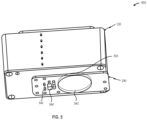
- FIG. 5 is a perspective view that depicts the physical positioning of the water seepage detection module 240 with respect to the monitoring module 230 such that the monitoring module antenna system 333 is physically aligned with the water seepage detection module antenna system 343, in accordance with at least one embodiment described herein.
- the physical alignment of the monitoring module antenna system 333 with the water seepage detection module antenna system 343 beneficially increases power transfer from the power supply circuitry 336 to the water seepage detection module 240.
- the physical alignment of the monitoring module antenna system 333 with the water seepage detection module antenna system 343 beneficially increases the data transmission bandwidth, reduces the data error rate, and/or reduces noise in the data transmission between the water seepage detection module 240 and the monitoring module 230.
- the roofing membrane 112 is disposed between the water seepage detection module 240 and the monitoring module 230, making it difficult to visually observe the positioning of the monitoring module 230 with respect to the water seepage detection module 240.
- one or more surface features may be disposed in, on, about, or across the surface of the drain plate 202 to assist in a uniform positioning of the water seepage detection module 240 with respect to the drain plate 202.
- the one or more positioning members 260 may facilitate the uniform positioning of the the monitoring module 230 with respect to the water seepage detection module 240 such that the water seepage detection module antenna system 343 aligns with the monitoring module antenna system 333.
- FIG. 6 is an upper perspective view of another illustrative roof drain system 600 that includes a plurality of drain cap fasteners 602A-602n (collectively, “drain cap fasteners 602") passing through a flange 604 disposed at least partially about the periphery of the drain cap 606, in accordance with at least one embodiment described herein.
- a flange 604 may extend from the drain cap 606 and may be physically coupled to the drain plate 202 using a plurality of drain cap fasteners 602.
- a positioning member 608 may extend from the flange 604 and may physically couple to the monitoring module 230 thereby fixing the position of the monitoring module 230 with respect to the roof drain 102.
- the drain cap fasteners 602 may include one or more removable fasteners, such as one or more threaded studs and corresponding nuts or wingnuts. In some embodiments, some or all of the drain cap fasteners 602 may pass through slots or similar elongated or tapered apertures to permit a fine adjustment of the flange 604 with respect to the drain opening in the roof 108.
- FIG. 7A is a partial top plan view that depicts an illustrative roof drain system 700 depicting an example monitoring module 230 disposed proximate an example water seepage detection module 240 (the roofing membrane 112 has been omitted for clarity and to more clearly demonstrate the relationship between the monitoring module 230 and the water seepage detection module 240), in accordance with at least one embodiment described herein.
- FIG. 7B is a partial bottom view of the illustrative roof drain system 700 of FIG. 7A that depicts the positioning of the water seepage detection module 240 with respect to the water sensor aperture 315, in accordance with at least one embodiment described herein.
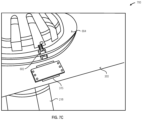
- FIG. 7C is a close-up top perspective view of the water seepage detection module 240 with respect to the water sensor aperture 315, in accordance with at least one embodiment described herein.
- the monitoring module 230 is disposed above and proximate the water seepage detection module 240 such that the monitoring module antenna system 333 is aligned with the water seepage detection module antenna system 343.
- the water seepage detection module 240 is disposed proximate the water sensor aperture 315 formed in the drain plate 202 such that the water seepage sensors 342 are able to detect the presence of water or moisture between the roofing membrane 112 and the roof substructure 308.
- the water seepage sensors 342 may contact the roof substructure 308.
- the water seepage sensors 342 are disposed close to, but not in contact with, the roof substructure 308 such that a gap exists between the water seepage sensors 342 and the roof substructure 308.
- the water seepage sensors 342 may be disposed such that a gap of about: 0.0156 inches (1/64"), 0.0312 inches (1/32"), 0.0625 inches (1/16"), 0.125 inches (1/8"), or 0.25 inches (1/4") inch (where an inch is 2.54cm) exists between the water seepage sensors 342 and the roof substructure 308.
- the water seepage detection module 240 is disposed proximate the water sensor aperture 315 formed in the drain plate 202 and positioned such that the water seepage sensors 342 have an unobstructed path to the roof substructure 308.
- the water sensor aperture 315 formed in the drain plate 202 may be larger in width than the corresponding width of the water seepage detection module 240. In other embodiments, not shown in FIG. 7B and FIG.
- the water sensor aperture 315 formed in the drain plate 202 may be sufficiently large to allow the unobstructed passage of the water seepage sensors 342, but smaller in width than the corresponding width of the water seepage detection module 240.
- the water seepage detection module 240 may be physically coupled to the drain plate 202.
- the water seepage detection module 240 may be non-detachably attached to the drain plate 202 using one or more chemical adhesives, one or more thermally set adhesives, one or more electromagnetically set adhesives (e.g ., UV set adhesives), one or more rivets, or combinations thereof.
- the water seepage detection module 240 may be detachably attached to the drain plate 202 using one or more removable fasteners, such as one or more threaded fasteners, one or more camlock connectors, one or more spiral cam fasteners (e.g. , DZUS ® fasteners) or combinations thereof.
- removable fasteners such as one or more threaded fasteners, one or more camlock connectors, one or more spiral cam fasteners (e.g. , DZUS ® fasteners) or combinations thereof.
- FIG. 8A is a top perspective view that depicts an illustrative water seepage detection module 240, the water seepage detection module antenna system 343 is visible on the upper surface of the water seepage detection module 240, in accordance with at least one embodiment described herein.
- FIG. 8B is a bottom perspective view that depicts the lower surface of the illustrative water seepage detection module 240 depicted in FIG. 8A , the water seepage sensors 342 are visible extending from the lower surface of the illustrative water seepage detection module 240 also visible are a plurality of water seepage detection module locator features 802A-802n (collectively, "locator features 802"), in accordance with at least one embodiment described herein.
- the water seepage detection module 240 may be a sealed module that is positioned between the drain plate 202 and the roofing membrane 112.
- the plurality of water seepage detection module locator features 802 may be disposed to form a unique pattern that corresponds to a plurality of complimentary features formed in the drain plate 202.
- the plurality of water seepage detection module locator features 802 may permit the permanent or detachable attachment of the water seepage detection module 240 at a defined location and in a defined physical orientation with respect to the roof drain 102.
- the water seepage detection module locator features 802 may include a plurality of raised features as depicted in FIG. 8B and the corresponding surface features in the drain plate 202 may include a plurality of detents.
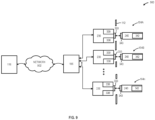
- FIG. 9 is a schematic diagram that depicts an illustrative system 900 in which a plurality of detectors 104A-104n (collectively, “detectors 104") are communicatively coupled to a gateway 106 using a short-range wireless communication protocol and in which the gateway 106 communicatively coupled to a building management system 116, in accordance with at least one embodiment described herein. As depicted in FIG. 9 , each gateway 106 provides an interface between the detectors 104 and the building management system 116.
- the building management system 116 may be disposed in a location remote from the gateway 106 and one or more wired and/or wireless networks 902 may be used to communicatively couple the gateway 106 to the building management system 116 using one or more long-range wireless communication protocols.
- the one or more networks 902 may include any number and/or combination of networks.
- Example networks include one or more local area networks (LANs), one or more wireless local area networks (WLANs) one or more wide area networks (WANs), one or more worldwide area networks (WWAN - the Internet), or combinations thereof.
- Communication between the gateway 106 and the building management system 116 may use a standard communication protocol (e.g., IEEE 802.3 - Ethernet and/or IEEE 802.11 - WiFi) or a closed or proprietary communication protocol.
- the gateway 106 communicates some or all of the data gathered by the detectors 104A-104n to the building management system 116. Such data may include unique identification data for each detector, temperature data from some or all of the detectors, water seepage data from some or all of the detectors 104, and/or water level data from some or all of the detectors 104.
- the gateway 106 may push data to the building management system 116 on a continuous, intermittent, periodic, aperiodic, or event-driven basis.
- the building management system 116 may pull data from the gateway 106 on a continuous, intermittent, periodic, aperiodic, or event-driven basis.
- the gateway 106 communicatively couples to one or more detectors 104 using one or more short-range wireless communication protocols.
- the gateway 106 may communicatively couple to 2 or more detectors 104, 4 or more detectors 104, 8 or more detectors 104, or 16 or more detectors 104.
- the detectors 104 may communicatively couple to the gateway 106 via one or more wired networks, one or more wireless networks, or any combination thereof.
- the detectors 104 may include a LoRa wireless communications interface circuitry 324 to communicate with the gateway 106.
- the LoRa wireless communications interface circuitry 324 communicates via a low-power, wide area network (LPWAN).
- LPWAN low-power, wide area network
- the detectors 104 may include any type of wired or wireless interface circuitry. In embodiments, some or all of the detectors 104 may push data to the gateway 106 on a continuous, intermittent, periodic, aperiodic, or event-driven basis (detection of water seepage, detection of high water level, detection of potential freeze conditions, detection of potential thaw conditions, etc. ) . In some embodiments, the detectors 104 may push the data to the gateway 106 in response to a poll, inquiry, or similar request message transmitted by the gateway 106 to some or all of the detectors 104. In other embodiments, the gateway 106 may pull data from some or all of the detectors 104 on a continuous, intermittent, periodic, aperiodic, or event-driven basis.
- substantially refers to a degree of precision within acceptable tolerance that accounts for and reflects minor real-world variation due to material composition, material defects, and/or limitations in manufacturing processes. Such variation may therefore be said to achieve largely, but not necessarily wholly, the target/nominal characteristic.
- a modifier is intended to include minor variation that can cause a deviation of up to and including ⁇ 10% from a particular stated quality/characteristic unless otherwise provided by the present disclosure.
- Coupled refers to any connection, coupling, link or the like between elements/components.
- directly coupled refers to two elements in contact with each other in a manner that does not include an intermediate element/component disposed therebetween.
Landscapes
- Engineering & Computer Science (AREA)
- Architecture (AREA)
- Civil Engineering (AREA)
- Structural Engineering (AREA)
- Computer Networks & Wireless Communication (AREA)
- Signal Processing (AREA)
- Business, Economics & Management (AREA)
- Emergency Management (AREA)
- Physics & Mathematics (AREA)
- General Physics & Mathematics (AREA)
- Examining Or Testing Airtightness (AREA)
- Investigating Or Analyzing Materials By The Use Of Electric Means (AREA)
- Arrangements For Transmission Of Measured Signals (AREA)
Claims (14)
- Système de drain de toit destiné à être utilisé avec un revêtement d'étanchéité (112) d'une sous-structure de toit (208), le système de drain de toit comprenant :un drain de toit (102), le drain de toit (102) comprenant :une plaque de drain (202) configurée pour être au moins partiellement disposée sous le revêtement d'étanchéité,une ouverture de drain (204) s'étendant à travers la plaque de drain (204), l'ouverture de drain (204) étant configurée pour être accouplée de manière fluidique à un tuyau de drain (218) ; etun capuchon de drain (206) s'étendant au moins partiellement autour de l'ouverture de drain (204) ; etun détecteur (104), le détecteur (104) comprenant :un module de détection d'infiltration d'eau (240) configuré pour être disposé entre la sous-structure de toit (208) et le revêtement d'étanchéité (112), le module de détection d'infiltration d'eau (240) comprenant un capteur d'infiltration d'eau (342) configuré pour générer un signal d'infiltration d'eau en réponse à la détection d'une infiltration d'eau sous le revêtement d'étanchéité (112) ; etun module de surveillance (230) configuré pour être disposé au-dessus du revêtement d'étanchéité (112), le module de surveillance (230) comprenant :
des circuits de surveillance de niveau d'eau (338) pour générer un signal de niveau d'eau :
et
des circuits de commande (332) pour recevoir sans fil le signal d'infiltration d'eau et transmettre un signal de passerelle, le signal de passerelle comprenant des données représentatives d'au moins l'un parmi le signal d'infiltration d'eau ou le signal de niveau d'eau, dans lequel la plaque de drain (202) comprend une ouverture de capteur d'eau (315) configurée pour permettre à une partie du capteur d'infiltration d'eau (342) de s'étendre sous une surface supérieure (212) de la plaque de drain (202). - Système de drain de toit selon la revendication 1, dans lequel le module de détection d'infiltration d'eau (240) est configuré pour être fixé à la plaque de drain (202) ;
et éventuellement ou de préférence, comprenant en outre au moins un élément de fixation configuré pour fixer le module de détection d'infiltration d'eau à la plaque de drain. - Système de drain de toit selon la revendication 1, dans lequel le capteur d'infiltration d'eau (342) comprend un élément de capteur configuré pour être disposé au moins partiellement à l'intérieur de l'ouverture de capteur d'eau (315) pour détecter l'infiltration d'eau sous le revêtement d'étanchéité ; et éventuellement ou de préférence, dans lequel l'élément de capteur comprend une pluralité de contacts résistifs.
- Système de drain de toit selon la revendication 1, dans lequel le module de détection d'infiltration d'eau (240) et le module de surveillance (230) sont configurés pour communiquer l'un avec l'autre via un protocole de communication sans fil à courte portée.
- Système de drain de toit selon la revendication 3, dans lequel le module de surveillance (230) est configuré pour transférer sans fil de l'énergie au module de détection d'infiltration d'eau (240) en réponse à un signal provenant d'une passerelle (106) ;
et éventuellement ou de préférence dans lequel soit :i) le module de surveillance (230) alimente le couplage inductif du module de détection d'infiltration d'eau (240) ; ouii) le module de surveillance (230) est configuré pour communiquer avec la passerelle (106) via un protocole de communication sans fil à longue portée. - Système de drain de toit selon la revendication 1, dans lequel le module de surveillance (230) comprend un dispositif de stockage d'énergie ;et éventuellement ou de préférence, dans lequel le dispositif de stockage d'énergie comprend une batterie ;et en outre, éventuellement ou de préférence, dans lequel les circuits de commande déterminent un niveau d'énergie restant dans la batterie ; etdans lequel le signal de passerelle comprend des données représentatives du niveau d'énergie de batterie déterminé.
- Système de drain de toit selon la revendication 6, dans lequel le capteur d'infiltration d'eau (342) est alimenté par un couplage inductif ; et éventuellement ou de préférence dans lequel le couplage inductif comprend un couplage inductif résonant.
- Système de drain de toit selon la revendication 7, dans lequel le module de surveillance (230) comprend une bobine primaire (333) et le module de détection d'infiltration d'eau (240) comprend une bobine secondaire (343).
- Système de drain de toit selon la revendication 8, dans lequel :i) le module de détection d'infiltration d'eau (240) comprend de première et seconde surfaces disposées de manière opposée, dans lequel la bobine secondaire (343) est disposée sur la première surface et le capteur d'infiltration d'eau (342) est disposé sur la seconde surface, le capteur d'infiltration d'eau (342) étant configuré pour détecter une fuite d'eau sous le revêtement d'étanchéité ; ouii) comprenant en outre une couche protectrice disposée sur des circuits sur la seconde surface ; ouiii) dans lequel la bobine secondaire (343) est alignée par rapport à la plaque de drain (202) et la bobine primaire (333) est alignée par rapport à la bobine secondaire (343) ;et éventuellement ou de préférence, comprenant en outre un élément de positionnement (260) configuré pour localiser la bobine primaire disposée dans le module de surveillance par rapport à la bobine secondaire disposée dans le module de détection d'infiltration d'eau ;
et en outre éventuellement ou de préférence, dans lequel l'élément de positionnement comprend une première extrémité accouplée au capuchon de drain et s'étendant à partir de celui-ci et une seconde extrémité accouplée au module de surveillance. - Système de drain de toit selon la revendication 1, dans lequel le module de surveillance (230) comprend un logement (232) définissant une cavité, la cavité comprenant :les circuits de commande (332) pour communiquer sans fil avec le module de détection d'infiltration d'eau (240) et recevoir le signal de niveau d'eau ; etdes circuits d'interface de communication (324) pour transmettre le signal de passerelle ;et éventuellement ou de préférence, dans lequel le signal de niveau d'eau est généré, au moins en partie, sur la base d'une pluralité de broches (236) au moins partiellement disposées à l'extérieur du logement ; oudans lequel l'indicateur d'alignement est configuré pour générer au moins une indication visuelle ou une indication acoustique.
- Système de drain de toit selon la revendication 8, dans lequel le module de surveillance (230) comprend en outre un indicateur d'alignement configuré pour vérifier l'alignement de la bobine primaire (333) dans le module de surveillance avec la bobine secondaire (343) dans le module de détection d'infiltration d'eau (240).
- Système de drain de toit selon la revendication 1, dans lequel le module de surveillance (230) comprend en outre des circuits de détection de température.
- Système de drain de toit selon la revendication 1, comprenant en outre une passerelle (106) configurée pour recevoir une pluralité de signaux de passerelle provenant d'une pluralité de modules de surveillance, ladite passerelle (106) étant configurée pour générer une notification en réponse audit signal de passerelle ;et éventuellement ou de préférence, dans lequel la passerelle (106) est configurée pour transmettre un signal au module de surveillance (230) pour amener des circuits d'alimentation (336) dans le module de surveillance (230) à fournir de l'énergie aux circuits de détection d'infiltration d'eau (344) dans le module de détection d'infiltration d'eau (240) ;et en outre éventuellement ou de préférence, dans lequel la passerelle (106) est configurée pour transmettre le signal au module de surveillance (230) pour amener les circuits d'alimentation (336) dans le module de surveillance (230) à fournir de l'énergie aux circuits de détection d'infiltration d'eau (344) dans le module de détection d'infiltration d'eau (240) en fonction de conditions météorologiques.
- Système de drain de toit selon la revendication 1, dans lequel le module de détection d'infiltration d'eau (240) est configuré pour être disposé entre la plaque de drain (202) et le revêtement d'étanchéité (112).
Applications Claiming Priority (2)
| Application Number | Priority Date | Filing Date | Title |
|---|---|---|---|
| US202063110759P | 2020-11-06 | 2020-11-06 | |
| PCT/US2021/058236 WO2022098994A1 (fr) | 2020-11-06 | 2021-11-05 | Systèmes et procédés de drain de toit intelligent |
Publications (3)
| Publication Number | Publication Date |
|---|---|
| EP4240924A1 EP4240924A1 (fr) | 2023-09-13 |
| EP4240924A4 EP4240924A4 (fr) | 2023-12-06 |
| EP4240924B1 true EP4240924B1 (fr) | 2025-01-29 |
Family
ID=81456801
Family Applications (1)
| Application Number | Title | Priority Date | Filing Date |
|---|---|---|---|
| EP21890142.9A Active EP4240924B1 (fr) | 2020-11-06 | 2021-11-05 | Systèmes de drain de toit intelligent |
Country Status (4)
| Country | Link |
|---|---|
| US (2) | US12012760B2 (fr) |
| EP (1) | EP4240924B1 (fr) |
| DK (1) | DK4240924T3 (fr) |
| WO (1) | WO2022098994A1 (fr) |
Families Citing this family (6)
| Publication number | Priority date | Publication date | Assignee | Title |
|---|---|---|---|---|
| US12018489B2 (en) * | 2020-04-14 | 2024-06-25 | Zurn Water, Llc | Domed roof drain strainer assembly |
| US20220025653A1 (en) * | 2020-07-24 | 2022-01-27 | Roofguard Manufacturing, Llc | Drain cover assembly |
| US12179238B2 (en) * | 2022-08-22 | 2024-12-31 | Watershed Systems, LLC | Debris clearing system and method |
| DE102023104478A1 (de) * | 2023-02-23 | 2024-08-29 | Adolf Würth GmbH & Co. KG | Feuchtigkeitssensor und Verfahren zum Bestimmen einer Feuchtigkeitsmenge |
| CN117824745A (zh) * | 2023-12-25 | 2024-04-05 | 江苏凯伦建材股份有限公司 | 一种覆膜金属板屋面虹吸排水系统的测试装置 |
| DE102023136811A1 (de) * | 2023-12-28 | 2025-07-03 | Tobias Becker | Schutzvorrichtung für ein Ablaufgully und Vorrichtung zum Betreiben derselben |
Family Cites Families (32)
| Publication number | Priority date | Publication date | Assignee | Title |
|---|---|---|---|---|
| US3967197A (en) * | 1974-10-04 | 1976-06-29 | A-Tech, Inc. | Method for detecting moisture in multiple layer roofs |
| US4110945A (en) | 1976-09-07 | 1978-09-05 | The Dow Chemical Company | Roof installation for locating water leakage points |
| US4598273A (en) | 1984-08-16 | 1986-07-01 | Bryan Jr Bynum O | Leak detection system for roofs |
| GB8717235D0 (en) | 1987-07-21 | 1987-08-26 | Darling Products Ltd J E | Moisture leak alarm |
| US5193390A (en) * | 1991-05-20 | 1993-03-16 | Nill Jr Andrew J | Early warning roof vent |
| NO300938B1 (no) | 1993-06-04 | 1997-08-18 | Asle Johnsen | Anordning og anlegg for varsling av tilstopping av taksluk eller liknende |
| US6225909B1 (en) | 1998-05-19 | 2001-05-01 | Andrew J. Nill, Jr. | Roof vents with moisture detectors and roof systems incorporating same |
| US6147613A (en) * | 1998-06-18 | 2000-11-14 | Doumit; Joseph | Early warning water leak detection system |
| GB9920157D0 (en) | 1999-08-25 | 1999-10-27 | Flow Control Systems Limited | Drain blockage ensor |
| US6995676B2 (en) * | 2002-05-28 | 2006-02-07 | Mark Amacher | Moisture detection and location system |
| US20060033629A1 (en) * | 2004-08-13 | 2006-02-16 | Froet Industries, Llc | Over flow sensor |
| US7292155B2 (en) * | 2005-09-01 | 2007-11-06 | Detec Systems Llc | Moisture detection sensor tape with leak locate |
| EP1806461B1 (fr) | 2006-01-06 | 2012-11-21 | Hermanus Johannes Visser | Procédé et dispositif de surveillance de chargements de toit |
| NO333551B1 (no) | 2007-08-08 | 2013-07-08 | Asle Ingmar Johnsen | Anordning for deteksjon og maling av lagdannelse rundt dreneringsavlop |
| DE102008033947A1 (de) | 2008-07-19 | 2010-01-21 | Progeo Monitoring Gmbh | Verfahren und Vorrichtung zur Dichtheitsprüfung von Bauwerksabdichtungen |
| US8566051B2 (en) | 2010-01-19 | 2013-10-22 | Clark Robert Gunness | Leak detection and location system, method, and software product |
| US20120062384A1 (en) * | 2010-09-14 | 2012-03-15 | Jay R. Smith Manufacturing Company | Roof drain overflow sensor |
| GB2501915A (en) * | 2012-05-10 | 2013-11-13 | Thermocable Flexible Elements Ltd | Environmental alarm system providing a remote alert |
| CA2818121C (fr) * | 2013-06-06 | 2014-08-26 | Detec Systems Ltd. | Methode de detection d'une fuite dans la membrane d'un toit |
| US20150269830A1 (en) | 2014-03-18 | 2015-09-24 | Beldon Technologies, Inc. | Roof monitoring method and system |
| US10970990B1 (en) * | 2015-02-19 | 2021-04-06 | State Farm Mutual Automobile Insurance Company | Systems and methods for monitoring building health |
| US9632003B1 (en) | 2015-10-06 | 2017-04-25 | Clark Robert Gunness | Systems and methods for leak detection in roofing and waterproofing membranes |
| PL3176341T3 (pl) * | 2015-12-03 | 2019-05-31 | Fleischmann & Petschnig Dachdeckungs Ges M B H | Element instalacyjny dla dachu płaskiego |
| US9624671B1 (en) * | 2015-12-03 | 2017-04-18 | Clark Robert Gunness | Leak detection and location system and method |
| US10571141B1 (en) * | 2017-06-01 | 2020-02-25 | Paul A Gray | Roof moisture detection and removal system |
| US10171892B2 (en) * | 2016-08-16 | 2019-01-01 | John PETRACHEK | System and method for monitoring water level on a roof |
| US10352047B2 (en) * | 2017-01-13 | 2019-07-16 | Detec Systems Llc | Method of locating a leak site in roof membranes using lengths of moisture detection tape set out in zones |
| US10214907B1 (en) * | 2017-12-19 | 2019-02-26 | Clark Robert Gunness | Leak detection and location system |
| US10850145B2 (en) | 2018-01-23 | 2020-12-01 | Tyco Fire Products Lp | System and method for low point monitoring in a fire suppression system |
| AT16586U1 (de) | 2018-04-13 | 2020-02-15 | Steinbacher Daemmstoff Ges M B H | Hausdach mit Wasserableitung |
| US10458877B1 (en) * | 2018-04-26 | 2019-10-29 | Molex, Llc | Water leak detection systems for flat commercial roof structures |
| CN110206237B (zh) * | 2019-05-18 | 2020-09-11 | 陕西建工第五建设集团有限公司 | 一种基于虹吸式屋面排水结构的排水方法 |
-
2021
- 2021-11-05 WO PCT/US2021/058236 patent/WO2022098994A1/fr not_active Ceased
- 2021-11-05 EP EP21890142.9A patent/EP4240924B1/fr active Active
- 2021-11-05 DK DK21890142.9T patent/DK4240924T3/da active
-
2023
- 2023-05-05 US US18/143,984 patent/US12012760B2/en active Active
-
2024
- 2024-06-17 US US18/745,124 patent/US20240337106A1/en active Pending
Also Published As
| Publication number | Publication date |
|---|---|
| EP4240924A1 (fr) | 2023-09-13 |
| US20240337106A1 (en) | 2024-10-10 |
| US20230272620A1 (en) | 2023-08-31 |
| US12012760B2 (en) | 2024-06-18 |
| DK4240924T3 (da) | 2025-02-17 |
| WO2022098994A1 (fr) | 2022-05-12 |
| EP4240924A4 (fr) | 2023-12-06 |
Similar Documents
| Publication | Publication Date | Title |
|---|---|---|
| US12012760B2 (en) | Intelligent roof drain systems and methods | |
| EP4240925B1 (fr) | Systèmes et procédés de drain de toit intelligent | |
| JP6350665B2 (ja) | センサモジュールおよびマンホール情報収集処理システム | |
| KR100874343B1 (ko) | 맨홀 감시용 무선시스템 | |
| US8228190B2 (en) | Valve malfunctioning detection system for a vacuum sewer an associated methods | |
| KR20200077325A (ko) | 간편 설치형 내수침수 감지시스템 | |
| KR20200077326A (ko) | 볼라드형 내수침수 모니터링 시스템 | |
| GB2497157A (en) | Sewerage system level sensing | |
| CN107870592A (zh) | 一种古树智能监控的方法、装置及系统 | |
| KR100989933B1 (ko) | 맨홀 감시시스템의 안테나 구조 | |
| KR102713788B1 (ko) | 저지대 침수 감시장치 및 이를 이용한 침수 감시시스템 | |
| CN210626693U (zh) | 地质灾害防治用雨量监测装置 | |
| CN218865221U (zh) | 一种道路用雨水监测装置 | |
| RU2811346C1 (ru) | Устройство и система мониторинга снеговой нагрузки | |
| KR102371788B1 (ko) | 상수도 스마트 관망 관리용 IoT 기반 자가전원 구동방식 압력센서 | |
| KR102857093B1 (ko) | 침수계측장치 | |
| JP2023066488A (ja) | 水検知センサ及びこれに用いる水電池並びに冠水検知方法 | |
| CN111006740A (zh) | 一种雨水盖积水监测系统 | |
| Kim et al. | Design and implementation of a real-time slope monitoring system based on ubiquitous sensor network | |
| US12392643B2 (en) | Sensor arrangement | |
| CN210005890U (zh) | 一种水位远程监测控制器 | |
| CN221236081U (zh) | 一种智能井盖 | |
| KR102690805B1 (ko) | 맨홀 뚜껑 | |
| CN217765131U (zh) | 压力式液位监测仪 | |
| CN212540761U (zh) | 一种用于滑坡应急监测的设备 |
Legal Events
| Date | Code | Title | Description |
|---|---|---|---|
| STAA | Information on the status of an ep patent application or granted ep patent |
Free format text: STATUS: THE INTERNATIONAL PUBLICATION HAS BEEN MADE |
|
| PUAI | Public reference made under article 153(3) epc to a published international application that has entered the european phase |
Free format text: ORIGINAL CODE: 0009012 |
|
| STAA | Information on the status of an ep patent application or granted ep patent |
Free format text: STATUS: REQUEST FOR EXAMINATION WAS MADE |
|
| 17P | Request for examination filed |
Effective date: 20230505 |
|
| AK | Designated contracting states |
Kind code of ref document: A1 Designated state(s): AL AT BE BG CH CY CZ DE DK EE ES FI FR GB GR HR HU IE IS IT LI LT LU LV MC MK MT NL NO PL PT RO RS SE SI SK SM TR |
|
| A4 | Supplementary search report drawn up and despatched |
Effective date: 20231103 |
|
| RIC1 | Information provided on ipc code assigned before grant |
Ipc: H04W 4/38 20180101ALI20231027BHEP Ipc: G08B 25/10 20060101ALI20231027BHEP Ipc: G08B 21/20 20060101ALI20231027BHEP Ipc: E04D 13/04 20060101ALI20231027BHEP Ipc: E04D 13/00 20060101AFI20231027BHEP |
|
| DAV | Request for validation of the european patent (deleted) | ||
| DAX | Request for extension of the european patent (deleted) | ||
| GRAP | Despatch of communication of intention to grant a patent |
Free format text: ORIGINAL CODE: EPIDOSNIGR1 |
|
| STAA | Information on the status of an ep patent application or granted ep patent |
Free format text: STATUS: GRANT OF PATENT IS INTENDED |
|
| INTG | Intention to grant announced |
Effective date: 20240903 |
|
| GRAS | Grant fee paid |
Free format text: ORIGINAL CODE: EPIDOSNIGR3 |
|
| GRAA | (expected) grant |
Free format text: ORIGINAL CODE: 0009210 |
|
| STAA | Information on the status of an ep patent application or granted ep patent |
Free format text: STATUS: THE PATENT HAS BEEN GRANTED |
|
| AK | Designated contracting states |
Kind code of ref document: B1 Designated state(s): AL AT BE BG CH CY CZ DE DK EE ES FI FR GB GR HR HU IE IS IT LI LT LU LV MC MK MT NL NO PL PT RO RS SE SI SK SM TR |
|
| REG | Reference to a national code |
Ref country code: GB Ref legal event code: FG4D |
|
| REG | Reference to a national code |
Ref country code: CH Ref legal event code: EP |
|
| REG | Reference to a national code |
Ref country code: DK Ref legal event code: T3 Effective date: 20250212 |
|
| REG | Reference to a national code |
Ref country code: DE Ref legal event code: R096 Ref document number: 602021025691 Country of ref document: DE |
|
| REG | Reference to a national code |
Ref country code: IE Ref legal event code: FG4D |
|
| REG | Reference to a national code |
Ref country code: NL Ref legal event code: MP Effective date: 20250129 |
|
| PG25 | Lapsed in a contracting state [announced via postgrant information from national office to epo] |
Ref country code: NL Free format text: LAPSE BECAUSE OF FAILURE TO SUBMIT A TRANSLATION OF THE DESCRIPTION OR TO PAY THE FEE WITHIN THE PRESCRIBED TIME-LIMIT Effective date: 20250129 |
|
| PG25 | Lapsed in a contracting state [announced via postgrant information from national office to epo] |
Ref country code: RS Free format text: LAPSE BECAUSE OF FAILURE TO SUBMIT A TRANSLATION OF THE DESCRIPTION OR TO PAY THE FEE WITHIN THE PRESCRIBED TIME-LIMIT Effective date: 20250429 |
|
| PG25 | Lapsed in a contracting state [announced via postgrant information from national office to epo] |
Ref country code: FI Free format text: LAPSE BECAUSE OF FAILURE TO SUBMIT A TRANSLATION OF THE DESCRIPTION OR TO PAY THE FEE WITHIN THE PRESCRIBED TIME-LIMIT Effective date: 20250129 |
|
| PG25 | Lapsed in a contracting state [announced via postgrant information from national office to epo] |
Ref country code: PL Free format text: LAPSE BECAUSE OF FAILURE TO SUBMIT A TRANSLATION OF THE DESCRIPTION OR TO PAY THE FEE WITHIN THE PRESCRIBED TIME-LIMIT Effective date: 20250129 |
|
| PG25 | Lapsed in a contracting state [announced via postgrant information from national office to epo] |
Ref country code: ES Free format text: LAPSE BECAUSE OF FAILURE TO SUBMIT A TRANSLATION OF THE DESCRIPTION OR TO PAY THE FEE WITHIN THE PRESCRIBED TIME-LIMIT Effective date: 20250129 |
|
| REG | Reference to a national code |
Ref country code: LT Ref legal event code: MG9D |
|
| PG25 | Lapsed in a contracting state [announced via postgrant information from national office to epo] |
Ref country code: IS Free format text: LAPSE BECAUSE OF FAILURE TO SUBMIT A TRANSLATION OF THE DESCRIPTION OR TO PAY THE FEE WITHIN THE PRESCRIBED TIME-LIMIT Effective date: 20250529 Ref country code: NO Free format text: LAPSE BECAUSE OF FAILURE TO SUBMIT A TRANSLATION OF THE DESCRIPTION OR TO PAY THE FEE WITHIN THE PRESCRIBED TIME-LIMIT Effective date: 20250429 |
|
| REG | Reference to a national code |
Ref country code: AT Ref legal event code: MK05 Ref document number: 1763564 Country of ref document: AT Kind code of ref document: T Effective date: 20250129 |
|
| PG25 | Lapsed in a contracting state [announced via postgrant information from national office to epo] |
Ref country code: HR Free format text: LAPSE BECAUSE OF FAILURE TO SUBMIT A TRANSLATION OF THE DESCRIPTION OR TO PAY THE FEE WITHIN THE PRESCRIBED TIME-LIMIT Effective date: 20250129 |
|
| PG25 | Lapsed in a contracting state [announced via postgrant information from national office to epo] |
Ref country code: PT Free format text: LAPSE BECAUSE OF FAILURE TO SUBMIT A TRANSLATION OF THE DESCRIPTION OR TO PAY THE FEE WITHIN THE PRESCRIBED TIME-LIMIT Effective date: 20250529 Ref country code: LV Free format text: LAPSE BECAUSE OF FAILURE TO SUBMIT A TRANSLATION OF THE DESCRIPTION OR TO PAY THE FEE WITHIN THE PRESCRIBED TIME-LIMIT Effective date: 20250129 |
|
| PG25 | Lapsed in a contracting state [announced via postgrant information from national office to epo] |
Ref country code: BG Free format text: LAPSE BECAUSE OF FAILURE TO SUBMIT A TRANSLATION OF THE DESCRIPTION OR TO PAY THE FEE WITHIN THE PRESCRIBED TIME-LIMIT Effective date: 20250129 Ref country code: GR Free format text: LAPSE BECAUSE OF FAILURE TO SUBMIT A TRANSLATION OF THE DESCRIPTION OR TO PAY THE FEE WITHIN THE PRESCRIBED TIME-LIMIT Effective date: 20250430 |
|
| PG25 | Lapsed in a contracting state [announced via postgrant information from national office to epo] |
Ref country code: AT Free format text: LAPSE BECAUSE OF FAILURE TO SUBMIT A TRANSLATION OF THE DESCRIPTION OR TO PAY THE FEE WITHIN THE PRESCRIBED TIME-LIMIT Effective date: 20250129 |
|
| PG25 | Lapsed in a contracting state [announced via postgrant information from national office to epo] |
Ref country code: SE Free format text: LAPSE BECAUSE OF FAILURE TO SUBMIT A TRANSLATION OF THE DESCRIPTION OR TO PAY THE FEE WITHIN THE PRESCRIBED TIME-LIMIT Effective date: 20250129 |
|
| PG25 | Lapsed in a contracting state [announced via postgrant information from national office to epo] |
Ref country code: SM Free format text: LAPSE BECAUSE OF FAILURE TO SUBMIT A TRANSLATION OF THE DESCRIPTION OR TO PAY THE FEE WITHIN THE PRESCRIBED TIME-LIMIT Effective date: 20250129 |
|
| PG25 | Lapsed in a contracting state [announced via postgrant information from national office to epo] |
Ref country code: IT Free format text: LAPSE BECAUSE OF FAILURE TO SUBMIT A TRANSLATION OF THE DESCRIPTION OR TO PAY THE FEE WITHIN THE PRESCRIBED TIME-LIMIT Effective date: 20250129 |
|
| PG25 | Lapsed in a contracting state [announced via postgrant information from national office to epo] |
Ref country code: CZ Free format text: LAPSE BECAUSE OF FAILURE TO SUBMIT A TRANSLATION OF THE DESCRIPTION OR TO PAY THE FEE WITHIN THE PRESCRIBED TIME-LIMIT Effective date: 20250129 Ref country code: EE Free format text: LAPSE BECAUSE OF FAILURE TO SUBMIT A TRANSLATION OF THE DESCRIPTION OR TO PAY THE FEE WITHIN THE PRESCRIBED TIME-LIMIT Effective date: 20250129 |
|
| PG25 | Lapsed in a contracting state [announced via postgrant information from national office to epo] |
Ref country code: RO Free format text: LAPSE BECAUSE OF FAILURE TO SUBMIT A TRANSLATION OF THE DESCRIPTION OR TO PAY THE FEE WITHIN THE PRESCRIBED TIME-LIMIT Effective date: 20250129 |
|
| PG25 | Lapsed in a contracting state [announced via postgrant information from national office to epo] |
Ref country code: SK Free format text: LAPSE BECAUSE OF FAILURE TO SUBMIT A TRANSLATION OF THE DESCRIPTION OR TO PAY THE FEE WITHIN THE PRESCRIBED TIME-LIMIT Effective date: 20250129 |
|
| REG | Reference to a national code |
Ref country code: DE Ref legal event code: R097 Ref document number: 602021025691 Country of ref document: DE |
|
| PLBE | No opposition filed within time limit |
Free format text: ORIGINAL CODE: 0009261 |
|
| STAA | Information on the status of an ep patent application or granted ep patent |
Free format text: STATUS: NO OPPOSITION FILED WITHIN TIME LIMIT |
|
| 26N | No opposition filed |
Effective date: 20251030 |
|
| PGFP | Annual fee paid to national office [announced via postgrant information from national office to epo] |
Ref country code: DE Payment date: 20251128 Year of fee payment: 5 |
|
| PGFP | Annual fee paid to national office [announced via postgrant information from national office to epo] |
Ref country code: GB Payment date: 20251127 Year of fee payment: 5 |
|
| PGFP | Annual fee paid to national office [announced via postgrant information from national office to epo] |
Ref country code: DK Payment date: 20251125 Year of fee payment: 5 |
|
| PGFP | Annual fee paid to national office [announced via postgrant information from national office to epo] |
Ref country code: FR Payment date: 20251125 Year of fee payment: 5 |