EP4242189A1 - Reaktive bindemittelmischung für zementartige gegenstände - Google Patents
Reaktive bindemittelmischung für zementartige gegenstände Download PDFInfo
- Publication number
- EP4242189A1 EP4242189A1 EP22305285.3A EP22305285A EP4242189A1 EP 4242189 A1 EP4242189 A1 EP 4242189A1 EP 22305285 A EP22305285 A EP 22305285A EP 4242189 A1 EP4242189 A1 EP 4242189A1
- Authority
- EP
- European Patent Office
- Prior art keywords
- cementitious
- binder mixture
- reactive binder
- silica source
- source material
- Prior art date
- Legal status (The legal status is an assumption and is not a legal conclusion. Google has not performed a legal analysis and makes no representation as to the accuracy of the status listed.)
- Granted
Links
Images
Classifications
-
- C—CHEMISTRY; METALLURGY
- C04—CEMENTS; CONCRETE; ARTIFICIAL STONE; CERAMICS; REFRACTORIES
- C04B—LIME, MAGNESIA; SLAG; CEMENTS; COMPOSITIONS THEREOF, e.g. MORTARS, CONCRETE OR LIKE BUILDING MATERIALS; ARTIFICIAL STONE; CERAMICS; REFRACTORIES; TREATMENT OF NATURAL STONE
- C04B40/00—Processes, in general, for influencing or modifying the properties of mortars, concrete or artificial stone compositions, e.g. their setting or hardening ability
- C04B40/0028—Aspects relating to the mixing step of the mortar preparation
- C04B40/006—Aspects relating to the mixing step of the mortar preparation involving the elimination of excess water from the mixture
- C04B40/0064—Processes of the Magnini or Hatscheck type
-
- C—CHEMISTRY; METALLURGY
- C04—CEMENTS; CONCRETE; ARTIFICIAL STONE; CERAMICS; REFRACTORIES
- C04B—LIME, MAGNESIA; SLAG; CEMENTS; COMPOSITIONS THEREOF, e.g. MORTARS, CONCRETE OR LIKE BUILDING MATERIALS; ARTIFICIAL STONE; CERAMICS; REFRACTORIES; TREATMENT OF NATURAL STONE
- C04B28/00—Compositions of mortars, concrete or artificial stone, containing inorganic binders or the reaction product of an inorganic and an organic binder, e.g. polycarboxylate cements
- C04B28/14—Compositions of mortars, concrete or artificial stone, containing inorganic binders or the reaction product of an inorganic and an organic binder, e.g. polycarboxylate cements containing calcium sulfate cements
-
- C—CHEMISTRY; METALLURGY
- C04—CEMENTS; CONCRETE; ARTIFICIAL STONE; CERAMICS; REFRACTORIES
- C04B—LIME, MAGNESIA; SLAG; CEMENTS; COMPOSITIONS THEREOF, e.g. MORTARS, CONCRETE OR LIKE BUILDING MATERIALS; ARTIFICIAL STONE; CERAMICS; REFRACTORIES; TREATMENT OF NATURAL STONE
- C04B28/00—Compositions of mortars, concrete or artificial stone, containing inorganic binders or the reaction product of an inorganic and an organic binder, e.g. polycarboxylate cements
- C04B28/02—Compositions of mortars, concrete or artificial stone, containing inorganic binders or the reaction product of an inorganic and an organic binder, e.g. polycarboxylate cements containing hydraulic cements other than calcium sulfates
- C04B28/021—Ash cements, e.g. fly ash cements ; Cements based on incineration residues, e.g. alkali-activated slags from waste incineration ; Kiln dust cements
-
- C—CHEMISTRY; METALLURGY
- C04—CEMENTS; CONCRETE; ARTIFICIAL STONE; CERAMICS; REFRACTORIES
- C04B—LIME, MAGNESIA; SLAG; CEMENTS; COMPOSITIONS THEREOF, e.g. MORTARS, CONCRETE OR LIKE BUILDING MATERIALS; ARTIFICIAL STONE; CERAMICS; REFRACTORIES; TREATMENT OF NATURAL STONE
- C04B28/00—Compositions of mortars, concrete or artificial stone, containing inorganic binders or the reaction product of an inorganic and an organic binder, e.g. polycarboxylate cements
- C04B28/14—Compositions of mortars, concrete or artificial stone, containing inorganic binders or the reaction product of an inorganic and an organic binder, e.g. polycarboxylate cements containing calcium sulfate cements
- C04B28/145—Calcium sulfate hemi-hydrate with a specific crystal form
-
- C—CHEMISTRY; METALLURGY
- C04—CEMENTS; CONCRETE; ARTIFICIAL STONE; CERAMICS; REFRACTORIES
- C04B—LIME, MAGNESIA; SLAG; CEMENTS; COMPOSITIONS THEREOF, e.g. MORTARS, CONCRETE OR LIKE BUILDING MATERIALS; ARTIFICIAL STONE; CERAMICS; REFRACTORIES; TREATMENT OF NATURAL STONE
- C04B28/00—Compositions of mortars, concrete or artificial stone, containing inorganic binders or the reaction product of an inorganic and an organic binder, e.g. polycarboxylate cements
- C04B28/24—Compositions of mortars, concrete or artificial stone, containing inorganic binders or the reaction product of an inorganic and an organic binder, e.g. polycarboxylate cements containing alkyl, ammonium or metal silicates; containing silica sols
- C04B28/26—Silicates of the alkali metals
-
- C—CHEMISTRY; METALLURGY
- C04—CEMENTS; CONCRETE; ARTIFICIAL STONE; CERAMICS; REFRACTORIES
- C04B—LIME, MAGNESIA; SLAG; CEMENTS; COMPOSITIONS THEREOF, e.g. MORTARS, CONCRETE OR LIKE BUILDING MATERIALS; ARTIFICIAL STONE; CERAMICS; REFRACTORIES; TREATMENT OF NATURAL STONE
- C04B2111/00—Mortars, concrete or artificial stone or mixtures to prepare them, characterised by specific function, property or use
- C04B2111/00474—Uses not provided for elsewhere in C04B2111/00
- C04B2111/00612—Uses not provided for elsewhere in C04B2111/00 as one or more layers of a layered structure
-
- C—CHEMISTRY; METALLURGY
- C04—CEMENTS; CONCRETE; ARTIFICIAL STONE; CERAMICS; REFRACTORIES
- C04B—LIME, MAGNESIA; SLAG; CEMENTS; COMPOSITIONS THEREOF, e.g. MORTARS, CONCRETE OR LIKE BUILDING MATERIALS; ARTIFICIAL STONE; CERAMICS; REFRACTORIES; TREATMENT OF NATURAL STONE
- C04B2111/00—Mortars, concrete or artificial stone or mixtures to prepare them, characterised by specific function, property or use
- C04B2111/00474—Uses not provided for elsewhere in C04B2111/00
- C04B2111/00612—Uses not provided for elsewhere in C04B2111/00 as one or more layers of a layered structure
- C04B2111/0062—Gypsum-paper board like materials
-
- Y—GENERAL TAGGING OF NEW TECHNOLOGICAL DEVELOPMENTS; GENERAL TAGGING OF CROSS-SECTIONAL TECHNOLOGIES SPANNING OVER SEVERAL SECTIONS OF THE IPC; TECHNICAL SUBJECTS COVERED BY FORMER USPC CROSS-REFERENCE ART COLLECTIONS [XRACs] AND DIGESTS
- Y02—TECHNOLOGIES OR APPLICATIONS FOR MITIGATION OR ADAPTATION AGAINST CLIMATE CHANGE
- Y02W—CLIMATE CHANGE MITIGATION TECHNOLOGIES RELATED TO WASTEWATER TREATMENT OR WASTE MANAGEMENT
- Y02W30/00—Technologies for solid waste management
- Y02W30/50—Reuse, recycling or recovery technologies
- Y02W30/91—Use of waste materials as fillers for mortars or concrete
Definitions
- the invention relates to a reactive binder mixture for manufacturing cementitious articles, in particular cementitious board.
- the manufacturing process of cementitious articles such as boards includes a step during which a cementitious preparation sets, thus forming the cementitious article.
- the setting time may vary depending on the components of the cementitious preparation or the chosen manufacturing process.
- continuous processes for manufacturing cementitious boards include continuously spreading the cementitious preparation on a conveyor carrying a lower sheeting, this sheeting and the cementitious preparation then being shaped by an extruder and cut into boards of desired dimensions before being cured.
- Continuous processes may require a precise setting time, usually a few minutes, which is faster than conventional processes during which the cementitious preparation is poured into moulds to set.
- plaster also known as calcium sulphate hemihydrate
- cementitious compositions comprising calcium sulphate hemihydrate. Such compositions are particularly suitable for continuous processes for manufacturing cementitious articles such as boards.
- the use of pozzolanic materials, such as silica fume, is known to mitigate the formation of thaumasite in gypsum-cement composition.
- the present invention is based on the finding that the stability of cementitious articles comprising calcium sulphate hemihydrate, in particular under wet conditions, can be enhanced by the addition of an alkali silicate material.
- the present invention fits into this context by providing a reactive binder mixture for manufacturing a cementitious composition resulting in cementitious articles which are significantly less prone to precipitation of thaumasite and swelling and thus more durable in wet conditions, thanks to the addition of a silica source material comprising alkali silicate material.
- the present invention refers to a reactive binder mixture comprising, based on the total dry matter, 10 to 40 wt.% hydraulic cement, 40 to 80 wt.% calcium sulphate hemihydrate, and 1 to 35 wt.% silica source material, wherein the silica source material comprises an alkali silicate material.
- a second object of the present invention refers to a cementitious composition comprising the reactive binder mixture of the invention.
- a third object of the present invention refers to a cementitious article, in particular a cementitious board, obtained from the curing of the cementitious composition of the invention.
- the alkali silicate material is preferably selected from sodium silicates, potassium silicates, lithium silicates, caesium silicates or mixtures thereof, more preferably from sodium or potassium silicates.
- the alkali silicate material has a modulus equal to or higher than 1.
- modulus refers to the silica modulus of the alkali silicate material, which corresponds to the molar ratio SiO 2 /M 2 O, with M being an alkaline element such as sodium or potassium.
- a modulus higher than 2.5, preferably higher than 3, is advantageous for workability of the cementitious composition.
- the alkali silicate material comprises, based on dry matter, at least 50 wt.%, preferably at least 60 wt.%, more preferably at least 75 wt.%, of alkali silicates.
- the alkali silicate material has a median particle size D 50 of 1 to 500 ⁇ m, preferably 10 to 300 ⁇ m, more preferably 20 to 200 ⁇ m. This can be measured by laser diffraction. D 50 is the corresponding particle size when the cumulative percentage reaches 50%, i.e. the portions of particles with diameters smaller and larger than this value are 50%.
- the reactive binder mixture according to the present invention comprises relatively low contents of hydraulic cement compared to calcium sulphate hemihydrate. Despite this relative low content, the cementitious article manufactured with this reactive binder mixture have similar, if not improved, water resistance.
- the water resistance is defined here as the capability to maintain the mechanical properties in wet environment at the same level as in dry conditions. Typically for boards, it can be assessed as set out in EN12467.
- the hydraulic cement may be any type of cement: CEM I, II, III, IV or V, as defined in EN 197-1:2000.
- the hydraulic cement is Portland cement (CEM I).
- Calcium sulphate hemihydrate can refer either to alpha plaster or beta plaster.
- Alpha plaster has lower specific surface area compared to beta plaster, which results in lower water demand for equivalent workability.
- the reactive binder mixture comprises from 10 wt.%, preferably 12 wt.%, more preferably 15 wt.%, or even 17 wt.%, to 40 wt.%, preferably 30 wt.%, more preferably 25 wt.%, or even 20 wt.%, of hydraulic cement.
- the addition of calcium sulphate hemihydrate in the reactive binder mixture accelerates the setting time of the cementitious composition obtained from this reactive binder mixture.
- the use of the reactive binder mixture according to the invention in a cementitious article can thus mitigate or even prevent formation of thaumasite crystals while having a controlled setting time, for example tenths of seconds to tenths of minutes.
- the cementitious article also exhibits good water resistance. Additionally, cementitious articles manufactured according to the invention can have a reduced carbon footprint due to their composition, and as such can be more sustainable, low-carbon alternatives compared to existing cementitious articles.
- the reactive binder composition comprises from 40 wt.%, preferably 45 wt.%, more preferably 50 wt.%, or even 52 wt.%, to 80 wt.%, preferably 75 wt.%, more preferably 70 wt.%, or even 65 wt.%, of calcium sulphate hemihydrate.
- the reactive binder composition comprises from 1 wt.%, preferably 2 wt.%, more preferably 5 wt.%, or even 7 wt.%, to 35 wt.%, preferably 33 wt.%, more preferably 30 wt.%, of silica source material.
- the silica source material comprises typically at least 20 wt.%, preferably at least 50 wt.%, more preferably at least 70 wt.%, or even at least 90 wt.%, of alkali silicate material.
- the silica source material may consist essentially of, or consist of, alkali silicate material.
- the silica source material can comprise a pozzolanic material.
- the pozzolanic material can be selected from silica fumes, fly ash, metakaolin or mixtures thereof.
- the reactive binder mixture comprises at least 15 to 25 wt.% hydraulic cement, 50 to 70 wt.% calcium sulphate hemihydrate, and 7 to 35 wt.% silica source material.
- the reactive binder mixture comprises at least 17 to 20 wt.% hydraulic cement, 52 to 65 wt.% calcium sulphate hemihydrate, and 10 to 30 wt.% silica source material.
- the content of hydraulic cement, calcium sulphate hemihydrate and silica source material generally sums up to at least 80 wt.%, preferably at least 90 wt.%, more preferably at least 95 wt.%, even more preferably at least 99 wt.% of the total reactive binder mixture based on dry matter.
- the reactive binder mixture consists essentially of, or consists of, hydraulic cement, calcium sulphate hemihydrate and alkali silicate material, i.e. the composition does not comprise further components acting as reactive binders.
- the invention also relates to a cementitious composition
- a cementitious composition comprising, based on the total dry matter, 15 to 90 wt%, preferably 20 to 70 wt.%, more preferably 25 to 50 wt/%, of the reactive binder mixture as defined above and 10 to 85 wt.%, preferably 30 to 80 wt.%, more preferably 50 to 75 wt.%, of fillers.
- the cementitious composition can be a dry blend or an aqueous slurry. When the cementitious composition is an aqueous slurry it comprises typically a water-to-binder weight ratio ranging from 0.2 to 1.
- Fillers may be selected from aggregates such as sand, limestone or other calcium carbonates, greywacke, basalt, dolomite, volcanic rock, slate, and/or recycled material from the production of the cementitious boards, or mixtures thereof, lightweight fillers such as expanded clays, expanded perlites, expanded shale, polystyrene beads, expanded glass beads, or mixtures thereof, and fibers such as glass fibers, synthetic fibers, natural fibers, and mixtures thereof.
- aggregates such as sand, limestone or other calcium carbonates, greywacke, basalt, dolomite, volcanic rock, slate, and/or recycled material from the production of the cementitious boards, or mixtures thereof
- lightweight fillers such as expanded clays, expanded perlites, expanded shale, polystyrene beads, expanded glass beads, or mixtures thereof
- fibers such as glass fibers, synthetic fibers, natural fibers, and mixtures thereof.
- Such fillers are intended to be effectively inert materials. Such effectively inert materials do not tend to significantly affect the setting characteristics of the reactive binder mixture. In particular, fillers do not create any significant chemical reaction with the reactive binder mixture.
- Admixtures may also be added to the cementitious composition, for instance to alter or enhance the properties of this reactive binder mixture and/or to improve the workability of the cementitious composition and/or to improve the properties of the cementitious article.
- admixtures There are several types of admixtures, among which are retarders, set and hardening accelerators, plasticisers, foaming agents, bonding agents, shrinkage reducers, anti-foam agents, pigments, hydrophobic agents and corrosion inhibitors.
- Retarders are components which can significantly delay the setting time of the reactive binder mixture.
- Retarders can be chosen from citric acid, tartaric acid, gluconates, phosphates, polyacrylates, polymethylacrylates, sugars and protein-based agents.
- accelerators can speed up the mechanical properties development of the reactive binder mixture.
- Accelerators can be chosen from soluble salts such as potassium sulphate or ammonium sulphate, mineral acids, organic acids, chlorides, nitrates, sulphates and bisulphates, or gypsum seeds as nucleating agents.
- Plasticisers, or superplasticisers are used to increase the binder content without affecting the workability, or, to increase the fluidity for a same solid content.
- Plasticisers or superplasticisers used in the invention may be selected from lignosulphonates or synthetic naphthalene sulphonates, polycarboxylate ethers or phosphonated polyarylethers.
- foaming agents which are used to produce air bubbles in the cementitious board.
- Foaming agents can be made from hydrolysed proteins, synthetic surfactants and alkyl ether sulphonates combined with water and air.
- the present invention further relates to a cementitious article, in particular a cementitious board, cementitious prefabricated elements or mortars including flooring products, obtained from the curing of the cementitious composition as defined above.
- the cementitious article is preferably a cementitious board, comprising a lightweight core between a first covering layer and a second covering layer, wherein the core results from the curing of an aqueous cementitious composition as defined above.
- the reactive binder mixture is therefore mixed with fillers to make cementitious boards, which in the present invention refer to construction boards obtained from cementitious compositions.
- the expression "lightweight core” refers to a core having a weight of 5 kg/m 2 to 17 kg/m 2 and/or a specific gravity of 0.4 to 1.36.
- the invention also covers a process for manufacturing a cementitious article as previously described, in particular a cementitious board, comprising a step of mixing hydraulic cement, calcium sulphate hemihydrate and the silica source material to form a reactive binder mixture as previously described, a step wherein an aqueous cementitious composition is formed by adding water to the reactive binder mixture, and a step of forming the cementitious article using the aqueous cementitious composition.
- the forming step may include casting the aqueous cementitious composition into moulds or continuously pouring and extruding the aqueous cementitious composition.
- the process of the invention is a process for manufacturing a cementitious board as previously described, comprising a step of mixing hydraulic cement, calcium sulphate hemihydrate and the silica source material to form a reactive binder mixture as previously described, a step wherein the aqueous cementitious composition is formed by adding fillers and water to the reactive binder mixture, and a step wherein the aqueous cementitious composition is poured onto a conveyor, in which the first covering layer carried by the conveyor is covered with the aqueous cementitious composition.
- the process further comprises a step in which fillers are added to the aqueous cementitious composition.
- the process may also comprise a step wherein the first covering layer covered in aqueous cementitious composition is extruded, cut and cured.
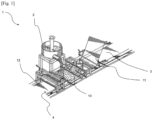
- FIG. 1 is a schematic view of a cementitious board manufacturing process
- the cementitious board manufacturing process 1 which is used to manufacture cementitious boards 4 according to the invention is a continuous process.
- Such manufacturing process comprises at least a tank 2, in which components for an aqueous cementitious composition 10 are continuously mixed to form a cementitious slurry.
- the components of such aqueous cementitious composition 10 will be described hereinafter.
- the aqueous cementitious composition 10 is poured on a conveyor 3, this conveyor 3 carrying a first covering layer 11.
- This first covering layer 11 is thus covered with the aqueous cementitious composition 10, the latter forming a lightweight core of the cementitious boards 4.
- the conveyor 3 comprises vibrating components which help spread out the aqueous cementitious composition 10 with its vibrations.
- the cementitious board 4 may also comprise a second covering layer 12, which is to be placed on top of the aqueous cementitious composition 10. Once the aqueous cementitious composition 10 has been poured on the first covering layer 11, they may go through an extruder and a cutting station, not shown on figure 1 , where they are cut into cementitious boards 4 of desired dimensions. The cementitious boards 4 can then be stored for a curing process when necessary.
- the components mixed in the tank 2 to form the aqueous cementitious composition 10 are a reactive binder mixture, water, and in some embodiments fillers.
- the reactive binder mixture can make up 15 to 90 wt.% of the components of the aqueous cementitious composition while the fillers make up 10 to 85 wt. %. These percentages are based on the solid weight (wt.) ratio between the component and the total dry matter.
- the fillers can be chosen from aggregates such as sand or calcium carbonate, lightweight fillers such as expanded clay or hydrophobic expanded perlite, and fibers such as glass fibers, synthetic fibers or natural fibers. These fillers are effectively inert materials, which do not significantly react with the reactive binder mixture.
- the aqueous cementitious composition may also comprise admixtures, e.g., retarders, accelerators, plasticisers or foaming agents. Such admixtures can be used to alter or enhance the properties of the reactive binder mixture and to improve the quality of the cementitious board 4.
- Samples were prepared from an aqueous cementitious composition comprising, based on total dry weight, 32 wt.% of a reactive binder (comprising hydraulic cement, calcium sulphate hemihydrate and silica source material), 68 wt.% of fillers (comprising calcium carbonate and sand), 0.3 wt.% of plasticizer and 0.005 wt.% of retarder.
- Sample I1 according to the invention comprises sodium silicate
- samples C1 and C2 which are comparative examples, comprise pozzolanic material consisting of two different silica fumes: a densified (aggregated) silica fume powder SF1, and an undensified silica fume powder SF2.
- the samples were obtained by mixing the components with water, with a water-to-binder weight ratio of approximatively 0.625, and pouring the aqueous compositions thus obtained into moulds that consisted of three cavities measuring 4 x 4 x 16 cm 3 each, and then covered with plastic to preserve humidity.
- the samples, each thus measuring approximately 4 x 4 x 16 cm 3 were demoulded after 24 hours and placed in sealed bags at room temperature (3 samples of identical formulation in each sealed bag). After curing for a further 6 days, each board sample was removed from the sealed bags and submitted to an immersion test consisting in placing the samples in water at approximately 5°C for up to 300 days with no water renewal. The dimensional variations of the samples were measured approximately every 7 days.
- Table 2 shows the dimensional variations in mm/m of samples over time.
- sample I1 according to the invention showed nearly no dimensional changes even after 300 days of immersion.
- sample C2 comprising undensified silica fume showed similar results.
- Sample C1 comprising densified silica fume showed increasing swelling from 14 days and up to 300 days of immersion.
- Board sample I1 according to the invention thus exhibits similar or enhanced stability under humid conditions compared to board samples C1 and C2 made with conventional pozzolanic materials.
- the present invention thus offers a reactive binder mixture for cementitious article, the components of such reactive binder mixture being selected for the article to exhibit good water resistance.
Landscapes
- Chemical & Material Sciences (AREA)
- Engineering & Computer Science (AREA)
- Ceramic Engineering (AREA)
- Materials Engineering (AREA)
- Structural Engineering (AREA)
- Organic Chemistry (AREA)
- Chemical Kinetics & Catalysis (AREA)
- Inorganic Chemistry (AREA)
- Combustion & Propulsion (AREA)
- Crystallography & Structural Chemistry (AREA)
- Curing Cements, Concrete, And Artificial Stone (AREA)
Priority Applications (8)
| Application Number | Priority Date | Filing Date | Title |
|---|---|---|---|
| EP22305285.3A EP4242189B1 (de) | 2022-03-11 | 2022-03-11 | Reaktive bindemittelmischung für zementartige gegenstände |
| ES22305285T ES3020061T3 (en) | 2022-03-11 | 2022-03-11 | Reactive binder mixture for cementitious article |
| MX2024011090A MX2024011090A (es) | 2022-03-11 | 2023-03-03 | Mezcla de aglutinante reactivo para articulo de cemento. |
| US18/845,743 US20250197288A1 (en) | 2022-03-11 | 2023-03-03 | Reactive binder mixture for cementitious article |
| CA3244979A CA3244979A1 (en) | 2022-03-11 | 2023-03-03 | REACTIVE BINDER MIXTURE FOR CEMENTITIOUS ARTICLES |
| AU2023232298A AU2023232298A1 (en) | 2022-03-11 | 2023-03-03 | Reactive binder mixture for cementitious article |
| PCT/EP2023/055460 WO2023169960A1 (en) | 2022-03-11 | 2023-03-03 | Reactive binder mixture for cementitious article |
| CL2024002732A CL2024002732A1 (es) | 2022-03-11 | 2024-09-11 | Mezcla de aglomerante reactivo para artículo de cemento |
Applications Claiming Priority (1)
| Application Number | Priority Date | Filing Date | Title |
|---|---|---|---|
| EP22305285.3A EP4242189B1 (de) | 2022-03-11 | 2022-03-11 | Reaktive bindemittelmischung für zementartige gegenstände |
Publications (3)
| Publication Number | Publication Date |
|---|---|
| EP4242189A1 true EP4242189A1 (de) | 2023-09-13 |
| EP4242189B1 EP4242189B1 (de) | 2025-02-12 |
| EP4242189C0 EP4242189C0 (de) | 2025-02-12 |
Family
ID=80930143
Family Applications (1)
| Application Number | Title | Priority Date | Filing Date |
|---|---|---|---|
| EP22305285.3A Active EP4242189B1 (de) | 2022-03-11 | 2022-03-11 | Reaktive bindemittelmischung für zementartige gegenstände |
Country Status (8)
| Country | Link |
|---|---|
| US (1) | US20250197288A1 (de) |
| EP (1) | EP4242189B1 (de) |
| AU (1) | AU2023232298A1 (de) |
| CA (1) | CA3244979A1 (de) |
| CL (1) | CL2024002732A1 (de) |
| ES (1) | ES3020061T3 (de) |
| MX (1) | MX2024011090A (de) |
| WO (1) | WO2023169960A1 (de) |
Citations (6)
| Publication number | Priority date | Publication date | Assignee | Title |
|---|---|---|---|---|
| EP1081113A1 (de) * | 1999-08-10 | 2001-03-07 | United States Gypsum Company | Gips-Zement Mischungen zur Herstellung von Baustoffen |
| WO2002042064A1 (en) * | 2000-11-21 | 2002-05-30 | United States Gypsum Company | Structural sheathing panels |
| WO2009006048A2 (en) * | 2007-06-29 | 2009-01-08 | United States Gypsum Company | Method for smoothing cementitious slurry in the production of structural cementitious panels |
| DE102009024200B3 (de) * | 2009-06-08 | 2010-09-30 | Bauhaus Universität Weimar | Anorganisches Bindemittel und dessen Verwendungen |
| US20160137551A1 (en) * | 2014-11-13 | 2016-05-19 | Colas | Geosynthsesis binder comprising a calcium- alkaline activator and a silico-aluminous compound |
| FR3053040A1 (fr) * | 2016-06-23 | 2017-12-29 | Saint Gobain Placo | Materiau de construction sous forme de plaques |
-
2022
- 2022-03-11 ES ES22305285T patent/ES3020061T3/es active Active
- 2022-03-11 EP EP22305285.3A patent/EP4242189B1/de active Active
-
2023
- 2023-03-03 WO PCT/EP2023/055460 patent/WO2023169960A1/en not_active Ceased
- 2023-03-03 MX MX2024011090A patent/MX2024011090A/es unknown
- 2023-03-03 CA CA3244979A patent/CA3244979A1/en active Pending
- 2023-03-03 AU AU2023232298A patent/AU2023232298A1/en active Pending
- 2023-03-03 US US18/845,743 patent/US20250197288A1/en active Pending
-
2024
- 2024-09-11 CL CL2024002732A patent/CL2024002732A1/es unknown
Patent Citations (6)
| Publication number | Priority date | Publication date | Assignee | Title |
|---|---|---|---|---|
| EP1081113A1 (de) * | 1999-08-10 | 2001-03-07 | United States Gypsum Company | Gips-Zement Mischungen zur Herstellung von Baustoffen |
| WO2002042064A1 (en) * | 2000-11-21 | 2002-05-30 | United States Gypsum Company | Structural sheathing panels |
| WO2009006048A2 (en) * | 2007-06-29 | 2009-01-08 | United States Gypsum Company | Method for smoothing cementitious slurry in the production of structural cementitious panels |
| DE102009024200B3 (de) * | 2009-06-08 | 2010-09-30 | Bauhaus Universität Weimar | Anorganisches Bindemittel und dessen Verwendungen |
| US20160137551A1 (en) * | 2014-11-13 | 2016-05-19 | Colas | Geosynthsesis binder comprising a calcium- alkaline activator and a silico-aluminous compound |
| FR3053040A1 (fr) * | 2016-06-23 | 2017-12-29 | Saint Gobain Placo | Materiau de construction sous forme de plaques |
Non-Patent Citations (2)
| Title |
|---|
| KOVLER K: "Setting and Hardening of Gypsum-Portland Cement-Silica Fume Blends, Part 1: Temperature and Setting Expansion", vol. 28, no. 3, 1 January 1998 (1998-01-01), pages 423 - 437, XP009539011, ISSN: 0008-8846, Retrieved from the Internet <URL:https://api.elsevier.com/content/article/PII:S0008884698000052?httpAccept=text/plain> DOI: 10.1016/S0008-8846(98)00005-2 * |
| WANG YINGBIN ET AL: "Effect of silica fume on the thaumasite form of sulfate attack on cement-based materials", WUHAN UNIVERSITY OF TECHNOLOGY. JOURNAL (MATERIAL SCIENCE EDITION), WUHAN LIGONG DAXUE,WUHAN UNIVERSITY OF TECHNOLOGY, CN, vol. 32, no. 5, 7 October 2017 (2017-10-07), pages 1108 - 1114, XP036334028, ISSN: 1000-2413, [retrieved on 20171007], DOI: 10.1007/S11595-017-1718-3 * |
Also Published As
| Publication number | Publication date |
|---|---|
| CL2024002732A1 (es) | 2025-01-24 |
| MX2024011090A (es) | 2024-09-18 |
| WO2023169960A1 (en) | 2023-09-14 |
| EP4242189B1 (de) | 2025-02-12 |
| AU2023232298A1 (en) | 2024-09-12 |
| CA3244979A1 (en) | 2023-09-14 |
| ES3020061T3 (en) | 2025-05-21 |
| US20250197288A1 (en) | 2025-06-19 |
| EP4242189C0 (de) | 2025-02-12 |
Similar Documents
| Publication | Publication Date | Title |
|---|---|---|
| AU2002302913B2 (en) | Low density calcium silicate hydrate strength accelerant additive for cementitious products | |
| US20020117086A1 (en) | Low shrinkage, high strength cellular lightweight concrete | |
| US20040204516A1 (en) | Polymer-cement composites and methods of making same | |
| NZ210258A (en) | Non-expansive cement containing portland cement and calcium sulphate | |
| US20150240163A1 (en) | Fire core compositions and methods | |
| WO1993001148A1 (en) | Foamed cementitious composition and method of making | |
| CA2416493A1 (en) | Low shrinkage, high strength cellular lightweight concrete | |
| EP0353062A2 (de) | Zementzusammensetzungen mit Verstärkungen | |
| JPH11147777A (ja) | 軽量硬化物及びその製造方法 | |
| US5605570A (en) | Alkali-activated glassy silicate foamed concrete | |
| EP4092006B1 (de) | Verfahren zur herstellung eines mineralschaums, mineralschaum und seiner verwendung | |
| EP4242189A1 (de) | Reaktive bindemittelmischung für zementartige gegenstände | |
| US20240400455A1 (en) | Cement board | |
| EP4242191A1 (de) | Reaktive bindemittelmischung für zementartige gegenstände | |
| EP4242190B1 (de) | Reaktive bindemittelmischung für zementartige gegenstände | |
| EP4134355A1 (de) | Selbstschäumende gipszusammensetzungen | |
| EP4717683A1 (de) | Zementplatte | |
| RU2830336C1 (ru) | Наномодифицированная полистиролбетонная смесь | |
| JP2000063161A (ja) | 充填材、無機水硬組成物および板材 | |
| JPH035352A (ja) | 繊維補強スラグ石膏セメント系軽量硬化体の製造方法 | |
| JPS61178478A (ja) | 軽量気泡コンクリ−ト体の製造方法 | |
| CN117003521A (zh) | 一种用于釉面发泡陶瓷保温板外墙外保温系统的胶粘剂 | |
| EP4534501A1 (de) | Verfahren zur herstellung eines mineralschaums und aus diesem mineralschaum erhältliches zellmaterial | |
| JPH0518788B2 (de) |
Legal Events
| Date | Code | Title | Description |
|---|---|---|---|
| PUAI | Public reference made under article 153(3) epc to a published international application that has entered the european phase |
Free format text: ORIGINAL CODE: 0009012 |
|
| STAA | Information on the status of an ep patent application or granted ep patent |
Free format text: STATUS: THE APPLICATION HAS BEEN PUBLISHED |
|
| AK | Designated contracting states |
Kind code of ref document: A1 Designated state(s): AL AT BE BG CH CY CZ DE DK EE ES FI FR GB GR HR HU IE IS IT LI LT LU LV MC MK MT NL NO PL PT RO RS SE SI SK SM TR |
|
| STAA | Information on the status of an ep patent application or granted ep patent |
Free format text: STATUS: REQUEST FOR EXAMINATION WAS MADE |
|
| 17P | Request for examination filed |
Effective date: 20240313 |
|
| RBV | Designated contracting states (corrected) |
Designated state(s): AL AT BE BG CH CY CZ DE DK EE ES FI FR GB GR HR HU IE IS IT LI LT LU LV MC MK MT NL NO PL PT RO RS SE SI SK SM TR |
|
| GRAP | Despatch of communication of intention to grant a patent |
Free format text: ORIGINAL CODE: EPIDOSNIGR1 |
|
| STAA | Information on the status of an ep patent application or granted ep patent |
Free format text: STATUS: GRANT OF PATENT IS INTENDED |
|
| INTG | Intention to grant announced |
Effective date: 20241008 |
|
| GRAS | Grant fee paid |
Free format text: ORIGINAL CODE: EPIDOSNIGR3 |
|
| GRAA | (expected) grant |
Free format text: ORIGINAL CODE: 0009210 |
|
| STAA | Information on the status of an ep patent application or granted ep patent |
Free format text: STATUS: THE PATENT HAS BEEN GRANTED |
|
| AK | Designated contracting states |
Kind code of ref document: B1 Designated state(s): AL AT BE BG CH CY CZ DE DK EE ES FI FR GB GR HR HU IE IS IT LI LT LU LV MC MK MT NL NO PL PT RO RS SE SI SK SM TR |
|
| REG | Reference to a national code |
Ref country code: GB Ref legal event code: FG4D |
|
| REG | Reference to a national code |
Ref country code: CH Ref legal event code: EP |
|
| REG | Reference to a national code |
Ref country code: DE Ref legal event code: R096 Ref document number: 602022010482 Country of ref document: DE |
|
| REG | Reference to a national code |
Ref country code: IE Ref legal event code: FG4D |
|
| U01 | Request for unitary effect filed |
Effective date: 20250225 |
|
| U07 | Unitary effect registered |
Designated state(s): AT BE BG DE DK EE FI FR IT LT LU LV MT NL PT RO SE SI Effective date: 20250317 |
|
| U20 | Renewal fee for the european patent with unitary effect paid |
Year of fee payment: 4 Effective date: 20250318 |
|
| PGFP | Annual fee paid to national office [announced via postgrant information from national office to epo] |
Ref country code: AT Payment date: 20250417 Year of fee payment: 4 |
|
| REG | Reference to a national code |
Ref country code: ES Ref legal event code: FG2A Ref document number: 3020061 Country of ref document: ES Kind code of ref document: T3 Effective date: 20250521 |
|
| PG25 | Lapsed in a contracting state [announced via postgrant information from national office to epo] |
Ref country code: RS Free format text: LAPSE BECAUSE OF FAILURE TO SUBMIT A TRANSLATION OF THE DESCRIPTION OR TO PAY THE FEE WITHIN THE PRESCRIBED TIME-LIMIT Effective date: 20250512 |
|
| PG25 | Lapsed in a contracting state [announced via postgrant information from national office to epo] |
Ref country code: PL Free format text: LAPSE BECAUSE OF FAILURE TO SUBMIT A TRANSLATION OF THE DESCRIPTION OR TO PAY THE FEE WITHIN THE PRESCRIBED TIME-LIMIT Effective date: 20250212 |
|
| PGFP | Annual fee paid to national office [announced via postgrant information from national office to epo] |
Ref country code: ES Payment date: 20250428 Year of fee payment: 4 |
|
| PG25 | Lapsed in a contracting state [announced via postgrant information from national office to epo] |
Ref country code: IS Free format text: LAPSE BECAUSE OF FAILURE TO SUBMIT A TRANSLATION OF THE DESCRIPTION OR TO PAY THE FEE WITHIN THE PRESCRIBED TIME-LIMIT Effective date: 20250612 Ref country code: NO Free format text: LAPSE BECAUSE OF FAILURE TO SUBMIT A TRANSLATION OF THE DESCRIPTION OR TO PAY THE FEE WITHIN THE PRESCRIBED TIME-LIMIT Effective date: 20250512 |
|
| PG25 | Lapsed in a contracting state [announced via postgrant information from national office to epo] |
Ref country code: HR Free format text: LAPSE BECAUSE OF FAILURE TO SUBMIT A TRANSLATION OF THE DESCRIPTION OR TO PAY THE FEE WITHIN THE PRESCRIBED TIME-LIMIT Effective date: 20250212 |
|
| PG25 | Lapsed in a contracting state [announced via postgrant information from national office to epo] |
Ref country code: GR Free format text: LAPSE BECAUSE OF FAILURE TO SUBMIT A TRANSLATION OF THE DESCRIPTION OR TO PAY THE FEE WITHIN THE PRESCRIBED TIME-LIMIT Effective date: 20250513 |
|
| PG25 | Lapsed in a contracting state [announced via postgrant information from national office to epo] |
Ref country code: SM Free format text: LAPSE BECAUSE OF FAILURE TO SUBMIT A TRANSLATION OF THE DESCRIPTION OR TO PAY THE FEE WITHIN THE PRESCRIBED TIME-LIMIT Effective date: 20250212 |
|
| PG25 | Lapsed in a contracting state [announced via postgrant information from national office to epo] |
Ref country code: CZ Free format text: LAPSE BECAUSE OF FAILURE TO SUBMIT A TRANSLATION OF THE DESCRIPTION OR TO PAY THE FEE WITHIN THE PRESCRIBED TIME-LIMIT Effective date: 20250212 |
|
| REG | Reference to a national code |
Ref country code: CH Ref legal event code: H13 Free format text: ST27 STATUS EVENT CODE: U-0-0-H10-H13 (AS PROVIDED BY THE NATIONAL OFFICE) Effective date: 20251024 |
|
| PG25 | Lapsed in a contracting state [announced via postgrant information from national office to epo] |
Ref country code: SK Free format text: LAPSE BECAUSE OF FAILURE TO SUBMIT A TRANSLATION OF THE DESCRIPTION OR TO PAY THE FEE WITHIN THE PRESCRIBED TIME-LIMIT Effective date: 20250212 |
|
| PLBE | No opposition filed within time limit |
Free format text: ORIGINAL CODE: 0009261 |
|
| STAA | Information on the status of an ep patent application or granted ep patent |
Free format text: STATUS: NO OPPOSITION FILED WITHIN TIME LIMIT |
|
| PG25 | Lapsed in a contracting state [announced via postgrant information from national office to epo] |
Ref country code: MC Free format text: LAPSE BECAUSE OF FAILURE TO SUBMIT A TRANSLATION OF THE DESCRIPTION OR TO PAY THE FEE WITHIN THE PRESCRIBED TIME-LIMIT Effective date: 20250212 |
|
| PG25 | Lapsed in a contracting state [announced via postgrant information from national office to epo] |
Ref country code: CH Free format text: LAPSE BECAUSE OF NON-PAYMENT OF DUE FEES Effective date: 20250331 |
|
| PG25 | Lapsed in a contracting state [announced via postgrant information from national office to epo] |
Ref country code: IE Free format text: LAPSE BECAUSE OF NON-PAYMENT OF DUE FEES Effective date: 20250311 |
|
| 26N | No opposition filed |
Effective date: 20251113 |
|
| U20 | Renewal fee for the european patent with unitary effect paid |
Year of fee payment: 5 Effective date: 20260209 |
|
| PGFP | Annual fee paid to national office [announced via postgrant information from national office to epo] |
Ref country code: GB Payment date: 20260128 Year of fee payment: 5 |
|
| PGFP | Annual fee paid to national office [announced via postgrant information from national office to epo] |
Ref country code: TR Payment date: 20260309 Year of fee payment: 5 |