EP4242843A1 - Procédé et appareil de gestion de mémoire de carte graphique, dispositif et système - Google Patents
Procédé et appareil de gestion de mémoire de carte graphique, dispositif et système Download PDFInfo
- Publication number
- EP4242843A1 EP4242843A1 EP21888512.7A EP21888512A EP4242843A1 EP 4242843 A1 EP4242843 A1 EP 4242843A1 EP 21888512 A EP21888512 A EP 21888512A EP 4242843 A1 EP4242843 A1 EP 4242843A1
- Authority
- EP
- European Patent Office
- Prior art keywords
- video memory
- memory resources
- task
- priority task
- priority
- Prior art date
- Legal status (The legal status is an assumption and is not a legal conclusion. Google has not performed a legal analysis and makes no representation as to the accuracy of the status listed.)
- Pending
Links
Images



Classifications
-
- G—PHYSICS
- G06—COMPUTING OR CALCULATING; COUNTING
- G06F—ELECTRIC DIGITAL DATA PROCESSING
- G06F9/00—Arrangements for program control, e.g. control units
- G06F9/06—Arrangements for program control, e.g. control units using stored programs, i.e. using an internal store of processing equipment to receive or retain programs
- G06F9/46—Multiprogramming arrangements
- G06F9/50—Allocation of resources, e.g. of the central processing unit [CPU]
- G06F9/5005—Allocation of resources, e.g. of the central processing unit [CPU] to service a request
- G06F9/5011—Allocation of resources, e.g. of the central processing unit [CPU] to service a request the resources being hardware resources other than CPUs, Servers and Terminals
- G06F9/5016—Allocation of resources, e.g. of the central processing unit [CPU] to service a request the resources being hardware resources other than CPUs, Servers and Terminals the resource being the memory
-
- G—PHYSICS
- G06—COMPUTING OR CALCULATING; COUNTING
- G06F—ELECTRIC DIGITAL DATA PROCESSING
- G06F9/00—Arrangements for program control, e.g. control units
- G06F9/06—Arrangements for program control, e.g. control units using stored programs, i.e. using an internal store of processing equipment to receive or retain programs
- G06F9/46—Multiprogramming arrangements
- G06F9/50—Allocation of resources, e.g. of the central processing unit [CPU]
- G06F9/5005—Allocation of resources, e.g. of the central processing unit [CPU] to service a request
- G06F9/5027—Allocation of resources, e.g. of the central processing unit [CPU] to service a request the resource being a machine, e.g. CPUs, Servers, Terminals
-
- G—PHYSICS
- G06—COMPUTING OR CALCULATING; COUNTING
- G06F—ELECTRIC DIGITAL DATA PROCESSING
- G06F12/00—Accessing, addressing or allocating within memory systems or architectures
- G06F12/02—Addressing or allocation; Relocation
- G06F12/0223—User address space allocation, e.g. contiguous or non contiguous base addressing
- G06F12/023—Free address space management
-
- G—PHYSICS
- G06—COMPUTING OR CALCULATING; COUNTING
- G06N—COMPUTING ARRANGEMENTS BASED ON SPECIFIC COMPUTATIONAL MODELS
- G06N20/00—Machine learning
-
- G—PHYSICS
- G06—COMPUTING OR CALCULATING; COUNTING
- G06N—COMPUTING ARRANGEMENTS BASED ON SPECIFIC COMPUTATIONAL MODELS
- G06N3/00—Computing arrangements based on biological models
- G06N3/02—Neural networks
- G06N3/08—Learning methods
-
- G—PHYSICS
- G06—COMPUTING OR CALCULATING; COUNTING
- G06T—IMAGE DATA PROCESSING OR GENERATION, IN GENERAL
- G06T1/00—General purpose image data processing
- G06T1/20—Processor architectures; Processor configuration, e.g. pipelining
Definitions
- the present application relates to a technical field of machine learning, and in particular relates to a video memory management method, apparatus and system, a machine learning system, and an electronic device.
- an enterprise With the continuous development of deep learning algorithms and the support of the computing power of a graphics processing unit (GPU), deep learning has become a vital part of an enterprise product data flow.
- an enterprise In order to support large-scale deep learning applications, an enterprise usually build a shared GPU cluster to support the development of products across a plurality of fields, such as computer vision, natural language processing, speech recognition, recommendation and advertising services, etc.
- the deep learning system allows a plurality of deep learning tasks to be executed simultaneously on one GPU, so that more deep learning training tasks can be completed with the same amount of resources.
- a typical method for reusing GPU memory resources is that video memory management is performed by a unified video memory allocator in a deep learning framework; when the allocator receives an application for video memory resources from any task, as long as a GPU executing the task has idle video memory resources, a corresponding video memory space is allocated to the task, regardless of video memory resource requirements of other tasks that are simultaneously executed on the GPU.
- Such processing method may speed up a small-batch training speed of the tasks.
- the foregoing method for reusing resources does not provide any performance isolation guarantee, which will bring uncontrollable mutual influence between the plurality of tasks.
- a deep learning system may guarantee task training performance thereof. Due to the lack of a performance isolation mechanism of the GPU, if there are other tasks that are executed together on such GPU, potential competition for video memory resources may lead to serious performance degradation of the "resource guarantee" task.
- the present application provides a video memory management method to solve the problem that the performance of a high-priority task cannot be guaranteed in the prior art.
- the present application further provides a video memory management apparatus and system, a machine learning system, and an electronic device.
- the present application provides a video memory management method, including: determining priorities of a plurality of machine learning tasks executed by a graphics processing unit; if video memory resources are to be allocated for a high-priority task, and the amount of allocatable video memory resources is smaller than the amount of video memory resources required by the high-priority task, releasing at least a part of video memory resources occupied by a low-priority task; and allocating the video memory resources to the high-priority task, so as to execute the high-priority task at least according to tensor data in a video memory space.
- the method further includes: releasing idle video memory resources occupied by the plurality of machine learning tasks.
- the releasing idle video memory resources occupied by the plurality of machine learning tasks includes: determining the usage status information of video memory resources of the machine learning task; and if the information satisfies a video memory resource release condition, releasing the idle video memory resources.
- the usage status information includes: an upper limit of the video memory resources actually used by the task; and the release condition comprises: a duration during which the amount of the video memory resource allocated to the task is larger than the upper limit reaches a duration threshold.
- the method further includes: releasing idle video memory resources of other high-priority tasks.
- the releasing at least a part of the video memory resources occupied by a low-priority task includes: if the amount of idle video memory resources of the low-priority task is larger than or equal to the amount of the required video memory resources, releasing the idle video memory resources occupied by the low-priority task.
- the releasing at least a part of the video memory resources occupied by a low-priority task includes: if the amount of the idle video memory resources of the low-priority task is smaller than the amount of the required video memory resources, allocating internal memory resources to the low-priority task, and releasing at least a part of the video memory resources used by the low-priority task, so as to continue to execute the low-priority task at least according to tensor data in an internal memory space.
- the method further includes: if the amount of the allocatable video memory resources increases to the amount of the video memory resources required by the low-priority task, allocating the video memory resources to the low-priority task, so as to continue to execute the low-priority task according to the tensor data in the video memory space.
- the low-priority tasks include: iterative learning tasks; and the releasing the video memory resources used by the low-priority task includes: after the low-priority task completes current iterative learning, releasing at least a part of the used video memory resources.
- the method further includes: allocating internal memory resources to the high-priority task, so as to execute the high-priority task according to the tensor data in the internal memory space and the tensor data in the video memory space.
- the method further includes: releasing the internal memory resources of the high-priority task.
- the machine learning tasks include distributed deep learning tasks.
- the present application further provides a video memory management method, including: executing a machine learning task by a graphics processing unit; determining the usage status information of video memory resources of the machine learning task; and if the information satisfies a video memory resource release condition, releasing idle video memory resources occupied by the task, so as to allocate the idle video memory resources to other machine learning tasks that are executed in parallel by the graphics processing unit.
- the present application further provides a video memory management apparatus, including: a priority determination unit, configured to determine priorities of a plurality of machine learning tasks executed by a graphics processing unit; a video memory release unit, configured to release at least a part of video memory resources occupied by a low-priority task if video memory resources are to be allocated to a high-priority task, and the amount of allocatable video memory resources is smaller than the amount of video memory resource required by the high-priority task; and a video memory allocation unit, configured to allocate the video memory resources to the high-priority task, so as to execute the high-priority task at least according to tensor data in a video memory space.
- a priority determination unit configured to determine priorities of a plurality of machine learning tasks executed by a graphics processing unit
- a video memory release unit configured to release at least a part of video memory resources occupied by a low-priority task if video memory resources are to be allocated to a high-priority task, and the amount of allo
- the present application further provides an electronic device, including: a processor and a memory, wherein the memory is configured to store a program for implementing a video memory management method, and after being powered on and executing the program of the method by the processor, the device performs the following steps: determining priorities of a plurality of machine learning tasks executed by a graphics processing unit; if video memory resources are to be allocated for a high-priority task, and an allocatable video memory space is smaller than a video memory space required by the high-priority task, releasing at least a part of a video memory space of a low-priority task; and allocating the video memory space to the high-priority task according to the video memory space released from the low-priority task, so as to execute the high-priority task at least according to tensor data in a video memory.
- the present application further provides a video memory management apparatus, including: a task executing unit configured to execute a machine learning task by a graphics processing unit; an information determining unit configured to determine the usage status information of video memory resources of the machine learning task; and a video memory release unit configured to release idle video memory resources occupied by the task if the information satisfies a video memory resource release condition, so as to allocate the idle video memory resources to other machine learning tasks that are executed in parallel by the graphics processing unit.
- a video memory management apparatus including: a task executing unit configured to execute a machine learning task by a graphics processing unit; an information determining unit configured to determine the usage status information of video memory resources of the machine learning task; and a video memory release unit configured to release idle video memory resources occupied by the task if the information satisfies a video memory resource release condition, so as to allocate the idle video memory resources to other machine learning tasks that are executed in parallel by the graphics processing unit.
- the present application further provides an electronic device, including: a processor and a memory, wherein the memory is configured to store a program for implementing a video memory management method, and after being powered on and executing the program of the method by the processor, the device performs the following steps: executing a machine learning task by a graphics processing unit; determining the usage status information of video memory resources of the machine learning task; if the information satisfies a video memory resource release condition, releasing idle video memory resources occupied by the task, so as to allocate the idle video memory resources to other machine learning tasks that are executed in parallel by the graphics processing unit.
- the present application further provides a video memory management system, including: a storage resource coordinator, configured to determine priorities of a plurality of machine learning tasks that are executed by a graphics processing unit; and if video memory resources are to be allocated for a high-priority task, and the amount of allocatable video memory resources is smaller than the amount of video memory resources of the high-priority task, send a video memory resource release instruction to a first storage resource allocator of low-priority tasks, and send a video memory resource allocation instruction to a second storage resource allocator of high-priority tasks; a first storage resource allocator configured to release at least a part of video memory resources occupied by the low-priority task according to the release instruction; a second storage resource allocator, configured to allocate the video memory resources to the high-priority task according to the allocation instruction, so as to execute the high-priority task at least according to tensor data in a video memory space.
- a storage resource coordinator configured to determine priorities of a
- the allocator is further configured to send the usage status information of the video memory resources of the tasks; and the coordinator is further configured to send the video memory resource release instruction to the allocator if the information satisfies a video memory resource release condition.
- the allocator is further configured to send the information to the coordinator according to a preset period.
- the present application further provides a machine learning system, including: a client configured to send the priority information of machine learning tasks to a server; a server configured to determine the priorities of the plurality of machine learning tasks executed by a graphics processing unit; if video memory resources are to be allocated to a high-priority task, and the amount of allocatable video memory resources is smaller than the amount of video memory resources required by the high-priority task, release at least a part of video memory resources occupied by a low-priority task; and allocate the video memory resources to the high-priority task, so as to execute the high-priority task at least according to tensor data in a video memory space.
- a machine learning system including: a client configured to send the priority information of machine learning tasks to a server; a server configured to determine the priorities of the plurality of machine learning tasks executed by a graphics processing unit; if video memory resources are to be allocated to a high-priority task, and the amount of allocatable video memory resources is smaller than the amount
- the present application further provides a computer-readable storage medium, wherein the computer-readable storage medium stores instructions, and when the instructions are executed on a computer, the computer is enabled to execute the foregoing various methods.
- the present application provides a computer program product including instructions, wherein when the instructions are executed on a computer, the computer is enabled to execute the foregoing various methods.
- the present application has the following technical advantages: According to the video memory management method provided by the embodiment of the present application, the priorities of the plurality of the machine learning tasks executed by the graphics processing unit are determined; if video memory resources are to be allocated for a high-priority task, and the amount of the allocatable video memory resources is smaller than the amount of the video memory resources required by the high-priority task, at least a part of the video memory resources occupied by the low-priority task are released; and the video memory resources are allocated to the high-priority task, so as to execute the high-priority task at least according to the tensor data in the video memory space.
- Such processing mode allocates the video memory resources occupied by the low-priority task to the high-priority task when the allocatable video memory resources are insufficient, thereby realizing dynamic scaling optimization of the GPU video memory resources occupied by the plurality of machine learning tasks executed in parallel on the GPU, and in this way, the GPU video memory resources are allocated to the other tasks under the premise of guaranteeing the performance of the high-priority task. Therefore, a resource utilization rate of a whole cluster can be improved, and meanwhile the performance of the high-priority task is guaranteed.
- the machine learning task is executed by the graphics processing unit; the usage status information of the video memory resources of the machine learning task is determined; if the information satisfies the video memory resources release condition, the idle video memory resources occupied by the task are released, so as to allocate the idle video memory resources to other machine learning tasks executed in parallel by the graphics processing unit. Due to such processing mode, the idle video memory resources occupied by the task are released in time. Therefore, a resource utilization rate of a whole cluster can be effectively enhanced.
- the priorities of the plurality of machine learning tasks executed by the graphics processing unit are determined through the storage resource coordinator; if the video memory resources are to be allocated to the high-priority task, and the amount of the allocatable video memory resources is smaller than the amount of the video memory resources required by the high-priority task, the video memory resource release instruction is sent to the first storage resource allocator of low-priority tasks, and the video memory resource allocation instruction is sent to the second storage resource allocator of high-priority tasks; the first storage resource allocator releases at least a part of the video memory resources occupied by the low-priority task according to the release instruction; the second storage resource allocator allocates the video memory resources to the high-priority task according to the allocation instruction, so as to execute the high-priority task at least according to the tensor data in the video memory space.
- Such processing mode allocates the video memory resources occupied by the low-priority task to the high-priority task through the local storage resource coordinator of the GPU device when the allocatable video memory resources are insufficient, thereby realizing dynamic scaling optimization of the GPU video memory resources occupied by the plurality of machine learning tasks executed in parallel on a GPU, and in this way, the GPU video memory resources can be allocated to the other tasks under the premise of guaranteeing the performance of the high-priority task. Therefore, a resource utilization rate of a whole cluster can be improved, and meanwhile the performance of the high-priority task is guaranteed.
- the client sends the priority information of the machine learning tasks to the server; the server determines the priorities of the plurality of machine learning tasks executed by the graphics processing unit; if video memory resources are to be allocated to the high-priority task, and the amount of the allocatable video memory resources is smaller than the amount of the video memory resources required by the high-priority task, at least a part of the video memory resources occupied by the low-priority task are released; and the video memory resources are allocated to the high-priority task, so as to execute the high-priority task at least according to the tensor data in the video memory space.
- Such processing mode allocates the video memory resources occupied by the low-priority task to the high-priority task when the allocatable video memory resources are insufficient, thereby realizing dynamic scaling optimization of the GPU video memory resources occupied by the plurality of machine learning tasks executed in parallel on the GPU, and in this way, the GPU video memory resources are allocated to the other tasks under the premise of guaranteeing the performance of the high-priority task. Therefore, a resource utilization rate of a whole cluster can be improved, and meanwhile the performance of the high-priority task is guaranteed.
- the present application provides a video memory management method, apparatus and system, a machine learning system, and an electronic device.
- Various solutions will be described in detail in combination with specific embodiments below.
- FIG. 1 is a schematic flowchart of an embodiment of a video memory management method according to the present application.
- the method provided by this embodiment may include the following steps: Step S101: determining priorities of a plurality of machine learning tasks executed by a graphics processing unit.
- the video memory management method provided by the present application can be applied in a machine learning system, and is used for allocating and using GPU video memory resources when the plurality of machine learning tasks share the GPU video memory resources.
- the machine learning system may be a deep learning system constructed based on a deep learning computing framework, such as TensorFlow, PyTorch and other deep learning computing frameworks.
- the machine learning task also called a machine learning model training task, may learn a machine learning model from training data.
- the model may be a model based on a deep neural network, and correspondingly, the machine learning task is a deep learning task.
- the model is a named entity recognition model, a speech recognition model, a product recommendation model, or the like learned from the training data.
- the model may also be a machine learning model based on a non-neural network such as a decision tree.
- the machine learning system may be a distributed machine learning system, including one or more GPU-based computing nodes, also called GPU devices.
- Each GPU device may include one or more GPUs.
- a plurality of machine learning tasks may be executed in parallel on one GPU, and these machine learning tasks share video memory resources of the GPU.
- the GPU device further includes a central processing unit (CPU) and an internal memory, wherein the CPU may also be called a host machine of the GPU.
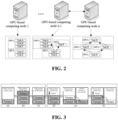
- a node 1 includes a GPU1 and a GPU2, wherein a task D and a task E are simultaneously executed on the GPU1, and a task A, a task B and a task C are simultaneously executed on the GPU2.
- the video memory resources occupied by each task can be dynamically adjusted according to the performance guarantee priorities (referred to as priorities) of the plurality of tasks executed in parallel on the GPU.
- priorities The higher the priority of the task, the more the performance of the task must be guaranteed.
- the priorities of the tasks may be determined according to application requirements, for example, only two priorities are set: a high priority and a low priority. For example, if a learning task 1 of the named entity recognition model is a "performance guarantee task" with a service level guarantee, and a learning task 2 of the speech recognition model is a "speculative execution task" without a service level guarantee, then the task 1 may be set with the high priority, and the task 2 may be set with the low priority.
- Table 1 shows priority setting information of machine learning tasks in an example.
- Table 1 Machine Learning Task Table Task ID Task priority Task 1 (Named Entity Recognition Model) First level (highest priority) Task 2 (Speech Recognition Model) Second level (second highest priority) Task 3 (product recommendation model) Second level (second highest priority) Task 4 (Language Model) Third Level (lowest priority) ...
- Step S 103 if video memory resources are to be allocated for a high-priority task, and the amount of allocatable video memory resources is smaller than the amount of video memory resources required by the high-priority task, releasing at least a part of a video memory space occupied by a low-priority task.
- the video memory management method when allocating the video memory resources to the high-priority task, if the amount of the allocatable video memory resources on the GPU is smaller than the amount of the video memory resources required by the high-priority task, a part or all of a video memory space occupied by the low-priority task should be released, and the released video memory space is allocated to the high-priority task, so as to store tensor data of the high-priority task in a video memory as much as possible, and thus the executing performance of the high-priority task can be guaranteed.
- the amount of the required video memory resources may be the amount of video memory resources to be increased for a deep learning task being executed, or may be the amount of video memory resources initially required by a deep learning task to be executed.
- the amount of the required video memory resources may be determined by the deep learning task. Since a method for determining the amount of the required video memory resources belongs to a well-known prior art, it is not repeated here.
- the video memory resources required by the task is determined first. After determining the video memory resources required by the task, if the amount of the allocatable video memory resources of the GPU is smaller than the amount of the video memory resource required by the task, the priority of the task and the priorities of other tasks that are executed on the GPU should be determined. If the priority of the task to be executed is higher than the priorities of the other tasks being executed, the video memory resources occupied by the low-priority task should be releases to guarantee the performance of the high-priority task.
- the amount of the video memory resources that should be released may be determined according to the amount of the video memory resources required by the task to be executed. For example, if the high-priority task needs 1G video memory resources, 1.2 G video memory resources occupied by the low-priority task may be released.
- the video memory resources occupied by one or the plurality of low-priority tasks may be released.
- the video memory resources occupied by the plurality of low-priority tasks may be released to release the video memory resources more than 5G.
- the method may further include the following steps: releasing idle video memory resources occupied by the plurality of machine learning tasks.
- the inventors found that most deep learning tasks cannot fully utilize all of the allocated GPU memory resources at all times, and usually have idle video memory resources. Through research, the inventors have found that the idle video memory resources of the deep learning tasks may be caused by the following reasons.
- the idle video memory resources will not be released, but will be always reserved for the task.
- the whole video memory resources occupied by the task are not reduced, and a part of the video memory resources are idle video memory resources.
- the task may use these video memory resources, e.g., for storing other tensor data, or may not use these video memory resources, thereby results in a relatively low utilization rate of the GPU resources in many cases.
- the idle video memory resources that are not used by the tasks are released, and thus can be timely allocated to other tasks, to realize optimization of the processing of the plurality of tasks in a shared GPU resource scenario, and prevent the other tasks from queuing up. Therefore, a resource utilization rate of the GPU is improved, and then throughput of the shared GPU cluster can be improved.
- the releasing idle video memory resources occupied by the plurality of machine learning tasks may include the following sub-steps: 1) determining usage status information of video memory resources of the machine learning task; and 2) if the information satisfies a video memory resource release condition, releasing idle video memory resources.
- the usage status information includes: an upper limit of the video memory resources actually used by the task.
- the release condition includes: a duration during which the amount of video memory resources allocated to the task is larger than the upper limit reaches a duration threshold. For example, during the executing of the task, the upper limit value (peak value) of the video memory resources that are actually used is determined every 10 seconds. When the amount of the video memory resources occupied by the task is larger than the peak value that is actually needed for 30 consecutive seconds (after the usage status information has been determined three times), the idle video memory resources will be released.
- the releasing at least a part of a video memory space occupied by a low-priority task may include the following sub-steps: if the amount of idle video memory resources of the low-priority task is larger than or equal to the amount of required video memory resources, releasing the idle video memory resources occupied by the low-priority task.
- both types of tasks may be executed based on data stored in the video memory space, so that not only the executing performance of the high-priority task can be guaranteed, but also the performance of the low-priority task can be prevented from being affected.
- the releasing at least a part of a video memory space occupied by a low-priority task may further include the following sub-steps: if the amount of idle video memory resources of the low-priority task is smaller than the amount of required video memory resources, allocating internal memory resources to the low-priority task, and releasing at least a part of video memory resources used by the low-priority task, so as to continue to execute the low-priority task at least according to tensor data in an internal memory space.
- the video memory resources used by the low-priority task are not idle video memory resources, and the tensor data of the low-priority tasks is still stored in these video memory resources which are needed by the low-priority task needs to guarantee the executing performance. However, a part or all of the video memory resources used by the low-priority task are released, and a part or all of the tensor data of the low-priority task is temporarily transferred from the video memory space to the internal memory space for storage, so that the low-priority task can be executed continuously at least according to the tensor data in the internal memory space.
- the low-priority task can be executed continuously based on one part of the tensor data in the internal memory space and another part of the tensor data in the video memory space. If all of the video memory resources used by the low-priority task are released, the low-priority task can be executed continuously based on all of the tensor data in the internal memory space. Hence, no matter what the situation is, the task will not fail.
- the video memory resources occupied by the tensor data of the low-priority task need to be further released, and all or part of tensor data of the low-priority task are transferred to the internal memory space of the host machine of the GPU for storage, to execute the low-priority task at least based on the tensor data in the internal memory space. Therefore, the low-priority task and the high-priority task can be prevented from competing for the video memory resources, and the performance of the high-priority task can be guaranteed, at the cost of sacrificing part of the performance of the low-priority task.
- a sub-figure (a) shows video memory resources occupied by a deep learning task in an initial stage, including a tensor of data, wherein the height of a dotted line indicates a level of the occupied video memory resources.
- a sub-figure (b) shows that an upper limit of video memory usage increases with a corresponding increase of tensor data required by the task.
- These tensor data may be cached in a pool of an internal memory allocator (a video memory resource allocator) of the task, that is, cached in a video memory space allocated to the task, so that next small-batch tensor data of the task can be reused.
- the enlarged video memory resource of the task may accommodate three tensors of data. With continuous executing of the task, some tensor data are only used in a specific deep learning training stage, and these tensor data will not be used after the stage and will be cleared from the video memory, thereby causing idle video memory resources.
- a sub-figure (c) shows that after one tensor of data is cleared, idle video memory resources appear, while the level of the video memory resources does not change.
- the upper limit of video memory usage is dynamically adjusted according to the video memory resources actually required by the task.
- the video memory resources currently in use are actively detected, and the idle video memory resources are released, thereby adjusting the upper limit of video memory usage to an appropriate value.
- a sub-figure (d) shows the level of the video memory resources after the available video memory (idle video memory resources) is recycled (released), after the foregoing available video memory has not been used for a period of time.
- a deep learning system opens an interface to the outside, which allows the upper limit of GPU video memory usage for the task to be raised or reduced when the task is executed, and even reduced to a value lower than an actual requirement of the task.
- a sub-picture (e) may show a situation that when there is a high-priority task and the allocatable video memory is insufficient, a tensor of data of a low-priority task is transferred to an internal memory space of a host machine, so that the released video memory resources can be allocated to the high-priority task, to guarantee the performance of the high-priority task.
- the method may further include the following steps: if the amount of the allocatable video memory resources increases to the amount of the video memory resources required by the low-priority task, allocating the video memory resources to the low-priority task, so as to continue to execute the low-priority task according to the tensor data in the video memory space.
- a sub-figure (f) shows a situation that when the GPU video memory resources are no longer in shortage, the tensor data of the low-priority task is transferred from the internal memory space to the video memory space again, so as to improve the performance of the low-priority task as much as possible.
- the low-priority tasks include: iterative learning tasks.
- the releasing the video memory resources used by the low-priority task may be implemented in the following manner: after the low-priority task completes current iterative learning, releasing the used video memory resources.
- the tensor is a data unit for storing data in a deep learning framework.
- the tensor may store data during training, and a task may include a plurality of tensors in one training.
- Tensor data may be an arbitrary quantity of multi-dimensional arrays composed of a set of original values, including training data for one small-batch training, model parameters generated during training, and data of various intermediate nodes in a network, or the like.
- the utilization rate of the GPU video memory resources is improved under the premise of guaranteeing the executing performance of the high-priority task.
- the internal memory resources can be used as the video memory resources when the video memory resources are insufficient, but this usually causes huge data copy overheads.
- the inventors of the present invention have found that in the deep learning tasks, training is performed in small batches, and the tensor data will be created and destroyed in small batches. The same tensor will be repeatedly created between small batches, so as to choose to dynamically adjust the upper limit of video memory usage for the task on the boundary of the small batches. At this time, the tensor data has been released, so that data copy explicitly performed between the video memory and the internal memory can be avoided, thereby avoiding huge copy overheads.
- the method may further include the following step: allocating a part of internal memory resources and a part of video memory resources to the high-priority task, so as to execute the high-priority task according to the tensor data in the internal memory space and the tensor data in the video memory space.
- the method may further include the following step: releasing the internal memory resources of the high-priority task, so that the high-priority task can be executed completely based on the tensor data in the video memory space.
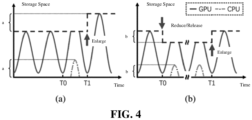
- video memory resources required by a high-priority task suddenly increase at time T0, the required video memory resources are denoted as a.
- allocatable video memory resources are insufficient, so that a is first occupied in an internal memory space, and the high-priority task is executed temporarily based on the tensor data in an internal memory.
- video memory resources b used by a low-priority task is released, and b is occupied in an internal memory space.
- the low-priority task is executed based on tensor data in an internal memory space, and thus part of the operating performance is lost.
- the video memory resources of the low-priority task at time T1 are increased by b, and the low-priority task is continuously executed based on tensor data in a video memory space.
- not only a video memory space occupied by the low-priority task can be released, but also an idle video memory space occupied by other high-priority tasks can be released.
- an idle video memory space occupied by other high-priority tasks can be released.
- the method may further include S105: according to the video memory space released from the low-priority task, allocating the video memory space to the high-priority level task so as to execute the high-priority task at least according to tensor data in a video memory.
- the priorities of the plurality of machine learning tasks executed by the graphics processing unit are determined; if the video memory resources are to be allocated to the high-priority task, and the amount of the allocatable video memory resources is smaller than the amount of the video memory resources required by the high-priority task, at least a part of the video memory resources occupied by the low-priority task are released; and the video memory resources are allocated to the high-priority task, so as to execute the high-priority task at least according to the tensor data in the video memory space.
- Such processing mode allocates the video memory resources occupied by the low-priority task to the high-priority task when the allocatable video memory resources are insufficient, thereby realizing dynamic scaling optimization of the GPU video memory resources occupied by the plurality of machine learning tasks executed in parallel on the GPU, and in this way, the GPU video memory resources can be allocated to the other tasks under the premise of guaranteeing the performance of the high-priority task. Therefore, a resource utilization rate of a whole cluster can be improved, and meanwhile the performance of the high-priority task is guaranteed.
- a video memory management method is provided, and correspondingly, the present application further provides a video memory management apparatus.
- the apparatus corresponds to the foregoing method embodiments. Since the apparatus embodiments are basically similar to the method embodiments, the apparatus embodiments are simply described, and for relevant parts, reference can be made to part of the description of the method embodiments. The apparatus embodiments described below are illustrative only.
- FIG. 5 is a schematic structural diagram of an embodiment of a video memory management apparatus according to the present application.
- the present application further provides a video memory management apparatus, including:
- a video memory management method is provided, and correspondingly, the present application further provides an electronic device.
- the device corresponds to the foregoing method embodiments. Since the device embodiment is basically similar to the method embodiments, the device embodiments are simply described, and for relevant parts, reference can be made to part of the description of the method embodiments. The device embodiments described below are illustrative only.
- the electronic device includes a processor and a memory, wherein the memory is configured to store a program for implementing a video memory management method, and after being powered on and executing the program of the method by the processor, the device performs the following steps: determining priorities of a plurality of machine learning tasks executed by a graphics processing unit; if video memory resources are to be allocated for a high-priority task, and an allocatable video memory space is smaller than a video memory space required by the high-priority task, releasing at least a part of a video memory space of a low-priority task; and allocating the video memory space to the high-priority task according to the video memory space released from the low-priority task, so as to execute the high-priority task at least according to tensor data in a video memory.
- the present application further provides a video memory management method.
- the parts in this embodiment that are the same as those in the first embodiment will not be described again, please refer to the corresponding parts in the first embodiment.
- the method may include the following steps:
- the machine learning tasks include, but are not limited to, deep learning tasks.
- the idle video memory resources may include at least one of the following resources: idle video memory resources generated by modules that cannot be processed in parallel in the deep learning task, and idle video memory resources generated when a plurality of resources required by the deep learning task are satisfied.
- the machine learning task may be a distributed deep learning task.
- the idle video memory resources may be idle video memory resources generated when a plurality of image processing units corresponding to a distributed deep learning task synchronize data.
- the idle video memory resources of the deep learning task may be caused by the following reasons.
- the usage status information includes, but is not limited to: an upper limit of the video memory resources actually used by the task.
- the release condition includes, but is not limited to: a duration during which the amount of video memory resources allocated to the task is larger than the upper limit reaches a duration threshold.
- the duration threshold may be determined according to application requirements, for example, set to 30 seconds.
- the upper limit value (peak value) of the video memory resources that are actually used is determined every 10 seconds.
- the amount of the video memory resources occupied by the task is larger than the peak value that is actually needed for 30 consecutive seconds (after the usage status information is determined three times), the idle video memory resources will be released.
- the machine learning task is executed by the graphics processing unit; the usage status information of the video memory resources of the machine learning task is determined; if the information satisfies a video memory resources release condition, the idle video memory resources occupied by the task are released, so as to allocate the idle video memory resources to other machine learning tasks executed in parallel by the graphics processing unit. Due to such processing method, the idle video memory resources occupied by the task are released in time. Therefore, a resource utilization rate of a whole cluster can be effectively improved.
- a video memory management method is provided, and correspondingly, the present application further provides a video memory management apparatus.
- the apparatus corresponds to the foregoing method embodiment. Since the apparatus embodiment is basically similar to the method embodiment, the apparatus embodiment is simply described, and for relevant parts, reference can be made to part of the description of the method embodiment. The apparatus embodiment described below is illustrative only.
- the apparatus includes:
- a video memory management method is provided, and correspondingly, the present application further provides an electronic device.
- the device corresponds to the foregoing method embodiment. Since the device embodiment is basically similar to the method embodiment, the device embodiment is simply described, and for relevant parts, reference can be made to part of the description of the method embodiment. The device embodiment described below is illustrative only.
- the electronic device includes a processor and a memory, wherein the memory is configured to store a program for implementing a video memory management method, and after being powered on and executing the program of the method by the processor, the device performs the following steps: executing a machine learning task by a graphics processing unit; determining the usage status information of video memory resources of the machine learning task; if the information satisfies a video memory resource release condition, releasing idle video memory resources occupied by the task, so as to allocate the idle video memory resources to other machine learning tasks executed in parallel by the graphics processing unit.
- the present application further provides a video memory management system.
- the parts in this embodiment that are the same as those in the first embodiment will not be described again, please refer to the corresponding parts in the first embodiment.
- FIG. 6 is a schematic structural diagram of an embodiment of a video memory management apparatus according to the present application.
- the video memory management system provided by the present invention includes: a storage resource coordinator, a storage resource allocator (a first storage resource allocator) of low-priority tasks (such as a task A), and a storage resource allocator (a second storage resource allocator) of low-priority tasks (such as a task B).
- the system provided by this embodiment realizes adaptive dynamic scaling optimization of GPU video memory resources for machine learning tasks through co-design of the storage resource coordinator and a machine learning computing framework.
- the storage resource coordinator supports adaptive GPU video memory resource adjustment, and can be deployed in a GPU computing node to schedule and manage memory resources of one or more GPUs in the node, to dynamically adjust the usage of the GPU video memory resources for a plurality of tasks on one GPU.
- the machine learning computing framework corresponds to machine learning tasks, and each task is executed by the machine learning computing framework.
- the machine learning computing framework may be an end-to-end machine learning platform, and various machine learning frameworks can have own ecosystems, which include various tools, libraries and other resources, and can help developers easily build and deploy applications supported by machine learning.
- the machine learning computing framework is a deep learning computing framework, including but not limited to TensorFlow, PyTorch, MXNet, Caffe, etc.
- the storage resource coordinator is configured to determine priorities of a plurality of machine learning tasks executed by a graphics processing unit. If video memory resources are to be allocated to a high-priority task, and the amount of allocatable video memory resources is smaller than the amount of video memory resources required by the high-priority task, a video memory resource release instruction is sent to the storage resource allocator of low-priority tasks, and a video memory resource allocation instruction is sent to the storage resource allocator of low-priority tasks (a second storage resource allocator).
- the storage resource allocator of low-priority tasks is configured to release at least a part of video memory resources occupied by a low-priority task according to the release instruction.
- the storage resource allocator of high-priority tasks is configured to allocate the video memory resources to the high-priority task according to the allocation instruction, so as to execute the high-priority task at least according to tensor data of a video memory space.
- the allocator is further configured to send the usage status information of the video memory resources of the machine learning tasks.
- the allocator can send the information to the coordinator according to a preset period.
- the coordinator is further configured to send a video memory resource release instruction to the allocator if the information satisfies a video memory resource release condition.
- the priorities of the plurality of machine learning tasks executed by the graphics processing unit are determined by the storage resource coordinator. If video memory resources are to be allocated for the high-priority task and the amount of the allocatable video memory resources is smaller than the amount of the video memory resources required by the high-priority task, the video memory resource release instruction is sent to the first storage resource allocator of low-priority tasks, and the video memory resource allocation instruction is sent to the second storage resource allocator of low-priority tasks; the first storage resource allocator releases at least a part of the video memory resources occupied by the low-priority task according to the release instruction; the second storage resource allocator allocates the video memory resources to the high-priority task according to the allocation instruction, so as to execute the high-priority task at least according to the tensor data in the video memory space.
- Such processing mode allocates the video memory resources occupied by the low-priority task to the high-priority task by the local storage resource coordinator of the GPU device when the allocatable video memory resources are insufficient, thereby realizing dynamic scaling optimization of the GPU video memory resources occupied by the plurality of machine learning tasks executed in parallel on the GPU, and in this way, the GPU video memory resources can be allocated to the other tasks under the premise of guaranteeing the performance of the high-priority task. Therefore, a resource utilization rate of a whole cluster can be improved, and meanwhile the performance of the high-priority task is guaranteed.
- the present application further provides a machine learning system.
- the parts in this embodiment that are the same as those in the first embodiment will not be described again, please refer to the corresponding parts in the first embodiment.
- the machine learning system provided by the present application includes a client and a server.
- the client is configured to send the priority information of machine learning tasks to the server.
- the server is configured to determine the priorities of the plurality of machine learning tasks executed by a graphics processing unit; if video memory resources are to be allocated for a high-priority task and the amount of allocatable video memory resources is smaller than the amount of video memory resources required by the high-priority task, release at least a part of the video memory resources occupied by a low-priority task; and allocate the video memory resources to the high-priority task, so as to execute the high-priority task at least according to tensor data in a video memory space.
- the client includes, but is not limited to, mobile communication devices, that is, mobile phones or smart phones, as well as personal computers, personal digital assistants (PADs), iPads and other terminal device.
- the server may execute the machine learning tasks on a GPU cluster.
- a task service apparatus may be provided for a user via the client, and the user may determine a machine learning task to be executed by the task service apparatus of the client, and set the priority of the task, for example, selecting "second level" priority, and different service charges may need to be paid for different priorities.
- the client may submit a task executing request to the server.
- the server may store the priority information of the task and store the task in a task table.
- the server may include one or more GPU computing nodes, each node may execute the machine learning task in a machine learning framework, and a storage resource coordinator deployed in the GPU computing node may obtain the priority information of the plurality of tasks that are to be executed by the computing node.
- Table 2 shows machine learning task information in this embodiment. Table 2.
- Machine Learning Task Table Task ID User ID Task priority Task 1 (Named Entity Recognition Model) User A First level (Performance Guarantee Tasks) Task 2 (Named Entity Recognition Model) User B Second level (speculative execution tasks) Task 3 (product recommendation model) User C Second level (speculative execution tasks) Task 4 (Language Model) User C First level (Performance Guarantee Tasks) ...
- the learning task 1 of the named entity recognition model of the user A is a "performance guarantee task”
- the learning task 2 of the named entity recognition model of the user B is a "speculative execution task”
- the priority of the "performance guarantee task” is higher than the priority of the "speculative execution task”.
- the following operations can be performed: if video memory resources are to be allocated to the high-priority task, and the amount of the allocatable video memory resources is smaller than the amount of the video memory resources required by the high-priority task, releasing at least a part of the video memory resources occupied by the low-priority task; and allocating the video memory resources to the high-priority task, so as to execute the high-priority task at least according to the tensor data in the video memory space.
- the server is further configured to determine the performance information of the machine learning tasks; and adjust the priorities of the tasks according to the performance information.
- the priority of the task A is originally the second level, but the performance of the task does not meet service level requirements of the "second level” required by the user by the system, so that the priority of the task may be adjusted to the first level, and thus the actual performance of the task can meet the service level requirements of the "second level” required by the user.
- the server can record the change information of the video memory resources during the executing of the machine learning task, and adjust the priority information of the task according to the change information. For example, if a high-priority task is executed 30% of the time based on tensor data in an internal memory space, the performance information of the task does not meet the service level requirements, and therefore, the priority of the task can be increased.
- the server is further configured to determine the performance information of the machine learning tasks; and determine the priorities of the machine learning tasks that can be served.
- a video memory resource management service can be provided for the task A and the task B.
- the client sends the priority information of the machine learning tasks to the server; the server determines the priorities of the plurality of machine learning tasks executed by the graphics processing unit; if video memory resources are to be allocated for the high-priority task and the amount of the allocatable video memory resources is smaller than the amount of the video memory resources required by the high-priority task, at least a part of the video memory resources occupied by the low-priority task are released; and the video memory resources are allocated to the high-priority task, so as to execute the high-priority task at least according to the tensor data in the video memory space.
- Such processing mode allocates the video memory resources occupied by the low-priority task to the high-priority task when the allocatable video memory resources are insufficient, thereby realizing dynamic scaling optimization of the GPU video memory resources occupied by the plurality of machine learning tasks executed in parallel on the GPU, and in this way, the GPU video memory resources are allocated to the other tasks under the premise of guaranteeing the performance of the high-priority task. Therefore, a resource utilization rate of a whole cluster can be improved, and meanwhile the performance of the high-priority task is guaranteed.
- a computing device includes one or more processors (CPUs), an input/output interface, a network interface, and a memory.
- the memory may include a volatile memory, a random access memory (RAM), and/or a non-volatile memory in computer-readable media, e.g., a read-only memory (ROM) or a flash RAM.
- RAM random access memory
- ROM read-only memory
- flash RAM flash random access memory
Landscapes
- Engineering & Computer Science (AREA)
- Theoretical Computer Science (AREA)
- Physics & Mathematics (AREA)
- Software Systems (AREA)
- General Physics & Mathematics (AREA)
- General Engineering & Computer Science (AREA)
- Artificial Intelligence (AREA)
- Data Mining & Analysis (AREA)
- Evolutionary Computation (AREA)
- Mathematical Physics (AREA)
- Computing Systems (AREA)
- Computer Vision & Pattern Recognition (AREA)
- Medical Informatics (AREA)
- Biomedical Technology (AREA)
- Molecular Biology (AREA)
- General Health & Medical Sciences (AREA)
- Computational Linguistics (AREA)
- Biophysics (AREA)
- Life Sciences & Earth Sciences (AREA)
- Health & Medical Sciences (AREA)
- Memory System Of A Hierarchy Structure (AREA)
- Memory System (AREA)
- Two-Way Televisions, Distribution Of Moving Picture Or The Like (AREA)
Applications Claiming Priority (2)
| Application Number | Priority Date | Filing Date | Title |
|---|---|---|---|
| CN202011219652.6A CN114443263B (zh) | 2020-11-03 | 2020-11-03 | 显存管理方法、装置、设备及系统 |
| PCT/CN2021/127856 WO2022095815A1 (fr) | 2020-11-03 | 2021-11-01 | Procédé et appareil de gestion de mémoire de carte graphique, dispositif et système |
Publications (2)
| Publication Number | Publication Date |
|---|---|
| EP4242843A1 true EP4242843A1 (fr) | 2023-09-13 |
| EP4242843A4 EP4242843A4 (fr) | 2023-09-13 |
Family
ID=81361391
Family Applications (1)
| Application Number | Title | Priority Date | Filing Date |
|---|---|---|---|
| EP21888512.7A Pending EP4242843A4 (fr) | 2020-11-03 | 2021-11-01 | Procédé et appareil de gestion de mémoire de carte graphique, dispositif et système |
Country Status (4)
| Country | Link |
|---|---|
| US (2) | US12292821B2 (fr) |
| EP (1) | EP4242843A4 (fr) |
| CN (1) | CN114443263B (fr) |
| WO (1) | WO2022095815A1 (fr) |
Families Citing this family (20)
| Publication number | Priority date | Publication date | Assignee | Title |
|---|---|---|---|---|
| CN109325494B (zh) * | 2018-08-27 | 2021-09-17 | 腾讯科技(深圳)有限公司 | 图片处理方法、任务数据处理方法和装置 |
| CN114443263B (zh) | 2020-11-03 | 2025-06-06 | 阿里巴巴集团控股有限公司 | 显存管理方法、装置、设备及系统 |
| US12504991B1 (en) * | 2021-11-30 | 2025-12-23 | Teradata Us, Inc. | Workload memory management to achieve service level goals in a highly concurrent database system executing in a cloud and/or on-prem systems |
| CN114968567B (zh) * | 2022-05-17 | 2026-02-10 | 北京百度网讯科技有限公司 | 用于分配计算节点的计算资源的方法、装置和介质 |
| CN114675976B (zh) * | 2022-05-26 | 2022-09-16 | 深圳前海环融联易信息科技服务有限公司 | 基于kubernetes的GPU共享方法、装置、设备及介质 |
| CN114896070B (zh) * | 2022-06-01 | 2025-11-28 | 中国科学院计算技术研究所 | 一种用于深度学习任务的gpu资源分配方法 |
| CN115061800A (zh) * | 2022-06-30 | 2022-09-16 | 中国联合网络通信集团有限公司 | 边缘计算任务的处理方法、边缘服务器及存储介质 |
| CN115509704A (zh) * | 2022-09-20 | 2022-12-23 | 联想(北京)有限公司 | 一种任务调度方法、装置、设备及存储介质 |
| CN115292199B (zh) * | 2022-09-22 | 2023-03-24 | 荣耀终端有限公司 | 一种显存泄露的处理方法及相关装置 |
| CN116010092B (zh) * | 2022-12-28 | 2026-02-06 | 中国电信股份有限公司 | 显存资源分配方法及装置 |
| CN116643860A (zh) * | 2023-04-26 | 2023-08-25 | 国家气象信息中心(中国气象局气象数据中心) | 针对气象机器学习算法运行的优先级调度方法、系统、电子设备和计算机程序产品 |
| US20250199856A1 (en) * | 2023-12-15 | 2025-06-19 | Red Hat, Inc. | Real-time application prioritization |
| CN117435521B (zh) * | 2023-12-21 | 2024-03-22 | 西安芯云半导体技术有限公司 | 基于gpu渲染的纹理显存映射方法、装置及介质 |
| CN118312333B (zh) * | 2024-06-07 | 2024-10-18 | 支付宝(杭州)信息技术有限公司 | 基于GPU多stream并发的显存复用方法和装置 |
| CN118427120B (zh) * | 2024-07-04 | 2024-11-01 | 北京壁仞科技开发有限公司 | 一种分组归一化算子的执行方法、设备及存储介质 |
| WO2026019279A1 (fr) * | 2024-07-17 | 2026-01-22 | Samsung Electronics Co., Ltd. | Dispositifs électroniques de gestion de mémoire à base d'indices et procédés pour modèles d'intelligence artificielle génératifs |
| CN118672788B (zh) * | 2024-08-20 | 2025-01-10 | 淘宝(中国)软件有限公司 | 流媒体的数据处理系统、方法、设备、存储介质及程序产品 |
| KR20260030224A (ko) * | 2024-08-26 | 2026-03-06 | 주식회사 딥엑스 | 프로세싱 코어를 제어하기 위한 시스템 및 방법 |
| CN118796477B (zh) * | 2024-09-10 | 2025-01-03 | 中国人民解放军国防科技大学 | Ai框架上的昆仑xpu芯片内存分配优化方法及系统 |
| CN119536889B (zh) * | 2024-11-22 | 2026-04-07 | 上海壁仞科技股份有限公司 | 用于管理显存的方法、设备和存储介质 |
Family Cites Families (22)
| Publication number | Priority date | Publication date | Assignee | Title |
|---|---|---|---|---|
| WO2003009144A1 (fr) * | 2001-07-19 | 2003-01-30 | Wind River Systems, Inc. | Systeme de gestion memoire |
| US8892827B2 (en) * | 2011-01-07 | 2014-11-18 | Apple Inc. | Cooperative memory management |
| JP2012221217A (ja) * | 2011-04-08 | 2012-11-12 | Sony Corp | メモリ管理装置、メモリ管理方法、および、制御プログラム |
| CN102331918B (zh) * | 2011-07-07 | 2014-04-30 | 曙光信息产业股份有限公司 | 一种龙芯刀片集成显卡 |
| US9170859B2 (en) * | 2012-06-07 | 2015-10-27 | Apple Inc. | Targeted memory pressure event notifications |
| US9940053B2 (en) * | 2014-05-28 | 2018-04-10 | Nec Corporation | Information processing device, information processing system, memory management method, and program recording medium |
| US10733090B1 (en) * | 2014-11-07 | 2020-08-04 | Amazon Technologies, Inc. | Memory management in a system with discrete memory regions |
| US9678854B2 (en) * | 2015-05-15 | 2017-06-13 | International Business Machines Corporation | Application-centric analysis of leak suspect operations |
| JP6541930B2 (ja) * | 2017-05-17 | 2019-07-10 | 三菱電機株式会社 | メモリ管理システム、情報処理装置およびメモリの管理方法 |
| US11461869B2 (en) * | 2018-03-14 | 2022-10-04 | Samsung Electronics Co., Ltd. | Slab based memory management for machine learning training |
| JP6793316B2 (ja) * | 2018-03-30 | 2020-12-02 | パナソニックIpマネジメント株式会社 | 電子機器、制御方法、及び、プログラム |
| CN109828833B (zh) * | 2018-11-02 | 2020-09-29 | 上海帆一尚行科技有限公司 | 一种神经网络训练任务的排队系统及其方法 |
| CN109766183A (zh) * | 2018-12-28 | 2019-05-17 | 郑州云海信息技术有限公司 | 一种集群gpu复用及智能负载的方法及系统 |
| CN111400022A (zh) * | 2019-01-02 | 2020-07-10 | 中国移动通信有限公司研究院 | 一种资源调度方法、装置及电子设备 |
| US11301296B2 (en) * | 2019-05-31 | 2022-04-12 | Apple Inc. | Memory management based on classification of a software process |
| KR102086757B1 (ko) * | 2019-07-31 | 2020-03-09 | 서강대학교 산학협력단 | Gpu 메모리 스케줄러 및 이를 이용한 gpu 메모리 선점 방법 |
| CN110457135A (zh) * | 2019-08-09 | 2019-11-15 | 重庆紫光华山智安科技有限公司 | 一种资源调度方法、装置及共享gpu显存的方法 |
| CN111078395B (zh) * | 2019-11-12 | 2023-06-20 | 华中科技大学 | 一种基于张量的深度学习gpu内存管理优化方法及系统 |
| CN111124691B (zh) * | 2020-01-02 | 2022-11-25 | 上海交通大学 | 多进程共享的gpu调度方法、系统及电子设备 |
| CN111768006B (zh) * | 2020-06-24 | 2024-09-06 | 北京金山云网络技术有限公司 | 一种人工智能模型的训练方法、装置、设备及存储介质 |
| CN111737019B (zh) * | 2020-08-31 | 2020-12-11 | 西安芯瞳半导体技术有限公司 | 一种显存资源的调度方法、装置及计算机存储介质 |
| CN114443263B (zh) | 2020-11-03 | 2025-06-06 | 阿里巴巴集团控股有限公司 | 显存管理方法、装置、设备及系统 |
-
2020
- 2020-11-03 CN CN202011219652.6A patent/CN114443263B/zh active Active
-
2021
- 2021-11-01 WO PCT/CN2021/127856 patent/WO2022095815A1/fr not_active Ceased
- 2021-11-01 EP EP21888512.7A patent/EP4242843A4/fr active Pending
-
2023
- 2023-04-25 US US18/306,636 patent/US12292821B2/en active Active
-
2025
- 2025-04-02 US US19/098,330 patent/US20250231867A1/en active Pending
Also Published As
| Publication number | Publication date |
|---|---|
| CN114443263A (zh) | 2022-05-06 |
| US20230297498A1 (en) | 2023-09-21 |
| US12292821B2 (en) | 2025-05-06 |
| CN114443263B (zh) | 2025-06-06 |
| WO2022095815A1 (fr) | 2022-05-12 |
| EP4242843A4 (fr) | 2023-09-13 |
| US20250231867A1 (en) | 2025-07-17 |
Similar Documents
| Publication | Publication Date | Title |
|---|---|---|
| US12292821B2 (en) | Video memory management method, apparatus, device and system | |
| Xiao et al. | {AntMan}: Dynamic scaling on {GPU} clusters for deep learning | |
| US12608238B2 (en) | Resource scheduling method, electronic device, and storage medium | |
| WO2024245038A1 (fr) | Procédé et appareil de planification de ressources informatiques virtuelles en nuage | |
| CN114968567B (zh) | 用于分配计算节点的计算资源的方法、装置和介质 | |
| CN110493317B (zh) | 处理云平台资源碎片的方法及相关设备 | |
| CN112445615A (zh) | 一种线程的调度系统、计算机设备和存储介质 | |
| CN111427675A (zh) | 一种数据处理方法、装置以及计算机可读存储介质 | |
| CN116149843B (zh) | 基于动态规划的资源分配方法、网络及存储介质和处理器 | |
| WO2024245037A1 (fr) | Procédé de planification de ressources informatiques virtuelles et composant de plan de commande | |
| CN119248525B (zh) | 推理系统的内存管理方法和装置 | |
| CN116010051A (zh) | 一种联邦学习多任务调度方法及装置 | |
| WO2025224527A1 (fr) | Procédé de planification de tâche applicable à un grand modèle de langage (llm), et dispositif informatique, support de stockage et produit programme d'ordinateur | |
| CN114546587A (zh) | 一种在线图像识别服务的扩缩容方法及相关装置 | |
| CN114138441B (zh) | 一种集群管理任务调度的方法及装置 | |
| CN119248522B (zh) | 推理系统的内存管理方法和装置 | |
| CN115586961A (zh) | 一种ai平台计算资源任务调度方法、装置及介质 | |
| CN115509704A (zh) | 一种任务调度方法、装置、设备及存储介质 | |
| CN114629960A (zh) | 资源调度方法、装置、系统、设备、介质和程序产品 | |
| CN111400021B (zh) | 一种深度学习方法、装置及系统 | |
| CN115632993B (zh) | 流量控制方法及装置 | |
| CN111966456A (zh) | 一种容器显存动态分配方法、装置、设备 | |
| CN120335976A (zh) | 一种资源配置方法、电子设备及存储介质 | |
| CN117519930A (zh) | 批量任务的执行方法、装置及电子设备 | |
| CN115168057B (zh) | 基于k8s集群的资源调度方法及装置 |
Legal Events
| Date | Code | Title | Description |
|---|---|---|---|
| STAA | Information on the status of an ep patent application or granted ep patent |
Free format text: STATUS: THE INTERNATIONAL PUBLICATION HAS BEEN MADE |
|
| PUAI | Public reference made under article 153(3) epc to a published international application that has entered the european phase |
Free format text: ORIGINAL CODE: 0009012 |
|
| STAA | Information on the status of an ep patent application or granted ep patent |
Free format text: STATUS: REQUEST FOR EXAMINATION WAS MADE |
|
| 17P | Request for examination filed |
Effective date: 20230602 |
|
| A4 | Supplementary search report drawn up and despatched |
Effective date: 20230721 |
|
| AK | Designated contracting states |
Kind code of ref document: A1 Designated state(s): AL AT BE BG CH CY CZ DE DK EE ES FI FR GB GR HR HU IE IS IT LI LT LU LV MC MK MT NL NO PL PT RO RS SE SI SK SM TR |
|
| DAV | Request for validation of the european patent (deleted) | ||
| DAX | Request for extension of the european patent (deleted) | ||
| P01 | Opt-out of the competence of the unified patent court (upc) registered |
Free format text: CASE NUMBER: APP_48046/2024 Effective date: 20240821 |
|
| STAA | Information on the status of an ep patent application or granted ep patent |
Free format text: STATUS: EXAMINATION IS IN PROGRESS |
|
| 17Q | First examination report despatched |
Effective date: 20250826 |