EP4243635B1 - Procédé et dispositif de détection de défauts de capsule dans un filtre de l'industrie du traitement du tabac - Google Patents
Procédé et dispositif de détection de défauts de capsule dans un filtre de l'industrie du traitement du tabac Download PDFInfo
- Publication number
- EP4243635B1 EP4243635B1 EP21801507.1A EP21801507A EP4243635B1 EP 4243635 B1 EP4243635 B1 EP 4243635B1 EP 21801507 A EP21801507 A EP 21801507A EP 4243635 B1 EP4243635 B1 EP 4243635B1
- Authority
- EP
- European Patent Office
- Prior art keywords
- capsule
- filter
- threshold value
- value
- density
- Prior art date
- Legal status (The legal status is an assumption and is not a legal conclusion. Google has not performed a legal analysis and makes no representation as to the accuracy of the status listed.)
- Active
Links
Images
Classifications
-
- A—HUMAN NECESSITIES
- A24—TOBACCO; CIGARS; CIGARETTES; SIMULATED SMOKING DEVICES; SMOKERS' REQUISITES
- A24C—MACHINES FOR MAKING CIGARS OR CIGARETTES
- A24C5/00—Making cigarettes; Making tipping materials for, or attaching filters or mouthpieces to, cigars or cigarettes
- A24C5/14—Machines of the continuous-rod type
- A24C5/18—Forming the rod
- A24C5/1814—Forming the rod containing parts of different densities, e.g. dense ends
-
- A—HUMAN NECESSITIES
- A24—TOBACCO; CIGARS; CIGARETTES; SIMULATED SMOKING DEVICES; SMOKERS' REQUISITES
- A24C—MACHINES FOR MAKING CIGARS OR CIGARETTES
- A24C5/00—Making cigarettes; Making tipping materials for, or attaching filters or mouthpieces to, cigars or cigarettes
- A24C5/14—Machines of the continuous-rod type
- A24C5/18—Forming the rod
- A24C5/1821—Forming the rod containing different tobacco mixtures, e.g. composite rods
-
- A—HUMAN NECESSITIES
- A24—TOBACCO; CIGARS; CIGARETTES; SIMULATED SMOKING DEVICES; SMOKERS' REQUISITES
- A24C—MACHINES FOR MAKING CIGARS OR CIGARETTES
- A24C5/00—Making cigarettes; Making tipping materials for, or attaching filters or mouthpieces to, cigars or cigarettes
- A24C5/14—Machines of the continuous-rod type
- A24C5/18—Forming the rod
- A24C5/1892—Forming the rod with additives, e.g. binding agent, flavorants
-
- A—HUMAN NECESSITIES
- A24—TOBACCO; CIGARS; CIGARETTES; SIMULATED SMOKING DEVICES; SMOKERS' REQUISITES
- A24C—MACHINES FOR MAKING CIGARS OR CIGARETTES
- A24C5/00—Making cigarettes; Making tipping materials for, or attaching filters or mouthpieces to, cigars or cigarettes
- A24C5/32—Separating, ordering, counting or examining cigarettes; Regulating the feeding of tobacco according to rod or cigarette condition
- A24C5/34—Examining cigarettes or the rod, e.g. for regulating the feeding of tobacco; Removing defective cigarettes
- A24C5/3412—Examining cigarettes or the rod, e.g. for regulating the feeding of tobacco; Removing defective cigarettes by means of light, radiation or electrostatic fields
-
- A—HUMAN NECESSITIES
- A24—TOBACCO; CIGARS; CIGARETTES; SIMULATED SMOKING DEVICES; SMOKERS' REQUISITES
- A24D—CIGARS; CIGARETTES; TOBACCO SMOKE FILTERS; MOUTHPIECES OF CIGARS OR CIGARETTES; MANUFACTURE OF TOBACCO SMOKE FILTERS OR MOUTHPIECES
- A24D3/00—Tobacco smoke filters, e.g. filter tips or filtering inserts; Filters specially adapted for simulated smoking devices; Mouthpieces of cigars or cigarettes
- A24D3/02—Manufacture of tobacco smoke filters
- A24D3/0204—Preliminary operations before the filter rod forming process, e.g. crimping, blooming
- A24D3/0212—Applying additives to filter materials
- A24D3/0216—Applying additives to filter materials the additive being in the form of capsules, beads or the like
-
- A—HUMAN NECESSITIES
- A24—TOBACCO; CIGARS; CIGARETTES; SIMULATED SMOKING DEVICES; SMOKERS' REQUISITES
- A24D—CIGARS; CIGARETTES; TOBACCO SMOKE FILTERS; MOUTHPIECES OF CIGARS OR CIGARETTES; MANUFACTURE OF TOBACCO SMOKE FILTERS OR MOUTHPIECES
- A24D3/00—Tobacco smoke filters, e.g. filter tips or filtering inserts; Filters specially adapted for simulated smoking devices; Mouthpieces of cigars or cigarettes
- A24D3/02—Manufacture of tobacco smoke filters
- A24D3/0295—Process control means
-
- G—PHYSICS
- G01—MEASURING; TESTING
- G01N—INVESTIGATING OR ANALYSING MATERIALS BY DETERMINING THEIR CHEMICAL OR PHYSICAL PROPERTIES
- G01N22/00—Investigating or analysing materials by the use of microwaves or radio waves, i.e. electromagnetic waves with a wavelength of one millimetre or more
- G01N22/02—Investigating the presence of flaws
-
- G—PHYSICS
- G01—MEASURING; TESTING
- G01N—INVESTIGATING OR ANALYSING MATERIALS BY DETERMINING THEIR CHEMICAL OR PHYSICAL PROPERTIES
- G01N22/00—Investigating or analysing materials by the use of microwaves or radio waves, i.e. electromagnetic waves with a wavelength of one millimetre or more
- G01N22/04—Investigating moisture content
Definitions
- the present invention relates to a method and a device for detecting capsule defects in a filter in the tobacco processing industry.
- Filters from the tobacco processing industry can be in the form of filter rods, cut filter rods or a filter piece connected to a cigarette.
- capsules containing flavourings are incorporated into the filter. These are crushed in the filter immediately before the cigarette is smoked, thus releasing their flavourings into the filter.
- a widely used flavouring is menthol, for example.
- the advantage of using such a filter with one or more incorporated capsules is that the flavourings are already in the filter and are not burned together with the tobacco, but are added to the tobacco smoke unburned. The formation of harmful substances through the combustion of the flavourings can thus be avoided. A change in the flavour through burning with the tobacco can also be ruled out.
- parameters of the capsules can be measured and their quality monitored using suitable sensor systems during production and/or when testing the finished product.
- the parameters of interest for the capsules include their position and distance in the filter as well as their condition, i.e. whether the capsules are intact or damaged.
- a method for measuring mass or density and/or for measuring moisture in a large number of portioned units in a non-metallic carrier material has become known.
- a microwave measuring device consisting of at least one microwave resonator for generating at least one resonance mode measures in a locally limited measuring range.
- the microwave measuring device measures at least one parameter of the resonance mode when only the carrier material without the portioned unit is in the measuring range and when the portioned unit is at least partially in the measuring range.
- An evaluation unit subtracts the parameter measured for the carrier material from the measured values for the portioned unit and determines a value for the moisture and/or for the mass or density of the portioned unit from at least one difference via a characteristic map.
- Out of IT BO 20120394 A1 A method is known with which it is possible to distinguish in a filter in the tobacco processing industry whether a capsule is missing or whether the capsule has already been destroyed. To do this, two recorded profiles of the filter material are compared with each other and threshold values for the detection of a capsule and the detection of moisture leakage in the filter material are determined using statistical methods.
- the invention is based on the object of providing a method and a device which reliably allow an accurate evaluation of the measurement signals relating to a capsule defect for a filter in the tobacco processing industry.
- the object is achieved by a method having the features of claim 1 and by a device having the features of claim 13.
- Advantageous embodiments form the subject matter of the subclaims.
- the method according to the invention for detecting capsule defects in a filter rod in the tobacco processing industry uses a microwave measuring device that measures the density and/or moisture of a filter along its longitudinal direction.
- the maximum value of the measured values is compared with a threshold value in a specific area of the measurement profiles.
- the measured values are indicative of the density and/or moisture, which means that the values for density and/or moisture can be determined from these directly or with the help of other variables.
- the threshold value is undershot, a capsule error in the filter is detected.
- a fluctuation measure for the density and/or moisture is recorded in an area in front of and/or behind a measuring point. Areas around the target positions of the capsules are used as measuring points.
- the value for the fluctuation measure determined for the area is compared with a capsule threshold value for the measured values. If the capsule threshold value is exceeded, a broken capsule is detected.
- the capsule threshold value is equal or undershot, a missing capsule in the filter is detected.
- the value for the fluctuation measure is compared with the capsule threshold value.
- the selection of the measuring points is particularly relevant for the detection of a missing capsule. Only if a capsule is If the capsule is missing, it can be identified as an error. Target positions or expected positions are therefore selected as measuring points.
- the invention is based on the observation that a broken capsule increases fluctuations in the measurement signals and therefore leads to a greater value in the degree of fluctuation than the pure filter, which lacks the capsule and which, without any remains of the broken capsule and/or the leaked flavoring, shows a uniform density and thus a low degree of fluctuation in the measurement signals. Since the second comparison is not based on the measurement signals for density and/or moisture themselves, but on their degree of fluctuation in the area of the capsule defect, reliable information on the condition of the capsule is obtained with little technical effort.
- a best fit line is determined for the measured values in an adjustment area around the measuring point and the degree of fluctuation is determined relative to the best fit line.
- the adjustment area can, for example, have a predetermined distance in front of and behind the measuring point.
- the best fit line is preferably formed by linear regression of the measured values in the adjustment area. The use of a best fit line is based on the insight that humidity and density fluctuations that are not caused by the capsule or its contents change more slowly locally and can therefore be well represented by linear regression.
- the microwave measuring device is designed as a microwave resonator, which measures at least one change in the resonance width and/or a shift in the resonance frequency.
- the filter with or without an inserted capsule changes the dielectric Properties in the microwave resonator. This leads to a broadening of the resonance curve and a shift in its resonance frequency.
- a change in the width of the resonance curve and a shift in the resonance frequency can be evaluated as a humidity and a density value.
- the change in the resonance curve is usually recorded compared to the empty resonator. It is also possible to operate a suitable microwave measuring device with two or more resonance modes and to evaluate the change in the signals between the different resonance modes. In general, it is sufficient for the method according to the invention to measure values for density signals and/or humidity signals and to determine their variations according to the degree of fluctuation in a spatial area.
- the value for the degree of fluctuation is determined for a predetermined section along the longitudinal direction of the filter.
- the sections of this development must be coordinated with the expected target positions for the capsules.
- the predetermined section can, for example, be in front of and/or behind the target position of the capsule for which the measured maxima for density and/or humidity are below the threshold value.
- the predetermined section can also, for example, coincide with the adjustment range for the regression line.
- the positions in which the capsules are expected along the longitudinal direction are predetermined. This can, for example, result from the manufacturing process of the capsule filter strand itself, for example by introducing capsules into the filter at predetermined intervals starting from a starting position.
- the predetermined position can For example, it can also be determined using a specified distance between the capsules, for example by measuring the presence of a capsule when a threshold value is exceeded and from there determining the expected positions for further capsules using given distance values.
- the value for the degree of fluctuation can be determined in an area before and/or after the expected capsule position.
- the values for the degree of fluctuation are calculated continuously, regardless of whether the measured values for density and/or humidity have fallen below the threshold value or not.
- the standard deviation is then evaluated for a previous section of the route if the threshold value is fallen below.
- the filter is a filter rod transported in its longitudinal direction.
- the filter rod is made from filter tow and transported in one piece before it is cut.
- the filter rod can be tested on the endless strand or/and after the filter strand has been cut into individual filter rods.
- the method according to the invention can not only be used in production, but can also be used to test finished cigarettes.
- the filter to be measured is the filter piece of the cigarette transported in its longitudinal direction.
- the measurement and inspection of the finished filter piece on a cigarette is preferably carried out in a test station, but can in principle also be carried out as part of the manufacturing process for the cigarette.
- the value for the degree of fluctuation is determined as a standard deviation.
- the object according to the invention is also achieved by a device with the features of claim 13.
- the device is used to measure capsule defects in a filter in the tobacco processing industry.
- the device has a microwave measuring device and a control, whereby the control can also be part of the microwave measuring device.
- the microwave measuring device measures values that are indicative of the density and/or the moisture in the filter, whereby the control is designed to compare the measured values with a threshold value and to detect a capsule defect if the threshold value is undershot.
- the control is also designed to reliably distinguish a destroyed capsule from a missing capsule by comparing the value for the degree of fluctuation with a capsule threshold value.
- the device is preferably part of a filter rod test station.
- the device can also be part of a device for producing filters, for example a filter rod machine or a machine that assembles various filter pieces into combination filters (filter rod combiner).
- the device can also be part of a device for producing cigarettes, for example a cigarette machine.
- the controller is designed to determine a standard deviation as a value for the degree of fluctuation.
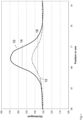
- Fig. 1 shows in a diagram the measured density value (plotted dimensionlessly) as a function of a position in millimeters for a filter rod.
- Two measurement curves are drawn, whereby the continuous measurement curve 10 shows the measured density values for a filter rod with an intact capsule and the measurement curve 12 shows the measured values for the density with a broken capsule. It can be clearly seen that in the range from 56 mm to approximately 61-62 mm and from 76 mm onwards, the two measurement curves show the same density values.
- the intact capsule leads to significantly larger Readings that rise to 170.
- the readings of the broken capsule rise to values slightly above 140.
- the intact capsules in the filter strand can be reliably detected by an upper threshold value 14, which has a value of approximately 158.
- the measured values of curve 10 clearly exceed the upper threshold value 14, so that an intact capsule can be reliably detected.
- Fig. 1 also shows a lower threshold value 16, which has a value of just under 140. In the example shown, the signal for the broken capsule can be discriminated with the lower threshold value 16.
- the Fig. 1 The method presented would in principle also be suitable for detecting the situation with a missing capsule.
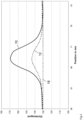
- Fig. 2 shows the course 18 with a missing capsule in the filter strand.
- the Fig. 1 The thresholds 14 and 16 shown would also be able to distinguish between a broken capsule and a missing capsule.
- the method outlined above has a number of serious disadvantages in practice.
- the difference in the signals between a missing capsule and a broken capsule is not very great. It is therefore not possible to reliably distinguish between these capsule errors.
- cases also occur in which the capsule breaks into different pieces, so that instead of a maximum, different, weakly pronounced, local maxima appear in the signals. In this case, it is not possible to distinguish between a missing and a broken capsule.
- the disadvantage that is particularly significant in terms of measurement technology is that both threshold value comparisons are based on the absolute values of the measured signals. These absolute values vary greatly with the Ambient conditions, especially the moisture levels.
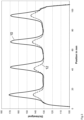
- Fig. 3 shows the measured density signals for four capsules in a filter rod, each with intact capsules and with broken capsules. This is a filter rod that has already been cut and has four individual filters.
- a surrounding area is recognized as an area with a capsule defect.
- the standard deviation of the measured signals is calculated in the surrounding area, for example in a range of +/- 10 mm, preferably +/- 5 mm.
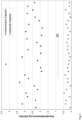
- Fig. 4 shows the measured standard deviations for the measured signals. The standard deviation is measured for each signal, regardless of whether the measured signal has fallen below the threshold or not. Fig. 4 It can be seen that the standard deviations determined for the signals with a broken capsule are significantly larger than the standard deviations of the signals with a missing capsule. By using the capsule threshold value 20 for the standard deviation, the two capsule errors can be reliably distinguished from each other.
- the capsule threshold value 20 can be used uniformly for a wide variety of applications. Even small capsules do not prevent a reliable distinction between the two capsule defects.
- the use of the standard deviation has a number of advantages: Especially for smaller capsules, a larger relative difference can be seen between the signals from broken and missing capsules. The differentiation of the damage patterns can therefore be made with greater precision. In addition, the distinction between broken and missing capsules is not dependent on the absolute values and can therefore be used independently of the filter tow density and moisture content.
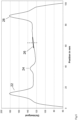
- Fig. 5 shows the measured density of the filter tow.
- the signal values 22 and 28 show two maxima for the density values.
- the maxima 22 and 28 indicate the presence of intact capsules.
- the signal value 24, with its lower value, indicates a broken capsule.
- a missing capsule can be easily detected, especially if the density of the filter tow of the filter is homogeneous. If the density of the filter tow is inhomogeneous, however, the standard deviation related to the mean value is increased and is only of limited use for detecting missing capsules.
- a linear regression is used to determine a regression line for the measuring points in the area around the target position.
- the regression line 26 shows, for example, a trend in the density of the filter tow.
- the degree of fluctuation of the measured values relative to the regression line is a suitable criterion for distinguishing between broken and missing capsules.
- Fig. 5 shows a filter rod 100 mm long that should contain 4 capsules. Two of the capsules in positions 22 and 28 are intact, one capsule in position 24 is broken and one in position 26 is missing.
- the density of the filter tow in the area between approx. 50 mm and 80 mm is inhomogeneous and increases monotonically in this area. The standard deviation of the density with respect to the density mean would be increased in this area, although there is no broken capsule.
- the image also shows a regression line 26 around the target capsule position (+/- 5 mm). The degree of fluctuation of the measured values compared to this regression line is low. The reason for this is that if a capsule were broken, non-monotonic signal deviations would occur, which would also increase the degree of fluctuation of the measured values compared to the regression line.
Landscapes
- Physics & Mathematics (AREA)
- General Health & Medical Sciences (AREA)
- Health & Medical Sciences (AREA)
- Chemical & Material Sciences (AREA)
- Electromagnetism (AREA)
- Life Sciences & Earth Sciences (AREA)
- Analytical Chemistry (AREA)
- Biochemistry (AREA)
- General Physics & Mathematics (AREA)
- Immunology (AREA)
- Pathology (AREA)
- Toxicology (AREA)
- Manufacturing Of Cigar And Cigarette Tobacco (AREA)
- Cigarettes, Filters, And Manufacturing Of Filters (AREA)
- Investigating Or Analyzing Materials By The Use Of Magnetic Means (AREA)
Claims (15)
- Procédé de détection de défauts de capsule dans un filtre de l'industrie du traitement du tabac, dans lequel un appareil de mesure à hyperfréquence mesure des valeurs indicatives d'une densité et/ou d'une humidité du filtre le long de sa direction longitudinale, dans lequel le procédé présente les étapes suivantes :a. comparaison de valeurs mesurées avec une valeur seuil, où un défaut de capsule est présent dans le filtre en cas de valeur inférieure à la valeur seuil etb. détermination d'une valeur pour un niveau de fluctuation des valeurs mesurées dans une plage avant et/ou après un point de mesure, dans laquelle au moins une valeur mesurée est inférieure à la valeur seuil,caractérisé en ce que le procédé présente en outre l'étape suivante :
c. comparaison de la valeur pour le niveau de fluctuation avec une valeur seuil de capsule prédéterminée, oùi. une capsule est cassée en cas de valeur supérieure à la valeur seuil de capsule etii. une capsule est manquante en cas de valeur inférieure à la valeur seuil de capsule. - Procédé selon la revendication 1, caractérisé en ce qu'une droite de compensation est déterminée pour les valeurs mesurées dans une plage d'adaptation située autour du point de mesure et le niveau de fluctuation est déterminé par rapport à la droite de compensation.
- Procédé selon la revendication 1 ou 2, caractérisé en ce qu'une recherche de maximum est effectuée aux environs du point de mesure.
- Procédé selon l'une des revendications 1 à 3, caractérisé en ce que l'appareil de mesure à hyperfréquence est conçu comme un résonateur à hyperfréquence, pour lequel sont mesurés au moins une modification de la largeur de sa courbe de résonance et/ou un décalage de sa fréquence de résonance.
- Procédé selon l'une des revendications 1 à 4, caractérisé en ce que l'appareil de mesure à hyperfréquence est conçu comme un résonateur à hyperfréquence, lequel mesure un signal de densité et/ou un signal d'humidité.
- Procédé selon l'une des revendications 1 à 5, caractérisé en ce que la valeur pour le niveau de fluctuation est déterminée pour une longueur prédéterminée de la plage dans la direction longitudinale.
- Procédé selon l'une des revendications 1 à 6, caractérisé en ce que les capsules sont attendues à des positions déterminées le long de la direction longitudinale.
- Procédé selon la revendication 7, caractérisé en ce que la valeur pour le niveau de fluctuation est déterminée respectivement dans un intervalle autour de la position attendue de la capsule.
- Procédé selon l'une des revendications 1 à 8, caractérisé en ce que le filtre est conçu comme un bâtonnet filtre ou un boudin de filtres transporté dans la direction longitudinale.
- Procédé selon l'une des revendications 1 à 8, caractérisé en ce que le filtre est conçu comme un bout de filtre d'une cigarette transportée dans la direction longitudinale.
- Procédé selon l'une des revendications 1 à 10, caractérisé en ce que la valeur seuil de capsule est indépendante du matériau de la capsule et/ou du type de remplissage de la capsule.
- Procédé selon l'une des revendications 1 à 11, caractérisé en ce que la valeur seuil de capsule est indépendante de la mèche de filtre située autour.
- Dispositif de mesure de défauts de capsule dans un filtre de l'industrie de traitement du tabac, comprenant un système de mesure à hyperfréquence et un moyen de commande de traitement des valeurs mesurées :a. le système de mesure à hyperfréquence mesure des valeurs indicatives de la densité et/ou de l'humidité dans le filtre, le moyen de commande étant conçu pour comparer les valeurs mesurées avec une valeur seuil et pour détecter un défaut de capsule en cas de valeur inférieure à la valeur seuil et,b. le moyen de commande est conçu pour déterminer une valeur pour un niveau de fluctuation pour les valeurs mesurées dans une plage avant et/ou après un point de mesure, dans laquelle au moins une valeur mesurée est inférieure à la valeur seuil, et pour comparer la valeur pour le niveau de fluctuation avec une valeur seuil de capsule, dans lequeli. une capsule cassée est détectée en cas de valeur supérieure à la valeur seuil de capsule etii. une capsule manquante est détectée en cas de valeur inférieure à la valeur seuil de capsule.
- Station de test de bâtonnet filtre comprenant un dispositif selon la revendication 13.
- Machine de production pour cigarettes ou filtres comprenant un dispositif selon la revendication 13.
Applications Claiming Priority (2)
| Application Number | Priority Date | Filing Date | Title |
|---|---|---|---|
| DE102020129732.7A DE102020129732B3 (de) | 2020-11-11 | 2020-11-11 | Verfahren und Vorrichtung zur Erkennung von Kapselfehlern in einem Filter der tabakverarbeitenden Industrie |
| PCT/EP2021/079812 WO2022101010A1 (fr) | 2020-11-11 | 2021-10-27 | Procédé et dispositif de détection de défauts de capsule dans un filtre de l'industrie du traitement du tabac |
Publications (2)
| Publication Number | Publication Date |
|---|---|
| EP4243635A1 EP4243635A1 (fr) | 2023-09-20 |
| EP4243635B1 true EP4243635B1 (fr) | 2024-10-02 |
Family
ID=78483295
Family Applications (1)
| Application Number | Title | Priority Date | Filing Date |
|---|---|---|---|
| EP21801507.1A Active EP4243635B1 (fr) | 2020-11-11 | 2021-10-27 | Procédé et dispositif de détection de défauts de capsule dans un filtre de l'industrie du traitement du tabac |
Country Status (8)
| Country | Link |
|---|---|
| US (1) | US12439954B2 (fr) |
| EP (1) | EP4243635B1 (fr) |
| JP (1) | JP7628179B2 (fr) |
| KR (1) | KR20230104641A (fr) |
| CN (1) | CN116600667B (fr) |
| DE (1) | DE102020129732B3 (fr) |
| ES (1) | ES2994980T3 (fr) |
| WO (1) | WO2022101010A1 (fr) |
Citations (2)
| Publication number | Priority date | Publication date | Assignee | Title |
|---|---|---|---|---|
| EP2243385A2 (fr) * | 2009-04-21 | 2010-10-27 | HAUNI Maschinenbau AG | Surveillance de capsule et réglage de la position de la capsule dans des filtres de l'industrie de traitement du tabac |
| EP2249670B1 (fr) * | 2008-02-01 | 2019-05-15 | R.J.Reynolds Tobacco Company | Système d'analyse d'un élément de filtre associé à un article à fumer, et procédé associé |
Family Cites Families (10)
| Publication number | Priority date | Publication date | Assignee | Title |
|---|---|---|---|---|
| DE102009004457A1 (de) | 2009-01-13 | 2010-07-22 | Tews Elektronik Gmbh & Co. Kg | Verfahren und Vorrichtung zur Messung von Masse und Dichte und/oder zur Messung der Feuchte von portionierten Einheiten |
| DE102009017962A1 (de) | 2009-04-21 | 2010-11-04 | Hauni Maschinenbau Ag | Verfahren und Vorrichtung zur Überprüfung der Qualität von mit Kapseln versehenen Filterstäben |
| ITBO20120394A1 (it) * | 2012-07-20 | 2014-01-21 | Gd Spa | Metodo di ispezione di un elemento allungato in materiale fibroso. |
| US9664570B2 (en) * | 2012-11-13 | 2017-05-30 | R.J. Reynolds Tobacco Company | System for analyzing a smoking article filter associated with a smoking article, and associated method |
| EP2796061A1 (fr) * | 2013-04-25 | 2014-10-29 | Tews Elektronik Gmbh&co. Kg | Dispositif et procédé de mesure de capsules dans des filtres de cigarettes |
| DE102013223535A1 (de) * | 2013-11-19 | 2015-05-21 | Hauni Maschinenbau Ag | Verfahren und Vorrichtung zur Erkennung von Stranginhomogenitäten eines Materialstrangs der Tabak verarbeitenden Industrie |
| DE102014211575A1 (de) | 2014-06-17 | 2015-12-17 | Hauni Maschinenbau Ag | Mikrowellenmessvorrichtung, Anordnung und Verfahren zur Überprüfung von stabförmigen Artikeln oder eines Materialstrangs der Tabak verarbeitenden Industrie sowie Maschine der Tabak verarbeitenden Industrie |
| CN105866140B (zh) * | 2016-05-27 | 2019-02-12 | 山东中烟工业有限责任公司 | 一种爆珠滤棒中爆珠的微波测定方法 |
| DE102016114642A1 (de) * | 2016-08-08 | 2018-02-08 | Hauni Maschinenbau Gmbh | Verfahren und Vorrichtung zum Erkennen und/oder Prüfen eines in ein stab- oder strangförmiges Produkt der Tabak verarbeitenden Industrie eingelegten Objekts |
| CN110279142B (zh) | 2019-02-14 | 2021-10-08 | 山东中烟工业有限责任公司 | 滤棒中爆珠是否破损的测定方法、存储介质及设备 |
-
2020
- 2020-11-11 DE DE102020129732.7A patent/DE102020129732B3/de active Active
-
2021
- 2021-10-27 US US18/035,818 patent/US12439954B2/en active Active
- 2021-10-27 WO PCT/EP2021/079812 patent/WO2022101010A1/fr not_active Ceased
- 2021-10-27 ES ES21801507T patent/ES2994980T3/es active Active
- 2021-10-27 CN CN202180085105.XA patent/CN116600667B/zh active Active
- 2021-10-27 JP JP2023527679A patent/JP7628179B2/ja active Active
- 2021-10-27 EP EP21801507.1A patent/EP4243635B1/fr active Active
- 2021-10-27 KR KR1020237018016A patent/KR20230104641A/ko active Pending
Patent Citations (2)
| Publication number | Priority date | Publication date | Assignee | Title |
|---|---|---|---|---|
| EP2249670B1 (fr) * | 2008-02-01 | 2019-05-15 | R.J.Reynolds Tobacco Company | Système d'analyse d'un élément de filtre associé à un article à fumer, et procédé associé |
| EP2243385A2 (fr) * | 2009-04-21 | 2010-10-27 | HAUNI Maschinenbau AG | Surveillance de capsule et réglage de la position de la capsule dans des filtres de l'industrie de traitement du tabac |
Also Published As
| Publication number | Publication date |
|---|---|
| EP4243635A1 (fr) | 2023-09-20 |
| KR20230104641A (ko) | 2023-07-10 |
| DE102020129732B3 (de) | 2021-12-02 |
| CN116600667B (zh) | 2025-12-12 |
| ES2994980T3 (en) | 2025-02-05 |
| CN116600667A (zh) | 2023-08-15 |
| WO2022101010A1 (fr) | 2022-05-19 |
| JP7628179B2 (ja) | 2025-02-07 |
| US12439954B2 (en) | 2025-10-14 |
| US20230404133A1 (en) | 2023-12-21 |
| JP2023549147A (ja) | 2023-11-22 |
Similar Documents
| Publication | Publication Date | Title |
|---|---|---|
| EP1895291B1 (fr) | Procédé de mesure de la masse d'un plastifiant et de l'humidité dans la tige d'un filtre | |
| EP2207027B1 (fr) | Procédé et dispositif de mesure de l'humidité des capsules dans une tige de filtre à cigarettes en transportant la tige de filtre à travers un résonateur à micro-ondes | |
| EP1221608B1 (fr) | Méthode pour tester un matériau de production dans un champ de micro-ondes | |
| EP2674044B1 (fr) | Procédé et dispositif de détection de défauts d'homogénéité d'une tige de matériau de l'industrie de traitement du tabac | |
| EP3044571B1 (fr) | Procédé et dispositif de vérification d'un système d'inspection servant à détecter des défauts de surfaces | |
| DE10037180C1 (de) | Verfahren zum Detektieren und Selektieren von Fremdkörpern in Cigaretten | |
| EP1739411B1 (fr) | Dispositif et procédé pour détecter et rejeter des cigarettes défectueuses | |
| EP3354143B1 (fr) | Procédé et dispositif de surveillance et de fabrication d'un boudin de filtre de l'industrie de traitement du tabac | |
| EP2404512B1 (fr) | Dispositif de fabrication de cigarettes dans l'industrie de traitement du tabac | |
| EP2873334B1 (fr) | Procédé et dispositif de détection de défauts d'homogénéité d'une tige de matériau de l'industrie de traitement du tabac | |
| EP2238845B2 (fr) | Procédé de contrôle optique d'une bande de papier d'enveloppement de l'industrie de traitement du tabac | |
| DE102011003466A1 (de) | Herstellen von stabförmigen Artikeln der Tabak verarbeitenden Industrie | |
| EP3281536B1 (fr) | Procédé et dispositif de détection et/ou de contrôle d'un produit inséré dans un produit en forme de tige ou de barre provenant de l'industrie du tabac | |
| EP2606754B1 (fr) | Procédé de mesure de la position de segments avec des substances absorbantes dans des tiges à filtre multi-segment de l'industrie de traitement du tabac | |
| EP1197746B1 (fr) | Méthode et dispositif de détermination du contenu en triacétine d'embouts filtres | |
| DE102020129732B3 (de) | Verfahren und Vorrichtung zur Erkennung von Kapselfehlern in einem Filter der tabakverarbeitenden Industrie | |
| EP2865282B2 (fr) | Système et procédé de contrôle d'articles en forme de tige de l'industrie de traitement du tabac | |
| DE102006041191B4 (de) | Filtermeßstabstation sowie Verfahren zur Messung der Masse eines Weichmachers, der Feuchtigkeit und/oder des trockenen Filtermaterials in einem Filterstab | |
| DE4209309A1 (de) | Verfahren und vorrichtung zum bestimmen des durchmessers von stabfoermigen artikeln | |
| DE3403485C2 (fr) | ||
| DE69719249T2 (de) | Verfahren zum Feststellen von Fadenungleichmässigkeit | |
| DE102023101357B4 (de) | Verfahren zur Messung von Polypropylenglykol-Derivaten | |
| DE4014659A1 (de) | Verfahren und vorrichtung zum bestimmen der dichte eines tabakstrangs | |
| DE102022106532A1 (de) | Maschine und Verfahren zur Herstellung eines Endlosstrangs der Tabakindustrie |
Legal Events
| Date | Code | Title | Description |
|---|---|---|---|
| STAA | Information on the status of an ep patent application or granted ep patent |
Free format text: STATUS: UNKNOWN |
|
| STAA | Information on the status of an ep patent application or granted ep patent |
Free format text: STATUS: THE INTERNATIONAL PUBLICATION HAS BEEN MADE |
|
| PUAI | Public reference made under article 153(3) epc to a published international application that has entered the european phase |
Free format text: ORIGINAL CODE: 0009012 |
|
| STAA | Information on the status of an ep patent application or granted ep patent |
Free format text: STATUS: REQUEST FOR EXAMINATION WAS MADE |
|
| 17P | Request for examination filed |
Effective date: 20230609 |
|
| AK | Designated contracting states |
Kind code of ref document: A1 Designated state(s): AL AT BE BG CH CY CZ DE DK EE ES FI FR GB GR HR HU IE IS IT LI LT LU LV MC MK MT NL NO PL PT RO RS SE SI SK SM TR |
|
| DAV | Request for validation of the european patent (deleted) | ||
| DAX | Request for extension of the european patent (deleted) | ||
| RIC1 | Information provided on ipc code assigned before grant |
Ipc: G01N 22/02 20060101ALI20240313BHEP Ipc: A24D 3/02 20060101ALI20240313BHEP Ipc: G01N 22/04 20060101ALI20240313BHEP Ipc: A24C 5/34 20060101AFI20240313BHEP |
|
| GRAP | Despatch of communication of intention to grant a patent |
Free format text: ORIGINAL CODE: EPIDOSNIGR1 |
|
| STAA | Information on the status of an ep patent application or granted ep patent |
Free format text: STATUS: GRANT OF PATENT IS INTENDED |
|
| INTG | Intention to grant announced |
Effective date: 20240422 |
|
| GRAS | Grant fee paid |
Free format text: ORIGINAL CODE: EPIDOSNIGR3 |
|
| GRAA | (expected) grant |
Free format text: ORIGINAL CODE: 0009210 |
|
| STAA | Information on the status of an ep patent application or granted ep patent |
Free format text: STATUS: THE PATENT HAS BEEN GRANTED |
|
| AK | Designated contracting states |
Kind code of ref document: B1 Designated state(s): AL AT BE BG CH CY CZ DE DK EE ES FI FR GB GR HR HU IE IS IT LI LT LU LV MC MK MT NL NO PL PT RO RS SE SI SK SM TR |
|
| REG | Reference to a national code |
Ref country code: GB Ref legal event code: FG4D Free format text: NOT ENGLISH |
|
| REG | Reference to a national code |
Ref country code: CH Ref legal event code: EP |
|
| REG | Reference to a national code |
Ref country code: IE Ref legal event code: FG4D Free format text: LANGUAGE OF EP DOCUMENT: GERMAN |
|
| REG | Reference to a national code |
Ref country code: DE Ref legal event code: R096 Ref document number: 502021005358 Country of ref document: DE |
|
| P01 | Opt-out of the competence of the unified patent court (upc) registered |
Free format text: CASE NUMBER: APP_59581/2024 Effective date: 20241104 |
|
| REG | Reference to a national code |
Ref country code: NL Ref legal event code: FP |
|
| REG | Reference to a national code |
Ref country code: LT Ref legal event code: MG9D |
|
| REG | Reference to a national code |
Ref country code: ES Ref legal event code: FG2A Ref document number: 2994980 Country of ref document: ES Kind code of ref document: T3 Effective date: 20250205 |
|
| PG25 | Lapsed in a contracting state [announced via postgrant information from national office to epo] |
Ref country code: HR Free format text: LAPSE BECAUSE OF FAILURE TO SUBMIT A TRANSLATION OF THE DESCRIPTION OR TO PAY THE FEE WITHIN THE PRESCRIBED TIME-LIMIT Effective date: 20241002 Ref country code: PT Free format text: LAPSE BECAUSE OF FAILURE TO SUBMIT A TRANSLATION OF THE DESCRIPTION OR TO PAY THE FEE WITHIN THE PRESCRIBED TIME-LIMIT Effective date: 20250203 Ref country code: IS Free format text: LAPSE BECAUSE OF FAILURE TO SUBMIT A TRANSLATION OF THE DESCRIPTION OR TO PAY THE FEE WITHIN THE PRESCRIBED TIME-LIMIT Effective date: 20250202 |
|
| PG25 | Lapsed in a contracting state [announced via postgrant information from national office to epo] |
Ref country code: FI Free format text: LAPSE BECAUSE OF FAILURE TO SUBMIT A TRANSLATION OF THE DESCRIPTION OR TO PAY THE FEE WITHIN THE PRESCRIBED TIME-LIMIT Effective date: 20241002 |
|
| PG25 | Lapsed in a contracting state [announced via postgrant information from national office to epo] |
Ref country code: BG Free format text: LAPSE BECAUSE OF FAILURE TO SUBMIT A TRANSLATION OF THE DESCRIPTION OR TO PAY THE FEE WITHIN THE PRESCRIBED TIME-LIMIT Effective date: 20241002 |
|
| PG25 | Lapsed in a contracting state [announced via postgrant information from national office to epo] |
Ref country code: NO Free format text: LAPSE BECAUSE OF FAILURE TO SUBMIT A TRANSLATION OF THE DESCRIPTION OR TO PAY THE FEE WITHIN THE PRESCRIBED TIME-LIMIT Effective date: 20250102 |
|
| PG25 | Lapsed in a contracting state [announced via postgrant information from national office to epo] |
Ref country code: LV Free format text: LAPSE BECAUSE OF FAILURE TO SUBMIT A TRANSLATION OF THE DESCRIPTION OR TO PAY THE FEE WITHIN THE PRESCRIBED TIME-LIMIT Effective date: 20241002 Ref country code: GR Free format text: LAPSE BECAUSE OF FAILURE TO SUBMIT A TRANSLATION OF THE DESCRIPTION OR TO PAY THE FEE WITHIN THE PRESCRIBED TIME-LIMIT Effective date: 20250103 |
|
| PG25 | Lapsed in a contracting state [announced via postgrant information from national office to epo] |
Ref country code: CZ Free format text: LAPSE BECAUSE OF FAILURE TO SUBMIT A TRANSLATION OF THE DESCRIPTION OR TO PAY THE FEE WITHIN THE PRESCRIBED TIME-LIMIT Effective date: 20241002 Ref country code: PL Free format text: LAPSE BECAUSE OF FAILURE TO SUBMIT A TRANSLATION OF THE DESCRIPTION OR TO PAY THE FEE WITHIN THE PRESCRIBED TIME-LIMIT Effective date: 20241002 |
|
| PG25 | Lapsed in a contracting state [announced via postgrant information from national office to epo] |
Ref country code: RS Free format text: LAPSE BECAUSE OF FAILURE TO SUBMIT A TRANSLATION OF THE DESCRIPTION OR TO PAY THE FEE WITHIN THE PRESCRIBED TIME-LIMIT Effective date: 20250102 |
|
| REG | Reference to a national code |
Ref country code: CH Ref legal event code: PL |
|
| PG25 | Lapsed in a contracting state [announced via postgrant information from national office to epo] |
Ref country code: SM Free format text: LAPSE BECAUSE OF FAILURE TO SUBMIT A TRANSLATION OF THE DESCRIPTION OR TO PAY THE FEE WITHIN THE PRESCRIBED TIME-LIMIT Effective date: 20241002 |
|
| REG | Reference to a national code |
Ref country code: DE Ref legal event code: R097 Ref document number: 502021005358 Country of ref document: DE |
|
| PG25 | Lapsed in a contracting state [announced via postgrant information from national office to epo] |
Ref country code: MC Free format text: LAPSE BECAUSE OF FAILURE TO SUBMIT A TRANSLATION OF THE DESCRIPTION OR TO PAY THE FEE WITHIN THE PRESCRIBED TIME-LIMIT Effective date: 20241002 |
|
| PG25 | Lapsed in a contracting state [announced via postgrant information from national office to epo] |
Ref country code: DK Free format text: LAPSE BECAUSE OF FAILURE TO SUBMIT A TRANSLATION OF THE DESCRIPTION OR TO PAY THE FEE WITHIN THE PRESCRIBED TIME-LIMIT Effective date: 20241002 |
|
| PG25 | Lapsed in a contracting state [announced via postgrant information from national office to epo] |
Ref country code: BE Free format text: LAPSE BECAUSE OF NON-PAYMENT OF DUE FEES Effective date: 20241031 Ref country code: LU Free format text: LAPSE BECAUSE OF NON-PAYMENT OF DUE FEES Effective date: 20241027 |
|
| PG25 | Lapsed in a contracting state [announced via postgrant information from national office to epo] |
Ref country code: EE Free format text: LAPSE BECAUSE OF FAILURE TO SUBMIT A TRANSLATION OF THE DESCRIPTION OR TO PAY THE FEE WITHIN THE PRESCRIBED TIME-LIMIT Effective date: 20241002 |
|
| PG25 | Lapsed in a contracting state [announced via postgrant information from national office to epo] |
Ref country code: CH Free format text: LAPSE BECAUSE OF NON-PAYMENT OF DUE FEES Effective date: 20241031 |
|
| PG25 | Lapsed in a contracting state [announced via postgrant information from national office to epo] |
Ref country code: RO Free format text: LAPSE BECAUSE OF FAILURE TO SUBMIT A TRANSLATION OF THE DESCRIPTION OR TO PAY THE FEE WITHIN THE PRESCRIBED TIME-LIMIT Effective date: 20241002 |
|
| PG25 | Lapsed in a contracting state [announced via postgrant information from national office to epo] |
Ref country code: SK Free format text: LAPSE BECAUSE OF FAILURE TO SUBMIT A TRANSLATION OF THE DESCRIPTION OR TO PAY THE FEE WITHIN THE PRESCRIBED TIME-LIMIT Effective date: 20241002 |
|
| REG | Reference to a national code |
Ref country code: BE Ref legal event code: MM Effective date: 20241031 |
|
| PLBE | No opposition filed within time limit |
Free format text: ORIGINAL CODE: 0009261 |
|
| STAA | Information on the status of an ep patent application or granted ep patent |
Free format text: STATUS: NO OPPOSITION FILED WITHIN TIME LIMIT |
|
| PG25 | Lapsed in a contracting state [announced via postgrant information from national office to epo] |
Ref country code: SE Free format text: LAPSE BECAUSE OF FAILURE TO SUBMIT A TRANSLATION OF THE DESCRIPTION OR TO PAY THE FEE WITHIN THE PRESCRIBED TIME-LIMIT Effective date: 20241002 |
|
| 26N | No opposition filed |
Effective date: 20250703 |
|
| PG25 | Lapsed in a contracting state [announced via postgrant information from national office to epo] |
Ref country code: IE Free format text: LAPSE BECAUSE OF NON-PAYMENT OF DUE FEES Effective date: 20241027 |
|
| PGFP | Annual fee paid to national office [announced via postgrant information from national office to epo] |
Ref country code: NL Payment date: 20251023 Year of fee payment: 5 |
|
| PGFP | Annual fee paid to national office [announced via postgrant information from national office to epo] |
Ref country code: DE Payment date: 20251211 Year of fee payment: 5 |
|
| PGFP | Annual fee paid to national office [announced via postgrant information from national office to epo] |
Ref country code: GB Payment date: 20251024 Year of fee payment: 5 |
|
| PGFP | Annual fee paid to national office [announced via postgrant information from national office to epo] |
Ref country code: AT Payment date: 20260113 Year of fee payment: 5 |
|
| PGFP | Annual fee paid to national office [announced via postgrant information from national office to epo] |
Ref country code: IT Payment date: 20251031 Year of fee payment: 5 |
|
| PGFP | Annual fee paid to national office [announced via postgrant information from national office to epo] |
Ref country code: FR Payment date: 20251029 Year of fee payment: 5 |
|
| PG25 | Lapsed in a contracting state [announced via postgrant information from national office to epo] |
Ref country code: CY Free format text: LAPSE BECAUSE OF FAILURE TO SUBMIT A TRANSLATION OF THE DESCRIPTION OR TO PAY THE FEE WITHIN THE PRESCRIBED TIME-LIMIT; INVALID AB INITIO Effective date: 20211027 |
|
| PGFP | Annual fee paid to national office [announced via postgrant information from national office to epo] |
Ref country code: ES Payment date: 20251114 Year of fee payment: 5 |
|
| PG25 | Lapsed in a contracting state [announced via postgrant information from national office to epo] |
Ref country code: HU Free format text: LAPSE BECAUSE OF FAILURE TO SUBMIT A TRANSLATION OF THE DESCRIPTION OR TO PAY THE FEE WITHIN THE PRESCRIBED TIME-LIMIT; INVALID AB INITIO Effective date: 20211027 |