EP4245869A1 - Procédé de traitement de masse noire pour obtenir des produits chimiques de batterie - Google Patents
Procédé de traitement de masse noire pour obtenir des produits chimiques de batterie Download PDFInfo
- Publication number
- EP4245869A1 EP4245869A1 EP22162603.9A EP22162603A EP4245869A1 EP 4245869 A1 EP4245869 A1 EP 4245869A1 EP 22162603 A EP22162603 A EP 22162603A EP 4245869 A1 EP4245869 A1 EP 4245869A1
- Authority
- EP
- European Patent Office
- Prior art keywords
- lithium
- sulfate
- process solution
- cobalt
- nickel
- Prior art date
- Legal status (The legal status is an assumption and is not a legal conclusion. Google has not performed a legal analysis and makes no representation as to the accuracy of the status listed.)
- Pending
Links
Images



Classifications
-
- C—CHEMISTRY; METALLURGY
- C22—METALLURGY; FERROUS OR NON-FERROUS ALLOYS; TREATMENT OF ALLOYS OR NON-FERROUS METALS
- C22B—PRODUCTION AND REFINING OF METALS; PRETREATMENT OF RAW MATERIALS
- C22B26/00—Obtaining alkali, alkaline earth metals or magnesium
- C22B26/10—Obtaining alkali metals
- C22B26/12—Obtaining lithium
-
- B—PERFORMING OPERATIONS; TRANSPORTING
- B01—PHYSICAL OR CHEMICAL PROCESSES OR APPARATUS IN GENERAL
- B01J—CHEMICAL OR PHYSICAL PROCESSES, e.g. CATALYSIS OR COLLOID CHEMISTRY; THEIR RELEVANT APPARATUS
- B01J39/00—Cation exchange; Use of material as cation exchangers; Treatment of material for improving the cation exchange properties
- B01J39/04—Processes using organic exchangers
- B01J39/07—Processes using organic exchangers in the weakly acidic form
-
- B—PERFORMING OPERATIONS; TRANSPORTING
- B01—PHYSICAL OR CHEMICAL PROCESSES OR APPARATUS IN GENERAL
- B01J—CHEMICAL OR PHYSICAL PROCESSES, e.g. CATALYSIS OR COLLOID CHEMISTRY; THEIR RELEVANT APPARATUS
- B01J49/00—Regeneration or reactivation of ion-exchangers; Apparatus therefor
- B01J49/50—Regeneration or reactivation of ion-exchangers; Apparatus therefor characterised by the regeneration reagents
- B01J49/53—Regeneration or reactivation of ion-exchangers; Apparatus therefor characterised by the regeneration reagents for cationic exchangers
-
- C—CHEMISTRY; METALLURGY
- C22—METALLURGY; FERROUS OR NON-FERROUS ALLOYS; TREATMENT OF ALLOYS OR NON-FERROUS METALS
- C22B—PRODUCTION AND REFINING OF METALS; PRETREATMENT OF RAW MATERIALS
- C22B15/00—Obtaining copper
- C22B15/0063—Hydrometallurgy
- C22B15/0065—Leaching or slurrying
- C22B15/0067—Leaching or slurrying with acids or salts thereof
- C22B15/0071—Leaching or slurrying with acids or salts thereof containing sulfur
-
- C—CHEMISTRY; METALLURGY
- C22—METALLURGY; FERROUS OR NON-FERROUS ALLOYS; TREATMENT OF ALLOYS OR NON-FERROUS METALS
- C22B—PRODUCTION AND REFINING OF METALS; PRETREATMENT OF RAW MATERIALS
- C22B23/00—Obtaining nickel or cobalt
- C22B23/04—Obtaining nickel or cobalt by wet processes
- C22B23/0407—Leaching processes
- C22B23/0415—Leaching processes with acids or salt solutions except ammonium salts solutions
- C22B23/043—Sulfurated acids or salts thereof
-
- C—CHEMISTRY; METALLURGY
- C22—METALLURGY; FERROUS OR NON-FERROUS ALLOYS; TREATMENT OF ALLOYS OR NON-FERROUS METALS
- C22B—PRODUCTION AND REFINING OF METALS; PRETREATMENT OF RAW MATERIALS
- C22B3/00—Extraction of metal compounds from ores or concentrates by wet processes
- C22B3/04—Extraction of metal compounds from ores or concentrates by wet processes by leaching
- C22B3/06—Extraction of metal compounds from ores or concentrates by wet processes by leaching in inorganic acid solutions, e.g. with acids generated in situ; in inorganic salt solutions other than ammonium salt solutions
- C22B3/08—Sulfuric acid, other sulfurated acids or salts thereof
-
- C—CHEMISTRY; METALLURGY
- C22—METALLURGY; FERROUS OR NON-FERROUS ALLOYS; TREATMENT OF ALLOYS OR NON-FERROUS METALS
- C22B—PRODUCTION AND REFINING OF METALS; PRETREATMENT OF RAW MATERIALS
- C22B3/00—Extraction of metal compounds from ores or concentrates by wet processes
- C22B3/20—Treatment or purification of solutions, e.g. obtained by leaching
- C22B3/42—Treatment or purification of solutions, e.g. obtained by leaching by ion-exchange extraction
-
- C—CHEMISTRY; METALLURGY
- C22—METALLURGY; FERROUS OR NON-FERROUS ALLOYS; TREATMENT OF ALLOYS OR NON-FERROUS METALS
- C22B—PRODUCTION AND REFINING OF METALS; PRETREATMENT OF RAW MATERIALS
- C22B47/00—Obtaining manganese
- C22B47/0018—Treating ocean floor nodules
- C22B47/0045—Treating ocean floor nodules by wet processes
- C22B47/0054—Treating ocean floor nodules by wet processes leaching processes
- C22B47/0063—Treating ocean floor nodules by wet processes leaching processes with acids or salt solutions
-
- C—CHEMISTRY; METALLURGY
- C22—METALLURGY; FERROUS OR NON-FERROUS ALLOYS; TREATMENT OF ALLOYS OR NON-FERROUS METALS
- C22B—PRODUCTION AND REFINING OF METALS; PRETREATMENT OF RAW MATERIALS
- C22B7/00—Working up raw materials other than ores, e.g. scrap, to produce non-ferrous metals and compounds thereof; Methods of a general interest or applied to the winning of more than two metals
- C22B7/006—Wet processes
- C22B7/007—Wet processes by acid leaching
-
- H—ELECTRICITY
- H01—ELECTRIC ELEMENTS
- H01M—PROCESSES OR MEANS, e.g. BATTERIES, FOR THE DIRECT CONVERSION OF CHEMICAL ENERGY INTO ELECTRICAL ENERGY
- H01M10/00—Secondary cells; Manufacture thereof
- H01M10/54—Reclaiming serviceable parts of waste accumulators
-
- Y—GENERAL TAGGING OF NEW TECHNOLOGICAL DEVELOPMENTS; GENERAL TAGGING OF CROSS-SECTIONAL TECHNOLOGIES SPANNING OVER SEVERAL SECTIONS OF THE IPC; TECHNICAL SUBJECTS COVERED BY FORMER USPC CROSS-REFERENCE ART COLLECTIONS [XRACs] AND DIGESTS
- Y02—TECHNOLOGIES OR APPLICATIONS FOR MITIGATION OR ADAPTATION AGAINST CLIMATE CHANGE
- Y02P—CLIMATE CHANGE MITIGATION TECHNOLOGIES IN THE PRODUCTION OR PROCESSING OF GOODS
- Y02P10/00—Technologies related to metal processing
- Y02P10/20—Recycling
-
- Y—GENERAL TAGGING OF NEW TECHNOLOGICAL DEVELOPMENTS; GENERAL TAGGING OF CROSS-SECTIONAL TECHNOLOGIES SPANNING OVER SEVERAL SECTIONS OF THE IPC; TECHNICAL SUBJECTS COVERED BY FORMER USPC CROSS-REFERENCE ART COLLECTIONS [XRACs] AND DIGESTS
- Y02—TECHNOLOGIES OR APPLICATIONS FOR MITIGATION OR ADAPTATION AGAINST CLIMATE CHANGE
- Y02W—CLIMATE CHANGE MITIGATION TECHNOLOGIES RELATED TO WASTEWATER TREATMENT OR WASTE MANAGEMENT
- Y02W30/00—Technologies for solid waste management
- Y02W30/50—Reuse, recycling or recovery technologies
- Y02W30/84—Recycling of batteries or fuel cells
Definitions
- the present invention relates to the recovery of nickel, cobalt, manganese and lithium from a black mass, and the separation and purification thereof.
- LIBs lithium ion batteries
- NCM nickel, cobalt and manganese
- NCA nickel, cobalt and aluminum
- the primary lithium production is concentrated to South America, where lithium-rich brine is pumped into massive evaporation pools where it is concentrated by solar evaporation. This process takes up to two years.
- the lithium concentrate is then processed into lithium carbonate, and then eventually turned into lithium hydroxide by a conversion reaction with lime and crystallized by evaporation.
- the emergence of low-cobalt cathode materials favors hydroxide as lithium source, which is more readily processed from solid ore.
- Methods to recycle lithium batteries are generally split into two main parts: mechanical handling and component recycling.
- mechanical handling batteries are dismantled, shred and separated into its main constituents: casings, electrode foils, electrolytes, plastics and the electrode materials. These components are then further processed to produce products.
- black mass In hydrometallurgical routes, a mixture of electrode materials commonly referred to as black mass is often leached using a combination of an inorganic acid, e.g. sulfuric acid, and a reducing agent to dissolve the soluble elements after which the insoluble materials (e.g. graphite) can be separated by filtration. Metals are then separated from each other and/or purified using pH adjustments, or with liquid-liquid extraction technologies.
- the black mass is expected to contain 3-4 wt-% lithium.
- the process solution is expected to contain 2.5-4.5 g/l of lithium, but the lithium content may also be higher depending on the black mass or the leaching step conditions.
- Nickel, cobalt and manganese content varies depending on the CAM (cathode active material) chemistry.
- Other elements present may be aluminium and copper (from electrode foils), fluoride and phosphorous (from the electrolyte salt, lithium hexaflorophosphate) and various miscible organic solvents and their degradation products (from the electrolyte solvent) as well as graphite from the anode active material (AAM) and plastics (from separator material).
- AAM anode active material
- plastics from separator material
- Document CN 109402394 A discloses a method for recycling valuable metals from lithium ion battery electrode waste.
- the document teaches that leaching the electrode waste and then adjusting pH with sodium hydroxide, potassium hydroxide or lithium hydroxide, a precipitation slag of mixed nickel, cobalt and manganese hydroxides and a lithium sulfate solution can be produced.
- the lithium sulfate solution is subjected to an electrodialysis step, producing a lithium hydroxide solution.
- the lithium hydroxide is crystallized by evaporation.
- the resulting lithium hydroxide concentrate after evaporation can be optionally circulated back in the process, which would also recirculate more impurities into the process.
- Mixed use of sodium, potassium and lithium hydroxides will cause severe difficulties to produce pure products and achieve battery-grades of the end product. Furthermore, separation of the elements will create waste fractions.
- Document CN 108517409 A discloses a method in which waste battery cathode material is subjected to a leaching step, purification step and co-extraction steps for nickel, cobalt, manganese and lithium. After the co-extraction step, the resulting lithium sulfate can be subjected to an electrodialysis step and a crystallization step, from which the concentrated mother liquor can be circulated back to the purification step and the resulting sulfuric acid returned to the leaching step. Similarly to CN 109402394 , this process yields a mixture of metals and circulating the mother liquor will lead to a buildup of impurities in the purification stage.
- An object of the present invention is to provide a method for processing a black mass into nickel, cobalt, manganese and lithium products in a sustainable and environmentally friendly way.
- a further object of the present invention is to purify and separate metals while avoiding the use of caustic soda, ammonia or other chemicals that would require additional downstream processing.
- an object of the present invention is to provide a method for recycling lithium and for producing lithium products.
- a black mass to battery chemicals comprising steps of:
- black mass refers to a mixture of cathode and/or anode active materials, which are separated from battery components.
- the black mass can be either from spent or fresh/unused Li-ion batteries processed using any number of mechanical routes and/or from off-specification cathode active material (CAM).
- CAM off-specification cathode active material
- cathode active material refers for example to a lithium-containing cathode material based on nickel, cobalt and aluminum (NCA) or a cathode material based on nickel, cobalt and manganese (NCM). Any other cathode active materials that contain lithium can be also used in the present method.
- bed volume refers to a volume of a resin bed when packed into a column.
- removing it is meant in this description that at least 90 wt-% of the desired elements or compounds, are removed, preferably at least 95 wt-%, more preferably at least 98 wt-%are removed.
- the present embodiments relate to a recovery and purification of elements, such as nickel, cobalt, copper, manganese and lithium, from a black mass, and recycling lithium chemicals in the recovery and purification process.
- a method for processing a black mass to battery chemicals typically comprises steps of:
- the method enables the use of chemicals based on lithium, an element already present in the black mass, and hence sodium sulfate generation can be avoided.
- lithium chemicals are made on-site and in-situ from lithium sulfate, which is an intermediate produced during hydrometallurgical processing of the black mass.
- the lithium chemicals produced are recycled to at least one of the steps 1, 2, 3, and 4.
- the on-site processing reduces significantly the overall CO 2 footprint of the process.
- separation of the lithium element is done using ion exchange in aqueous media, which has several advantages over liquid-liquid extractions. In the liquid-liquid extractions, kerosene will need to be replaced at regular intervals due to fouling, which is eliminated in the present method. So, lower operational expenses (OPEX) can be achieved. Further, the present method provides easier handling, because there is no ATEX (Appareils destines àAU utilises en Atmospheres Explosives) requirements.
- the first process solution comprises lithium sulfate and at least one of manganese sulfate, copper sulfate, nickel sulfate and cobalt sulfate, depending on the black mass.
- the first process solution can comprise:
- a solids concentration of the black mass can be 5-20 wt-%, preferably 9-12 wt-%, in the sulfuric acid in the step 1).
- step 1) a mixture comprising the black mass and the sulfuric acid can be heated to 60-90 °C, preferably 70-80 °C.
- the leaching of step 1) is otherwise carried out as is known in the art.
- the reducing agent can be for example, hydrogen peroxide.
- the mixture can be filtered for 0-4 hours, preferably 1-2 hours, after the addition of reducing agent to the mixture. This produces a metal-containing first process solution and a graphite/plastic solid filter cake.
- the first process solution is moved to the next step in a process, while the filter cake can be packed for reuse in graphite processing.
- the step 2) further comprises a step of precipitating manganese oxide before or after removing other impurities
- step 5) comprises converting the lithium sulfate produced in step 3) and/or 4) by electrolysis to lithium persulfate to be used in step 2).
- the manganese oxide is precipitated before removal of other impurities, i.e. manganese oxide is first precipitated from the first process solution, and the other impurities are then removed from the thus obtained manganese-purified process solution.
- precipitating manganese oxide from the first process solution using lithium persulfate is preferably made before the removal of other impurities using lithium hydroxide.
- the reason for this preferred order is that the oxidizing precipitation decreases pH of the process solution. If the manganese is removed after removing the other impurities, an extra pH adjusting step may be needed before step 3). Thus, removing manganese first enables to avoid the extra pH adjusting step before step 4). Manganese, if present, is thus precipitated using oxidative precipitation in step 2). Oxidative precipitation enables the use of lithium persulfate. Hence, using of ammonium persulfate is not necessary and thus generation of ammonium sulfate can be avoided.
- the method preferably comprises a step 3a) after the step 2) and before the step 3), which step 3a) comprises adjusting of pH of the second process solution with lithium hydroxide.
- step 3a) comprises adjusting of pH of the second process solution with lithium hydroxide.
- the pH of the second process solution can be for example, at least 3, preferably 3 to 6. Such pH is preferable in view of the chromatographic separation of step 3).
- a concentration of lithium persulfate is 20-30 wt-%, preferably 25-28 wt-%, in the step 2).
- the first process solution from the step 1) can be heated to 70-90 °C, preferably to 75-85 °C.
- Lithium persulfate can be dosed according to: MnSO 4 + Li 2 S 2 O 8 + H 2 O ⁇ MnO 2 + Li 2 SO 4 + H 2 SO 4
- a molar ratio of lithium persulfate (LiPS) to manganese sulfate is 0.95-1.3:1, preferably 1-1.1:1.
- LiPS lithium persulfate
- the LiPS is added to the reaction vessel, and as the reaction is endothermic, temperature can be followed closely to ensure the reaction takes place in optimal conditions.
- the mixture can be filtered and the solid manganese oxide can be removed from the process solution.
- Manganese oxide can be packed and stored for use in other processes. Alternatively, manganese oxide can be further processed to manganese sulfate.
- potential organic solvents can be also oxidized to CO 2 by the LiPS in the step 2). This is a side effect of using oxidizing LiPS.
- the other impurities are selected from a group of aluminum, fluoride and phosphorous. These impurities are removed from the process solution in the step 2).
- Fluoride and phosphorous can be expected to be in the form of metal fluorides and phosphates, but may also be present in acid form.
- pH of the second process solution is 4-5.5, preferably 4.2-4.7 during the removal of the other impurities.
- Aluminum as hydroxide can be reacted with the present fluorides (F) and phosphorous (P) for 1-6 hours, preferably 2-4 hours. This can precipitate phosphates to ⁇ 1 ppm and fluoride to 20-60 ppm. A mixture can be filtered and a solid mixed Al/F/P filter cake can be packed for disposal and/or reuse. Residual fluoride may be absorbed onto an aluminum oxide bed, which improves purity of downstream products. The obtained second process solution is then moved to the next stage of the process.
- F fluorides
- P phosphorous
- the method further comprises a step 3b) before the step 3) and after step 2) and the optional step 3a) described above, which step 3b) comprises removing residual fluoride from the second process solution.
- Residual fluoride can be removed for example by passing it through a bed of activated alumina (AA).
- AA activated alumina
- the AA can act as an absorbent for the fluoride, reducing the content of fluoride to ⁇ 10 ppm.
- 50-200 bed volumes, preferably 100-150 bed volumes, of the process solution is pumped through the AA bed.
- the contact time of the process solution can be for example, 3-8 minutes, preferably 5-6 minutes.
- Temperature can be for example, 10-60 °C, preferably 20-40 °C.
- the chromatographic lithium separation of step 3) comprises:
- the chromatographic lithium separation of step 3) may be carried out for example as disclosed in European Patent Application No. 20206690.8 , which description of this separation is hereby incorporated by reference.
- This separation step yields lithium sulfate as well as a third process solution, which is led to step 4) of the process.
- the second process solution containing lithium sulfate and at least one of nickel sulfate, cobalt sulfate and copper sulfate is passed through an acid cation exchange resin bed.
- the resin bed can be for example, carboxylic or sulfonic acid resin bed.
- a pH of the solution can be for example, 3-6.5, preferably 4-5.5.
- a rate of passing can be for example, 0.5-6 bed volumes per hour (BVs/h), preferably 2-4 BVs/h.
- lithium raffinate comprising lithium sulfate
- BVs bed volumes
- Other elements i.e. nickel sulfate, cobalt sulfate and copper sulfate
- the operating capacity can be predetermined by calculating the resin capacity from the element content of the initial feed.
- the operating capacity can be detected on-line by visual inspection or with spectroscopic methods such as by UV or other methods known by person skilled in the art. For a typical process solution containing 20-30 g/l of elements (i.e.
- the lithium raffinate can be collected at 0-3 BVs, preferably 0.5-2 BVs.
- Temperature during chromatographic separation can be 20-100 °C, preferably 25-50 °C and intra-column pressure can be from ambient pressure up to 10 bar, preferably between 1-5 bar.
- the lithium raffinate can be re-circulated through the resin bed several times to further increase purity and concentration of lithium sulfate in the lithium raffinate.
- the resulting lithium raffinate can then be processed to lithium products such as lithium carbonate or lithium hydroxide using known hydrometallurgical methods.
- the lithium raffinate solution can be used for flushing of the resin bed to increase purity and concentration of lithium of the lithium raffinate.
- the solution leaving the column after flushing can contain lithium salt and lithium hydroxide.
- the other elements i.e. nickel sulfate, cobalt sulfate and copper sulfate
- the strong acid solution can be for example, sulfuric acid or hydrochloric acid solution.
- a concentration of the strong acid solution can be for example, 10-25 wt-%, preferably 15-20 wt-%. Alternatively, other applicable strong acids can be used with the similar concentration.
- the acid solution is fed at a rate of 1-6 BVs/h, preferably 2-4 BVs/h.
- the resulting eluate can contain for example, nickel, cobalt, and/or copper in a form of salts, such as sulfates or chlorides, depending on the strong acid used.
- the resin bed can be washed with 0.5-2 BVs, preferably 1-1.5 BVs, of water to remove any residual eluate.
- the resin can be regenerated using for example, 2-25 wt-%, preferably 5-20 wt-%, lithium hydroxide solution.
- the lithium hydroxide can be fed through the resin bed at a rate of 1-6 BV/h, preferably 2-4 BV/h. After this step, the resin bed is ready for a new use for separating lithium.
- the number of columns in series can be 1-10, preferably 2-6. Other techniques, such as simulated moving bed, can also be applied.
- the eluate can then be processed into separate products using known metallurgical processes, such as liquid-liquid extractions, or using an eluate processing method described below.
- an iminodiacetic acid (IDA) resin for example Lanxess TP207 MDS
- IDA iminodiacetic acid
- the amount of eluate pumped through the resin bed can be for example, 0.5-3 BV's, preferably 1-1.5 BVs, but also depends on the initial feed concentration.
- This process chromatographically separates nickel from cobalt, releasing lithium sulfate from the resin into the cobalt fraction. Nickel is recovered as nickel sulfate for selling.
- a cobalt/lithium sulfate is created for further processing.
- the resin can be then eluted using for example 1-3 BVs, preferably 1.5-2 BVs, of 5-25 wt-% sulfuric acid, preferably 15-20 wt-%, resulting in a nickel sulfate solution.
- Temperature during this stage can be 10-60 °C, preferably 20-50 °C.
- any residual nickel in the cobalt fraction can be separated using a bed of bis-picolyl amine resin or other method known to a person skilled in the art.
- Prior art also describes the option to separate nickel and cobalt from the process solution using bis-picolyl amines instead of IDA resins.
- Cobalt can be separated from the cobalt fraction by the same process as the initial lithium separation in the step 4), as described above. In this process, nickel sulfate and cobalt sulfate for selling and a lithium sulfate solution for further use are created.
- step 4) of the method at least one of copper, nickel and cobalt are separated from the third process solution by ion exchange.
- ion exchange chelating ion exchange resins can be used for separating nickel from cobalt.
- lithium is bound to the chelating ion exchange resin.
- nickel is bound to the chelating ion exchange resin, lithium is released and mixed with cobalt.
- the step 4) thus enables of separating lithium sulfate from nickel and/or cobalt and/or copper, and creating lithium sulfate and a nickel/cobalt sulfate mix for further processing, as well as a copper sulfate solution for selling.
- copper sulfate can be eluted after the step 1) or 2). In this case, there is no need for eluting copper sulfate in the step 4).
- lithium sulfate collected from step 3) and/or 4) is converted by electrodialysis to lithium hydroxide to be used in at least one of the steps 2), 3) and 4), and to sulfuric acid to be used in the step 1).
- a concentration of the lithium hydroxide solution obtained from the process can be for example, around 5-12 wt-%, preferably 8-10 wt-%.
- the lithium chemicals needed in the present method are made on-site and in-situ from lithium sulfate. Further, sodium sulfate generation can be avoided, because lithium-based chemicals are used instead of commonly used sodium hydroxide.
- lithium sulfate can be bled as required before electrolysis if sulfate content increases in the process, and vice versa if sulfate content decreases, additional sulfates can be added in the form of sulfuric acid in step 1.
- the lithium persulfate can be produced using electrolysis of lithium sulfate.
- lithium sulfate can be passed through a cell.
- the cell may comprise a boron doped diamond (BDD) anode, a platinum or iron (steel) cathode and a cation exchange membrane.
- the cation exchange membrane can be for example, Nafion N424.
- a current density can be for example, 250-2500 A/m 2 , preferably 500-1250 A/m 2 .
- Lithium persulfate is formed at the anode.
- the catholyte in the cell can be a water-based electrically conductive solution such as a sulfate solution. This reaction can be continued until desired concentration of lithium persulfate is achieved.
- the lithium persulfate used in step 2) may thus come from step 5 of the method, i.e. be recycled.
- an additional sulfate salt can be added to lithium sulfate before electrolysis in step 5).
- sulfate salt can be for example sulfuric acid or sodium sulfate.
- the amount of excess sulfate can be for example, 0.5-10 wt-%, preferably 1-5 wt-%, of the lithium sulfate content.
- lithium persulfate can be pumped from the system into a storage tank and fresh lithium sulfate can be added to the system.
- Lithium sulfate equivalent can be pumped into the system as lithium persulfate is taken out of the process.
- the sulfuric acid which has been produced by electrodialysis is used in the step 3) or 4). So, sulfuric acid can be guided to the step 3) or 4) in addition of the step 1). In case sufficient amounts of sulfuric acid is created, it may be used in all of the steps 1), 3) and 4).
- the step 5) further comprises concentrating the lithium hydroxide before use in at least one of the steps 2), 3) and 4).
- lithium hydroxide is immediately ready for use in the steps 2), 3) and 4).
- the step 5) further comprises concentrating the sulfuric acid before use in at least one of the step 1), 3) and/or 4).
- sulfuric acid is in this case immediately ready for use in the step 1) and optionally in the step 3) or 4).
- the step 5) further comprises crystallizing of excess lithium hydroxide.
- the excess lithium hydroxide which is not needed in the process, can be processed for further use, such as storage or selling.
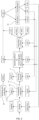
- FIGURE 1 illustrates a method for processing a black mass to battery chemicals in accordance with a first embodiment.
- a black mass 1 is fed to leaching 2, where it is leached using for example sulfuric acid (H 2 SO 4 ) and hydrogen peroxide (H 2 O 2 ) to produce a first process solution and graphite.
- the first process solution 3 is led to a second process step after separation from graphite 4.
- impurities such as aluminum (Al), fluoride (F) and phosphorus (P) are removed from the first process solution 3 using lithium hydroxide (LiOH).
- the impurities 6 are separated, and the solution, i.e. the second process solution 7 is led to a third step.
- the second process solution 7 from the removal of impurities is treated using chromatographic lithium separation, whereby lithium is separated from the second process solution creating lithium sulfate 9 and a third process solution 10, which is led to a fourth step.
- copper (Cu), nickel (Ni) and/or cobalt (Co) are separated from the third process solution by ion exchange 11 using lithium hydroxide, forming also lithium sulfate (Li 2 SO 4 ).
- lithium sulfate collected from the third and fourth step is converted by electrodialysis 12 to lithium hydroxide and sulfuric acid. Lithium hydroxide is transferred to the second step as well as to the third and fourth step. Sulfuric acid is transferred to the first step and optionally to the third or fourth step.
- FIGURE 2 illustrates a second embodiment of the present method.
- manganese oxide (MnO 2 ) is precipitated in a precipitation step 14 from the first process solution 3 using lithium persulfate (Li 2 S 2 O 8 ) before the second step described above.
- Manganese oxide 15 is further processed to manganese sulfate (MnSO 4 ) via dissolving and purification 16.
- the rest of the process is as in the embodiment of FIGURE 1 , i.e. the first process solution without manganese 17 is led to the impurities removal step.
- the process comprises electrolysis 13, which converts the lithium sulfate to lithium persulfate to be used in the manganese precipitation 14.
- FIGURE 3 illustrates a third embodiment of the present method.
- manganese oxide MnO 2
- a precipitation step 14 after the second step described above in connection with FIGURE 1 , i.e. from the second process solution 7.
- pH is adjusted in a separate step 18, and the thus obtained second process solution without manganese 19 is led to the chromatographic separation.
- FIGURE 4 illustrates a fourth embodiment, wherein an optional further step is illustrated, namely a step where the lithium sulfate is partially removed, i.e. bled, from the process in a step 21, in case an excess is accumulating.
- an optional step is a top-up of sulfuric acid 20, in case there is a need. Such needs may raise for example when the constitution of the black mass changes.
- Element content of a typical process solution from leached black mass Element mg/l Al, ICP-OES 1954 Co, ICP-OES 10160 Cu, ICP-OES 3253 Li, ICP-OES 3704 Mn, ICP-OES 9056 Ni, ICP-OES 10080 P, ICP-OES 70,2 F, ISE 128 TOC 184
- Aluminum, copper, fluoride, phosphorous and TOC content can vary depending on the technology chosen for production of black mass from LIBs.
- a 200 g/l lithium sulfate solution was circulated through an Electro MP Cell (Electrocell) with a BDD anode and platinum cathode, both 100 cm 2 . 12.5 A current was induced from a power source. Temperature was kept at a stable 20 °C during the process. Circulation was continued for approximately 6.5 hours and samples were taken at regular intervals and persulfate concentration was determined by a colorimetric back titration method. At 6 hours, persulfate concentration had reached 240 g/l and plateaued. Current was stopped and persulfate solution stored.
- Electro MP Cell Electro MP Cell
- Aluminum was thus precipitated selectively, which also precipitated a significant amount of fluoride and all phosphorous. Reduction in metal concentrations were largely due to dilution which can be lessened by using a slurry of strong lithium hydroxide solution.
- Fluoride, phosphorous and aluminum were all absorbed into the activated alumina, leaving all other metals in solution.
- FIGURE 5 shows that clear separation of lithium from nickel, cobalt and copper is observed.
- the full line indicates the curve for nickel, cobalt and copper, while the dashed line is for lithium.
- V (BV) stands for the volume of the resin bed used, while c stands for concentration in mg/l.
- the cobalt fraction can then be purified by a process similar to the one described in Example 4 to recover lithium.
Landscapes
- Chemical & Material Sciences (AREA)
- Engineering & Computer Science (AREA)
- Organic Chemistry (AREA)
- Materials Engineering (AREA)
- Manufacturing & Machinery (AREA)
- Mechanical Engineering (AREA)
- Metallurgy (AREA)
- Life Sciences & Earth Sciences (AREA)
- General Life Sciences & Earth Sciences (AREA)
- Environmental & Geological Engineering (AREA)
- Geology (AREA)
- Geochemistry & Mineralogy (AREA)
- Chemical Kinetics & Catalysis (AREA)
- Ocean & Marine Engineering (AREA)
- Oceanography (AREA)
- Inorganic Chemistry (AREA)
- Electrochemistry (AREA)
- General Chemical & Material Sciences (AREA)
- Manufacture And Refinement Of Metals (AREA)
- Inorganic Compounds Of Heavy Metals (AREA)
- Battery Electrode And Active Subsutance (AREA)
- Secondary Cells (AREA)
Priority Applications (7)
| Application Number | Priority Date | Filing Date | Title |
|---|---|---|---|
| EP22162603.9A EP4245869A1 (fr) | 2022-03-17 | 2022-03-17 | Procédé de traitement de masse noire pour obtenir des produits chimiques de batterie |
| AU2023234694A AU2023234694A1 (en) | 2022-03-17 | 2023-03-17 | Method for processing black mass to battery chemicals |
| PCT/EP2023/056918 WO2023175157A1 (fr) | 2022-03-17 | 2023-03-17 | Procédé de transformation de masse noire en produits chimiques de batterie |
| KR1020247034245A KR20240164547A (ko) | 2022-03-17 | 2023-03-17 | 블랙 매스를 배터리 화학물질로 가공하기 위한 방법 |
| CA3246110A CA3246110A1 (fr) | 2022-03-17 | 2023-03-17 | Procédé de transformation de masse noire en produits chimiques de batterie |
| CN202380041138.3A CN119234048A (zh) | 2022-03-17 | 2023-03-17 | 用于将黑色团块加工成电池化学品的方法 |
| US18/847,700 US20250207220A1 (en) | 2022-03-17 | 2023-03-17 | Method for processing black mass to battery chemicals |
Applications Claiming Priority (1)
| Application Number | Priority Date | Filing Date | Title |
|---|---|---|---|
| EP22162603.9A EP4245869A1 (fr) | 2022-03-17 | 2022-03-17 | Procédé de traitement de masse noire pour obtenir des produits chimiques de batterie |
Publications (1)
| Publication Number | Publication Date |
|---|---|
| EP4245869A1 true EP4245869A1 (fr) | 2023-09-20 |
Family
ID=80786558
Family Applications (1)
| Application Number | Title | Priority Date | Filing Date |
|---|---|---|---|
| EP22162603.9A Pending EP4245869A1 (fr) | 2022-03-17 | 2022-03-17 | Procédé de traitement de masse noire pour obtenir des produits chimiques de batterie |
Country Status (7)
| Country | Link |
|---|---|
| US (1) | US20250207220A1 (fr) |
| EP (1) | EP4245869A1 (fr) |
| KR (1) | KR20240164547A (fr) |
| CN (1) | CN119234048A (fr) |
| AU (1) | AU2023234694A1 (fr) |
| CA (1) | CA3246110A1 (fr) |
| WO (1) | WO2023175157A1 (fr) |
Cited By (1)
| Publication number | Priority date | Publication date | Assignee | Title |
|---|---|---|---|---|
| FR3161804A1 (fr) * | 2024-04-25 | 2025-10-31 | Ampere Sas | Procédé de fabrication du matériau actif pour électrode positive Li2S |
Families Citing this family (1)
| Publication number | Priority date | Publication date | Assignee | Title |
|---|---|---|---|---|
| BE1032423B1 (nl) | 2024-02-29 | 2025-09-29 | Umicore Nv | Proces voor de scheiding van metalen door oplosmiddelextractie |
Citations (5)
| Publication number | Priority date | Publication date | Assignee | Title |
|---|---|---|---|---|
| CN108069447A (zh) * | 2017-12-13 | 2018-05-25 | 长沙矿冶研究院有限责任公司 | 利用锂离子电池正极活性废料制备电池级氢氧化锂的方法 |
| CN108517409A (zh) | 2018-04-04 | 2018-09-11 | 长沙矿冶研究院有限责任公司 | 一种从废旧动力电池正极废料中回收有价金属的方法 |
| CN109402394A (zh) | 2018-10-16 | 2019-03-01 | 长沙矿冶研究院有限责任公司 | 一种从锂离子电池电极废料中综合回收有价金属的方法 |
| WO2019160982A1 (fr) * | 2018-02-17 | 2019-08-22 | Lilac Solutions, Inc. | Système intégré d'extraction et de conversion de lithium |
| WO2020092157A1 (fr) * | 2018-10-30 | 2020-05-07 | Albemarle Corporation | Procédés d'extraction de métaux à partir de batteries lithium-ion |
-
2022
- 2022-03-17 EP EP22162603.9A patent/EP4245869A1/fr active Pending
-
2023
- 2023-03-17 US US18/847,700 patent/US20250207220A1/en active Pending
- 2023-03-17 WO PCT/EP2023/056918 patent/WO2023175157A1/fr not_active Ceased
- 2023-03-17 CA CA3246110A patent/CA3246110A1/fr active Pending
- 2023-03-17 AU AU2023234694A patent/AU2023234694A1/en active Pending
- 2023-03-17 CN CN202380041138.3A patent/CN119234048A/zh active Pending
- 2023-03-17 KR KR1020247034245A patent/KR20240164547A/ko active Pending
Patent Citations (5)
| Publication number | Priority date | Publication date | Assignee | Title |
|---|---|---|---|---|
| CN108069447A (zh) * | 2017-12-13 | 2018-05-25 | 长沙矿冶研究院有限责任公司 | 利用锂离子电池正极活性废料制备电池级氢氧化锂的方法 |
| WO2019160982A1 (fr) * | 2018-02-17 | 2019-08-22 | Lilac Solutions, Inc. | Système intégré d'extraction et de conversion de lithium |
| CN108517409A (zh) | 2018-04-04 | 2018-09-11 | 长沙矿冶研究院有限责任公司 | 一种从废旧动力电池正极废料中回收有价金属的方法 |
| CN109402394A (zh) | 2018-10-16 | 2019-03-01 | 长沙矿冶研究院有限责任公司 | 一种从锂离子电池电极废料中综合回收有价金属的方法 |
| WO2020092157A1 (fr) * | 2018-10-30 | 2020-05-07 | Albemarle Corporation | Procédés d'extraction de métaux à partir de batteries lithium-ion |
Non-Patent Citations (1)
| Title |
|---|
| STRAUSS M L ET AL: "Separation of cobalt, nickel, and manganese in leach solutions of waste lithium-ion batteries using Dowex M4195 ion exchange resin", HYDROMETALLURGY, ELSEVIER SCIENTIFIC PUBLISHING CY. AMSTERDAM, NL, vol. 206, 5 October 2021 (2021-10-05), XP086870345, ISSN: 0304-386X, [retrieved on 20211005], DOI: 10.1016/J.HYDROMET.2021.105757 * |
Cited By (1)
| Publication number | Priority date | Publication date | Assignee | Title |
|---|---|---|---|---|
| FR3161804A1 (fr) * | 2024-04-25 | 2025-10-31 | Ampere Sas | Procédé de fabrication du matériau actif pour électrode positive Li2S |
Also Published As
| Publication number | Publication date |
|---|---|
| WO2023175157A1 (fr) | 2023-09-21 |
| KR20240164547A (ko) | 2024-11-19 |
| CN119234048A (zh) | 2024-12-31 |
| AU2023234694A1 (en) | 2024-10-24 |
| US20250207220A1 (en) | 2025-06-26 |
| CA3246110A1 (fr) | 2023-09-21 |
Similar Documents
| Publication | Publication Date | Title |
|---|---|---|
| EP3904546B1 (fr) | Procédé de récupération de composants à partir des batteries alcalines | |
| EP3899071B1 (fr) | Procédé de recyclage de batteries | |
| EP4481074A1 (fr) | Procédé de récupération de lithium à partir de batterie au lithium-ion usagée | |
| EP4464805A1 (fr) | Procédé de récupération de lithium à partir de batteries au lithium-ion usagées | |
| EP2450991B1 (fr) | Installation et procédé pour le traitement d'accumulateurs et de batteries usagés | |
| AU2022388904B2 (en) | Process for recycling lithium iron phosphate batteries | |
| US20250207220A1 (en) | Method for processing black mass to battery chemicals | |
| JP2013095951A (ja) | リチウム回収方法 | |
| CN110669933A (zh) | 一种去除镍钴锰溶液中氟的方法 | |
| EP3995597B1 (fr) | Procédé de récupération et de purification de lithium | |
| CN108588420A (zh) | 一种废铅酸蓄电池湿法回收铅的方法 | |
| KR20240165990A (ko) | 리튬 이온 배터리들로부터 금속을 회수하기 위한 개선된 시스템 및 방법 | |
| WO2022170399A1 (fr) | Récupération de métaux | |
| Premathilake et al. | Advancing hydrometallurgical recycling of spent lithium-ion batteries: an AI-based readiness and sustainability assessment | |
| EP4675754A1 (fr) | Procédé de recyclage de batteries | |
| WO2024246339A1 (fr) | Procédé | |
| WO2025116754A1 (fr) | Procédé de récupération de nickel et de cobalt à partir d'un mélange de composés de ces métaux provenant de batteries lithium-ion usagées | |
| WO2025216625A1 (fr) | Procédé de récupération de matériaux critiques à partir de masse noire de batteries li-ion | |
| WO2025155996A1 (fr) | Récupération de métaux de haute valeur à partir de batteries au lithium-ion | |
| WO2025040555A1 (fr) | Procédé d'extraction de lithium à partir de batteries contenant du lithium | |
| WO2026068958A1 (fr) | Procédé d'extraction d'un métal à partir d'un matériau précurseur |
Legal Events
| Date | Code | Title | Description |
|---|---|---|---|
| PUAI | Public reference made under article 153(3) epc to a published international application that has entered the european phase |
Free format text: ORIGINAL CODE: 0009012 |
|
| STAA | Information on the status of an ep patent application or granted ep patent |
Free format text: STATUS: THE APPLICATION HAS BEEN PUBLISHED |
|
| AK | Designated contracting states |
Kind code of ref document: A1 Designated state(s): AL AT BE BG CH CY CZ DE DK EE ES FI FR GB GR HR HU IE IS IT LI LT LU LV MC MK MT NL NO PL PT RO RS SE SI SK SM TR |
|
| STAA | Information on the status of an ep patent application or granted ep patent |
Free format text: STATUS: REQUEST FOR EXAMINATION WAS MADE |
|
| 17P | Request for examination filed |
Effective date: 20240320 |
|
| RBV | Designated contracting states (corrected) |
Designated state(s): AL AT BE BG CH CY CZ DE DK EE ES FI FR GB GR HR HU IE IS IT LI LT LU LV MC MK MT NL NO PL PT RO RS SE SI SK SM TR |