EP4246111A1 - Dispositif de mesure pour mesurer un couple - Google Patents
Dispositif de mesure pour mesurer un couple Download PDFInfo
- Publication number
- EP4246111A1 EP4246111A1 EP23161824.0A EP23161824A EP4246111A1 EP 4246111 A1 EP4246111 A1 EP 4246111A1 EP 23161824 A EP23161824 A EP 23161824A EP 4246111 A1 EP4246111 A1 EP 4246111A1
- Authority
- EP
- European Patent Office
- Prior art keywords
- measuring device
- mirror
- light source
- torque
- light
- Prior art date
- Legal status (The legal status is an assumption and is not a legal conclusion. Google has not performed a legal analysis and makes no representation as to the accuracy of the status listed.)
- Withdrawn
Links
- 239000003990 capacitor Substances 0.000 claims description 12
- 238000003306 harvesting Methods 0.000 claims description 5
- 238000004146 energy storage Methods 0.000 claims description 3
- 238000005259 measurement Methods 0.000 description 8
- 238000005452 bending Methods 0.000 description 6
- 238000009434 installation Methods 0.000 description 3
- 238000000034 method Methods 0.000 description 3
- 238000004891 communication Methods 0.000 description 2
- 238000006073 displacement reaction Methods 0.000 description 2
- 239000000463 material Substances 0.000 description 2
- 230000003287 optical effect Effects 0.000 description 2
- 238000012545 processing Methods 0.000 description 2
- 230000006978 adaptation Effects 0.000 description 1
- 230000003321 amplification Effects 0.000 description 1
- 230000005540 biological transmission Effects 0.000 description 1
- 239000000919 ceramic Substances 0.000 description 1
- 230000001419 dependent effect Effects 0.000 description 1
- 230000000694 effects Effects 0.000 description 1
- 230000005489 elastic deformation Effects 0.000 description 1
- 239000002184 metal Substances 0.000 description 1
- 238000003199 nucleic acid amplification method Methods 0.000 description 1
- 230000005855 radiation Effects 0.000 description 1
- 230000000284 resting effect Effects 0.000 description 1
Images

Classifications
-
- G—PHYSICS
- G01—MEASURING; TESTING
- G01L—MEASURING FORCE, STRESS, TORQUE, WORK, MECHANICAL POWER, MECHANICAL EFFICIENCY, OR FLUID PRESSURE
- G01L3/00—Measuring torque, work, mechanical power, or mechanical efficiency, in general
- G01L3/02—Rotary-transmission dynamometers
- G01L3/04—Rotary-transmission dynamometers wherein the torque-transmitting element comprises a torsionally-flexible shaft
- G01L3/10—Rotary-transmission dynamometers wherein the torque-transmitting element comprises a torsionally-flexible shaft involving electric or magnetic means for indicating
- G01L3/12—Rotary-transmission dynamometers wherein the torque-transmitting element comprises a torsionally-flexible shaft involving electric or magnetic means for indicating involving photoelectric means
-
- G—PHYSICS
- G01—MEASURING; TESTING
- G01L—MEASURING FORCE, STRESS, TORQUE, WORK, MECHANICAL POWER, MECHANICAL EFFICIENCY, OR FLUID PRESSURE
- G01L3/00—Measuring torque, work, mechanical power, or mechanical efficiency, in general
- G01L3/02—Rotary-transmission dynamometers
- G01L3/04—Rotary-transmission dynamometers wherein the torque-transmitting element comprises a torsionally-flexible shaft
- G01L3/08—Rotary-transmission dynamometers wherein the torque-transmitting element comprises a torsionally-flexible shaft involving optical means for indicating
-
- G—PHYSICS
- G01—MEASURING; TESTING
- G01B—MEASURING LENGTH, THICKNESS OR SIMILAR LINEAR DIMENSIONS; MEASURING ANGLES; MEASURING AREAS; MEASURING IRREGULARITIES OF SURFACES OR CONTOURS
- G01B11/00—Measuring arrangements characterised by the use of optical techniques
- G01B11/16—Measuring arrangements characterised by the use of optical techniques for measuring the deformation in a solid, e.g. optical strain gauge
-
- G—PHYSICS
- G01—MEASURING; TESTING
- G01L—MEASURING FORCE, STRESS, TORQUE, WORK, MECHANICAL POWER, MECHANICAL EFFICIENCY, OR FLUID PRESSURE
- G01L3/00—Measuring torque, work, mechanical power, or mechanical efficiency, in general
- G01L3/24—Devices for determining the value of power, e.g. by measuring and simultaneously multiplying the values of torque and revolutions per unit of time, by multiplying the values of tractive or propulsive force and velocity
Definitions
- the invention relates to a measuring device for measuring a torque about an axis in an elastic connecting element, which connects a first element to a second element in a rotationally fixed manner about the axis, comprising a light source, at least one mirror and a light sensor array.
- Measuring devices of the type mentioned at the beginning are widely known from the prior art. That's how it describes DE 10 2008 054 028 A1 a method in which light radiation is generated inside a hollow cylindrical body using a light source.
- Other documents often show measuring arrangements for bicycles.
- this describes DE 20 2018 103 775 U1 or the CH 702 990 A1 an optical device for measuring a force on a bicycle pedal axle.
- a light beam is generated by a light source, which traverses the bicycle pedal axis along the longitudinal axis and falls on an image sensor.
- What all of these devices have in common is that a specialist is required for installation, especially in a bottom bracket shaft of a bicycle, with the devices from a specific provider being limited to a corresponding type of bicycle.
- Mechanical parts also often have to be replaced, which leads to hidden costs. What all known devices also have in common is that the accuracy of the measurement is not very high.
- the aim of the invention is therefore to create a measuring device that is easy to install and universally compatible. Furthermore, the measuring device should have a high measurement accuracy.
- a measuring device of the type mentioned at the outset in which a first mirror and a second mirror are arranged such that the first mirror is rigidly connected to the first element and the second mirror to the second element, with the light source a light beam can be generated, which is reflected at least once by the first mirror and the second mirror and ultimately hits the light sensor array and the point of impact of the light beam on the light sensor array depends on the torque.
- the connecting element can be made from a wide variety of materials that have elastic behavior, for example a plastic or a metal.
- an elastic connecting element is understood to mean any connecting element which essentially assumes an original shape or an original state again after a load such as a torque has been eliminated, so that based on the deformation, which is measured via a position of the light beam on the light sensor array a burden can be concluded.
- the elastic connecting element can also have a very high rigidity, so that a torque only leads to very small deformations. Accordingly, any connecting element that has an elastic deformation behavior at least in some areas is viewed here as elastic, so that in principle a connecting element made of ceramic can also be viewed as an elastic connecting element.
- a high level of measurement accuracy can be achieved in the range of a deviation of the light beam of nanometers.
- Multiple reflections increase the deviation of the light beam.
- a deviation in a range of a few nanometers can be measured, so that, in conjunction with a corresponding amplification of the deviation through multiple reflections, a highly accurate torque measurement is possible. This allows the torque to be determined particularly precisely.
- the light sensor array can basically be designed in a variety of ways and, for example, have several light sensors arranged in columns and rows. Furthermore, the light sensor array can also be designed by a photo sensor similar to a sensor used in a digital camera in order to be able to detect a shift of just a few ⁇ m or nm in a point at which a light beam strikes. This enables a particularly precise torque determination. In a particularly simple embodiment, the light sensor array can also only be formed by several photodiodes, which are arranged at a defined distance from one another in order to determine a position of the light beam.
- the light source can emit a focused light beam and is preferably a light-emitting diode (LED) or a laser light source. If a focused light beam can be emitted by the light source, a corresponding deviation caused by a torque can also be accurately detected.
- LED light-emitting diode
- a further mirror is provided, which is arranged at an angle ⁇ to the axis and deflects the light beam onto the first mirror, whereby the light source can generate a preferably axis-parallel beam which can impinge on the further mirror.
- This arrangement allows the light source to be arranged on one side of the measuring device together with the light sensor array and other energy-requiring devices.
- a particularly high measurement accuracy can be achieved if the first mirror and the second mirror are arranged parallel or anti-parallel to one another in an unloaded state and preferably parallel to the axis of the connecting element. This enables multiple reflection of the light beam and corresponding accuracy.
- first expandable ring is permanently mounted on the first element and a second expandable ring on the second element for fastening in a hollow shaft
- first expandable ring and the second expandable ring can have an outer diameter of 15 mm to 22 mm.
- the expandable rings make it easy to adapt to different diameters of hollow shafts, as the measuring device itself only has a diameter of approx. 10 mm.
- an energy storage device such as a battery can be provided in the device.
- the device can also be supplied with energy wirelessly, for example via Bluetooth or near field communication (NFC).
- NFC near field communication
- the measuring device is designed to record wirelessly transmitted energy, in particular to record energy that is transmitted via electromagnetic waves, for example with a frequency that is used for Bluetooth or NFC.
- an antenna for receiving such electromagnetic waves can be provided in or on the measuring device.
- the energy transmitted to the measuring device in this way can then be used directly to operate the measuring device and/or stored in an energy storage device such as a battery or a capacitor.
- a capacitor is provided for the energy supply, with an energy harvesting device preferably being provided with which electrical energy can be generated and the capacitor charged when the measuring device rotates around the axis.
- the capacitor can be charged, for example, by converting energy from rotation of the device into electrical energy.
- devices known from the prior art for energy harvesting can be used.
- a corresponding energy harvesting device can be designed to generate electrical energy by exploiting the rotation of a pedal crankshaft, whereby the energy can be stored in the capacitor.
- energy can be transmitted wirelessly into the device, for example using electromagnetic waves, in particular Bluetooth or near-field communication (NFC).
- the advantage of using a capacitor instead of batteries is twofold: firstly, the density of the energy that can be stored is ten to a thousand times higher for a capacitor than for a battery; secondly, a capacitor does not require a charging circuit, which batteries generally need, but can do so Use energy directly.
- microcontroller controls the light source and transmits the data from the light sensor array to the outside, for example using Bluetooth.
- Microcontroller, light source and light sensor array can be included be arranged on a common circuit board and use a common power supply by means of the capacitor.
- the measuring arrangement has proven to be particularly advantageous when it is installed in the hollow shaft of a bottom bracket shaft of a bicycle.
- the small installation space and the possibility of being mounted in a hollow shaft result in a particularly economical installation and also simple measurement of the torque acting on the bottom bracket shaft of a bicycle.
- the first element is then rigidly connected to a part of the bottom bracket shaft which is arranged near a bottom bracket crank, while the second element is arranged closer to a gear in the bottom bracket shaft so that the bottom bracket shaft experiences a moment in a region between the first element and the second element transported from the bottom bracket crank to the gear, which is measured by the measuring device.
- a torsional rigidity is preferably also known for such a shaft in order to determine a torque based on the deformation of the hollow shaft and the connecting element.
- the application of the measuring device is not limited to determining a torque.
- the measuring device can also be used to measure a bending moment of a boom.
- the first element and the second element are usually connected to parts of the boom that move relative to one another when there is a load or a bending moment acting on the boom, so that here too, based on a deformation of the elastic connecting element, which is caused by a change in a position, at which the light beam hits the light sensor array, a deformation of the boom and a load such as a bending moment can be concluded via the corresponding stiffness.
- Fig. 1 now shows the structure of a measuring device 1 according to the invention, with a first expandable ring 12 and a second expandable ring 13 also being provided at the ends, with which the measuring device 1 can be fastened in a hollow shaft, for example frictionally.
- the measuring device 1 can also have a rectangular or square cross section.
- a round shape is specifically intended for applications in rotating hollow shafts, such as a bottom bracket shaft 15 of a bicycle.
- the measuring arrangement 1 according to the invention has a first element 4, a connecting element 3 and a second element 5.
- a processing unit consists of a single circuit board which has a light source 6, preferably a laser light source, a light sensor array 7 and a microcontroller 14.
- the latter controls both the light source 6 and the light sensor array 7 and exchanges data with external units such as a smartphone, so that the torque can be monitored online using a smartphone.
- a first mirror 8 is rigidly connected to the first element 4 and a second mirror 9 is rigidly connected to the second element 5.
- the first element 4 and the second element 5 are connected via the elastic connecting element 3, which can also be part of a hollow shaft can, and can therefore have a rotation by an angle ⁇ when a torque is applied to one another.
- the light sensor array 7 can basically be designed in a variety of ways and, for example, have several light sensors arranged in columns and rows. Furthermore, the light sensor array 7 can also be designed by a photo sensor similar to a sensor used in a digital camera in order to be able to detect a shift of just a few ⁇ m or nm in a point at which a light beam strikes.
- FIG. 2 the basic operation of the measuring device 1 is shown.
- a first mirror 8 is fixedly mounted on a first element 4.
- a second mirror 9 is permanently mounted on the second element 5.
- the further mirror 11 reflects the light beam 10 onto the first mirror 8, from where it is reflected onto the second mirror 9, which is repeated several times. At the end, the light beam 10 is thrown onto the light sensor array 7.
- the solid line of the light beam 10 represents it in a rest position, while the dashed line of the light beam 10 shows it in a loaded state and therefore has a certain deviation.
- a rotation of the first element 4 relative to the second element 5 causes a displacement of a point at which the light beam hits the light sensor array 7. Based on this displacement, an angle ⁇ can be concluded by which the first element 4 was rotated relative to the second element 5.
- the torque can then be calculated mathematically based on the torsional rigidity of the devices connecting the first element 4 and the second element 5.
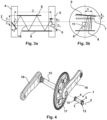
- Fig. 3a and Fig. 3b show the working method schematically.
- the light beam path is shown again in a resting state.
- a light beam 10 is thrown from a light source 6 onto a further mirror 11, from which it is reflected several times onto the first mirror 8 and subsequently onto the second mirror 9 before it hits the light sensor array 7.
- the accuracy of the measurement can be increased by increasing the number of reflections between the first mirror 8 and the second mirror 9. The higher the number of reflections, the greater the deviation S for an angle ⁇ generated by a torque.
- a change in the number of reflections can be achieved by adjusting the deflection angle ⁇ of the further mirror 11 or by changing one of the parameters C, D, E 0 , E 1 , E 2 , where E 0 , E 1 and E 2 are the distance between the individual ones Mirror to axis 2 and C also represents the distance of the light sensor array 7 to axis 2.
- D here denotes the maximum distance from the point of impact on the further mirror 11 to the point of impact on the light sensor array 7.
- Fig. 3b the deflection of the light beam 10 is now shown by a twist angle ⁇ generated by a torque, where S represents the deflection of the light beam 10 onto the light sensor array 7. The twist angle ⁇ can then be determined from this deviation S.
- Fig. 4 now shows the application of the measuring device 1 on a bicycle.
- the two pedal cranks 16 are connected by means of a hollow bottom bracket shaft 15, with the force being transmitted to a gear 17.
- the measuring device 1 can be used here without Dismantling of important apparatus components can be introduced into the hollow shaft.
- the measuring device 1 can be adapted to different diameters of bottom bracket shafts 15 and is connected there to the bottom bracket shaft 15 in a force-fitting manner by means of expandable rings 12, 13.
- the inner diameter can be between 15 mm and 22 mm, for example, which enables optimal adaptation to different types and brands of bicycles.
- the pedaling force on the pedal cranks 16 now generates a torque in the bottom bracket shaft 15, which is subsequently transmitted to the measuring device 1.
- the torque ⁇ can now be calculated from the angle of rotation ⁇ between the first element 4 and the second element 5, which is generated by the torque and is dependent on a torsional rigidity of the bottom bracket shaft 15, with the data from the measuring device 1 being sent to an external data processing system such as a smartphone be transmitted, for example using a wireless data transmission method such as Bluetooth.
- first measuring device 1 between the first pedal crank 16 and the gear 17 and a second measuring device 1 between the second pedal crank 16 and the gear 17 in the bottom bracket shaft 15
- first measuring device 1 between the first pedal crank 16 and the gear 17
- second measuring device 1 between the second pedal crank 16 and the gear 17 in the bottom bracket shaft 15
- a capacitor (not shown) can be connected to the second element, which is charged by an energy harvesting device (also not shown) by rotating the bottom bracket shaft. It is therefore not necessary to provide an additional energy supply -
- the measurable pedaling force essentially depends on two factors: the torque generated in the pedal crankshaft and the speed, while the speed can be inferred from the torque (the torque reaches a peak at every rotation of the bottom bracket shaft 15, namely when the cyclist presses the pedal).
- One way to measure the applied torque is to measure the microscopic twist angle ⁇ that exists between two separate cross sections of the pedal crankshaft 15.
- the measuring device 1 according to the invention can now be used to measure a deviation of a light beam in the range of a few nanometers. This is also made possible by the multiple reflection of the light beam 10 between two mirrors 8, 9. With the invention, apart from other possible applications, it is now possible to continuously measure the force applied by a cyclist.
- the measuring device 1 according to the invention can be used in a wide variety of devices to measure torques. This is particularly advantageous for industrial machines or agricultural machines. Its use can also be advantageous in automobiles.
- the measuring device 1 can, in addition to measuring a torque, also be used to detect other deformations, for example to detect a bending moment about an axis 2 normal to the axis of rotation.
- other rigidities must be taken into account in order to determine the bending moment based on the deformation to be able to close.
- the application of the device is therefore not limited to the determination of torques, although this is the preferred application.
- the deformation of a boom can also be determined using a corresponding device.
Landscapes
- Physics & Mathematics (AREA)
- General Physics & Mathematics (AREA)
- Chemical & Material Sciences (AREA)
- Engineering & Computer Science (AREA)
- Combustion & Propulsion (AREA)
- Force Measurement Appropriate To Specific Purposes (AREA)
Applications Claiming Priority (1)
| Application Number | Priority Date | Filing Date | Title |
|---|---|---|---|
| ATA50158/2022A AT525176B1 (de) | 2022-03-14 | 2022-03-14 | Messvorrichtung zum Messen eines Drehmomentes |
Publications (1)
| Publication Number | Publication Date |
|---|---|
| EP4246111A1 true EP4246111A1 (fr) | 2023-09-20 |
Family
ID=84839213
Family Applications (1)
| Application Number | Title | Priority Date | Filing Date |
|---|---|---|---|
| EP23161824.0A Withdrawn EP4246111A1 (fr) | 2022-03-14 | 2023-03-14 | Dispositif de mesure pour mesurer un couple |
Country Status (2)
| Country | Link |
|---|---|
| EP (1) | EP4246111A1 (fr) |
| AT (1) | AT525176B1 (fr) |
Citations (11)
| Publication number | Priority date | Publication date | Assignee | Title |
|---|---|---|---|---|
| US3196675A (en) * | 1963-02-28 | 1965-07-27 | Donald R Buchele | Optical torquemeter |
| DE19523756A1 (de) * | 1995-06-29 | 1997-01-02 | Schlattl Werner Bavaria Tech | Arbeitsmaschine und Sensor für eine Arbeitsmaschine |
| DE102008003026A1 (de) * | 2007-01-03 | 2008-08-14 | GM Global Technology Operations, Inc., Detroit | Lasersensorvorrichtung und Verfahren zur Detektion eines Getriebewellendrehmoments |
| DE102008054028A1 (de) | 2008-10-30 | 2010-05-12 | Eurocopter Deutschland Gmbh | Verfahren zur berührungslosen Bestimmung von an einem hohlzylindrischen Körper angreifenden Kräften und/oder Momenten sowie eine Messanordnung zur Durchführung des Verfahrens |
| EP2213996A1 (fr) * | 2009-02-03 | 2010-08-04 | Delphi Technologies, Inc. | Dispositif de mesure optique de couple appliqué à un arbre de torsion |
| WO2010132926A1 (fr) * | 2009-05-20 | 2010-11-25 | Torque Wizz Pty Ltd | Dispositif de mesure de couple |
| CH702990A1 (de) | 2010-04-23 | 2011-10-31 | Bmc Trading Ag | Vorrichtung und verfahren zur messung einer krafteinwirkung auf eine fahrradpedalachse. |
| WO2014064245A1 (fr) * | 2012-10-26 | 2014-05-01 | Danmarks Tekniske Universitet | Wattmètre optique pour bicyclette |
| DE102016001227A1 (de) * | 2016-02-04 | 2017-08-10 | Kuka Roboter Gmbh | Lastsensor |
| DE202018103775U1 (de) | 2018-07-02 | 2018-07-09 | Scott Sports Sa | Leistungsmessanordnung |
| RU2681663C1 (ru) * | 2018-04-25 | 2019-03-12 | Федеральное государственное автономное образовательное учреждение высшего образования "Дальневосточный федеральный университет" (ДВФУ) | Торсиометр |
Family Cites Families (4)
| Publication number | Priority date | Publication date | Assignee | Title |
|---|---|---|---|---|
| DE3804389A1 (de) * | 1988-02-12 | 1989-08-24 | Gewerk Eisenhuette Westfalia | Messeinrichtung, insbesondere fuer ueberlast-getriebe |
| GB2387650A (en) * | 2002-04-20 | 2003-10-22 | Mark Paul Norman | Displacement sensors |
| WO2015134685A1 (fr) * | 2014-03-07 | 2015-09-11 | Ashton Instruments, Inc. | Systèmes de mesure |
| EP3467463A1 (fr) * | 2017-10-05 | 2019-04-10 | Conti Temic microelectronic GmbH | Procédé de détermination d'un moment de torsion |
-
2022
- 2022-03-14 AT ATA50158/2022A patent/AT525176B1/de active
-
2023
- 2023-03-14 EP EP23161824.0A patent/EP4246111A1/fr not_active Withdrawn
Patent Citations (11)
| Publication number | Priority date | Publication date | Assignee | Title |
|---|---|---|---|---|
| US3196675A (en) * | 1963-02-28 | 1965-07-27 | Donald R Buchele | Optical torquemeter |
| DE19523756A1 (de) * | 1995-06-29 | 1997-01-02 | Schlattl Werner Bavaria Tech | Arbeitsmaschine und Sensor für eine Arbeitsmaschine |
| DE102008003026A1 (de) * | 2007-01-03 | 2008-08-14 | GM Global Technology Operations, Inc., Detroit | Lasersensorvorrichtung und Verfahren zur Detektion eines Getriebewellendrehmoments |
| DE102008054028A1 (de) | 2008-10-30 | 2010-05-12 | Eurocopter Deutschland Gmbh | Verfahren zur berührungslosen Bestimmung von an einem hohlzylindrischen Körper angreifenden Kräften und/oder Momenten sowie eine Messanordnung zur Durchführung des Verfahrens |
| EP2213996A1 (fr) * | 2009-02-03 | 2010-08-04 | Delphi Technologies, Inc. | Dispositif de mesure optique de couple appliqué à un arbre de torsion |
| WO2010132926A1 (fr) * | 2009-05-20 | 2010-11-25 | Torque Wizz Pty Ltd | Dispositif de mesure de couple |
| CH702990A1 (de) | 2010-04-23 | 2011-10-31 | Bmc Trading Ag | Vorrichtung und verfahren zur messung einer krafteinwirkung auf eine fahrradpedalachse. |
| WO2014064245A1 (fr) * | 2012-10-26 | 2014-05-01 | Danmarks Tekniske Universitet | Wattmètre optique pour bicyclette |
| DE102016001227A1 (de) * | 2016-02-04 | 2017-08-10 | Kuka Roboter Gmbh | Lastsensor |
| RU2681663C1 (ru) * | 2018-04-25 | 2019-03-12 | Федеральное государственное автономное образовательное учреждение высшего образования "Дальневосточный федеральный университет" (ДВФУ) | Торсиометр |
| DE202018103775U1 (de) | 2018-07-02 | 2018-07-09 | Scott Sports Sa | Leistungsmessanordnung |
Also Published As
| Publication number | Publication date |
|---|---|
| AT525176B1 (de) | 2023-01-15 |
| AT525176A4 (de) | 2023-01-15 |
Similar Documents
| Publication | Publication Date | Title |
|---|---|---|
| DE10017572B4 (de) | Wälzlager mit fernabfragbaren Erfassungseinheiten | |
| EP0039900B1 (fr) | Procédé et dispositif de mesure de la vitesse angulaire d'un corps en rotation | |
| EP2093537A1 (fr) | Système et procédé pour déterminer l'alignement de deux pièces de machine rotatives, l'alignement de deux cylindres creux, ou pour éprouver la rectitude d'u component | |
| DE19828498A1 (de) | Verfahren und Vorrichtung zum Messen von Unwuchten an rotierenden Körpern | |
| DE102016010549A1 (de) | Drehmomentsensor mit Nebenschlussspeiche | |
| EP3590811A2 (fr) | Dispositif de mesure des puissances | |
| EP2473818B1 (fr) | Dispositif pour mesurer et/ou enregistrer des distances et des variations de distance et dispositif pour mesurer et/ou enregistrer des contraintes mécaniques | |
| DE10023961B4 (de) | System zur Messung physikalischer Größen bei einer Achse oder drehbaren Welle | |
| DE102019120695A1 (de) | Verlagerungssensor vom nicht-kontakttyp | |
| DE10311247B4 (de) | Portable Einrichtung zum Erfassen einer Lage und von Abmessungen eines Objekts | |
| AT525176B1 (de) | Messvorrichtung zum Messen eines Drehmomentes | |
| EP2203730A2 (fr) | Dispositif de mesure destiné à déterminer l'état de fonctionnement d'un arbre, procédé et ensemble arbre muni du dispositif de mesure | |
| DE102004039314A1 (de) | Vorrichtung und Verfahren zum Bestimmen von Drehmomenten an einer Turbinenwelle | |
| DE102017003100A1 (de) | Sensoreinrichtung, Wellenmessanordnung mit einer eine Mittelachse aufweisenden tordierbaren Welle und einer Sensoreinrichtung. Elektromotor mit einer Sensoreinrichtung und einer eine Mittelachse aufweisenden tordierbaren Welle, und Verfahren zum Ermitteln eines an einer tordierbaren Welle angreifenden Drehmoments mittels einer Sensoreinrichtung | |
| DE102011116551A1 (de) | Verfahren zur Messung der Verformung eines Rotorblattes | |
| EP0491151A1 (fr) | Capteur de force pour la mesure de la tension des fils | |
| WO2015082512A2 (fr) | Machine hydrodynamique pourvue d'un système de mesure | |
| EP3278059B1 (fr) | Système et procédé pour déterminer le déplacement relatif de deux corps l'un par rapport à l'autre | |
| DE2824183B2 (de) | Vorrichtung zum Messen von Drehmomenten | |
| DE102014218518A1 (de) | Vorrichtung zur Erfassung von Verformungen eines Rotorblatts und Verfahren zur Montage einer derartigen Vorrichtung | |
| EP3467463A1 (fr) | Procédé de détermination d'un moment de torsion | |
| WO2018069160A1 (fr) | Dispositif de mesure de couple | |
| DE3140638C2 (de) | Verschiebungsmeßinstrument | |
| EP2369313A1 (fr) | Agencement de calibrage pour une balance électronique | |
| DE2803149C2 (de) | Verfahren zum Ausmessen von Härteprüfeindrücken in Materialoberflächen sowie Einrichtung zur Durchführung des Verfahrens |
Legal Events
| Date | Code | Title | Description |
|---|---|---|---|
| PUAI | Public reference made under article 153(3) epc to a published international application that has entered the european phase |
Free format text: ORIGINAL CODE: 0009012 |
|
| STAA | Information on the status of an ep patent application or granted ep patent |
Free format text: STATUS: THE APPLICATION HAS BEEN PUBLISHED |
|
| AK | Designated contracting states |
Kind code of ref document: A1 Designated state(s): AL AT BE BG CH CY CZ DE DK EE ES FI FR GB GR HR HU IE IS IT LI LT LU LV MC ME MK MT NL NO PL PT RO RS SE SI SK SM TR |
|
| STAA | Information on the status of an ep patent application or granted ep patent |
Free format text: STATUS: THE APPLICATION IS DEEMED TO BE WITHDRAWN |
|
| 18D | Application deemed to be withdrawn |
Effective date: 20240321 |