EP4246913A2 - Procédé, dispositif et support lisible par ordinateur pour mesurer le temps d'impact de trafic pendant un changement de trajet - Google Patents
Procédé, dispositif et support lisible par ordinateur pour mesurer le temps d'impact de trafic pendant un changement de trajet Download PDFInfo
- Publication number
- EP4246913A2 EP4246913A2 EP23160331.7A EP23160331A EP4246913A2 EP 4246913 A2 EP4246913 A2 EP 4246913A2 EP 23160331 A EP23160331 A EP 23160331A EP 4246913 A2 EP4246913 A2 EP 4246913A2
- Authority
- EP
- European Patent Office
- Prior art keywords
- time
- traffic hit
- oam
- traffic
- frame
- Prior art date
- Legal status (The legal status is an assumption and is not a legal conclusion. Google has not performed a legal analysis and makes no representation as to the accuracy of the status listed.)
- Pending
Links
Images




Classifications
-
- H—ELECTRICITY
- H04—ELECTRIC COMMUNICATION TECHNIQUE
- H04L—TRANSMISSION OF DIGITAL INFORMATION, e.g. TELEGRAPHIC COMMUNICATION
- H04L41/00—Arrangements for maintenance, administration or management of data switching networks, e.g. of packet switching networks
- H04L41/08—Configuration management of networks or network elements
- H04L41/0893—Assignment of logical groups to network elements
-
- H—ELECTRICITY
- H04—ELECTRIC COMMUNICATION TECHNIQUE
- H04L—TRANSMISSION OF DIGITAL INFORMATION, e.g. TELEGRAPHIC COMMUNICATION
- H04L43/00—Arrangements for monitoring or testing data switching networks
- H04L43/06—Generation of reports
- H04L43/062—Generation of reports related to network traffic
-
- H—ELECTRICITY
- H04—ELECTRIC COMMUNICATION TECHNIQUE
- H04L—TRANSMISSION OF DIGITAL INFORMATION, e.g. TELEGRAPHIC COMMUNICATION
- H04L47/00—Traffic control in data switching networks
- H04L47/10—Flow control; Congestion control
- H04L47/34—Flow control; Congestion control ensuring sequence integrity, e.g. using sequence numbers
-
- H—ELECTRICITY
- H04—ELECTRIC COMMUNICATION TECHNIQUE
- H04L—TRANSMISSION OF DIGITAL INFORMATION, e.g. TELEGRAPHIC COMMUNICATION
- H04L41/00—Arrangements for maintenance, administration or management of data switching networks, e.g. of packet switching networks
- H04L41/14—Network analysis or design
- H04L41/145—Network analysis or design involving simulating, designing, planning or modelling of a network
-
- H—ELECTRICITY
- H04—ELECTRIC COMMUNICATION TECHNIQUE
- H04L—TRANSMISSION OF DIGITAL INFORMATION, e.g. TELEGRAPHIC COMMUNICATION
- H04L41/00—Arrangements for maintenance, administration or management of data switching networks, e.g. of packet switching networks
- H04L41/16—Arrangements for maintenance, administration or management of data switching networks, e.g. of packet switching networks using machine learning or artificial intelligence
-
- H—ELECTRICITY
- H04—ELECTRIC COMMUNICATION TECHNIQUE
- H04L—TRANSMISSION OF DIGITAL INFORMATION, e.g. TELEGRAPHIC COMMUNICATION
- H04L43/00—Arrangements for monitoring or testing data switching networks
- H04L43/02—Capturing of monitoring data
- H04L43/028—Capturing of monitoring data by filtering
-
- H—ELECTRICITY
- H04—ELECTRIC COMMUNICATION TECHNIQUE
- H04L—TRANSMISSION OF DIGITAL INFORMATION, e.g. TELEGRAPHIC COMMUNICATION
- H04L43/00—Arrangements for monitoring or testing data switching networks
- H04L43/08—Monitoring or testing based on specific metrics, e.g. QoS, energy consumption or environmental parameters
- H04L43/0823—Errors, e.g. transmission errors
- H04L43/0829—Packet loss
-
- H—ELECTRICITY
- H04—ELECTRIC COMMUNICATION TECHNIQUE
- H04L—TRANSMISSION OF DIGITAL INFORMATION, e.g. TELEGRAPHIC COMMUNICATION
- H04L43/00—Arrangements for monitoring or testing data switching networks
- H04L43/10—Active monitoring, e.g. heartbeat, ping or trace-route
- H04L43/106—Active monitoring, e.g. heartbeat, ping or trace-route using time related information in packets, e.g. by adding timestamps
-
- H—ELECTRICITY
- H04—ELECTRIC COMMUNICATION TECHNIQUE
- H04L—TRANSMISSION OF DIGITAL INFORMATION, e.g. TELEGRAPHIC COMMUNICATION
- H04L43/00—Arrangements for monitoring or testing data switching networks
- H04L43/50—Testing arrangements
Definitions
- Embodiments of the present disclosure relate to the field of communications, and more particularly, to methods, devices and computer-readable media for automatically and in service, measuring, traffic hit time during path switch.
- An optical or packet transmission system typically implements a protection mechanism to protect a networking entity, such as a port, an optical path data unit (ODUk) container (in the case of an optical transport network (OTN)), an Ethernet service/virtual local area network (VLAN) (in the case of an Ethernet) or a label switching path (LSP) or a pseudo wire (PW) (in the case of multi-protocol label switching (MPLS)).
- ODUk optical path data unit
- VLAN virtual local area network
- LSP label switching path
- MPLS pseudo wire
- An offline method is usually used to measure by using a test instrument. The principle of testing is to connect a device under test (DUT) to the test instrument, the test instrument generates traffic frames having a constant size and a constant period, and then measures the number of frames lost during a switching operation. The traffic hit time may be obtained from the number of lost frames and the period of the frames.
- This method is offline and causes interference to the network service of the device under test (because it replaces a
- the problem of the above method lies in that, it is an active test (which generates interference) and requires to interrupt a service, however, there is a need for measuring a user traffic hit time during the protection switching in service, that is, a method that may be used when the service is in starting and running states.
- a network element itself is required to execute measurements that are executed by a traditional external test instrument, calculate a switching time and report the same, such that a network service provider may verify the consistency of service level specifications (SLS).
- SLS consistency of service level specifications
- the embodiments of the present disclosure relate to methods, devices and computer-readable media for automatically and in service, measuring, traffic hit time during path switch.
- a method for measuring traffic hit time during path switch is performed at a first device, and includes: sending, to a second device, operation administration and maintenance (OAM) frames with continuous sequence numbers; receiving, from the second device, response OAM frames; determining traffic hit start time and traffic hit stop time based on the received OAM frames; detecting an occurrence of path switch, and determining that the path switch is completed before the traffic hit stop time; and in response to determining that the path switch is completed before the traffic hit stop time, calculating the traffic hit time based at least on the traffic hit start time and the traffic hit stop time.
- OAM operation administration and maintenance
- a method for measuring traffic hit time during path switch is performed at a first device, and includes: receiving, from a second device, operation administration and maintenance (OAM) frames with continuous sequence numbers; determining traffic hit start time and traffic hit stop time based on the received OAM frames; detecting an occurrence of path switch, and determining that the path switch is completed before the traffic hit stop time; and in response to determining that the path switch is completed before the traffic hit stop time, calculating the traffic hit time based at least on the traffic hit start time and the traffic hit stop time.
- OAM operation administration and maintenance
- a first device for measuring traffic hit time during path switch including: at least one processor; and at least one memory, including a computer program code, wherein the at least one memory and the computer program code are configured to, with the at least one processor, cause the first device to: send, to a second device, operation administration and maintenance (OAM) frames with continuous sequence numbers; receive, from the second device, response OAM frames; determine traffic hit start time and traffic hit stop time based on the received OAM frames; detect an occurrence of path switch, and determine that the path switch is completed before the traffic hit stop time; and in response to determining that the path switch is completed before the traffic hit stop time, calculate the traffic hit time based at least on the traffic hit start time and the traffic hit stop time.
- OAM operation administration and maintenance
- a first device for measuring a traffic hit time during path switch including: at least one processor; and at least one memory, including a computer program code, wherein the at least one memory and the computer program code are configured to, with the at least one processor, cause the first device to: receive, from a second device, operation administration and maintenance (OAM) frames with continuous sequence numbers; determine traffic hit start time and traffic hit stop time based on the received OAM frames; detect an occurrence of path switch, and determine that the path switch is completed before the traffic hit stop time; and in response to determining that the path switch is completed before the traffic hit stop time, calculate the traffic hit time based at least on the traffic hit start time and the traffic hit stop time.
- OAM operation administration and maintenance
- a method for measuring a path switch time is executed at a first node, and includes: receiving, from at least a second node, an indication of a state machine for path switch; filtering the indication by using a sliding window of a duration P, wherein P is configurable; determining start time and completion time of the path switch based on a filtering result of the indication; and calculating the path switch time based on the start time and the completion time of the path switch.
- a first node for measuring a path switch time including: at least one processor; and at least one memory, including computer program code, wherein the at least one memory and the computer program code are configured to, with the at least one processor, cause the first node to: receive, from at least a second node, an indication of a state machine for path switch; filter the indication by using a sliding window of a duration P, wherein P is configurable; determine start time and completion time of the path switch based on a filtering result of the indication; and calculate the path switch time based on the start time and the completion time of the path switch.
- a computer-readable storage medium having a program code is stored thereon, and the program code is configured to, when executed, cause an apparatus to execute the method according to any one of the first aspect, the second aspect, or the fifth aspect.
- the term “including” and similar terms thereof should be understood as open-ended inclusions, that is, “including but not limited to”.
- the term “based on” should be understood to be “ based at least partially on”.
- the term “one embodiment” or “an embodiment” should be understood as “at least one embodiment”.
- the terms “first”, “second” and the like may refer to different or the same objects. Other explicit and implicit definitions may also be included below.
- determining encompasses a wide variety of actions. For example, “determining” may include operating, computing, processing, deriving, investigating, searching (for example, looking up in a table, a database, or another data structure), ascertaining, and the like. Further, “determining” may include receiving (for example, receiving information), accessing (for example, accessing data in a memory), etc. In addition, “determining” may include parsing, choosing, selecting, establishing, etc.
- circuit refers to one or more of the following: (a) hardware-only circuit implementations (such as implementations in only analog and/or digital circuitry); (b) combinations of hardware circuits and software, such as (as applicable): (i) a combination of analog and/or digital hardware circuit(s) with software/firmware, and (ii) any portions of hardware processor(s) with software (including digital signal processor(s)), software, and memory(ies) that work together to cause an apparatus, such as a mobile phone or server, to perform various functions); and (c) hardware circuit(s) and or processor(s), such as a microprocessor(s) or a portion of a microprocessor(s), that requires software (e.g., firmware) for operation, but the software may not be present when it is not needed for operation.
- software e.g., firmware
- circuitry also covers an implementation of merely a hardware circuit or processor (or multiple processors) or portion of a hardware circuit or processor and its (or their) accompanying software and/or firmware.
- circuitry also covers, for example and if applicable to the particular claim element, a baseband integrated circuit or processor integrated circuit for a mobile device or a similar integrated circuit in server, a cellular network device, or other computing or network device.
- Ethernet ETH switches A and B provide an end-to-end operator Ethernet service defined by an MEF, so as to carry a user data traffic, which is referred to as "service frames", and the redundancy between a client equipment (CE) A and a CE B is provided by using an Ethernet protection mechanism (e.g., ITU-T G8032 Ethernet Ring Protection (ERP) or ITU-T G.8031 Ethernet Linear Protection (ELP), and the like) on a network side, so that the user data traffic may be switched from a working path to a protection path, and vice versa.
- an Ethernet protection mechanism e.g., ITU-T G8032 Ethernet Ring Protection (ERP) or ITU-T G.8031 Ethernet Linear Protection (ELP), and the like
- the International Telecommunication Union ITU-T G.808.1 defines different time periods from network damage to complete recovery of a protected traffic.
- the ITU-T G.8031 ELP and ITU-T G.8032 ERP require that the time experienced from the starting of a protection switching operation to the completion of the protection switching operation should be less than 50ms.
- a service provider is most concerned with the recovery time of the protected traffic, that is, traffic hit time experienced by the user data traffic.
- Conventional methods require disabling the network service, using an external test instrument to generate a traffic of frames having a constant size and a constant period, then measuring the number of frames lost during the switching operation, and obtaining the traffic hit time by means of the number of lost frames and the period of the frames.
- the conventional methods cause interference to the network service of a device under test, and may often be only used in laboratory environments.
- the embodiments of the present disclosure propose a method of automatically and in service measuring traffic hit time during path switch, and the method may execute measurement when the service is in the starting and running state.
- the basic principle is to enable an ETH OAM tool on a maintenance endpoint (MEP) of a user network interface (UNI) of the CE, so as to monitor user data traffics in one direction or two directions, and the ETH OAM tool may send OAM frames, which have a constant period (or have a constant period and a constant size at the same time) and form a sequence.
- MEP maintenance endpoint
- UNI user network interface
- traffic hit start time and traffic hit stop time are obtained according to sequence numbers and/or timestamp information in the received ETH OAM frames, so as to calculate traffic hit time.
- Fig. 1 is a schematic diagram 100 of path switch of a service traffic and an OAM traffic between a CE A and a CE B during protection switching according to an embodiment of the present disclosure.
- an end-to-end service traffic working path 130 which passes by a client port 105, a network port 107 and an Ethernet 120 of an ETH switch A 103, and a network port 108 and a client port 106 of an ETH switch B 104
- an end-to-end service traffic protection path 140 which passes by the client port 105, a network port 109 and the Ethernet 120 of the ETH switch A 103, and a network port 110 and the client port 106 of the ETH switch B 104.
- ETH OAM traffic working path 150 which passes by the network port 107 and the Ethernet 120 of the ETH switch A 103, and the network port 108 and the client port 106 of the ETH switch B
- ETH OAM traffic protection path 160 which passes by the network port 109 and the Ethernet 120 of the ETH switch A 103, and the network port 110 of the ETH switch B.
- Fig. 2 illustrates an example diagram 200 of sending and receiving a user service traffic according to an embodiment of the present disclosure.
- a port 201 of CE A sends, to a port 202 of CE B, a data frame having a variable size and a variable period.
- the data frame may experience protection switching or loss due to other reasons during the transmission process, there may be one or more traffic hit times in the data frame received by the port 202 of CE B, for example, a user traffic hit time 1 as shown in Fig. 2 and a user traffic hit time 2 for protection switching.
- Fig. 3 illustrates an example diagram 300 of sending and receiving an OAM traffic embedded in the user service traffic shown in Fig. 2 according to an embodiment of the present disclosure.
- the OAM frame sent by an OAM sending end (OAM Tx) 301 to an OAM receiving end (OAM Rx) 302 has a constant period.
- OAM frame received by the OAM Rx 302 there are an OAM traffic hit time 1 corresponding to the user traffic hit time 1 shown in Fig. 2 and an OAM traffic hit time 2 for protection switching and corresponding to the user traffic hit time 2 shown in Fig. 2 .
- the OAM frame sent by the OAM Tx 301 to the OAM Rx 302 may have a constant period and a constant size, which is not limited in the present disclosure in this regard.
- a method for measuring the traffic hit time between the CE A and the CE B during protection switching by using an OAM traffic will be specifically described below in combination with Fig. 1 to Fig. 3 .
- the following preconditions may be executed:
- the traffic hit time from the CE A to the CE B during protection switching may be measured by executing the following functions.
- the start time of the traffic hit time is based on one of the following methods:
- the stop time of the traffic hit time may be based on the following method:
- an M filter, an X/Y filter and an N filter can be carefully designed, in order to be able to capture real faults/recoveries and filter false faults/recoveries.
- a method for implementing the filter based on the sequence numbers of the OAM frames at least includes:
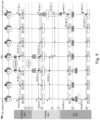
- Fig. 4 illustrates an example diagram 400 of detecting traffic hit start time and traffic hit stop time of protection switching by using an OAM frame according to an embodiment of the present disclosure, wherein a dark color block represents a lost OAM frame, and a light color block represents an OAM frame that is successfully received by the OAM Rx.
- the start time of the traffic hit time corresponds to the frame 26
- the stop time of the traffic hit time corresponds to the frame 38.
- the start time of the traffic hit time corresponds to the frame 21, and the stop time of the traffic hit time corresponds to the frame 38.
- the method according to the embodiment of the present disclosure may be implemented using various OAM tools, including, but not limited to, single-ended SLM, such as single-ended SLM defined by the ITU-T Y 1731/G.8013 specification; double-ended SLM, such as double-ended SLM defined by the ITU-T Y 1731/G. 8013 specification; single-ended SLM of additional type-length-value (TLV) carrying a timestamp; double-ended SLM of additional TLV carrying a timestamp; single-ended delay measurement (DM) of additional TLV carrying a sequence number; double-ended DM of additional TLV carrying a sequence number; and a newly proposed OAM tool having a sequence number and a timestamp.
- single-ended SLM such as single-ended SLM defined by the ITU-T Y 1731/G.8013 specification
- double-ended SLM such as double-ended SLM defined by the ITU-T Y 1731/G. 8013 specification
- the first two OAM tools may be used for the sequence number-based traffic hit time calculation method in step 5, while the remaining OAM tools may be used for the timestamp-based traffic hit time calculation method in step 5.
- the method according to the embodiment of the present disclosure being implemented using some OAM tools in the OAM tools will be described below by way of example. It should be noted that, the method according to the embodiment of the present disclosure is not limited to the OAM tools described above or described below, but any OAM tool having a sequence number and/or a timestamp may be used for implementing the method according to the embodiment of the present disclosure, and is within the protection scope of the present disclosure.
- Fig. 5 illustrates an example diagram 500 of measuring traffic hit time of protection switching by using an OAM tool based on single-ended SLM according to an embodiment of the present disclosure.
- an SLM initiator 501 sends an SLM frame (i.e., an OAM frame) to an SLM responder 502, the SLM responder 502 responds to each received SLM frame with a synthetic loss response (SLR) frame (i.e., an OAM frame), and the calculation of SLM frame loss may be only performed at the SLM initiator 501.
- SLR synthetic loss response
- An SLM SLR protocol frame carries 3 counters: TxFCf, RxFCf and TxFCb, and the SLM initiator/responder is in a local snapshot RxFCl.
- TxFCf denotes the total number of transmitted SLM frames in the far-end direction at the time this SLM frame is sent; RxFCf denotes the total number of received SLM frames in the far-end direction at the time this SLM frame is received; TxFCb denotes the total number of transmitted SLR frames in the near-end direction at the time this SLR frame is sent; and RxFCl denotes the total number of the received SLR frames in the near-end direction at the time this SLR frame is received.
- the SLM initiator may calculate far-end frame loss and near-end frame loss based on the counter carried in the received SLR, for example, by means of the following manner:
- SLM responder As SLM responder generates SLRs only when SLMs are received, in the near-end direction from B to A SLR frames may not be generated at constant periods due to the loss of SLM frames. So, during the time SLRs are not generated, frame loss in near-end direction are not catched, so the traffic hit time may be always zero, or far less than the real hit time. 2) SLM initiator calculates the frame loss only when SLRs are received, but if SLRs are lost in the near-end direction, the far-end counters (TxFCf and RxFCf) cannot be received continuously, which may impact the judgement of the start/end of the far-end direction traffic hit time.
- TxFCf and RxFCf the far-end counters
- one solution may be to use such single-ended SLM to calculate bidirectional traffic hit time (i.e., a time from traffic hit to bidirectional traffic recovery in any direction).
- TxFCf may be regarded as TxSeqNum
- RxFCl may be regarded as RxSeqNum.
- TxFCf may be regarded as TxSeqNum
- RxFCf may be regarded as RxSeqNum.
- Fig. 6 illustrates an example diagram 600 of measuring traffic hit time of protection switching by using an OAM tool based on double-ended SLM according to an embodiment of the present disclosure.
- an SLM transmitter i.e., SLM Tx_1 601 or SLM Tx_2 603 sends a 1SL frame (i.e., an OAM frame) to an SLM receiver (i.e., SLM Rx_1 602 or SLM Rx_2 604).
- the SLM receiver calculates traffic hit time in the far-end direction (i.e., the direction from A to B) based on the received 1SL frame.
- the 1SL frame carries one counter, e.g.,TxFCf, this counter counts from 1 for each 1SL frame, and the SLM receiver is in the local snapshot RxFCl.
- TxFCf denotes the total number of transmitted 1SL frames in the far-end direction at the time this 1SL frame is sent
- RxFCl denotes the total number of the received 1SL frames in the near-end direction at the time this 1SL frame is received.
- the SLM receiver calculates near-end frame loss based on the counter carried in the received 1SL. That is, the SLM Rx_1 602 may calculate the frame loss in the direction from A to B, and the SLM Rx_2 604 may calculate the frame loss in the direction from B to A.
- TxFCf may be regarded as TxSeqNum
- RxFCf may be regarded as RxSeqNum
- Fig. 7 illustrates another example diagram of measuring traffic hit time of protection switching by using an OAM tool based on single-ended SLM according to an embodiment of the present disclosure.
- the OAM frame has a timestamp field.
- An SLM initiator 701 sends SLM frames to an SLM responder 702, the SLM responder 702 utilizes the SLR frames for each received SLM frame, and the calculation of SLM frame loss may be only performed at the SLM initiator 701.
- the start time and the stop time of the traffic hit time can be still determined based on the sequence number, but the traffic hit time may be calculated based on the timestamp method in the step 5.
- the method for measuring the traffic hit time is described above by way of example by using the OAM tools based on single-ended SLM, double-ended SLM and single-ended SLM with timestamps.
- the present disclosure is not limited thereto, any other mechanisms may send service frames/packets having constant periods/sizes, sequence numbers, and/or timestamps, and these mechanisms are all within the scope of the present disclosure.
- the transmission time of Ethernet protection switching is usually about 50ms, therefore, if the period of the used OAM frames is about hundreds of microseconds, the measured traffic hit time can reach the precision of 1 millisecond, or if the period of the used OAM frames is 3.33ms or 10ms, the precision is about tens or hundreds of milliseconds.
- the detection of the start time/stop time of the traffic hit time may also relate to big data and artificial intelligence/machine learning technology.
- the state (e.g., receiving or discarding) of each OAM frame in the OAM traffic is stored in a memory as historical data like big data, and then an artificial intelligence/machine learning model may perform further training and analysis based on these historical data, so as to predict or judge a fault occurrence time capable of triggering protection, and to help recommend values of M, N, X and Y to simplify user configurations.
- the present disclosure further provides a method for automatically and in service measuring a path switch time by means of snooping a state machine of Ethernet protection switching.
- the method may include: monitoring the input, output and state of the state machine of the Ethernet protection mechanism (e.g., Ethernet linear protection in the ITU-T G.8031 specification, and Ethernet ring network protection in the ITU-T G.8032 specification and/or spanning tree protocol mechanism, and the like), so as to serve as an indication of the occurrence of a protection switching action, recording the time at which the indication changes each time, and then using a sliding window of P milliseconds (P is an integer and default value can be 100ms) to filter the changes of the indication.
- the path switch time may be: the stop time of the change - the start time of the change.
- the indication of the occurrence of the protection switching action includes at least one of the following: a change of the protection state; a condition for triggering the changes of the protection state (e.g., a local failure, a local external annotation, a received protocol message or a timer, and the like); a condition for triggering a filtering database (FDB) flushing action (e.g., a local failure, a local external switching command, a received protocol packet or a timer, and the like); start/completion of network bridge setup (in the Ethernet linear protection); start/completion of selector setup (in the Ethernet linear protection); start/completion of the FDB flushing action (in the Ethernet ring network protection); and blocking/unblocking of a ring network port (in the Ethernet ring network protection).
- FDB filtering database
- the above indication is described by way of example only, the method according to the embodiment of the present disclosure is not limited to the above indication, other indications such as input, output or state of a protection switching algorithm may also be used, and these indications are all within the scope of the present disclosure.
- the Ethernet linear protection algorithm may include an Ethernet linear protection algorithm in the ITU-T G.803 1/Y. 1342 specification
- the Ethernet ring network protection algorithm may include an Ethernet ring network protection algorithm in the ITU-T G.8032/Y. 1344 specification, but the present disclosure is not limited thereto, the method of the present disclosure may be implemented based on any Ethernet protection algorithms, and these algorithms are all within the scope of the present disclosure.
- the start time/completion time of the path switch may be detected in the following method: if one indication among the indications occurs, and no indication occurs within a duration P before the one indication occurs, determining the timestamp of the frame corresponding to the indication to be start time of the path switch; and if the indication of the state machine does not occur within the duration P after the last indication, determining the timestamp of the frame corresponding to the last indication to be the completion time of the path switch.
- Fig. 8 illustrates an example diagram 800 of measuring a path switch time according to an embodiment of the present disclosure.
- the following indications appear in sequence on a node B:
- Fig. 9 illustrates another example diagram 900 of measuring a path switch time according to an embodiment of the present disclosure.
- the following indications appear in sequence on the node B:
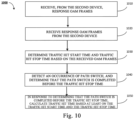
- Fig. 10 illustrates a flowchart of an example method 1000 implemented at an SLM initiator according to an embodiment of the present disclosure.
- the method 1000 may be implemented at the SLM initiator 501 as shown in Fig. 5 and the SLM initiator 701 as shown in Fig. 7 .
- the method 1000 will be described with reference to Fig. 7 . It should be understood that, the method 1000 may include additional actions not shown in the figures and/or the illustrated actions may be omitted, and the scope of the present disclosure is not limited thereto.
- operation management maintenance (OAM) frames with continuous sequence numbers can be sent to the SLM responder 702.
- response OAM frames can be received from the SLM responder 702.
- traffic hit start time and traffic hit stop time can be determined based on the received OAM frames.
- an occurrence of the path switch can be detected, and it can be determined that the path switch is completed before the traffic hit stop time.
- traffic hit time in response to determining that the path switch is completed before the traffic hit stop time, traffic hit time can be calculated based at least on the traffic hit start time and the traffic hit stop time.
- receiving the response OAM frames from the SLM responder 702 may include: performing, by the SLM initiator 701, snapshots on sequence order values of the received OAM frames, wherein the sequence order values can correspond to the numbers of the OAM frames received at the SLM initiator 701 when the corresponding OAM frame is received at the SLM initiator 701.
- determining the traffic hit start time may include: based on the sequence numbers and the sequence order values of the received OAM frames, determining that M continuous OAM frames are lost, wherein M is a configurable positive integer, and the first frame among the M continuous OAM frames may correspond to the traffic hit start time.
- determining the traffic hit start time may include: based on the sequence numbers and the sequence order values of the received OAM frames, determining that Y OAM frames among X sent OAM frames are lost, wherein X and Y are configurable positive integers, and the first frame among the Y OAM frames may correspond to the traffic hit start time.
- determining the traffic hit stop time may include: based on the sequence numbers of the received OAM frames, determining that N continuous OAM frames are received, wherein N is a configurable positive integer, and the last frame among the N continuous OAM frames may correspond to the traffic hit stop time.
- the method 1000 may further include: after the traffic hit stop time is determined, saving a sequence number of a frame corresponding to the traffic hit start time and a sequence number of a frame corresponding to the traffic hit stop time.
- the OAM frame may have a constant period
- calculating the traffic hit time may include one of the following: calculating the number of lost frames based on the sequence number of the frame corresponding to the traffic hit start time and the sequence number of the frame corresponding to the traffic hit stop time, and calculating the traffic hit time based on the number of lost frames and the period of the OAM frame; or, calculating the traffic hit time based on the number of lost frames, the period of the OAM frame, and a maximum transmission unit (MTU) time of the OAM frame.
- MTU maximum transmission unit
- the OAM frame may have a timestamp
- the method 1000 may further include: after the traffic hit stop time is determined, saving a timestamp of a frame corresponding to a traffic hit start time and a timestamp of the frame corresponding to the traffic hit stop time.
- determining the traffic hit time may include one of the following: calculating the traffic hit time based on the timestamp of the frame corresponding to the traffic hit stop time and the timestamp of the frame corresponding to the traffic hit start time; and calculating the traffic hit time based on the timestamp of the frame corresponding to the traffic hit stop time, the timestamp of the frame corresponding to the traffic hit start time, and the maximum transmission unit (MTU) time of the OAM frame.
- MTU maximum transmission unit
- the SLM initiator 701 may detect the occurrence of the path switch by monitoring a state change of a protection group.
- the method 1000 may further include: storing the state of each OAM frame among the OAM frames in a memory as historical data, and employing an artificial intelligence/machine learning model to use the historical data to execute at least one of the following operations: predicting or determining when the path switch is triggered; and generating values of M, X, Y and N.
- Fig. 11 illustrates a flowchart of an example method 1100 according to an embodiment of the present disclosure.
- the method 1100 may be implemented at the SLM receiver (i.e., the SLM Rx_1 602 or SLM Rx_2 604) as shown in Fig. 6 .
- the method 1100 will be described with reference to Fig. 6 . It should be understood that, the method 1100 may include additional actions not shown in the figures and/or the illustrated actions may be omitted, and the scope of the present disclosure is not limited thereto.
- operation management maintenance (OAM) frames with continuous sequence numbers can be received from the SLM sender.
- OAM operation management maintenance
- traffic hit start time and traffic hit stop time can be determined based on the received OAM frames.
- an occurrence of the path switch can be detected, and it can be determined that the path switch is completed before the traffic hit stop time.
- traffic hit time in response to determining that the path switch is completed before the traffic hit stop time, traffic hit time can be calculated based at least on the traffic hit start time and the traffic hit stop time.
- receiving the OAM frames from the SLM sender may include: performing, by the SLM receiver, snapshots on sequence order values of the received OAM frames, wherein the sequence order values may correspond to the numbers of the OAM frames received at the SLM receiver when the corresponding OAM frame is received at the SLM receiver.
- determining the traffic hit start time may include: based on the sequence numbers and the sequence order values of the received OAM frames, determining that M continuous OAM frames are lost, wherein M is a configurable positive integer, and the first frame among the M continuous OAM frames may correspond to the traffic hit start time.
- determining the traffic hit start time may include: based on the sequence numbers and the sequence order values of the received OAM frames, determining that Y OAM frames among X sent OAM frames are lost, wherein X and Y are configurable positive integers, and the first frame among the Y OAM frames may correspond to the traffic hit start time.
- determining the traffic hit stop time may include: based on the sequence numbers of the received OAM frames, determining that N continuous OAM frames are received, wherein N is a configurable positive integer, and the last frame among the N continuous OAM frames may correspond to the traffic hit stop time.
- the method 1100 further may include: after the traffic hit stop time is determined, saving a sequence number of a frame corresponding to the traffic hit start time and a sequence number of a frame corresponding to the traffic hit stop time.
- the OAM frame may have a constant period
- calculating the traffic hit time may include one of the following: calculating the number of lost frames based on the sequence number of the frame corresponding to the traffic hit start time and the sequence number of the frame corresponding to the traffic hit stop time, and calculating the traffic hit time based on the number of lost frames and the period of the OAM frame; or, calculating the traffic hit time based on the number of lost frames, the period of the OAM frame, and a maximum transmission unit (MTU) time of the OAM frame.
- MTU maximum transmission unit
- the OAM frame may have a timestamp
- the method 1100 may further include: after the traffic hit stop time is determined, saving a timestamp of a frame corresponding to the traffic hit start time and a timestamp of a frame corresponding to the traffic hit stop time.
- determining the traffic hit time may include one of the following: calculating the traffic hit time based on the timestamp of the frame corresponding to the traffic hit stop time and the timestamp of the frame corresponding to the traffic hit start time; and calculating the traffic hit time based on the timestamp of the frame corresponding to the traffic hit stop time, the timestamp of the frame corresponding to the traffic hit start time, and the maximum transmission unit (MTU) time of the OAM frame.
- MTU maximum transmission unit
- the SLM receiver may detect the occurrence of the path switch by monitoring a state change of a protection group.
- the method 1100 may further includes: storing the state of each OAM frame among the OAM frames in a memory as historical data, and employing an artificial intelligence/machine learning model to use the historical data to execute at least one of the following operations: predicting or determining when the path switch is triggered; and generating values of M, X, Y and N.
- Fig. 12 illustrates a flowchart of an example method 1200 according to an embodiment of the present disclosure.
- the method 1200 may be implemented at the node B as shown in Fig. 8 .
- the method 1200 will be described with reference to Fig. 8 . It should be understood that, the method 1200 may include additional actions not shown in the figures and/or the illustrated actions may be omitted, and the scope of the present disclosure is not limited thereto.
- an indication of a state machine for path switch can be received from the node C and/or the node D.
- the indication can be filtered by using a sliding window of a duration P, wherein P is configurable.
- start time and completion time of the path switch can be determined based on a filtering result of the indication.
- path switch time can be calculated based on the start time and the completion time of the path switch.
- the indication may include at least one of the following: a change of a protection state; a condition for triggering the change of the protection state; a condition for triggering a filtering database (FDB) flushing action; start/completion of network bridge setup; start/completion of selector setup; start/completion of the FDB flushing action; and blocking/unblocking of a ring network port.
- FDB filtering database
- determining the start time of the path switch may include: if one indication among the indications is filtered, and no indication of the state machine occurs within the duration P before the one indication filtered, determining a timestamp of a frame corresponding to the one indication to be the start time of the path switch.
- determining the completion time of the path switch may include: if no indication of the state machine occurs within the duration P after the last filtered indication among the indications, determining a timestamp of a frame corresponding to the last filtered indication to be the completion time of the path switch.
- the path switch may be based on at least one of the following mechanisms: Ethernet linear protection; Ethernet ring network protection; and/or spanning tree protocol.
- the OAM-based measurement method and snooping measurement method provided in the embodiments of the present disclosure have various significant advantages as shown in the following table.
- Traditional method Proposed OAM-based method
- Proposed snooping method Solution Test Pattern is generated by external test instrument.
- Accuracy of the traffic hit time No accuracy as it does not measure the real traffic.
- Sufficient accuracy of milliseconds Sufficient accuracy of milliseconds Traffic hit time Covers the entire protected traffic restoration time as per ITU-T G.808.1.
- Traffic hit time in the case of multiple switching operations The total traffic hit time experienced during all switching operations. The traffic hit time for each time switching operation. The switching time for each time switching operation. Granularity of the monitored traffic Per user traffic Per user traffic Per Ethernet protection group (protecting multiple user traffics.) Applicable network type Ethernet services over any carrier networks (native Ethernet networks, Ethernet over Ethernet services over any carrier networks (native Ethernet networks, Ethernet over MPLS(-TP) networks, Native Ethernet networks. MPLS(-TP) networks, Ethernet or IP networks, etc). Ethernet or IP networks, etc).
- various embodiments of the present disclosure may be implemented in hardware or dedicated circuits, software, logic, or any combinations thereof. Some aspects may be implemented in hardware, while other aspects may be implemented in firmware or software, which may be executed by a controller, a microprocessor, or other computing devices. Although various aspects of embodiments of the present disclosure are shown and described as block diagrams, flowcharts, or using some other illustrations, it should be understood that the blocks, apparatuses, systems, techniques or methods described herein may be implemented as, for example, nonrestrictive examples, hardware, software, firmware, dedicated circuits or logic, general-purpose hardware or controllers, or other computing devices, or some combinations thereof.
- the present disclosure further provides at least one computer program product, which is tangibly stored on a non-transitory computer-readable storage medium.
- the computer program product includes computer-executable instructions, such as instructions included in program modules, and the computer-executable instructions are executed in a device on a real or virtual processor of a target, so as to execute the methods as described above with reference to Figs. 10-12 .
- the program modules include routines, programs, libraries, objects, categories, components, data structures, and the like for executing particular tasks or implementing particular abstract data types.
- the functions of the program modules may be combined or segmented between the program modules as needed.
- Machine-executable instructions for the program modules may be executed inside local or distributed devices. In the distributed devices, the program modules may be located in local and remote storage media.
- Computer program codes for implementing the methods of the present disclosure may be compiled in one or more programming languages. These computer program codes may be provided for processors of general-purpose computers, special-purpose computers, or other programmable data processing apparatuses, such that the program codes, when executed by the computers or other programmable data processing apparatuses, cause specified functions/operations in the flowcharts and/or block diagrams to be implemented.
- the program codes may be entirely executed on the computers, partly on the computers, as stand-alone software packages, partly on the computers and partly on remote computers or entirely on the remote computers or servers.
- the computer program codes or related data may be carried by any suitable carriers, so that the devices, apparatuses or processors may execute the various processing and operations described above.
- the carriers include signals, computer-readable media, and the like.
- the signals may include electrical, optical, radio, sound, or other forms of propagation signals, such as carriers, infrared signals, and the like.
- the computer-readable medium may be any tangible medium, which includes or stores programs for or about instruction execution systems, apparatuses or devices.
- the computer-readable medium may be a computer-readable signal medium or a computer-readable storage medium.
- the computer-readable medium may include, but is not limited to, electronic, magnetic, optical, electromagnetic, infrared or semiconductor systems, apparatuses or devices, or any suitable combinations thereof. More detailed examples of the computer-readable storage medium include: an electrical connection with one or more wires, a portable computer disk, a hard disk, a random access memory (RAM), a read-only memory (ROM), an erasable programmable read-only memory (EPROM or flash memory), an optical storage device, a magnetic storage device, or any suitable combinations thereof.
- a method for measuring traffic hit time during path switch wherein the method is performed at a first device, and comprises: sending, to a second device, operation administration and maintenance (OAM) frames with continuous sequence numbers; receiving, from the second device, response OAM frames; determining traffic hit start time and traffic hit stop time based on the received OAM frames; detecting an occurrence of the path switch, and determining that the path switch is completed before the traffic hit stop time; and in response to determining that the path switch is completed before the traffic hit stop time, calculating the traffic hit time based at least on the traffic hit start time and the traffic hit stop time.
- OAM operation administration and maintenance
- Aspect 2 The method according to Aspect 1, wherein receiving from the second device the response OAM frames comprises: performing, by the first device, snapshots on sequence order values of the received OAM frames, wherein the sequence order values correspond to the numbers of the OAM frames that have been received at the first device when the corresponding OAM frame is received at the first device.
- determining the traffic hit start time comprises: based on the sequence numbers and the sequence order values of the received OAM frames, determining that M continuous OAM frames are lost, wherein M is a configurable positive integer, and the traffic hit start time corresponds to the first frame among the M continuous OAM frames.
- determining the traffic hit start time comprises: based on the sequence numbers and the sequence order values of the received OAM frames, determining that Y OAM frames among X sent OAM frames are lost, wherein X and Y are configurable positive integers, and the traffic hit start time corresponds to the first frame among the Y OAM frames.
- determining the traffic hit stop time comprises: based on the sequence numbers of the received OAM frames, determining that N continuous OAM frames are received, wherein N is a configurable positive integer, and the traffic hit stop time corresponds to the first frame among the N continuous OAM frames.
- Aspect 6 The method according to Aspect 5, further comprising: after the traffic hit stop time is determined, saving a sequence number of a frame corresponding to the traffic hit start time and a sequence number of a frame corresponding to the traffic hit stop time.
- Aspect 7 The method according to Aspect 6, wherein the OAM frame has a constant period, and calculating the traffic hit time comprises one of the following: calculating the number of lost frames based on the sequence number of the frame corresponding to the traffic hit start time and the sequence number of the frame corresponding to the traffic hit stop time, and calculating the traffic hit time based on the number of lost frames and the period of the OAM frame; or calculating the traffic hit time based on the number of lost frames, the period of the OAM frame, and a maximum transmission unit (MTU) time of the OAM frame.
- MTU maximum transmission unit
- Aspect 8 The method according to Aspect 5, wherein the OAM frame has a timestamp, and the method further comprises: after the traffic hit stop time is determined, saving a timestamp of a frame corresponding to the traffic hit start time and a timestamp of the frame corresponding to a traffic hit stop time.
- determining the traffic hit time comprises one of the following: calculating the traffic hit time based on the timestamp of the frame corresponding to the traffic hit stop time and the timestamp of the frame corresponding to the traffic hit start time; or calculating the traffic hit time based on the timestamp of the frame corresponding to the traffic hit stop time, the timestamp of the frame corresponding to the traffic hit start time, and the maximum transmission unit (MTU) time of the OAM frame.
- MTU maximum transmission unit
- Aspect 10 The method according to Aspect 1, wherein the first device detects the occurrence of the path switch by monitoring a state change of a protection group.
- Aspect 11 The method according to Aspect 5, further comprising: storing a state of OAM frame among the OAM frames in a memory as historical data, and employing an artificial intelligence/machine learning model to use the historical data to perform at least one of the following: predicting or determining when the path switch is triggered; and generating values of M, X, Y and N.
- a method for measuring traffic hit time during path switch wherein the method is performed at a first device, and comprises: receiving, from a second device, operation administration and maintenance (OAM) frames with continuous sequence numbers; determining traffic hit start time and traffic hit stop time based on the received OAM frames; detecting an occurrence of the path switch, and determining that the path switch is completed before the traffic hit stop time; and in response to determining that the path switch is completed before the traffic hit stop time, calculating traffic hit time based at least on the traffic hit start time and the traffic hit stop time.
- OAM operation administration and maintenance
- Aspect 13 The method according to Aspect 12, wherein receiving from the second device the OAM frames comprises: performing, by the first device, snapshots on sequence order values of the received OAM frames, wherein the sequence order values correspond to the numbers of the OAM frames that have been received at the first device when the corresponding OAM frame is received at the first device.
- determining the traffic hit start time comprises: based on the sequence numbers and the sequence order values of the received OAM frames, determining that M continuous OAM frames are lost, wherein M is a configurable positive integer, and the traffic hit start time corresponds to the first frame among the M continuous OAM frames.
- determining the traffic hit start time comprises: based on the sequence numbers and the sequence order values of the received OAM frames, determining that Y OAM frames among X sent OAM frames are lost, wherein X and Y are configurable positive integers, and the traffic hit start time corresponds to the first frame among the Y OAM frames.
- determining the traffic hit stop time comprises: based on the sequence numbers of the received OAM frames, determining that N continuous OAM frames are received, wherein N is a configurable positive integer, and the traffic hit stop time corresponds to the first frame among the N continuous OAM frames.
- Aspect 17 The method according to Aspect 16, further comprising: after the traffic hit stop time is determined, saving a sequence number of a frame corresponding to the traffic hit start time and a sequence number of a frame corresponding to the traffic hit stop time.
- Aspect 18 The method according to Aspect 17, wherein the OAM frame has a constant period, and calculating the traffic hit time comprises one of the following: calculating the number of lost frames based on the sequence number of the frame corresponding to the traffic hit start time and the sequence number of the frame corresponding to the traffic hit stop time, and calculating the traffic hit time based on the number of lost frames and the period of the OAM frame; or calculating the traffic hit time based on the number of lost frames, the period of the OAM frame, and a maximum transmission unit (MTU) time of the OAM frame.
- MTU maximum transmission unit
- Aspect 19 The method according to Aspect 16, wherein the OAM frame has a timestamp, and the method further comprises: after the traffic hit stop time is determined, saving a timestamp of a frame corresponding to the traffic hit start time and a timestamp of the frame corresponding to a traffic hit stop time.
- determining the traffic hit time comprises one of the following: calculating the traffic hit time based on the timestamp of the frame corresponding to the traffic hit stop time and the timestamp of the frame corresponding to the traffic hit start time; and calculating the traffic hit time based on the timestamp of the frame corresponding to the traffic hit stop time, the timestamp of the frame corresponding to the traffic hit start time, and the maximum transmission unit (MTU) time of the OAM frame.
- MTU maximum transmission unit
- Aspect 21 The method according to Aspect 12, wherein the first device detects the occurrence of the path switch by monitoring a state change of a protection group.
- Aspect 22 The method according to Aspect 16, further comprising: storing a state of OAM frame among the OAM frames in a memory as historical data, and employing an artificial intelligence/machine learning model to use the historical data to perform at least one of the following: predicting or determining when the path switch is triggered; and generating values of M, X, Y and N.
- a first device for measuring traffic hit time during path switch comprising: at least one processor; and at least one memory including computer program code, wherein the at least one memory and the computer program code are configured to, with the at least one processor, cause the first device to: send, to a second device, operation administration and maintenance (OAM) frames with continuous sequence numbers; receive, from the second device, response OAM frames; determine traffic hit start time and traffic hit stop time based on the received OAM frames; detect an occurrence of the path switch, and determine that the path switch is completed before the traffic hit stop time; and in response to determining that the path switch is completed before the traffic hit stop time, calculate traffic hit time based at least on the traffic hit start time and the traffic hit stop time.
- OAM operation administration and maintenance
- Aspect 24 The first device according to Aspect 23, wherein the at least one memory and the computer program code are configured to, with the at least one processor, cause the first device to receive from the second device the response OAM frames by: performing, by the first device, snapshots on sequence order values of the received OAM frames, wherein the sequence order values correspond to the numbers of the OAM frames that have been received at the first device when the corresponding OAM frame is received at the first device.
- Aspect 25 The first device according to Aspect 24, wherein the at least one memory and the computer program code are configured to, with the at least one processor, cause the first device to determine the traffic hit start time by: based on the sequence numbers and the sequence order values of the received OAM frames, determining that M continuous OAM frames are lost, wherein M is a configurable positive integer, and the traffic hit start time corresponds to the first frame among the M continuous OAM frames.
- Aspect 26 The first device according to Aspect 24, wherein the at least one memory and the computer program code are configured to, with the at least one processor, cause the first device to determine the traffic hit start time by: based on the sequence numbers and the sequence order values of the received OAM frames, determining that Y OAM frames among X sent OAM frames are lost, wherein X and Y are configurable positive integers, and the traffic hit start time corresponds to the first frame among the Y OAM frames.
- Aspect 27 The first device according to Aspect 25 or 26, wherein the at least one memory and the computer program code are configured to, with the at least one processor, cause the first device to determine the traffic hit stop time by: based on the sequence numbers of the received OAM frames, determining that N continuous OAM frames are received, wherein N is a configurable positive integer, and the traffic hit stop time corresponds to the first frame among the N continuous OAM frames.
- Aspect 28 The first device according to Aspect 27, wherein the at least one memory and the computer program code are further configured to, with the at least one processor, cause the first device to: after the traffic hit stop time is determined, save a sequence number of a frame corresponding to the traffic hit start time and a sequence number of a frame corresponding to the traffic hit stop time.
- Aspect 29 The first device according to Aspect 28, wherein the OAM frame has a constant period, and the at least one memory and the computer program code are configured to, with the at least one processor, cause the first device to calculate the traffic hit time by one of the following: calculating the number of lost frames based on the sequence number of the frame corresponding to the traffic hit start time and the sequence number of the frame corresponding to the traffic hit stop time, and calculating the traffic hit time based on the number of lost frames and the period of the OAM frame; or calculating the traffic hit time based on the number of lost frames, the period of the OAM frame, and a maximum transmission unit (MTU) time of the OAM frame.
- MTU maximum transmission unit
- Aspect 30 The first device according to Aspect 27, wherein the OAM frame has a timestamp, and the at least one memory and the computer program code are further configured to, with the at least one processor, cause the first device to: after the traffic hit stop time is determined, save a timestamp of a frame corresponding to a traffic hit start time and a timestamp of the frame corresponding to the traffic hit stop time.
- Aspect 31 The first device according to Aspect 30, wherein the at least one memory and the computer program code are configured to, with the at least one processor, cause the first device to calculate the traffic hit time by one of the following: calculating the traffic hit time based on the timestamp of the frame corresponding to the traffic hit stop time and the timestamp of the frame corresponding to the traffic hit start time; and calculating the traffic hit time based on the timestamp of the frame corresponding to the traffic hit stop time, the timestamp of the frame corresponding to the traffic hit start time, and the maximum transmission unit (MTU) time of the OAM frame.
- MTU maximum transmission unit
- Aspect 32 The first device according to Aspect 23, wherein the at least one memory and the computer program code are configured to, with the at least one processor, cause the first device to detect the occurrence of the path switch by: monitoring a state change of a protection group.
- Aspect 33 The first device according to Aspect 27, wherein the at least one memory and the computer program code are further configured to, with the at least one processor, cause the first device to store a state of OAM frame among the OAM frames in a memory as historical data, and employ an artificial intelligence/machine learning model to use the historical data to perform at least one of the following: predicting or determining when the path switch is triggered; and generating values of M, X, Y and N.
- a first device for measuring traffic hit time during path switch comprising: at least one processor; and at least one memory including computer program code, wherein the at least one memory and the computer program code are configured to, with the at least one processor, cause the first device to: receive, from a second device, operation administration and maintenance (OAM) frames with continuous sequence numbers; determine traffic hit start time and traffic hit stop time based on the received OAM frames; detect an occurrence of the path switch, and determine that the path switch is completed before the traffic hit stop time; and in response to determining that the path switch is completed before the traffic hit stop time, calculate traffic hit time at least based on the traffic hit start time and the traffic hit stop time.
- OAM operation administration and maintenance
- Aspect 35 The first device according to Aspect 34, wherein the at least one memory and the computer program code are configured to, with the at least one processor, cause the first device to receive the OAM frames from the second device by: performing, by the first device, snapshots on sequence order values of the received OAM frames, wherein the sequence order values correspond to the numbers of the OAM frames received at the first device when the corresponding OAM frame is received at the first device.
- Aspect 36 The first device according to Aspect 35, wherein the at least one memory and the computer program code are configured to, with the at least one processor, cause the first device to determine the traffic hit start time by: based on the sequence numbers and the sequence order values of the received OAM frames, determining that M continuous OAM frames are lost, wherein M is a configurable positive integer, and the traffic hit start time corresponds to the first frame among the M continuous OAM frames.
- Aspect 37 The first device according to Aspect 35, wherein the at least one memory and the computer program code are configured to, with the at least one processor, cause the first device to determine the traffic hit start time by: based on the sequence numbers and the sequence order values of the received OAM frames, determining that Y OAM frames among X sent OAM frames are lost, wherein X and Y are configurable positive integers, and the traffic hit start time corresponds to the first frame among the Y OAM frames.
- Aspect 38 The first device according to Aspect 36 or 37, wherein the at least one memory and the computer program code are configured to, with the at least one processor, cause the first device to determine the traffic hit stop time by: based on the sequence numbers of the received OAM frames, determining that N continuous OAM frames are received, wherein N is a configurable positive integer, and the traffic hit stop time corresponds to the first frame among the N continuous OAM frames.
- Aspect 39 The first device according to Aspect 38, wherein the at least one memory and the computer program code are further configured to, with the at least one processor, cause the first device to: after the traffic hit stop time is determined, save a sequence number of a frame corresponding to a traffic hit start time and a sequence number of the frame corresponding to the traffic hit stop time.
- Aspect 40 The first device according to Aspect 39, wherein the OAM frame has a constant period, and the at least one memory and the computer program code are configured to, with the at least one processor, cause the first device to calculate the traffic hit time by one of the following: calculating the number of lost frames based on the sequence number of the frame corresponding to the traffic hit start time and the sequence number of the frame corresponding to the traffic hit stop time, and calculating the traffic hit time based on the number of lost frames and the period of the OAM frame; or calculating the traffic hit time based on the number of lost frames, the period of the OAM frame, and a maximum transmission unit (MTU) time of the OAM frame.
- MTU maximum transmission unit
- Aspect 41 The first device according to Aspect 38, wherein the OAM frame has a timestamp, and the at least one memory and the computer program code are further configured to, with the at least one processor, cause the first device to: after the traffic hit stop time is determined, save a timestamp of a frame corresponding to the traffic hit start time and a timestamp of a frame corresponding to the traffic hit stop time.
- Aspect 42 The first device according to Aspect 41, wherein the at least one memory and the computer program code are configured to, with the at least one processor, cause the first device to calculate the traffic hit time by one of the following: calculating the traffic hit time based on the timestamp of the frame corresponding to the traffic hit stop time and the timestamp of the frame corresponding to the traffic hit start time; and calculating the traffic hit time based on the timestamp of the frame corresponding to the traffic hit stop time, the timestamp of the frame corresponding to the traffic hit start time, and the maximum transmission unit (MTU) time of the OAM frame.
- MTU maximum transmission unit
- Aspect 43 The first device according to Aspect 34, wherein the at least one memory and the computer program code are configured to, with the at least one processor, cause the first device to detect the occurrence of the path switch by: monitoring a state change of a protection group.
- Aspect 44 The first device according to Aspect 38, wherein the at least one memory and the computer program code are further configured to, with the at least one processor, cause the first device to store a state of OAM frame among the OAM frames in a memory as historical data, and employ an artificial intelligence/machine learning model to use the historical data to perform at least one of the following: predicting or determining when the path switch is triggered; and generating values of M, X, Y and N.
- Aspect 45 A computer-readable storage medium, having program code stored thereon, wherein the program code is configured to, when executed, cause an apparatus to execute the method according to any one of Aspects 1-11 or Aspects 12-22.
- a method for measuring path switch time wherein the method is performed at a first node, and comprises: receiving, from at least a second node, an indication of a state machine for path switch; filtering the indication by using a sliding window of a duration P, wherein P is configurable; determining start time and completion time of the path switch based on a filtering result of the indication; and calculating the path switch time based on the start time and the completion time of the path switch.
- Aspect 47 The method according to Aspect 46, wherein the indication comprises at least one of the following: a change of a protection state; a condition for triggering the change of the protection state; a condition for triggering a filtering database (FDB) flushing action; start/completion of network bridge setup; start/completion of selector setup; start/completion of the FDB flushing action; and blocking/unblocking of a ring network port.
- FDB filtering database
- determining the start time of the path switch comprises: if one indication among the indications is filtered, and no indication of the state machine occurs within the duration P before the one indication filtered, determining a timestamp of a frame corresponding to the one indication to be the start time of the path switch.
- determining the completion time of the path switch comprises: if no indication of the state machine occurs within the duration P after the last filtered indication among the indications, determining a timestamp of a frame corresponding to the last filtered indication to be the completion time of the path switch.
- Aspect 50 The method according to Aspect 46, wherein the path switch is based on at least one of the following mechanisms: Ethernet linear protection; Ethernet ring network protection; and/or spanning tree protocol.
- a first node for measuring a path switch time comprising: at least one processor; and at least one memory including computer program code, wherein the at least one memory and the computer program code are configured to, with the at least one processor, cause the first node to: receive, from at least a second node, an indication of a state machine for path switch; filter the indication by using a sliding window of a duration P, wherein P is configurable; determine start time and completion time of the path switch based on a filtering result of the indication; and calculate the path switch time based on the start time and the completion time of the path switch.
- Aspect 52 The first node according to Aspect 51, wherein the indication comprises at least one of the following: a change of a protection state; a condition for triggering the change of the protection state; a condition for triggering a filtering database (FDB) flushing action; start/completion of network bridge setup; start/completion of selector setup; start/completion of the FDB flushing action; and blocking/unblocking of a ring network port.
- FDB filtering database
- Aspect 53 The first node according to Aspect 52, wherein the at least one memory and the computer program code are configured to, with the at least one processor, cause the first node to determine the start time of the path switch by: if one indication among the indications is filtered, and no indication of the state machine occurs within the duration P before the one indication filtered, determining a timestamp of a frame corresponding to the one indication to be the start time of the path switch.
- Aspect 54 The first node according to Aspect 53, wherein the at least one memory and the computer program code are configured to, with the at least one processor, cause the first node to determine the completion time of the path switch by: if no indication of the state machine occurs within the duration P after the last filtered indication among the indications, determining a timestamp of a frame corresponding to the last filtered indication to be the completion time of the path switch.
- Aspect 55 The first node according to Aspect 51, wherein the path switch is based on at least one of the following mechanisms: Ethernet linear protection; Ethernet ring network protection; and/or spanning tree protocol.
- Aspect 56 A computer-readable storage medium, having program code stored thereon, wherein the program code is configured to, when executed, cause an apparatus to execute the method according to any one of Aspects 46-50.
Landscapes
- Engineering & Computer Science (AREA)
- Computer Networks & Wireless Communication (AREA)
- Signal Processing (AREA)
- Environmental & Geological Engineering (AREA)
- Computer Security & Cryptography (AREA)
- Data Exchanges In Wide-Area Networks (AREA)
- Devices For Checking Fares Or Tickets At Control Points (AREA)
- Measurement Of Unknown Time Intervals (AREA)
Applications Claiming Priority (1)
| Application Number | Priority Date | Filing Date | Title |
|---|---|---|---|
| CN202210259608.0A CN116800632A (zh) | 2022-03-16 | 2022-03-16 | 测量路径切换期间流中断时间的方法、装置和计算机可读介质 |
Publications (2)
| Publication Number | Publication Date |
|---|---|
| EP4246913A2 true EP4246913A2 (fr) | 2023-09-20 |
| EP4246913A3 EP4246913A3 (fr) | 2023-11-29 |
Family
ID=85510887
Family Applications (1)
| Application Number | Title | Priority Date | Filing Date |
|---|---|---|---|
| EP23160331.7A Pending EP4246913A3 (fr) | 2022-03-16 | 2023-03-07 | Procédé, dispositif et support lisible par ordinateur pour mesurer le temps d'impact de trafic pendant un changement de trajet |
Country Status (3)
| Country | Link |
|---|---|
| US (1) | US12513067B2 (fr) |
| EP (1) | EP4246913A3 (fr) |
| CN (1) | CN116800632A (fr) |
Families Citing this family (4)
| Publication number | Priority date | Publication date | Assignee | Title |
|---|---|---|---|---|
| EP4497261A4 (fr) * | 2022-04-27 | 2025-07-23 | Samsung Electronics Co Ltd | Équipement utilisateur, station de base et procédé réalisé par ceux-ci |
| CN117193991B (zh) * | 2023-11-08 | 2024-02-23 | 广州翼辉信息技术有限公司 | 一种实时操作系统中断处理时间的准确测量方法 |
| DE102024111705B4 (de) | 2024-04-25 | 2026-02-05 | Deutsche Telekom Ag | Verfahren zur automatischen Erkennung und Dokumentation der Durchführung einer Messung bezüglich einer Daten-Kommunikationsverbindung |
| CN121924053A (zh) * | 2024-10-16 | 2026-04-24 | 诺基亚通信(上海)股份有限公司 | 用于以太网通信的设备、方法、装置和计算机可读介质 |
Family Cites Families (11)
| Publication number | Priority date | Publication date | Assignee | Title |
|---|---|---|---|---|
| FR2790348B1 (fr) | 1999-02-26 | 2001-05-25 | Thierry Grenot | Systeme et procede de mesure des durees de transfert et des taux de pertes dans des reseaux de telecommunication haut-debit |
| JP2002354011A (ja) * | 2001-05-24 | 2002-12-06 | Mitsubishi Electric Corp | 2重化切替システム |
| GB2410394B (en) * | 2004-01-22 | 2007-04-04 | Agilent Technologies Inc | Service disruption time determination apparatus and method therefor |
| CN1756187A (zh) * | 2004-09-30 | 2006-04-05 | 华为技术有限公司 | 出口标签交换路由器与其相连数据设备间故障的处理方法 |
| US20100302967A1 (en) * | 2009-05-29 | 2010-12-02 | Electronics And Telecommunications Research Institute | Method and apparatus for measuring network delay in ethernet ring network |
| WO2012177213A2 (fr) * | 2011-06-20 | 2012-12-27 | Telefonaktiebolaget L M Ericsson (Publ) | Procédés et dispositif de surveillance d'un chemin de données |
| CN103152205B (zh) * | 2013-03-22 | 2016-02-10 | 烽火通信科技股份有限公司 | 基于流索引的oam处理方法及装置 |
| US10015066B2 (en) * | 2016-02-04 | 2018-07-03 | Ciena Corporation | Propagation of frame loss information by receiver to sender in an ethernet network |
| CN109257194B (zh) * | 2017-07-12 | 2019-11-19 | 中兴通讯股份有限公司 | 处理承载通道的oam信息的方法、装置、设备及系统 |
| US10469367B2 (en) * | 2017-10-04 | 2019-11-05 | Cisco Technology, Inc. | Segment routing network processing of packets including operations signaling and processing of packets in manners providing processing and/or memory efficiencies |
| US20230188874A1 (en) * | 2021-12-10 | 2023-06-15 | Adtran, Inc. | Rapid Network Redundancy Failover |
-
2022
- 2022-03-16 CN CN202210259608.0A patent/CN116800632A/zh active Pending
-
2023
- 2023-03-07 US US18/179,426 patent/US12513067B2/en active Active
- 2023-03-07 EP EP23160331.7A patent/EP4246913A3/fr active Pending
Also Published As
| Publication number | Publication date |
|---|---|
| US20230300050A1 (en) | 2023-09-21 |
| US12513067B2 (en) | 2025-12-30 |
| CN116800632A (zh) | 2023-09-22 |
| EP4246913A3 (fr) | 2023-11-29 |
Similar Documents
| Publication | Publication Date | Title |
|---|---|---|
| US12513067B2 (en) | Method, device and computer-readable medium for measuring traffic hit time during path switch | |
| CN112866043B (zh) | 网络质量检测方法、装置、服务器和计算机可读介质 | |
| KR101993866B1 (ko) | 데이터 전송 채널을 관리하는 방법 및 장치 | |
| EP2242236B1 (fr) | Procédé pour mesurer une perte de trame, système pour mesurer une perte de trame et dispositif pour mesurer une perte de trame | |
| KR102455332B1 (ko) | 네트워크 장치의 상태를 결정하는 방법 및 장치 | |
| CN104202190B (zh) | 一种网络链路监控方法及设备 | |
| EP2903213B1 (fr) | Procédé et appareil de test de débit | |
| CN106330588B (zh) | 一种bfd检测方法与装置 | |
| WO2018001326A1 (fr) | Procédé et dispositif d'acquisition d'informations de défaillance | |
| CN110049317A (zh) | 一种视频监控系统的在线故障检测方法、系统和电子设备 | |
| CN106233666B (zh) | 根据opc ua标准诊断网络中的传输故障的方法和装置 | |
| CN108989128B (zh) | 基于组网结构的故障定位方法及装置 | |
| CN113285871B (zh) | 链路保护方法、sdn控制器和通信网络系统 | |
| EP2858302A1 (fr) | Procédé de vérification de connectivité sur une liaison de flux de service, appareil connexe, et système | |
| DE102004063567A1 (de) | Dienstunterbrechungszeitbestimmungsvorrichtung und -Verfahren | |
| CN108802568B (zh) | 一种智能站同杆并架双回线路的故障测距方法及装置 | |
| US20170310535A1 (en) | Diagnosis method and diagnostic device for a network | |
| CN100401826C (zh) | 传输链路的故障检测方法 | |
| CN101741647B (zh) | 一种测量以太环网切换时间的方法及装置 | |
| JP2016146555A (ja) | サービス影響原因推定装置、サービス影響原因推定プログラム、及びサービス影響原因推定方法 | |
| US20110154099A1 (en) | Method and system for masking defects within a network | |
| US20120250536A1 (en) | Ethernet-dual-ended loss measurement calculation | |
| CN108418724A (zh) | 基于云计算的下一代关键信息基础设施网络智能管理系统 | |
| CN115733726A (zh) | 网络群障确定方法、装置、存储介质及电子装置 | |
| CN113949657A (zh) | 物联网检测装置、系统和测试方法 |
Legal Events
| Date | Code | Title | Description |
|---|---|---|---|
| PUAI | Public reference made under article 153(3) epc to a published international application that has entered the european phase |
Free format text: ORIGINAL CODE: 0009012 |
|
| STAA | Information on the status of an ep patent application or granted ep patent |
Free format text: STATUS: THE APPLICATION HAS BEEN PUBLISHED |
|
| AK | Designated contracting states |
Kind code of ref document: A2 Designated state(s): AL AT BE BG CH CY CZ DE DK EE ES FI FR GB GR HR HU IE IS IT LI LT LU LV MC ME MK MT NL NO PL PT RO RS SE SI SK SM TR |
|
| PUAL | Search report despatched |
Free format text: ORIGINAL CODE: 0009013 |
|
| AK | Designated contracting states |
Kind code of ref document: A3 Designated state(s): AL AT BE BG CH CY CZ DE DK EE ES FI FR GB GR HR HU IE IS IT LI LT LU LV MC ME MK MT NL NO PL PT RO RS SE SI SK SM TR |
|
| RIC1 | Information provided on ipc code assigned before grant |
Ipc: H04L 43/50 20220101ALN20231025BHEP Ipc: H04L 43/106 20220101ALN20231025BHEP Ipc: H04L 43/062 20220101ALN20231025BHEP Ipc: H04L 43/028 20220101ALN20231025BHEP Ipc: H04L 41/16 20220101ALN20231025BHEP Ipc: H04L 41/14 20220101ALN20231025BHEP Ipc: H04L 41/0893 20220101ALI20231025BHEP Ipc: H04L 43/04 20220101ALI20231025BHEP Ipc: H04L 43/0829 20220101AFI20231025BHEP |
|
| STAA | Information on the status of an ep patent application or granted ep patent |
Free format text: STATUS: REQUEST FOR EXAMINATION WAS MADE |
|
| 17P | Request for examination filed |
Effective date: 20240527 |
|
| RBV | Designated contracting states (corrected) |
Designated state(s): AL AT BE BG CH CY CZ DE DK EE ES FI FR GB GR HR HU IE IS IT LI LT LU LV MC ME MK MT NL NO PL PT RO RS SE SI SK SM TR |