EP4247656B1 - Hinterachse mit integriertem elektromotor - Google Patents
Hinterachse mit integriertem elektromotor Download PDFInfo
- Publication number
- EP4247656B1 EP4247656B1 EP21807301.3A EP21807301A EP4247656B1 EP 4247656 B1 EP4247656 B1 EP 4247656B1 EP 21807301 A EP21807301 A EP 21807301A EP 4247656 B1 EP4247656 B1 EP 4247656B1
- Authority
- EP
- European Patent Office
- Prior art keywords
- motor housing
- axle
- chassis
- mount
- truck
- Prior art date
- Legal status (The legal status is an assumption and is not a legal conclusion. Google has not performed a legal analysis and makes no representation as to the accuracy of the status listed.)
- Active
Links
Images




Classifications
-
- B—PERFORMING OPERATIONS; TRANSPORTING
- B60—VEHICLES IN GENERAL
- B60K—ARRANGEMENT OR MOUNTING OF PROPULSION UNITS OR OF TRANSMISSIONS IN VEHICLES; ARRANGEMENT OR MOUNTING OF PLURAL DIVERSE PRIME-MOVERS IN VEHICLES; AUXILIARY DRIVES FOR VEHICLES; INSTRUMENTATION OR DASHBOARDS FOR VEHICLES; ARRANGEMENTS IN CONNECTION WITH COOLING, AIR INTAKE, GAS EXHAUST OR FUEL SUPPLY OF PROPULSION UNITS IN VEHICLES
- B60K1/00—Arrangement or mounting of electrical propulsion units
-
- B—PERFORMING OPERATIONS; TRANSPORTING
- B60—VEHICLES IN GENERAL
- B60G—VEHICLE SUSPENSION ARRANGEMENTS
- B60G9/00—Resilient suspensions of a rigid axle or axle housing for two or more wheels
- B60G9/02—Resilient suspensions of a rigid axle or axle housing for two or more wheels the axle or housing being pivotally mounted on the vehicle, e.g. the pivotal axis being parallel to the longitudinal axis of the vehicle
- B60G9/022—Resilient suspensions of a rigid axle or axle housing for two or more wheels the axle or housing being pivotally mounted on the vehicle, e.g. the pivotal axis being parallel to the longitudinal axis of the vehicle the axle having an imaginary pivotal point
- B60G9/025—Resilient suspensions of a rigid axle or axle housing for two or more wheels the axle or housing being pivotally mounted on the vehicle, e.g. the pivotal axis being parallel to the longitudinal axis of the vehicle the axle having an imaginary pivotal point using linkages for the suspension of the axle allowing its lateral swinging displacement
-
- B—PERFORMING OPERATIONS; TRANSPORTING
- B60—VEHICLES IN GENERAL
- B60K—ARRANGEMENT OR MOUNTING OF PROPULSION UNITS OR OF TRANSMISSIONS IN VEHICLES; ARRANGEMENT OR MOUNTING OF PLURAL DIVERSE PRIME-MOVERS IN VEHICLES; AUXILIARY DRIVES FOR VEHICLES; INSTRUMENTATION OR DASHBOARDS FOR VEHICLES; ARRANGEMENTS IN CONNECTION WITH COOLING, AIR INTAKE, GAS EXHAUST OR FUEL SUPPLY OF PROPULSION UNITS IN VEHICLES
- B60K11/00—Arrangement in connection with cooling of propulsion units
- B60K11/02—Arrangement in connection with cooling of propulsion units with liquid cooling
-
- B—PERFORMING OPERATIONS; TRANSPORTING
- B60—VEHICLES IN GENERAL
- B60L—PROPULSION OF ELECTRICALLY-PROPELLED VEHICLES; SUPPLYING ELECTRIC POWER FOR AUXILIARY EQUIPMENT OF ELECTRICALLY-PROPELLED VEHICLES; ELECTRODYNAMIC BRAKE SYSTEMS FOR VEHICLES IN GENERAL; MAGNETIC SUSPENSION OR LEVITATION FOR VEHICLES; MONITORING OPERATING VARIABLES OF ELECTRICALLY-PROPELLED VEHICLES; ELECTRIC SAFETY DEVICES FOR ELECTRICALLY-PROPELLED VEHICLES
- B60L50/00—Electric propulsion with power supplied within the vehicle
- B60L50/50—Electric propulsion with power supplied within the vehicle using propulsion power supplied by batteries or fuel cells
- B60L50/60—Electric propulsion with power supplied within the vehicle using propulsion power supplied by batteries or fuel cells using power supplied by batteries
-
- B—PERFORMING OPERATIONS; TRANSPORTING
- B62—LAND VEHICLES FOR TRAVELLING OTHERWISE THAN ON RAILS
- B62D—MOTOR VEHICLES; TRAILERS
- B62D21/00—Understructures, i.e. chassis frame on which a vehicle body may be mounted
- B62D21/11—Understructures, i.e. chassis frame on which a vehicle body may be mounted with resilient means for suspension, e.g. of wheels or engine; sub-frames for mounting engine or suspensions
-
- B—PERFORMING OPERATIONS; TRANSPORTING
- B60—VEHICLES IN GENERAL
- B60G—VEHICLE SUSPENSION ARRANGEMENTS
- B60G2200/00—Indexing codes relating to suspension types
- B60G2200/30—Rigid axle suspensions
- B60G2200/314—Rigid axle suspensions with longitudinally arranged arms articulated on the axle
-
- B—PERFORMING OPERATIONS; TRANSPORTING
- B60—VEHICLES IN GENERAL
- B60G—VEHICLE SUSPENSION ARRANGEMENTS
- B60G2200/00—Indexing codes relating to suspension types
- B60G2200/30—Rigid axle suspensions
- B60G2200/34—Stabilising mechanisms, e.g. for lateral stability
- B60G2200/343—Stabilising mechanisms, e.g. for lateral stability with an axle suspended by two pivoted rods in "V"-arrangement, the rods being coupled at its apex
-
- B—PERFORMING OPERATIONS; TRANSPORTING
- B60—VEHICLES IN GENERAL
- B60G—VEHICLE SUSPENSION ARRANGEMENTS
- B60G2202/00—Indexing codes relating to the type of spring, damper or actuator
- B60G2202/10—Type of spring
- B60G2202/15—Fluid spring
- B60G2202/152—Pneumatic spring
- B60G2202/1524—Pneumatic spring with two air springs per wheel, arranged before and after the wheel axis
-
- B—PERFORMING OPERATIONS; TRANSPORTING
- B60—VEHICLES IN GENERAL
- B60G—VEHICLE SUSPENSION ARRANGEMENTS
- B60G2204/00—Indexing codes related to suspensions per se or to auxiliary parts
- B60G2204/10—Mounting of suspension elements
- B60G2204/18—Mounting of vehicle engines
-
- B—PERFORMING OPERATIONS; TRANSPORTING
- B60—VEHICLES IN GENERAL
- B60G—VEHICLE SUSPENSION ARRANGEMENTS
- B60G2204/00—Indexing codes related to suspensions per se or to auxiliary parts
- B60G2204/10—Mounting of suspension elements
- B60G2204/20—Mounting of accessories, e.g. pump, compressor
- B60G2204/202—Mounting of accessories, e.g. pump, compressor of cables
-
- B—PERFORMING OPERATIONS; TRANSPORTING
- B60—VEHICLES IN GENERAL
- B60G—VEHICLE SUSPENSION ARRANGEMENTS
- B60G2300/00—Indexing codes relating to the type of vehicle
- B60G2300/02—Trucks; Load vehicles
- B60G2300/026—Heavy duty trucks
-
- B—PERFORMING OPERATIONS; TRANSPORTING
- B60—VEHICLES IN GENERAL
- B60G—VEHICLE SUSPENSION ARRANGEMENTS
- B60G2300/00—Indexing codes relating to the type of vehicle
- B60G2300/50—Electric vehicles; Hybrid vehicles
-
- B—PERFORMING OPERATIONS; TRANSPORTING
- B60—VEHICLES IN GENERAL
- B60K—ARRANGEMENT OR MOUNTING OF PROPULSION UNITS OR OF TRANSMISSIONS IN VEHICLES; ARRANGEMENT OR MOUNTING OF PLURAL DIVERSE PRIME-MOVERS IN VEHICLES; AUXILIARY DRIVES FOR VEHICLES; INSTRUMENTATION OR DASHBOARDS FOR VEHICLES; ARRANGEMENTS IN CONNECTION WITH COOLING, AIR INTAKE, GAS EXHAUST OR FUEL SUPPLY OF PROPULSION UNITS IN VEHICLES
- B60K1/00—Arrangement or mounting of electrical propulsion units
- B60K2001/001—Arrangement or mounting of electrical propulsion units one motor mounted on a propulsion axle for rotating right and left wheels of this axle
-
- B—PERFORMING OPERATIONS; TRANSPORTING
- B60—VEHICLES IN GENERAL
- B60L—PROPULSION OF ELECTRICALLY-PROPELLED VEHICLES; SUPPLYING ELECTRIC POWER FOR AUXILIARY EQUIPMENT OF ELECTRICALLY-PROPELLED VEHICLES; ELECTRODYNAMIC BRAKE SYSTEMS FOR VEHICLES IN GENERAL; MAGNETIC SUSPENSION OR LEVITATION FOR VEHICLES; MONITORING OPERATING VARIABLES OF ELECTRICALLY-PROPELLED VEHICLES; ELECTRIC SAFETY DEVICES FOR ELECTRICALLY-PROPELLED VEHICLES
- B60L2240/00—Control parameters of input or output; Target parameters
- B60L2240/40—Drive Train control parameters
- B60L2240/42—Drive Train control parameters related to electric machines
- B60L2240/425—Temperature
-
- B—PERFORMING OPERATIONS; TRANSPORTING
- B60—VEHICLES IN GENERAL
- B60L—PROPULSION OF ELECTRICALLY-PROPELLED VEHICLES; SUPPLYING ELECTRIC POWER FOR AUXILIARY EQUIPMENT OF ELECTRICALLY-PROPELLED VEHICLES; ELECTRODYNAMIC BRAKE SYSTEMS FOR VEHICLES IN GENERAL; MAGNETIC SUSPENSION OR LEVITATION FOR VEHICLES; MONITORING OPERATING VARIABLES OF ELECTRICALLY-PROPELLED VEHICLES; ELECTRIC SAFETY DEVICES FOR ELECTRICALLY-PROPELLED VEHICLES
- B60L2240/00—Control parameters of input or output; Target parameters
- B60L2240/40—Drive Train control parameters
- B60L2240/48—Drive Train control parameters related to transmissions
- B60L2240/485—Temperature
-
- B—PERFORMING OPERATIONS; TRANSPORTING
- B60—VEHICLES IN GENERAL
- B60Y—INDEXING SCHEME RELATING TO ASPECTS CROSS-CUTTING VEHICLE TECHNOLOGY
- B60Y2200/00—Type of vehicle
- B60Y2200/10—Road Vehicles
- B60Y2200/14—Trucks; Load vehicles, Busses
- B60Y2200/142—Heavy duty trucks
-
- B—PERFORMING OPERATIONS; TRANSPORTING
- B60—VEHICLES IN GENERAL
- B60Y—INDEXING SCHEME RELATING TO ASPECTS CROSS-CUTTING VEHICLE TECHNOLOGY
- B60Y2410/00—Constructional features of vehicle sub-units
- B60Y2410/10—Housings
-
- B—PERFORMING OPERATIONS; TRANSPORTING
- B60—VEHICLES IN GENERAL
- B60Y—INDEXING SCHEME RELATING TO ASPECTS CROSS-CUTTING VEHICLE TECHNOLOGY
- B60Y2410/00—Constructional features of vehicle sub-units
- B60Y2410/115—Electric wiring; Electric connectors
-
- Y—GENERAL TAGGING OF NEW TECHNOLOGICAL DEVELOPMENTS; GENERAL TAGGING OF CROSS-SECTIONAL TECHNOLOGIES SPANNING OVER SEVERAL SECTIONS OF THE IPC; TECHNICAL SUBJECTS COVERED BY FORMER USPC CROSS-REFERENCE ART COLLECTIONS [XRACs] AND DIGESTS
- Y02—TECHNOLOGIES OR APPLICATIONS FOR MITIGATION OR ADAPTATION AGAINST CLIMATE CHANGE
- Y02T—CLIMATE CHANGE MITIGATION TECHNOLOGIES RELATED TO TRANSPORTATION
- Y02T10/00—Road transport of goods or passengers
- Y02T10/60—Other road transportation technologies with climate change mitigation effect
- Y02T10/64—Electric machine technologies in electromobility
Definitions
- the invention relates to a truck with a rear axle with integrated electric motor.
- the electric motor or electric motors are new components to be packaged in the vehicle.
- Architectural concepts include placing the electric motor and transmission in the chassis, e.g. on the spot where the internal combustion engine is located.
- the driven axle may instead be powered by an internal electric motor resulting in a compact design where an electric powertrain can have all of the functions of a conventional powertrain embedded in a single body, also known as an E-axle.
- the E-axle receives its energy from an electric power source, e.g. a battery pack or fuel cells, located elsewhere in the truck and connected through one or multiple power cables.
- DE 102016004367 describes a rigid axle driven by an electric drive having a suspension for an axle with an electric motor and gearbox arranged in alignment with one another. Air bellows supports extend transversely to the driven axle and are attached to a housing of the gearbox.
- Publication EP2991889 describes another approach to integrating modules for powering an electric vehicle into a truck architecture.
- a chassis component is disclosed for carrying a load applied to the vehicle, such as a fifth wheel, which is distributed to the wheels of the vehicle.
- a hollow space in the chassis component can be used for housing an electrical drive unit and a power transmission.
- the chassis component may function as a complete suspension component for connecting the wheels to the chassis.
- the increased load characteristics of the chassis component relative to a that of a conventional truck would require design modifications to the suspension setup.
- WO2017114418 describes an electric drive axle assembly in which a power motor and transmission are arranged perpendicular to the axle, for driving the wheels of the vehicle via a differential.
- the E-axle moves with respect to the electric power source while the truck is driving.
- the conventional rear axle setup and power transmission can be conserved.
- the power cable should also bend or deflect with the movement of the E-axle. This deflection can cause a durability problem due to an inherent fatigue limit of the power cable.
- a truck comprising a rear axle and a suspension system.
- the rear axle comprises a motor housing extending laterally between rear wheels of the truck.
- the rear axle further comprises an electric motor and power transmission coaxially aligned in said motor housing and arranged for driving the rear wheels.
- the suspension system suspends the rear axle to a chassis of the truck, and at least comprises a pair of springs and shock absorbers, and an anti-roll stabilizer and a guiding rod linkage for allowing movement in a vertical direction relative to the chassis.
- the motor housing is limited by a minimum vertical ground clearance between the road surface and a bottom surface of the motor housing.
- the motor housing comprises a reinforced central top section providing a guiding rod mount for pivotally mounting the guiding rod linkage to the rear axle.
- the truck according to the invention is characterized in that the Thu motor housing further comprises suspension yokes integrated into the housing and extending on either side of the motor housing near both axial ends, the suspension yokes provide spring mounts and shock absorber mounts for mounting said opposed pair of springs and shock absorbers, and in that the motor housing comprises a rear section outer surface provided with connectors, to provide input ports to the electric motor, the connectors are provided in an orientation to guide one or more high voltage power cables adjacent the rear section outer surface in a vertical upward direction. For the high voltage cables, the upward vertical orientation will minimize the bending stresses induced by the axle suspension movement.
- Said connectors are thus provided with an orientation to guide the one or more high voltage cables in upward direction minimize fatigue stress, since high voltage cable connectors typically are provided from low resistance metals, e.g. copper or copper alloys, that are susceptible to bending stress.
- the one or more high voltage cables electrically connects the electric power source to the E-axle.
- a support beam may form a mechanical support structure to lead the power cable along a cable path extending between a chassis mount and an E-axle mount.
- the support beam may comprise one or more bending stiffness elements, forming a stiffness of the support beam that is highest in a middle section and that decreases towards the chassis mount and the E-axle mount, evenly distributing the bending stress in the support beam along the cable path when the E-axle moves relative to the chassis, to further prevent local fatigue failure of the power cable.
- the support beam may extend from a chassis mount in a backward direction along a longitudinal member of the chassis and connects the E-axle mount along a vertical direction, to said a rear section outer surface provided with connectors, to provide input ports to the electric motor.
- an electrically conductive core may be mounted between the chassis mount and the E-axle connector, to make a ground connection between the E-axle and the chassis and the support beam may be mounted to the conductive core along at least a part of the cable path, e.g. to form an electrically insulating sleeve with a bending stiffness that varies along the cable path.
- the support beam comprises bending stiffness elements comprising one or more flanges extending along the cable path.
- the flanges may have a flange height that is highest in the middle section of the support beam and that decreases towards the chassis mount and the E-axle mount.
- the bending stiffness elements may comprise two vertically extending flanges forming an H-beam to prevent the support beam from deflecting in a lateral direction.
- the support beam comprises laterally extending cable supports arranged for leading multiple power cables adjacent the cable path, each power cable following the cable path at a lateral offset from the support beam.
- the multiple power cables may be connected to the E-axle by a common power connector, at a distance beyond the E-axle mount to allow disconnecting the power cables without disassembling the support beam from the E-axle mount.
- an anti-roll mount of an anti-roll stabilizer on each axial end of the motor housing, an anti-roll mount of an anti-roll stabilizer, an opposing pair of spring mounts and a shock absorber mount lie on a common plane perpendicular to a centerline of the rear wheels of the truck.
- the anti-roll stabilizer may comprise a torsion shaft.
- the torsion shaft is mounted to the chassis while allowing an axial rotation at an offset to the rear axle, and has a pair of linkage plates on both ends extending from the torsion shaft towards the anti-roll mounts.
- the anti-roll stabilizer is configured such that a roll movement of the truck, causing a difference in a vertical displacement of the anti-roll mounts on each axial end of the motor housing relative to the chassis, is counteracted by a torsional stiffness of the torsion shaft.
- the guiding rod linkage comprises a pair of guiding rods.
- the pair of guiding rod is pivotally mounted to the chassis at an offset to the rear axle, and extends towards the reinforced central top section.
- the reinforced central top section of the motor housing comprises a number of ribs.
- the ribs converge toward the guiding rod mount and have a rib height that is highest near the guiding rod mount and that decreases away from the guiding rod mount.
- housing extensions are coaxially connected to both axial ends of the motor housing for mounting rear wheel brakes.
- the housing extensions have a proximal base part that is axially connected to the motor housing, and have a distal part extending away from the motor housing toward the rear wheels with a diameter smaller than the proximal base part.
- the motor housing comprises a rear section outer surface provided with connectors, to provide input ports to the electric motor.
- the connectors are provided in an orientation to guide one or more high voltage power cables adjacent the rear section outer surface in a vertical upward direction.
- the motor housing may be arranged for internally carrying a gearbox and/or inverter for powering different groups of coils of the electric motor.
- the motor housing is made of an electrically conductive material to electromagnetically shield at least the electric motor. Additionally or alternatively, the motor housing is made of a thermally conductive material to passively cool e.g. the electric motor or the power transmission.
- the rear axle is provided with an internal cooling circuit for circulating coolant fluid through the axle housing and one or more coolant hose connectors on the rear section outer surface for receiving one or more coolant hoses, to actively cool at least the electric motor.
- the coolant fluid may additionally be employed as lubricant for lubricating rotating parts inside the motor housing, such as the power transmission.
- FIG 1 shows a top view of a truck 10 with a rear axle 400 with integrated electric motor according to a first embodiment.
- the rear axle 400 comprises a motor housing 440 extending laterally between rear wheels 11 of the truck 10.
- the rear axle 400 comprises an electric motor 410 and power transmission 420, coaxially aligned in said motor housing 440 and arranged for driving the rear wheels 11.
- the rear axle can comprise two electric motors 410 and corresponding power transmissions 420, each arranged for driving the rear wheels 11 on one side of the truck 10, whereas the electric motors 410 are oriented back to back. This setup allows independent (electronic) control of the torque to the rear wheels 11 on each side of the truck 10.
- a single electric motor 410 and power transmission 420 can be used to simultaneously drive the rear wheels 11 on both sides of the truck 10, e.g. by having a hollow shaft electric motor and power transmission 420.
- the corresponding power transmission 420 may comprise a controllable differential drive or planetary gear system to mechanically divide the drive torque between the rear wheels 11 on each side.
- the truck 10 further comprises a suspension system 200, for suspending the rear axle 400 to a chassis 15.
- the suspension system 200 at least comprises a pair of springs 210 and shock absorbers 220, and an anti-roll stabilizer 270 and a guiding rod linkage 280 for allowing movement in a vertical direction Z relative to the chassis 15.
- the motor housing 440 is limited by a minimum vertical ground clearance DH between the road surface 5 and a bottom surface of the motor housing 440.
- the minimum vertical ground clearance DH may be at least fifteen centimeters.
- the minimum vertical ground clearance is between fifteen and 25 centimeters.
- Figure 1 shows that the motor housing 440 comprises a reinforced central top section 444 providing a guiding rod mount 285 for pivotally mounting the guiding rod linkage 280 to the rear axle 400.
- the motor housing 440 further comprises suspension yokes 450 integrated into the housing.
- the suspension yokes 450 extend on either side of the motor housing 440 near both axial ends, and provide spring mounts 215 and shock absorber mounts 225 for mounting the opposed pair of springs 210 and shock absorbers 220.
- a rear section 490 is provided on the motor housing 440, provided with connectors 480 to provide input ports to the electric motor.
- a further embodiment of a truck 10 is depicted with one or more high voltage cables 300.
- the high voltage cables 300 extend from chassis mount 510 in a backward (-X) direction along a longitudinal member 15 of the chassis, and approach the connectors 480 along the vertical (-Z) direction.
- the benefit of this configuration is that the length of the power cables 300 can be made as long as possible within the given length of the truck 10, which reduces the movement amplitude per centimeter of cable when the E-axle 400 moves relative to the chassis 100.
- the high voltage cables 300 extend along a longitudinal member 15 of the chassis 100, e.g. on an inside surface of the longitudinal member 110, the power cables can be shielded inside the chassis 100 against dirt, damage, and electromagnetic emission.
- the rear section outer surface 490 is easily accessible from the bottom of the truck, e.g. for service or maintenance.
- the rear section outer surface 490 is a surface on a rear half, more preferably a rear bottom quadrant of the E-axle.
- the connectors are provided in an orientation to guide one or more high voltage power cables 300 adjacent the rear section outer surface 490 in a vertical upward direction +Z.
- the connectors can be provided on a rear section outer surface 490 which is substantially flat and smooth, so that power cables 300 can closely be guided upward along the E-axle 400.
- the connectors on the rear section outer surface 490 can e.g. be straight connectors oriented outward, while the connectors 480 on the power cables 300 are right-angle connectors 480, or vice versa.
- the rear section outer surface 490 may for example be oriented relatively upward or perpendicular to the outer surface of the E-axle, so that straight connectors can be used on the rear section outer surface 490 and on the power cables 300.
- Figure 3 provides an embodiment of a support beam 500, comprising bending stiffness elements extending along the cable path.
- three typical areas can be distinguished along the cable path 900: (i) Starting at the chassis mount 510, the support beam comprises a chassis end section, which extends horizontally in the -X direction from the chassis mount 510. As the distance to the chassis mount 510 increases, the bending stiffness of the support beam 500 increases as well. (ii) Next, the support beam 500 transitions into a middle section, in which the bending stiffness of the support beam 500 reaches a maximum.
- an end section approaches the E-axle mount 520 vertically in the -Z direction along the cable path. Similar to the chassis end section, the bending stiffness of the E-axle end section is lower towards the E-axle mount 520 and increases as the distance thereto is increased.
- the cable may be connected to the support beam 500 by lateral mounting elements 590.
- the vertical orientation of the E-axle end section increases the (vertical) bending stiffness of that section of the support beam 500. This may allow the absolute length of the E-axle end section to be longer than the chassis end section.
- the stiffness of the support beam 500 can be relatively less sensitive to the distance between the chassis mount 510 and E-axle mount 520 in the vertical direction Z, than to the distance between the chassis mount 510 and E-axle mount 520 in the horizontal direction X.
- a longer length of power cable 400 can be supported by a less sensitive support beam 500, which improves spreading the total movement of the power cable 400 equally along the cable path 900.
- the suspension yokes 450 further provide anti-roll mounts 275 on a bottom section of the motor housing 440 near both axial ends to mount the anti-roll stabilizer 270 to the rear axle 400.
- the suspension yoke 450 is coaligned with plane 808 and designed to bear all corresponding suspension loads on the motor housing 440, while other parts of the motor housing are largely unloaded and can therefore be relatively thin-walled or light-weight.
- a rear axle 400 with integrated electric motor 410 and power transmission 420 could have comparable weight as a conventional driven axle.
- the compact size of the electric motor 410 and transmission 420 allows placing them in between the wheels, coaxial with the centerline 101 of the rear wheels 11. This eliminates the need for an angled drive mechanism, and therefore reduces the total weight of the rear axle 400. It is a challenge, however, to integrate the electric rear axle 400 into a conventional truck architecture without significantly changing the dynamic properties of the truck 10.
- the current solution proposes to integrate carrying and driving functions into the rear axle 400.
- Driving functions are e.g. provided by the driveshafts, the wheel hubs with their bearings, the wheels and tires.
- the carrying functions are for example provided by the motor housing 440, where on conventional trucks a rigid driven axle is used.
- the suspension system 200 with springs 210 and shock absorbers 220, together with the guiding rod linkage 280 and anti-roll stabilizer 270 are other examples of carrying functions.
- the rear axle assembly is typically fitted with brakes between the driving and carrying components.
- FIG 4 provides an isometric view of a further embodiment of the truck 10, wherein the anti-roll stabilizer 270 comprises a torsion shaft 271 which is mounted to the chassis (not shown) while allowing an axial rotation at an offset to the rear axle 400.
- the torsion shaft 271 has a pair of linkage plates 272, 273 on both ends extending towards the anti-roll mounts 275.
- a roll movement of the truck 10 causing a difference in a vertical displacement of the anti-roll mounts 275 on each axial end of the motor housing 440 relative to the chassis 15, is counteracted by a torsional stiffness of the torsion shaft 271.
- the linkage plates 272, 273 are rigidly connected to the ends of the torsion shaft 271 and extend perpendicularly to the axis of rotation 303 of the torsion shaft 271 towards the anti-roll mounts 275.
- the linkage plates 272, 273 have equal length, so that the torsion shaft 271 is mounted parallel to the rear axle 400, such that the rear axle 400 is suspended to the chassis as part of a parallelogram mechanism comprising the anti-roll stabilizer and the guiding rod linkage, allowing a movement of the rear axle 400 in vertical direction Z, while other degrees of freedom of the rear axle 400 are constrained.
- the anti-roll stabilizer may comprise e.g. planar bearings, roller bearings or ball bearings on the ends of the torsion shaft 271 to mount the torsion shaft 271 to the chassis 15 while allowing axial rotation.
- the bearings can be mounted on a central section of the torsion shaft 271 between the linkage plates 272, 273 to mount the torsion shaft 271 to the chassis 15 while allowing axial rotation.
- the linkage plates 272, 273 are pivotally mounted to the anti-roll mounts 275 on the motor housing 440.
- the connection between the linkage plates 272, 273 and the anti-roll mounts may comprise planar bearings, ball bearings, or roller bearings.
- the linkage plates 272, 273 can be rigidly connected to the motor housing 440 or may be an integral part of the suspension yokes 450, or the torsion shaft 271 or entire anti-roll stabilizer 270 can be mounted at a different location or orientation to create a suspension system with alternative kinematics and dynamics.
- the reaction forces on the motor housing 440 caused by interaction of the rear axle 400 with the suspension system 300 may still be concentrated in a single plane 808, as long as the anti-roll mount, the opposing pair of spring mounts 215 and the shock absorber mount 225 lie on a common plane 808 perpendicular to the centerline 101 of the rear wheels 11 of the truck 10.
- Figure 5 provides an isometric view of another further embodiment of the truck 10, wherein the guiding rod linkage 280 comprises a pair of guiding rods 281, 282.
- the pair of guiding rods 281, 282 are pivotally mounted to the chassis (not shown) at an offset to the rear axle 400, and extend towards the reinforced central top section 444.
- the guiding rods 281, 282 have an equal length.
- the pair of guiding rods 281, 282 can for example be mounted between the rear axle 400 and the chassis, such that the rear axle 400 is suspended to the chassis as part of a parallelogram mechanism comprising the guiding rod linkage and the anti-roll stabilizer, allowing a movement of the rear axle 400 in vertical direction Z, while other degrees of freedom of the rear axle 400 are constrained.
- the pair of guiding rods 281, 282 may form a V-shape, with the ends of the guiding rods that are mounted to the chassis spread along a common axis of rotation 202, and the ends of the guiding rods that are mounted to the rear axle 400 converging toward the guiding rod mount 285.
- the pair of guiding rods 281, 282 can have a V-shape of which the converging end is mounted to the chassis, and the other ends are mounted to the motor housing 440, near the axial ends, or to the suspension yokes 450.
- the diverging ends of the V-shaped pair of guiding rods 281, 282 is mounted to the suspension yokes together with the anti-roll mount, the opposing pair of spring mounts 215 and the shock absorber mount 225 on a common plane 808 perpendicular to a centerline 101 of the rear wheels 11 of the truck 10. This may provide optimal distribution of reaction forces on the rear axle 400, caused by interaction with the suspension system while the truck is driving, which with topology optimization, may lead to further weight reduction of the rear axle 400.
- the reinforced central top section 444 of the motor housing 440 comprises a number of ribs converging toward the guiding rod mount 285 and having a rib height that is highest near the guiding rod mount 285 and that decreases away from the guiding rod mount 285.
- the rib height is aligned with the vertical direction Z, such that the vertical bending stiffness of the reinforced central top section 444 is increased.
- the ribs can e.g. be an integral part of the motor housing or be separately assembled parts.
- the reinforced central top section 444 is provided by the motor housing 440 having a larger wall thickness near the guiding rod mount 285. However, compared to the embodiment with ribs, this may lead to a higher overall weight of the motor housing 440.
- the reinforced central top section 444 can be provided by the motor housing 440 having an internal wall structure supporting the central top section.
- the motor housing 440 may comprise a central wall that axially splits the rear axle into two opposite compartments, each housing components for driving wheels on one side of the truck 10. Accordingly, the central wall may serve as a support wall to reinforce the central top section 444.
- housing extensions 470 are coaxially connected to both axial ends of the motor housing 440 for mounting rear wheel brakes 600.
- the housing extensions 470 have a proximal base part that is axially connected to the motor housing 440, and have a distal part extending away from the motor housing 440 toward the rear wheels 11 with a diameter smaller than the proximal base part.
- the housing extensions 470 can be conical, horn shaped, or comprise a stepped outer surface.
- the housing extensions 470 are brackets connecting the rear wheel brakes 600 to the motor housing 440.
- the housing extensions 470 can be an integral part of the motor housing 440, or the motor housing 440 can provide surfaces for directly mounting the rear wheel brakes 600.
- the motor housing 440 comprises a rear section outer surface 490 provided with connectors 480, to provide input ports to the electric motor (not shown).
- the rear section outer surface 490 is easily accessible from the bottom of the truck, e.g. for service or maintenance.
- the rear section outer surface 490 is a surface on a rear half, more preferably a rear bottom quadrant of the motor housing 440. In case of more than one connector, these are preferably provided parallel to the centerline 101 of the rear wheels, to have equal bending behavior of the cables to be connected to the connectors 480 through a mating cable connector 481.
- the connectors 480 are provided in an orientation to guide one or more high voltage power cables 300 adjacent the rear section outer surface 490 in a vertical upward direction +Z.
- the connectors 480 can be provided on a rear section outer surface 490 which is substantially flat and smooth, so that power cables 300 can closely be guided upward along the motor housing 440.
- the connectors 480 on the rear section outer surface 490 can e.g. be straight connectors 480 oriented outward, while the cable connectors 481 of the power cables 300 are right-angle connectors, or vice versa.
- the rear section outer surface 490 may for example be oriented relatively upward or perpendicular to the outer surface of the motor housing 440, so that straight connectors 480 can be used on the rear section outer surface 490 and on the power cables 300.
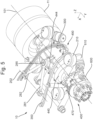
- Figure 6 provides an exploded view of yet another or further embodiment of the truck 10, wherein the motor housing 440 is additionally arranged for internally carrying a gearbox and/or inverter 430 for powering different groups of coils of the electric motor 410.
- the gearbox and/or inverter 430 is coaxially aligned with the electric motor 410 and the power transmission 420.
- the gearbox and/or inverter 430 can placed behind the electric motor 410 relative to the power transmission 420, in a central section of the motor housing 440.
- the electric motor 410 and power transmission 420 fit into the cavity inside the motor housing 440.
- a gearbox and/or inverter 430 into the rear axle 400 as well. This could bring advantages in the cable connections from the invertor 430 to the electric motor 410.
- the invertor 430 is connected to the electric motor 410 by multiple cables to power different groups of coils. By having an invertor 430 placed close to the electric motor 410 the cables can be short, and since they are located inside the motor housing 440, problems with electromagnetic radiation due to the alternating current can be limited by applying EMC shielding measures to the motor housing 440.
- the motor housing 440 is made of an electrically conductive material to electromagnetically shield at least the electric motor 410.
- the motor housing 440 can form a Faraday cage around the internally carried electric components to reduce emission of and susceptibility to electromagnetic radiation, which may be required for performance and reliability of the truck, or to comply to industry specific technical regulations.
- the motor housing 440 can be made of cast iron, steel, or an aluminum alloy.
- the motor housing 440 is made of an electrically nonconductive material, such as a plastic, but has an electrically conductive element adjacent the inner or outer surface of the motor housing 440, such as a conductive paint or a separate conductive mesh structure forming a Faraday cage around the internally carried components.
- the motor housing 440 is made of a thermally conductive material with a thermal conductivity of at least ten Watt per meter Kelvin to passively cool e.g. the electric motor 410.
- the thermal conductivity of the motor housing 440 can be between ten and seventy Watt per meter Kelvin for steel motor housings 440, between thirty and one hundred Watt per meter Kelvin for (cast) Iron motor housings 440, or between seventy and two hundred and forty Watt per meter Kelvin for Aluminum (alloy) motor housings 440.
- the rear axle 400 is provided with an internal cooling circuit for circulating coolant fluid through the motor housing 440 and one or more coolant hose connectors on the rear section outer surface 490 for receiving one or more coolant hoses 350, to actively cool at least the electric motor 410.
- the motor housing 440 may comprise internal walls adjacent the internally carried components, such as the electric motor 410. Accordingly, the internal walls can have channels for circulating coolant fluid through the motor housing 440 close to the source of heat.
- the external walls of the motor housing 440 may comprise channels for coolant fluid.
- a separate element comprising an internal cooling circuit, such as a heat sink or other type of heat exchanger, can be built into or onto the motor housing.
- the motor housing may comprise sealed compartments having a defined inlet and outlet, each compartment housing a component such as an electric motor or a power transmission, and being supplied with a flow of coolant fluid.
- the coolant hoses are fluidly connected to an external pump and reservoir containing coolant fluid, which is pumped to and from the rear axle 400.
- the rear axle cooling system may be part of a larger truck cooling system, cooling other parts on the truck 100 as well to reduce the total weight of the truck 10.
- the rear axle 400 may comprise its own independent cooling system, e.g. if the cooling capacity required for cooling the rear axle 400 cannot be matched with that of other parts of the truck 10.
- the coolant fluid is additionally employed as lubricant for lubricating rotating parts inside the motor housing 440 such as the power transmission 420, to avoid requiring separated flows of lubricant and coolant fluid, and thus reduce the total weight of the truck 10.
- Figure 7A provides a side view of a truck 10 comprising an electric rear axle 400.
- Figure 7B provides a side view of a conventional truck 70 architecture, comprising an internal combustion engine 71, a power transmission 72 and propshaft 73, driving the rear wheels 11 of the truck through a conventional driven axle 78.
- the conventional driven axle 78 and electric rear axle 400 can be mounted to the chassis 15 by the same guiding rod linkage 280, and at the same chassis mount 286 and guiding rod mount 285.
- the anti-roll stabilizer 270 can have the same dimensions, orientation, and mounts 275 and 276. This facilitates integration of electric rear axle 400 into conventional truck architecture 70.
- the torsion shaft 271 of the anti-roll stabilizer can be placed at a more advantageous location between chassis mounts 276 compared to the conventional driven axle 78, which may benefit manufacturability and serviceability.
- the torsion shaft is preferably located between or near mounts 275.
- the relatively bulkier shape of the motor housing 440 would force the torsion shaft 271 forward in X-direction.
- a more forward mounted torsion shaft implies a larger distance in X-direction between the anti-roll mounts 275 and the centerline 101 of the rear axle 400 as well, with negative effects on kinematics and secondary torque on the axle.
- the inventive solution is to flip the anti-roll stabilizer 270 over one hundred and eighty degrees along the Z-direction before mounting it to the rear axle 400. As shown in Figure 5 , this implies that the torsion shaft 271 is mounted to the chassis 15 and the linkage plates 272, 273 are mounted to the anti-roll mounts 275 on the rear axle 400. The function of the anti-roll stabilizer 270 is thereby kept similar to one on a conventional driven axle 78.
Landscapes
- Engineering & Computer Science (AREA)
- Mechanical Engineering (AREA)
- Transportation (AREA)
- Chemical & Material Sciences (AREA)
- Combustion & Propulsion (AREA)
- Life Sciences & Earth Sciences (AREA)
- Sustainable Development (AREA)
- Sustainable Energy (AREA)
- Power Engineering (AREA)
- Arrangement Or Mounting Of Propulsion Units For Vehicles (AREA)
- Vehicle Body Suspensions (AREA)
Claims (15)
- Lastkraftwagen (10), umfassend:- eine Hinterachse (400), mit einem Motorgehäuse (440), welches sich seitlich zwischen Hinterrädern (11) des Lastkraftwagens erstreckt, und einem Elektromotor (410) und Getriebe (420), koaxial ausgerichtet in dem Motorgehäuse (440) und zum Antreiben der Hinterräder (11) angeordnet; und- ein Aufhängungssystem (200) zum Aufhängen der Hinterachse (400) an einem Fahrgestell (100) des Lastkraftwagens, wobei das Aufhängungssystem (200) mindestens ein Paar Federn (210) und Stoßdämpfer (220) und einen Antirollstabilisator (270) und ein Führungsstangengestänge (280) zum Zulassen einer Bewegung in einer vertikalen Richtung (Z) relativ zum Fahrgestell (100) aufweist;wobei das Motorgehäuse (440) durch eine minimale vertikale Bodenfreiheit (DH) zwischen der Straßenoberfläche (5) und einer Unterseite des Motorgehäuses (440) begrenzt ist;wobei das Motorgehäuse (440) einen verstärkten mittleren oberen Abschnitt (444) umfasst, der eine Führungsstangenhalterung (285) zur schwenkbaren Montage des Führungsstangengestänges (280) an der Hinterachse (400) bereitstellt;dadurch gekennzeichnet, dass das Motorgehäuse (440) ferner Aufhängungsgabeln (450) umfasst, die in das Gehäuse (440) integriert sind und sich auf beiden Seiten des Motorgehäuses (440) in der Nähe der beiden axialen Enden erstrecken, wobei die Aufhängungsgabeln (450) Federaufnahmen (215) und Stoßdämpferaufnahmen (225) zur Aufnahme der gegenüberliegenden Paare von Federn (210) und Stoßdämpfern (220) bereitstellen, wobei das Motorgehäuse (440) eine mit Verbindern (480) versehene Außenfläche (490) des hinteren Abschnitts umfasst, um Eingangsanschlüsse für den Elektromotor bereitzustellen, und wobei die Verbinder (480) in einer Ausrichtung vorgesehen sind, um ein oder mehrere Hochspannungsstromkabel (300), der Außenfläche (490) des hinteren Abschnitts benachbart, in einer vertikalen Aufwärtsrichtung (+Z) zu führen.
- Lastkraftwagen nach Anspruch 1, ferner umfassend einen Stützträger (500), ausbildend eine mechanische Stützstruktur zum Führen des Stromkabels (300) entlang einer Kabelbahn (900), die sich erstreckt zwischen einer Fahrgestellaufnahme (510) und einer E-Achsen-Aufnahme (520).
- Lastkraftwagen nach Anspruch 2, wobei der Stützträger (500) ferner einen elektrisch leitfähigen Kern aufweist, der zwischen der Fahrgestellaufnahme (510) und der E-Achsen-Aufnahme (520) montiert ist, um eine Masseverbindung zwischen der E-Achse und dem Fahrgestell herzustellen.
- Lastkraftwagen nach Anspruch 2 oder 3, wobei der Stützträger (500) entlang mindestens eines Teils der Kabelbahn (900) am leitfähigen Kern montiert ist.
- Lastkraftwagen nach einem der Ansprüche 2 bis 4, wobei der Stützträger (500) ein oder mehrere biegsame Versteifungselemente umfasst, die eine Steifigkeit des Stützträgers bilden, die in einem mittleren Abschnitt am höchsten ist und die in Richtung der Fahrgestellaufnahme (510) und der E-Achsen-Aufnahme (520) abnimmt, wobei die Biegebelastung im Stützträger entlang der Kabelbahn (900) gleichmäßig verteilt wird, wenn sich die E-Achse relativ zum Fahrgestell bewegt, um einen lokalen Ermüdungsdefekt des Stromkabels zu verhindern.
- Lastkraftwagen nach Anspruch 5, wobei die biegsamen Versteifungselemente sich vertikal erstreckende Flansche umfassen, um ein Ablenken des Stützträgers (500) in einer seitlichen Richtung zu verhindern.
- Lastkraftwagen nach einem der vorstehenden Ansprüche, wobei die Aufhängungsgabeln (450) ferner Stabilisatoraufnahmen (275) zur Aufnahme des Antirollstabilisators an der Hinterachse (400) bereitstellen und wobei der Antirollstabilisator (270) eine Torsionswelle (271) umfasst, wobei die Torsionswelle am Fahrgestell (100) montiert ist, während sie eine axiale Drehung in einem Versatz zur Hinterachse (400) zulässt, und aufweisend ein Paar Verbindungsplatten (272, 273) an beiden Enden, sich erstreckend von der Torsionswelle (271) zu den Stabilisatoraufnahmen (275), sodass einer Rollbewegung des Lastkraftwagens, die einen Unterschied in einer vertikalen Verschiebung der Stabilisatoraufnahmen (275) an jedem axialen Ende des Motorgehäuses (440) relativ zum Fahrgestell verursacht, durch eine Torsionssteifigkeit der Torsionswelle (271) entgegengewirkt wird.
- Lastkraftwagen nach einem der vorstehenden Ansprüche, wobei das Führungsstangengestänge (280) ein Paar Führungsstangen (281, 282) umfasst, wobei das Paar Führungsstangen (281, 282) drehbar am Fahrgestell, versetzt zur Hinterachse (400), montiert ist und sich in Richtung des verstärkten mittleren oberen Abschnitts (444) erstreckt.
- Lastkraftwagen nach einem der vorstehenden Ansprüche, wobei der verstärkte mittlere obere Abschnitt (444) des Motorgehäuses eine Anzahl von Rippen umfasst, die sich zur Führungsstangenaufnahme (285) hin annähern und eine Rippenhöhe aufweisen, die in der Nähe der Führungsstangenaufnahme (285) am höchsten ist und die von der Führungsstangenaufnahme (285) weg abnimmt.
- Lastkraftwagen nach einem der vorstehenden Ansprüche, wobei Gehäuseverlängerungen (470) mit beiden axialen Enden des Motorgehäuses (440) zur Aufnahme von Hinterradbremsen (600) koaxial verbunden sind, wobei die Gehäuseverlängerungen (470) einen proximalen Basisteil aufweisen, der axial mit dem Motorgehäuse (440) verbunden ist, und einen distalen Teil aufweisen, der sich vom Motorgehäuse (440) weg in Richtung der Hinterräder (11) erstreckt, mit einem Durchmesser, der kleiner als der proximale Basisteil ist.
- Lastkraftwagen nach einem der vorstehenden Ansprüche, wobei das Motorgehäuse (440) zusätzlich zum Tragen eines Getriebes und/oder Wechselrichters (430) im Inneren zum Antreiben verschiedener Gruppen von Spulen des Elektromotors (410) angeordnet ist.
- Lastkraftwagen nach einem der vorstehenden Ansprüche, wobei das Motorgehäuse (440) aus einem elektrisch leitfähigen Material hergestellt ist, um zumindest den Elektromotor (410) elektromagnetisch abzuschirmen.
- Lastkraftwagen nach einem der vorstehenden Ansprüche, wobei das Motorgehäuse (440) aus einem thermisch leitfähigen Material mit einer Wärmeleitfähigkeit von mindestens zehn Watt pro Meter Kelvin hergestellt ist.
- Lastkraftwagen nach einem der vorstehenden Ansprüche, wobei die Hinterachse (400) mit einem internen Kühlkreislauf zum Zirkulieren von Kühlfluid durch das Motorgehäuse (440) und einem oder mehreren Kühlmittelschlauchverbindern an der Außenfläche (490) des hinteren Abschnitts zur Aufnahme eines oder mehrerer Kühlmittelschläuche (350) zur aktiven Kühlung zumindest des Elektromotors (410) versehen ist.
- Lastkraftwagen nach Anspruch 14, wobei das Kühlfluid zusätzlich als Schmiermittel zum Schmieren rotierender Teile im Inneren des Motorgehäuses (440) verwendet wird.
Applications Claiming Priority (2)
| Application Number | Priority Date | Filing Date | Title |
|---|---|---|---|
| NL2026916A NL2026916B1 (en) | 2020-11-17 | 2020-11-17 | Rear axle with integrated electric motor |
| PCT/NL2021/050702 WO2022108444A1 (en) | 2020-11-17 | 2021-11-16 | Rear axle with integrated electric motor |
Publications (3)
| Publication Number | Publication Date |
|---|---|
| EP4247656A1 EP4247656A1 (de) | 2023-09-27 |
| EP4247656B1 true EP4247656B1 (de) | 2024-11-27 |
| EP4247656C0 EP4247656C0 (de) | 2024-11-27 |
Family
ID=74592657
Family Applications (1)
| Application Number | Title | Priority Date | Filing Date |
|---|---|---|---|
| EP21807301.3A Active EP4247656B1 (de) | 2020-11-17 | 2021-11-16 | Hinterachse mit integriertem elektromotor |
Country Status (4)
| Country | Link |
|---|---|
| US (1) | US12403756B2 (de) |
| EP (1) | EP4247656B1 (de) |
| NL (1) | NL2026916B1 (de) |
| WO (1) | WO2022108444A1 (de) |
Families Citing this family (15)
| Publication number | Priority date | Publication date | Assignee | Title |
|---|---|---|---|---|
| US10967927B2 (en) | 2017-09-22 | 2021-04-06 | Link Mfg., Ltd. | Mounting brackets for auxiliary suspension systems |
| NL2026916B1 (en) * | 2020-11-17 | 2022-07-01 | Daf Trucks Nv | Rear axle with integrated electric motor |
| FR3123044B1 (fr) * | 2021-05-20 | 2024-04-12 | Psa Automobiles Sa | Dispositif de renfort de train arriere de vehicule, notamment automobile |
| US11820188B2 (en) | 2021-07-08 | 2023-11-21 | Link Mfg., Ltd. | Driven lift axles and associated systems and methods |
| US20250388182A1 (en) * | 2022-07-05 | 2025-12-25 | Jatco Ltd | Vehicle |
| DE102022117576B4 (de) * | 2022-07-14 | 2024-07-25 | Daimler Truck AG | Fahrwerk für ein Nutzfahrzeug |
| US12545095B2 (en) * | 2022-11-04 | 2026-02-10 | Oshkosh Corporation | Electrified fire fighting vehicle |
| US20240149808A1 (en) | 2022-11-04 | 2024-05-09 | Oshkosh Corporation | High voltage cable routing for electrified vehicle |
| US20240149864A1 (en) * | 2022-11-04 | 2024-05-09 | Oshkosh Corporation | Electrified fire fighting vehicle |
| CN116424080A (zh) * | 2023-04-28 | 2023-07-14 | 重庆长安凯程汽车科技有限公司 | 电机悬置结构和车辆 |
| US12441143B2 (en) | 2023-11-13 | 2025-10-14 | Caterpillar Inc. | Multi-link front suspension for an underground articulated dump truck |
| JP2025098434A (ja) * | 2023-12-20 | 2025-07-02 | トヨタ自動車株式会社 | 電気自動車 |
| EP4674650A1 (de) * | 2024-07-05 | 2026-01-07 | Volvo Truck Corporation | Elektrische fahrzeugachse |
| WO2026030080A1 (en) * | 2024-07-29 | 2026-02-05 | Worley Group Inc. | Drivetrain for a haul truck that splits torque between two motors, system and method |
| US12466485B1 (en) * | 2025-02-27 | 2025-11-11 | Workhorse Group Inc. | Land vehicles incorporating front and rear powertrain units, powertrain units, and components therefor |
Citations (1)
| Publication number | Priority date | Publication date | Assignee | Title |
|---|---|---|---|---|
| US20210006137A1 (en) * | 2019-07-02 | 2021-01-07 | Honda Motor Co., Ltd. | Drive unit |
Family Cites Families (23)
| Publication number | Priority date | Publication date | Assignee | Title |
|---|---|---|---|---|
| JP4081889B2 (ja) * | 1998-11-11 | 2008-04-30 | 日産自動車株式会社 | 電動車両の強電ハーネス配索構造 |
| US6820707B1 (en) * | 2002-06-03 | 2004-11-23 | The Ohio State University Research Foundation | Two motor electric axle |
| US6923282B2 (en) * | 2002-10-01 | 2005-08-02 | General Motors Corporation | Chassis subassembly module and method for using same |
| US9394004B2 (en) * | 2010-11-02 | 2016-07-19 | Honda Motor Co., Ltd. | Electric automobile |
| DE102011113198B4 (de) * | 2011-09-10 | 2024-11-28 | Volkswagen Aktiengesellschaft | Querträger zur Befestigung einer elektrischen Maschine in einem Motorraum eines Fahrzeugs und Fahrzeug |
| WO2014045708A1 (ja) * | 2012-09-21 | 2014-03-27 | 日産自動車株式会社 | 車両搭載用強電ユニット |
| EP2991889B1 (de) | 2013-04-29 | 2018-11-14 | Volvo Truck Corporation | Fahrwerkskomponente für eine schwerlastfahrzeug-rahmenstruktur sowie lastkraftwagen oder traktor mit solch einer fahrwerkskomponente |
| CN205070668U (zh) * | 2015-10-29 | 2016-03-02 | 新誉轨道交通科技有限公司 | 牵引电机的接线盒盖板 |
| WO2017114418A1 (en) * | 2015-12-31 | 2017-07-06 | Byd Company Limited | Agitator truck |
| DE102016004367A1 (de) | 2016-04-09 | 2017-02-16 | Daimler Ag | Achsaufhängung für eine durch einen elektrischen Antrieb angetriebene Achse |
| FR3068649B1 (fr) * | 2017-07-10 | 2021-11-26 | Renault Sas | Dispositif monobloc de support d'un groupe motopropulseur integrant un palier relais |
| US11273700B2 (en) * | 2017-08-18 | 2022-03-15 | Arvinmeritor Technology, Llc | Axle assembly having an electric motor module |
| CN107554265B (zh) * | 2017-09-04 | 2020-02-21 | 紫程(宁波)电动重型卡车有限公司 | 双桥电驱动装置及矿用自卸车 |
| DE102018213651A1 (de) * | 2018-08-14 | 2020-02-20 | Zf Friedrichshafen Ag | Antreibbare Achse für ein Fahrzeug |
| IT201900015431A1 (it) * | 2019-09-03 | 2021-03-03 | Iveco Spa | Assale di trazione per un veicolo pesante ibrido |
| KR102777765B1 (ko) * | 2019-12-03 | 2025-03-07 | 현대자동차주식회사 | 전기 차량의 구동 시스템 |
| NL2026916B1 (en) * | 2020-11-17 | 2022-07-01 | Daf Trucks Nv | Rear axle with integrated electric motor |
| WO2022112996A1 (en) * | 2020-11-25 | 2022-06-02 | Fpt Industrial S.P.A. | Improved drive system for an electric vehicle |
| US12214650B2 (en) * | 2021-03-05 | 2025-02-04 | Dana Heavy Vehicle Systems Group, Llc | Systems for drive axle |
| US11820188B2 (en) * | 2021-07-08 | 2023-11-21 | Link Mfg., Ltd. | Driven lift axles and associated systems and methods |
| US11828353B1 (en) * | 2022-09-14 | 2023-11-28 | Arvinmeritor Technology, Llc | Axle assembly having a planetary gear set |
| IT202300007737A1 (it) * | 2023-04-20 | 2024-10-20 | Ferrari Spa | Assale elettrico avente un rotore per la generazione di suono |
| EP4506197A1 (de) * | 2023-08-09 | 2025-02-12 | Volvo Truck Corporation | Radantriebseinheit zur montage an einem fahrgestell eines schwerlastfahrzeugs |
-
2020
- 2020-11-17 NL NL2026916A patent/NL2026916B1/en active
-
2021
- 2021-11-16 EP EP21807301.3A patent/EP4247656B1/de active Active
- 2021-11-16 WO PCT/NL2021/050702 patent/WO2022108444A1/en not_active Ceased
- 2021-11-16 US US18/037,264 patent/US12403756B2/en active Active
Patent Citations (1)
| Publication number | Priority date | Publication date | Assignee | Title |
|---|---|---|---|---|
| US20210006137A1 (en) * | 2019-07-02 | 2021-01-07 | Honda Motor Co., Ltd. | Drive unit |
Also Published As
| Publication number | Publication date |
|---|---|
| EP4247656C0 (de) | 2024-11-27 |
| WO2022108444A1 (en) | 2022-05-27 |
| US12403756B2 (en) | 2025-09-02 |
| NL2026916B1 (en) | 2022-07-01 |
| US20240001748A1 (en) | 2024-01-04 |
| EP4247656A1 (de) | 2023-09-27 |
Similar Documents
| Publication | Publication Date | Title |
|---|---|---|
| US12403756B2 (en) | Rear axle with integrated electric motor | |
| US11498435B2 (en) | Systems and methods for an electrified heavy-duty vehicle | |
| US12311768B2 (en) | Electric axle assembly | |
| CN114987615B (zh) | 用于车辆的车架结构 | |
| CN110562026A (zh) | 用于电动化车辆的电机集成桥总成 | |
| US20240270067A1 (en) | Vehicle driving assembly and vehicle | |
| WO2013106049A1 (en) | Electric drive vehicle chassis | |
| CN102405147A (zh) | 燃料电池的搭载结构 | |
| CN103561983A (zh) | 用来冷却电动机的设备 | |
| US20250121904A1 (en) | Battery assembly for an off-road vehicle | |
| US20220045577A1 (en) | Electric motor for an axle assembly | |
| EP4347290A1 (de) | Vormontiertes elektrisches leistungsmodul | |
| CN221162996U (zh) | 底盘及新能源商用车 | |
| US20200298694A1 (en) | Bus with cooled in-wheel electric engines | |
| US12115832B2 (en) | Systems for conducting air between the wheel wells of an electrified vehicle | |
| CN223658254U (zh) | 全地形车动力机构及全地形车 | |
| CN118541277A (zh) | 车辆的底盘 | |
| EP4212374B1 (de) | Fahrzeugkühlungsmodul und fahrzeug | |
| CN221498175U (zh) | 电动牵引车前端集成模块及电动牵引车 | |
| EP4527654A1 (de) | Elektrische antriebsachsenanordnung und fahrzeug mit der elektrischen antriebsachsenanordnung | |
| US20250042240A1 (en) | In-wheel motor fixing structure and in-wheel motor | |
| KR20250179818A (ko) | 차량 프레임에 장착 가능한 인휠주행모듈 | |
| CN121079213A (zh) | 热交换器的搭载构造 | |
| CN115489291A (zh) | 一种电驱动双轮边电机模块化驱动桥 | |
| KR20250121963A (ko) | 전동 휠용 코너 모듈 |
Legal Events
| Date | Code | Title | Description |
|---|---|---|---|
| STAA | Information on the status of an ep patent application or granted ep patent |
Free format text: STATUS: UNKNOWN |
|
| STAA | Information on the status of an ep patent application or granted ep patent |
Free format text: STATUS: THE INTERNATIONAL PUBLICATION HAS BEEN MADE |
|
| PUAI | Public reference made under article 153(3) epc to a published international application that has entered the european phase |
Free format text: ORIGINAL CODE: 0009012 |
|
| STAA | Information on the status of an ep patent application or granted ep patent |
Free format text: STATUS: REQUEST FOR EXAMINATION WAS MADE |
|
| 17P | Request for examination filed |
Effective date: 20230615 |
|
| AK | Designated contracting states |
Kind code of ref document: A1 Designated state(s): AL AT BE BG CH CY CZ DE DK EE ES FI FR GB GR HR HU IE IS IT LI LT LU LV MC MK MT NL NO PL PT RO RS SE SI SK SM TR |
|
| DAV | Request for validation of the european patent (deleted) | ||
| DAX | Request for extension of the european patent (deleted) | ||
| GRAP | Despatch of communication of intention to grant a patent |
Free format text: ORIGINAL CODE: EPIDOSNIGR1 |
|
| STAA | Information on the status of an ep patent application or granted ep patent |
Free format text: STATUS: GRANT OF PATENT IS INTENDED |
|
| INTG | Intention to grant announced |
Effective date: 20240620 |
|
| GRAS | Grant fee paid |
Free format text: ORIGINAL CODE: EPIDOSNIGR3 |
|
| GRAA | (expected) grant |
Free format text: ORIGINAL CODE: 0009210 |
|
| STAA | Information on the status of an ep patent application or granted ep patent |
Free format text: STATUS: THE PATENT HAS BEEN GRANTED |
|
| AK | Designated contracting states |
Kind code of ref document: B1 Designated state(s): AL AT BE BG CH CY CZ DE DK EE ES FI FR GB GR HR HU IE IS IT LI LT LU LV MC MK MT NL NO PL PT RO RS SE SI SK SM TR |
|
| REG | Reference to a national code |
Ref country code: GB Ref legal event code: FG4D |
|
| REG | Reference to a national code |
Ref country code: CH Ref legal event code: EP |
|
| REG | Reference to a national code |
Ref country code: DE Ref legal event code: R096 Ref document number: 602021022562 Country of ref document: DE |
|
| REG | Reference to a national code |
Ref country code: IE Ref legal event code: FG4D |
|
| U01 | Request for unitary effect filed |
Effective date: 20241224 |
|
| U07 | Unitary effect registered |
Designated state(s): AT BE BG DE DK EE FI FR IT LT LU LV MT NL PT RO SE SI Effective date: 20250114 |
|
| PG25 | Lapsed in a contracting state [announced via postgrant information from national office to epo] |
Ref country code: HR Free format text: LAPSE BECAUSE OF FAILURE TO SUBMIT A TRANSLATION OF THE DESCRIPTION OR TO PAY THE FEE WITHIN THE PRESCRIBED TIME-LIMIT Effective date: 20241127 Ref country code: IS Free format text: LAPSE BECAUSE OF FAILURE TO SUBMIT A TRANSLATION OF THE DESCRIPTION OR TO PAY THE FEE WITHIN THE PRESCRIBED TIME-LIMIT Effective date: 20250327 |
|
| PG25 | Lapsed in a contracting state [announced via postgrant information from national office to epo] |
Ref country code: ES Free format text: LAPSE BECAUSE OF FAILURE TO SUBMIT A TRANSLATION OF THE DESCRIPTION OR TO PAY THE FEE WITHIN THE PRESCRIBED TIME-LIMIT Effective date: 20241127 |
|
| PG25 | Lapsed in a contracting state [announced via postgrant information from national office to epo] |
Ref country code: NO Free format text: LAPSE BECAUSE OF FAILURE TO SUBMIT A TRANSLATION OF THE DESCRIPTION OR TO PAY THE FEE WITHIN THE PRESCRIBED TIME-LIMIT Effective date: 20250227 |
|
| PG25 | Lapsed in a contracting state [announced via postgrant information from national office to epo] |
Ref country code: GR Free format text: LAPSE BECAUSE OF FAILURE TO SUBMIT A TRANSLATION OF THE DESCRIPTION OR TO PAY THE FEE WITHIN THE PRESCRIBED TIME-LIMIT Effective date: 20250228 |
|
| PG25 | Lapsed in a contracting state [announced via postgrant information from national office to epo] |
Ref country code: PL Free format text: LAPSE BECAUSE OF FAILURE TO SUBMIT A TRANSLATION OF THE DESCRIPTION OR TO PAY THE FEE WITHIN THE PRESCRIBED TIME-LIMIT Effective date: 20241127 |
|
| PG25 | Lapsed in a contracting state [announced via postgrant information from national office to epo] |
Ref country code: RS Free format text: LAPSE BECAUSE OF FAILURE TO SUBMIT A TRANSLATION OF THE DESCRIPTION OR TO PAY THE FEE WITHIN THE PRESCRIBED TIME-LIMIT Effective date: 20250227 |
|
| PG25 | Lapsed in a contracting state [announced via postgrant information from national office to epo] |
Ref country code: SM Free format text: LAPSE BECAUSE OF FAILURE TO SUBMIT A TRANSLATION OF THE DESCRIPTION OR TO PAY THE FEE WITHIN THE PRESCRIBED TIME-LIMIT Effective date: 20241127 |
|
| PG25 | Lapsed in a contracting state [announced via postgrant information from national office to epo] |
Ref country code: SK Free format text: LAPSE BECAUSE OF FAILURE TO SUBMIT A TRANSLATION OF THE DESCRIPTION OR TO PAY THE FEE WITHIN THE PRESCRIBED TIME-LIMIT Effective date: 20241127 |
|
| PG25 | Lapsed in a contracting state [announced via postgrant information from national office to epo] |
Ref country code: CZ Free format text: LAPSE BECAUSE OF FAILURE TO SUBMIT A TRANSLATION OF THE DESCRIPTION OR TO PAY THE FEE WITHIN THE PRESCRIBED TIME-LIMIT Effective date: 20241127 |
|
| PLBE | No opposition filed within time limit |
Free format text: ORIGINAL CODE: 0009261 |
|
| STAA | Information on the status of an ep patent application or granted ep patent |
Free format text: STATUS: NO OPPOSITION FILED WITHIN TIME LIMIT |
|
| 26N | No opposition filed |
Effective date: 20250828 |
|
| U20 | Renewal fee for the european patent with unitary effect paid |
Year of fee payment: 5 Effective date: 20251127 |
|
| PGFP | Annual fee paid to national office [announced via postgrant information from national office to epo] |
Ref country code: GB Payment date: 20251121 Year of fee payment: 5 |