EP4248814A2 - Procédé d'épluchage de pommes de terre et robot de cuisine - Google Patents
Procédé d'épluchage de pommes de terre et robot de cuisine Download PDFInfo
- Publication number
- EP4248814A2 EP4248814A2 EP23191841.8A EP23191841A EP4248814A2 EP 4248814 A2 EP4248814 A2 EP 4248814A2 EP 23191841 A EP23191841 A EP 23191841A EP 4248814 A2 EP4248814 A2 EP 4248814A2
- Authority
- EP
- European Patent Office
- Prior art keywords
- peeling
- potato
- rotation
- tool
- food
- Prior art date
- Legal status (The legal status is an assumption and is not a legal conclusion. Google has not performed a legal analysis and makes no representation as to the accuracy of the status listed.)
- Pending
Links
- 235000002595 Solanum tuberosum Nutrition 0.000 title claims abstract description 270
- 244000061456 Solanum tuberosum Species 0.000 title claims abstract description 270
- 238000000034 method Methods 0.000 title claims abstract description 32
- 235000013305 food Nutrition 0.000 claims abstract description 199
- 238000002360 preparation method Methods 0.000 claims abstract description 91
- 235000012015 potatoes Nutrition 0.000 claims abstract description 70
- 238000010438 heat treatment Methods 0.000 claims abstract description 18
- 238000002156 mixing Methods 0.000 claims abstract description 15
- 238000005520 cutting process Methods 0.000 claims description 11
- 238000004519 manufacturing process Methods 0.000 claims 1
- XLYOFNOQVPJJNP-UHFFFAOYSA-N water Substances O XLYOFNOQVPJJNP-UHFFFAOYSA-N 0.000 description 12
- 239000002699 waste material Substances 0.000 description 8
- 238000010411 cooking Methods 0.000 description 7
- 230000008569 process Effects 0.000 description 6
- 238000011161 development Methods 0.000 description 5
- 230000018109 developmental process Effects 0.000 description 5
- 239000002184 metal Substances 0.000 description 5
- 239000004615 ingredient Substances 0.000 description 4
- 230000008878 coupling Effects 0.000 description 3
- 238000010168 coupling process Methods 0.000 description 3
- 238000005859 coupling reaction Methods 0.000 description 3
- 238000013461 design Methods 0.000 description 3
- 238000009826 distribution Methods 0.000 description 3
- 230000000694 effects Effects 0.000 description 3
- 238000012360 testing method Methods 0.000 description 3
- 208000012886 Vertigo Diseases 0.000 description 2
- 230000003213 activating effect Effects 0.000 description 2
- 238000004140 cleaning Methods 0.000 description 2
- 238000013213 extrapolation Methods 0.000 description 2
- 238000009499 grossing Methods 0.000 description 2
- 239000004033 plastic Substances 0.000 description 2
- 238000005498 polishing Methods 0.000 description 2
- 235000016068 Berberis vulgaris Nutrition 0.000 description 1
- 241000335053 Beta vulgaris Species 0.000 description 1
- 239000004743 Polypropylene Substances 0.000 description 1
- 230000004913 activation Effects 0.000 description 1
- 238000004026 adhesive bonding Methods 0.000 description 1
- 239000011324 bead Substances 0.000 description 1
- 230000006399 behavior Effects 0.000 description 1
- 230000015572 biosynthetic process Effects 0.000 description 1
- 238000009529 body temperature measurement Methods 0.000 description 1
- 238000006243 chemical reaction Methods 0.000 description 1
- 239000008162 cooking oil Substances 0.000 description 1
- 239000006260 foam Substances 0.000 description 1
- 230000006870 function Effects 0.000 description 1
- 238000001746 injection moulding Methods 0.000 description 1
- 238000003780 insertion Methods 0.000 description 1
- 230000037431 insertion Effects 0.000 description 1
- 235000012054 meals Nutrition 0.000 description 1
- 238000005259 measurement Methods 0.000 description 1
- 230000000704 physical effect Effects 0.000 description 1
- -1 polypropylene Polymers 0.000 description 1
- 229920001155 polypropylene Polymers 0.000 description 1
- 238000012545 processing Methods 0.000 description 1
- 230000009467 reduction Effects 0.000 description 1
- 230000002040 relaxant effect Effects 0.000 description 1
- 230000000630 rising effect Effects 0.000 description 1
- 230000035807 sensation Effects 0.000 description 1
- 238000002791 soaking Methods 0.000 description 1
- 239000011343 solid material Substances 0.000 description 1
- 239000006228 supernatant Substances 0.000 description 1
- 230000007704 transition Effects 0.000 description 1
Images


Classifications
-
- A—HUMAN NECESSITIES
- A47—FURNITURE; DOMESTIC ARTICLES OR APPLIANCES; COFFEE MILLS; SPICE MILLS; SUCTION CLEANERS IN GENERAL
- A47J—KITCHEN EQUIPMENT; COFFEE MILLS; SPICE MILLS; APPARATUS FOR MAKING BEVERAGES
- A47J17/00—Household peeling, stringing, or paring implements or machines
- A47J17/14—Machines for peeling
- A47J17/18—Machines for peeling with scraping discs or rotors
-
- A—HUMAN NECESSITIES
- A47—FURNITURE; DOMESTIC ARTICLES OR APPLIANCES; COFFEE MILLS; SPICE MILLS; SUCTION CLEANERS IN GENERAL
- A47J—KITCHEN EQUIPMENT; COFFEE MILLS; SPICE MILLS; APPARATUS FOR MAKING BEVERAGES
- A47J44/00—Multi-purpose machines for preparing food with several driving units
-
- A—HUMAN NECESSITIES
- A23—FOODS OR FOODSTUFFS; TREATMENT THEREOF, NOT COVERED BY OTHER CLASSES
- A23N—MACHINES OR APPARATUS FOR TREATING HARVESTED FRUIT, VEGETABLES OR FLOWER BULBS IN BULK, NOT OTHERWISE PROVIDED FOR; PEELING VEGETABLES OR FRUIT IN BULK; APPARATUS FOR PREPARING ANIMAL FEEDING- STUFFS
- A23N7/00—Peeling vegetables or fruit
- A23N7/02—Peeling potatoes, apples or similarly shaped vegetables or fruit
-
- A—HUMAN NECESSITIES
- A47—FURNITURE; DOMESTIC ARTICLES OR APPLIANCES; COFFEE MILLS; SPICE MILLS; SUCTION CLEANERS IN GENERAL
- A47J—KITCHEN EQUIPMENT; COFFEE MILLS; SPICE MILLS; APPARATUS FOR MAKING BEVERAGES
- A47J27/00—Cooking-vessels
- A47J27/004—Cooking-vessels with integral electrical heating means
-
- A—HUMAN NECESSITIES
- A47—FURNITURE; DOMESTIC ARTICLES OR APPLIANCES; COFFEE MILLS; SPICE MILLS; SUCTION CLEANERS IN GENERAL
- A47J—KITCHEN EQUIPMENT; COFFEE MILLS; SPICE MILLS; APPARATUS FOR MAKING BEVERAGES
- A47J43/00—Implements for preparing or holding food, not provided for in other groups of this subclass
- A47J43/04—Machines for domestic use not covered elsewhere, e.g. for grinding, mixing, stirring, kneading, emulsifying, whipping or beating foodstuffs, e.g. power-driven
- A47J43/046—Machines for domestic use not covered elsewhere, e.g. for grinding, mixing, stirring, kneading, emulsifying, whipping or beating foodstuffs, e.g. power-driven with tools driven from the bottom side
Definitions
- the invention relates to a method for peeling potatoes and a food processor.
- potato peeling machines that rotate discs with an abrasive surface to peel potatoes.
- the well-known potato peeling machines include, for example, the Kenwood Chef AT444 and Melissa 16220007.
- a method according to the main claim and a food processor according to the secondary claim are used to solve the problem.
- Advantageous embodiments result from the subclaims.
- the method makes it possible for a food processor, which is intended for preparing a dish in a food preparation vessel by means of heating and chopping or mixing, to also be used for peeling potatoes.
- a food processor which is intended for preparing a dish in a food preparation vessel by means of heating and chopping or mixing
- the existing drive of the food processor is used to drive the potato peeling disc for peeling potatoes.
- the user no longer needs a special machine for peeling potatoes and does not need to undertake any complex conversion of an existing food processor.
- Motorized turning of the tool means that the food processor causes the drive to rotate the tool.
- the tool is driven in particular by a shaft of the drive, which extends centrally and at right angles through the bottom of the food preparation vessel.
- the following additional method step is provided: motorized rotation of the tool with the attached potato peeling disk in an opposite, second direction of rotation.
- the abrasive structure can be designed so that it only has an abrasive effect in the first direction of rotation.
- the potatoes can be mixed better so that an improved peeling result can be achieved.
- first direction of rotation and the second direction of rotation are changed several times, preferably at a regular interval. In this way, peeling and cleaning can be done in one process.
- the food processor has a potato peeling mode and when the potato peeling mode is activated, the food processor causes the tool to be rotated at a predefined rotational speed in the first direction of rotation and/or at a further, preferably different, predefined rotational speed in the second direction of rotation.
- a fixed, predefined rotational speed for the first and/or second direction of rotation allows a particularly reliable achievement of a reproducible peeling result. User errors are avoided. controlled by a control device of the food processor.
- a food processor causes a tool to rotate, in particular by a control device of the food processor correspondingly controlling a drive for the tool.
- a predefined rotation speed is a value of a target rotation speed that has been stored in a memory of the control device.
- the following embodiments relate to determining the peeling time in the first direction of rotation by the food processor.
- the peeling speed In order to still be able to achieve a total peeling time that is acceptable to the user for peeling potatoes in a food processor with an acceptable or even good peeling result, the peeling speed must be increased, but without excessive waste.
- a good peeling result is measured by little or no peel residue on a peeled potato despite as little waste as possible and the shortest possible peeling time.
- the food processor determines a weight of the potatoes in the food preparation vessel or specifies a potato weight to be filled to the user via the user interface. Determining the weight through the The food processor is preferably carried out using at least one, preferably three, weight sensors integrated in the food processor. The food processor then determines a peeling time depending on the specified or determined weight, with the tool being rotated in the first direction of rotation for the peeling time. An improved, reproducible peeling result can be achieved in this way.
- the food processor in particular the memory connected to the control device, comprises at least two predefined pairs of values, the first pair of values comprising a first peeling time for a first weight and the second pair of values comprising a second peeling time for a second weight. The food processor, in particular the control device, determines the peeling time in the first direction of rotation by linearly interpolating a peeling time based on the two predefined pairs of values based on the weight of the potatoes in the food preparation vessel.
- the food processor determines the peeling time depending on the weight and/or the potato size, and the tool is rotated in the first direction of rotation for the peeling time.
- potato size is preferably meant an approximately average size of the potatoes or potato pieces in the food preparation vessel.
- a size of potatoes can be described by a maximum spatial extent in any axis. If the potato size is not entered by the user, one embodiment provides for a maximum expansion to be used as a measure for the potato size and/or the diameter of the lid opening (in Fig. 1 , reference number 12) of the lid of the food preparation vessel is to be equated with the size of the potato. A sufficient estimate can be achieved without additional processor load for a separate determination of the potato size.
- the food processor comprises at least two predefined pairs of values, the first pair of values comprising a first peeling time for a first weight and/or a first potato size and the second pair of values comprising a second peeling time for a second weight and/or a second potato size.
- the food processor determines the peeling time in the first direction of rotation by linear interpolation based on the two predefined pairs of values. In other words, the food processor determines the peeling time in the first direction of rotation based on the weight of the potatoes In the food preparation vessel, a peeling time is linearly interpolated based on the two predefined pairs of values.
- the rotation speed for the first rotation direction is at least 450 rpm and/or at most 1200 rpm. An improved peeling result can be achieved reliably.
- the tool is rotated at about 500 rpm or about 800 rpm or about 1100 rpm in the first direction of rotation.
- these values correspond to the predefined rotational speed for the first direction of rotation.
- An improved peeling result can be achieved reliably. By approximately we mean a deviation of 10%. 800 rpm already enables a significant reduction in the overall peeling time. Using a food processor to peel potatoes at 1100 rpm reduces foam formation, especially when adding cooking oil.
- the tool for mixing and/or chopping rotates, so that during a peeling process in a water bath, depending on the speed of rotation, different strengths of upward flow of water arise in the food preparation vessel, which influences the effects described above has.
- the tool is rotated in the first direction of rotation for at least 3 minutes and/or at most 9 minutes to peel the potatoes in the food preparation vessel.
- the tool for peeling in particular 650g of potatoes, is rotated for approximately 7 minutes at approximately 500 rpm or for approximately 4 minutes at approximately 1100 rpm, with rotation speeds in between being rotated for a peeling time that corresponds is linearly interpolated.
- the motorized rotation of the tool and thus the potato peeling disk for peeling the potatoes through the potato peeling disk within the food preparation vessel is initially carried out at a first speed for a first peeling time, and then the tool and thus the potato peeling disk is used to peel the potatoes within the food preparation vessel rotated motorized at a second speed for a second peeling time.
- the second speed differs from the first speed.
- the second speed is lower than the first speed.
- Speed and rotational speed mean one and the same thing.
- the second peeling time is longer than the first peeling time in order to reduce waste.
- potatoes can be peeled particularly efficiently with a food processor using a potato peeling disc.
- This embodiment is based on the knowledge that protrusions on the potatoes are removed at an (initially) high speed. With the (subsequent) lower speed, the surfaces of the potatoes can be removed more quickly and evenly without much waste. In this way, the overall peeling time can be reduced overall with little waste.
- the first speed is greater than 700 rpm, preferably greater than or equal to 1100 rpm, and/or at most 1250 rpm.
- the first peeling time is at least 30 seconds and/or at most 120 seconds. Supernatants from the potatoes can be removed effectively. In particular, 30 seconds are preferred for 200g and/or 120 seconds are preferred for 1100g weight of potatoes in the food preparation vessel.
- the second speed is greater than 350 rpm, preferably greater than or equal to 500 rpm, and/or at most 600 rpm. A particularly even peeling result with little waste can be achieved in this way.
- the second peeling time is preferably at least 150 seconds and/or at most 240 seconds.
- the quotient of the second peeling time and a diameter of the potato peeling disk is at least 1 second / millimeter and / or at most 2 seconds / millimeter. A uniform peeling result with little waste can be achieved in this way. For example, if the potatoes weigh 200g, a quotient of 150 s / 148 mm is preferred, with 148 mm being a preferred diameter of the potato peeling disk.
- the control device is set up so that the food processor is caused to rotate the tool at the first speed for the first peeling period and at the second speed for the second peeling period.
- water is added to the food preparation vessel, at least to submerge the entire potato peeling disc and/or at most up to 5 cm above the highest point of the tool for mixing or chopping the food processor.
- a motorized rotation of the tool and thus simultaneously the potato peeling disk takes place in the opposite second direction of rotation, the abrasive structure on the surface of the potato peeling disk being designed in such a way that when rotating in the first direction of rotation Potatoes are peeled and when turning in the second direction of rotation, a roughened potato surface is smoothed, which had been roughened by the previous peeling. This makes it possible to smooth, also known as polish, the surface of the potato.
- the duration of rotation in the second direction of rotation is at least 10 seconds and/or at most 60 seconds. This ensures that a roughened potato surface is evenly smoothed.
- the control device is set up so that the food processor is caused to rotate the tool at the first speed or the predefined rotation speed for the peeling period and at the second speed for the time period for smoothing.
- a further aspect of the invention relates to a food processor for carrying out the method according to the aspect of the invention described above.
- the food processor includes a removable food preparation vessel, a heating element for heating a food in the food preparation vessel, a rotatable tool for mixing or chopping the food in the food preparation vessel, which is centrally located on a bottom of the food preparation vessel, and a potato peeling disc with an abrasive structure whose surface includes.
- the potato peeling disc can or is attached to the tool from above, in such a way that the potato peeling disc is manually releasable and rotationally coupled to the tool, so that during operation potatoes can be added to the food preparation vessel from above onto the potato peeling disc and the potato peeling disc can be connected to the like Rotary speed rotates as the tool when the tool motorized in a first rotation direction for peeling the potatoes with the potato peeling disc is rotated within the food preparation vessel.
- the potato peeling disk has a central opening, which is formed by an inner contour that is at least 10 mm long, which extends parallel to the central axis and, after being placed on the tool, rests on an outer surface of the tool for at least 10 mm in such a way that when filling of the food preparation vessel with 800 g of potatoes, the potato peeling disc essentially maintains its position, i.e. does not tip over to the side. Even a potato peeling disc with a diameter of approx. 150 mm, whose horizontal alignment is only held on the tool by the detachable connection to the inner contour, can withstand the load.
- the diameter of the opening is preferably at least 17 mm and/or at most 19 mm.
- the inner contour contains, preferably by means of a U-shaped free cut, a locking arm which extends parallel to the central axis and has a locking lug which projects radially inwards towards the central axis.
- the locking arm When plugged on, the locking arm is displaced radially outwards and thus pivoted, so that the locking lug can slide along the outer surface of the tool until the locking lug snaps into an annular groove in the outer surface of the tool when the intended plug-in position is reached.
- the potato peeling disc remains in the intended axial attachment position.
- a driver which is preferably present on the underside of the potato peeling disk remains reliably rotationally coupled to the tool, more precisely to one of the radial arms of the tool. The potato peeling disc can therefore always rotate reliably with the tool.
- the food processor comprises an integrated weight sensor for determining a weight of the potatoes to be peeled located in the food preparation vessel and/or a control device is configured such that a peeling time for the first direction of rotation is determined depending on the weight.
- the abrasive structure on the surface of the potato peeling disk is a structure with a geometrically indeterminate cutting edge.
- the abrasive structure is produced by an abrasive.
- the abrasive structure with a geometrically indeterminate cutting edge is provided with a cover layer. This makes cleaning easier.
- the abrasive structure is provided as a separate layer that can be attached to the surface of the potato peeling disk and removed non-destructively.
- the abrasive structure with a geometrically indeterminate cutting edge is integrated on the surface in a way and/or provided by the covering layer in such a way that the abrasive structure peels potatoes in the first direction of rotation and does not peel, in particular smooth, in the second direction of rotation, can.
- the deck layer can, for example, form a large number of ramps, which result in the abrasive structure being smoothed by the deck layer in the second direction of rotation and being able to peel only in the first direction of rotation.
- the abrasive structure on the surface of the potato peeling disc is a structure with a geometrically determined cutting edge.
- the abrasive structure is formed by a plurality of projections, each projection extending over an area of at least 5 mm 2 and/or at most 20 mm 2 on the surface of the potato peeling disk.
- the projections are spaced apart from one another, preferably at least at a distance which corresponds to half the extent of a projection in the direction of the distance.
- the distance in the circumferential direction is at least 1 mm and/or at most 4 mm, particularly preferably approximately 3 mm.
- the side distances are approximately as large as the distances in the circumferential direction and/or at least 1 mm and/or at most 4 mm, particularly preferably approximately 3 mm.
- the maximum height of the projections is at least 0.5 mm and/or at most 2 mm, particularly preferably approximately 1 mm.
- the projections are teeth, in particular with a ramp shape.
- the teeth Preferably have a rectangular dimension on the surface.
- Another aspect of the invention relates to a method for preparing a food with a food processor in a removable food preparation vessel using a heating element for heating a food in the food preparation vessel and a rotatable tool for mixing or chopping the food in the food preparation vessel, the method comprising the following steps: manually loosening a potato peeling disk that had been attached to a mixing or chopping tool of a food processor for peeling potatoes so that an abrasive structure of a surface of the potato peeling disk faced upward; manually turning over the potato peeling disc; Attaching the potato peeling disc with the abrasive structure facing down onto the tool so that the abrasive structure faces a bottom of the food preparation vessel; Rotating the tool.
- the potato peeling disk does not rotate with the tool at the same rotational speed when the potato peeling disk is attached to the tool with the abrasive structure pointing downwards.
- a square tooth is provided, in particular a cuboid tooth, wherein a plurality of the teeth are positioned on a surface of the potato peeling disk and/or with a front surface pointing tangentially, substantially tangentially or parallel to a circumferential direction.
- the alignment of the teeth is therefore in the circumferential direction or at least essentially in the circumferential direction.
- the teeth have a first surface on the back with an angle ⁇ to the surface of the potato peeling disk and / or a second surface on the front, i.e. in particular the front surface, with an angle ⁇ to the surface of the potato peeling disk.
- a plateau which preferably runs straight and/or essentially parallel to the surface of the potato peeling disc, connects the first surface and the second surface.
- the angle ⁇ and/or the angle ⁇ is between 80° and 100°, preferably approximately 90°.
- a normal of the first and/or second surface is aligned tangentially, substantially tangentially or parallel to the circumferential direction of the potato peeling disk.
- a normal of the first surface and a normal of the second surface lie in a plane that is preferably oriented parallel to the central axis.
- the Figure 1 shows a food processor 1 for carrying out a food preparation process in a food preparation vessel 2.
- a heating element 6 can be installed for heating a food 20, in particular on an underside of a bottom 15 of the food preparation vessel 2.
- a rotatable tool 9, in particular with a cutting edge can be used, which is coupled via a shaft (not shown), in particular through an opening in the bottom 15 of the food preparation vessel 2, to a drive 11 for motorized rotation of the tool 9.
- a housing 27 of the food processor 1 encloses the drive 11 and provides a receptacle 29 for the food preparation vessel 2.
- the drive 11 includes an electric motor that can be controlled by a control device 10 of the food processor.
- control device 10 can control functional components of the food processor such as the heating element 6 and/or the drive 11. Measuring sensors for detecting an actual state, such as a temperature sensor 28, can be present.
- at least one weight sensor 8 is provided in a stand of the food processor 1, through which the housing 27 stands on a surface 30. Signals from the at least one measuring sensor for temperature measurement or weight measurement are passed to the control device 10 in order to be processed there.
- the control device 10 includes a processor 21 and a memory 22.
- Fig. 1 is illustrated how a potato peeling disk 7, which has an abrasive structure on its surface 18, is manually attached 35 from above onto the tool 9, which is located centrally on the bottom 15 of the food preparation vessel 2, in order to create a rotationally coupled, which can also be released manually To establish a connection with the tool, so that during operation the potato peeling disk 7 rotates at the same rotational speed 26 as the tool 9.
- the rotary coupling is preferably carried out using a driver 25, which is located on the underside of the potato peeling disk downwards towards the bottom 15 of the food preparation vessel 2 extends.
- the tool 9 has at least one such arm, but at most six, preferably exactly four, such arms.
- the at least one arm or all arms of the tool 9 run in an axial region below the free end of the tool 9.
- the potato peeling disk 7 has no further structure for a rotational coupling with the tool 9, which makes it easier to attach it 25. This eliminates the need for complex, correct and precise rotational alignment for attaching 25.
- the potato peeling disk 7 includes a locking arm 44 which extends parallel to the central axis 40 about which the potato peeling disk 7 rotates during operation.
- the locking arm 44 can be pivoted elastically in a radial manner.
- the locking arm 44 preferably has a locking lug 45 directed inwards towards the central axis 40 (cf. Fig. 3b ).
- the user When attaching 35, the user first places the potato peeling disk 7 with the opening 38 in the middle of a free end of the tool 9, which extends upwards and is centered on the central axis 40 and is in particular rotationally symmetrical.
- the inner contour 39 which rests on the outer lateral surface of the free end of the tool 9 at a large number of points or areas distributed over the inner circumference, is pushed onto the free end of the tool 9. If the free end reaches the locking nose 45 when plugging it on 35, the user must apply additional manual pressure from above onto the potato peeling disk 7 in order to displace the locking arm 44 with the locking nose 45 radially outwards and thereby pivot it.
- the locking lug 45 grinds along the outer lateral surface of the free end of the tool 9 until a circumferential annular groove 42 of the tool 9 is reached, which is located in the area of the free end of the tool 9 and is located around the central axis 40 on a Plane extends perpendicular to the central axis 40.
- the annular groove 42 is a closed, circumferential recess in the free end of the tool 9.
- the latching arm 44 then springs back radially inwards and/or, after latching 37, returns to its position oriented parallel to the central axis.
- the potato peeling disk 7 has reached its intended attachment position in the axial position of the snap-in 37.
- the potato peeling disk is held in the axial position relative to the tool 9 by the snap 37.
- control device 10 is set up so that it detects when the intended attachment position has been reached by evaluating the signals of at least one weight sensor 8 and/or only allows activation of a potato peeling mode when the potato peeling disk 7 is in the intended position Attachment position. Snapping 37 generates a movement impulse that can be detected using the weight sensors 8.
- a lid 3 is closed, in which the lid 3 is placed 36 onto the food preparation vessel 2 from above.
- a locking device 23 can be provided to lock the lid 3, for example with rollers as in Figure 1 shown by a pivoting movement illustrated with arrows to lock in the closed state.
- Potatoes are added into the food preparation vessel 2, in particular through the lid opening 12 of the lid 3.
- Water is preferably added into the food preparation vessel 2, preferably until the entire potato peeling disk is immersed, in particular up to a maximum of approximately 1 cm or 6 cm above the uppermost point of the potato peeling disk 7.
- At 1 cm there is a comparatively strong water flow from bottom to top, which hits the potatoes during peeling, preferably from below through openings in the potato peeling disk 7.
- the potatoes roll through the water bath on the potato peeling disk 7 during peeling, so that This removes peeled residue from the potato surface. For example, a total of 600ml of water is supplied.
- the tool 9 is motorized in a first direction of rotation 41. Peeling edges of the abrasive structure on the surface 18 of the potato peeling disk 7 come into engagement with the potatoes that are located on the potato peeling disk 7 within the food preparation vessel 2 by rotating in the first direction of rotation 41.
- the Abrasive structure can be in a configuration that is exemplary in Fig. 1 illustrated, may be jagged or tetrahedral. Are also preferred for the exemplary embodiment Fig. 1 ramp-shaped projections to form the abrasive structure.
- the abrasive structure for the exemplary embodiment Fig. 1 have been produced by an abrasive with a grain size of at most 800 ⁇ m, in particular at most 600 ⁇ m and/or at least 500 ⁇ m. All of these possible variants will be discussed in more detail later.
- the user can receive information and instructions from the control device 10 and make inputs for the control device 10 via a user interface 24, which in particular includes a touchscreen display 4 or a button 5.
- a user interface 24 which in particular includes a touchscreen display 4 or a button 5.
- the button 5 is a rotary button.
- the user is enabled to manually adjust, readjust or set the peeling time, preferably using the rotary knob.
- the user interface 24 can include user-operable icons 13 on the touchscreen display 4.
- the control device 10 has access to digital recipes with multiple recipe steps that can be implemented by the user and the food processor to prepare a meal 20 using the user interface 24.
- control device 10 based on one or more cooking parameters that are defined in the digital recipe or set manually by the user via the user interface 24, ensures that a food 20 in the food preparation vessel 2 is prepared in the desired manner by appropriately controlling the heating element 6 and/or the drive 11 is prepared.
- the peeling process can be programmed as a recipe step in such a digital recipe. Potatoes then represent the dish 20, which is in Fig. 1 are hidden for clarity.
- a potato peeling mode is provided.
- the potato peeling mode can be activated by a recipe step and/or by the user using the user interface 24.
- the control device 10 moves the tool 9 at a predefined rotational speed 26 (cf. Fig. 2 ) in the first Direction of rotation 41 rotates.
- the predefined rotation speed 26 and/or a peeling time 47 is predetermined and/or suggested to the user via the user interface 24, for example using an output or display via the touchscreen display 4.
- a potato peeling disc 7 preferably has - as in Fig. 1 , 3 and 4 shown - a waveform 19 with a large number of teeth 17 on its surface 18.
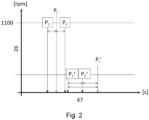
- the Figure 2 illustrates an embodiment in which the food processor 1, which has determined a weight of the potatoes in the food preparation vessel 2 in particular using the at least one weight sensor 8, determines a peeling time 47 depending on the determined weight, so that the tool 9 for the determined peeling time 47 can be rotated in the first rotation direction 41.
- the Fig. 2 this embodiment and the following description Fig. 2 can also be used in further developments in such a way that instead of the weight in a further development a potato size is used or in a further development a weight and a potato size are used analogously.
- the unit “rpm” stands for "rotations per minute”.
- the unit “s” stands for seconds.
- At least two predefined value pairs P 1 , P 2 are stored in a memory 22 of the food processor 1 or of a cloud or server PC (not shown).
- a first pair of values P 1 includes a first peeling time 47, a first rotation speed 26 and a first state variable (first weight or first potato size or first weight and first potato size), for which the first peeling time 47 of the first pair of values P 1 in the first direction of rotation 41 the first rotation speed 26 is to be applied.
- a second pair of values P 2 includes a second peeling time 47, the first rotation speed 26 and a second state variable (second weight or second potato size or second weight and second potato size), for which the second peeling time 47 of the second pair of values P 2 in the first direction of rotation 41 the first rotation speed 26 is to be applied.
- the control device 10 When the peeling mode is activated, the control device 10 causes the drive 11 to rotate the tool 9 and thus the potato peeling disk 7 in the first direction of rotation 41.
- the peeling time 47 for this turning in the first direction of rotation 41 is determined by a processor 21 of the control device 10, a cloud or server PC determined by linear interpolation based on the two predefined, ie stored, value pairs P 1 , P 2 .
- the values included in the value pairs P 1 , P 2 come from tests carried out by the manufacturer.
- the processor 21 Based on the determined state variable, in particular when activating the peeling mode, the processor 21 interpolates the peeling time 47 to be applied linearly between the at least or exactly two value pairs P 1 , P 2 . If the state variable already exists, the state variable is determined by accessing the existing state variable.
- a linearly interpolated peeling time of 240 seconds is determined based on the determined weight of 650 g.
- pairs of values P 1 ', P 2 ' are additionally stored for a second rotational speed, for example for 500 revolutions per minute.
- the control device 10 can switch to a second rotational speed based on a parameter for peeling.
- the parameter can be a desired and selectable peeling property such as "quick peeling" or exceeding a limit value with regard to the weight and/or the potato size.
- the parameter can also be a recipe step specification or sensor information about the physical properties from inside the food preparation vessel 2, for example the temperature. For example, at 500 rpm and 500 g of potatoes, a peeling time of 5.25 s can be stored in the value pair P 1 ' be.
- a second pair of values P 2 'with 500 revolutions per minute can, for example, include a peeling time of 7 s for 650 g of potatoes. Interpolation can also be carried out accordingly.
- Fig. 2 shows by way of example that a peeling time can also be extrapolated using the formula given above if the determined weight is not between the weight of the first pair of values P 1 ' and the second pair of values P 2 '. This also applies analogously to the example explained above with the value pairs P 1 and P 2 .
- the method of interpolation based on at least two pairs of values automatically also includes an extrapolation. Interpolated and extrapolated values always lie on the same straight line when illustrated as a function curve.
- absolute lower limits and/or upper limits can be set for the peeling time, which keeps the results of the interpolation or extrapolation within a specified range of values for the peeling time.
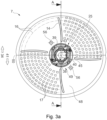
- the Figure 3a shows a potato peeling disc 7 according to the invention, in particular with a diameter of at least 120 mm and / or at most 160 mm, preferably approximately 148 mm or 150 mm.
- the potato peeling disk 7 shown has a height of at least 20 mm and/or at most 40 mm, preferably approximately 28 mm or 30 mm.
- the potato peeling disk 7 comprises a plurality of slots 14 which extend in an arcuate manner within the inner and outer boundaries of the potato peeling disk 7 essentially in the radial direction and are evenly spaced apart from one another in the circumferential direction.
- the individual arrangement of the teeth 17, which adjoin slots 14, are arranged according to purely aesthetic considerations.
- the teeth 17 are in the preferred embodiment Fig. 3a arranged in a plurality of ring tracks 16, ie, along concentric circles around the central axis 40.
- the orientation of the teeth 17 is in the direction of the respective ring track 16, preferably parallel to a tangent to the ring track 16, the tangent passing through an intersection point central longitudinal axis of a tooth 17 runs with the ring track 16.
- the teeth 17 of the potato peeling disk are arranged in mutually parallel, rectilinear rows, which in particular run radially with respect to the central axis 40 and/or form areas with differently oriented, parallel rows.
- the teeth 17 have a width transverse to their orientation of at least 1 mm and/or at most 5 mm, preferably at most 2 mm. In one embodiment, the teeth 17 have a length parallel to their alignment of at least 1 mm and/or at most 5 mm. In one embodiment, the teeth 17 have a height of at most 2 mm, but at least a height of 0.5 mm. In particular, the teeth are longer than they are wide and/or longer than they are high and/or wider than they are high and/or approximately as high as they are wide on a front side of the teeth 17.
- An orientation of a tooth 17 is the direction of its longitudinal extent on the surface 18 of the potato peeling disk 7, with a front side of the tooth 17, which has a peeling edge for peeling, pointing in the direction of orientation. Peeling therefore takes place by rotating in the first direction of rotation 41, which moves the tooth 17 substantially in the direction of its alignment.
- the first direction of rotation 41 which essentially points in the direction of alignment of the teeth 17, corresponds to clockwise rotation and the opposite, second rotation direction 34 corresponds to counterclockwise rotation (cf. Fig. 3a ).
- the first direction of rotation 41 can correspond to left-hand rotation and the second rotation direction 34 to right-hand rotation.
- the potato peeling disc has 7 as in Fig. 3a shown a disk part 48, which extends radially completely outwards from a central hub part 49 with the opening 38 and the inner contour 39.
- the teeth 17 are in Fig. 3a can be seen from below because the teeth 17 protrude on the top when the disk thickness of the disk part 48 is essentially constant.
- the teeth on the underside form a depression that corresponds to the projection contour on the surface.
- Fig. 3a such depressions that lead to the projections of the teeth, for example in Fig. 3b are shown, correspond.
- the teeth 17 are arranged on parallel ring tracks 16 which run coaxially around the central axis 40.
- the teeth themselves have a rectangular outer contour and/or are not curved.
- the teeth 17 have a substantially square outer contour in the top view and/or in the bottom view. There are sections in the circumferential direction between two gaps 14 between which the teeth have been omitted. There is a smooth surface 18 on the top (and bottom).
- the potato peeling disk 7 is placed on a tool 9 with the opening 38 for peeling potatoes.
- Radially inwardly directed beads extending along the central axis 40 which are distributed over the circumference of the inner contour 39, serve to ensure a stable fit of the potato peeling disk 7 on the rotatable tool 9 of the food processor 1.
- a free cut 43 allows a central end element to protrude axially Tool, for example a fastening rivet, and at the same time creating an axial locking arm 44 with a locking lug 45 projecting radially inwards at its free end, which in the intended insertion position of the potato peeling disk 7 on the rotatable tool 9 into a corresponding annular groove 42 of the tool 9 can intervene.
- a manually detachable but stable fit of the potato peeling disk 7 when attached can be achieved in this way.
- this is a snap connection.
- a driver 25 enables the tool 9 to be coupled to the potato peeling disk 7, so that a rotation of the tool 9 leads to a rotation of the potato peeling disk 7, in particular at the same rotational speed.
- At least one Bore 56, preferably two bores 56, and/or at least one notch 50, preferably two notches 50, allow improved water transport to the surface 18.
- the peeling in the peeling mode, is first rotated in the first direction of rotation 41 and immediately afterwards in the second direction of rotation 34 for smoothing and/or polishing (without loosening or turning the potato peeling disk 7).
- a digital recipe and/or the controller 10 is set up so that with the help of the potato peeling disk 7, a combined process such as peeling and polishing, peeling and cooking, soaking and peeling and/or achieving a different surface quality for different foods, ingredients and/or Food such as potatoes or beets can be achieved.
- a complex food preparation process is made possible (for example by a corresponding digital recipe or a corresponding manual setting on the food processor), in which food is first peeled, then polished and finally cooked, preferably without loosening, turning or changing the potato peeling disk 7.
- User assistance in such a complex food preparation process can be minimized or even eliminated except for activating the digital recipe and adding the ingredients.
- the potato peeling disk 7 is attached to the tool 9 35. Water and ingredients (with or without a bag around the ingredients or food 20) are poured into the food preparation vessel 2.
- the user can start the food preparation process via a second mode of the kitchen appliance 1, which is supported by the control 10, or through appropriate manual settings of a process time, a temperature and/or speed of the tool 9.
- the waveform 19 and the rotational movement of the potato peeling disk 7 in the second rotation direction 34, which is driven by the tool 9, causes uniform mixing and temperature distribution in the food preparation vessel 2 and optimal cooking of the food 20. Due to the compact design and wave shape 19 of the potato peeling disk 7, the volume can be increased of the food preparation vessel 2 can be used optimally.
- the teeth 17 have no effect on the food 20 in the second direction of rotation 34. The rotation behavior in this second mode allows a uniform temperature distribution of the food in the food preparation vessel 2 to be obtained.
- the potato peeling disk 7 has a further functional surface on the underside, for example a smooth surface, with which “slow cooking” and “sous vide” can also be carried out. Particularly when a potato peeling disk 7 is provided with recesses on the underside, the potato peeling disk 7 can be inserted upside down onto the tool 9 in one embodiment. The food 7 during food preparation of the "slow cooking” and “sous vide” type is then moved in an improved manner without damaging the food or a bag around the food.
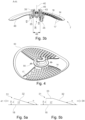
- Figure 3b shows a schematic representation of a section that runs centrally through a potato peeling disk 7, in particular the potato peeling disk 7 Fig. 3a . Also in Fig. 3b the recesses of the teeth 17 are visible on the underside of the potato peeling disk 7.
- the potato peeling disk 7 has an overall curved shape.
- the disk part 48 of the potato peeling disk 7 runs in a wave shape around the hub part 49.
- the waveform is not visible because of the sectional view.
- the driver 25 extends axially downwards starting from the outer edge of the hub part 49.
- the length of the driver 25 is at least half as long as the opening 38.
- the Fig. 3b shows the free cut 43, which creates the locking arm 44.
- the locking lug 45 is arranged at the free end of the locking arm 44.
- the disk part 48 essentially has the shape of a perforated disk in plan view, ie, a disk with a central through hole.
- an inner edge of the disk part 48 is on a plane perpendicular to the central axis 40.
- the disk part 48 extends in the radial direction with different gradients depending on the angular position to the central axis 40. While the inner edge of the disk part 48 is on a plane perpendicular to the Central axis 40, the outer edge describes a wave in the circumferential direction with at least one or two wave crests and wave troughs.
- the potato peeling disc 7 comprises metal and/or is constructed in two parts or exactly three parts, i.e. made from separately manufactured parts.
- the entire potato peeling disc 7 is made in one piece from plastic by injection molding.
- the disk part 48 is preferably made of metal, preferably a sheet metal, in particular with a (constant) thickness of at least 1 mm and/or at most 2 mm.
- the hub part 49 is made of plastic, preferably polypropylene, and/or is molded around an inner edge region of the disk part 48.
- the hub part 49 is also made from two separately manufactured parts, in particular a lower part and an upper part.
- the diameter 46 of the opening 38 is 17 mm, preferably with a transition fit.
- Figure 4 shows a potato peeling disc in particular Fig. 3a and/or 3b in a spatial representation diagonally from above. The ramp shape and orientation of the teeth 17 are clearly visible here.
- the Figures 5a and 5b show two tooth variants of potato peeling disks 7 according to the invention, which, for example, are based on the designs in the Figures 1 , 3 , 4 and 7 are applicable, in a side view transverse to the orientation of the respective tooth 17. Both tooth variants are ramp-like and also ramp-shaped.
- the tooth variant of the Fig. 5a the tooth 17 has an inclined surface 32 on the back with an angle ⁇ between 140 ° and 170 ° to the surface 18 of the potato peeling disk 7.
- the tooth variant shown has in addition to the tooth variant Fig. 5a another plateau 33, which adjoins the end of the inclined surface 32.
- the oblique Surface 32 and/or the plateau 33 may be made of sheet metal or delimit a projection made of solid material from the surface 18.
- the projection can also be created by forming a sheet metal.
- the peeling edge 31 preferably has an angle ⁇ to the surface 18 between 80° and 100°, preferably approximately 90° or 91°.
- a closed area of the surface 18 or a passage preferably extends between the peeling edge 31 and the surface 18.
- the entire surface 18 of the potato peeling disk 7, with the exception of the opening 38, the bore 56 and the slots 14, is closed in a liquid-tight manner.
- the inclined surface 32 of a ramp-like tooth 17 is designed to be rectilinear, flat and/or with a constant gradient, in particular the entire inclined surface 32.
- the front of tooth 17 is in 5a and 5b aligned in the first direction of rotation 41 and opposite to the second direction of rotation 34.
- the teeth 17 have an angular shape and/or each have a first surface on the back with an angle ⁇ to the surface 18 of the potato peeling disk 7 and/or a second surface on the front with an angle ⁇ to the surface 18 of the potato peeling disk 7 ( see Fig. 4b).
- a plateau which preferably runs straight and/or essentially parallel to the surface 18 of the potato peeling disk 7, connects the first surface and the second surface.
- the angle ⁇ and/or the angle ⁇ is between 80° and 100°, preferably approximately 90°.
- a normal of the first and/or second surface is aligned tangentially, substantially tangentially or parallel to the circumferential direction of the potato peeling disk 7.
- Figure 6a shows a schematic cross-sectional representation of a flat potato peeling disk in a food processor 1 (cf. Fig. 1 ), whereby the potato peeling disc is attached to a rotatable tool 9 of the food processor 1 and is located within the food preparation vessel 2.
- a section of the food processor 1 is shown.
- An abrasive structure with aligned teeth is shown in simplified form as a thick line on the top of the potato peeling disk 7.
- the abrasive structure can be a geometrically determined cutting edge (such as ramp-shaped or tetrahedral teeth) or a geometrically indeterminate cutting edge (such as an abrasive embedded in the surface 19). exhibit.
- the potato peeling disk 7 just shown can be flat, wavy or wavy.
- Figure 6b shows a schematic cross-sectional representation of the exemplary embodiment Fig. 6a with an additional wall insert 51.
- the abrasive structure of the wall insert 51 is also shown in simplified form as a thick line.
- the wall insert 51 is preferably flatly curved and/or adapted to the surface of the inner wall of the food preparation vessel 2 of the food processor 1 and/or can be attached to it in a manually detachable manner. This means potatoes are peeled more efficiently.
- FIG. 6c shows a schematic cross-sectional representation of a potato peeling pot insert 52.
- the abrasive structure is shown in simplified form as a thick line.
- a pot insert 52 can be made from the potato peeling disk 7 as a base and a pot insert wall 53.
- Figure 7 shows a schematic representation of a geometry of a potato peeling disk 7, which includes steps 54.
- the abrasive structure is not illustrated here either. If the abrasive structure does not include a geometrically determined cutting edge, in one embodiment the abrasive structure can be provided by a releasable layer with a thickness of at least 0.6 mm and/or at most 2 mm, which can be changed if necessary.
- Ramp-shaped sections 55 extend in the circumferential direction up to such a step 54. Steps 54 and ramp-shaped sections 55 can therefore be found alternating in the circumferential direction.
- the potatoes are peeled raw.
Landscapes
- Engineering & Computer Science (AREA)
- Food Science & Technology (AREA)
- Mechanical Engineering (AREA)
- Life Sciences & Earth Sciences (AREA)
- Chemical & Material Sciences (AREA)
- Polymers & Plastics (AREA)
- Preparation Of Fruits And Vegetables (AREA)
- Apparatuses For Bulk Treatment Of Fruits And Vegetables And Apparatuses For Preparing Feeds (AREA)
- Food-Manufacturing Devices (AREA)
Priority Applications (1)
| Application Number | Priority Date | Filing Date | Title |
|---|---|---|---|
| EP23191841.8A EP4248814A3 (fr) | 2021-07-21 | 2021-07-21 | Procédé d'épluchage de pommes de terre et robot de cuisine |
Applications Claiming Priority (2)
| Application Number | Priority Date | Filing Date | Title |
|---|---|---|---|
| EP21186946.6A EP4101349B1 (fr) | 2021-07-21 | 2021-07-21 | Procédé d'épluchage de pommes de terre et robot de cuisine |
| EP23191841.8A EP4248814A3 (fr) | 2021-07-21 | 2021-07-21 | Procédé d'épluchage de pommes de terre et robot de cuisine |
Related Parent Applications (1)
| Application Number | Title | Priority Date | Filing Date |
|---|---|---|---|
| EP21186946.6A Division EP4101349B1 (fr) | 2021-07-21 | 2021-07-21 | Procédé d'épluchage de pommes de terre et robot de cuisine |
Publications (2)
| Publication Number | Publication Date |
|---|---|
| EP4248814A2 true EP4248814A2 (fr) | 2023-09-27 |
| EP4248814A3 EP4248814A3 (fr) | 2023-12-13 |
Family
ID=77021144
Family Applications (2)
| Application Number | Title | Priority Date | Filing Date |
|---|---|---|---|
| EP21186946.6A Active EP4101349B1 (fr) | 2021-07-21 | 2021-07-21 | Procédé d'épluchage de pommes de terre et robot de cuisine |
| EP23191841.8A Pending EP4248814A3 (fr) | 2021-07-21 | 2021-07-21 | Procédé d'épluchage de pommes de terre et robot de cuisine |
Family Applications Before (1)
| Application Number | Title | Priority Date | Filing Date |
|---|---|---|---|
| EP21186946.6A Active EP4101349B1 (fr) | 2021-07-21 | 2021-07-21 | Procédé d'épluchage de pommes de terre et robot de cuisine |
Country Status (7)
| Country | Link |
|---|---|
| US (1) | US20230024102A1 (fr) |
| EP (2) | EP4101349B1 (fr) |
| CN (1) | CN115670210A (fr) |
| AU (1) | AU2022203522B2 (fr) |
| DE (1) | DE202022101009U1 (fr) |
| ES (1) | ES2961984T3 (fr) |
| PL (1) | PL4101349T3 (fr) |
Families Citing this family (2)
| Publication number | Priority date | Publication date | Assignee | Title |
|---|---|---|---|---|
| USD1049774S1 (en) * | 2021-07-21 | 2024-11-05 | Vorwerk & Co. Interholding Gmbh | Multifunction food processor part |
| DE202022104377U1 (de) | 2022-08-02 | 2022-08-08 | Stefan Laibold | Dampfumleitung für die Öffnung eines Deckels auf einem Kochgefäß |
Family Cites Families (15)
| Publication number | Priority date | Publication date | Assignee | Title |
|---|---|---|---|---|
| US2613712A (en) | 1949-06-09 | 1952-10-14 | Pearlman Harry | Portable vegetable peeling machine |
| US4998467A (en) * | 1989-11-24 | 1991-03-12 | Kovach John R | Potato peeling device |
| US5289760A (en) * | 1992-08-24 | 1994-03-01 | George Barradas | Combination food processor and fryer |
| WO2001034007A1 (fr) * | 1999-11-09 | 2001-05-17 | Walter Bennett | Dispositif integre a une machine a eplucher les pommes de terre |
| KR100546892B1 (ko) * | 2004-06-18 | 2006-01-31 | 최병국 | 감자박피기 |
| EP2039257A1 (fr) * | 2007-09-19 | 2009-03-25 | Circle Tekko Co., Ltd. | Appareil de pelage de produit agricole |
| NO329703B1 (no) * | 2009-02-24 | 2010-12-06 | John Kristian Haukas | Anordning ved potetskrellemaskin |
| US8262005B2 (en) * | 2009-09-08 | 2012-09-11 | Wal-Mart Stores, Inc. | Processing apparatus and method |
| FR2982756B1 (fr) * | 2011-11-18 | 2013-11-08 | Seb Sa | Dispositif de cuisson |
| DE202012105011U1 (de) | 2012-12-21 | 2013-01-25 | Vorwerk & Co. Interholding Gmbh | Elektromotorisch betriebene Küchenmaschine |
| WO2016144877A1 (fr) * | 2015-03-06 | 2016-09-15 | Vita-Mix Management Corporation | Système d'identification de récipient de mélange |
| WO2016168889A1 (fr) * | 2015-04-23 | 2016-10-27 | Breville Pty Limited | Éplucheur de pommes de terre |
| PL3530161T3 (pl) | 2018-02-21 | 2021-02-08 | Vorwerk & Co. Interholding Gmbh | Urządzenie do przygotowywania potraw z narzędziem do rozdrabniania |
| DE102018115988A1 (de) * | 2018-07-02 | 2020-01-02 | Vorwerk & Co. Interholding Gmbh | Verfahren zur Digitalisierung eines Kochprozesses, Küchengerät sowie System zur Digitalisierung eines Kochprozesses |
| ES2983960T3 (es) * | 2019-10-01 | 2024-10-28 | Vorwerk Co Interholding | Robot de cocina para controlar otro aparato electrodoméstico |
-
2021
- 2021-07-21 EP EP21186946.6A patent/EP4101349B1/fr active Active
- 2021-07-21 PL PL21186946.6T patent/PL4101349T3/pl unknown
- 2021-07-21 EP EP23191841.8A patent/EP4248814A3/fr active Pending
- 2021-07-21 ES ES21186946T patent/ES2961984T3/es active Active
-
2022
- 2022-02-23 DE DE202022101009.9U patent/DE202022101009U1/de active Active
- 2022-05-24 AU AU2022203522A patent/AU2022203522B2/en active Active
- 2022-06-30 US US17/854,731 patent/US20230024102A1/en active Pending
- 2022-07-20 CN CN202210861723.5A patent/CN115670210A/zh active Pending
Also Published As
| Publication number | Publication date |
|---|---|
| EP4101349A1 (fr) | 2022-12-14 |
| CN115670210A (zh) | 2023-02-03 |
| EP4101349C0 (fr) | 2023-08-23 |
| AU2022203522A1 (en) | 2023-02-09 |
| EP4101349B1 (fr) | 2023-08-23 |
| DE202022101009U1 (de) | 2022-03-29 |
| EP4248814A3 (fr) | 2023-12-13 |
| AU2022203522B2 (en) | 2023-05-25 |
| ES2961984T3 (es) | 2024-03-14 |
| US20230024102A1 (en) | 2023-01-26 |
| PL4101349T3 (pl) | 2024-02-26 |
Similar Documents
| Publication | Publication Date | Title |
|---|---|---|
| EP4026460B1 (fr) | Appareil de préparation des aliments permettant de couper les aliments, pièce rapportée de broyage et procédé | |
| DE69825295T2 (de) | Küchen-mixer für umkehrbare drehrichtung | |
| EP2441364B1 (fr) | Insert de mélange pour un pot | |
| DE60210130T2 (de) | Mischvorrichtung für eine speiseeismaschine insbesondere für hausgebrauch | |
| EP4101349B1 (fr) | Procédé d'épluchage de pommes de terre et robot de cuisine | |
| DE102010017335A1 (de) | Küchenmaschine mit einem Rührgefäß sowie Verfahren zum Betreiben einer solchen Küchenmaschine | |
| DE10235326A1 (de) | Vorrichtung zur Verarbeitung der Ausgangsstoffe eines Nahrungsmittelproduktes | |
| EP3530161A1 (fr) | Appareil de préparation d'aliments pourvu d'outil de broyage | |
| DE102008038783A1 (de) | Küchenmaschine mit einem Rührgefäß sowie Verfahren hierzu | |
| EP3513696B1 (fr) | Robot de cuisine avec un élement de couverture pour un récipient de préparation | |
| EP3473107B1 (fr) | Dispositif et procédé de traitement et de transformation du chocolat ainsi qu'utilisation d'une machine universelle lors dudit procédé | |
| EP4101350B1 (fr) | Disque d'épluchage de pommes de terre, robot de cuisine et procédé | |
| DE2755744A1 (de) | Nahrungsmittelverarbeitungsgeraet | |
| DE60214214T2 (de) | Vorrichtung und verfahren zum kochen von nahrungsmitteln mit mikrowellen | |
| EP4494536B1 (fr) | Appareil de préparation d'aliments pour couper des aliments, accessoire de broyage et procédé | |
| DE3704385C1 (de) | Teigformgeraet | |
| DE60200203T2 (de) | Temperiervorrichtung | |
| EP2621320B1 (fr) | Lame de râpe réglable | |
| AT503495B1 (de) | Vorrichtung zum zubereiten von getränken | |
| DE202021002124U1 (de) | Erweiterungs-Einsatz zur Aufnahme in einem Zubereitungsgefäß einer Küchenmaschine sowie Küchenmaschine mit dem Erweiterungs-Einsatz | |
| DE102012220996A1 (de) | Küchengerät | |
| DE4322280A1 (de) | Arbeitsbehälter für eine elektrisch betriebene Haushaltsküchenmaschine | |
| DE3635086C1 (en) | Disc for an apparatus for the preparation of foodstuffs, in particular cream or egg white | |
| DE69500827T2 (de) | Vorrichtung und Verfahren zum Regeln eines Kochgerätes | |
| EP4243660B1 (fr) | Module d'insertion pour récipient d'appareil de cuisine |
Legal Events
| Date | Code | Title | Description |
|---|---|---|---|
| PUAI | Public reference made under article 153(3) epc to a published international application that has entered the european phase |
Free format text: ORIGINAL CODE: 0009012 |
|
| STAA | Information on the status of an ep patent application or granted ep patent |
Free format text: STATUS: THE APPLICATION HAS BEEN PUBLISHED |
|
| AC | Divisional application: reference to earlier application |
Ref document number: 4101349 Country of ref document: EP Kind code of ref document: P |
|
| AK | Designated contracting states |
Kind code of ref document: A2 Designated state(s): AL AT BE BG CH CY CZ DE DK EE ES FI FR GB GR HR HU IE IS IT LI LT LU LV MC MK MT NL NO PL PT RO RS SE SI SK SM TR |
|
| REG | Reference to a national code |
Ref country code: DE Ref legal event code: R079 Free format text: PREVIOUS MAIN CLASS: A47J0044000000 Ipc: A47J0017180000 |
|
| PUAL | Search report despatched |
Free format text: ORIGINAL CODE: 0009013 |
|
| AK | Designated contracting states |
Kind code of ref document: A3 Designated state(s): AL AT BE BG CH CY CZ DE DK EE ES FI FR GB GR HR HU IE IS IT LI LT LU LV MC MK MT NL NO PL PT RO RS SE SI SK SM TR |
|
| RIC1 | Information provided on ipc code assigned before grant |
Ipc: A47J 44/00 20060101ALI20231108BHEP Ipc: A23N 7/02 20060101ALI20231108BHEP Ipc: A47J 17/18 20060101AFI20231108BHEP |
|
| STAA | Information on the status of an ep patent application or granted ep patent |
Free format text: STATUS: REQUEST FOR EXAMINATION WAS MADE |
|
| 17P | Request for examination filed |
Effective date: 20240612 |
|
| RBV | Designated contracting states (corrected) |
Designated state(s): AL AT BE BG CH CY CZ DE DK EE ES FI FR GB GR HR HU IE IS IT LI LT LU LV MC MK MT NL NO PL PT RO RS SE SI SK SM TR |