EP4249864A2 - Capteur de vibrations à transducteur intégré en surface - Google Patents
Capteur de vibrations à transducteur intégré en surface Download PDFInfo
- Publication number
- EP4249864A2 EP4249864A2 EP23161753.1A EP23161753A EP4249864A2 EP 4249864 A2 EP4249864 A2 EP 4249864A2 EP 23161753 A EP23161753 A EP 23161753A EP 4249864 A2 EP4249864 A2 EP 4249864A2
- Authority
- EP
- European Patent Office
- Prior art keywords
- transducer
- housing
- sensor
- integrated
- vehicle
- Prior art date
- Legal status (The legal status is an assumption and is not a legal conclusion. Google has not performed a legal analysis and makes no representation as to the accuracy of the status listed.)
- Pending
Links
Images

Classifications
-
- G—PHYSICS
- G01—MEASURING; TESTING
- G01H—MEASUREMENT OF MECHANICAL VIBRATIONS OR ULTRASONIC, SONIC OR INFRASONIC WAVES
- G01H11/00—Measuring mechanical vibrations or ultrasonic, sonic or infrasonic waves by detecting changes in electric or magnetic properties
- G01H11/06—Measuring mechanical vibrations or ultrasonic, sonic or infrasonic waves by detecting changes in electric or magnetic properties by electric means
- G01H11/08—Measuring mechanical vibrations or ultrasonic, sonic or infrasonic waves by detecting changes in electric or magnetic properties by electric means using piezoelectric devices
-
- B—PERFORMING OPERATIONS; TRANSPORTING
- B60—VEHICLES IN GENERAL
- B60R—VEHICLES, VEHICLE FITTINGS, OR VEHICLE PARTS, NOT OTHERWISE PROVIDED FOR
- B60R1/00—Optical viewing arrangements; Real-time viewing arrangements for drivers or passengers using optical image capturing systems, e.g. cameras or video systems specially adapted for use in or on vehicles
- B60R1/12—Mirror assemblies combined with other articles, e.g. clocks
-
- G—PHYSICS
- G01—MEASURING; TESTING
- G01H—MEASUREMENT OF MECHANICAL VIBRATIONS OR ULTRASONIC, SONIC OR INFRASONIC WAVES
- G01H1/00—Measuring characteristics of vibrations in solids by using direct conduction to the detector
-
- G—PHYSICS
- G01—MEASURING; TESTING
- G01H—MEASUREMENT OF MECHANICAL VIBRATIONS OR ULTRASONIC, SONIC OR INFRASONIC WAVES
- G01H1/00—Measuring characteristics of vibrations in solids by using direct conduction to the detector
- G01H1/12—Measuring characteristics of vibrations in solids by using direct conduction to the detector of longitudinal or not specified vibrations
-
- G—PHYSICS
- G01—MEASURING; TESTING
- G01H—MEASUREMENT OF MECHANICAL VIBRATIONS OR ULTRASONIC, SONIC OR INFRASONIC WAVES
- G01H3/00—Measuring characteristics of vibrations by using a detector in a fluid
-
- H—ELECTRICITY
- H10—SEMICONDUCTOR DEVICES; ELECTRIC SOLID-STATE DEVICES NOT OTHERWISE PROVIDED FOR
- H10N—ELECTRIC SOLID-STATE DEVICES NOT OTHERWISE PROVIDED FOR
- H10N30/00—Piezoelectric or electrostrictive devices
- H10N30/30—Piezoelectric or electrostrictive devices with mechanical input and electrical output, e.g. functioning as generators or sensors
- H10N30/302—Sensors
-
- H—ELECTRICITY
- H10—SEMICONDUCTOR DEVICES; ELECTRIC SOLID-STATE DEVICES NOT OTHERWISE PROVIDED FOR
- H10N—ELECTRIC SOLID-STATE DEVICES NOT OTHERWISE PROVIDED FOR
- H10N30/00—Piezoelectric or electrostrictive devices
- H10N30/80—Constructional details
- H10N30/88—Mounts; Supports; Enclosures; Casings
-
- B—PERFORMING OPERATIONS; TRANSPORTING
- B60—VEHICLES IN GENERAL
- B60R—VEHICLES, VEHICLE FITTINGS, OR VEHICLE PARTS, NOT OTHERWISE PROVIDED FOR
- B60R1/00—Optical viewing arrangements; Real-time viewing arrangements for drivers or passengers using optical image capturing systems, e.g. cameras or video systems specially adapted for use in or on vehicles
- B60R1/12—Mirror assemblies combined with other articles, e.g. clocks
- B60R2001/1223—Mirror assemblies combined with other articles, e.g. clocks with sensors or transducers
Definitions
- the present disclosure relates to a vibration sensor having a surface-integrated transducer.
- Hands-free communication systems (telephone, voice recognition, speech-to-text, etc.), and systems that are designed to create a quiet cabin (active noise cancellation (ANC) and road noise cancellation (RNC) systems) are just a few examples of vehicle systems that operate using speakers and microphones mounted to an interior or to an exterior surface of the vehicle. Advancements in such vehicle systems typically require microphone sensors that are placed in strategic locations. For example, a hands-free communication system uses one or more microphones that are positioned close to a user's head, such as an overhead console or in a headliner. However, such microphone sensors are normally visible because they need acoustic transparent air-paths (e.g., a grill or other opening) through which sound waves can be detected. In addition, installations of microphone sensors typically required dedicated spaces within the vehicle structure, such as an overhead console and/or a headliner.
- ANC active noise cancellation
- RNC road noise cancellation
- vehicle systems may use sound detection on the vehicle exterior. For example, voice commands to unlock a door, open a trunk, roll down a window.
- voice commands to unlock a door, open a trunk, roll down a window.
- sensors are located outside of the vehicle and are subject to harsh environmental conditions that can damage the sensors causing their performance to degrade making the unreliable.
- a sensor having a surface structure and a transducer integrated with the backside of the surface structure.
- the transducer measures structure-borne vibrations carried by the surface structure.
- the transducer is a piezo-diaphragm based vibration sensor completely enclosed by a housing and the housing is integrated with the backside of the surface structure.
- the surface structure is at least one of glass, metal, and plastic.
- a sensor assembly having a support frame, a mirrored glass surface within the support frame, a housing integrated with a backside of the mirrored glass surface, and a transducer enclosed in the housing, the transducer measures structure-borne sound waves carried by the mirrored glass surface.
- the support frame is mounted to an interior surface of a vehicle. In one or more embodiments, the support frame is mounted to an exterior surface of a vehicle.
- a vibration sensor having a rigid surface of at least one of glass, metal, and plastic, and a transducer integrated with the rigid surface, the transducer measures structure-borne sound waves that cause vibration motion of the rigid surface.
- the vibration motion is measured as acceleration.
- the vibration motion is measured as velocity.
- the vibration motion is measured as displacement or deformation.
- the vibration motion is measured as strain or stress.
- FIG. 1 is an exploded view of a surface-integrated vibration sensor assembly 100, shown as a mirror assembly in the present example, having a frame 104, also called a support frame or support structure, supporting a rigid surface 106, also called a surface structure, which, in the present example, is mirrored glass surface.
- a transducer 108 such as a vibration sensor, is integrated to one side of the surface 106.
- the transducer 108 is also connected to a printed circuit board assembly 110 that provides power and signal conditioning to the transducer 108.
- a back housing 112 attached to the frame 104 supports the surface 106, transducer 108 and printed circuit board assembly 110.
- a mounting element 114 extends from the back housing 112 may attach the surface-integrated transducer assembly 100 to a front windshield glass of a vehicle(not shown in FIG. 1 ).
- the surface-integrated vibration sensor assembly 100 is integrated, in the present example, to the surface 106 to sense vibrations of the surface 106 induced by structure-borne sound, such as speech energy.
- structure-borne sound such as speech energy.
- the surface 106 in FIG. 1 is shown to be part of a rearview mirror assembly in the present example, but the surface-integrated vibration sensor assembly 100 may also be incorporated into other surfaces.
- the surface 106 may consist of a glass surface such as an exterior side mirror.
- the surface 106 may consist of an interior panel such as a console, pillar structure, or instrument panel.
- the surface may consist of an exterior vehicle body panel or an interior facing body panel such as an interior door or floor panel.
- the transducer 108 In either an interior or exterior surface 106, the transducer 108 is sensing structure-borne, sound induced structural vibrations and not direct sound waves propagating in air. Therefore, the surface-integrated vibration sensor assembly 100 does not require a transparent path for airborne soundwaves, such as a grill or vent.
- the transducer 108 is fully integrated into the surface 106 keeping transducer 108 from being visible to a vehicle user. Further, the transducer 108 being integrated into the surface 106 keeps the transducer 108 fully sealed from the environment in which it is being used, making the vibration sensor assembly 100 much more durable and damage resistant when compared to a traditional microphone sensor that senses airborne sound waves by way of a vent or grill that is exposed to harsh environmental conditions.
- the surface-integrated vibration sensor assembly 100 is sensing sound as it is transmitted through a solid structure.
- the surface-integrated vibration sensor assembly 100 has a transducer 108 that may be, for example, a piezo-diaphragm based sensor, such as described in US Patent Application Serial No. 17/332488 and US Patent Application Serial No. 17/332492 , incorporated herein by reference.
- a transducer 108 When sound vibrations hit the solid structure of surface 106, they generate vibrations. The vibrations are then measured by the transducer 108, in this example, the transducer 108 is the piezo-diaphragm based sensor integrated into surface 106.
- transducer 108 is the piezo-diaphragm based sensor, which is designed to sense acceleration (i.e., an accelerometer).
- acceleration i.e., an accelerometer
- vibration motions in a structure can present in many forms including acceleration, velocity, displacement or deformation, strain, and stress. Therefore, it is possible that other types of transducers 108 that measure any physical quantity related to structure vibration may also be integrated into the surface 106 and the piezo-diaphragm based sensor is but one example.
- the transducer 108 measures the vibration (i.e., acceleration) of the surface 106, which is a base structure to which the transducer 108 is integrated, regardless of the source of the vibration.
- the transducer 108 then picks up the sound signal and functions as a microphone.
- the transducer 108 may be used in connection with voice command applications.
- the transducer 108 may detect signals that can be used in the ANC/RNC system.
- the transducer 108 itself is integrated directly into the surface 106 and the integrated transducer 108 and surface 106 are enclosed, along with the PCB 110, in the frame 104 and housing 112 of the sensor assembly.
- This configuration of the transducer 108 makes it especially advantageous for use in a vehicle interior. Compared to a typical microphone sensor, the vibration sensor assembly 100 is entirely hidden and does not require any additional installation space in the vehicle.
- FIG. 2 shows a surface-integrated vibration sensor assembly 200 having the transducer 108 enclosed in a housing 206 and the housing 206 is integrated into the surface 106.
- the surface 106 has a first side 202, for example, an inner surface or a rear face, of the rearview mirror and a second side 204, for example the outer surface or front face of the rearview mirror.
- the first side 202 of the surface 106 is not visible when viewing the vibration sensor 200 from the second side 204. Therefore, the transducer 108 is not visible from the second side 204 of surface 106.
- the housing 206 completely encases the transducer 108, the printed circuit board assembly 110 and a pair of electrical wires 210 coupled between the transducer 108 and the printed circuit board assembly 110. Additionally, signal lead wires 214 are accessible from outside the housing 206 for the transducer 108 to transmit signals, detected and measured by the transducer 108, of structure-borne vibrations, caused by sound, that occur at the surface 106. The signal is indicative of sound detected at the surface 106.
- the transducer 108 is enclosed within the housing 206, and the housing 206 is integrated with the first side 202 of the surface 106, such as by an adhesive layer 212.
- the surface-integrated vibration sensor 200 is integrated with the surface 106 at the first side 202 so it is not visible from the second side 204.
- the housing 206 is integrated into the surface 106. This configuration is especially advantageous for use in a vehicle exterior, such as a side mirror, because the transducer 108 is sealed inside housing 206 and is protected from potentially harsh environmental conditions.
- the piezo-diaphragm based transducer 108 may be attached to a side wall of the housing along a circumferential edge, or it may be rigidly connected to a bottom side 216 of the housing 206 through an adhesive layer 218. Additionally, or alternatively, the bottom side 216 of the housing 206 may be integrated to the first side 202 of the surface 106, for example, with more, or less surface area contact with adhesive layer 212. A sensitivity of the sensor assembly 200 may be adjusted by altering a thickness and contact area between any one or more of the transducer 108, the housing 206, and/or the bottom side 216 with one or more of the adhesive layers 212 or 218.
- signal processing, filtering, etc. may occur either at the printed circuit board assembly 110 at the sensor or at other locations or at another hardware location that is in communication with the vibration sensor assembly 100, 200.
- a high pass filter (not shown) with a cutoff frequency between 100 and 500 Hz may be used to clean the signal sensed by vibration sensor assembly 100, 200.
- the high pass filter may be implemented with either analog or digital circuitry residing on the printed circuit board assembly 110 or in hardware located at a vehicle infotainment system (also not shown).
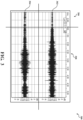
- FIG. 3 is a comparison graph 300 of speech sound waves recorded under varying vehicle driving conditions. Speech sound waves recorded using the vibration sensor are compared to speech sound waves recorded using an acoustic omni-directional microphone. Two channels of audio recordings were taken simultaneously with the vehicle in park and in motion.
- the top plot 302 shows the recording from the rearview mirror surface-integrated vibration sensor described herein.
- the bottom plot 304 shows the recording from an acoustic microphone mounted at the overhead console location close to the rearview mirror.
- the left portion 306 of the graph is the result of recording speech while the vehicle is parked.
- the right portion 308 of the graph is the result of recording speech while the vehicle is travelling at a speed between 20-50 miles per hour.
- the sensitivity of the surface-integrated vibration sensor is comparable to the sensitivity of the acoustic omni-directional microphone, making it a viable alternative to a regular acoustic microphone, but with many more possible locations inside and outside of the vehicle.
- the surface-integrated vibration sensor remains completely hidden and does not require transparent pathways that are necessary for the acoustic microphone.
- the surface-integrated vibration sensor has a sensor that is completely enclosed making it impervious to harsh environmental conditions it would be exposed to when used on the exterior of the vehicle, thereby making it a practical solution for use externally where a traditional microphone would not be practical.
- any method or process claims may be executed in any order, may be executed repeatedly, and are not limited to the specific order presented in the claims.
Landscapes
- Physics & Mathematics (AREA)
- General Physics & Mathematics (AREA)
- Engineering & Computer Science (AREA)
- Multimedia (AREA)
- Mechanical Engineering (AREA)
- Measurement Of Mechanical Vibrations Or Ultrasonic Waves (AREA)
- Fittings On The Vehicle Exterior For Carrying Loads, And Devices For Holding Or Mounting Articles (AREA)
Applications Claiming Priority (1)
| Application Number | Priority Date | Filing Date | Title |
|---|---|---|---|
| US17/699,256 US12078525B2 (en) | 2022-03-21 | 2022-03-21 | Vibration sensor having a surface-integrated transducer |
Publications (2)
| Publication Number | Publication Date |
|---|---|
| EP4249864A2 true EP4249864A2 (fr) | 2023-09-27 |
| EP4249864A3 EP4249864A3 (fr) | 2023-10-04 |
Family
ID=85640774
Family Applications (1)
| Application Number | Title | Priority Date | Filing Date |
|---|---|---|---|
| EP23161753.1A Pending EP4249864A3 (fr) | 2022-03-21 | 2023-03-14 | Capteur de vibrations à transducteur intégré en surface |
Country Status (3)
| Country | Link |
|---|---|
| US (1) | US12078525B2 (fr) |
| EP (1) | EP4249864A3 (fr) |
| CN (1) | CN116793477A (fr) |
Citations (1)
| Publication number | Priority date | Publication date | Assignee | Title |
|---|---|---|---|---|
| DE102020123100A1 (de) * | 2019-09-04 | 2021-03-04 | Ford Global Technologies, Llc | Systeme und verfahren für einen piezoelektrischen membranwandler für automobilmikrofonanwendungen |
Family Cites Families (7)
| Publication number | Priority date | Publication date | Assignee | Title |
|---|---|---|---|---|
| US6420975B1 (en) * | 1999-08-25 | 2002-07-16 | Donnelly Corporation | Interior rearview mirror sound processing system |
| US7370983B2 (en) * | 2000-03-02 | 2008-05-13 | Donnelly Corporation | Interior mirror assembly with display |
| JP4552883B2 (ja) | 2006-04-19 | 2010-09-29 | 株式会社デンソー | 振動検出方法 |
| KR101677894B1 (ko) | 2013-07-15 | 2016-11-21 | 한국전자통신연구원 | 차량 침입 감지 방법 및 그 장치 |
| CN106379243A (zh) | 2016-02-24 | 2017-02-08 | 深圳嘟嘟智能科技有限公司 | 可显示电子图像的后视镜系统及具有该后视镜系统的汽车 |
| US10629081B2 (en) | 2017-11-02 | 2020-04-21 | Ford Global Technologies, Llc | Accelerometer-based external sound monitoring for backup assistance in a vehicle |
| DE102020112871A1 (de) | 2020-05-12 | 2021-11-18 | Bayerische Motoren Werke Aktiengesellschaft | Kraftfahrzeug mit einer Akustikeinrichtung zum Erzeugen und Erfassen von Hörschall |
-
2022
- 2022-03-21 US US17/699,256 patent/US12078525B2/en active Active
-
2023
- 2023-03-02 CN CN202310189984.1A patent/CN116793477A/zh active Pending
- 2023-03-14 EP EP23161753.1A patent/EP4249864A3/fr active Pending
Patent Citations (1)
| Publication number | Priority date | Publication date | Assignee | Title |
|---|---|---|---|---|
| DE102020123100A1 (de) * | 2019-09-04 | 2021-03-04 | Ford Global Technologies, Llc | Systeme und verfahren für einen piezoelektrischen membranwandler für automobilmikrofonanwendungen |
Also Published As
| Publication number | Publication date |
|---|---|
| US20230296428A1 (en) | 2023-09-21 |
| US12078525B2 (en) | 2024-09-03 |
| CN116793477A (zh) | 2023-09-22 |
| EP4249864A3 (fr) | 2023-10-04 |
Similar Documents
| Publication | Publication Date | Title |
|---|---|---|
| EP3650275B1 (fr) | Microphone invisible de ciel de toit | |
| US8036412B2 (en) | Microphone system having pressure-gradient capsules | |
| US11895452B2 (en) | Bone conduction microphone | |
| US20210368252A1 (en) | Invisible headliner microphone | |
| US11336974B2 (en) | Invisible microphone assembly for a vehicle | |
| US6885751B2 (en) | Pressure-gradient microphone capsule | |
| US20040208334A1 (en) | Vehicle accessory microphone | |
| WO2008055253A1 (fr) | Haut-parleur dans le plan | |
| US20250088781A1 (en) | Closed sound receiver with sound-permeable boundary surface | |
| US11533568B1 (en) | Structure-borne sound and vibration sensor | |
| US20220386039A1 (en) | Multi-stage structure-borne sound and vibration sensor | |
| US12078525B2 (en) | Vibration sensor having a surface-integrated transducer | |
| JP2960220B2 (ja) | 車室内騒音検出用マイクロフォン | |
| EP3977752B1 (fr) | Techniques de réduction du bruit du vent | |
| CN116569068A (zh) | 用于机动车辆的超声波传感器组件和机动车辆 | |
| EP4531424A1 (fr) | Microphone à montage en surface à panneau mince | |
| EP1442529B1 (fr) | Microphone pour accessoire de vehicule | |
| GB2611026A (en) | Vehicle intercom system | |
| US12607500B2 (en) | Waterproof sound and vibration sensing device | |
| JP2020120282A (ja) | マイクロフォン | |
| US20260031100A1 (en) | Voice acquisition device | |
| JP2024118157A (ja) | 音声取得装置 | |
| JP2680401B2 (ja) | 雑音抑制マイクロホンシステム | |
| JP2024113458A5 (fr) | ||
| JPS63211898A (ja) | 車載用スピ−カ装置 |
Legal Events
| Date | Code | Title | Description |
|---|---|---|---|
| PUAI | Public reference made under article 153(3) epc to a published international application that has entered the european phase |
Free format text: ORIGINAL CODE: 0009012 |
|
| STAA | Information on the status of an ep patent application or granted ep patent |
Free format text: STATUS: THE APPLICATION HAS BEEN PUBLISHED |
|
| PUAL | Search report despatched |
Free format text: ORIGINAL CODE: 0009013 |
|
| AK | Designated contracting states |
Kind code of ref document: A2 Designated state(s): AL AT BE BG CH CY CZ DE DK EE ES FI FR GB GR HR HU IE IS IT LI LT LU LV MC ME MK MT NL NO PL PT RO RS SE SI SK SM TR |
|
| AK | Designated contracting states |
Kind code of ref document: A3 Designated state(s): AL AT BE BG CH CY CZ DE DK EE ES FI FR GB GR HR HU IE IS IT LI LT LU LV MC ME MK MT NL NO PL PT RO RS SE SI SK SM TR |
|
| RIC1 | Information provided on ipc code assigned before grant |
Ipc: G01H 3/00 20060101ALI20230830BHEP Ipc: G01H 1/00 20060101ALI20230830BHEP Ipc: G01H 11/08 20060101AFI20230830BHEP |
|
| STAA | Information on the status of an ep patent application or granted ep patent |
Free format text: STATUS: REQUEST FOR EXAMINATION WAS MADE |
|
| 17P | Request for examination filed |
Effective date: 20240326 |
|
| RBV | Designated contracting states (corrected) |
Designated state(s): AL AT BE BG CH CY CZ DE DK EE ES FI FR GB GR HR HU IE IS IT LI LT LU LV MC ME MK MT NL NO PL PT RO RS SE SI SK SM TR |
|
| STAA | Information on the status of an ep patent application or granted ep patent |
Free format text: STATUS: EXAMINATION IS IN PROGRESS |
|
| 17Q | First examination report despatched |
Effective date: 20250915 |