EP4250032A1 - Système de singulation robotique avec indication visuelle automatisée pour intervention humaine - Google Patents
Système de singulation robotique avec indication visuelle automatisée pour intervention humaine Download PDFInfo
- Publication number
- EP4250032A1 EP4250032A1 EP23162291.1A EP23162291A EP4250032A1 EP 4250032 A1 EP4250032 A1 EP 4250032A1 EP 23162291 A EP23162291 A EP 23162291A EP 4250032 A1 EP4250032 A1 EP 4250032A1
- Authority
- EP
- European Patent Office
- Prior art keywords
- receptacle
- error
- indication
- visual indication
- respect
- Prior art date
- Legal status (The legal status is an assumption and is not a legal conclusion. Google has not performed a legal analysis and makes no representation as to the accuracy of the status listed.)
- Withdrawn
Links
Images





Classifications
-
- B—PERFORMING OPERATIONS; TRANSPORTING
- B65—CONVEYING; PACKING; STORING; HANDLING THIN OR FILAMENTARY MATERIAL
- B65G—TRANSPORT OR STORAGE DEVICES, e.g. CONVEYORS FOR LOADING OR TIPPING, SHOP CONVEYOR SYSTEMS OR PNEUMATIC TUBE CONVEYORS
- B65G43/00—Control devices, e.g. for safety, warning or fault-correcting
- B65G43/02—Control devices, e.g. for safety, warning or fault-correcting detecting dangerous physical condition of load carriers, e.g. for interrupting the drive in the event of overheating
-
- G—PHYSICS
- G05—CONTROLLING; REGULATING
- G05B—CONTROL OR REGULATING SYSTEMS IN GENERAL; FUNCTIONAL ELEMENTS OF SUCH SYSTEMS; MONITORING OR TESTING ARRANGEMENTS FOR SUCH SYSTEMS OR ELEMENTS
- G05B19/00—Program-control systems
- G05B19/02—Program-control systems electric
- G05B19/418—Total factory control, i.e. centrally controlling a plurality of machines, e.g. direct or distributed numerical control [DNC], flexible manufacturing systems [FMS], integrated manufacturing systems [IMS] or computer integrated manufacturing [CIM]
- G05B19/4189—Total factory control, i.e. centrally controlling a plurality of machines, e.g. direct or distributed numerical control [DNC], flexible manufacturing systems [FMS], integrated manufacturing systems [IMS] or computer integrated manufacturing [CIM] characterised by the transport system
-
- B—PERFORMING OPERATIONS; TRANSPORTING
- B07—SEPARATING SOLIDS FROM SOLIDS; SORTING
- B07C—POSTAL SORTING; SORTING INDIVIDUAL ARTICLES, OR BULK MATERIAL FIT TO BE SORTED PIECE-MEAL, e.g. BY PICKING
- B07C5/00—Sorting according to a characteristic or feature of the articles or material being sorted, e.g. by control effected by devices which detect or measure such characteristic or feature; Sorting by manually actuated devices, e.g. switches
- B07C5/02—Measures preceding sorting, e.g. arranging articles in a stream orientating
-
- B—PERFORMING OPERATIONS; TRANSPORTING
- B07—SEPARATING SOLIDS FROM SOLIDS; SORTING
- B07C—POSTAL SORTING; SORTING INDIVIDUAL ARTICLES, OR BULK MATERIAL FIT TO BE SORTED PIECE-MEAL, e.g. BY PICKING
- B07C5/00—Sorting according to a characteristic or feature of the articles or material being sorted, e.g. by control effected by devices which detect or measure such characteristic or feature; Sorting by manually actuated devices, e.g. switches
- B07C5/36—Sorting apparatus characterised by the means used for distribution
-
- B—PERFORMING OPERATIONS; TRANSPORTING
- B07—SEPARATING SOLIDS FROM SOLIDS; SORTING
- B07C—POSTAL SORTING; SORTING INDIVIDUAL ARTICLES, OR BULK MATERIAL FIT TO BE SORTED PIECE-MEAL, e.g. BY PICKING
- B07C2501/00—Sorting according to a characteristic or feature of the articles or material to be sorted
- B07C2501/0063—Using robots
-
- B—PERFORMING OPERATIONS; TRANSPORTING
- B25—HAND TOOLS; PORTABLE POWER-DRIVEN TOOLS; MANIPULATORS
- B25J—MANIPULATORS; CHAMBERS PROVIDED WITH MANIPULATION DEVICES
- B25J9/00—Program-controlled manipulators
- B25J9/16—Program controls
- B25J9/1674—Program controls characterised by safety, monitoring, diagnostic
-
- G—PHYSICS
- G05—CONTROLLING; REGULATING
- G05B—CONTROL OR REGULATING SYSTEMS IN GENERAL; FUNCTIONAL ELEMENTS OF SUCH SYSTEMS; MONITORING OR TESTING ARRANGEMENTS FOR SUCH SYSTEMS OR ELEMENTS
- G05B19/00—Program-control systems
- G05B19/02—Program-control systems electric
- G05B19/418—Total factory control, i.e. centrally controlling a plurality of machines, e.g. direct or distributed numerical control [DNC], flexible manufacturing systems [FMS], integrated manufacturing systems [IMS] or computer integrated manufacturing [CIM]
- G05B19/4183—Total factory control, i.e. centrally controlling a plurality of machines, e.g. direct or distributed numerical control [DNC], flexible manufacturing systems [FMS], integrated manufacturing systems [IMS] or computer integrated manufacturing [CIM] characterised by data acquisition, e.g. workpiece identification
-
- G—PHYSICS
- G05—CONTROLLING; REGULATING
- G05B—CONTROL OR REGULATING SYSTEMS IN GENERAL; FUNCTIONAL ELEMENTS OF SUCH SYSTEMS; MONITORING OR TESTING ARRANGEMENTS FOR SUCH SYSTEMS OR ELEMENTS
- G05B2219/00—Program-control systems
- G05B2219/30—Nc systems
- G05B2219/39—Robotics, robotics to robotics hand
- G05B2219/39102—Manipulator cooperating with conveyor
-
- G—PHYSICS
- G05—CONTROLLING; REGULATING
- G05B—CONTROL OR REGULATING SYSTEMS IN GENERAL; FUNCTIONAL ELEMENTS OF SUCH SYSTEMS; MONITORING OR TESTING ARRANGEMENTS FOR SUCH SYSTEMS OR ELEMENTS
- G05B2219/00—Program-control systems
- G05B2219/30—Nc systems
- G05B2219/45—Nc applications
- G05B2219/45047—Sorting
Definitions
- Singulation, sortation, and other parcel induction operations typically involves picking packages or other items from a source chute, bin, conveyor, or other source receptacle and placing them singly in a singulation/sortation destination, such as a single segment or tray in a segmented conveyor.
- Information typically must be determined to enable downstream handling of each item, such as by determining a destination and/or a class of service.
- Robotic systems have been provided to automate the singulation process.
- cameras or other optical sensors or scanners are used to read optical codes, such as bar codes and/or QR codes, and/or to read text information, such as by performing optical character recognition (OCR) to determine information printed in human-readable form, e.g., text and/or numbers, on an item, such as a shipping label.
- OCR optical character recognition
- optical codes may be scanned at the sortation station, e.g., by cameras in fixed positions in the workspace and/or cameras on the robotic arm end effector.
- a robotic arm may move a package through a "read zone" of a set of one or more scanners, e.g., as the package is moved from a pick area to a destination tray or bin to which it is to be placed.
- human workers cooperate with the robotic system to correct mistakes. For example, if two or more packages are placed in a single tray, a human may remove one of the packages and then place it in a later tray. However, errors may occur in automated singulation that a human worker may not be able to detect. For example, in a typical system there is no way for humans to determine which packages failed to scan when passing through the barcode reader or other scanner "read zone", because a package on the output conveyor that has had its barcode read successfully may look the same as a package that failed to read as it passed through the barcode scanner or other scanner "read zone".
- the invention can be implemented in numerous ways, including as a process; an apparatus; a system; a composition of matter; a computer program product embodied on a computer readable storage medium; and/or a processor, such as a processor configured to execute instructions stored on and/or provided by a memory coupled to the processor.
- these implementations, or any other form that the invention may take, may be referred to as techniques.
- the order of the steps of disclosed processes may be altered within the scope of the invention.
- a component such as a processor or a memory described as being configured to perform a task may be implemented as a general component that is temporarily configured to perform the task at a given time or a specific component that is manufactured to perform the task.
- the term 'processor' refers to one or more devices, circuits, and/or processing cores configured to process data, such as computer program instructions.
- a visual indication is provided to indicate to a downstream human (or other robotic) worker that a package requires correction.
- the visual indication indicates what type of corrective action is required, e.g., to unstick two or more packages, lay a polybag or other non-rigid package flat for downstream scanning, reorientate package for downstream scanning, manually scan and place in a subsequent segment or receptacle, etc.
- an LED or other light or visual indicator on or adjacent to the bin, tray, or other receptacle or singulation location is illuminated to indicate there is an error or issue to be corrected with respect to that bin, tray, or other receptacle.
- an LED light on a bin or tilt tray may be activated via a wireless signal. As the bin or tray moves along the conveyor, the light provides a visual indication of the issue. Once the condition has been corrected, the light is turned off by remote/wireless signal.
- an LED array strip is provided on a rail strip next to a tilt tray or other type of segmented conveyor.
- other display technologies are used.
- the LED elements adjacent to that tray are illuminated, indicating to a human worker that intervention is needed.
- the color of the illuminated LED lights may indicate the corrective action that is required, e.g., red to reorientate package with bar code on top.
- overhead lights are used to create a spotlight that illuminates a package with respect to which corrective action is needed. The light follows the package as it travels towards the inductor.
- the lights are extinguished.
- FIG 1A is a diagram illustrating an embodiment of a robotic singulation system comprising a subsystem configured to indicate to a downstream human (or other robotic) worker a bin or other receptacle with respect to which intervention is required.
- system and environment 100 includes a robotic arm 102 positioned and configured to pick items from a chute, conveyor, or other source of items 104 and place them singly, each in a corresponding location on a segmented conveyor 106.
- Segmented conveyor 106 includes a sequence of tilt trays or other receptacles 108, including the receptacle marked "123" in Figure 1A .
- images taken by one or more cameras, such as camera 110, and/or sensor data generated by one or more other sensors in the workspace may be used to determine information about items as they are placed in corresponding locations 108 on segmented conveyor 106.
- a bar code or other optical scanner may be used to read a shipping label, to determine a destination and/or shipping class, for example.
- the information may be used to determine downstream handling of each item, such as which downstream conveyor, chute, bin, or other destination to which the item should be routed, e.g., by causing the tilt tray or other receptacle 108 to be actuated at a precise time associated with routing the item to its downstream destination.
- a side table 112 is positioned alongside the segmented conveyor 106, to provide a work surface for a downstream human worker 114 to use to correct problems with respect to items placed on the segmented conveyor 106.
- an LED strip 116 alongside the segmented conveyor 106 provides a visual indication that human intervention is required.
- the LED strip 116 is stationary but individual elements, e.g., LED 118a in the state shown, are illuminated so that elements adjacent to a tilt tray at any given time are illuminated as the tilt tray moves through the system.
- the lights enable downstream human worker 114 to see, as a tray approaches (e.g., tray "123" in this example), that human intervention is required.
- the LED strip 116 and/or light 118a may indicated the nature of the intervention that is required, e.g., pull for manual sortation/scanning, flatten out or reorientation for downstream scanning, etc., such as by displaying a color or pattern (e.g., sequence, duration, and/or timing of flashing) associated with the nature of intervention (e.g., red to pull off the conveyor and manually scan; yellow to flatten out for downstream scanning, etc.).
- a color or pattern e.g., sequence, duration, and/or timing of flashing
- FIG. 1B is a diagram illustrating an embodiment of a robotic singulation system comprising a subsystem configured to indicate to a downstream human (or other robotic) worker a bin or other receptacle with respect to which intervention is required.
- the bin "123" i.e., bin 108
- LED lights 118 adjacent to the bin as it passed were illuminated.
- the LED 118a which as illuminated when the bin "123" was adjacent to it as shown in Figure 1A , is no longer illuminated in Figure 1B , but the LED 118y now adjacent to the bin "123", in the state shown in Figure 1B , is illuminated.
- LED lights on a stationary strip located adjacent to the segmented conveyor 106 are illuminated in sequence, as a bin requiring intervention passes, in other embodiments an LED or other visual indicator on the bin itself may be illuminated to indicate an issue requiring human or other downstream worker intervention with respect to that bin.
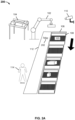
- FIG 2A is a diagram illustrating an embodiment of a robotic singulation system comprising a subsystem configured to indicate to a downstream human (or other robotic) worker a bin or other receptacle with respect to which intervention is required.
- system and environment 200 includes robotic arm 102, source of items 104, segmented conveyor 106, bin 108 (labeled "123"), camera 110, side table 112, and worker 114, as in Figures 1A and 1B .
- a spot (or other shape or design) 202 is shown as being projected onto the table 112, at a location adjacent to the bin 108 (i.e., "123") with respect to which intervention is required, e.g., by worker 114.
- a computer-controlled LED or other light e.g.,. in the overhead, is used to project the spot or other image 202 onto table 112.
- a series of lights may be activated in sequence, with adjacent lights overlapping briefly, for example, to give the effect of a projected light that appears to run alongside the affected tray 108 as the segmented conveyor 106 advances.
- the tray/bin 108 itself may be illuminated as it advances.
- the light(s) may be projected by stationary elements mounted in the overhead, not shown in Figure 2A , which are activated in sequence to follow a tray 108 requiring intervention as it moves through the system.
- the lights enable a downstream human worker, such as worker 114, to see, as a tray approaches, that human intervention is required, and in some embodiments the nature of the intervention, e.g., pull for manual sortation/scanning, flatten out or reorientation for downstream scanning, etc. For example, different colors and/or different symbols (circle, square, triangle, alphanumeric character, or string, etc.) may be displayed to indicate the intervention that is required.
- Figure 2B is a diagram illustrating an embodiment of a robotic singulation system comprising a subsystem configured to indicate to a downstream human (or other robotic) worker a bin or other receptacle with respect to which intervention is required.
- the bin 108 (“123") has moved nearer to the worker 114, as the segmented conveyor 106 advanced, and the spot 202 has been projected onto table 112 in a manner such that the spot 202 appears to follow the affected bin 108 as it advanced toward the worker 114.
- the system discontinues projecting the spot (or other shape or content) 202 alongside the bin 108.
- Figure 3 is a flow diagram illustrating an embodiment of a process to perform automated singulation and invoke an exception handling module as needed.
- the process 300 of Figure 3 may be performed by a control computer, such as a computer configured to control a robotic singulation system, including elements configured to provide a visual indication of a bin or receptable with respect to which intervention is required, such as those illustrated in Figures 1A and 1B and in Figures 2A and 2B .
- a next item is picked, e.g., by robotic arm 102 from source of items 104, in the examples shown in Figures 1A , 1B , 2A , and 2B , and move through a scanner read region.
- the item may be moved past an array of optical scanners and/or move through a trajectory that exposes a label to the unobstructed via of a camera, such as camera 110 in Figures 1A , 1B , 2A , and 2B .
- the item is placed in its designated bin or other receptacle.
- the system implementing process 300 and/or a related or higher level process may select and designate a destination bin for the item, such as a specific bin having an associated identifier.
- a destination bin for the item such as a specific bin having an associated identifier.
- the robotic arm e.g., robotic arm 102
- the system tracks and times placement of the item in a manner determined to achieve placement of the item in the designated bin.
- an error may be detected if the label or other information was not scanned and decoded fully and successfully, or if by accident or error two or more items were picked and placed into the same destination bin (or other receptacle), instead of just the intended one, or if an item failed to scan (fully) and is placed in the correct bin but needs to be flattened out or otherwise adjusted to enable a downstream (e.g., overhead) scanner to be used to scan the label, etc.
- the bin (or other destination) identifier and item information (as/if known) and (if known) an error code specifying the error (e.g., failed to fully scan, two items in one bin, item needs to be flattened out or reoriented, etc.) are passed to an exception handling module.
- the bin identifier and error code may be passed to a software module configured to actuate, monitor, and control a set of elements configured to provide a visual indication of a bin (or other receptacle) with respect to which intervention by a downstream worker is required, as in the examples described above in connection with Figures 1A , 1B , 2A , and 2B .
- the process advances to 310. If more items need to be picked and placed, then a next iteration of steps 302, 304, and 306 is performed. If no further items requiring picking/placement, the process 300 ends.
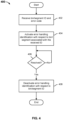
- Figure 4 is a flow diagram illustrating an embodiment of a process to provide an indication of a bin or other receptacle with respect to which intervention is required, in the context of a robotic singulation system.
- the process 400 of Figure 4 may be implemented by a subsystem or module configured to actuate, monitor, and control a set of elements configured to provide a visual indication of a bin (or other receptacle) with respect to which intervention by a downstream worker is required, as in the examples described above in connection with Figures 1A , 1B , 2A , and 2B .
- an indication is received comprising a bin/segment identifier and an associated error code indicating a nature of an error that has been detected with respect to the bin/segment with which the received bin/segment identifier is associated.
- the indication at 402 is generated by a control computer configured to use a robotic arm to pick/place items each in a corresponding location on a segmented conveyor.
- the computer or processor implementing the process 400 detects the error and/or determines the bin/segment identifier, e.g., based on image data generated by a camera, such as camera 110 in the examples shown in Figures 1A , 1B , 2A , and 2B .
- error handling identification is activated with respect to the bin/segment with which the bin/segment identifier received at 402 is associated.
- an LED strip and/or spotlight as illustrated in Figures 1A and 1B and Figures 2A and 2B , respectively, may be controlled to display a light or other visual indication on or adjacent to the affected bin/segment as it moves through the workspace.
- a computer vision system may be used to track the affected bin/segment as it moves through the workspace, e.g., based on a bin/segment identifier visible to the vision system, and the light and/or illumination elements are controlled dynamically, as the position of the affected bin/segment is updated, to provide a visual indication at locations adjacent to the affected bin/segment as it moves through the workspace.
- techniques other than computer vision may be used to track the affected segment/bin as it moves through the system, such as GPS, RFID, and/or position feedback sensors comprising or otherwise associate with the segmented conveyor.
- the visual indication is provided on or adjacent to the affected bin/segment until it is determined at 406 that the error condition has been resolved.
- a human or other worker who resolved the issue may provide user input, via a user interface, indicating the error has been corrected.
- a computer vision system may detect that the human worker has intervened and/or that the error condition has been corrected.
- the error handling identification system and/or elements is/are deactivated, with respect to the bin/segment with which the bin/segment identifier received at 402 is associated, and the process 400 ends.
- Figure 5 is a flow diagram illustrating an embodiment of a process to detect and report that a condition requiring intervention has been resolved, in the context of a robotic singulation system.
- the process of Figure 5 may be performed to implement step 406 of the process 400 of Figure 4 .
- user and/or sensor input is/are received with respect to a bin/segment with respect to which an error condition previously was associated.
- a user may indicate explicitly via a user interface that the error was resolved, or the system may determine based on computer vision that the error condition has been resolved (e.g., the item has been flattened or reoriented such that a label is visible, a second item has been removed from the bin/segment, leaving on the intended item, etc.).
- an output indicating that the error has been resolved is provided.
- an output that includes the bin/segment identifier may be communicated to another module or subsystem, such as one implementing the process 400 of Figure 4 .
- techniques disclosed herein may be used to provide a visual indication to a downstream worker that a given bin/segment moving through the workspace requires intervention to resolve an error.
Landscapes
- Engineering & Computer Science (AREA)
- General Engineering & Computer Science (AREA)
- Manufacturing & Machinery (AREA)
- Quality & Reliability (AREA)
- Physics & Mathematics (AREA)
- General Physics & Mathematics (AREA)
- Automation & Control Theory (AREA)
- Warehouses Or Storage Devices (AREA)
- Manipulator (AREA)
Applications Claiming Priority (1)
| Application Number | Priority Date | Filing Date | Title |
|---|---|---|---|
| US202263322882P | 2022-03-23 | 2022-03-23 |
Publications (1)
| Publication Number | Publication Date |
|---|---|
| EP4250032A1 true EP4250032A1 (fr) | 2023-09-27 |
Family
ID=85704058
Family Applications (1)
| Application Number | Title | Priority Date | Filing Date |
|---|---|---|---|
| EP23162291.1A Withdrawn EP4250032A1 (fr) | 2022-03-23 | 2023-03-16 | Système de singulation robotique avec indication visuelle automatisée pour intervention humaine |
Country Status (2)
| Country | Link |
|---|---|
| US (1) | US20230322497A1 (fr) |
| EP (1) | EP4250032A1 (fr) |
Families Citing this family (1)
| Publication number | Priority date | Publication date | Assignee | Title |
|---|---|---|---|---|
| US20250389672A1 (en) * | 2024-06-21 | 2025-12-25 | Retiina, LLC | Light directed singulation quality control |
Citations (4)
| Publication number | Priority date | Publication date | Assignee | Title |
|---|---|---|---|---|
| US20180127219A1 (en) * | 2016-11-08 | 2018-05-10 | Berkshire Grey Inc. | Systems and methods for processing objects |
| US20200047218A1 (en) * | 2016-05-03 | 2020-02-13 | Opex Corporation | Material handling apparatus and method for automatic and manual sorting of items using a dynamically configurable sorting array |
| WO2020142385A1 (fr) * | 2018-12-31 | 2020-07-09 | Datalogic Usa Inc. | Entrepôt intelligent, transporteur et système de gestion de palettes |
| WO2021080678A1 (fr) * | 2019-10-25 | 2021-04-29 | Dexterity, Inc. | Séparation d'articles arbitraires mélangés |
Family Cites Families (4)
| Publication number | Priority date | Publication date | Assignee | Title |
|---|---|---|---|---|
| JP3632546B2 (ja) * | 2000-02-25 | 2005-03-23 | 株式会社ダイフク | 仕分け設備 |
| US8608068B2 (en) * | 2007-12-05 | 2013-12-17 | Siemens Industry, Inc. | Mail processing tracking system and method |
| US10336542B2 (en) * | 2016-11-18 | 2019-07-02 | Amazon Technologies, Inc. | Systems and methods for maximizing tote contents |
| CA3117829A1 (fr) * | 2018-10-30 | 2020-05-07 | Berkshire Grey, Inc. | Systemes et methodes de traitement d'objets comprenant des postes semi-autonomes et un traitement de sortie automatise |
-
2023
- 2023-03-16 EP EP23162291.1A patent/EP4250032A1/fr not_active Withdrawn
- 2023-03-22 US US18/125,030 patent/US20230322497A1/en active Pending
Patent Citations (4)
| Publication number | Priority date | Publication date | Assignee | Title |
|---|---|---|---|---|
| US20200047218A1 (en) * | 2016-05-03 | 2020-02-13 | Opex Corporation | Material handling apparatus and method for automatic and manual sorting of items using a dynamically configurable sorting array |
| US20180127219A1 (en) * | 2016-11-08 | 2018-05-10 | Berkshire Grey Inc. | Systems and methods for processing objects |
| WO2020142385A1 (fr) * | 2018-12-31 | 2020-07-09 | Datalogic Usa Inc. | Entrepôt intelligent, transporteur et système de gestion de palettes |
| WO2021080678A1 (fr) * | 2019-10-25 | 2021-04-29 | Dexterity, Inc. | Séparation d'articles arbitraires mélangés |
Also Published As
| Publication number | Publication date |
|---|---|
| US20230322497A1 (en) | 2023-10-12 |
Similar Documents
| Publication | Publication Date | Title |
|---|---|---|
| US11986859B2 (en) | Perception systems and methods for identifying and processing a variety of objects | |
| US12159192B2 (en) | Robotic systems and methods for identifying and processing a variety of objects | |
| CA3004711C (fr) | Systemes de tri et procedes pour assurer le tri de divers objets | |
| US20040195320A1 (en) | System for projecting a handling instruction onto a moving item or parcel | |
| US20170066597A1 (en) | Information processing device, information processing system, distribution system, information processing method, and program storage medium | |
| US9171278B1 (en) | Item illumination based on image recognition | |
| CN112969652B (zh) | 包括半自主站和自动化输出处理的用于处理物体的系统和方法 | |
| US10850923B2 (en) | Transporter and transporting method | |
| US20160176636A1 (en) | Picking Display Device and Picking Display System | |
| US12194503B2 (en) | Systems, devices, and methods for enhanced sortation of delivery items | |
| EP4250032A1 (fr) | Système de singulation robotique avec indication visuelle automatisée pour intervention humaine | |
| US20200410435A1 (en) | Method and camera system for monitoring a picking or packaging process | |
| US12083561B2 (en) | Correlating information to facilitate automated sortation | |
| EP3403792B1 (fr) | Machine pour traiter des panneaux de bois ou similaires et pour détecter les positions des panneaux après le traitement; ainsi que la méthode correspondante; | |
| EP3647235B1 (fr) | Dispositif d'indication de projection, système de tri des colis, et procédé d'indication de projection | |
| JP6689893B2 (ja) | プロジェクタ利用ピッキング装置 | |
| EP4250033A1 (fr) | Système de séparation robotique avec routage automatisé de paquets balayés manuellement | |
| CN212733068U (zh) | 基于灯光指引的货物分拣系统 | |
| US20240300104A1 (en) | Projected issue display for human intervention in robotic system |
Legal Events
| Date | Code | Title | Description |
|---|---|---|---|
| PUAI | Public reference made under article 153(3) epc to a published international application that has entered the european phase |
Free format text: ORIGINAL CODE: 0009012 |
|
| STAA | Information on the status of an ep patent application or granted ep patent |
Free format text: STATUS: THE APPLICATION HAS BEEN PUBLISHED |
|
| AK | Designated contracting states |
Kind code of ref document: A1 Designated state(s): AL AT BE BG CH CY CZ DE DK EE ES FI FR GB GR HR HU IE IS IT LI LT LU LV MC ME MK MT NL NO PL PT RO RS SE SI SK SM TR |
|
| P01 | Opt-out of the competence of the unified patent court (upc) registered |
Effective date: 20230929 |
|
| STAA | Information on the status of an ep patent application or granted ep patent |
Free format text: STATUS: THE APPLICATION HAS BEEN WITHDRAWN |
|
| 18W | Application withdrawn |
Effective date: 20231103 |