EP4250069A2 - Appareil, procédés et systèmes d'utilisation de directions végétiques pour définir des actions, des fonctions ou l'exécution - Google Patents
Appareil, procédés et systèmes d'utilisation de directions végétiques pour définir des actions, des fonctions ou l'exécution Download PDFInfo
- Publication number
- EP4250069A2 EP4250069A2 EP23186368.9A EP23186368A EP4250069A2 EP 4250069 A2 EP4250069 A2 EP 4250069A2 EP 23186368 A EP23186368 A EP 23186368A EP 4250069 A2 EP4250069 A2 EP 4250069A2
- Authority
- EP
- European Patent Office
- Prior art keywords
- signals
- gestural
- sensor
- user
- eeg
- Prior art date
- Legal status (The legal status is an assumption and is not a legal conclusion. Google has not performed a legal analysis and makes no representation as to the accuracy of the status listed.)
- Granted
Links
Images


Classifications
-
- G—PHYSICS
- G06—COMPUTING OR CALCULATING; COUNTING
- G06F—ELECTRIC DIGITAL DATA PROCESSING
- G06F3/00—Input arrangements for transferring data to be processed into a form capable of being handled by the computer; Output arrangements for transferring data from processing unit to output unit, e.g. interface arrangements
- G06F3/01—Input arrangements or combined input and output arrangements for interaction between user and computer
- G06F3/011—Arrangements for interaction with the human body, e.g. for user immersion in virtual reality
- G06F3/015—Input arrangements based on nervous system activity detection, e.g. brain waves [EEG] detection, electromyograms [EMG] detection, electrodermal response detection
-
- G—PHYSICS
- G01—MEASURING; TESTING
- G01C—MEASURING DISTANCES, LEVELS OR BEARINGS; SURVEYING; NAVIGATION; GYROSCOPIC INSTRUMENTS; PHOTOGRAMMETRY OR VIDEOGRAMMETRY
- G01C19/00—Gyroscopes; Turn-sensitive devices using vibrating masses; Turn-sensitive devices without moving masses; Measuring angular rate using gyroscopic effects
- G01C19/58—Turn-sensitive devices without moving masses
-
- G—PHYSICS
- G06—COMPUTING OR CALCULATING; COUNTING
- G06F—ELECTRIC DIGITAL DATA PROCESSING
- G06F3/00—Input arrangements for transferring data to be processed into a form capable of being handled by the computer; Output arrangements for transferring data from processing unit to output unit, e.g. interface arrangements
- G06F3/01—Input arrangements or combined input and output arrangements for interaction between user and computer
- G06F3/011—Arrangements for interaction with the human body, e.g. for user immersion in virtual reality
- G06F3/012—Head tracking input arrangements
-
- G—PHYSICS
- G06—COMPUTING OR CALCULATING; COUNTING
- G06F—ELECTRIC DIGITAL DATA PROCESSING
- G06F3/00—Input arrangements for transferring data to be processed into a form capable of being handled by the computer; Output arrangements for transferring data from processing unit to output unit, e.g. interface arrangements
- G06F3/01—Input arrangements or combined input and output arrangements for interaction between user and computer
- G06F3/017—Gesture based interaction, e.g. based on a set of recognized hand gestures
-
- G—PHYSICS
- G06—COMPUTING OR CALCULATING; COUNTING
- G06F—ELECTRIC DIGITAL DATA PROCESSING
- G06F3/00—Input arrangements for transferring data to be processed into a form capable of being handled by the computer; Output arrangements for transferring data from processing unit to output unit, e.g. interface arrangements
- G06F3/01—Input arrangements or combined input and output arrangements for interaction between user and computer
- G06F3/03—Arrangements for converting the position or the displacement of a member into a coded form
- G06F3/033—Pointing devices displaced or positioned by the user, e.g. mice, trackballs, pens or joysticks; Accessories therefor
- G06F3/0346—Pointing devices displaced or positioned by the user, e.g. mice, trackballs, pens or joysticks; Accessories therefor with detection of the device orientation or free movement in a three-dimensional [3D] space, e.g. 3D mice, 6-DOF [six degrees of freedom] pointers using gyroscopes, accelerometers or tilt-sensors
Definitions
- the present disclosure relates to the control and operation of non-tactile devices, and more particularly, to a system and method for using data related to thought (i.e., imagined directions) and motion to control the operation of a non-tactile device and/or communicate.
- Electroencephalograms ECGs
- magnetic electroencephalograms MEGs
- the like are often used to detect, receive, process, convert, and record brain waves.
- the brain waves detected, received, processed, converted and recorded by these devices are often converted into signals that may be utilized to control other objects/devices, communicate with other objects/devices and/or other humans and the like.
- US Patent No. 9,405,366 which is hereby incorporated by reference in its entirety to the extent not inconsistent with the present application, describes a device configured to detect, receive, process convert and record brain waves into signals that may be used to control other objects/devices and communicate with other objects/devices and/or other humans and the like.
- the brain waves acquired by EEG and MEG-like devices may be difficult to detect, receive, process, record, and convert into signals used to control other objects/devices and communicate with other objects/devices and/or other humans.
- many current devices require a training period (also referred to as "bio training"). During the training period, device users may train the device to identify brain wave patterns and associate them to specific executions or functions.
- the training period may require a user to undergo multiple training sessions and utilize specialized personnel to effectively and accurately train the device to detect the user's brain waves.
- a user may be able to imagine certain thoughts more easily than other thoughts. For example, a user may have a preferred imagined direction that is easier to think about than others are. For this reason, it may be easier to train the device to detect the user's brain waves for some directions more easily than for others.
- a state-of-the art brain wave to communication device in September 2016 allowed a monkey to type 12 words per minute (http://spectrum.ieee.org/the-human-os/biomedical/bionics/monkeys-type-12-words-per-minute-with-braintokeyboard-communication).
- many devices that acquire brain waves include components that are implanted within the user's skull. Such devices are extremely invasive and required skilled personnel to implant, monitor, and use the device.
- some current devices aim to link brain waves acquired by the device with easily identifiable behaviors such as eye-blinks, smiles, jaw clenches, and brow raises. These easily identifiable behaviors are often used to indicate the onset of a pattern or brain-signal of interest that should be converted into a signal to control other objects/devices, communicate with other objects/devices and/or other humans and the like.
- easily identifiable behaviors are often used to indicate the onset of a pattern or brain-signal of interest that should be converted into a signal to control other objects/devices, communicate with other objects/devices and/or other humans and the like.
- many of the easily identifiable behaviors are overt and easily visible.
- brain waves i.e., EEG data
- a device detects, receives, processes, converts, and records EEG data and micro-gestural data to signals that are transmitted in order to control other objects/devices, communicate with other objects/devices and/or transmits to and receives EEG data and micro-gestural data from other humans.
- the device is covert, accurate, fast and may be easily used by a wide range of users without substantial bio training.
- the device may include a gestural sensor and/or an EEG sensor configured to receive one or more bio-signals from a user.
- bio-signals may be defined as gestural data and EEG data.
- the device may include a non-transitory memory component configured to store software that causes a process component, coupled to the gestural and/or EEG sensor, to aggregate and transmit via a communications component the one or more bio-signals to a separate, secondary device, such as, for example, a mobile device or a computer etc.
- a power source component of the device may be configured to power at least one of the gestural sensor and/or the EEG sensor, the non-transitory memory, power components, and communications component.
- the device may be configured to fit substantially within an ear canal, or other operable location within the near operative vicinity of the user.
- a device detects, receives, processes and records EEG data to signals used for control of other objects/devices and communication with other objects/devices and/or other humans.
- the device may be covert, accurate, and fast and may be easily used by a wide range of users without substantial user bio training.
- FIG. 1A illustrates the components of an exemplary device 100.
- the device 100 may include a brain signal sensor such as EEG signal sensor 101 configured to detect, receive, process, convert, record and transmit EEG data.
- the device 100 may also include a gestural sensor 103 configured to detect, receive, process, convert, record and transmit gestural signal data.
- the device 100 may also include a processor component 105 configured to detect, receive, process, convert, record and transmit EEG data from the EEG signal sensor 101 and the gestural signal sensor data obtained and processed from the gestural sensor 103.
- the processor component 105 may be controlled by software located on non-transitory memory 107 stored on the device 100.
- the device 100 may also include a communications module 109 configured to detect, receive, process, convert record and transmit data and/or information from the device 100 to anyone of a plurality of separate devices and/or humans.
- the components of the device 100 may be powered by one or more power components 111.
- the EEG signal sensor 101, the gestural sensor 103, the processor component 105, non-transitory memory 107, and communications module 109 may be contained within the device 100.
- the device 100 may take the shape of an ear-bud or similar device. In such an embodiment, at least a portion of the device 100 may be configured to fit within the ear canal of a user.
- the device 100 may be worn covertly. For example, the device 100 may preferably not be visible to someone interacting with the user (i.e., covert).
- brain signal sensor may include one or more of an electroencephalogram (EEG), magnetic electroencephalograms (MEGs), and the like.
- EEG electroencephalogram
- MEGs magnetic electroencephalograms
- the EEG signal sensor 101 may be configured to obtain EEG data from a user.
- the EEG signal sensor 101 may include one or more electrodes configured to project into the ear canal and in the operative vicinity of the user to record EEG data from the user's head.
- the device 100 is configured to detect, receive process, convert, record, and transmit gestural data into signals to control other objects, devices and/or with other objects/devices and/or other humans.
- the EEG signal sensor 101 may record electrical activity such as mu rhythms, EMG signals and the like from the temple, behind the user's ear, and/or the mastoid region.
- the EEG signal sensor 101 may include at least one active dry EEG electrode.
- a single sensor EEG may be configured to record from on the temple or behind the ear on the mastoid.
- the placement of the single sensor EEG may be optimized to detect, for example, but not limited to, a jaw clench or the like.
- the gestural sensor 103 may include one or more of an accelerometer, gyroscope, and the like.
- the gestural sensor 103 may provide head tracking by recording rotational, altitude, acceleration vectors, movements and the like.
- the gestural sensor 103 may record movements from a location, such as, for example, but not limited to, the operative vicinity of a user.
- each of the accelerometer and gyroscope may record movements along three axes.
- the gestural sensor 103 may record movement along six axes (three from each of the gyroscope and accelerometer).
- the gyroscope is a micro-gyroscope.
- movements recorded by the micro-gyroscope may include head turns, head tilts, head nods and the like.
- the gestural sensor 103 may include an inner ear pressure sensor (not shown) that is configured to detect changes in the inner ear pressure of a user.
- the inner ear pressure of a user may change in accordance with the balance and movement of the user. Accordingly, the inner ear pressure sensor may provide additional information regarding gestural behavior.
- the gestural sensor 103 may also detect the head turns, head tilts, head nods, jaw clenches and other covert behaviors, detected by the micro-gyroscope. It is envisioned that the gestural motions such as jaw clenches may cause changes in inner ear pressure that are detectable by the inner ear pressure sensor.
- the device 100 is able to address the challenges presented by conventional devices that aim to detect, receive, process, convert, record and transmit EEG data and microgestural to signals used for control of other objects/devices and communication with other objects/devices and/or other humans.
- Information from gestural sensors 103 may include recorded movement. Recorded movement allows for a more accurate and faster input and is universal between users, unlike thoughts of imagined directions. The recorded movement from gestural sensors 103 is universal and reproducible.
- gestural data such as those obtained from gestural sensors, such as accelerometers, micro-gyroscopes and/or inner ear pressure monitors
- gestural sensors such as accelerometers, micro-gyroscopes and/or inner ear pressure monitors
- brain waves such as imagined directions into signals used for control of other objects/devices and communication with other objects/devices and/or other humans are often dependent on a user's ability to imagine directions, and often brain waves associated with one direction are often more pronounced and strongly differentiable than brain waves associated with a different direction.
- gestural signals such as those acquired by gestural sensors such as micro-gyroscopes accelerometers, and/or inner ear pressure monitors are able to detect signals associated with all directions equally. Accordingly, the device 100 has many benefits over current conventional systems by using both gestural data and EEG data to detect, receive, process, convert, record and transmit EEG data and microgestures into signals to control other objects/devices and with other objects/devices and/or other humans.
- the processor 105 may control the operation of the EEG signal sensor 101, gestural sensor 103, communications module 109, and any other additional components of the device 100.
- the processor 105 may be controlled by software instructions (and the like) stored on non-transitory memory component 107 of the device.
- the components of the device 100 including the EEG signal sensor 101, gestural sensor 103, processor 105, communication module 109, non-transitory memory 107, and the like may be powered by way of the power component 111.
- the power component 111 may include batteries and/or rechargeable batteries and the like.
- the communication module 109 may include components to transmit data and information from the device 100 to a separate device. Data and information may be transmitted in any suitable format including wireless and wired communication. The data and information may be transmitted in accordance with any suitable security protocol and the like. The communication module 109 may also receive data and information from separate devices that include signals to control the operation of the device 100. In one embodiment, the communication module 109 may first receive software updates that are later used to update software code stored on the non-transitory memory component 107 of the device. In one embodiment, the communication module 109 may receive signals from a separate device that control the operation of the device 100, including signals that cause one or more components of the device 100 to vibrate, illuminate, emit sound, or the like. The vibrations, illuminations, sounds, may be used by the separate device to communicate with other objects/devices and/or other humans with a user of the device 100.
- EEG data recorded by the EEG signal sensor 101 may be processed at the EEG signal sensor 101 and/or at the processor 105 prior to being transmitted by the communication module 109 from device 100 to a separate device.
- Gestural data recorded by the gestural sensor 103 may be processed at the EEG signal sensor 101 and/or at the processor 105 prior to being transmitted by the communication module 109 from device 100 to a separate device. Processing may include isolating one or more signals or waveform of interest by applying filters, algorithms, signal processing techniques, and the like.
- the raw data recorded by each of the gestural sensor 103 and EEG signal sensor 101 may be transmitted without any processing to the separate device, such as, for example, micro device, mobile device or computer by way of the communication module 109. In this manner, the latencies associated with processing the raw data may be avoided.
- the gestural data recorded by the gestural sensor 103 may be indicative of the onset of a directional thought or motion.
- EEG and gestural signals corresponding to a directional thought or motion may be obtained by the EEG signal sensor 101 and gestural sensor 103 of the device 100 processed by the processor 105, which routes the directional thought or motion information obtained by one or both of the gestural sensor 103 and EEG signal sensor 101 to the communication module 109 for transmission from the device 100 to a separate device.
- EEG signals and gestural signals corresponding to a directional thought or motion may be received by a separate device.
- the separate device may include one or more computers with one or more processors and non-transitory memory.
- the separate device may be a laptop, desktop, tablet, cell phone, or the like.
- the separate device may receive the EEG signals and/or gestural signals corresponding to a directional thought.
- the directional thought may be converted into a rune and/or line movements in accordance with the techniques discussed in US Patent No. 9,405,366 .
- the rune and/or line movements may be used to control the operation of a software application for communication located at the separate device.
- the separate device either automatically or by way of user input, may transmit a signal to the device 100 responsive to translating the rune and/or line movements.
- the device 100 may include additional components as needed for operation in accordance with the description herein.
- FIG. 1B illustrates an exemplary embodiment of a system using the device of FIG. 1A .
- the device 100 may be communicatively coupled via communications module 109 to a second device 120.
- the second device 120 may include a communication module 121, a gestural and EEG signal to rune/line movement module 123 and a rune/line movement to action module 125.
- the second device 120 may be coupled to a database 130.
- the database 130 may include a rune/line movement data structure 131.
- the gestural and EEG signal to rune/line movement module 123 may be configured to aggregate and process gestural and EEG signals in order to determine a rune and/or line movement.
- the process for aggregating and processing gestural and EEG signals may be in accordance with what is described by US Patent No. 9,405,366 , the disclosure of which is hereby incorporated by reference to the extent not inconsistent with the present application.
- the rune/line movement to action module 125 may access database 130 to retrieve information regarding the actions corresponding to the rune and/or line movement from rune/line movement data structure 131.
- the device 120 may perform one or more actions.
- Example actions may include transmitting a signal to the first device 100 to cause the first device 100 to vibrate, illuminate, emit sound, or the like.
- the rune/line movement to action module 125 may use the communications module 121 to transmit a signal to the first device 100.
- the device 120 may include a user interface that is configured to display a message or emit a sound corresponding to the rune/line movement based on the information retrieved from the rune/line movement data structure 131 from the rune/line movement to action module 125.
- the action may correspond to sending a signal to control the operation of one or more devices distinct from device 120 and/or device 100.
- FIG. 2 illustrates another exemplary embodiment of the device 200 which may include one or more of the following elements (without limitation): gestural sensor such as a micro-gyroscope 203, a brain-wave sensor such as EEG sensor 201, a piezoelectric speaker 209C, a light sensor 209D, a temperature sensor 211E, a microphone 209F, a piezoelectric film speaker 209E, a USB port 209B, a communications transceiver U209A, a battery 211A, a thermal electric harvesting component 211B, and a USB rechargeable charger 211C.
- gestural sensor such as a micro-gyroscope 203
- a brain-wave sensor such as EEG sensor 201
- a piezoelectric speaker 209C such as EEG sensor 201
- a piezoelectric speaker 209C such as EEG sensor 201
- a light sensor 209D such as EEG sensor
- a temperature sensor 211E such as a temperature sensor
- the EEG sensor 201 may be a 100 mV signal sensor with an operational amplifier.
- the temperature sensor 211D may be a negative temperature coefficient (NTC) temperature sensor.
- the piezoelectric speaker 209C may receive audio signals from a separate device 221, 231 by way of a communications transceiver 209A.
- the communications transceiver 209A may be a Bluetooth ® transceiver. Upon receiving such a signal, the piezoelectric speaker 209C may emit an audio signal to the user of the device 200.
- a communications module may include the communications transceiver 209A (e.g., Bluetooth ® transceiver) which is configured to stream data and information from the micro-gyroscope 203, and/or the EEG sensor 201, and/or digital audio between the user of the device 200 and a separate device 221, 231.
- the communication module of device 200 may also include a USB port 209B that is configured to link to a separate device via a wireless or wired connection.
- the USB port 209B may be configured to receive software updates for the components of the device 200.
- the battery 211A may be an alkaline battery that is configured to generate all the voltages required by the sensors 203, 201, components of the communication module including speakers 209C, communications transceiver 209A, USB port 209B, and the like.
- the power component, battery 211A may be rechargeable by way of a near-field charger and/or USB rechargeable component 211C.
- the battery 211A may also be rechargeable by way of a thermal electric harvesting component 211B. Power to the components of the device 200 from the battery 211A may managed by a button or the like.
- the exemplary embodiment of the device 200 depicted in FIG. 2 may wirelessly transmit gestural signals and EEG signals to separate devices such as a computer system 221 operating in a software environment specially configured with an application interface to control operation of the device 200.
- the computer system 221 may also include a user interface 223, debugging software, testing software, other health monitoring applications, and the like.
- the exemplary embodiment of the device 200 depicted in FIG. 2 may also wirelessly (by way of Bluetooth ® or other means) transmit gestural signals and EEG signals to a separate portable device 231 such as a cell phone, tablet, or the like.
- the separate portable device 231 may be operating an application 233 specially configured to control the operation of the device 200.
- FIG. 3 illustrates a block diagram of a method for use in accordance with an exemplary embodiment of the device.
- a first device detects a primer indicative of the onset of directional thought via a gestural sensor on the first device.
- the device records bio-signals associated with directional thought via a gestural sensor and/or an EEG sensor on the first device.
- a bio-signal may include an EEG signal and/or a gestural signal such as a gyroscope signal, accelerometer signal and the like.
- the first device may then transmit the recorded bio-signals associated with directional thought to a second device at step 305.
- the second device may receive the bio-signals recorded from the first device at step 307.
- the second device may then process the received bio-signals into a series of directional intentions, runes, and/or line patterns at step 309.
- the second device may also search in a database for a corresponding action affiliated with the determined directional intention, rune and/or line pattern at step 311.
- the second device may also match the obtained directional intention, rune and/or line pattern with the corresponding element stored in the database in step 311.
- the second device may then perform the operation or action indicated by the directional intention, rune and/or line pattern matched in step 311.
- the processes performed by the second device to convert the received bio-signals into an operation are described in US Patent No. 9,405,366 .
- the operation may include transmitting a signal to the first device to vibrate, illuminate, emit sound, or the like.
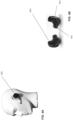
- FIG. 4A illustrates an exemplary embodiment of the device at least partially located within the ear canal.
- the device 400 may include one or more of the components discussed above with respect to the FIGS. 1 and 2 .
- FIG. 4B illustrates an exemplary embodiment of the device that comprises an earbud.
- the device 400 includes an outer housing 403 visible to a user, and a cushion area 401 configured to fit at least substantially within a user's ear canal.
- the outer housing 403 may be shaped to conform to the anatomy of a user's ear.
- the cushion area 401 may be made of soft and flexible material such as silicone. Alternative materials may be used.
- the cushion area 401 may form a seal with the user's ear canal to prevent audio leakage.
- the outer housing 403 may be constructed using 3D printer.
- the device is operative within the vicinity of a user, within the vicinity of a user's ear, or within the vicinity of a user's ear canal or other operative locations.
- Systems and methods of the present disclosure may include and/or may be implemented by one or more specialized computers including specialized hardware and/or software components.
- a specialized computer may be a programmable machine capable of performing arithmetic and/or logical operations and specially programmed to perform the particular functions described herein.
- computers may include processors, memories, data storage devices, and/or other specially programmed components. These components may be connected physically or through network or wireless links.
- Computers may also include software, which may direct the operations of the aforementioned components.
- Computers may be referred to with terms such as servers, personal computers (PCs), mobile devices, and other terms that may be interchangeable therewith, and any special purpose computer capable of performing the described functions may be used.
- Module may include specially configured hardware and/or software components.
- module may refer to logic embodied in hardware or firmware or to a collection of software instructions.
- modules described herein refer to logical modules that may be combined with other modules or divided into sub-modules despite their physical organization or storage.
- Computers may be linked to one another via one or more networks.
- a network may be any plurality of completely or partially interconnected computers, wherein some or all of the computers are able to communicate with one another. Connections between computers may be wired in some cases (e.g., via wired TCP connection or other wired connection) or may be wireless (e.g., via a Wi-Fi network connection). Any connection through which at least two computers may exchange data may be the basis of a network.
- separate networks may be able to be interconnected such that one or more computers within one network may communicate with one or more computers in another network. In such a case, the plurality of separate networks may optionally be considered a single network.
- the non-transitory memory component described above may include, for example, without being limited to, at least one of a read-only memory (ROM), a random access memory (RAM), a flash memory, a dynamic RAM (DRAM) and a static RAM (SRAM), storing computer-readable instructions executable by processing components.
- Memory components may include any suitable non-transitory computer readable storage medium storing computer-readable instructions executable by processing components for performing the operations described herein. Although only one memory component is illustrated in each of FIGS. 1 and 2 , in some examples, the one or more computer systems may include two or more memory devices (e.g., dynamic memory and static memory).
- the one or more computer systems may include data storage devices storing instructions (e.g., software) for performing any one or more of the functions described herein.
- Data storage devices may include any suitable non-transitory computer-readable storage medium, including, without being limited to, solid-state memories, optical media, and magnetic media.
- the term "computer” shall refer to an electronic device or devices, including those specifically configured with capabilities to be utilized in connection with a data conversion and distribution system, such as a device capable of receiving, transmitting, processing and/or using data and information in the particular manner and with the particular characteristics described herein.
- the computer may include a server, a processor, a microprocessor, a personal computer, such as a laptop, palm PC, desktop or workstation, a network server, a mainframe, an electronic wired or wireless device, such as for example, a telephone, a cellular telephone, a personal digital assistant, a smartphone, an interactive television, such as for example, a television adapted to be connected to the Internet or an electronic device adapted for use with a television, an electronic pager or any other computing and/or communication device specifically configured to perform one or more functions described herein.
- a server a processor, a microprocessor
- a personal computer such as a laptop, palm PC, desktop or workstation
- a network server such as a mainframe
- an electronic wired or wireless device such as for example, a telephone, a cellular telephone, a personal digital assistant, a smartphone
- an interactive television such as for example, a television adapted to be connected to the Internet or an electronic device adapted for use with a television, an electronic pager
- network shall refer to any type of network or networks, including those capable of being utilized in connection with a data conversion and distribution system described herein, such as, for example, any public and/or private networks, including, for instance, the Internet, an intranet, or an extranet, any wired or wireless networks or combinations thereof.
- user interface shall refer to any suitable type of device, connection, display and/or system through which information may be conveyed to and received from a user, such as, without limitation, a monitor, a computer, a graphical user interface, a terminal, a screen, a keyboard, a touchscreen, a biometric input device that may include a microphone and/or camera, a telephone, a personal digital assistant, a smartphone, or an interactive television.
- computer-readable storage medium should be taken to include a single medium or multiple media that store one or more sets of instructions.
- computer-readable storage medium shall also be taken to include any medium that is capable of storing or encoding a set of instructions for execution by the machine and that causes the machine to perform any one or more of the methodologies of the present disclosure.
Landscapes
- Engineering & Computer Science (AREA)
- General Engineering & Computer Science (AREA)
- Theoretical Computer Science (AREA)
- General Physics & Mathematics (AREA)
- Physics & Mathematics (AREA)
- Human Computer Interaction (AREA)
- General Health & Medical Sciences (AREA)
- Neurosurgery (AREA)
- Neurology (AREA)
- Health & Medical Sciences (AREA)
- Dermatology (AREA)
- Biomedical Technology (AREA)
- Radar, Positioning & Navigation (AREA)
- Remote Sensing (AREA)
- User Interface Of Digital Computer (AREA)
- Measurement And Recording Of Electrical Phenomena And Electrical Characteristics Of The Living Body (AREA)
Applications Claiming Priority (3)
| Application Number | Priority Date | Filing Date | Title |
|---|---|---|---|
| US201762449158P | 2017-01-23 | 2017-01-23 | |
| EP18741177.2A EP3570740B1 (fr) | 2017-01-23 | 2018-01-22 | Appareil et procédé pour utiliser une direction imaginée afin de définir au moins une action |
| PCT/US2018/014736 WO2018136893A1 (fr) | 2017-01-23 | 2018-01-22 | Appareil, procédés et systèmes pour utiliser une direction imaginée afin de définir des actions, des fonctions ou une exécution |
Related Parent Applications (2)
| Application Number | Title | Priority Date | Filing Date |
|---|---|---|---|
| EP18741177.2A Division EP3570740B1 (fr) | 2017-01-23 | 2018-01-22 | Appareil et procédé pour utiliser une direction imaginée afin de définir au moins une action |
| EP18741177.2A Division-Into EP3570740B1 (fr) | 2017-01-23 | 2018-01-22 | Appareil et procédé pour utiliser une direction imaginée afin de définir au moins une action |
Publications (4)
| Publication Number | Publication Date |
|---|---|
| EP4250069A2 true EP4250069A2 (fr) | 2023-09-27 |
| EP4250069A3 EP4250069A3 (fr) | 2023-10-11 |
| EP4250069B1 EP4250069B1 (fr) | 2025-09-17 |
| EP4250069C0 EP4250069C0 (fr) | 2025-09-17 |
Family
ID=62906904
Family Applications (2)
| Application Number | Title | Priority Date | Filing Date |
|---|---|---|---|
| EP18741177.2A Active EP3570740B1 (fr) | 2017-01-23 | 2018-01-22 | Appareil et procédé pour utiliser une direction imaginée afin de définir au moins une action |
| EP23186368.9A Active EP4250069B1 (fr) | 2017-01-23 | 2018-01-22 | Système d'utilisation de directions végétiques pour définir des actions, des fonctions ou l'exécution |
Family Applications Before (1)
| Application Number | Title | Priority Date | Filing Date |
|---|---|---|---|
| EP18741177.2A Active EP3570740B1 (fr) | 2017-01-23 | 2018-01-22 | Appareil et procédé pour utiliser une direction imaginée afin de définir au moins une action |
Country Status (4)
| Country | Link |
|---|---|
| US (7) | US10275027B2 (fr) |
| EP (2) | EP3570740B1 (fr) |
| CA (1) | CA3051095A1 (fr) |
| WO (1) | WO2018136893A1 (fr) |
Families Citing this family (7)
| Publication number | Priority date | Publication date | Assignee | Title |
|---|---|---|---|---|
| US9405366B2 (en) * | 2013-10-02 | 2016-08-02 | David Lee SEGAL | Systems and methods for using imagined directions to define an action, function or execution for non-tactile devices |
| EP3570740B1 (fr) | 2017-01-23 | 2023-08-30 | Naqi Logix Inc. | Appareil et procédé pour utiliser une direction imaginée afin de définir au moins une action |
| WO2023043490A1 (fr) | 2021-09-14 | 2023-03-23 | Applied Cognition, Inc. | Évaluation non invasive de l'écoulement glymphatique et de la neurodégénérescence à partir d'un dispositif à porter sur soi |
| US11972050B2 (en) | 2021-11-01 | 2024-04-30 | Brown University | Brain computer interface (BCI) system that can be implemented on multiple devices |
| WO2023183858A1 (fr) * | 2022-03-22 | 2023-09-28 | David Segal | Systèmes et procédés de réalité augmentée utilisant des dispositifs portables basés sur la tête pour interagir avec des objets |
| US12004874B2 (en) | 2022-10-24 | 2024-06-11 | Applied Cognition, Inc. | Wearable device and method for non-invasive assessment of glymphatic flow |
| US12008163B1 (en) | 2023-03-06 | 2024-06-11 | Naqi Logix Inc. | Earbud sensor assembly |
Citations (1)
| Publication number | Priority date | Publication date | Assignee | Title |
|---|---|---|---|---|
| US9405366B2 (en) | 2013-10-02 | 2016-08-02 | David Lee SEGAL | Systems and methods for using imagined directions to define an action, function or execution for non-tactile devices |
Family Cites Families (82)
| Publication number | Priority date | Publication date | Assignee | Title |
|---|---|---|---|---|
| US5724987A (en) | 1991-09-26 | 1998-03-10 | Sam Technology, Inc. | Neurocognitive adaptive computer-aided training method and system |
| JPH06296757A (ja) | 1992-06-30 | 1994-10-25 | D F C:Kk | コンピュータゲーム機用制御信号入力装置 |
| US5840040A (en) | 1992-12-18 | 1998-11-24 | The Regents Of The University Of California | Encephalolexianalyzer |
| US5474082A (en) | 1993-01-06 | 1995-12-12 | Junker; Andrew | Brain-body actuated system |
| US5638826A (en) | 1995-06-01 | 1997-06-17 | Health Research, Inc. | Communication method and system using brain waves for multidimensional control |
| US8350804B1 (en) | 1996-04-10 | 2013-01-08 | Moll Edward W | Thought controlled system |
| US6402520B1 (en) | 1997-04-30 | 2002-06-11 | Unique Logic And Technology, Inc. | Electroencephalograph based biofeedback system for improving learning skills |
| US6024700A (en) | 1998-07-16 | 2000-02-15 | Nemirovski; Guerman G. | System and method for detecting a thought and generating a control instruction in response thereto |
| AU2174700A (en) | 1998-12-10 | 2000-06-26 | Christian R. Berg | Brain-body actuated system |
| US6377833B1 (en) | 1999-01-25 | 2002-04-23 | Douglas Albert | System and method for computer input of dynamic mental information |
| US6920229B2 (en) * | 1999-05-10 | 2005-07-19 | Peter V. Boesen | Earpiece with an inertial sensor |
| US6503197B1 (en) | 1999-11-09 | 2003-01-07 | Think-A-Move, Ltd. | System and method for detecting an action of the head and generating an output in response thereto |
| AUPQ404899A0 (en) | 1999-11-16 | 1999-12-09 | Price, Gregory Walter Dr | Aprocess of interactive stimulation of the brain as a means of modifying the electroencephalogram so as to modify particular electrophysiological respon ses |
| DE10049847B4 (de) | 2000-04-19 | 2005-12-01 | Lg Electronics Inc. | Mikrowellenherd |
| US6353754B1 (en) | 2000-04-24 | 2002-03-05 | Neuropace, Inc. | System for the creation of patient specific templates for epileptiform activity detection |
| US20130211238A1 (en) | 2001-01-30 | 2013-08-15 | R. Christopher deCharms | Methods for physiological monitoring, training, exercise and regulation |
| US20020103429A1 (en) | 2001-01-30 | 2002-08-01 | Decharms R. Christopher | Methods for physiological monitoring, training, exercise and regulation |
| SE0101001D0 (sv) * | 2001-03-22 | 2001-03-22 | Siemens Elema Ab | X-ray imagning system |
| US6952809B2 (en) | 2001-03-30 | 2005-10-04 | International Business Machines Corporation | Method and apparatus for navigating a windowed operating environment |
| US6529773B1 (en) | 2001-08-01 | 2003-03-04 | The United States Of America As Represented By The Secretary Of The Air Force | Communication and control by means of brainwave and other processes causing voltage changes that can be measured from the body |
| US6829502B2 (en) | 2002-05-30 | 2004-12-07 | Motorola, Inc. | Brain response monitoring apparatus and method |
| US9153074B2 (en) | 2011-07-18 | 2015-10-06 | Dylan T X Zhou | Wearable augmented reality eyeglass communication device including mobile phone and mobile computing via virtual touch screen gesture control and neuron command |
| KR100495504B1 (ko) | 2002-12-12 | 2005-06-14 | 한국전자통신연구원 | 뇌파를 이용한 자동차 브레이크 제어 장치 및 제어 방법 |
| US7706871B2 (en) | 2003-05-06 | 2010-04-27 | Nellcor Puritan Bennett Llc | System and method of prediction of response to neurological treatment using the electroencephalogram |
| US8412342B2 (en) | 2003-11-14 | 2013-04-02 | Hearworks Pty, Limited | Implantable acoustic sensor |
| US7120486B2 (en) | 2003-12-12 | 2006-10-10 | Washington University | Brain computer interface |
| WO2005065794A1 (fr) | 2004-01-02 | 2005-07-21 | Interactive Productline Ab | Procede de jeu faisant appel aux ondes cerebrales |
| US20050153268A1 (en) | 2004-01-14 | 2005-07-14 | Junkin William H. | Brain-based processing skill enhancement |
| US20050177058A1 (en) | 2004-02-11 | 2005-08-11 | Nina Sobell | System and method for analyzing the brain wave patterns of one or more persons for determining similarities in response to a common set of stimuli, making artistic expressions and diagnosis |
| MXPA06011168A (es) * | 2004-04-01 | 2007-04-16 | William C Torch | Biosensores, comunicadores, y controladores que verifican el movimiento del ojo y metodos para utilizarlos. |
| US10039445B1 (en) * | 2004-04-01 | 2018-08-07 | Google Llc | Biosensors, communicators, and controllers monitoring eye movement and methods for using them |
| US8938289B2 (en) | 2004-08-25 | 2015-01-20 | Motorika Limited | Motor training with brain plasticity |
| US20180146879A9 (en) | 2004-08-30 | 2018-05-31 | Kalford C. Fadem | Biopotential Waveform Data Fusion Analysis and Classification Method |
| TWI257214B (en) | 2004-12-10 | 2006-06-21 | Univ Nat Chiao Tung | Brainwave-controlled embedded Internet robot agent architecture |
| US7383728B2 (en) * | 2005-07-13 | 2008-06-10 | Ultimate Balance, Inc. | Orientation and motion sensing in athletic training systems, physical rehabilitation and evaluation systems, and hand-held devices |
| US8047914B2 (en) | 2005-08-25 | 2011-11-01 | Bally Gaming, Inc. | Player verification system |
| US7580742B2 (en) | 2006-02-07 | 2009-08-25 | Microsoft Corporation | Using electroencephalograph signals for task classification and activity recognition |
| US20080211768A1 (en) | 2006-12-07 | 2008-09-04 | Randy Breen | Inertial Sensor Input Device |
| US20080208008A1 (en) | 2007-02-28 | 2008-08-28 | Microsoft Corporation | Wireless body sensor with small size background |
| US20090306531A1 (en) | 2008-06-05 | 2009-12-10 | Eric Claude Leuthardt | Methods and systems for controlling body parts and devices using ipsilateral motor cortex and motor related cortex |
| US8265743B2 (en) | 2007-12-27 | 2012-09-11 | Teledyne Scientific & Imaging, Llc | Fixation-locked measurement of brain responses to stimuli |
| SI2291080T1 (sl) | 2008-05-14 | 2015-11-30 | The Scripps Research Institute | Novi modulatorji sfingosinskih fosfatnih receptorjev |
| US8326408B2 (en) | 2008-06-18 | 2012-12-04 | Green George H | Method and apparatus of neurological feedback systems to control physical objects for therapeutic and other reasons |
| EP2327005B1 (fr) | 2008-07-25 | 2017-08-23 | Qualcomm Incorporated | Détection améliorée d'un geste de séquence de signes de la main |
| US8155736B2 (en) | 2009-03-16 | 2012-04-10 | Neurosky, Inc. | EEG control of devices using sensory evoked potentials |
| EP2483759A1 (fr) * | 2009-09-30 | 2012-08-08 | France Telecom | Dispositif de commande |
| US9880619B2 (en) * | 2010-02-23 | 2018-01-30 | Muy Interactive Ltd. | Virtual reality system with a finger-wearable control |
| US8493174B2 (en) * | 2010-03-24 | 2013-07-23 | Dharma P. Agrawal | Apparatus for instantaneous translation of sign language |
| WO2011140303A1 (fr) | 2010-05-05 | 2011-11-10 | University Of Maryland, College Park | Procédés basés sur un domaine temps pour interfaces cerveau-machines non invasives |
| US8822674B2 (en) | 2010-08-20 | 2014-09-02 | Taisho Pharmaceutical Co., Ltd | Crystal form of 4-isopropylphenyl glucitol compound and process for production thereof |
| US8755782B2 (en) | 2010-08-24 | 2014-06-17 | Lg Electronics Inc. | Mobile terminal and method of controlling operation of the mobile terminal |
| WO2012040782A1 (fr) | 2010-09-29 | 2012-04-05 | John Conan Doyle | Système et procédé de mesure de la position relative des membres d'un ongulé |
| KR101314570B1 (ko) | 2011-10-12 | 2013-10-07 | 서울대학교산학협력단 | 정밀한 제어를 위한 뇌-기계 인터페이스 장치 및 방법 |
| WO2013059833A1 (fr) | 2011-10-21 | 2013-04-25 | Neurotrek, Inc. | Procédé et système de communication directe |
| US20130106707A1 (en) | 2011-10-26 | 2013-05-02 | Egalax_Empia Technology Inc. | Method and device for gesture determination |
| KR101873741B1 (ko) | 2011-10-26 | 2018-07-03 | 엘지전자 주식회사 | 휴대 단말기 및 그 제어 방법 |
| CN103190902B (zh) | 2012-01-06 | 2017-08-04 | 无极技术公司 | 利用脑波频率数据和交互式多媒体显示来确定、监控及分析个人化响应变量的方法和系统 |
| US8493354B1 (en) | 2012-08-23 | 2013-07-23 | Immersion Corporation | Interactivity model for shared feedback on mobile devices |
| CN102664210B (zh) | 2012-05-14 | 2015-05-06 | 友达光电股份有限公司 | 太阳能模块与其制造方法 |
| EP2667638B1 (fr) | 2012-05-24 | 2016-02-03 | Oticon A/s | Dispositif auditif à électrode externe |
| US9814426B2 (en) | 2012-06-14 | 2017-11-14 | Medibotics Llc | Mobile wearable electromagnetic brain activity monitor |
| US8786546B1 (en) * | 2012-08-10 | 2014-07-22 | Rockwell Collins, Inc | Hands-free electroencephalography display enablement and unlock method and apparatus |
| US9955286B2 (en) * | 2013-05-08 | 2018-04-24 | Natalya Segal | Smart wearable devices and system therefor |
| EP2813175A3 (fr) * | 2013-06-14 | 2015-04-01 | Oticon A/s | Dispositif d'aide auditive avec interface cerveau-ordinateur |
| WO2015042907A1 (fr) * | 2013-09-29 | 2015-04-02 | Nokia Corporation | Appareil pour activer des modes d'entrée de commande et procédés associés |
| US20150309562A1 (en) * | 2014-04-25 | 2015-10-29 | Osterhout Group, Inc. | In-vehicle use in head worn computing |
| US9436279B2 (en) | 2014-03-31 | 2016-09-06 | Rovi Guides, Inc. | Systems and methods for controlling user devices based on brain activity |
| US10867527B2 (en) * | 2014-09-01 | 2020-12-15 | 5Lion Horus Tech Llc. | Process and wearable device equipped with stereoscopic vision for helping the user |
| US20170227779A1 (en) * | 2014-09-30 | 2017-08-10 | Konica Minolta, Inc. | Head Mounted Display And Wearable Computer |
| CN104503592A (zh) * | 2015-01-23 | 2015-04-08 | 北京智谷睿拓技术服务有限公司 | 头部动作确定方法和装置 |
| US20180012377A1 (en) * | 2016-07-08 | 2018-01-11 | Toyota Motor Engineering & Manufacturing North America, Inc. | Vision-assist devices and methods of calibrating vision-assist devices |
| US10796715B1 (en) * | 2016-09-01 | 2020-10-06 | Arizona Board Of Regents On Behalf Of Arizona State University | Speech analysis algorithmic system and method for objective evaluation and/or disease detection |
| US10303436B2 (en) * | 2016-09-19 | 2019-05-28 | Apple Inc. | Assistive apparatus having accelerometer-based accessibility |
| US10069956B2 (en) * | 2016-11-21 | 2018-09-04 | Lenovo (Singapore) Pte. Ltd. | Apparatus, method, and program product for performing an action in response to a movement |
| US10515623B1 (en) * | 2016-12-23 | 2019-12-24 | Amazon Technologies, Inc. | Non-speech input to speech processing system |
| EP3570740B1 (fr) * | 2017-01-23 | 2023-08-30 | Naqi Logix Inc. | Appareil et procédé pour utiliser une direction imaginée afin de définir au moins une action |
| US11385481B1 (en) * | 2017-02-01 | 2022-07-12 | Ram Pattikonda | Advanced dynamic focus eyewear |
| US10736566B2 (en) * | 2017-02-13 | 2020-08-11 | The Board Of Trustees Of The University Of Alabama | Food intake monitor |
| US10110986B1 (en) * | 2017-03-28 | 2018-10-23 | Motorola Mobility Llc | Haptic feedback for head-wearable speaker mount such as headphones or earbuds to indicate ambient sound |
| US11327576B2 (en) * | 2017-10-23 | 2022-05-10 | Sony Corporation | Information processing apparatus, information processing method, and program |
| US10567888B2 (en) * | 2018-02-08 | 2020-02-18 | Nuance Hearing Ltd. | Directional hearing aid |
| US10802894B2 (en) * | 2018-03-30 | 2020-10-13 | Inflight VR Software GmbH | Method, apparatus, and computer-readable medium for managing notifications delivered to a virtual reality device |
-
2018
- 2018-01-22 EP EP18741177.2A patent/EP3570740B1/fr active Active
- 2018-01-22 EP EP23186368.9A patent/EP4250069B1/fr active Active
- 2018-01-22 CA CA3051095A patent/CA3051095A1/fr active Pending
- 2018-01-22 WO PCT/US2018/014736 patent/WO2018136893A1/fr not_active Ceased
- 2018-01-22 US US15/877,206 patent/US10275027B2/en active Active
-
2019
- 2019-03-18 US US16/356,701 patent/US10606354B2/en active Active
-
2020
- 2020-03-30 US US16/834,085 patent/US10866639B2/en active Active
- 2020-12-08 US US17/114,737 patent/US11334158B2/en active Active
-
2022
- 2022-05-16 US US17/663,519 patent/US11775068B2/en active Active
-
2023
- 2023-09-08 US US18/243,700 patent/US12147602B2/en active Active
-
2024
- 2024-11-18 US US18/950,642 patent/US20250147591A1/en active Pending
Patent Citations (1)
| Publication number | Priority date | Publication date | Assignee | Title |
|---|---|---|---|---|
| US9405366B2 (en) | 2013-10-02 | 2016-08-02 | David Lee SEGAL | Systems and methods for using imagined directions to define an action, function or execution for non-tactile devices |
Also Published As
| Publication number | Publication date |
|---|---|
| CA3051095A1 (fr) | 2018-07-26 |
| US10275027B2 (en) | 2019-04-30 |
| US12147602B2 (en) | 2024-11-19 |
| US20230418379A1 (en) | 2023-12-28 |
| US10606354B2 (en) | 2020-03-31 |
| US20190212818A1 (en) | 2019-07-11 |
| EP4250069A3 (fr) | 2023-10-11 |
| US20180210549A1 (en) | 2018-07-26 |
| US10866639B2 (en) | 2020-12-15 |
| EP4250069B1 (fr) | 2025-09-17 |
| EP3570740B1 (fr) | 2023-08-30 |
| WO2018136893A1 (fr) | 2018-07-26 |
| EP3570740A1 (fr) | 2019-11-27 |
| US20200225750A1 (en) | 2020-07-16 |
| EP3570740C0 (fr) | 2023-08-30 |
| EP4250069C0 (fr) | 2025-09-17 |
| US11334158B2 (en) | 2022-05-17 |
| US20250147591A1 (en) | 2025-05-08 |
| US20210089128A1 (en) | 2021-03-25 |
| EP3570740A4 (fr) | 2020-12-23 |
| US11775068B2 (en) | 2023-10-03 |
| US20220276708A1 (en) | 2022-09-01 |
Similar Documents
| Publication | Publication Date | Title |
|---|---|---|
| US12147602B2 (en) | Apparatus, methods, and systems for using imagined direction to define actions, functions, or execution | |
| EP3759944B1 (fr) | Surveillance de la santé au moyen de dispositifs pouvant être portés au niveau de l'oreille et de dispositifs accessoires | |
| US12374335B2 (en) | Local artificial intelligence assistant system with ear-wearable device | |
| EP3407230B1 (fr) | Appareil électronique et son procédé de commande | |
| US20220279266A1 (en) | Activity detection using a hearing instrument | |
| HK40099896B (en) | System for using imagined direction to perform at least one action | |
| HK40099896A (en) | System for using imagined direction to perform at least one action | |
| HK40017860A (en) | Apparatus and method for using imagined direction to perform at least one action | |
| HK40017860B (en) | Apparatus and method for using imagined direction to perform at least one action | |
| JP2020201536A (ja) | 情報処理装置、情報処理システム及び情報処理プログラム | |
| WO2024184672A1 (fr) | Ensemble capteur d'écouteur | |
| JP2022097293A (ja) | 情報処理装置、情報処理方法、及び情報処理プログラム | |
| US12615472B2 (en) | Activity detection using a hearing instrument | |
| US12008163B1 (en) | Earbud sensor assembly | |
| CN108628445A (zh) | 脑电波采集方法及相关产品 | |
| CN118714974A (zh) | 用于使用可穿戴设备处内部容纳的信号处理部件来感测信号和处理信号的智能电极、以及包含这些智能电极的可穿戴设备 |
Legal Events
| Date | Code | Title | Description |
|---|---|---|---|
| PUAI | Public reference made under article 153(3) epc to a published international application that has entered the european phase |
Free format text: ORIGINAL CODE: 0009012 |
|
| STAA | Information on the status of an ep patent application or granted ep patent |
Free format text: STATUS: THE APPLICATION HAS BEEN PUBLISHED |
|
| REG | Reference to a national code |
Ref country code: DE Ref legal event code: R079 Free format text: PREVIOUS MAIN CLASS: G06F0003034600 Ipc: G06F0003010000 Ref document number: 602018085790 Country of ref document: DE |
|
| PUAL | Search report despatched |
Free format text: ORIGINAL CODE: 0009013 |
|
| AC | Divisional application: reference to earlier application |
Ref document number: 3570740 Country of ref document: EP Kind code of ref document: P |
|
| AK | Designated contracting states |
Kind code of ref document: A2 Designated state(s): AL AT BE BG CH CY CZ DE DK EE ES FI FR GB GR HR HU IE IS IT LI LT LU LV MC MK MT NL NO PL PT RO RS SE SI SK SM TR |
|
| AK | Designated contracting states |
Kind code of ref document: A3 Designated state(s): AL AT BE BG CH CY CZ DE DK EE ES FI FR GB GR HR HU IE IS IT LI LT LU LV MC MK MT NL NO PL PT RO RS SE SI SK SM TR |
|
| RIC1 | Information provided on ipc code assigned before grant |
Ipc: G06F 3/0346 20130101ALI20230901BHEP Ipc: G06F 3/01 20060101AFI20230901BHEP |
|
| STAA | Information on the status of an ep patent application or granted ep patent |
Free format text: STATUS: REQUEST FOR EXAMINATION WAS MADE |
|
| REG | Reference to a national code |
Ref country code: HK Ref legal event code: DE Ref document number: 40099896 Country of ref document: HK |
|
| 17P | Request for examination filed |
Effective date: 20240409 |
|
| RBV | Designated contracting states (corrected) |
Designated state(s): AL AT BE BG CH CY CZ DE DK EE ES FI FR GB GR HR HU IE IS IT LI LT LU LV MC MK MT NL NO PL PT RO RS SE SI SK SM TR |
|
| GRAP | Despatch of communication of intention to grant a patent |
Free format text: ORIGINAL CODE: EPIDOSNIGR1 |
|
| STAA | Information on the status of an ep patent application or granted ep patent |
Free format text: STATUS: GRANT OF PATENT IS INTENDED |
|
| INTG | Intention to grant announced |
Effective date: 20250429 |
|
| GRAS | Grant fee paid |
Free format text: ORIGINAL CODE: EPIDOSNIGR3 |
|
| GRAA | (expected) grant |
Free format text: ORIGINAL CODE: 0009210 |
|
| STAA | Information on the status of an ep patent application or granted ep patent |
Free format text: STATUS: THE PATENT HAS BEEN GRANTED |
|
| AC | Divisional application: reference to earlier application |
Ref document number: 3570740 Country of ref document: EP Kind code of ref document: P |
|
| AK | Designated contracting states |
Kind code of ref document: B1 Designated state(s): AL AT BE BG CH CY CZ DE DK EE ES FI FR GB GR HR HU IE IS IT LI LT LU LV MC MK MT NL NO PL PT RO RS SE SI SK SM TR |
|
| REG | Reference to a national code |
Ref country code: GB Ref legal event code: FG4D |
|
| REG | Reference to a national code |
Ref country code: CH Ref legal event code: EP |
|
| REG | Reference to a national code |
Ref country code: DE Ref legal event code: R096 Ref document number: 602018085790 Country of ref document: DE |
|
| REG | Reference to a national code |
Ref country code: IE Ref legal event code: FG4D |
|
| U01 | Request for unitary effect filed |
Effective date: 20251003 |
|
| U07 | Unitary effect registered |
Designated state(s): AT BE BG DE DK EE FI FR IT LT LU LV MT NL PT RO SE SI Effective date: 20251014 |
|
| PG25 | Lapsed in a contracting state [announced via postgrant information from national office to epo] |
Ref country code: NO Free format text: LAPSE BECAUSE OF FAILURE TO SUBMIT A TRANSLATION OF THE DESCRIPTION OR TO PAY THE FEE WITHIN THE PRESCRIBED TIME-LIMIT Effective date: 20251217 |
|
| PG25 | Lapsed in a contracting state [announced via postgrant information from national office to epo] |
Ref country code: HR Free format text: LAPSE BECAUSE OF FAILURE TO SUBMIT A TRANSLATION OF THE DESCRIPTION OR TO PAY THE FEE WITHIN THE PRESCRIBED TIME-LIMIT Effective date: 20250917 |
|
| PG25 | Lapsed in a contracting state [announced via postgrant information from national office to epo] |
Ref country code: GR Free format text: LAPSE BECAUSE OF FAILURE TO SUBMIT A TRANSLATION OF THE DESCRIPTION OR TO PAY THE FEE WITHIN THE PRESCRIBED TIME-LIMIT Effective date: 20251218 |
|
| PG25 | Lapsed in a contracting state [announced via postgrant information from national office to epo] |
Ref country code: RS Free format text: LAPSE BECAUSE OF FAILURE TO SUBMIT A TRANSLATION OF THE DESCRIPTION OR TO PAY THE FEE WITHIN THE PRESCRIBED TIME-LIMIT Effective date: 20251217 |
|
| U20 | Renewal fee for the european patent with unitary effect paid |
Year of fee payment: 9 Effective date: 20260126 |
|
| PG25 | Lapsed in a contracting state [announced via postgrant information from national office to epo] |
Ref country code: SM Free format text: LAPSE BECAUSE OF FAILURE TO SUBMIT A TRANSLATION OF THE DESCRIPTION OR TO PAY THE FEE WITHIN THE PRESCRIBED TIME-LIMIT Effective date: 20250917 |
|
| PGFP | Annual fee paid to national office [announced via postgrant information from national office to epo] |
Ref country code: GB Payment date: 20260126 Year of fee payment: 9 |
|
| PG25 | Lapsed in a contracting state [announced via postgrant information from national office to epo] |
Ref country code: ES Free format text: LAPSE BECAUSE OF FAILURE TO SUBMIT A TRANSLATION OF THE DESCRIPTION OR TO PAY THE FEE WITHIN THE PRESCRIBED TIME-LIMIT Effective date: 20250917 |
|
| PG25 | Lapsed in a contracting state [announced via postgrant information from national office to epo] |
Ref country code: IS Free format text: LAPSE BECAUSE OF FAILURE TO SUBMIT A TRANSLATION OF THE DESCRIPTION OR TO PAY THE FEE WITHIN THE PRESCRIBED TIME-LIMIT Effective date: 20260117 |