EP4252985A1 - Procédé de fabrication d'un panneau de contreplaqué et panneau de contreplaqué obtenu selon ce procédé - Google Patents
Procédé de fabrication d'un panneau de contreplaqué et panneau de contreplaqué obtenu selon ce procédé Download PDFInfo
- Publication number
- EP4252985A1 EP4252985A1 EP22382296.6A EP22382296A EP4252985A1 EP 4252985 A1 EP4252985 A1 EP 4252985A1 EP 22382296 A EP22382296 A EP 22382296A EP 4252985 A1 EP4252985 A1 EP 4252985A1
- Authority
- EP
- European Patent Office
- Prior art keywords
- wood
- veneers
- board
- plywood
- paper
- Prior art date
- Legal status (The legal status is an assumption and is not a legal conclusion. Google has not performed a legal analysis and makes no representation as to the accuracy of the status listed.)
- Withdrawn
Links
- 239000011120 plywood Substances 0.000 title claims abstract description 47
- 238000004519 manufacturing process Methods 0.000 title claims abstract description 35
- 238000000034 method Methods 0.000 title claims description 20
- 239000002023 wood Substances 0.000 claims abstract description 53
- 241000219000 Populus Species 0.000 claims abstract description 24
- 239000000853 adhesive Substances 0.000 claims abstract description 8
- 230000001070 adhesive effect Effects 0.000 claims abstract description 8
- WSFSSNUMVMOOMR-UHFFFAOYSA-N Formaldehyde Chemical compound O=C WSFSSNUMVMOOMR-UHFFFAOYSA-N 0.000 claims description 21
- 239000011347 resin Substances 0.000 claims description 12
- 229920005989 resin Polymers 0.000 claims description 12
- 238000003825 pressing Methods 0.000 claims description 5
- 239000000654 additive Substances 0.000 claims description 4
- 239000003292 glue Substances 0.000 claims description 3
- 239000002516 radical scavenger Substances 0.000 claims description 2
- 229920003002 synthetic resin Polymers 0.000 claims description 2
- 239000000057 synthetic resin Substances 0.000 claims description 2
- 239000000123 paper Substances 0.000 description 32
- 239000002655 kraft paper Substances 0.000 description 22
- 230000007547 defect Effects 0.000 description 9
- 238000000576 coating method Methods 0.000 description 5
- 238000004026 adhesive bonding Methods 0.000 description 3
- 239000011248 coating agent Substances 0.000 description 3
- 239000000203 mixture Substances 0.000 description 3
- 239000011505 plaster Substances 0.000 description 3
- 239000007787 solid Substances 0.000 description 3
- 241000894007 species Species 0.000 description 3
- 235000008331 Pinus X rigitaeda Nutrition 0.000 description 2
- 235000011613 Pinus brutia Nutrition 0.000 description 2
- 241000018646 Pinus brutia Species 0.000 description 2
- 238000005520 cutting process Methods 0.000 description 2
- 230000006866 deterioration Effects 0.000 description 2
- 238000001035 drying Methods 0.000 description 2
- 238000005516 engineering process Methods 0.000 description 2
- 239000000945 filler Substances 0.000 description 2
- 239000000446 fuel Substances 0.000 description 2
- 238000003475 lamination Methods 0.000 description 2
- 235000018185 Betula X alpestris Nutrition 0.000 description 1
- 235000018212 Betula X uliginosa Nutrition 0.000 description 1
- 240000007182 Ochroma pyramidale Species 0.000 description 1
- 239000004743 Polypropylene Substances 0.000 description 1
- 241000274582 Pycnanthus angolensis Species 0.000 description 1
- XSQUKJJJFZCRTK-UHFFFAOYSA-N Urea Chemical compound NC(N)=O XSQUKJJJFZCRTK-UHFFFAOYSA-N 0.000 description 1
- 229920002522 Wood fibre Polymers 0.000 description 1
- 239000000956 alloy Substances 0.000 description 1
- 229910045601 alloy Inorganic materials 0.000 description 1
- 238000005452 bending Methods 0.000 description 1
- 239000004202 carbamide Substances 0.000 description 1
- 210000000078 claw Anatomy 0.000 description 1
- 238000004040 coloring Methods 0.000 description 1
- 230000000295 complement effect Effects 0.000 description 1
- 238000010276 construction Methods 0.000 description 1
- 238000004132 cross linking Methods 0.000 description 1
- 230000003247 decreasing effect Effects 0.000 description 1
- 239000000835 fiber Substances 0.000 description 1
- 238000007730 finishing process Methods 0.000 description 1
- 238000009472 formulation Methods 0.000 description 1
- 238000003306 harvesting Methods 0.000 description 1
- 238000007731 hot pressing Methods 0.000 description 1
- 230000003116 impacting effect Effects 0.000 description 1
- 238000005470 impregnation Methods 0.000 description 1
- 229920005610 lignin Polymers 0.000 description 1
- 239000000463 material Substances 0.000 description 1
- 239000002184 metal Substances 0.000 description 1
- 239000000025 natural resin Substances 0.000 description 1
- 238000010422 painting Methods 0.000 description 1
- -1 polypropylene Polymers 0.000 description 1
- 229920001155 polypropylene Polymers 0.000 description 1
- 230000001105 regulatory effect Effects 0.000 description 1
- 238000004513 sizing Methods 0.000 description 1
- 230000008961 swelling Effects 0.000 description 1
- 230000000930 thermomechanical effect Effects 0.000 description 1
- 125000000391 vinyl group Chemical group [H]C([*])=C([H])[H] 0.000 description 1
- 229920002554 vinyl polymer Polymers 0.000 description 1
- 239000012855 volatile organic compound Substances 0.000 description 1
- 239000001993 wax Substances 0.000 description 1
- 238000005303 weighing Methods 0.000 description 1
Images
Classifications
-
- B—PERFORMING OPERATIONS; TRANSPORTING
- B27—WORKING OR PRESERVING WOOD OR SIMILAR MATERIAL; NAILING OR STAPLING MACHINES IN GENERAL
- B27D—WORKING VENEER OR PLYWOOD
- B27D1/00—Joining wood veneer with any material; Forming articles thereby; Preparatory processing of surfaces to be joined, e.g. scoring
- B27D1/04—Joining wood veneer with any material; Forming articles thereby; Preparatory processing of surfaces to be joined, e.g. scoring to produce plywood or articles made therefrom; Plywood sheets
-
- B—PERFORMING OPERATIONS; TRANSPORTING
- B27—WORKING OR PRESERVING WOOD OR SIMILAR MATERIAL; NAILING OR STAPLING MACHINES IN GENERAL
- B27D—WORKING VENEER OR PLYWOOD
- B27D1/00—Joining wood veneer with any material; Forming articles thereby; Preparatory processing of surfaces to be joined, e.g. scoring
- B27D1/04—Joining wood veneer with any material; Forming articles thereby; Preparatory processing of surfaces to be joined, e.g. scoring to produce plywood or articles made therefrom; Plywood sheets
- B27D1/06—Manufacture of central layers; Form of central layers
-
- B—PERFORMING OPERATIONS; TRANSPORTING
- B27—WORKING OR PRESERVING WOOD OR SIMILAR MATERIAL; NAILING OR STAPLING MACHINES IN GENERAL
- B27J—MECHANICAL WORKING OF CANE, CORK, OR SIMILAR MATERIALS
- B27J7/00—Mechanical working of tree or plant materials not otherwise provided for
-
- B—PERFORMING OPERATIONS; TRANSPORTING
- B32—LAYERED PRODUCTS
- B32B—LAYERED PRODUCTS, i.e. PRODUCTS BUILT-UP OF STRATA OF FLAT OR NON-FLAT, e.g. CELLULAR OR HONEYCOMB, FORM
- B32B21/00—Layered products comprising a layer of wood, e.g. wood board, veneer, wood particle board
- B32B21/04—Layered products comprising a layer of wood, e.g. wood board, veneer, wood particle board comprising wood as the main or only constituent of a layer, which is next to another layer of the same or of a different material
- B32B21/06—Layered products comprising a layer of wood, e.g. wood board, veneer, wood particle board comprising wood as the main or only constituent of a layer, which is next to another layer of the same or of a different material of paper or cardboard
-
- B—PERFORMING OPERATIONS; TRANSPORTING
- B32—LAYERED PRODUCTS
- B32B—LAYERED PRODUCTS, i.e. PRODUCTS BUILT-UP OF STRATA OF FLAT OR NON-FLAT, e.g. CELLULAR OR HONEYCOMB, FORM
- B32B21/00—Layered products comprising a layer of wood, e.g. wood board, veneer, wood particle board
- B32B21/14—Layered products comprising a layer of wood, e.g. wood board, veneer, wood particle board comprising wood board or veneer
-
- B—PERFORMING OPERATIONS; TRANSPORTING
- B32—LAYERED PRODUCTS
- B32B—LAYERED PRODUCTS, i.e. PRODUCTS BUILT-UP OF STRATA OF FLAT OR NON-FLAT, e.g. CELLULAR OR HONEYCOMB, FORM
- B32B29/00—Layered products comprising a layer of paper or cardboard
- B32B29/06—Layered products comprising a layer of paper or cardboard specially treated, e.g. surfaced, parchmentised
-
- B—PERFORMING OPERATIONS; TRANSPORTING
- B32—LAYERED PRODUCTS
- B32B—LAYERED PRODUCTS, i.e. PRODUCTS BUILT-UP OF STRATA OF FLAT OR NON-FLAT, e.g. CELLULAR OR HONEYCOMB, FORM
- B32B7/00—Layered products characterised by the relation between layers; Layered products characterised by the relative orientation of features between layers, or by the relative values of a measurable parameter between layers, i.e. products comprising layers having different physical, chemical or physicochemical properties; Layered products characterised by the interconnection of layers
- B32B7/04—Interconnection of layers
- B32B7/12—Interconnection of layers using interposed adhesives or interposed materials with bonding properties
-
- B—PERFORMING OPERATIONS; TRANSPORTING
- B27—WORKING OR PRESERVING WOOD OR SIMILAR MATERIAL; NAILING OR STAPLING MACHINES IN GENERAL
- B27N—MANUFACTURE BY DRY PROCESSES OF ARTICLES, WITH OR WITHOUT ORGANIC BINDING AGENTS, MADE FROM PARTICLES OR FIBRES CONSISTING OF WOOD OR OTHER LIGNOCELLULOSIC OR LIKE ORGANIC MATERIAL
- B27N7/00—After-treatment, e.g. reducing swelling or shrinkage, surfacing; Protecting the edges of boards against access of humidity
- B27N7/005—Coating boards, e.g. with a finishing or decorating layer
-
- B—PERFORMING OPERATIONS; TRANSPORTING
- B32—LAYERED PRODUCTS
- B32B—LAYERED PRODUCTS, i.e. PRODUCTS BUILT-UP OF STRATA OF FLAT OR NON-FLAT, e.g. CELLULAR OR HONEYCOMB, FORM
- B32B2250/00—Layers arrangement
- B32B2250/05—5 or more layers
-
- B—PERFORMING OPERATIONS; TRANSPORTING
- B32—LAYERED PRODUCTS
- B32B—LAYERED PRODUCTS, i.e. PRODUCTS BUILT-UP OF STRATA OF FLAT OR NON-FLAT, e.g. CELLULAR OR HONEYCOMB, FORM
- B32B2250/00—Layers arrangement
- B32B2250/40—Symmetrical or sandwich layers, e.g. ABA, ABCBA, ABCCBA
-
- B—PERFORMING OPERATIONS; TRANSPORTING
- B32—LAYERED PRODUCTS
- B32B—LAYERED PRODUCTS, i.e. PRODUCTS BUILT-UP OF STRATA OF FLAT OR NON-FLAT, e.g. CELLULAR OR HONEYCOMB, FORM
- B32B2260/00—Layered product comprising an impregnated, embedded, or bonded layer wherein the layer comprises an impregnation, embedding, or binder material
- B32B2260/02—Composition of the impregnated, bonded or embedded layer
- B32B2260/028—Paper layer
-
- B—PERFORMING OPERATIONS; TRANSPORTING
- B32—LAYERED PRODUCTS
- B32B—LAYERED PRODUCTS, i.e. PRODUCTS BUILT-UP OF STRATA OF FLAT OR NON-FLAT, e.g. CELLULAR OR HONEYCOMB, FORM
- B32B2260/00—Layered product comprising an impregnated, embedded, or bonded layer wherein the layer comprises an impregnation, embedding, or binder material
- B32B2260/04—Impregnation, embedding, or binder material
- B32B2260/046—Synthetic resin
-
- B—PERFORMING OPERATIONS; TRANSPORTING
- B32—LAYERED PRODUCTS
- B32B—LAYERED PRODUCTS, i.e. PRODUCTS BUILT-UP OF STRATA OF FLAT OR NON-FLAT, e.g. CELLULAR OR HONEYCOMB, FORM
- B32B2307/00—Properties of the layers or laminate
- B32B2307/50—Properties of the layers or laminate having particular mechanical properties
- B32B2307/536—Hardness
-
- B—PERFORMING OPERATIONS; TRANSPORTING
- B32—LAYERED PRODUCTS
- B32B—LAYERED PRODUCTS, i.e. PRODUCTS BUILT-UP OF STRATA OF FLAT OR NON-FLAT, e.g. CELLULAR OR HONEYCOMB, FORM
- B32B2307/00—Properties of the layers or laminate
- B32B2307/70—Other properties
- B32B2307/732—Dimensional properties
- B32B2307/737—Dimensions, e.g. volume or area
- B32B2307/7375—Linear, e.g. length, distance or width
- B32B2307/7376—Thickness
-
- B—PERFORMING OPERATIONS; TRANSPORTING
- B32—LAYERED PRODUCTS
- B32B—LAYERED PRODUCTS, i.e. PRODUCTS BUILT-UP OF STRATA OF FLAT OR NON-FLAT, e.g. CELLULAR OR HONEYCOMB, FORM
- B32B2605/00—Vehicles
Definitions
- the present invention pertains to the wood sector, and more specifically to wood veneering and plywood work.
- the main objective of the present invention is a manufacturing process by which a lightweight, high quality plywood board is obtained in a simple and economical way, suitable for the manufacture of furniture for recreational vehicles and boats, such as caravans, yachts or the like.
- the plywood board is formed by stacking an odd number of poplar 'unrolled' veneers, in which the even veneers (butts) are the ones that receive the adhesive on both sides and have the grain perpendicular to the odd veneers (cores).
- This stacking of veneers forms the core of the board, which is complemented by a top and bottom veneer, which form the face and back of the board, and the board is finished by applying heat and pressing the veneers together.
- the traditional process of obtaining a plywood board comprises the following steps:
- the plywood panels thus obtained have a high dimensional stability compared to a solid wood panel, and are the type of panel with the best weight/performance ratio (dimensional stability, mechanical strength, moisture resistance) compared to panels made of other materials or other wood-based panels, as well as being the only structural panel suitable for outdoor use and used in such aggressive environments as, for example, the nautical sector.
- plywood for special applications such as caravans or yachts must be a light and very stable board, which is achieved by using very light poplar clones, selecting the veneers after very careful drying to obtain whole, defect-free veneers.
- this type of board needs faces that allow a very good surface finish, suitable for covering with decorative wallpaper, whether paper, vinyl, polypropylene, etc., without surface defects.
- the finished plywood boards, already covered with the decorative coating, are supplied to the RV manufacturer, who feeds the boards into a computer numerical control (CNC) machine in order to cut the different parts that make up the RV furniture, making maximum use of the board to make the furniture.
- CNC computer numerical control
- CNC machines require a very flat board, as if it were crooked it would not be possible to carry out the cutting correctly. A perfect surface finish is also required, so that all the resulting parts are valid and do not give rise to rejects that would entail a high replacement cost, as this part would have to be made manually.
- balsa wood present problems of sustainability, as well as in the durability/strength ratio of the wood at the metal connection points (low resistance to screw pull-out).
- a type of plywood board for recreational vehicles consisting of a core of poplar inner veneers, a face and back of calaboose wood ( Pycnanthus angolensis ), which is a type of wood with superior hardness and surface quality to poplar, with fewer changes in tone and discolourations, and with fewer knots and cracks.
- an MDF board is a panel made of wood fibres (which have been previously defibrated and lignin removed) agglutinated with synthetic resins by means of strong pressure and heat, until reaching a density of around 700 kg to 900 kg per m3 in the aforementioned thickness of 1.2 and 1.5 mm.
- MDF boards have a uniform and homogeneous structure and a fine texture that allows their faces and edges to have a perfect finish.
- MDF panels can be processed in much the same way as solid wood and can be milled and cut in their entirety. In contrast to solid wood, the dimensional stability is excellent, but the weight is very high. It is an excellent base for veneers and is perfect for lacquering or painting, and is also easy to glue.
- MDF board is usually medium-dark brown in colour and is a low-cost board, economical in today's market, which is used for a multitude of applications. It is recommended for the construction of all types of furniture where weight is not an important factor.
- MDF boards are produced using mainly pine wood, namely selected and debarked logs from plantations generally managed under the concept of continuous and permanent reforestation.
- the logs debarked and dried tree trunks
- chips shredded wood
- the fibre is mixed with additives (resin, wax and urea) and finally undergoes a pressing process where pressure and temperature are applied to produce MDF board.
- MDF as a laminated product in the manufacture of components for recreational vehicles (caravans, yachts, etc.), it has the advantages of having high hardness and optimum surface quality superior to calaboose, without changes in tone or discolouration, without knots or cracks, and without the need to repair with repair putty (plaster), except for marks generated by dirt during the pressing process.
- MDF board has the disadvantages of being heavier and less resistant to humidity (greater swelling), as well as less resistance and durability in the removal of screws.
- the present invention solves the above-mentioned disadvantages by providing a manufacturing process by means of which a light and high quality plywood board is obtained in a simple and economical way, suitable for the manufacture of recreational vehicle furniture, such as caravans, yachts or similar.
- the plywood board obtained by this process is also described.
- the process of the invention uses wood paper (perhaps better known as "Kraft' paper), of high grammage and impregnated with resins, to form the face and back of the board, which allows the boards obtained by the process of the invention to be light, of high quality and economical.
- Wood paper perhaps better known as "Kraft' paper
- a first aspect of the invention relates to a process for manufacturing a plywood panel for recreational vehicle furniture, such as caravans or yachts, comprising stacking an odd number of poplar veneers that will constitute the core of the panel.
- the even veneers are the ones that receive the adhesive on both sides and have the grain perpendicular to the odd veneers.
- the process of the present invention is characterised by the fact that a layer of poplar wood paper (or Kraft paper) is placed on the top and bottom face of the plywood core of the board to form the face and back of the board, and finally the veneers are pressed together.
- poplar wood paper or Kraft paper
- Another aspect of the invention relates to a plywood board suitable for the manufacture of recreational vehicle furniture (caravans, yachts or similar), preferably obtained by means of the process described above, and comprising a plywood core formed by an odd number of poplar unrolled veneers, one face and one backing respectively arranged on the upper and lower surfaces of the core of the board.
- the board is notable for the fact that the face and back are made of wood paper (Kraft paper), each having a thickness of between 0,5 and 0,8 mm.
- Kraft paper has been used exclusively in veneer processes, but not for the production of a high surface quality plywood board, in which by means of a single pressing process, wood paper (Kraft paper) replaces the existing high quality faces of tropical species such as calabo, meranti, etc.
- the wood paper (Kraft paper) used in the present invention has been specially designed for this specific application, manufacture of recreational vehicle furniture, such as caravans or yachts, where said wood paper has a greater thickness than usual, in order to allow an adequate calibration of the platform.
- the wood paper of the invention is impregnated with resins specifically designed to prevent the telegraphing of defects that naturally occur in the poplar veneer underneath it.
- wood-based paper or Kraft paper
- advantages of wood-based paper are its consistency in colour, texture and structure.
- the finished plywood board with wooden paper face and backing (Kraft paper) of high grammage according to the invention for application as a laminated product in the manufacture of furniture components for recreational vehicles, such as caravans or yachts, has multiple advantages, among which the following stand out:
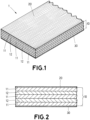
- FIGs 1 and 2 show a preferred embodiment of a plywood board (1) according to the present invention, comprising a plywood core (10) made up of an odd number of poplar veneers, preferably five veneers placed with the grain direction alternately opposite, so that three even veneers or "butts" (11), and two odd veneers or “cores” (12) are defined, as clearly shown in Figure 2 .
- a plywood core 10 made up of an odd number of poplar veneers, preferably five veneers placed with the grain direction alternately opposite, so that three even veneers or "butts” (11), and two odd veneers or “cores” (12) are defined, as clearly shown in Figure 2 .
- the board further comprises a face (20) and a back (30) attached respectively to the top and bottom surfaces of the plywood core (10).
- said face (20) and back (30) consist of wood papers ("Kraft” papers) impregnated with resin.
- plywood core (10), face (20) and back (30) are glued together, the plywood board (1) being obtained by the manufacturing process described above.
- this plywood board (1) of particular application for recreational vehicle furniture, such as caravans or yachts, and provided with a face (20) and back (30) of wood paper (Kraft paper) according to the invention, the manufacture of wood paper (Kraft paper) has been adapted for this particular use.
- wood-based paper is conventionally intended for veneer manufacturing processes.
- the usual process by which wood-based paper (kraft paper) is used, mainly for boards intended for outdoor use, advertising, facades, etc. is as follows: A pre-existing platform with its corresponding wooden core, back, face and back, all of which are made of wood, is puttied to repair small surface defects, and then the platform is calibrated. The platform (finished board) is then covered with a wooden paper (Kraft paper).
- a repair filler has been developed for repairing defects in even veneers or "contras", instead of the traditional repair system with wood chips.
- a thicker than usual wood paper has been designed, as well as impregnation resins that improve the anti-telegraphed properties of the paper, by means of which an efficient product/process is obtained, with the necessary quality in all the parameters described above: consistent thickness, surface hardness, ability to be sanded (sandability), compatibility with the adhesives that are subsequently used for lamination with the decorative coatings, etc.
- the cost per m 2 of this wood paper is comparable to the best tropical veneers with the advantage of sustainability and guarantee of supply of wood paper (Kraft paper) compared to these tropical species.
- the density of the wood paper (Kraft paper) is around 900 kg/m 3 , somewhat higher than tropical woods, but this is compensated by the fact that it is thinner, thus not impacting on the final density of the board.
- the scratch hardness of the wood paper is increased, thus achieving an optimal compromise between the veneer thickness and its impact on the parameters: sandability (margin for calibration), anti-telegraphing (concealment of the micro-defects of the poplar veneer underneath), surface hardness, surface quality, cost and weight.
- the wood paper has an optimum behaviour in humid environments and a minimum emission of volatile organic compounds such as formaldehyde.
- the way in which the resin impregnates the paper must be complete and uniform so that the internal strength of the paper is not reduced, which would give it a low internal bond coefficient, which could result in a peeling failure when the coating is subjected to certain stresses.
- one of the stages of the manufacturing process is calibration, which seeks to unify the thickness across the entire surface of the board, since the sum of the tolerances of the thicknesses of the different sheets means that the board comes out of the press with "mountainous areas" (hills and valleys), creating differences in thickness within the board.
- sizing manages to eliminate or reduce these differences, reducing the thickness of the thickness of the last faces, especially in the mountainous areas mentioned above.
- sanding reduces the roughness of the last veneer.
- the composition of the glue used for the manufacture of the plywood board has also been adapted. Since conventional wood-based paper (Kraft paper) has a very high formaldehyde emission, it cannot be used as the resulting board would have a higher formaldehyde emission than allowed by European regulations, and especially the German regulations that apply to this product.
- Wooden paper (Kraft paper) has a considerable amount of resin that gives it adhesive strength (“web strength ”) and strength, which currently causes a high emission of this gas regulated by the UNE 717 standard.
- web strength adhesive strength
- strength strength
Landscapes
- Engineering & Computer Science (AREA)
- Life Sciences & Earth Sciences (AREA)
- Wood Science & Technology (AREA)
- Mechanical Engineering (AREA)
- Forests & Forestry (AREA)
- Manufacturing & Machinery (AREA)
- Veneer Processing And Manufacture Of Plywood (AREA)
Priority Applications (1)
| Application Number | Priority Date | Filing Date | Title |
|---|---|---|---|
| EP22382296.6A EP4252985A1 (fr) | 2022-03-29 | 2022-03-29 | Procédé de fabrication d'un panneau de contreplaqué et panneau de contreplaqué obtenu selon ce procédé |
Applications Claiming Priority (1)
| Application Number | Priority Date | Filing Date | Title |
|---|---|---|---|
| EP22382296.6A EP4252985A1 (fr) | 2022-03-29 | 2022-03-29 | Procédé de fabrication d'un panneau de contreplaqué et panneau de contreplaqué obtenu selon ce procédé |
Publications (1)
| Publication Number | Publication Date |
|---|---|
| EP4252985A1 true EP4252985A1 (fr) | 2023-10-04 |
Family
ID=81846474
Family Applications (1)
| Application Number | Title | Priority Date | Filing Date |
|---|---|---|---|
| EP22382296.6A Withdrawn EP4252985A1 (fr) | 2022-03-29 | 2022-03-29 | Procédé de fabrication d'un panneau de contreplaqué et panneau de contreplaqué obtenu selon ce procédé |
Country Status (1)
| Country | Link |
|---|---|
| EP (1) | EP4252985A1 (fr) |
Citations (4)
| Publication number | Priority date | Publication date | Assignee | Title |
|---|---|---|---|---|
| EP3308916A1 (fr) * | 2015-06-12 | 2018-04-18 | Grupo Garnica Plywood, S.A. | Panneau contreplaqué pour la fabrication de mobilier de caravanes et procédé d'obtention de ce panneau |
| IT201800003227A1 (it) * | 2018-03-02 | 2019-09-02 | Eget Srls Unipersonale | Pannello di legno rivestito, suoi usi e relativo processo di produzione. |
| CN110341001A (zh) * | 2019-06-25 | 2019-10-18 | 南宁科天水性科技有限责任公司 | 一种抗翘曲变形的浸渍胶膜纸饰面胶合板及其生产工艺 |
| AU2020101572A4 (en) * | 2020-07-30 | 2020-09-10 | Nanjing Forestry University | A Bamboo-wood Composite Electrical Laminated Wood |
-
2022
- 2022-03-29 EP EP22382296.6A patent/EP4252985A1/fr not_active Withdrawn
Patent Citations (4)
| Publication number | Priority date | Publication date | Assignee | Title |
|---|---|---|---|---|
| EP3308916A1 (fr) * | 2015-06-12 | 2018-04-18 | Grupo Garnica Plywood, S.A. | Panneau contreplaqué pour la fabrication de mobilier de caravanes et procédé d'obtention de ce panneau |
| IT201800003227A1 (it) * | 2018-03-02 | 2019-09-02 | Eget Srls Unipersonale | Pannello di legno rivestito, suoi usi e relativo processo di produzione. |
| CN110341001A (zh) * | 2019-06-25 | 2019-10-18 | 南宁科天水性科技有限责任公司 | 一种抗翘曲变形的浸渍胶膜纸饰面胶合板及其生产工艺 |
| AU2020101572A4 (en) * | 2020-07-30 | 2020-09-10 | Nanjing Forestry University | A Bamboo-wood Composite Electrical Laminated Wood |
Similar Documents
| Publication | Publication Date | Title |
|---|---|---|
| US11338557B2 (en) | Method of manufacturing a timber composite, the timber composite obtained and decorative panels comprising such timber composite | |
| RU2361730C2 (ru) | Способ изготовления шпона | |
| CN1072560C (zh) | 在层压纸上涂布三聚氰胺树脂的方法 | |
| US12337576B2 (en) | Decorative panels comprising a timber composite | |
| US20080268273A1 (en) | Wood veneer surfaced decorative laminate product and method of making same | |
| PT2105320E (pt) | Acabamento decorativo de um painel de material derivado de madeira | |
| WO2001064408A1 (fr) | Panneau de particules substrat resistant aux chocs, et materiau composite l'utilisant | |
| EP3544778B1 (fr) | Panneau de bois multicouche revêtu et procédé de production d'un panneau central | |
| EP0462586B1 (fr) | Planche ressemblant à du bois | |
| JP5248004B2 (ja) | 床材及びその製造方法 | |
| AU723544B2 (en) | Microveneer decorative laminate and method of making and articles made therefrom | |
| US20240300138A1 (en) | Method to produce factory-finished wood panels | |
| EP4308773B1 (fr) | Procédé de production d'un panneau de construction et panneau de construction | |
| WO2022190070A1 (fr) | Panneaux de bois décoratifs prêts à l'emploi et leur procédé de préparation | |
| EP3308916A1 (fr) | Panneau contreplaqué pour la fabrication de mobilier de caravanes et procédé d'obtention de ce panneau | |
| US20050003147A1 (en) | Laminated board and methods of producing the same | |
| EP4520495A1 (fr) | Procédé de fabrication d'un panneau de contreplaqué et panneau de contreplaqué obtenu par un tel procédé | |
| JP7728187B2 (ja) | 木質複合材、床材、木質複合材の製造方法、および、床材の製造方法 | |
| US20260091573A1 (en) | Methods of producing laminate boards | |
| US20250353210A1 (en) | Method of manufacturing an improved oriented strand board panel | |
| CN120985776A (zh) | 一种龙眼木实木复合地板的加工方法 | |
| EP4045729A1 (fr) | Panneau à base de fibres de bois et procédé pour obtenir un tel panneau | |
| WO2024191652A1 (fr) | Procédé de production de panneaux en bois finis en usine | |
| WO2024189436A1 (fr) | Panneau multicouche et procédé de production associé | |
| CN118679060A (zh) | 用于生产稳定单板的方法和稳定单板 |
Legal Events
| Date | Code | Title | Description |
|---|---|---|---|
| PUAI | Public reference made under article 153(3) epc to a published international application that has entered the european phase |
Free format text: ORIGINAL CODE: 0009012 |
|
| STAA | Information on the status of an ep patent application or granted ep patent |
Free format text: STATUS: THE APPLICATION HAS BEEN PUBLISHED |
|
| AK | Designated contracting states |
Kind code of ref document: A1 Designated state(s): AL AT BE BG CH CY CZ DE DK EE ES FI FR GB GR HR HU IE IS IT LI LT LU LV MC MK MT NL NO PL PT RO RS SE SI SK SM TR |
|
| STAA | Information on the status of an ep patent application or granted ep patent |
Free format text: STATUS: THE APPLICATION IS DEEMED TO BE WITHDRAWN |
|
| 18D | Application deemed to be withdrawn |
Effective date: 20240405 |