EP4253355A2 - Procédé de réduction du 3,3,3-trifluoropropyne contenu dans le 2,3,3,3-tétrafluoropropène - Google Patents
Procédé de réduction du 3,3,3-trifluoropropyne contenu dans le 2,3,3,3-tétrafluoropropène Download PDFInfo
- Publication number
- EP4253355A2 EP4253355A2 EP23183389.8A EP23183389A EP4253355A2 EP 4253355 A2 EP4253355 A2 EP 4253355A2 EP 23183389 A EP23183389 A EP 23183389A EP 4253355 A2 EP4253355 A2 EP 4253355A2
- Authority
- EP
- European Patent Office
- Prior art keywords
- composition
- concentration
- tfpy
- hydroxide
- caustic material
- Prior art date
- Legal status (The legal status is an assumption and is not a legal conclusion. Google has not performed a legal analysis and makes no representation as to the accuracy of the status listed.)
- Pending
Links
Images
Classifications
-
- C—CHEMISTRY; METALLURGY
- C07—ORGANIC CHEMISTRY
- C07C—ACYCLIC OR CARBOCYCLIC COMPOUNDS
- C07C21/00—Acyclic unsaturated compounds containing halogen atoms
- C07C21/02—Acyclic unsaturated compounds containing halogen atoms containing carbon-to-carbon double bonds
- C07C21/18—Acyclic unsaturated compounds containing halogen atoms containing carbon-to-carbon double bonds containing fluorine
-
- C—CHEMISTRY; METALLURGY
- C07—ORGANIC CHEMISTRY
- C07C—ACYCLIC OR CARBOCYCLIC COMPOUNDS
- C07C17/00—Preparation of halogenated hydrocarbons
- C07C17/38—Separation; Purification; Stabilisation; Use of additives
- C07C17/395—Separation; Purification; Stabilisation; Use of additives by treatment giving rise to a chemical modification of at least one compound
-
- B—PERFORMING OPERATIONS; TRANSPORTING
- B01—PHYSICAL OR CHEMICAL PROCESSES OR APPARATUS IN GENERAL
- B01D—SEPARATION
- B01D53/00—Separation of gases or vapours; Recovering vapours of volatile solvents from gases; Chemical or biological purification of waste gases, e.g. engine exhaust gases, smoke, fumes, flue gases, aerosols
- B01D53/26—Drying gases or vapours
- B01D53/28—Selection of materials for use as drying agents
-
- C—CHEMISTRY; METALLURGY
- C07—ORGANIC CHEMISTRY
- C07C—ACYCLIC OR CARBOCYCLIC COMPOUNDS
- C07C17/00—Preparation of halogenated hydrocarbons
- C07C17/07—Preparation of halogenated hydrocarbons by addition of hydrogen halides
- C07C17/087—Preparation of halogenated hydrocarbons by addition of hydrogen halides to unsaturated halogenated hydrocarbons
-
- C—CHEMISTRY; METALLURGY
- C07—ORGANIC CHEMISTRY
- C07C—ACYCLIC OR CARBOCYCLIC COMPOUNDS
- C07C17/00—Preparation of halogenated hydrocarbons
- C07C17/093—Preparation of halogenated hydrocarbons by replacement by halogens
- C07C17/20—Preparation of halogenated hydrocarbons by replacement by halogens of halogen atoms by other halogen atoms
- C07C17/202—Preparation of halogenated hydrocarbons by replacement by halogens of halogen atoms by other halogen atoms two or more compounds being involved in the reaction
- C07C17/206—Preparation of halogenated hydrocarbons by replacement by halogens of halogen atoms by other halogen atoms two or more compounds being involved in the reaction the other compound being HX
-
- C—CHEMISTRY; METALLURGY
- C07—ORGANIC CHEMISTRY
- C07C—ACYCLIC OR CARBOCYCLIC COMPOUNDS
- C07C17/00—Preparation of halogenated hydrocarbons
- C07C17/25—Preparation of halogenated hydrocarbons by splitting-off hydrogen halides from halogenated hydrocarbons
-
- C—CHEMISTRY; METALLURGY
- C07—ORGANIC CHEMISTRY
- C07C—ACYCLIC OR CARBOCYCLIC COMPOUNDS
- C07C17/00—Preparation of halogenated hydrocarbons
- C07C17/38—Separation; Purification; Stabilisation; Use of additives
- C07C17/42—Use of additives, e.g. for stabilisation
-
- C—CHEMISTRY; METALLURGY
- C07—ORGANIC CHEMISTRY
- C07C—ACYCLIC OR CARBOCYCLIC COMPOUNDS
- C07C21/00—Acyclic unsaturated compounds containing halogen atoms
- C07C21/22—Acyclic unsaturated compounds containing halogen atoms containing carbon-to-carbon triple bonds
Definitions
- the invention provides a process for reducing fluorinated alkyne impurities in 2,3,3,3-tetrafluoropropene (HFO-1234yf) using a caustic material.
- the level of TFPY (3,3,3-trifluoropropyne) impurity is reduced to levels of less than 100 ppm using a caustic such as sodium hydroxide (NaOH).
- Hydrofluorooleiins such as tetrafluoropropenes, including 2,3,3,3-tetrafluoropropene (HFO-1234yf), are known to be effective refrigerants, heat transfer media, propellants, foaming agents, blowing agents, gaseous dielectrics, sterilant carriers, polymerization media, particulate removal fluids, carrier fluids, buffing abrasive agents, displacement drying agents and power cycle working fluids.
- CFCs chlorofluorocarbons
- HCFCs hydrochlorofluorocarbons
- HFO-1234yf has also been shown to be a low global warming compound with low toxicity and, hence, can meet increasingly stringent requirements for refrigerants in mobile air conditioning. Accordingly, compositions containing HFO-1234yf are among the materials being developed for use in many of the aforementioned applications.
- One manufacturing process for HFO-1234yf uses 1, 1, 2, 3-tetrachloropropene (1230xa) as starting raw material.
- the process comprises the following three steps: Step (1) 1230xa + 3HF --> 2-chloro-3,3,3-trifluoropropene (1233xf) + 3HCl in a vapor phase reactor charged with a solid catalyst; Step (2) 1233xf + HF --> 2-chloro-1,1,1,2-tetrafluoropropane (244bb) in a liquid phase reactor charged with a liquid catalyst; and Step (3) 244bb --> 1234yf + HCl in a vapor phase reactor.
- Step (3) the final product - 2,3,3,3-tetrafluoropropene (1234yf)- is commonly contaminated with fluorinated organic byproducts, such as fluorinated alkynes.
- fluorinated alkynes include fluorinated propynes, such as 3,3,3-trifluoropropyne (TFPY).
- TFPY is toxic and flammable; reducing the amount of TFPY in 1234yf using an improved method is therefore desirable.
- the invention is to a process for reducing the concentration of a fluorinated alkyne impurity in 2,3,3,3-tetrafluoropropene (HFO-1234yf); the process comprises contacting a mixture comprising 2,3,3,3-tetrafluoropropene (HFO-1234yf) and at least one fluorinated alkyne impurity having the formula RC ⁇ CH wherein R is a perfluorinated straight chain C 1 -C 3 alkyl with a caustic material under conditions effective to reduce the concentration of the alkyne impurity.
- the conditions effective include those whereby the caustic material forms a reaction product with at least some of the alkyne impurity, and whereby the HFO-1234yf remains substantially unreacted.
- substantially unreacted as used herein, it is meant that at least 90% HFO-1234yf by weight does not react with the caustic material.
- the reaction product can then be removed, reducing the concentration of the alkyne impurity from the HFO-1234yf.
- the fluorinated alkyne impurity is TFPY.
- Caustic materials serviceable in the invention include, without limitation, alkali metal hydroxides, alkali metal oxides, alkali earth metal hydroxides, alkali earth metal oxides, and combinations thereof.
- the caustic material is sodium hydroxide (NaOH).
- NaOH sodium hydroxide
- the concentration of the fluorinated alkyne impurity is reduced by at least about 20% (w/w); in another embodiment, the concentration of the fluorinated alkyne impurity is reduced by a least about 50% (w/w).
- the invention is to a process for reducing the concentration of 3,3,3-trifluoropropyne (TFPY) in 2,3,3,3-tetrafluoropropene (HFO-1234yf) which comprises (a) providing a first composition comprising 2,3,3,3-tetrafluoropropene (HFO-1234yf) and a first concentration of 3,3,3-trifluoropropyne (TFPY); (b) contacting the first composition with a caustic material under conditions effective to react the caustic material with at least a portion of the TFPY; and (c) recovering a second composition comprising 1234yf and a second concentration of TFPY, the second concentration being less than the first concentration.
- the first concentration of TFPY is greater than 300 parts per million by weight (ppm)
- the second concentration of TFPY is 300 ppm or less.
- the 200 ppm or less preferably, 100 ppm or less.
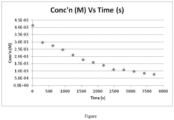
- the Figure graphs the decrease in concentration of TFPY over time in an embodiment of the invention using 4% NaOH (w/w) as a caustic material at 25° C.
- the invention provides a process for reducing the concentration of a fluorinated alkyne impurity in 2,3,3,3-tetrafluoropropene (HFO-1234yf) which comprises contacting a mixture comprising 2,3,3,3-tetrafluoropropene (HFO-1234yf) and at least one fluorinated alkyne impurity having the formula RC ⁇ CH wherein R is a perfluorinated straight chain C 1 -C 3 alkyl with a caustic material under conditions effective to reduce the concentration of the alkyne impurity.
- reaction product includes, without limitation, single and multiple products formed by contact of a caustic with an alkyne impurity as described herein, including without limitation, the decomposition or other product or products formed by contact of caustics such as NaOH with alkynes such as TFPY.
- straight chain perfluorinated alkyl group means a straight-chain alkyl group wherein all hydrogens on carbon atoms of the alkyl group have been substituted by fluorines.
- Examples of a straight-chain perfluorinated alkyl group include -CF 3 , -CF 2 CF 3 and -CF 2 CF 2 CF 3 .
- the perfluorinated alkyl group is -CF 3 , i.e. the fluorinated alkyne impurity is 3,3,3-trifluoropropyne (TFPY).
- the starting concentration of fluorinated alkyne impurity in the mixture is greater than about 400 ppm, although the other starting concentrations, including concentrations lower than 400 ppm, are contemplated.
- Contacting can be accomplished by ways known in the art, including e.g. direct addition of the caustic material to composition comprised of HFO-1234yf and the fluorinated alkyne impurity; other methods of contacting include passing the composition comprising HFO-1234yf and the fluorinated alkyne impurity in vapor form through a reaction vessel or reactor charged with the caustic material.
- the HFO-1234yf having the reduced concentration of fluorinated alkyne impurity can be recovered by conventional methods, e.g.
- other purification means such as distillation can then be applied to further increase the purity of HFO-1234yf.
- the caustic material may comprise, for example, alkali metal hydroxides, alkali metal oxides, alkali earth metal hydroxides, alkali earth metal oxides, and combinations thereof.
- suitable alkali metal hydroxides include potassium hydroxide (KOH), sodium hydroxide (NaOH), lithium hydroxide (LiOH), cesium hydroxide (CsOH), rubidium hydroxide (RbOH), and combinations thereof.
- suitable alkali earth metal hydroxides include magnesium hydroxide (Mg(OH) 2 ), calcium hydroxide (Ca(OH) 2 ), strontium hydroxide (Sr(OH) 2 ), barium hydroxide (Ba(OH) 2 ), and combinations thereof.
- a representative, non-limiting example of an alkali earth metal oxide is calcium oxide (CaO).
- the caustic material is NaOH.
- the conditions effective include, without limitation, the caustic material being present in an aqueous solution at less than 50% by weight; in an embodiment, the caustic material is present in an aqueous solution at between 0.1% to about 20% by weight; in another embodiment, the caustic material is present in an aqueous solution at between about 1% to about 10% by weight; in a further embodiment, the caustic material is present in an aqueous solution at between about 2% to about 5% by weight; yet more preferably, the caustic material is present in an aqueous solution at between about 4% by weight.
- suitable temperatures for the contacting step include temperatures between about 0°C and about 100°C; in an embodiment between about 10°C and about 80°C; in a further embodiment between about 20°C and about 60°C
- suitable pressures for the contacting step include pressures between about 0.1 psig and about 1 000 psig; in another embodiment between about 5 psig and about 500 psig; in a further embodiment between about 10 psig and about 100 psig.
- the reaction product between the caustic material and the alkyne impurity can be removed from the HFO-1234yf by techniques known in the art, such as by phase separation, optionally followed by distillation.
- the practice of the invention reduces the concentration of the fluorinated alkyne impurity in the mixture by at least about 20%; preferably, the concentration of the fluorinated alkyne impurity in the mixture is reduced by at least about 30%; more preferably, the concentration of the fluorinated alkyne impurity in the mixture is reduced by at least about 40%; still more preferably, the concentration of the fluorinated alkyne impurity in the mixture is reduced by at least about 50%.
- the practice of the invention reduces the concentration of the fluorinated alkyne impurity to a level of about 300 ppm or less; in an embodiment, the concentration of the fluorinated alkyne impurity is reduced to a level of about 200 ppm or less; still, in another embodiment, the concentration of the fluorinated alkyne impurity is reduced to a level of about 100 ppm or less.
- the invention relates to a process for reducing the concentration of 3,3,3-trifluoropropyne (TFPY) in a composition comprised of same and 2,3,3,3-tetrafluoropropene (HFO-1234yf) which comprises (a) providing a first composition comprising 2,3,3,3-tetrafluoropropene (HFO-1234yf) and a first concentration of an fluorinated alkyne impurity such as 3,3,3-trifluoropropyne (TFPY); without limitation, the first concentration of TFPY, as representative of a fluorinated alkyne impurity, is greater than 300 ppm, although lower concentrations are contemplated.
- the process further includes (b) contacting the first composition with a caustic material under conditions effective to react the caustic material with at least a portion of the TFPY; the caustic materials are as described hereinabove including being provided in the form of an aqueous solution at the weight percentages described hereunder.
- the caustic material comprises NaOH.
- the NaOH is provided as aqueous solution of about 0.1% to about 20% NaOH by weight; in still another embodiment, the NaOH is provided as aqueous solution of about 1% to about 10% NaOH by weight; in another further embodiment, the NaOH is provided as aqueous solution of about 2% to about 5% NaOH by weight; still in another embodiment, the NaOH is provided as aqueous solution of about 4% NaOH by weight.
- the process further includes (c) recovering a second composition comprising 1234yf and a second concentration of TFPY, the second concentration being less than the first concentration; without limitation, in practices where the first concentration of TFPY is greater than 300 ppm, the second concentration of TFPY is 300 ppm or less; preferably, about 200 ppm or less; more preferably, about 100 ppm or less.
- the process of the invention may be employed, for example, as part of a larger process to make compounds such as 2,3,3,3-tetrafluoropropene (1234yf).
- the process of the invention can be related to Step (3) for the three-step process to make 1234yf as described above.
- the HCFC-244bb produced in Step (2) is dehydrohalogenated under conditions effective to produce 2,3,3,3-tetrafluoropropene (HFO-1234yf).
- the dehydrohalogenating step comprises a gas or vapor phase catalytic reaction.
- the catalytic conversion of HCFC-244bb is conducted under conditions effective to dehydrochlorinate HCFC-244bb to produce 2,3,3,3-tetrafluoropropene (HFO-1234yf).
- dehydrochlorination of HCFC-244bb is done in a vapor phase, and more preferably in a fixed-bed reactor in the vapor phase.
- the dehydrohalogenation reaction may be conducted in any suitable reaction vessel or reactor, but it should preferably be constructed from materials which are resistant to the corrosive effects of hydrogen chloride (to the extent that such material is formed under the dehydrohalogenation conditions) such as nickel and its alloys, including Hastelloy, Inconel, Incoloy, and Monel or vessels lined with fluoropolymers and may employ single or multiple tubes packed with a dehydrohalogenation catalyst.
- materials which are resistant to the corrosive effects of hydrogen chloride to the extent that such material is formed under the dehydrohalogenation conditions
- nickel and its alloys including Hastelloy, Inconel, Incoloy, and Monel or vessels lined with fluoropolymers and may employ single or multiple tubes packed with a dehydrohalogenation catalyst.
- the catalysts can include metal halides, halogenated metal oxides, neutral (or zero oxidation state) metal or metal alloy, or activated carbon in bulk or supported form.
- metal halides or metal oxides catalysts preferably mono-, bi-, and tri-valent metal halides, oxide and their mixtures/combinations, and more preferably mono-, and bi-valent metal halides and their mixtures/combinations.
- Component metals include, but are not limited to, Cr 3+ , Fe 3+ , Mg 2+ , Ca 2+ , Ni 2+ , Zn 2+ , Pd 2+ , Li + , Na + , K + , and Cs + .
- Component halogens include, but are not limited to, F - , Cl - , Br - , and I - .
- useful mono- or bi-valent metal halide include, but are not limited to, LiF, NaF, KF, CsF, MgF 2 , CaF 2 , LiCl, NaCl, KCl, and CsCl.
- Halogenation treatments can include any of those known in the prior art, particularly those that employ HF, F 2 , HCl, Cl 2 , HBr, Br 2 , HI, and I 2 as the halogenation source.
- metals, metal alloys and their mixtures When neutral, i.e., zero valent, metals, metal alloys and their mixtures are used.
- Useful metals include, but are not limited to, Pd, Pt, Rh, Fe, Co, Ni, Cu, Mo, Cr, Mn, and combinations of the foregoing as alloys or mixtures.
- the catalyst may be supported or unsupported.
- Useful examples of metal alloys include, but are not limited to, SS 316, Monel 400, Inconel 825, Inconel 600, and Inconel 625.
- HCFC-244bb can be introduced into the reactor either in pure form, partially purified form, or as part of the reactor effluent from the preceding step.
- the HCFC-244bb may optionally be fed with an inert gas diluent such as nitrogen, argon, or the like.
- the HCFC-244bb is pre-vaporized or preheated prior to entering the reactor. Alternately, the HCFC-244bb is vaporized inside the reactor.
- Useful reaction temperatures may range from about 100° C. to about 700° C.
- Preferred temperatures may range from about 150° C. to about 600° C., and more preferred temperatures may range from about 200° C. to about 550° C.
- the reaction may be conducted at atmospheric pressure, super-atmospheric pressure or under vacuum.
- the vacuum pressure can be from about 5 torr (0.0966 psia) to about 760 torr (14.69 psia).
- Contact time of the HCFC-244bb with the catalyst may range from about 0.5 seconds to about 120 seconds, however, longer or shorter times can be used.
- the conversion of the HCFC-244bb is at least about 10%, more preferably at least about 20%, and even more preferably at least about 30%.
- the selectivity to HFO-1234yf is at least about 70%, more preferably at least about 85% and more preferably at least about 95%.
- the process flow may be in the down or up direction through a bed of the catalyst or horizontal direction. It may also be advantageous to periodically regenerate the catalyst after prolonged use while in place in the reactor. Regeneration of the catalyst may be accomplished by any means known in the art such as using an oxidizing agent such as O 2 or chlorine.
- the catalyst may be regenerated by passing air or air diluted with nitrogen over the catalyst at temperatures of from about 100° C. to about 400° C., and in another embodiment from about 200° C. to about 375° C., for from about 0.5 hour to about 3 days depending on the size of the reactor.
- the regeneration of the catalyst may also involve the use of a reducing agent such as H 2 .
- Other reducing agents include, without limitation, NH 3 (ammonia), CO (carbon monoxide), CH 4 (methane); mixtures of these, including mixtures with hydrogen, may also be used.
- the effluent from the dehydrohalogenation reaction step may be processed to achieve desired degrees of separation and/or other processing.
- the reactor effluent comprises HFO-1234yf
- the effluent will generally also include HCl and unreacted HCFC-244bb.
- Some portion or substantially all of these components of the reaction product may be recovered via any separation or purification method known in the art such as neutralization and distillation.
- the concentration of alkyne impurities, such as TFPY can be reduced by the practice of the present invention.
- hydrogen chloride is then recovered from the result of the dehydrochlorination reaction. Recovering of hydrogen chloride is conducted by conventional distillation where it is removed from the distillate.
- HCl can be recovered or removed by using water or caustic scrubbers.
- HCl is removed as an aqueous solution.
- caustic is used, HCl is just removed from system as a chloride salt in aqueous solution.
- dehydrohalogenation of HCFC-244bb can also be accomplished by reacting it with a strong caustic solution that includes, but is not limited to KOH, NaOH, Ca(OH) 2 and CaO at an elevated temperature.
- a strong caustic solution that includes, but is not limited to KOH, NaOH, Ca(OH) 2 and CaO at an elevated temperature.
- the strength of the caustic solution is from about 2 wt % to about 100 wt %, in another embodiment from about 5 wt % to about 90 wt % and still in a further embodiment from about 10 wt % to about 80 wt %.
- the caustic to HCFC-244bb mole ratio preferably ranges from about 1:1 to about 2:1; more preferably from about 1.1:1 to about 1.5:1 and most preferably from about 1.2:1 to about 1.4:1.
- the reaction may be conducted at a temperature of from about 20° C. to about 100° C., in another embodiment from about 30° C. to about 90° C. and in a further embodiment from about 40° C. to about 80° C.
- the reaction may be conducted at atmospheric pressure, super-atmospheric pressure or under vacuum.
- the vacuum pressure can be from about 5 torr (14.80 psig) to about 760 torr (29.40 psig).
- a solvent or phase transfer catalyst such as Aliquat 336 may optionally be used to help dissolve the organic compounds in the caustic solution. This optional step may be conducted using solvents that are well known in the art for said purpose.
- HFO-1234yf may be recovered from the reaction product mixture comprised of unreacted starting materials and by-products by any means known in the art, such as by extraction and preferably distillation.
- the mixture of HFO-1234yf and any by-products are passed through a distillation column.
- the distillation may be preferably conducted in a standard distillation column at atmospheric pressure, super-atmospheric pressure or a vacuum.
- the pressure is less than about 300 psig, preferably less than about 200 psig and most preferably less than 150 psig.
- the pressure of the distillation column inherently determines the distillation operating temperature.
- the conversion HCFC-244bb is at least about 60%, more preferably at least about 75%, and even more preferably at least about 90%.
- the selectivity to HFO-1234yf is at least about 70%, more preferably at least about 85% and more preferably at least about 95%
- caustic and “caustic material” are synonymous and are used interchangeably.
- TFA trifluoroacetic acid
- the concentration of the dissolved gas was calculated against a calibrated TFA / D 2 O insert.
- a sample of 44% NaOH solution was prepared and about 0.1 g sample was injected into the sample and mixed. This made about 4% NaOH by weight solution.
- the time of injection was noted and the sample was analyzed by 19 F NMR every 5-6 minutes for 1 hour.
- the concentration of TFPY in 4% NaOH (w/w) solution was measured and plotted and is shown in the Figure.
- the Figure graphically depicts the TFPY concentration in 4% NaOH solution as a function of time at 25°C. As shown in the Figure, the concentration of 3,3,3-trifluoropropyne decreased with time, indicating the occurrence of reaction between TFPY and NaOH.
- HFO-1234yf 2,3,3,3-tetrafluoropropene
- a 1L Tedlar gas was filled with 3,3,3-trifluoropropyne (TFPY) gas at room temperature, and a 2.11g 4% NaOH solution was injected into the bag through septum. The liquid was allowed to react for 4 days with occasional swirling of the bag. The liquid was carefully drawn out of the bag with a syringe and analyzed by 19 F NMR with calibrated TFA (trifluoroacetic acid) / D 2 O insert.
- TFA trifluoroacetic acid
- a 750 g mixture of 1234yf and TFPY (0.5% TFPY) is passed through a 200 ml 4% NaOH (w/w) aqueous solution at room temperature and 1 atm pressure via a gas sparger, and the tail gas is collected in liquid nitrogen trap.
- the collected material was analyzed by GC and GCMS. The results show the concentration of TFPY in 1234yf is reduced to about 260 ppm, and the recovery of 1234yf was 99%.
- a 750 g mixture of 1234yf and TFPY (0.5% TFPY) was passed through a 210 ml 4% w/w NaOH aqueous solution at room temperature and 1 atm pressure via a gas sparger, and the tail gas was collected in liquid nitrogen trap.
- the collected material was analyzed by GC and GCMS. The results show the concentration of TFPY in 1234yf was reduced to about 20 ppm w/w, and the recovery of 1234yf is 99%.
- a 175 g mixture of 1234yf and TFPY (0.5% w/w TFPY) was passed through a 200 ml % (w/w) NaOH aqueous solution at room temperature and 1 atm pressure via a gas sparger, and the tail gas was collected in liquid nitrogen trap.
- the collected material was analyzed by GC and GCMS. The results show the concentration of TFPY in 1234yf was reduced to about 75 ppm w/w, and the recovery of 1234yf was 99%.
- a 2000 g mixture of 1234yf and TFPY (0.5% w/w TFP) was passed through a 205 ml 10% w/w NaOH aqueous solution at room temperature via a gas sparger, and the tail gas is collected in liquid nitrogen trap.
- the collected material was analyzed by GC and GCMS. The results show the concentration of TFPY in 1234yf was reduced to 165 ppm w/w, and the recovery of 1234yf was 98%.
Landscapes
- Chemical & Material Sciences (AREA)
- Organic Chemistry (AREA)
- Chemical Kinetics & Catalysis (AREA)
- General Chemical & Material Sciences (AREA)
- Engineering & Computer Science (AREA)
- Analytical Chemistry (AREA)
- Oil, Petroleum & Natural Gas (AREA)
- Organic Low-Molecular-Weight Compounds And Preparation Thereof (AREA)
Applications Claiming Priority (3)
| Application Number | Priority Date | Filing Date | Title |
|---|---|---|---|
| US201662416206P | 2016-11-02 | 2016-11-02 | |
| PCT/US2017/059679 WO2018085512A2 (fr) | 2016-11-02 | 2017-11-02 | Procédé de réduction du 3,3,3-trifluoropropyne contenu dans le 2,3,3,3-tétrafluoropropène |
| EP17867256.4A EP3535234B1 (fr) | 2016-11-02 | 2017-11-02 | Procédé de réduction du 3,3,3-trifluoropropyne contenu dans le 2,3,3,3-tétrafluoropropène |
Related Parent Applications (1)
| Application Number | Title | Priority Date | Filing Date |
|---|---|---|---|
| EP17867256.4A Division EP3535234B1 (fr) | 2016-11-02 | 2017-11-02 | Procédé de réduction du 3,3,3-trifluoropropyne contenu dans le 2,3,3,3-tétrafluoropropène |
Publications (2)
| Publication Number | Publication Date |
|---|---|
| EP4253355A2 true EP4253355A2 (fr) | 2023-10-04 |
| EP4253355A3 EP4253355A3 (fr) | 2023-12-06 |
Family
ID=62076358
Family Applications (2)
| Application Number | Title | Priority Date | Filing Date |
|---|---|---|---|
| EP23183389.8A Pending EP4253355A3 (fr) | 2016-11-02 | 2017-11-02 | Procédé de réduction du 3,3,3-trifluoropropyne contenu dans le 2,3,3,3-tétrafluoropropène |
| EP17867256.4A Active EP3535234B1 (fr) | 2016-11-02 | 2017-11-02 | Procédé de réduction du 3,3,3-trifluoropropyne contenu dans le 2,3,3,3-tétrafluoropropène |
Family Applications After (1)
| Application Number | Title | Priority Date | Filing Date |
|---|---|---|---|
| EP17867256.4A Active EP3535234B1 (fr) | 2016-11-02 | 2017-11-02 | Procédé de réduction du 3,3,3-trifluoropropyne contenu dans le 2,3,3,3-tétrafluoropropène |
Country Status (10)
| Country | Link |
|---|---|
| US (1) | US10913697B2 (fr) |
| EP (2) | EP4253355A3 (fr) |
| JP (4) | JP6979066B2 (fr) |
| KR (3) | KR102830918B1 (fr) |
| CN (2) | CN109923096B (fr) |
| ES (1) | ES2957715T3 (fr) |
| MX (2) | MX2019005068A (fr) |
| PL (1) | PL3535234T3 (fr) |
| PT (1) | PT3535234T (fr) |
| WO (1) | WO2018085512A2 (fr) |
Families Citing this family (2)
| Publication number | Priority date | Publication date | Assignee | Title |
|---|---|---|---|---|
| GB201701099D0 (en) * | 2017-01-23 | 2017-03-08 | Mexichem Fluor Sa De Cv | Process |
| WO2021090073A1 (fr) * | 2019-11-06 | 2021-05-14 | Honeywell International Inc. | Compositions azéotropiques ou de type azéotropique à base de 3,3,3-trifluoropropyne (tfpy) et de fluorure d'hydrogène (hf) |
Citations (2)
| Publication number | Priority date | Publication date | Assignee | Title |
|---|---|---|---|---|
| US20110270000A1 (en) | 2010-04-29 | 2011-11-03 | Honeywell International Inc. | Method for producing tetrafluoropropenes |
| US8058486B2 (en) | 2004-04-29 | 2011-11-15 | Honeywell International Inc. | Integrated process to produce 2,3,3,3-tetrafluoropropene |
Family Cites Families (12)
| Publication number | Priority date | Publication date | Assignee | Title |
|---|---|---|---|---|
| JPH10316599A (ja) * | 1997-05-20 | 1998-12-02 | Asahi Chem Ind Co Ltd | 塩化ビニリデンの製造方法 |
| US8766020B2 (en) * | 2008-07-31 | 2014-07-01 | Honeywell International Inc. | Process for producing 2,3,3,3-tetrafluoropropene |
| US8952208B2 (en) * | 2006-01-03 | 2015-02-10 | Honeywell International Inc. | Method for prolonging a catalyst's life during hydrofluorination |
| GB0918069D0 (en) * | 2009-10-15 | 2009-12-02 | Ineos Fluor Holdings Ltd | Process |
| KR101458679B1 (ko) * | 2009-11-10 | 2014-11-05 | 다이킨 고교 가부시키가이샤 | 2,3,3,3-테트라플루오로프로펜의 정제 방법 |
| WO2012011609A1 (fr) * | 2010-07-23 | 2012-01-26 | Daikin Industries, Ltd. | Procédé de purification du 2,3,3,3-tétrafluoropropène |
| IN2014DN06917A (fr) * | 2012-02-10 | 2015-05-15 | Haiyou Wang | |
| KR20150021551A (ko) * | 2012-06-06 | 2015-03-02 | 이 아이 듀폰 디 네모아 앤드 캄파니 | 플루오로올레핀 중 RfCCX 불순물의 감소 방법 |
| US9272968B2 (en) * | 2013-03-14 | 2016-03-01 | Honeywell International Inc. | Process to suppress the formation of 3,3,3-trifluoropropyne in fluorocarbon manufacture |
| CN105431399B (zh) * | 2013-03-15 | 2017-12-26 | 得凯莫斯公司弗罗里达有限公司 | 减少氟烯烃中的炔烃杂质的方法 |
| PL2970058T3 (pl) * | 2013-03-15 | 2024-05-06 | Honeywell International Inc. | Sposób usuwania fluorowcowanego etylenu stanowiącego zanieczyszczenia z mieszaniny fluoroolefin |
| US20150259267A1 (en) * | 2014-03-14 | 2015-09-17 | E.I. Du Pont De Nemours And Company | PROCESS FOR THE REDUCTION OF RfC=CX IMPURITIES IN FLUOROOLEFINS |
-
2017
- 2017-11-02 KR KR1020237032261A patent/KR102830918B1/ko active Active
- 2017-11-02 EP EP23183389.8A patent/EP4253355A3/fr active Pending
- 2017-11-02 PL PL17867256.4T patent/PL3535234T3/pl unknown
- 2017-11-02 KR KR1020197015820A patent/KR102582866B1/ko active Active
- 2017-11-02 MX MX2019005068A patent/MX2019005068A/es unknown
- 2017-11-02 WO PCT/US2017/059679 patent/WO2018085512A2/fr not_active Ceased
- 2017-11-02 CN CN201780068375.3A patent/CN109923096B/zh active Active
- 2017-11-02 PT PT178672564T patent/PT3535234T/pt unknown
- 2017-11-02 US US16/346,739 patent/US10913697B2/en active Active
- 2017-11-02 ES ES17867256T patent/ES2957715T3/es active Active
- 2017-11-02 EP EP17867256.4A patent/EP3535234B1/fr active Active
- 2017-11-02 JP JP2019522696A patent/JP6979066B2/ja active Active
- 2017-11-02 KR KR1020257022164A patent/KR20250105507A/ko active Pending
- 2017-11-02 CN CN202210663913.6A patent/CN114805016B/zh active Active
-
2019
- 2019-04-30 MX MX2023008369A patent/MX2023008369A/es unknown
-
2021
- 2021-11-12 JP JP2021184485A patent/JP7216791B2/ja active Active
-
2023
- 2023-01-19 JP JP2023006621A patent/JP7606548B2/ja active Active
-
2024
- 2024-12-13 JP JP2024218544A patent/JP2025038082A/ja active Pending
Patent Citations (2)
| Publication number | Priority date | Publication date | Assignee | Title |
|---|---|---|---|---|
| US8058486B2 (en) | 2004-04-29 | 2011-11-15 | Honeywell International Inc. | Integrated process to produce 2,3,3,3-tetrafluoropropene |
| US20110270000A1 (en) | 2010-04-29 | 2011-11-03 | Honeywell International Inc. | Method for producing tetrafluoropropenes |
Also Published As
| Publication number | Publication date |
|---|---|
| KR102582866B1 (ko) | 2023-09-25 |
| KR20190067927A (ko) | 2019-06-17 |
| KR102830918B1 (ko) | 2025-07-04 |
| CN114805016A (zh) | 2022-07-29 |
| JP2023052523A (ja) | 2023-04-11 |
| ES2957715T3 (es) | 2024-01-24 |
| JP2019532977A (ja) | 2019-11-14 |
| EP3535234A4 (fr) | 2020-06-10 |
| JP7216791B2 (ja) | 2023-02-01 |
| MX2023008369A (es) | 2023-07-26 |
| PT3535234T (pt) | 2023-09-26 |
| JP2025038082A (ja) | 2025-03-18 |
| PL3535234T3 (pl) | 2024-02-05 |
| KR20250105507A (ko) | 2025-07-08 |
| EP4253355A3 (fr) | 2023-12-06 |
| EP3535234A2 (fr) | 2019-09-11 |
| JP2022024050A (ja) | 2022-02-08 |
| EP3535234B1 (fr) | 2023-07-05 |
| KR20230141910A (ko) | 2023-10-10 |
| US20200055804A1 (en) | 2020-02-20 |
| US10913697B2 (en) | 2021-02-09 |
| CN109923096B (zh) | 2022-06-21 |
| WO2018085512A3 (fr) | 2018-06-14 |
| WO2018085512A2 (fr) | 2018-05-11 |
| JP7606548B2 (ja) | 2024-12-25 |
| JP6979066B2 (ja) | 2021-12-08 |
| CN114805016B (zh) | 2026-04-07 |
| CN109923096A (zh) | 2019-06-21 |
| MX2019005068A (es) | 2019-06-12 |
Similar Documents
| Publication | Publication Date | Title |
|---|---|---|
| US10125068B2 (en) | Process for producing 2,3,3,3-tetrafluoropropene | |
| EP2556042B1 (fr) | Procédé intégré de production concomitante de trans-1-chloro-3,3,3-trifluoropropène et de trans-1,3,3,3-tétrafluoropropène | |
| US9296670B2 (en) | Process for the manufacture of 2,3,3,3-tetrafluoropropene | |
| EP2585423B1 (fr) | Procédé destiné à prolonger la durée de vie d'un catalyseur durant l'hydrofluoration | |
| EP1900716B1 (fr) | Procédé de fabrication trans-1234ze à HFC intégré | |
| US9758450B2 (en) | Integrated process to produce 2,3,3,3-tetrafluoropropene | |
| US20100185027A1 (en) | Isomerization of 1,1,3,3-Tetrafluoropropene | |
| EP2776383B1 (fr) | Procédé de production d'un hydrohaloalcane par fluoration catalytique | |
| JP2025038082A (ja) | 2,3,3,3-テトラフルオロプロペン中の3,3,3-トリフルオロプロピンを減少させる方法 |
Legal Events
| Date | Code | Title | Description |
|---|---|---|---|
| PUAI | Public reference made under article 153(3) epc to a published international application that has entered the european phase |
Free format text: ORIGINAL CODE: 0009012 |
|
| STAA | Information on the status of an ep patent application or granted ep patent |
Free format text: STATUS: THE APPLICATION HAS BEEN PUBLISHED |
|
| AC | Divisional application: reference to earlier application |
Ref document number: 3535234 Country of ref document: EP Kind code of ref document: P |
|
| AK | Designated contracting states |
Kind code of ref document: A2 Designated state(s): AL AT BE BG CH CY CZ DE DK EE ES FI FR GB GR HR HU IE IS IT LI LT LU LV MC MK MT NL NO PL PT RO RS SE SI SK SM TR |
|
| PUAL | Search report despatched |
Free format text: ORIGINAL CODE: 0009013 |
|
| AK | Designated contracting states |
Kind code of ref document: A3 Designated state(s): AL AT BE BG CH CY CZ DE DK EE ES FI FR GB GR HR HU IE IS IT LI LT LU LV MC MK MT NL NO PL PT RO RS SE SI SK SM TR |
|
| RIC1 | Information provided on ipc code assigned before grant |
Ipc: C01D 1/04 20060101ALI20231027BHEP Ipc: C07C 21/22 20060101ALI20231027BHEP Ipc: C07C 21/18 20060101AFI20231027BHEP |
|
| STAA | Information on the status of an ep patent application or granted ep patent |
Free format text: STATUS: REQUEST FOR EXAMINATION WAS MADE |
|
| 17P | Request for examination filed |
Effective date: 20240606 |
|
| RBV | Designated contracting states (corrected) |
Designated state(s): AL AT BE BG CH CY CZ DE DK EE ES FI FR GB GR HR HU IE IS IT LI LT LU LV MC MK MT NL NO PL PT RO RS SE SI SK SM TR |
|
| STAA | Information on the status of an ep patent application or granted ep patent |
Free format text: STATUS: EXAMINATION IS IN PROGRESS |
|
| 17Q | First examination report despatched |
Effective date: 20260309 |