EP4254253A1 - Procédé de génération de la structure d'un objet - Google Patents
Procédé de génération de la structure d'un objet Download PDFInfo
- Publication number
- EP4254253A1 EP4254253A1 EP22165479.1A EP22165479A EP4254253A1 EP 4254253 A1 EP4254253 A1 EP 4254253A1 EP 22165479 A EP22165479 A EP 22165479A EP 4254253 A1 EP4254253 A1 EP 4254253A1
- Authority
- EP
- European Patent Office
- Prior art keywords
- physical parameter
- parameter values
- target
- structures
- parameter value
- Prior art date
- Legal status (The legal status is an assumption and is not a legal conclusion. Google has not performed a legal analysis and makes no representation as to the accuracy of the status listed.)
- Withdrawn
Links
Images



Classifications
-
- G—PHYSICS
- G06—COMPUTING OR CALCULATING; COUNTING
- G06F—ELECTRIC DIGITAL DATA PROCESSING
- G06F30/00—Computer-aided design [CAD]
- G06F30/10—Geometric CAD
- G06F30/17—Mechanical parametric or variational design
-
- G—PHYSICS
- G06—COMPUTING OR CALCULATING; COUNTING
- G06F—ELECTRIC DIGITAL DATA PROCESSING
- G06F30/00—Computer-aided design [CAD]
- G06F30/20—Design optimisation, verification or simulation
- G06F30/27—Design optimisation, verification or simulation using machine learning, e.g. artificial intelligence, neural networks, support vector machines [SVM] or training a model
-
- G—PHYSICS
- G06—COMPUTING OR CALCULATING; COUNTING
- G06F—ELECTRIC DIGITAL DATA PROCESSING
- G06F2111/00—Details relating to CAD techniques
- G06F2111/20—Configuration CAD, e.g. designing by assembling or positioning modules selected from libraries of predesigned modules
Definitions
- the invention relates to the field of computer modeling of structures, in particular two-dimensional or three-dimensional structures for example using a computer aided designing (CAD) system.
- CAD computer aided designing
- the invention more particularly provides a method for generating or suggesting designs based on target physical properties of the structure of an object input by a user.
- NVH specific wind resistance, specific maximum noise, vibration and harshness parameters
- the invention provides a method implemented by a processor for generating a structure of an object with a computer aided design system wherein the generated structure of the object fulfills one or more target physical parameter values, the method comprising:
- the invention more particularly reduces to a minimum the need to have a manual input from a user when creating the design of a new structure that is expected to fulfill certain target physical parameter values.
- a user can input the target parameter values for example into a CAD system that can then activate a model trained using artificial intelligence based on previous CAD designs of similar structures.
- the model works for example by analyzing a plurality of data inputs from CAD documents of different structures to identify relations between structural elements of the objects and physical parameter values. Such relations can for example associate physical parameters such as tortional stiffness, bending stiffness, lateral stiffness, dynamic stiffness, free-free stiffness, maximum deformation during impact, resistance force during static impact, resistance force during dynamic impact, maximum tolerated temperature, mass of the object, Eigenfrequency of the object to the shape of the object, its thickness, its topology.
- the model can in particular read CAD files to associate specific structural elements in numerical form to a corresponding physical parameter.
- Input of these datasets can for example provide generic relations between material compositions or certain shapes and their effect on physical properties such as stiffness, rigidity, ductility, resistance to different environmental conditions such as applied force, temperature, electrical conductivity, heat capacitance for example.
- the relation between the structure of an object and a physical parameter value can already be formulated as mathematical equations relating for example the thickness of a structure to its rigidity or torsional stiffness.
- One advantage of the method of the invention relies in particular in the fact that known literature and human skill is not capable of identifying certain relations between structural parameter values and physical parameter values.
- Complex structures made of a plurality of basic structural elements sometimes respond in unexpected ways that are hard to predict when applying knowledge that is inferred from the response of basic structural elements.
- the method of the invention is better at predicting the behavior of more complex structures resulting from an association of basic structural elements, and therefore also capable to construct templates for structures of objects based on input target physical parameter values. According to the invention, it is possible that more than one structure of an object is generated when more than one structure can fulfill the target physical parameters values.
- parameter value encompasses both numbers provided for the value, qualitative descriptors (such as names, or general indications regarding size, thickness or degrees such as high low, medium for example), and value ranges.
- obtaining the set may further comprise:
- the indication of at least one target structural parameter value can be a qualitative indication such as: body of a car, rim of a wheel, wing of an airplane, table etc. It can also be a quantitative limitation, for example on the number of elements it may comprise such as: four wheels, three openings, at least six planes.
- the quantitative information can also be in the form of numerical values limiting some parameters such as a maximum size, a maximum width, a ratio of length versus width.
- the method may also comprise different models wherein each model is adapted for specific types of objects that can be indicated by a qualitative or quantitative input in the form of target structural parameter values.
- the target physical parameter values may comprise at least one among: maximum tolerated noise, maximum tolerated vibration, maximum tolerated harshness, tortional stiffness, bending stiffness, lateral stiffness, dynamic stiffness, free-free stiffness, maximum deformation during impact, resistance force during static impact, resistance force during dynamic impact, maximum tolerated temperature, mass of the object, Eigenfrequency of the object.
- NVH maximum tolerated noise, vibration and harshness
- Terms mention in the above list can further be referred to as encompassing the mechanical response of the structure to applied stress or strain, the frequency response of the structure.
- Other physical properties of the object can also be defined, that may relate to the intrinsic physical properties of the object such as for example its curing or setting temperature in the case of an adhesive, Young's modulus, heat capacitance, heat conductivity, deformation energy, values indicative of the elasticity and ductility of the structure.
- the method may further comprise:
- the method may further comprise:
- a similarity index can be an indication of how original a generated structure is compared to existing and known designs. It may also reflect the reliability of the generated structure since generated structures that differ too much from all past structures encountered and found in the dataset might have unexpected mechanical responses when a prototype of the generated structure is tested.
- the method may further comprise:
- an evaluation phase for example using finite element analysis or by building a prototype of the generated structure and subjecting it to real-life tests can be implemented.
- an additional constraint can be added in the form of an additional fixed target structural parameter value before implementing the method of the invention once again.
- the method may further comprise:
- the method can generate more than one generated structure of an object, should one of these structures not fulfill all desired target physical parameter values it is possible to select one of the other generated structures of the object.
- the method may also rank the generated structures of an object based on how close on average the predicted physical parameter values are to the target physical parameter values.
- predetermined amount may typically refer to a relative difference of more than 5% or more than 10% or more than 25%.
- the method may further comprise:
- the method of the invention is applied to an initial template provided by a user or selected from a selection of templates that define a list of such fixed target structural parameter values.
- the generated structure of an object amounts then to an optimization of the existing template by removing parts thereof or adding parts thereto or change the properties of existing parts thereof to reach the desired target physical parameter values.
- the model may further comprise:
- basic structural elements may be at least one among:
- the "basic structural elements” are understood as being building blocks that can be assembled together to form more complex structures.
- complex objects can be decomposed as the combination of several such “basic structural elements” arranged together at certain coordinates, comprising mechanical connections between them that can all be associated with certain physical parameter values.
- the model may further comprise:
- the structures the numerical description of which are part of the dataset differ by at least one among: size, shape, topology, volume, mass, material composition, thickness, number of basic structural elements, values of physical parameters.
- a machine learning algorithm is then capable of identifying the effect of certain combinations of basic structural elements or changes in basic structural elements on the resulting physical parameter values of the generated structure of an object.
- Values of physical parameters mentioned above may for example comprise Young's modulus, yield strength, a stress-strain curve, values indicative of the failure of the criteria such as the elastic limit of the structure for example.
- the method may further comprise:
- the invention further pertains to a computer program product comprising instructions for executing a method for generating a structure of an object with a computer aided design system wherein the generated structure of the object fulfills one or more target physical parameter values, the method comprising:
- the invention further pertains to a computer program product comprising instructions for implementing the method as described above.
- the above computer program product can also be viewed as a non-transitory computer readable storage medium having stored thereon a computer program comprising instructions for execution of the method described above.
- the invention pertains to a method for constructing or generating a structure of an object with a computer aided design system that reduces the need for manual conception of the structure of the object, thereby increasing the efficiency and speed with which new structures are created.
- the method of the invention is implemented by a processor, such as a computer, a server, any user interface allowing the use of a program coding instructions of the method.
- the method further enables the construction of structures of objects that comprise fewer flaws than those made manually by a user based on the user's personal subjective experience of structure designs.
- the method 1 comprises a step of obtaining 101 a set comprising at least one target physical parameter value 2.
- the set may further comprise at least one target structural parameter value 3.
- the target physical parameter value 2 is typically either an intrinsic property of the object, related for example to its composition, or a parameter that is representative of the mechanical response of the object to external constraints, for example of the type applied when testing the response of the object.
- Examples of physical parameters may typically include: maximum tolerated noise, maximum tolerated vibration, maximum tolerated harshness, tortional stiffness, bending stiffness, lateral stiffness, dynamic stiffness, free-free stiffness, maximum deformation during impact, resistance force during static impact, resistance force during dynamic impact, maximum tolerated temperature, mass of the object, Eigenfrequency of the object.
- the above terms are typically used by engineers to designate properties of structures as observed after applying mechanical constraints to them. Conditions in which constraints are applied to objects generally follow standards defined in evaluation tests.
- CAD files comprise information relating to the results of such tests that can be available in particular to train a model as will be discussed below.
- Parameters such as Young's modulus, the maximum tolerated temperature, setting temperature, curing temperature, heat capacitance, heat conductivity, electrical resistance qualify as intrinsic properties of the structure of the object (but are still referred to in the invention as physical parameters), and can be related to its material composition, its volume but also to its design. Other physical parameters are more closely dependent on the topology of the structure and reflect parameters representative of the response of the object to external mechanical constraints.
- the target structural parameter value 3 is not a required input. However, it is recommended at least to provide some initial indication of the general template that should be used for constructing a new structure of an object. For example, such an indication can be qualitative and mention the type of object that is desired such as the body of a car, a wing, a table, a seat.
- a target structural parameter value 3 may also be a fixed topological feature. Examples of structural parameter values can for example comprise: size, shape, topology, volume, mass, material composition, thickness, number of basic structural elements.
- the material composition can for example include a material type or a ratio of different materials which can form a compound. Some of these additives or compositions can be formed of adhesives.
- the method 1 proceeds by obtaining 102 a model 4 that is trained on a dataset comprising data corresponding to numerical descriptions of a plurality of structures of objects having known structural parameter values and physical parameter values.
- This model 4 is for example generated by reading many different CAD files corresponding to structures of objects in numerical form that differ by their structural and physical parameter values.
- An artificial intelligence such as a machine learning algorithm can be used to establish relations between the structural parameter values of the structures and corresponding physical parameter values. Some of these relations can be further input into the dataset or into an algorithm that generates the model 4 using the training material (also referred to as dataset) by providing it with general knowledge with respect to physical laws governing the relation between the topology of an object and its physical parameters, in particular its mechanical response.
- the method 1 of the invention can then find at least one structure that fulfills the desired target physical parameter values 2 and construct 103 a generated structure 5 of an object.
- the method 1 may generate more than one structure and recommend them according to a ranking order, for example from the most suitable (the one that has the less deviations from the input target physical parameter values 2) to the less suitable (the ones that are within a tolerable range of values but might be regarded as less conventional by their structure or frequency of occurrence in the dataset based on similarity comparison such as the number of basic structural features in common).
- the "conventional" character of a generated structure 5 might be based on structural proximity to structures available in the dataset used to train the model 4 or on past CAD files in general.
- the method 1 of the invention is however also capable of designing structures that have no exact equivalent among past recordings of CAD files.
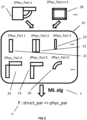
- the schematic diagram of figure 2 provides some visual examples of basic structural elements and more complex structural elements that can be part of the dataset 10.
- each structure 21-28 can be defined by values representative of the structural parameters of the object, as well as by the associated physical parameter values of that structure. These physical parameter values are schematically illustrated on figure 2 by the labels ⁇ Phys_par ⁇ 1- ⁇ Phys_par ⁇ 6, ⁇ Phys_par ⁇ n, ⁇ Phys_par ⁇ n+1.
- the dataset 10 advantageously comprises basic structural elements 21, 23, 26 as well as more complex structural elements 22, 24, 25, 27, 28 that can be decomposed into several basic structural elements 21, 23, 26.
- the dataset 10 can also be regularly updated with additional structures 27, 28, so that the model 4 that is used to construct generated structures 5 of objects can be regularly improved.
- a machine learning algorithm 7 is applied to the dataset 10.
- This algorithm processes CAD files as a chain of characters, for example in text from, such as in ASCII format to find the different relations existing in the lines of code of the CAD file in order to extract therefrom the structural parameters of the object described numerically in the CAD file.
- the sections highlighted in bold characters link different elements together so that the algorithm can translate the ASCII file into geometrical information regarding the topology of the structure as well as its coordinates, and coordinates of elements comprised therein.
- the algorithm is also capable of identifying interactions between basic structural elements 21, 23, 26.
- the basic structural elements 21, 23, 26 that can be identified in an object or found in a dataset 10, one can for example find geometrical structures such as: a segment, a plane, a curve, a line, a surface, an arch, a circle, a disk, a sphere, a ball.
- the basic structural elements may also be referred to not from the standpoint of their geometrical definition but from a functional point of view and comprise for example: a point, spline, a profile, an enclosed volume, an edge.
- a point can for example be a special structure within a plane or profile that has characteristics differing from those of the rest of the surrounding structure. This can for example be a place where a bolt, a bump, an extrusion, a button or soldered element is present.
- the above are non-limitative examples and any type of structure commonly found in CAD files is usable to train a model 4 as mentioned above.
- Figure 3 provides one example in which the method 1 of the invention is used to design a corner sealing element 34 between two curved structures 301, 302 of an object 6.
- the method 1 can also be applied to generate a structure of the object 6 from the beginning, instead of solving the problem of finding only the design of the corner sealing element 34.
- caption 30 shows an enlarged view of the corner sealing element 34.
- the torsional stiffness, bending stiffness, lateral stiffness, free free stiffness and dynamic stiffness can all be parameterized as desired physical parameter values 2 as input of a program that implements the method 1 of the invention.
- the model 4 is capable of associating structural parameter values to corresponding physical parameter values for corner sealing elements 34 in general.
- the bottom right lines 31, 32, 33 show three different side views of possible corner sealing elements 34.
- Line 33 shows the design that results from a mere juxtaposition of two curved elements 301 and 302.
- Line 31 shows the design that could be suggested by an automatic merger of both elements using predictive tools currently available in CAD systems.
- Line 32 shows the design obtained when applying the method 1 of the invention based on the model 4 described above. It can be seen that line 32 is not as smooth as line 31.
- Line 31 does not offer the same mechanical resistance to torsional and lateral constraints and does not optimize the resistance to external mechanical constraints as opposed to line 32.
- Figure 4 shows another example in which the method 1 described above may be used to find positions to create connection elements within the object 6 of figure 3 .
- the side view of object 6 shows positions 41-47 that are determined by the method 1 of the invention as being particularly suitable for fixing connection elements at positions that are deemed to be most suitable based on the structural parameter values of object 6.
- the shape, nature and size of connection elements (such as for example bumps, knobs, voids, pads) is determined by the model 4.
- the method 1 of the invention may further comprise an evaluation phase.
- This evaluation phase can be conducted in a numerical form using for example finite element analysis tools or on a built prototype of the generated structure 5 to which mechanical and environmental constraints are applied to measure the mechanical response of the structure.
- the evaluation phase can consist in standard tests performed in design engineering or comprise specific tests developed to check that the generated structure 5 respects all values or value ranges of the target physical parameter values 2.
- the evaluation test can apply constraints at specific locations of the generated structure 5 to check the mechanical response of the generated structure 5 to torsional stress, bending, impact stress. Temperature can also be modified to see if a resulting mechanical deformation compromises the integrity of the structure.
- the method 1 of the invention may be applied again using the same target physical parameter values 2 as input but by fixing and/or modifying some target structural parameter values 3. If the model 4 constructed more than one generated structure 5 during the first implementation of the method 1, then another generated structure 5 can be subjected to the evaluation phase.
- the method 1 of the invention can for example be used to design three-dimensional or two-dimensional CAD models, create mesh model (inserts), perform optimization of existing templates of structures (topology/shape optimization).
- type of structure that can be constructed, and can include for example structural inserts, NVH baffles, tapes or pads. It can also be used in combination with manufacturing devices such as 3D printers or automatic production facilities once a structure fulfilling target physical parameter values 2 is constructed.
- the method 1 can form the basis for further predictions of defects or performance weaknesses of structures, for example by providing an indication relative to the similarity of the constructed generated structure 5 to past structures stored for example in the database.
- the method 1 of the invention may further comprise a step of comparing a generated structure 5 to structures available in the dataset to indicate how close it is to past structures of known physical parameters values 2. This can provide some indication to a user as to the reliability of the design that is provided by the method 1 of the invention.
- the method 1 may also use such a similarity index to rank generated structures and preferably suggest generated structures 5 that have a higher similarity index to known past structures.
- a user can also select the desired generated structure 5 among those constructed by the method 1.
- a lower similarity index might typically be indicative of a more creative design.
- the model 4 used in the method 1 of the invention is obtained by applying a machine learning algorithm to data from the dataset 10.
- the artificial intelligence involved proceeds as a supervised machine learning.
- the model 4 is used to construct a generated structure 5 of the object. This can for example involve the model 4 determining the position and type of basic structural elements 21, 23, 26 arranged together to form a more complex structure. This combination of elements can involve automation scripts that are built into a CAD system. They can further comprise some simulation capabilities based for example on finite element analysis. User feedback can also be gathered to update the model 4 by rejecting for example designs that are deemed to be incompatible with the expectations of a user for the type of target structural parameter values 3 and target physical parameter values 2 that were provided.
- the method 1 of the invention can further include a tool that provides a protocol to be followed to manufacture the generated structure 5 of the object.
- a protocol can for example comprise a step-by-step description of how to assemble different elements together to produce the object having the desired generated structure 5.
- the model 4 may be obtained by data in the dataset 10 that comprise not only structural parameter values and associated physical parameter values but further also manufacturing data about how each structure of an object is manufactured.
- the method 1 of the invention is implemented by a processor in a computer or server for example.
- a typical system implementing the method 1 may for example comprise a data processing engine, that can receive inputs from a user that defines the target physical parameter values 2 and target structural parameter values 3.
- the data processing engine also receives the model 4 so that the generated structure 5 can be constructed based on both the model 4 and the target parameters.
- the data processing engine then instructs the CAD system to perform operations in order to construct the generated structure 5.
- a system further comprises a machine learning tool that generates the model 4 and updates it regularly.
- the machine learning tool is configured to read historical design data from CAD files and create the model 4 that is then sent to the data processing engine.
- One effect of the method 1 of the invention is to reduce the conception phase when constructing a new structure from about 20 days to less than 5 days.
- the steps of the examples and embodiments described above can be implemented by a processor such as a processor in a computer, or a computer itself.
- a computer program product comprising steps of the above-described method 1 can be used to implement the method 1 on a computer.
- Non-transitory computer readable storage mediums These could for example comprise a processor or chip, FPGA (field programable gate array), an electronic circuit comprising several processors or chips, a hard drive, a flash or SD card, a USB stick, a CD-ROM or DVD-ROM or Blue-Ray disc, or a diskette.
- FPGA field programable gate array
Landscapes
- Engineering & Computer Science (AREA)
- Physics & Mathematics (AREA)
- Geometry (AREA)
- Theoretical Computer Science (AREA)
- General Physics & Mathematics (AREA)
- Evolutionary Computation (AREA)
- Computer Hardware Design (AREA)
- General Engineering & Computer Science (AREA)
- Mathematical Analysis (AREA)
- Pure & Applied Mathematics (AREA)
- Mathematical Optimization (AREA)
- Computational Mathematics (AREA)
- Artificial Intelligence (AREA)
- Computer Vision & Pattern Recognition (AREA)
- Medical Informatics (AREA)
- Software Systems (AREA)
- Management, Administration, Business Operations System, And Electronic Commerce (AREA)
Priority Applications (3)
| Application Number | Priority Date | Filing Date | Title |
|---|---|---|---|
| EP22165479.1A EP4254253A1 (fr) | 2022-03-30 | 2022-03-30 | Procédé de génération de la structure d'un objet |
| US18/730,228 US20250110473A1 (en) | 2022-01-21 | 2023-01-19 | Method for generating a structure of an object |
| PCT/EP2023/051223 WO2023139160A1 (fr) | 2022-01-21 | 2023-01-19 | Procédé de génération d'une structure d'un objet |
Applications Claiming Priority (1)
| Application Number | Priority Date | Filing Date | Title |
|---|---|---|---|
| EP22165479.1A EP4254253A1 (fr) | 2022-03-30 | 2022-03-30 | Procédé de génération de la structure d'un objet |
Publications (1)
| Publication Number | Publication Date |
|---|---|
| EP4254253A1 true EP4254253A1 (fr) | 2023-10-04 |
Family
ID=80999293
Family Applications (1)
| Application Number | Title | Priority Date | Filing Date |
|---|---|---|---|
| EP22165479.1A Withdrawn EP4254253A1 (fr) | 2022-01-21 | 2022-03-30 | Procédé de génération de la structure d'un objet |
Country Status (1)
| Country | Link |
|---|---|
| EP (1) | EP4254253A1 (fr) |
Cited By (2)
| Publication number | Priority date | Publication date | Assignee | Title |
|---|---|---|---|---|
| CN120449347A (zh) * | 2025-04-27 | 2025-08-08 | 广东工业大学 | 一种参数驱动的半自动设计框架的构建方法及系统 |
| EP4617936A1 (fr) * | 2024-03-15 | 2025-09-17 | Pratt & Whitney Canada Corp. | Système et procédé de génération d'une conception préliminaire d'une architecture structurale pour un système de propulsion d'aéronef |
Citations (2)
| Publication number | Priority date | Publication date | Assignee | Title |
|---|---|---|---|---|
| US20190056715A1 (en) * | 2017-08-16 | 2019-02-21 | General Electric Company | Framework for rapid additive design with generative techniques |
| US20210286921A1 (en) * | 2020-03-16 | 2021-09-16 | Accenture Global Solutions Limited | Generating style grammars for generative design |
-
2022
- 2022-03-30 EP EP22165479.1A patent/EP4254253A1/fr not_active Withdrawn
Patent Citations (2)
| Publication number | Priority date | Publication date | Assignee | Title |
|---|---|---|---|---|
| US20190056715A1 (en) * | 2017-08-16 | 2019-02-21 | General Electric Company | Framework for rapid additive design with generative techniques |
| US20210286921A1 (en) * | 2020-03-16 | 2021-09-16 | Accenture Global Solutions Limited | Generating style grammars for generative design |
Cited By (2)
| Publication number | Priority date | Publication date | Assignee | Title |
|---|---|---|---|---|
| EP4617936A1 (fr) * | 2024-03-15 | 2025-09-17 | Pratt & Whitney Canada Corp. | Système et procédé de génération d'une conception préliminaire d'une architecture structurale pour un système de propulsion d'aéronef |
| CN120449347A (zh) * | 2025-04-27 | 2025-08-08 | 广东工业大学 | 一种参数驱动的半自动设计框架的构建方法及系统 |
Similar Documents
| Publication | Publication Date | Title |
|---|---|---|
| CN110059330B (zh) | 用于创作模拟场景的方法和系统 | |
| US20210295167A1 (en) | Generative networks for physics based simulations | |
| EP4254253A1 (fr) | Procédé de génération de la structure d'un objet | |
| US8401827B2 (en) | Processing device and method for structure data representing a physical structure | |
| CN111783238B (zh) | 涡轮轴结构可靠性分析方法、分析装置及可读存储介质 | |
| CN114329802A (zh) | 用于翼型件的概率疲劳和混合极限评估及可视化方法 | |
| CN112749450B (zh) | 基于Hyperworks的仿真分析方法及系统 | |
| CN104217094A (zh) | 用于计算结构的疲劳以及疲劳破坏的方法 | |
| US6116766A (en) | Fabrication based computer aided design system using virtual fabrication techniques | |
| JP2010020763A (ja) | 一連の序列的に関連している工学シミュレーションのそれぞれにおいて適切な数値精度を有するcae解析解法を選択するシステムおよび方法 | |
| US20140149084A1 (en) | Goal-driven computer aided design workflow | |
| US20240086591A1 (en) | Systems and methods for simulating printed circuit board components | |
| US20110022613A1 (en) | Method and System for Qualifying CAD Objects | |
| CN115130200A (zh) | 一种车门密封性能仿真分析方法及系统 | |
| US20230177240A1 (en) | Systems and methods for semi-discrete modeling of progressive damage and failure in composite laminate materials | |
| US20250110473A1 (en) | Method for generating a structure of an object | |
| US20250148169A1 (en) | Mirror Finite Element Mesh Generation | |
| Morshedzadeh et al. | Multi-level management of discrete event simulation models in a product lifecycle management framework | |
| CN103970925A (zh) | 撞击事件数字模拟中的、包括低阶和二次有限元的接触表面定义标准 | |
| Șoica et al. | Design and Simulation of Mechanical Structures Using FEM (Finite Element Method) | |
| EP4386611A1 (fr) | Procédé d'optimisation d'un paramètre physique d'un adhésif | |
| CN104809261A (zh) | 用于执行设计敏感度分析的方法和系统 | |
| Bala Anand et al. | Process automation of simulation using Toolkit/Tool Command Language (TK/TCL) scripting | |
| KR20220149096A (ko) | 자동차 부품의 성능 검증 결과를 예측하는 인공지능 모델의 학습 데이터를 생성하는 방법 및 장치 | |
| Riha et al. | NESSUS capabilities for ill-behaved performance functions |
Legal Events
| Date | Code | Title | Description |
|---|---|---|---|
| PUAI | Public reference made under article 153(3) epc to a published international application that has entered the european phase |
Free format text: ORIGINAL CODE: 0009012 |
|
| STAA | Information on the status of an ep patent application or granted ep patent |
Free format text: STATUS: THE APPLICATION HAS BEEN PUBLISHED |
|
| AK | Designated contracting states |
Kind code of ref document: A1 Designated state(s): AL AT BE BG CH CY CZ DE DK EE ES FI FR GB GR HR HU IE IS IT LI LT LU LV MC MK MT NL NO PL PT RO RS SE SI SK SM TR |
|
| STAA | Information on the status of an ep patent application or granted ep patent |
Free format text: STATUS: THE APPLICATION IS DEEMED TO BE WITHDRAWN |
|
| 18D | Application deemed to be withdrawn |
Effective date: 20240405 |