EP4257124A1 - Formulation orale comprenant de l'acide 1-(3-cyano-1-isopropyl-indole-5-yl)pyrazole-4-carboxylique et son procédé de préparation - Google Patents
Formulation orale comprenant de l'acide 1-(3-cyano-1-isopropyl-indole-5-yl)pyrazole-4-carboxylique et son procédé de préparation Download PDFInfo
- Publication number
- EP4257124A1 EP4257124A1 EP21900958.6A EP21900958A EP4257124A1 EP 4257124 A1 EP4257124 A1 EP 4257124A1 EP 21900958 A EP21900958 A EP 21900958A EP 4257124 A1 EP4257124 A1 EP 4257124A1
- Authority
- EP
- European Patent Office
- Prior art keywords
- api
- oral formulation
- weight
- content
- glidant
- Prior art date
- Legal status (The legal status is an assumption and is not a legal conclusion. Google has not performed a legal analysis and makes no representation as to the accuracy of the status listed.)
- Withdrawn
Links
Images
Classifications
-
- A—HUMAN NECESSITIES
- A61—MEDICAL OR VETERINARY SCIENCE; HYGIENE
- A61K—PREPARATIONS FOR MEDICAL, DENTAL OR TOILETRY PURPOSES
- A61K9/00—Medicinal preparations characterised by special physical form
- A61K9/20—Pills, tablets, discs, rods
- A61K9/2004—Excipients; Inactive ingredients
- A61K9/2022—Organic macromolecular compounds
- A61K9/205—Polysaccharides, e.g. alginate, gums; Cyclodextrin
- A61K9/2054—Cellulose; Cellulose derivatives, e.g. hydroxypropyl methylcellulose
-
- A—HUMAN NECESSITIES
- A61—MEDICAL OR VETERINARY SCIENCE; HYGIENE
- A61K—PREPARATIONS FOR MEDICAL, DENTAL OR TOILETRY PURPOSES
- A61K9/00—Medicinal preparations characterised by special physical form
- A61K9/20—Pills, tablets, discs, rods
- A61K9/2004—Excipients; Inactive ingredients
- A61K9/2009—Inorganic compounds
-
- A—HUMAN NECESSITIES
- A61—MEDICAL OR VETERINARY SCIENCE; HYGIENE
- A61K—PREPARATIONS FOR MEDICAL, DENTAL OR TOILETRY PURPOSES
- A61K31/00—Medicinal preparations containing organic active ingredients
- A61K31/33—Heterocyclic compounds
- A61K31/395—Heterocyclic compounds having nitrogen as a ring hetero atom, e.g. guanethidine or rifamycins
- A61K31/41—Heterocyclic compounds having nitrogen as a ring hetero atom, e.g. guanethidine or rifamycins having five-membered rings with two or more ring hetero atoms, at least one of which being nitrogen, e.g. tetrazole
- A61K31/415—1,2-Diazoles
- A61K31/4155—1,2-Diazoles non condensed and containing further heterocyclic rings
-
- A—HUMAN NECESSITIES
- A61—MEDICAL OR VETERINARY SCIENCE; HYGIENE
- A61K—PREPARATIONS FOR MEDICAL, DENTAL OR TOILETRY PURPOSES
- A61K9/00—Medicinal preparations characterised by special physical form
- A61K9/20—Pills, tablets, discs, rods
- A61K9/2004—Excipients; Inactive ingredients
- A61K9/2013—Organic compounds, e.g. phospholipids, fats
-
- A—HUMAN NECESSITIES
- A61—MEDICAL OR VETERINARY SCIENCE; HYGIENE
- A61K—PREPARATIONS FOR MEDICAL, DENTAL OR TOILETRY PURPOSES
- A61K9/00—Medicinal preparations characterised by special physical form
- A61K9/20—Pills, tablets, discs, rods
- A61K9/2004—Excipients; Inactive ingredients
- A61K9/2022—Organic macromolecular compounds
- A61K9/2027—Organic macromolecular compounds obtained by reactions only involving carbon-to-carbon unsaturated bonds, e.g. polyvinyl pyrrolidone, poly(meth)acrylates
Definitions
- the present invention relates to an oral formulation with excellent physical properties, which comprising an active pharmaceutical ingredient (API) selected from 1-(3-cyano-1-isopropyl-indol-5-yl)pyrazol-4-carboxylic acid or a pharmaceutically acceptable salt thereof with high content, which is useful as a xanthine oxidase inhibitor that can prevent the deposition of uric acid in the body, and to a preparation method thereof.
- API active pharmaceutical ingredient
- Xanthine oxidase is an enzyme that converts hypoxanthine to xanthine, and also converts the formed xanthine to uric acid. It is known that when there is too much uric acid in the body, it causes various diseases, including gout and the like.
- substances that inhibit the activity of xanthine oxidase can effectively treat xanthine oxidase-related diseases such as hyperuricacidemia, gout, heart failure, cardiovascular diseases, high blood pressure, diabetes, kidney diseases, joint diseases, and inflammatory bowel disease.
- KR 10-1751325 provides 1-(3-cyano-1-isopropyl-indol-5-yl)pyrazol-4-carboxylic acid, and a method for preparing the compound
- KR 10-1424013 provides various types of crystalline forms obtained by using various solvents, and a preparation method thereof.
- Formulations comprising API with high content cannot generally be said to have excellent fluidity and tableting properties. Accordingly, in order to overcome these disadvantages, it is common to use wet granulation or dry granulation method or to increase the amounts of excipients to reduce the API ratio.
- the high content formulation can increase the manufacturing time and production cost by performing a granulation process for improving fluidity, as well as increase the total weight and volume of the formulation by increasing the amount of excipients. So conventional high content formulation shows increasing the production cost and lowering the patient's convenience in taking.
- the formulation assay may be affected by the imbalance between the excipients and the high content API.
- the present invention provides an oral formulation with excellent physical properties, comprising an API selected from 1-(3-cyano-1-isopropyl-indol-5-yl)pyrazol-4-carboxylic acid or a pharmaceutically acceptable salt thereof, and excipients, in particular a glidant in the excipients, and a method for preparing the oral formulation.
- an API selected from 1-(3-cyano-1-isopropyl-indol-5-yl)pyrazol-4-carboxylic acid or a pharmaceutically acceptable salt thereof
- excipients in particular a glidant in the excipients
- the glidant comprised in the oral formulation of the present invention is SiO 2 selected from the group consisting of colloidal silicon dioxide, hydrated silicon dioxide and combinations thereof, and the content of the glidant per formulation is 0.2 to 1% by weight, or 0.2 to 0.8% by weight, based on the total weight of the formulation.
- the content of API comprised in the oral formulation of the present invention is 30 to 50% by weight based on the total weight of the formulation.
- the API assay of the oral formulation of the present invention is 95% or more.
- the oral formulation of the present invention is used for the treatment or prophylaxis of xanthine oxidase-related diseases selected from the group consisting of hyperuricacidemia, gout, heart failure, cardiovascular diseases, high blood pressure, diabetes, kidney diseases, inflammation, joint diseases, and inflammatory bowel disease.
- the oral formulation comprising 1-(3-cyano-1-isopropyl-indol-5-yl)pyrazol-4-carboxylic acid or a pharmaceutically acceptable salt thereof as an API according to the present invention has excellent physical properties and maintain high formulation assay with a glidant in the excipients despite the high API content.
- the oral formulation according to the present invention comprises a high content of 1-(3-cyano-1-isopropyl-indol-5-yl)pyrazol-4-carboxylic acid or a pharmaceutically acceptable salt thereof, which is an API, and thus is not only economical, but also can increase the convenience of administration.
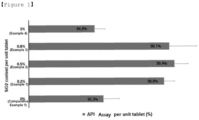
- FIG. 1 shows API assay per unit tablet depending on glidant (SiO 2 ) content.
- the inventors of the present invention have continued research in various ways in order to increase the content of the API and maintain or increase the physical properties in the oral formulation comprising 1-(3-cyano-1-isopropyl-indol-5-yl)pyrazol-4-carboxylic acid or a pharmaceutically acceptable salt thereof as API. And as a result, the inventors of the present invention have developed an oral formulation with high API assay while excellent physical properties comprising a glidant in excipients.
- the present invention provides an oral formulation comprising a high content of the API selected from 1-(3-cyano-1-isopropyl-indol-5-yl)pyrazol-4-carboxylic acid or a pharmaceutically acceptable salt thereof, with a glidant in excipients.
- pharmaceutically acceptable salt refers to a salt form of a compound that does not cause serious irritation to the organism to which the compound is administered and does not impair the biological activities and physical properties of the compound.
- 1-(3-cyano-1-isopropyl-indol-5-yl)pyrazol-4-carboxylic acid which is the API comprised in the oral formulation of the present invention, can be converted to its salt by conventional methods.
- API assay refers to the amount of an active ingredient in a formulation or tablet.
- the assay is an important quality characteristic of the final product.
- one aspect of the present invention provides an oral formulation comprising i) 1-(3-cyano-1-isopropyl-indol-5-yl)pyrazol-4-carboxylic acid or a pharmaceutically acceptable salt thereof as an API, and ii) a glidant in excipients.
- the glidant may be comprised in an amount of greater than 0 % by weight and less than 1 % by weight, 0.1 % by weight or more and less than 1 % by weight, 0.2 % by weight or more and less than 1 % by weight, greater than 0 % by weight and 0.9 % by weight or less, 0.1 % by weight or more and 0.9 % by weight or less, 0.2 % by weight or more and 0.9 % by weight or less, greater than 0 % by weight and 0.8 % by weight or less, 0.1 % by weight or more and 0.8 % by weight or less, or 0.2 % by weight or more and 0.8 % by weight or less, by weight based on the total weight of the formulation.
- the glidant may be comprised in an amount of 0.1 % by weight, 0.2 % by weight, 0.3 % by weight, 0.4 % by weight, 0.5 % by weight, 0.6 % by weight, 0.7 % by weight, 0.8 % by weight, or 0.9 % by weight based on the total weight of the formulation.
- the glidant may be selected from the group consisting of colloidal silicon dioxide, hydrated silicon dioxide, talc and combinations thereof, but is not limited thereto.
- talc when talc is used as a glidant, since hardness tends to decrease and friability tends to increase when formulated as tablets, it is preferable to use a SiO 2 series such as colloidal silicon dioxide, hydrated silicon dioxide, or a combination thereof as the glidant.
- the oral formulation further comprises one or more excipients selected from a pharmaceutically acceptable diluent, disintegrant, binder, stabilizer, lubricant and the like as an excipient.
- the diluent, disintegrant, binder, stabilizer, lubricant and the like may be any ones known to be commonly used in the art.
- the diluent may be used in an amount of 30 to 50 % by weight, 40 to 50 % by weight, or 45 to 50 % by weight, based on the total weight of the oral formulation.
- the disintegrant may be used in an amount ranging from 1 to 30 % by weight, 1 to 20 % by weight, 1 to 100 % by weight or 1 to 5 % by weight, based on the total weight of the oral formulation.
- the binder may be used in an amount ranging from 1 to 30 % by weight, 1 to 20 % by weight, 1 to 100 % by weight, or 1 to 5 % by weight, based on the total weight of the oral formulation.
- the stabilizer may be used in an amount ranging from 0.1 to 10 % by weight, 0.3 to 5 % by weight, or 0.5 to 4 % by weight, based on the total weight of the oral formulation.
- the lubricant may be used in an amount ranging from 0.1 to 10 % by weight, 0.3 to 5 % by weight, or 0.5 to 4 % by weight, based on the total weight of the oral formulation.
- the diluent may be selected from the group consisting of microcrystalline cellulose (MCC), lactose monohydrate, lactose anhydrous, lactose, starch, mannitol, carboxymethyl cellulose, sorbitol, and combinations thereof, but is not limited thereto.
- MCC microcrystalline cellulose
- the disintegrant may be selected from the group consisting of low-substituted hydroxypropyl cellulose, crospovidone, croscarmellose sodium, sodium starch glycolate, F-melt ® , and combinations thereof, but is not limited thereto.
- the binder may be selected from the group consisting of hydroxypropyl cellulose, hydroxypropyl methylcellulose, hypromellose, polyvinyl acetic acid, povidone, polyvinylpyrrolidone, copovidone, Macrogol, sodium lauryl sulfate, light anhydrous silicic acid, synthetic aluminum silicate, calcium silicate or silicate derivatives such as magnesium metasilicate aluminate, phosphate such as calcium hydrogen phosphate, carbonate such as calcium carbonate, pregelatinized starch, gums such as acacia gum, gelatin, cellulose derivatives such as ethyl cellulose, and mixtures thereof, but is not limited thereto.
- the stabilizer may be selected from the group consisting of BHT, BHA, ascorbic acid, tocopherol, EDTA, and mixtures thereof, but is not limited thereto.
- the lubricant may be selected from the group consisting of magnesium stearate, silicon dioxide, talc, light anhydrous silicic acid, sodium stearyl fumarate, and combinations thereof, but is not limited thereto.
- the oral formulation can be administered once a day and can be taken daily.
- the content of API comprised in the oral formulation is 30 to 50 % by weight, 35 to 50 % by weight, 40 to 50 % by weight, 45 to 50 % by weight, 30 to 45 % by weight, 35 to 45 % by weight, 40 to 45 % by weight, 30 to 40 % by weight, or 35 to 40 % by weight based on the total weight of the oral formulation.
- the API may be comprised in an amount of, for example, 50 to 500 mg, 50 to 400 mg, 50 to 300 mg, 50 to 200 mg, 50 to 100 mg, 100 to 500 mg, 100 to 400 mg, 100 to 300 mg, 100 to 200 mg, 200 to 500 mg, 200 to 400 mg, 200 to 300 mg, 300 to 500 mg, or 300 to 400 mg per unit dosage form.
- the API may be comprised in an amount of, for example, 50 mg, 100 mg, 150 mg, 200 mg, 300 mg, 400 mg, or 455 mg per unit dosage form.
- the API assay in the formulation of the present invention may be 95% to 105%, 96% to 105%, 97% to 105%, 98% to 105%, 99% to 105%, 100% to 105%, 95% to 100%, 96% to 100%, 97% to 100%, 97% to 100%, or 99% to 100%.
- the API assay may be 95% or more, 96% or more, 97% or more, 98% or more, or 99% or more, and may be 105% or less, 104% or less, 103% or less, 102% or less, 101% or less, or 100% or less.
- API assay refers to the content of pure API excluding impurities among API content comprised per unit dosage form. Specifically, it may have the similar meaning as the purity of the API.
- the present invention provides a method for preparing an oral formulation comprising 1-(3-cyano-1-isopropyl-indol-5-yl)pyrazol-4-carboxylic acid or a pharmaceutically acceptable salt thereof, which comprises the steps of i) mixing an API selected from 1-(3-cyano-1-isopropyl-indol-5-yl)pyrazol-4-carboxylic acid or a pharmaceutically acceptable salt thereof, and a glidant to preparing a first mixture; ii) mixing pharmaceutically acceptable excipients to preparing a second mixture; and iii) formulating said first mixture and said second mixture into an oral formulation.
- the steps of preparing each of the first mixture and the second mixture in the preparation method of the present invention includes a step of milling after mixing.
- the glidant in the first mixture in the manufacturing method of the present invention includes SiO 2 selected from the group consisting of colloidal silicon dioxide, hydrated silicon dioxide and combinations thereof.
- the pharmaceutically acceptable excipients in the second mixture in the preparation method of the present invention optionally include the aforementioned excipients.
- API assay and assay of the formulation prepared by the preparation method of the present invention are the same as the aforementioned API assay and assay of the oral formulation of the present invention, respectively.
- the oral formulation may be formulated according to any tablet preparation method or granule preparation method known in the art.
- the present invention provides a method for treating or preventing human xanthine oxidase-related diseases by administration of an oral formulation comprising the 1-(3-cyano-1-isopropyl-indol-5-yl)pyrazol-4-carboxylic acid or a pharmaceutically acceptable salt thereof as an API and a glidant.
- human xanthine oxidase-related diseases refers to diseases that can be treated or prevented by inhibiting human xanthine oxidase, and may be, for example, hyperuricacidemia, gout, heart failure, cardiovascular diseases, high blood pressure, diabetes, diabetes-related complications, kidney diseases, inflammation, joint diseases, inflammatory bowel disease, and the like, but is not limited thereto.
- diabetes-related complications may be hyperlipidemia, arteriosclerosis, obesity, high blood pressure, retinopathy, renal failure, and the like.
- treatment means stopping or delaying the progression of a disease when used for a subject showing symptoms of the disease
- prevention means stopping or delaying the symptoms of the disease when administered to a subject who does not show symptoms of the disease but is at a high risk of developing the disease.
- the bulk density and tapped density of the mixture (powder) for preparing the uncoated tablets of Examples and Comparative Examples were measured.
- the bulk density was the volume when about 50 g of granular powder was put into the measuring cylinder, and the tapped density was measured when there was no further change in volume after lightly tapping the measuring cylinder on the floor at a constant height 100 times.
- the bulk density refers to the volume occupied by a certain mass of powder, and means the sum of the volume of powder and the volume of voids between particles as a total volume.
- Carr's index is a measure of the compressibility of a powder and is defined as a percentage of (tapped density-bulk density)/tapped density. A higher index means that the powder is more compact and has poor flowability.
- the hardness and friability are used as indices that can predict the wear and tear of tablets in the handling and coating process of uncoated tablets after tableting.
- Friability % mass before test ⁇ mass after test / mass before test ⁇ 100
- one tablet is put into a table hardness tester to measure hardness, and in this way, 10 tablets are repeated to measure the average hardness.
- the disintegration time is an index that affects dissolution and absorption in the body after ingestion of the formulation.
- the disintegration tester After the disintegration tester was sufficiently filled with purified water, it is adjusted to 37 ⁇ 2°C. Four tablets of the sample are put into the square glass pipe of the disintegration tester, it is operated in the prescribed way, and the time at which the tablet completely disintegrates and disappears is measured to obtain an average value.
- the assay is an important quality characteristic of the final product, and the API average assay of the uncoated tablet was measured.
- the uncoated tablets of Examples and Comparative Examples below were tested for dissolution.
- the dissolution method was a paddle method, the stirring speed was 50 rpm, and the dissolution temperature was 37 ⁇ 0.5°C.
- the eluate was 900 ml of pH 6.8 phosphate buffer.
- the solution obtained in the above dissolution test was filtered through a 0.45 ⁇ m membrane filter and the UPLC method was used, and the concentration of 1-(3-cyano-1-isopropyl-indol-5-yl)pyrazol-4-carboxylic acid, which is an API, was analyzed.
- the analysis conditions are the same as the assay analysis method.
- Examples 1 to 8 and Comparative Example 1 were prepared as uncoated tablets using the ingredients shown in Tables 2 to 4 below in the corresponding content.
- 1-(3-cyano-1-isopropyl-indol-5-yl)pyrazol-4-carboxylic acid (API) and glidant are mixed and milled to prepare a first mixture.
- a diluent, a disintegrant, and a lubricant, which are components not included in the first mixture, are mixed and milled to prepare a second mixture.
- Example 1 In the case of Examples 1 to 8 comprising the glidant, after mixing the first mixture and the second mixture, the mixture is tableted using a rotary tablet machine (Modul P, GEA, Belgium) under the conditions of pre-pressure: 5.0 kN and main pressure: 14-15 kN to obtain uncoated tablets.
- a rotary tablet machine Mode P, GEA, Belgium
- the process of preparing mixture 1 is omitted, and 1-(3-cyano-1-isopropyl-indol-5-yl)pyrazol-4-carboxylic acid (API) and all excipients were mixed and milled, followed by tableting in the same way as Example 1, to prepare uncoated tablets.
- API 1-(3-cyano-1-isopropyl-indol-5-yl)pyrazol-4-carboxylic acid
- MCC 102 used as a diluent is a microcrystalline cellulose component.
- PRUV ® used as a lubricant is a trade name and is a sodium stearyl fumarate component) .
- Table 2 Item Ingredient Example 1 Example 2 Example 3 Example 4 Cont ent mg/T Cont ent ratio % Cont ent mg/T Cont ent ratio % Cont ent mg/T Cont ent ratio % Cont ent mg/T Cont ent ratio % API 100. 0 45.5 100. 0 45.5 100. 0 45.5 100. 0 45.5 Dilu ent MCC 102 (microcrys talline cellulose) 105.
- Example 3 Func tion Type Example 5
- Example 6 Example 7
- Example 8 Cont ent mg/T Cont ent ratio % Cont ent mg/T Cont ent ratio % Cont ent mg/T Cont ent ratio % Cont ent mg/T Cont ent ratio % API 100. 0 45.5 100. 0 50.0 100. 0 54.9 100. 0 59.9
- Dilu ent MCC 102 microcrys talline cellulose
- the bulk density, tapped density, and Carr's index did not show any significant difference depending on the inclusion and content of the glidant (SiO 2 ) in the mixture state before the uncoated tablet was prepared.
- Example 1 As a result of measuring the API assay of the uncoated tablet, as shown in Table 6 and Figure 1 below, in the case of Comparative Example 1, the average assay is 95.3%, and when comprising 0.2 to 0.8% by weight of SiO 2 , it is increased up to 98.8 to 99.4% (Examples 1 to 3). However, in the case of Example 4 comprising 1% by weight of SiO 2 , it is reduced to 94.8% similar to Comparative Example 1, indicating that the preferred content range of SiO 2 is 0.2 to 0.8% by weight based on the total weight of the formulation.
- Comparative Example 1 has a low hardness, so it shows early dissolution, but shows a constant dissolution rate thereafter.
- SiO 2 was comprised, the slope showed a constant increase, and in particular, Example 2 (0.5 % by weight of SiO 2 ) showed the highest tendency for the 60-minute dissolution rate (Table 5).
- Example 2 shows best physical properties in table 5, and Example 5 was prepared by changing SiO 2 to talc while maintaining the glidant content (0.5 % by weight) from Example 2.
- Example 5 As shown in Table 6 below, in the case of Example 5 comprising talc as a glidant in the mixture state before the uncoated tablet was prepared, the bulk density showed no difference compared with Example 2 and Comparative Example 1, but Carr's index was calculated to be 28%. Therefore, in the case of Example 5, Carr's index is "poor" category and is not suitable for direct pressing.
- the hardness of the uncoated tablet is 5.1 kP, which does not reach the target hardness of 6.0 kP, and the friability is also three times higher than in Example 2, and thus it has physical properties that are not suitable for the tablet.
- Example 5 It can be seen that the average assay of Example 5 is also lowered compared to Example 2.
- Example 6 In order to prepare an uncoated tablet comprising an API of 50 % by weight or more, the characteristics depending on the increase of API content (Examples 6 to 8) based on the content (45.5 % by weight) of Example 2 were analyzed.
- Example 8 (API content: 60 % by weight) showed a hardness of 3.0 kP and a friability of 0.2% or more, and thus it was not suitable for formulating into tablets (Table 7) .
- Examples 2, 6, and 7 showed an average assay of 99% or more, whereas Example 8 showed an average assay of 94.6% (Table 7).
- the average assay is 99% or more, but when the API content is 60% by weight, the average assay is significantly lowered to 94.6%, and when the API content is more than 50%, even if the content is excellent, the hardness of the uncoated tablet is lowered and the friability is increased. Therefore, it can be seen that when the content of the API is 55% by weight or more, it is not desirable to formulate it as a tablet.
- Table 7 Item Example 2 Example 6 Example 7 Example 8 API content (%) (based on total tablet) 45.5 50 55 60 Bulk density (g/ml) 0.39 0.43 0.43 0.44 Carr's index (%) 25.0 25.0 24.0 23.0 Hardness (kP) 7.3 5.4 4.0 3.0 Friability (%) 0.05 0.08 0.10 0.22 Disintegration time (sec) 10 10 10 7 Assay Average assay (%) 99.4 99.6 99.3 94.6
Landscapes
- Health & Medical Sciences (AREA)
- Chemical & Material Sciences (AREA)
- Life Sciences & Earth Sciences (AREA)
- Animal Behavior & Ethology (AREA)
- Epidemiology (AREA)
- Pharmacology & Pharmacy (AREA)
- Medicinal Chemistry (AREA)
- General Health & Medical Sciences (AREA)
- Public Health (AREA)
- Veterinary Medicine (AREA)
- Inorganic Chemistry (AREA)
- Biophysics (AREA)
- Molecular Biology (AREA)
- Medicinal Preparation (AREA)
- Pharmaceuticals Containing Other Organic And Inorganic Compounds (AREA)
Applications Claiming Priority (2)
| Application Number | Priority Date | Filing Date | Title |
|---|---|---|---|
| KR20200165790 | 2020-12-01 | ||
| PCT/KR2021/017843 WO2022119270A1 (fr) | 2020-12-01 | 2021-11-30 | Formulation orale comprenant de l'acide 1-(3-cyano-1-isopropyl-indole-5-yl)pyrazole-4-carboxylique et son procédé de préparation |
Publications (2)
| Publication Number | Publication Date |
|---|---|
| EP4257124A1 true EP4257124A1 (fr) | 2023-10-11 |
| EP4257124A4 EP4257124A4 (fr) | 2024-05-29 |
Family
ID=81854229
Family Applications (1)
| Application Number | Title | Priority Date | Filing Date |
|---|---|---|---|
| EP21900958.6A Withdrawn EP4257124A4 (fr) | 2020-12-01 | 2021-11-30 | Formulation orale comprenant de l'acide 1-(3-cyano-1-isopropyl-indole-5-yl)pyrazole-4-carboxylique et son procédé de préparation |
Country Status (16)
| Country | Link |
|---|---|
| US (1) | US20240173259A1 (fr) |
| EP (1) | EP4257124A4 (fr) |
| JP (2) | JP7618806B2 (fr) |
| KR (1) | KR102749901B1 (fr) |
| CN (1) | CN116528853B (fr) |
| AR (1) | AR124180A1 (fr) |
| AU (1) | AU2021392532B2 (fr) |
| BR (1) | BR112023009427A2 (fr) |
| CA (1) | CA3195598A1 (fr) |
| CL (1) | CL2023001061A1 (fr) |
| CO (1) | CO2023005206A2 (fr) |
| MX (1) | MX2023005461A (fr) |
| PE (1) | PE20230850A1 (fr) |
| TW (1) | TWI884340B (fr) |
| WO (1) | WO2022119270A1 (fr) |
| ZA (1) | ZA202305155B (fr) |
Families Citing this family (1)
| Publication number | Priority date | Publication date | Assignee | Title |
|---|---|---|---|---|
| CA3197405A1 (fr) * | 2020-12-01 | 2022-06-09 | Lg Chem, Ltd. | Formulation orale stable contenant de l'acide 1-(3-cyano-1-isopropyl-indol-5-yl) pyrazole-4-carboxylique |
Family Cites Families (16)
| Publication number | Priority date | Publication date | Assignee | Title |
|---|---|---|---|---|
| GB9501127D0 (en) * | 1995-01-20 | 1995-03-08 | Wellcome Found | Tablet |
| GB0209265D0 (en) * | 2002-04-23 | 2002-06-05 | Novartis Ag | Organic compounds |
| US20070014853A1 (en) * | 2005-07-15 | 2007-01-18 | Ilan Zalit | Pharmaceutical dosage form containing novel pharmaceutical granulate |
| KR20080039876A (ko) * | 2005-07-22 | 2008-05-07 | 미리어드 제네틱스, 인크. | 높은 약물 충진 제형 및 투여형 |
| US8003647B2 (en) * | 2007-04-11 | 2011-08-23 | Kissei Pharmaceutical Co., Ltd. | (Aza)indole derivative and use thereof for medical purposes |
| TWI423962B (zh) * | 2009-10-07 | 2014-01-21 | Lg Life Sciences Ltd | 有效作為黃嘌呤氧化酶抑制劑之新穎化合物、其製備方法及含該化合物之醫藥組成物 |
| CA2813555C (fr) * | 2010-10-15 | 2014-11-25 | Ardea Biosciences, Inc. | Methodes de traitement de l'hyperuricemie et de maladies liees |
| TWI548630B (zh) | 2011-04-06 | 2016-09-11 | Lg生命科學有限公司 | 1-(3-氰基-1-異丙基-吲哚-5-基)吡唑-4-羧酸結晶型及其製造方法 |
| WO2013001441A1 (fr) * | 2011-06-29 | 2013-01-03 | Ranbaxy Laboratories Limited | Formulations sèches de febuxostat |
| EP2692342A1 (fr) * | 2012-07-30 | 2014-02-05 | Interquim, S.A. | Procédé pour la préparation de compositions pharmaceutiques comprenant du Febuxostat sous la forme de comprimés |
| US10064826B2 (en) * | 2013-03-15 | 2018-09-04 | Navinta, Llc | Direct compression and dry granulation processes for preparing carglumic acid tablets having less impurities than those produced by wet granulation process |
| JP2017081859A (ja) * | 2015-10-29 | 2017-05-18 | 共和薬品工業株式会社 | テルミサルタン含有錠剤の製造方法 |
| CN106880619A (zh) * | 2015-12-15 | 2017-06-23 | 北大方正集团有限公司 | 一种托匹司他胶囊剂及其制备方法 |
| JP6946609B2 (ja) * | 2017-06-08 | 2021-10-06 | 高田製薬株式会社 | ブロナンセリン含有錠剤 |
| JP2020117503A (ja) * | 2019-01-25 | 2020-08-06 | 株式会社東洋新薬 | 経口組成物 |
| EP4218755A4 (fr) * | 2020-11-04 | 2024-03-27 | Lg Chem, Ltd. | Procédé de préparation de particules cristallines d'acide 1-(3-cyano-1-isopropyl-indole-5-yl)pyrazole-4-carboxylique, et composition pharmaceutique les comprenant |
-
2021
- 2021-11-30 US US18/255,241 patent/US20240173259A1/en not_active Abandoned
- 2021-11-30 MX MX2023005461A patent/MX2023005461A/es unknown
- 2021-11-30 AR ARP210103305A patent/AR124180A1/es unknown
- 2021-11-30 AU AU2021392532A patent/AU2021392532B2/en not_active Expired - Fee Related
- 2021-11-30 PE PE2023001480A patent/PE20230850A1/es unknown
- 2021-11-30 TW TW110144683A patent/TWI884340B/zh active
- 2021-11-30 JP JP2023532829A patent/JP7618806B2/ja active Active
- 2021-11-30 KR KR1020210167952A patent/KR102749901B1/ko active Active
- 2021-11-30 WO PCT/KR2021/017843 patent/WO2022119270A1/fr not_active Ceased
- 2021-11-30 BR BR112023009427A patent/BR112023009427A2/pt unknown
- 2021-11-30 CA CA3195598A patent/CA3195598A1/fr active Pending
- 2021-11-30 CN CN202180079311.XA patent/CN116528853B/zh active Active
- 2021-11-30 EP EP21900958.6A patent/EP4257124A4/fr not_active Withdrawn
-
2023
- 2023-04-13 CL CL2023001061A patent/CL2023001061A1/es unknown
- 2023-04-25 CO CONC2023/0005206A patent/CO2023005206A2/es unknown
- 2023-05-10 ZA ZA2023/05155A patent/ZA202305155B/en unknown
-
2025
- 2025-01-08 JP JP2025002875A patent/JP2025039725A/ja not_active Withdrawn
Also Published As
| Publication number | Publication date |
|---|---|
| JP2025039725A (ja) | 2025-03-21 |
| EP4257124A4 (fr) | 2024-05-29 |
| CA3195598A1 (fr) | 2022-06-09 |
| US20240173259A1 (en) | 2024-05-30 |
| AR124180A1 (es) | 2023-02-22 |
| JP7618806B2 (ja) | 2025-01-21 |
| AU2021392532A1 (en) | 2023-06-29 |
| CL2023001061A1 (es) | 2023-12-11 |
| PE20230850A1 (es) | 2023-05-23 |
| KR102749901B1 (ko) | 2025-01-03 |
| WO2022119270A1 (fr) | 2022-06-09 |
| MX2023005461A (es) | 2023-05-22 |
| BR112023009427A2 (pt) | 2024-02-06 |
| CN116528853B (zh) | 2026-03-20 |
| CN116528853A (zh) | 2023-08-01 |
| TW202231270A (zh) | 2022-08-16 |
| ZA202305155B (en) | 2024-09-25 |
| TWI884340B (zh) | 2025-05-21 |
| JP2023551524A (ja) | 2023-12-08 |
| AU2021392532B2 (en) | 2025-04-10 |
| CO2023005206A2 (es) | 2023-04-27 |
| KR20220077092A (ko) | 2022-06-08 |
Similar Documents
| Publication | Publication Date | Title |
|---|---|---|
| JP5344620B2 (ja) | オルメサルタンメドキソミル及びアムロジピンの固形製剤 | |
| WO2004054574A1 (fr) | Medicament solide administre par voie orale | |
| AU2024227367A1 (en) | Stable oral formulation containing 1-(3-cyano-1-isopropyl-indol-5-yl)pyrazole-4-carboxylic acid | |
| KR102585644B1 (ko) | 1-(3-시아노-1-아이소프로필-인돌-5-일)피라졸-4-카르복실산을 포함하는 경구용 제제 | |
| EP4257124A1 (fr) | Formulation orale comprenant de l'acide 1-(3-cyano-1-isopropyl-indole-5-yl)pyrazole-4-carboxylique et son procédé de préparation | |
| CN116648243A (zh) | 三苯基钙敏感化合物的制剂 | |
| TWI402083B (zh) | 固形製劑及其安定化方法 | |
| HK40095918A (zh) | 包含1-(3-氰基-1-异丙基-吲哚-5-基)吡唑-4-甲酸的口服制剂及其制备方法 | |
| EP4342458A1 (fr) | Formulation orale contenant de l'acide 1-(3-cyano-1-isopropyl-indol-5-yl)pyrazole-4-carboxylique | |
| CA2609026A1 (fr) | Preparations contenant du losartan et/ou des sels de ce compose | |
| EA049988B1 (ru) | Лекарственная форма для перорального применения, содержащая 1-(3-циано-1-изопропил-индол-5-ил)пиразол-4-карбоновую кислоту | |
| HK40097002A (zh) | 含有1-(3-氰基-1-异丙基-吲哚-5-基)吡唑-4-甲酸的口服制剂 | |
| EP4413987A1 (fr) | Composition antifibrotique | |
| HK40095726A (zh) | 含有1-(3-氰基-1-异丙基-吲哚-5-基)吡唑-4-甲酸的稳定的口服制剂 |
Legal Events
| Date | Code | Title | Description |
|---|---|---|---|
| STAA | Information on the status of an ep patent application or granted ep patent |
Free format text: STATUS: THE INTERNATIONAL PUBLICATION HAS BEEN MADE |
|
| PUAI | Public reference made under article 153(3) epc to a published international application that has entered the european phase |
Free format text: ORIGINAL CODE: 0009012 |
|
| STAA | Information on the status of an ep patent application or granted ep patent |
Free format text: STATUS: REQUEST FOR EXAMINATION WAS MADE |
|
| 17P | Request for examination filed |
Effective date: 20230622 |
|
| AK | Designated contracting states |
Kind code of ref document: A1 Designated state(s): AL AT BE BG CH CY CZ DE DK EE ES FI FR GB GR HR HU IE IS IT LI LT LU LV MC MK MT NL NO PL PT RO RS SE SI SK SM TR |
|
| DAV | Request for validation of the european patent (deleted) | ||
| DAX | Request for extension of the european patent (deleted) | ||
| A4 | Supplementary search report drawn up and despatched |
Effective date: 20240425 |
|
| RIC1 | Information provided on ipc code assigned before grant |
Ipc: A61K 31/4155 20060101ALI20240419BHEP Ipc: A61K 9/20 20060101AFI20240419BHEP |
|
| STAA | Information on the status of an ep patent application or granted ep patent |
Free format text: STATUS: THE APPLICATION HAS BEEN WITHDRAWN |
|
| 18W | Application withdrawn |
Effective date: 20250702 |