EP4257227A1 - Dispositif et procédé d'extraction d'hydrides du lithium - Google Patents
Dispositif et procédé d'extraction d'hydrides du lithium Download PDFInfo
- Publication number
- EP4257227A1 EP4257227A1 EP22305438.8A EP22305438A EP4257227A1 EP 4257227 A1 EP4257227 A1 EP 4257227A1 EP 22305438 A EP22305438 A EP 22305438A EP 4257227 A1 EP4257227 A1 EP 4257227A1
- Authority
- EP
- European Patent Office
- Prior art keywords
- mixture
- lithium
- cooling
- stirring
- compound
- Prior art date
- Legal status (The legal status is an assumption and is not a legal conclusion. Google has not performed a legal analysis and makes no representation as to the accuracy of the status listed.)
- Withdrawn
Links
Images

Classifications
-
- C—CHEMISTRY; METALLURGY
- C01—INORGANIC CHEMISTRY
- C01B—NON-METALLIC ELEMENTS; COMPOUNDS THEREOF; METALLOIDS OR COMPOUNDS THEREOF NOT COVERED BY SUBCLASS C01C
- C01B6/00—Hydrides of metals including fully or partially hydrided metals, alloys or intermetallic compounds ; Compounds containing at least one metal-hydrogen bond, e.g. (GeH3)2S, SiH GeH; Monoborane or diborane; Addition complexes thereof
- C01B6/04—Hydrides of alkali metals, alkaline earth metals, beryllium or magnesium; Addition complexes thereof
-
- B—PERFORMING OPERATIONS; TRANSPORTING
- B01—PHYSICAL OR CHEMICAL PROCESSES OR APPARATUS IN GENERAL
- B01D—SEPARATION
- B01D59/00—Separation of different isotopes of the same chemical element
- B01D59/02—Separation by phase transition
- B01D59/08—Separation by phase transition by fractional crystallisation, by precipitation, by zone freezing
-
- B—PERFORMING OPERATIONS; TRANSPORTING
- B01—PHYSICAL OR CHEMICAL PROCESSES OR APPARATUS IN GENERAL
- B01D—SEPARATION
- B01D9/00—Crystallisation
- B01D9/004—Fractional crystallisation; Fractionating or rectifying columns
-
- C—CHEMISTRY; METALLURGY
- C22—METALLURGY; FERROUS OR NON-FERROUS ALLOYS; TREATMENT OF ALLOYS OR NON-FERROUS METALS
- C22B—PRODUCTION AND REFINING OF METALS; PRETREATMENT OF RAW MATERIALS
- C22B26/00—Obtaining alkali, alkaline earth metals or magnesium
- C22B26/10—Obtaining alkali metals
- C22B26/12—Obtaining lithium
-
- B—PERFORMING OPERATIONS; TRANSPORTING
- B01—PHYSICAL OR CHEMICAL PROCESSES OR APPARATUS IN GENERAL
- B01D—SEPARATION
- B01D9/00—Crystallisation
- B01D9/0004—Crystallisation cooling by heat exchange
-
- C—CHEMISTRY; METALLURGY
- C01—INORGANIC CHEMISTRY
- C01P—INDEXING SCHEME RELATING TO STRUCTURAL AND PHYSICAL ASPECTS OF SOLID INORGANIC COMPOUNDS
- C01P2006/00—Physical properties of inorganic compounds
- C01P2006/88—Isotope composition differing from the natural occurrence
-
- Y—GENERAL TAGGING OF NEW TECHNOLOGICAL DEVELOPMENTS; GENERAL TAGGING OF CROSS-SECTIONAL TECHNOLOGIES SPANNING OVER SEVERAL SECTIONS OF THE IPC; TECHNICAL SUBJECTS COVERED BY FORMER USPC CROSS-REFERENCE ART COLLECTIONS [XRACs] AND DIGESTS
- Y02—TECHNOLOGIES OR APPLICATIONS FOR MITIGATION OR ADAPTATION AGAINST CLIMATE CHANGE
- Y02E—REDUCTION OF GREENHOUSE GAS [GHG] EMISSIONS, RELATED TO ENERGY GENERATION, TRANSMISSION OR DISTRIBUTION
- Y02E30/00—Energy generation of nuclear origin
- Y02E30/10—Nuclear fusion reactors
Definitions
- the present disclosure is related to devices and methods for separating lithium hydrides in a liquid mixture, particularly it is related to separation of lithium hydride, lithium deuteride and lithium tritide in a mixture that contains lithium.
- tritium represents half of the most efficient fusion reaction, and is also a very scarce isotope of hydrogen. It is calculated that there are about 20kg of tritium occurring naturally, so in order to be used as a fuel, tritium must be artificially generated. Currently the price of a gram of tritium is about 30,000 dollars.
- the current methods for production of tritium in fusion reactors involve collecting it back from a lithium blanket or breeder. As part of the fusion reaction process neutrons are expelled, lithium is then made to react with the neutrons and produce tritium.
- the lithium blanket may be constructed of solid lithium or of liquid lithium.
- lithium hydride LiH
- LiD lithium deuteride
- LiT lithium tritide
- the prior art teaches the Maroni process which uses high-temperature molten mixed alkali metal halide salts, LiCl:LiF:LiBr as an extraction solvent.
- the process is known to develop impurities like liquid and gaseous acids such as HCl, HF and HBr in the salt phase, therefore these solvents are very corrosive and volatile.
- molten lithium compounds including LiOH and Li 2 CO 3 can be used as a solvent for extracting lithium tritide from the molten lithium metal.
- using LiOH avoids the generation of HF.
- the method described by Farmer also includes subjecting the extracted LiT solution to electrolysis in an electrochemical cell and does not overcome this limitation in the prior art.
- One embodiment addresses all or some of the drawbacks of known methods for separating lithium from a liquid that contains lithium.
- One embodiment provides a method for separating lithium from a lithium mixture, the method comprising:
- the first compound is lithium tritide
- the first temperature is above 691°C
- the second temperature is comprised between 689°C and 691°C, for example equal to about 690°C, the first separation step forming the second mixture.
- the first stirring and cooling steps are adapted to deposit at least part of the first compound, and at least part of lithium hydride, the first separation step forming the fifth mixture.
- the first compound is lithium tritide
- the first mixture further comprises lithium deuteride as a second compound
- the first stirring and cooling steps are adapted to deposit at least part of lithium deuteride and lithium tritide, and at least part of lithium hydride, the first separation step forming the fifth mixture.
- the first temperature is above 691°C
- the second temperature is comprised between 687 and 689°C, for example equal to about 688°C.
- the method further comprises a first extraction step adapted to extracting the deposited compound(s), after or during the first separation step.
- the method comprises repeating the first stirring, cooling and separating steps, and in some cases, the first extraction step.
- the first mixture comprises a second compound among lithium deuteride and lithium tritide, different from the first compound, and the method further comprises:
- the method further comprises a second extraction step adapted to extracting the second compound, after or during the second separation step.
- the second compound is lithium deuteride
- the third temperature is comprised between 687 and 689°C, for example equal to about 688°C.
- the method comprises repeating the second stirring, cooling and separating steps, and in some cases, the second extraction step.
- the method further comprises:
- the method further comprises a third extraction step adapted to extracting lithium hydride, after or during the third separation step.
- the fourth temperature is comprised between 685 and 687°C, for example equal to about 686°C.
- the method comprises repeating the third stirring, cooling and separating steps, and in some cases, the third extraction step.
- the method further comprises a neutron bombardment and/or plasma exposure step applied to the second mixture, the third mixture, the fourth mixture, and/or the fifth mixture, for example to recreate a mixture similar to the first mixture.
- providing the first mixture comprises a heating step adapted to heating the first mixture to the first temperature.
- the first mixture is in a liquid or molten form.
- One embodiment provides a device adapted to implement the method according to an embodiment, wherein the device comprises:
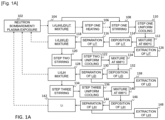
- FIG. 1A A diagram of an embodiment of a method for extraction of lithium hydrides is shown in FIG. 1A . It may be possible to start the process at any step or follow a different sequence in order to achieve the same results.
- the method may be started with a liquid or molten Li/LiH/LiD/LiT mixture 104 (first mixture), which may be then heated to a first temperature in a first heating step or step one heating 106 and is then stirred in a step one stirring 108. Then the mixture is uniformly cooled in a step one uniform cooling 110, until the mixture reaches a second temperature which may be about 690°C, described as the mixture at 690°C 112 step in the diagram of FIG. 1A . At this point deposition of LiT occurs in the deposition of LiT 114 step. After LiT deposits, a next step is the separation of LiT from the rest of the mixture in the separation of LiT 116 step.
- LiT may be extracted in an extraction of LiT 126 step.
- the remain mixture in the liquid phase is a Li/LiH/LiD mixture 118 (second mixture).
- the mixture with these components is now subjected to a step two stirring 120, and then to step two uniform cooling 122, until the mixture reaches a third temperature which may be about 688°C, this step is described in the diagram as mixture at 688°C 124.
- deposition of LiD occurs in a deposition of LiD 132 step. Once deposition ends, LiD starts to separate in a separation of LiD 130 step.
- LiD may be extracted from the mixture in an extraction of LiD 138 step.
- the Li/LiH mixture may once again be stirred in a step three stirring 134 and once again it is cooled in a step three uniform cooling 136, until the mixture reaches a fourth temperature which may be 686°C, this step is described in the diagram as mixture at 686°C 140.
- a fourth temperature which may be 686°C
- LiH starts to deposit in a deposition of LiH 146 step.
- deposition terminates, it is now possible to separate LiH in a separation of LiH 144 step.
- the mixture is comprised solely or mainly of molten Li 142 (fourth mixture).
- Li/LiH/LiD 118, Li/LiH 128 or Li 142 mixtures may be subjected to deuterium-tritium plasma exposure and/or neutron bombardment 102 in order to recreate the Li/LiH/LiD/LiT mixture 104. The method may then be restarted.
- step one stirring 108 may occur concurrently, for example the stirring steps, step one stirring 108, step two stirring 120 or step three stirring 134 may occur during the accompanying cooling step, step one uniform cooling 110, step two uniform cooling 122 or step three uniform cooling 136, respectively.
- LiT, LiD, LiH, or Li compound when reference is made to a LiT, LiD, LiH, or Li compound, this means that the compound contains mainly, or is rich of, respectively LiT, LiD, LiH, or Li, in other words that the compound is not necessarily pure LiT, LiD, LiH, or Li.
- a Li/LiH/LiD mixture may contain residual traces of LiT
- a Li/LiH mixture may contain residual traces of LiT and/or LiD. The same applies for other mixtures of lithium and/or lithium ionic compounds.
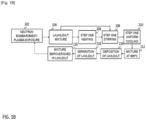
- FIG. 1B A diagram of another embodiment of a method for extraction of lithium hydrides is shown in FIG. 1B , in which a collective precipitation of LiH and/or LiD and/or LiT is made, by cooling the Li/LiH/LiD/LiT mixture to for example 686°C.
- the method of FIG. 1B may be started with a liquid or molten Li/LiH/LiD/LiT mixture 104 (first mixture), which may be then heated in a first heating step or step one heating 106 and is then stirred in a step one stirring 108.
- the mixture is uniformly cooled in a step one uniform cooling 210, until the mixture reaches a first temperature which may be 686°C, described as the mixture at 686°C 212 in the diagram of FIG. 1B .
- LiH/LiD/LiT occurs in the deposition of LiH/LiD/LiT 214 step.
- a next step is the separation of LiH/LiD/LiT from the rest of the mixture in the separation of LiH/LiD/LiT 216 step.
- LiH/LiD/LiT may be extracted. Once LiH/LiD/LiT is extracted the remain mixture in the liquid phase is a mixture 218 impoverished in Li/LiH/LiD (fifth mixture).
- the mixture 218 impoverished in Li/LiH/LiD may be subjected to deuterium-tritium plasma exposure and/or neutron bombardment 102 in order to recreate the Li/LiH/LiD/LiT mixture 104. The method may then be restarted.
- FIG. 2 An embodiment of a device 200 that executes this method is shown in FIG. 2 .
- it is comprised of a mechanism for revolving a mixture 204 which may be a stirrer 208, a mechanism for removing muds 206 which may be described as a paddle 212, a mechanism for heating or cooling which may be a serpentine 210, through which hot or cold water or another fluid may be used to heat or cool the mixture 204.
- a container 202 which may be insulated, the container 202 has holes 214 (apertures) for taking in and removing the mixture 204.
- composition of the mixture 204 may be any of the Li/LiH/LiD/LiT 104, Li/LiH/LiD 118, Li/LiH 128, Li 142 mixtures from the diagram in FIG. 1A or mixture 218 impoverished in Li/LiH/LiD from the diagram in FIG. 1B .
- the muds 206 may be comprised of the products of any of the separation or deposition steps and effectively realize the extraction of LiT 126, extraction of LiD 138 or extraction of LiH 148.
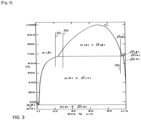
- the first trajectory line 302 occurs at about 20% molar component in the LiH mixture, above 690°C the LiH mixture is in the alfa, liquid phase.
- the LiH mixture is cooled, it enters two phases: an alfa liquid phase and a beta solid phase.
- a second trajectory line 304 with a mole percentage of about 30% may also be used. In this third trajectory line 304, at above 750°C, the mixture is in the alfa, liquid phase.
- the liquid mixture separates in two distinctive liquid phases: alfa and beta. If cooling is then continued below 690°C, the beta liquid phase solidifies.
- a third trajectory 306 when the molar percentage may be at around 90%, starts with the beta liquid phase at above 750°C. Following the third trajectory 306, if the mixture is cooled below 750°C but above 690°C, the alfa and beta liquid phases separate. Further, if the mixture is cooled below 690°C the beta phase once again solidifies. It is the beta solid phase that may be removed and taken as the mud 206 from FIG. 2 .
- the device shown in FIG. 2 executes each step of the method shown in the diagram from FIG. 1A or FIG. 1B .
- the serpentine 210 may be used for step one heating 106 or any of the cooling steps: step one uniform cooling 110, 210, step two uniform cooling 122 or step three uniform cooling 136.
- the stirrer 208 may be used for the stirring steps: step one stirring 108, step two stirring 120 or step three stirring 134.
- the paddle 212 may be used to remove the muds 206, these are the products of the separation and deposition steps. Extraction is executed by the paddle 212, which removes the muds 206 through one of the holes 214 of the container, this may be achieved by pushing.
- Example 1 A method for separating lithium from a lithium mixture, the method comprising:
- Example 2 The method according to example 1, wherein the first compound is lithium tritide, the first temperature is above 691°C and the second temperature is comprised between 689°C and 691°C, for example equal to about 690°C, the first separation step (116) forming the second mixture (118).
- Example 3 The method according to example 1, wherein the first stirring (108) and cooling (210) steps are adapted to deposit at least part of the first compound, and at least part of lithium hydride, the first separation step (116) forming the fifth mixture (218).
- Example 4 The method according to example 1, wherein the first compound is lithium tritide and the first mixture (104) further comprises lithium deuteride as a second compound, and the first stirring (108) and cooling (210) steps are adapted to deposit at least part of lithium deuteride and lithium tritide, and at least part of lithium hydride to form a fifth mixture (218).
- Example 5 The method according to example 3 or 4, wherein the first temperature is above 691°C, and the second temperature is comprised between 687 and 689°C, for example equal to about 688°C.
- Example 6 The method according to any one of examples 1 to 5, further comprising a first extraction step (126) adapted to extracting the deposited compound(s), after or during the first separation step.
- Example 7 The method according to any one of examples 1 to 6, comprising repeating the first stirring, cooling and separating steps, and in some cases, the first extraction step.
- Example 8 The method according to any one of examples 1, 2, 6, 7, wherein the first mixture (104) comprises a second compound among lithium deuteride and lithium tritide, different from the first compound, the method further comprising:
- Example 9 The method according to example 8, further comprising a second extraction step (138) adapted to extracting the second compound, after or during the second separation step (130).
- Example 10 The method according to example 8 or 9, wherein the second compound is lithium deuteride, and the third temperature is comprised between 687 and 689°C, for example equal to about 688°C.
- Example 11 The method according to any one of examples 8 to 10, comprising repeating the second stirring, cooling and separating steps, and in some cases, the second extraction step.
- Example 12 The method according to any one of examples 8 to 11, wherein the method further comprises:
- Example 13 The method according to example 12, further comprising a third extraction step (148) adapted to extracting lithium hydride, after or during the third separation step (144).
- Example 14 The method according to example 12 or 13, wherein the fourth temperature is comprised between 685 and 687°C, for example equal to about 686°C.
- Example 15 The method according to any one of examples 12 to 14, comprising repeating the third stirring, cooling and separating steps, and in some cases, the third extraction step.
- Example 16 The method according to any one of examples 1 to 15, further comprising a neutron bombardment and/or plasma exposure step (102) applied to the second mixture (118), the third mixture (128), the fourth mixture (142), and/or the fifth mixture (218), for example to recreate a mixture similar to the first mixture (104).
- Example 17 The method according to any one of examples 1 to 16, wherein providing the first mixture (104) comprises a heating step (106) adapted to heating the first mixture to the first temperature.
- Example 18 The method according to any one of examples 1 to 17, wherein the first mixture (104) is in a liquid or molten form.
- Example 19 A device adapted to implement the method of any of examples 1 to 18, wherein the device comprises:
- Example 20 The device according to example 19, wherein the cooling mechanism (210) is also adapted to heating the mixture (204), for example the cooling mechanism comprises a serpentine.
- Example 21 The device according to example 19 or 20, wherein the container comprises at least one aperture (214) adapted to taking in and out at least part of the mixture.
- Example 22 The device according to any one of examples 19 to 21, further comprising a removing mechanism (212) adapted to removing at least part of the mixture out of the container.
Landscapes
- Chemical & Material Sciences (AREA)
- Organic Chemistry (AREA)
- Engineering & Computer Science (AREA)
- Geology (AREA)
- General Life Sciences & Earth Sciences (AREA)
- Life Sciences & Earth Sciences (AREA)
- Chemical Kinetics & Catalysis (AREA)
- Materials Engineering (AREA)
- Inorganic Chemistry (AREA)
- Environmental & Geological Engineering (AREA)
- Manufacturing & Machinery (AREA)
- Mechanical Engineering (AREA)
- Metallurgy (AREA)
- Crystallography & Structural Chemistry (AREA)
- Manufacture And Refinement Of Metals (AREA)
Priority Applications (11)
| Application Number | Priority Date | Filing Date | Title |
|---|---|---|---|
| EP22305438.8A EP4257227A1 (fr) | 2022-04-04 | 2022-04-04 | Dispositif et procédé d'extraction d'hydrides du lithium |
| PCT/EP2023/058821 WO2023194368A1 (fr) | 2022-04-04 | 2023-04-04 | Séparation isotopique de lithium |
| US18/850,491 US20250214837A1 (en) | 2022-04-04 | 2023-04-04 | Device and method for extraction of lithium hydrides |
| CN202380031493.2A CN119136896A (zh) | 2022-04-04 | 2023-04-04 | 用于提取锂氢化物的设备和方法 |
| CN202380031490.9A CN119136895A (zh) | 2022-04-04 | 2023-04-04 | 锂的同位素分离 |
| PCT/EP2023/058819 WO2023194366A1 (fr) | 2022-04-04 | 2023-04-04 | Dispositif et procédé d'extraction d'hydrures de lithium |
| JP2024559546A JP2025511923A (ja) | 2022-04-04 | 2023-04-04 | リチウム水素化物の抽出装置および抽出方法 |
| EP23717874.4A EP4504387A1 (fr) | 2022-04-04 | 2023-04-04 | Séparation isotopique de lithium |
| US18/850,490 US20250206609A1 (en) | 2022-04-04 | 2023-04-04 | Isotopic separation of lithium |
| JP2024559545A JP2025512328A (ja) | 2022-04-04 | 2023-04-04 | リチウムの同位体分離 |
| EP23717488.3A EP4504386A1 (fr) | 2022-04-04 | 2023-04-04 | Dispositif et procédé d'extraction d'hydrures de lithium |
Applications Claiming Priority (1)
| Application Number | Priority Date | Filing Date | Title |
|---|---|---|---|
| EP22305438.8A EP4257227A1 (fr) | 2022-04-04 | 2022-04-04 | Dispositif et procédé d'extraction d'hydrides du lithium |
Publications (1)
| Publication Number | Publication Date |
|---|---|
| EP4257227A1 true EP4257227A1 (fr) | 2023-10-11 |
Family
ID=82258160
Family Applications (2)
| Application Number | Title | Priority Date | Filing Date |
|---|---|---|---|
| EP22305438.8A Withdrawn EP4257227A1 (fr) | 2022-04-04 | 2022-04-04 | Dispositif et procédé d'extraction d'hydrides du lithium |
| EP23717488.3A Pending EP4504386A1 (fr) | 2022-04-04 | 2023-04-04 | Dispositif et procédé d'extraction d'hydrures de lithium |
Family Applications After (1)
| Application Number | Title | Priority Date | Filing Date |
|---|---|---|---|
| EP23717488.3A Pending EP4504386A1 (fr) | 2022-04-04 | 2023-04-04 | Dispositif et procédé d'extraction d'hydrures de lithium |
Country Status (5)
| Country | Link |
|---|---|
| US (1) | US20250214837A1 (fr) |
| EP (2) | EP4257227A1 (fr) |
| JP (1) | JP2025511923A (fr) |
| CN (1) | CN119136896A (fr) |
| WO (1) | WO2023194366A1 (fr) |
Citations (5)
| Publication number | Priority date | Publication date | Assignee | Title |
|---|---|---|---|---|
| US4043802A (en) * | 1974-09-30 | 1977-08-23 | Commonwealth Scientific And Industrial Research Organization | Continuous reflux refining of metals |
| EP1380658A1 (fr) * | 2002-07-05 | 2004-01-14 | Corus Technology BV | Méthode de cristallisation fractionnée de métal liquide |
| WO2013166505A2 (fr) | 2012-05-04 | 2013-11-07 | Lawrence Livermore National Security, Llc | Cellule d'électrolyse au tritiure de lithium (lit) destinée à éliminer le tritiure d'un métal lithium |
| US20160121268A1 (en) * | 2013-07-11 | 2016-05-05 | Exelon Generarion Company, | Separation and concentration of isotopologues |
| US10450600B2 (en) | 2007-11-19 | 2019-10-22 | Biometrix Technology Inc. | Method of designing DNA probe chip for room temperature hybridization and the DNA probe chip |
-
2022
- 2022-04-04 EP EP22305438.8A patent/EP4257227A1/fr not_active Withdrawn
-
2023
- 2023-04-04 JP JP2024559546A patent/JP2025511923A/ja active Pending
- 2023-04-04 CN CN202380031493.2A patent/CN119136896A/zh active Pending
- 2023-04-04 US US18/850,491 patent/US20250214837A1/en active Pending
- 2023-04-04 EP EP23717488.3A patent/EP4504386A1/fr active Pending
- 2023-04-04 WO PCT/EP2023/058819 patent/WO2023194366A1/fr not_active Ceased
Patent Citations (5)
| Publication number | Priority date | Publication date | Assignee | Title |
|---|---|---|---|---|
| US4043802A (en) * | 1974-09-30 | 1977-08-23 | Commonwealth Scientific And Industrial Research Organization | Continuous reflux refining of metals |
| EP1380658A1 (fr) * | 2002-07-05 | 2004-01-14 | Corus Technology BV | Méthode de cristallisation fractionnée de métal liquide |
| US10450600B2 (en) | 2007-11-19 | 2019-10-22 | Biometrix Technology Inc. | Method of designing DNA probe chip for room temperature hybridization and the DNA probe chip |
| WO2013166505A2 (fr) | 2012-05-04 | 2013-11-07 | Lawrence Livermore National Security, Llc | Cellule d'électrolyse au tritiure de lithium (lit) destinée à éliminer le tritiure d'un métal lithium |
| US20160121268A1 (en) * | 2013-07-11 | 2016-05-05 | Exelon Generarion Company, | Separation and concentration of isotopologues |
Non-Patent Citations (6)
| Title |
|---|
| A. YAKIMOVICH KONSTANTIN ET AL: "Thermodynamic Properties of Li-LiH (LiD, LiT) Systems. The Phase Diagram", OPEN JOURNAL OF PHYSICAL CHEMISTRY, vol. 02, no. 03, 1 August 2012 (2012-08-01), pages 141 - 146, XP055963737, ISSN: 2162-1969, Retrieved from the Internet <URL:https://www.scirp.org/pdf/OJPC20120300009_22657242.pdf> [retrieved on 20220922], DOI: 10.4236/ojpc.2012.23019 * |
| CONDON JAMES B: "Preparation and Properties of Lithium Hydride", 1 January 1991 (1991-01-01), pages 1 - 54, XP055963861, Retrieved from the Internet <URL:https://juser.fz-juelich.de/record/848091/files/Jül_2422_Condon.pdf> [retrieved on 20220922] * |
| IW ET AL: "OAK RIDGE NATIONAL LABORATORY UNION CARBIDE CORPORATION NUCLEAR DIVISION DATE: SUBJECT: POST OFFICE BOX X OAK RIDGE, TENMtMEE 17010 Methods of Tritium Recovery from Molten Lithium", 18 December 1968 (1968-12-18), pages 1 - 68, XP055964082, Retrieved from the Internet <URL:https://inis.iaea.org/collection/NCLCollectionStore/_Public/16/040/16040142.pdf?r=1> [retrieved on 20220923] * |
| PRETZEL F E ET AL: "Properties of lithium hydride I. Single crystals", JOURNAL OF PHYSICS AND CHEMISTRY OF SOLIDS, PERGAMON PRESS, LONDON, GB, vol. 16, no. 1-2, 1 November 1960 (1960-11-01), pages 10 - 20, XP024493422, ISSN: 0022-3697, [retrieved on 19601101], DOI: 10.1016/0022-3697(60)90064-0 * |
| SMITH H M ET AL: "Y-2095 EQUILIBRIUM DISSOCIATION PRESSURES OF LITHIUM HYDRIDE AND LITHIUM DEUTERIDE", 1 December 1977 (1977-12-01), pages 1 - 20, XP055963852, Retrieved from the Internet <URL:https://digital.library.unt.edu/ark:/67531/metadc1066407/m2/1/high_res_d/5346375.pdf> [retrieved on 20220922] * |
| SZE D-K ET AL: "Tritium recovery from lithium, based on a cold trap", FUSION ENGINEERING AND DESIGN, ELSEVIER SCIENCE PUBLISHERS, AMSTERDAM, NL, vol. 28, 2 March 1995 (1995-03-02), pages 220 - 225, XP004046901, ISSN: 0920-3796 * |
Also Published As
| Publication number | Publication date |
|---|---|
| JP2025511923A (ja) | 2025-04-16 |
| CN119136896A (zh) | 2024-12-13 |
| EP4504386A1 (fr) | 2025-02-12 |
| WO2023194366A1 (fr) | 2023-10-12 |
| US20250214837A1 (en) | 2025-07-03 |
Similar Documents
| Publication | Publication Date | Title |
|---|---|---|
| Liu et al. | Organic eutectic salts‐assisted direct lithium regeneration for extremely low state of health Ni‐rich cathodes | |
| Al-Asheh et al. | Treatment and recycling of spent lithium-based batteries: a review | |
| CN110741444B (zh) | 熔盐反应堆 | |
| CN101767804B (zh) | 一种从盐湖卤水中提取锂的方法 | |
| US20120122017A1 (en) | Heterogeneous hydrogen-catalyst power system | |
| Huang et al. | In situ recombination of elements in spent lithium-ion batteries to recover high-value γ-LiAlO2 and LiAl5O8 | |
| Fredrickson et al. | Molten salt reactor salt processing–technology status | |
| CN102906925A (zh) | 电化学氢催化剂动力系统 | |
| CN103219052A (zh) | 一种高纯度的氟化物熔盐及其制备方法 | |
| WO2018169588A2 (fr) | Compositions de sel pour réacteurs nucléaires à sels fondus | |
| Laidler et al. | Development of IFR pyroprocessing technology | |
| US20140138257A1 (en) | System for extraction of tritium from liquid metal coolants | |
| US20250214837A1 (en) | Device and method for extraction of lithium hydrides | |
| CN113046576A (zh) | 一种高纯锂及高纯锂的提取方法、应用 | |
| KR102431073B1 (ko) | 염 용해물에서 폐질화물 핵연료를 재처리하는 방법 | |
| US20240339232A1 (en) | Flow through liquid metal cooled molten salt reactors | |
| JPH067179B2 (ja) | 自己精製溶融金属燃料炉 | |
| Schultz | Production of hydrogen by fusion energy: a review and perspective | |
| Wang et al. | Hydrogen Production by Thermochemical Cycles | |
| RU2848304C1 (ru) | Энергетическая установка с возвратом очищенного натрия на АЭС и в технологический процесс | |
| Calaway et al. | Review of the ANL program on liquid lithium processing and tritium control technology | |
| Hummarkoski | Reconsideration of lithium renewability and sustainability for future energy development | |
| Holcomb | Disruptive thermal-spectrum molten salt breeder reactor fuel cycle technologies | |
| JPH0582908B2 (fr) | ||
| Hur et al. | Comparative thermodynamic assessment of pyroprocessing and chlorination for the treatment of LWR spent nuclear fuel |
Legal Events
| Date | Code | Title | Description |
|---|---|---|---|
| PUAI | Public reference made under article 153(3) epc to a published international application that has entered the european phase |
Free format text: ORIGINAL CODE: 0009012 |
|
| STAA | Information on the status of an ep patent application or granted ep patent |
Free format text: STATUS: THE APPLICATION HAS BEEN PUBLISHED |
|
| AK | Designated contracting states |
Kind code of ref document: A1 Designated state(s): AL AT BE BG CH CY CZ DE DK EE ES FI FR GB GR HR HU IE IS IT LI LT LU LV MC MK MT NL NO PL PT RO RS SE SI SK SM TR |
|
| STAA | Information on the status of an ep patent application or granted ep patent |
Free format text: STATUS: THE APPLICATION IS DEEMED TO BE WITHDRAWN |
|
| 18D | Application deemed to be withdrawn |
Effective date: 20240412 |