EP4257637A1 - Procédé de traitement de mélange de pet recyclé - Google Patents
Procédé de traitement de mélange de pet recyclé Download PDFInfo
- Publication number
- EP4257637A1 EP4257637A1 EP23164046.7A EP23164046A EP4257637A1 EP 4257637 A1 EP4257637 A1 EP 4257637A1 EP 23164046 A EP23164046 A EP 23164046A EP 4257637 A1 EP4257637 A1 EP 4257637A1
- Authority
- EP
- European Patent Office
- Prior art keywords
- blend
- rpet
- solid
- compatibilizer
- pet
- Prior art date
- Legal status (The legal status is an assumption and is not a legal conclusion. Google has not performed a legal analysis and makes no representation as to the accuracy of the status listed.)
- Granted
Links
Images


Classifications
-
- C—CHEMISTRY; METALLURGY
- C08—ORGANIC MACROMOLECULAR COMPOUNDS; THEIR PREPARATION OR CHEMICAL WORKING-UP; COMPOSITIONS BASED THEREON
- C08L—COMPOSITIONS OF MACROMOLECULAR COMPOUNDS
- C08L67/00—Compositions of polyesters obtained by reactions forming a carboxylic ester link in the main chain; Compositions of derivatives of such polymers
- C08L67/02—Polyesters derived from dicarboxylic acids and dihydroxy compounds
- C08L67/03—Polyesters derived from dicarboxylic acids and dihydroxy compounds the dicarboxylic acids and dihydroxy compounds having the carboxyl- and the hydroxy groups directly linked to aromatic rings
-
- C—CHEMISTRY; METALLURGY
- C08—ORGANIC MACROMOLECULAR COMPOUNDS; THEIR PREPARATION OR CHEMICAL WORKING-UP; COMPOSITIONS BASED THEREON
- C08J—WORKING-UP; GENERAL PROCESSES OF COMPOUNDING; AFTER-TREATMENT NOT COVERED BY SUBCLASSES C08B, C08C, C08F, C08G or C08H
- C08J11/00—Recovery or working-up of waste materials
- C08J11/04—Recovery or working-up of waste materials of polymers
-
- C—CHEMISTRY; METALLURGY
- C08—ORGANIC MACROMOLECULAR COMPOUNDS; THEIR PREPARATION OR CHEMICAL WORKING-UP; COMPOSITIONS BASED THEREON
- C08G—MACROMOLECULAR COMPOUNDS OBTAINED OTHERWISE THAN BY REACTIONS ONLY INVOLVING UNSATURATED CARBON-TO-CARBON BONDS
- C08G63/00—Macromolecular compounds obtained by reactions forming a carboxylic ester link in the main chain of the macromolecule
- C08G63/02—Polyesters derived from hydroxycarboxylic acids or from polycarboxylic acids and polyhydroxy compounds
- C08G63/12—Polyesters derived from hydroxycarboxylic acids or from polycarboxylic acids and polyhydroxy compounds derived from polycarboxylic acids and polyhydroxy compounds
- C08G63/16—Dicarboxylic acids and dihydroxy compounds
- C08G63/18—Dicarboxylic acids and dihydroxy compounds the acids or hydroxy compounds containing carbocyclic rings
- C08G63/181—Acids containing aromatic rings
- C08G63/183—Terephthalic acids
-
- C—CHEMISTRY; METALLURGY
- C08—ORGANIC MACROMOLECULAR COMPOUNDS; THEIR PREPARATION OR CHEMICAL WORKING-UP; COMPOSITIONS BASED THEREON
- C08G—MACROMOLECULAR COMPOUNDS OBTAINED OTHERWISE THAN BY REACTIONS ONLY INVOLVING UNSATURATED CARBON-TO-CARBON BONDS
- C08G63/00—Macromolecular compounds obtained by reactions forming a carboxylic ester link in the main chain of the macromolecule
- C08G63/78—Preparation processes
- C08G63/80—Solid-state polycondensation
-
- C—CHEMISTRY; METALLURGY
- C08—ORGANIC MACROMOLECULAR COMPOUNDS; THEIR PREPARATION OR CHEMICAL WORKING-UP; COMPOSITIONS BASED THEREON
- C08G—MACROMOLECULAR COMPOUNDS OBTAINED OTHERWISE THAN BY REACTIONS ONLY INVOLVING UNSATURATED CARBON-TO-CARBON BONDS
- C08G63/00—Macromolecular compounds obtained by reactions forming a carboxylic ester link in the main chain of the macromolecule
- C08G63/88—Post-polymerisation treatment
-
- C—CHEMISTRY; METALLURGY
- C08—ORGANIC MACROMOLECULAR COMPOUNDS; THEIR PREPARATION OR CHEMICAL WORKING-UP; COMPOSITIONS BASED THEREON
- C08J—WORKING-UP; GENERAL PROCESSES OF COMPOUNDING; AFTER-TREATMENT NOT COVERED BY SUBCLASSES C08B, C08C, C08F, C08G or C08H
- C08J3/00—Processes of treating or compounding macromolecular substances
- C08J3/20—Compounding polymers with additives, e.g. colouring
-
- C—CHEMISTRY; METALLURGY
- C08—ORGANIC MACROMOLECULAR COMPOUNDS; THEIR PREPARATION OR CHEMICAL WORKING-UP; COMPOSITIONS BASED THEREON
- C08K—Use of inorganic or non-macromolecular organic substances as compounding ingredients
- C08K3/00—Use of inorganic substances as compounding ingredients
- C08K3/02—Elements
- C08K3/04—Carbon
-
- C—CHEMISTRY; METALLURGY
- C08—ORGANIC MACROMOLECULAR COMPOUNDS; THEIR PREPARATION OR CHEMICAL WORKING-UP; COMPOSITIONS BASED THEREON
- C08K—Use of inorganic or non-macromolecular organic substances as compounding ingredients
- C08K7/00—Use of ingredients characterised by shape
- C08K7/22—Expanded, porous or hollow particles
- C08K7/24—Expanded, porous or hollow particles inorganic
-
- C—CHEMISTRY; METALLURGY
- C08—ORGANIC MACROMOLECULAR COMPOUNDS; THEIR PREPARATION OR CHEMICAL WORKING-UP; COMPOSITIONS BASED THEREON
- C08L—COMPOSITIONS OF MACROMOLECULAR COMPOUNDS
- C08L67/00—Compositions of polyesters obtained by reactions forming a carboxylic ester link in the main chain; Compositions of derivatives of such polymers
- C08L67/02—Polyesters derived from dicarboxylic acids and dihydroxy compounds
-
- C—CHEMISTRY; METALLURGY
- C08—ORGANIC MACROMOLECULAR COMPOUNDS; THEIR PREPARATION OR CHEMICAL WORKING-UP; COMPOSITIONS BASED THEREON
- C08J—WORKING-UP; GENERAL PROCESSES OF COMPOUNDING; AFTER-TREATMENT NOT COVERED BY SUBCLASSES C08B, C08C, C08F, C08G or C08H
- C08J2367/00—Characterised by the use of polyesters obtained by reactions forming a carboxylic ester link in the main chain; Derivatives of such polymers
- C08J2367/02—Polyesters derived from dicarboxylic acids and dihydroxy compounds
-
- C—CHEMISTRY; METALLURGY
- C08—ORGANIC MACROMOLECULAR COMPOUNDS; THEIR PREPARATION OR CHEMICAL WORKING-UP; COMPOSITIONS BASED THEREON
- C08L—COMPOSITIONS OF MACROMOLECULAR COMPOUNDS
- C08L2207/00—Properties characterising the ingredient of the composition
- C08L2207/20—Recycled plastic
-
- Y—GENERAL TAGGING OF NEW TECHNOLOGICAL DEVELOPMENTS; GENERAL TAGGING OF CROSS-SECTIONAL TECHNOLOGIES SPANNING OVER SEVERAL SECTIONS OF THE IPC; TECHNICAL SUBJECTS COVERED BY FORMER USPC CROSS-REFERENCE ART COLLECTIONS [XRACs] AND DIGESTS
- Y02—TECHNOLOGIES OR APPLICATIONS FOR MITIGATION OR ADAPTATION AGAINST CLIMATE CHANGE
- Y02W—CLIMATE CHANGE MITIGATION TECHNOLOGIES RELATED TO WASTEWATER TREATMENT OR WASTE MANAGEMENT
- Y02W30/00—Technologies for solid waste management
- Y02W30/50—Reuse, recycling or recovery technologies
- Y02W30/62—Plastics recycling; Rubber recycling
Definitions
- the present invention relates a technology of recycling and reusing PET, particularly to an rPET blend processing method, which can completely reuse PET/PE blend plastic materials or PET/PP blend plastic materials, which are unlikely to separate originally.
- PET Poly (ethylene terephthalate)
- PET Poly (ethylene terephthalate)
- PET is a polymeric material having the maximum output and the cheapest price, featuring transparency and superior mechanical properties.
- PET is extensively used in plastic bottles, package materials, fabrics, etc.
- the annual output of PET has reached 78.2 megatons in 2020, and the waste thereof is tremendously massive.
- PET recycling has become an important environmental-protection subject. PET recycling not only reduces carbon dioxide emission but also satisfies the 3R environmental-protection demands (reduce, recycle, and reuse). Further, PET recycling can achieve an energy-saving effect.
- plastic blend waste such as PET/PE blend waste and PET/PP blend waste (called rPET blend hereinafter)
- rPET blend PET/PP blend waste
- the intrinsic viscosity (IV) of rPET blend is about 0.5 or less. If the intrinsic viscosity of rPET blend can be raised to 0.6 or more, it can satisfy the requirements of mechanical properties and processing-molding performance. Therefore, how to restore or even increase the intrinsic viscosity of rPET blend and the molecular weight thereof is an important topic in processing rPET blend.
- the PET/PE blend material or PET/PP blend material contains two or more incompatible plastic materials.
- the difference of the polarities of the incompatible plastic materials is as much as the difference of the polarities of water and oil.
- Only the additive having the effect of an interfacial agent can decrease the surface tension between the materials respectively having different polarities and makes them mix homogeneously, whereby the plastic blend can be granulated for usage.
- the additive is called the compatibilizer.
- the compatibilizers may be divided into the unreactive types and the reactive types.
- the reactive type compatibilizer has the function of an interfacial agent to enable the plastic materials having different polarities to mix. Further, the reactive type compatibilizer can form chemical bonds with the recycled plastic materials to enhance the mechanical properties.
- the disadvantage of using the reactive type compatibilizer is that the reactive type compatibilizer must be added by a ratio of at least 0.5%. Thus, the application of the reactive type compatibilizer is limited considering the cost thereof.
- the primary objective of the present invention is to provide a recycled poly (ethylene terephthalate) (rPET) blend processing method, which can mix the PET/PE blend materials or PET/PP blend material compatibly and increase the IV value thereof to 0.6 or more, whereby to overcome the bottleneck of the existing technology and completely reuse rPET blend.
- rPET recycled poly (ethylene terephthalate)
- the present invention proposes an rPET blend processing method, which comprises steps: adding a compatibilizer to rPET blend; mixing the compatibilizer and the rPET blend uniformly to forma mixture; granulating the mixture to form PET-containing granules; performing a crystallization process and a solid-state polymerization process of the PET-containing granules in sequence to obtain solid-state polymerized PET blend pellets, which have an IV value of 0.6 and above.
- rPET blend contains at least one of PET/PE blend and PET/PP blend.
- the compatibilizer used by the present invention contains porous carbon structures each having a diameter ranging from 300nm to10 ⁇ m and a specific surface area of 300-1500 square meters per gram.
- the compatibilizer used by the present invention can undertake functional group modification, such as amino group modification or carboxyl group modification, so as to enhance the reactivity of compatibilizer and rPET blend.
- the proportion of the compatibilizer added to rPET blend ranges from 50ppm to 2wt%.
- the parameters of the pre-crystallization process and the solid-state polymerization process can be regulated according to requirement of the intended product so as to obtain the desired IV value of the solid-state polymerized PET blend pellets, which are manufactured from rPET blend, whereby to favor the fabrication and application of the related products.
- the time of holding temperature is cumulative.
- a first solid-polymerization process is used to increase the IV value of the solid-state polymerized PET blend pellets to a range enabling a special operation (such as fagoting) to perform.
- a second solid-polymerization process further enhances the crystallinity and mechanical strength of the product.
- Fig. 1 for a flowchart of an rPET blend processing method according to one embodiment of the present invention.
- the method of the present invention comprises Steps S10-S30.
- Step S10 add a compatibilizer, which is adopted by the present invention, to an rPET blend; mix the compatibilizer and the rPET blend uniformly to form a mixture; granulate the mixture to generate polymer nucleuses and obtain a plurality of PET-containing granules.
- a compatibilizer which is adopted by the present invention
- the compatibilizer adopted by the present invention has porous carbon structures, which may be but are not limited to be carbon aerogels.
- the porous carbon structure has a diameter ranging from 300nm to 10 ⁇ m and a specific surface area of 300-1500 square meters per gram.
- the porous carbon structure of the compatibilizer can enable the cross-link reaction or dehydration reaction of the polymer chains of the rPET blend to elongate the polymer chains or form networks. Therefore, the compatibilizer may be regarded as a polymer chain extender.
- rPET blend contains at least one of PET/PE blend and PET/PP blend.
- An appropriate amount of compatibilizer may be added to the rPET blend to acquire the required IV value according to the application of rPET blend. It is preferred: the proportion of the compatibilizer added to the rPET blend ranges from 50ppm to 2wt%.
- Functional group modification such as amino group modification or carboxyl group modification, may be performed on the porous carbon structures of the compatibilizer used by the present invention so as to enhance the reactivity of compatibilizer and the rPET blend.
- the porous carbon powder may be modified to obtain a carboxyl-modified compatibilizer powder.
- Step S20 perform a pre-crystallization process of the PET-containing granules. It is preferred: the pre-crystallization process is performed at a temperature of 130-140°C for a temperature holding time of 2-24 hours in an inert gas and positive pressure environment.
- Step S30 perform a solid-state polymerization process (SSP) of the pre-crystallized PET-containing granules.
- SSP solid-state polymerization process
- the solid-state polymerization process is performed at a temperature of 190-230°C for a temperature holding time of 12-72 hours in a vacuum environment or in an inert gas and positive pressure environment.
- solid-state polymerized PET blend pellets which have homogeneousness, fine crystallinity, and an increased IV value, are acquired.
- the solid-state polymerized PET blend pellets have an IV value of 0.6 and above, favoring the succeeding production and application of the related products.
- the parameters of the pre-crystallization process and the solid-state polymerization process can be regulated according to requirement of the intended product so as to obtain the desired IV value of the solid-state polymerized PET blend pellets, which are manufactured from rPET blend, whereby to favor the succeeding fabrication and application of the related products of the rPET blend.
- the time of holding temperature of the solid-state polymerization process is cumulative. Therefore, in the solid-state polymerization process of Step S30, a first solid-polymerization process is used to increase the IV value of the solid-state polymerized PET blend pellets to a range enabling a special operation (such as fagoting) to perform. Then, a second solid-polymerization process is performed to enhance the crystallinity and mechanical strength of the solid-state polymerized PET blend pellets.
- Embodiments I-IV are used to further demonstrate that the method of the present invention can effectively raise the IV value of rPET blend.
- the compatibilizer powder used in Embodiment I has a diameter of 400nm and a specific surface area of 700 square meters per gram.
- the compatibilizer powder is added to rPET blend by a weight ratio of 250ppm.
- the compatibilizer powder and the rPET blend are mixed homogeneously to form a mixture.
- the mixture is squeezed out by a twin-screw extruder to form "carbon powder- rPET blend" granules, which is called the compatibilizer-rPET blend mixture granules hereinafter.
- the pre-crystallization process is performed at a temperature of 135°C for a temperature holding time interval of 3 hours in a nitrogen and positive pressure environment.
- the solid-state polymerization process is performed at a temperature of 200°C in a nitrogen and positive pressure environment.
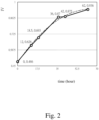
- the solid-state polymerized PET blend pellets are sampled for the tests of IV values after the solid-state polymerization process has been undertaken for 12 hours, 18.5 hours, 36 hours, 42 hours, and 62 hours.
- the measured IV values are plotted with respect to the time at which the solid-state polymerized PET blend pellets are sampled, and an interpolation and linear regression calculation is performed on the measured IV values to obtain the dashed curve shown in Fig.
- the IV values of the solid-state polymerized PET blend pellets sampled at different time point may be worked out to meet the requirement of the succeeding fabrication.
- the IV values of the solid-state polymerized PET blend pellets sampled at the time points after the process has been undertaken for 12 hours, 18.5 hours, 36 hours, 42 hours, and 62 hours are respectively 0.626, 0.693, 0.87, 0.875, and 0.936.
- the compatibilizer powder used in Embodiment I is also used in Embodiment II.
- the compatibilizer powder is added to rPET blend by a weight ratio of 150ppm.
- the compatibilizer powder and rPET blend are mixed homogeneously to form a mixture.
- the mixture is squeezed out by a twin-screw extruder to form "150ppm compatibilizer-rPET blend mixture granules".
- the pre-crystallization process is performed at a temperature of 135°C for a temperature holding time interval of 3 hours in a nitrogen and positive pressure environment.
- the solid-state polymerization process is performed at a temperature of 200°C in a nitrogen and positive pressure environment.
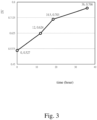
- the solid-state polymerized PET blend pellets are sampled for the tests of IV values after the solid-state polymerization process has been undertaken for 12 hours, 18.5 hours, and 36 hours.
- the measured IV values are plotted with respect to the time at which the solid-state polymerized PET blend pellets are sampled, and an interpolation and linear regression calculation is performed on the measured IV values to obtain a curve shown in Fig. 3 , whereby the IV values of the solid-state polymerized PET blend pellets sampled at different time point may be worked out to meet the requirement of the succeeding fabrication.
- the IV values of the solid-state polymerized PET blend pellets sampled at the time points after the process has been undertaken for 12 hours, 18.5 hours and 36 hours, 42 hours, and 62 hours are respectively 0.624, 0.703, and 0.766.
- the compatibilizer powder used in Embodiment III has a diameter of 10 ⁇ m and a specific surface area of 590 square meters per gram.
- the compatibilizer powder is added to rPET blend by a weight ratio of 500ppm.
- the compatibilizer powder and rPET blend are mixed homogeneously to form a mixture.
- the mixture is squeezed out by a twin-screw extruder to form 500ppm compatibilizer-rPET blend mixture granules.
- the pre-crystallization process is performed at a temperature of 135°C for a temperature holding time interval of 3 hours in a nitrogen and positive pressure environment.
- the solid-state polymerization process is performed at a temperature of 200°C in a nitrogen and positive pressure environment.
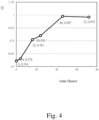
- the solid-state polymerized PET blend pellets are sampled for the tests of IV values after the process has been undertaken for 4 hours, 16 hours, 34 hours, 46 hours, and 72 hours, as shown in Fig. 4 .
- the IV values of the solid-state polymerized PET blend pellets sampled at the time points after the solid-state polymerization process has been undertaken for 4 hours, 16 hours, 34 hours, 46 hours, and 72 hours are respectively 0.576, 0.761, 0.8, 0.987 and 0.979.
- the concentration of the compatibilizer powder used in Embodiment III is two times the concentration of the compatibilizer powder used in Embodiment I.
- the compatibilizer powder used in Embodiment III has a diameter larger than the diameter of the compatibilizer powder used in Embodiment I, the rising modes of IV values of Embodiment III and Embodiment I are almost the same, and both the curves of IV values of Embodiment III and Embodiment I rise steeply. It indicates: the higher the concentration of the compatibilizer powder, the more effectively the IV value is raised. On the other hand, the smaller the diameter of the compatibilizer powder, the less the amount of the compatibilizer powder required to achieve the same IV value. In the case of a smaller diameter and a less amount of the compatibilizer powder, a longer time interval is needed to achieve the same IV value.
- Embodiment IV uses the compatibilizer powder having a diameter of 10 ⁇ m and a specific surface area of 590 square meters per gram, and the compatibilizer powder is added to rPET blend by a weight ratio of 500ppm.
- the compatibilizer powder and rPET blend are mixed homogeneously to form a mixture.
- the mixture is squeezed out by a twin-screw extruder to form 500ppm compatibilizer-rPET blend mixture granules.
- the pre-crystallization process is performed at a temperature of 135°C for a temperature holding time interval of 3 hours in an atmospheric environment.
- the solid-state polymerization process is performed at a temperature of 200°C in an atmospheric environment.
- the solid-state polymerized PET blend pellets are sampled for the tests of IV values after the solid-state polymerization process has been undertaken for 16 hours, 24 hours, and 46 hours. It is found: the IV values are too low to detect. It indicates that the atmospheric environment may cause PET to crack.
- the compatibilizer powder and the pre-crystallization process used in Embodiment V are the same as those used in Embodiment III.
- the solid-state polymerization process of Embodiment V is performed at a temperature of 200°C in a vacuum environment.
- the solid-state polymerized PET blend pellets are sampled for the test of the IV value after the solid-state polymerization process has been undertaken for 72 hours.
- the IV value is about 0.78. It indicates that the solid-state polymerization process is more efficient in the nitrogen environment than in the vacuum environment.
- Embodiment VI the processes used in Embodiment III are user to fabricate the samples of the solid-state polymerized PET blend pellets. After the solid-state polymerization process has been undertaken for 24 hours, the process is terminated to collect the samples.
- the samples fabricated with 200ppm compatibilizer have an IV value of 0.85.
- the solid-state polymerized PET blend pellets are used to fabricate tensile test specimens.
- the tensile test specimens are placed in a baker and treated with a second solid-state polymerization process (at a temperature of 200°C for a temperature holding time interval of 48 hours in a nitrogen and positive pressure environment).
- the test results show that the tensile strength is further increased.
- Table.1 shows the tensile test results of the test specimens of Embodiment VI and ordinary packing tapes.
- Table.1 Group Tensile strength (Kgf/cm2) Breaking elongation (%) Embodiment VI 4090 5.87 PET packing tape (high strength tape) 4000 8 ⁇ 12 PET packing tape (standard tape) 3500 12 ⁇ 18
- Embodiment VII the compatibilizer powder is added to the blend of rPET +rPE by a weight ratio of 500ppm; the compatibilizer powder and the blend of rPET+rPE are mixed homogeneously to fabricate solid-state polymerized PET blend pellets, wherein the proportions of rPET and rPE are respectively 80% and 20%.
- the melt index (MI) of the sample is 14.4 (according to the test method in ASTM D1238).
- the solid-state polymerized PET blend pellets are used to fabricate plastic faucets, as shown in Fig.5 .
- the plastic faucets are uniform in tincture. It indicates: the blend of rPET+rPE and the compatibilizer powder indeed become a homogeneous solution after pelletization. None of the faucets is damaged after more than 10 cycles of drop tests. It indicates that the products fabricated via mold-injecting the solid-state polymerized PET blend pellets have the strength and toughness meeting the utilization standard.
- the rPET blend processing method of the present invention is characterized in adding a porous carbon-structured compatibilizer to rPET blend; and controlling the parameters of a pre-crystallization process and a solid-state polymerization process to increase the crystallinity of the rPET blend and raise the IV value of the rPET blend to 0.6 and above.
Landscapes
- Chemical & Material Sciences (AREA)
- Health & Medical Sciences (AREA)
- Chemical Kinetics & Catalysis (AREA)
- Medicinal Chemistry (AREA)
- Polymers & Plastics (AREA)
- Organic Chemistry (AREA)
- Life Sciences & Earth Sciences (AREA)
- Sustainable Development (AREA)
- Polyesters Or Polycarbonates (AREA)
- Processing And Handling Of Plastics And Other Materials For Molding In General (AREA)
- Compositions Of Macromolecular Compounds (AREA)
- Separation, Recovery Or Treatment Of Waste Materials Containing Plastics (AREA)
Applications Claiming Priority (1)
| Application Number | Priority Date | Filing Date | Title |
|---|---|---|---|
| TW111113038 | 2022-04-06 |
Publications (3)
| Publication Number | Publication Date |
|---|---|
| EP4257637A1 true EP4257637A1 (fr) | 2023-10-11 |
| EP4257637B1 EP4257637B1 (fr) | 2024-07-10 |
| EP4257637C0 EP4257637C0 (fr) | 2024-07-10 |
Family
ID=85726295
Family Applications (1)
| Application Number | Title | Priority Date | Filing Date |
|---|---|---|---|
| EP23164046.7A Active EP4257637B1 (fr) | 2022-04-06 | 2023-03-24 | Procédé de traitement de mélange de pet recyclé |
Country Status (7)
| Country | Link |
|---|---|
| US (1) | US12371562B2 (fr) |
| EP (1) | EP4257637B1 (fr) |
| JP (1) | JP7465006B2 (fr) |
| KR (1) | KR20230143931A (fr) |
| CN (1) | CN116891620A (fr) |
| PL (1) | PL4257637T3 (fr) |
| TW (1) | TWI823653B (fr) |
Families Citing this family (1)
| Publication number | Priority date | Publication date | Assignee | Title |
|---|---|---|---|---|
| PL450641A1 (pl) * | 2024-12-19 | 2026-06-22 | Ergis Spółka Akcyjna | Sposób wytwarzania taśmy PET z tworzywa z dodatkiem recyklatu PET. |
Family Cites Families (10)
| Publication number | Priority date | Publication date | Assignee | Title |
|---|---|---|---|---|
| US6284808B1 (en) * | 1997-02-03 | 2001-09-04 | Illinois Tool Works Inc. | Inline solid state polymerization of PET flakes for manufacturing plastic strap by removing non-crystalline materials from recycled PET |
| AU734307B2 (en) * | 1998-01-21 | 2001-06-07 | Illinois Tool Works Inc. | Inline solid state polymerization of pet flakes for manufacturing plastic strip |
| AT505462B1 (de) * | 2006-11-13 | 2010-10-15 | Erema | Verfahren zur vorbehandlung, aufarbeitung bzw. recyclierung von thermoplastischem kunststoffmaterial |
| JP2011006521A (ja) * | 2009-06-23 | 2011-01-13 | S-Company:Kk | リサイクルpetペレットの製造方法、ペレット及びそれを用いた成形品 |
| MX380986B (es) * | 2013-02-12 | 2025-03-12 | Instituto Potosino De Investig Cientifica Y Tecnologica A C | Compatibilizante basado en redes interpenetradas polimericas (ipn) para reciclar mezclas de polimeros. |
| TWI633139B (zh) * | 2013-11-21 | 2018-08-21 | 鄒智揮 | 熱塑性樹脂之成核劑及熱塑性樹脂組成物 |
| CN104312112B (zh) * | 2014-11-06 | 2016-01-27 | 北京市第五建筑工程集团有限公司 | 一种聚酯聚乙烯合金塑料管材及其制备方法 |
| CN110093018A (zh) * | 2019-05-20 | 2019-08-06 | 福建师范大学 | 一种利用回收混纺纺织物制备的聚酯合金及其制备方法 |
| CN112175325A (zh) * | 2020-10-13 | 2021-01-05 | 马鞍山卓凡新材料科技有限公司 | 一种修复废旧塑料生产垃圾桶力学性能的加工工艺 |
| CN113150512A (zh) * | 2021-05-17 | 2021-07-23 | 上海纤苏新材料科技有限公司 | 一种连续长玻璃纤维对回收聚对苯二甲酸乙二醇酯/聚乙烯合金增强的制备方法 |
-
2022
- 2022-11-01 TW TW111141514A patent/TWI823653B/zh active
- 2022-11-01 JP JP2022175337A patent/JP7465006B2/ja active Active
- 2022-11-01 US US18/051,553 patent/US12371562B2/en active Active
-
2023
- 2023-02-02 CN CN202310078481.7A patent/CN116891620A/zh active Pending
- 2023-03-23 KR KR1020230038182A patent/KR20230143931A/ko active Pending
- 2023-03-24 PL PL23164046.7T patent/PL4257637T3/pl unknown
- 2023-03-24 EP EP23164046.7A patent/EP4257637B1/fr active Active
Non-Patent Citations (1)
| Title |
|---|
| AHMADLOUYDARAB MAJID ET AL: "Compatibilization of immiscible polymer blends (R-PET/PP) by adding PP-g-MA as compatibilizer: analysis of phase morphology and mechanical properties", POLYMER BULLETIN, SPRINGER, HEIDELBERG, DE, vol. 77, no. 11, 7 December 2019 (2019-12-07), pages 5753 - 5766, XP037267086, ISSN: 0170-0839, [retrieved on 20191207], DOI: 10.1007/S00289-019-03054-W * |
Also Published As
| Publication number | Publication date |
|---|---|
| JP7465006B2 (ja) | 2024-04-10 |
| EP4257637B1 (fr) | 2024-07-10 |
| PL4257637T3 (pl) | 2024-11-18 |
| EP4257637C0 (fr) | 2024-07-10 |
| US20230323113A1 (en) | 2023-10-12 |
| CN116891620A (zh) | 2023-10-17 |
| US12371562B2 (en) | 2025-07-29 |
| TWI823653B (zh) | 2023-11-21 |
| TW202340346A (zh) | 2023-10-16 |
| JP2023154378A (ja) | 2023-10-19 |
| KR20230143931A (ko) | 2023-10-13 |
Similar Documents
| Publication | Publication Date | Title |
|---|---|---|
| Pattanakul et al. | Properties of recycled high density polyethylene from milk bottles | |
| US8258239B2 (en) | Production method of polyethylene terephthalate graft copolymerized resin and molded product thereof | |
| US8314174B2 (en) | Dispersions of high carboxyl polyamides into polyesters using an interfacial tension reducing agent | |
| EP4257637B1 (fr) | Procédé de traitement de mélange de pet recyclé | |
| CN113025009A (zh) | 一种耐紫外老化的pbat材料及其制备方法 | |
| US11566103B2 (en) | Hyperbranched polylactide resin compositions | |
| CN101724242B (zh) | Ppc与pbat、pcl及pla共混物及制备方法 | |
| KR100953363B1 (ko) | 2정점 중합체의 향상된 제조 방법 | |
| CN111423689B (zh) | 一种改性聚丙烯材料及其制备方法与应用 | |
| CN101724251B (zh) | Ppc与pbat共混物及制备方法 | |
| Mamoor et al. | Recycling of mixed plastics waste containing polyethylene, polyvinylchloride and polyethylene terephthalate | |
| EP4389817A1 (fr) | Procédé de production d'une composition de polyéthylène basse densité mélangée comprenant des compositions de polymères recyclés | |
| CN113943387A (zh) | 无单体残留、高活性增粘扩链剂的制备方法及其应用 | |
| CN110964339B (zh) | 一种气密性良好的生物基复合材料薄膜制备方法 | |
| CN1286880C (zh) | 超韧性、高粘度尼龙6树脂的制备方法 | |
| KR100728087B1 (ko) | 반응압출을 이용한 폐 고밀도 폴리에틸렌의 재활용 방법 | |
| CN117567851B (zh) | 一种耐高温的可生物降解聚酯材料及其制备方法 | |
| EP4194499B1 (fr) | Nouveau procédé de recyclage de polyéthylène | |
| Kostov et al. | Rheological behaviour of recycled and virgin polyethyleneterephthalate and mixtures of them | |
| US7851553B2 (en) | Composition comprising at least two incompatible thermoplastic polymers and a compatibilizer, its method of preparation and its use | |
| TWI785690B (zh) | 回收固聚粒的製造方法及打包帶 | |
| US9018293B2 (en) | Dispersions of high carboxyl polyamides into polyesters | |
| KR100772290B1 (ko) | 비난연성 폴리올레핀 가교 발포체 조성물 | |
| EP4524190A1 (fr) | Composition de polymère recyclé | |
| Maund et al. | Mechanical properties and stability of recycled post-consumer poly (vinyl chloride) bottle compounds |
Legal Events
| Date | Code | Title | Description |
|---|---|---|---|
| PUAI | Public reference made under article 153(3) epc to a published international application that has entered the european phase |
Free format text: ORIGINAL CODE: 0009012 |
|
| STAA | Information on the status of an ep patent application or granted ep patent |
Free format text: STATUS: REQUEST FOR EXAMINATION WAS MADE |
|
| 17P | Request for examination filed |
Effective date: 20230324 |
|
| AK | Designated contracting states |
Kind code of ref document: A1 Designated state(s): AL AT BE BG CH CY CZ DE DK EE ES FI FR GB GR HR HU IE IS IT LI LT LU LV MC ME MK MT NL NO PL PT RO RS SE SI SK SM TR |
|
| GRAP | Despatch of communication of intention to grant a patent |
Free format text: ORIGINAL CODE: EPIDOSNIGR1 |
|
| STAA | Information on the status of an ep patent application or granted ep patent |
Free format text: STATUS: GRANT OF PATENT IS INTENDED |
|
| INTG | Intention to grant announced |
Effective date: 20240227 |
|
| GRAS | Grant fee paid |
Free format text: ORIGINAL CODE: EPIDOSNIGR3 |
|
| GRAA | (expected) grant |
Free format text: ORIGINAL CODE: 0009210 |
|
| STAA | Information on the status of an ep patent application or granted ep patent |
Free format text: STATUS: THE PATENT HAS BEEN GRANTED |
|
| AK | Designated contracting states |
Kind code of ref document: B1 Designated state(s): AL AT BE BG CH CY CZ DE DK EE ES FI FR GB GR HR HU IE IS IT LI LT LU LV MC ME MK MT NL NO PL PT RO RS SE SI SK SM TR |
|
| REG | Reference to a national code |
Ref country code: CH Ref legal event code: EP |
|
| REG | Reference to a national code |
Ref country code: DE Ref legal event code: R096 Ref document number: 602023000218 Country of ref document: DE |
|
| U01 | Request for unitary effect filed |
Effective date: 20240718 |
|
| U07 | Unitary effect registered |
Designated state(s): AT BE BG DE DK EE FI FR IT LT LU LV MT NL PT RO SE SI Effective date: 20240902 |
|
| PG25 | Lapsed in a contracting state [announced via postgrant information from national office to epo] |
Ref country code: NO Free format text: LAPSE BECAUSE OF FAILURE TO SUBMIT A TRANSLATION OF THE DESCRIPTION OR TO PAY THE FEE WITHIN THE PRESCRIBED TIME-LIMIT Effective date: 20241010 |
|
| PG25 | Lapsed in a contracting state [announced via postgrant information from national office to epo] |
Ref country code: GR Free format text: LAPSE BECAUSE OF FAILURE TO SUBMIT A TRANSLATION OF THE DESCRIPTION OR TO PAY THE FEE WITHIN THE PRESCRIBED TIME-LIMIT Effective date: 20241011 |
|
| PG25 | Lapsed in a contracting state [announced via postgrant information from national office to epo] |
Ref country code: IS Free format text: LAPSE BECAUSE OF FAILURE TO SUBMIT A TRANSLATION OF THE DESCRIPTION OR TO PAY THE FEE WITHIN THE PRESCRIBED TIME-LIMIT Effective date: 20241110 |
|
| PG25 | Lapsed in a contracting state [announced via postgrant information from national office to epo] |
Ref country code: HR Free format text: LAPSE BECAUSE OF FAILURE TO SUBMIT A TRANSLATION OF THE DESCRIPTION OR TO PAY THE FEE WITHIN THE PRESCRIBED TIME-LIMIT Effective date: 20240710 |
|
| PG25 | Lapsed in a contracting state [announced via postgrant information from national office to epo] |
Ref country code: RS Free format text: LAPSE BECAUSE OF FAILURE TO SUBMIT A TRANSLATION OF THE DESCRIPTION OR TO PAY THE FEE WITHIN THE PRESCRIBED TIME-LIMIT Effective date: 20241010 Ref country code: ES Free format text: LAPSE BECAUSE OF FAILURE TO SUBMIT A TRANSLATION OF THE DESCRIPTION OR TO PAY THE FEE WITHIN THE PRESCRIBED TIME-LIMIT Effective date: 20240710 |
|
| PG25 | Lapsed in a contracting state [announced via postgrant information from national office to epo] |
Ref country code: RS Free format text: LAPSE BECAUSE OF FAILURE TO SUBMIT A TRANSLATION OF THE DESCRIPTION OR TO PAY THE FEE WITHIN THE PRESCRIBED TIME-LIMIT Effective date: 20241010 Ref country code: NO Free format text: LAPSE BECAUSE OF FAILURE TO SUBMIT A TRANSLATION OF THE DESCRIPTION OR TO PAY THE FEE WITHIN THE PRESCRIBED TIME-LIMIT Effective date: 20241010 Ref country code: IS Free format text: LAPSE BECAUSE OF FAILURE TO SUBMIT A TRANSLATION OF THE DESCRIPTION OR TO PAY THE FEE WITHIN THE PRESCRIBED TIME-LIMIT Effective date: 20241110 Ref country code: HR Free format text: LAPSE BECAUSE OF FAILURE TO SUBMIT A TRANSLATION OF THE DESCRIPTION OR TO PAY THE FEE WITHIN THE PRESCRIBED TIME-LIMIT Effective date: 20240710 Ref country code: GR Free format text: LAPSE BECAUSE OF FAILURE TO SUBMIT A TRANSLATION OF THE DESCRIPTION OR TO PAY THE FEE WITHIN THE PRESCRIBED TIME-LIMIT Effective date: 20241011 Ref country code: ES Free format text: LAPSE BECAUSE OF FAILURE TO SUBMIT A TRANSLATION OF THE DESCRIPTION OR TO PAY THE FEE WITHIN THE PRESCRIBED TIME-LIMIT Effective date: 20240710 |
|
| U20 | Renewal fee for the european patent with unitary effect paid |
Year of fee payment: 3 Effective date: 20250122 |
|
| PG25 | Lapsed in a contracting state [announced via postgrant information from national office to epo] |
Ref country code: SM Free format text: LAPSE BECAUSE OF FAILURE TO SUBMIT A TRANSLATION OF THE DESCRIPTION OR TO PAY THE FEE WITHIN THE PRESCRIBED TIME-LIMIT Effective date: 20240710 |
|
| PG25 | Lapsed in a contracting state [announced via postgrant information from national office to epo] |
Ref country code: SK Free format text: LAPSE BECAUSE OF FAILURE TO SUBMIT A TRANSLATION OF THE DESCRIPTION OR TO PAY THE FEE WITHIN THE PRESCRIBED TIME-LIMIT Effective date: 20240710 |
|
| PLBE | No opposition filed within time limit |
Free format text: ORIGINAL CODE: 0009261 |
|
| STAA | Information on the status of an ep patent application or granted ep patent |
Free format text: STATUS: NO OPPOSITION FILED WITHIN TIME LIMIT |
|
| 26N | No opposition filed |
Effective date: 20250411 |
|
| PG25 | Lapsed in a contracting state [announced via postgrant information from national office to epo] |
Ref country code: MC Free format text: LAPSE BECAUSE OF FAILURE TO SUBMIT A TRANSLATION OF THE DESCRIPTION OR TO PAY THE FEE WITHIN THE PRESCRIBED TIME-LIMIT Effective date: 20240710 |
|
| PG25 | Lapsed in a contracting state [announced via postgrant information from national office to epo] |
Ref country code: IE Free format text: LAPSE BECAUSE OF NON-PAYMENT OF DUE FEES Effective date: 20250324 |
|
| PGFP | Annual fee paid to national office [announced via postgrant information from national office to epo] |
Ref country code: TR Payment date: 20260323 Year of fee payment: 4 |
|
| PGFP | Annual fee paid to national office [announced via postgrant information from national office to epo] |
Ref country code: CZ Payment date: 20260320 Year of fee payment: 4 |
|
| PGFP | Annual fee paid to national office [announced via postgrant information from national office to epo] |
Ref country code: PL Payment date: 20260319 Year of fee payment: 4 |
|
| U20 | Renewal fee for the european patent with unitary effect paid |
Year of fee payment: 4 Effective date: 20260326 |
|
| PG25 | Lapsed in a contracting state [announced via postgrant information from national office to epo] |
Ref country code: CY Free format text: LAPSE BECAUSE OF FAILURE TO SUBMIT A TRANSLATION OF THE DESCRIPTION OR TO PAY THE FEE WITHIN THE PRESCRIBED TIME-LIMIT Effective date: 20240710 |