EP4257665A2 - Opazifizierter schaumwein und verfahren zur herstellung davon - Google Patents
Opazifizierter schaumwein und verfahren zur herstellung davon Download PDFInfo
- Publication number
- EP4257665A2 EP4257665A2 EP23189313.2A EP23189313A EP4257665A2 EP 4257665 A2 EP4257665 A2 EP 4257665A2 EP 23189313 A EP23189313 A EP 23189313A EP 4257665 A2 EP4257665 A2 EP 4257665A2
- Authority
- EP
- European Patent Office
- Prior art keywords
- oenological
- activated carbon
- suspension
- finely divided
- concentrate
- Prior art date
- Legal status (The legal status is an assumption and is not a legal conclusion. Google has not performed a legal analysis and makes no representation as to the accuracy of the status listed.)
- Pending
Links
Images

Classifications
-
- C—CHEMISTRY; METALLURGY
- C01—INORGANIC CHEMISTRY
- C01B—NON-METALLIC ELEMENTS; COMPOUNDS THEREOF; METALLOIDS OR COMPOUNDS THEREOF NOT COVERED BY SUBCLASS C01C
- C01B32/00—Carbon; Compounds thereof
- C01B32/30—Active carbon
- C01B32/354—After-treatment
-
- C—CHEMISTRY; METALLURGY
- C12—BIOCHEMISTRY; BEER; SPIRITS; WINE; VINEGAR; MICROBIOLOGY; ENZYMOLOGY; MUTATION OR GENETIC ENGINEERING
- C12G—WINE; PREPARATION THEREOF; ALCOHOLIC BEVERAGES; PREPARATION OF ALCOHOLIC BEVERAGES NOT PROVIDED FOR IN SUBCLASSES C12C OR C12H
- C12G1/00—Preparation of wine or sparkling wine
- C12G1/06—Preparation of sparkling wine; Impregnation of wine with carbon dioxide
-
- C—CHEMISTRY; METALLURGY
- C01—INORGANIC CHEMISTRY
- C01B—NON-METALLIC ELEMENTS; COMPOUNDS THEREOF; METALLOIDS OR COMPOUNDS THEREOF NOT COVERED BY SUBCLASS C01C
- C01B32/00—Carbon; Compounds thereof
- C01B32/30—Active carbon
-
- C—CHEMISTRY; METALLURGY
- C01—INORGANIC CHEMISTRY
- C01B—NON-METALLIC ELEMENTS; COMPOUNDS THEREOF; METALLOIDS OR COMPOUNDS THEREOF NOT COVERED BY SUBCLASS C01C
- C01B32/00—Carbon; Compounds thereof
- C01B32/30—Active carbon
- C01B32/312—Preparation
-
- C—CHEMISTRY; METALLURGY
- C12—BIOCHEMISTRY; BEER; SPIRITS; WINE; VINEGAR; MICROBIOLOGY; ENZYMOLOGY; MUTATION OR GENETIC ENGINEERING
- C12H—PASTEURISATION, STERILISATION, PRESERVATION, PURIFICATION, CLARIFICATION OR AGEING OF ALCOHOLIC BEVERAGES; METHODS FOR ALTERING THE ALCOHOL CONTENT OF FERMENTED SOLUTIONS OR ALCOHOLIC BEVERAGES
- C12H1/00—Pasteurisation, sterilisation, preservation, purification, clarification, or ageing of alcoholic beverages
- C12H1/02—Pasteurisation, sterilisation, preservation, purification, clarification, or ageing of alcoholic beverages combined with removal of precipitate or added materials, e.g. adsorption material
- C12H1/04—Pasteurisation, sterilisation, preservation, purification, clarification, or ageing of alcoholic beverages combined with removal of precipitate or added materials, e.g. adsorption material with the aid of ion-exchange material or inert clarification material, e.g. adsorption material
- C12H1/0408—Pasteurisation, sterilisation, preservation, purification, clarification, or ageing of alcoholic beverages combined with removal of precipitate or added materials, e.g. adsorption material with the aid of ion-exchange material or inert clarification material, e.g. adsorption material with the aid of inorganic added material
-
- C—CHEMISTRY; METALLURGY
- C01—INORGANIC CHEMISTRY
- C01P—INDEXING SCHEME RELATING TO STRUCTURAL AND PHYSICAL ASPECTS OF SOLID INORGANIC COMPOUNDS
- C01P2004/00—Particle morphology
- C01P2004/60—Particles characterised by their size
- C01P2004/61—Micrometer sized, i.e. from 1-100 micrometer
-
- C—CHEMISTRY; METALLURGY
- C01—INORGANIC CHEMISTRY
- C01P—INDEXING SCHEME RELATING TO STRUCTURAL AND PHYSICAL ASPECTS OF SOLID INORGANIC COMPOUNDS
- C01P2004/00—Particle morphology
- C01P2004/60—Particles characterised by their size
- C01P2004/62—Submicrometer sized, i.e. from 0.1-1 micrometer
-
- C—CHEMISTRY; METALLURGY
- C12—BIOCHEMISTRY; BEER; SPIRITS; WINE; VINEGAR; MICROBIOLOGY; ENZYMOLOGY; MUTATION OR GENETIC ENGINEERING
- C12G—WINE; PREPARATION THEREOF; ALCOHOLIC BEVERAGES; PREPARATION OF ALCOHOLIC BEVERAGES NOT PROVIDED FOR IN SUBCLASSES C12C OR C12H
- C12G2200/00—Special features
- C12G2200/21—Wine additives, e.g. flavouring or colouring agents
Definitions
- the present invention relates to a sparkling wine and its production process, sparkling white wine packaged in a bottle.
- Special wines include sparkling wines, coming from grapes, musts or wines treated according to techniques accepted by the OIV, characterized, upon uncorking, by the production of a more or less persistent foam resulting from a release of dioxide carbon of exclusively endogenous origin.
- the excess pressure of this gas in the bottle is at least equal to 3.5 bars at 20°C. However, for bottles with a capacity of less than 0.25 1, the minimum overpressure is reduced to 3 bars at 20°C.
- Sparkling wines are also defined and regulated by EC Regulation 478/2008 which describes eight main categories of sparkling wines.
- Sparkling wines are, for example, obtained according to the traditional method, commonly called the Champagne method, which can be summarized in a few steps including the fermentation of the must then the still wine is bottled with a liqueur and leavens in order to a second fermentation. After a minimum of fifteen months of aging, the bottles are stirred (remuage) then disgorged (disgorgement) and before final corking (cork), the expedition liqueur is added.
- This sparkling wine is available either in white or rosé.
- the quantitative characteristics of these colors are not referenced in any codex or technical charter.
- CAO oenological activated carbon
- This activated carbon is defined by the International CEnological Codex (INS: 53; OENO 7/2007). It is used to decolorize musts or deodorize them. It can also be used for wines. From the wines, the carbon is extracted by stages of filtration, fining and/or centrifugation.
- the activated carbon added if necessary to the must having absorbed the chemical components having a negative influence on the health or sensory level, is evacuated with the deposits of the must from the tank after various operations such as racking.
- the wine collected from the vat no longer contains oenological activated carbon.
- the aim of the present invention is to develop an effervescent, cloudy, stable white wine and means to obtain such a wine in particular.
- the subject of the invention is a sparkling white wine packaged in a bottle, characterized in that it contains a dose of activated carbon which does not alter the organoleptic properties of the wine, the dose of opacifier consisting of a suspension in a food liquid, of finely divided oenological activated carbon, having a particle size less than or equal to 5 ⁇ m.
- the finely divided oenological carbon has a particle size less than 3 ⁇ m for 90% of the oenological activated carbon particles.
- the particle size of the oenological activated carbon according to the invention is a particle size measured, for example, by the laser particle size method. This process consists of determining the volume average diameter Dv of the oenological activated carbon particles. This measurement is the average diameter of a sphere enveloping a grain of oenological activated carbon in its finely divided state.
- the food liquid is distilled water or wine.
- the concentration of finely divided oenological activated carbon in the dose is between 5 and 50 mg.
- the invention also relates to a process for producing an opaque sparkling white wine.
- This process is characterized by the addition of a dose of opacifier, before the final stage of corking, which consists of a suspension of finely divided oenological activated carbon in a food liquid, the concentrate resulting from sonication is filtered filtration with a 5 ⁇ m filter.
- the process of producing an effervescent white wine consists of adding at the time of drawing, a dose of opacifier which consists of a suspension of finely divided oenological activated carbon in a food liquid, the filter is filtered. concentrate resulting from sonication to filtration with a 5 ⁇ m filter.
- the invention also relates to a suspension of finely divided oenological activated carbon in a food liquid, the concentrate resulting from sonication is filtered by filtration with a 5 ⁇ m filter.
- the invention also relates to a suspension for dosing an sparkling white wine with activated carbon consisting of using a suspension of 20 g/l of finely divided oenological activated carbon.
- the process for producing a sparkling white wine is characterized in that at the first so-called alcoholic fermentation, a dose of between 0.01 - 1 g/L of finely divided oenological activated carbon (S'2) is added. , having a particle size less than or equal to 5 ⁇ m.
- the process for producing a sparkling white wine is characterized in that at the clarification stage a dose of between 0.01 - 1 g/L of finely divided oenological activated carbon (S'2) is added , having a particle size less than or equal to 5 ⁇ m.
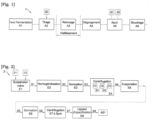
- the production process according to the traditional method of sparkling white wine 1, opacified, presented in the bottle consists of carrying out a first fermentation of the must A1, then the drawing of still wine A2 in the bottle with the addition of a drawing liquor and A21 sourdoughs as well as glue or stirring aid.
- Bottled wine ages for at least fifteen months. At the end of this aging period, the deposits accumulated in the neck of the bottle following the riddling stage are eliminated during disgorging A4.
- the expedition (or dosage) liqueur A51 is added before marketing.
- a dose of opacifier A52 is added at the same time or with the dosage liquor A51 which does not alter the organoleptic properties of the wine. Then the bottle is corked.
- FIG. 2 shows the diagram of an example of a process for preparing an oenological activated carbon and a process for producing 2 the dosage liquor to opacify a sparkling white wine.
- Process 2 begins with a step of preparing a mother suspension E1 of oenological activated carbon E11 in food liquid E12 such as distilled water or better still wine.
- Oenological activated carbon E11 is of plant origin in the powder state of fine particles of size between 1 and 100 ⁇ m. This oenological activated carbon meets the requirements of the international oenological CODEX (SIN 153 OENO7/2007; OIV-OEN 604/218). This suspension of oenological activated carbon S1 thus prepared will undergo several treatments to obtain a suspension of finely divided oenological activated carbon forming the dosage liquor as fine as possible having filtered the concentrate resulting from sonication through filtration with a 5 ⁇ m filter.
- the S1 stock suspension is prepared with a concentration of the order of 1 to 100 g/L.
- the mother suspension S1 is then first homogenized E2 by mechanical stirring for example.
- the homogenized mother suspension S2 is sonicated with ultrasound for three hours E3 to obtain a suspension based on defragmented CAO S3.
- a first centrifugation step E41 carried out at a rotation speed of the order of 1200 RCF for a duration of the order of 30 minutes, the supernatant S41 is collected, that is to say a volume of suspension in the upper part of the jar used for centrifugation.
- This supernatant is subjected to a new centrifugation step E42 at S41 to collect a new supernatant S42.
- centrifugation steps E4 reducing the volume of liquid, several series of centrifugation are carried out in parallel to ultimately obtain by addition, a final supernatant volume S4.
- the filtered supernatant is then reduced by E5 evaporation with a reduction rate giving between 1 and 2% S5 concentrate.
- the centrifugation steps are carried out for a duration of around 30-180 minutes at speeds of around 500-2200 RCF.
- the supernatants are monitored by measurements of the optical density OD at 620nm.
- the S5 concentrate is sonicated with ultrasound for three hours E6 to finally obtain a defragmented S6 concentrate.
- the final concentrate S7 resulting from this step E7 is filtered with a filter retaining particles larger than 5 microns.
- the analysis of the finely divided oenological activated carbon thus obtained was carried out by laser granulometry. It showed that the volume average diameter Dv of finely divided oenological activated carbon particles was less than 3 microns for 90% of the particles.
- the volume average diameter is, by definition, the diameter of the envelope sphere or sphere circumscribed by a grain of activated carbon analyzed. Tests have shown that the finely divided oenological activated carbon according to the invention remains in suspension in a particularly stable manner in the wine.
- the concentrate S7 thus collected is added E8 with a supplement of food liquid to obtain the dosage suspension S8 (dosage liquor).
- This S8 dosage suspension is added A5 to the bottled and disgorged white wine, before final corking, in parallel or with the dosage / shipping liqueur.
- the concentration of oenological activated carbon in a dose is between 5 and 50 mg/L
- the concentration of the dosing liquor is advantageously between 0.01 and 10 g/L of finely divided oenological charcoal.
- FIG. 3 shows the diagram of a variant of the process for preparing an oenological activated carbon and a process for producing the dosing liquor to opacify a sparkling white wine.
- Process 3 begins with a step of preparing a mother suspension E'1 of oenological activated carbon E'11 in food liquid E'12 such as distilled water or better still wine.
- Oenological activated carbon E'11 is of plant origin in the powder state of fine particles of size between 1 and 100 ⁇ m. This oenological activated carbon meets the requirements of the international oenological CODEX (SIN 153 OENO7/2007; OIV-OEN 604/218). This suspension of oenological activated carbon S'1 thus prepared will undergo several treatments to obtain a suspension of finely divided oenological activated carbon forming the dosage liquor as fine as possible.
- the S'1 stock suspension is prepared with a concentration of around 50 to 1000 g/L.
- the mother suspension S'1 is then finely ground or micronized E'2 using a horizontal microbead mill, for example a Netzsch Labstar mill, using metal or metal oxide microbeads with a diameter of between 100 - 1000 ⁇ m.
- the filling rate of the crusher is between 10 - 90% of its capacity and the rotation speed is between 1000 - 5000 rpm.
- the grinding time is between 1 - 24 hours to reach a final carbon content in the mother suspension S'2 of between 1 - 20% in mass concentration.
- the micronized mother suspension S'2 is diluted E'3 in food liquid E'13 such as demineralized water.
- micronized and diluted mother suspension S'3 is disaggregated by ultrasonic homogenization for a period of between 1 and 15 min E'4 to obtain a suspension based on defragmented oenological activated carbon S'4.
- the concentrate obtained S'6 is again disaggregated by a first step of homogenization by ultrasound for a period of between 1 - 15 min E'7 then the resulting S'7 is again subjected to another step of sonication in baths at ultrasound for a period of between 1 - 3 h E'8.
- the time for the ultrasonic homogenization stage is quite short given the energy provided by the probe, in order to avoid any caramelization of the liquor.
- the concentrate obtained S'8 is finally filtered on 5 ⁇ m E'9 filters retaining particles larger than 5 ⁇ m in order to obtain a filtered concentrate S'9 with particles smaller than 5 ⁇ m.
- the filtered concentrate is subjected to an E'10 centrifugation to collect a final S'10 supernatant.
- the centrifugation step is carried out at a rotation speed of between 2000 - 4000 rpm for a duration of around 30 - 180 minutes.
- the supernatant S'10 that is to say a volume of suspension, is collected in the upper part of the tube used for centrifugation.
- the opacification liquor is finally obtained.
- the analysis of the size distribution of the activated carbon thus finely divided was carried out by laser granulometry. It shows that the volume average diameter Dv of finely divided oenological activated carbon particles was less than 0.33 microns for 50% of the particles (The volume average diameter is, by definition, the diameter of the envelope sphere or sphere circumscribed by a grain of activated carbon analyzed). Tests have shown that the finely divided oenological activated carbon according to the invention remains in suspension in a particularly stable manner in the wine.
- This S'10 dosing opacification liqueur is added A5 to the bottled and disgorged white wine, before final corking, in parallel or with the dosing/expedition liqueur.
- the final charcoal concentration is between 1 and 50 mg in a 750 mL bottle.
- the concentration of the dosing liquor is advantageously between 0.01 and 50 g/L of finely divided oenological charcoal.
Landscapes
- Chemical & Material Sciences (AREA)
- Organic Chemistry (AREA)
- Inorganic Chemistry (AREA)
- Engineering & Computer Science (AREA)
- General Engineering & Computer Science (AREA)
- Zoology (AREA)
- Biochemistry (AREA)
- Bioinformatics & Cheminformatics (AREA)
- Health & Medical Sciences (AREA)
- General Health & Medical Sciences (AREA)
- Genetics & Genomics (AREA)
- Life Sciences & Earth Sciences (AREA)
- Wood Science & Technology (AREA)
- Food Science & Technology (AREA)
- Distillation Of Fermentation Liquor, Processing Of Alcohols, Vinegar And Beer (AREA)
- Alcoholic Beverages (AREA)
- Carbon And Carbon Compounds (AREA)
- Food Preservation Except Freezing, Refrigeration, And Drying (AREA)
Applications Claiming Priority (3)
| Application Number | Priority Date | Filing Date | Title |
|---|---|---|---|
| FR2006897A FR3111885A3 (fr) | 2020-06-30 | 2020-06-30 | Vin blanc effervescent opacifié et son procédé d’élaboration |
| PCT/FR2021/051196 WO2022003292A1 (fr) | 2020-06-30 | 2021-06-29 | Vin blanc effervescent opacifié et son procédé d'élaboration |
| EP21745372.9A EP4172302A1 (de) | 2020-06-30 | 2021-06-29 | Opazifizierter schaumwein und verfahren zur herstellung davon |
Related Parent Applications (1)
| Application Number | Title | Priority Date | Filing Date |
|---|---|---|---|
| EP21745372.9A Division EP4172302A1 (de) | 2020-06-30 | 2021-06-29 | Opazifizierter schaumwein und verfahren zur herstellung davon |
Publications (2)
| Publication Number | Publication Date |
|---|---|
| EP4257665A2 true EP4257665A2 (de) | 2023-10-11 |
| EP4257665A3 EP4257665A3 (de) | 2023-12-27 |
Family
ID=77021647
Family Applications (2)
| Application Number | Title | Priority Date | Filing Date |
|---|---|---|---|
| EP21745372.9A Pending EP4172302A1 (de) | 2020-06-30 | 2021-06-29 | Opazifizierter schaumwein und verfahren zur herstellung davon |
| EP23189313.2A Pending EP4257665A3 (de) | 2020-06-30 | 2021-06-29 | Opazifizierter schaumwein und verfahren zur herstellung davon |
Family Applications Before (1)
| Application Number | Title | Priority Date | Filing Date |
|---|---|---|---|
| EP21745372.9A Pending EP4172302A1 (de) | 2020-06-30 | 2021-06-29 | Opazifizierter schaumwein und verfahren zur herstellung davon |
Country Status (6)
| Country | Link |
|---|---|
| US (1) | US12624321B2 (de) |
| EP (2) | EP4172302A1 (de) |
| AU (1) | AU2021298915A1 (de) |
| CL (1) | CL2022003794A1 (de) |
| FR (3) | FR3111885A3 (de) |
| WO (1) | WO2022003292A1 (de) |
Family Cites Families (4)
| Publication number | Priority date | Publication date | Assignee | Title |
|---|---|---|---|---|
| FR2689903B1 (fr) * | 1992-04-10 | 1995-07-07 | Guillon Thierry | Procede et dispositif de decoloration et de filtration des mouts et des vins blancs taches, obtenus, notamment, a partir de raisins noirs. |
| JP6302080B2 (ja) * | 2014-01-21 | 2018-03-28 | キャボット コーポレイションCabot Corporation | 微粒子サイズの活性炭 |
| CN108455600B (zh) * | 2018-03-07 | 2021-04-27 | 郑州大学 | 一种生物质分级多孔碳材料的制备方法 |
| CN108862278A (zh) * | 2018-05-29 | 2018-11-23 | 木林森活性炭江苏有限公司 | 一种酒类专用活性炭的生产方法 |
-
2020
- 2020-06-30 FR FR2006897A patent/FR3111885A3/fr not_active Ceased
-
2021
- 2021-06-24 FR FR2106766A patent/FR3111884B1/fr active Active
- 2021-06-29 US US18/003,537 patent/US12624321B2/en active Active
- 2021-06-29 EP EP21745372.9A patent/EP4172302A1/de active Pending
- 2021-06-29 AU AU2021298915A patent/AU2021298915A1/en active Pending
- 2021-06-29 EP EP23189313.2A patent/EP4257665A3/de active Pending
- 2021-06-29 WO PCT/FR2021/051196 patent/WO2022003292A1/fr not_active Ceased
-
2022
- 2022-12-12 FR FR2213201A patent/FR3130266A1/fr active Pending
- 2022-12-28 CL CL2022003794A patent/CL2022003794A1/es unknown
Also Published As
| Publication number | Publication date |
|---|---|
| FR3130266A1 (fr) | 2023-06-16 |
| US12624321B2 (en) | 2026-05-12 |
| NZ795909A (en) | 2026-01-30 |
| BR112022026407A2 (pt) | 2023-03-14 |
| AU2021298915A1 (en) | 2023-02-02 |
| WO2022003292A1 (fr) | 2022-01-06 |
| EP4257665A3 (de) | 2023-12-27 |
| US20230272315A1 (en) | 2023-08-31 |
| FR3111884A1 (fr) | 2021-12-31 |
| FR3111885A3 (fr) | 2021-12-31 |
| EP4172302A1 (de) | 2023-05-03 |
| FR3111884B1 (fr) | 2024-04-12 |
| CL2022003794A1 (es) | 2023-05-19 |
Similar Documents
| Publication | Publication Date | Title |
|---|---|---|
| TWI573868B (zh) | Alcoholic beverages containing juices containing fruit juice | |
| CN106867740A (zh) | 一种干红、桃红葡萄酒的联动酿造工艺 | |
| Schneider et al. | Orange wines: Tannin extraction kinetics during maceration of white grapes | |
| CN103103049B (zh) | 桑椹白兰地及工艺 | |
| FR3111884A1 (fr) | Vin blanc effervescent opacifié et son procédé d’élaboration | |
| KR0140040B1 (ko) | 배를 이용한 증류주 제조방법 | |
| JP7038028B2 (ja) | 選択的光透過抑制容器入りアルコール飲料 | |
| KR100874717B1 (ko) | 혼합 과실 캠벨 포도주 | |
| Capounova et al. | Comparison of some commercial pectic enzyme preparations applicable in wine technology | |
| Awe | Effect of clarifying agents (gelatin and kaolin) on fruit wine production | |
| Nogueira et al. | Slow fermentation in French cider processing due to partial biomass reduction | |
| EP1236795B1 (de) | Verbessertes Weinbereitungsverfahren | |
| RU2853928C1 (ru) | Дымчатое игристое белое вино и способ его производства | |
| RU2218389C2 (ru) | Способ переработки плодово-ягодного сырья | |
| EP3353285B1 (de) | Hefestämme für fermentierte getränke und insbesondere für wein | |
| EP1848792A1 (de) | Verfahren zur herstellung eines getränks | |
| RU2254368C1 (ru) | Способ производства специального вина | |
| Iwouno et al. | Evaluation of dealcoholized beverage from pineapple wine and sorghum beer | |
| SU1668385A1 (ru) | Способ созревани виноматериала при производстве красных столовых вин | |
| JPH0678741A (ja) | ワインの製造方法 | |
| EP3561047A1 (de) | Verfahren zur herstellung einer inaktiven hefe zur verwendung in der önologie | |
| JP7300183B2 (ja) | ワインの製造方法 | |
| MD1784Z (ro) | Procedeu de fabricare a vinului materie primă | |
| JP2001245650A (ja) | 酒類の製造方法 | |
| FR2654742A1 (fr) | Boissons a base de mout de raisin partiellement fermente. |
Legal Events
| Date | Code | Title | Description |
|---|---|---|---|
| PUAI | Public reference made under article 153(3) epc to a published international application that has entered the european phase |
Free format text: ORIGINAL CODE: 0009012 |
|
| STAA | Information on the status of an ep patent application or granted ep patent |
Free format text: STATUS: REQUEST FOR EXAMINATION WAS MADE |
|
| 17P | Request for examination filed |
Effective date: 20230808 |
|
| AC | Divisional application: reference to earlier application |
Ref document number: 4172302 Country of ref document: EP Kind code of ref document: P |
|
| AK | Designated contracting states |
Kind code of ref document: A2 Designated state(s): AL AT BE BG CH CY CZ DE DK EE ES FI FR GB GR HR HU IE IS IT LI LT LU LV MC MK MT NL NO PL PT RO RS SE SI SK SM TR |
|
| REG | Reference to a national code |
Ref country code: DE Ref legal event code: R079 Free format text: PREVIOUS MAIN CLASS: C12H0001070000 Ipc: C01B0032354000 |
|
| PUAL | Search report despatched |
Free format text: ORIGINAL CODE: 0009013 |
|
| AK | Designated contracting states |
Kind code of ref document: A3 Designated state(s): AL AT BE BG CH CY CZ DE DK EE ES FI FR GB GR HR HU IE IS IT LI LT LU LV MC MK MT NL NO PL PT RO RS SE SI SK SM TR |
|
| RIC1 | Information provided on ipc code assigned before grant |
Ipc: C01B 32/384 20170101ALI20231117BHEP Ipc: C01B 32/378 20170101ALI20231117BHEP Ipc: C01B 32/354 20170101AFI20231117BHEP |