EP4257964A1 - Appareil de détection pour la position d'un matériau étranger dans un élément de batterie à basse tension et procédé d'analyse l'utilisant - Google Patents
Appareil de détection pour la position d'un matériau étranger dans un élément de batterie à basse tension et procédé d'analyse l'utilisant Download PDFInfo
- Publication number
- EP4257964A1 EP4257964A1 EP22911702.3A EP22911702A EP4257964A1 EP 4257964 A1 EP4257964 A1 EP 4257964A1 EP 22911702 A EP22911702 A EP 22911702A EP 4257964 A1 EP4257964 A1 EP 4257964A1
- Authority
- EP
- European Patent Office
- Prior art keywords
- low
- foreign material
- battery cell
- voltage
- location
- Prior art date
- Legal status (The legal status is an assumption and is not a legal conclusion. Google has not performed a legal analysis and makes no representation as to the accuracy of the status listed.)
- Pending
Links
Images




Classifications
-
- G—PHYSICS
- G01—MEASURING; TESTING
- G01N—INVESTIGATING OR ANALYSING MATERIALS BY DETERMINING THEIR CHEMICAL OR PHYSICAL PROPERTIES
- G01N27/00—Investigating or analysing materials by the use of electric, electrochemical, or magnetic means
- G01N27/60—Investigating or analysing materials by the use of electric, electrochemical, or magnetic means by investigating electrostatic variables, e.g. electrographic flaw testing
- G01N27/61—Investigating the presence of flaws
-
- G—PHYSICS
- G01—MEASURING; TESTING
- G01N—INVESTIGATING OR ANALYSING MATERIALS BY DETERMINING THEIR CHEMICAL OR PHYSICAL PROPERTIES
- G01N27/00—Investigating or analysing materials by the use of electric, electrochemical, or magnetic means
- G01N27/02—Investigating or analysing materials by the use of electric, electrochemical, or magnetic means by investigating impedance
- G01N27/04—Investigating or analysing materials by the use of electric, electrochemical, or magnetic means by investigating impedance by investigating resistance
- G01N27/20—Investigating the presence of flaws
-
- G—PHYSICS
- G01—MEASURING; TESTING
- G01R—MEASURING ELECTRIC VARIABLES; MEASURING MAGNETIC VARIABLES
- G01R31/00—Arrangements for testing electric properties; Arrangements for locating electric faults; Arrangements for electrical testing characterised by what is being tested not provided for elsewhere
- G01R31/36—Arrangements for testing, measuring or monitoring the electrical condition of accumulators or electric batteries, e.g. capacity or state of charge [SoC]
- G01R31/382—Arrangements for monitoring battery or accumulator variables, e.g. SoC
-
- G—PHYSICS
- G01—MEASURING; TESTING
- G01R—MEASURING ELECTRIC VARIABLES; MEASURING MAGNETIC VARIABLES
- G01R31/00—Arrangements for testing electric properties; Arrangements for locating electric faults; Arrangements for electrical testing characterised by what is being tested not provided for elsewhere
- G01R31/36—Arrangements for testing, measuring or monitoring the electrical condition of accumulators or electric batteries, e.g. capacity or state of charge [SoC]
- G01R31/392—Determining battery ageing or deterioration, e.g. state of health
-
- G—PHYSICS
- G01—MEASURING; TESTING
- G01R—MEASURING ELECTRIC VARIABLES; MEASURING MAGNETIC VARIABLES
- G01R31/00—Arrangements for testing electric properties; Arrangements for locating electric faults; Arrangements for electrical testing characterised by what is being tested not provided for elsewhere
- G01R31/50—Testing of electric apparatus, lines, cables or components for short-circuits, continuity, leakage current or incorrect line connections
- G01R31/52—Testing for short-circuits, leakage current or ground faults
-
- H—ELECTRICITY
- H01—ELECTRIC ELEMENTS
- H01M—PROCESSES OR MEANS, e.g. BATTERIES, FOR THE DIRECT CONVERSION OF CHEMICAL ENERGY INTO ELECTRICAL ENERGY
- H01M10/00—Secondary cells; Manufacture thereof
- H01M10/04—Construction or manufacture in general
- H01M10/0413—Large-sized flat cells or batteries for motive or stationary systems with plate-like electrodes
-
- H—ELECTRICITY
- H01—ELECTRIC ELEMENTS
- H01M—PROCESSES OR MEANS, e.g. BATTERIES, FOR THE DIRECT CONVERSION OF CHEMICAL ENERGY INTO ELECTRICAL ENERGY
- H01M10/00—Secondary cells; Manufacture thereof
- H01M10/04—Construction or manufacture in general
- H01M10/0436—Small-sized flat cells or batteries for portable equipment
-
- H—ELECTRICITY
- H01—ELECTRIC ELEMENTS
- H01M—PROCESSES OR MEANS, e.g. BATTERIES, FOR THE DIRECT CONVERSION OF CHEMICAL ENERGY INTO ELECTRICAL ENERGY
- H01M10/00—Secondary cells; Manufacture thereof
- H01M10/42—Methods or arrangements for servicing or maintenance of secondary cells or secondary half-cells
- H01M10/4285—Testing apparatus
-
- H—ELECTRICITY
- H01—ELECTRIC ELEMENTS
- H01M—PROCESSES OR MEANS, e.g. BATTERIES, FOR THE DIRECT CONVERSION OF CHEMICAL ENERGY INTO ELECTRICAL ENERGY
- H01M10/00—Secondary cells; Manufacture thereof
- H01M10/42—Methods or arrangements for servicing or maintenance of secondary cells or secondary half-cells
- H01M10/48—Accumulators combined with arrangements for measuring, testing or indicating the condition of cells, e.g. the level or density of the electrolyte
-
- Y—GENERAL TAGGING OF NEW TECHNOLOGICAL DEVELOPMENTS; GENERAL TAGGING OF CROSS-SECTIONAL TECHNOLOGIES SPANNING OVER SEVERAL SECTIONS OF THE IPC; TECHNICAL SUBJECTS COVERED BY FORMER USPC CROSS-REFERENCE ART COLLECTIONS [XRACs] AND DIGESTS
- Y02—TECHNOLOGIES OR APPLICATIONS FOR MITIGATION OR ADAPTATION AGAINST CLIMATE CHANGE
- Y02E—REDUCTION OF GREENHOUSE GAS [GHG] EMISSIONS, RELATED TO ENERGY GENERATION, TRANSMISSION OR DISTRIBUTION
- Y02E60/00—Enabling technologies; Technologies with a potential or indirect contribution to GHG emissions mitigation
- Y02E60/10—Energy storage using batteries
Definitions
- the present invention relates to an analyzer capable of accurately identifying a location of a foreign material in a low-voltage battery cell, and a method for analyzing a foreign material of a low-voltage battery cell using the same.
- lithium secondary batteries such as lithium-ion batteries and lithium-ion polymer batteries with high energy density, high discharge voltage, and output stability.
- Secondary batteries are also classified depending on how an electrode assembly, which has a structure having a positive electrode, a negative electrode, and a separator interposed between the positive electrode and the negative electrode, is structured, and representatively, there may be a jelly-roll (wound type) electrode assembly having a structure in which long sheet-type positive electrodes and negative electrodes are wound with a separator interposed therebetween, a stack-type (layered type) electrode assembly in which multiple positive electrodes and negative electrodes cut in units of a predetermined size are stacked in order with a separator interposed therebetween, a stack-folding type electrode assembly having a structure of winding unit cells such as a bi-cell or a full cell, etc. in which positive electrodes and negative electrodes of a predetermined unit are layered with a separator interposed therebetween, etc.
- a jelly-roll (wound type) electrode assembly having a structure in which long sheet-type positive electrodes and negative electrodes are wound with a separator interposed therebetween
- secondary batteries are manufactured by injecting an electrolyte solution, which is a liquid electrolyte, in a state where the electrode assembly is accommodated inside a battery container, and sealing the battery container.
- an electrolyte solution which is a liquid electrolyte
- a secondary battery that has been manufactured may have various defects due to various causes during an assembly process, manufacturing process, or during its usage. Among them, a phenomenon in which a battery that has been manufactured exhibits a voltage drop behavior higher than a self-discharge rate is called a low-voltage.
- This low-voltage defect phenomenon is typically caused by a foreign material located inside the battery, and typically, when a metal foreign material exists in a positive electrode, the metal foreign material grows into a dendrite at a negative electrode, and such a dendrite causes an internal short circuit (short) of a secondary battery. As a result, the internal short circuit of the secondary battery causes failure, damage, ignition, and the like of the secondary battery.
- a foreign material that causes such a low-voltage defect
- the foreign material is sampled, and image analysis and elemental analysis are performed on the foreign material using FE-SEM-EDS.
- OCV open circuit voltage
- monocells having an amount of voltage drop that exceeds the amount of self-discharge are selected, foreign materials in the corresponding monocells and the monocells adjacent thereto are visually confirmed, and then the foreign materials were sampled.
- HI-POT test freezes an electrolyte under liquid nitrogen and then applies a high voltage to induce burning by concentrating a current on a potential short-circuit location, and after checking the location of the burnt monocell by disassembling the battery cell, the foreign material is sampled. But there was a problem that there was a great concern about information loss of the sampled specimen due to the explosive power caused by applying the high voltage.
- the present invention is to solve the above problems of the prior art, and it is directed to provide an apparatus for detecting the location of a foreign material capable of solving fatigue due to a time-consuming analysis and having a high probability of finding a foreign material when searching for the location of foreign material by visual inspection, and a detection method thereof.
- An apparatus for detecting the location of a foreign material of a low-voltage battery cell includes: a first measurement electrode and a second measurement electrode disposed on a positive electrode and a negative electrode of a battery cell to be evaluated, respectively, to measure a leakage current; a current measuring device for measuring a leakage current; and a data processing part for processing a measured leakage current data, wherein the first and second measurement electrodes each have a structure in which a plurality of unit electrodes to which coordinate information is assigned are collected, the current measuring device measures a leakage current flowing through the unit electrode of the first measurement electrode and the unit electrode of the second measurement electrode that have the same coordinate information and are electrically connected, and the data processing part checks the location of a foreign material from a leakage current data through a coordinate information of a unit electrode having a large leakage current.
- the apparatus for detecting the location of a foreign material of a low-voltage battery cell further includes a first jig and a second jig, wherein the first and second jigs are configured to press a laminate of the first and second measurement electrodes and the battery cell to be evaluated from both sides in a state in which the laminate is interposed therebetween.
- the battery cell is a monocell in which a low-voltage defect has been confirmed, and is a monocell having a positive electrode/a separator/a negative electrode structure.
- the unit electrodes are arranged in a matrix in the horizontal and vertical directions, having a coordinate information according to the matrix.
- the unit electrodes have the same volume and shape, and have a rectangular parallelepiped or a regular hexahedron shape.
- the unit electrode of the first measurement electrode and the unit electrode of the second measurement electrode having the same coordinate information constitute a single current circuit, and the current measuring device is configured to simultaneously measure each leakage current of current circuits corresponding to the number of the coordinate information.
- a printed circuit board including a plurality of current circuits corresponding to the number of the coordinate information is further included.
- the printed circuit board is a flexible printed circuit board (FPCB).
- FPCB flexible printed circuit board
- the apparatus for detecting the location of a foreign material of a low-voltage battery cell further includes an amplifier for amplifying a leakage current.
- the apparatus for detecting the location of a foreign material of a low-voltage battery cell further includes a power source for applying an external power source to a current circuit formed by the unit electrode of the first measurement electrode and the unit electrode of the second measurement electrode.
- a method for detecting the location of a foreign material of a low-voltage battery cell includes: screening a low-voltage monocell causing a low-voltage in the battery cell including a plurality of monocells; and specifying the location of a foreign material using the apparatus for detecting for the location of a foreign material by measuring a leakage current of the screened low-voltage monocell.
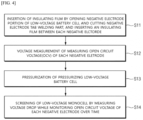
- the screening a low-voltage monocell includes: an insertion of an insulating film by opening a negative electrode portion of the low-voltage battery cell, cutting a negative electrode tab welding part, and inserting an insulating film between each negative electrode; an initial voltage measurement of measuring an initial open circuit voltage (OCV1) of each negative electrode; a pressurization of pressurizing the low-voltage battery cell; and a screening of a low-voltage monocell by monitoring an open circuit voltage of each negative electrode over time.
- OCV1 initial open circuit voltage
- a method for analyzing a foreign material of a low-voltage defective battery cell includes: screening a low-voltage monocell causing a low-voltage in a battery cell including a plurality of monocells; specifying the location of a foreign material using the apparatus for detecting according to claim 1 by measuring a leakage current of the screened low-voltage monocell; and analyzing the type of a foreign material by sampling the vicinity of the location of the specified foreign material.
- a device and a method for detecting the location of a foreign material in a low-voltage battery cell measure a leakage current through a plurality of unit electrodes having coordinate information, and has an effect of quickly and accurately finding the location of a foreign material from the coordinate information of the unit electrode having a large leakage current.
- FIG. 1 is a side view of an apparatus for detecting the location of a foreign material in a low-voltage battery cell according to an exemplary embodiment of the present invention
- FIG. 2 is a top view of an apparatus for detecting the location of a foreign material in a low-voltage battery cell according to an exemplary embodiment of the present invention.
- the apparatus for detecting the location of a foreign material of a low-voltage battery cell 100 includes: a first measurement electrode 110 and a second measurement electrode 120 disposed on a positive electrode 11 and a negative electrode 12 of a battery cell 10 to be evaluated, respectively, to measure a leakage current; a current measuring device 150 for measuring a leakage current; and a data processing part 160 for processing a measured leakage current data.
- the battery cell 10 is interposed between the first measurement electrode 110 and the second measurement electrode 120, and the first measurement electrode faces the positive electrode 11 of the battery cell 10, and the second measurement electrode 120 faces the negative electrode 12, respectively.
- the battery cell may be a monocell, and such a monocell has a structure in which a positive electrode/a separator/a negative electrode are stacked. Since the apparatus for detecting the location of a foreign material of the present invention is for finding the location of a foreign material in a low-voltage defective battery cell, the monocell is a monocell in which the low-voltage defect has been confirmed.
- the first measurement electrode 110 and the second measurement electrode 120 are electrically connected, and as they directly contact a low-voltage battery cell interposed therebetween, when a leakage current is induced in the low-voltage battery cell, a leakage current flows in the first measurement electrode 110 and the second measurement electrode 120. Also, the current measuring device 160 measures leakage current flowing through the first measurement electrode and the second measurement electrode.
- the first measurement electrode 110 and the second measurement electrode 120 has a structure in which a plurality of unit electrodes 111, 121 to which coordinate information is assigned, respectively, are collected.
- the plurality of unit electrodes 111 constituting the first unit electrode are arranged in a matrix along the horizontal direction (X-axis direction) and the vertical direction (Y-axis direction), and thus have coordinate information according to the matrix. Accordingly, the coordinate information indicates the information of the location the foreign material in the first measurement electrode and the second measurement electrode.
- a plurality of unit electrodes 111 are arranged in a matrix along the vertical direction (Y-axis direction) and the horizontal direction (X-axis direction), and similarly, in the second measurement electrode 120, a plurality of unit electrodes 121 are arranged in a matrix along the vertical direction (Y-axis direction) and the horizontal direction (X-axis direction).
- the unit electrodes 111 constituting the first measurement electrode form rows a, b, c, d along the vertical direction, and columns 1, 2, 3... 10 along the horizontal direction.
- Coordinate information of a1 may be given to the unit electrode located in row a, column 1
- coordinate information of d10 may be given to the unit electrode located in row d, column 10.
- a method of assigning coordinate information to the unit electrodes 121 constituting the second measurement electrode is the same as above.
- the unit electrode of the first measurement electrode and the unit electrode of the second measurement electrode having the same coordinate information are electrically connected to form one current circuit, and the current measuring device measures a leakage current flowing through the unit electrode of the first measurement electrode and the unit electrode of the second measurement electrode having the same coordinate information.
- the unit electrode of a1 of the first measurement electrode and the unit electrode of a1 of the second measurement electrode form a pair to be electrically connected
- the unit electrode of b 1 of the first measurement electrode and the unit of b 1 of the second measurement electrode form a pair to be electrically connected
- the unit electrodes to which the remaining coordinate information is assigned are also paired and electrically connected in this manner. Accordingly, a plurality of current circuits corresponding to the number of coordinate information are configured, and the current measuring device simultaneously measures leakage current flowing through each of the plurality of current circuits, thereby enabling measurement of leakage current according to the coordinate information.
- the plurality of unit electrodes to which the coordinate information is assigned have the same volume and shape. This is because, if the volume and shape of the unit electrodes are not the same, the leakage current is affected by these factors, and thus it may be difficult to detect the location of the foreign material through simple comparison of the leakage current.
- the data processing part 160 checks the location of the foreign material from the leakage current data measured by the current measuring device through coordinate information of a unit electrode having a large leakage current.
- the leakage current measured in the current circuit formed by the unit electrode at the location where the foreign material exists is larger than the leakage current measured in the current circuit formed by the other unit electrodes.
- FIG. 5 is a diagram showing a leakage current measured by an analyzer of the present invention.
- the data processing part 160 may process the plurality of leakage current values measured by the current measuring device 150 according to the coordinate information, and print them out as shown in FIG. 5 . Accordingly, by checking the coordinate information with a large leakage current, it can be determined that there is a foreign material at the location of the corresponding coordinate information.
- the apparatus for detecting the location of a foreign material in a low-voltage battery cell of the present invention can accurately detect the location of leakage current in the low-voltage battery cell to be inspected through the unit electrode to which coordinate information is assigned, compared to the conventional method of inspecting the location of a foreign material and through visual inspection, when finding a suspected foreign material or sampling multiple suspected locations, there is an effect of dramatically improving work load and dramatically enhancing time and analysis accuracy.
- the apparatus for detecting the location of a foreign material in a low-voltage battery cell may further include a first jig 130 and a second jig 140.
- the first and second jigs 130, 140 may be configured to press a laminate from both sides of the laminate in a state in which the laminate of the first and second measurement electrodes 110, 120 and the battery cell 10 to be evaluated are interposed between the first and second jigs 130, 140.
- Pressurizing both sides of the laminate of the first and second measurement electrodes 110, 120 and the battery cell 10 to be evaluated is to maximally induce a leakage current.
- the positive and negative electrodes are applied with an electric current at the location where the foreign material is present by the pressurization, and the battery cell to be evaluated requires current to maintain the voltage, so leakage current is generated.
- the leakage current generated in this way flows through the first and second measurement electrodes in contact with the positive electrode and the negative electrode, so that the leakage current can be measured through a current measuring device.
- the structure of the first jig 130 and the second jig 140 is not limited in the structure and shape as long as it is capable of pressurizing the laminate of the first and second measurement electrodes 110, 120 and the battery cell 10 to be evaluated.
- the first and second jigs 130, 140 may have a rectangular plate shape, and the size of the pressing surface may correspond to the area the laminate of the first and second measurement electrodes 110, 120 and the battery to be evaluated face.
- the apparatus for detecting the location of a foreign material in a low-voltage battery cell according to the present invention may further include an amplifier that amplifies the leakage current. This is to increase the discrimination of the leakage current value when the leakage current value is low.
- the apparatus for detecting the location of a foreign material in a low-voltage battery cell may include a power source for applying external power to a current circuit formed by a unit electrode of the first measurement electrode and a unit electrode of the second measurement electrode. This is also added to increase the discrimination of the leakage current value when the leakage current value is low.
- the apparatus for detecting the location of a foreign material in a low-voltage battery cell may include a printed circuit board (PCB) in which current circuits corresponding to the number of the coordinate information are assembled. Accordingly, wires for electrically connecting the unit electrodes of the first measurement electrode and the unit electrodes of the second measurement electrode are unnecessary, these circuits are stabilized, and uniformity and reliability are increased.
- the printed circuit board may be a flexible printed circuit board (FPCB).
- FPCB flexible printed circuit board
- FIG. 3 is a flowchart of a method for detecting the location of a foreign material in a low-voltage battery cell according to an exemplary embodiment of the present invention.
- the method for detecting the location of a foreign material in a low-voltage battery cell according to the present invention includes: screening S 10 a low-voltage monocell causing a low-voltage in the battery cell containing a plurality of monocells; and specifying S20 the location of a foreign material using the apparatus for detecting the location of a foreign material by measuring a leakage current of the screened low-voltage monocell.
- a stack type or a stack/folding type battery cell has a structure in which a monocell having a positive electrode/a separator/a negative electrode structure is stacked in numbers, and the screening S 10 of a low-voltage monocell is a step of screening the monocell in which the foreign material is located in the low-voltage battery cell.
- FIG. 4 is a flow chart of a monocell screening step according to an exemplary embodiment of the present invention.
- the screening S 10 of monocell includes: an insertion of an insulating film S11 by opening a negative electrode portion of the low-voltage battery cell, cutting a negative electrode tab welding part, and inserting an insulating film between each negative electrode; an initial voltage measurement S12 of measuring an initial open circuit voltage (OCV1) of each negative electrode; a pressurization S13 of pressurizing the low-voltage battery cell; and a screening S 14 of a low-voltage monocell by monitoring an open circuit voltage of each negative electrode over time.
- OCV1 initial open circuit voltage
- an insulating film S11 inserts an insulating film for insulating between monocells in order to measure an open circuit voltage (OCV) in units of individual monocells in a plurality of monocells,
- the initial voltage measurement step S12 measures for the comparison of the amount of voltage drop.
- a low-voltage battery cell is a battery cell in which the amount of voltage drop exceeds the self-discharge amount, and over time, a battery cell with a large voltage drop is selected as a low-voltage monocell.
- the initial voltage is measured and recorded, and then a low-voltage monocell is screened by calculating the difference to the voltage (amount of voltage drop) according to the lapse of time.
- the open circuit voltage is measured for all negative electrodes.
- the pressurization step is for accelerating the voltage drop.
- the pressurizing means is not particularly limited as long as it can accelerate the voltage drop, and as a specific example, it may be a press jig including a pair of press plates capable of pressurizing both sides of the battery cell. Since the electrolyte solution may leak in the pressurization step, it is preferable to enclose and seal the electrolytic cell in a packaging material capable of sealing the electrolytic cell before proceeding with the pressurization step.
- a packaging material is not particularly limited as long as it is a material capable of preventing leakage of the electrolyte solution, and specifically may be a plastic packaging material.
- the screening step S14 as the open circuit voltage of each negative electrode is measured over time, the amount of voltage drop is calculated, and a monocell including a negative electrode having a large voltage drop is screened as a low-voltage battery cell.
- the step S20 of confirming the location of the foreign material causing the leakage current is performed by measuring the leakage current of the monocell using the above-described apparatus for detecting the location of a foreign material.
- the apparatus for detecting the location of a foreign material detects the location of a foreign material according to the coordinate information showing a large leakage current by measuring the leakage current for the current circuit constituted by the first measurement electrode and the second measurement electrode having the same coordinate information, in which the first measurement electrode and the second measurement electrode for measuring leakage current, respectively, have a structure in which a plurality of unit electrodes to which coordinate information is assigned are collected, the method for detecting the location of a foreign material according to the present invention has an effect of quickly and accurately detecting the location of a foreign material causing the low-voltage.
- FIG. 6 is a flowchart of a foreign material analysis method of a low-voltage defective battery cell according to an exemplary embodiment of the present invention.
- the method for analyzing a foreign material of a low-voltage battery cell according to the present invention includes: screening S31 of a low-voltage monocell of screening a monocell causing a low-voltage in a battery cell containing a plurality of monocells; specifying S32 the location of a foreign material using the detection device according to claim 1 by measuring a leakage current of the screened low-voltage monocell; and analyzing S33 the type of a foreign material by sampling the vicinity of the location of the specified foreign material.
- Analyzing the type of a foreign material S33 is a step of sampling the vicinity of the specified location of a foreign material, and analyzing the type of a foreign material with the sampled specimen, and specifically, a FE-SEM-EDS analysis method can be used.
- sampling means manufacturing a specimen so that the specified foreign material can be included.
- the FE-SEM-EDS analysis method uses equipment used for a high-resolution, a high-magnification, and a low-damage surface analysis, enabling microstructure analysis, morphology, cross-section analysis, and particle size analysis, etc., and qualitative and quantitative analysis of an unknown sample are possible with an EDS equipment.
- the analytical method of the present invention has an effect of improving analysis accuracy because the sampled specimen has a very high probability of containing foreign materials causing low-voltage.
Landscapes
- Chemical & Material Sciences (AREA)
- Physics & Mathematics (AREA)
- General Physics & Mathematics (AREA)
- Chemical Kinetics & Catalysis (AREA)
- Electrochemistry (AREA)
- Engineering & Computer Science (AREA)
- Manufacturing & Machinery (AREA)
- General Chemical & Material Sciences (AREA)
- Life Sciences & Earth Sciences (AREA)
- Analytical Chemistry (AREA)
- Biochemistry (AREA)
- General Health & Medical Sciences (AREA)
- Immunology (AREA)
- Pathology (AREA)
- Health & Medical Sciences (AREA)
- Secondary Cells (AREA)
- Charge And Discharge Circuits For Batteries Or The Like (AREA)
Applications Claiming Priority (2)
| Application Number | Priority Date | Filing Date | Title |
|---|---|---|---|
| KR1020210184656A KR20230095312A (ko) | 2021-12-22 | 2021-12-22 | 저전압 전지 셀의 이물 위치 검출 장치 및 이를 이용한 분석 방법 |
| PCT/KR2022/019876 WO2023121069A1 (fr) | 2021-12-22 | 2022-12-08 | Appareil de détection pour la position d'un matériau étranger dans un élément de batterie à basse tension et procédé d'analyse l'utilisant |
Publications (2)
| Publication Number | Publication Date |
|---|---|
| EP4257964A1 true EP4257964A1 (fr) | 2023-10-11 |
| EP4257964A4 EP4257964A4 (fr) | 2024-07-24 |
Family
ID=86902978
Family Applications (1)
| Application Number | Title | Priority Date | Filing Date |
|---|---|---|---|
| EP22911702.3A Pending EP4257964A4 (fr) | 2021-12-22 | 2022-12-08 | Appareil de détection pour la position d'un matériau étranger dans un élément de batterie à basse tension et procédé d'analyse l'utilisant |
Country Status (6)
| Country | Link |
|---|---|
| US (1) | US12298273B2 (fr) |
| EP (1) | EP4257964A4 (fr) |
| JP (1) | JP7540860B2 (fr) |
| KR (1) | KR20230095312A (fr) |
| CN (1) | CN116710766B (fr) |
| WO (1) | WO2023121069A1 (fr) |
Families Citing this family (3)
| Publication number | Priority date | Publication date | Assignee | Title |
|---|---|---|---|---|
| DE112024000527T5 (de) * | 2023-01-09 | 2025-12-24 | National Instruments Corporation | Elektrische verfahren zur erkennung struktureller defekten in batteriezellen |
| KR20250053432A (ko) | 2023-10-13 | 2025-04-22 | 주식회사 엘지에너지솔루션 | 전지셀 검사 방법 |
| KR20250072139A (ko) | 2023-11-16 | 2025-05-23 | 주식회사 러닝비전 | 금속 이물 검출장치 |
Family Cites Families (23)
| Publication number | Priority date | Publication date | Assignee | Title |
|---|---|---|---|---|
| JP2003022946A (ja) | 2001-07-06 | 2003-01-24 | Hitachi Ltd | 半導体装置の製造方法 |
| JP5016238B2 (ja) | 2006-03-07 | 2012-09-05 | プライムアースEvエナジー株式会社 | 電池、及びその製造方法 |
| JP4967421B2 (ja) | 2006-04-03 | 2012-07-04 | 株式会社デンソー | 電流測定装置 |
| JP4993196B2 (ja) | 2007-08-23 | 2012-08-08 | トヨタ自動車株式会社 | 捲回電極体の検査方法、および、捲回電極体の検査装置 |
| KR101291724B1 (ko) * | 2007-09-04 | 2013-07-31 | 주식회사 엘지화학 | 배터리의 누설전류 감지 장치 및 방법 |
| KR101008057B1 (ko) | 2008-12-24 | 2011-01-13 | 재단법인 포항산업과학연구원 | 고전압을 이용한 고체 산화물 연료전지용 전해질막 및 셀 결함 검사 장치 및 검사 방법 |
| JP5342373B2 (ja) * | 2009-08-21 | 2013-11-13 | ボッシュ株式会社 | 圧力センサの異常診断装置及び異常診断方法 |
| JP5488162B2 (ja) | 2010-04-23 | 2014-05-14 | 株式会社デンソー | 電流分布測定装置、その異常時対応方法、および燃料電池システム |
| JP2012132855A (ja) | 2010-12-23 | 2012-07-12 | Toyota Motor Corp | 電池用電極シートの検査方法及び検査装置 |
| KR101790118B1 (ko) | 2014-12-05 | 2017-10-25 | 주식회사 엘지화학 | 전극조립체의 불량 유무 선별용 가압장치 및 불량 유무 선별방법 |
| US9659775B2 (en) * | 2015-02-25 | 2017-05-23 | Fuji Electric Co., Ltd. | Method for doping impurities, method for manufacturing semiconductor device |
| US9810559B2 (en) * | 2015-03-16 | 2017-11-07 | Invensys Systems, Inc. | Systems and methods for detecting leaks in an electromagnetic flowmeter |
| JP6737235B2 (ja) | 2017-05-22 | 2020-08-05 | トヨタ自動車株式会社 | 電池およびその製造方法 |
| KR102161028B1 (ko) * | 2017-07-11 | 2020-10-05 | 주식회사 엘지화학 | 이차전지의 불량 검사 장치 및 불량 검사 방법 |
| US10944300B2 (en) * | 2017-09-18 | 2021-03-09 | Witricity Corporation | Hybrid foreign-object detection and positioning system |
| KR102290736B1 (ko) | 2018-11-21 | 2021-08-18 | 주식회사 엘지에너지솔루션 | 저전압 불량 전지셀 검출을 위한 가압단락 검사장치 |
| KR102395248B1 (ko) | 2018-08-09 | 2022-05-04 | 주식회사 엘지에너지솔루션 | 배터리 분리막 손상 검출장치 및 검출방법 |
| KR20200055457A (ko) | 2018-11-13 | 2020-05-21 | 삼성전자주식회사 | 혼합물 반도체 웨이퍼의 결함(defect)을 검출하는 비파괴 검사 시스템 및 그 동작 방법 |
| KR102408132B1 (ko) | 2018-11-21 | 2022-06-14 | 주식회사 엘지에너지솔루션 | 지그 가압 방식의 가압 단락 검사 방법 |
| CN110289656B (zh) * | 2019-07-04 | 2023-05-16 | 大唐恩智浦半导体有限公司 | 电池管理电路及电池模块 |
| EP4064395A4 (fr) | 2019-11-19 | 2023-08-02 | APB Corporation | Procédé d'inspection et procédé de fabrication d'un bloc batterie |
| KR102263601B1 (ko) | 2021-03-24 | 2021-06-11 | (주)이너아이 | 배터리 내부균열 검사장치 |
| CN113406502B (zh) * | 2021-08-19 | 2021-12-07 | 四川新能源汽车创新中心有限公司 | 基于机器学习的缺陷电池筛选方法、设备及介质 |
-
2021
- 2021-12-22 KR KR1020210184656A patent/KR20230095312A/ko active Pending
-
2022
- 2022-12-08 EP EP22911702.3A patent/EP4257964A4/fr active Pending
- 2022-12-08 CN CN202280009956.0A patent/CN116710766B/zh active Active
- 2022-12-08 JP JP2023541793A patent/JP7540860B2/ja active Active
- 2022-12-08 WO PCT/KR2022/019876 patent/WO2023121069A1/fr not_active Ceased
- 2022-12-08 US US18/270,811 patent/US12298273B2/en active Active
Also Published As
| Publication number | Publication date |
|---|---|
| US12298273B2 (en) | 2025-05-13 |
| CN116710766B (zh) | 2026-03-24 |
| JP7540860B2 (ja) | 2024-08-27 |
| EP4257964A4 (fr) | 2024-07-24 |
| CN116710766A (zh) | 2023-09-05 |
| WO2023121069A1 (fr) | 2023-06-29 |
| US20240060934A1 (en) | 2024-02-22 |
| JP2024504928A (ja) | 2024-02-02 |
| KR20230095312A (ko) | 2023-06-29 |
Similar Documents
| Publication | Publication Date | Title |
|---|---|---|
| EP4257964A1 (fr) | Appareil de détection pour la position d'un matériau étranger dans un élément de batterie à basse tension et procédé d'analyse l'utilisant | |
| EP3719915B1 (fr) | Procédé et appareil pour détection de dommages de séparateur de batterie | |
| KR102886237B1 (ko) | 상대 비교를 통한 이상 전지 검출 방법 | |
| KR20200035594A (ko) | 가압력을 이용한 전지셀의 비파괴적 단선 여부 평가 방법 | |
| KR20230011096A (ko) | 전지의 용접 상태 검사 방법 | |
| KR20220111364A (ko) | 전지셀 내 이물 검출 및 분석 방법 및 장치 | |
| EP4535019A1 (fr) | Procédé et appareil d'inspection de cellule, et dispositif électronique | |
| KR20210111076A (ko) | 용접 상태 검사 장치 | |
| US20240302425A1 (en) | Secondary Battery Cell Insulation Test Apparatus and Method Using the Same | |
| KR102900762B1 (ko) | 와전류 센서를 이용한 전지 셀의 균열 검사 시스템 | |
| US12298278B2 (en) | Battery cell weld portion inspection apparatus and battery cell weld portion inspection method using the same | |
| KR102221782B1 (ko) | 결함 검사 장치 | |
| JP7479465B2 (ja) | 溶接不良の検査方法 | |
| US12153098B2 (en) | Device for inspecting for electrode assembly defects before electrolyte injection and defect inspection method therefor | |
| KR20070081533A (ko) | 중대형 전지모듈에서 단위전지들의 용접 상태를 검사하는방법 | |
| US20250309384A1 (en) | Battery inspection apparatus and inspection method of the same | |
| Pettinger | Production test procedures | |
| KR20260038092A (ko) | 전지 셀 내 이물 검출 및 분석 방법 | |
| CN120878934A (zh) | 电芯、电芯的制作方法及测试方法 | |
| KR20250121709A (ko) | 전극 탭의 용접강도 평가방법 | |
| KR20250162296A (ko) | 배터리 검사 장치 및 배터리 검사 방법 | |
| KR20250162339A (ko) | 배터리 검사시스템 및 배터리 검사방법 | |
| JP2025095437A (ja) | バイポーラ型電池の短絡検査方法 | |
| CN120948248A (zh) | 电池单体的测试方法、系统、装置及介质 | |
| KR20240138261A (ko) | 이차전지 셀 절연 검사 장치 및 방법 |
Legal Events
| Date | Code | Title | Description |
|---|---|---|---|
| STAA | Information on the status of an ep patent application or granted ep patent |
Free format text: STATUS: THE INTERNATIONAL PUBLICATION HAS BEEN MADE |
|
| PUAI | Public reference made under article 153(3) epc to a published international application that has entered the european phase |
Free format text: ORIGINAL CODE: 0009012 |
|
| STAA | Information on the status of an ep patent application or granted ep patent |
Free format text: STATUS: REQUEST FOR EXAMINATION WAS MADE |
|
| 17P | Request for examination filed |
Effective date: 20230707 |
|
| AK | Designated contracting states |
Kind code of ref document: A1 Designated state(s): AL AT BE BG CH CY CZ DE DK EE ES FI FR GB GR HR HU IE IS IT LI LT LU LV MC ME MK MT NL NO PL PT RO RS SE SI SK SM TR |
|
| REG | Reference to a national code |
Ref country code: DE Ref legal event code: R079 Free format text: PREVIOUS MAIN CLASS: G01N0027200000 Ipc: G01R0031392000 |
|
| A4 | Supplementary search report drawn up and despatched |
Effective date: 20240621 |
|
| RIC1 | Information provided on ipc code assigned before grant |
Ipc: H01M 10/48 20060101ALI20240617BHEP Ipc: H01M 10/42 20060101ALI20240617BHEP Ipc: G01R 31/52 20200101ALI20240617BHEP Ipc: G01R 31/392 20190101AFI20240617BHEP |
|
| STAA | Information on the status of an ep patent application or granted ep patent |
Free format text: STATUS: EXAMINATION IS IN PROGRESS |
|
| 17Q | First examination report despatched |
Effective date: 20250212 |
|
| DAV | Request for validation of the european patent (deleted) | ||
| DAX | Request for extension of the european patent (deleted) | ||
| GRAP | Despatch of communication of intention to grant a patent |
Free format text: ORIGINAL CODE: EPIDOSNIGR1 |
|
| STAA | Information on the status of an ep patent application or granted ep patent |
Free format text: STATUS: GRANT OF PATENT IS INTENDED |
|
| INTG | Intention to grant announced |
Effective date: 20260121 |
|
| P01 | Opt-out of the competence of the unified patent court (upc) registered |
Free format text: CASE NUMBER: UPC_APP_0003941_4257964/2026 Effective date: 20260203 |
|
| GRAS | Grant fee paid |
Free format text: ORIGINAL CODE: EPIDOSNIGR3 |
|
| GRAJ | Information related to disapproval of communication of intention to grant by the applicant or resumption of examination proceedings by the epo deleted |
Free format text: ORIGINAL CODE: EPIDOSDIGR1 |
|
| GRAL | Information related to payment of fee for publishing/printing deleted |
Free format text: ORIGINAL CODE: EPIDOSDIGR3 |
|
| STAA | Information on the status of an ep patent application or granted ep patent |
Free format text: STATUS: EXAMINATION IS IN PROGRESS |
|
| GRAP | Despatch of communication of intention to grant a patent |
Free format text: ORIGINAL CODE: EPIDOSNIGR1 |
|
| STAA | Information on the status of an ep patent application or granted ep patent |
Free format text: STATUS: GRANT OF PATENT IS INTENDED |
|
| INTC | Intention to grant announced (deleted) |