EP4258975B1 - Bestimmung eines schlafzustands eines benutzers - Google Patents
Bestimmung eines schlafzustands eines benutzers Download PDFInfo
- Publication number
- EP4258975B1 EP4258975B1 EP21824389.7A EP21824389A EP4258975B1 EP 4258975 B1 EP4258975 B1 EP 4258975B1 EP 21824389 A EP21824389 A EP 21824389A EP 4258975 B1 EP4258975 B1 EP 4258975B1
- Authority
- EP
- European Patent Office
- Prior art keywords
- sleep state
- reliability value
- user
- physiological signal
- determination
- Prior art date
- Legal status (The legal status is an assumption and is not a legal conclusion. Google has not performed a legal analysis and makes no representation as to the accuracy of the status listed.)
- Active
Links
Images


Classifications
-
- A—HUMAN NECESSITIES
- A61—MEDICAL OR VETERINARY SCIENCE; HYGIENE
- A61B—DIAGNOSIS; SURGERY; IDENTIFICATION
- A61B5/00—Measuring for diagnostic purposes; Identification of persons
- A61B5/48—Other medical applications
- A61B5/4806—Sleep evaluation
- A61B5/4812—Detecting sleep stages or cycles
-
- A—HUMAN NECESSITIES
- A61—MEDICAL OR VETERINARY SCIENCE; HYGIENE
- A61B—DIAGNOSIS; SURGERY; IDENTIFICATION
- A61B5/00—Measuring for diagnostic purposes; Identification of persons
- A61B5/01—Measuring temperature of body parts ; Diagnostic temperature sensing, e.g. for malignant or inflamed tissue
-
- A—HUMAN NECESSITIES
- A61—MEDICAL OR VETERINARY SCIENCE; HYGIENE
- A61B—DIAGNOSIS; SURGERY; IDENTIFICATION
- A61B5/00—Measuring for diagnostic purposes; Identification of persons
- A61B5/02—Detecting, measuring or recording for evaluating the cardiovascular system, e.g. pulse, heart rate, blood pressure or blood flow
- A61B5/0205—Simultaneously evaluating both cardiovascular conditions and different types of body conditions, e.g. heart and respiratory condition
- A61B5/02055—Simultaneously evaluating both cardiovascular condition and temperature
-
- A—HUMAN NECESSITIES
- A61—MEDICAL OR VETERINARY SCIENCE; HYGIENE
- A61B—DIAGNOSIS; SURGERY; IDENTIFICATION
- A61B5/00—Measuring for diagnostic purposes; Identification of persons
- A61B5/05—Detecting, measuring or recording for diagnosis by means of electric currents or magnetic fields; Measuring using microwaves or radio waves
- A61B5/053—Measuring electrical impedance or conductance of a portion of the body
- A61B5/0531—Measuring skin impedance
- A61B5/0533—Measuring galvanic skin response
-
- A—HUMAN NECESSITIES
- A61—MEDICAL OR VETERINARY SCIENCE; HYGIENE
- A61B—DIAGNOSIS; SURGERY; IDENTIFICATION
- A61B5/00—Measuring for diagnostic purposes; Identification of persons
- A61B5/24—Detecting, measuring or recording bioelectric or biomagnetic signals of the body or parts thereof
- A61B5/316—Modalities, i.e. specific diagnostic methods
- A61B5/369—Electroencephalography [EEG]
- A61B5/377—Electroencephalography [EEG] using evoked responses
- A61B5/38—Acoustic or auditory stimuli
-
- A—HUMAN NECESSITIES
- A61—MEDICAL OR VETERINARY SCIENCE; HYGIENE
- A61B—DIAGNOSIS; SURGERY; IDENTIFICATION
- A61B5/00—Measuring for diagnostic purposes; Identification of persons
- A61B5/48—Other medical applications
- A61B5/4806—Sleep evaluation
- A61B5/4809—Sleep detection, i.e. determining whether a subject is asleep or not
-
- A—HUMAN NECESSITIES
- A61—MEDICAL OR VETERINARY SCIENCE; HYGIENE
- A61B—DIAGNOSIS; SURGERY; IDENTIFICATION
- A61B5/00—Measuring for diagnostic purposes; Identification of persons
- A61B5/48—Other medical applications
- A61B5/4848—Monitoring or testing the effects of treatment, e.g. of medication
-
- A—HUMAN NECESSITIES
- A61—MEDICAL OR VETERINARY SCIENCE; HYGIENE
- A61B—DIAGNOSIS; SURGERY; IDENTIFICATION
- A61B5/00—Measuring for diagnostic purposes; Identification of persons
- A61B5/72—Signal processing specially adapted for physiological signals or for diagnostic purposes
- A61B5/7221—Determining signal validity, reliability or quality
-
- A—HUMAN NECESSITIES
- A61—MEDICAL OR VETERINARY SCIENCE; HYGIENE
- A61B—DIAGNOSIS; SURGERY; IDENTIFICATION
- A61B5/00—Measuring for diagnostic purposes; Identification of persons
- A61B5/72—Signal processing specially adapted for physiological signals or for diagnostic purposes
- A61B5/7235—Details of waveform analysis
- A61B5/7264—Classification of physiological signals or data, e.g. using neural networks, statistical classifiers, expert systems or fuzzy systems
-
- A—HUMAN NECESSITIES
- A61—MEDICAL OR VETERINARY SCIENCE; HYGIENE
- A61B—DIAGNOSIS; SURGERY; IDENTIFICATION
- A61B5/00—Measuring for diagnostic purposes; Identification of persons
- A61B5/72—Signal processing specially adapted for physiological signals or for diagnostic purposes
- A61B5/7235—Details of waveform analysis
- A61B5/7264—Classification of physiological signals or data, e.g. using neural networks, statistical classifiers, expert systems or fuzzy systems
- A61B5/7267—Classification of physiological signals or data, e.g. using neural networks, statistical classifiers, expert systems or fuzzy systems involving training the classification device
-
- A—HUMAN NECESSITIES
- A61—MEDICAL OR VETERINARY SCIENCE; HYGIENE
- A61B—DIAGNOSIS; SURGERY; IDENTIFICATION
- A61B2505/00—Evaluating, monitoring or diagnosing in the context of a particular type of medical care
- A61B2505/07—Home care
-
- A—HUMAN NECESSITIES
- A61—MEDICAL OR VETERINARY SCIENCE; HYGIENE
- A61B—DIAGNOSIS; SURGERY; IDENTIFICATION
- A61B2562/00—Details of sensors; Constructional details of sensor housings or probes; Accessories for sensors
- A61B2562/02—Details of sensors specially adapted for in-vivo measurements
- A61B2562/0219—Inertial sensors, e.g. accelerometers, gyroscopes, tilt switches
-
- A—HUMAN NECESSITIES
- A61—MEDICAL OR VETERINARY SCIENCE; HYGIENE
- A61B—DIAGNOSIS; SURGERY; IDENTIFICATION
- A61B2562/00—Details of sensors; Constructional details of sensor housings or probes; Accessories for sensors
- A61B2562/02—Details of sensors specially adapted for in-vivo measurements
- A61B2562/0261—Strain gauges
-
- A—HUMAN NECESSITIES
- A61—MEDICAL OR VETERINARY SCIENCE; HYGIENE
- A61B—DIAGNOSIS; SURGERY; IDENTIFICATION
- A61B2562/00—Details of sensors; Constructional details of sensor housings or probes; Accessories for sensors
- A61B2562/02—Details of sensors specially adapted for in-vivo measurements
- A61B2562/0271—Thermal or temperature sensors
Definitions
- the present invention relates to determining a sleep state of a user.
- the determining may be associated with analysis of physiological readings taken from the user.
- Systems for monitoring sleep and delivering sensory stimulation to users during sleep may include physiological sensor-based sleep monitoring, such as polysomnogram (PSG), electroencephalogram (EEG), or electrocardiogram (ECG) sensor-based sleep monitoring.
- PSG polysomnogram
- EEG electroencephalogram
- ECG electrocardiogram
- Sleep states may include sleeping and waking (or being awake). Sleep may be categorized into either REM (rapid eye movement) sleep or NREM (non-rapid eye movement) sleep. NREM sleep may be split into different "stages", such as stage 1, stage 2 and stage 3, relating to progressively more "deep” sleep. Stage 3 NREM sleep is a deep form of sleep and one of the sleep states.
- NREM sleep is known to have beneficial effects on brain function, such as memory.
- physiological measurements may be taken and monitored for characteristics indicative of the different states.
- quality of some measurements may be compromised due to factors such as movement, electrode misplacement or perspiration, which leads to less accurate sleep state determination.
- WO 02/100267 discloses a method and apparatus for monitoring consciousness.
- JP2017176278 discloses a method and apparatus for recording biological data.
- a computer-implemented method for determining a sleep state of a user comprises receiving a physiological signal from a physiological signal detector used by the user.
- the physiological signal comprises data from physiological measurements including an electrocardiogram (ECG), a polysomnogram (PSG), eye movements (EOG), muscle activity and/or heart rate.
- ECG electrocardiogram
- PSG polysomnogram
- EOG eye movements
- muscle activity and/or heart rate.
- the method further comprises determining, based on the received physiological signal, the sleep state of the user.
- the method further comprises calculating a reliability value associated with the determination. The reliability value is calculated based on a comparison of the received physiological signal with historic physiological signals of the same sleep state as the determined sleep state.
- a device for determining a sleep state of a user comprises a receiver to receive a physiological signal from a physiological signal detector used by the user.
- the physiological signal comprises data from physiological measurements including an electrocardiogram (ECG), a polysomnogram (PSG), eye movements (EOG), muscle activity and/or heart rate.
- ECG electrocardiogram
- PSG polysomnogram
- EOG eye movements
- muscle activity and/or heart rate.
- the device further comprises a processor to determine, based on the received physiological signal, the sleep state of the user.
- the processor further calculates a reliability value associated with the determination. The reliability value is calculated based on a comparison of the received physiological signal with historic physiological signals of the same sleep state as the determined sleep state.
- a non-transitory computer-readable medium storing a program which, when executed on a computer, is configured to cause the computer to perform a process.
- the process comprises determining the sleep state of the user based on a received physiological signal received from a physiological signal detector used by a user.
- the physiological signal comprises data from physiological measurements including an electrocardiogram (ECG), a polysomnogram (PSG), eye movements (EOG), muscle activity and/or heart rate.
- ECG electrocardiogram
- PSG polysomnogram
- EOG eye movements
- muscle activity muscle activity and/or heart rate.
- the process further comprises calculating a reliability value associated with the determination. The reliability value is calculated based on a comparison of the received physiological signal with historic physiological signals of the same sleep state as the determined sleep state.
- Embodiments of aspects may provide a method, device and computer-readable medium, as well as a computer program and system, to determine a sleep state of a user.
- Sleep states may include sleeping or being awake. Sleep may be categorized into either REM (rapid eye movement) sleep or NREM (non-rapid eye movement) sleep. NREM sleep may be split into different "stages", such as stage 1, stage 2 and stage 3, relating to progressively more "deep" sleep. Each different sleep stage may be indicative of a different sleep state. Categorising sleep into stages based on physiological readings may be carried out manually by an experienced medical professional. Stage 3 NREM sleep is a deep form of sleep. NREM sleep is known to have beneficial effects on brain function, such as improved memory. The restorative value of sleep can be enhanced by auditory stimulation in stage 3 (deep) NREM sleep.
- stage 3 sleep may be detected by real-time analysis of physiological measurements from a person, such as PSG, ECG or EEG measurements for example.
- Some wearable devices such as the Philips SmartSleep system, may be used to detect sleep states, in particular stage 3 sleep, and deliver appropriate stimulation while ensuring sleep is not disturbed.
- Such a system may provide a closed-loop, EEG-based system that may detect deep sleep in real-time and deliver auditory stimulation to enhance sleep slow waves without causing arousal/disturbing the sleep.
- physiological measurements may be taken and monitored for characteristics indicative of the different states of sleep. Under some conditions however, quality of some physiological measurements may be compromised due to factors such as movement, electrode misplacement or perspiration, which leads to less accurate sleep state detection.
- physiological measurements such as PSG, ECG or EEG measurements
- PSG ECG or EEG measurements
- the analysis may initially be performed manually or automatically.
- Such measurements may be used to train a deep neural network to detect similar patterns in future measurements.
- one category of physiological measurements may be combined with data from other sensors, such as inertia sensors/accelerometers, temperature sensors, strain sensors or skin conductance sensors, to improve the categorization of sleep states.
- Some physiological measurements may be of poor quality such that manual categorization of sleep states becomes difficult.
- a processor for example on which a deep neural network is implemented, may however be able to categories such sleep states, even when a human annotator cannot.
- reliability of the measured data may be indicated.
- EEG measurements are discussed in detail as one example of physiological measurements taken. However, any other physiological measurements may be used, such as electrocardiogram (ECG), polysomnogram (PSG), eye movements (EOG), muscle activity or heart rate.
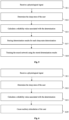
- a computer-implemented method for determining a sleep state of a user may comprise receiving S11 a physiological signal.
- the physiological signal may be received from a physiological signal detector used by the user.
- the method may further comprise determining S 12 the sleep state of the user. The determining may be carried out based on the received physiological signal.
- the method may further comprise calculating S 13 a reliability value associated with the determination. The reliability value may be calculated based on a comparison of the received physiological signal with historic physiological signals of the same sleep state as the determined sleep state.
- a sleep state of a user may be desirable to improve the efficacy of therapies, including stimulation of the user, to improve the quality of sleep and therefore increase the beneficial effects on the user.
- An electroencephalogram (EEG), for example, is seen generally as a reliable method for monitoring the brain activity of a user, from which brain activity the respective sleep states may be identified. In some instances however, such as those mentioned above; movement, electrode misplacement or perspiration, an EEG signal may be affected, such that the respective sleep states become less easy to identify. With the comparison to historic EEG signals, identification of sleep states in such instances may be improved by the method described.
- a polysomnogram signal may include one or more categories of data normally associated with a polysomnogram, including for example EEG.
- a polysomnogram signal detector may be any suitable detector to detect the one or more categories of data normally associated with a polysomnogram.
- a physiological signal may include one or more categories of data related to the physiology of the user, including for example PSG, EEG and/or ECG data.
- Physiological signals may be data representative of physiological readings taken by any suitable sensor, such as a physiological signal detector. Physiological signals may be received directly or indirectly from the physiological signal detector.
- Historic physiological signals may include physiological signals that have previously had the sleep state of the user determined. This determination may have been carried out manually or automatically.
- the historic physiological signals may relate to the same user or may relate to multiple users.
- Historic physiological signals may also have an associated reliability value and physiological signals below a threshold reliability value may be excluded from the comparison or excluded from the historic signals.
- Physiological signals may for example be direct outputs from physiological sensors or may be data relating to or indicative of physiological readings.
- EEG signals these may for example be direct outputs from an EEG or may be data relating to or indicative of EEG readings. Comparison between physiological signals and historic physiological signals may be performed on the same type of signals, such as comparing EEG signals with historic EEG signals.
- the reliability value may be calculated on the basis of how far from historic signal data the received signals lie. That is to say, for EEG signals for example, each sleep state may for example have characteristic EEG patterns, such as wavelength and period of time between the start and the end of the sleep state. Large deviations in such characteristics may lead to a higher level of uncertainty regarding the classification of the sleep state and therefore a lower reliability value. If the EEG signals lie within an expected wavelength range and period length range, then the uncertainty regarding the classification of the sleep state is low and therefore a higher reliability value may be calculated.
- EEG signals may include any one or more of: Misplacement of electrodes.
- An EEG for example, may be detected by placing electrodes at specific points on the user's skin. If the electrodes are incorrectly connected to the head of the user, the EEG readings may be affected. This may be due to user error or sometimes may be the result of an unusual head shape.
- the electrodes may be part of a "wearable" device, such as a headband. In some instances, the headband may inadvertently be worn back-to-front, resulting in misplacement of the electrodes.
- Electrodes may not be sufficiently connected to the user's skin to give a clear EEG reading, for example due to sweating.
- Changes in the ambient electrical fields may manifest as artifacts in EEG readings.
- Muscle movements in forehead, jaw and eyelids may reduce signal quality of EEG.
- EEG patterns vary from person to person. For example, elderly users show substantially different EEG patterns to those of the younger population. These differences may be included in historic EEG signals, to give great context.
- each inaccuracy source may itself have a characteristic effect on physiological signals. Therefore, it may be possible to classify sleep states associated with lower reliability values, based on the characteristics of the received physiological signals. Therefore, the reliability value may be correspondingly raised.
- manual identification of the source of the inaccuracy may be performed and an indication of the identified inaccuracy source may be included in the historic physiological signals. Therefore, identification of the sleep state may be possible for physiological signals which would otherwise be deemed too uncertain to result in reliable sleep state categorization.
- Fig. 2 shows an example of an EEG signal, along with an annotation of the signal to place each sleep period into a category corresponding to a sleep state or to identify the period as corrupted and therefore cannot be given a categorization.
- numbers are assigned to the various sleep states or other categories in the annotation of the signal.
- -3 is NREM stage 3
- -2 is NREM stage 2
- -1 is NREM stage 1
- 0 is REM sleep
- 1 is awake and 8 is corrupted.
- Fig. 2 shows an expanded view of two 10 second periods from the EEG signal.
- a normal EEG signal of a deep (stage 3) NREM sleep is shown. This EEG signal would be easily categorized with a high reliability value.
- a corrupted EEG signal is shown in the second expanded view. This signal would have a low reliability value, and potentially low enough that a sleep state may not be assigned.
- similar patterns may have been observed in the past and categorized into a sleep state such that the reliability is raised and the period can be assigned a sleep state.
- the method may further comprise outputting S14 the sleep state determination when the reliability value is equal to or higher than a predetermined first threshold value.
- a threshold value may be set, above which the reliability is deemed high enough that useful sleep state determination can be achieved.
- the method may further comprise preventing S15 output of the sleep state determination when the reliability value is lower than the predetermined first threshold value. Therefore, if the threshold level of reliability is not met, useful sleep state determination is deemed not possible and a sleep state category is not output. In this case either no categorization may be output or a determination indicating no category may be output. Further action may be taken based on the output sleep state determination or determination indicating no category. This is discussed in more detail below.
- Reliability values may for example be given in the form of a number from 1 to 10, with 1 being the least reliable and 10 being the most reliable.
- the first threshold value may for example be set at 2.
- the method further comprises requesting S16 data from a peripheral device when the reliability value is lower than a second predetermined threshold value.
- a second threshold value may be set indicating that reliability is not so low that the physiological signal cannot be categorized, but is low enough that the categorization may be improved with more information. Therefore, the threshold may be set higher than the first threshold value. That is to say, the second threshold is associated with a higher level of reliability than the first threshold value.
- the second threshold value on the scale detailed above, may for example be set at 3.
- the peripheral device may for example be a wearable device or any other sleep monitoring device. Correlation between data collected from the peripheral device and the physiological signal may improve reliability when determining a category for a period of the physiological signal.
- the peripheral devices include any of an inertia sensor, a temperature sensor, a strain sensor and a skin conductance sensor. Each peripheral device may produce one or more types of sleep monitoring data or associated data useful for putting the received physiological signals into context in order to improve the reliability value.
- an inertia sensor may detect movement of a user. Movement may affect the physiological signal, for example if it were to include EEG signals, but may also be associated with some sleep states and not others. Therefore, it may be useful to correlate this data with the received physiological signal, for a particular time period, in order to improve the reliability associated with a sleep state determination for that time period.
- a user's temperature may fluctuate during sleep and such fluctuations may be indicative of a sleep state.
- electrodes used to detect an EEG signal of a user may have attached thereto a strain sensor to detect when the electrodes, or other parts of the device to which the electrodes are attached, are under strain.
- a skin conductance sensor may give an indication of perspiration, which may affect an EEG signal depending on the level of conductance detected. Correlation of data collected from any one or more peripheral devices may be used to increase the reliability value associated with a sleep state determination for a particular time period.
- the determining is performed by a neural network.
- the neural network may for example be a deep neural network and the neural network architecture may include convolutional layers, or recurrent layers (for example long short-term memory, LSTM, layer blocks).
- the output layer of the neural network may generate the sleep state determination and may further generate an associated reliability value.
- the output layer of the neural network may use for example a SoftMax activation.
- the method may further comprise storing S17 determination results for each sleep state determination.
- the determination results may be stored in any suitable memory. Determination results may be stored including associated reliability values, or other associated data or metadata. In this way, a database of determination results may be built up, which may yield more accurate sleep state determination, as the number of stored results grows.
- the method may further comprise training S18 the neural network using the stored determination results.
- the neural network output may be generated by imposing a similar threshold on the values of the output layer. If the physiological signal deviates too far from an expected range, or a reliability value for a particular time period is lower than a threshold, then the neural network does not output a sleep state determination for the time period.
- the neural network may further use Bayesian Deep Learning methods like Monte Carlo dropout to generate the reliability estimate along with the sleep state determination for the specific time period.
- the neural network may further use out-of-distribution analysis methods to improve accuracy of the determination.
- a temporal model uncertainty function of u m ( t ) may be produced, which in a typical embodiment is a vector values signal of multiple uncertainty metrics.
- peripheral devices such as sensors may provide further data for processing by the neural network.
- sensors may, for example, include inertial sensors, skin temperature sensors, or strain sensors. Strain sensors may for example be included in a headband strap holding electrodes to a user's head, from which EEG signals may be detected, and skin conductance measurements may be taken between the EEG electrodes.
- a detection model may be developed for all conditions for the sources of signal deterioration.
- the detection models may typically be based on neural networks.
- the outcomes of all sensor measurements, including the EEG signal detector, are collected in a time-varying vector-valued sensor uncertainty function u s ( t ).
- the weight of w may be designed in advance and included in the program code or it may be possible to learn it over time, based on system performance and feedback from the user.
- the uncertainty function may represent the inverse of a reliability value, such that the higher the uncertainty, the lower the reliability.
- a causal inference technique may be used to estimate the causal relation of different environmental conditions to the certainty of the staging model in a particular user over time in different conditions, and optimize the weight w to maximize the reliable determination of the user sleep state, based on the detected signals and data collected from peripheral devices.
- the method may further comprise causing S 19 auditory stimulation of the user, based on the output sleep state determination.
- Auditory stimulation when applied during the appropriate sleep state, and without disturbing the user's sleep or waking them up, may enhance sleep's restorative effects. For example, initiating auditory stimulation of the user when it is determined that the user is in stage 3 NREM sleep, may help the user to feel more rested the following day.
- stimulation may include outputs other than auditory stimulation, such as haptic stimulation of the user, for example.
- the method detailed above may be carried out by a program, which may be stored on any suitable storage medium, such that when the program is executed on a suitable computer processor, a process is carried out according to the method. Further, the method may be performed on any suitable device, an example of which is detailed below.
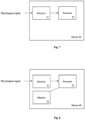
- a device 20 for determining a sleep state of a user comprises a receiver 21 to receive a physiological signal from a physiological signal detector used by the user.
- the device 20 further comprises a processor 22 to determine, based on the received physiological signal, the sleep state of the user and calculate a reliability value associated with the determination. The reliability value being calculated based on a comparison of the received physiological signal with historic physiological signals of the same sleep state as the determined sleep state.
- the physiological signal detector may for example be separate from the device 20, or included in the device 20.
- the physiological signal detector may in one example be an EEG signal detector and may include electrodes to attach to the user.
- the device 20 may for example be a wearable device, such as a headband in which such electrodes are included.
- the processor 22 may be any suitable computing device.
- the reliability value may for example be used as a weight, to give the associated determined sleep state a relative significance to other determined sleep states in the historic physiological signals. In this way, historic physiological signals with low variation from the expected signals for a given sleep state may be given a higher reliability value and as such, may be used to improve the understanding of what an expected signal is.
- the reliability value may be considered as a metric for improving the immediate sleep state determination, but may also be used to improve future determinations.
- the processor 22 may further output the sleep state determination when the reliability value is equal to or higher than a first threshold value.
- the processor 22 may for example prevent output of the sleep state determination when the reliability value is lower than the first threshold value.
- sleep state determinations and the physiological signals from which they are determined, which have a reliability value below the first threshold value may be excluded from the historic physiological signals used for future determinations.
- the processor 22 further requests data from a peripheral device when the reliability value is lower than a second threshold value.
- Data from the peripheral device is correlated with the received physiological signals in order to give further context to the physiological signals for the purpose of sleep state determination. If, as a result of such correlation, a sleep state may be more reliably determined, the reliability value may be updated as appropriate, which may raise the reliability value to above the second threshold value.
- the peripheral device includes any of an inertia sensor, a temperature sensor, a strain sensor, and a skin conductance sensor.
- the device 20 may further comprise a memory 23 to store determination results for each sleep state determination.
- the memory 23 may be any suitable memory for storing determination results, historic physiological signals, reliability values and any other data or metadata useful for future sleep state determination.
- the processor 22 may comprise a neural network to determine the sleep state of the user and the neural network is trained using the stored determination results.
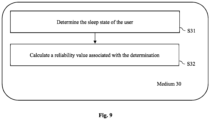
- a non-transitory computer-readable medium 30 storing a program which, when executed on a computer, is configured to cause the computer to perform a process.
- the process comprises determining S31, based on a received physiological signal received from a physiological signal detector used by a user, the sleep state of the user.
- the process further comprises calculating S32 a reliability value associated with the determination, the reliability value being calculated based on a comparison of the received physiological signal with historic physiological signals of the same sleep state as the determined sleep state.
- the process may further comprise storing determination results for each sleep state determination and training a neural network using the stored determination results, as set out in detail above.
- the process may further comprise requesting data from a peripheral device when the reliability value is lower than a threshold value, as set out in relation to the method and device above.
- Examples in the present disclosure can be provided as methods, systems or machine readable instructions, such as any combination of software, hardware, firmware or the like.
- Such machine readable instructions may be included on a computer readable storage medium (including but is not limited to disc storage, CD-ROM, optical storage, etc.) having computer readable program codes therein or thereon.
- the machine readable instructions may, for example, be executed by a general purpose computer, a special purpose computer, an embedded processor or processors of other programmable data processing devices to realize the functions described in the description and diagrams.
- a processor or processing apparatus may execute the machine readable instructions.
- functional modules of the apparatus and devices may be implemented by a processor executing machine readable instructions stored in a memory, or a processor operating in accordance with instructions embedded in logic circuitry.
- the term 'processor' is to be interpreted broadly to include a CPU, processing unit, ASIC, logic unit, or programmable gate array etc.
- the methods and functional modules may all be performed by a single processor or divided amongst several processors.
- Such machine readable instructions may also be stored in a computer readable storage that can guide the computer or other programmable data processing devices to operate in a specific mode.
- Such machine readable instructions may also be loaded onto a computer or other programmable data processing devices, so that the computer or other programmable data processing devices perform a series of operations to produce computer-implemented processing, thus the instructions executed on the computer or other programmable devices realize functions specified by flow(s) in the flow charts or block(s) in the block diagrams.
- teachings herein may be implemented in the form of a computer software product, the computer software product being stored in a storage medium and comprising a plurality of instructions for making a computer device implement the methods recited in the examples of the present disclosure.
- a computer program may be stored/distributed on a suitable medium, such as an optical storage medium or a solid-state medium supplied together with or as part of other hardware, but may also be distributed in other forms, such as via the Internet or other wired or wireless telecommunication systems. Any reference signs in the claims should not be construed as limiting the scope.
Landscapes
- Health & Medical Sciences (AREA)
- Life Sciences & Earth Sciences (AREA)
- Engineering & Computer Science (AREA)
- Physics & Mathematics (AREA)
- Public Health (AREA)
- General Health & Medical Sciences (AREA)
- Medical Informatics (AREA)
- Animal Behavior & Ethology (AREA)
- Veterinary Medicine (AREA)
- Surgery (AREA)
- Molecular Biology (AREA)
- Biophysics (AREA)
- Pathology (AREA)
- Biomedical Technology (AREA)
- Heart & Thoracic Surgery (AREA)
- Artificial Intelligence (AREA)
- Physiology (AREA)
- Psychiatry (AREA)
- Signal Processing (AREA)
- Computer Vision & Pattern Recognition (AREA)
- Cardiology (AREA)
- Fuzzy Systems (AREA)
- Evolutionary Computation (AREA)
- Mathematical Physics (AREA)
- Dermatology (AREA)
- Anesthesiology (AREA)
- Acoustics & Sound (AREA)
- Psychology (AREA)
- Nuclear Medicine, Radiotherapy & Molecular Imaging (AREA)
- Radiology & Medical Imaging (AREA)
- Pulmonology (AREA)
- Measurement Of The Respiration, Hearing Ability, Form, And Blood Characteristics Of Living Organisms (AREA)
- Measuring And Recording Apparatus For Diagnosis (AREA)
Claims (8)
- Computerimplementiertes Verfahren zur Bestimmung eines Schlafzustands eines Benutzers, wobei das Verfahren Folgendes umfasst:empfangen (S11) eines physiologischen Signals von einem vom Benutzer verwendeten Detektor für physiologische Signale, wobei das physiologische Signal Daten aus physiologischen Messungen umfasst, einschließlich eines Elektrokardiogramms (ECG), eines Polysomnogramms (PSG), Augenbewegungen (EOG), Muskelaktivität und/oder Pulsschlag;bestimmen (S12), basierend auf dem empfangenen physiologischen Signal, des Schlafzustands des Benutzers; undberechnen (S13) eines ersten Zuverlässigkeitswerts, der mit der Bestimmung verbunden ist, wobei der erste Zuverlässigkeitswert basierend auf einem Vergleich des empfangenen physiologischen Signals mit historischen physiologischen Signalen desselben Schlafzustands wie dem ermittelten Schlafzustand berechnet wird,dadurch gekennzeichnet, dass das Verfahren weiterhin Folgendes umfasst:
wenn der erste Zuverlässigkeitswert niedriger als ein zweiter Schwellenwert ist:anfordern (S16) von Daten von einem Peripheriegerät; bestimmen eines Korrelationsgrads zwischen den Daten vom Peripheriegerät und dem empfangenen physiologischen Signal;berechnen eines zweiten Zuverlässigkeitswerts, der mit der Bestimmung des Schlafzustands des Benutzers verbunden ist, wobei der zweite Zuverlässigkeitswert auf dem Korrelationsgrad basiert; undaktualisieren des ersten Zuverlässigkeitswerts, wenn basierend auf dem ersten Zuverlässigkeitswert und dem zweiten Zuverlässigkeitswert der bestimmte Schlafzustand zuverlässiger bestimmt wird, wobeizu den Peripheriegeräten gehören Trägheitssensoren, Temperatursensoren, Dehnungssensoren und Hautleitfähigkeitssensoren. - Verfahren nach Anspruch 1, weiterhin umfassend:wenn der erste Zuverlässigkeitswert gleich oder höher als ein erster Schwellenwert ist, Ausgeben (S14) der Schlafzustandsbestimmung; undwenn der erste Zuverlässigkeitswert niedriger als der erste Schwellenwert ist, Verhindern (S15) der Ausgabe der Schlafzustandsbestimmung.
- Verfahren nach einem der vorhergehenden Ansprüche, wobei das Bestimmen (S12) des Schlafzustands eines Benutzers wird durch ein neuronales Netzwerk durchgeführt.
- Verfahren nach Anspruch 2 oder Anspruch 3, wenn er von Anspruch 2 abhängig ist, ferner umfassend: verursachen (S19) einer akustischen Stimulation des Benutzers, basierend auf der ausgegebenen Schlafzustandsbestimmung.
- Vorrichtung (20) zum Bestimmen eines Schlafzustands eines Benutzers, wobei die Vorrichtung (20) umfasst:einen Empfänger (21) zum Empfangen eines physiologischen Signals von einem vom Benutzer verwendeten Detektor für physiologische Signale, wobei das physiologische Signal Daten aus physiologischen Messungen umfasst, einschließlich eines Elektrokardiogramms (ECG), eines Polysomnogramms (PSG), Augenbewegungen (EOG) und Muskelaktivität und/oder Herzfrequenz; undeinen Prozessor (22), um auf der Grundlage des empfangenen physiologischen Signals den Schlafzustand des Benutzers zu bestimmen und einen mit der Bestimmung verbundenen ersten Zuverlässigkeitswert zu berechnen, wobei der erste Zuverlässigkeitswert auf der Grundlage eines Vergleichs des empfangenen physiologischen Signals mit historischen physiologischen Signalen berechnet wird Signale des gleichen Schlafzustands wie der ermittelte Schlafzustand, dadurch gekennzeichnet, dass der Prozessor (22) weiterhin dazu konfiguriert ist: wenn der erste Zuverlässigkeitswert niedriger als ein zweiter Schwellenwert ist:daten von einem Peripheriegerät anfordern;einen Grad der Korrelation zwischen den Daten vom Peripheriegerät und dem empfangenen physiologischen Signal bestimmen;berechnen eines zweiten Zuverlässigkeitswerts, der mit der Bestimmung des Schlafzustands des Benutzers verbunden ist, wobei der zweite Zuverlässigkeitswert auf dem Korrelationsgrad basiert; undden ersten Zuverlässigkeitswert aktualisieren, wenn basierend auf dem ersten Zuverlässigkeitswert und dem zweiten Zuverlässigkeitswert der bestimmte Schlafzustand zuverlässiger bestimmt werden kann, wobeidas Peripheriegerät umfasst einen Trägheitssensor, einen Temperatursensor, einen Dehnungssensor und einen Hautleitfähigkeitssensor.
- Vorrichtung (20) nach Anspruch 5, wobei der Prozessor (22) weiterhin dazu konfiguriert ist:wenn der erste Zuverlässigkeitswert gleich oder höher als ein erster Schwellenwert ist, Ausgeben der Schlafzustandsbestimmung; undwenn der erste Zuverlässigkeitswert niedriger als der erste Schwellenwert ist, Verhindern der Ausgabe der Schlafzustandsbestimmung.
- Nichtflüchtiges computerlesbares Medium (30), das ein Programm speichert, das, wenn es auf einem Computer ausgeführt wird, so konfiguriert ist, dass es den Computer veranlasst, einen Prozess auszuführen, der Folgendes umfasst:bestimmen (S31), basierend auf einem empfangenen physiologischen Signal, das von einem von einem Benutzer verwendeten physiologischen Signaldetektor empfangen wurde, des Schlafzustands des Benutzers, wobei das physiologische Signal Daten aus physiologischen Messungen umfasst, einschließlich eines Elektrokardiogramms (ECG), eines Polysomnogramms (PSG), Augenbewegungen (EOG), Muskelaktivität und/oder Herzfrequenz; undberechnen (S32) eines ersten Zuverlässigkeitswerts, der mit der Bestimmung verbunden ist, wobei der erste Zuverlässigkeitswert basierend auf einem Vergleich des empfangenen physiologischen Signals mit historischen physiologischen Signalen desselben Schlafzustands wie der bestimmte Schlafzustand berechnet wird, dadurch gekennzeichnet, dass der Prozess weiterhin umfasst:
wenn der erste Zuverlässigkeitswert niedriger als ein Schwellenwert ist:anfordern von Daten von einem Peripheriegerät;bestimmen eines Korrelationsgrads zwischen den Daten des Peripheriegeräts und dem empfangenen physiologischen Signal;berechnen eines zweiten Zuverlässigkeitswerts, der mit der Bestimmung des Schlafzustands des Benutzers verbunden ist, wobei der zweite Zuverlässigkeitswert auf dem Korrelationsgrad basiert; undaktualisieren des ersten Zuverlässigkeitswerts, wenn basierend auf dem ersten Zuverlässigkeitswert und dem zweiten Zuverlässigkeitswert der bestimmte Schlafzustand zuverlässiger bestimmt wird, wobeidas Peripheriegerät umfasst einen Trägheitssensor, einen Temperatursensor, einen Dehnungssensor und einen Hautleitfähigkeitssensor. - Medium nach Anspruch 7, wobei das Verfahren weiterhin Folgendes umfasst:speichern der Bestimmungsergebnisse für jede Schlafzustandsbestimmung; undtrainieren eines neuronalen Netzwerks unter Verwendung der gespeicherten Bestimmungsergebnisse.
Applications Claiming Priority (2)
| Application Number | Priority Date | Filing Date | Title |
|---|---|---|---|
| EP20213750.1A EP4011278A1 (de) | 2020-12-14 | 2020-12-14 | Bestimmung eines schlafzustands eines benutzers |
| PCT/EP2021/085143 WO2022128765A1 (en) | 2020-12-14 | 2021-12-10 | Determining a sleep state of a user |
Publications (2)
| Publication Number | Publication Date |
|---|---|
| EP4258975A1 EP4258975A1 (de) | 2023-10-18 |
| EP4258975B1 true EP4258975B1 (de) | 2024-06-19 |
Family
ID=74124989
Family Applications (2)
| Application Number | Title | Priority Date | Filing Date |
|---|---|---|---|
| EP20213750.1A Withdrawn EP4011278A1 (de) | 2020-12-14 | 2020-12-14 | Bestimmung eines schlafzustands eines benutzers |
| EP21824389.7A Active EP4258975B1 (de) | 2020-12-14 | 2021-12-10 | Bestimmung eines schlafzustands eines benutzers |
Family Applications Before (1)
| Application Number | Title | Priority Date | Filing Date |
|---|---|---|---|
| EP20213750.1A Withdrawn EP4011278A1 (de) | 2020-12-14 | 2020-12-14 | Bestimmung eines schlafzustands eines benutzers |
Country Status (3)
| Country | Link |
|---|---|
| US (1) | US12201443B2 (de) |
| EP (2) | EP4011278A1 (de) |
| WO (1) | WO2022128765A1 (de) |
Families Citing this family (2)
| Publication number | Priority date | Publication date | Assignee | Title |
|---|---|---|---|---|
| US20220133194A1 (en) * | 2020-05-24 | 2022-05-05 | Optios, Inc. | Measuring and strengthening physiological/neurophysiological states predictive of superior performance |
| US20240074683A1 (en) * | 2022-09-07 | 2024-03-07 | The Fourth Dimension Gaming Ltd | System and method of predicting a neuropsychological state of a user |
Family Cites Families (13)
| Publication number | Priority date | Publication date | Assignee | Title |
|---|---|---|---|---|
| CA2448806C (en) * | 2001-06-13 | 2011-10-18 | Compumedics Limited | Methods and apparatus for monitoring consciousness |
| US7302858B2 (en) * | 2004-09-24 | 2007-12-04 | Kevin Walsh | MEMS capacitive cantilever strain sensor, devices, and formation methods |
| US8083682B2 (en) * | 2006-07-19 | 2011-12-27 | Cardiac Pacemakers, Inc. | Sleep state detection |
| US20140276242A1 (en) * | 2013-03-14 | 2014-09-18 | Healthward International, LLC | Wearable body 3d sensor network system and method |
| DE102013005900A1 (de) * | 2013-04-05 | 2014-10-09 | Dräger Medical GmbH | Körperkerntemperatursensor |
| EP4133997B1 (de) * | 2013-07-08 | 2026-04-15 | ResMed Sensor Technologies Limited | Ein von einem prozessor und einem system ausgeführtes verfahren zur verwaltung des schlafes |
| US9655559B2 (en) * | 2014-01-03 | 2017-05-23 | Vital Connect, Inc. | Automated sleep staging using wearable sensors |
| US10449672B2 (en) * | 2016-03-14 | 2019-10-22 | California Institute Of Technology | Wearable electromyography sensor array using conductive cloth electrodes for human-robot interactions |
| JP6648597B2 (ja) | 2016-03-28 | 2020-02-14 | 富士通株式会社 | 生体データ記録方法、生体データ記録装置、及び生体データ記録プログラム |
| US20190282152A1 (en) * | 2016-07-18 | 2019-09-19 | Koninklijke Philips N.V. | Device for assessing psychophysiological responsiveness |
| EP4736759A2 (de) * | 2017-10-17 | 2026-05-06 | Whoop, Inc. | Angewandte datenqualitätsmetriken für physiologische messungen |
| WO2020139771A1 (en) * | 2018-12-28 | 2020-07-02 | Dexcom, Inc. | Safety tools for decision support recommendations made to users of continuous glucose monitoring systems |
| CN116569276A (zh) * | 2020-10-09 | 2023-08-08 | 瑞思迈传感器技术有限公司 | 自动用户接口识别 |
-
2020
- 2020-12-14 EP EP20213750.1A patent/EP4011278A1/de not_active Withdrawn
-
2021
- 2021-12-10 WO PCT/EP2021/085143 patent/WO2022128765A1/en not_active Ceased
- 2021-12-10 EP EP21824389.7A patent/EP4258975B1/de active Active
- 2021-12-13 US US17/549,293 patent/US12201443B2/en active Active
Also Published As
| Publication number | Publication date |
|---|---|
| WO2022128765A1 (en) | 2022-06-23 |
| US12201443B2 (en) | 2025-01-21 |
| EP4258975A1 (de) | 2023-10-18 |
| EP4011278A1 (de) | 2022-06-15 |
| US20220183620A1 (en) | 2022-06-16 |
Similar Documents
| Publication | Publication Date | Title |
|---|---|---|
| US10687757B2 (en) | Psychological acute stress measurement using a wireless sensor | |
| JP7191159B2 (ja) | コンピュータプログラム、及び、被験者の感情状態を提供する方法 | |
| EP2914171B1 (de) | Messung von psychologischem stress aus kardiovaskulären und aktivitätssignalen | |
| RU2602797C2 (ru) | Способ и устройство измерения стресса | |
| US12097049B2 (en) | Methods, apparatus and systems for adaptable presentation of sensor data | |
| EP4258975B1 (de) | Bestimmung eines schlafzustands eines benutzers | |
| JP2023552023A (ja) | 睡眠者タイプに基づくユーザ分類により睡眠データの測定を改善する方法およびシステム | |
| JPWO2020166239A1 (ja) | 睡眠時無呼吸症候群判定装置、睡眠時無呼吸症候群判定方法、及び、睡眠時無呼吸症候群判定プログラム | |
| US10420514B2 (en) | Detection of chronotropic incompetence | |
| US11813077B2 (en) | Arrhythmic heartbeat resilient sleep apnea detection | |
| WO2019075520A1 (en) | INDICATOR OF RESPIRATORY CONDITION | |
| EP3501385A1 (de) | System und verfahren zur bestimmung des stresszustands einer person | |
| JP7608264B2 (ja) | 生体データ関連指標計測システム | |
| US20250195010A1 (en) | Method, device and system for assessing reliablitiy of estimated metrics relating to a physiological state of a user | |
| WO2017180617A1 (en) | Psychological acute stress measurement using a wireless sensor | |
| EP4012722A1 (de) | Schlafqualitätsanalyse | |
| EP4714345A1 (de) | Messung der bereitschaft für tägliche aktivitäten unter verwendung von wearable-daten und subjektiver eingabe | |
| EP4170666A1 (de) | Vorrichtung, system und verfahren zur erzeugung von informationen hinsichtlich der genesung eines patienten | |
| JP2020010881A (ja) | 検出装置、ウェアラブルセンシングデバイス、検出方法、およびプログラム | |
| CN121171622A (zh) | 一种多源同步数据处理方法及系统 | |
| BR102024002538A2 (pt) | Método e sistema híbrido para detecção de sonolência em múltiplos cenários e método para processamento de dados usando dados históricos e em tempo real em dispositivos vestíveis | |
| US20180303431A1 (en) | User migraine analysis component | |
| WO2021141572A1 (en) | Methods and systems for adaptable presentation of sensor data |
Legal Events
| Date | Code | Title | Description |
|---|---|---|---|
| STAA | Information on the status of an ep patent application or granted ep patent |
Free format text: STATUS: UNKNOWN |
|
| STAA | Information on the status of an ep patent application or granted ep patent |
Free format text: STATUS: THE INTERNATIONAL PUBLICATION HAS BEEN MADE |
|
| PUAI | Public reference made under article 153(3) epc to a published international application that has entered the european phase |
Free format text: ORIGINAL CODE: 0009012 |
|
| STAA | Information on the status of an ep patent application or granted ep patent |
Free format text: STATUS: REQUEST FOR EXAMINATION WAS MADE |
|
| STAA | Information on the status of an ep patent application or granted ep patent |
Free format text: STATUS: EXAMINATION IS IN PROGRESS |
|
| 17P | Request for examination filed |
Effective date: 20230714 |
|
| AK | Designated contracting states |
Kind code of ref document: A1 Designated state(s): AL AT BE BG CH CY CZ DE DK EE ES FI FR GB GR HR HU IE IS IT LI LT LU LV MC MK MT NL NO PL PT RO RS SE SI SK SM TR |
|
| 17Q | First examination report despatched |
Effective date: 20231017 |
|
| GRAP | Despatch of communication of intention to grant a patent |
Free format text: ORIGINAL CODE: EPIDOSNIGR1 |
|
| STAA | Information on the status of an ep patent application or granted ep patent |
Free format text: STATUS: GRANT OF PATENT IS INTENDED |
|
| DAV | Request for validation of the european patent (deleted) | ||
| DAX | Request for extension of the european patent (deleted) | ||
| INTG | Intention to grant announced |
Effective date: 20240123 |
|
| GRAS | Grant fee paid |
Free format text: ORIGINAL CODE: EPIDOSNIGR3 |
|
| GRAA | (expected) grant |
Free format text: ORIGINAL CODE: 0009210 |
|
| STAA | Information on the status of an ep patent application or granted ep patent |
Free format text: STATUS: THE PATENT HAS BEEN GRANTED |
|
| AK | Designated contracting states |
Kind code of ref document: B1 Designated state(s): AL AT BE BG CH CY CZ DE DK EE ES FI FR GB GR HR HU IE IS IT LI LT LU LV MC MK MT NL NO PL PT RO RS SE SI SK SM TR |
|
| REG | Reference to a national code |
Ref country code: GB Ref legal event code: FG4D |
|
| REG | Reference to a national code |
Ref country code: CH Ref legal event code: EP |
|
| REG | Reference to a national code |
Ref country code: DE Ref legal event code: R096 Ref document number: 602021014659 Country of ref document: DE |
|
| PG25 | Lapsed in a contracting state [announced via postgrant information from national office to epo] |
Ref country code: BG Free format text: LAPSE BECAUSE OF FAILURE TO SUBMIT A TRANSLATION OF THE DESCRIPTION OR TO PAY THE FEE WITHIN THE PRESCRIBED TIME-LIMIT Effective date: 20240619 |
|
| PG25 | Lapsed in a contracting state [announced via postgrant information from national office to epo] |
Ref country code: HR Free format text: LAPSE BECAUSE OF FAILURE TO SUBMIT A TRANSLATION OF THE DESCRIPTION OR TO PAY THE FEE WITHIN THE PRESCRIBED TIME-LIMIT Effective date: 20240619 Ref country code: FI Free format text: LAPSE BECAUSE OF FAILURE TO SUBMIT A TRANSLATION OF THE DESCRIPTION OR TO PAY THE FEE WITHIN THE PRESCRIBED TIME-LIMIT Effective date: 20240619 |
|
| REG | Reference to a national code |
Ref country code: LT Ref legal event code: MG9D |
|
| PG25 | Lapsed in a contracting state [announced via postgrant information from national office to epo] |
Ref country code: GR Free format text: LAPSE BECAUSE OF FAILURE TO SUBMIT A TRANSLATION OF THE DESCRIPTION OR TO PAY THE FEE WITHIN THE PRESCRIBED TIME-LIMIT Effective date: 20240920 |
|
| REG | Reference to a national code |
Ref country code: NL Ref legal event code: MP Effective date: 20240619 |
|
| PG25 | Lapsed in a contracting state [announced via postgrant information from national office to epo] |
Ref country code: LV Free format text: LAPSE BECAUSE OF FAILURE TO SUBMIT A TRANSLATION OF THE DESCRIPTION OR TO PAY THE FEE WITHIN THE PRESCRIBED TIME-LIMIT Effective date: 20240619 |
|
| PG25 | Lapsed in a contracting state [announced via postgrant information from national office to epo] |
Ref country code: NO Free format text: LAPSE BECAUSE OF FAILURE TO SUBMIT A TRANSLATION OF THE DESCRIPTION OR TO PAY THE FEE WITHIN THE PRESCRIBED TIME-LIMIT Effective date: 20240919 Ref country code: LV Free format text: LAPSE BECAUSE OF FAILURE TO SUBMIT A TRANSLATION OF THE DESCRIPTION OR TO PAY THE FEE WITHIN THE PRESCRIBED TIME-LIMIT Effective date: 20240619 Ref country code: HR Free format text: LAPSE BECAUSE OF FAILURE TO SUBMIT A TRANSLATION OF THE DESCRIPTION OR TO PAY THE FEE WITHIN THE PRESCRIBED TIME-LIMIT Effective date: 20240619 Ref country code: GR Free format text: LAPSE BECAUSE OF FAILURE TO SUBMIT A TRANSLATION OF THE DESCRIPTION OR TO PAY THE FEE WITHIN THE PRESCRIBED TIME-LIMIT Effective date: 20240920 Ref country code: FI Free format text: LAPSE BECAUSE OF FAILURE TO SUBMIT A TRANSLATION OF THE DESCRIPTION OR TO PAY THE FEE WITHIN THE PRESCRIBED TIME-LIMIT Effective date: 20240619 Ref country code: BG Free format text: LAPSE BECAUSE OF FAILURE TO SUBMIT A TRANSLATION OF THE DESCRIPTION OR TO PAY THE FEE WITHIN THE PRESCRIBED TIME-LIMIT Effective date: 20240619 Ref country code: RS Free format text: LAPSE BECAUSE OF FAILURE TO SUBMIT A TRANSLATION OF THE DESCRIPTION OR TO PAY THE FEE WITHIN THE PRESCRIBED TIME-LIMIT Effective date: 20240919 |
|
| PG25 | Lapsed in a contracting state [announced via postgrant information from national office to epo] |
Ref country code: NL Free format text: LAPSE BECAUSE OF FAILURE TO SUBMIT A TRANSLATION OF THE DESCRIPTION OR TO PAY THE FEE WITHIN THE PRESCRIBED TIME-LIMIT Effective date: 20240619 |
|
| REG | Reference to a national code |
Ref country code: AT Ref legal event code: MK05 Ref document number: 1695374 Country of ref document: AT Kind code of ref document: T Effective date: 20240619 |
|
| PG25 | Lapsed in a contracting state [announced via postgrant information from national office to epo] |
Ref country code: NL Free format text: LAPSE BECAUSE OF FAILURE TO SUBMIT A TRANSLATION OF THE DESCRIPTION OR TO PAY THE FEE WITHIN THE PRESCRIBED TIME-LIMIT Effective date: 20240619 |
|
| PG25 | Lapsed in a contracting state [announced via postgrant information from national office to epo] |
Ref country code: PT Free format text: LAPSE BECAUSE OF FAILURE TO SUBMIT A TRANSLATION OF THE DESCRIPTION OR TO PAY THE FEE WITHIN THE PRESCRIBED TIME-LIMIT Effective date: 20241021 |
|
| PG25 | Lapsed in a contracting state [announced via postgrant information from national office to epo] |
Ref country code: PT Free format text: LAPSE BECAUSE OF FAILURE TO SUBMIT A TRANSLATION OF THE DESCRIPTION OR TO PAY THE FEE WITHIN THE PRESCRIBED TIME-LIMIT Effective date: 20241021 |
|
| PG25 | Lapsed in a contracting state [announced via postgrant information from national office to epo] |
Ref country code: PL Free format text: LAPSE BECAUSE OF FAILURE TO SUBMIT A TRANSLATION OF THE DESCRIPTION OR TO PAY THE FEE WITHIN THE PRESCRIBED TIME-LIMIT Effective date: 20240619 |
|
| PG25 | Lapsed in a contracting state [announced via postgrant information from national office to epo] |
Ref country code: EE Free format text: LAPSE BECAUSE OF FAILURE TO SUBMIT A TRANSLATION OF THE DESCRIPTION OR TO PAY THE FEE WITHIN THE PRESCRIBED TIME-LIMIT Effective date: 20240619 |
|
| PG25 | Lapsed in a contracting state [announced via postgrant information from national office to epo] |
Ref country code: IS Free format text: LAPSE BECAUSE OF FAILURE TO SUBMIT A TRANSLATION OF THE DESCRIPTION OR TO PAY THE FEE WITHIN THE PRESCRIBED TIME-LIMIT Effective date: 20241019 Ref country code: AT Free format text: LAPSE BECAUSE OF FAILURE TO SUBMIT A TRANSLATION OF THE DESCRIPTION OR TO PAY THE FEE WITHIN THE PRESCRIBED TIME-LIMIT Effective date: 20240619 |
|
| PG25 | Lapsed in a contracting state [announced via postgrant information from national office to epo] |
Ref country code: CZ Free format text: LAPSE BECAUSE OF FAILURE TO SUBMIT A TRANSLATION OF THE DESCRIPTION OR TO PAY THE FEE WITHIN THE PRESCRIBED TIME-LIMIT Effective date: 20240619 |
|
| PG25 | Lapsed in a contracting state [announced via postgrant information from national office to epo] |
Ref country code: RO Free format text: LAPSE BECAUSE OF FAILURE TO SUBMIT A TRANSLATION OF THE DESCRIPTION OR TO PAY THE FEE WITHIN THE PRESCRIBED TIME-LIMIT Effective date: 20240619 Ref country code: SK Free format text: LAPSE BECAUSE OF FAILURE TO SUBMIT A TRANSLATION OF THE DESCRIPTION OR TO PAY THE FEE WITHIN THE PRESCRIBED TIME-LIMIT Effective date: 20240619 |
|
| PG25 | Lapsed in a contracting state [announced via postgrant information from national office to epo] |
Ref country code: ES Free format text: LAPSE BECAUSE OF FAILURE TO SUBMIT A TRANSLATION OF THE DESCRIPTION OR TO PAY THE FEE WITHIN THE PRESCRIBED TIME-LIMIT Effective date: 20240619 Ref country code: SM Free format text: LAPSE BECAUSE OF FAILURE TO SUBMIT A TRANSLATION OF THE DESCRIPTION OR TO PAY THE FEE WITHIN THE PRESCRIBED TIME-LIMIT Effective date: 20240619 |
|
| PG25 | Lapsed in a contracting state [announced via postgrant information from national office to epo] |
Ref country code: SM Free format text: LAPSE BECAUSE OF FAILURE TO SUBMIT A TRANSLATION OF THE DESCRIPTION OR TO PAY THE FEE WITHIN THE PRESCRIBED TIME-LIMIT Effective date: 20240619 Ref country code: SK Free format text: LAPSE BECAUSE OF FAILURE TO SUBMIT A TRANSLATION OF THE DESCRIPTION OR TO PAY THE FEE WITHIN THE PRESCRIBED TIME-LIMIT Effective date: 20240619 Ref country code: RO Free format text: LAPSE BECAUSE OF FAILURE TO SUBMIT A TRANSLATION OF THE DESCRIPTION OR TO PAY THE FEE WITHIN THE PRESCRIBED TIME-LIMIT Effective date: 20240619 Ref country code: PL Free format text: LAPSE BECAUSE OF FAILURE TO SUBMIT A TRANSLATION OF THE DESCRIPTION OR TO PAY THE FEE WITHIN THE PRESCRIBED TIME-LIMIT Effective date: 20240619 Ref country code: IS Free format text: LAPSE BECAUSE OF FAILURE TO SUBMIT A TRANSLATION OF THE DESCRIPTION OR TO PAY THE FEE WITHIN THE PRESCRIBED TIME-LIMIT Effective date: 20241019 Ref country code: ES Free format text: LAPSE BECAUSE OF FAILURE TO SUBMIT A TRANSLATION OF THE DESCRIPTION OR TO PAY THE FEE WITHIN THE PRESCRIBED TIME-LIMIT Effective date: 20240619 Ref country code: EE Free format text: LAPSE BECAUSE OF FAILURE TO SUBMIT A TRANSLATION OF THE DESCRIPTION OR TO PAY THE FEE WITHIN THE PRESCRIBED TIME-LIMIT Effective date: 20240619 Ref country code: CZ Free format text: LAPSE BECAUSE OF FAILURE TO SUBMIT A TRANSLATION OF THE DESCRIPTION OR TO PAY THE FEE WITHIN THE PRESCRIBED TIME-LIMIT Effective date: 20240619 Ref country code: AT Free format text: LAPSE BECAUSE OF FAILURE TO SUBMIT A TRANSLATION OF THE DESCRIPTION OR TO PAY THE FEE WITHIN THE PRESCRIBED TIME-LIMIT Effective date: 20240619 |
|
| PG25 | Lapsed in a contracting state [announced via postgrant information from national office to epo] |
Ref country code: IT Free format text: LAPSE BECAUSE OF FAILURE TO SUBMIT A TRANSLATION OF THE DESCRIPTION OR TO PAY THE FEE WITHIN THE PRESCRIBED TIME-LIMIT Effective date: 20240619 |
|
| REG | Reference to a national code |
Ref country code: DE Ref legal event code: R097 Ref document number: 602021014659 Country of ref document: DE |
|
| PG25 | Lapsed in a contracting state [announced via postgrant information from national office to epo] |
Ref country code: DK Free format text: LAPSE BECAUSE OF FAILURE TO SUBMIT A TRANSLATION OF THE DESCRIPTION OR TO PAY THE FEE WITHIN THE PRESCRIBED TIME-LIMIT Effective date: 20240619 |
|
| PLBE | No opposition filed within time limit |
Free format text: ORIGINAL CODE: 0009261 |
|
| STAA | Information on the status of an ep patent application or granted ep patent |
Free format text: STATUS: NO OPPOSITION FILED WITHIN TIME LIMIT |
|
| 26N | No opposition filed |
Effective date: 20250320 |
|
| PG25 | Lapsed in a contracting state [announced via postgrant information from national office to epo] |
Ref country code: MC Free format text: LAPSE BECAUSE OF FAILURE TO SUBMIT A TRANSLATION OF THE DESCRIPTION OR TO PAY THE FEE WITHIN THE PRESCRIBED TIME-LIMIT Effective date: 20240619 |
|
| REG | Reference to a national code |
Ref country code: CH Ref legal event code: PL |
|
| PG25 | Lapsed in a contracting state [announced via postgrant information from national office to epo] |
Ref country code: LU Free format text: LAPSE BECAUSE OF NON-PAYMENT OF DUE FEES Effective date: 20241210 |
|
| PG25 | Lapsed in a contracting state [announced via postgrant information from national office to epo] |
Ref country code: SE Free format text: LAPSE BECAUSE OF FAILURE TO SUBMIT A TRANSLATION OF THE DESCRIPTION OR TO PAY THE FEE WITHIN THE PRESCRIBED TIME-LIMIT Effective date: 20240619 |
|
| REG | Reference to a national code |
Ref country code: BE Ref legal event code: MM Effective date: 20241231 |
|
| PG25 | Lapsed in a contracting state [announced via postgrant information from national office to epo] |
Ref country code: BE Free format text: LAPSE BECAUSE OF NON-PAYMENT OF DUE FEES Effective date: 20241231 |
|
| PG25 | Lapsed in a contracting state [announced via postgrant information from national office to epo] |
Ref country code: FR Free format text: LAPSE BECAUSE OF NON-PAYMENT OF DUE FEES Effective date: 20241231 |
|
| PG25 | Lapsed in a contracting state [announced via postgrant information from national office to epo] |
Ref country code: CH Free format text: LAPSE BECAUSE OF NON-PAYMENT OF DUE FEES Effective date: 20241231 |
|
| PG25 | Lapsed in a contracting state [announced via postgrant information from national office to epo] |
Ref country code: IE Free format text: LAPSE BECAUSE OF NON-PAYMENT OF DUE FEES Effective date: 20241210 |
|
| PGFP | Annual fee paid to national office [announced via postgrant information from national office to epo] |
Ref country code: DE Payment date: 20251229 Year of fee payment: 5 |