EP4260932A1 - Procédé et système pour réduire la consommation d'eau dans un processus de désalcoolisation à membrane - Google Patents
Procédé et système pour réduire la consommation d'eau dans un processus de désalcoolisation à membrane Download PDFInfo
- Publication number
- EP4260932A1 EP4260932A1 EP22168160.4A EP22168160A EP4260932A1 EP 4260932 A1 EP4260932 A1 EP 4260932A1 EP 22168160 A EP22168160 A EP 22168160A EP 4260932 A1 EP4260932 A1 EP 4260932A1
- Authority
- EP
- European Patent Office
- Prior art keywords
- membrane
- dealcoholization
- unit
- permeate
- alcohol
- Prior art date
- Legal status (The legal status is an assumption and is not a legal conclusion. Google has not performed a legal analysis and makes no representation as to the accuracy of the status listed.)
- Withdrawn
Links
Images



Classifications
-
- C—CHEMISTRY; METALLURGY
- C12—BIOCHEMISTRY; BEER; SPIRITS; WINE; VINEGAR; MICROBIOLOGY; ENZYMOLOGY; MUTATION OR GENETIC ENGINEERING
- C12H—PASTEURISATION, STERILISATION, PRESERVATION, PURIFICATION, CLARIFICATION OR AGEING OF ALCOHOLIC BEVERAGES; METHODS FOR ALTERING THE ALCOHOL CONTENT OF FERMENTED SOLUTIONS OR ALCOHOLIC BEVERAGES
- C12H3/00—Methods for reducing the alcohol content of fermented solutions or alcoholic beverage to obtain low alcohol or non-alcoholic beverages
- C12H3/04—Methods for reducing the alcohol content of fermented solutions or alcoholic beverage to obtain low alcohol or non-alcoholic beverages using semi-permeable membranes
-
- B—PERFORMING OPERATIONS; TRANSPORTING
- B01—PHYSICAL OR CHEMICAL PROCESSES OR APPARATUS IN GENERAL
- B01D—SEPARATION
- B01D61/00—Processes of separation using semi-permeable membranes, e.g. dialysis, osmosis or ultrafiltration; Apparatus, accessories or auxiliary operations specially adapted therefor
- B01D61/58—Multistep processes
-
- B—PERFORMING OPERATIONS; TRANSPORTING
- B01—PHYSICAL OR CHEMICAL PROCESSES OR APPARATUS IN GENERAL
- B01D—SEPARATION
- B01D61/00—Processes of separation using semi-permeable membranes, e.g. dialysis, osmosis or ultrafiltration; Apparatus, accessories or auxiliary operations specially adapted therefor
- B01D61/02—Reverse osmosis; Hyperfiltration ; Nanofiltration
- B01D61/025—Reverse osmosis; Hyperfiltration
-
- B—PERFORMING OPERATIONS; TRANSPORTING
- B01—PHYSICAL OR CHEMICAL PROCESSES OR APPARATUS IN GENERAL
- B01D—SEPARATION
- B01D61/00—Processes of separation using semi-permeable membranes, e.g. dialysis, osmosis or ultrafiltration; Apparatus, accessories or auxiliary operations specially adapted therefor
- B01D61/02—Reverse osmosis; Hyperfiltration ; Nanofiltration
- B01D61/025—Reverse osmosis; Hyperfiltration
- B01D61/026—Reverse osmosis; Hyperfiltration comprising multiple reverse osmosis steps
-
- B—PERFORMING OPERATIONS; TRANSPORTING
- B01—PHYSICAL OR CHEMICAL PROCESSES OR APPARATUS IN GENERAL
- B01D—SEPARATION
- B01D61/00—Processes of separation using semi-permeable membranes, e.g. dialysis, osmosis or ultrafiltration; Apparatus, accessories or auxiliary operations specially adapted therefor
- B01D61/02—Reverse osmosis; Hyperfiltration ; Nanofiltration
- B01D61/08—Apparatus therefor
-
- B—PERFORMING OPERATIONS; TRANSPORTING
- B01—PHYSICAL OR CHEMICAL PROCESSES OR APPARATUS IN GENERAL
- B01D—SEPARATION
- B01D61/00—Processes of separation using semi-permeable membranes, e.g. dialysis, osmosis or ultrafiltration; Apparatus, accessories or auxiliary operations specially adapted therefor
- B01D61/02—Reverse osmosis; Hyperfiltration ; Nanofiltration
- B01D61/12—Controlling or regulating
-
- B—PERFORMING OPERATIONS; TRANSPORTING
- B01—PHYSICAL OR CHEMICAL PROCESSES OR APPARATUS IN GENERAL
- B01D—SEPARATION
- B01D2311/00—Details relating to membrane separation process operations and control
- B01D2311/06—Specific process operations in the permeate stream
-
- B—PERFORMING OPERATIONS; TRANSPORTING
- B01—PHYSICAL OR CHEMICAL PROCESSES OR APPARATUS IN GENERAL
- B01D—SEPARATION
- B01D2311/00—Details relating to membrane separation process operations and control
- B01D2311/08—Specific process operations in the concentrate stream
-
- B—PERFORMING OPERATIONS; TRANSPORTING
- B01—PHYSICAL OR CHEMICAL PROCESSES OR APPARATUS IN GENERAL
- B01D—SEPARATION
- B01D2311/00—Details relating to membrane separation process operations and control
- B01D2311/10—Temperature control
- B01D2311/106—Cooling
-
- B—PERFORMING OPERATIONS; TRANSPORTING
- B01—PHYSICAL OR CHEMICAL PROCESSES OR APPARATUS IN GENERAL
- B01D—SEPARATION
- B01D2311/00—Details relating to membrane separation process operations and control
- B01D2311/10—Temperature control
- B01D2311/106—Cooling
- B01D2311/1061—Cooling between serial separation steps
-
- B—PERFORMING OPERATIONS; TRANSPORTING
- B01—PHYSICAL OR CHEMICAL PROCESSES OR APPARATUS IN GENERAL
- B01D—SEPARATION
- B01D2311/00—Details relating to membrane separation process operations and control
- B01D2311/25—Recirculation, recycling or bypass, e.g. recirculation of concentrate into the feed
- B01D2311/251—Recirculation of permeate
- B01D2311/2512—Recirculation of permeate to feed side
-
- B—PERFORMING OPERATIONS; TRANSPORTING
- B01—PHYSICAL OR CHEMICAL PROCESSES OR APPARATUS IN GENERAL
- B01D—SEPARATION
- B01D2311/00—Details relating to membrane separation process operations and control
- B01D2311/25—Recirculation, recycling or bypass, e.g. recirculation of concentrate into the feed
- B01D2311/252—Recirculation of concentrate
- B01D2311/2523—Recirculation of concentrate to feed side
-
- B—PERFORMING OPERATIONS; TRANSPORTING
- B01—PHYSICAL OR CHEMICAL PROCESSES OR APPARATUS IN GENERAL
- B01D—SEPARATION
- B01D2313/00—Details relating to membrane modules or apparatus
- B01D2313/50—Specific extra tanks
- B01D2313/501—Permeate storage tanks
-
- B—PERFORMING OPERATIONS; TRANSPORTING
- B01—PHYSICAL OR CHEMICAL PROCESSES OR APPARATUS IN GENERAL
- B01D—SEPARATION
- B01D2315/00—Details relating to the membrane module operation
- B01D2315/14—Batch-systems
-
- B—PERFORMING OPERATIONS; TRANSPORTING
- B01—PHYSICAL OR CHEMICAL PROCESSES OR APPARATUS IN GENERAL
- B01D—SEPARATION
- B01D2317/00—Membrane module arrangements within a plant or an apparatus
- B01D2317/02—Elements in series
- B01D2317/025—Permeate series
-
- B—PERFORMING OPERATIONS; TRANSPORTING
- B01—PHYSICAL OR CHEMICAL PROCESSES OR APPARATUS IN GENERAL
- B01D—SEPARATION
- B01D2317/00—Membrane module arrangements within a plant or an apparatus
- B01D2317/02—Elements in series
- B01D2317/027—Christmas tree arrangements
-
- B—PERFORMING OPERATIONS; TRANSPORTING
- B01—PHYSICAL OR CHEMICAL PROCESSES OR APPARATUS IN GENERAL
- B01D—SEPARATION
- B01D61/00—Processes of separation using semi-permeable membranes, e.g. dialysis, osmosis or ultrafiltration; Apparatus, accessories or auxiliary operations specially adapted therefor
- B01D61/02—Reverse osmosis; Hyperfiltration ; Nanofiltration
- B01D61/027—Nanofiltration
Definitions
- the present invention relates to a method and system for reducing water consumption in a membrane dealcoholization process.
- the system comprises a membrane dealcoholization unit and a membrane polishing unit, where the membrane polishing unit comprises at least two reverse osmosis steps with recirculation of streams.
- Membrane dealcoholization of beverages is a widely known process, and the demand for alcohol reduced or alcohol-free beverages has increased during the last years.
- An often-used technology used for removing alcohol from beverages is reverse osmosis.
- Reverse Osmosis represents state-of-the-art technology in liquid or water treatment. Reverse osmosis has earned its name as the most convenient and thorough method to filter water from unwanted constituents. It is used by most water bottling plants, and by many industries that require high quality water in manufacturing.
- Osmosis is the movement of a solvent through a semipermeable membrane (as of a living cell) into a solution of higher solute concentration that tends to equalize the concentrations of solute on the two sides of the membrane.
- WO 2019/178422 a number of solutions are described for recovering high concentration ethanol from the permeate water originating from a membrane dealcoholization process.
- the alcohol is obtained in high concentration using high pressure reverse osmosis to provide a retentate fraction, which can be further distilled to further increase the concentration of ethanol, as the alcohol product and a water permeate fraction.
- the process is combined with a dealcoholization process where ethanol is removed from a beverage in two reverse osmosis steps followed by a high-pressure reverse osmosis step where ethanol in the permeate stream from the dealcoholization step is concentrated and water is recirculated to the dealcoholization process either from the high-pressure reverse osmosis process or from the dealcoholization process itself as part of the water used for the dealcoholization process.
- a membrane dealcoholization and water reduction system comprising a dealcoholization section and a polishing section; in which the dealcoholization section comprises at least one membrane dealcoholization unit having a retentate and a permeate side, said membrane dealcoholization unit having a feed inlet positioned at the retentate side of the membrane dealcoholization unit, a retentate outlet a permeate outlet and a water inlet positioned at the retentate side of the membrane dealcoholization unit;
- the at least two membrane polishing units are reverse osmosis units.
- the presence of at least two membrane polishing units interconnected according to the invention has surprisingly proven to allow generation of clean water in large enough volumes within an acceptable time frame to render a feasible process.
- the time efficiency of the solution according to the invention is comparable to solutions using only external water without compromising the output, i.e. desired dealcoholization of a solution such as a beverage and the concurrent alcohol recovery.
- a solution with one polisher under same conditions would take at least 25% longer to achieve a similar result, as is shown in the appended figures.
- the at least two membrane polishing units have a semipermeable membrane allowing water and alcohol to pass and wherein the units are configured to allow for an operating pressure in the range of 15 to 80 bar, preferably 30 to 60 bar, more preferred, 40 to 55 bar and further having a temperature control means allowing for a temperature of -5 to 15 °C, preferably -2 to 10 °C, more preferred -1 to 8 °C.
- the membrane dealcoholization unit is a reverse osmosis unit having a semipermeable membrane allowing water and alcohol to pass, and optionally wherein the unit is configured to allow an operating pressure in the range of 10 to 45 bar, preferably 15 to 36 bar, and further having a temperature control means allowing for a temperature at or below 25 °C, preferably 10 to 20 °C.
- the permeate outlet of the second membrane polishing unit is connected to the water inlet of the membrane dealcoholization unit directly and/or via an intermediate buffer tank.
- an intermediate buffer tank Such configuration allows for a flexible operation of the system. During startup of the process, the amount of permeate water is limited due to the high concentration of solutes whereas during operation of the system enough permeate water is generated for the dealcoholization, such that the amount of external water added is minimized.
- the presence of the buffer tank thus allows for both a flexible operation but also further reduction of external water supply, particularly in the early phases of the process where the polishing process has not yet yielded a large amount of polished permeate. This is due to the fact that the configuration allows for collection of polished permeate from the preconcentration phase for use in the initial diafiltration phase of the dealcoholization process.
- the invention in another aspect relates to a polishing section for use in a membrane dealcoholization and water reduction process, said polishing section comprises at least two membrane polishing units, where a first membrane polishing unit has an inlet positioned at the retentate side of the unit, a retentate outlet and a permeate outlet, and where a second membrane polishing unit has an inlet positioned at the retentate side of the unit, a retentate outlet and a permeate outlet;
- the membrane polishing unit may be retrofitted to existing dealcoholization plants in a simple manner thereby improving on water consumption without compromising the time spent, and at the same time providing a further valuable by-product in the form of concentrated alcohol. Details and variations described for the polishing section in relation to the combined system equally apply to the polishing section when used as a retrofit section.
- the invention also provides a method for reducing water consumption in a membrane dealcoholization process, said method comprising the steps of
- the water savings are as high as 30 - 85% and even 50 - 95%. This is obtained with same or lower energy consumption and production time compared to the prior art method while the products obtained are same quality in terms of alcohol content. It was found that in order for the overall process to be feasible at least two membrane polishing units were necessary to be able to run the process for a sufficiently short time while obtaining the very large water savings. Thus, compared to using one membrane polishing unit the benefit of using two was significant and non-linear.
- the membrane dealcoholization unit and the first and second (or more) membrane polishing units are a reverse osmosis unit as these technologies have proven efficient in filtering or retaining ethanol from beverages without substantial removal of other solutes.
- the permeate substantially comprising or essentially consisting of water is fed to a buffer tank and the permeate substantially comprising or essentially consisting of water is fed from the buffer tank to the retentate side of the membrane dealcoholization unit of step i).
- This intermediate buffer tank is particularly useful in batch processes where the amount of water in the permeate flow varies over time. Thus, in a batch process, the amount of permeate water generated in the starting phase is relatively low. Towards the end of the dealcoholization process, the polished permeate will substitute a larger part of the demand for external water..
- the solution fed to the dealcoholizing unit, such as a beverage product, comprising alcohol, in step i) is subjected to a preconcentration step, and wherein the preconcentration permeate generated, is fed to the buffer tank, preferably the preconcentration permeate is polished.
- the preconcentration permeate in the buffer tank was found to be an important source of water savings during the initial phase of the diafiltration part of the dealcoholization process.
- the holding tank may also serve as a means for saving more water in the overall process.
- the permeate may be fed to the buffer tank either through the permeate flow path through the at least two polishing units or via a separate flow. It preferably follows the permeate flow path.
- the beverage product is fed at a temperature at or below 25 °C. Temperature influences the efficiency of the filtration and it is desired to minimize the energy spent in cooling the liquids, it is therefore a balance. Further, it is preferred that the alcohol enriched permeate obtained in step i) is cooled to a temperature in the range of -5 to 15 °C to provide a cooled alcohol enriched permeate which is fed to the first membrane polishing unit in step ii).
- the alcohol reduced solution obtained in step i) is recovered and sold and/or the alcohol enriched retentate obtained in step ii) is used as alcohol base in an alcoholized solution. More preferred both the alcohol reduced solution and the alcohol enriched retentate are or can be incorporated into commercial products.
- the solution is a beverage wherein the alcohol content of the dealcoholized beverage is 0.5 % abv or below, preferably ⁇ 0.5 % abv, more preferably ⁇ 0.05 % abv.
- the second alcohol enriched retentate or a fraction of the second alcohol enriched retentate is fed to the retentate side of the first membrane polishing unit of step ii) during operation, optionally pre-mixed with the alcohol enriched permeate. This will further increase the amount of clean water for recirculation and collection of alcohol in the water.
- the second alcohol enriched retentate fraction may be discharged from the method and used for other purposes during start-up and/or at the end of a batch operation of the method.
- the mode of operation is batch.
- Batch operation is typically used when working with beverages and also batch operation is a mode of operation that appears to benefit the most from the flexible set up in terms of water saving.
- the permeate comprising or essentially consisting of water is fed to the top section of the tank and the permeate comprising or essentially consisting of water which is fed to the membrane dealcoholization unit is taken from the lower section of the tank.
- the buffer tank is configured to allow the feed to layer such that there is minimal mixing whereby the holding time in the tank is substantially the same for any portion of the feed throughout the batch process.
- the system and method consist of two membrane polishing units. This construction has proven to allow for both time and energy efficient generation of a large amount of clean water that may be used for recirculation.
- the sum of the upper and lower lines corresponds to the supply of external water in figure 5a .
- the x axis' show normalized time units, t, and the y axis' show the normalized water volume supplied, WV.
- both the dealcoholization and membrane polishing units are membrane units having semipermeable membranes.
- the semipermeable membranes according to the invention are of a nature that allows water and alcohol to pass through and, as such, essential ingredients that comprise for example aroma, color and other components that cause turbidity are predominantly retained.
- Suitable semipermeable membranes for use in the polishing units are reverse osmosis or nanofiltration membranes usable according to the invention and are standard thin-film polymer membranes, such as Filmtec TM membranes obtainable from DOW, Hydranautics membranes of the ESP series, such as ESPA4-DL, Turboclean RO membranes from Trisep, such as RO ACM2-46, Fluid Systems ® from Koch Separation Solutions, such as TFC SR200/400/34 or RO membranes from LG Chem, LG BW440 UES.
- Suitable semipermeable membranes for use in the dealcoholization units are reverse osmosis or nanofiltration membranes usable according to the invention and are standard thin-film polymer membranes, such as Filmtec TM membranes of the TW type obtainable from DOW, Hydranautics membranes of the CP or SanRO series, RO membranes from LG Chem, GEA AromaPlus or TML membranes from Toray.
- Such membranes have a higher chemical resistance than cellulose acetate membranes originally used for membrane dealcoholization.
- the typical permeation of membranes usable according to the invention have a salt rejection of minimum 80% when using standard test conditions such as testing at 32,000 ppm NaCI, 5 ppm Boron, 800 psi (5.5 MPa), 25 °C, pH 8 and 8% recovery.
- a solution is preferably an alcoholized beverage, and consequently in these embodiments the alcohol is ethanol.
- An alcoholized beverage may be selected from but not limited to beer, wine, liqueur, sparkling wine, cider, spirits, like gin and whisky, fermented drinks like kvass and kombucha.
- the beverage is beer, wine or cider as these beverages are produced at the highest volumes.
- external water is deoxygenated water, such as deoxygenated brew water.
- deoxygenated water such as deoxygenated brew water.
- the production and use of deoxygenated water is common knowledge for the skilled person.
- the oxygen level depends on the specific needs of the products and business requirements and providing this is within the common knowledge.
- the raw water for deoxygenation is in some embodiments softened or preferably demineralized water.
- membrane dealcoholization processes typically first include a preconcentration phase followed by the diafiltration process where the permeate fractions comprise water and alcohol and trace amounts of other components of the solution.
- the system and method of the invention may be operated both as batch and continuous process. Preferred is a batch process.
- reverse osmosis in the dealcoholization section operates at filtration temperatures of approximately 0 to 50 °C, presenting no thermal stress to the solution or beverage to be treated.
- the temperature is at or below 25 °C, preferably 10 to 20 °C.
- the pressure in the dealcoholization process has an operating pressure in the range of 10 to 45 bar, preferably 15 to 36 bar. It is preferred that the alcohol is ethanol even though the invention should not be limited thereto.
- reverse osmosis in the polishing section operates at filtration temperatures of approximately - 5 to 15 °C, preferably - 2 to 10 °C, more preferred -1 to 8 °C.
- the pressure in the polishing section has an operating pressure in the range of 15 to 80 bar, preferably 30 to 60 bar, more preferred, 35 to 55 bar.
- an exemplary batch process has an initial beverage volume of 1000 hL.
- the ratio of dealcoholization water to feed is typically 1.5:1 to 4:1 depending on whether the desired alcohol content in the dealcoholized beverage or solution is 0.5 % abv or 0.05 % abv.
- water savings of up to 85 to 95 % as exemplified corresponds to 1,700 to 3,800 hL of water savings for processing 1000 hL.
- the membrane dealcoholization starts with a preconcentration step without any diafiltration.
- the feed is concentrated from 2 to less than 5 times, such as 3 to 4 times.
- the permeate from the preconcentration may be fed to the buffer tank, when present, and be used for the initial diafiltration of the feed thereby saving a substantial amount of water in the initial part of the process where a high amount of permeate has not yet been generated.
- the permeate may be fed to the buffer tank either through the permeate flow path through the at least two polishing units or via a separate flow. It preferably follows the permeate polishing flow path.
- the process according to the invention as well as a membrane dealcoholization process without a membrane polishing unit has a duration of around 13 to 15 hours. Introducing full recirculation of permeate only slightly increased the processing time to around 16 hours. Hence, the savings in water and energy by far exceeds the extra time needed for the process. In addition, when including a buffer tank, the water savings are increased since the preconcentration permeate can be used in the initial diafiltration phase. Compared to processes with only one membrane polishing unit it was found that the processing time using two or more membrane polishing units is significantly reduced and comparable to using only external water - hence resulting also in energy savings due to a shorter processing time.
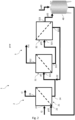
- a membrane dealcoholization and water reduction system comprising a dealcoholization section, 2, and a polishing section, 3;
- the dealcoholization section, 2 comprises at least one membrane dealcoholization unit, 21, having a retentate and a permeate side, said membrane dealcoholization unit having a feed inlet, 22, positioned at the retentate side of the membrane dealcoholization unit, a retentate outlet, 23, a permeate outlet, 24, and a water inlet, 25, positioned at the retentate side of the membrane dealcoholization unit.
- the membrane dealcoholization unit, 21, is preferably a reverse osmosis unit having a semipermeable membrane allowing water and alcohol to pass, while retaining other solutes of the beverage thus providing a dealcoholized beverage having a desired taste and mouthfeel.
- the starting abv of the feed can be up to 20% to 40%, typically it is 3% abv to 15% abv, most often 3.5 to 8% abv, but it may be higher or lower. It is contemplated that the feed, f2, may be fed from a buffer tank (not shown).
- the target abv of the dealcoholized beverage is typically, is ⁇ 0.5 % abv, preferably ⁇ 0.05 % abv, but can be up to 2.5%. This may be achieved by diluting the alcohol reduced solution leaving the dealcoholizing unit to the desired level.
- the at least one membrane dealcoholization unit, 21, is configured to allow for an operating pressure in the range of 10 to 45 bar, preferably 15 to 36 bar, and further having a temperature control means allowing for a temperature at or below 25 °C, preferably 10 to 20 °C.
- Suitable units are GEA AromaPlus Membrane dealcoholization unit available from GEA.
- the treatment in the membrane dealcoholization unit, 21, provides an alcohol reduced solution, r2, and an alcohol containing permeate, p2.
- the alcohol reduced solution, r2 will typically have an alcohol content below 0.5% abv, preferably below 0.05% abv.
- the major part of the alcohol of the feed, f2 leaves the membrane dealcoholization unit, 21, in the alcohol containing permeate, p2.
- the relative alcohol content in the permeate is low due to the high volume of water used, typically around 0.025 % abv.
- the polishing section, 3, comprises at least two membrane polishing units, 31 and 32, each having a retentate and a permeate side, in which a first membrane polishing unit, 31, has an inlet, 311, positioned at the retentate side of the unit, a retentate outlet, 312, and a permeate outlet, 313, and in which a second membrane polishing unit, 32, has an inlet, 321, positioned at the retentate side of the unit, a retentate outlet, 322, and a permeate outlet, 323.
- the membrane polishing units, 31 and 32 may be the same type or different, preferable they are of the same type operated under similar conditions. It is however contemplated that they may have different dimensions.
- the dealcoholization and membrane polishing units are fluidly connected such that the permeate outlet, 24, of the membrane dealcoholization unit, 21, is connected to the inlet, 311, of the first membrane polishing unit, 31, the permeate outlet, 313, of the first membrane polishing unit, 31, is connected to the inlet, 321, of the second membrane polishing unit, 32, and the retentate outlet, 322, of the second membrane polishing unit, 32, is connected to the inlet, 311, of the first membrane polishing unit, 31, and the permeate outlet, 323, of the second membrane polishing unit, 32, is connected to the water inlet, 25, of the membrane dealcoholization unit, 21.
- the second membrane polishing unit does not communicate with the surroundings but is in full circulation with the first membrane polishing unit, 31 and the membrane dealcoholization unit, 21.
- External water may be supplied in stream w2 either directly to the membrane dealcoholization unit, 21, through the water inlet, 25 or mixed with the second alcohol depleted permeate, p32.
- the at least two membrane polishing units, 31 and 32 are in the embodiment shown reverse osmosis units.
- the semipermeable membrane of two membrane polishing units, 31 and 32 are configured to allow water and alcohol to pass whereas other constituents of the solution are essentially retained by the membrane.
- membranes include but are not limited to Filmtec membranes from Dow or Dupont, such as Filmtec from Dow, Hydranautics membranes of the ESP series, such as ESPA4-DL, Turboclean RO membranes from Trisep, such as RO 8038-ACM2-46, Fluid Systems ® from Koch Separation Solutions, such as TFC SR200 8040-SR200-400-34 or RO membranes from LG Chem, such as LG BW 440 UES.
- the units are configured to allow for an operating pressure in the range of 15 to 80 bar, preferably 30 to 60 bar, more preferred, 40 to 55 bar and further having a temperature control means allowing for a temperature of -5 to 15 °C, preferably -2 to 10 °C, more preferred -1 to 8 °C.
- the alcohol enriched retentate, r31 is drawn from the polisher, 31, and is in preferred embodiments used as is or as an alcohol base for other products, including beverages such as Hard Seltzers, including beverages such as flavored alcoholic beverages (FAB) or neutral malt-based beverages (NMB).
- the alcohol enriched retentate may have an alcohol content of up to 25% abv.
- the alcohol depleted permeate, p31 is further depleted from alcohol in the second polisher, 32.
- the flow of the alcohol containing permeate, p2 is considered 100%.
- the flowrate of the alcohol depleted permeate, p31, of the first membrane polishing unit comprises at least 10% of the flow of the alcohol containing permeate, p2, for example 10 to 85 to 98 %
- the alcohol enriched retentate, r31 comprises at least 2% of the flow of the alcohol containing permeate, p2, for example 2 to 65 to 90 %.
- the alcohol enriched retentate, r31 has an alcohol content of up to 25% abv whereas the alcohol depleted permeate, p31, has an alcohol content of above 0 to 12 % abv.
- the alcohol depleted permeate, p31, of the first membrane polishing unit, 31, is further depleted from alcohol to provide a second alcohol enriched retentate, r32, and a permeate, p32.
- the second alcohol enriched retentate, r32 comprises at least 2% of the flowrate of the alcohol containing permeate, p2, for example 2 to 50 to 95%, and the flowrate of the second alcohol depleted permeate, p32, of the second membrane polishing unit comprises at least 5 % of the flowrate of the alcohol containing permeate, p2, for example 5 to 85 to 98.
- the second alcohol enriched retentate, r32 has an alcohol content of up to 15% abv whereas the alcohol depleted permeate, p32, has an alcohol content of 0 to 10% abv
- the second alcohol enriched retentate or a fraction thereof can in the embodiment shown be fed to the retentate side of the first membrane polishing unit, 31, during operation, it may be fed directly to the membrane polishing unit in a separate feed inlet or be pre-mixed with the alcohol enriched permeate, p2. Thereby further alcohol is captured and the amount on waste is further reduced.
- the fraction is typically discharged from the method and system and used for other purposes since the amount of alcohol in the permeate, p2, has not been built up.
- a further embodiment is shown in which all units and streams are the same as described for figure 1 but where the permeate outlet, 323, of the second membrane polishing unit, 32, is connected to the water inlet, 25, of the membrane dealcoholization unit, 21, via an intermediate buffer tank, 40.
- preconcentration permeate from the dealcoholization section may be directed to the buffer tank, and be used as a means for water supply in the initial phase of the diafiltration part of the dealcoholization.
- the presence of the buffer tank is thus an important source of optimizing the water saving during the process by providing flexibility in the water flows during the stages of the dealcoholization process, in particular for a batch process.
- water from the buffer tank is fed to the retentate side, 321, of the second polisher, 32, optionally premixed with the first dealcoholized permeate, p31.
- the permeate or a portion of the permeate p32 is circulated back to the retentate side, 321, of the second polisher, 32, optionally premixed with the first dealcoholized permeate, p31.
- a portion of the first dealcoholized permeate, p31 is circulated back to the retentate side, 311, of the first polisher, 31, optionally premixed with the alcohol enriched permeate.
- a portion of the first dealcoholized permeate, p31 is circulated back to the retentate side, 311, of the first polisher, 31, water from the buffer tank, 40, is fed to the retentate side, 321, of the second polisher, 32, optionally premixed with the first dealcoholized permeate, p31.
- the polishers are connected such that the permeate outlet of polisher n is fluidly connected to the inlet of polisher n+1.
- the permeate outlet of the last polisher is then recirculated and connected to the water inlet of the membrane dealcoholization unit.
- the retentate outlet of the subsequent membrane polishing units are either recirculated to one of the inlets of one of the previous membrane polishing units (31, 32, etc.) or mixed with the alcohol enriched retentate (r31).
- three or more membrane polishing units are used, when processing time is important.
- the system of the invention relates to a dealcoholization and water reduction system, 1, said system comprising a membrane dealcoholization section, 2, and a polishing section, 3;
- the dealcoholization section, 2 comprises at least one membrane dealcoholization unit, 21, having a retentate and a permeate side, said membrane dealcoholization unit having a feed inlet, 22, positioned at the retentate side of the membrane dealcoholization unit, a retentate outlet, 23, a permeate outlet, 24, and a water inlet, 25, positioned at the retentate side of the membrane dealcoholization unit;
- any of the effluent product streams may be further concentrated by way of evaporation, distillation, freeze concentration or other methods used in the art for concentrating a liquid.
- the product streams may be diluted to a desired percentage of solute concentration.
- Figure 4 illustrates a dealcoholization process without reuse of water (4a), with recirculation according to the invention with two membrane polishing units (4b) and with recirculation according using one membrane polishing unit (4c).
- the upper line shows the alcohol content in the beverage to be dealcoholized
- the lower line shows the alcohol content in the alcohol enriched permeate (corresponding to p2).
- a batch dealcoholization was simulated using a GEA proprietary simulation program. Similar simulations can be made using commercially available software such as Matlab, Chemcad or Aspen.
- the batch was tested with a typical high density beer product (i.e., initial abv around 7%).
- the initial beer volume was for this example set to 100000 liters (1000 hl).
- the dealcoholization process is initiated with a preconcentration around 3.5 times before the actual diafiltration starts.
- dealcoholization was performed using pure water for comparison and in the second the process was according to the invention with two polishers. As can be seen from the graphs of figures 4a and 4b , the duration of the processes is substantially the same. The process according to the invention is marginally longer.
- Example 2 Illustration of the water usage according to the invention with and without using a buffer tank.
- the graph shows the supply of external water.
- the upper lines show the supply of polished permeate in triangles and the lower lines show the supply of external water as circles.
- the processing time with one polishing unit and a buffer tank was around 50% longer than with no polishing units or buffer tank and around 20% longer with two polishing units and a buffer tank, thus resulting in around 25% prolonged processing time comparing one with two polishing units.
- the total need for external water supply decreased compared to the embodiment with no polishing units which is further facilitated by the presence of the buffer tank.
- the external water saving is significant.
- the systems and methods of the invention allow for significant water savings. It can also be seen that the lowest demand for external water is in embodiments with at least two polishing units and where there is a buffer tank to which preconcentration water is fed.
- Example 3 illustration of total energy consumption comparing variations with one and two membrane polishing units
Landscapes
- Chemical & Material Sciences (AREA)
- Engineering & Computer Science (AREA)
- Water Supply & Treatment (AREA)
- Chemical Kinetics & Catalysis (AREA)
- Nanotechnology (AREA)
- Organic Chemistry (AREA)
- Biochemistry (AREA)
- Life Sciences & Earth Sciences (AREA)
- Health & Medical Sciences (AREA)
- Bioinformatics & Cheminformatics (AREA)
- General Engineering & Computer Science (AREA)
- General Health & Medical Sciences (AREA)
- Genetics & Genomics (AREA)
- Food Science & Technology (AREA)
- Wood Science & Technology (AREA)
- Zoology (AREA)
- Separation Using Semi-Permeable Membranes (AREA)
Priority Applications (4)
| Application Number | Priority Date | Filing Date | Title |
|---|---|---|---|
| EP22168160.4A EP4260932A1 (fr) | 2022-04-13 | 2022-04-13 | Procédé et système pour réduire la consommation d'eau dans un processus de désalcoolisation à membrane |
| EP23717494.1A EP4507812A1 (fr) | 2022-04-13 | 2023-04-04 | Procédé et système de réduction de la consommation d'eau dans un processus de désalcoolisation membranaire |
| PCT/EP2023/058850 WO2023198532A1 (fr) | 2022-04-13 | 2023-04-04 | Procédé et système de réduction de la consommation d'eau dans un processus de désalcoolisation membranaire |
| US18/856,361 US20250257299A1 (en) | 2022-04-13 | 2023-04-04 | Method and system for reducing water consumption in a membrane dealcoholization process |
Applications Claiming Priority (1)
| Application Number | Priority Date | Filing Date | Title |
|---|---|---|---|
| EP22168160.4A EP4260932A1 (fr) | 2022-04-13 | 2022-04-13 | Procédé et système pour réduire la consommation d'eau dans un processus de désalcoolisation à membrane |
Publications (1)
| Publication Number | Publication Date |
|---|---|
| EP4260932A1 true EP4260932A1 (fr) | 2023-10-18 |
Family
ID=81308209
Family Applications (2)
| Application Number | Title | Priority Date | Filing Date |
|---|---|---|---|
| EP22168160.4A Withdrawn EP4260932A1 (fr) | 2022-04-13 | 2022-04-13 | Procédé et système pour réduire la consommation d'eau dans un processus de désalcoolisation à membrane |
| EP23717494.1A Pending EP4507812A1 (fr) | 2022-04-13 | 2023-04-04 | Procédé et système de réduction de la consommation d'eau dans un processus de désalcoolisation membranaire |
Family Applications After (1)
| Application Number | Title | Priority Date | Filing Date |
|---|---|---|---|
| EP23717494.1A Pending EP4507812A1 (fr) | 2022-04-13 | 2023-04-04 | Procédé et système de réduction de la consommation d'eau dans un processus de désalcoolisation membranaire |
Country Status (3)
| Country | Link |
|---|---|
| US (1) | US20250257299A1 (fr) |
| EP (2) | EP4260932A1 (fr) |
| WO (1) | WO2023198532A1 (fr) |
Citations (5)
| Publication number | Priority date | Publication date | Assignee | Title |
|---|---|---|---|---|
| DE3423594A1 (de) * | 1984-06-27 | 1986-01-02 | Akzo Gmbh, 5600 Wuppertal | Weinklaerung mittels crossflow-filtration |
| EP2893817A1 (fr) * | 2014-01-10 | 2015-07-15 | Wia Wine AG | Dispositif et procédé de fabrication d'une boisson désalcoolisée |
| US20160136577A1 (en) * | 2014-11-17 | 2016-05-19 | Massachusetts Institute Of Technology | Concentration control in filtration systems, and associated methods |
| WO2018200434A1 (fr) * | 2017-04-26 | 2018-11-01 | Bl Technologies, Inc. | Système à uf/oi intégré, à haute récupération |
| WO2019178422A1 (fr) | 2018-03-15 | 2019-09-19 | KSQ Therapeutics, Inc. | Compositions de régulation génique et procédés pour améliorer l'immunothérapie |
-
2022
- 2022-04-13 EP EP22168160.4A patent/EP4260932A1/fr not_active Withdrawn
-
2023
- 2023-04-04 US US18/856,361 patent/US20250257299A1/en active Pending
- 2023-04-04 EP EP23717494.1A patent/EP4507812A1/fr active Pending
- 2023-04-04 WO PCT/EP2023/058850 patent/WO2023198532A1/fr not_active Ceased
Patent Citations (5)
| Publication number | Priority date | Publication date | Assignee | Title |
|---|---|---|---|---|
| DE3423594A1 (de) * | 1984-06-27 | 1986-01-02 | Akzo Gmbh, 5600 Wuppertal | Weinklaerung mittels crossflow-filtration |
| EP2893817A1 (fr) * | 2014-01-10 | 2015-07-15 | Wia Wine AG | Dispositif et procédé de fabrication d'une boisson désalcoolisée |
| US20160136577A1 (en) * | 2014-11-17 | 2016-05-19 | Massachusetts Institute Of Technology | Concentration control in filtration systems, and associated methods |
| WO2018200434A1 (fr) * | 2017-04-26 | 2018-11-01 | Bl Technologies, Inc. | Système à uf/oi intégré, à haute récupération |
| WO2019178422A1 (fr) | 2018-03-15 | 2019-09-19 | KSQ Therapeutics, Inc. | Compositions de régulation génique et procédés pour améliorer l'immunothérapie |
Also Published As
| Publication number | Publication date |
|---|---|
| US20250257299A1 (en) | 2025-08-14 |
| WO2023198532A1 (fr) | 2023-10-19 |
| EP4507812A1 (fr) | 2025-02-19 |
Similar Documents
| Publication | Publication Date | Title |
|---|---|---|
| EP0202590B1 (fr) | Procédé continu de recyclage pour la fabrication de boissons à faible teneur en alcool | |
| Massot et al. | Nanofiltration and reverse osmosis in winemaking | |
| JP6778690B2 (ja) | ビールまたはシードル濃縮物 | |
| JP6857256B2 (ja) | ビール/ハード・サイダー濃縮物を生成するためのシステムおよびその方法 | |
| JPH06501391A (ja) | 天然発酵飲料の脱アルコールのための膜処理 | |
| JPS58209975A (ja) | アルコ−ル飲料の製法 | |
| CN1060972A (zh) | 除去含水原料中不良成分的方法及装置 | |
| US4664918A (en) | Process for reducing alcohol in fermented beverages by means of dialysis | |
| CN1373181A (zh) | 一种制取低醇或无醇原汁发酵酒精饮料的方法 | |
| EP4260932A1 (fr) | Procédé et système pour réduire la consommation d'eau dans un processus de désalcoolisation à membrane | |
| US4717482A (en) | Production of low alcoholic content beverages | |
| US11786865B2 (en) | Membrane-based production of high ethanol content solutions | |
| US7455777B2 (en) | Method of adjusting levels of dissolved compounds in beverages | |
| JP2026503652A (ja) | 加圧補助ダイアフィルトレーション分離方法およびシステム | |
| IE53719B1 (en) | Alcoholic beverages and method of manufacture | |
| EP0057785B1 (fr) | Procédé pour la préparation d'une boisson aromatisée et alcoholique | |
| JPH07265055A (ja) | ビールの微細濾過 | |
| JPS61119180A (ja) | 低アルコ−ルビ−ルの製造方法 | |
| AU2020234694B2 (en) | System and method for the production of high gravity non-alcoholic beer through minimal water addition | |
| US6033690A (en) | Process for pre-conditioning brewer's wort with beer fermentation products and production of a beer therefrom | |
| CN100494336C (zh) | 一种调节葡萄酒醇度的方法 | |
| JP2025169195A (ja) | 濃縮ぶどう搾汁液の製造方法、及びワインの製造方法 | |
| WO2008051100A2 (fr) | Procédé pour une concentration et une rectification simultanées de moût de raisin à l'aide de nanofiltration et d'électrodialyse | |
| JPH0292266A (ja) | 低アルコール飲料の製造法 | |
| US20240002761A1 (en) | Hard seltzer compositions and methods of making |
Legal Events
| Date | Code | Title | Description |
|---|---|---|---|
| PUAI | Public reference made under article 153(3) epc to a published international application that has entered the european phase |
Free format text: ORIGINAL CODE: 0009012 |
|
| STAA | Information on the status of an ep patent application or granted ep patent |
Free format text: STATUS: THE APPLICATION HAS BEEN PUBLISHED |
|
| AK | Designated contracting states |
Kind code of ref document: A1 Designated state(s): AL AT BE BG CH CY CZ DE DK EE ES FI FR GB GR HR HU IE IS IT LI LT LU LV MC MK MT NL NO PL PT RO RS SE SI SK SM TR |
|
| STAA | Information on the status of an ep patent application or granted ep patent |
Free format text: STATUS: THE APPLICATION IS DEEMED TO BE WITHDRAWN |
|
| 18D | Application deemed to be withdrawn |
Effective date: 20240419 |