EP4261003A1 - Gleichmässig heizendes verfahren zur verbesserung des heizergebnisses - Google Patents
Gleichmässig heizendes verfahren zur verbesserung des heizergebnisses Download PDFInfo
- Publication number
- EP4261003A1 EP4261003A1 EP22168498.8A EP22168498A EP4261003A1 EP 4261003 A1 EP4261003 A1 EP 4261003A1 EP 22168498 A EP22168498 A EP 22168498A EP 4261003 A1 EP4261003 A1 EP 4261003A1
- Authority
- EP
- European Patent Office
- Prior art keywords
- heating
- heated
- mold
- heating source
- containing space
- Prior art date
- Legal status (The legal status is an assumption and is not a legal conclusion. Google has not performed a legal analysis and makes no representation as to the accuracy of the status listed.)
- Withdrawn
Links
Images
Classifications
-
- B—PERFORMING OPERATIONS; TRANSPORTING
- B29—WORKING OF PLASTICS; WORKING OF SUBSTANCES IN A PLASTIC STATE IN GENERAL
- B29C—SHAPING OR JOINING OF PLASTICS; SHAPING OF MATERIAL IN A PLASTIC STATE, NOT OTHERWISE PROVIDED FOR; AFTER-TREATMENT OF THE SHAPED PRODUCTS, e.g. REPAIRING
- B29C44/00—Shaping by internal pressure generated in the material, e.g. swelling or foaming ; Producing porous or cellular expanded plastics articles
- B29C44/34—Auxiliary operations
- B29C44/3415—Heating or cooling
-
- B—PERFORMING OPERATIONS; TRANSPORTING
- B29—WORKING OF PLASTICS; WORKING OF SUBSTANCES IN A PLASTIC STATE IN GENERAL
- B29C—SHAPING OR JOINING OF PLASTICS; SHAPING OF MATERIAL IN A PLASTIC STATE, NOT OTHERWISE PROVIDED FOR; AFTER-TREATMENT OF THE SHAPED PRODUCTS, e.g. REPAIRING
- B29C35/00—Heating, cooling or curing, e.g. crosslinking or vulcanising; Apparatus therefor
- B29C35/02—Heating or curing, e.g. crosslinking or vulcanizing during moulding, e.g. in a mould
-
- B—PERFORMING OPERATIONS; TRANSPORTING
- B29—WORKING OF PLASTICS; WORKING OF SUBSTANCES IN A PLASTIC STATE IN GENERAL
- B29C—SHAPING OR JOINING OF PLASTICS; SHAPING OF MATERIAL IN A PLASTIC STATE, NOT OTHERWISE PROVIDED FOR; AFTER-TREATMENT OF THE SHAPED PRODUCTS, e.g. REPAIRING
- B29C35/00—Heating, cooling or curing, e.g. crosslinking or vulcanising; Apparatus therefor
- B29C35/02—Heating or curing, e.g. crosslinking or vulcanizing during moulding, e.g. in a mould
- B29C35/04—Heating or curing, e.g. crosslinking or vulcanizing during moulding, e.g. in a mould using liquids, gas or steam
-
- B—PERFORMING OPERATIONS; TRANSPORTING
- B29—WORKING OF PLASTICS; WORKING OF SUBSTANCES IN A PLASTIC STATE IN GENERAL
- B29C—SHAPING OR JOINING OF PLASTICS; SHAPING OF MATERIAL IN A PLASTIC STATE, NOT OTHERWISE PROVIDED FOR; AFTER-TREATMENT OF THE SHAPED PRODUCTS, e.g. REPAIRING
- B29C35/00—Heating, cooling or curing, e.g. crosslinking or vulcanising; Apparatus therefor
- B29C35/02—Heating or curing, e.g. crosslinking or vulcanizing during moulding, e.g. in a mould
- B29C35/08—Heating or curing, e.g. crosslinking or vulcanizing during moulding, e.g. in a mould by wave energy or particle radiation
- B29C35/0805—Heating or curing, e.g. crosslinking or vulcanizing during moulding, e.g. in a mould by wave energy or particle radiation using electromagnetic radiation
-
- B—PERFORMING OPERATIONS; TRANSPORTING
- B29—WORKING OF PLASTICS; WORKING OF SUBSTANCES IN A PLASTIC STATE IN GENERAL
- B29C—SHAPING OR JOINING OF PLASTICS; SHAPING OF MATERIAL IN A PLASTIC STATE, NOT OTHERWISE PROVIDED FOR; AFTER-TREATMENT OF THE SHAPED PRODUCTS, e.g. REPAIRING
- B29C35/00—Heating, cooling or curing, e.g. crosslinking or vulcanising; Apparatus therefor
- B29C35/02—Heating or curing, e.g. crosslinking or vulcanizing during moulding, e.g. in a mould
- B29C35/12—Dielectric heating
-
- B—PERFORMING OPERATIONS; TRANSPORTING
- B29—WORKING OF PLASTICS; WORKING OF SUBSTANCES IN A PLASTIC STATE IN GENERAL
- B29C—SHAPING OR JOINING OF PLASTICS; SHAPING OF MATERIAL IN A PLASTIC STATE, NOT OTHERWISE PROVIDED FOR; AFTER-TREATMENT OF THE SHAPED PRODUCTS, e.g. REPAIRING
- B29C43/00—Compression moulding, i.e. applying external pressure to flow the moulding material; Apparatus therefor
- B29C43/003—Compression moulding, i.e. applying external pressure to flow the moulding material; Apparatus therefor characterised by the choice of material
-
- B—PERFORMING OPERATIONS; TRANSPORTING
- B29—WORKING OF PLASTICS; WORKING OF SUBSTANCES IN A PLASTIC STATE IN GENERAL
- B29C—SHAPING OR JOINING OF PLASTICS; SHAPING OF MATERIAL IN A PLASTIC STATE, NOT OTHERWISE PROVIDED FOR; AFTER-TREATMENT OF THE SHAPED PRODUCTS, e.g. REPAIRING
- B29C43/00—Compression moulding, i.e. applying external pressure to flow the moulding material; Apparatus therefor
- B29C43/32—Component parts, details or accessories; Auxiliary operations
- B29C43/52—Heating or cooling
-
- B—PERFORMING OPERATIONS; TRANSPORTING
- B29—WORKING OF PLASTICS; WORKING OF SUBSTANCES IN A PLASTIC STATE IN GENERAL
- B29C—SHAPING OR JOINING OF PLASTICS; SHAPING OF MATERIAL IN A PLASTIC STATE, NOT OTHERWISE PROVIDED FOR; AFTER-TREATMENT OF THE SHAPED PRODUCTS, e.g. REPAIRING
- B29C44/00—Shaping by internal pressure generated in the material, e.g. swelling or foaming ; Producing porous or cellular expanded plastics articles
- B29C44/34—Auxiliary operations
- B29C44/36—Feeding the material to be shaped
- B29C44/38—Feeding the material to be shaped into a closed space, i.e. to make articles of definite length
- B29C44/44—Feeding the material to be shaped into a closed space, i.e. to make articles of definite length in solid form
- B29C44/445—Feeding the material to be shaped into a closed space, i.e. to make articles of definite length in solid form in the form of expandable granules, particles or beads
-
- B—PERFORMING OPERATIONS; TRANSPORTING
- B29—WORKING OF PLASTICS; WORKING OF SUBSTANCES IN A PLASTIC STATE IN GENERAL
- B29D—PRODUCING PARTICULAR ARTICLES FROM PLASTICS OR FROM SUBSTANCES IN A PLASTIC STATE
- B29D35/00—Producing footwear
- B29D35/12—Producing parts thereof, e.g. soles, heels, uppers, by a moulding technique
- B29D35/122—Soles
-
- B—PERFORMING OPERATIONS; TRANSPORTING
- B29—WORKING OF PLASTICS; WORKING OF SUBSTANCES IN A PLASTIC STATE IN GENERAL
- B29D—PRODUCING PARTICULAR ARTICLES FROM PLASTICS OR FROM SUBSTANCES IN A PLASTIC STATE
- B29D35/00—Producing footwear
- B29D35/12—Producing parts thereof, e.g. soles, heels, uppers, by a moulding technique
- B29D35/128—Moulds or apparatus therefor
-
- B—PERFORMING OPERATIONS; TRANSPORTING
- B29—WORKING OF PLASTICS; WORKING OF SUBSTANCES IN A PLASTIC STATE IN GENERAL
- B29C—SHAPING OR JOINING OF PLASTICS; SHAPING OF MATERIAL IN A PLASTIC STATE, NOT OTHERWISE PROVIDED FOR; AFTER-TREATMENT OF THE SHAPED PRODUCTS, e.g. REPAIRING
- B29C35/00—Heating, cooling or curing, e.g. crosslinking or vulcanising; Apparatus therefor
- B29C35/02—Heating or curing, e.g. crosslinking or vulcanizing during moulding, e.g. in a mould
- B29C35/04—Heating or curing, e.g. crosslinking or vulcanizing during moulding, e.g. in a mould using liquids, gas or steam
- B29C35/041—Heating or curing, e.g. crosslinking or vulcanizing during moulding, e.g. in a mould using liquids, gas or steam using liquids
- B29C2035/042—Heating or curing, e.g. crosslinking or vulcanizing during moulding, e.g. in a mould using liquids, gas or steam using liquids other than water
- B29C2035/043—Heating or curing, e.g. crosslinking or vulcanizing during moulding, e.g. in a mould using liquids, gas or steam using liquids other than water oil
-
- B—PERFORMING OPERATIONS; TRANSPORTING
- B29—WORKING OF PLASTICS; WORKING OF SUBSTANCES IN A PLASTIC STATE IN GENERAL
- B29C—SHAPING OR JOINING OF PLASTICS; SHAPING OF MATERIAL IN A PLASTIC STATE, NOT OTHERWISE PROVIDED FOR; AFTER-TREATMENT OF THE SHAPED PRODUCTS, e.g. REPAIRING
- B29C35/00—Heating, cooling or curing, e.g. crosslinking or vulcanising; Apparatus therefor
- B29C35/02—Heating or curing, e.g. crosslinking or vulcanizing during moulding, e.g. in a mould
- B29C35/04—Heating or curing, e.g. crosslinking or vulcanizing during moulding, e.g. in a mould using liquids, gas or steam
- B29C35/045—Heating or curing, e.g. crosslinking or vulcanizing during moulding, e.g. in a mould using liquids, gas or steam using gas or flames
- B29C2035/046—Heating or curing, e.g. crosslinking or vulcanizing during moulding, e.g. in a mould using liquids, gas or steam using gas or flames dried air
-
- B—PERFORMING OPERATIONS; TRANSPORTING
- B29—WORKING OF PLASTICS; WORKING OF SUBSTANCES IN A PLASTIC STATE IN GENERAL
- B29C—SHAPING OR JOINING OF PLASTICS; SHAPING OF MATERIAL IN A PLASTIC STATE, NOT OTHERWISE PROVIDED FOR; AFTER-TREATMENT OF THE SHAPED PRODUCTS, e.g. REPAIRING
- B29C35/00—Heating, cooling or curing, e.g. crosslinking or vulcanising; Apparatus therefor
- B29C35/02—Heating or curing, e.g. crosslinking or vulcanizing during moulding, e.g. in a mould
- B29C35/08—Heating or curing, e.g. crosslinking or vulcanizing during moulding, e.g. in a mould by wave energy or particle radiation
- B29C35/0805—Heating or curing, e.g. crosslinking or vulcanizing during moulding, e.g. in a mould by wave energy or particle radiation using electromagnetic radiation
- B29C2035/0822—Heating or curing, e.g. crosslinking or vulcanizing during moulding, e.g. in a mould by wave energy or particle radiation using electromagnetic radiation using IR radiation
-
- B—PERFORMING OPERATIONS; TRANSPORTING
- B29—WORKING OF PLASTICS; WORKING OF SUBSTANCES IN A PLASTIC STATE IN GENERAL
- B29C—SHAPING OR JOINING OF PLASTICS; SHAPING OF MATERIAL IN A PLASTIC STATE, NOT OTHERWISE PROVIDED FOR; AFTER-TREATMENT OF THE SHAPED PRODUCTS, e.g. REPAIRING
- B29C35/00—Heating, cooling or curing, e.g. crosslinking or vulcanising; Apparatus therefor
- B29C35/02—Heating or curing, e.g. crosslinking or vulcanizing during moulding, e.g. in a mould
- B29C35/08—Heating or curing, e.g. crosslinking or vulcanizing during moulding, e.g. in a mould by wave energy or particle radiation
- B29C35/0805—Heating or curing, e.g. crosslinking or vulcanizing during moulding, e.g. in a mould by wave energy or particle radiation using electromagnetic radiation
- B29C2035/0855—Heating or curing, e.g. crosslinking or vulcanizing during moulding, e.g. in a mould by wave energy or particle radiation using electromagnetic radiation using microwave
-
- B—PERFORMING OPERATIONS; TRANSPORTING
- B29—WORKING OF PLASTICS; WORKING OF SUBSTANCES IN A PLASTIC STATE IN GENERAL
- B29C—SHAPING OR JOINING OF PLASTICS; SHAPING OF MATERIAL IN A PLASTIC STATE, NOT OTHERWISE PROVIDED FOR; AFTER-TREATMENT OF THE SHAPED PRODUCTS, e.g. REPAIRING
- B29C35/00—Heating, cooling or curing, e.g. crosslinking or vulcanising; Apparatus therefor
- B29C35/02—Heating or curing, e.g. crosslinking or vulcanizing during moulding, e.g. in a mould
- B29C35/08—Heating or curing, e.g. crosslinking or vulcanizing during moulding, e.g. in a mould by wave energy or particle radiation
- B29C35/0805—Heating or curing, e.g. crosslinking or vulcanizing during moulding, e.g. in a mould by wave energy or particle radiation using electromagnetic radiation
- B29C2035/0861—Heating or curing, e.g. crosslinking or vulcanizing during moulding, e.g. in a mould by wave energy or particle radiation using electromagnetic radiation using radio frequency
-
- B—PERFORMING OPERATIONS; TRANSPORTING
- B29—WORKING OF PLASTICS; WORKING OF SUBSTANCES IN A PLASTIC STATE IN GENERAL
- B29C—SHAPING OR JOINING OF PLASTICS; SHAPING OF MATERIAL IN A PLASTIC STATE, NOT OTHERWISE PROVIDED FOR; AFTER-TREATMENT OF THE SHAPED PRODUCTS, e.g. REPAIRING
- B29C43/00—Compression moulding, i.e. applying external pressure to flow the moulding material; Apparatus therefor
- B29C43/02—Compression moulding, i.e. applying external pressure to flow the moulding material; Apparatus therefor of articles of definite length, i.e. discrete articles
- B29C43/021—Compression moulding, i.e. applying external pressure to flow the moulding material; Apparatus therefor of articles of definite length, i.e. discrete articles characterised by the shape of the surface
-
- B—PERFORMING OPERATIONS; TRANSPORTING
- B29—WORKING OF PLASTICS; WORKING OF SUBSTANCES IN A PLASTIC STATE IN GENERAL
- B29K—INDEXING SCHEME ASSOCIATED WITH SUBCLASSES B29B, B29C OR B29D, RELATING TO MOULDING MATERIALS OR TO MATERIALS FOR MOULDS, REINFORCEMENTS, FILLERS OR PREFORMED PARTS, e.g. INSERTS
- B29K2105/00—Condition, form or state of moulded material or of the material to be shaped
- B29K2105/04—Condition, form or state of moulded material or of the material to be shaped cellular or porous
- B29K2105/048—Expandable particles, beads or granules
Definitions
- Present invention is related to a heating method, especially to an evenly heating method for enhancing heating result.
- the heating method provided by the present invention is first used in foam material, and the following content will use such foam material as an example to illustrate for better explanation and understanding.
- foam material such foam material as an example to illustrate for better explanation and understanding.
- the present invention is not intended to be limited for such only application. Any other suitable material with similar mechanism can be applied to the heating method provided by the present invention.
- the conventional forming method to shape the foamed beads into molded products or final products is mainly used the method same as the conventional Styrofoam beads.
- it comprises the steps of introducing the Styrofoam beads into a closed mold maintaining in high temperature and pressure full of steam; immersing the Styrofoam beads in such closed environment for several hours to have all beads reaching a balance or homogeneous status; releasing the pressure from the steam; following with filling with more steam in high heat and pressure to have all the beads expanded and foamed into molded products.
- the present invention provides a method for improving heating the material more evenly in reasonable cost.
- An evenly heating method comprises steps of: introducing an object to be heated into a containing space of a mold; using a mechanical force to reduce the containing space to compress the object to be heated; and applying a heating source to the mold to heat the object in the mold.
- the object to be heat has flexible, elastic, and compressive properties.
- the object to be heated comprises semi-foamed materials or foamed materials, or unfoamed materials.
- the object to be heated is foamed beads.
- the mold comprises an upper lid and a lower container to define the containing space within, and the upper lid compresses the object to be heated and reduces the containing space.
- the mechanical force is applied to the mold by electric machinery, pneumatic machinery, or hydraulic machinery.
- the mechanical force is to use an air compressor compressing air in room temperature into the mold along with introducing the object to be heated into the mold.
- the heating source includes external heating source, an internal heating source or combination thereof.
- the external heating source comprises heating the mold by hot water, steam, resistance heating element, direct fire heating, electronic heating element, electromagnetic element, capacitive dielectric element, electric heating tube, hot air or hot oil.
- the internal heating source comprises radiation heating such as infrared ray heating, radio frequency radiation heating, or microwave heating.
- the present invention has the following advantages:
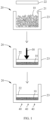
- FIG. 1 is an illustrating flowchart of a preferred embodiment in accordance to the present invention.
- FIG. 1 an illustrating flow chart of a preferred embodiment of an evenly heating method for enhancing heating result provided by the present invention.
- foamed beads are firstly used as processing objects, and will be explained in detail below.
- the method comprises steps as follows.
- the object 10 to be heated by the present invention described in this embodiment preferably has flexible, elastic, and compressive properties. It could be in a form such as semi-foamed materials or foamed materials, or unfoamed materials that may partially have compressive ability.
- foamed beads are particles that may have been in a semi-foamed condition, and are commonly made of plastic materials including thermoplastic polyurethane elastomer (E-TPU), polylactic acid (PLA), polypropylene (PP), polyethylene (PE), polyamide Amine (PA), Polystyrene (PS), Polyphenylene Ether (PPE), Thermoplastic Elastomer (TPE), Thermoplastic Polyester Elastomer (TPEE), Polyolefin Elastomer (TPO), or Ethylene Vinyl Acetate Copolymer (EVA).
- the mold 20 in this embodiment preferably includes at least an upper lid 22 and a lower container 23 and the containing space 21 is formed therebetween.
- the mold 20 When the object 10 to be heated is foamed beads as a preferred embodiment being introduced into the mold 20 at the first step, the mold 20 may be in a closed or unclosed state.
- the upper lid 22 compresses onto the object 10 to be heated and making the containing space 21 smaller and applying the mechanical force 30 on the object 10. Meanwhile, each particle of foamed beads in the containing space 21 will be compressed more tightly and having a contact area of each beads increased.
- the mold 20 will be heated by the heating source 40. As the contact area of each particle has been compress with tightly condition, the heating source 40 could evenly applied to each particle of foamed beads and rapidly spread to all the particles.
- the present invention could avoid to use high heat and high pressure of steam with longer time immersing or soaking treatment as the conventional Styrofoam beads to obtain a better quality of molded products.
- each of the foamed bead will have more even pressure distribution and compression condition which could avoid any uneven pressure or compression happened and have a better appearance of the molded product.
- the aforementioned mechanical force 30 could be applied by any suitable machinery force including an electric, pneumatic or hydraulic machine that directly applies pressure to the upper lid 22 or the lower container 23 and compresses the containing space 21.
- Another preferred embodiment to applying the mechanical force 30 can also use an air compressor compressing air in room temperature (without using high heat) into the mold 20. Such compressed air will transmit the foamed beads into the mold 20 at the same time, and the effect of compression to the foamed beads can also be achieved during the process.
- the aforementioned heating source 40 includes one or a combination of an external heating source or an internal heating source.
- the external heating source includes heating the mold 20 by hot water, steam, resistance heating element, direct fire heating, electronic heating element, electromagnetic heating, capacitive dielectric heating, electric heating tube, hot air heating, hot oil heating.
- the internal heating source includes heating the mold 20 using radiation like infrared (IR), radio frequency radiation (RF), and microwave (MW). It is preferred that the mold 20 has its structure or material compatible to the heating source 40. For example, when applying the external heat to the mold 20, it is preferred to use conductive material such as metal on the mold 20 to be able to transmit such heat to the object 10 to be heated within the containing space 21. When applying the internal heat to the mold 20, it is preferred to use the transmitted material such as plastic on the mold 20 to be able to transmit such heat to the object.
- an internal heating source such as microwave heating
- microwave heating to heat and form the object 10 to be heated.
- Microwaves providing the energy which could cause intermolecular vibration of the object 10 to be heated and then generate heat from the intermolecular, which can give more even heating performing and have the molded product with good appearance and better forming condition.
- the molded product (or final product) from the foamed beads could have a more obvious texture from the particles which is a significant character of such material.
- the molded product could be widely applied to all kinds of applications including shoe sole, filler material or shock absorbing material.
- the cost for manufacture could be greatly reduced without longer time processing, special equipment to generate high heat or high pressure.
- the present invention could effectively reduce the production cost and processing time for such unique material, and make a significant contribution to the cost price of the finished product.
- the performance test in table 1 is obtained by the above preferred embodiment of the present invention.
- the foamed beads contain the material of thermoplastic polyurethane foamed beads (E-TPU) with an average particle weight at a range of 25 ⁇ 10 mg, a thickness of the test piece is 10 mm, and the density is 250 kg/cm 3 .
- E-TPU thermoplastic polyurethane foamed beads
- the present invention uses the mechanical force 30 in step 2 to compress the foamed beads so that the compression ratio of the foamed beads is 1 to 3, or more preferably to be 2.
- the heating source 40 is heated by microwaves with a power of 100W for 180 seconds and is left for cooling before taking out.
- Table 1 Testing Items Standard Value
- the present invention utilizes the method to compress the foamed beads with the mechanical force 30 applied in step 2 to make the foamed bead with compression ratio better at the range of 1-3, and the heating source 40 uses microwaves with a power of 50-100W. After being heated for 120 to 240 sec, several test pieces formed by the present have the same or better mechanical properties than the test pieces obtained by other conventional molding methods under the same specifications.
- the heating method provided by the present invention is suitable to produce all kinds of foaming products including micro-foaming or even high foaming requests.
- the final products could be widely as shoe sole, insole, mat, or mattresses.
- the heating method of the present invention is not limited to such foamed material.
- the present invention could also apply to food heating or precooking process with similar idea of compression the heated item during the processing.
Landscapes
- Engineering & Computer Science (AREA)
- Mechanical Engineering (AREA)
- Physics & Mathematics (AREA)
- Health & Medical Sciences (AREA)
- Oral & Maxillofacial Surgery (AREA)
- Thermal Sciences (AREA)
- Electromagnetism (AREA)
- Toxicology (AREA)
- Casting Or Compression Moulding Of Plastics Or The Like (AREA)
Priority Applications (1)
| Application Number | Priority Date | Filing Date | Title |
|---|---|---|---|
| EP22168498.8A EP4261003A1 (de) | 2022-04-14 | 2022-04-14 | Gleichmässig heizendes verfahren zur verbesserung des heizergebnisses |
Applications Claiming Priority (1)
| Application Number | Priority Date | Filing Date | Title |
|---|---|---|---|
| EP22168498.8A EP4261003A1 (de) | 2022-04-14 | 2022-04-14 | Gleichmässig heizendes verfahren zur verbesserung des heizergebnisses |
Publications (1)
| Publication Number | Publication Date |
|---|---|
| EP4261003A1 true EP4261003A1 (de) | 2023-10-18 |
Family
ID=81328547
Family Applications (1)
| Application Number | Title | Priority Date | Filing Date |
|---|---|---|---|
| EP22168498.8A Withdrawn EP4261003A1 (de) | 2022-04-14 | 2022-04-14 | Gleichmässig heizendes verfahren zur verbesserung des heizergebnisses |
Country Status (1)
| Country | Link |
|---|---|
| EP (1) | EP4261003A1 (de) |
Citations (7)
| Publication number | Priority date | Publication date | Assignee | Title |
|---|---|---|---|---|
| US5139407A (en) * | 1989-09-01 | 1992-08-18 | General Electric Company | Apparatus for reducing thermoplastic material compression mold cycle time |
| WO2009009348A1 (en) * | 2007-07-10 | 2009-01-15 | Federal-Mogul Corporation | Microwave-assisted press cure processing of friction pads |
| US20140243442A1 (en) * | 2011-10-06 | 2014-08-28 | Jsp International Sarl | Moulding of plastic particulate matter |
| EP2781327A1 (de) * | 2011-11-16 | 2014-09-24 | JSR Corporation | Formvorrichtung und herstellungsverfahren für thermoplastische formung |
| EP3338984A2 (de) * | 2016-12-01 | 2018-06-27 | Adidas AG | Verfahren zur herstellung eines kunststoffformteils, kunststoffformteil und schuh |
| US20180319052A1 (en) * | 2017-05-03 | 2018-11-08 | Pou Chen Corporation | Molding device having heating and cooling functions |
| WO2021147645A1 (zh) * | 2020-01-20 | 2021-07-29 | 正合林兴业股份有限公司 | 可伸缩模具结构以及其发泡制备方法 |
-
2022
- 2022-04-14 EP EP22168498.8A patent/EP4261003A1/de not_active Withdrawn
Patent Citations (7)
| Publication number | Priority date | Publication date | Assignee | Title |
|---|---|---|---|---|
| US5139407A (en) * | 1989-09-01 | 1992-08-18 | General Electric Company | Apparatus for reducing thermoplastic material compression mold cycle time |
| WO2009009348A1 (en) * | 2007-07-10 | 2009-01-15 | Federal-Mogul Corporation | Microwave-assisted press cure processing of friction pads |
| US20140243442A1 (en) * | 2011-10-06 | 2014-08-28 | Jsp International Sarl | Moulding of plastic particulate matter |
| EP2781327A1 (de) * | 2011-11-16 | 2014-09-24 | JSR Corporation | Formvorrichtung und herstellungsverfahren für thermoplastische formung |
| EP3338984A2 (de) * | 2016-12-01 | 2018-06-27 | Adidas AG | Verfahren zur herstellung eines kunststoffformteils, kunststoffformteil und schuh |
| US20180319052A1 (en) * | 2017-05-03 | 2018-11-08 | Pou Chen Corporation | Molding device having heating and cooling functions |
| WO2021147645A1 (zh) * | 2020-01-20 | 2021-07-29 | 正合林兴业股份有限公司 | 可伸缩模具结构以及其发泡制备方法 |
Similar Documents
| Publication | Publication Date | Title |
|---|---|---|
| JP3781598B2 (ja) | 真空断熱材の変形方法、真空断熱材の固定方法、冷凍・冷蔵容器及び断熱箱体 | |
| CN1147518C (zh) | 开孔刚性聚氨酯泡沫及其制造方法 | |
| US11827764B2 (en) | Complex structure material, resin component, method of producing resin component | |
| US11530310B2 (en) | Method for preparing foamed thermoplastic polyurethane elastomer product | |
| US3082483A (en) | Method for producing a flexible, resilient, low density web of cellular plastic | |
| JPH0724861A (ja) | 断熱性および/または構造用2重壁成形体の製造方法およびその方法で得られる製品 | |
| EP4261003A1 (de) | Gleichmässig heizendes verfahren zur verbesserung des heizergebnisses | |
| CN100374274C (zh) | 生物可降解泡沫制品及相关技术的改进 | |
| US20230330901A1 (en) | An Evenly Heating Method for Enhancing Heating Result | |
| US12558820B2 (en) | Method for producing popcorn-containing shaped parts | |
| US2296305A (en) | Manufacture of thin sheets of chemically blown rubber | |
| US3631133A (en) | Process for expanding polystyrene | |
| TWI804765B (zh) | 一種提升加熱均勻性的方法 | |
| CN105331086A (zh) | 废弃聚氨酯泡沫的再生利用工艺方法 | |
| EP0410432B1 (de) | Verfahren zur Herstellung von wärmedämmenden Bauelementen und erhaltene Produkte | |
| CN102502114B (zh) | 一种用于有压缩机后罩的冰箱底垫及制作方法 | |
| CN115536899A (zh) | 一种轻量化吸音循环泡沫及其制备方法 | |
| JP2001162640A (ja) | 熱可塑性樹脂発泡成形体の製造方法 | |
| JP2001181365A (ja) | 真空断熱パネル充填材用連続気泡硬質ポリウレタンフォームの製造方法 | |
| JP2001181364A (ja) | 連続気泡硬質ポリウレタンフォーム成形体の製造方法 | |
| US5800658A (en) | Method and means by manufacture of a product of expanded polymer | |
| KR100590224B1 (ko) | 열 차단성이 우수한 폴리스틸렌 발포체의 제조방법 및 그제조방법에 의하여 제조된 폴리스틸렌 발포체 | |
| DE202022102246U1 (de) | Eine die Erwärmungshomogenität verbessernde Formwerkzeugstruktur | |
| EP0687216B1 (de) | Verfahren und mittel bei der herstellung von expandierten polymergegenständen | |
| CN111906985B (zh) | 多段发泡的方法 |
Legal Events
| Date | Code | Title | Description |
|---|---|---|---|
| PUAI | Public reference made under article 153(3) epc to a published international application that has entered the european phase |
Free format text: ORIGINAL CODE: 0009012 |
|
| STAA | Information on the status of an ep patent application or granted ep patent |
Free format text: STATUS: THE APPLICATION HAS BEEN PUBLISHED |
|
| AK | Designated contracting states |
Kind code of ref document: A1 Designated state(s): AL AT BE BG CH CY CZ DE DK EE ES FI FR GB GR HR HU IE IS IT LI LT LU LV MC MK MT NL NO PL PT RO RS SE SI SK SM TR |
|
| STAA | Information on the status of an ep patent application or granted ep patent |
Free format text: STATUS: THE APPLICATION IS DEEMED TO BE WITHDRAWN |
|
| 18D | Application deemed to be withdrawn |
Effective date: 20240419 |