EP4261111A1 - Outil d'inspection robotique à utiliser dans des espaces confinés - Google Patents
Outil d'inspection robotique à utiliser dans des espaces confinés Download PDFInfo
- Publication number
- EP4261111A1 EP4261111A1 EP22168118.2A EP22168118A EP4261111A1 EP 4261111 A1 EP4261111 A1 EP 4261111A1 EP 22168118 A EP22168118 A EP 22168118A EP 4261111 A1 EP4261111 A1 EP 4261111A1
- Authority
- EP
- European Patent Office
- Prior art keywords
- axis
- robot
- coupled
- legs
- actuator
- Prior art date
- Legal status (The legal status is an assumption and is not a legal conclusion. Google has not performed a legal analysis and makes no representation as to the accuracy of the status listed.)
- Withdrawn
Links
Images

Classifications
-
- B—PERFORMING OPERATIONS; TRANSPORTING
- B25—HAND TOOLS; PORTABLE POWER-DRIVEN TOOLS; MANIPULATORS
- B25J—MANIPULATORS; CHAMBERS PROVIDED WITH MANIPULATION DEVICES
- B25J9/00—Program-controlled manipulators
- B25J9/16—Program controls
- B25J9/1679—Program controls characterised by the tasks executed
- B25J9/1682—Dual arm manipulator; Coordination of several manipulators
-
- B—PERFORMING OPERATIONS; TRANSPORTING
- B25—HAND TOOLS; PORTABLE POWER-DRIVEN TOOLS; MANIPULATORS
- B25J—MANIPULATORS; CHAMBERS PROVIDED WITH MANIPULATION DEVICES
- B25J15/00—Gripping heads and other end effectors
- B25J15/0019—End effectors other than grippers
-
- B—PERFORMING OPERATIONS; TRANSPORTING
- B25—HAND TOOLS; PORTABLE POWER-DRIVEN TOOLS; MANIPULATORS
- B25J—MANIPULATORS; CHAMBERS PROVIDED WITH MANIPULATION DEVICES
- B25J19/00—Accessories fitted to manipulators, e.g. for monitoring, for viewing; Safety devices combined with or specially adapted for use in connection with manipulators
- B25J19/0025—Means for supplying energy to the end effector
-
- B—PERFORMING OPERATIONS; TRANSPORTING
- B25—HAND TOOLS; PORTABLE POWER-DRIVEN TOOLS; MANIPULATORS
- B25J—MANIPULATORS; CHAMBERS PROVIDED WITH MANIPULATION DEVICES
- B25J19/00—Accessories fitted to manipulators, e.g. for monitoring, for viewing; Safety devices combined with or specially adapted for use in connection with manipulators
- B25J19/005—Accessories fitted to manipulators, e.g. for monitoring, for viewing; Safety devices combined with or specially adapted for use in connection with manipulators using batteries, e.g. as a back-up power source
-
- B—PERFORMING OPERATIONS; TRANSPORTING
- B25—HAND TOOLS; PORTABLE POWER-DRIVEN TOOLS; MANIPULATORS
- B25J—MANIPULATORS; CHAMBERS PROVIDED WITH MANIPULATION DEVICES
- B25J19/00—Accessories fitted to manipulators, e.g. for monitoring, for viewing; Safety devices combined with or specially adapted for use in connection with manipulators
- B25J19/02—Sensing devices
- B25J19/021—Optical sensing devices
-
- B—PERFORMING OPERATIONS; TRANSPORTING
- B25—HAND TOOLS; PORTABLE POWER-DRIVEN TOOLS; MANIPULATORS
- B25J—MANIPULATORS; CHAMBERS PROVIDED WITH MANIPULATION DEVICES
- B25J9/00—Program-controlled manipulators
- B25J9/16—Program controls
- B25J9/1694—Program controls characterised by use of sensors other than normal servo-feedback from position, speed or acceleration sensors, perception control, multi-sensor controlled systems, sensor fusion
- B25J9/1697—Vision controlled systems
-
- B—PERFORMING OPERATIONS; TRANSPORTING
- B62—LAND VEHICLES FOR TRAVELLING OTHERWISE THAN ON RAILS
- B62D—MOTOR VEHICLES; TRAILERS
- B62D57/00—Vehicles characterised by having other propulsion or other ground- engaging means than wheels or endless track, alone or in addition to wheels or endless track
- B62D57/02—Vehicles characterised by having other propulsion or other ground- engaging means than wheels or endless track, alone or in addition to wheels or endless track with ground-engaging propulsion means, e.g. walking members
- B62D57/032—Vehicles characterised by having other propulsion or other ground- engaging means than wheels or endless track, alone or in addition to wheels or endless track with ground-engaging propulsion means, e.g. walking members with alternately or sequentially lifted supporting base and legs; with alternately or sequentially lifted feet or skid
-
- G—PHYSICS
- G01—MEASURING; TESTING
- G01N—INVESTIGATING OR ANALYSING MATERIALS BY DETERMINING THEIR CHEMICAL OR PHYSICAL PROPERTIES
- G01N29/00—Investigating or analysing materials by the use of ultrasonic, sonic or infrasonic waves; Visualisation of the interior of objects by transmitting ultrasonic or sonic waves through the object
- G01N29/04—Analysing solids
-
- G—PHYSICS
- G01—MEASURING; TESTING
- G01N—INVESTIGATING OR ANALYSING MATERIALS BY DETERMINING THEIR CHEMICAL OR PHYSICAL PROPERTIES
- G01N29/00—Investigating or analysing materials by the use of ultrasonic, sonic or infrasonic waves; Visualisation of the interior of objects by transmitting ultrasonic or sonic waves through the object
- G01N29/22—Details, e.g. general constructional or apparatus details
- G01N29/225—Supports, positioning or alignment in moving situation
- G01N29/226—Handheld or portable devices
-
- G—PHYSICS
- G01—MEASURING; TESTING
- G01N—INVESTIGATING OR ANALYSING MATERIALS BY DETERMINING THEIR CHEMICAL OR PHYSICAL PROPERTIES
- G01N2291/00—Indexing codes associated with group G01N29/00
- G01N2291/02—Indexing codes associated with the analysed material
- G01N2291/028—Material parameters
- G01N2291/0289—Internal structure, e.g. defects, grain size, texture
Definitions
- the invention relates to a robotic inspection tool for use ins confined spaces and a method of inspection.
- Airborne drones may be used for remote inspections.
- a robot for use in a confined space includes a body and a power supply coupled to and supported by the body.
- the robot also includes a plurality of legs, each leg including a mounting member fixedly attached to the body, a pivot member coupled to the mounting member for pivotal movement about a first axis, a shoulder mount coupled to the mounting member for pivotal movement about a second axis, the second axis normal to and coplanar with the first axis in all operating positions of the shoulder mount and the pivot member, a shoulder member coupled to the shoulder mount for pivotal movement about a third axis, the third axis normal to the first axis and the second axis in all operating positions of the shoulder mount and the shoulder member, an arm member coupled to the shoulder member for pivotal movement about a fourth axis that is parallel to the third axis, and a foot coupled to the arm member for pivotal movement about a fifth axis that is parallel to the third axis.
- the robot also includes a controller disposed within the body and oper
- a robot for use in a confined space includes a body and an arrangement of six legs. Each leg is connected to the body and includes a plurality of linkages arranged to define a first axis, a second axis, a third axis, a fourth axis, and a fifth axis. The first axis is normal to and coplanar with the second axis regardless of the position of the plurality of linkages.
- the robot also includes a plurality of actuators, each actuator coupled to the leg and arranged to pivotally move a portion of the plurality of linkages about one of the first axis, the second axis, the third axis, the fourth axis, and the fifth axis.
- the robot also includes a power supply coupled to the body and operable to deliver power to each actuator of the plurality of actuators and a controller coupled to the power supply and operable to selectively deliver power to each actuator of each leg to move the robot.
- a method of operating a robot includes positioning the robot in a confined space, the robot including a plurality of legs.
- the method includes sequentially moving the legs to propel the robot from a first position to an inspection position, visually confirming the robot is in the inspection position using an optical sensor and coupling a non-destructive examination tool to a first leg of the plurality of legs.
- the method further includes positioning the non-destructive examination tool in an inspection position and performing a non-destructive test on a component.
- phrases "associated with” and “associated therewith,” as well as derivatives thereof, may mean to include, be included within, interconnect with, contain, be contained within, connect to or with, couple to or with, be communicable with, cooperate with, interleave, juxtapose, be proximate to, be bound to or with, have, have a property of, or the like.
- any features, methods, steps, components, etc. described with regard to one embodiment are equally applicable to other embodiments absent a specific statement to the contrary.
- first, second, third and so forth may be used herein to refer to various elements, information, functions, or acts, these elements, information, functions, or acts should not be limited by these terms. Rather these numeral adjectives are used to distinguish different elements, information, functions or acts from each other. For example, a first element, information, function, or act could be termed a second element, information, function, or act, and, similarly, a second element, information, function, or act could be termed a first element, information, function, or act, without departing from the scope of the present disclosure.
- adjacent to may mean that an element is relatively near to but not in contact with a further element or that the element is in contact with the further portion, unless the context clearly indicates otherwise.
- phrase “based on” is intended to mean “based, at least in part, on” unless explicitly stated otherwise. Terms “about” or “substantially” or like terms are intended to cover variations in a value that are within normal industry manufacturing tolerances for that dimension. If no industry standard is available, a variation of twenty percent would fall within the meaning of these terms unless otherwise stated.
- Figure 1 illustrates a robot 100 suitable for use in many locations, but particularly suited for the performance of inspections in confined spaces.
- confined space refers to a space or area that is difficult for a person to access or that is hazardous for a portion to access. Difficult spaces can include small spaces within machines, components, or devices. Hazardous spaces could include spaces in which the atmosphere is dangerous, where radiation exposure may be present, high, or exposed locations, or where other dangers may be present. In addition to confined spaces, the robot 100 is well-suited for use in remote areas where onsite inspection can be costly due to travel or other requirements.
- the robot 100 includes a body 102 and a plurality of legs 104 extending from the body 102. In the illustrated construction, the robot 100 includes six legs 104.
- the robot 100 also includes especially two sensors in the form of optical sensors 106 connected to the body 102.
- the optical sensors 106 operate to capture video images that can be stored by the robot 100 and/or transmitted by the robot 100 to another location.
- a single optical sensor 106 could be used in place of the two optical sensors 106 if desired.
- the provision of two optical sensors 106 spaced apart from one another provides two different angles of view of the scene in front of the optical sensors 106.
- the two views can be combined to provide a stereo or 3D image of the scene in front of the optical sensors 106.
- Other constructions could include different sensors in place of the optical sensors 106 or in conjunction with the optical sensors 106 if desired.
- infrared sensors could be employed as optical sensors 106 or in conjunction with the optical sensors 106.
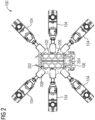
- Figure 2 is a bottom view of the robot 100 better illustrating the body 102.
- the body 102 includes a frame 206 that defines and protects a body interior.
- the frame 206 includes a plurality of hexagonal openings that reduce the weight of the frame 206 without significantly reducing the strength and stiffness of the frame 206.
- other constructions could include a solid-walled frame or could include different sizes and arrangements of the openings as may be desired.
- the frame 206 is elongated in one direction to define a long axis that extends along a centerline of the body 102.
- the frame 206 includes a plurality of attachment points 208 with each attachment point 208 arranged to receive and support one of the plurality of legs 104.
- Four of the attachment points 208 are arranged near the corners of the frame 206 with the remaining two attachment points 208 located approximately midway along the long axis of the frame 206.
- the body interior is sized and shaped to house, support, and protect components including a power supply such as a battery, and preferably a rechargeable battery 202 and a controller 204.
- the rechargeable battery 202 is selected and sized to provide power for all the necessary operations of the robot 100 for a desired period of time. For example, some rechargeable batteries 202 may provide for one hour of operation with others providing more or less depending on the power requirements of the robot 100 and any tools used by the robot 100.
- the controller 204 is preferably a microprocessor-based controller that includes a processor, memory, and data storage arranged to allow the processor to control all aspects of the operation of the robot 100 either with user intervention and control (e.g., steering or directing the robot 100) or autonomously.
- the data storage is sized to provide enough data storage for programing the operation of the robot 100 with other constructions including additional data storage to allow for the storage of data that might be collected by the robot 100 (e.g., data from the optical sensors 106, inspection data, path data, etc.).
- the frame 206 may also support and protect other components such as a transmitter, receiver, transceiver, an antenna, other communication devices, other power supplies such as an AC power connector, and the like.
- the frame 206 is therefore sized to support all the necessary components for a desired application while also protecting those components that need additional protection.
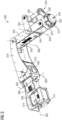
- Figure 3 is a perspective view of a first leg 300 better illustrating its details.
- each of the legs 104 is similar to the first leg 300 with only minor differences therebetween.
- the first leg 300 includes a plurality of linkages or components that are arranged to allow adjacent linkages to move or pivot with respect to one another about one or more of a first axis 302, a second axis 304, a third axis 306, a fourth axis 308, and a fifth axis 310.
- a mounting member 312 is arranged to fixedly attach the first leg 300 to one of the attachment points 208 of the frame 206, thereby attaching the first leg 300 to the body 102 of the robot 100.
- the mounting member 312 includes four apertures arranged to receive fasteners that fixedly attach the mounting member 312 to the frame 206.
- a first actuator 336 is fixedly attached to the mounting member 312 so that during operation of the first actuator 336, the first actuator 336 does not move with respect to the mounting member 312.
- a pivot member 314 is pivotally coupled to the mounting member 312 for pivotal rotation with respect to the mounting member 312 about the first axis 302.
- the first actuator 336 is coupled to the pivot member 314 such that operation of the first actuator 336 produces rotational movement of the pivot member 314 with respect to the mounting member 312 about the first axis 302.
- a second actuator 338 is fixedly attached to the pivot member 314 so that during operation of the second actuator 338, the second actuator 338 does not move with respect to the pivot member 314. Arrangements of the pivot member 314 different from that illustrated in figure 3 are also possible.
- a shoulder mount 316 is pivotally coupled to the pivot member 314 for pivotal rotation with respect to the pivot member 314 about the second axis 304.
- the second actuator 338 is coupled to the shoulder mount 316 such that operation of the second actuator 338 produces rotational movement of the shoulder mount 316 with respect to the pivot member 314 about the second axis 304.
- a third actuator 340 is fixedly attached to the shoulder mount 316 so that during operation of the third actuator 340, the third actuator 340 does not move with respect to the shoulder mount 316. Arrangements of the shoulder mount 316 different from that illustrated in figure 3 are also possible.
- a shoulder member 318 is pivotally coupled to the shoulder mount 316 for pivotal rotation with respect to the shoulder mount 316 about the third axis 306.
- the third actuator 340 is coupled to the shoulder member 318 such that operation of the third actuator 340 produces rotational movement of the shoulder member 318 with respect to the shoulder mount 316 about the third axis 306. Arrangements of the shoulder member 318 different from that illustrated in figure 3 are also possible.
- An arm member 320 is pivotally coupled to the shoulder member 318 for pivotal rotation with respect to the shoulder member 318 about the fourth axis 308.
- a fourth actuator 342 is fixedly attached to the arm member 320 so that during operation of the fourth actuator 342, the fourth actuator 342 does not move with respect to the arm member 320.
- the fourth actuator 342 is also coupled to the shoulder member 318 such that operation of the fourth actuator 342 produces rotational movement of the arm member 320 with respect to the shoulder member 318 about the fourth axis 308.
- a fifth actuator 344 is also fixedly attached to the arm member 320 so that during operation of the fifth actuator 344, the fifth actuator 344 does not move with respect to the arm member 320. Arrangements of the arm member 320 different from that illustrated in figure 3 are also possible.
- the arm member 320 includes a first end through which the fourth axis 308 passes and a second end through which the fifth axis 310 passes.
- a foot 322 is pivotally coupled to the arm member 320 for pivotal movement about the fifth axis 310.
- a foot linkage 324 couples the foot 322 to the arm member 320 at a second pivot axis 346 between the first end and the second end of the arm member 320.
- the fifth actuator 344 is coupled to the foot linkage 324 to produce pivotal movement of the foot linkage 324 about the second pivot axis 346.
- the foot linkage 324 includes an upper linkage 326, a middle linkage 328, and a lower linkage 330.
- the upper linkage 326 includes a first end that is connected to the fifth actuator 344 such that operation of the fifth actuator 344 rotates the upper linkage 326 about the second pivot axis 346.
- the middle linkage 328 includes a first end pivotally connected to a second end of the upper linkage 326 and a second end that is pivotally connected to a first end of the lower linkage 330.
- a second end of the lower linkage 330 is fixedly attached to the foot 322.
- the lower linkage 330 is formed as one piece with the foot 322.
- the foot 322 includes a foot pad 332 and a fixing member 334.
- the foot pad 332 is arranged to receive one or more tools that may be desired with the fixing member 334 arranged to facilitate the attachment of the desired tool.
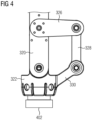
- the tool includes a magnet 402 attached to the first leg 300.
- the magnet 402 may be disk-shaped with a central aperture that receives the fixing member 334.
- the fixing member 334 may include a threaded portion that receives a nut that locks the magnet 402 in place.
- the magnet 402 in some constructions is able to move (e.g., +/-15 degrees) in any direction to allow for any minor misalignment. In these constructions, the magnet 402 will lock in place when the magnet 402 is activated and is biased (e.g., spring-loaded) back into a center position when not activated.
- Other possible tools include sensors such as non-destructive examination tools.
- an ultrasonic probe or a magnetic detector could be coupled to the foot 322 of the first leg 300 for use in inspecting a component.
- Many other tools are suitable for use with the first leg 300. As such, the tools for the first leg 300 should not be limited to the few examples provided herein.
- the arrangement of the various axes is selected to make the movement of the first leg 300 and more specifically, the programming of the movement simpler.
- the first axis 302 extends in a first or "X" direction with the second axis 304 being arranged normal to the first axis 302 such that the second axis extends in a second or "Y" direction.
- the first axis 302 and the second axis 304 are positioned to intersect with one another at a single point that does not change during movement of the first leg 300. More specifically, regardless of the position or configuration of the first leg 300, the relationship and intersection point of the first axis 302 and the second axis 304 does not change.
- This arrangement allows the two joints to be considered one omnidirectional joint rather than two unidirectional joints, thus simplifying the kinematic layout significantly, which also greatly simplifies programming movement of the first leg 300.
- the third axis 306, the fourth axis 308, and the fifth axis 310 are parallel to one another and normal to the first axis 302 and the second axis 304.
- the third axis 306, the fourth axis 308, and the fifth axis 310 extend in a third or "Z" direction with respect to the first axis 302 and the second axis 304.
- the second pivot axis 346 is also parallel to the third axis 306, the fourth axis 308, and the fifth axis 310.
- the position of the foot 322, and more specifically, the position of the fifth actuator 344 is the mirror of the position of the third actuator 340 and the fourth actuator 342 such that the foot 322 remains parallel to the body 102 and the ground or the component on which the robot 100 is positioned.
- this arrangement can be offset to accommodate movement on convex/concave surfaces or when needed during transition from a surface in a first plane to a second surface in a different plane (e.g., from horizontal to vertical).
- the first leg 300 is exemplary of the remaining legs 104 illustrated in the robot 100 of figure 1 and figure 2 . While fewer legs 104 than six could be employed, six legs 104 will allow for a secure climb of a vertical surface, where at least four legs 104 may always have magnetic contact to the wall. It is desirable that the magnets 402 are selected such that two magnets 402 can carry the full weight of the robot 100.
- the robot 100 includes five actuators 336, 338, 340, 342, and 344.
- Each actuator 336, 338, 340, 342, and 344 may include an electric motor such as a DC motor, a geared motor, a servo motor, a stepper motor, or any other type of actuator operable to produce precise rotational movements to position each of the various linkages as required.
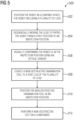
- Figure 5 illustrates a method of operating a robot 500.
- the method positions the robot in a confined space, the robot including a plurality of legs.
- the method sequentially moves the legs to propel the robot from a first position to an inspection position.
- the method visually confirms the robot is in the inspection position using an optical sensor.
- the method couples a non-destructive examination tool to a first leg of the plurality of legs.
- the method positions the non-destructive examination tool in an inspection position.
- the method performs a non-destructive test on a component.
- the robot 100 is programmed to perform a desired task in a desired confined space or other location.
- the robot 100 is remotely controlled by a user who operates the robot 100.
- the robot 100 sends data collected by the optical sensors 106 to the user to allow the user to see the area around the robot 100 to enhance the ability to control the robot 100.
- the robot 100 is preprogrammed with the ability to move in certain directions so that the user simply operates a joystick or other input device to guide the robot 100.
- the motion of the legs 104 is preprogrammed to allow simple inputs by a user to be converted to complex and coordinated movement of the various legs 104.
- data can be collected using a tool, sensor, or instrument.
- the robot 100 is positioned adjacent a component and an ultrasonic probe is positioned on the component to inspect the component for damage.
- the robot 100 is programmed to move between waypoints and to perform inspections at certain points. In this arrangement, the user has little to no input during the operation of the robot 100.
Landscapes
- Engineering & Computer Science (AREA)
- Mechanical Engineering (AREA)
- Robotics (AREA)
- Chemical & Material Sciences (AREA)
- Physics & Mathematics (AREA)
- Immunology (AREA)
- General Health & Medical Sciences (AREA)
- General Physics & Mathematics (AREA)
- Biochemistry (AREA)
- Pathology (AREA)
- Analytical Chemistry (AREA)
- Life Sciences & Earth Sciences (AREA)
- Health & Medical Sciences (AREA)
- Combustion & Propulsion (AREA)
- Transportation (AREA)
- Acoustics & Sound (AREA)
- Manipulator (AREA)
- Investigating Or Analyzing Materials By The Use Of Ultrasonic Waves (AREA)
Priority Applications (5)
| Application Number | Priority Date | Filing Date | Title |
|---|---|---|---|
| EP22168118.2A EP4261111A1 (fr) | 2022-04-13 | 2022-04-13 | Outil d'inspection robotique à utiliser dans des espaces confinés |
| EP23716459.5A EP4476125A1 (fr) | 2022-04-13 | 2023-03-30 | Outil d'inspection robotique destiné à être utilisé dans des espaces confinés et procédé d'inspection |
| PCT/EP2023/058301 WO2023198470A1 (fr) | 2022-04-13 | 2023-03-30 | Outil d'inspection robotique destiné à être utilisé dans des espaces confinés et procédé d'inspection |
| JP2024560596A JP7789954B2 (ja) | 2022-04-13 | 2023-03-30 | 閉鎖空間で使用可能なロボット検査ツール及び検査方法 |
| US18/854,524 US20250353180A1 (en) | 2022-04-13 | 2023-03-30 | Robotic inspection tool for use in confined spaces and method of inspection |
Applications Claiming Priority (1)
| Application Number | Priority Date | Filing Date | Title |
|---|---|---|---|
| EP22168118.2A EP4261111A1 (fr) | 2022-04-13 | 2022-04-13 | Outil d'inspection robotique à utiliser dans des espaces confinés |
Publications (1)
| Publication Number | Publication Date |
|---|---|
| EP4261111A1 true EP4261111A1 (fr) | 2023-10-18 |
Family
ID=81386565
Family Applications (2)
| Application Number | Title | Priority Date | Filing Date |
|---|---|---|---|
| EP22168118.2A Withdrawn EP4261111A1 (fr) | 2022-04-13 | 2022-04-13 | Outil d'inspection robotique à utiliser dans des espaces confinés |
| EP23716459.5A Pending EP4476125A1 (fr) | 2022-04-13 | 2023-03-30 | Outil d'inspection robotique destiné à être utilisé dans des espaces confinés et procédé d'inspection |
Family Applications After (1)
| Application Number | Title | Priority Date | Filing Date |
|---|---|---|---|
| EP23716459.5A Pending EP4476125A1 (fr) | 2022-04-13 | 2023-03-30 | Outil d'inspection robotique destiné à être utilisé dans des espaces confinés et procédé d'inspection |
Country Status (4)
| Country | Link |
|---|---|
| US (1) | US20250353180A1 (fr) |
| EP (2) | EP4261111A1 (fr) |
| JP (1) | JP7789954B2 (fr) |
| WO (1) | WO2023198470A1 (fr) |
Cited By (4)
| Publication number | Priority date | Publication date | Assignee | Title |
|---|---|---|---|---|
| CN119459920A (zh) * | 2024-10-31 | 2025-02-18 | 成都理工大学 | 一种四足机器人的腿足部结构 |
| WO2026046604A1 (fr) * | 2024-08-27 | 2026-03-05 | Siemens Energy Global GmbH & Co. KG | Robot destiné à être utilisé dans un espace confiné |
| WO2026046605A1 (fr) * | 2024-08-27 | 2026-03-05 | Siemens Energy Global GmbH & Co. KG | Robot destiné à être utilisé dans un espace exigu |
| WO2026046594A1 (fr) * | 2024-08-27 | 2026-03-05 | Siemens Energy Global GmbH & Co. KG | Robot destiné à être utilisé dans un espace confiné |
Citations (9)
| Publication number | Priority date | Publication date | Assignee | Title |
|---|---|---|---|---|
| JPS62131886A (ja) * | 1985-12-03 | 1987-06-15 | Toshiba Corp | 多足歩行機 |
| WO2006129857A1 (fr) * | 2005-06-03 | 2006-12-07 | Osaka University | Robot marcheur et procede de commande correspondant |
| US7663332B2 (en) * | 2004-09-14 | 2010-02-16 | Toyota Jidosha Kabushiki Kaisha | Walking robot by using passive changes in joint angles and control method thereof |
| US20110194906A1 (en) * | 2008-10-13 | 2011-08-11 | Rolls-Royce Plc | Machine tool |
| US20170186504A1 (en) * | 2015-12-29 | 2017-06-29 | Ge-Hitachi Nuclear Energy Americas Llc | Apparatus for inspecting nuclear reactor and method thereof |
| US9845122B2 (en) * | 2014-12-25 | 2017-12-19 | Mitsubishi Heavy Industries, Ltd. | Mobile robot and front end tool |
| US9981389B2 (en) * | 2014-03-03 | 2018-05-29 | California Institute Of Technology | Robotics platforms incorporating manipulators having common joint designs |
| US10301017B2 (en) * | 2016-08-26 | 2019-05-28 | Patrick del Castillo | Flying and walking drone |
| CN107010136B (zh) * | 2016-12-02 | 2020-07-03 | 北京航空航天大学 | 一种六自由度可进行腿臂融合操作的步行机器人单腿结构 |
Family Cites Families (1)
| Publication number | Priority date | Publication date | Assignee | Title |
|---|---|---|---|---|
| GB2598756B (en) * | 2020-09-10 | 2024-07-31 | Bladebug Ltd | A system and method of robot locomotion |
-
2022
- 2022-04-13 EP EP22168118.2A patent/EP4261111A1/fr not_active Withdrawn
-
2023
- 2023-03-30 EP EP23716459.5A patent/EP4476125A1/fr active Pending
- 2023-03-30 JP JP2024560596A patent/JP7789954B2/ja active Active
- 2023-03-30 WO PCT/EP2023/058301 patent/WO2023198470A1/fr not_active Ceased
- 2023-03-30 US US18/854,524 patent/US20250353180A1/en active Pending
Patent Citations (9)
| Publication number | Priority date | Publication date | Assignee | Title |
|---|---|---|---|---|
| JPS62131886A (ja) * | 1985-12-03 | 1987-06-15 | Toshiba Corp | 多足歩行機 |
| US7663332B2 (en) * | 2004-09-14 | 2010-02-16 | Toyota Jidosha Kabushiki Kaisha | Walking robot by using passive changes in joint angles and control method thereof |
| WO2006129857A1 (fr) * | 2005-06-03 | 2006-12-07 | Osaka University | Robot marcheur et procede de commande correspondant |
| US20110194906A1 (en) * | 2008-10-13 | 2011-08-11 | Rolls-Royce Plc | Machine tool |
| US9981389B2 (en) * | 2014-03-03 | 2018-05-29 | California Institute Of Technology | Robotics platforms incorporating manipulators having common joint designs |
| US9845122B2 (en) * | 2014-12-25 | 2017-12-19 | Mitsubishi Heavy Industries, Ltd. | Mobile robot and front end tool |
| US20170186504A1 (en) * | 2015-12-29 | 2017-06-29 | Ge-Hitachi Nuclear Energy Americas Llc | Apparatus for inspecting nuclear reactor and method thereof |
| US10301017B2 (en) * | 2016-08-26 | 2019-05-28 | Patrick del Castillo | Flying and walking drone |
| CN107010136B (zh) * | 2016-12-02 | 2020-07-03 | 北京航空航天大学 | 一种六自由度可进行腿臂融合操作的步行机器人单腿结构 |
Cited By (4)
| Publication number | Priority date | Publication date | Assignee | Title |
|---|---|---|---|---|
| WO2026046604A1 (fr) * | 2024-08-27 | 2026-03-05 | Siemens Energy Global GmbH & Co. KG | Robot destiné à être utilisé dans un espace confiné |
| WO2026046605A1 (fr) * | 2024-08-27 | 2026-03-05 | Siemens Energy Global GmbH & Co. KG | Robot destiné à être utilisé dans un espace exigu |
| WO2026046594A1 (fr) * | 2024-08-27 | 2026-03-05 | Siemens Energy Global GmbH & Co. KG | Robot destiné à être utilisé dans un espace confiné |
| CN119459920A (zh) * | 2024-10-31 | 2025-02-18 | 成都理工大学 | 一种四足机器人的腿足部结构 |
Also Published As
| Publication number | Publication date |
|---|---|
| JP2025512099A (ja) | 2025-04-16 |
| JP7789954B2 (ja) | 2025-12-22 |
| EP4476125A1 (fr) | 2024-12-18 |
| US20250353180A1 (en) | 2025-11-20 |
| WO2023198470A1 (fr) | 2023-10-19 |
Similar Documents
| Publication | Publication Date | Title |
|---|---|---|
| EP4261111A1 (fr) | Outil d'inspection robotique à utiliser dans des espaces confinés | |
| EP3505445B1 (fr) | Système de manipulation et procédé pour aéronef | |
| US8306661B2 (en) | Method and system for establishing no-entry zone for robot | |
| KR20220012921A (ko) | 3차원 라이다를 갖는 로봇 구성 | |
| US20180295327A1 (en) | Surveillance unit | |
| Pouliot et al. | LineScout Technology: From inspection to robotic maintenance on live transmission power lines | |
| Paul et al. | Landing of a multirotor aerial vehicle on an uneven surface using multiple on-board manipulators | |
| US10589423B2 (en) | Robot vision super visor for hybrid homing, positioning and workspace UFO detection enabling industrial robot use for consumer applications | |
| JP2014188640A (ja) | ロボットおよびロボット制御方法 | |
| Zieliński et al. | Agent-based structures of robot systems | |
| WO2020220093A1 (fr) | Véhicule d'inspection | |
| Pfotzer et al. | Development and calibration of KaRoLa, a compact, high-resolution 3D laser scanner | |
| Volpe et al. | A prototype manipulation system for Mars rover science operations | |
| Novotny et al. | AMOBILE ROBOT PLATFORM FOR SEARCH AND RESCUE APPLICATIONS. | |
| US20250262750A1 (en) | Mobile operating robot | |
| Trebi-Ollennu et al. | Robotic arm in-situ operations for the mars exploration rovers surface mission | |
| Smith et al. | Computer vision control of an underwater manipulator | |
| Ogusu et al. | Microdrone-equipped mobile crawler robot system, dir-3, for high-step climbing and high-place inspection | |
| US12233545B2 (en) | Modular, propelled cable suspended robot for industrial plants and unmanned offshore platforms | |
| Ueda et al. | Improvement of the remote operability for the arm-equipped tracked vehicle HELIOS IX | |
| Uddin et al. | Design & Development of Electric Cable Inspection | |
| Wedler et al. | Pan/Tilt-Unit as a perception module for extra-terrestrial vehicle and landing systems | |
| Machida et al. | Precise EV robot: Flight model and telerobotic operation for ETS-VII | |
| Johnson et al. | Design of a Robotic Catch and Release Manipulation Architecture (CARMA) | |
| Ottaviano | Analysis and design of a four-cable-driven parallel manipulator for planar and spatial tasks |
Legal Events
| Date | Code | Title | Description |
|---|---|---|---|
| PUAI | Public reference made under article 153(3) epc to a published international application that has entered the european phase |
Free format text: ORIGINAL CODE: 0009012 |
|
| STAA | Information on the status of an ep patent application or granted ep patent |
Free format text: STATUS: THE APPLICATION HAS BEEN PUBLISHED |
|
| AK | Designated contracting states |
Kind code of ref document: A1 Designated state(s): AL AT BE BG CH CY CZ DE DK EE ES FI FR GB GR HR HU IE IS IT LI LT LU LV MC MK MT NL NO PL PT RO RS SE SI SK SM TR |
|
| STAA | Information on the status of an ep patent application or granted ep patent |
Free format text: STATUS: THE APPLICATION IS DEEMED TO BE WITHDRAWN |
|
| 18D | Application deemed to be withdrawn |
Effective date: 20240419 |