EP4261777A1 - Verfahren, computerprogramm, vorrichtung und system zur verfolgung eines zielobjekts - Google Patents
Verfahren, computerprogramm, vorrichtung und system zur verfolgung eines zielobjekts Download PDFInfo
- Publication number
- EP4261777A1 EP4261777A1 EP22305515.3A EP22305515A EP4261777A1 EP 4261777 A1 EP4261777 A1 EP 4261777A1 EP 22305515 A EP22305515 A EP 22305515A EP 4261777 A1 EP4261777 A1 EP 4261777A1
- Authority
- EP
- European Patent Office
- Prior art keywords
- image
- tracking
- target object
- images
- processed
- Prior art date
- Legal status (The legal status is an assumption and is not a legal conclusion. Google has not performed a legal analysis and makes no representation as to the accuracy of the status listed.)
- Pending
Links
Images


Classifications
-
- G—PHYSICS
- G06—COMPUTING OR CALCULATING; COUNTING
- G06T—IMAGE DATA PROCESSING OR GENERATION, IN GENERAL
- G06T7/00—Image analysis
- G06T7/20—Analysis of motion
-
- G—PHYSICS
- G06—COMPUTING OR CALCULATING; COUNTING
- G06T—IMAGE DATA PROCESSING OR GENERATION, IN GENERAL
- G06T7/00—Image analysis
- G06T7/20—Analysis of motion
- G06T7/246—Analysis of motion using feature-based methods, e.g. the tracking of corners or segments
- G06T7/248—Analysis of motion using feature-based methods, e.g. the tracking of corners or segments involving reference images or patches
-
- G—PHYSICS
- G06—COMPUTING OR CALCULATING; COUNTING
- G06T—IMAGE DATA PROCESSING OR GENERATION, IN GENERAL
- G06T7/00—Image analysis
- G06T7/70—Determining position or orientation of objects or cameras
-
- G—PHYSICS
- G06—COMPUTING OR CALCULATING; COUNTING
- G06V—IMAGE OR VIDEO RECOGNITION OR UNDERSTANDING
- G06V10/00—Arrangements for image or video recognition or understanding
- G06V10/70—Arrangements for image or video recognition or understanding using pattern recognition or machine learning
- G06V10/82—Arrangements for image or video recognition or understanding using pattern recognition or machine learning using neural networks
-
- G—PHYSICS
- G06—COMPUTING OR CALCULATING; COUNTING
- G06V—IMAGE OR VIDEO RECOGNITION OR UNDERSTANDING
- G06V20/00—Scenes; Scene-specific elements
- G06V20/50—Context or environment of the image
- G06V20/52—Surveillance or monitoring of activities, e.g. for recognising suspicious objects
-
- G—PHYSICS
- G06—COMPUTING OR CALCULATING; COUNTING
- G06T—IMAGE DATA PROCESSING OR GENERATION, IN GENERAL
- G06T2207/00—Indexing scheme for image analysis or image enhancement
- G06T2207/10—Image acquisition modality
- G06T2207/10016—Video; Image sequence
-
- G—PHYSICS
- G06—COMPUTING OR CALCULATING; COUNTING
- G06T—IMAGE DATA PROCESSING OR GENERATION, IN GENERAL
- G06T2207/00—Indexing scheme for image analysis or image enhancement
- G06T2207/20—Special algorithmic details
- G06T2207/20081—Training; Learning
-
- G—PHYSICS
- G06—COMPUTING OR CALCULATING; COUNTING
- G06T—IMAGE DATA PROCESSING OR GENERATION, IN GENERAL
- G06T2207/00—Indexing scheme for image analysis or image enhancement
- G06T2207/20—Special algorithmic details
- G06T2207/20084—Artificial neural networks [ANN]
-
- G—PHYSICS
- G06—COMPUTING OR CALCULATING; COUNTING
- G06T—IMAGE DATA PROCESSING OR GENERATION, IN GENERAL
- G06T2207/00—Indexing scheme for image analysis or image enhancement
- G06T2207/30—Subject of image; Context of image processing
- G06T2207/30196—Human being; Person
-
- G—PHYSICS
- G06—COMPUTING OR CALCULATING; COUNTING
- G06T—IMAGE DATA PROCESSING OR GENERATION, IN GENERAL
- G06T2207/00—Indexing scheme for image analysis or image enhancement
- G06T2207/30—Subject of image; Context of image processing
- G06T2207/30232—Surveillance
-
- G—PHYSICS
- G06—COMPUTING OR CALCULATING; COUNTING
- G06T—IMAGE DATA PROCESSING OR GENERATION, IN GENERAL
- G06T2207/00—Indexing scheme for image analysis or image enhancement
- G06T2207/30—Subject of image; Context of image processing
- G06T2207/30241—Trajectory
-
- H—ELECTRICITY
- H04—ELECTRIC COMMUNICATION TECHNIQUE
- H04N—PICTORIAL COMMUNICATION, e.g. TELEVISION
- H04N7/00—Television systems
- H04N7/18—Closed-circuit television [CCTV] systems, i.e. systems in which the video signal is not broadcast
Definitions
- the present invention relates to a method for tracking a target object in images taken by at least one camera. It also relates to a computer program, a device and a system implementing such a method.
- the field of the invention is generally the field of tracking objects from images captured by cameras, also called tracking in English, and in particular in real time.
- each image of the image stream is first processed by an object detector, such as an object detector implementing the RESNET50 model, in order to identify at least one object and its position in the image. Then, each object is identified by comparing its visual signature with that of the objects identified in the previously processed images.
- an object detector such as an object detector implementing the RESNET50 model
- An aim of the present invention is to remedy at least one of the disadvantages of the state of the art.
- Another aim of the invention is to propose an object tracking solution that consumes less energy and computing resources while presenting similar, or even identical, performances to current solutions.
- the invention proposes to carry out tracking of a target object by processing only part of the images of the image stream captured by the camera.
- the invention proposes to give up processing all the images of the image stream and proposes to only process some of the images of the image stream.
- the solution proposed by the present invention is less demanding in energy and computing resources compared to current solutions which propose to process all the images of an image stream.
- the inventor of the present application has noticed that processing only part of the images does not reduce, or very little, the tracking performance. Indeed, the inventor noticed that the capture frequency of current cameras is such that the movement of a target object can be deduced and followed efficiently and faithfully from only part of the images forming a stream of images. images captured by the camera. This observation is all the more true when the movement speed of the target object is low, such as humans for example.
- object or “target object” means any type of object, such as a human, an animal, a car, etc.
- “tracklet” means a set of at least one image, or image area, belonging to the same object and captured by a camera.
- the appearance distance between two images can be calculated by generating a digital signature for each of the images, for example by an intelligent model such as a neural network, then by calculating the distance, Euclidean or cosine, between these two digital signatures.
- camera we mean any type of image acquisition device, such as any type of RGB, LIDAR, thermal, 3D camera, etc.
- processed image is meant an image of the image stream to which the tracking phase is applied.
- unprocessed image we mean an image of the image stream to which the tracking phase is not applied.
- the method according to the invention may comprise a step of estimating the position of the target object at a time lying between the times of capture of two images processed during two successive iterations of the tracking phase, depending on the positions of said target object in said processed images.
- Such an estimate can be carried out following any predetermined relationship.
- the position of the target object at said instant can be achieved according to a linear movement law. That is, the target object is considered to move linearly between its detected positions in two processed images. Thus, for each moment between the moments of capture of the processed images, the position of the target object is determined on the linear trajectory joining the positions of the target object in said processed images.
- T1 and P2 be the positions of the target object on two processed images IM1 and IM2 captured respectively at times T1 and T2.
- the frequency of carrying out the tracking phase can be determined as a function of a number of images separating the processed images.
- the tracking phase can be implemented for each image every N image(s), with N ⁇ 2, and preferably N ⁇ 20, so that two successive iterations of the detection phase are applied to two images separated, in time, from at least one image, and in particular from N images, unprocessed.
- the number N can, in no way limiting, be determined as a function of the capture frequency of the camera, and more generally of the capture frequency of the images in the image stream.
- the tracking phase can be carried out for a processed image IM 1 .
- the next image that will be processed by the next iteration of the tracking phase will be image IM N.
- the processed images will be images IM 1 , IM 21 , IM 41 , etc. captured by the camera.
- the frequency of carrying out the tracking phase can be determined as a function of a duration separating the moments of capture of the processed images.
- the tracking phase can be carried out for each image captured every DUR seconds.
- the duration DUR separating two images processed during two successive iterations of the tracking phase can be between 1 and 5 seconds and in particular between 2 and 3 seconds.
- the DUR duration is not necessarily an integer.
- the tracking phase can be carried out for a processed image IM 1 captured at time T1.
- the image stream can be captured prior to the first iteration of the detection phase so that the tracking of the target object is not carried out in real time.
- the target object can be tracked in an image database, for example as part of a search in the recent past.
- the method according to the invention can be implemented to carry out real-time tracking of the target object.
- the method according to the invention may further comprise a step of transmitting, from the camera to a tracking device, each processed image.
- the processed images can be transmitted to the tracking device.
- the images captured by the camera, but which are not processed during the tracking phase are not transmitted to the tracking device. So, the invention makes it possible to reduce the data transmitted from the camera to the tracking device, and is therefore less demanding in terms of communication resources.
- the transmission of a processed image from the camera to the tracking device can be carried out at the request of said tracking device.
- the tracking device sends a request to the camera asking the camera to capture an image at a time T1 and transmit it to it.
- the tracking device then processes the image received.
- the tracking device sends a request to the camera asking the camera to capture a new image at said instant T2 and to transmit it to him, and so on.
- an image capture plan can be transmitted to the camera, for example by the tracking device, said capture plan indicating several, or even all, moments of image capture to be processed, for example at the start of the follow-up phase.
- the camera can be arranged to capture only the processed images.
- the camera can be activated only for capturing images which will be processed during the tracking phase, and deactivated the rest of the time.
- the camera can be activated at times T1 and T2 to capture and transmit the processed images to the tracking device, and deactivated between times T1 and T2 , which saves energy, reduces camera fatigue and increases its lifespan.
- the detection step can be carried out by an artificial intelligence model, and in particular by a neural network, previously trained to detect the presence of an object in an image.
- Such a model may be a convolutional neural network, such as RESNET50, trained to detect objects in an image and indicate their position.
- RESNET50 convolutional neural network
- Neural networks for detecting objects and their positions in images are well known to those skilled in the art, and will therefore not be described in more detail here for the sake of brevity.
- the position of an object on an image can for example correspond to the center of a rectangle surrounding said object on said image.
- the spatial distance threshold value SDS can be determined by testing.
- the SDS can be determined as a function of the target object, in particular as a function of a dimension of the object and/or a speed of the target object.
- the multiplier coefficient K can be a function of the frequency, or the cadence, of iteration of the monitoring phase. Indeed, the inventor observed that a target object cannot move more than K times its own width between two iterations of the tracking phase.
- the appearance distance can be the Euclidean distance or the cosine distance between two visual signatures of two objects.
- At least one visual signature can be generated by an artificial intelligence model, and in particular by a neural network, previously trained for this purpose.
- Neural networks for generating a visual signature of an object are well known to those skilled in the art and will therefore not be described here in more detail.
- a computer program comprising executable instructions which, when executed by a computing device, implement all the steps of the method, according to the invention, of monitoring of a target object.
- the computer program can be in any computer language, such as for example machine language, C, C++, JAVA, Python, etc.
- a device for tracking a target object comprising means configured to implement implements all the steps of the method, according to the invention, for tracking a target object.
- the device according to the invention can be any type of device such as a server, a computer, a tablet, a calculator, a processor, a computer chip, programmed to implement the method according to the invention, for example by the computer program according to the invention.
- At least one camera may be local or remote to the processing device.
- the camera can be in communication with the processing device via a wired or wireless communication network, such as for example the Internet network.
- the latter can be distributed in space for example within a place, such as a station or an airport, or in a city, or even along a track of circulation.
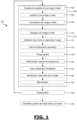
- FIGURE 1 is a schematic representation of a non-limiting exemplary embodiment of a method according to the present invention for real-time tracking of a target object.
- the process 100 of the FIGURE 1 can be used for real-time tracking of any type of target objects such as humans, animals, cars, etc. from an image stream coming from one or more cameras.
- the image stream comes from, or was obtained, from a single camera.
- the method is used for real-time monitoring of a target person.
- the method 100 comprises a step 102 of obtaining an image to be processed, denoted IM1, for a capture instant T1.
- the image IM1 can be received automatically.
- a tracking plan indicating the moments of capture of the images to be processed
- the camera for example by a tracking device.
- the latter can acquire an image at each time indicated in the tracking plan and automatically transmits it to the tracking device implementing the tracking.
- step 102 may include a step 104 of transmitting, to the camera, a request to capture the image IM1 at time T1 for example by the tracking device.
- This request can be sent to the camera as time T1 approaches.
- the camera can capture the image IM1 during a step 106.
- the captured image IM1 can be transmitted to the tracking device, through a wired or wireless connection, possibly through of a private or public communications network, such as the Internet.
- the camera can capture images at a capture frequency F c .
- steps 104 and 106 are replaced by a step, not shown, requesting the image captured at time T1.
- the camera, or an intermediate server where the images are stored, can then communicate the image captured at time T1 to the tracking device, during step 108.
- the method 100 may include a tracking phase 110 carried out for the image IM1 obtained during step 102.
- the tracking phase 110 includes a step 112 of receiving the image to be processed, IM1 captured at time T1.
- the image IM1 is processed during a detection step 114, to detect at least one object present in said image and its position.
- This detection can be carried out with solutions well known to those skilled in the art, such as for example the RESNET50 model.
- Step 114 therefore provides a list of at least one detected object, with their position, and the image area associated with each object.
- a spatial distance DS j is calculated between each detected object and the position of the target object detected during an iteration preceding phase of tracking phase 110.
- step 116 provides a spatial distance DS j between each object detected in the image and the target object detected in the image processed during an immediately preceding iteration.
- each detected object is a new object and a new tracklet is associated with said new detected object.
- a step 118 filtering is applied to the spatial distances DS j to keep only the objects whose spatial distance DS j is less than or equal to a spatial distance threshold, SDS, previously defined.
- SDS spatial distance threshold
- the objective of this step 118 is to eliminate the objects detected on the image IM1 which are located in positions in which the target object cannot be found, taking into account its previously detected position. Step 118 therefore only provides a list of at least one object located in positions that the target object can occupy at time T1, unless the target object is not visible.
- an appearance signature or a visual signature, is determined for each object not eliminated by the spatial filtering of step 118.
- the determination of the visual signature of each object can be carried out with well-defined solutions. known to those skilled in the art, such as for example a neural network previously trained for this purpose, taking as input the area of the image corresponding to said object.
- Step 120 therefore provides, for each object having passed the spatial filtering of step 118, a visual signature.
- a visual distance DV k is calculated between each object having passed spatial filtering and the target object, depending on the signature of said object and the target object. This distance can be a Euclidean distance or a cosine distance.
- the position of the target object, in the processed image IM1 is then memorized, during a step 126, in association with the capture instant T1 of the processed image IM1.
- the tracking phase 110 for image IM1 is completed and can be repeated for a new image, denoted IM2.
- the image IM2 processed during a following iteration is not the image which immediately follows the image IM1, so that the camera can capture, or captures, at least one image, called non- processed, between image IM1 and IM2 and which is not processed during a tracking phase.
- the DUR duration is chosen so that DUR>1/F c , with F c the frequency at which the camera can capture, or does capture, images.
- DUR 2s.
- the method 100 can comprise, following the monitoring phase 110, a time delay step 130 until time T2 is reached.
- time T2 is reached, or is about to be reached, method 100 is repeated for an image IM2 captured at time T2, and so on.
- the method 100 and in particular the tracking phase 110, can be repeated every N images, with N ⁇ 2, so that the camera captures, or is capable of capturing, between the images IM1 and IM2 processed by two iterations successive phases of the method 100 and in particular of the tracking phase 110, at least one intermediate image which will not be processed by the tracking phase 110.
- N 20 images.
- the method 100 and in particular the tracking phase 110, is carried out at a detection frequency F d lower than the capture frequency F c at which the camera captures, or is configured to capture, or is capable of capturing, images.
- the number of images processed is reduced, which reduces the calculation resources and the communication resources for transferring and processing the images by the tracking device.
- the method 100 can further comprise a step 140 of estimating the position of the target object at a time for which no image has been processed, and located between the times of capture of two processed images during two successive iterations of the monitoring phase. This estimation can be carried out based on the positions of the target object detected in said processed images.
- the position of the target object can be estimated according to a linear movement law, at constant speed.
- P1 and P2 be the positions of the target object on two processed images IM1 and IM2 captured respectively at times T1 and T2.
- Step 140 can be carried out during the implementation of the method 100, for example between two iterations of the monitoring phase 110. Alternatively, step 140 can be carried out after the implementation of all the iterations of the phase tracking 110.
- the method 100 performs real-time tracking of a target object.
- the method according to the invention can alternatively be used for tracking a target object which would not be in real time, but in a stream of images captured before execution of the method according to the invention.
- FIGURE 2 is a schematic representation of a non-limiting exemplary embodiment of a method according to the present invention for tracking a target object within a stream of previously captured images.
- the process 200 of the FIGURE 2 can be used for tracking any type of target objects such as humans, animals, cars, etc.
- the method is used for tracking a target person, within a stream of images.
- the image stream can be a stream of images captured by one or more cameras, at a capture frequency F c .
- the image stream can be a stream of images captured by a single camera at a capture frequency F c .
- the method 200 comprises a step 202 of obtaining an image to be processed, denoted IM1, for a capture instant T1.
- This image IM1 is requested during a step 202 for example from a server on which the image stream is stored.
- the requested image IM1 is transmitted to the tracking device during a step 206.
- the phase 202 of obtaining the image IM1 is followed by the phase of processing the image IM1 110.
- the method 200 is repeated for a new image to be processed IM2 captured at a time T2.
- the image IM2 is chosen so that at least one unprocessed image separates the image IM1 and the image IM2.
- the method 200 can optionally include step 140, like the method 100 of the FIGURE 1 .
- FIGURE 3 is a schematic representation of a non-limiting embodiment of a tracking device according to the invention.
- the device 300 can be used to implement a monitoring method according to the invention, and in particular the method 100 of the FIGURE 1 or method 200 of the FIGURE 2 .
- the device 300 further comprises a module 304 for detecting at least one object, and its position, in a processed image received by the module 302.
- This detection module 304 can be configured to execute an artificial intelligence model, and in particular a neural network, previously trained to detect the presence of an object in an image.
- an artificial intelligence model may be a convolutional neural network, such as RESNET50, trained to detect objects in an image and indicate their position.
- the module 306 is in particular configured to implement steps 116-124 of the methods 100 or 200 of the FIGURES 1 Or 2 .
- At least one of the modules 302-308 can be a module independent of the other modules 302-308. At least two of the modules 302-308 can be integrated within the same module
- the device 300 can be at least one server, a computer, a processor, or an electronic chip.
- the device 300 may be at least one computer program, or a virtual machine, executed by a server, a computer, a processor, or an electronic chip, etc.
- FIGURE 4 is a schematic representation of a non-limiting exemplary embodiment of a system according to the invention for real-time tracking of a target object.
- the system 400 can be used to implement a tracking method according to the invention, and in particular the method 100 of the FIGURE 1 .
- the system 400 can be used for tracking a target object of any type, and in particular a target person, from at least one video stream coming from N cameras 402 1 -402 n of said system 400, distributed in space and forming a network 404 of cameras, with n ⁇ 1.
- the system 400 can be used for tracking a target object of any type, and in particular a target person, from a video stream stored in a database (not shown in the figure).
- FIGURE 4 ).
- the system 400 further comprises a tracking device according to the invention 406, such as for example the device 300 of the FIGURE 3 .
- the device 406 can be local to the cameras 402 1 -402 n or remote from the cameras 402 1 -402 n .
- the device 406 can be connected to each of the cameras 402 1 -402 n by a wired or wireless connection.
Landscapes
- Engineering & Computer Science (AREA)
- Theoretical Computer Science (AREA)
- Physics & Mathematics (AREA)
- General Physics & Mathematics (AREA)
- Multimedia (AREA)
- Computer Vision & Pattern Recognition (AREA)
- Evolutionary Computation (AREA)
- Health & Medical Sciences (AREA)
- Artificial Intelligence (AREA)
- Computing Systems (AREA)
- Databases & Information Systems (AREA)
- General Health & Medical Sciences (AREA)
- Medical Informatics (AREA)
- Software Systems (AREA)
- Image Analysis (AREA)
Priority Applications (2)
| Application Number | Priority Date | Filing Date | Title |
|---|---|---|---|
| EP22305515.3A EP4261777A1 (de) | 2022-04-11 | 2022-04-11 | Verfahren, computerprogramm, vorrichtung und system zur verfolgung eines zielobjekts |
| US18/296,332 US12505558B2 (en) | 2022-04-11 | 2023-04-05 | Method, computer program, device, and system for tracking a target object |
Applications Claiming Priority (1)
| Application Number | Priority Date | Filing Date | Title |
|---|---|---|---|
| EP22305515.3A EP4261777A1 (de) | 2022-04-11 | 2022-04-11 | Verfahren, computerprogramm, vorrichtung und system zur verfolgung eines zielobjekts |
Publications (1)
| Publication Number | Publication Date |
|---|---|
| EP4261777A1 true EP4261777A1 (de) | 2023-10-18 |
Family
ID=82067657
Family Applications (1)
| Application Number | Title | Priority Date | Filing Date |
|---|---|---|---|
| EP22305515.3A Pending EP4261777A1 (de) | 2022-04-11 | 2022-04-11 | Verfahren, computerprogramm, vorrichtung und system zur verfolgung eines zielobjekts |
Country Status (2)
| Country | Link |
|---|---|
| US (1) | US12505558B2 (de) |
| EP (1) | EP4261777A1 (de) |
Citations (3)
| Publication number | Priority date | Publication date | Assignee | Title |
|---|---|---|---|---|
| EP3839816A1 (de) * | 2019-12-17 | 2021-06-23 | Bull SAS | Elektronische vorrichtung zur identifizierung und zur nachverfolgung mindestens eines ziels, entsprechendes elektronisches system, verfahren und computerprogramm |
| US20220004768A1 (en) * | 2020-07-06 | 2022-01-06 | Bull Sas | Method for assisting real-time monitoring of at least one person on sequences of images |
| CA3156840A1 (en) * | 2020-07-03 | 2022-01-06 | Invision Ai, Inc. | Video-based tracking systems and methods |
Family Cites Families (1)
| Publication number | Priority date | Publication date | Assignee | Title |
|---|---|---|---|---|
| CN110610514B (zh) * | 2018-06-15 | 2023-09-19 | 株式会社日立制作所 | 实现多目标跟踪的方法、装置、电子设备 |
-
2022
- 2022-04-11 EP EP22305515.3A patent/EP4261777A1/de active Pending
-
2023
- 2023-04-05 US US18/296,332 patent/US12505558B2/en active Active
Patent Citations (3)
| Publication number | Priority date | Publication date | Assignee | Title |
|---|---|---|---|---|
| EP3839816A1 (de) * | 2019-12-17 | 2021-06-23 | Bull SAS | Elektronische vorrichtung zur identifizierung und zur nachverfolgung mindestens eines ziels, entsprechendes elektronisches system, verfahren und computerprogramm |
| CA3156840A1 (en) * | 2020-07-03 | 2022-01-06 | Invision Ai, Inc. | Video-based tracking systems and methods |
| US20220004768A1 (en) * | 2020-07-06 | 2022-01-06 | Bull Sas | Method for assisting real-time monitoring of at least one person on sequences of images |
Non-Patent Citations (2)
| Title |
|---|
| LEE GIYOUNG ET AL: "Tracking Multiple Moving Vehicles in Low Frame Rate Videos Based on Trajectory Information", 2013 IEEE INTERNATIONAL CONFERENCE ON SYSTEMS, MAN, AND CYBERNETICS, IEEE, 13 October 2013 (2013-10-13), pages 3615 - 3620, XP032556966, DOI: 10.1109/SMC.2013.616 * |
| LEE GIYOUNG ET AL: "Trajectory-based vehicle tracking at low frame rates", EXPERT SYSTEMS WITH APPLICATIONS, ELSEVIER, AMSTERDAM, NL, vol. 80, 14 March 2017 (2017-03-14), pages 46 - 57, XP029974864, ISSN: 0957-4174, DOI: 10.1016/J.ESWA.2017.03.023 * |
Also Published As
| Publication number | Publication date |
|---|---|
| US20230326037A1 (en) | 2023-10-12 |
| US12505558B2 (en) | 2025-12-23 |
Similar Documents
| Publication | Publication Date | Title |
|---|---|---|
| EP3707676B1 (de) | Verfahren zur schätzung der installation einer kamera im referenzrahmen einer dreidimensionalen szene, vorrichtung, system mit erweiterter realität und zugehöriges computerprogramm | |
| EP2930659B1 (de) | Verfahren zum erkennen von interessanten punkten in einem digitalen bild | |
| EP3770805B1 (de) | Verfahren zur identifizierung einer person in einem video durch eine gesichtssignatur dieser person, entsprechendes computerprogrammm und entsprechende vorrichtung | |
| CN113469099B (zh) | 目标检测模型的训练方法、检测方法、装置、设备及介质 | |
| FR3040818A1 (fr) | Procede de detection d'objets sur une surface de stationnement | |
| EP3937071A1 (de) | Verfahren zur unterstützung der echtzeitverfolgung von mindestens einer person auf bildsequenzen | |
| EP3770806B1 (de) | Verfahren zur videoüberwachung der überschreitung einer linie durch personen, entsprechendes computerprogramm und entsprechende vorrichtung | |
| EP3836014B1 (de) | Verfahren zur verfolgung eines elements, eines zugehörigen elektronischen geräts und eines computerprogrammprodukts | |
| WO2019110914A1 (fr) | Extraction automatique d'attributs d'un objet au sein d'un ensemble d'images numeriques | |
| EP4235570B1 (de) | Verfahren, vorrichtung und system zur echtzeit- und multi-kamera-verfolgung eines zielobjekts | |
| FR2916562A1 (fr) | Procede de detection d'un objet en mouvement dans un flux d'images | |
| EP4261777A1 (de) | Verfahren, computerprogramm, vorrichtung und system zur verfolgung eines zielobjekts | |
| EP3853762A1 (de) | An bord eines schienenfahrzeugs installiertes videoüberwachungssystem | |
| Lima et al. | Toward unlabeled multi-view 3D pedestrian detection by generalizable AI: techniques and performance analysis | |
| EP4439478A1 (de) | Verfahren zur verfolgung mehrerer objekte | |
| EP4191530A1 (de) | Gleichzeitiges lokalisierungsverfahren und kartierung mit selbstüberwachter zeitmaskierung und maschinenlernmodell zur erzeugung solch einer maskierung | |
| FR3104291A1 (fr) | Procédé et système de configuration d’un dispositif d’imagerie d’un véhicule automobile comportant N capteurs et N réseaux de neurones encodeurs dédiés | |
| EP2149099B1 (de) | Vorrichtung und verfahren zur verarbeitung von bildern zur bestimmung der signatur eines films | |
| CN116311077A (zh) | 一种基于显著性图的多光谱融合的行人检测方法及装置 | |
| WO2021099395A1 (fr) | Procédé de détection de pics d'intensité de faisceau lumineux réfléchi de manière spéculaire | |
| EP3155446B1 (de) | Verfahren und system zur schätzung eines parameters in einem kraftfahrzeug und kraftfahrzeug mit solch einem system | |
| EP4592953A1 (de) | Verfahren und vorrichtung zur korrektur der verfolgung von objekten sowie verfahren und system zur verfolgung von objekten mit solch einer korrektur | |
| EP2769360B1 (de) | Verfahren zum finden von objekten durch auflösung in einem dreidimensionalen raum einer szene | |
| WO2024194539A1 (fr) | Procede et dispositif d'enrichissement d'une image d'une scene, au sein d'un vehicule | |
| FR2927443A1 (fr) | Procede de suivi d'individus dans un champ de vision d'une camera |
Legal Events
| Date | Code | Title | Description |
|---|---|---|---|
| PUAI | Public reference made under article 153(3) epc to a published international application that has entered the european phase |
Free format text: ORIGINAL CODE: 0009012 |
|
| STAA | Information on the status of an ep patent application or granted ep patent |
Free format text: STATUS: THE APPLICATION HAS BEEN PUBLISHED |
|
| AK | Designated contracting states |
Kind code of ref document: A1 Designated state(s): AL AT BE BG CH CY CZ DE DK EE ES FI FR GB GR HR HU IE IS IT LI LT LU LV MC MK MT NL NO PL PT RO RS SE SI SK SM TR |
|
| STAA | Information on the status of an ep patent application or granted ep patent |
Free format text: STATUS: REQUEST FOR EXAMINATION WAS MADE |
|
| P01 | Opt-out of the competence of the unified patent court (upc) registered |
Effective date: 20240227 |
|
| 17P | Request for examination filed |
Effective date: 20240315 |
|
| RBV | Designated contracting states (corrected) |
Designated state(s): AL AT BE BG CH CY CZ DE DK EE ES FI FR GB GR HR HU IE IS IT LI LT LU LV MC MK MT NL NO PL PT RO RS SE SI SK SM TR |
|
| GRAP | Despatch of communication of intention to grant a patent |
Free format text: ORIGINAL CODE: EPIDOSNIGR1 |
|
| STAA | Information on the status of an ep patent application or granted ep patent |
Free format text: STATUS: GRANT OF PATENT IS INTENDED |
|
| INTG | Intention to grant announced |
Effective date: 20251219 |
|
| GRAS | Grant fee paid |
Free format text: ORIGINAL CODE: EPIDOSNIGR3 |
|
| GRAA | (expected) grant |
Free format text: ORIGINAL CODE: 0009210 |
|
| STAA | Information on the status of an ep patent application or granted ep patent |
Free format text: STATUS: THE PATENT HAS BEEN GRANTED |