EP4261935A1 - Materiau composite silicium-carbone prelithie, anode le comprenant et procede de fabrication d'un materiau composite - Google Patents
Materiau composite silicium-carbone prelithie, anode le comprenant et procede de fabrication d'un materiau composite Download PDFInfo
- Publication number
- EP4261935A1 EP4261935A1 EP22168409.5A EP22168409A EP4261935A1 EP 4261935 A1 EP4261935 A1 EP 4261935A1 EP 22168409 A EP22168409 A EP 22168409A EP 4261935 A1 EP4261935 A1 EP 4261935A1
- Authority
- EP
- European Patent Office
- Prior art keywords
- lithium
- silicon
- carbon composite
- composite material
- surface coating
- Prior art date
- Legal status (The legal status is an assumption and is not a legal conclusion. Google has not performed a legal analysis and makes no representation as to the accuracy of the status listed.)
- Withdrawn
Links
Images
Classifications
-
- H—ELECTRICITY
- H01—ELECTRIC ELEMENTS
- H01M—PROCESSES OR MEANS, e.g. BATTERIES, FOR THE DIRECT CONVERSION OF CHEMICAL ENERGY INTO ELECTRICAL ENERGY
- H01M4/00—Electrodes
- H01M4/02—Electrodes composed of, or comprising, active material
- H01M4/36—Selection of substances as active materials, active masses, active liquids
- H01M4/48—Selection of substances as active materials, active masses, active liquids of inorganic oxides or hydroxides
- H01M4/485—Selection of substances as active materials, active masses, active liquids of inorganic oxides or hydroxides of mixed oxides or hydroxides for inserting or intercalating light metals, e.g. LiTi2O4 or LiTi2OxFy
-
- H—ELECTRICITY
- H01—ELECTRIC ELEMENTS
- H01M—PROCESSES OR MEANS, e.g. BATTERIES, FOR THE DIRECT CONVERSION OF CHEMICAL ENERGY INTO ELECTRICAL ENERGY
- H01M10/00—Secondary cells; Manufacture thereof
- H01M10/05—Accumulators with non-aqueous electrolyte
- H01M10/052—Li-accumulators
-
- H—ELECTRICITY
- H01—ELECTRIC ELEMENTS
- H01M—PROCESSES OR MEANS, e.g. BATTERIES, FOR THE DIRECT CONVERSION OF CHEMICAL ENERGY INTO ELECTRICAL ENERGY
- H01M10/00—Secondary cells; Manufacture thereof
- H01M10/05—Accumulators with non-aqueous electrolyte
- H01M10/052—Li-accumulators
- H01M10/0525—Rocking-chair batteries, i.e. batteries with lithium insertion or intercalation in both electrodes; Lithium-ion batteries
-
- H—ELECTRICITY
- H01—ELECTRIC ELEMENTS
- H01M—PROCESSES OR MEANS, e.g. BATTERIES, FOR THE DIRECT CONVERSION OF CHEMICAL ENERGY INTO ELECTRICAL ENERGY
- H01M4/00—Electrodes
- H01M4/02—Electrodes composed of, or comprising, active material
- H01M4/04—Processes of manufacture in general
- H01M4/0402—Methods of deposition of the material
- H01M4/0404—Methods of deposition of the material by coating on electrode collectors
-
- H—ELECTRICITY
- H01—ELECTRIC ELEMENTS
- H01M—PROCESSES OR MEANS, e.g. BATTERIES, FOR THE DIRECT CONVERSION OF CHEMICAL ENERGY INTO ELECTRICAL ENERGY
- H01M4/00—Electrodes
- H01M4/02—Electrodes composed of, or comprising, active material
- H01M4/04—Processes of manufacture in general
- H01M4/0402—Methods of deposition of the material
- H01M4/0421—Methods of deposition of the material involving vapour deposition
- H01M4/0428—Chemical vapour deposition
-
- H—ELECTRICITY
- H01—ELECTRIC ELEMENTS
- H01M—PROCESSES OR MEANS, e.g. BATTERIES, FOR THE DIRECT CONVERSION OF CHEMICAL ENERGY INTO ELECTRICAL ENERGY
- H01M4/00—Electrodes
- H01M4/02—Electrodes composed of, or comprising, active material
- H01M4/04—Processes of manufacture in general
- H01M4/043—Processes of manufacture in general involving compressing or compaction
- H01M4/0435—Rolling or calendering
-
- H—ELECTRICITY
- H01—ELECTRIC ELEMENTS
- H01M—PROCESSES OR MEANS, e.g. BATTERIES, FOR THE DIRECT CONVERSION OF CHEMICAL ENERGY INTO ELECTRICAL ENERGY
- H01M4/00—Electrodes
- H01M4/02—Electrodes composed of, or comprising, active material
- H01M4/04—Processes of manufacture in general
- H01M4/0471—Processes of manufacture in general involving thermal treatment, e.g. firing, sintering, backing particulate active material, thermal decomposition, pyrolysis
-
- H—ELECTRICITY
- H01—ELECTRIC ELEMENTS
- H01M—PROCESSES OR MEANS, e.g. BATTERIES, FOR THE DIRECT CONVERSION OF CHEMICAL ENERGY INTO ELECTRICAL ENERGY
- H01M4/00—Electrodes
- H01M4/02—Electrodes composed of, or comprising, active material
- H01M4/13—Electrodes for accumulators with non-aqueous electrolyte, e.g. for lithium-accumulators; Processes of manufacture thereof
- H01M4/133—Electrodes based on carbonaceous material, e.g. graphite-intercalation compounds or CFx
-
- H—ELECTRICITY
- H01—ELECTRIC ELEMENTS
- H01M—PROCESSES OR MEANS, e.g. BATTERIES, FOR THE DIRECT CONVERSION OF CHEMICAL ENERGY INTO ELECTRICAL ENERGY
- H01M4/00—Electrodes
- H01M4/02—Electrodes composed of, or comprising, active material
- H01M4/13—Electrodes for accumulators with non-aqueous electrolyte, e.g. for lithium-accumulators; Processes of manufacture thereof
- H01M4/134—Electrodes based on metals, Si or alloys
-
- H—ELECTRICITY
- H01—ELECTRIC ELEMENTS
- H01M—PROCESSES OR MEANS, e.g. BATTERIES, FOR THE DIRECT CONVERSION OF CHEMICAL ENERGY INTO ELECTRICAL ENERGY
- H01M4/00—Electrodes
- H01M4/02—Electrodes composed of, or comprising, active material
- H01M4/13—Electrodes for accumulators with non-aqueous electrolyte, e.g. for lithium-accumulators; Processes of manufacture thereof
- H01M4/139—Processes of manufacture
- H01M4/1393—Processes of manufacture of electrodes based on carbonaceous material, e.g. graphite-intercalation compounds or CFx
-
- H—ELECTRICITY
- H01—ELECTRIC ELEMENTS
- H01M—PROCESSES OR MEANS, e.g. BATTERIES, FOR THE DIRECT CONVERSION OF CHEMICAL ENERGY INTO ELECTRICAL ENERGY
- H01M4/00—Electrodes
- H01M4/02—Electrodes composed of, or comprising, active material
- H01M4/13—Electrodes for accumulators with non-aqueous electrolyte, e.g. for lithium-accumulators; Processes of manufacture thereof
- H01M4/139—Processes of manufacture
- H01M4/1395—Processes of manufacture of electrodes based on metals, Si or alloys
-
- H—ELECTRICITY
- H01—ELECTRIC ELEMENTS
- H01M—PROCESSES OR MEANS, e.g. BATTERIES, FOR THE DIRECT CONVERSION OF CHEMICAL ENERGY INTO ELECTRICAL ENERGY
- H01M4/00—Electrodes
- H01M4/02—Electrodes composed of, or comprising, active material
- H01M4/36—Selection of substances as active materials, active masses, active liquids
- H01M4/362—Composites
- H01M4/366—Composites as layered products
-
- H—ELECTRICITY
- H01—ELECTRIC ELEMENTS
- H01M—PROCESSES OR MEANS, e.g. BATTERIES, FOR THE DIRECT CONVERSION OF CHEMICAL ENERGY INTO ELECTRICAL ENERGY
- H01M4/00—Electrodes
- H01M4/02—Electrodes composed of, or comprising, active material
- H01M4/36—Selection of substances as active materials, active masses, active liquids
- H01M4/38—Selection of substances as active materials, active masses, active liquids of elements or alloys
- H01M4/381—Alkaline or alkaline earth metals elements
- H01M4/382—Lithium
-
- H—ELECTRICITY
- H01—ELECTRIC ELEMENTS
- H01M—PROCESSES OR MEANS, e.g. BATTERIES, FOR THE DIRECT CONVERSION OF CHEMICAL ENERGY INTO ELECTRICAL ENERGY
- H01M4/00—Electrodes
- H01M4/02—Electrodes composed of, or comprising, active material
- H01M4/36—Selection of substances as active materials, active masses, active liquids
- H01M4/38—Selection of substances as active materials, active masses, active liquids of elements or alloys
- H01M4/386—Silicon or alloys based on silicon
-
- H—ELECTRICITY
- H01—ELECTRIC ELEMENTS
- H01M—PROCESSES OR MEANS, e.g. BATTERIES, FOR THE DIRECT CONVERSION OF CHEMICAL ENERGY INTO ELECTRICAL ENERGY
- H01M4/00—Electrodes
- H01M4/02—Electrodes composed of, or comprising, active material
- H01M4/36—Selection of substances as active materials, active masses, active liquids
- H01M4/58—Selection of substances as active materials, active masses, active liquids of inorganic compounds other than oxides or hydroxides, e.g. sulfides, selenides, tellurides, halogenides or LiCoFy; of polyanionic structures, e.g. phosphates, silicates or borates
- H01M4/583—Carbonaceous material, e.g. graphite-intercalation compounds or CFx
- H01M4/587—Carbonaceous material, e.g. graphite-intercalation compounds or CFx for inserting or intercalating light metals
-
- H—ELECTRICITY
- H01—ELECTRIC ELEMENTS
- H01M—PROCESSES OR MEANS, e.g. BATTERIES, FOR THE DIRECT CONVERSION OF CHEMICAL ENERGY INTO ELECTRICAL ENERGY
- H01M4/00—Electrodes
- H01M4/02—Electrodes composed of, or comprising, active material
- H01M4/62—Selection of inactive substances as ingredients for active masses, e.g. binders, fillers
- H01M4/624—Electric conductive fillers
- H01M4/625—Carbon or graphite
-
- H—ELECTRICITY
- H01—ELECTRIC ELEMENTS
- H01M—PROCESSES OR MEANS, e.g. BATTERIES, FOR THE DIRECT CONVERSION OF CHEMICAL ENERGY INTO ELECTRICAL ENERGY
- H01M4/00—Electrodes
- H01M4/02—Electrodes composed of, or comprising, active material
- H01M2004/021—Physical characteristics, e.g. porosity, surface area
-
- H—ELECTRICITY
- H01—ELECTRIC ELEMENTS
- H01M—PROCESSES OR MEANS, e.g. BATTERIES, FOR THE DIRECT CONVERSION OF CHEMICAL ENERGY INTO ELECTRICAL ENERGY
- H01M4/00—Electrodes
- H01M4/02—Electrodes composed of, or comprising, active material
- H01M2004/026—Electrodes composed of, or comprising, active material characterised by the polarity
- H01M2004/027—Negative electrodes
-
- Y—GENERAL TAGGING OF NEW TECHNOLOGICAL DEVELOPMENTS; GENERAL TAGGING OF CROSS-SECTIONAL TECHNOLOGIES SPANNING OVER SEVERAL SECTIONS OF THE IPC; TECHNICAL SUBJECTS COVERED BY FORMER USPC CROSS-REFERENCE ART COLLECTIONS [XRACs] AND DIGESTS
- Y02—TECHNOLOGIES OR APPLICATIONS FOR MITIGATION OR ADAPTATION AGAINST CLIMATE CHANGE
- Y02E—REDUCTION OF GREENHOUSE GAS [GHG] EMISSIONS, RELATED TO ENERGY GENERATION, TRANSMISSION OR DISTRIBUTION
- Y02E60/00—Enabling technologies; Technologies with a potential or indirect contribution to GHG emissions mitigation
- Y02E60/10—Energy storage using batteries
Definitions
- the present disclosure relates to a surface-coated lithium-silicon-carbon composite material comprising a porous carbon scaffold comprising micropores and mesopores with a pore volume. Furthermore, the disclosure relates to a method for manufacturing a surface-coated lithium-silicon-carbon composite material, to an anode electrode and to an electrochemical storage device.
- Lithium-ion batteries are widely used and provide stored energy to different components. Especially in electric vehicles and in hybrid electric vehicles such lithium-ion batteries are supplying the vehicle components and the drivetrain with electrical energy. In such use cases a long electric driving range is highly desirable and can be achieved by increasing the capacity of the battery.
- the capacity of the battery may be increased by increasing the surface area of the electrodes. This is achieved by a more complex surface structure.
- Different methods are known for coating at least one of the current collectors of the anodes with silicon-carbon in order to increase the area for reversible lithium intercalation and the amount of lithium ions taking part during the charging and discharging procedure.
- Such complex surface structures and coatings may be prone to chemical reactions with compounds of the environment e.g. during the manufacturing of the lithium-ion cells.
- parts of the anodes and their surface structures accidently can be exposed to harmful, e.g. oxidizing, substances.
- SEI layer solid electrolyte intermediate phase layer
- Such SEI layer usually forms due to a reduction of organic solvents and anions on an electrode surface during charge and discharge cycles of the lithium-ion batteries. A relevant part of the SEI layer formation occurs during the first charge and discharge cycle.
- An objective of the present disclosure is to provide a lithium-silicon-carbon composite material and a method for manufacturing a lithium-silicon-carbon composite material which comprises an improved chemical stability and which reduces the lithium losses for the formation of the SEI layer in the first cycles of an electrochemical device.
- a lithium-silicon-carbon composite material is provided.
- the lithium-silicon-carbon composite material may be formed as a surface-coated lithium-silicon-carbon composite material or as a surface-coated lithium-alloy-silicon-carbon composite material.
- Such lithium-silicon-carbon composite material may be utilized in an anode electrode and accordingly in an electrochemical storage device like a lithium-ion cell or battery.
- the lithium-silicon-carbon composite material comprises a porous carbon scaffold with micropores and mesopores and a total pore volume of more than 0.5 cm 3 /g.
- the porous carbon scaffold of the lithium-silicon-carbon composite material may comprise a plurality of particles for additional adjustment of its chemical and mechanical properties. Providing additional particles inside the porous carbon scaffold of the lithium-silicon-carbon composite material enables control of the kinetics of the lithium ions inside the lithium-silicon-carbon composite material.
- the lithium-silicon-carbon composite material comprises a silicon content between 30% and 70%, including 30% and 70%. Moreover, a Li content from 2% to 20%, including 2% and 20% is incorporated into the lithium-silicon-carbon composite material. Thus, the lithium-silicon-carbon composite material is provided in a pre-lithiated form.
- the silicon content and the lithium content can be defined in relation to the weight/mass or to the volume of the entire lithium-silicon-carbon composite material.
- the lithium-silicon-carbon composite material comprises an at least partly applied first surface coating layer forming a surface coating on a surface area of the lithium-silicon-carbon composite.
- the at least partly applied first surface coating layer comprises one or multiple elements of Li, B, Al, Si, P, Ti, Zr, Nb and/or W.
- an anode electrode which comprises a surface-coated silicon-carbon material.
- the anode electrode can preferably comprise a current collector e.g. a metal foil.
- a current collector e.g. a metal foil.
- the lithium-silicon-carbon composite material can be provided for improved electrical characteristics of the anode electrode.
- the surface-coated silicon-carbon material is preferably in pre-lithiated form and thus as a surface-coated lithium-silicon-carbon material.
- the lithium-silicon-carbon composite material can for example comprise the at least one surface coating on the surface areas which are not in contact with the current collector of the electrode anode.
- the chemical and mechanical stability of the surface-coated lithium-silicon-carbon composite material and thus of the anode electrode with such a material is improved.
- the surface coating can be applied via a chemical vapor deposition, like an atomic layer deposition process.
- Such surface coating can also be applied onto lithium-silicon-carbon composite materials with complex or uneven surface geometries.
- a SEI layer usually forms due to a reduction of organic solvents and anions on a surface of the anode electrode during charge and discharge cycles of an electrochemical cell. Since such organic solvents and anions are not present in the pre-lithiated composite material, the SEI layer formation is minimized.
- the lithium ions for the reversible lithium intercalation may bypass the first surface coating without remarkable decrease in corresponding kinetics when the at least partially applied first surface coating is formed as a layer with a thickness of 0.1 nm to 1 ⁇ m.
- the first surface coating comprises a metal oxide from at least one or more of the elements B, Al, Si, Zr, Nb and/or W.
- suitable metal oxides may be formed as Al 2 O 3 and/or LiAlO 2 .
- suitable metal oxides may be formed as ZrO 2 or/and Li 2 ZrO 3 or mixtures of Al 2 O 3 , ZrO 2 and mixed lithium aluminum oxides and lithium zirconium oxides.
- Appropriate surface coatings can be applied via atomic layer deposition (ALD) process of trimethylaluminum and water or oxygen (subsequent two or more ALD cycles) at temperature between 100 °C and 450 °C, optionally followed by a chemical reaction of the resulting aluminum oxide and aluminum hydroxides with a lithium compound like Li-N(SiMe 3 ) 2 to form a lithiated metal oxide.
- ALD atomic layer deposition
- Such coatings can also be applied in combination with heat exposure and/or in combination with a catalyst.
- the surface coating layer can be applied by of mixing a metal oxide compound (Al 2 O 3 , Zr(OH) 4 , ZrO(OH) 2 ) with lithium compounds, followed by a heat treatment step an temperature higher than 200 °C.
- the first surface coating is covering at least 50% of the surface area of the lithium-silicon-carbon composite material.
- the surface area of the lithium-silicon-carbon composite material is defined as the entire surface area in its final form applied to an anode electrode.
- all or most of the surface of the lithium-silicon-carbon composite material which is not in contact with a current collector foil of the anode electrode can comprise the surface coating.
- the surface coating of the lithium-silicon-carbon composite material may comprise multiple surface coating layers which may also at least partially cover the available surface area of the lithium-silicon-carbon composite material. Different surface coating layers may overlap each other at least partially.
- the lithium-silicon-carbon composite material can comprise an additional protection when the surface area of the lithium-silicon-carbon composite material is at least partially covered by the first surface coating layer and at least partially covered by a second surface coating layer.
- the second surface coating layer is at least partially applied on top of the first surface coating layer and/or besides the first surface coating layer. The second surface coating layer enables additional control of the chemical and mechanical stability of the lithium-silicon-carbon composite material.
- the second surface coating layer is formed as a carbon coating.
- Such second surface coating layer may result in a reduced electrical resistance of the lithium-silicon-carbon composite material in a transition area between the second surface coating layer and a current collector or a metal when utilizing the lithium-silicon-carbon composite material in an electrode.
- second surface coating layer may increase the electrical conductivity within the layers of the lithium-silicon-carbon composite material.
- an additional step can be applied to further passivate the surface area or the lithium-silicon-carbon composite material by flushing dry atmosphere (O 2 , N 2 or mixtures thereof) over the lithium-silicon-carbon composite material at elevated temperatures between 120 °C and 250 °C. This procedure helps to improve the processability with water-based binder solutions, especially to avoid a H 2 formation.
- the lithium-silicon-carbon composite material comprises a surface area in the range of 2m 2 /g to 30 m 2 /g, more preferably in the range of 4 m 2 /g to 10 m 2 /g.
- the appropriate boundaries of, 2 m 2 /g, 30 m 2 /g, 4 m 2 /g and 10 m 2 /g may also form the part of the defined ranges.
- the first surface coating layer and/or the second surface coating layer can be efficiently applied onto a lithium-silicon-carbon composite material with an increased surface area due to its porous carbon scaffold.
- the lithium-silicon-carbon composite material comprises lithium.
- the first surface coating layer may also comprise lithium formed as a metal oxide.
- the first surface coating may comprise a mixture of Al 2 O 3 , AIO(OH) and LiAlO 2 which may act as channels for lithium ions during the reversible lithium intercalation between an electrolyte and the lithium-silicon-carbon composite material.
- the kinetics of the lithium ions through the first and/or second surface coating can be improved.
- a method for manufacturing a surface-coated lithium-silicon-carbon composite material is provided.
- a porous carbon scaffold with micropores and mesopores is provided.
- a Li compound is introduced into the micropores and mesopores of the provided porous carbon scaffold via a solution based infiltration method. Then the solvent of the solution based infiltration method is removed in order to yield or form a microporous and mesoporous carbon scaffold with introduced Li compound.
- At least one additional compound comprising Si, Fe, Al, Ni, W and/or Ti is introduced into the micropores and mesopores of the porous carbon scaffold by chemical vapor infiltration in order to form a lithium-alloy-carbon composite material.
- the additional compound is preferably SiH 4 .
- At least one surface coating layer is applied at least partially on a surface area of the lithium-alloy-carbon composite material.
- the at least one surface coating layer comprises silicon oxides, aluminum oxides or zirconium oxides or lithium oxides.
- the aluminum or the zirconium may remain in the material so that the surface-coated lithium-silicon-carbon composite material can also be formed as a surface-coated lithium-alloy-carbon composite material
- the lithium-silicon-carbon composite material can be protected against unintentional chemical reaction like uncontrolled oxidation processes.
- an electrode comprising the surface coated lithium-silicon-carbon composite material will provide an improved chemical stability and reduced likelihood to unwanted chemical reactions due to the at least partial surface coating.
- the lithium compound can be introduced as LiAlH 4 into the micropores and mesopores of the provided porous carbon scaffold via the solution-based infiltration method.
- the solution can be removed using vacuum and/or heating at temperatures e.g. above 100°C. After heating the resulting material and introducing SiH 4 at a temperature of e.g. 450°C with the chemical vapor infiltration method byproducts like CH 4 and H 2 may evaporate, too.
- Li-AI of the LiAlH 4 of the LiAlH 4 may remain and form Li-Al-Si alloys in the porous carbon scaffold.
- the at least one surface coating layer of the surface area coating of the lithium-silicon-carbon composite material is applied via a gas phase deposition method.
- a gas phase deposition method like atomic layer deposition or molecular layer deposition can be carried out in order to provide a surface coating with a controlled and uniform layer thickness.
- the at least one surface coating of the lithium-alloy-carbon composite material or lithium-silicon-carbon composite material is treated with a metal alkoxide or metal amide or alkyl metal compound to form a processed compound surface on the surface area of the lithium-silicon-carbon composite material, wherein the processed compound surface is treated with moisture or oxygen or ozone in order to form the at least one layer of the first surface coating layer.
- a metal alkoxide or metal amide or alkyl metal compound to form a processed compound surface on the surface area of the lithium-silicon-carbon composite material, wherein the processed compound surface is treated with moisture or oxygen or ozone in order to form the at least one layer of the first surface coating layer.
- Such materials for formation of the processed compound surface are widely used and thus can be provided in a cost efficient manner. For example trimethylaluminum can be utilized in order to form the processed compound surface.
- the lithium from the lithium-silicon carbon composite can react with the aluminum oxide and/or zirconium oxide and form lithiated AI-O and Zr-O compounds like LiAlO 2 and/or Li 2 ZrO 3 as the surface coating layer.
- At least one surface coating layer of the surface area of the lithium-silicon-carbon composite material is alternatively formed with lithium content in a further embodiment.
- lithium e.g. as LiAlO 2 besides Al 2 O 3 the molecules channels for faster lithium ion exchange between an electrolyte and the lithium-silicon-carbon composite material of an electrode can be introduced.
- the surface coating of the surface area of the lithium-silicon-carbon composite material comprises a metal oxide from at least one of the elements B, Al, Si, Zr, Nb, W and/or Li.
- the metal oxides are utilized as precursors.
- Alternative or additional precursors may be formed as ZrO 2 , TiO 2 , Al 2 O 3 , SiN x , TaN x etc. and can be introduced by mixing methods.
- molecules like Nb(OEt) 5 or Li-N(SiMe 3 ) 2 can be introduced in order to precisely control the chemical composition of the at least one surface coating.
- the method for manufacturing of the surface coated lithium-silicon-carbon composite material comprises a plurality of possible materials for adjustment of the chemical and mechanical properties of the surface coating.
- a temperature in a range of 25 °C to 550 °C is applied.
- methods like thermal atomic or molecular layer deposition or plasma-enhanced atomic or molecular layer deposition are suitable for the manufacturing of the surface coated lithium-silicon-carbon composite material.
- the treatment of the lithium-silicon-carbon composite material with a metal alkoxide or metal amide or alkyl metal compound to form a processed compound surface and the treating of the treatment of the processed compound surface with moisture or oxygen or ozone are repeated at least once.
- the formation of an even coating of the surface area of the lithium-silicon-carbon composite material without leaving any unwanted traces of the processed compounds e.g. AlCH 3 can be ensured.
- the manufacturing method can be accelerated if during the treatment of the processed compound with moisture or oxygen or ozone a temperature in a range from 25 °C to 550 °C is applied.
- the manufacturing temperature of this step is in the range of 250°C to 450°C, more preferably in the range of 350° to 400°C.
- a method for manufacturing at least one anode electrode is provided.
- a silicon-carbon composite mixture with at least one carbon is mixed.
- the silicon-carbon composite mixture is formed as lithium-silicon-carbon composite mixture.
- the silicon-carbon composite mixture is combined with at least one aqueous binder solution and/or with at least one non-aqueous binder solution in order to form an electrode paste.
- the electrode paste is applied at least partially on at least one surface of a current collector.
- the current collector may be formed as a foil made of a material which is electrically conductive.
- the current collector with the applied electrode paste is dried at a temperature of 100 °C to 140 °C forming the at least one anode electrode.
- a binder a styrene-butadiene gum/carboxymethylcellulose (CMC/SBR) blend
- a polyacrylic acid (PAA) and/or a lithium polyacrylic (LiPAA) or a sodium polyacrylic (NaPAA) may be utilized.
- the binder is formed as a fluoropolymer such as a polytetrafluoroethylene (PTFE), a perfluoroalkoxy polymer resin (PFA), a fluorinated ethylene propylene (FEP), a polyethylene tetrafluoroethylene (ETFE), a polyvinyl fluoride (PVF), a polyethylene chlorotrifluoroethylene (ECTFE), a (polyvinylidene fluoride (PCDF), a (polychlorotrifluoroethylene (PCTFE), a trifluoroethanol, or combinations of at least one of these materials with at least one other material.
- PTFE polytetrafluoroethylene
- PFA perfluoroalkoxy polymer resin
- FEP fluorinated ethylene propylene
- EFE polyethylene tetrafluoroethylene
- EFE polyvinyl fluoride
- ECTFE polyethylene chlorotrifluoroethylene
- PCDF polyvinylidene fluor
- a binder is a polyimide or a copolymer of polyacrylic acid and styrene-butadiene. Further possible binders may be formed as methyl methacrylate or as polyvinylidene difluoride.
- the step of the surface coating can be applied after the drying process of the electrode paste or the silicon-carbon composite can be provided in an already surface coated form.
- a manufacturing process for the anode electrode can also be performed based on dry or semi-dry silicon-carbon composite mixture.
- a dry silicon-carbon composite mixture combined with a binder powder and comprising graphite particles and/or carbon black particles is provided.
- the binder powder may be formed as PTFE powder.
- ethylene carbonate can be added to the mixture.
- the silicon-carbon composite mixture combined with the binder powder is applied via calendering at least partially on at least one surface of a conductor foil or current collector.
- at least one surface coating is applied on a surface area of the lithium-silicon-carbon composite material forming the surface-coated lithium-silicon-carbon composite material, wherein the at least one surface coating comprises aluminum oxides or zirconium oxides and covers the surface area of the lithium-silicon-carbon composite material at least partially.
- the conductor foil with the applied dry or semi-dry electrode paste is then dried at a temperature of e.g. 100 °C to 140 °C forming the at least one anode electrode.
- an electrochemical storage device especially formed as a lithium-ion-battery or lithium-ion-battery cell.
- the electrochemical storage device comprises at least one inventive anode electrode, at least one cathode electrode, a separator disposed between the cathode electrode and the anode electrode, and an electrolyte comprising lithium ions.
- the cathode electrode preferably comprises a transition metal oxide.
- the components of the electrochemical storage device are positioned inside a housing or case, e.g. aluminum pouch.
- anode electrode By utilizing an anode electrode with the surface-coated silicon-carbon material the requirements on a dry room environment for manufacturing the electrochemical storage device can be reduced due to the surface protected anode electrode.
- a usage of a lithium-silicon-carbon composite material in an anode electrode comprises a porous carbon scaffold comprising micropores and mesopores and a total pore volume no less than 0.5 cm 3 /g; a silicon content from 30% to 70%; a Li content from 2% to 20%, including 2% and 20%; and comprises an at least partly applied first surface coating layer forming a surface coating on a surface area of the lithium-silicon-carbon composite comprising one or multiple elements of Li, B, Al, Si, P, Ti, Zr, Nb and/or W.
- the silicon content and the lithium content can be defined in relation to the weight/mass or in relation to the volume of the entire lithium-silicon-carbon composite material.
- the surface coating layer on the silicon-carbon composite has a thickness in the range from of 0.1 nm to 0.1 ⁇ m.
- the surface coating layer on the lithium-silicon-carbon composite material comprises a metal oxide from at least one or more of the elements B, Al, Si, Zr, Nb, Wand/or Li.
- the surface coating area of the at least one surface coating is covering 50% or more of the surface area of the lithium-silicon-carbon composite material.
- the lithium-silicon-carbon composite material comprises a further or second surface coating layer on top of the first surface coating layer, whereby the first surface coating layer and the second surface coating are forming the surface coating area at least partially.
- the further or the second surface coating is a carbon coating.
- anode electrode is provided in an inventive electrochemical storage device.
- any concentration range, percentage range, ratio range, or integer range is to be understood to include the value of any integer within the recited range and, when appropriate, fractions thereof (such as one tenth and one hundredth of an integer), unless otherwise indicated.
- the terms “about” and “approximately” mean ⁇ 20%, ⁇ 10%, ⁇ 5% or ⁇ 1% of the indicated range, value, or structure, unless otherwise indicated.
- carbon portion of the silicon-carbon composite materials refers to a material or substance consisting of carbon or at least comprising carbon.
- a carbon material may comprise high purity, amorphous and crystalline materials.
- a carbon material may be an activated carbon, a pyrolyzed dried polymer gel, a pyrolyzed polymer cryogel, a pyrolyzed polymer xerogel, a pyrolyzed polymer aerogel, an activated dried polymer gel, an activated polymer cryogel, an activated polymer xerogel, an activated polymer aerogel, or a combination thereof.
- a carbon is producible by a pyrolysis of coconut shells or other organic waste.
- a polymer is a molecule comprising two or more repeating structural units.
- a porous carbon also known as a porous carbon material, offers the advantage that it is usually easy to produce, usually has low impurities and a large pore volume. As a result, a porous carbon exhibits good electrical conductivity and high mechanical and chemical stability.
- the carbon material has a high micropore volume ratio.
- the porous carbon has a pore space, also referred to as a pore volume, wherein the pore space is a group of voids (pores) in the carbon that is fillable with a gas or fluid.
- properties of porous carbon, and manufacturing methods are described in the prior art, for example US Publication No. 2017 / 0015559 , the full disclosure of which is hereby incorporated by reference in its entirety for all purposes.
- the Si portion of the silicon-carbon composite materials may be pure silicon or a material composition comprising silicon.
- the Si portion may be at least one alloy.
- An alloy may be a silicon-titanium alloy (Si-Ti), a silicon iron alloy (Si-Fe), a silicon nickel alloy (Si-Ni).
- the Si portion may consist of P-dopants, As-dopants or N-dopants.
- a P-dopant is usually a phosphorus dopant
- an As-dopant is usually an arsenic dopant
- an N-dopant is usually a nitrogen dopant.
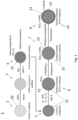
- Fig. 1 shows an exemplary diagram illustrating a method 1 for manufacturing a surface-coated lithium-silicon-carbon composite material 10 according to an embodiment of the invention.
- a porous carbon scaffold with micropores and mesopores is provided.
- the shown shape and size of the porous carbon scaffold 20 and of the lithium-silicon-carbon composite material 10 is intended for illustration purpose of the method 1.
- the final shape and size of the utilized materials may vary depending on the requirements.
- a Li compound is introduced into the micropores and mesopores of the provided porous carbon scaffold 20 via a solution based infiltration method. Then in a further method step 4, the solvent of the solution based infiltration method is removed in order to yield or form a microporous and mesoporous carbon scaffold with introduced Li compound 21.
- the porous carbon scaffold 20 is provided in a pre-lithiated form e.g. Li-AI alloys.
- At least one additional compound comprising Si, Fe, Al, Ni, W and/or Ti is introduced into the micropores and mesopores of the porous carbon scaffold by chemical vapor infiltration in order to form a lithium-alloy-carbon composite material 22.
- SiH 4 is utilized as the additional compound for performing the chemical vapor infiltration step.
- At least one surface coating layer 12 of the surface coating comprises silicon oxides, aluminum oxides or zirconium oxides.
- the lithium-alloy-carbon composite material 22 is treated with a metal alkoxide or metal amide or alkyl metal compound in order to form a processed compound layer (not shown).
- the surface area of the lithium-alloy-carbon composite material 22 is covered with trimethylaluminum TMA. During the exposure of the surface area to the trimethylaluminum it dissociatively chemisorbs on the surface area of the lithium-alloy-carbon composite material 22 and any remaining trimethylaluminum which is in gas-phase can be removed easily.
- the dissociative chemisorption of trimethylaluminum TMA results in a processed compound surface which is covered with AlCH 3 molecules.
- This processed compound surface is treated with moisture H 2 O or oxygen O 2 or ozone O 3 in order to form the at least one first layer of surface coating 12.
- This first surface coating layer 12 consists of of Al 2 O 3 molecules since the treatment leads to a chemical reaction of the CH 3 of the processed compound surface.
- Such coating may be provided with thermal atomic layer deposition which also requires a temperature increase, e.g. to 450°C.
- the first surface coating layer 12 can be treated with Li-N(SiMe 3 ) 2 in combination with heating in order to modify the first surface coating layer 12 to a modified first surface coating layer 13 such that it contains Li in form of LiAlO 2 in addition to the Al 2 O 3 molecules.
- Such molecules with lithium Li may increase the kinetics of Li ions through the modified first surface coating layer 13.
- a second surface coating layer 14 can be applied on top of the first surface coating layer 13 which was previously modified such that it contains LiAlO 2 and Al 2 O 3 molecules.
- the second surface coating layer 14 consists of carbon C.
- the first surface coating layer 13 and the second surface coating layer 14 are forming the surface coating 11 of the lithium-silicon-carbon composite material.
- the surface-coated lithium-silicon-carbon composite material 10 is formed which is formed as lithium-alloy-silicon-carbon composite material in the shown example.
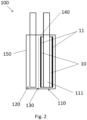
- Fig. 2 shows a sectional view of an exemplary electrochemical storage device 100 with an electrode anode 110 comprising a surface-coated lithium-silicon-carbon composite material 10 manufactured with a method illustrated in Fig. 1 .
- the electrochemical storage device 100 is formed as a lithium-ion-battery cell.
- the electrochemical storage device 100 comprises at least one anode electrode 110, at least one cathode electrode 120 and a separator 130 disposed between the cathode electrode 120 and the anode electrode 110.
- the cathode electrode preferably comprises a transition metal oxide.
- an electrolyte 140 comprising lithium ions is provided in a cell housing 150 of the electrochemical storage device 100.
- the electrochemical storage device 100 can be formed as a lithium-ion-battery cell in a pouch form.
- the cell housing 150 may be formed as a aluminum bag.
- the anode electrode 110, the cathode electrode 120 and the separator 130 are arranged in the cell housing 150, too.
- Fig. 2 shows a simplified sectional view.
- the anode electrode 110, the cathode electrode 120 and the separator 130 are usually formed as multiple layers which are winded or folded in order to optimize packaging and in order to increase the possible surface area of the electrolyte 140. In the shown example, only one layer of the components is visible for illustrational purpose.
- the anode electrode 110 is coated on both sides with a surface-coated lithium-alloy-lithium-silicon-carbon composite material 10.
- the surface coating 11 of the surface-coated lithium-silicon-carbon composite material 10 is performed on surface areas of the lithium-silicon-carbon composite material 10 which are not in contact with a current collector 111 of the anode electrode 110.
- anode electrode 110 By utilizing an anode electrode 110 with the surface-coated silicon-carbon material 10 the requirements on a dry room environment for manufacturing the electrochemical storage device 100 can be reduced. Especially during filling of the electrolyte 140 into the cell housing 150 the chemical interaction of the electrode anode with contaminants can be reduced or prevented due to the surface protection via the surface coating 11.
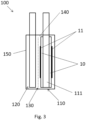
- a further exemplary electrochemical storage device 100 is shown.
- the electrochemical storage device 100 comprises an electrode anode 110 with a surface-coated lithium-silicon-carbon composite material 10.
- the surface coating 11 of the lithium-silicon-carbon composite material 10 is applied partially on the surface are of the lithium-silicon-carbon composite material 10 such that parts of the surface area of the lithium-silicon-carbon composite material 10 remain without the surface coating 11.
Landscapes
- Chemical & Material Sciences (AREA)
- Electrochemistry (AREA)
- General Chemical & Material Sciences (AREA)
- Chemical Kinetics & Catalysis (AREA)
- Engineering & Computer Science (AREA)
- Manufacturing & Machinery (AREA)
- Materials Engineering (AREA)
- Composite Materials (AREA)
- Inorganic Chemistry (AREA)
- Battery Electrode And Active Subsutance (AREA)
- Application Of Or Painting With Fluid Materials (AREA)
- Carbon And Carbon Compounds (AREA)
- Secondary Cells (AREA)
Priority Applications (8)
| Application Number | Priority Date | Filing Date | Title |
|---|---|---|---|
| EP22168409.5A EP4261935A1 (fr) | 2022-04-14 | 2022-04-14 | Materiau composite silicium-carbone prelithie, anode le comprenant et procede de fabrication d'un materiau composite |
| CA3255455A CA3255455A1 (fr) | 2022-04-14 | 2023-04-14 | Matériau composite silicium-carbone prélithié, anode le comprenant et procédé de fabrication d'un matériau composite |
| KR1020247037821A KR20250067084A (ko) | 2022-04-14 | 2023-04-14 | 사전리튬화된 실리콘-탄소 복합 재료, 이를 포함하는 애노드, 및 복합 재료의 제조 방법 |
| US18/856,666 US20250233141A1 (en) | 2022-04-14 | 2023-04-14 | Pre-lithiated silicon-carbon composite material, an anode comprising the same and a method to manufacture of a composite material |
| PCT/EP2023/059783 WO2023198886A1 (fr) | 2022-04-14 | 2023-04-14 | Matériau composite silicium-carbone prélithié, anode le comprenant et procédé de fabrication d'un matériau composite |
| JP2024560790A JP2025517599A (ja) | 2022-04-14 | 2023-04-14 | プレリチオ化ケイ素-炭素複合材料、それを含有する陽極、及び複合材料の製造方法 |
| EP23719739.7A EP4508692A1 (fr) | 2022-04-14 | 2023-04-14 | Matériau composite silicium-carbone prélithié, anode le comprenant et procédé de fabrication d'un matériau composite |
| CN202380042095.0A CN119318026A (zh) | 2022-04-14 | 2023-04-14 | 预锂化的硅碳复合材料、包含其的阳极及制造复合材料的方法 |
Applications Claiming Priority (1)
| Application Number | Priority Date | Filing Date | Title |
|---|---|---|---|
| EP22168409.5A EP4261935A1 (fr) | 2022-04-14 | 2022-04-14 | Materiau composite silicium-carbone prelithie, anode le comprenant et procede de fabrication d'un materiau composite |
Publications (1)
| Publication Number | Publication Date |
|---|---|
| EP4261935A1 true EP4261935A1 (fr) | 2023-10-18 |
Family
ID=81326279
Family Applications (2)
| Application Number | Title | Priority Date | Filing Date |
|---|---|---|---|
| EP22168409.5A Withdrawn EP4261935A1 (fr) | 2022-04-14 | 2022-04-14 | Materiau composite silicium-carbone prelithie, anode le comprenant et procede de fabrication d'un materiau composite |
| EP23719739.7A Pending EP4508692A1 (fr) | 2022-04-14 | 2023-04-14 | Matériau composite silicium-carbone prélithié, anode le comprenant et procédé de fabrication d'un matériau composite |
Family Applications After (1)
| Application Number | Title | Priority Date | Filing Date |
|---|---|---|---|
| EP23719739.7A Pending EP4508692A1 (fr) | 2022-04-14 | 2023-04-14 | Matériau composite silicium-carbone prélithié, anode le comprenant et procédé de fabrication d'un matériau composite |
Country Status (7)
| Country | Link |
|---|---|
| US (1) | US20250233141A1 (fr) |
| EP (2) | EP4261935A1 (fr) |
| JP (1) | JP2025517599A (fr) |
| KR (1) | KR20250067084A (fr) |
| CN (1) | CN119318026A (fr) |
| CA (1) | CA3255455A1 (fr) |
| WO (1) | WO2023198886A1 (fr) |
Citations (5)
| Publication number | Priority date | Publication date | Assignee | Title |
|---|---|---|---|---|
| US20170015559A1 (en) | 2014-03-14 | 2017-01-19 | Energ2 Technologies, Inc. | Novel methods for sol-gel polymerization in absence of solvent and creation of tunable carbon structure from same |
| US20170170477A1 (en) * | 2015-08-28 | 2017-06-15 | Energ2 Technologies, Inc. | Novel materials with extremely durable intercalation of lithium and manufacturing methods thereof |
| US20220059818A1 (en) * | 2020-08-18 | 2022-02-24 | Group14 Technologies, Inc. | Lithium-silicon battery |
| US20220055906A1 (en) * | 2020-08-18 | 2022-02-24 | Group14 Technologies, Inc. | Particulate composite materials |
| WO2022072715A1 (fr) * | 2020-09-30 | 2022-04-07 | Group14 Technologies, Inc. | Méthodes de passivation pour contrôler la teneur en oxygène et la réactivité de matériaux composites silicium-carbone |
-
2022
- 2022-04-14 EP EP22168409.5A patent/EP4261935A1/fr not_active Withdrawn
-
2023
- 2023-04-14 US US18/856,666 patent/US20250233141A1/en active Pending
- 2023-04-14 JP JP2024560790A patent/JP2025517599A/ja active Pending
- 2023-04-14 CN CN202380042095.0A patent/CN119318026A/zh active Pending
- 2023-04-14 EP EP23719739.7A patent/EP4508692A1/fr active Pending
- 2023-04-14 KR KR1020247037821A patent/KR20250067084A/ko active Pending
- 2023-04-14 WO PCT/EP2023/059783 patent/WO2023198886A1/fr not_active Ceased
- 2023-04-14 CA CA3255455A patent/CA3255455A1/fr active Pending
Patent Citations (5)
| Publication number | Priority date | Publication date | Assignee | Title |
|---|---|---|---|---|
| US20170015559A1 (en) | 2014-03-14 | 2017-01-19 | Energ2 Technologies, Inc. | Novel methods for sol-gel polymerization in absence of solvent and creation of tunable carbon structure from same |
| US20170170477A1 (en) * | 2015-08-28 | 2017-06-15 | Energ2 Technologies, Inc. | Novel materials with extremely durable intercalation of lithium and manufacturing methods thereof |
| US20220059818A1 (en) * | 2020-08-18 | 2022-02-24 | Group14 Technologies, Inc. | Lithium-silicon battery |
| US20220055906A1 (en) * | 2020-08-18 | 2022-02-24 | Group14 Technologies, Inc. | Particulate composite materials |
| WO2022072715A1 (fr) * | 2020-09-30 | 2022-04-07 | Group14 Technologies, Inc. | Méthodes de passivation pour contrôler la teneur en oxygène et la réactivité de matériaux composites silicium-carbone |
Also Published As
| Publication number | Publication date |
|---|---|
| JP2025517599A (ja) | 2025-06-10 |
| CA3255455A1 (fr) | 2023-10-19 |
| US20250233141A1 (en) | 2025-07-17 |
| WO2023198886A1 (fr) | 2023-10-19 |
| EP4508692A1 (fr) | 2025-02-19 |
| CN119318026A (zh) | 2025-01-14 |
| KR20250067084A (ko) | 2025-05-14 |
Similar Documents
| Publication | Publication Date | Title |
|---|---|---|
| EP3547411B1 (fr) | Électrode négative pour accumulateur au lithium, son procédé de fabrication, et accumulateur au lithium la comprenant | |
| KR101939959B1 (ko) | 고체 전지용 정극재 및 그 제조 방법 및 고체 전지용 정극재를 이용한 전고체 리튬 유황 전지 및 그 제조 방법 | |
| Lin et al. | Chemical doping of a core–shell silicon nanoparticles@ polyaniline nanocomposite for the performance enhancement of a lithium ion battery anode | |
| Ma et al. | Hybrid cathode architectures for lithium batteries based on TiS2 and sulfur | |
| US20250253314A1 (en) | Surface-coated silicon-carbon composite material, method for manufacturing a surface-coated silicon-carbon composite material, anode electrode and electrochemical storage device | |
| Xue et al. | A nickel cobaltate nanoparticle-decorated hierarchical porous N-doped carbon nanofiber film as a binder-free self-supported cathode for nonaqueous Li–O2 batteries | |
| JP4954865B2 (ja) | 改善された電気化学特性を有する負極活物質及びこれを含む電気化学素子 | |
| CN104956454B (zh) | 锂离子电容器及其制备方法 | |
| CN101405898B (zh) | 非水电解质二次电池 | |
| US9653718B2 (en) | Unification-typed electrode assembly and secondary battery using the same | |
| EP2677588B1 (fr) | Ensemble d'électrodes intégré et batterie rechargeable l'utilisant | |
| Kim et al. | Three-dimensional SWCNT and MWCNT hybrid networks for extremely high-loading and high rate cathode materials | |
| Yang et al. | Dual‐Interface‐Dominant Cathode Architectures Enabling Fast Sulfur Redox and Stable Interfaces in All‐Solid‐State Li‐S Batteries | |
| EP4261941A1 (fr) | Arrangement de matériaux en alliage de lithium-silicium pré-lithié, anode le comprenant et procédé de fabrication d'un arrangement de matériaux | |
| US20250233141A1 (en) | Pre-lithiated silicon-carbon composite material, an anode comprising the same and a method to manufacture of a composite material | |
| EP4261932A1 (fr) | Matériau composite silicium-carbone et anode le comprenant | |
| US12362386B2 (en) | Solid electrolyte, preparation method thereof, lithium air battery including the solid electrolyte, and electrochemical device including the solid electrolyte | |
| Su et al. | Improved electrochemical performance of LiNi 0. 5 Mn 0. 3 Co 0. 2 O2 electrodes coated by atomic-layer-deposited Ta2O5 |
Legal Events
| Date | Code | Title | Description |
|---|---|---|---|
| PUAI | Public reference made under article 153(3) epc to a published international application that has entered the european phase |
Free format text: ORIGINAL CODE: 0009012 |
|
| STAA | Information on the status of an ep patent application or granted ep patent |
Free format text: STATUS: THE APPLICATION HAS BEEN PUBLISHED |
|
| AK | Designated contracting states |
Kind code of ref document: A1 Designated state(s): AL AT BE BG CH CY CZ DE DK EE ES FI FR GB GR HR HU IE IS IT LI LT LU LV MC MK MT NL NO PL PT RO RS SE SI SK SM TR |
|
| STAA | Information on the status of an ep patent application or granted ep patent |
Free format text: STATUS: THE APPLICATION IS DEEMED TO BE WITHDRAWN |
|
| 18D | Application deemed to be withdrawn |
Effective date: 20240419 |