EP4261954A1 - Catalyseur et batterie métal-air - Google Patents
Catalyseur et batterie métal-air Download PDFInfo
- Publication number
- EP4261954A1 EP4261954A1 EP21823333.6A EP21823333A EP4261954A1 EP 4261954 A1 EP4261954 A1 EP 4261954A1 EP 21823333 A EP21823333 A EP 21823333A EP 4261954 A1 EP4261954 A1 EP 4261954A1
- Authority
- EP
- European Patent Office
- Prior art keywords
- catalyst
- metal
- electrode
- oxide
- respect
- Prior art date
- Legal status (The legal status is an assumption and is not a legal conclusion. Google has not performed a legal analysis and makes no representation as to the accuracy of the status listed.)
- Pending
Links
Images



Classifications
-
- H—ELECTRICITY
- H01—ELECTRIC ELEMENTS
- H01M—PROCESSES OR MEANS, e.g. BATTERIES, FOR THE DIRECT CONVERSION OF CHEMICAL ENERGY INTO ELECTRICAL ENERGY
- H01M4/00—Electrodes
- H01M4/86—Inert electrodes with catalytic activity, e.g. for fuel cells
- H01M4/90—Selection of catalytic material
- H01M4/9016—Oxides, hydroxides or oxygenated metallic salts
-
- B—PERFORMING OPERATIONS; TRANSPORTING
- B01—PHYSICAL OR CHEMICAL PROCESSES OR APPARATUS IN GENERAL
- B01J—CHEMICAL OR PHYSICAL PROCESSES, e.g. CATALYSIS OR COLLOID CHEMISTRY; THEIR RELEVANT APPARATUS
- B01J21/00—Catalysts comprising the elements, oxides, or hydroxides of magnesium, boron, aluminium, carbon, silicon, titanium, zirconium, or hafnium
- B01J21/18—Carbon
-
- B—PERFORMING OPERATIONS; TRANSPORTING
- B01—PHYSICAL OR CHEMICAL PROCESSES OR APPARATUS IN GENERAL
- B01J—CHEMICAL OR PHYSICAL PROCESSES, e.g. CATALYSIS OR COLLOID CHEMISTRY; THEIR RELEVANT APPARATUS
- B01J23/00—Catalysts comprising metals or metal oxides or hydroxides, not provided for in group B01J21/00
- B01J23/16—Catalysts comprising metals or metal oxides or hydroxides, not provided for in group B01J21/00 of arsenic, antimony, bismuth, vanadium, niobium, tantalum, polonium, chromium, molybdenum, tungsten, manganese, technetium or rhenium
- B01J23/32—Manganese, technetium or rhenium
- B01J23/34—Manganese
-
- B—PERFORMING OPERATIONS; TRANSPORTING
- B01—PHYSICAL OR CHEMICAL PROCESSES OR APPARATUS IN GENERAL
- B01J—CHEMICAL OR PHYSICAL PROCESSES, e.g. CATALYSIS OR COLLOID CHEMISTRY; THEIR RELEVANT APPARATUS
- B01J23/00—Catalysts comprising metals or metal oxides or hydroxides, not provided for in group B01J21/00
- B01J23/70—Catalysts comprising metals or metal oxides or hydroxides, not provided for in group B01J21/00 of the iron group metals or copper
- B01J23/74—Iron group metals
- B01J23/745—Iron
-
- B—PERFORMING OPERATIONS; TRANSPORTING
- B01—PHYSICAL OR CHEMICAL PROCESSES OR APPARATUS IN GENERAL
- B01J—CHEMICAL OR PHYSICAL PROCESSES, e.g. CATALYSIS OR COLLOID CHEMISTRY; THEIR RELEVANT APPARATUS
- B01J23/00—Catalysts comprising metals or metal oxides or hydroxides, not provided for in group B01J21/00
- B01J23/70—Catalysts comprising metals or metal oxides or hydroxides, not provided for in group B01J21/00 of the iron group metals or copper
- B01J23/76—Catalysts comprising metals or metal oxides or hydroxides, not provided for in group B01J21/00 of the iron group metals or copper combined with metals, oxides or hydroxides provided for in groups B01J23/02 - B01J23/36
- B01J23/84—Catalysts comprising metals or metal oxides or hydroxides, not provided for in group B01J21/00 of the iron group metals or copper combined with metals, oxides or hydroxides provided for in groups B01J23/02 - B01J23/36 with arsenic, antimony, bismuth, vanadium, niobium, tantalum, polonium, chromium, molybdenum, tungsten, manganese, technetium or rhenium
- B01J23/889—Manganese, technetium or rhenium
- B01J23/8892—Manganese
-
- B—PERFORMING OPERATIONS; TRANSPORTING
- B01—PHYSICAL OR CHEMICAL PROCESSES OR APPARATUS IN GENERAL
- B01J—CHEMICAL OR PHYSICAL PROCESSES, e.g. CATALYSIS OR COLLOID CHEMISTRY; THEIR RELEVANT APPARATUS
- B01J35/00—Catalysts, in general, characterised by their form or physical properties
- B01J35/40—Catalysts, in general, characterised by their form or physical properties characterised by dimensions, e.g. grain size
- B01J35/45—Nanoparticles
-
- B—PERFORMING OPERATIONS; TRANSPORTING
- B01—PHYSICAL OR CHEMICAL PROCESSES OR APPARATUS IN GENERAL
- B01J—CHEMICAL OR PHYSICAL PROCESSES, e.g. CATALYSIS OR COLLOID CHEMISTRY; THEIR RELEVANT APPARATUS
- B01J35/00—Catalysts, in general, characterised by their form or physical properties
- B01J35/60—Catalysts, in general, characterised by their form or physical properties characterised by their surface properties or porosity
- B01J35/61—Surface area
- B01J35/617—500-1000 m2/g
-
- H—ELECTRICITY
- H01—ELECTRIC ELEMENTS
- H01M—PROCESSES OR MEANS, e.g. BATTERIES, FOR THE DIRECT CONVERSION OF CHEMICAL ENERGY INTO ELECTRICAL ENERGY
- H01M12/00—Hybrid cells; Manufacture thereof
- H01M12/04—Hybrid cells; Manufacture thereof composed of a half-cell of the fuel-cell type and of a half-cell of the primary-cell type
- H01M12/06—Hybrid cells; Manufacture thereof composed of a half-cell of the fuel-cell type and of a half-cell of the primary-cell type with one metallic and one gaseous electrode
-
- H—ELECTRICITY
- H01—ELECTRIC ELEMENTS
- H01M—PROCESSES OR MEANS, e.g. BATTERIES, FOR THE DIRECT CONVERSION OF CHEMICAL ENERGY INTO ELECTRICAL ENERGY
- H01M12/00—Hybrid cells; Manufacture thereof
- H01M12/08—Hybrid cells; Manufacture thereof composed of a half-cell of a fuel-cell type and a half-cell of the secondary-cell type
-
- H—ELECTRICITY
- H01—ELECTRIC ELEMENTS
- H01M—PROCESSES OR MEANS, e.g. BATTERIES, FOR THE DIRECT CONVERSION OF CHEMICAL ENERGY INTO ELECTRICAL ENERGY
- H01M4/00—Electrodes
- H01M4/86—Inert electrodes with catalytic activity, e.g. for fuel cells
- H01M4/8605—Porous electrodes
- H01M4/8615—Bifunctional electrodes for rechargeable cells
-
- H—ELECTRICITY
- H01—ELECTRIC ELEMENTS
- H01M—PROCESSES OR MEANS, e.g. BATTERIES, FOR THE DIRECT CONVERSION OF CHEMICAL ENERGY INTO ELECTRICAL ENERGY
- H01M4/00—Electrodes
- H01M4/86—Inert electrodes with catalytic activity, e.g. for fuel cells
- H01M4/8647—Inert electrodes with catalytic activity, e.g. for fuel cells consisting of more than one material, e.g. consisting of composites
- H01M4/8652—Inert electrodes with catalytic activity, e.g. for fuel cells consisting of more than one material, e.g. consisting of composites as mixture
-
- H—ELECTRICITY
- H01—ELECTRIC ELEMENTS
- H01M—PROCESSES OR MEANS, e.g. BATTERIES, FOR THE DIRECT CONVERSION OF CHEMICAL ENERGY INTO ELECTRICAL ENERGY
- H01M4/00—Electrodes
- H01M4/86—Inert electrodes with catalytic activity, e.g. for fuel cells
- H01M4/8663—Selection of inactive substances as ingredients for catalytic active masses, e.g. binders, fillers
- H01M4/8673—Electrically conductive fillers
-
- H—ELECTRICITY
- H01—ELECTRIC ELEMENTS
- H01M—PROCESSES OR MEANS, e.g. BATTERIES, FOR THE DIRECT CONVERSION OF CHEMICAL ENERGY INTO ELECTRICAL ENERGY
- H01M4/00—Electrodes
- H01M4/86—Inert electrodes with catalytic activity, e.g. for fuel cells
- H01M4/90—Selection of catalytic material
- H01M4/9075—Catalytic material supported on carriers, e.g. powder carriers
- H01M4/9083—Catalytic material supported on carriers, e.g. powder carriers on carbon or graphite
-
- H—ELECTRICITY
- H01—ELECTRIC ELEMENTS
- H01M—PROCESSES OR MEANS, e.g. BATTERIES, FOR THE DIRECT CONVERSION OF CHEMICAL ENERGY INTO ELECTRICAL ENERGY
- H01M4/00—Electrodes
- H01M4/86—Inert electrodes with catalytic activity, e.g. for fuel cells
- H01M4/96—Carbon-based electrodes
-
- H—ELECTRICITY
- H01—ELECTRIC ELEMENTS
- H01M—PROCESSES OR MEANS, e.g. BATTERIES, FOR THE DIRECT CONVERSION OF CHEMICAL ENERGY INTO ELECTRICAL ENERGY
- H01M2300/00—Electrolytes
- H01M2300/0002—Aqueous electrolytes
- H01M2300/0014—Alkaline electrolytes
-
- H—ELECTRICITY
- H01—ELECTRIC ELEMENTS
- H01M—PROCESSES OR MEANS, e.g. BATTERIES, FOR THE DIRECT CONVERSION OF CHEMICAL ENERGY INTO ELECTRICAL ENERGY
- H01M2300/00—Electrolytes
- H01M2300/0085—Immobilising or gelification of electrolyte
Definitions
- the present invention relates to catalysts and metal-air batteries comprising the same. More specifically, the present invention relates to catalysts that comprise particles that comprise a metal oxide and a carbonaceous material for metal-air batteries.
- metal-air battery technologies is a very promising way to obtain energy storage devices with high energy density that can meet the new requirements for a greater autonomy in electric vehicles, in electronic devices and energy storage systems for renewable energy facilities.
- the object of the invention is to provide a catalyst for a metal-air battery and a metal-air battery, as defined in the claims.
- One aspect of the invention relates to a catalyst that comprises particles that comprise a metal oxide and a carbonaceous material, wherein the metal oxide is an iron oxide or manganese oxide, and the carbonaceous material is a graphenic carbon material.
- Another aspect of the invention relates to a metal-air battery that comprises a metal electrode, an air electrode and an electrolyte disposed between the metal electrode and the air electrode, the air electrode comprising the catalyst of the invention.
- the present invention has a great advantage in using catalysts based on abundant materials, low-cost and environmentally friendly metals such as iron and manganese, as well as being able to be synthesized by an industrially scalable method.
- the present invention has demonstrated the use of such catalysts being active and stable in ORR during discharge and OER during charge.
- the catalyst 14 of the invention comprises particles that comprise a metal oxide and a carbonaceous material wherein the metal oxide is an iron oxide or a manganese oxide and the carbonaceous material is a graphenic carbon material.
- the graphenic carbon material includes the graphene and related graphene-based materials described in " All in the graphene family - A recommended nomenclature for two-dimensional carbon materials", CARBON 65 (2013) 1-6 .
- the metal oxide is selected from the group consisting of oxide, oxyhydroxide and hydroxide of iron or manganese or a mixture thereof, preferably being selected from the group consisting of Mn 3 O 4 , MnO 2 , MnO(OH), Fe 3 O 4 , FeO, FeO(OH) and Fe 2 O 3 or a mixture thereof.
- the graphenic carbon material is selected from the group consisting of graphene, graphene oxide, multilayer graphene and nanoplatelets of graphene.
- the carbonaceous material comprises nanographite.
- the graphenic carbon material has a surface area between 25 and 1500 m 2 /g, preferably between 25 and 750 m 2 /g, and more preferably between 400 and 500 m 2 /g.
- the size of the particle is between 10 and 300 nm, preferably between 5 and 80 nm.
- the particle size is designated as the maximum diameter of the particle.
- the weight proportion of the carbonaceous material with respect to the total weight of the catalyst 14 is between 20% and 80%, preferably being about 50%.
- the weight proportion of the metal oxide with respect to the total weight of the catalyst 14 is between 20% and 80%, preferably being about 50%.
- the sum of the weight proportion of each component that comprises the catalyst 14 must be 100%.
- the particle comprises a mixture of metal oxides of Mn and Fe.
- the weight ratio of Mn with respect to Fe is between 95:5 and 5:95.
- the weight proportion of the carbonaceous material with respect to the total weight of the catalyst 14 is 50% and the weight ratio of Mn with respect to Fe is 50:50.
- the weight proportion of the carbonaceous material with respect to the total weight of the catalyst 14 is 50%, the weight proportion of the metal oxide with respect to the total weight of the catalyst 14 is 50% and the weight ratio of Mn with respect to Fe is 50:50.
- the particles consist of a metal oxide and a carbonaceous material.
- the features described for the metal oxide, carbonaceous material, and the particle above are considered described also for the respective embodiments depending on this embodiment.
- the catalyst 14 is a bifunctional catalyst.
- the catalyst 14 of the invention is suitable for batteries used in stationary energy storage, self-consumption, off grid installations, Uninterruptible Power Supply (UPS) applications, electric fencing, road signs, navigation aid instruments, Internet of Things (IoT) and Telecommunications and parking meters.
- UPS Uninterruptible Power Supply
- Another aspect of the invention relates to a metal-air battery 10 that comprises a metal electrode or anode 11, an air electrode 13 and an electrolyte 12 disposed between the metal electrode 11 and the air electrode 13, the air electrode 13 of the metal-air battery 10 comprising the catalyst 14 of the invention, as shown in Figure 1 .
- the metal electrode 11 is selected from the group consisting of Fe, Zn, Al, Mg, Li and Na, being preferably Zn.
- the electrolyte 12 is an aqueous solution or a gelified electrolyte with a pH greater than 7, preferably between 12 and 14, or a membrane electrolyte that is able to transport hydroxyl groups, as for example the commercially available A201 membrane from Tokuyama which consists of hydrocarbon backbone comprising quaternary ammonium moieties, or membranes based on functionalized polymer backbones as polyvynil alcohol, polysulfones or polytetrafluoroethylene.
- A201 membrane from Tokuyama which consists of hydrocarbon backbone comprising quaternary ammonium moieties, or membranes based on functionalized polymer backbones as polyvynil alcohol, polysulfones or polytetrafluoroethylene.
- the catalyst 14 amount in the air electrode 13 is between 1 to 50 mg/cm 2 , preferably between 7 to 12 mg/cm 2 .
- Example 1 Electroreduction of oxygen with MnOx / Graphene catalyst in alkaline medium.
- the catalyst of this example is codified as GNM-1.
- the electrochemical tests were conducted using an Autolab Pgstat 302 N potentiostat/galvanostat. and a standard three-compartment glass cell with a rotating disk electrode (RDE) as working electrode, a graphite bar and Ag/AgCI as counter and reference electrodes.
- the catalyst was deposited on a glassy carbon (GC) electrode by means of an ink.
- a mass of 6 mg of the catalyst, 780 ⁇ l Millipore MilliQ ® water, 200 ⁇ l of isopropyl alcohol and 20 ⁇ l of 5 wt.% Nafion were mixed and ultrasonically dispersed to make the ink.
- a volume of 20 ⁇ l of the catalyst ink was deposited onto de GC electrode surface (0.196 cm 2 ) giving a catalyst loading of 0.6 mg / cm 2 .
- the activity of the catalyst was evaluated by simulating the charge of the battery (oxygen evolution reaction, OER) and simulating the discharge of the battery (oxygen reduction reaction, ORR).
- OER oxygen evolution reaction
- ORR oxygen reduction reaction
- the ORR and OER were performed in O 2 saturated 0.1 M KOH at 10 mVs -1 and 1600 rpm by means of a rotating disk electrode.
- the most relevant parameters obtained from the polarization curves obtained are the mean wave potential (E1/2) for the ORR that was 0.76 V and the operating voltage at a current density of 10 mA /cm 2 for the OER that was 1.9 V.
- Example 2 Bifunctional catalyst based on a MnOx-FeOx / Graphene nanocomposite for its application on the air electrode of a rechargeable metal-air battery.
- the catalyst of this example is codified as GNM-4.
- the electrochemical tests were conducted using an Autolab Pgstat 302 N potentiostat/galvanostat and a standard three-compartment glass cell with a rotating disk electrode (RDE) (Pine Research Instruments) as working electrode, a graphite bar and Ag/AgCI as counter and reference electrodes similarly to example 1.
- the catalyst was deposited on a glassy carbon (GC) electrode by means of an ink in the same way that was described in the example 1.
- the activity of the electrocatalyst was evaluated simulating the charge of the battery (OER) and the discharge of the battery (ORR) in O 2 saturated 0.1 M KOH at 10 mVs -1 and 1600 rpm by means of a rotating disk electrode.
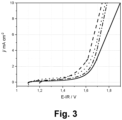
- the dot line in Figure 2 and 3 show the polarization curves for the evaluation of GNM-4 performance in the ORR and OER.
- the most relevant parameters obtained from the polarization curves obtained in the curves are the mean wave potential (E 1/2 ) for the ORR that was 0,75 V and the operating voltage at a current density of 10 mA/cm 2 for the OER that was 1,77 V.
- the battery cycling was simulated by means of an accelerated chronopotentiometry test at different fixed charge and discharge currents.
- the catalyst was deposited on a glassy carbon (GC) electrode by means of an ink in the same way that was described in the example 1. Specifically, two accelerated tests have been carried out applying a discharge current of 0.5 A/g and a charge current of 0.25 A/g and 0.5 A/g during successive cycles of 10 minutes of duration.
- GC glassy carbon
- Figure 4 illustrates the results of the accelerated stability test by chronopotentiometry of GNM-4 bifunctional catalyst, in charge (dash dot line) and discharge (solid line) regimes of 25 A/g and 05 A/g, during 100 successive cycles of 10 minutes duration.
- the electrochemical tests were conducted using a standard three-compartment glass cell with a RDE as working electrode, a graphite bar and Ag/AgCI as counter and reference electrodes.
- the catalyst was deposited on a glassy carbon (GC) electrode by means of an ink in the same way that was described in the example 1.
- the activity of the electrocatalyst was evaluated simulating the charge of the battery (OER) and the discharge of the battery (ORR) in O 2 saturated 0.1 M KOH at 10 mVs -1 .
- Figure 2 illustrates the ORR polarization curve in terms of Faradaic current density by geometric surface area of the electrode (mA/cm 2 ) with respect to operating voltage of different catalysts according to one embodiment of the invention
- GNM1 solid line
- GNM2 dashed line
- GNM4 dot line
- GNM7 dot line
- Figure 3 illustrates the OER polarization curve in terms of Faradaic current density by geometric surface area of the electrode (mA/cm 2 ) of the catalysts in Figure 2 .
Landscapes
- Chemical & Material Sciences (AREA)
- Chemical Kinetics & Catalysis (AREA)
- Engineering & Computer Science (AREA)
- Electrochemistry (AREA)
- General Chemical & Material Sciences (AREA)
- Materials Engineering (AREA)
- Organic Chemistry (AREA)
- Manufacturing & Machinery (AREA)
- Composite Materials (AREA)
- Hybrid Cells (AREA)
- Inert Electrodes (AREA)
Applications Claiming Priority (2)
| Application Number | Priority Date | Filing Date | Title |
|---|---|---|---|
| EP20383075.7A EP4012809A1 (fr) | 2020-12-09 | 2020-12-09 | Catalyseur et batterie métal-air |
| PCT/ES2021/070875 WO2022123098A1 (fr) | 2020-12-09 | 2021-12-03 | Catalyseur et batterie métal-air |
Publications (1)
| Publication Number | Publication Date |
|---|---|
| EP4261954A1 true EP4261954A1 (fr) | 2023-10-18 |
Family
ID=73834427
Family Applications (2)
| Application Number | Title | Priority Date | Filing Date |
|---|---|---|---|
| EP20383075.7A Withdrawn EP4012809A1 (fr) | 2020-12-09 | 2020-12-09 | Catalyseur et batterie métal-air |
| EP21823333.6A Pending EP4261954A1 (fr) | 2020-12-09 | 2021-12-03 | Catalyseur et batterie métal-air |
Family Applications Before (1)
| Application Number | Title | Priority Date | Filing Date |
|---|---|---|---|
| EP20383075.7A Withdrawn EP4012809A1 (fr) | 2020-12-09 | 2020-12-09 | Catalyseur et batterie métal-air |
Country Status (3)
| Country | Link |
|---|---|
| US (1) | US20240039006A1 (fr) |
| EP (2) | EP4012809A1 (fr) |
| WO (1) | WO2022123098A1 (fr) |
Family Cites Families (17)
| Publication number | Priority date | Publication date | Assignee | Title |
|---|---|---|---|---|
| CN101326675B (zh) * | 2005-12-06 | 2012-06-06 | 雷沃尔特科技有限公司 | 双功能空气电极 |
| KR101257852B1 (ko) * | 2010-11-05 | 2013-04-24 | 삼성전자주식회사 | 리튬 공기 전지용 양극, 그 제조방법 및 이를 채용한 리튬 공기 전지 |
| US20140255803A1 (en) * | 2011-10-14 | 2014-09-11 | Wayne State University | Graphene supported bifunctional catalysts |
| EP2687483A1 (fr) * | 2012-07-16 | 2014-01-22 | Basf Se | Graphène contenant de l'azote et éventuellement du fer et/ou du cobalt |
| KR101521417B1 (ko) * | 2013-08-12 | 2015-05-21 | 한국과학기술원 | 금속산화물 반도체 나노 구조체와 그래핀의 복합체를 이용한 가스 센서용 부재,가스 센서 및 그 제조 방법 |
| SG10201405422UA (en) * | 2013-09-02 | 2015-04-29 | Agency Science Tech & Res | Bifunctional Catalysts for Oxygen Reduction and Evolution Reactions and Rechargeable Metal Air Batteries Using the Same |
| CN103682381B (zh) * | 2013-12-16 | 2016-02-10 | 清华大学 | 电催化剂及其制备方法 |
| CN107004866B (zh) * | 2014-12-26 | 2019-12-03 | 日本制铁株式会社 | 金属空气电池用电极 |
| WO2017123289A2 (fr) * | 2015-10-06 | 2017-07-20 | Board Of Regents, The University Of Texas System | Piles à combustible liquide direct sans membrane |
| CN105562030B (zh) * | 2016-01-06 | 2017-11-10 | 齐鲁工业大学 | 耐硫酸盐化的三氧化铝硫磺回收催化剂及其制备方法 |
| CN105789644B (zh) * | 2016-03-02 | 2018-08-21 | 中南大学 | 一种Fe-N/C氧还原反应复合电催化剂的制备方法 |
| CN106558706A (zh) * | 2016-11-25 | 2017-04-05 | 东华大学 | 碳载FeO/MnO2尖晶石双功能催化剂及其制备方法和应用 |
| CN106477566B (zh) * | 2016-12-28 | 2019-01-29 | 山东理工大学 | 一种高氮含量的三维氮掺杂石墨烯的制备方法 |
| EP3553866A1 (fr) * | 2018-04-13 | 2019-10-16 | Technische Universität Berlin | Matériau catalyseur pour une pile à combustible ainsi que son procédé de fabrication |
| ES2678419B2 (es) * | 2018-04-25 | 2018-11-29 | Gnanomat Sl | Método de obtención de nanomateriales compuestos de material carbonáceo y óxidos metálicos |
| CN111725528A (zh) * | 2020-06-03 | 2020-09-29 | 上海交通大学 | 二氧化锰复合多孔石墨烯阴极催化剂及其制备方法与应用 |
| US11888167B2 (en) * | 2020-08-03 | 2024-01-30 | Nanyang Technological University | Catalyst for rechargeable energy storage devices and method for making the same |
-
2020
- 2020-12-09 EP EP20383075.7A patent/EP4012809A1/fr not_active Withdrawn
-
2021
- 2021-12-03 EP EP21823333.6A patent/EP4261954A1/fr active Pending
- 2021-12-03 WO PCT/ES2021/070875 patent/WO2022123098A1/fr not_active Ceased
- 2021-12-03 US US18/256,731 patent/US20240039006A1/en active Pending
Also Published As
| Publication number | Publication date |
|---|---|
| US20240039006A1 (en) | 2024-02-01 |
| EP4012809A1 (fr) | 2022-06-15 |
| WO2022123098A1 (fr) | 2022-06-16 |
Similar Documents
| Publication | Publication Date | Title |
|---|---|---|
| Fang et al. | Prussian blue analog-derived 2D ultrathin CoFe 2 O 4 nanosheets as high-activity electrocatalysts for the oxygen evolution reaction in alkaline and neutral media | |
| Ma et al. | A bifunctional electrocatalyst α-MnO 2-LaNiO 3/carbon nanotube composite for rechargeable zinc–air batteries | |
| JP6350092B2 (ja) | 微生物燃料電池用炭素触媒及びその製造方法、触媒インキ並びに微生物燃料電池 | |
| Zhang et al. | La2O3 doped carbonaceous microspheres: a novel bifunctional electrocatalyst for oxygen reduction and evolution reactions with ultrahigh mass activity | |
| US20040121228A1 (en) | Active electrode composition with conductive polymeric binder | |
| Li et al. | Electrochemical Performance of MnO2‐based Air Cathodes for Zinc‐air Batteries | |
| Wittmaier et al. | Bifunctional, carbon-free nickel/cobalt-oxide cathodes for lithium-air batteries with an aqueous alkaline electrolyte | |
| Hameed | Microwave irradiated Ni–MnOx/C as an electrocatalyst for methanol oxidation in KOH solution for fuel cell application | |
| Milikić et al. | A Pt/MnV2O6 nanocomposite for the borohydride oxidation reaction | |
| CN112366324A (zh) | 一种多层功能结构和耐久稳定的电可充空气电极及其制造方法 | |
| WO2013051503A1 (fr) | Solution électrolytique destinée à une pile alcaline et pile alcaline | |
| Zhang et al. | One-pot synthesis of MnFe2O4/C by microwave sintering as an efficient bifunctional electrocatalyst for oxygen reduction and oxygen evolution reactions | |
| Chen et al. | Ethanol oxidation on Pd/C promoted with CaSiO3 in alkaline medium | |
| Guo et al. | Ultrafine IrO2 nanoparticle-decorated carbon as an electrocatalyst for rechargeable Li–O2 batteries with enhanced charge performance and cyclability | |
| Ebrahimi et al. | Design of NiS@ MnS/MWCNT heterostructure and its application for electrocatalytic oxidation of methanol with synergistically enhancing catalytic performance | |
| KR102398943B1 (ko) | 란타나이드 및 악티나이드 전기화학 | |
| CN113355690B (zh) | 一种利用废旧锂离子电池正极材料大规模制备高效电解水催化剂的方法 | |
| EP4261954A1 (fr) | Catalyseur et batterie métal-air | |
| Choudhary et al. | MnO2 Nanowires as an Electrode Material for Gel Polymer Electrolyte‐Based Zn‐Air Battery | |
| Du et al. | Self‐Assembly of Surface‐Functionalized Ag1. 8Mn8O16 Nanorods with Reduced Graphene Oxide Nanosheets as an Efficient Bifunctional Electrocatalyst for Rechargeable Zinc‐Air Batteries | |
| KR101649338B1 (ko) | 이산화루테늄/이산화망간/탄소 복합체를 이용한 공기전극 및 이의 제조방법. | |
| Pei et al. | Preparation and performance of highly efficient Au nanoparticles electrocatalyst for the direct borohydride fuel cell | |
| Luis-Sunga et al. | Graphene-based materials as highly promising catalysts for energy storage and conversion applications | |
| Li et al. | Improved electrocatalytic activity and durability of NiMn2O4-CNTs as reversible oxygen reaction electrocatalysts in zinc-air batteries | |
| Patra et al. | Graphene-based nanocomposites as electrode materials for Zn-air batteries |
Legal Events
| Date | Code | Title | Description |
|---|---|---|---|
| STAA | Information on the status of an ep patent application or granted ep patent |
Free format text: STATUS: UNKNOWN |
|
| STAA | Information on the status of an ep patent application or granted ep patent |
Free format text: STATUS: THE INTERNATIONAL PUBLICATION HAS BEEN MADE |
|
| PUAI | Public reference made under article 153(3) epc to a published international application that has entered the european phase |
Free format text: ORIGINAL CODE: 0009012 |
|
| STAA | Information on the status of an ep patent application or granted ep patent |
Free format text: STATUS: REQUEST FOR EXAMINATION WAS MADE |
|
| 17P | Request for examination filed |
Effective date: 20230710 |
|
| AK | Designated contracting states |
Kind code of ref document: A1 Designated state(s): AL AT BE BG CH CY CZ DE DK EE ES FI FR GB GR HR HU IE IS IT LI LT LU LV MC MK MT NL NO PL PT RO RS SE SI SK SM TR |
|
| DAV | Request for validation of the european patent (deleted) | ||
| DAX | Request for extension of the european patent (deleted) |